Hitachi Unified Storage VM from
Hitachi Data Systems
ViON Corporation
Hitachi’s Strategic PartnerTable of Contents
Executive Summary ... 3
Entry-level Enterprise Solution………...3
Unified Platform ... …3
Storage Virtualization... 3
Unified Management... 3
Introduction ... 4
About Hitachi, Ltd., and Hitachi Data Systems ... .4
Solution Overview ... 6 Features ... 6 Benefits ... 6 Product Description ... 7 Storage System ... 7 Technology ... 7 Storage Virtualization... 7 High Availability ... 8 Component Description ... 9
Hitachi Unified Storage VM Block Module ... 9
Hitachi Unified Storage VM File Module ... 12
Specification Summary: Hardware ... 14
Specification Summary: Software ... 15
Storage Management Software ... 16
Hitachi Base Operating System ... 16
Hitachi Base Operating System F ... 18
Additional File Software Offerings ... 18
Hitachi Command Suite Analytics ... 19
Hitachi Command Suite Mobility ... 20
Hitachi Local Replication ... 22
Hitachi Remote Replication ... 22
Additional Software Offerings ... 23
Services and Support ... 24
Total Cost of Ownership (TCO) Benefits ... 26
Appendix A: Certifications ... 27
Executive Summary
Entry-level Enterprise Solution
The solution proposed is an entry-level enterprise storage platform combining storage virtualization services with unified block, file and object data management. A versatile, scalable platform, Hitachi Unified Storage VM offers a new storage virtualization system for providing central storage services to existing storage assets. Unified management delivers end-to-end central storage management of all virtualized internal and external storage. A unique, hardware-accelerated, object-based file system supports intelligent file tiering and migration, as well as virtual NAS functionality, without compromising performance or scalability.
Unified Platform
This unified storage platform for all data can centrally consolidate file, block and object data (with Hitachi Content Platform). All file, block and object data can be provisioned within virtualized
environments, and provides application-aware data protection for both virtualized and nonvirtualized server applications. File and block data co-exist and share underlying storage capacity available as a common storage pool. The added support for an object-based file system enables fast searches, intelligent file tiering, data migration and fast replication.
Storage Virtualization
Intelligent, controller-based storage virtualization provides a platform for aggregating all file, object and block storage services, as well as all heterogeneous storage hardware. This is the only approach to storage virtualization that gives lower-level and legacy storage systems access to enterprise-class performance, functionality and services. Hitachi Universal Volume Manager administers connectivity between the Hitachi controller and external storage devices. Virtualization enables the consolidation and aggregation of all multivendor storage resources in a single pool of enterprise storage capacity.
Unified Management
Hitachi Command Suite provides a software management platform for advanced data and storage management that improves administration, operations, provisioning, performance and resilience for Hitachi storage environments. By enabling efficient management practices for virtualized storage and servers, organizations can effectively manage their IT infrastructure with limited staff resources while building a sustainable foundation for future growth. With new levels of usability, workflow, scalability and integration, Hitachi Command Suite provides breakthrough efficiencies that help IT organizations to fully leverage leading Hitachi storage virtualization.
Introduction
About Hitachi, Ltd., and Hitachi Data Systems
Hitachi, Ltd. (NYSE: HIT / TSE: 6501), with 360,000 employees and FY2010 revenues of more than US$112 billion, is one of the world’s largest global electronics companies.
Hitachi Data Systems is a wholly owned subsidiary of Hitachi, Ltd., with more than 5, 800
employees. They conduct business through direct and indirect channels in the public, government and private sectors in more than 100 countries and regions. Hitachi technologies are trusted by the world’s leading enterprises, including more than 70% of the Fortune 100 and more than 80% of the Fortune Global 100.
Hitachi Data Systems believes that data drives our world — and information is the new currency. With a vision that IT must be virtualized, automated, cloud-ready and sustainable, Hitachi offers solutions that improve IT costs and agility. Hitachi Data Systems technology helps organizations transform raw data into valuable information by making data more accessible and easier to manage. As the leader in storage virtualization, only Hitachi Data Systems offers a single, virtualized platform for all data and information.
Hitachi Data Systems best-in-class information technologies, services and solutions deliver: Compelling customer return on investment (ROI).
Unmatched return on assets (ROA). Demonstrable business impact
About ViON Corporation
ViON Corporation (ViON) is a small, veteran-owned corporation, established in 1980, and
headquartered in Herndon, Virginia. We specialize in designing, delivering and maintaining storage and server solutions to Enterprise-wide data centers throughout the federal government and public sector and commercial marketplaces.
We excel in solutions addressing Enterprise Storage, Disaster Recovery, Server Consolidation, Business Continuance and File Services in the Windows, UNIX and z/OS environments. ViON leads as the most certified vendor of storage, services and critical IT solutions. Our customers choose us because we provide a cost-effective storage environment capable of delivering the right data to the right people–no matter what/no excuses.
ViON offers Assured Computing as one of our unique solutions for disaster recovery problems facing Agencies today. Assured Computing is comprised of ViON plus our partnerships with the market leaders in storage and storage management. It is the combination of teamwork, business sensitivity and technical leadership that enables us to provide value added solutions for our customers.
ViON’s consistent, successful track record is a direct reflection of our people, our products and our skill–as evidenced by our growing customer base and their continued reliance on ViON as the architect and builder of their storage environment.
Solution Overview
Hitachi Unified Storage (HUS) VM is an entry-level enterprise storage platform combining storage virtualization services with unified block, file and object data management. This versatile, scalable platform offers a new storage virtualization system to provide central storage services to existing storage assets. Unified management delivers end-to-end central storage management of all virtualized internal and external storage. A unique, hardware-accelerated, object-based file system supports intelligent file tiering and migration, as well as virtual NAS functionality, without
compromising performance or scalability.
Using this system, you can deploy virtual server applications within a new storage virtualization framework. You can extend new services to your current storage investments, and more closely align IT with business objectives by enhancing capacity efficiency. HUS VM storage systems provide the foundation for matching application service requirements to different classes of storage and for delivering critical services.
Features
Hitachi Command Suite: Unified management scales up for the largest infrastructure and application deployments. Single management framework has the breadth to manage storage, servers and the IT infrastructure. Deep integration ensures the highest level of operational efficiency
Data mobility: Host-transparent movement, copy and migration of data between storage, including 3rd-party storage, without interrupting the application.
Hitachi Dynamic Tiering: Automated data placement supports higher performance and lower cost, managing internal and external data, including multivendor storage. Dynamic Tiering places the right data in the right place, at the right time, with no performance degradation.
Server virtualization: Deeply integrates with leading virtual server platforms, delivers end-to-end visibility from individual virtual machines to storage logical unity, and protects large-scale multivendor environments.
Eco-friendly: Platform allows better capacity per square foot and lower power consumption compared to the previous generation. It enables more efficient utilization with the use of Hitachi Dynamic Provisioning.
Data resilience: Universal data replication can be provided across multiple data centers.
Benefits
Enables the move to a new storage platform with less effort and cost compared to the industry average.
Increases performance and lowers operating cost with automated data placement.
Supports scalable management for growing and complex storage environment using fewer resources.
Achieves better power efficiency and stores more capacity for more sustainable data centers. Lowers operational risk and data loss exposure with data resilience solutions.
Product Description
Storage System
Technology
Hitachi storage virtualization technology has been in continuous development since 1995, when Hitachi Data Systems debuted Hitachi Freedom 7700. This system consolidated storage for mainframe, UNIX and Microsoft Windows servers on a single platform. Hosting multiple operating platforms was achieved by separating control information and application data in the storage controller. Three years later, the controller technology was refined to enable the dynamic movement of LUNs between RAID groups. This functionality is still unique to Hitachi Data Systems almost 15 years after it was introduced. Hitachi Virtual Storage Platform, introduced in 2010, is
powered by the 5th-generation Hi-Star™ crossbar switch architecture. HUS VM is also built on this 5th-generation switch, which is contained in its new integrated
architecture. This latest architecture provides entry-level enterprise storage and offers higher performance, scalability, reliability and flexibility than many competitive
offerings available today. Figure 1: Hitachi Unified Storage VM
Storage Virtualization
Intelligent, controller-based storage virtualization provides a platform for aggregating all file, object and block storage services and all heterogeneous storage hardware. This is the only approach to storage virtualization that gives lower level and legacy storage systems access to enterprise-class performance, functionality and services (see Figure 2). Hitachi Universal Volume Manager
administers connectivity between HUS VM and external storage devices. Virtualization enables the consolidation and aggregation of all multivendor storage resources in a single pool of enterprise storage capacity.
High Availability
In addition to offering highly scalable, high-performing entry-level enterprise storage, HUS VM places emphasis on high availability to satisfy the needs of the most demanding enterprise applications. Hitachi Data Systems offers a combination of unique industry solutions and best-in-class 3rd-party software integration to deliver unbeatable resilience and availability.
• Heterogeneous asynchronous remote replication over any distance. • Nondisruptive microcode and hardware upgrades.
• Automatic failover architecture with redundant, hot-swappable components. • Dual data paths and dual control paths connecting every component. • Active-active, dual-ported disk drives.
• Nonvolatile backup of cache using a combination of battery and flash disk drives.
• Hi-Track® Remote Monitoring system, which immediately sends notification of any incident
Component Description
Hitachi Unified Storage VM Block Module
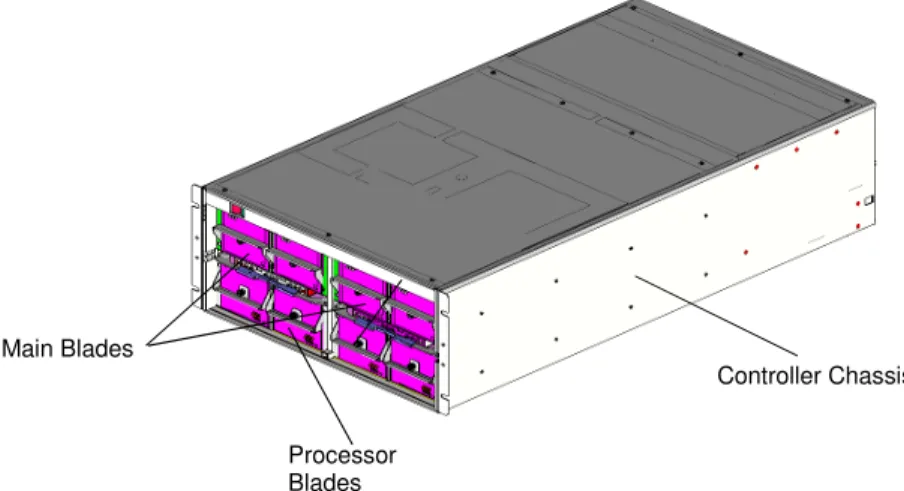
Hitachi Unified Storage VM is based on a new block storage system powered by its storage virtualization controller (see Figures 3 and 4). This virtual storage system is a single-controller chassis, available with no drives, and containing the control logic, processors, memory and
interfaces to drive chassis and host servers. Its dual-node, shared-resource architecture creates a redundant configuration in which the storage system can continue operation should a component failure occur. Main components can be added, removed and replaced without shutting down a device while the storage system is in operation. The microcode can also be upgraded without shutting down the storage system. A service processor is mounted in the controller chassis, which monitors the running condition of the storage system. Connecting the service processor with a Hitachi service center enables remote maintenance.
Figure 3. Front View of Controller Chassis
Figure 4. Rear View of Controller Chassis Processor Blades Main Blades Controller Chassis Controller Chassis Power Supplies Host I/O Modules Host I/O Modules Back-end I/O Modules Back-end I/O Modules Service Processor
The block controller module includes the main processor blades, service processor and power supply with a built-in cooling fan. Two or more host I/O modules must be installed 2 pieces at a time. Up to 8 can be installed for configurations with disk drives. If drives are used, back-end I/O modules must be installed as well. For a diskless configuration, back-end I/O modules are not required. The host I/O modules can be installed in 4 empty slots for back-end I/O modules.
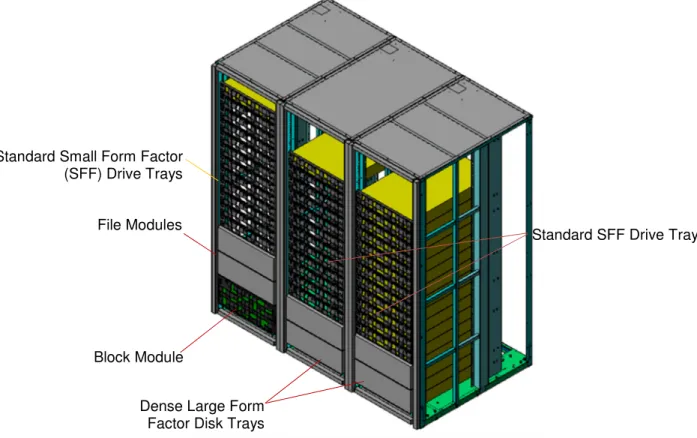
The system can be configured starting with a single diskless system up to a large, 3-rack system that includes up to 1,152 hard disk drives (HDD) (see Figure 5). The configuration may include up to 128 solid-state disk (SSD) drives and a total of 256GB cache. The system provides a highly granular upgrade path. It allows the addition of file modules or disk drives to the drive chassis in an existing system as storage needs increase, all mounted in standard 19-inch racks. A basic HUS VM storage system consists of a controller chassis and 0, 1 or more drive trays that contain the HDD or SSD drives. HUS VM supports multiple concurrent operating systems to create a heterogeneous system environment.
Figure 5. Hitachi Unified Storage VM Basic Configuration
Hitachi Unified Storage VM is available with a choice of disk drives, ranging from high-performance solid state and SAS drives. Both large form factor (LFF) 3.5 in. drives and small form factor (SFF) drives are supported (see Figure 6). All drive types use a 6Gb/sec interface to the back-end I/O modules..
Block Module File Modules Standard Small Form Factor
(SFF) Drive Trays
Standard SFF Drive Trays
Dense Large Form Factor Disk Trays
Figure 6. Standard SFF Drive Tray
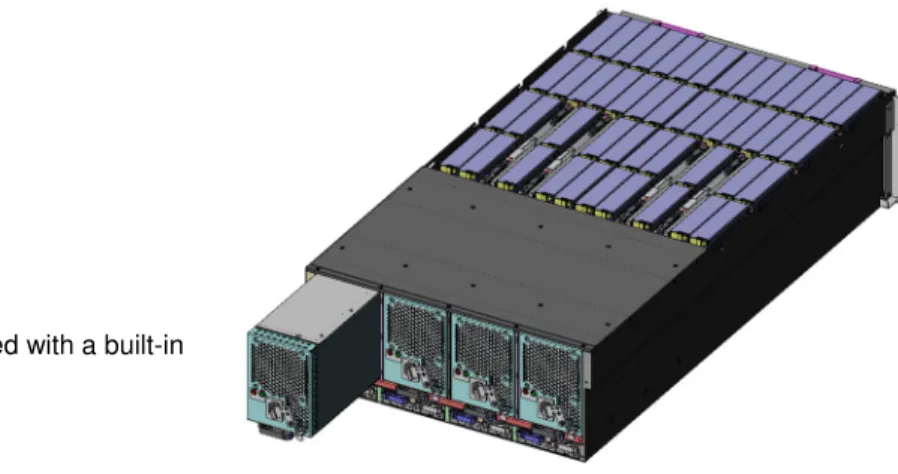
The standard drive tray is a chassis to install up to 24 2.5’ (SFF) disk drives and 2.5” flash drives. It includes 2 enclosure communications boards and 2 power supplies with a built-in cooling fan (see Figure 7).
Figure 7. Front View Dense Disk Drive Tray
The dense disk drive tray is configured with up to 48 3.5” (LFF) drives. The ENCs and power
supplies are individual for each half of the unit, and are installed duplex configuration (see Figure 8). SFF HDD
24 SFF HDDs can be installed. Power supply is provided with a built-in cooling fan. Enclosure Communications Board Enclosure Communications Board LFF HDD
Figure 8. Rear View Dense Disk Drive Tray
Hitachi Unified Storage VM file module features hybrid core architecture. This architecture employs the best properties of FPGA-based design to optimize data movement and supports
high-performance, multicore processors for efficient data management functions. Both classes of activity work at full speed without an impact on each other. They can handle a number of simultaneous workloads, such as serving email to thousands of users and hosting large-scale online transaction processing (OLTP) applications, while maintaining high performance. They also provide high IOPS performance and utilize built-in 10 gigabit Ethernet (GbE) and 1GbE for high-throughput NAS and iSCSI networking connectivity. Up to 4 nodes in a single cluster meet demands for scalable storage with greater access, capacity and performance. Storage can be added at any time to meet new application or business needs, or consolidate disparate storage, all with a single point of
management, and no downtime. These systems offer a total usable capacity of from 4PB to 8PB under a single namespace, all of which is easily managed from a central system management.
Hitachi Unified Storage VM File Module
Hitachi Unified Storage VM file modules are designed to meet the high-performance and scalability requirements of enterprise mission-critical applications (see Figure 9). They can help to reduce total cost of ownership through consolidation, without sacrificing performance and scalability. BlueArc® SiliconFS, Hitachi Data Systems patented hardware accelerated object-based file system, enables file system performance and scalability without compromise. In addition, multiple layers of storage virtualization overcome the complexities associated with large-scale file system management and data availability.
Front View Rear View
Figure 9. Hitachi Unified Storage VM File Module Views
HUS VM file modules can handle a number of simultaneous workloads, such as serving email to thousands of users and hosting large-scale OLTP applications, while maintaining high performance. They also provide high IOPS performance and utilize built-in 10GbE and 1GbE for high-throughput NAS and iSCSI networking connectivity. Up to 4 nodes may be added in a single cluster to meet
Power supply is provided with a built-in cooling fan.
demands for scalable storage with greater access, capacity and performance. Storage can be added at any time to meet new application or business needs, or to consolidate disparate storage, all with a single point of management, and no downtime.
The file modules offer a total usable capacity of from 4PB to 8PB under a single namespace. They are all easily managed from a central system management unit (SMU) that enables administration via command line interface (CLI) or an intuitive graphical user interface (GUI).
Metadata optimization for improved storage efficiency is included in BlueArc SiliconFS. The number of metadata operations is significantly greater than the regular data operations and contributes to a larger share of the I/O workload mix. This function enables use of fewer high-performance disks combined with lower-cost disks, while achieving the same high performance. This efficiency is delivered by automatically separating the metadata from the user data. Metadata is placed the on the faster tier of storage and the user data on the slower, less-expensive tier, resulting in improved overall system performance and reduced costs.
BlueArc SiliconFS also includes core functionality for storage virtualization. Individual file systems belong to enterprise virtual servers (EVS) within each physical system, each with its own set of IP addresses, policies and individual port assignments. Virtual servers are used to group server resources to match the needs of application or organizational requirements. In a clustered
environment, file systems can be quickly relocated among physical servers for load balancing, and virtual servers automatically migrate in a cluster failover scenario. The file system also organizes RAID storage into a logical pool of shared storage that can simultaneously provision multiple file systems. This allows administrators to provision file systems as needed manually or by setting rules that automatically enforce policies; they can add storage capacity when necessary, distributing data dynamically across available storage to optimize performance.
Intelligent file tiering helps organizations move data among storage and archive tiers, whether within the data center, or externally from remote or branch offices, with automated policy-driven migration tools.
The cluster namespace functionality provides a single namespace with a directory structure that is independent of where data actually resides in physical storage. Virtual servers are used to group server resources to match the needs of application or organizational requirements. In a clustered environment, file systems can be quickly relocated among physical servers for load balancing, and virtual servers automatically migrate in a cluster failover scenario.
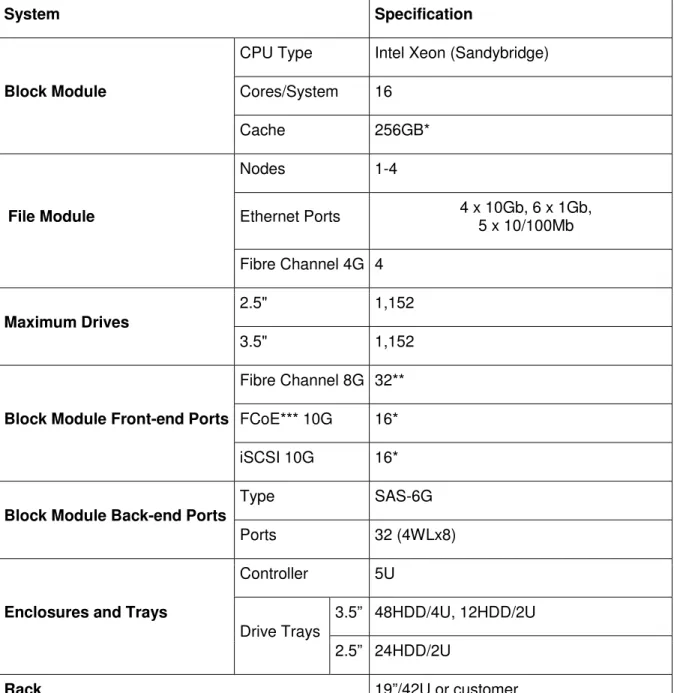
Specification Summary: Hardware
Table 1. Hitachi Unified Storage VM Hardware Specifications
System Specification
Block Module
CPU Type Intel Xeon (Sandybridge)
Cores/System 16 Cache 256GB* File Module Nodes 1-4 Ethernet Ports 4 x 10Gb, 6 x 1Gb, 5 x 10/100Mb Fibre Channel 4G 4 Maximum Drives 2.5" 1,152 3.5" 1,152
Block Module Front-end Ports
Fibre Channel 8G 32**
FCoE*** 10G 16*
iSCSI 10G 16*
Block Module Back-end Ports
Type SAS-6G
Ports 32 (4WLx8)
Enclosures and Trays
Controller 5U
Drive Trays
3.5” 48HDD/4U, 12HDD/2U 2.5” 24HDD/2U
Rack 19”/42U or customer
* Available within 6 months of first shipments ** Up to 48 Fibre Channel ports when configured without any hard disk drives *** Fibre Channel over Ethernet
Specification Summary: Software
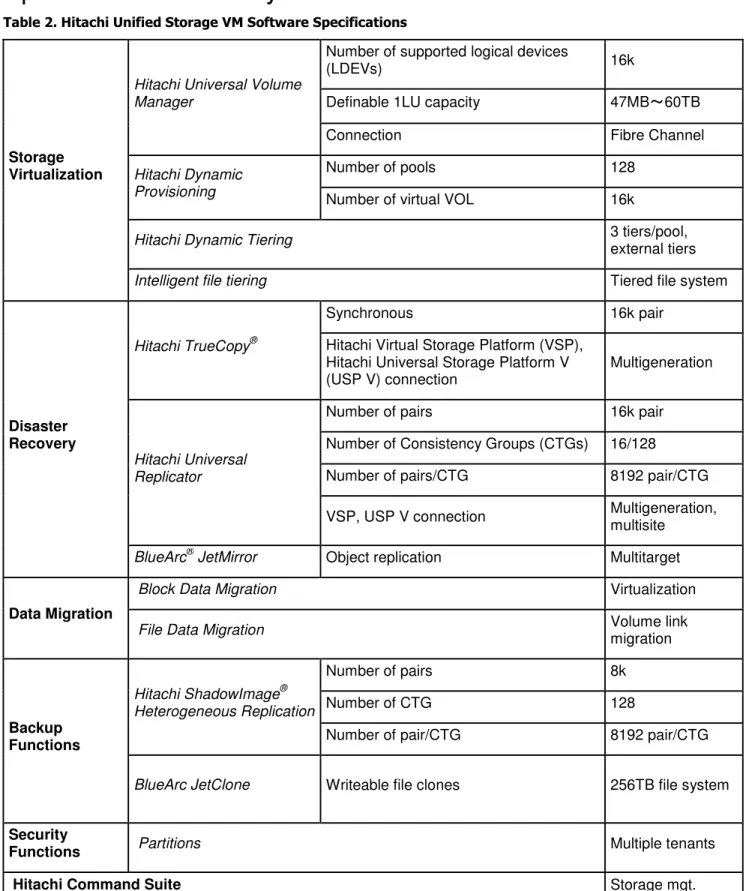
Table 2. Hitachi Unified Storage VM Software SpecificationsStorage Virtualization
Hitachi Universal Volume Manager
Number of supported logical devices
(LDEVs) 16k
Definable 1LU capacity 47MB~60TB
Connection Fibre Channel
Hitachi Dynamic Provisioning
Number of pools 128
Number of virtual VOL 16k
Hitachi Dynamic Tiering 3 tiers/pool,
external tiers
Intelligent file tiering Tiered file system
Disaster Recovery
Hitachi TrueCopy®
Synchronous 16k pair
Hitachi Virtual Storage Platform (VSP), Hitachi Universal Storage Platform V (USP V) connection
Multigeneration
Hitachi Universal Replicator
Number of pairs 16k pair
Number of Consistency Groups (CTGs) 16/128
Number of pairs/CTG 8192 pair/CTG
VSP, USP V connection Multigeneration, multisite
BlueArc® JetMirror Object replication Multitarget
Data Migration
Block Data Migration Virtualization
File Data Migration Volume link
migration Backup Functions Hitachi ShadowImage® Heterogeneous Replication Number of pairs 8k Number of CTG 128
Number of pair/CTG 8192 pair/CTG
BlueArc JetClone Writeable file clones 256TB file system
Security
Functions Partitions Multiple tenants
Storage Management Software
Hitachi Base Operating System
Hitachi Base Operating System software package simplifies storage management while taking full advantage of the capabilities of the storage systems. It utilizes an easy-to-use and intuitive GUI to centrally manage Hitachi storage systems and also includes complete CLI. It provides user, logical, physical and host management views that enable provisioning and storage pooling for primary and secondary storage. The Base Operating System includes the following individual software
components:
Hitachi Device Manager
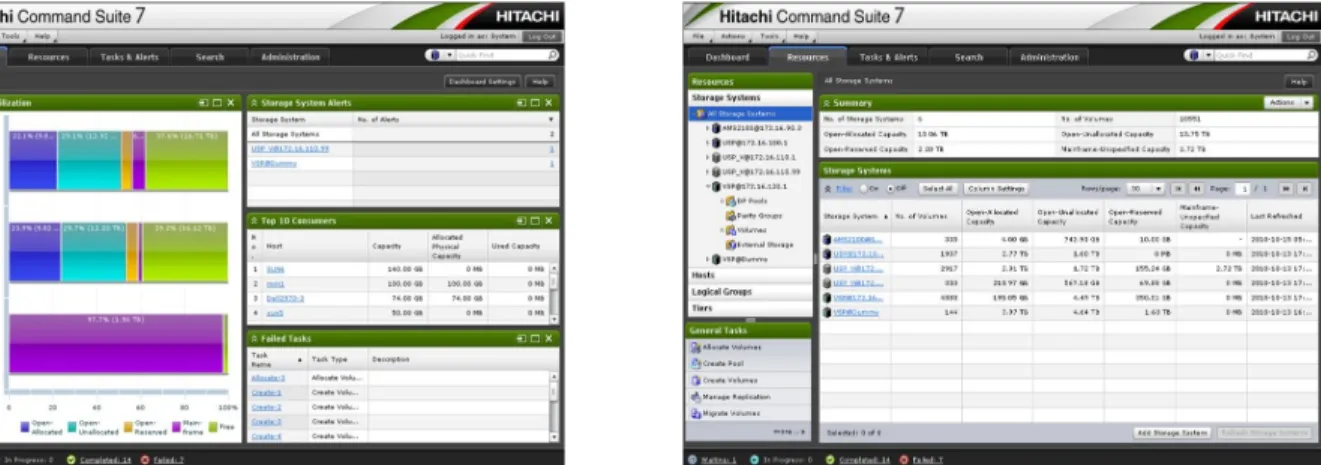
Hitachi Device Manager provides centralized management of multiple Hitachi storage systems. Hitachi Device Manager v7 features a new graphical user interface, integrated workflows for
improved usability and significant improvements to both scalability and performance (see Figure 10). By providing a single console for managing complex storage environments, Hitachi Device Manager software unifies and simplifies storage management. Featuring both an intuitive graphical user interface and a complete command line interface (CLI), Device Manager centrally manages single or multiple Hitachi storage systems. With highly efficient context sensitive workflows, Device Manager supports multiple management views, including physical, logical, host, NAS and virtual server for provisioning and storage pooling for primary and secondary storage.
Figure 10. Hitachi Device Manager v7 GUI (a part of the overall Hitachi Command Suite v7) Hitachi Dynamic Provisioning
Hitachi Dynamic Provisioning software is thin provisioning software that provides virtual storage capacity. Provisioning storage from a virtual pool reduces administration costs by cutting the time to provision new storage. It also improves application availability by reducing the downtime needed for storage provisioning.
Capacity is allocated to an application without it being physically mapped until it is used. In this manner it is possible to achieve overall higher rates of storage utilization with just-in-time
of physical storage capacity to the storage system. Physical storage can be nondisruptively added as needed. Dynamic Provisioning places storage in a central pool that is available to all thin provisioned volumes. Automatically allocate additional physical storage to the volume from the shared virtual pool whenever an application requires additional capacity.
Hitachi Universal Volume Manager
Hitachi Universal Volume Manager adds unique storage controller-based virtualization supporting externally attached storage. Hitachi Universal Volume Managerenables heterogeneous storage solutions with pooled tiered storage and simplifies storage management, improves storage utilization and increases storage services levels. A single, consolidated pool of storage is available for all hosts and applications, which hides whatever complex networking and storage hardware that may be behind it. This common pool can be used equally across all hosts and applications independent of the heterogeneous storage and system hardware that they represent.A single, common interface is presented to manage the entire SAN.
Hitachi Virtual Partition Manager
Hitachi Virtual Partition Manager enables the logical partitioning of ports, cache and disk (parity groups) into independently managed virtual machines. The virtual private storage machine is an allocation of specific ports, cache and disks or parity groups within a partition. An administrator can be provided with access for an individual partition. That administrator would then be able to use any of the storage management tools and business continuity software within his or her partition, but only to be able to impact the storage and resources within that partition. These partitions can be allocated dynamically to utilize resources based on changes in business requirements. In Hitachi Basic Operating System V software (for VSP), expanded Virtual Partition Manager support adds up to 16 partitions.
Hitachi Dynamic Link Manager Advanced
Hitachi Dynamic Link Manager Advanced software offers robust multipath SAN connections
between servers and storage systems. It provides fault tolerant failover, failback, load balancing and centralized path management for improved information access, usability and availability. Automatic workload balancing helps to maintain outstanding system performance across all available paths. If one path were to fail, Hitachi Dynamic Link Manager Advanced would automatically switch the I/O to an alternate path, ensuring that an active route to data is always available.
Hitachi Server Priority Manager
Hitachi Server Priority Manager software makes it easier to meet application performance service level agreements (SLAs) by prioritizing the application's server port access. It allows a single storage system to limit the I/O activity of noncritical servers, such as a development server, and prioritize the performance of business-critical servers accessing the same storage system port. Service levels can be set using Server Priority Manager software, ensuring that the critical servers achieve specified minimum throughput thresholds ahead of the noncritical servers. Production servers are thereby assured that business-critical applications are not adversely affected by noncritical applications.
The Hitachi Base Operating System also includes: LUN Manager, SNMP agent, cache residency manager feature, Hitachi Storage Navigator, Hitachi Data Retention Utility, virtual LUN software, performance monitor feature and volume shredder feature.
Hitachi Base Operating System F
The Hitachi Base Operating System F provides multiprotocol file services, dynamic provisioning, intelligent file tiering, file virtualization and unified directory structure.
The Hitachi Base Operating System F Entry bundle includes CIFS and NFS, 2x virtual server, storage pool, file system audit, file system rollback, quick snapshot restore, high-availability cluster and entry 90-day trial license.
The Hitachi Base Operating System F Value bundle includes the above features plus 4x virtual server and file system recover from snapshot (WFS2 – from 6.1).
The Hitachi Base Operating System F Ultra bundle includes the above plus 64x virtual server, replication bundle XVL (cross volume links), and Hitachi Data Migrator, powered by CommVault®. Intelligent file tiering helps organizations move data among storage and archive tiers with
automated, policy-driven migration tools. This integration of NAS and “write once, read many” (WORM) features combine NAS, archive, index and search technologies.
Tiered file system (TFS), also known as “metadata optimization,” separates file system metadata from user data and automatically places metadata on the highest tier for improved performance and storage cost-efficiency. Complementary with the policy-based intelligent file tiering capability, it migrates data between different file systems.
Cluster namespace creates a unified directory structure across storage pools and servers. Multiple file systems appear under a single common root, and both CIFS and NFS clients obtain global access through any cluster node.
Virtual file system supports CIFS and NFS protocols for flexibility and power to handle very large files and millions of small files, plus concurrent file system operations with no performance impact. Automatic file system expansion is also available.
Dynamic provisioning (or thin provisioning) with virtual volumes removes the need to pre-allocate capacity and enables oversubscription. Dynamic provisioning also supports large 256TB volumes.
Additional File Software Offerings
WORM, virtual server migration, iSCSI, read caching and Virtual Server Security are available as well as the following.
BlueArc JetMirror
BlueArc JetMirror disaster recovery capabilities, based on object replication, bring data back online quickly and efficiently through enhanced tools that automate system failover and failback. A source file system can be included in multiple replication schedules, allowing for multitarget replication. The snapshots and replication states for each replication job are separately maintained. BlueArc
JetMirror also supports file replication, which allows it to recover a more granular subset of files compared to object replication, which works only at the file system level.
BlueArc JetClone
BlueArc JetClone software performs cloning at the file level. Using BlueArc JetClone, multiple copies or clones of single files are made by taking snapshots of that file and saving subsequent differences separately. By referring back to the original file for most of the data, BlueArc JetClone avoids making multiple copies of the common elements of the file. Using BlueArc JetClone, entire development and production environments can be deployed in a matter of minutes with little incremental storage costs.
BlueArc JetCenter, specifically developed for VMware environments, provides snapshot
management from within a vCenter console. As an integrated plug-in to vSphere, BlueArc JetCenter allows vSphere administrators to work from their existing management interface to create snapshots for backup or recovery of virtual machines and VMDK files. Choice of instant on-demand snapshots taken by the user, policy-based snapshots, or orphan snapshots from deleted file module storage systems and virtual machines are possible. Policy-based retention allows the administrator to define the preservation timeframe by snapshot, freeing up storage capacity. Snapshot retention can be defined by the administrator by the number of backups, the number of days, or a mixture of both backups and days.
Hitachi Command Suite Analytics
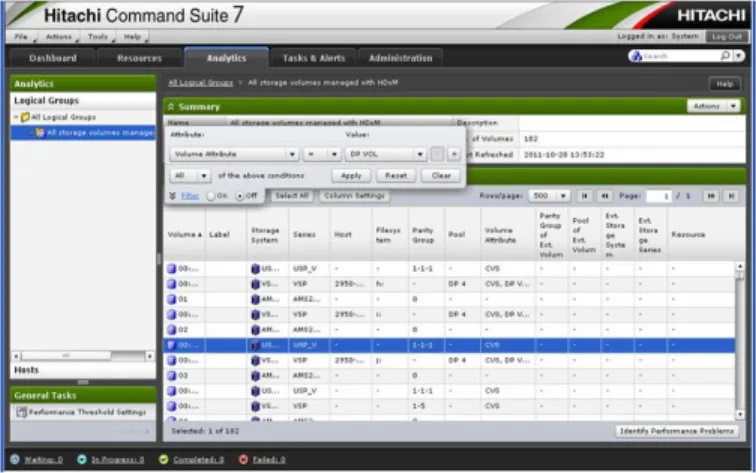
The Hitachi Command Suite Analytics software (see Figure 11) gathers information and reports on storage network resources enabling storage administrators to make informed storage management decisions. It includes the following individual software components:
Figure 11. Hitachi Command Suite Analytics
Hitachi Command Director
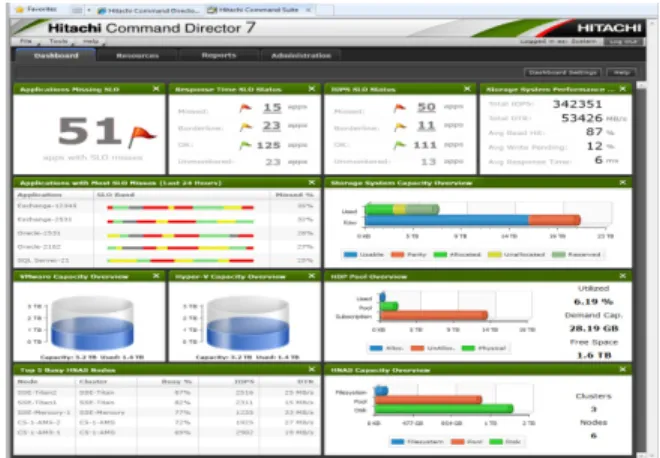
Hitachi Command Director software (see Figure 12) provides centralized reporting and management of Hitachi storage environments. It offers comprehensive business application views and integration of key performance and capacity statistics from across Hitachi Command Suite. With Hitachi
Command Director, host discovery for both allocated and utilized capacity reporting can be provided without the use of host-based software agents. Even in virtualized server environments, virtual machines are correlated back to their respective data stores and LDEVs on the Hitachi storage system. It provides customized dashboards for real-time monitoring of key storage performance indicators by business application, such as I/O, reads and writes, response times and utilized capacity. By verifying that application-based storage service level objectives are being met,
policy-based storage tier management can be implemented to enable the rapid modification of the storage environment.
Figure 12. Hitachi Command Director GUI
Hitachi Tuning Manager
Hitachi Tuning Manager software is an automated, intelligent and path-aware storage resource management tool that maps, monitors, analyzes and measures storage network resources and performance from the application to the device. By monitoring all storage network resources,
including hosts, file systems, databases, SAN switches and Hitachi storage systems, Hitachi Tuning Manager provides the necessary visibility for complete performance management of the entire storage environment. Through a web-based interface, Tuning Manager software facilitates
monitoring of the storage network with a comprehensive range of performance statistics combined with predefined reports and custom reporting capabilities. Performance statistics can be trended over time to ensure performance requirements for mission-critical applications are being met and facilitate the forecasting of future storage needs based on actual usage patterns.
Hitachi Command Suite Mobility
The mobility tools in Hitachi Command Suite can optimize the system’s tiered storage capabilities at the volume or sub-LUN level. The mobility software package components include:
Hitachi Dynamic Tiering
Hitachi Dynamic Tiering (see Figure 13) increases performance and lowers operating cost using automated data placement. Data is automatically moved according to simple rules. Two or three
Figure 13. Hitachi Command Suite Mobility: Hitachi Dynamic Tiering
tiers of storage can be defined using any of the storage media types available for Hitachi Virtual Storage Platform. Tier creation is automatic based on media type and speed. Using ongoing embedded performance monitoring and periodic analysis, the data is moved at a fine-grain, sub-LUN level to the most appropriate tier. The most active data moves to the highest tier. During the process the system automatically maximizes use of storage, keeping the higher tiers fully utilized.
Hitachi Tiered Storage Manager
Hitachi Tiered Storage Manager (see Figure 14) provides an easy-to-use interface for performing transparent, nondisruptive movement of data volumes across heterogeneous storage systems. It allows seamless transparent data volume movement among any storage systems attached to Virtual Storage Platform. Movement of data volumes between custom storage tiers is accomplished without needing administrators to pause or quiesce applications. Tiered Storage Manager masks the
underlying complexity of tiered storage data migration and does not require the administrator to master the operation of complex storage analysis.
Hitachi Local Replication
The Hitachi Local Replication software is used to both replicate full volumes as well as create snapshot copies of internal volumes. The package includes the following individual software components:
Hitachi Replication Manager
With Hitachi Replication Manager, administrators can configure, monitor and manage any replication systems that are based on Hitachi storage systems. Combining robust reporting, mirroring and features previously available in separate offerings, it manages in-system or distance replication for open systems and mainframe environments. Replication Manager simplifies and optimizes
configuration, operations, task management, automation and monitoring of the critical applications and storage components of your replication infrastructure.
Hitachi ShadowImage® Heterogeneous Replication
By providing nondisruptive, high-speed data replication within any Hitachi storage system or virtualized storage pool, Hitachi ShadowImage Heterogeneous Replication software enables immediate use of data in decision support, software testing and development, and data protection operations. ShadowImage cloning operations are independent of operating system, application or device, allowing efficient and centralized replicated storage volume management. ShadowImage software provides heterogeneous replication between any storage systems within a virtualized storage pool managed by Hitachi Virtual Storage Platform. Leveraging the storage virtualization capabilities of the platform, administrators can move data that resides on an externally attached storage system from the source to a target data volume anywhere in the storage pool, including to another externally attached system.
Hitachi Remote Replication
Hitachi Remote Replication software package is used to replicate volumes between primary and secondary data centers. It includes the following individual software components:
Hitachi Universal Replicator
Hitachi Universal Replicator delivers the industry’s first multiplatform, multivendor, remote copy capability. Supporting asynchronous, real-time replication of data from one Virtual Storage Platform to another, the software gives storage administrators a consistent replication approach, using a common set of procedures, tools and skills, for all data center storage. Conventional replication solutions push updates from the primary storage system to a remote location. Universal Replicator running on Virtual Storage Platform at the remote site pulls changes from journal volumes
maintained by Virtual Storage Platform running Universal Replicator at the primary site. This approach offloads replication overhead from the primary storage system and dramatically reduces the impact of replication on the business application. Transmitted record sets include a time stamp (mainframe only) and sequence number, enabling the replication engine to verify receipt of all records at the remote site and to sequence writes in the correct order for storage.
Hitachi TrueCopy Synchronous Remote Replication
Hitachi TrueCopy synchronous remote replication software duplicates data from one Hitachi storage system to another, across any distance. TrueCopy software automates the recovery process and enables normal business operations to resume in minutes rather than hours or days following an outage at the primary site. TrueCopy software provides host-independent data replication including heterogeneous replication capabilities for any type of data across any distance, without affecting application performance. Copies generated by Hitachi replication software products can be used for the rapid recovery of production systems or the restart of production on disaster recovery systems following an outage. They can also be used for data warehousing, data mining or data migration applications.
Additional Software Offerings
HitachiResource Partition ManagerHitachi Resource Partition Manager software enables administrative partitioning of Hitachi Unified Storage VM resources. It can be used with local authentication, or it can be integrated into corporate directory services and security systems using standard management interfaces such as Active Directory, LDAP and RADIUS. Solving both security and audit/compliance issues, Hitachi Resource Partition Manager enables management of shared storage assets by different groups.
Services and Support
Warranty, Support Plan
A 3-year comprehensive warranty includes 24/7 coverage, 2 hours to first contact and 4 hour onsite response, as required (within geographic coverage areas). An available upgrade to Warranty Plus includes: 24/7 coverage with 30 minutes to first contact, onsite within negotiated response window (within geographic coverage areas) and additional training and consulting hours (annual), access to capacity planning and performance tools, and selected score card access.
The basic installation service (mandatory) includes:
• Telephone predelivery site survey conducted to confirm power, location of equipment,
access and expectations.
• Telephone consultation to determine optimal configuration. • Physical inspection for shipment damage.
• Physical connection of cable interfaces.
• Installation of any additional features and options as specified on the order, including
software enablement (functionality only).
• Installation of resource and configuration management program using your PC. • Consultation to determine optimal configuration and operation.
• Hardware is installed to the Installation level (command prompt), with up to 2 hosts or
servers and up to 5 LUNs per host or server configured and accessible.
• Installation, configuration and testing of Hi-Track® Remote Monitoring system. • Confirmation of maintenance provisions and call handling procedures.
• Training: basic handling of equipment and configuration.
• Note: Physical installation of host bus adapters (HBAs) is not included.
Upgrading to the Installation Plus Service provides incremental assistance after the successful completion of the Installation Service checklist. Activities may include additional customer
connectivity and testing support, assistance with implementing additional host/LUN configurations, as well as customer Network and SAN testing and validation. General engineering assistance may also be provided by this service if defined and documented in an approved SAD. The Installation Plus Service is billable in daily increments, and is not intended to substitute or replace the various Hitachi Data Systems Global Solutions Services (GSS) service offerings, including defined
statement of work (SOW) or request for price quotation (RPQ) engagements.
Services
There are currently two service delivery options available to customers:
Partner Service Delivery
Hitachi Data Systems provides partners the opportunity to install and configure File and Content Solutions for customers. To be eligible to perform such services, partners must meet the minimum
certification requirements. For details on this program please login to PartnerXchange select the Services tab and then click on the Partner Delivered Services link.
Hitachi Data Systems Service Delivery
Hitachi Data Systems Global Solution Services (GSS) consultants provide installation, configuration and integration plus other high-end Professional Services offerings. The Hitachi Data Systems Customer Service and Support (CS&S) organization offers installation and configuration services.
Total Cost of Ownership (TCO) Benefits
This efficient storage architecture includes 3 key elements: storage virtualization, unified architecture and ease of management. These elements deliver a TCO reduction over alternative storage
architectures. The economic benefits are paid off in:
Significant storage capacity reclamation. Reduce disk drive costs through tiered storage, storage reclamation and dynamic tiering.
Return on assets (ROA). Better utilize existing storage assets; use them even beyond their depreciation life.
Device migration. Host-transparent migration enables the move to the new storage platform with less effort and cost compared to host migration approach.
Multitier storage. In a centrally controlled virtual pool, multitiered storage can share backup services, replication, snap copy management, etc.
Change management. Common management of heterogeneous assets, nondisruptive
configuration changes and less labor time required for provisioning.
Environmental. Reduce electrical usage, floor space and carbon emissions compared to the competition.
Appendix A: Certifications
VMware ESX Certifications
VMware ESX 4.0 UP1 — Emulex — Fibre Channel SVD VMware ESX 4.0 UP1 — QLogic — Fibre Channel SVD
VMware ESXi 5.0 — Emulex — Fibre Channel SVD with Thin Provisioning VMware ESXi 5.0 — QLogic — Fibre Channel SVD with Thin Provisioning VMware ESX 4.1 UP1 — Emulex — VAAI
VMware ESX 4.1 UP1 — QLogic — VAAI VMware ESXi 5.0 — SRM 5.0 — Fibre Channel VMware ESXi 5.0 — SRM 5.1 — Fibre Channel
Microsoft Certifications
Microsoft device logo — Windows 2008 R2/SP1 — MPIO Microsoft device logo — Windows 2012 — MPIO
Microsoft device Cluster Validation — Windows 2008 SP2 — MPIO — 4 node Microsoft device Cluster Validation — Windows 2012 — MPIO — 4 node
Citrix XEN Server Certification
Citrix XEN Server 5.6 FP1 (X64) certification (also covers 6.0 and 6.0.2)
SLES Certifications
SuSE 11 SP1 (X64) certification SuSE 10 SP4 (X64) certification
Oracle Certification
Oracle Cluster 4.0 (Solaris 11 SPARC and x64)
Future Plans — Post GA
Oracle OEL certifications
Citrix XEN Server 6.0.3 (X64) certification
MS device cluster — Windows 2008 SP2 — HDLM 4 node
Citrix XEN Server 6.0 (X64) certification for Hitachi NAS Platform, powered by BlueArc®
VMware ESX 4.0 UP1 — 10G NIC — iSCSI SVD VMware ESXi 5.0 — 10G NIC — iSCSI SVD VMware ESXi 5.0 — SRM 5.0 — iSCSI
Appendix B: Warranty and Maintenance and Support Terms
Please obtain updated Warranty and Maintenance and Support Terms (for all countries, in different languages) from: http://www.hds.com/corporate/legal/?WT.ac=us_ft_legal&_p=vCorporate Headquarters Regional Contact Information
750 Central Expressway Americas: +1 408 970 1000 or [email protected]
Santa Clara, California 95050-2627 USA Europe, Middle East and Africa: +44 (0) 1753 618000 or [email protected]
www.hds.com Asia Pacific: +852 3189 7900 or [email protected]
Hitachi is a registered trademark of Hitachi, Ltd., in the United States and other countries. Hitachi Data Systems is a registered trademark and service mark of Hitachi, Ltd., in the United States and other countries.
IBM and FileNet are registered trademarks of International Business Machines Corporation.
All other trademarks, service marks and company names in this document or website are properties of their respective owners.
Notice: This document is for informational purposes only, and does not set forth any warranty, expressed or implied, concerning any equipment or service offered or to be offered by Hitachi Data Systems Corporation.