Texas Affordable Baccalaureate Program
A Collaboration between the Texas Higher Education Coordinating Board, South
Texas College, and Texas A&M University-Commerce
This case study is part of a series on newer competency-based degree programs that have
been emerging in recent years. The case studies are prepared by the Council for Adult
and Experiential Learning (CAEL) with funding from Lumina Foundation.
THE TEXAS AFFORDABLE
BACCALAUREATE PROGRAM:
AN OVERVIEW
In January 2014, the Texas Higher Education Coordinating Board (THECB), South Texas College (STC), and Texas A&M University-Commerce (A&M Commerce) launched the Texas Affordable Baccalaureate Program, the state’s first compe-tency-based bachelor-level degree. The applied baccalaureate degree in organizational leadership is offered as a low-cost alternative to a traditional postsecondary degree, with a goal to serve stu-dents from lower socio-economic backgrounds.
The degree is also designed to provide stu-dents with the competencies that employers have identified as necessary for the 21st century, and it gives students the opportunity to acceler-ate time to completion—and reduce their costs— as they earn a postsecondary degree.
The program, as originally designed, features a blended model that combines competency-based courses and courses with a more tradi-tional format. In this blended model, students earn the first 90 credit hours required for the degree through self-paced online competency-based modules (42 semester credit hours in gen-eral core curriculum, 48 semester credit hours in lower division electives), with the last 30 credit hours (upper division, applied) offered in either a hybrid or online format. Recently, based on stu-dent feedback and interest, the program piloted an alternative model in which the upper divi-sion courses are also available in the self-paced online competency-based format.
Texas Affordable Baccalaureate Program
Snapshot
• Year-round enrollment
• Applied baccalaureate degree uses a com-petency-based model and flat-rate tuition to shorten the path to college completion • Core coursework and electives delivered
online in self-paced modules
• Upper level coursework and problem-based learning sessions delivered in a more tradi-tional course format, either face-to-face or online; new pilot model offers upper level component in same self-paced format as lower level
• Course competencies defined by faculty and industry leaders
BACKGROUND
In 2011, Texas Governor Rick Perry challenged all Texas institutions of higher education to develop a $10,000 bachelor’s degree, inclusive of all materials. THECB decided to meet that chal-lenge and began working to build a new program with A&M Commerce and STC. A&M Commerce, which serves a large military student population, had been an early adopter of online education and expressed early interest in developing a com-petency-based program as a way to provide better access and improve the success of its students. STC is a Level II institution offering associate and bachelor’s degrees as well as certificate programs;
it serves a large Latino student population, an important target of degree completion efforts in the state. The $10,000 degree challenge pro-vided an opportunity to create a different strat-egy for helping more high-need students access a bachelor’s degree program.
In 2012, THECB staff led by Dr. Van L. Davis, director of innovations in higher education, began working on the Texas Affordable Baccalaureate (TAB) degree along with the leadership of STC and A&M Commerce. The first task as a team was to identify the kind of degree to design and offer, taking into consideration both student demand and local employers’ needs. To understand what employers wanted in their potential employees and the types of jobs that would benefit the regions, the TAB leadership team examined labor markets and anticipated job growth in the STC and A&M Commerce regions using data from the Texas Workforce Commission and Bureau of Labor Statistics. The data showed that some of the highest growth fields in Texas included managerial/supervisory positions, particularly in the services industry and growing manufacturing base, and that many of these positions required a bachelor’s degree. An intensive occupational analysis of the regions around STC and A&M Commerce, including input from local employ-ers and industry leademploy-ers, confirmed that local employers needed mid-level managers with a bachelor’s degree.
At the same time, the TAB leadership team examined their own students who had earned an associate degree for jobs in technical careers but were returning to the institutions to pursue bachelor’s degrees. Lacking a bachelor’s degree
was their main obstacle to career advancement. The TAB team wanted the degree program to benefit this population of students, which may not be well served by a traditional business administration bachelor’s degree as such pro-grams often do not award full credit for techni-cal associate degrees or leadership experience outside of a business environment. According to Dr. Van Davis, “We took seriously what our institutions were telling us. It takes skills to serve as a supervisor or manager. There was no need for a traditional business degree, rather an organizational leadership degree as the next step from the technical associate degree.” The team, therefore, focused on designing an
applied baccalaureate degree in organizational leadership.
THECB, STC, and A&M Commerce col-laborated with The College for All Texans Foundation (CFAT), a non-profit 501(c)(3) sup-port organization for THECB, which raises awareness and financial support for the state’s higher education plan “Closing the Gaps by 2015.” CFAT served as an umbrella adminis-trative organization over the group and, in the spring of 2012, submitted an application for a $1 million grant to support the TAB proj-ect through EDUCAUSE’s Next Generation Learning Challenges (NGLC), an initiative funded in part by the Bill and Melinda Gates Foundation to support technology-based educational innovations to improve college readiness and completion. In July 2012, NGLC awarded the $1 million grant to the TAB leader-ship team to design, pilot, and scale the com-petency-based degree program.
WHAT IS COMPETENCY-BASED EDUCATION?
In recent years, a number of postsecondary institutions have developed new competency-based degree programs. These programs are promising for the future of higher education because they establish clear expectations for what graduates must know and be able to do, and many models are self-paced. The emphasis on learning acquired rather than seat time is particu-larly important for adult and nontraditional learners who bring learning from their work and life experiences to higher education. Competency-based models allow students to build on what they already know to obtain a post-secondary credential at their own pace.
DESIGNING THE PROGRAM AND
ITS COMPETENCIES
From the beginning, THECB knew that the success of the TAB program depended on a strong cross-institutional collaboration and strong faculty support at both colleges. The TAB leadership team, therefore, involved faculty ear-ly in the design process. Faculty members were nominated by administrators from each cam-pus, based on their knowledge and expertise in identified subject areas. THECB facilitated the engagement of faculty from both institutions through a series of monthly meetings, designed to encourage faculty to collaborate on decision making, share perspectives and insights, work together to build TAB’s curriculum, develop pro-gram and course learning outcomes, improve overall sustainability of the program, and build a shared commitment from both institutions.
In addition to the governor’s $10,000 degree challenge, several other initiatives were under-way in Texas that helped the team shape the program. One major influence was the THECB and CFAT’s participation in the Texas Tuning Project from 2009 to 2013 (sidebar). This project, which was a faculty-led pilot funded by Lumina Foundation, was designed to define what stu-dents must know, understand, and be able to demonstrate after completing a degree in a spe-cific field (Texas Higher Education Coordinating Board [THECB], 2014e). The project helped the TAB leadership team understand the process of building a degree from the ground up, paying particularly close attention to learning outcomes. Also, in 2009, THECB had worked on revising the statewide general education core curricu-lum using the Association of American Colleges and Universities (AAC&U) Liberal Education and America’s Promise (LEAP) Essential Learning Outcomes as a basis for the revisions.
In 2011, the THECB (2014b & 2014d) approved the revisions to the Texas Core Curriculum (TCC) for all Texas public institutions of higher education, and each institution’s core curriculum now includes a statement of purpose, six core objectives, and nine common component areas.
Concurrently, THECB (2014a) was convening small faculty groups in specific disciplines to revise and set new learning outcomes in lower division courses through its Learning Outcomes Project. Thus, by the time the TAB project was assembling faculty groups to develop its lower division competencies, participants were able to draw on the lessons and experiences of the Texas Tuning Project, the statewide general
education core curriculum revision using LEAP Essential Learning Outcomes, and the lower divi-sion outcomes revidivi-sion.
When starting the process of identifying the competencies for the TAB degree, the team asked, “What type of jobs do we expect our students to get?” Competencies were then reverse engi-neered from the answers to that question. Faculty explored the industries in which their students might be employed, the types of jobs for which graduates could be qualified, and the skills and competencies required for those positions. As a result, the overarching competencies took shape.
Texas Tuning Project
In April 2009, Lumina Foundation launched an initiative called “Tuning USA.” The aim was to create a shared understanding among higher education’s stakeholders of the subject-specific knowledge and transferable skills that students in six fields (biology, chemistry, edu-cation, history, physics, and graphic design) must demonstrate in each course and upon completion of a degree program.
Tuning is the faculty-led process of harmo-nizing higher education programs and degrees. The fine-tuning (or course alignment) process involved identifying a set of lower division courses for a given discipline area, up to the level of a certificate or an associate degree, and aligning their learning outcomes across institu-tions and sectors in order to provide a basis for voluntary transfer compacts and articula-tion agreements. From 2009 through 2013, with a four-year grant from Lumina Foundation, 12 academic disciplines were “tuned” in Texas (THECB, 2014e).
LEAP ESSENTIAL LEARNING OUTCOMES
Knowledge of human cultures and the physicaland natural world
• Through study in the sciences and math-ematics, social sciences, humanities, histories, languages, and the arts Intellectual and practical skills, including
• Inquiry and analysis
• Critical and creative thinking • Written and oral communication • Quantitative literacy
• Information literacy
• Teamwork and problem solving
• Personal and social responsibility • Civic knowledge and engagement—local
and global
• Intercultural knowledge and competence
• Ethical reasoning and action
• Foundations and skills for lifelong learning Integrative and applied learning, including
• Synthesis and advanced accomplishment across general and specialized studies (The Association of America’s Colleges and Universities [AAC&U], 2014)
After identifying the competencies, the team continued to work backward, starting with more questions: “When a student finishes a course, what should they know, what should they be able to do? If they need to know these skills, how do we assess those items, and what should those assessments look like?” In this way, a matrix evolved containing all the learning outcomes associated with the competencies and written using Bloom’s taxonomy action verbs (Bloom, 1956). The TAB team then developed corre-sponding assessment processes, assessment instruments, and course materials. Developing more specific measureable competency defini-tions was an intense process of relating the LEAP Essential Learning Outcomes back to the degree, which required several exercises involving both upper and lower division faculty members. The Essential Learning Outcomes were integrated into all three components of the degree: general education core curriculum, lower division elec-tives, and the upper division applied coursework.
What resulted from this process was a com-petency framework for the TAB degree that includes two levels of competencies: for the lower level, there are 72 general education core competencies, and 19 lower division competen-cies, making a total of 91 competencies that students must demonstrate; the upper level framework consists of 8 large overall compe-tency categories.
91 Lower Division Competencies
The lower division competency modules were developed by faculty teams in each discipline. The 72 general education core competency areas
include global understanding, problem solving, effective communication, analysis, ethics, and lit-eracy. The 19 lower division elective competency areas include Spanish as the required foreign lan-guage and related business and technical fields. Students are required to demonstrate mastery (80% of the content) of all 91 competencies, or transfer in credit that is equivalent, for this 75% of the degree.
8 Upper Division Competency Categories
The eight overarching competency categories that define the framework for the upper division courses are:
• interpersonal skills; • organizational behavior;
• problem solving/decision making; • change management;
• resource management;
• strategy/operations management; • information literacy; and
• statistics/applied research.
These eight competency categories each include a definition, or summary statement, and detailed associated individual competencies that students must demonstrate. For example,
8 OVERARCHING
UPPER DIVISION
COMPETENCY CATEGORIES
INTERPERSONALSKILLS
91 LOWER DIVISION COMPETENCIES
GLOBAL UNDERSTANDING PROBLEM SOLVING EFFECTIVE COMMUNICATION ANALYSIS ETHICS LITERACY
For each competency students must demonstrate:
All 19 areas include:
REQUIRED FOREIGN LANGUAGE
(SPANISH)
RELATED BUSINESS
FIELDS
RELATED TECHNICAL FIELDS
Each one includes a definition, or summary statement, and detailed associated individual competencies that students must demonstrate.
ORGANIZATIONAL BEHAVIOR PROBLEM SOLVING/ DECISION MAKING CHANGE MANAGEMENT RESOURCE MANAGEMENT STRATEGY/OPERATIONS
MANAGEMENT INFORMATION LITERACY
STATISTICS/APPLIED RESEARCH
72 GENERAL EDUCATION
CORE COMPETENCY AREAS
19 LOWER DIVISION ELECTIVE
COMPETENCY AREAS
the definition of the Change Management cat-egory is:
Understand how the political, economic, social, and technological forces in the envi-ronment influence organizational behavior, policy, and practices.
The Change Management category’s associ-ated competencies include the abilities to:
• analyze why & how organizations resist change;
• explain a leader’s role in managing change; and
• apply a structured change management process.
The eight competency categories are embed-ded into the upper division coursework, and students must demonstrate all of the associated competencies to earn the applied baccalaureate degree in organizational leadership: a bachelor of applied arts and sciences (BAAS) at A&M Commerce or a bachelor of applied science (BAS) at STC (THECB, 2014c).
Mapping the Competencies to the
Credit Hour
Although the applied baccalaureate degree program is designed around the competencies, the leadership team also needed to be sure that competencies mapped back to the credit hour. This was done by mapping the competen-cies back to courses offered in each institution’s traditionally formatted degrees. As students complete the TAB program’s competency-based learning modules, internal systems translate the competencies into courses that will appear on the student’s transcript. In addition, the team developed a formula for each registrar to cal-culate traditional grades for the transcript. The competencies themselves are currently not list-ed on the student’s transcript.
The competency modules are mapped back to the credit hour for a number of reasons. First, the TAB leadership team wanted students to have
transcript portability. If a student starts the orga-nizational leadership program and decides it isn’t
a good fit, they will have a transcript with actual courses completed and grades that any institu-tion will understand. This is also beneficial for students pursuing graduate degrees after earning the TAB degree. A second reason is that work-ing with credit hours as opposed to competency modules was easier for navigating the financial aid process and allowed both institutions to make only slight changes to their satisfactory academic progress (SAP) requirements. A third reason is institutional funding. Texas is primar-ily a formula-funded state where institutions are awarded most of their funding based on full-time equivalent enrollments at the beginning of each semester (on the 12th day of class).
DEGREE PROGRAM STRUCTURE
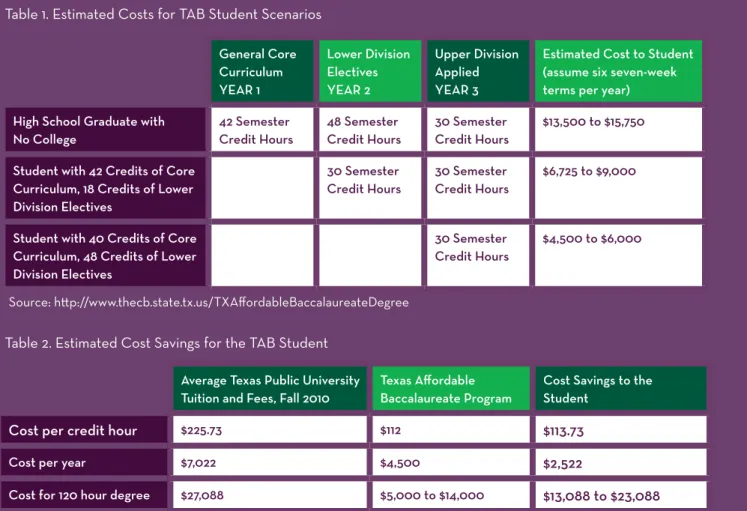
The competencies required for the BAS/BAAS degree map back to a total of 120 credits, which are distributed as shown in Table 1.Students enroll at either A&M Commerce or STC. At both institutions, students can complete the general education core curriculum and lower division elective requirements through self-paced online courses, each of which contains one to seven competency modules. Students have multiple options for completing the upper division portion of the degree. A&M Commerce offers this part of the degree through an entirely online experience. STC offers students a hybrid, face-to-face course format.
In addition, since many students come to the program with an associate degree or prior learn-ing from the workplace or military, there are also options for students to satisfy many of the degree requirements through transfer credit or prior learning assessment (PLA). Students may demonstrate competencies they have acquired in previous employment, life experience, and prior coursework through any method of PLA available, including CLEP exams and portfo-lio assessment. Both institutions also have a long history of using the American Council on Education’s (ACE) credit recommendations for military training and occupations and for corpo-rate training. The TAB degree program accepts
transfer credits from technical associate degrees that typically would not be accepted by aca-demic degree programs. A maximum of 75% of the degree requirements can be met through a combination of transfer and PLA credits. TAB academic coaches and program staff are trained to counsel students in identifying likely areas for prior learning assessment.
CURRICULUM
The TAB leadership team researched employ-er needs, both locally and on a national/intemploy-erna- national/interna-tional scale, and found that employers are look-ing for skills in communication, problem solvlook-ing, working in multicultural communities, critical thinking, conflict resolution and mediation, team-based work, and global interactions. While the TAB faculty used this information to identify the degree’s competencies and learning objectives,
it needed help with the instructional design of the online competency modules and the appro-priate online direct assessments for the lower level courses.
Based on Pearson Education’s work with Northern Arizona University’s (NAU) Personalized Learning program (another NGLC grant recipi-ent), the TAB leadership team decided to use Pearson’s services for its lower division develop-ment. With the faculty-designed competency maps guiding its work, Pearson created online course designs, which were then reviewed by faculty to ensure academic integrity and outcome alignment. These designs included both course content and assessments for each of the self-paced competency-based modules. The online format in these modules was specifically designed to allow students to advance to the next module as soon as they proved mastery of a concept. On average, three to four individual competency
LOWER DIVISION ELECTIVES UPPER DIVISION APPLIED Additional career-focused competencies, including foreign language Self-paced online competency modules Traditional hybrid; traditional online New pilot: self-paced competency modules Interpersonal skills, organizational behavior, problem solving/decision making, change management, resource management, strategy/operations management, information literacy, statistics/applied research Global understanding, problem
solving, effective communication, analysis,
ethics, and literacy
Self-paced online competency modules
42
48
30
GENERAL EDUCATION CORE CURRICULUMFORMAT CREDIT HOUR EQUIVALENCY COMPETENCY
AREAS
modules are included in each self-paced course offered through the program.
The upper division problem-based curriculum was fully developed by faculty and is driven by the eight competency categories. To fully real-ize and apply their skills and competencies, stu-dents must complete a capstone project, work-ing in teams on real-world problems provided by local businesses. The upper level curriculum is designed to be delivered in six seven-week terms as follows:
• Term 1: Issues in Organizational Leadership
• Terms 2 & 3: Data Driven Decision Making
• Terms 2 & 3: Behavior, Ethics, and Leadership
• Terms 4 & 5: Leadership & Leadership Theory
• Term 4: Leading Organizational Change/Group and Work Dynamics • Terms 5 & 6: Capstone Project
As previously noted, the two institutions dif-fer in their delivery methods of the upper divi-sion applied curriculum. STC currently offers a hybrid of online and face-to-face curriculum delivery. In STC’s hybrid model, students com-plete some work online, and then they meet with other students once per week to practice the content together. At A&M Commerce, because the BAAS in organizational leadership is offered exclusively online, this upper division work is completed in a virtual environment, and all group projects and meetings with peers are conducted through Skype, e-mail, and other methods of online communication.
In fall 2014, in response to student demand, A&M Commerce began piloting an online competency-based option for the upper divi-sion curriculum. Students at A&M Commerce requested this change because they found that the competency-based modules were more flexible, and their feedback indicated that making the transition from an entirely competency-based lower division to an accel-erated traditional upper division curriculum was not seamless.
ASSESSMENT APPROACH
All competency modules include embedded course assessments. Assessments for both the general education core curriculum and the lower division electives follow the same process. Each module has a pre-assessment that students take as a diagnostic at the beginning of the module, and then a post-assessment at the end of the module. If a student scores high enough on the pre-assess-ment, that student may be allowed to go straight to the post-assessment. This is similar to other institutions’ competency-based degree programs, such as the one offered by NAU; but where NAU allows students to skip post-assessments based on their pre-assessment performance, this is not an option for students in the Texas program. The post-assessments are longer and more difficult and are designed for students to prove a deeper level of understanding of the competencies. Students have three chances to pass the post-assessment, and they must score an 80% or higher in order to move on to the next module.
The assessments vary in terms of format, depending on the particular competency being tested; the assessment formats include multiple choice tests, short essays, videos and presen-tations, and actual work products. Faculty in each concentration area were instrumental in the design of the assessments and determined which type of assessment should be used.
Student mastery of the upper division compe-tencies is evaluated through a capstone e-port-folio. Students use the e-portfolio to showcase how they applied their knowledge and skills to a real-world application. In addition to having an assessment function, the program designed the e-portfolio to be something that the students can use outside of the institution, providing graduates with a way to demonstrate job skills to potential employers and begin to document their professional achievements.
The program designers are considering future use of the Collegiate Assessment of Academic Proficiency (CAAP) or similar com-prehensive assessment instruments in addi-tion to the assessment tools already set in place. The CAAP assessment is a standardized,
nationally normed assessment program from American College Testing (ACT) of collegiate-level learning. Students would take the CAAP or similar assessment upon entering the TAB program and then again after their capstone course. The program designers expect that student results from this assessment will enable A&M Commerce and STC to bench-mark their students against those at other institutions nationally.
FACULTY AND STUDENT
SUPPORT STAFF
Program designers intended the applied bac-calaureate degree in organizational leadership to be a faculty-centered model. From the beginning full-time faculty worked with business leader input to develop competencies, courses, assessments, and curriculum materials. According to THECB’s Van Davis, “Faculty involved in developing cur-riculum have the best understanding of what is competency-based vs. traditional coursework and are, therefore, able to help students develop a strategy to move through the process.”
Faculty members also serve as content instruc-tors, providing real-time feedback and support whenever needed as well as administering pre- and post-assessments, facilitating the student’s learning by answering questions, providing one-on-one tutoring, and monitoring progress. These full-time instructional staff members are
assigned to specific content domains or courses. Additionally, for the upper division part of the degree, full-time faculty work in more of a tra-ditional faculty role, delivering both face-to-face and online courses.
Full-time program staff serve as academic coaches, who work with individual students throughout the student’s career to provide feed-back and support. These coaches work with the same students from enrollment through gradua-tion, checking in with the student at least once per week. The program uses learning and predictive analytics, developed by Civitas Learning, to help students stay in school and graduate on time. The academic coaches are able to see at-a-glance how their students are doing, allowing them to give
more attention to students who fall into the at-risk categories and require additional help. According to Davis, “This hands-on support, including advis-ing, mentoradvis-ing, and active problem solvadvis-ing, is key to early student retention and success.”
COST AND PRICING/SUSTAINABILITY
The first year start-up costs to develop the TAB program were covered by the two-year $1 million grant from EDUCAUSE NGLC. This included travel, program development, faculty developed assessments, competencies, and objectives. A portion of the curriculum and competency map-ping completed by Pearson was also supported by the grant along with the development of a suite of marketing resources, including small ini-tial social media buys, and of gap ware to auto-mate the student enrollment process. However, both participating institutions also contributed considerable time and both human and financial resources. The estimated outlays and in-kind staff time was $250,000 from A&M Commerce and $160,000 from STC. In addition, both institutions committed to taking on the cost of the predictive analytics from Civitas Learning. Costs for student access to the online modules, learning materials, and assessments are being amortized over a five-year contract between Pearson and the two institutions and is also not covered by the grant (Pearson will receive $250 for each enrolled stu-dent through 2018). As the institutions develop new CBE degree offerings, these offerings can use the same core curriculum and elective cours-es, thus reducing development costs.The price of the program for the student is $750 for each seven-week period of enrollment, inclusive of electronic resources, for the lower division curriculum. Students can complete as many competency modules or courses in each week term as they are able. Six seven-week terms are offered each 12 month academic cycle. Because students can complete core and lower division competencies online and through self-paced modules, those with work-based and other experiential learning can advance quickly. The program estimates that a student with little or no college experience can expect to earn 120
Table 2. Estimated Cost Savings for the TAB Student Table 1. Estimated Costs for TAB Student Scenarios
Source: Presentation to the Texas Higher Education Coordinating Board, April 24, 2014, http://www.thecb.state.tx.us Source: http://www.thecb.state.tx.us/TXAffordableBaccalaureateDegree
degree credits in approximately 3 years, with a total cost of $13,500 to $15,750. Students enter-ing the program with an earned associate degree could complete the BAS/BAAS degree in 1.5 to 2 years, with a cost of approximately $6,725 to $9,000. Students with credit from prior college learning and work experience, needing only the upper division coursework, can earn 30 degree credits in one year (six terms), for a total cost of approximately $4,500 to $6,000 (Table 1). These figures are presented as ranges to allow for oth-er costs, such as CLEP fees (if any), graduation fees, and the cost of learning materials, which are not built into the upper division modules. Of course, because the program allows students to progress at their own pace, highly experienced and motivated students can complete in an even shorter time and at a lower cost. For example, one student has successfully completed six courses in a seven-week period at a cost of $750.
THECB estimates that the program’s cost per credit is about half that of a traditional degree, saving the student $113.73 per credit. With this model, the student potentially saves between $13,088 to $23,088 in tuition and at least two semesters of time by earning the TAB degree in three years (Table 2).The pricing model assumes that course delivery savings are realized by the institution by developing and adopting existing outcomes-based curriculum materials (from both institutions and Pearson) as well as by using alternative academic staff-ing structures and online delivery to minimize overhead expenses. The TAB leadership team hopes that as student enrollments increase, tuition costs could be further reduced due to economies of scale.
It is estimated that the program will be self-supporting and sustainable by the fifth year of operation. General Core Curriculum YEAR 1 Lower Division Electives YEAR 2 Upper Division Applied YEAR 3
Estimated Cost to Student (assume six seven-week terms per year) High School Graduate with
No College 42 Semester Credit Hours 48 Semester Credit Hours 30 Semester Credit Hours $13,500 to $15,750
Student with 42 Credits of Core Curriculum, 18 Credits of Lower Division Electives 30 Semester Credit Hours 30 Semester Credit Hours $6,725 to $9,000
Student with 40 Credits of Core Curriculum, 48 Credits of Lower Division Electives
30 Semester Credit Hours
$4,500 to $6,000
Average Texas Public University Tuition and Fees, Fall 2010
Texas Affordable Baccalaureate Program
Cost Savings to the Student
Cost per credit hour $225.73 $112 $113.73
Cost per year $7,022 $4,500 $2,522
ACCREDITATION AND FINANCIAL AID
Obtaining necessary accreditation by the Southern Association of Colleges and Schools Commission on Colleges (SACSCOC) for the TAB degree was a lengthy process. SACSCOC originally approved the program in January 2013 but later approached the team requesting a substantive change proposal from both institu-tions. According to SACSCOC, a substantive change proposal is required if there is: “any change in the established mission or objectives of the institution; a change in legal status, form of control, or ownership of the institution; or the addition of courses or programs that rep-resent a significant departure, either in content or method of delivery, from those that were offered when the institution was last evaluated.” After several conversations with SACSCOC, including the submission of the substantive change proposal, SACSCOC accepted notifica-tion of the program and added the program to the scope of accreditation at each institution in December 2013.Because of the way in which the program maps the competencies back to the credit hour, and because two seven-week terms in the TAB program are equivalent to one standard term, students pursuing the applied baccalaureate degree in organizational leadership can receive federal financial aid. The biggest challenge in meeting financial aid regulatory requirements was the self-paced feature of the program. In order to satisfy satisfactory academic progress (SAP) requirements, TAB students must com-plete the equivalent of four courses across two seven-week terms (comparable to students in traditional programs completing 12 semester credit hours each traditional semester). Typically, academic coaches enroll students in two courses per term, and if students complete those, they will be enrolled in additional courses. If a stu-dent doesn’t complete two courses during the first term, the courses will carry over to the next term, and the student will have the second term to complete those and any additional courses they need to remain at full-time status to stay eli-gible for financial aid. Since multiple competency
modules equate to a course, and each module has a post-assessment, the academic coaches are able to track a student’s progress as each module is completed. A&M Commerce is cur-rently looking into new financial aid software systems to support this process as the program increases enrollments.
ISSUES AND CHALLENGES
A significant challenge in developing the TAB program was the faculty’s initial lack of knowl-edge about competency-based education and even some initial resistance to this new concept. The team devoted time and energy at the front end, engaging and educating faculty from both institutions. The team asked faculty to shift their focus from teaching to student learning, and to ask themselves, “What do students need to know, and what do they need to do?” According to Dr. Ali Esmaeili, dean for bachelor programs and uni-versity relations at STC, after two to three months of meeting, the faculty began to talk with greater ease about competencies. Dr. Mary Hendrix, A&M Commerce’s vice president for student access and success, notes that while this expansion of faculty awareness and understanding was the big-gest challenge, the solution also yielded the larg-est reward in that the faculty became completely invested in the program and developed a curricu-lum they felt they could call their own.
An additional, unanticipated challenge was the many ways in which the new program affected various parts of the institutions. Changes were needed in terms of policies, financial aid process-es, student information systems, and registration. Perhaps the biggest challenge the team encoun-tered, and which is still not completely resolved, is that of the back-end operational system and IT integration issues. During the first several terms, neither institution’s learning management sys-tem had the capability to enroll students in the competency modules or link the program com-petencies to the course-based format tracked in the student information systems. During the start-up phase, when initial enrollments were low, manual enrollment and tracking was manageable. However, for the program to scale up, a more
permanent solution is needed to automate this process. Project partners are currently working on a local solution to bridge the gap between the student information management systems and learning management systems. If there is a mes-sage to deliver to potential competency-based degree program designers from the TAB leader-ship team, it is to think about such technology challenges sooner rather than later.
STUDENT OUTREACH, ENROLLMENT,
AND OUTCOMES
The TAB leadership team has developed a marketing toolkit that both institutions can use and adapt to reach potential student groups. The toolkit includes a 30-second TV ad that can
be used on websites, a radio PSA, social media ads, and print materials. Both institutions plan to work with employers, specifically those that have tuition assistance programs in place, to market the program to their employees. In addi-tion, to reach the target market of students who have stopped-out with a certain number of cred-its but no degree, the team has an arrangement with the Texas Department of Public Safety to access current addresses for a statewide mailer.
During the program’s initial soft launch phase, enrollments were the result of students learn-ing about the program through word of mouth. Through word of mouth alone, the schools saw a combined student enrollment of 10 in term 1, 28 in term 2, and 50 in term 3. By term 5 the combined student enrollment has grown to 151. Eventually, enrollments for both institutions are projected to total 6,000 by 2018.
As the program ramps up and adds enroll-ments, the partners have established metrics for evaluation of various outcome measures, includ-ing student completions and reduced time to degree. The grant partners have created a pro-gram advisory committee that will be responsible for looking at the evaluation results from each institution, making recommendations for changes based on real data.
NEXT STEPS
With the continued rollout of the first TAB degree program, A&M Commerce and STC are planning to launch other competency-based degrees at their institutions within the next few years. The lower division competencies for the applied baccalaureate degree in organizational leadership were originally developed so they could be used by a number of different degrees, so that the cost to develop new degree offer-ings will be significantly lower than the cost to develop the first one. Additionally, THECB, A&M Commerce, and STC developed the degree program to be replicated at other institutions. Therefore, the partners will share all
compe-tency maps, learning outcomes, and objectives, including the program model itself, with any and all institutions. THECB, A&M Commerce, and STC hope to see more competency-based pro-grams throughout the state in the coming years. While employers have been a strong pres-ence during the development of the program, the team plans to continue this relationship by including them in a program advisory committee. The advisory committee will keep the curriculum current, review assessment results, and ensure that the program design continues to align with employer needs.
Now that A&M Commerce has decided to offer the upper division applied coursework as competency modules, the TAB leadership team and faculty groups will work together to adapt the curriculum, competency assessments, and artifacts to be used in students’ e-portfolios for this new version.
And finally, as the NGLC grant cycle comes to a close, the role of THECB will phase out, requir-ing the two institutions to take on the respon-sibilities of program organization, infrastruc-ture, and administration. Blackboard Learning Solutions has been working with the TAB team, making recommendations on these strategic planning efforts.
Acknowledgments
The authors of this case study were CAEL’s Rebecca Klein-Collins and Kathleen Glancey. The case study benefitted from several interviews and correspondence with Dr. Van Davis at the Texas Higher Education Coordinating Board, Dr. Ali Esmaeili and Rosemond Moore from South Texas College, and Dr. Mary Hendrix and Dr. Donna Smith from Texas A&M University-Commerce.
References
Association of American Colleges and Universities. (2014.). Liberal education and America’s promise (LEAP): Essential learning outcomes. Retrieved from http://www.aacu.org/leap/vision.cfm.
Bloom, B. S., & Krathwohl, D. R. (1956). Taxonomy of educational objectives: The classification of edu-cational goals. Handbook I: Cognitive Domain. New York, NY: Longmans, Green. Retrieved from http:// www.clemson.edu/assessment/assessmentpractices/referencematerials/documents/Blooms%20
Taxonomy%20Action%20Verbs.pdf.
The Texas Higher Education Coordinating Board (THECB). (2012). 2012 Texas public higher education almanac. Austin, TX: Author.
THECB. (2014a). ACGM learning outcomes project. Retrieved from http://www.thecb.state.tx.us/index. cfm?objectid=DE96F52A-D583-AE1B-C7265EA2CD5E90B3
THECB. (2014b). Elements of the Texas state core curriculum. Retrieved from http://www.thecb.state. tx.us/index.cfm?objectid=427FDE26-AF5D-F1A1-E6FDB62091E2A507
THECB. (2014c). Final BAS organizational leadership competencies 6-14. Austin, TX: Author. THECB. (2014d). Texas core curriculum. Retrieved from http://www.thecb.state.tx.us/index.
cfm?objectid=417252EA-B240-62F7-9F6A1A125C83BE08
THECB (2014e). Tuning Texas through Lumina Foundation. Retrieved from http://www.thecb.state. tx.us/index.cfm?objectid=B4B957B5-BD9D-A63B-1C8FFEF251B26E00
Articles on the Texas Affordable Baccalaureate Degree Program
Biemiller, L. (2014, February 5). Texas rolls out an ‘affordable baccalaureate’ degree.
Chronicle of Higher Education. Retrieved from http://chronicle.com/blogs/wiredcampus/ texas-rolls-out-an-affordable-baccalaureate-degree/50119
Hamilton, R. (2014, February 5). A&M-Commerce, South Texas College
announce $10K degrees. The Texas Tribune. Retrieved from http://ketr.org/post/ am-commerce-south-texas-college-announce-10k-degrees
Hamilton, R. (2014, February 4). New degree available for around $10K, books includ-ed. The Texas Tribune. Retrieved from http://www.texastribune.org/2014/02/05/ new-degree-available-around-10k-books-included/
Lewis, J. (2014). Next gen tools: Strategies and innovations for implementing breakthrough Models: Faculty engagement. Retrieved from http://net.educause.edu/ir/library/pdf/NGB1404.pdf
Mekelburg, M. (2014, February 6). Texas affordable baccalaure-ate degree program offers low-cost alternative to college degree. The Daily Texan. Retrieved from http://www.dailytexanonline.com/2014/02/06/
texas-affordable-baccalaureate-degree-program-offers-low-cost-alternative-to-college
Polden, K. (2014, February 6). Higher education partners launch Texas affordable baccalaureate
We advocate and innovate on behalf of adult learners to increase access to education and economic security. We provide adults with career guidance and help them earn college credit for what they already know. We equip colleges and universities to attract, retain, and graduate more adult students. We provide employers with smart strategies for employee development. We build workforce organizations’ capacity to connect worker skills to employer demands.