A Comparison White Paper by MicroStrategy
This White Paper reflects the views, opinions and conclusions of MicroStrategy Incorporated (“MicroStrategy”) and other contributors to this White Paper. This White Paper is provided “as is” and without express or limited warranty of any kind by either MicroStrategy or anyone who has been involved in the creation, production or distribution of this White Paper (collectively, “Contributors”), including, but not limited to, the implied warranties of merchantability and fitness for a particular purpose. Neither MicroStrategy nor Contributors makes any warranty, express or implied, concerning the accuracy, correctness, completeness or adequacy of any information that is provided in this White Paper. The entire risk with respect to the use of, or reliance on, this White Paper is with you. Should this White Paper prove inac-curate or erroneous (in whole or in part), you (and not MicroStrategy or Contributors) assume the entire risk for all costs related to the use of this White Paper.
In no event will MicroStrategy or Contributors be liable to you on account of any claim for damage, including any lost profits, lost savings, or other special, incidental, consequential, exemplary or other direct or indirect damages, including but not limited to any damages assessed against or paid by you to any third party, arising from the use of, or reliance on, this White Paper, even if MicroStrategy and Contributors have been advised of the possibility of such damages. In addition, neither MicroStrategy nor Contributors shall be liable for any claim by you or any other party for damages arising from the use of, or reliance on, this White Paper, based upon principles of contract warranty, negligence, strict liability, the failure of any remedy to achieve its essential purpose, or otherwise.
This White Paper is copyrighted and all rights are reserved by MicroStrategy. MicroStrategy reserves the right to make periodic modifications to this White Paper without obligation to notify any person or entity of such revision. Copying, duplicating, selling, or otherwise distributing any part of this White Paper without prior written consent of an authorized representative of MicroStrategy is prohibited. Copyright Information
All Contents Copyright © 2011 MicroStrategy Incorporated. All Rights Reserved. Trademark Information
MicroStrategy, MicroStrategy 6, MicroStrategy 7, MicroStrategy 7i, MicroStrategy 7i Evaluation Edition, MicroStrategy 7i Olap Services, MicroStrategy 8, MicroStrategy 9, MicroStrategy Distribution Services, MicroStrategy MultiSource Option, MicroStrategy Command Manager, MicroStrategy Enterprise Manager, MicroStrategy Object Manager, MicroStrategy Reporting Suite, MicroStrategy Power User, MicroStrategy Analyst, MicroStrategy Consumer, MicroStrategy Email Delivery, MicroStrategy BI Author, MicroStrategy BI Modeler, MicroStrategy Evaluation Edition, MicroStrategy Administrator, MicroStrategy Agent, MicroStrategy Architect, MicroStrategy BI Developer Kit, MicroStrategy Broadcast Server, MicroStrategy Broadcaster, MicroStrategy Broadcaster Server, MicroStrategy Business Intelligence Platform, MicroStrategy Consulting, MicroStrategy CRM Applications, MicroStrategy Customer Analyzer, MicroStrategy Desktop, MicroStrategy Desktop Analyst, MicroStrategy Desktop Designer, MicroStrategy eCRM 7, MicroStrategy Education, MicroStrategy eTrainer, MicroStrategy Executive, MicroStrategy Infocenter, MicroStrategy Intelligence Server, MicroStrategy Intelligence Server Universal Edition, MicroStrategy MDX Adapter, MicroStrategy Narrowcast Server, MicroStrategy Objects, MicroStrategy OLAP Provider, MicroStrategy SDK, MicroStrategy Support, MicroStrategy Telecaster, MicroStrategy Transactor, MicroStrategy Web, MicroStrategy Web Business Analyzer, MicroStrategy World, Application Development and Sophisticated Analysis, Best In Business Intelligence, Centralized Application Management, Information Like Water, Intelligence Through Every Phone, Intelligence To Every Decision Maker, Intelligent E-Business, Personalized Intelligence Portal, Query Tone, Rapid Application Development, MicroStrategy Intelligent Cubes, The Foundation For Intelligent E-Business, The Integrated Business Intelligence Platform Built For The Enterprise, The Platform For Intelligent E-Business, The Scalable Business Intelligence Platform Built For The Internet, Industrial-Strength Business Intelligence, Office Intelligence, MicroStrategy Office, MicroStrategy Report Services, MicroStrategy Web MMT, MicroStrategy Web Services, Pixel Perfect, Pixel-Perfect, MicroStrategy Mobile, MicroStrategy Integrity Manager and MicroStrategy Data Mining Services are all registered trademarks or trademarks of MicroStrategy Incorporated.
All other company and product names may be trademarks of the respective companies with which they are associated. Specifications subject to change without notice. MicroStrategy is not responsible for errors or omissions. MicroStrategy makes no warranties or commitments concerning the availability of future products or versions that may be planned or under development.
Patent Information
This product is patented. One or more of the following patents may apply to the product sold herein: U.S. Patent Nos. 6,154,766, 6,173,310, 6,260,050, 6,263,051, 6,269,393, 6,279,033, 6,567,796, 6,587,547, 6,606,596, 6,658,093, 6,658,432, 6,662,195, 6,671,715, 6,691,100, 6,694,316, 6,697,808, 6,704,723, 6,741,980, 6,765,997, 6,768,788, 6,772,137, 6,788,768, 6,798,867, 6,801,910, 6,820,073, 6,829,334, 6,836,537, 6,850,603, 6,859,798, 6,873,693, 6,885,734, 6,940,953, 6,964,012, 6,977,992, 6,996,568, 6,996,569, 7,003,512, 7,010,518, 7,016,480, 7,020,251, 7,039,165, 7,082,422, 7,113,993, 7,127,403, 7,174,349, 7,181,417, 7,194,457, 7,197,461, 7,228,303, 7,260,577, 7,266,181, 7,272,212, 7,302,639, 7,324,942, 7,330,847, 7,340,040, 7,356,758, 7,356,840, 7,415,438, 7,428,302, 7,430,562, 7,440,898, 7,486,780, 7,509,671, 7,516,181, 7,559,048, 7,574,376, 7,617,201, 7,725,811, 7,801,967, 7,836,178, 7,861,161, 7,861,253 and 7,881,443. Other patent applications are pending.
How to Contact Us MicroStrategy Incorporated 1850 Towers Crescent Plaza
I. Executive Summary
...
2
II. Comparison of MicroStrategy 9 and WebFocus on the Key BI Capabilities
...
3
1. Delivering More BI with Less IT Effort - MicroStrategy Delivers the Lowest TCO ...
5
2. All User Needs through a Single Platform ...
9
3. Self-Service Through a Fast and Intuitive User Experience ...
14
4. High Performance at Any Scale ...
18
5. Quick to Implement and Deploy, Easy to Maintain and Administer ...
22
6. Highly Interactive and Flexible Mobile Intelligence ...
27
7. Deep Insight through Superior Analytics ...
32
8. Flexible Technology for Departmental to Enterprise BI ...
35
III. MicroStrategy – A Market Proven, Industrial-Strength Technology
...
38
MicroStrategy vs. Information Builders
I. Executive Summary
In the business intelligence (BI) marketplace, MicroStrategy competes vigorously with vendors such as
Information Builders. At first glance, it would seem that companies can use either MicroStrategy 9 or
WebFocus 8 to support their reporting and analysis needs. However, throughout the implementation and
maintenance of BI applications, companies are realizing significant differences in the BI capabilities between
MicroStrategy and the less robust and less integrated BI technologies, such as WebFocus. MicroStrategy’s
organically grown architecture delivers superior performance, scalability, usability, efficiency, and reliability; all
of which impact the total cost of ownership, user adoption, and ultimately the success of the BI project.
As user and business requirements have become more complex, IT budgets nonetheless have come under
increasing pressure. Organizations need to deliver BI solutions in light of expanding user requirements,
increasing amounts of data, and differing data sources with a minimal amount of IT resources.
Non-organic BI architectures, like WebFocus, require higher amounts of IT effort because of the basic nature
of integrating disparate BI technologies which leads to redundant and repetitive administration and the
constant development of one-off workarounds. In contrast, organically-developed BI architectures like
MicroStrategy require the minimum amount of IT effort needed to deploy and maintain BI applications
and can empower business people to create their own reports without reliance on IT personnel.
MicroStrategy 9 offers business users a redefined user interface for a fast and intuitive user experience
where they can access consistent information through secure Web, Microsoft Office, and mobile device
interfaces. MicroStrategy’s advanced analytical capabilities, such as predictive analytics and new
in-memory analysis provide users with fast and deep insight. With MicroStrategy’s scalable architecture
and a single metadata, users can seamlessly navigate from scorecards and dashboards to reports and
analysis without being required to open and close multiple BI tools and navigate dissimilar interfaces.
MicroStrategy 9 is advanced technology that allows companies to support all types of BI applications with
a single technology. MicroStrategy 9 builds on MicroStrategy’s unique strengths at the high-end of BI
to extend the boundaries of performance, scalability, and efficiency of enterprise BI. At the same time,
MicroStrategy 9 brings quick-to-deploy BI technology easily within reach of smaller departmental BI initiatives
through features such as multisource data access, in-memory ROLAP, and Visual Insight. Just as importantly,
MicroStrategy 9 provides a smooth migration path for islands of departmental BI to merge into
a cohesive and consistent enterprise-wide framework. With MicroStrategy 9, even as departmental
BI applications are consolidated into the enterprise-wide framework, the departments can
continue to retain significant autonomy and nimbleness that they enjoyed previously.
For nearly 20 years, MicroStrategy customers have gained an edge over their competitors with fast,
agile analysis using MicroStrategy’s sophisticated technology. Companies and industry analysts widely
recognize MicroStrategy for its administration-friendly architecture, robust security, self-service
zero-footprint Web interface, innovative mobile application platform, and proven user and data scalability.
II. Comparison of MicroStrategy 9 and WebFocus 8 on the Key BI
Capabilities
Business intelligence has the power to provide performance feedback and visibility to all people in an organization,
thus enabling businesses to make better decisions every day. However, not all BI technologies deliver on this
promise, falling short on a number of key capabilities demanded of enterprise BI applications. A complete and
efficient BI platform must provide organizations with the following key capabilities:
Key BI Capabilities
1. Delivering More BI with Less IT Effort
... pg.5
MicroStrategy technology requires far fewer IT personnel for a given amount of BI users because its reusable
metadata is easier to maintain requiring less redundancy, because end users have more self-service capabilities
that offload work from the IT staff, and because it provides a comprehensive suite of administrative tools
requiring less IT administrators. WebFocus provides very limited metadata reusability so report developers have to
spend more time redundantly creating report objects, resulting in a higher TCO. WebFocus end users have limited
self-service capabilities and are heavily dependent on IT, requiring more IT administrators and a greater degree
of hard coding. There are no out-of-the-box tracking and auditing tools that allow WebFocus administrators to
centrally monitor and manage BI applications, thus requiring more administrators per number of end users.
2. All User Needs through a Single Platform
... pg.9
MicroStrategy users can access any style of BI via a unified and home grown BI platform. MicroStrategy users
get a single “version of the truth” through interactive Web, Microsoft Office, and mobile device interfaces. In
WebFocus, most metadata information is dispersed in numerous proprietary files (based on functionality) that are
difficult to maintain. Accordingly, different styles of BI require different user interfaces. Developers are forced to
use many different interfaces to build different types of reports that can lead to “multiple versions of the truth.”
3. Self-Service Through a Fast and Intuitive Web Interface
... pg.14
To enhance usability, the MicroStrategy Web interface adopts many familiar paradigms including, ribbon toolbars,
accordion controls, control-click multi-select capability, and context-sensitive right-click actions. MicroStrategy’s
next-generation of advanced self-service functionality is designed to provide more control to business users. The
MicroStrategy advanced self-service interface provides incredible speed-of-interactivity, stunning visualizations,
drag-and-drop manipulations, and instant results – thus allowing business users to rapidly go from data to
decisions. WebFocus continues to force users to use FOCUS scripting. Though basic report formatting can be
performed in the middle-tier server. This does not leverage the database to the fullest extent possible, and results in
unnecessary network and hardware resource utilization.
5. Quick to Implement and Deploy, Easy to Maintain and Administer
...pg.21
MicroStrategy provides organizations a platform that is quick to implement and deploy as well as easy to
maintain and administer. MicroStrategy’s single code base offers the unique advantage of reusable business logic
across the entire platform. MicroStrategy’s single BI server provides efficient, centralized administration for IT and
fewer moving parts which translate into less downtime. Gartner‘s survey customers rated Information Builders’
product difficult to implement, migrate, and use. WebFocus lacks a common reusable metadata layer that is
shared across documents. This creates a maintenance challenge as developers are typically forced to continually
and manually synchronize metric, calculation, and filter definitions across documents.
6. Highly Interactive and Flexible Mobile Intelligence
... pg.24
MicroStrategy Mobile extends BI capabilities on mobile devices well beyond traditional grid and graph reports
and provides exceptional flexibility for creating purpose-built, workflow-driven mobile applications. MicroStrategy
Mobile apps are built using a metadata driven, point-and-click development paradigm, fully utilizing the
MicroStrategy BI platform infrastructure, security, and reusable metadata components. As a result, mobile
applications are faster and easier to create, easier to maintain, and provide the administration efficiencies needed
to deploy to hundreds of thousands of users while providing the industry's lowest total cost of ownership.
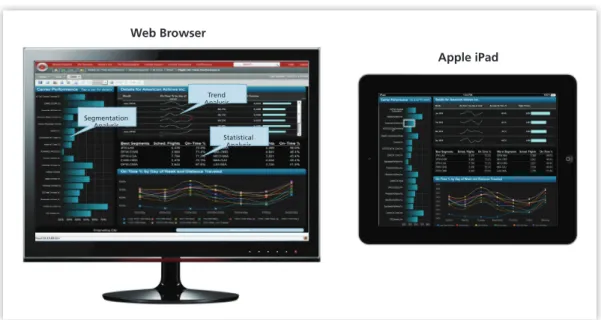
WebFocus does not fully leverage the device-specific capabilities for the iPhone or iPad because the WebFocus
Mobile solution uses a thin-client (pure browser-based) architecture. Creating and deploying rich Mobile BI
applications using WebFocus requires extensive development efforts.
7. Deep Insight through Superior Analytics
... pg.29
The MicroStrategy BI platform provides an extensive set of data manipulation and analytic options to allow
the user to delve deeply into a report to identify and discover important trends and patterns in the data.
MicroStrategy users can drill anywhere in the entire data warehouse for boundary-free investigative analysis.
MicroStrategy report designers and analysts can view and embed predictive analytics in reports and then
distribute them to all relevant decision makers and stakeholders. WebFocus does not have automatic drill
anywhere capabilities and drilling across hierarchies or reports requires IT hard coding for each report.
8. Flexible Technology for Departmental to Enterprise BI
...pg.32
MicroStrategy’s metadata reusability and life cycle management tools, such as MicroStrategy Object Manager
enable departments to incrementally migrate their business logic into a consolidated enterprise BI environment.
WebFocus does not have a tool equivalent to Object Manager to aid in consolidating and reconciling disparate
departmental BI applications into an enterprise-wide BI.
The following section of the white paper provides a side-by-side detailed evaluation of MicroStrategy 9 and
Information Builders WebFocus along the key BI capabilities discussed above.
1. DelIverIng More BI wIth less It effort - MICrostrategy DelIvers the lowest tCo
With IT budgets under increasing scrutiny and business requirements becoming more complex, today’s
organizations need to critically examine BI costs. The costs of BI extend beyond the initial acquisition. An IDC study,
Demonstrating Business Value: Selling to Your C-Level Executives, concludes, “Because the single largest factor
affecting TCO is staffing cost, IT initiatives that can reduce IT labor costs are likely to find greater acceptance among
financial decision makers, and initiatives that enable IT consolidation or automation can significantly reduce TCO
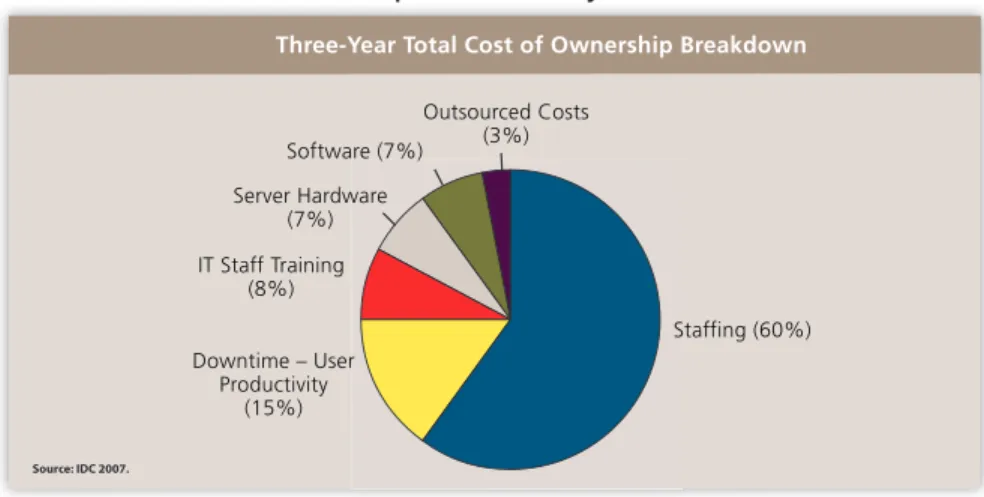
across the IT infrastructure.” Figure 1 shows that over three years, IT staffing constitutes between 60 and 71% of BI
Total Cost of Ownership (TCO).
three-year total Cost of ownership is Dominated by It Personnel Costs
Three-Year Total Cost of Ownership Breakdown
Staffing (60%) Downtime – User Productivity (15%) IT Staff Training (8%) Server Hardware (7%) Software (7%) Outsourced Costs (3%) Source: IDC 2007.
Figure 1: Staffing Costs Consume a Majority of Three-Year Software Lifecycle Costs
Three-year total cost of ownership for BI systems is dominated by costs related to IT personnel: IT personnel costs
account for 71% of total costs = Staffing (60%) + Outsourcing Costs (3%) + Staff Training (8%).
Customers and leading industry analysts alike recognize MicroStrategy’s ability to deliver BI to more users and a
great amount of data with fewer IT staff than other BI vendors. Many MicroStrategy customers have expanded their
BI deployments while saving millions of dollars a year in staffing costs by switching from non-MicroStrategy BI tools
to MicroStrategy’s efficient and scalable self-service BI platform. To save costs and ensure successful BI solutions,
decision makers must evaluate the key BI capabilities that reduce IT efforts and make the BI platform easier to
implement, deploy, maintain, and administer.
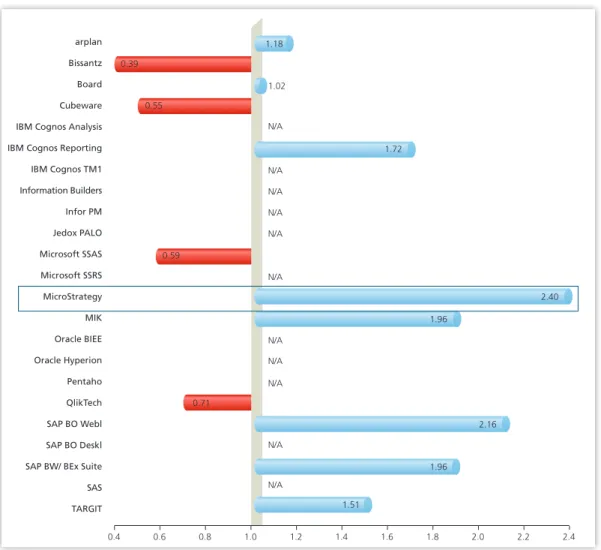
Microstrategy ranked #1 for administration efficiency
0.4 0.6 0.8 1.0 1.2 1.4 1.6 1.8 2.0 2.2 2.4 arplan Bissantz Board Cubeware IBM Cognos Analysis IBM Cognos Reporting IBM Cognos TM1 Information Builders Infor PM Jedox PALO Microsoft SSAS Microsoft SSRS MicroStrategy MIK Oracle BIEE Oracle Hyperion Pentaho QlikTech SAP BO Webl SAP BO Deskl SAP BW/ BEx Suite SAS TARGIT 1.02 1.18 1.72 N/A N/A 1.96 2.40 N/A 2.16 N/A 1.51 N/A N/A N/A N/A N/A 1.96 N/A N/AMicroStrategy Ranked #1 for Administration Efficiency
0.55 0.39
0.71 0.59
Source: The BI Survey 9 (2010) – This chart provides a KPI score for the deployed seats per administrator head. The KPI is calculated so
that higher administration costs lead to a lower KPI and vice versa.
Figure 2: MicroStrategy Technology is Recognized for its Ability to Support Many More Users for Each IT Administrator
MicroStrategy technology requires far fewer IT personnel for a given amount of BI users because its metadata is
inherently easier to maintain requiring less redundancy, because end users have more self-service capabilities that
offload work from IT staff, and because MicroStrategy provides a comprehensive set of administrative tools requiring
fewer IT administrators.
“
We evaluated several leading BI products and, using a total cost of ownership model, determined
that MicroStrategy had the best combination of ease-of-use, time-to-market, successful retail
implementations, and robust analytical capabilities.
”
– IT Senior Coordinator of Purchasing,
Private Label and Reporting, Whole Foods Market
The following table lists out key capabilities in which the MicroStrategy 9 platform helps organizations reduce costs
when designing, deploying, administering and maintaining BI applications.
KEY COST REDUCING
CAPABILITY MICROSTRATEGY 9 INFORMATION BUILDERS WEB FOCUS 8
Minimizing Design
ef
fort
Dynamic report
Personalization yes
• MicroStrategy has very robust Prompting engine. End users can dynamically author reports at run time by selecting attributes, metrics, metric levels, templates, filters, and even hierarchies. This greatly reduces report design dependency on IT and the number of reports for IT to maintain.
lIMIteD
• The WebFocus platform provides the ability to create reports in which users are prompted to pick data fields to place on a report. However, richer prompt types like hierarchy prompts and level prompts are not supported by WebFocus, limiting the range of ad hoc reports that developers can create for end users. • WebFocus InfoAssist has the ability to
create new computed fields from pre-existing data fields. WebFocus InfoAssist does not provide report consumers the ability to create and add derived elements (i.e. row groupings) to a report on-the-fly. automatic Multi-source
Drill anywhere yes
• Business users can automatically drill anywhere to any data source without IT hard coding.
no
• No automatic drill anywhere and drilling across hierarchies requires IT hard coding for each report.
• Drilling down is available but not automatically when a new report is created, as reports created in the WebFocus platform must be explicitly OLAP-enabled. Multi-selecting and drilling on multiple items is not available in the WebFocus platform.
formatting over the web yes
• Easy What-You-See-Is-What-You-Get (WYSIWYG) formatting allows business users to format reports at runtime without IT support.
lIMIteD
• Basic pixel perfect reports can be built in WebFocus using graphical layout tools such as InfoAssist, PowerPainter, or Report Assistant. More complex formatting and layout requirements typically require the report developer to write FOCUS code.
one repository of
reusable Business logic yes
• Report developers can reuse all existing business logic across the entire platform rather than spending time recreating business logic.
no
• There is no one single repository of reusable business logic, resulting in a higher TCO.
visual analysis for rapid
Decision Making yes
• MicroStrategy Visual Insight allows business users to intuitively visualize, filter, and drill into their data. The drag-and-drop, WYSIWYG interface allows business
lIMIteD
• WebFocus Visual Discovery is an in-memory analytics solution with data visualization capabilities, however the visual design process in Visual Discovery
KEY COST REDUCING
CAPABILITY MICROSTRATEGY 9 INFORMATION BUILDERS WEB FOCUS 8
Minimizing Deployment
ef
fort
easy to Customize and
Upgrade yes
• Upgradable plug-ins instantly customize to corporate look and feel without coding effort.
• Customizations are managed in a central location and can be upgraded with minimal IT effort.
lIMIteD
• WebFocus is more difficult to implement, migrate, and use.
• The components of the WebFocus platform generally are able to communicate without specific development effort to tie the components together. However, for moderately complex applications, the WebFocus architecture is largely dependent on writing FOCUS code to develop the BI application and reference different files and components of the WebFocus infrastructure.
automated Deployment yes
• Automated life cycle management tool synchronizes objects across development, test, and production environments thus greatly reducing manual work associated with BI deployments.
lIMIteD
• WebFocus does not offer a
comprehensive tool like MicroStrategy Object Manager for automated life cycle management and consolidation and reconciliation of disparate departmental BI applications.
Data Import from the
web Interfact yes
• MicroStrategy Data Import functionality is for business users and provides the ability to easily import data from local files or relational databases and quickly convert them into dashboards or visualizations without any IT involvement. There are no file size constraints.
yes
• The Upload Data File utility allows you to import data from a local file and access it through any of the WebFocus reporting tools, including Report Painter, HTML RA, HTML GA, HTML Layout Painter.
Minimizing
a
dministration
ef
fort
single server yes
• A centralized server dramatically reduces administrative effort and complexity.
yes
single Point of
administration yes
• Administrators need to create users and security settings once and these settings apply to the entire MicroStrategy platform without requiring duplicate IT efforts.
yes
• WebFocus provides a single point of administration.
out-of-the-Box
system-wide Monitoring yes
• Prebuilt system performance dashboards allow the administrator to immediately analyze system usage data down to the details and to easily optimize resources. • Automatically logs object change history
without requiring IT staff efforts, easing auditing process.
no
• There is no Out-of-the-Box System-wide Monitoring.
automated scripting
Control yes
• Reduces repetitive and time consuming administrative tasks through automated command line scripts.
lIMIteD
• WebFocus does not provide a comprehensive command line administrative tool for high volume tasks, making administration across BI applications more time consuming.
KEY COST REDUCING
CAPABILITY MICROSTRATEGY 9 INFORMATION BUILDERS WEB FOCUS 8
Minimizing Maintenance
ef
fort
automated report and Data Integrity Checking
yes
• MicroStrategy administrators can uncover inconsistencies or errors before business users see them while reducing 98% of manual regression testing efforts.
lIMIteD
• Administrators have limited ability to automate report and data integrity checking tasks.
highly reusable Business
Metadata yes
• IT staff have to maintain only one business metadata object in one place, and this one definition is reused across the entire platform to reduce IT maintenance efforts.
no
• WebFocus provides limited metadata reusability. This forces report developers to spend more time redundantly creating report objects and results in a higher TCO.
scalable In-Memory
rolaP architecture yes
• MicroStrategy customers can instantly leverage multiple types of data assets with a powerful in memory technology.
lIMIteD
• Information Builders’ product lacks a scalable In-memory ROLAP technology to provide an instant reporting database across multiple data sources. Information Builders only provides support for dynamic sourcing capabilities that leverage In-memory ROLAP cubes.
• WebFocus does not use multi-pass SQL and in-memory temporary tables thus missing opportunities to improve scalability and performance.
automatic Change
Management yes
• MicroStrategy’s unified platform and object-oriented development method ensure that a change is propagated to all related objects, ensuring one “version of the truth” with minimal IT maintenance effort.
lIMIteD
• WebFocus does not provide out-of-the-box tracking and change auditing in the metadata. MicroStrategy’s change journaling feature allows users to document and track changes to metadata objects.
2. all User neeDs throUgh a sIngle PlatforM
The ideal architecture for business intelligence is the one that provides organizations with a single and cohesive
model of the business that can be automatically displayed through any user interface. MicroStrategy users have
the option to access a single “version of the truth” through interactive Web, Microsoft Office, and mobile device
interfaces. MicroStrategy 9 includes a newly re-engineered Web user interface that is designed to be faster, more
powerful, and more personalized than ever before. The MicroStrategy 9 Web architecture boasts a wide range of
performance-enhancing changes that make the user interface interactive and instantly responsive to user requests.
five styles of Business Intelligence through a single Platform
Figure 3: Users Can Seamlessly Traverse All Styles of BI from a Unified Platform and a Single Interface
“
MicroStrategy’s long history and devotion to producing world-class business intelligence technology provided
us with extreme confidence that we are making the right decision for our casino partners. MicroStrategy’s
interactive dashboards with advanced data visualizations will allow our clients to view complex data in
an easily understood and graphically appealing manner to improve decision-making. In addition, we look
forward to implementing MicroStrategy’s Mobile BI on the BlackBerry, iPhone, and iPad, which will give
our customers far greater flexibility in business intelligence than is currently available today.
”
– President,
Aristocrat Technologies.
Scorecards &
Dashboards
Enterprise
Repor4ng
OLAP Analysis &
Visual Explora4on
Data Mining &
Predic4ve Analysis
Mobile Apps &
Aler4ng
• Ad Hoc Analysis • Predic4ve Analysis • Data Mining • Visual Explora4on • Slice & Dice Inves4ga4ve Analysis • Root Cause Determina4on • Page‐perfect Opera4onal Repor4ng • Pixel‐perfect Business Repor4ng • Print‐perfect Statements & Invoices • Opera4onal Dashboards • Dynamic Scorecards • Metrics Management • Mobile Applica4ons • Massive Informa4on Distribu4on • iPad, iPhone, BlackBerry, email • Excep4on‐based AlertsKEY BI REQUIREMENTS MICROSTRATEGY 9 INFORMATION BUILDERS WEBFOCUS 8 Dynamic enterprise Dashboards
• Dashboards integrated with industrial-strength BI platform • Fast WYSIWYG Pixel Perfect™
design
• Single design environment • Automatically drill anywhere in any
data source from the dashboard • Native parallel Flash and DHTML
visualizations
• Multiple layers of analysis • Multi-layout dashboards • Automatic multi-panel filtering • Dashboard templates reduce design
time
• Dashboard output caching in HTML, PDF, Excel, and Flash for instantaneous response • Actionable dashboards
yes
• Dashboards are created using reports and objects from MicroStrategy’s single metadata. Intelligence Server provides its sophisticated processing, security, caching, and analytical capabilities.
• Users design dashboards from MicroStrategy’s single Web interface using already familiar design paradigm. Dashboards are created in a Pixel Perfect, zero-footprint Web interface, WYSIWYG and freeform layout.
• MicroStrategy dashboards provide high interactivity via selector controls that allow users to dynamically apply filters to all dashboard components and to synchronize data across multiple analytical layers of information. Users can automatically drill throughout the full depth and breadth of the data warehouse to obtain more detailed information or view related information.
• MicroStrategy dashboards provide multipanel and multi-tab layers for various views of data. Multiple dashboards can also be assembled into a single dashboard book.
• MicroStrategy 9 dashboard templates provide reusable starting points with sophisticated formatting that can make any business user a dashboard designer. • Pre-calculated dashboards are cached for
instant viewing in HTML, PDF, Excel, and Flash.
• MicroStrategy provides the ability to implement, and embed transactional capabilities into the dashboards. Using MicroStrategy Dashboards, business users can not only monitor key business metrics, but also initiate appropriate actions from within the dashboard.
lIMIteD
• Basic enterprise reports can be built in WebFocus using graphical layout tools such as InfoAssist, PowerPainter, or Report Assistant. More complex formatting and layout requirements typically require the report developer to write FOCUS code.
• WebFocus InfoAssist gives users basic capabilities to layout grids and graphs on reports. However, custom development is typically required to provide interactivity common in dashboards, such as selectors and panels. Custom development is also typically required to provide complex layout logic.
KEY BI REQUIREMENTS MICROSTRATEGY 9 INFORMATION BUILDERS WEBFOCUS 8 rapid Comprehension of Data
through advanced visualizations • Out-of-the-box library of advanced
visualizations • Automatic drilling from
visualizations
• Easy to create and deploy customized widgets
• Flexible properties support different types of data comparisons • Extensible library of visualizations
and widgets created by 3rd parties • Customizable advanced
visualizations and widgets
yes
• MicroStrategy 9 provides an out-of-the-box library of advanced visualizations and widgets that enhance the understanding of complex data and highlight patterns and trends.
• MicroStrategy provides a library of advanced visualizations, including Bullet Graphs, Micro Charts, Interactive Heat Maps, Interactive Bubble Charts, Grid of Graphs, Bubbles Grid, RSS, Fish Eye, Media, Cloud, Time Slider, and Stack Area Charts. All visualizations have drilling capabilities and enable users to select data elements that filter out other areas of the dashboard. Each MicroStrategy widget has flexible capabilities and properties that enable users to immediately identify or further investigate trends or anomalies in the data. For example, the Heat Map widget incorporates OLAP technology that enables users to filter data based on numeric values.
• MicroStrategy customers can extend the advanced visualizations library by importing 3rd party visualizations. Advanced dashboard designers can edit or create their own visualizations or widgets. The widgets are built using the power of Adobe® Flash® and are part of
MicroStrategy’s single platform.
lIMIteD
• WebFocus' much more limited visualization capabilities hamper its ability to provide the impactful presentation of important trends and the identification of outliers in large volumes of data.
• No automatic drilling from visualizations.
robust enterprise reporting • Pixel Perfect absolute positioning • OLAP-enabled grids and graphs • Horizontal and vertical display of
data
• Desktop publishing formatting • Advanced Export to Excel, Word,
PowerPoint, or PDF • High quality printing • Templates for rapid design
yes
• MicroStrategy offers comprehensive report styles for banded reports. These documents are highly interactive, providing in-place OLAP analysis through pivoting, drilling, and Excel-like formatting toolbars.
• Highly formatted documents are built using common desktop publishing paradigms such as rulers and Pixel Perfect positioning, all in a zero-footprint Web. • MicroStrategy’s export to PDF capabilities
support advanced PDF features such as table of contents and watermarks. Export to Excel supports export of multiple document layouts to multiple Excel worksheets.
• Print-perfect reports can be printed exactly as-seen to any network printer. MicroStrategy documents can be printed horizontally or vertically. Users can dynamically change the page layout, apply fit-to-page functionality, and customize headers and footers for any report.
• MicroStrategy provides out-of-the-box
lIMIteD
• WebFocus offers significantly less reporting functionality and flexibility. • Basic enterprise reports can be built in WebFocususing graphical layout tools such as InfoAssist, PowerPainter, or Report Assistant. More complex formatting and layout requirements typically require the report developer to write FOCUS code.
KEY BI REQUIREMENTS MICROSTRATEGY 9 INFORMATION BUILDERS WEBFOCUS 8 Information Delivery and
Proactive notification • Ability to self-subscribe and
subscribe others to report deliveries • Alerting and thresholds
• Wide range of output types: Web, e-mail, print, fax, wireless, and file server
• Report bursting
• Portal integration, with support for portal servers including: Microsoft SharePoint, SAP NetWeaver Portal, Oracle WebLogic, and WebSphere
yes
• Users can subscribe themselves and other users to personalized reports and alerts. Report deliveries can be triggered by dynamic events, exception thresholds, or time schedules. Personalized content can be delivered via portal, print, email, wireless, or file servers.
• MicroStrategy’s platform leverages highly scalable technology that slices a single report and dynamically bursts personalized information to the right users. Reusing a single report across hundreds of users saves processing resources.
• Portal integration is available out-of-the-box, with support for portal servers such as Microsoft SharePoint, SAP NetWeaver Portal, Oracle WebLogic, and WebSphere. Portlet-to-portlet communication is also available out-of-the-box, making it easier to inject BI into a portal.
yes
• Information Builders’ product supports basic capabilities for information delivery and notification.
flexible and Powerful olaP Interactivity
• Drill anywhere fosters investigative analysis
• Derived elements and derived metrics for on-the-fly calculations and groupings
• View filters for quick data filtering • On the fly creation of derived
elements, custom groups, subtotals, etc.
• Built-in financial and statistical functions
yes
• The MicroStrategy BI platform provides an extensive set of data manipulation options to allow the user to delve deeply into a report to identify and discover important trends and patterns in the data. Users can drill anywhere in the entire data warehouse for boundary-free investigative analysis.
• New derived metrics, derived attribute element groups, filters, and subtotals can be created on-the-fly using existing metrics and attributes in the report. This functionality makes it possible for users to perform new calculations, custom groupings, and filtering directly on the report at the speed of thought. • MicroStrategy’s analytical engine provides
hundreds of built-in financial, statistical, and mathematical functions.
lIMIteD
• Drilling down is available but not automatically when a new report is created, as reports created in the WebFocus platform must be explicitly OLAP-enabled. Multi-selecting and drilling on multiple items is not possible in the WebFocus platform.
KEY BI REQUIREMENTS MICROSTRATEGY 9 INFORMATION BUILDERS WEBFOCUS 8 seamless Microsoft office
Integration
• All Office products supported (Excel, PowerPoint, Word, Outlook) • Leverage all BI reports and reporting
objects
• Full new report creation
• Ability to save logic created in Excel back to enterprise metadata • Persistent and interchangeable
formatting across Office and Web • Server based configuration for
client settings, user, host, and IP address settings
yes
• MicroStrategy delivers the complete reporting and analysis environment to Microsoft Excel, PowerPoint, Word, and Outlook users. MicroStrategy Office applications are linked to MicroStrategy security and administration, ensuring 100% data consistency across the enterprise. Users are able to access existing reports or create new ones from within Microsoft Office applications. Changes made through Microsoft Office are immediately reflected across MicroStrategy Office and Web interfaces and can be saved to the enterprise business logic metadata layer. Microsoft Office formatting changes are preserved after automatic data updates. • The Web administrator can set client side
settings and security. Users can change their passwords through the familiar Microsoft Office interface.
yes
• WebFocus delivers the reporting and analysis environment to Microsoft Excel but it can only export reports and charts to PowerPoint, and Word.
3. self-servICe throUgh a fast anD IntUItIve User eXPerIenCe
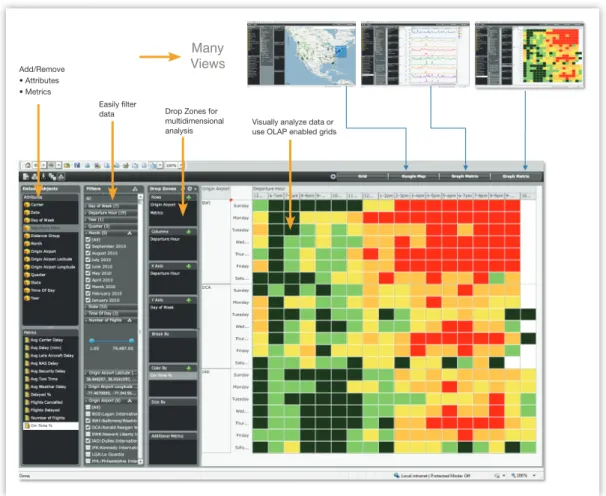
MicroStrategy 9 provides capabilities for business personnel to create their own ad hoc report designs easily from
their Web browser. Using drag-and-drop actions through the MicroStrategy 9 Web interface, any business person can
assemble virtually any report by adding attributes and metrics to a simple report template without the need to know
any technical details about the data or the underlying databases. With MicroStrategy 9, business users also have the
ability to interactively build analysis with dozens of visualization options. To enhance usability, the MicroStrategy 9 Web
user interface adopts many familiar Microsoft paradigms, including ribbon toolbars, accordion controls, control-click
multi-select capability, and context-sensitive right-click actions.
Microstrategy Provides end Users with a fast and Intuitive User experience
Add/Remove • A*ributes • MetricsMany
Views
Easily Filter data Visually Analyze Data or use OLAP enabled Grids Drop Zones for mulCdimensional analysisFigure 4: Design and Format a MicroStrategy Report Using a Fast and Intuitive User Interface
MicroStrategy’s next-generation of advanced self-service functionality is designed to provide more control to business
users. Business users can easily import their personal or corporate data directly from the MicroStrategy Web interface
and quickly convert the raw data into insightful visual analyses, reports, or dashboards. The MicroStrategy Visual
Insight interface provides incredible speed-of-interactivity, stunning visualizations, drag-and-drop manipulations, and
instant results – thus allowing business users to rapidly go from data to decisions..
“
We were impressed with MicroStrategy’s self-service architecture, ease-of-use, highly visual dashboards,
Add/Remove • Attributes • Metrics
Easily filter
data Drop Zones for multidimensional
KEY BI REQUIREMENTS MICROSTRATEGY 9 INFORMATION BUILDERS WEBFOCUS 8 User-friendly Interface
• Drag-and-drop actions • One-click access
• Familiar Microsoft paradigms • Tree view navigation • Ribbon toolbars and menus • Accordion controls • Personalized interface • User collaboration capabilities • Context-sensitive online help • Sophisticated formatting for final
report presentation
yes
• The MicroStrategy Web interface leverages many familiar, user-friendly paradigms, including folder-tree navigation, ribbon toolbars, accordion controls, control-click multi-select capabilities, and context-sensitive right-click actions.
• MicroStrategy 9 enables collaboration via comments that can be added to reports to provide instructions to other users and to share information. Every report can maintain and display a set of notes with details on who left the note and when.
• MicroStrategy provides users comprehensive, context-sensitive help throughout the interface.
• MicroStrategy Web allows users to format reports and save custom format styles. These include row-level headers, row-level values, column-level headers, column-level values, metric headers, metric values, subtotal headers, subtotal values, custom groups, consolidation, and reports.
lIMIteD
• Gartner’s survey customers rated Information Builders’ WebFocus as being more difficult to implement, migrate and use.
self-service web Interface • Fully interactive interface with
controls for data formatting, manipulation, and analysis • Real-time changes without a
publishing process
• Creation of report objects, such as prompts and filters, over the Web • What You See Is What You Get
(WYSIWYG) design and editing of any report type over the Web • Zero-footprint Web interface from
any browser
yes
• MicroStrategy puts wide-ranging control in the hands of business users, minimizing the need for IT personnel to perform the same functions. Business users are able to rapidly create, manipulate, format, and analyze any report themselves, all through a single Web interface. Report objects such as prompts, filters, derived metrics, thresholds, and totals can also be created over the Web. Individual columns and rows on a grid can be selected quickly and users can easily format, drill, pivot, and perform other tasks on-the-fly.
• Changes are available right away without any need to publish or export information to other environments. • Business users create highly formatted
reports using any metadata object using a zero-footprint, WYSIWYG design paradigm that drastically shortens report development time.
• MicroStrategy Web is zero-footprint, and does not rely on Java or ActiveX. As a result, report designers and business users can use any browser to design and interact with reports.
lIMIteD
• WebFocus end users, with consumer and recipient roles, get a dynamic view of reports only in WebFocus Info Assist. • WebFocus tools provide limited pixel-level
positioning of report objects over the report layout. More complex formatting and layout requirements typically require the report developer to write FOCUS code.
KEY BI REQUIREMENTS MICROSTRATEGY 9 INFORMATION BUILDERS WEBFOCUS 8 advanced self-service functionality • Data Import • Visual Insight yes
• The Data Import and Visual Insight functionality is designed to give more control to business users. Business users can convert raw data into decisions in minutes and without assistance from the IT department.
• Using Data Import functionality, business users can easily import personal or corporate data from local files, Excel files, or relational databases through the MicroStrategy Web interface. The imported data can be easily converted into interactive reports or dashboards without any IT assistance.
• MicroStrategy Visual Insight allows business users to visually identify patterns, trends, and anomalies in data. Business users can intuitively query, visualize, filter, and drill into their data. A drag-and-drop, WYSIWYG interface enables business users to visualize the changes as they are made. MicroStrategy Visual Insight provides incredible speed-of-interactivity, detailed visualizations, and instant query results, thus allowing business users to rapidly go from data to decisions.
lIMIteD
• WebFocus does support local file imports, and allows you to import data from a text file and access it through any of the WebFocus reporting tools, including Report Painter, HTML RA, HTML GA, HTML Layout Painter, but there are significant constraints on the file formats WebFocus supports. WebFocus supports only two file formats: Excel files and delimited text files.
• The visual design process in Visual Discovery module (an OEM from Advizor Solutions) is not as intuitive and automatic as in MicroStrategy Visual Insight.
Instant response to User actions • Extreme AJAX Web interface • High degree of client-side
processing while maintaining a zero-footprint Web client
yes
• The MicroStrategy Web architecture adheres to an Extreme AJAX model, shifting processing from the Web server to the Web browser for any browser type. By spreading the processing workload, the user is given a much more responsive and interactive Web experience while still preserving a true zero-footprint Web interface.
lIMIteD
• WebFocus report consumers get dynamic reports, but report development and usage isn’t as “smooth” as in MicroStrategy. Report and dashboard development can be more complicated, which is why more complex functionality requires coding in the WebFocus script.
KEY BI REQUIREMENTS MICROSTRATEGY 9 INFORMATION BUILDERS WEBFOCUS 8 Dynamic report Personalization
• Comprehensive parameter and question prompting (column, filter, search based, value, hierarchical) • Personal answers saved for reuse
across different reports
• Security profiles personalize report content for individual users
yes
• In MicroStrategy, a single report can span hundreds of possible data combinations tailored to different user needs.
• MicroStrategy prompts provide report input parameters that control most aspects of a report, and give the user significant ad hoc reporting capabilities. Prompts enable the personalization of reports from a single report definition, reducing the number of objects stored in the metadata repository.
• Advanced report parameters, like object (column) and hierarchy prompts, allow users to select the business attributes and KPIs to include in the report at run-time.
• MicroStrategy Web displays prompt values and report contents that are permitted by the user's security profile. For example, when running a prompted report, dashboard, or document, the user can only select prompt answers that he has permission to see. In a similar way, when running a report, only the metrics and attributes that the user has permission to see will be displayed to the user.
lIMIteD
• WebFocus allows users to select attributes and metrics, but does not have other prompt types like hierarchy prompts, and level prompts.
4. hIgh PerforManCe at any sCale
MicroStrategy technology has long been the performance leader at high user counts and data scale. MicroStrategy 9
continues and extends that leadership with adaptive caching technology called In-memory ROLAP and SQL generation
optimizations that can deliver the highest query performance, even when accessing hundreds of terabytes of data.
In-memory ROLAP takes advantage of the huge addressable memory space now available on 64- bit computers to
provide high performance middle-tier databases that can respond directly to data requests from reports, dashboards,
and OLAP analyses.
“
We look forward to using MicroStrategy 9 In-memory ROLAP technology to help us improve our user
experience with faster response times and to take unnecessary pressure off our Teradata system.
”
In-memory BI fills a void in the Performance Curve of a BI system
BEFORE IN-MEMORY BI
AFTER IN-MEMORY BI
Output Caching In-memory On-Disk Caching Query Database Query Slower Response Time Data Set Caching Report Caching Output Caching Database Query Data Set Caching In-memory Query Report Caching In-memory On-Disk Caching Query Faster Response Time
Figure 5: MicroStrategy In-Memory BI Provides the Combination of Fast Response Time from Multidimensional Caching and the Flexibility of
Ad Hoc Query BI
ROLAP is unique among BI architectures in that it can model whole relational databases as if they were a single
multi-dimensional cube. In this case, the cube is virtual since relational databases often contain terabytes of data that could
not fit within any physical cube technology. MicroStrategy’s virtual cube provides MicroStrategy users with the ability
to perform OLAP interactions with the data and drill freely throughout the vast virtual cube without the severe size
limitations of MOLAP architectures.
“
MicroStrategy’s new In-memory ROLAP option is game changing. Unlike other in-memory approaches on
the market today, it is fully integrated with an enterprise BI environment and provides high performance
transparently to business users. The way in which large amounts of data are stored and accessed in-memory
is so seamless that I was skeptical until I saw the actual SQL generated and witnessed the performance.
”
– Cindi Howson, Founder of BIScorecard
Microstrategy 9 Multi-source rolaP allows Data environments to be optimized for Performance and Cost
MicroStrategy Virtual Cube MicroStrategy Virtual Cube
Successful BI systems often experience dramatic growth in user populations. It is increasingly common for
a single MicroStrategy BI installation to support thousands and even tens of thousands of business users. The technical
challenge in these circumstances is to be able to efficiently accommodate thousands of concurrent user sessions while
providing high performance and easy administration. MicroStrategy 9 supports 64-bit Java Virtual Machines (JVMs)
in both J2EE Web servers as well as ASP.net Web Servers. The dramatically expanded memory available in 64- bit
JVMs supports many more concurrent user sessions, and allows users to display and interact with larger reports and
dashboards.
“
The most critical factor for our organization is the speed with which we can react to the needs of the
business. MicroStrategy enables our executives and other business users to run reports and analyses
within seconds, which in turn, allows our employees to make timely decisions that dramatically impact
the business. Also, our high performance BI environment encourages the use of BI across the company,
providing greater visibility into the business for more employees.
”
–
Chief Information Officer, FAMIQ
KEY BI REQUIREMENTS MICROSTRATEGY 9 INFORMATION BUILDERS WEBFOCUS 8
Quick response time • In-memory ROLAP • Dynamic sourcing • Dynamic multi-level caching
yes
• MicroStrategy’s In-memory ROLAP capabilities leverage 64-bit operating systems to improve the overall performance of the BI system. In-memory ROLAP cubes improve the performance of the most time-consuming and frequently-used queries, while still allowing users to seamlessly navigate the entire data warehouse. • When building a report, the report
developer never has to explicitly reference an In-memory ROLAP cube. Dynamic sourcing capabilities automatically direct queries to In-memory ROLAP cubes whenever possible. Administrators can be assured that the In-memory ROLAP cubes they create will automatically and immediately improve overall query performance.
• MicroStrategy provides automatic caching at multiple levels, including element list, metadata object, report dataset, XML definition, document output, and database connection caching. Caching makes the entire BI system efficient by reducing redundant computations and network traffic.
lIMIteD
• WebFocus provides OLAP technology which is much less efficient than MicroStrategy’s combination of ROLAP with a 64-bit operating system. • Data caching is limited in the WebFocus
platform. In WebFocus, HOLD files can be used to attempt to simulate caching, but there are major differences. The use of HOLD files to minimize database queries is not automatic and requires manual development efforts - to create the HOLD files and to point reports to the HOLD files. This generally becomes a tactical or point solution for specific reports.
• The WebFocus platform does not automatically create report caches that are shared between users, negatively impacting overall system performance. • The WebFocus caching engine cannot
automatically utilize existing HOLD file data sets or persisted scheduled reports for subset reports based on a master report.
KEY BI REQUIREMENTS MICROSTRATEGY 9 INFORMATION BUILDERS WEBFOCUS 8 high Performance rolaP engine
• Push-down joins • Push-down analytics • Multi-pass SQL
• Support for all implementations of multi-pass SQL, including the use of temp tables, derived tables, and common table expressions • Minimize network traffic • Automatic aggregate awareness • Database-specific SQL generation
and optimization through VLDB drivers
• SQL query optimization algorithms
yes
• MicroStrategy’s ROLAP architecture uses the database for much of its processing. Data joins and analytic calculations are processed in the database whenever possible. MicroStrategy’s multi-pass approach provides the flexibility to answer analytical questions in an optimal manner. Any technical advances in the database are seamlessly accessible to the MicroStrategy platform. By leveraging the database to its fullest extent possible, large volumes of transaction level data are processed efficiently and network traffic is minimized.
• Automatic and intelligent support for common data warehouse optimization techniques like aggregate tables and table partitioning ensures that the MicroStrategy SQL engine maximizes database usage for every analysis. • VLDB properties allow for further
fine-tuning of the SQL engine on both a global and report-by-report basis. Through VLDB drivers, MicroStrategy can optimize table join sequences, databases’ parallel execution capabilities, query optimization hints, and other database-specific tuning parameters.
• Global SQL query optimization algorithms optimize complex queries to reduce the number of SQL passes, providing further performance improvement to queries.
lIMIteD
• Limited Multisource implemented with a push - down architecture - Information Builders and 3rd party EII tools typically pull data from different sources, and join data in the mid-tier.
KEY BI REQUIREMENTS MICROSTRATEGY 9 INFORMATION BUILDERS WEBFOCUS 8 Market Proven enterprise
scalability and Performance • Native 64-bit BI processing • 64-bit Java Virtual Machines (JVMs)
support
• Server Clustering for failover recovery and load balancing • Customer references for large
user and data scale production deployments
yes
• The MicroStrategy platform is designed for enterprise scalability. Native 64-bit processing allows MicroStrategy to support large numbers of users and data volumes while improving performance. MicroStrategy supports native 64-bit processing for all major operating systems, and across the entire BI platform.
• MicroStrategy also fully supports 64-bit Java Virtual Machines (JVMs) in both J2EE Web servers as well as ASP.net Web Servers. The expanded memory available in 64-bit JVMs allows for optimal Web performance across the enterprise. One server can maintain more concurrent user sessions and run much larger reports, reducing overall hardware costs. • A cluster-capable server provides load
balancing and automatic failover capabilities, so system resources are allocated efficiently and system uptime is maximized. MicroStrategy clustered servers support asymmetric configurations, so each cluster node can support different applications. All cluster nodes share caches and in-memory cubes and all changes made to the metadata objects and security settings take effect immediately.
• MicroStrategy has many customer references for deployments to thousands of users who are reporting and analyzing tens of terabytes of data.
yes
• The Information Builders platform provides 64- bit processing.
5. QUICK to IMPleMent anD DePloy, easy to MaIntaIn anD aDMInIster
MicroStrategy 9 can deliver BI solutions quickly with little or no IT support. MicroStrategy’s unified BI architecture
offers many IT timesaving features including object reuse and optimized administration. MicroStrategy 9 allows
organizations to create a single shared business logic layer, the metadata, which presents a single cohesive model
of the business. Object reuse across the entire platform facilitates faster application development. Object reuse
across the entire platform also minimizes IT maintenance effort, since IT only needs to maintain one object instead
of several (or several hundred) object copies. Object reuse ensures a single “version of the truth” that persists across
all reports, dashboards, and analyses, regardless of who creates them.
Microstrategy allows report Designers to Create reusable Metadata Components
Range of Metadata Elements Used in Reports
REPORT DESIGN Layout Format Calculations REPORT COMPONENTS Parameterization Templates Filters Autostyles BUSINESS ABSTRACTION Metrics Hierarchies Custom Groupings Transformations DATA ABSTRACTION Attributes Facts Tables Aliases MicroStrategy Other BI Technologies Report-Specific Components Report-Specific Components Reusable Metadata Components Reusable Metadata Components
Figure 7: The More Comprehensive the Reusable Metadata, the More an Enterprise can Ensure Fast and Managed Development
MicroStrategy designed its architecture to minimize administration overhead through capabilities such as
a single administration point, reusable and automated cell level data security, and automatic internationalization
features. A central point of control across the entire platform reduces overhead. MicroStrategy’s universally-applied
reusable security system protects the privacy of the data and dynamically filters out data from any report based on
the security profile of each business user. MicroStrategy 9 offers the ability to automatically present every report,
dashboard, or OLAP analysis in the local language of each business user viewing the information without requiring
any additional design work by report authors. MicroStrategy capabilities, such as centralization and automation,
allow administrators to deliver secure BI to any user base, whether to a department or to thousands of users, with
minimal IT effort.
“
The new BI system has reduced the time we spend on monthly reporting by more than 50%. There is now
more time to spend on operations and innovation.
”
– IT Specialist, Silverstar Casino
KEY BI REQUIREMENTS MICROSTRATEGY 9 INFORMATION BUILDERS WEBFOCUS 8 Unified BI architecture
• Single interface provides seamless integration of analytics and reporting for root cause analysis
• Single metadata reduces IT effort • Single Server
• Single code base across platforms • Single, zero-footprint Web interface
yes
• MicroStrategy’s single code base offers reusable business logic across the entire platform. For example, MicroStrategy’s dashboards can be made from existing reports and objects, speeding development and ensuring consistency of report logic across reports and dashboards.
• MicroStrategy’s single BI server provides efficient, centralized administration for the IT administrator. A single server with fewer moving parts and processes translates into less downtime.
lIMIteD
• The product suite relies on separate sets of metadata. Most metadata information is dispersed in numerous proprietary files that are difficult to maintain. ReportCaster has its own separate metadata repository stored in a relational database. Different styles of BI require different user interfaces. Developers are forced to use many different interfaces to build different types of reports.
reusable and rich Metadata layer • Robust abstraction layer where all
physical constructs can be modeled logically and hidden from the business user
• Highly reusable metadata • Automatic change management • Object-oriented metadata
yes
• MicroStrategy’s object-oriented metadata defines an enterprise’s business layer in a single repository. Metadata objects can be nested as building blocks to create more complex objects. If a metadata object changes, every other metadata object dependent on it automatically changes. This ensures consistency across business definitions and minimizes the number of objects to create and maintain. • MicroStrategy assembles all metadata
objects necessary for a report and dynamically builds the report SQL at run-time. Complex queries, such as set qualifications, dimensional calculations, and custom groupings, are created easily without requiring manual SQL coding.
lIMIteD
• In the WebFocus platform, some metadata objects like the semantic layer and reports are shared across tools and users. However, many other metadata abstractions, like filters, cannot be created by the end user and shared as standalone reusable objects outside of the report without coding. The inability to create centralized and reusable metadata objects leads to redundant development work and risk of multiple versions of the truth. A change to a simple business rule can therefore require making changes to hundreds or even thousands of reports and will likely lead to significant workload.
• Report objects defined outside of master files, such as metric calculations and filters, cannot be reused nor embedded in other report components. Report objects must often be redundantly defined across reports, resulting in inefficient development and maintenance effort and increasing the risk of multiple versions of the truth. A standard methodology is hard to implement since each developer can create their independent versions of objects in reports.
• A WebFocus developer must usually manually inspect report and procedure definitions one-by-one to trace a report to its source and to examine associated business rules and data transformations.
KEY BI REQUIREMENTS MICROSTRATEGY 9 INFORMATION BUILDERS WEBFOCUS 8 enterprise-Caliber administration
• Single management console • Self-tuning scalable server for maximum performance • Impact analysis
• Usage monitoring / auditing • Controlled environment for usage analysis
• Object management / migration • Change journaling
• Automated regression testing • Optimization of In-Memory ROLAP
environment
yes
• MicroStrategy’s centralized administration provides a single console for real-time user and system management. Administrators can view and perform tasks on many system-wide activities, including executing jobs, user management, and scheduled services.
• MicroStrategy Enterprise Manager provides out-of-the box platform monitoring with hundreds of KPIs and corresponding dashboards to perform impact analysis, auditing and tuning of the BI application.
• MicroStrategy Object Manager facilitates metadata life cycle management, metadata dependencies, and project management.
• MicroStrategy’s change journaling system captures and logs all changes to the metadata. Change tracking is critical for Sarbanes-Oxley compliance. Persistent commenting allows distributed development teams to communicate with one another about their changes.
• MicroStrategy Integrity Manager automates the report comparison process and verifies the consistency of reports. This tool can detect, compare, and present inconsistencies in reports and data caused by changes in the BI ecosystem. Discrepancies in data values, SQL, and graph display are highlighted. • Cube Advisor recommends and
automatically creates an optimal set of In-Memory Cubes to reduce database processing and improve response times.
lIMIteD
• WebFocus does provide a centralized administration console for system management. Although it is possible to perform analysis on usage statistics, the number of statistic measures gathered is limited. Real-time usage monitoring is also not possible. There are no tools to facilitate project lifecycle management. • WebFocus does not have out-of-the-box
tracking and auditing of changes in the metadata.
• WebFocus relies on a 3rd party version control system (SourceSafe) to maintain version control of WebFocus metadata files (e.g., schema, reports). For more granular objects (e.g., dimensions, metrics, formulas, or filters) which do not exist as standalone files, WebFocus does not automatically track object changes out of the box.