,, ., f / PROCEEDINGS OF THE IBEE, VOL. 59, NO. 6, JUNE 1971
An Undergraduate Computer Engineering Option
--
for Electrical Engineering
CLARENCE L. COATES, JR.,
SENIOR MEMBER, IEEE,BRUCE ARDEN, THOMAS C. BARTEE,
MEMBER, IEEE,C. GORDON BELL,
SENIOR MEMBER, IEEE,FRANKLIN F. KUO,
MEMBER,IEEE,
EDWARD J. McCLUSKEY, JR.,
FELLOW, IEEE, ANDWILLIAM H. SURBER, JR.,
SENIOR MEMBER, IEEE
Invited Paper
The Committee on Computer Sciences in Electrical Engineering (the COSINE Committee) of the Commission on Engineering Education1 was formed in 1965 to suggest direction and encourage action in incorporating the com- puter in the electrical engineering curriculum. This has been done through meetings of department chairmen, meet- ings with representatives of industry and government, summer institutes, and issuing reports by the committee or prepared by appointed task forces.
The titles2 of reports by these task forces indicate the thrust of committee efforts :
1) "Some specifications for a computer-oriented first course in electrical engineering;"
2) "Some specifications for an undergraduate course in digital subsystems;"
3) "An undergraduate electrical engineering course on computer organization ;"
4) "Impact of computers on electrical engineering education-a view from industry;"
Manuscript received October 14, 1970; revised January 4, 1971. This study was supported by the National Science Foundation under Contract NSF-0310, Task Order No. 161 with the Commission on Education, National Academy of Engineering. This report was issued as a report of a Task Force appointed by the Computer Science in Electrical Engineering (COSINE) Committee of the Commission on Education of the National Academy of Engineering. It represents the views of the COSINE Commit- tee, but does not necessarily represent the views of the Commission or the Academy.
C. L. Coates, Jr., is with the Department of Electrical Engineering, Uni- versity of Texas, Austin, Tex. 78712.
B. Arden is with the Department of Electrical Engineering, University of Michigan, Ann Arbor, Mich. 48104.
T. C. Bartee is with the Division of Engineering and Applied Physics, Haward University, Cambridge, Mass. 021 38.
C. G. Bell is with the Department of Electrical Engineering, Carnegie- Mellon University, Pittsburgh, Pa. 1521 3.
F. F. Kuo is with the Department of Electrical Engineering, University of Hawaii, Honolulu, Hawaii 96822.
E. J. McCluskey, Jr., is with the Department of Electrical Engineering, Stanford University, Stanford, Calif. 94305.
W. H. Surber, Jr., is with the Department of Electrical Engineering, Princeton University, Princeton, N. J. 08540.
'
Now the Commission on Education of the National Academy of Engineering.'
Copies are available from Commission on Education, NAE, 2101 Constitution Ave., N.W., Washington, D. C., 20418.5) "An undergraduate computer engineering option for electrical engineering;"
6) "Digital systems laboratories;" 7) "Computer-aided circuit design;" 8) "Operating systems;"
9) "Computers in electrophysics;" 10) "Minicomputers."
The strong organizational trend is to provide computer engineering as an option or program within electrical en- gineering. In a survey completed in February 197 1, in which 203 departments responded, 87 indicated that they now offer an undergraduate option or program in computer engineering. An additional 35 without such options now indicated new plans were in progress for their implementa- tion within the next year. It becomes clear that the report on computer engineering options prepared by the task force under C. L. Coates is of primary importance in elec- trical engineering education at this time. It is published here in a form only slightly modified from the original COSINE report.
M. E. VAN VALKENBURG Chairman
COSINE Committee, 1968-197 1
Abstract-Computer engineering is concerned w i t h the organiza- tion, design, and utilization of digital processing systems. These may be general purpose computers or more specialized digital systems that are concerned w i t h communications. control. information processing, etc. The rapidly expanding application areas for digital processing techniques require increasing numbers of properly trained engineers. and i t is the responsibility of electrical engineering education t o provide the necessary educational opportunities. A means for doing this is an undergraduate computer engineering option within elec- trical engineering. The curriculum for such an educational program would be both hardware and software oriented, as described.
LECTRICAL Engineering is primarily the science
E
and art of generating, transmitting, and processing signals. Throughout its history, the scope of its re- sponsibilities has expanded as advances in science and tech- nology have stimulated new and varied application areas. During the 1930s, electrical engineering was concernedCOATES et a/. : UNDERGRADUATE COMPUTER ENGINEERING OPTION 855
almost exclusively with the generation, transmission, and utilization of large electric energy signals; and electrical engineering education focused attention on the subjects that were important to the development and application of this technology. During the 1940s, the electronics era emerged within electrical engineering and required that electrical engineering education expand into new areas. Originally, the new demands were modest and could be satisfied within the curriculum designed primarily for the electrical power era. The demands increased rapidly, however, and thereby produced serious stress within electrical engineering educa- tion. These were relieved and all responsibilities fulfilled by the option program; one concerned with electrical power engineering and the other with electronics or communica- tions engineering. During the 1950s, the opportunities for electronic engineers completely overshadowed those for electrical power engineers. This, together with the rapid expansion of electronics-oriented knowledge, caused the demise of the power engineering option. Electrical engi- neering education became a single curriculum directed pri- marily toward education in the science and technology of electronics. Within this era the study of systems, which heretofore had been of minor educational importance, be- came one of the dominant subject areas, and signal process- ing became an important topic thereof.
Until the 1950s, most of the signals with which electrical engineering was concerned were analog in nature; that is, they were defined over a continuous range of times and took on a continuous range of amplitudes. Radar and other systems that involved precise timing considerations were re- sponsible for the introduction of discrete-time discrete- amplitude signals; but the influence of this was not immedi- ately apparent and certainly had little effect on electrical engineering education. With the development of the digital computer, however, discrete signals became a new dimen- sion of electrical engineering. Since then, the rapid advances in digital technology, and the widespread successful applica- tion areas have made discrete signals and digital processing commonplace in electrical engineering. Moreover, their im- portance is growing without an apparent bound as the developments in integrated circuit and digital processing technologies make possible the achievement of systems with far more sophisticated types of processing and control func- tions than were heretofore possible. As a result, a significant and ever increasing fraction of electrical engineering is con- cerned with the organization, design, and utilization of digi- tal processing systems as general purpose computers or as components of systems concerned with communication, control, measurement, or signal processing. This we call computer engineering.
Once again electrical engineering education finds itself deficient in meeting the needs of electrical engineering with regard to a new dimension of the profession. Although it is deeply involved in a wide gamut of areas which border on or contribute to computer technology, it has yet to recognize and fulfill its responsibility to provide a coherent educa- tional opportunity for computer engineering. In part, this stems from the lack of differentiation, on the part of most
leaders of electrical engineering education, between com- puter engineering education and education in how to pro- gram a computer as a numerical calculator.
Computer engineering is concerned with the organiza- tion, design, and utilization of digital processing systems as general purpose computers or as components of larger sys- tems. Modern digital processing systems consist of hard- ware and software. Traditionally, electrical engineering departments have given some attention to the digital circuits portion of the hardware; but for the most part have ignored the organization portion of the hardware and all of the software aspects. This is a terribly nearsighted viewpoint. In the design of a digital processing system, hardware and software must be considered as an integrated entity. Soft- ware cannot be separated from hardware considerations; thus the computer engineer must be both a capable pro- grammer and a capable hardware designer.
In many respects electrical engineering education faces the same situation today, with the added obligation that it provide education in computer engineering, that it faced in the 1940s when the obligation for education of the electron- ics engineer was added to its responsibilities. Now, as then, the collective demands of the two areas encompass more knowledge than can be included in a single highly structured degree program. The solution today is the one that was adopted successfully in the past; namely, that electrical engineering education offer a computer engineering option program at the undergraduate level.
This report is concerned with a new undergraduate op- tion within electrical engineering which is called computer
engineering. The report will consider the need for such a pro- gram, a description of its content, and a plan of implemen- tation.
11. THE NEED FOR COMPUTER ENGINEERING
In recent years there have been proposed a number of curricula for education in computing. Most notable among these are the reports of the ACM Curriculum Committee on Computer Science: An Undergraduate Program in Com-
puter Science-Preliminary Considerations [l ] and Curric-
ulum 68 [2] ; and an interim report of the COSINE Commit- tee of the Commission on Engineering Education: Com-
puter Sciences in Electrical Engineering [3]. In view of these earlier efforts, why is this present report necessary?
Many universities have already recognized the need for education in computing and have organized computer sci- ence programs on all degree levels. In view of this situation, why is it necessary or even desirable to propose an under- graduate computer engineering option? Why should this be within electrical engineering?
During the past few years the extensive growth in the use and complexity of general purpose digital computers has produced an enormous demand for individuals with a soft- ware education. This was partly responsible for the ACM curriculum studies [I], [2] and, undoubtedly, influenced their objective. The results from both of these studies were science oriented educational programs with primary em- phasis on software education. Neither recognized the need
PROCEEDlNGS OF THE IEEE, JUNE 1971
for, nor gave consideration to, a program for computer engi- neering education. It is true that both of the ACM curricula have course descriptions which are similar to certain courses in the present report. Nevertheless, the core subjects of
Curriculum 68 [2], as well as the overall program, show clearly that the intent was a science-oriented software pro- gram and not an engineering program for education in dig- ital processing system design. The COSINE report [3] had a somewhat different objective from those of ACM. Its pur- pose was to indicate a minimal set of courses that could be included in the undergraduate electrical engineering curric- ulum and, thereby, introduce the student to the basic tech- niques and theoretical concepts of computing. It, too, was not directly concerned with educating the computer engi- neer. Therefore, the previous studies have not had computer engineering as the primary objective; and, consequently, they do not provide adequate guidelines for the fulfillment of this need.
In response to the demand for software education, univer- sities have established computer science departments or programs whose primary emphasis and objectives are con- sistent with those of the ACM curriculum reports. Most pro- grams are organized within the arts or sciences college of the university and emphasize programming, numerical analysis, and automata theory. For the most part the facul- ties have a science, rather than engineering, background with the result that the programs were initially science-ori- ented and have developed more and more in that direction since inception. The student emerging from this educational program is a science-oriented individual whose education is directed toward developing him, with experience, into a software specialist. As such, he is in great demand because of the extensive software needs generated by the general purpose digital computer.
He is not a computer engineer, however, nor could he become one without extensive study. Neither his education nor his interests are directed toward the design of digital systems. It is true that software is an essential part of com- puter engineering, but equally important parts are hardware and systems. Moreover, the concept of design is essential to computer engineering including the design of software, hardware, and systems. The graduate of most computer sci- ence programs is not educated for this type of activity. This objective requires an engineering education.
The digital system is a processor of information. Within the system, information is represented by discrete-time dis- crete-amplitude electrical signals; and the processor, there- fore, is an electronic system. Clearly, a knowledge of elec- tricity and electronics is fundamental to digital processing system design. Within the university, electrical engineering is responsible for engineering education in electronics. As the knowledge and applications of electronics has expanded during the last two decades, electrical engineering depart- ments have become deeply involved in many new and re- lated areas. Many of these, such as integrated circuits and microelectronics, switching theory and logical design, ma- chine organization, system theory, communications and
coding systems, etc., are essential to the science and tech- nology of digital processing systems. Therefore, within the normal engineering college structure, electrical engineering is the department whose faculty and facilities most closely correlate with the requirements for education in computer engineering.
This does not mean that all of the subjects within the traditional electrical engineering curriculum should be in- cluded in computer engineering. Neither does it imply that all of the subject matter that is essential to computer engi- neering education is contained within electrical engineering. Certainly, the traditional electrical engineering curriculum depends upon offerings from other departments within the university, such as mathematics, physics, etc. Similarly, computer engineering would utilize the educational offer- ings of appropriate departments including those of com- puter science.
111. THE UNDERGRADUATE PROGRAM The Committee strongly believes that electrical engineer- ing departments must include an undergraduate computer engineering option that will provide the student with a basic and comprehensive knowledge of the principles that under- lie the organization, design, and applications of digital pro- cessing systems. This option, called here computer engineer- ing, is intended to provide a sufficiently broad foundation to encompass both the hardware and software design as- pects of the system. Moreover, it must provide an under- standing of the important relationships and "tradeoffs" between the hardware and software components of the system and an understanding of how these functions should be partitioned in the system organization in view of the intended applications.
The committee recognizes the difficulty in attempting to specify a detailed curriculum in computer engineering; no single curriculum could possibly fit into the variety of pro- grams and organizational frameworks present in electrical engineering departments. A computer engineering program can assume a variety of forms. It can, for example, be a spe- cial option within electrical engineering as has been sug- gested. Alternatively, it can be realized by allowing enough elective flexibility within a standard electrical engineering curriculum to make it possible for a student to acquire the necessary computer engineering subject matter.
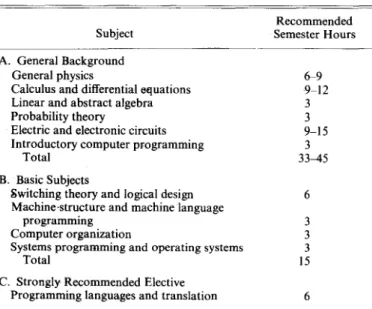
The committee also recognizes that the initiation of a program in computer engineering must depend primarily upon the courses already available within the university, and that the content and prerequisite structure of these will differ with different institutions. Because of this, the degree program for computer engineering is not specified com- pletely. Instead, only the material that would constitute the minimal recommended subjects for computer engineering, together with a group of recommended electives, is pre- sented. Where possible, this material is presented as subject blocks with the associated number of credit hours indicating the recommended depth of coverage of the subject. Pre- requisite relationships are held to a minimum since these
.COATES et al. : UNDERGRADUATE COMPUTER ENGINEERING OPTION TABLE I Subject Recommended Semester Hours A. General Background General physics 6 9 Calculus and differential equations 9-1 2 Linear and abstract algebra 3 Probability theory 3 Electric and electronic circuits 9-15 Introductory computer programming 3
Total 3 3 4 5
B. Basic Subjects
Switching theory and logical design 6
Machine.structure and machine language
programming 3
Computer organization 3 Systems programming and operating systems 3
Total 15
C. Strongly Recommended Elective
Programming languages and translation 6
" As pointed out in [3], some of the subjects are recommended for all electrical engineering students.
TABLE I1
Recommended Subject Semester Hours Numerical analysis 3 Logic and automata theory 3 Communication systems 3 Operations research 3 Simulation and modeling 3
Field analysis 3
Total 18
are determined by the course requirements at individual universities. Even so, the subject content and sequences should be considered only as a desirable configuration for indicating the recommended content. These could be modi- fied as necessary; and should, therefore, be regarded as guidelines to assist individual departments in developing a computer engineering curriculum that is commensurate with its particu!ar needs, circumstances, and available resources.
It must be emphasized that the recommended subjects represent the most important material; but, by themselves, do not constitute an adequate educational program. Every program should provide the opportunity to study special- ized and advanced aspects of a variety of subjects in areas of individual interest, as well as provide sufficient technical and general knowledge so that the student can continue to broaden his education and develop professionally through- out his career. This does not imply that the student must have some of the traditional subjects of the electrical engi- neer, such as antennas, microwaves, quantum electronics, machines, power system analysis, etc., or the abstract sub- jects of computer science, such as formal languages, com-
RECOY;\IIENDED PHFUUISITE S'1 RUC'TURE FOR CORE S.UI:JECTS
Grneral Calculi~s &
Physics Differential
Theory Theory & and Machine 3 hrs. Logical
Design
6 hrs. 3 hrs.
Machine Systems Programming Organization & Operating Systems
3 hrs. 3 hrs.
Fig. 1. Reference to Section IV, Description of Subject Areas, shows that laboratory experience is associated with a number of the subject areas of Tables I and 11. The semester hours credit given in these Tables does not necessarily include credit for the laboratory activity, since laboratory organization varies between universities.
putability, advanced numerical analysis, etc. Neither does it mean that some of these subjects could not 6e studied. What the committee recommends in this regard is that indi- vidual curricula reflect the concept of greater flexibility, since it is only in a climate offlexibility that engineering edu- cation can respond to the rapid advances in science and technology and adapt to the explosive growth of knowledge that is now occurring.
The material representing the recommended subjects for computer engineering, together with important electives, are given in Tables I and 11. Fig. 1 indicates the recom- mended prerequisite structure. These are followed by a description of each subject block and explanatory com- ments.
IV. DESCRIPTION OF SUBJECT AREAS
The following is a description of the subject areas that constitute the recommended subjects for computer engi- neering as listed in Table I. The subjects fall into the general classification areas of physics, mathematics, circuits, com- puter logic, and computer programming.
General Physics (6-9 semester hours)
Comment: This refers to the introductory physics course
or course sequence that is a part of the engineering curricula of most universities. The committee assumes that it contains the usual subjects including electricity.
Calculus and Dzfferential Equations (9-12 semester hours) Comment: This refers to the calculus and differential
equation course sequence that is a part of most electrical engineering curricula. It is intended that it include analytic geometry and/or the elements of linear algebra when this is a part of, or a prerequisite of, the calculusdiRerential equation sequence at a particular university.
Linear and Abstract Algebra (3 semester hours)
Comment: This course should introduce the student to
cluded in the calculus-differential equation sequence, the entire course could be concerned with abstract algebra. The abstract algebra presentation could be strictly theoretical or from an applications viewpoint. The latter is preferable at those institutions where it is practical. The material could be a standard course offered by the mathematics department or a special course offered by electrical engineering or some other department.
Probability Theory (3 semester hours)
Comment: The principal objective of this course is dis-
crete probability theory, although it would, undoubtedly, include some continuous probability consideration. Ele- mentary random process theory might also be included depending upon the institution, but this is not of primary importance. The material might be provided by a standard mathematics course or by a course in electrical engineering. The prerequisite structure would be determined by the content.
Electric and Electronic Circuits (9-15 semester hours) Comment: The intention is that each department use its
standard course offerings in network and electronic circuits to provide the necessary material. The principal objective of this subject area is the study of electronic circuits where this includes switching and logic circuits. This, of course, requires a background of network theory, and this topic is included in the subject area. Moreover, it is assumed that the subject area includes appropriate laboratory experience.
Introductory Computer Programming (3 semester hours) Comment: This course should provide the basic knowl-
edge and experience necessary to use computers for the solu- tion of engineering-oriented problems and for nonnumeric processing. The underlying fundamentals of algorithms, techniques for implementation and basic computer features should be stressed. A higher level language, such as For- tran, Algol, or Basic should be used in the treatment. The suggested material and level of presentation is that pro- vided by texts such as Hull [8], Rice and Rice [9], Kemeney and Kurtz [lo], or McCracken [ l l ] , [12].
A laboratory experience should be associated with the course that requires the student to write a significant num- ber of small, but complete, programs which solve particular problems. Oneor two programming projects might be given, in addition to the small problems, to introduce the use of subroutines and program structure.
Switching Theory and Logical Design (6 semester hours) Content: Combinational Circuits: Boolean algebra, bi-
nary and complement arithmetic codes, function represen- tations, logic gates, minimization techniques, Boolean func- tion realizations. Sequential Circuits: Flip-flop design from logic gates, representation, state reduction, realization of pulse and fundamental mode circuits, races, hazards, and iterative logic structures. Logic Subsystems: Encoding and decoding networks, binary and decimal counters, analog/ digital converters, and other selected digital subsystems.
Comments: This subject area includes the usual material
of switching theory and logical design, as well as material on the design of logic subsystems. The suggested level of pre- sentation is that provided by texts such as Hill and Peterson [4], or McCluskey [5], with additional logic design material, such as that provided by chapter 6 of Gschwind [6]. It is also recommended that laboratory experience be associated with this subject area.
Machine Structure and Machine Language Programming
(3 semester hours)
Content: Computer organization model for interpreting
a machine language, machine representation of data and instructions, programming in assembly language, 110 pro- cesses, equipment interrupts, stacks, and multiprogram- ming.
Comment: Students would not concentrate on machine
language programming but would solve enough problems to become familiar with the machine. This course should relate to the previous course, Introductory Computer Pro- gramming, by drawing a parallel to higher level languages. Possible texts are those by Flores [13], Wegner [14], Hellerman [15], Gear [16], and others.
Computer Organization (3 semester hours)
Content: Elements of a stored program computer, data
representation, algorithms for operating on data, arith- metic units, control units, memory units, processor struc- tures, and selected computer examples.
Comment: The content of this course is described in detail
in the COSINE Report, "An undergraduate electrical engi- neering course on c-omputer organizationm [7], that was the result of a previous study. It is strongly recommended that the subject areas of switching theory and logical design, and machine language programming be prerequisites for this course. Associated laboratory experience would be very desirable, although the committee recognizes that this re- quires extensive development and may not be practical initially.
Systems Programming and Operating Systems ( 3 semester hours)
Content: Program and data structure; operation of the
110 devices, their software control, and the interrupt struc- ture; the nature of hardware and software controlled re- sources followed by the method used to allocate resources to tasks; the accounting of resources; data files including the hardware and the organization based on user constraints of reliability, performance, cost, and software implementa- tion; the job control language; and generation of new sys- tems.
Comment: This course would first teach principles of sys-
tem programming design and organization. This course must presently use the case study method based on a particu- lar operating system(s). The operating system should be considered from a critical view, and incremental changes of hardware and software policy could be analyzed. This course should be taught concurrently with the machine or- ganization course. It would be desirable to use a simple early single-queue operating system which is well-under-
COATES et a/. : UNDERGRADUATE COMPUTER ENGINEERING OPTION
stood-as opposed to studying all the topics superficially. There are presently no texts which singularly cover the struc- ture and principle of operating system design. A possibility, however, is the book by Wegner [17], and the description of the operating systems used at the particular institution. Laboratory experience should be associated with this course and might consist of modeling the operating system being studied and comparing the predicted results with the actual observed performance.
Programming Languages and Translation (6 semester hours) Comment: This subject area is concerned with the study
, of different types of programming languages and a com-
parison of their characteristics; and the study of compilers and assemblers.
The following is a description of the subject areas listed in Table I1 as recommended electives for the computer engineering program.
Numerical Analysis (3 semester hours)
Comment: This is intended as the standard first course in numerical methods that is probably offered by the mathe- matics or computer science department. The exact content would determine both the mathematics and programming prerequisites, although it is recommended that some com- puter use be associated with the course.
Logic and Automata Theory (3 semester hours)
Comment: This is intended as a course combining elemen- tary formal logic and automata theory; although it could be exclusively one or the other, depending on the situation at a particular institution. The material and level of presen- tation suggested for an automata theory course is repre- sented by the book by Minsky [18].
Communication Systems (3 semester hours)
Comment: This could be either a statistical communica- tions theory course, or a course oriented more toward com- munication systems, depending upon the type of course available at the particular university.
Operations Research (3 semester hours)
Comment: This is intended to be the standard first course in operations research or mathematical programming that is available at the university. It is strongly suggested, how- ever, that the elements of queueing theory be included in this offering.
Simulation and Modeling (3 semester hours)
Comment: This is considered an area of increasing im- portance and one that should be available to the student when qualified faculty are present who can define the con- tent in terms of their available resources.
Field Analysis (3 semester hours)
Content: Field and wave concepts related to the computer system with emphasis on space and time problems relating to memory devices, systems noise, data transmission, ther- mal effects, etc.
Comment: What is intended is a field analysis course
designed specifically for the computer engineer. Such a course is not normally available today, however, and is in- cluded only to indicate the need for a special course.
The principal objective of this report is the establishment of undergraduate programs within engineering that would provide an adequate education in computer engineering. The report addresses itself to the option program within electrical engineering as the most logical route and suggests a curriculum for accomplishing the objectives. Throughout the roport, however, it has been emphasized that the avail- ability ofieomputer engineering is the important item, and that both
the
organizational mechanism and the exact cur- riculum by which it is accomplished are secondary as long as the essential subject matter is included.The committee realizes that a new program must depend primarily upon courses which currently exist within the university irrespective of the department in which they are offered. The responsibilities for education in many of the recommended subject areas and in the recommended elec- tive g r q have well established locations within the univer- sity organization. The subject areas of switching theory and logical design and machine organization are usually handled by electrical engineering as is the area of electric and elec- tronic circuits. Although some of the other areas are equally well established, there are some that might be in one or more of a number of different departments. A case in point are the software subjects.
In those institutions which have established computer science departments, software education would probably be their responsibility. In such cases the computer engineer- ing option might well use the appropriate computer science software courses. This does not imply that electrical engi- neering need not develop faculty capability in the software area for the computer engineering program; but, rather, that this is not essential for initiating the option. Ultimately, what needs to be done in this regard depends upon the re- quirements of the program as it evolves at each university. The committee recognizes that the recommended sub- jects of computer engineering may not correspond to exist- ing courses of a particular institution. In some cases the topics of a subject area may be distributed over more than the suggested number of credit hours because of course organization or prerequisite structure. In others some of the topics may not be available in existing courses. Under these circumstances the suggested material should be considered as representing the recommended content rather than the organization of topics into courses. In those cases where significant portions of a recommended subject area are not -available, a new course is the only solution. In many cases, however, courses do exist which collectively include the sug- gested topics as well as others, and these would satisfy the needs of the curriculum.
The authors wish to thank W. Miller, Stanford Univer- sity, and R. Spinrad, Xerox Data Systems, whose ideas and comments significantly influenced this report.
[ l ] Association for Computing Machinery, Curriculum Committee on Computer Science, "An undergraduate program in computer science -preliminary considerations," Commun. Ass. Comput. Mach., Sept. 1965, pp. 543-552.
[2] -, "Curriculum 68," Commun. Ass. Comput. Mach., Mar. 1968, pp. 151-197.
[3] COSINE Committee, Commission on Engineering Education, "Computer science in electrical engineering," IEEE Spectrum, Mar. 1968, pp. 96103.
[4] F. J. Hill and G. R. Peterson, Introduction to Switching Theory and
Logical Design. New York: Wiley, 1968.
[5] E. J. McCluskey, Introduciion to the Theory of Switching Circuits. New York: McGraw-Hill, 1965.
[6] H. W. Gschwind, Design of Digital Computers. New York: Springer, 1968.
[7] COSINE Committee, Commission on Engineering Education, "An undergraduate electrical engineering course on computer organiza- tion," Interim Rep., Oct. 1968.
[8] T. E. Hull, Introduction to Computing. Englewood Cliffs, N. J.:
Electric Power
Prentice-Hall, 1966.
[9] J. K. Rice and J. R. Rice, Introduction to Computer Science: Prob-
lems, Algorithms, Languages and Information, prelim. ed. New York: Holt, Rinehart, and Winston, 1967.
[lo] J. G. Kemeney and T. E. Kurtz, Basic Programming. New York: Wiley, 1968.
[ l l ] D. D. McCracken, A Guide to Fortran IV Programming. New York: Wiley.
[12] --, A Guide to Algol Programming. NewYork: Wiley.
[13] I. Flores, Computer Programming. Englewood Cliffs, N. J.: Prentice-Hall, 1966.
[14] P. Wegner, Programming Languages, Information Structures, and
Machine Organization. New York: McGraw-Hill, 1968. [15] H. Hellerman, Digital Computer System Principles. New York:
McGraw-Hill, 1967.
[16] W. C. Gear, Computer Organization and Programming. New York: McGraw-Hill, 1969.
[17] P. Wegner, Introduction to Systems Programming. New York: Academic Press, 1965.
[18] M. L. Minsky, Computation: Finite and Injinite Machines. Engle- wood Cliffs, N. J. : Prentice-Hall, 1967.
Systems Engineering Education
Modern Curriculum
Invited
Paper
Abstract-The nature. size, extent. and growth rate of modern electric power systems are discussed along w i t h examples t o illustrate the large number of concepts and techniques used and to indicate the variety of technological challenges faced by electric power systems engineers. The discussion then turns t o the need for a variety of edu- cational programs t o cover the breadth required, t o the qualifications for faculty rnembers-who staff these programs, and to the ways in which these programs should interact with the power industry. Fi- nally. the electric power systems engineering education program at M I T is discussed in terms of faculity, students, course offerings, and research projects.
I. INTRODUCTION
NE OF the most important systems in our society is the electric power system that supplies electricity to our homes, shops, and factories for the many uses that contribute to our high standard of living. We in- tend to discuss engineering education for application to this electric power system. Before we discuss education, how- ever, it will be helpful to define more carefully the compo-
Manuscript received December 17, 1970.
The authors are with the Massachusetts Institute of Technology, Cambridge, Mass. 02139.
nents of the U. S. electric power industry, its size, its growth rate, and its future needs.
We include in our definition of the electric power industry the electric utilities, both publicly-owned and investor- owned, the manufacturers who supply equipment to the utilities, the consulting firms who supply engineering and other services to the utilities, the large industrial users of electric energy, and the governmental bodies that regulate the activities of the utilities. As an indication of the size of the industry [I], the utilities currently have capital invest- ments in plant and equipment of about 100 billion dollars. The sale of electric energy currently runs about 20 billion dollars per year, and the rate of capital investment by the utilities is about 12 billion dollars a year. These figures in- clude only the generation, transmission, and distribution systems. They do not include the heavy expenditures made for the industrial, commercial, and residential electrical equipment which uses the electricity.
The many predictions of the growth rate of future electric power demands vary in detail, but agree on the important point that substantial growth will continue to the year 2000