18 November 2004
PARTICIPATION IN FULL-TIME EDUCATION BY
16 AND 17 YEAR OLDS IN NORTHERN IRELAND 2003/04
Key Points
• The participation rate of 16 and 17 year olds in full-time education in 2003/04 was 74.3% (68.8% for males and 80.0% for females).
• The participation rate for 16 year olds (77.9%) was higher than for 17 year olds (70.6%). The rate for female 16 year olds was 83.9% and for female 17 year olds was 76.2%. The rate for male 16 year olds was 72.3% and for male 17 year olds was 65.2%.
Participation of 16 & 17 Year Olds in Full-Time Education in Northern Ireland
0% 10% 20% 30% 40% 50% 60% 70% 80% 90% 100% 1999/2000 2000/01 2001/02 2002/03 2003/04 Participation Rate Female Male Total
Statistical Press Release
Department of Education, Rathgael House, 43 Balloo Road, Bangor, Co Down BT19 7PR
Department for Employment and Learning, Adelaide House, 39-49 Adelaide Street, Belfast BT2 8FD
Contact points: Press Enquiries: Press Office (028) 9127 9268 Public Enquiries: Statistics & Research Branch (028) 9127 9401
A National Statistics Publication tatistics &
esearch
R
S
a g e n c y No r t h e r n I r e l a n d
Key Points continued
• Participation rates in Northern Ireland were higher than in England. This was the case for both 16 and 17 year olds, and applied to both males and females.
• Some 67.4% of 16 year olds in full-time education attended schools whereas 32.6% attended further education colleges; the figures for 17 year olds were 61.8% and 38.2% respectively, and the figures for 16 and 17 year olds combined were 64.7% and 35.3% respectively.
Tables
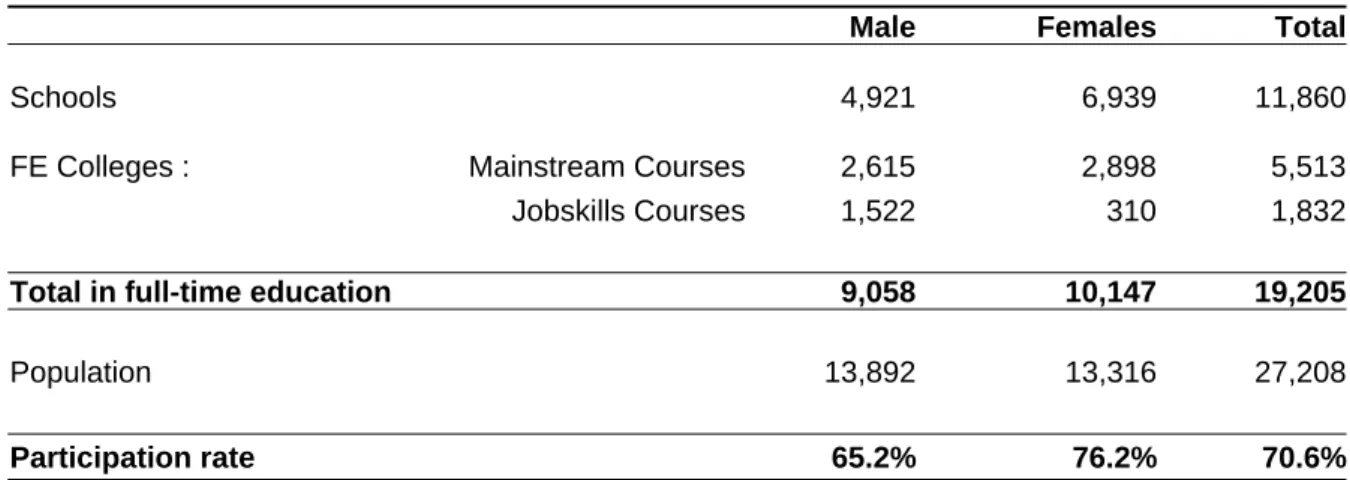
Table 1 : details the participation of 16 year olds in full-time education/ vocational training in schools and FE colleges in 2003/04, by type of establishment attended and sex.
Table 2 : details the participation of 17 year olds in full-time education/ vocational training in schools and FE colleges in 2003/04, by type of establishment attended and sex.
Table 3 : details the participation of 16 & 17 year olds in full-time education/ vocational training in schools and FE colleges in 2003/04, by type of establishment attended and sex.
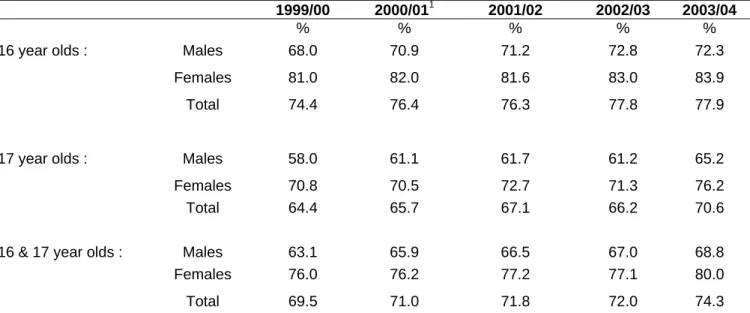
Table 4 : details the participation of 16 year olds, 17 year olds and 16 & 17 year olds in full-time education/vocational training in schools and FE colleges for the years 1999/2000 to 2003/04 inclusive, by sex.
Table 5 : compares the participation of 16 year olds, 17 year olds and 16 & 17 year olds in full-time education/vocational training in schools and FE colleges in 2003/04 in Northern Ireland and England.
Notes to Editors
National Statistics
1. This is a National Statistics publication. National Statistics are produced to high professional standards set out in the National Statistics Code of Practice. They undergo regular assurance reviews to ensure that they meet customer needs. They are produced free from any political interference.
2. For general enquiries about National Statistics, contact the National Statistics Public Enquiry Service on:
0845 601 3034
minicom: 01633 812399 e-mail: [email protected] Fax:01633 652747
Letters: The Library, Office for National Statistics, Cardiff Road, Newport, NP10 8XG
3. You can also find National Statistics on the Internet: www.statistics.gov.uk
Schools
1. The schools statistics in this press release have been derived from the Annual School Census, a return of pupil numbers by age and year group from each school in Northern Ireland.
2. The 2003/04 figures in this press release are counts of school pupils as at 10th October 2003.
3. Age is at 1st July 2003.
Further Education Colleges
1. The Further Education College statistics in this press release have been derived from the Further Education Statistical Record (FESR), a computerised return consisting of an individual record for each enrolment on a vocational course at a Northern Ireland further education college.
2. The 2003/04 figures in this press release are counts of student enrolments as at 1st November 2003. Age is at 1st July 2003.
3. This press release only refers to full-time enrolments, defined as attendance which is:
(a) for at least 15 hours and at least 7 sessions per week, or for more than 21 hours per week with no sessional requirement;
(b) on sandwich courses; or
(c) on short courses i.e. single self-contained periods of full-time study of under 4 weeks’ duration, within one academic year, which do not have to satisfy the hour and session requirements of (a) above.
4. In order to avoid double counting of pupils/students, this press release excludes link students, i.e. those whose attendance at a Further Education College is linked to their attendance at a school.
5. Although the Further Education Statistical Record represents enrolments rather than student numbers, a student may only enrol on one full-time course at any time. Consequently, the number of enrolments can be treated as the number of students for the purpose of this press release.
6. The Further Education College statistics were extracted using a new NICIS Management Information System within the colleges. This data should therefore be treated as provisional.
Population
The figures quoted in this press release are mid-year civilian population estimates. In general, the precision of the population estimates could be considered to be no better than to the nearest 100.
Further Enquiries
Requests for further information should be addressed to:
Mr Michael Bennett
Statistics and Research Branch Department of Education Rathgael House Balloo Road BANGOR Co. Down BT19 7PR Telephone (028) 9127 9707 Fax (028) 9127 9594 e-mail [email protected]
Department of Education Statistical Press Releases can be accessed at the Department’s internet site - www.deni.gov.uk/facts_figures
Press Enquiries should be made to the Department’s Press Office at the above address, telephone (028) 9127 9268 / fax (028) 9127 9271.
Table 1 : Participation in full-time education/vocational training in schools
and FE colleges by 16 year olds, 2003/04
Male Females Total
Schools 6,101 8,147 14,248
FE Colleges : Mainstream Courses 2,324 2,626 4,950
Jobskills Courses 1,645 310 1,955
Total in full-time education 10,070 11,083 21,153
Population 13,930 13,208 27,138 Participation rate 72.3% 83.9% 77.9%
Table 2 : Participation in full-time education/vocational training in schools
and FE colleges by 17 year olds, 2003/04
Male Females Total
Schools 4,921 6,939 11,860
FE Colleges : Mainstream Courses 2,615 2,898 5,513
Jobskills Courses 1,522 310 1,832
Total in full-time education 9,058 10,147 19,205
Population 13,892 13,316 27,208 Participation rate 65.2% 76.2% 70.6%
Table 3 : Participation in full-time education/vocational training in schools
and FE colleges by 16 & 17 year olds, 2003/04
Male Females Total
Schools 11,022 15,086 26,108
FE Colleges : Mainstream Courses 4,939 5,524 10,463
Jobskills Courses 3,167 620 3,787
Total in full-time education 19,128 21,230 40,358
Population 27,822 26,524 54,346
Table 4 : Participation in full-time education/vocational training in schools and FE colleges by 16&17 year olds, 1999/2000 to 2003/04
1999/00 2000/011 2001/02 2002/03 2003/04
% % % % %
16 year olds : Males 68.0 70.9 71.2 72.8 72.3
Females 81.0 82.0 81.6 83.0 83.9 Total 74.4 76.4 76.3 77.8 77.9
17 year olds : Males 58.0 61.1 61.7 61.2 65.2
Females 70.8 70.5 72.7 71.3 76.2 Total 64.4 65.7 67.1 66.2 70.6 16 & 17 year olds : Males 63.1 65.9 66.5 67.0 68.8
Females 76.0 76.2 77.2 77.1 80.0 Total 69.5 71.0 71.8 72.0 74.3
1
Figures from 2000/01 onwards include Jobskills trainees in Government Training Centres, which came under the remit of FE in that year. The net effect of this was to increase the participation rate. [The magnitude of this increase in 2000/01 was two percentage points.]
Table 5 : Comparison of participation in full-time education/vocational
training in schools and FE colleges by 16 & 17 year olds in Northern Ireland and England, 2003/04
Northern Ireland England1
% %
16 year olds : Males 72.3 67.9
Females 83.9 77.2
Total 77.9 72.4
17 year olds : Males 65.2 55.8
Females 76.2 64.2
Total 70.6 59.9
16 & 17 year olds : Males 68.8 61.9
Females 80.0 70.7
Total 74.3 66.2 1
DfES provisional figures. Age in the English figures is at 31st August 2003. Pupils in England aged 16 at 31st August may leave school. Pupils in Northern Ireland may leave school if they are aged 16 at 1st July.