62
THE COLD HARDINESS OF SOME VARIETIES OF GRAPEVINE
CULTIVATED IN THE VITICULTURAL AREA PLENITA (SOUTHWESTERN
ROMANIA)
DANIELA DOLORIS CICHI1, COSTEA DORIN CONSTANTIN1, GHEORGHIU NICOLAE2, 1University of Craiova, Faculty of Horticulture, [email protected]
2 S.C. POMIVITICOLA S.R.L. Plenita
Keywords: cold damage, dormant season, grapevine
ABSTRACT
The study shows the results concerning the assessment of the vulnerability of wine varieties to critical temperature conditions in the autumn-winter period: Italian Riesling, Sauvignon, Tămâioasă românească, Cabernet Sauvignon, Merlot, Fetească neagră and Syrah. In order to evaluate the conditions for vine hibernation in the studied area we preceded the evaluation of climatic parameters with thermal stress potential on vines during 2014/2015 and 2015/2016 dormant seasons, namely: the frequency and level of minimum critical temperatures, the duration and intensity of frost. The critical hibernation conditions during the two dormant periods have caused considerable losses of buds for all the studied varieties. The biggest damages of primary and secondary buds were recorded after the 2014-2015 dormant season, period during which they recorded the most intense freezing as the minimum critical level of temperature and duration.
INTRODUCTION
Low temperatures are also some of the abiotic factors with negative impact on grapevines. Depending on the time when they occur, the minimum level reached, their duration and manner of occurrence (sudden or slow), low temperatures can cause lower or greater damages, up to total plant destruction.
Worldwide, especially in cold climate regions, there are several studies concerning cold damage and cold hardiness of grapevines. Researches focused on: cultivar differences in bud hardiness ( Mills L.J. et al., 2006), management to minimize cold damage (Wolf & Pool R.M., 1988; Hamman & Dami, 2000; Wolf & Boyer, 2001; Davenport J. R. et al., 2008), physiological and environmental factors influencing cold hardiness of grapevines (Düring et al., 1990; Schnabel & Wample, 1987; Seyedbagheri & Fallahi , 1994); seasonal carbohydrate changes of canes and buds (Hamman et al., 1996; Jones K.S. et al., 1999; Cichi Daniela Doloris, 2005) and dynamically water content of bud / cortical tissues in relation to cold hardiness of different cultivars of grapevine
(Wolpert & Howell, 1986; Cichi Daniela Doloris, 2005).
Under the temperate continental climate conditions of Romania, grape vines grow up to the northern border, that is why the cold winter hardiness of grapevines has always been a matter of permanent concern for vine growers and has been the subject of several research studies (Voica N., 1974; Beznea D., 1986; Stoica Felicia, 2003; Daniela Doloris Cichi et al., 2006a, 2006b).
The present paper is focussed on the assessment of the vulnerability of wine grape varieties to critical temperature conditions of 2014-2015 and 2015-2016 autumn-winter periods in the grapevine area of Plenița (South-West of Romania).
63
44°13’00’’ -44°34’00’’ Northern latitude and is crossed by the meridian of 23°11’00’’ Eastern longitude.
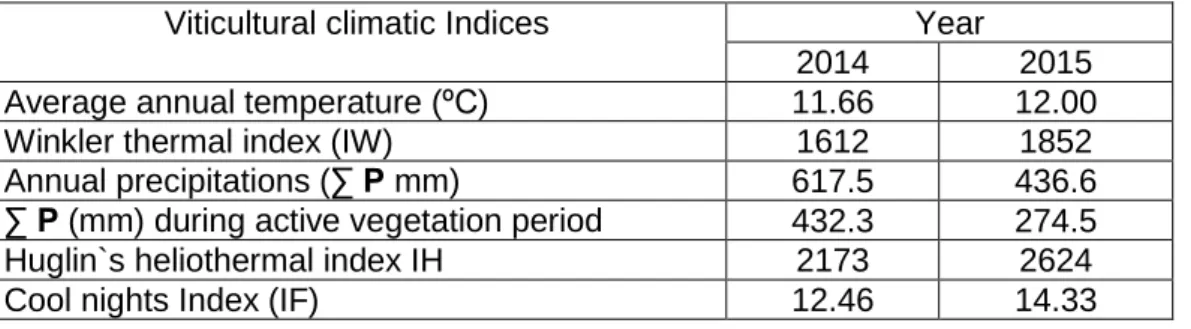
Table 1
The climate characteristics during the vegetation period of years 2014 and 2015
Viticultural climatic Indices Year
2014 2015
Average annual temperature (ºC) 11.66 12.00
Winkler thermal index (IW) 1612 1852
Annual precipitations (∑ P mm) 617.5 436.6
∑ P (mm) during active vegetation period 432.3 274.5
Huglin`s heliothermal index IH 2173 2624
Cool nights Index (IF) 12.46 14.33
The climate is moderate temperate with submediterranean influences due to the frequency of the western and south-western air currents, being also influenced by the south-tropical and east european air currents (Gheorghiu I., 2011; Tuță Veronica, 2011).
The main viticultural climatic characteristics during the vegetation period of 2014 and 2015 years are shown in Table 1.
MATERIAL AND METHOD
Three varieties for white wines were studied, namely - Riesling italian, Sauvignon and Tămâioasă românească and four varieties for red wines - Cabernet Sauvignon, Merlot, Fetească neagră and Syrah. They were grafted on Berlandieri x Riparia,
Oppenheim 4 selection rootstock, with planting distances of 2.2 x 1.0 m, semi-tall
training, Guyot cutting andan average load of 10-12 buds / m2.
The following observations were made for the purpose of monitoring the negative thermal stress parameters: the time when the first and last frost occurred (hoarfrosts and early autumn and late spring frosts), the duration of frost (days), the frequency (number of days and percentage %) and the intensity of winter frost.
In order to check the viability of buds, during the first ten days of March, the cane samples were taken before the pruning. This was done on separate varieties and the cane samples were chosen randomly, diagonally from several representatives points, thus showing the diversity of vineyard conditions. For each sample 20 canes resulting from 20 different stocks were taken and analysed for every variety. The cane samples taken were wrapped in packages and labelled, after which they were stored with their low parts inside water at 18 - 20 0 C.
In order to establish the percentage of buds injury (primary and secondary buds) a crosscut of buds was performed.
The analysis of the buds viability is based on the colour difference of the cut, i.e. the shiny light green colour for viable buds and the dark brown colour of non-viable buds (Olteanu I., 2000).
For statistical analysis XLSTAT-Pro for Microsoft Excel were used.
RESULTS AND DISCUSSIONS
64
Monitoring freezing events in the spring and fall, vine survival over several winters, and damage after specific extreme low temperature events provide information on the types of damages incurred on vines (Anne Fennell, 2004).
Based on the climatic data for the area under study, the earliest autumn frost since 2014-2015 was recorded on the 5th of November 2014 (0 ° C) and the latest spring frost on 24 March 2015 (-1.0 ° C). The first autumn frost in 2015-2016 was recorded on 1 November 2015 (0 ° C), while the latest spring frost on 26 March 2016 (- 3.0 ° C), Table 2.
In what concerns the duration of frost (i.e. the number of days with minimum daily temperatures ≤ 0 ° C), during the period and in the area under study, this was somewhere between 64 days (November 2015- March 2016) and 86 days (November 2014 - April 2015), Table 2.
Table 2
Duration and frequency of frost (2014-2016)*
Dormant season
Minimum temperature (Tmz) ≤ 00 C (Frost days)
Maximum temperature (Txz) ≤ 00 C (Days without thaw)
Duration (Days)
Number of days in month Number of days in month
Number of days without thaw
% of days without
thaw X XI XII I II III IV X XI XII I II III
2014/ 2015
86 0 7 22 22 20 14 1 0 4 7 4 5 0 20 23.25
2015/ 2016
64 0 5 18 29 7 5 0 0 0 2 14 0 0 16 25
*Processing weather data http://romanian.wunderground.com/history/airport/LRCV
Tmz- minimum daily temperatures Txz- maximum daily temperatures
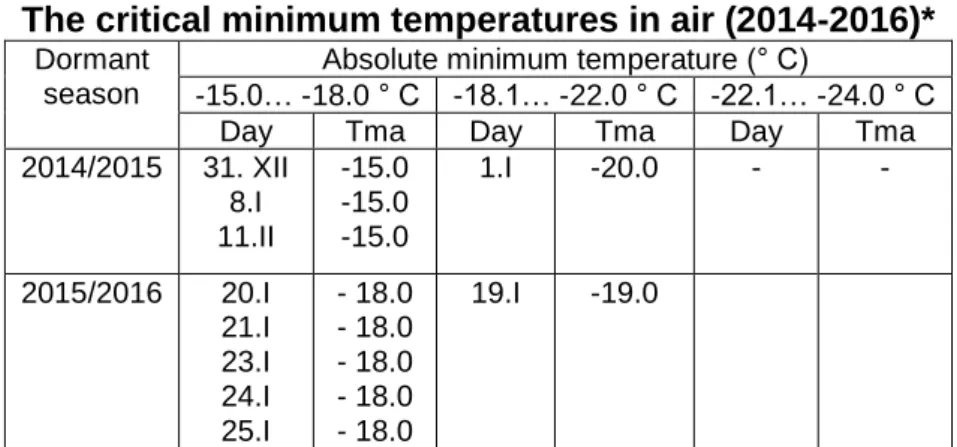
Table 3
The critical minimum temperatures in air (2014-2016)* Dormant
season
Absolute minimum temperature (° C)
-15.0… -18.0 ° C -18.1… -22.0 ° C -22.1… -24.0 ° C
Day Tma Day Tma Day Tma
2014/2015 31. XII 8.I 11.II
-15.0 -15.0 -15.0
1.I -20.0 - -
2015/2016 20.I 21.I 23.I 24.I 25.I
- 18.0 - 18.0 - 18.0 - 18.0 - 18.0
19.I -19.0
*Processing weather data http://romanian.wunderground.com/history/airport/LRCV
Tma- absolute minimum temperature
In what concerns the frequency of days when the maximum daily temperature was ≤ 0° C (Table 2), there were 23.25 % frost-free days during the 2014-2015 dormant season and 25 % during the dormant season of 2015-2016.
65
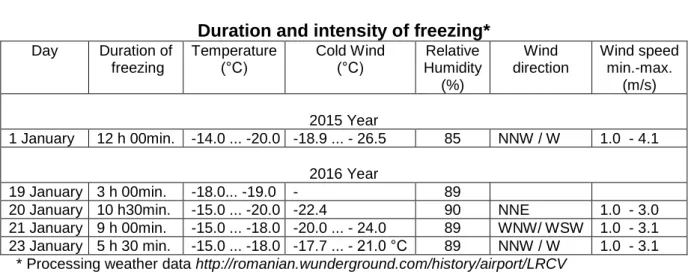
Table 4
Duration and intensity of freezing* Day Duration of
freezing
Temperature (°C)
Cold Wind (°C)
Relative Humidity
(%)
Wind direction
Wind speed min.-max.
(m/s)
2015 Year
1 January 12 h 00min. -14.0 ... -20.0 -18.9 ... - 26.5 85 NNW / W 1.0 - 4.1
2016 Year
19 January 3 h 00min. -18.0... -19.0 - 89
20 January 10 h30min. -15.0 ... -20.0 -22.4 90 NNE 1.0 - 3.0 21 January 9 h 00min. -15.0 ... -18.0 -20.0 ... - 24.0 89 WNW/ WSW 1.0 - 3.1 23 January 5 h 30 min. -15.0 ... -18.0 -17.7 ... - 21.0 °C 89 NNW / W 1.0 - 3.1 *Processing weather data http://romanian.wunderground.com/history/airport/LRCV
The 2015-2016 dormant season distinguished by duration and persistent frost with a minimum daily average temperature ≤ – 18.0 °C, during 2 episodes of 3 consecutive days each (19, 20 and 21 January 2016, followed by 23, 24 and 25 January 2016), Table 3 and Table 4 . As shown in Table 4, due to the cold wind, the temperature perceived at plant level was somewhere between -17.7 ...- 24.0 °C.
The most freezing cold weather was recorded on 1 January 2015, when the air temperature measured for 12 consecutive hours inside the weather forecast station was below -14.0 °C, and the absolute minimum was – 20.0 °C. It must be specified that due to the low speed cold wind, which hindered the mixing of air currents, the temperature perceived at plant level was somewhere between – 18.9 °C and– 26.5°C (Table 4).
Freezing tolerance and injury in grapevines.
The critical winter conditions during the two dormant seasons caused considerable bud losses in all varieties under study.
The biggest losses of buds (primary and secondary buds) were recorded after the 2014-2015 dormant season, when there was also the biggest number of days with minimum critical temperatures below -15.0 °C. The absolute minimum temperature of – 20.0 °C was recorded inside the weather forecast station at 2m high (recorded on 1 January) and - 26.5 °C respectively, which was recorded at stock level, due to the cold wind (Table 4 and Table 5).
Varieties with the biggest percentage of non-viable buds in 2015-2016 were Syrah (66.31 % primary killed buds and 35.32 % secondary killed buds) and Merlot (57.52 % primary killed buds). The lowest percentage of non-viable buds was recorded in red wine varieties, such as Fetească neagră (29.34 % primary killed buds), Table 5.
At critical temperatures of -20.0 °C, with an absolute minimum value recorded inside the weather forecast station for 12 consecutive hours between – 14.0 … – 20.0 °C and an absolute minimum temperature of – 26.5°C due to cold wind, at speed below 3.1 m /s (1 January 2015), depending on the number of killed buds, the varieties under study were classified as follows:
- varieties with medium resistance to frost (25-50 % killed buds)- Fetească neagră,
Cabernet Sauvignon and Riesling italian varieties;
66
Table 5
Buds freezing damages of seven grape cultivars during the dormant seasons 2014/2015 and 2015/ 2016
Cultivars Primary Killed buds (%)
Secondary Killed buds (%)
2014/2015 2015/2016 2014/2015 2015/2016
X±s
X X ±sX X ±sX X ±sX
Merlot 58.34 ± 7.32 56.71 ± 6.47 31.24 ± 2.14 23.12 ± 3.23 Syrah 64.35 ± 6.89 68.27 ± 6.76 37.18 ± 2.24 33.46 ± 2.87 Cabernet Sauvignon 36.38 ± 5.66 40.56 ± 5.28 16.29 ± 1.76 16.73 ± 2.44 Fetească neagră 31.26 ± 7.25 27.42 ± 6.18 18.48 ± 2.51 20.45 ± 2.17 Tămâioasă Românească 59.27 ± 6.27 49.61 ± 4.68 29.53 ± 3.16 28.71 ± 2.69 Sauvignon 51.25 ± 7.88 46.40 ± 5.17 34.32 ± 3.12 33.45 ± 3.25 Italian Riesling 44.59 ± 4.12 33.82 ± 4.53 17.89 ± 2.08 14.78 ± 2.31
During two frosty events, lasting three consecutive days each, characterised by duration and intensity (the 2015-2016 dormant period), the average of minimum daily temperatures recorded values ≤ – 18.0 °C , which were perceived as -17.7 ...- 24.0 °C by the plants. In terms of frost resistance (Table 5), varieties were classified as follows:
- with medium resistance to frost (25-50 % primary killed buds)- Fetească neagră,
Cabernet Sauvignon, Italian Riesling, Tămâioasă românească and Sauvignon cultivars; -with low resistance to frost (50-75 % primary killed buds)- Syrah and Merlot cultivars.
However, severe trunk damages were apparent on Syrah, Sauvignon and Merlot cultivars. Due to the critical conditions in autumn-winter and the massive bud losses both in 2015 and 2016, the vine trunks damaged by frost were rebuilt by using canes from basal spurs (buried in the autumn of 2014 and 2015, respectively) and recovery cuts were made for fruiting and renewal spurs to compensate the killed buds on annual canes.
CONCLUSIONS
In the temperate continental climate of Romania freezing injury is a serious problem that limits the productivity of grapevines.
The vulnerability of grape vines to winter conditions, expressed by the number of killed buds, is different depending on the specific thermal characteristics during autumn-winter., as well as on the genetic potential of hardiness to critical temperature characteristics.
BIBLIOGRAPHY
1. Anne Fennell, 2004- Freezing tolerance and injury in grapevines, Journal of Crop Improvement, 10:1-2, 201-235, DOI: 10.1300/J411v10n01_09
2. Beznea D., 1986 - Cercetări privind rezistenţa viţei de vie la temperaturile scăzute din
timpul iernii, Analele ICVV, vol XI, p. 49-63.
3. Cichi Daniela Doloris, 2005- Cercetari privind comportarea viței de vie la stres termic, Teză de doctorat, Universitatea din Craiova
4. Daniela Doloris Cichi, Olteanu I, Costea D.C., 2006a - Monitoring of the thermic
stress parameters in Dealurile Craiovei vineyards and their impact on grape vines, Lucrări
Ştiinţifice, Seria Horticultură, Anul XLIX vol. 1 (49): 693-699
67
l`adaptation de la vigne aux basses températures, .Analele Universităţii din Craiova seria
Biologie, Horticultură, Tehnologia Prelucrării Produselor Agricole, Ingineria Mediului, vol. XI (XLVII): 59-65
6. Davenport J. R., Keller M., Mills L. J., 2008- How Cold Can You Go? Frost and
Winter Protection for Grape, Hort Science vol. 43 (7): 1966- 1969.
7. Düring H., Ortoidze T.V., Bushnell B. , 1990- Effects of subzero temperatures on
chlorophyll fluorescence of grapevine buds, J. Plant Physiol. 136:758-760.
8. Ferguson, J.C., Tarara J.M., Mills L.J., Grove G.G., Keller M., 2011- Dynamic
thermal time model of cold hardiness for dormant grapevine buds, Annals of Botany 107:
389-396.
9. Gheorghiu N.C., 2011- Cercetări privind stabilirea arealelor din centrul viticol Oprişor cu
vocaţie pentru obţinerea vinurilor cu denumire de origine controlată, Teză de doctorat,
Universitatea din Craiova
10. Hamman R.A., Dami I.E., Walsh T.M., Stushnoff C., 1996- Seasonal
carbohydrate changes and cold hardiness of Chardonnay and Riesling grapevines, Amer.
J. Enol. Viticult. 47:31–36.
11. Hamman R.A., Dami I.E., 2000- Effects of irrigation on wine grape growth and fruit
quality, HortTechnology 10:162-168.
12. Jones K.S., Paroschy J., McKersie B.D., Bowley S.R., 1999- Carbohydrate
composition and freezing tolerance of canes and buds in Vitis vinifera, J. Plant Physiol.
155:101-106.
13. Mills L.J., Ferguson J.C., Keller M., 2006- Cold-hardiness evaluation of grapevine
buds and cane tissues, Amer. J. Enol. Vitic. 57:194– 200.
14. Olteanu I., 2000- Viticultura, Ed. Universitaria, Craiova
15. Schnabel B.J., Wample R.L., 1987- Dormancy and cold hardiness in Vitis vinifera L.
cv. White Riesling as influenced by photoperiod and temperature, Am. J. Enol. Vitic.
38:265-272.
16. Seyedbagheri M.M., Fallahi E., 1994- Physiological and environmental factors and
horticultural practices influencing cold hardiness of grapevines, J. Small Fruit Vitic. 2:3-38.
17. Stoica Felicia, 2003- Studiul posibilităților tehnologice de obținere a vinurilor aromate de tip VDOC în podgoria Drăgășani, Teză de doctorat, Univ. Craiova.
18. Tuță Veronica, 2011- Studiul potenţialului oenologic al unor soiuri de struguri de
origine mediteraneană cultivate la Oprişor Mehedinţi, Teza de doctorat, Universitatea din
Craiova
19. Voica N., 1974 – Cercetări comparative anatomo-fiziologice privind comportarea la ger
a unor soiuri de viţă de vie cultivate pe nisipuri şi sol brun roşcat de pădure. Teză de
doctorat, Universitatea din Craiova.
20. Wolf T.K., Pool R.M., 1988- Nitrogen fertilization and rootstock effects on wood
maturation and dormant bud cold hardiness of cv. Chardonnay grapevines, Am. J. Enol.
Vitic. 39:308-312.
21. Wolf T.K., Boyer J.D., 2001- Site selection and other vine management principles and
practices to minimize the threat of cold injury, In: Rantz, J.M. (ed.)- Proc. ASEV 50th
Anniversary Annual Meeting, Amer. Soc. Enology Viticulture, Davis, CA., p. 49–59.
22. Wolpert J.A., Howell G.S.,1986 - Cold acclimation of Concord grapevines, III,
Relationship between cold hardiness, tissue water content, and maturation, Vitis
25:151-159.