Multiple Ways of Processing in
Questionnaires
Pipina Nikolaidou
∗ †doi:10.23755/rm.v33i0.376
Abstract
In social sciences when questionnaires are used, there is a new tool, the bar instead of Likert scale. The bar has been suggested by Vougiouklis & Vougiouklis in 2008, who have proposed the replacement of Likert scales, usually used in questionnaires, with bar. This new tool, gives the opportunity to researchers to elaborate the questionnaires in different ways, depending on the filled questionnaires and of course on the problem. Moreover, we im-prove the procedure of the filling the questionnaires, using the bar instead of Likert scale, on computers where we write down automatically the results, so they are ready for research. This new kind of elaboration is being applied on data obtained by a survey, studying the new results. The hyperstructure theory is being related with questionnaires and we study the obtained hy-perstructures, which are used as an organized device of the problem and we focus on special problems.
Keywords: hyperstructures; questionnaires; bar;
2010 AMS subject classifications: 20N20, 16Y99.
∗Democritus University of Thrace, School of Education, 68100 Alexandroupolis, Greece;
†cPipina Nikolaidou. Received: 31-10-2017. Accepted: 26-12-2017. Published: 31-12-2017.
1
Basic definitions
The main object of this paper is the class of hyperstructures calledHv-structures
introduced in 1990 [17], which satisfy the weak axioms where the non-empty in-tersection replaces the equality. Some basic definitions are the following:
In a set H equipped with a hyperoperation (abbreviation hyperoperation = hope)·:H×H →P(H)− {∅},we abbreviate byWASStheweak associativity: (xy)z∩x(yz)6=∅,∀x, y, z∈Hand byCOWtheweak commutativity:xy∩yx 6= ∅,∀x, y ∈H.
The hyperstructure(H,·)is called anHv-semigroupif it isWASS, it is called
Hv-groupif it is reproductiveHv-semigroup, i.e.,xH =Hx=H,∀x∈H.
Motivation. In the classical theory the quotient of a group with respect to an invariant subgroup is a group. F. Marty from 1934, states that, the quotient of a group with respect to any subgroup is a hypergroup. Finally, the quotient of a group with respect to any partition (or equivalently to any equivalence relation) is anHv-group. This is the motivation to introduce theHv-structures [17], [18].
(R,+,·)is called anHv-ringif(+)and(·)are WASS, the reproduction axiom
is valid for(+)and(·)isweak distributivewith respect to(+):
x(y+z)∩(xy+xz)6=∅, (x+y)z∩(xz+yz)6=∅, ∀x, y, z ∈R.
Let(R,+,·)be anHv-ring, (M,+) be a COWHv-group and there exists an
external hope
·:R×M →P(M) : (a, x)→ax
such that∀a, b∈Rand∀x, y ∈M we have
a(x+y)∩(ax+ay)6=∅, (a+b)x∩(ax+bx)6=∅, (ab)x∩a(bx)6=∅,
then M is called an Hv-module over F. In the case of an Hv-field F, which is
defined later, instead of anHv-ring R, then theHv-vector spaceis defined.
For more definitions and applications on Hv-structures one can see [2], [3],
[4], [5], [6], [10], [14], [16], [18].
The main tool to study hyperstructures is the fundamental relation. In 1970 M. Koscas defined in hypergroups the relation β and its transitive closureβ*. This relation connects the hyperstructures with the corresponding classical structures and is defined in Hv-groups as well. T. Vougiouklis introduced the γ* and *
relations, which are defined, inHv-rings andHv-vector spaces, respectively [17].
Definition 1.1. The fundamental relations β*, γ* and *, are defined, in Hv
-groups,Hv-rings andHv-vector space, respectively, as the smallest equivalences
so that the quotient would be group, ring and vector space, respectively.
Specifying the above motivation we remark the following: Let(G,·)be a group and R be an equivalence relation (or a partition) in G, then (G/R,·) is anHv
-group, therefore we have the quotient(G/R,·)/β* which is a group, the funda-mental one. Remark that the classes of the fundafunda-mental group(G/R,·)/β* are a union of some of the R-classes. Otherwise, the(G/R,·)/β* has elements classes of G where they form a partition which classes are larger than the classes of the original partition R.
The way to find the fundamental classes is given by the following [17], [20], [21], [22]:
Theorem 1.1. Let (H,·) be an Hv-group and denote by U the set of all finite
products of elements of H. We define the relationβin H by settingxβyiff{x, y} ⊂
uwhereu∈U. Thenβ* is the transitive closure ofβ.
A well known and large class of hopes is given as follows [15], [18], [12]: Let(G,·)be a groupoid then for everyP ⊂G,P 6=∅, we define the follow-ing hopes called P-hopes: for allx, y ∈G
P :xP y = (xP)y∪x(P y),
Pr :xPry = (xy)P ∪x(yP), Pl :xPly= (P x)y∪P(xy).
The (G, P),(G, Pr) and (G, Pl) are called P-hyperstructures. The most usual case is if(G,·)is semigroup, thenxP y = (xP)y∪x(P y) =xP yand(G, P)is a semihypergroup. We do not know what hyperstructures are(G, Pr)and(G, Pl). In some cases, depending on the choice of P, the (G, Pr) and (G, Pl) can be associative or WASS. If more operations are defined inG, then for each operation severalP-hopes can be defined.
2
The bar in questionnaires
Last decades hyperstructures seem to have a variety of application not only in mathematics, but also in many other sciences [1], [2], [9], [13], [19], [25], including the social ones.
Definition 2.1. In every question substitute the Likert scale with ’the bar’ whose poles are defined with ’0’ on the left end, and ’1’ on the right end:
0 1
The subjects/participants are asked instead of deciding and checking a specific grade on the scale, to cut the bar at any point s/he feels expresses her/his answer to the specific question.
The use of the bar of Vougiouklis&Vougiouklis instead of a scale of Likert has several advantages during both the filling-in and the research processing. The final suggested length of the bar, according to the Golden Ratio, is 6.2cm, see [7], [8], [23]. Several advantages on the use of the bar instead of scale one can find in [9].
There are certain advantages concerning the use of the bar comparing to the Likert-scale during all stages of developing, filling and processing. The most im-portant maybe advantage of the bar though is the fact that it provides the potential for different types of processing. Therefore, it gives the initiative to the researcher to explore if the given answers follow a special kind of distribution, as Gauss or parabola for example. In this case the researcher has the opportunity to correct any kind of tendency appeared, for more accurate results. A possibility of choos-ing among a number of alternatives is offered, by uschoos-ing fuzzy logic in the same way as it has already been done combining mathematical models with multivalued operation.
3
Evaluation
The following survey is based on the described theory that has been estab-lished in the department of Elementary Education of Democritus University of Thrace, in the frame of course evaluation, and especially of Algebra of first semester. The sample was 152 students, who were asked to answer questions related to the course, to the teacher and to the teaching of the course. The questionnaire used the bar, which was firstly divided into six equal-segments according to the first questionnaires which used a six-grade Likert scale.
The use of histograms helped in order to explore if the answers follow any kind of distribution or they present any kind of tendency. In this case, the bar is redivided into equal-area segments, for more accurate results.
elaboration. The implemented program has been developed to overcome the prob-lems raised during the data collection, inputting of data from questionnaires to processing. It eliminates the time of data collection, transferring data directly for any kind of elaboration [10].
3.1
Question category: Course
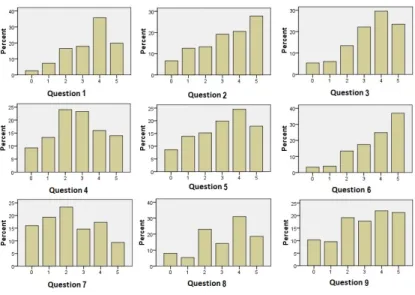
The first question category is about the course and consists of 9 questions. Gathering the answers on the bar, it is obvious that there is an upward trend, a fact that becomes even more obvious on the following histograms:
Figure 1: Question Category: Course
In the majority of the questions, on can notice a vast concentration in the last 2 or 3 grades and in some of the questions this is more obvious, as the concentration is the last grades is much higher.
More specifically, question number 1,2,3,5,6 and 9 present the biggest con-centration rate in the last 2 grades, while in question 4, there is a remarkable concentration in the center of the bar.
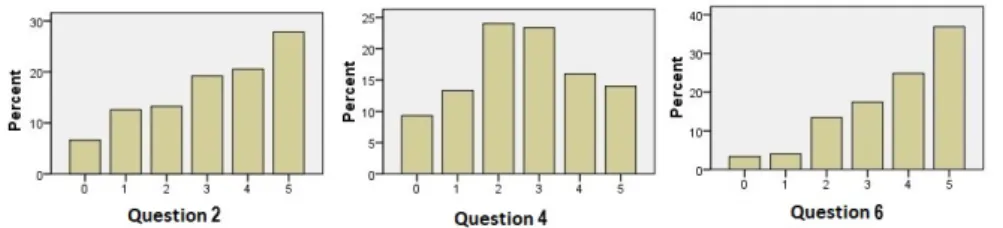
Based mainly on this histograms and some other parameters that have been obtained by the correspondence analysis, the answers of questions 2,4 and 6 will be redistributed on the bar, which will be now divided in equal-area segments: For question 2, the bar will be divided in 6 equal-ares segments according to the increasing-low parabola
Gauss distribution and,
for question 6, the bar will be divided in 6 equal-ares segments according to the increasing-upper parabola.
The new obtained histograms are the following:
Figure 2: Equal segments
Figure 3: Equal-area segments
One can see that the use of the upper-low parabola on question 2, reveals that in question 2, more than 50% was concentrated at the last two grades of the scale, but with the new distribution there exists a tendency to the first grades. For questions number 4 and 6 the new histograms give no more information.
3.2
Question category:Teaching
Figure 4: Question Category: Teaching
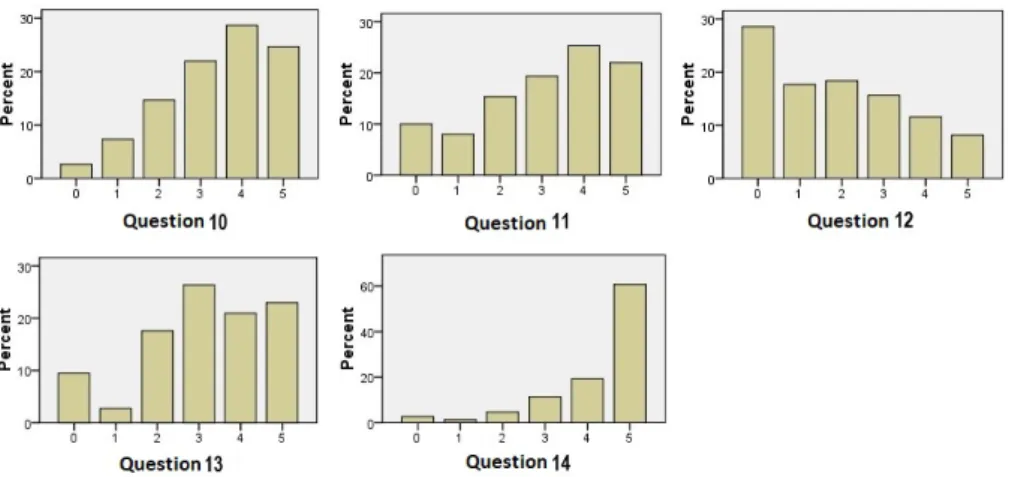
In this question category, there is also a general upward trend - with the ex-ception of question number 12. More specifically, in questions 10, 11 and 13 the biggest concentration rate appears in the last grades, in opposition to question 12, in which the biggest rate appears in the first 2 grades. Question 14 present a vast rate in the last grade.
So, for question 12 the bar will be divided in equal-area segments according to decreasing-low parabola and for question 14, according to increasing upper parabola. The new obtained histograms are the following:
Figure 5: Equal segments
From the new distribution, the bar gives different results for question 12, as it reveals that the increasing-low trend not exists anymore. This fact is very impor-tant for the researcher as it gives him information he couldn’t have only through the first subdivision of the bar. The second question leads to the same results.
3.3
Question category:Teacher
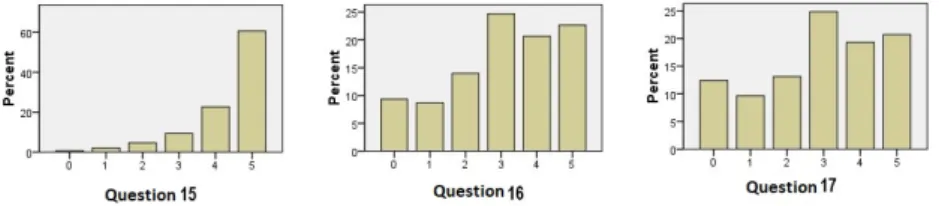
In the penultimate category there are 3 questions concerning the teacher.
Figure 7: Question Category: Teacher
Once again, there is an obvious trend to the respondents according to the his-tograms, even more remarkable in the first question: there is a vast concentration rate in the last grade. Because of that, the bar will be divided into equal area segments following the increasing-upper parabola:
Figure 8: Equal segments Figure 9: Equal-area segments
4
Questionnares and Hyperstructures
In the research processing suppose that we want to use Likert scale through the bar dividing the continuum [0,62] into equal segments and into equal area division of Gauss distribution [9] or parabola distribution [24]. If we consider that the continuum [0,62] is divided into n segments, we can number the n segments starting with 0. We can define a hope on the segments as follows [11] :
Definition 4.1.
For alli, j ∈ {0,1, ..., n−1}, ifenthenth segment ,then
ei⊕ej ={ek:x+y∈ek,∀x∈ei, y ∈ej}
Therefore, we can consider as an organized device the group(Zn,⊕)where n
the number of segments, as we have a modulo like hyperoperation. The multipli-cation tables obtained by this hyperoperation , referred in mm, are the following:
6 equal segments
0:[0,10.33], 1:(10.33,20.66], 2:(20.66,30.99], 3:(30.99,41.32], 4:(41.32,51.65], 5:(51.65,62]
⊕ 0 1 2 3 4 5
0 0,1 1,2 2,3 3,4 4,5 0,5
1 1,2 2,3 3,4 4,5 0,5 0,1
2 2,3 3,4 4,5 0,5 0,1 1,2
3 3,4 4,5 0,5 0,1 1,2 2,3
4 4,5 0,5 0,1 1,2 2,3 3,4
5 0,5 0,1 1,2 2,3 3,4 4,5
6 equal-area segments (Gauss distribution)
0:[0,22],1:(22,27],2:(27,31],3:(31,35],4:(35,40],5:(40,62],
⊕ 0 1 2 3 4 5
0 0,1,2,3,4,5 1,2,3,4,5 2,3,4,5 3,4,5 4,5 0,5
1 1,2,3,4,5 5 5 5 0,5 0,1
2 2,3,4,5 5 5 0,5 0 0,1,2
3 3,4,5 5 0,5 0 0 0,1,2,3
4 4,5 0,5 0 0 0 0,1,2,3,4
Increasing Low parabolax=y2
0:[0,34],1:(34,43],2:(43,49],3:(49,54],4:(54,58],5:(58,62]
⊕ 0 1 2 3 4 5
0 0,1,2,3,4,5 0,1,2,3,4,5 0,2,3,4,5 0,3,4,5 0,4,5 0,5
1 0,1,2,3,4,5 0 0 0,1 0,1 0,1
2 0,2,3,4,5 0 0,1 0,1 1,2 1,2
3 0,3,4,5 0,1 0,1 1,2 1,2,3 2,3
4 0,4,5 0,1 1,2 1,2,3 2,3 3,4
5 0,5 0,1 1,2 2,3 3,4 4,5
Increasing Upper parabola1−y= (1−x)2
0:[0,22],1:(22,32],2:(32,40],3:(40,48],4:(48,55],5:(55,62]
⊕ 0 1 2 3 4 5
0 0,1,2,3, 1,2,3,4 2,3,4,5 0,3,4,5 4,5,0 0,5
1 1,2,3,4 0,3,4,5 0,4,5 0 0,1 0,1
2 2,3,4,5 0,4,5 0 0,1 0,1,2 1,2
3 0,3,4,5 0 0,1 0,1,2 1,2,3 2,3
4 0,4,5 0,1 0,1,2 1,2,3 2,3 3,4
5 0,5 0,1 1,2 2,3 3,4 4,5
Decreasing low parabolay= (1−x)2
0:[0,4],1:(4,8],2:(8,13],3:(13,19],4:(19,28],5:(28,62]
⊕ 0 1 2 3 4 5
0 0,1 1,2 2,3 3,4 4,5 0,5
1 1,2 2,3 2,3,4 3,4 4,5 0,1,5
2 2,3 2,3,4 3,4 4,5 4,5 0,1,2,5
3 3,4 3,4 4,5 4,5 5 0,1,2,3,5
4 4,5 4,5 4,5 5 5 0,1,2,3,4,5
5 0,5 0,1,5 0,1,2,5 0,1,2,3,5 0,1,2,3,4,5 0,1,2,3,4,5
Decreasing upper parabola1−y=x2
0:[0,7],1:(7,14],2:(14,22],3:(22,30],4:(30,40],5:(40,62]
⊕ 0 1 2 3 4 5
0 0,1 1,2 2,3 3,4 4,5 0,5
1 1,2 2,3 2,3,4 3,4,5 4,5 0,1,5
2 2,3 2,3,4 3,4,5 4,5 5 0,1,2,5
3 3,4 3,4,5 4,5 5 0,1,5 0,1,2,3
4 4,5 4,5 5 0,1,5 0,1,2,5 1,2,3,4
References
[1] P. Corsini,Prolegomena of hypergroup theory, Aviani, 1994.
[2] P. Corsini, V. Leoreanu, Applications of Hyperstructure Theory, Kluwer Academic Publ.,2003.
[3] B. Davvaz,A brief survey of the theory ofHv-structures,8thAHA Congress,
Spanidis Press (2003), 39-70.
[4] B. Davvaz, V. Leoreanu,Hyperring Theory and Applications, Int. Academic Press, 2007.
[5] B. Davvaz,Polygroup theory and related systems, World Sci., 2013.
[6] S. Hoskova, Hv-structure is fifteen, Proc. of 4th International
mathe-matical workshop FAST VUT Brno, Czech Republic, (2005), 55-57, http://math.fce.vutbr.cz/pribyl/workshop2005/prispevky/Hoskova.pdf [7] P. Kambaki-Vougioukli, A., Karakos, N. Lygeros and T. Vougiouklis,Fuzzy
instead of discrete, Annals of Fuzzy Math. and Informatics (AFMI), V.2, N.1, (2011), 81-89.
[8] P. Kambaki-Vougiouklis, P. Nikolaidou and T. Vougiouklis,Questionnaires in Linguistics using the Bar and theHv-structures, Studies in Systems,
De-cision and Control 66, Springer, 2017, (2017), 257-266.
[9] P. Kambaki-Vougioukli, T. Vougiouklis, Bar instead of scale, Ratio Socio-logica,3,(2008), 49-56.
[10] P. Nikolaidou and T. Vougiouklis, Hv-structures and the Bar in
question-naires, Italian J. Pure Applied Math., 29, (2012), 341-350.
[11] P. Nikolaidou and T. Vougiouklis, Hyperstructures in Questionnaires, Pro-ceedings of 12th AHA, Algebraic Hyperstructures and its Applications, Xanthi, Greece 2014.
[12] P. Nikolaidou and T. Vougiouklis,The Lie-Santilli admissible hyperalgebras of typeAn, Ratio Mathematica 26, (2014), 113-128.
[14] R.M. Santilli, T. Vougiouklis,Lie-admissible hyperalgebras, Italian Journal of Pure and Applied Mathematics, 31, (2013), 239-254.
[15] T. Vougiouklis,Generalization of P-hypergroups, Rend. Circ. Mat. Palermo, S.II,, 36, (1987), 114-121.
[16] T. Vougiouklis, Representations of hypergroups by hypermatrices, Rivista Mat. Pura ed Appl., N2, (1987), 7-19.
[17] T. Vougiouklis, The fundamental relation in hyperrings. The general hyper-field,4thAHA Congress, World Scientific,(1991), 203-211.
[18] T. Vougiouklis, Hyperstructures and their Representations, Monographs in Mathematics, Hadronic Press, 1994.
[19] T. Vougiouklis, Some remarks on hyperstructures, Contemp. Math., 184, (1995), 427-431.
[20] T. Vougiouklis, Enlarging Hv-structures, Algebras and Combinatorics,
ICAC’ 97, Hong Kong, Springer - Verlag (1999), 455-463.
[21] T. Vougiouklis, On Hv-rings and Hv-representations, Discrete Math.,
208/209, (1999), 615-620.
[22] T. Vougiouklis, Finite Hv-structures and their representations, Rend. Sem.
Mat. Messina, S.II, V.9, (2003), 245-265.
[23] T. Vougiouklis, Bar and Theta Hyperoperations, Ratio Mathematica, 21 (2011), 27-42.
[24] T. Vougiouklis and P. Kambaki-Vougioukli, On the use of the bar, China-USA Business Review,10(6), (2011), 484-489.