O
Url: http://usnsj.com/index.php/JEE Email: [email protected]
Language Acquisition and Learning on Children
A. Introduction
Whenever and wherever the language is used, we will definitely keep in touch with the fact that people who use the language will have two different experiences. When humans communicate using the language in the meantime they are studying and also acquiring the language they hear and use. This different experience then is what causes the appearance of a very thin and significant difference when viewed from the perspective of the process. The experiences then bring upon a number of factors for each accompanying experience and those factors to be the ones which have caused the greatest impact in terms of Language Acquisition and Learning. The factors may be vary depend on what experience happened. Some explanations should be explicitly described such as Behaviorism, Acculturation, The Universal
Fernandes Arung
Universitas Sembilanbelas November Kolaka [email protected]
+6281241248541
ISSN: 2502-6909 Vol. 1, No. 1, March 2016
URL: http://usnsj.com/index.php/JEE/article/view/JEE001
© 2016 JEE All rights reserved
Abstract
Debating on Second Language Acquisition is not merely in terms of concept but also the real phenomena which postulate each research result. It needs more investigation on SLA due to the various realities on how children and adults acquire and learn any language. This research aims to describe how children and adults acquire and learn their first and second language. Participants consisted of children and adults whose ages determined by the researcher based on the purposive sampling technique. They were all six persons and chosen based on certain characteristics. Content analysis technique was applied in order to analyze all data gained. The result showed that since human alive inside mother’s womb especially at up to the age of three months, a fetus has tried to acquire sounds subconsciously. Language proficiency is really determined by three factors of Phased Process Approach namely Subconscious Acquisition, Conscious Acquisition, and Learning. The ideal time for learning something is begun from the age of 2 or 3 years old, by the fact that children have had the ability to bear a meaning on any input that they catch. The learning process has been begun within the process of acquisition. Based on the findings, it is clear that the children acquire the language step by step based on the development of the brain. Children acquire language is just the same as adult in acquiring the language although there will be some constraints faced by adult concern with the first language because adult has had the strong basis of the first language just than children.
Keywords: language acquisition, language learning, children acquisition, adult acquisition, children learning, adult learning
AUTHORS INFO ARTICLE INFO
Grammar Hypothesis, The Comprehension Hypothesis, The Interaction Hypothesis, Output Hypothesis, Socio-cultural Theory and Connectionism (Menezes; Journal) in order to meet the answer of how natural language happened, acquired, and learned.
The difference between Acquisition and Learning become the most popular research in investigating the area of Second Language Acquisition. Krashen stated ‘the acquisition-learning distinction helps interpret findings in all areas in second language acquisition research and practice’ (Krashen, 1981). However, this distinction is very important to be exposed in order to get to understanding on Second Language Acquisition. Some findings have been presented and they are stipulated as the basic concepts of the area of SLA.
B. Literature Review
1. Human Brain in Acquiring Languages
Human brain is unique. No one can prove perfectly what are all in the brain and what are the processes happened in it. The capacity and capability of human brain is restricted to what we call as human as a creature. We are all limited to think of our existence in terms of who the creator is and who is the creature. Therefore, we are asked to think what we deserve to think of. In the other hand, we should be grateful to those who have investigated and found all about brain. It has a corpus callosum that is a thick cable of nerves at the base of each brain. This connects two sides of brains; left and right hemisphere.
Brain is divided into two halves; right and left hemisphere which contains 250 cells, 3 pounds weight; around 1.300 to 1.400 grams, consists of 78% of water, 10% of fat, and 8% of protein. It consumes 20% of energy taken from human blood that contains glucose, protein, and oxygen. Brain needs 8 gallons per hour or 198 gallons a day or 8 to 12 glasses of water a day. There are four parts of the brain that is called as lobes of brain. They are Occipital that is in the back center of the brain and these functions as sight. Frontal is in the front of the brain which functions as to judge, create, solve, and plan. The next is Parietal which functions as the capability of senso-motoric and language and is in the top back of the brain. The last is Temporal which is in the left and right side of the brain and functions as hearing, memory, processing meaning, and language. In human brain, there is called as Cerebellum and Basal Ganglia that are very functional in regulating language. Basal Ganglia which are buried deep within the cerebrum clearly play a part in human language and thought (Lieberman, 2000). In the study of Split-brain, the scientists have found that “If an ordinary person is seated in front of a screen and asked to look forward and an object is flashed very briefly to his right side (i.e. his left brain), he will respond faster and more accurately if the task involves language” (Alfred, 2006). The left temporal of the brain is actually the most part of the brain to refer to human language capability in acquiring and processing language.
2. First and Second Language Acquisition
Language acquisition is the way of human being in obtaining subconsciously his/her first language to produce speech. So, language acquisition usually refers to first language. The first language acquisition here is not only to the language s/he acquired in the past for the first time for the first language but it is to the language s/he acquired and acquires for the first time for any language. What any language s/he acquires in the first time that is called as first language acquisition even though s/he has already had the primary first language. In the other words, s/he can acquire any language as his/her first or second or third language and so forth as long as the language is acquired for the first time. This is what we call as Language acquisition that refers to the first acquisition. Language acquisition or first acquisition or first language acquisition or second language acquisition and so forth slowly develops and in this period, listening skill is faster than speaking skill (Krashen, 1982). The process of language acquisition is always the same and it has a natural order as one acquires his/her first language from fetus to adult.
acquisition. A natural setting is for an acquisition process while a set-up situation is for learning process.
3. First and Second Language Learning
As stated above that First Language Acquisition is the language that one acquired and acquires for the first time for any language. Sequentially, after acquiring the L1 one can learn his/her L1 Acquisition; structures or grammars (Linguistic and Language Competence). This is what is called as the First Language Learning. The context or situation is set up to a formal. It can be of curriculum demand at school that one should learn in order to pass the examination. S/he has already had his/her L1 and now is the time to learn it formally or informally. This is just all about the setting or the way or the strategy of learning the language. The more your child knows about the way she learns best, the more insight, strategies, and self-awareness she will have to use her learning strengths to achieve her greatest potential as a joyful learner (Willis: 2008). In this process, accuracy and correctness are needed in order to approach to Linguistic and Language Competence and Performance.
In the Second Language Learning, L1 Learning has additional language to learn. Let’s say English; English as Second Language or English as Foreign Language. What other language learned for the first time besides L1 Learning then we call as Second Language Learning and also involve a mixture of these (Formal & Informal Learning) settings and circumstances (Troike, 2006). This should be distinguished from Second Language Acquisition. For example, when an Indonesian is brought in to America and s/he lives there at least three months; s/he hears the language every time and day without any translating from anyone who lives there then this is called as Second Language Acquisition. When an Indonesian takes English for example as the subject at school so s/he learns the grammars and structure of English and get the correctness of mistakes then this is called as Second Language Learning. But when an Indonesian is brought in to America in the occasion of an English Course, s/he actually acquires and learns the language there. While learning English there, in the other side s/he acquires the language when s/he listens to people use English in a communication.
4. Language acquisition
Human beings are unique. They are exist is not only for God has created them but also that they are supported by all existence things. According to Skinner, They are absolutely controlled by their environments and it is not only merely by themselves. In his book, Beyond Freedom and Dignity, published in 1971, he replied that all behaviors are controlled or managed by external stimuli. In other words that all human behaviors are determined by ways which are predictable by law principles.
Human acquires language is not because of they learn the language but it is merely that they acquire. Vice versa, they learn the language because they have acquired it. A language is a process of customary that is acquired through a conditioning process (Brown, 2000 p. 34). This is in line with the views of behaviorism experts who believes strongly that children come into the world with a tube of taste, a clean slate with no previous understanding of the world and of the language, and that the children are then shaped by their environment and slowly conditioned through a diverse schedule of reinforcement (Brown, 2000 p. 22). This was called as Nurture. Watson states that the explanation of any form of learning is through a process of conditioning then human form a stimuli-response relationship and the more complex human behavior learned through how to build a series or chains of responses (Brown, 2000 p. 80). Thus, Watson took an extreme position on one of the oldest psychology questions and fundamental concerns about Nature and Nurture. Watson states that every person is shaped into what they are then they are not born. He ignores the importance of ancestry, saying that the behavior is determined entirely by the environment. But such a view Watson never got a chance to be tested further. Yet his writings contributed significantly to the environmental elements are often associated with behaviorism.
before (Dardjowidjojo, 2003 p. 235). So what is meant by operant conditioning by Skinner is conditioning which organisms (humans) to produce a response, or operands (a sentence or speech or activities that operate on the basis of the environment), in the absence of stimuli that can be observed; operand is maintained (learned ) through reinforcement (reinforcement) (Brown, 2000 p. 22-23). Skinner's theory explains how the various trends in the response achieved through learning. If the response is followed by favorable consequences also called reinforcement, then the response is stronger and if the response produces negative consequences or punishment), then response will be weakened. Through these experiments, Skinner found that the acquisition of knowledge, including knowledge of the language is a mere habits or things to get used to a particular subject is done constantly and insistently (Dardjowidjojo, 2003 p. 235). Furthermore, following the tradition of Watson, Skinner showed little interest in what is happening "inside" man. He stated that it is useless to speculate on the personal cognitive processes that cannot be observed. Rather, he focuses on how the external environment to form a clear behavior. He suggested determinism, considered that the behavior is completely determined by environmental stimuli. In his view, people tend to show some patterns of behavior because they have tendencies response (response tendencies) they achieve stable through the experiences. Response tendencies can be changed in the future, as a result of new experiences, but it can continue to survive to create a certain level of consistency in behavior.
In relation with the acquisition of language, Skinner is a person supports the Nurture, because for him, every human spoken utterance actually follow a form that is both verbal and nonverbal language and behavior of this kind can only be learned from the human environment or external factors that exist in surrounding (Pateda, 1991 p. 99). Thus, it reinforces and clarifies the view that stimuli are paramount in the process of language acquisition because basically stimuli that affect response. In relation with behaviorism itself, according to Lyons (1977 p. 122) there are specific principles or tendencies which states that the flow tends to minimize the role of instincts and impulses inborn and an emphasis on the role played by learning in which animals and humans obtain -patterns of their behavior; emphasis on fertilization (Nurture) and not the sense of natural (nature), more emphasis on the environment than on heredity.
Furthermore, Bell (1981 p. 24) expressed the view of behaviorism is considered as an answer to the question how human beings actually learn the language, namely:
a. In an attempt to find an explanation for the process of human learning, psychologists should have a view that things can be observed that will be explained, while the things that cannot be observed should not be given an explanation or form part of the explanation.
b. Learning consists of the acquisition of habits, begins with imitation. c. The response is considered good yield good rewards too.
d. Habit strengthened by repeated so often that the stimuli with the response given were to be something that is automatic.
One more way in how to acquire language that is usually called as a Nature. This term is the view of some experts such as Chomsky, Derek Bickerton and David McNeill. Basically, the process of language acquisition that is the nature is that the process of language acquisition that is determined by innate knowledge and innate properties that are universal for experienced or owned by human beings (Brown, 2000 p. 34). Chomsky found that language acquisition is based on nature because he said when the child was born he had to be equipped with a specific tool makes it able to learn a language. The tool is called the Language Acquisition Devices (language acquisition device / LAD) is universal as evidenced by the similarity to the children in their process of language acquisition (Dardjowidjojo, 2003 p. 235-236). According to the nativist language is something only humans have because language is a system that has certain rules, creative and depending on the structure (Dardjowidjojo, 2003 p. 236). This view is rather opposite to Skinner’s. Still in relation to language, as well as the complexity of the language, the language of the nativist found is a mental activity and should not be considered as the physical activity, this is why it is also called the nativist approach mentalistic approach (Pateda, 1991 p. 101).
the process conditions in children, but is determined by the processes running on its own since the child was born into the world along with the knowledge of language and maturity of the child's age.
Brown (2000 p. 24) states that language acquisition device LAD consists of four innate linguistic properties, namely:
a. The ability to distinguish the sound of human beings' speech (speech sounds) of the other sounds in the environment.
b. The ability to organize data into a variety of language classes that can be refined or improved in the future.
c. The knowledge that only certain types of linguistic systems that are likely to be used and other system types is not possible to use.
d. The ability to evaluate the system constantly evolving language so as to build the simplest system from the existing linguistic input.
In answer to the question of how human beings learn language, Bell (1981 p. 24) also tries to bring some Chomsky's view, namely:
a. Activities occurring within the mind, such as how to process, store and retrieve knowledge from these deposits, which is the main focus and not the physical embodiment of knowledge. b. Learning is a matter of "reasonable acceptance" of the data received by the brain through the
senses.
c. Individual's ability to respond to new situations in which if only armed with stimulus-response habits alone will not be able to make the individual is ready.
d. Learning is a process of mental because it is better to know and cannot express it in words than to speak without understanding.
C. Methodology
1. Research Design
This research applied longitudinal research. It is to say that Longitudinal Research is an observational method in which the data is gathered over period of time on the same subjects repeatedly. This research had been conducted for around five years that involved nine (9) participants. The important thing in a Longitudinal Research is the observational activities that contain deep analysis on the data gained and in repetition. The process of triangulation is one important step for the data validity.
2. Participants
The participants of this research were a mother, children, and adults. The researchers used Purposive Sampling Technique in taking the participants of the research. Purposive Sampling Technique is one of the techniques used to determine the participants by considering something (Sugiyono, 2009) or based on certain characteristic. Therefore, the researchers took participants of this research that consisted of one mother with her fetuses; first fetus was 4 months and 3 weeks, second fetus was 3 months and 6 weeks. The fetuses were of one mother and it was 1 year period of time between the first and the second fetus. The investigation was done on both fetuses until they were 5 and 4 years old. The next participants were of four adults whose age was 13 to 25 years and they were living in bilingualism family. The adult participants were used as the supporting data.
3. Technique of Data Collection
In order to get the data in natural setting, the researcher was at the location during investigation and started to take data periodically by recording the activity of the investigation. The technique was to apply recording, observation, in-depth interview, and questionnaires. The recording was turned on to each conversation between the researcher and participants and it was finished if the conversation contains the data needed. This technique was applied for the observation and interview. The questionnaires were applied to gain the perception and the variable of how children and adults acquire and learn their second language and how to mediate the learners with EFL in the teaching and learning process. The investigation was done also regularly in order to get the supporting data. These supporting data were in the recording and on notes.
4. Instruments
consists of the researcher himself, video recorder, Interview manual, observation check list, field notes, and non-structure questionnaires.
5. Technique of Data Analysis
According to Kaelan (2005 p. 209) in Muhammad (2011 p. 221) data analysis is a process of raging the data orderly, organizing in one pattern, category, and describing the data unity. Based on this definition data should be ordered, grouped, and based on the pattern, category and unity. Thus, the content analysis technique that applied by the researchers to analyze the data when the data have been collected. In the process of analyzing data, the researchers apply some steps based on the technique of data analysis as follows: The data actually were taken 150 times and analyzed them each time after the data were taken in order to find the characteristic or substance of the aimed investigation; this was all about the validity of the data. The researchers firstly took the data in the field by recording the conversation and all activities and wrote down all important events happened during taking the data. Especially the fetuses and children, the researcher recorded the video and took some notes. The notes were taken far before birthing since the participants were 4 and 3 months inside their mother’s womb. For the adult participants, the researcher gave questionnaire, interview, and recorded the conversation during interview. The researcher took important notes during interview and wrote it down on field notes. Second, all collected video and recorded data were analyzed by transcribing the conversation and after that, the data were reduced by making gist summary and categorized into some patterns in the same pattern. The next was to display the categories and finally was to verify and conclude. Some data were triangulated for the validity.
D.Findings and Discussion 1. Findings
This part shows some findings related to the results of the investigation. In the early investigation before birthing, it was the fetus, who was three months in her mother’s womb, at the rest of her life had developed to mold her own auditory system to catch sounds from inside and outside of the womb. This enables her to hear and interpret what sound comes and what the meaning to what she can understand in her own interpretation. This situation is the beginning of human to hear the sounds though it is rather imperfect. At this time of age, a fetus has been ready to acquire language in shape of sounds that s/he hears to. When the researcher started to read some paragraphs to the fetus, the reaction usually was in a reflex movement to indicate her response to the sounds she heard. Although the movements did not always appear when reading performed but the quantity of movement was more regular to happen than when there was no reading performed at all.
At the age of 5 to 9 months, the fetus often moves when the researcher spoke in both languages; Indonesian and English. She tent to move if the sounds stopped (spoken language) and she stopped moving when the researcher started to speak again so as to cause her mother’s stomach out grow on the right or left side. In this age of life, the fetus has perfectly developed anatomically included the brain.
At the age of 0 to 6 months after birth, she was just usually keep silent or stared at anywhere when the mother or the researcher spoke to her. She occasionally opened her mouth at the age of up to 4 months as if she wanted to follow her mother’s mouth. At the age of 7 months to 1 year and 11 months, the researcher tried to challenge the baby by saying ‘come on’ or saying ‘no.. no.. no’ when the researcher did not want her to do something as the researcher wanted. It appeared that the baby only stared at him for a meantime and then she tried to do again what she wanted to do.
At the age of 1 year, the researcher tried to say one word like ‘papa’ or ‘mama’ once and again but the baby could not follow the researcher’s spoken word after he said the word. In 20 times of saying the words, it was only three times the baby followed to say ‘pa’ or ‘ma’ instead of ‘papa’ or ‘mama’. At this age the researcher tried to play music and as the result, the baby liked it very much. When the baby was crying, the researcher turned on the music that she had heard then she was calm down, but when the music was turned off, the baby turned to crying again. This happened up to early of three years old.
successful. The other participant at the same age, she only followed the phrases in the end of the phrase. It was the last word uttered by her mother. When mother said “bilang, sudah makan” then she tried to imitate by saying “…makan”. It was just the last word that she could say.
At the age of 3 years, the baby had understood to do what the researcher wanted her to do such as when the researcher asked her to get down from the motorcycle, by helping her to get down, in both Bahasa and English. She also could do counting in English from 1 to 5 though she cannot spell it perfectly. This was done once and again since 2.5 years old and sometimes the researcher make correctness in Bahasa when she made misspelling in counting. She also understood when the researcher asked her in English to go down in order to water after defecating or urinating. The baby also would lift her hands if the researcher asked her to do so by saying ‘hands up’ to mean to use a towel after taking a bath. These were also done since she was at the age of 3 till now with sometimes instructed and practiced in Bahasa but lately, she can act the instruction or command without any help. She also sometimes repeated the words as if to confirm the researcher’s words such as saying ‘gu daun?’ instead of go down or ‘endsap?’ instead of hands-up. The next finding was when the researcher set music up then turned it on then she tried to listen to it and then tried to follow the lyrics to say without any instruction. In up to two months, she was able to say the whole lyrics although she could not understand what the meaning of the lyrics are.
At the age of 4 years, the researcher started to ask her name by saying “what is your name?” and she was able to say “my nem is Keysha” instead of “my name is Keysha”. The next finding was when the researcher said “Keysha, don’t go anywhere. Do you understand?” then she replied “Yes, papa”. In this practical conversation, the researcher always gives reinforcement by teaching her how to answer such question.
The adult of 13 to 25 years were dominant in using their first language. They acquire their first language step by step. In the recorder, there was an adult whose age was 23 years. He uses Bahasa Tolaki mostly every day but his first language is Bahasa Indonesia. Based on the interview done, the fact was that his parents always uses Bahasa Tolaki to communicate in the family rather than Bahasa Indonesia even though it is his first language and he never learns Bahasa Tolaki formally but he always learn it informally instead. He uses Bahasa Indonesia when he is being at campus or talk to someone of different tribe.
Regarding to English language, two adult participants was more passively when they were being asked in English rather than the other two participants. The first two participants still understood what the researcher said though they cannot utter or reply in English. The second two participants did not understand at all what the researcher was talking about. Especially the first two participants, they never use English at home but they had ever joined an English Course.
2. Discussion
it. When his parents communicate using Bahasa Tolaki, the participant acquires the language subconsciously and in the other side, he consciously knows that he is hearing that language is being communicated but however, it is not being taught. The real subconscious acquisition is happened from 3 months in the womb to the last of 8 months after birth and it continues from that moment on.
In the Learning Process, everything is set up, instructed, and sometimes switched into the first language or dominant language as the guidance or instruction. The ideal time for learning something is begun from the age of 2 or 3 years old, by the fact that children have had the ability to bear a meaning on any input that they catch. This demands a mental agent which is described as the understanding of self and this, of course, requires a significant brain development. Goswami said “It has been demonstrated that by 3–4 years of age children develop a sophisticated understanding of persons as “mental agents” whose actions are caused by intentional mind states such as desires, intentions, and beliefs” (Goswami, 2002).
Based on the findings, the children at the age of 2 is started ideally to be taught. The learning process has been begun within the process of acquisition. When the participant spoke any word, she was just able to say the last word of the phrase. For instance, when the mother said “bilang, sudah makan”, this contains an instruction of being taught. While she was acquiring her first language, in the mean time she learned the language of how to say the phrase uttered. The point is that learning process needs an instruction or the setting to achieve what the speaker wants someone to do. Learning process usually needs correctness in order to show the learner the correct one. Correcting mistakes is the characteristic of a learning which is never found in acquisition process.
Actually, there is no compound process of both acquisition and learning but the process of them may occur in the same situation, in the other word, there might be a process of acquisition during learning process or in the learning process there might be a process of acquisition as long as there is no such instruction in its acquisition. For instance, when a person is learning English at school, while learning English, some conversations may occur naturally in English. The conversation that is happening naturally may become the process of acquisition because it is happening naturally without any instruction and or switching.
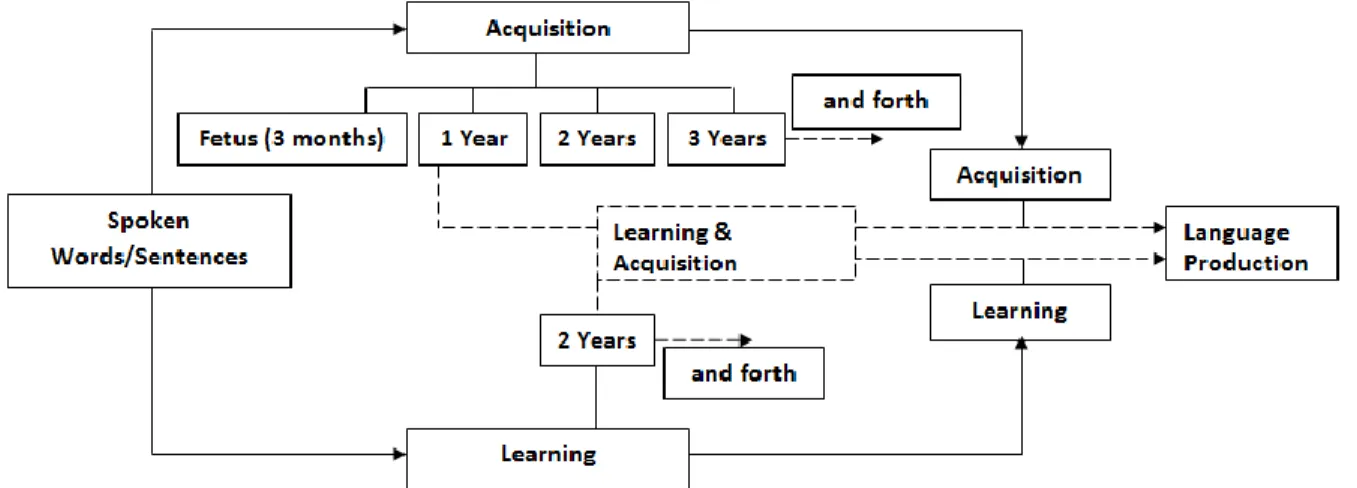
Now, we come to how actually children acquire and learn the language. Based on the findings, it is clear that the children acquire the language step by step based on the development of the brain. Children acquire language is just the same as adult in acquiring the language although there will be some constraints faced by adult concern with the first language because adult has had the strong basic of first language just than children. By this case, it is suggested to acquire any language since early childhood in order to get the natural process of acquisition. The first language as the language performance can be the powerful evidence of a process of acquisition. The following figure describes the theoretical framework between acquisition and learning.
Figure 1. The Theoretical Framework between Acquisition and Learning
acquire language consciously then means they have had significant capability in understanding the situation.
In learning language, children only need instructional reinforcement by describing the situation or meaning using the dominant language. From 2 or 3 years old up to 5 or 6, the time is good for children to teach in order to learn the language. In this phase of age, children have already had the enough capability in understanding the situation when instructing or describing or switching is perform. In this process of learning, children may have interference of the previous knowledge of understanding. Children usually need confirmation in order to get reinforcement in learning process. Asking for confirmation indicates the capability of understanding the situation or uttered words in learning process. It is actually not for asking for a correction but it is more to just confirming on what actually the uttered words meaning.
E. Conclusion
The difference between acquisition and learning is laid on the process. Acquisition process happened in two ways namely Subconscious and Conscious Acquisition while Learning is happened consciously. Acquisition is happened accidently, naturally, and multiple times while Learning is planned, unnatural, multiple times. Acquisition is happened in the way of setting up but the process should be in natural while Learning is happened in the way of setting up and the process is also set up, instructed, and switched. Acquisition is experienced ideally from around three months inside the womb up to the last of eight months after birth and then continue from that moment on but learning is experienced ideally from two or three years after birth and so on. In the process of learning, there might be a process of acquisition but in the process of acquisition there might not be a process of learning.
Children acquire language step by step based on the development of the brain and the case of learning as well. In acquiring language, children do not have any constraint deal with first language interference. Children tend to just listen to and then imitate, try to utter, repeat over and again, and need a positive reinforcement which is without any instruction or switching into the dominant language. In fact, it is needed for children who live in the context of EFL and ESL. Children acquire language subconsciously when they have not already had the capability in understanding the situation, self, and beliefs and consciously based on the level of age and they acquire language consciously when they have already had them.
Children learn the language by using instructional reinforcement. Children need confirmation in order to get reinforcement in learning process. The best time for children to learn language is at up to two or three years old.
F. References
Alfred, Jay. (2006). Brain and Realities. Victoria: Trafford Publishing
Brown, H. Douglas. (2000). Principles of Language Learning and Teaching. White Plains, NY: Longman.
Goswami, Usha. (2002). Blackwell Handbook of Childhood Cognitive Development. Victoria: Blackwell Publishers Ltd.
Krashen, Stephen. (1982). Principles and Practice in Second Language Acquisition. California: Pergamon Press Inc.
Krashen, Stephen. (1981). Second Language Acquisition and Second Language Learning. Southern California: Pergamon Press Inc.
Lieberman, P. (2000). Human language and our reptilian brain. Cambridge, MA: Harvard University Press.
Menezes, V Lúcia. (No year). Second Language Acquisition: From Main Theories To Complexity. Brazil: University of Minas Gerais.
Muhammad. (2011). Metode Penilitian Bahasa. Jogjakarta: AR – RUZZ MEDIA.
Sugiyono. (2009). Metode penilitian pendidikan pendekatan kuantitaf, kualitatif dan R&D. Bandung. Penerbit: Alfabeta Bandung.
Troike, M Saville. (2006). Introducing Second Language Acquisition. New York: Cambridge University Press.