76
THE CHARACTERISTICS OF ALCHEMILLA GENRE PLANTS PRESENT
IN ALEXANDRU BELDIE HERBARIUM FROM I.N.C.D.S. BUCHAREST
DELEANU ELENA*, IONESCU MONICA*, VECHIU EMILIA** *„Marin Dracea” National Institute for Research and Development in Forestry, e-mail: [email protected] **„Marin Dracea” National Institute for Research and Development in Forestry, Brașov
Key words: Alchemilla, botanists, plants, leaves.
ABSTRACT
The Alexandru Beldie Herbarium from I.N.C.D.S. Bucharest comprises approximately 40.000 plates of herbaceous plants, trees and shrubs. Amongst them, the present article analyses the 90 plates dedicated to the plants from the Alchemilla genre. After a short description of the genre, some of the 40 species present in this herbarium are described. The plants were gathered between 1854 and 1971, with a larger
incidence in the periods 1890-1899 and 1930-1949. Their origin ranges from different areas of our country (Bucegi, Ceahlău, Ciucas, Piatra Craiului, Rotnei) as well as from abroad (Spain, Hungary, Bulgaria, Switzerland) and were gathered by Romanian specialists (Al. Beldie, P. Cretzoiu, C. Georgescu, E. I. Nyarady, A. Haralamb) and foreign ones (D̕ Lagger, Dr.Hrizish, Joh. Bubela Wsetin, M. Bosse, R. Masson, Ph. Paiche A Geneve).
INTRODUCTION
"Alexandru Beldie" herbarium reunites numerous plants from the mountain area, namely 33 species of the Orobanche genus (Scărlătescu V. et al., 2017), 9 species of Melica, 11 species of Eragrostis genus (Cântar C. et al., 2017), 32 species of the Arabis genus (Dincă L. et al., 2017), 15 species of Ornithogalum genus (Enescu R. et al., 2017), 19 species of Androsace genus (Dincă M. et al., 2017), or the 112 species belonging to the Hieracium genus (Dincă L. et al., 2017).
Numerous Alchemilla species are collected in the Al. Beldie Herbarium from The National Institute of Research and Development in Forestry “Marin Drăcea”
from Bucharest. The plants are kept in the original portfolio in drawers of 30 modules (Vasile et al., 2017).
This collection is enrolled as INDEX HERBARIUM and all the species were gathered by known personalities in the field of systematic botany, one of the Romanian botanists being Al. Beldie, who dealt especially with this herbarium. The aim of this article is to present the state of this collection, to describe the species, the total number of Alchemilla
specimens (40 species), together with the date when they were collected, their location, the botanist who collected each exemplar and their conservation degree.
MATERIALS AND METHODS
The study material was composed of the 90 plates present in the above-mentioned Herbarium and belonging to the
Achemilla genre. The plates were grouped by species, harvest year, the
77
Table 1
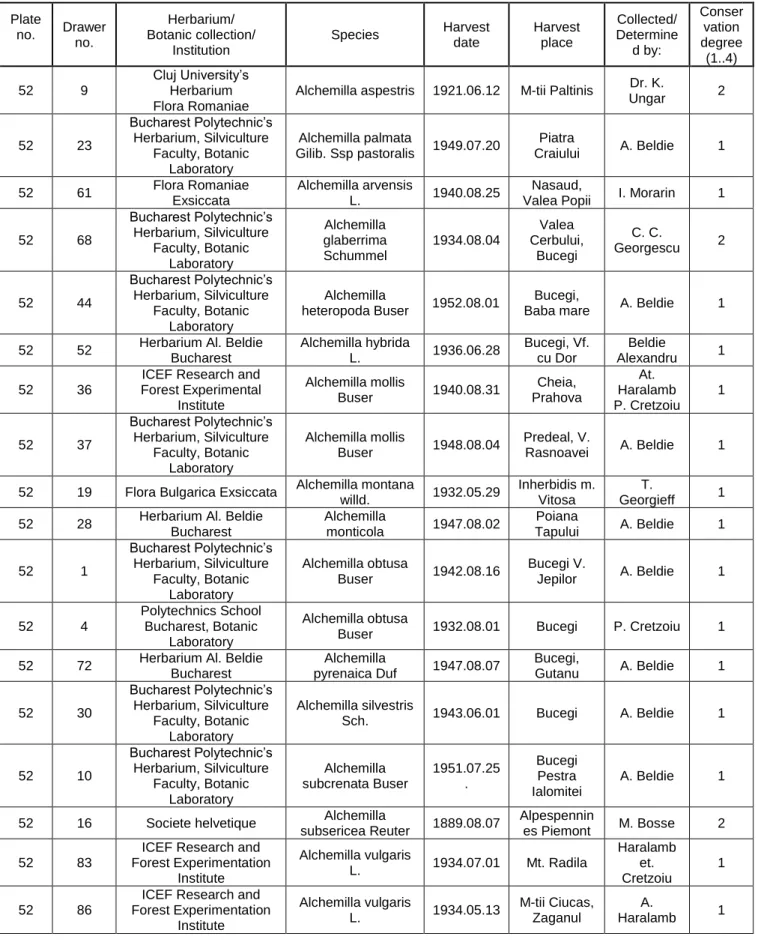
The inventory of Achemilla genus from INCDS Bucharest’s Al. Beldie Herbarium
(excerpt)
Plate
no. Drawer
no.
Herbarium/ Botanic collection/
Institution
Species Harvest
date Harvest place Collected/ Determine d by: Conser vation degree (1..4)
52 9
Cluj University’s Herbarium Flora Romaniae
Alchemilla aspestris 1921.06.12 M-tii Paltinis Dr. K.
Ungar 2
52 23
Bucharest Polytechnic’s Herbarium, Silviculture
Faculty, Botanic Laboratory
Alchemilla palmata
Gilib. Ssp pastoralis 1949.07.20
Piatra
Craiului A. Beldie 1
52 61 Flora Romaniae
Exsiccata
Alchemilla arvensis
L. 1940.08.25
Nasaud,
Valea Popii I. Morarin 1
52 68
Bucharest Polytechnic’s Herbarium, Silviculture Faculty, Botanic Laboratory Alchemilla glaberrima Schummel 1934.08.04 Valea Cerbului, Bucegi C. C.
Georgescu 2
52 44
Bucharest Polytechnic’s Herbarium, Silviculture
Faculty, Botanic Laboratory
Alchemilla
heteropoda Buser 1952.08.01
Bucegi,
Baba mare A. Beldie 1
52 52 Herbarium Al. Beldie
Bucharest
Alchemilla hybrida
L. 1936.06.28
Bucegi, Vf. cu Dor
Beldie
Alexandru 1
52 36
ICEF Research and Forest Experimental
Institute
Alchemilla mollis
Buser 1940.08.31
Cheia, Prahova At. Haralamb P. Cretzoiu 1
52 37
Bucharest Polytechnic’s Herbarium, Silviculture
Faculty, Botanic Laboratory
Alchemilla mollis
Buser 1948.08.04
Predeal, V.
Rasnoavei A. Beldie 1
52 19 Flora Bulgarica Exsiccata Alchemilla montana
willd. 1932.05.29
Inherbidis m. Vitosa
T.
Georgieff 1
52 28 Herbarium Al. Beldie
Bucharest
Alchemilla
monticola 1947.08.02
Poiana
Tapului A. Beldie 1
52 1
Bucharest Polytechnic’s Herbarium, Silviculture
Faculty, Botanic Laboratory
Alchemilla obtusa
Buser 1942.08.16
Bucegi V.
Jepilor A. Beldie 1
52 4
Polytechnics School Bucharest, Botanic
Laboratory
Alchemilla obtusa
Buser 1932.08.01 Bucegi P. Cretzoiu 1
52 72 Herbarium Al. Beldie
Bucharest
Alchemilla
pyrenaica Duf 1947.08.07
Bucegi,
Gutanu A. Beldie 1
52 30
Bucharest Polytechnic’s Herbarium, Silviculture
Faculty, Botanic Laboratory
Alchemilla silvestris
Sch. 1943.06.01 Bucegi A. Beldie 1
52 10
Bucharest Polytechnic’s Herbarium, Silviculture Faculty, Botanic Laboratory Alchemilla subcrenata Buser 1951.07.25 . Bucegi Pestra Ialomitei
A. Beldie 1
52 16 Societe helvetique Alchemilla
subsericea Reuter 1889.08.07
Alpespennin
es Piemont M. Bosse 2
52 83
ICEF Research and Forest Experimentation
Institute
Alchemilla vulgaris
L. 1934.07.01 Mt. Radila
Haralamb et. Cretzoiu
1
52 86
ICEF Research and Forest Experimentation
Institute
Alchemilla vulgaris
L. 1934.05.13
M-tii Ciucas, Zaganul
A.
78
RESULTS AND DISSCUTION
Achemilla is a plant from the
Rosales Order, Rosaceae family (the rose family, is a medium-sized family of
lowering plants, including 4.828 known
species in 91 genres) with the common name "lady's mantle" (Christenhusz, M. J. M. 2016 ). It is estimated that there are approximately 300 species, the majority
native to cool temperate and subarctic
regions of Europe and Asia, with a few species native to the mountains of Africa and the Americas.
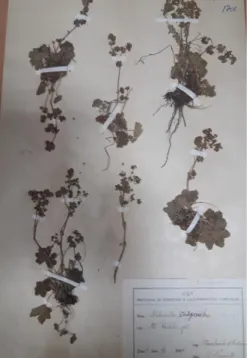
Alchemilla vulgaris belongs to the Rosaceae family, being present in hill areas up to mountain, humid ones, at forest margins and roads. The leaves are semi-circular, lobate (with 7 or 9 lobes), denticulated on the margins and with small and hard stems. The flowers are small, yellow-green and grouped in inflorescences. Common lady's mantle, is an herbaceous perennial plant commonly found in Europe and Greenland.
Figure 1. Alchemilla vulgaris
Alchemilla mollis, is an herbaceous perennial plant native to southern Europe that is cultivated throughout the world as an ornamental garden plant. It grows up to 30 or 45 cm (tall, with leaves that are palmately
veined, with a scalloped and serrated margin). The stipules are noteworthy in that they are fused together and leaf like. The chartreuse yellow flowers are held in dense clusters above the foliage.
(https://en.wikipedia.org/wiki/Alchemilla_
mollis)
Figure 2. Alchemilla mollis
Alchemilla erythropoda (dwarf lady's mantle) is a species of flowering herbaceous perennial plant from the Rosaceae family and native to Eastern Europe. It forms a clump of hairy, palmate leaves up to 15 centimetres high, with sprays of yellow flowers during early summer. Similar with its relative, A. mollis, their leaves are noted for being highly water-repellent. This plant is valued as groundcover cultivation in temperate regions as it tolerates a wide range of soil conditions, but is prone to self-seeding. It has gained the Royal Horticultural Society's Award of Garden Merit
(https://en.wikipedia.org/wiki/Alchemilla_e rythropoda).
79
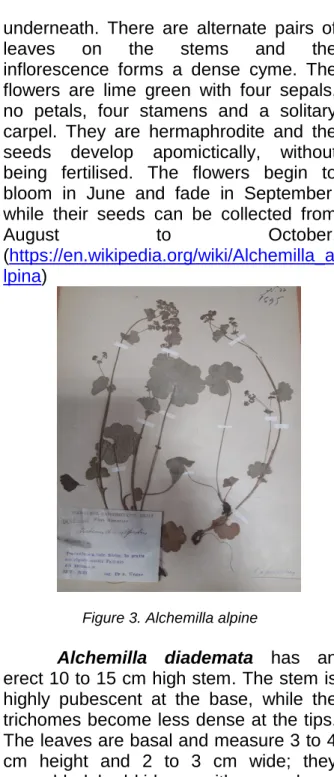
underneath. There are alternate pairs of leaves on the stems and the inflorescence forms a dense cyme. The flowers are lime green with four sepals, no petals, four stamens and a solitary carpel. They are hermaphrodite and the seeds develop apomictically, without being fertilised. The flowers begin to bloom in June and fade in September, while their seeds can be collected from
August to October.
(https://en.wikipedia.org/wiki/Alchemilla_a
lpina)
Figure 3. Alchemilla alpine
Alchemilla diademata has an erect 10 to 15 cm high stem. The stem is highly pubescent at the base, while the trichomes become less dense at the tips. The leaves are basal and measure 3 to 4 cm height and 2 to 3 cm wide; they resemble lobed kidneys with an oval and an inward curve on one side. The leaves are incised to the third into 7 to 9 lobes, each of them fringed by 6 to 7 teeth on each side of the lobes. The teeth end with bristles and are slightly connivant. The leaf underside is hispid, while its sinus is cordate. The plant has long, membranous and brownish stipules; it has a yellow-green pedicellate and glabrous inflorescence. The ovoid flowers appear from May to July, producing ovoid and
urn-shaped fruits
(https://en.wikipedia.org/wiki/Alchemilla_d iademata).
Alchemilla bursensis is a species of lady's mantle that is endemic to two sites in north-western Turkey. It inhabits stream sides and banks under beech forests, but it is likely threatened by climate changes and forestry. (https://en.wikipedia.org/wiki/Alchemilla_b ursensis)
Alchemilla arvensis, perennial plants with long petiolate leaves that have 7 up to 11 lobes. The flowers are organized in dichaz, glomerate and terminals. Usually found in mountain pastures, the plant has sericeous-silken leaves with rounded lobes.
Alchemilla hybrida is a hairy plant with the stem and leaves petiole jointed. Commonly found in humid orchards from mountains, its leaves are sericeous-silken.
Alchemilla alpestris, found in alpine orchards has a hairy stem and curly leaves, with semi rounded or short semi-oval lobes.
Alchemilla jaroschenkoi, is found in alpine meadows and pastures. (https://en.wikipedia.org/wiki/Alchemilla_j aroschenkoi)
Alchemilla stricta, grows near lakes or streams, in marshy grounds (https://en.wikipedia.org/wiki/Alchemilla_s tricta)
The most widespread Alchemilla
species present in this herbarium are:
Alchemilla mollis Buser (11), Alchemilla vulgaris L. (9), Alchemilla obtusa Buser (6), Alchemilla pyrenaica Duf (5),
Alchemilla fissa Schummel (4), Alchemilla hybrida L. (4), Alchemilla arvensis L. (4)
Alchemilla monticola (4), Alchemilla subcrenata Buser (3), Alchemilla montana Willd. (3), Alchemilla arvensis
Scop. (2), Alchemilla flabellata Buser (2),
Alchemilla pastoralis Buser (2),
Alchemilla silvestris (2) and Alchemilla xanthochlora (2).
The plant’s harvest year. The plants were gathered in a time period ranging between 1854 and 1971. The oldest plants of this genre are Alchemilla montana, gathered in 1854 and
80
The periods in which most plants were gathered were 1890-1899 and 1930-1949 (Figure 1).
Figure 4. Harvesting periods of Alchemilla plants from INCDS Herbarium
The harvesting place of the most of species (A. mollis, A. obtuse Buser, A. pyrenaica Duf, A. monticola, A. xanthochlora, A. heteropoda Buser, A.
subcrenata buser) is generally represented by high mountain areas: Bucegi Mountains (Babele, Cheile Ursilor, Peștera Ialomitei, Valea Cerbului, Poiana Crucii, Caraiman, Valea Jepilor, Varfu cu Dor, Golul Clabucet), Ceahlău Mountains, Piatra Craiului Mountains, Ciucas Mountains, Rodnei Mountains, or near cities from our country (Cheia, Câmpulung Muscel, Sinaia, Predeal, Auzga, Maneciu, Cluj, Turda). Various species of this genus were also harvested from abroad: Spain, Hungary, Bulgaria, Switzerland.
The experts that collect plants are represented by Romanian specialists (Al. Beldie, C.C. Georgescu, E.I. Nyarady, A. Haralamb, P. Cretzoiu) or foreign ones (D̕ Lagger, Dr.Hrizish, Joh. Bubela Wsetin, M. Bosse, R. Masson, Ph. Paiche A Geneve).
CONCLUSIONS
In "Alexandru Beldie" Herbarium, which contains more than 40,000 plates, 90 plates belong to the Alchemilla genus. The plants from this herbarium were gathered between 1854 and 1971, reaching a maximum in the period 1930-1949 and were gathered by renowned Romanian and foreign botanists (Al. Beldie, P. Cretzoiu, C. Georgescu, E. I. Nyarady, A. Haralamb). The plants were
gathered from Romanian mountain areas (Bucegi, Ceahlău, Ciucas, Piatra Craiului, Rotnei) or near cities from our country (Cheia, Câmpulung Muscel, Sinaia, Predeal, Auzga, Maneciu,Cluj, Turda), as well as from some European areas (Spain, Hungary, Bulgaria, Switzerland). The plants are in a good conservation degree and are very useful in many research and science domains.
BIBLIOGRAPHY
Beldie A., 1967, Flora și vegetația
Munților Bucegi. Ed. Academiei R.S.R., București, 167 p.
Beldie A. 1979, Flora Romaniei - determinator ilustrat al plantelor vasculare. Editura Academiei RSR. vol. I, p. 263.
Cântar I.C., M. Dincă, 2017, Doua genuri de plante din familia Poaceae (Melica si Eragrostis) existente in Herbarul Al. Beldie al INCDS Bucuresti.
Christenhusz, M. J. M. & Byng, J. W. 2016. "The number of known plants
species in the world and its annual increase". Phytotaxa. Magnolia Press. 261 (3): 201–217p.
Chisăliță I., D. Vasile, L. Dincă, 2017,
Unele specii de plante culese din parcul Bazoș, județul Timiș, existente în colecția Herbarului Alexandru Beldie de la I.N.C.D.S. București, Revista de Silvicultură și Cinegetică, nr.40, 71-76 p.
Dincă L., I.C. Cântar, M. Dincă, 2017,
81
Annals of West University of Timișoara, ser. Biology, vol. 20 (2),115-122 p.
Dincă L., D. Vasile, I. Voiculescu, 2017,
The characteristics of plants from Hieracium genre present in Alexandru Beldie Herbarium from I.N.C.D.S. Bucharest". Lucrări ştiinţifice USAMV Iaşi, seria Horticultură - vol. 60 (1), pag. 39-48.
Dincă Maria, L. Dincă, D. Vasile, 2017,
A short description of Androsace genre plants present in Alexandru Beldie Herbarium from I.N.C.D.S. Bucharest. Currents Trends in Natural Sciences, Vol. 6, Issue 12,16-24 p.
Enescu Raluca, L. Dincă, 2017,
Description of plant species of Ornithoghalum genus present in Al. Beldie Herbarium from ``Marin Drăcea`` Bucharest N.I.R.D.F. JOURNAL of Horticulture, Forestry and Biotechnology, Volume 21(3), 2017, 89-95 p.
Prodan I., Buia Al. 1958 Flora mica ilustrată a R.P.R. -Ed. Agro-Silvică, 268-269 p.
Scărlătescu Virgil, D. Vasile, L. Dincă, 2017, Plant species from "Al. Beldie" Herbarium - Orobanche genre - short description. ProEnvironment Promediu, 31(10), 191-198 p.
Vasile D., Dincă L., Indreica A., Voiculescu I., 2016 - Herbarul Alexandru Beldie - o colecție de plante și o importantă bază de date pentru specialiști. Revista de Silvicultură și Cinegetică, nr.39, 114-119 p.
12.https://en.wikipedia.org/wiki/Alchemilla _mollis
13.https://en.wikipedia.org/wiki/Alchemilla _erythropoda
14.https://en.wikipedia.org/wiki/Alchemilla _alpina
15.https://en.wikipedia.org/wiki/Alchemilla _diademata
16.https://en.wikipedia.org/wiki/Alchemilla _bursensis
17.https://en.wikipedia.org/wiki/Alchemilla _jaroschenkoi