34
RESEARCH ON DROUGHT TOLERANCE OF MAIZE HYBRIDS USING
SPECIFIC INDICES
BORLEANU IOANA CLAUDIA1 1Agricultural Research and Development Station Simnic
Key words: maize, relationship, drought, tolerance,indices
ABSTRACT
The reaction of maize genotypes to drought stress is evaluated using some specific indicators (SSI- stress susceptibility index, TOL-tolerance index, STI-stress tolerance index). Known that Simnic area is a drought year six maize genotypes grown in three different planting times and densities have been evaluated for their response to drought
stress using specific indicators. Grain yield was an important criterion for assessing
drought tolerance of the hybrids evaluated. In 2010 drought stress appeared in July to
September, period that coincides with flowering, silk and grain filling. Differences in stress tolerance index values were quite close, suggesting that this index is not influenced by
sowing time. In light of drought tolerance specific indices under three planting times and
densities only Kitty and Kamelias were the most drought tolerant hybrids.
INTRODUCTION
Among all natural stress factors which plants are subjected, drought affects 26% of the arable land of Earth, thus limiting more plants distribution and their productivity in both natural and agricultural systems (Hanson and Hitz, 1982). Maximum sensitivity of maize to drought enroll in 2-22 days after silk when the number of grains may decrease with 45%, 1000-kernels weight decreased also with 51% when the drought appeared to 12-16 days after silk leading to yield losses especially when the stress period appear from head emergence to grain filling (Denmead and Show, 1960, Claassen and Show, 1970, Grant et al., 1989, NeSmith and Richie, 1992, Heisey and Edmeades, 1998, Engelen-Eigles et al., 2001, Burzo and Dobrescu Aurelia, 2011). When drought occurs during this period of high sensitivity low grain yield is greatly correlated with the number of grains/plant (r = 0,90**
and ASI – anthesis silking interval = -0,60**) (Balaños and Edmeades, 1996). This is one
of the reasons why researchers have focused on this critical period to get drought tolerance in order to stabilize the number of grains/plant and to increase yield. Beside classical breeding methods that require time to obtain genotypes with tolerance to drought stress and technological methods to decrease drought effects, actually a huge attention is focused to obtain transgenic plants with high tolerance to this stress factor (Vasal et al., 1997, Seki and Kamel, 2003, Vinocur and Altman, 2005, Byun et al., 2007, Zhang and Shih, 2007). Regardless of how are obtained these genotypes assessment of drought effects is performed using some specific indicators (Rasielle and Hamblin, 1971, Fischer and Maurer, 1978, Fernandez, 1992). Thus, the aim of this study was to evaluate the tolerance to drought stress of six hybrids grown in three different planting times and densities in the climatic conditions of Simnic area.
MATERIAL AND METHODS
During 2010 year six maize hybrids grown on three times (the 15th April, the 1st May
and the 15th May) and planting density (40000pl/ha, 50000pl/ha and 60000pl/ha) have
been tested in different climatic conditions in order to evaluate their response to drought stress. The material was represented by six maize hybrids (F 475, Kamelias, Danubian,
KWS 2376, Rapsodia, Kitty) tested using a split plot design with two factors (Factor A –
planting density, Factor B – maize hybrid) in three replications. The size of each plot was
35
basal applied and 150 kg/ha ammonium nitrate top-dressed during vegetation period. Weeds were controlled in each experimental year using herbicides. To evaluate the reaction of the maize hybrids to drought stress were used specific indices: stress susceptibility index (SSI) (Fischer and Maurer, 1978), tolerance index (TOL) (Rosielle and Hamblin, 1981) and stress tolerance index (STI) (Fernandez, 1992). Also, grain yield was an important criterion for assessing drought tolerance of the hybrids evaluated.
RESULTS AND DISCUSSION
Generally, in rained conditions precipitations are variable and cannot be predicted, therefore a “successful” maize cultivar tolerant to drought stress must be able to withstand some variation in rainfall year to year and to record stable yields. The differences in grain yield between hybrids increased with the intensity of drought stress (Betrán et al., 2003). Drought affects maize grain yield to some degree at almost all grown stages, but the crop is the most susceptible during flowering (Denmead and Show, 1960, Claassen and Show, 1970, Grant et al., 1989) because its female florets develop virtually at the same time and are usually borne on a single ear on a single stem. Although there are often reasonable quantities of plant reserves formed well before flowering and stored in the stem, the developing maize ear has very little capacity to mobilize and attract them in its first two weeks of life. Often in Simnic area drought stress occurs during the most sensitive crop stages leading finally to yield decreased or even to crop compromising. In 2010 drought stress appeared in July to September, period that coincides with flowering, silk and grain filling. In the conditions of 0,26 drought intensity (moderately strong) stress susceptibility
index ranged between 0,11-0,95 ( for the 15th April planting time), 0,70-1,74 (for the 1st
May) and 0,86-1,46 (for the 15th May) (Table 1).
Table 1 Stress Susceptibility Index (SSI) values for 2010 year
Hybrid 40000 50000 60000
Yn Ys SSI Yn Ys SSI Yn Ys SSI
The 15th April
F475 66.9 53.0 0.79 76.0 58.0 0.91 69.6 59.3 0.57
Kamelias 64.1 58.0 0.37 73.4 63.4 0.52 62.2 65.4 0.20
Danubian 60.6 58.8 0.11 71.0 57.7 0.72 59.9 53.7 0.22 KWS2376 62.9 53.5 0.57 76.9 58.9 0.90 76.3 59.2 0.56
Rapsodia 64.5 61.8 0.16 77.1 62.9 0.71 74.4 61.5 0.67
Kitty 74.2 63.3 0.57 84.0 63.2 0.95 76.7 66.2 0.58
The 1st May
F475 71.7 47.5 1.30 81.6 55.1 1.25 72.3 49.6 1.21
Kamelias 74.0 60.5 0.70 77.6 59.2 0.91 86.1 55.2 1.38
Danubian 74.3 45.4 1.50 68.5 47.2 1.20 75.0 41.1 1.74 KWS2376 74.7 50.5 1.25 75.2 55.6 1.00 80.2 47.1 1.59
Rapsodia 78.2 49.3 1.42 72.8 57.9 0.79 78.8 52.2 1.30
Kitty 82.6 53.3 1.36 75.5 61.5 0.71 89.8 50.8 1.67
The 15th May
F475 67.6 41.9 1.46 69.8 50.1 1.09 69.0 50.7 1.02
Kamelias 70.6 50.9 1.07 73.9 57.3 0.86 80.9 57.8 1.10
Danubian 63.9 45.2 1.13 69.9 51.0 1.04 67.0 49.8 0.99 KWS2376 68.8 45.8 1.26 84.1 56.8 1.25 79.2 52.5 1.30
Rapsodia 67.9 43.6 1.38 75.6 54.6 1.07 76.8 53.4 1.17
Kitty 74.4 49.7 1.28 79.8 56.4 1.13 77.9 59.4 0.91
36
There results suggest that normal and delayed sowing time influenced drought tolerance of maize hybrids as evidenced by yield differences recorded. When maize
hybrids were sown on 15th April, Danubian at planting density of 40000 pl/ha recorded the
lowest SSI (0,11) meaning that is a drought tolerant cultivar in the conditions of a lower plants number/ha, while the highest SSI was recorded by Kitty at planting density of 50000pl/ha suggesting that it was most affected by drought stress. Among all maize
hybrids sown at the 1st May and 40000pl/ha the most tolerant to drought stress was
Kamelias which recorded 74 q/ha grain yield and SSI 0,70. The same hybrid was noticed also as having a good stress tolerance for 50000 pl/ha with 77,6 q/ha grain yield and SSI 0,91. For delayed sowing time most tested hybrids recorded a SSI up to 1, excepting Kamelias, Danubian and Kitty. Under three planting times and densities only Kamelias and Kitty were the most drought tolerant hybrids.
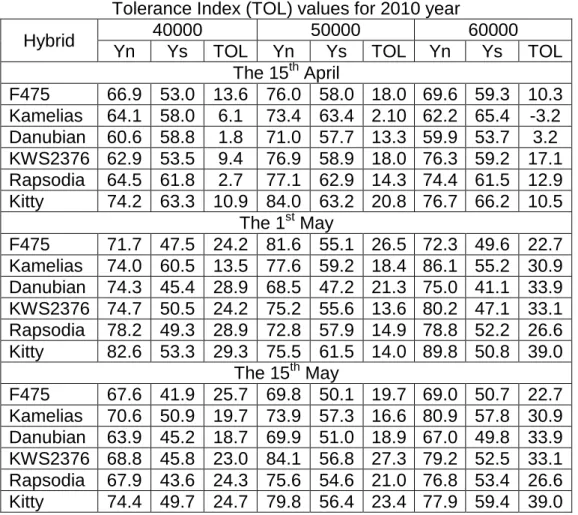
Tolerance index values ranged between 1,8-20,8 q/ha (for the 15th April sowing
time), 13,5-39 q/ha (for the 1st May sowing time) and 16,6-39 q/ha (for the 15th May sowing
time) (Table 2).
Table 2 Tolerance Index (TOL) values for 2010 year
Hybrid 40000 50000 60000
Yn Ys TOL Yn Ys TOL Yn Ys TOL
The 15th April
F475 66.9 53.0 13.6 76.0 58.0 18.0 69.6 59.3 10.3
Kamelias 64.1 58.0 6.1 73.4 63.4 2.10 62.2 65.4 -3.2
Danubian 60.6 58.8 1.8 71.0 57.7 13.3 59.9 53.7 3.2
KWS2376 62.9 53.5 9.4 76.9 58.9 18.0 76.3 59.2 17.1
Rapsodia 64.5 61.8 2.7 77.1 62.9 14.3 74.4 61.5 12.9
Kitty 74.2 63.3 10.9 84.0 63.2 20.8 76.7 66.2 10.5
The 1st May
F475 71.7 47.5 24.2 81.6 55.1 26.5 72.3 49.6 22.7
Kamelias 74.0 60.5 13.5 77.6 59.2 18.4 86.1 55.2 30.9
Danubian 74.3 45.4 28.9 68.5 47.2 21.3 75.0 41.1 33.9 KWS2376 74.7 50.5 24.2 75.2 55.6 13.6 80.2 47.1 33.1
Rapsodia 78.2 49.3 28.9 72.8 57.9 14.9 78.8 52.2 26.6
Kitty 82.6 53.3 29.3 75.5 61.5 14.0 89.8 50.8 39.0
The 15th May
F475 67.6 41.9 25.7 69.8 50.1 19.7 69.0 50.7 22.7
Kamelias 70.6 50.9 19.7 73.9 57.3 16.6 80.9 57.8 30.9
Danubian 63.9 45.2 18.7 69.9 51.0 18.9 67.0 49.8 33.9 KWS2376 68.8 45.8 23.0 84.1 56.8 27.3 79.2 52.5 33.1
Rapsodia 67.9 43.6 24.3 75.6 54.6 21.0 76.8 53.4 26.6
Kitty 74.4 49.7 24.7 79.8 56.4 23.4 77.9 59.4 39.0
For the 15th April sowing time as planting density increases TOL values grow,
excepting Kamelias and Danubian for a planting density of 60000 pl/ha. When maize was
sown at the 1th May all hybrids at all densities showed TOL values up to 13,5 q/ha. The
highest TOL value was recorded by Kitty (39 q/ha) for a planting density of 60000 pl/ha. This hybrid recorded also the highest TOL value for the same planting density when
sowing time was done at the 15th May. All maize hybrids sown at the 15th May for all
37
Overall TOL values below 5 q/ha recorded Danubian (1,8 q/ha) and Rapsodia (2,7 q/ha) for a planting density of 40000 pl/ha and Kamelias (-3,2 q/ha) and Danubian (3,2 q/ha) for a planting density of 60000 pl/ha.
Similar results for maize inbred lines and hybrids were reported by Ahmandzadeh (1997) and Khodarahmpour et al. (2011) and also for other crops (Clarke et al., 1992, Ramirez and Kelly, 1998).
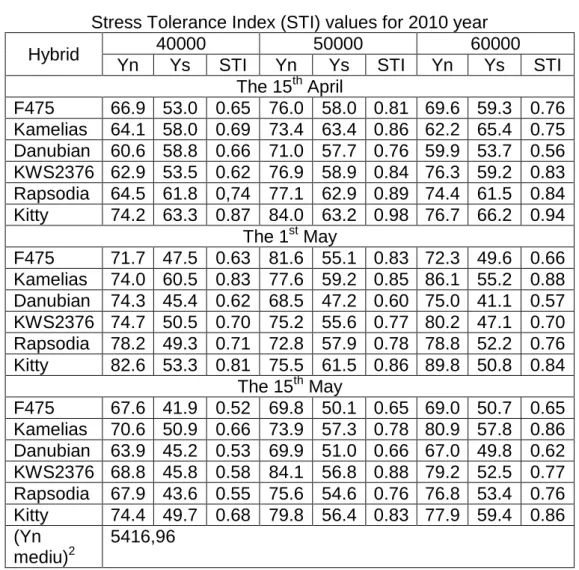
Differences in stress tolerance index values were quite close, suggesting that this index is not influenced by sowing time (Table 3). For the first two sowing time at a density of 60000 pl/ha Danubian recorded the lowest value of STI, but is not correlated with a higher yield in normal year. Generally, Kitty has been the most productive of all sowing times and densities recording high STI values due to lower yield obtained under drought conditions. STI vas the best index to identify superior genotypes in drought stress conditions as previously show other authors for different crops (Fernandez, 1992, Pourdad, 2008, Khodarahmpour and Hamidi, 2011, Khodarahmpour et al. ,2011).
Table 3 Stress Tolerance Index (STI) values for 2010 year
Hybrid 40000 50000 60000
Yn Ys STI Yn Ys STI Yn Ys STI
The 15th April
F475 66.9 53.0 0.65 76.0 58.0 0.81 69.6 59.3 0.76
Kamelias 64.1 58.0 0.69 73.4 63.4 0.86 62.2 65.4 0.75
Danubian 60.6 58.8 0.66 71.0 57.7 0.76 59.9 53.7 0.56 KWS2376 62.9 53.5 0.62 76.9 58.9 0.84 76.3 59.2 0.83 Rapsodia 64.5 61.8 0,74 77.1 62.9 0.89 74.4 61.5 0.84
Kitty 74.2 63.3 0.87 84.0 63.2 0.98 76.7 66.2 0.94
The 1st May
F475 71.7 47.5 0.63 81.6 55.1 0.83 72.3 49.6 0.66
Kamelias 74.0 60.5 0.83 77.6 59.2 0.85 86.1 55.2 0.88
Danubian 74.3 45.4 0.62 68.5 47.2 0.60 75.0 41.1 0.57 KWS2376 74.7 50.5 0.70 75.2 55.6 0.77 80.2 47.1 0.70 Rapsodia 78.2 49.3 0.71 72.8 57.9 0.78 78.8 52.2 0.76
Kitty 82.6 53.3 0.81 75.5 61.5 0.86 89.8 50.8 0.84
The 15th May
F475 67.6 41.9 0.52 69.8 50.1 0.65 69.0 50.7 0.65
Kamelias 70.6 50.9 0.66 73.9 57.3 0.78 80.9 57.8 0.86
Danubian 63.9 45.2 0.53 69.9 51.0 0.66 67.0 49.8 0.62 KWS2376 68.8 45.8 0.58 84.1 56.8 0.88 79.2 52.5 0.77 Rapsodia 67.9 43.6 0.55 75.6 54.6 0.76 76.8 53.4 0.76
Kitty 74.4 49.7 0.68 79.8 56.4 0.83 77.9 59.4 0.86
(Yn
mediu)2
5416,96
The results showed that the ability of crop cultivars to perform reasonably well in variable rainfall and water stress environments is an important trait for yield stability under drought stress conditions.
CONCLUSIONS
38
the conditions of 0,26 drought intensity (moderately strong) stress susceptibility index
ranged between 0,11-0,95 ( for the 15th April planting time), 0,70-1,74 (for the 1st May) and
0,86-1,46 (for the 15th May). Tolerance index values ranged between 1,8-20,8 q/ha (for the
15th April sowing time), 13,5-39 q/ha (for the 1st May sowing time) and 16,6-39 q/ha (for the
15th May sowing time). Differences in stress tolerance index values were quite close,
suggesting that this index is not influenced by sowing time. In light of drought tolerance specific indices under three planting times and densities only Kitty and Kamelias were the most drought tolerant hybrids.
BIBLIOGRAPHY
Ahmandzadeh A. - 1997. Determination of the best drought tolerance index in selected
maize (Zea mays L.) lines. MSc. Thesis, Tehran University, Tehran, Iran.
Bolaños J. and Edmeades G.O. - 1996. The importance of the anthesis- silking interval in breeding for drought tolerance in tropical maize. Field Crop Res. 48: 65.
Betrán F.J., Beck D., Bänziger M., Edmeades G.O. - 2003. Genetic analysis of inbred
and hybrid grain yield under stress and nonstress environments in tropical maize. Crop Science 43, p.807-817.
Burzo I. and Aurelia Dobrescu - 2011. Stresul termohidric la plante, ed. Ceres Bucuresti, 2011.
Byun M.O., Kwon H.B. , Perk S.C. - 2007. Recent advances in Genetic Engineering op
Potato crops for Drought and Saline Stress Tolerance. În Advances in Molecular Breeding Toward Drought and Salt Tolerant Crops, Jenks M.A., Hasegwa P.M., Jain S.M., ed. Springer, Neterlands 713-737.
Clarke J.M., DePauw R.M., Townley-Smith T.M. - 1992. Evaluation of methods for
quantification of drought tolerance in wheat. Crop Sci. 32, p.728-732.
Denmead D.T. and Shaw R.H. -1960. The effects of soil moisture stress at different
stagyes of growth on the developement and vired of corn.Agronomy J. 52: 272-274.
Engelen-Eigles G., Jones R.G., Phillips R.L. - 2001. DNA Endoduplication in Maize
Endosperm Cells Is Reduced by High temperature During the Mitotic Phase. Crop Science, 41:1114-1121.
Fernandez G.C.J. - 1992.Effective selection criteria for assessing stress tolerance. PP. Proceedings of the International Symposium on ,, Adaptation of vegetables and other food crop in temperature and water stress. AVRDC Publication. Tainan. Taiwan.
Fischer R.A., T. Maurer - 1978. Drought resistance in spring weat cultivars. I. Grain yield response. Aust. J. Agri Research, 29:897-912.
Grant R.F., Jackson B.S., Kiniry J.R., Arkin G.F. - 1989. Water deficit timing effect on
yield components in maize. Agronomy J. 81, p.61-65.
Knodarahmpour Z. and Hamidi J. - 2011. Evauation of drought tolerance in different
growth stages of maize (Zea mays L.) inbred lines using tolerance indices. African Journal of Biotech. 10, p.13482-13490.
Knodarahmpour Z., Choukan R., Bihamta M.R., Majidi Harvan E. - 2011. Determination of the best heat stress tolerance indices in maize (Zea mays L.) inbred lines and hybrids under Khuzestan Province conditions. Journal of Agricultural Sci. Tech. 13, p.111-121.
Hanson A.D., Hitz W.D. - 1982. Metabolic responses of mesophytes tonplant Water
deficits. Ann. Rev. Plant Physiol, 33: 163-203.
Heisey P.W. and Edemeades G.O. - 1998. Maize production in drought-stressed
environments: technical options and research resource allocation. World maize facts and trensds, 1997/1998, p: 1-36.
39
Pourdad S.S. - 2008. Study on drought resitsnce indices in spring safflower. Acta Agronomica Hungarica, ISSN 0238-161, vol. 56, p.203-212.
Ramirez P. and Kelly J.D., 1998. Traits Related to Drought Resistance in common bean. Euphytica 99, p.127-136.
Rosielle A.A and Hamblin J. 1981. Theoretical aspects of selection for yield in stress and non-stress environments. Crop Sci. 21, p.943-946.
Seki M.and Kamel A., 2003. Molecular responses to drought, salinity and frost: common and different paths for plant protection. Curr. Opinion Biotechnol. 14:194-199.
Vasal, S.K., Cordova, H.S., Beck D.L., Edmeades G.O.1997. Choices among breeding procedures and strategies for developing stress tolerant maize germplasm. In: Edmeades G.O., Bänziger M., Mickelson, H.R., Peña-Valdivia C.B. (eds). Developing Drought and Low-N Tolerance Maize. Prodeedings of a Symposium March 25-29, 1996, CIMMYT, El Batan, Mexico, Mexico D.F., CIMMYT.
Vinocur B., Altman A., 2005. Recent advances in engineering plant tolerance to abiotic stress: achievements and limitations. Curr. Opinion in Biotechnol. 16: 123-132.