Kay Hammond
and
Catherine Powell
paper
series
OCCasiONaL
DisCUssiON
&
Number 1/2017
ISSN 2324-3635
Entry-level tertiary student
perceptions of challenges
when using a wiki:
OCCASIONAL AND
DISCUSSION PAPER SERIES 1/2017
Entry-level tertiary student perceptions of challenges
when using a wiki: Trust and peer teaching
By Kay Hammond and Catherine Powell
Entry-level tertiary student perceptions of challenges when using a wiki: Trust and peer teaching by Kay Hammond and Catherine Powell is licensed under a Creative Commons Attribution-NonCommercial 4.0 International License.
THIS PUBLICATION MAY BE CITED AS:
Kay Hammond and Catherine Powell (2017). Entry-level tertiary student perceptions of
challenges when using a wiki: Trust and peer teaching. Unitec ePress Occasional and Discussion Paper Series (2017:2). Retrieved from http://www.unitec.ac.nz/epress.
ABOUT THIS SERIES:
Unitec ePress periodically publishes occasional and discussion papers that discuss current and ongoing research authored by members of staff and their research associates. All papers are blind reviewed. For more papers in this series please visit: www.unitec.ac.nz/epress/index.php/ category/publications/epress-series/discussion-and-occasionalpapers
Cover design by Penny Thomson CONTACT:
[email protected] www.unitec.ac.nz/epress/ Unitec Institute of Technology
Private Bag 92025, Victoria Street West Auckland 1142
New Zealand
ABSTRACT
Wikis are widely used in blended learning educational settings with varying degrees of success. Scholarly attention increasingly regards student perceptions and experiences of using wikis as part of ongoing development. Students in entry-level education often belong to high-needs target groups who particularly require positive experiences for successful transition into tertiary education. This paper reports action research exploring the use of a wiki by certificate-level students at a tertiary institution. The results showed most students did not engage with the wiki. Qualitative student feedback revealed valuable insight into two major social challenges when interacting online: trust and difficulties with peer-teaching. Recommendations are made regarding these social challenges that should be considered by educators aiming to use a wiki or other collaborative online learning and teaching spaces for entry-level education.
INTRODUCTION
Blended learning in higher education
A prominent feature of current higher education is the increasing number of students enrolling in tertiary qualifications (massification). In addition, there is increasing pressure to limit public
Entry-level tertiary student
perceptions of challenges
when using a wiki:
Trust and peer teaching
AUTHORS
Kay Hammond and Catherine Powell
expenditure on higher education. These two factors influence the drive towards combining technology with traditional teaching and learning practices (Engel & Halvorson, 2016). Blended learning is the integration of online learning into classroom-based learning (Maisie, 2006). There is international pressure to integrate technology into education, for reasons such as enhancing the learning experience of students and the drive to create flexible learning environments (Kanuka & Rourke, 2013; Percival & Muirhead, 2009; Sandbach, 2015). The use of blended learning has even been described as the “new normal in education” (Anders Norberg & Dziuban, 2011, p. 207).
One example of technology in blended learning is the use of a wiki. Vigentini and Cowan (2012) described a wiki as a website where users can read and edit the contents and structure. Its central features are that it is quick and easy, interactive, collaborative, interfaces with other products, and allows community. In addition to creating learning opportunities within the classroom, wikis offer a way of transcending the gap between traditional learning spaces within educational institutions, home and community (Angelaina & Jimoyiannis, 2012), and have been viewed as offering a solution to the problem of isolation or reluctance to seek face-to-face
support in educational contexts (Minocha, 2009). Online engagement alters the relationship between teachers and students in which there is greater responsiveness to student needs in the learning experience (Blessinger & Wankel, 2012). Wikis in education have been widely viewed as supporting construction of knowledge and collaborative learning in educational contexts (Roussinos & Jimoyiannis, 2013).
Roussinos & Jimoyiannis (2013) summarised several studies demonstrating successful use of wikis to develop student knowledge from surface learning to deeper understanding resulting from wiki-based collaborative learning opportunities. Naismith, Leet and Pilkington (2010) summarised literature on the success of using wikis as being influenced by factors relating to task, instruction, assessment, tutor facilitation, familiarity with technology, social skills, social pressure, time, and perceived ease of use and usefulness. Exploration of student experiences of wikis has revealed benefits and challenges of their use. Positive student experiences have included: valuing peer feedback and examples to assist their learning, receiving more immediate feedback, and reduced pressure from the teacher-student hierarchy (Lin & Yang, 2011). However, Elgort, Smith and Toland (2008) noted that despite the increase in wiki use in higher education, they are not always successful. They summarised research indicating wikis may be less effective when tasks are inauthentic or do not require students to work collaboratively. Cole (2009) reported on a failed implementation of a wiki with an undergraduate information systems class. Her students reported non-participation was due to time constraints, lack of interest, worry about technical ability, and self-doubt about their contribution quality. Negative student experiences have included preferring traditional teacher-directed methods (Lin & Yang, 2011), lack of familiarity with the wiki tool, and reluctance to critique beyond surface-level errors to maintain politeness (Demirbilek, 2015; Lin & Yang, 2011).
Indeed, there is much written about the promise of wikis, as well as some of the challenges they present. Studies have called for greater
exploration across diverse contexts of students’ experiences and perceptions of working with wiki technology in the process of their learning (Kear, Woodthorpe, Robertson & Hutchison, 2010; Larkin, Rowan, Garrick & Beavis, 2016; Lin & Yang, 2011). Larkin et al. (2016) argued:
In a time of rapid social and technological change, if we seek to move first-year scholarship forward we must be willing to document what actually happens when different cohorts of students are offered particular forms of support and how they make sense of, or value, what they experience. (p. 3)
This paper reports on the experiences of entry-level tertiary students when a wiki was introduced into their teaching and learning environment.
OUR CONTEXT
Unitec Institute of Technology is a tertiary education provider in Auckland, Aotearoa New Zealand. One of the programmes offered is the Certificate in Community Skills. This programme often transitions entry-level students into first-year bachelor-level study. Entry-level students in this context are those who are not ready to begin degree-level study, either due to academic skills or confidence levels. They are often second-chance learners, and may have complex family lives and a low level of confidence in their academic ability. Whilst the challenges faced by this cohort may have blocked them from direct access to degree-level study, they have a strong vision for their future and aspire to graduate. It is important to embed specific skills into the curricula that address the challenges of this cohort (Kift, Nelson, & Clarke, 2010). This cohort often needs to learn how to be successful students and may not yet have strong help-seeking behaviours. Tinto (2011) notes that aligning academic support to the needs of the students, setting clear expectations about required standards, and providing regular feedback are strategies that support students to learn the skills needed to succeed.
As part of academic support, academic literacy support staff, such as learning advisors, are also important in both teacher and student learning. Furthermore, they should foster collaborative
associations with teaching faculty who can provide insights into particular class contexts (Upcraft & Stephens, 2000). Learning advisors’ knowledge of students as learners is a valuable resource for course and programme development (Huijser, Kimmins & Galligan, 2008). Likewise, students are a valuable resource for teaching design and provision of courses (Bovill, Cook-Sather & Felten, 2011). Bovill et al. examined results across several projects and noted common benefits of collaboration with learning advisors for both students and staff that included a deeper perspective on learning, greater engagement, a sense of re-energising and a new sense of relationship between teachers and students. A wiki is a space where students, course teachers and learning advisors can interact, and this has been viewed as offering a solution to the problem of reluctance to seek face-to-face support in educational contexts (Minocha, 2009). Therefore, in this context, we combined the support of the course teacher and learning advisor on a wiki to assist students with academic support.
Considering the potential success and challenges of wikis, it is important to explore experiences of vulnerable students so that these may be shared and considered in future education design. The research objective was to explore entry-level students’ experiences and perceptions of using a wiki to assist them with their assignments. The exploration of the students’ perceptions and experiences of the wiki took place within the Certificate in Community Skills paper that often led to the first year in a Bachelor of Social Practice. The certificate required students to complete four assessments: 1) a verbal commentary of how their family was influenced by surrounding cultures, 2) a group presentation on the definition of community, 3) an essay (500-1000 words, with APA 6th referencing) on the Treaty of Waitangi (the 1840 treaty between some North Island Ma¯ori chiefs and representatives of the British Crown) and its implications for New Zealand, and 4) create a portfolio of resources for communicating across languages and cultures. The student cohort’s character was diverse in age and ethnicity. The wiki provided a space where they could share knowledge and receive peer feedback on their work to assist with the
completion of assignments. The course teacher (Catherine Powell) was an experienced leader of the class for six years and the learning advisor (Kay Hammond) was an experienced academic support person.
METHODOLOGY AND METHOD
Action research
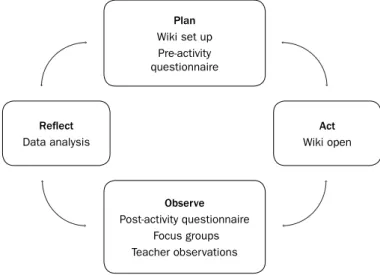
The researchers were also the practitioners seeking to improve their practice, and the findings of this project are intended to guide development of future practice; therefore, a developmental action research approach was adopted following Cardno’s (2003) four-stage action research cycle (act, observe, reflect, plan). We started our first phase at the planning stage of the cycle by focusing on a specific issue within our local context: the need for more academic support in a certificate class. Secondly, in the action phase, we provided academic support online through a wiki. Thirdly, in the observation phase, we collected data through a questionnaire, focus groups and our own observations. Fourthly, in the reflection phase, we explored and interpreted subjective human experience by analysing students’ and our responses to the wiki. Our action research cycle is outlined in Figure 1. We designed the study to be cyclical in nature, where the conclusion of one cycle would lead to the beginning of the next. This process enables the development of learning and practice through
Plan Wiki set up Pre-activity questionnaire Observe Post-activity questionnaire Focus groups Teacher observations Act Wiki open Reflect Data analysis
mutual understanding and influence (McNiff & Whitehead, 2011). Furthermore, through the self-critical nature of the action research process (Kemmis, 2009), we were open to transforming our own thinking and practice in supporting certificate-level students.
METHOD
The wiki
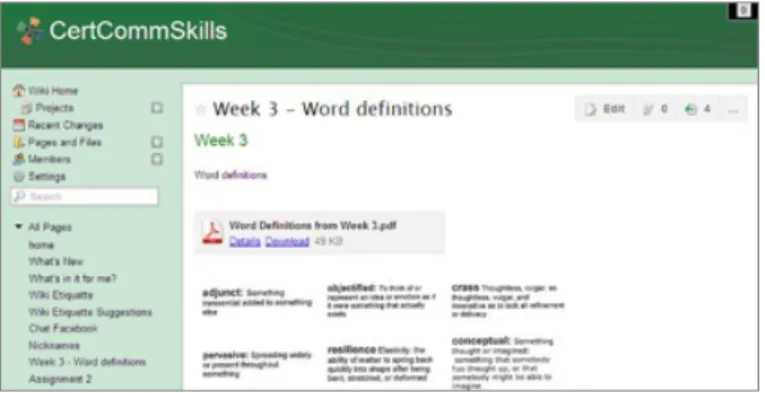
The wiki was hosted by Wikispaces. We set it up with pages including: what’s new, what’s in it for me? wiki etiquette, space for wiki etiquette suggestions from students, Google Plus instructions, eight steps for paraphrasing, peer feedback page, events, wiki practice page, space for questions, general feedback wall and staff profile pages. The focus was on getting students to interact socially, support each other with their assessments, begin accessing academic support and provide peer feedback. Some pages included content with a summary on the wiki page and a link to more details (see Figure 2), and other pages encouraged sharing of the content to extend learning (see Figure 3). Out-of-class training was held for students to learn to use the wiki. The wiki was open from the first week of the 16-week semester and was closed in week 13 after the post-activity questionnaire.
Recruitment – participants
Participants were 46 certificate students enrolled in the 16-week Culture and Community class in the Certificate in Community Skills. This represented 78% of the total enrolment. The average age was 28.3 years (mode = 19, median = 22, range = 16-61). There were 41 female and five male students. The range of ethnicities included: European (28%), Pacific Island (24%), ‘Mix’ (15%), Ma¯ori (indigenous) (11%), African (4%), Indian, Afghani, Asian, South African, no answer (11%) and ‘NZ’ (identification with New Zealand nationality rather than an ethnic group) (7%). Most participants (59%) had continued with study while the others had returned after gaps ranging from one to 20 years. Most participants had experience with email (97.8%), uploading something to the internet (78.3%) and using an instant message chat (63%). Relatively few had
Figure 2. Example of a content page
Figure 3. Example of a sharing page
experience with wikis (32.6%), blogs (28.3%) or Twitter (23.9%). All participants had access to the internet on campus and 80% had internet access at home.
Pre-activity questionnaire
Participants completed a simple pre-activity, multi-choice questionnaire to give information about demographics such as age, gender, ethnic identity, number of years since they last studied, number of years since last writing an essay, and two Likert Scale ratings – from 1 (not) to 5 (very) about their level of confidence and enjoyment with that essay. The second part obtained information about experience with technology; this asked about access to a computer and the internet at home. Participants were also asked if they knew what wiki was (yes/not sure/no) and whether they had any experience with a range of online tools (email, Twitter, instant-chat software, wiki, blog or having uploaded photos to the internet).
Post-activity questionnaire
In week 12 of the course, participants were given a post-activity questionnaire about their experiences using the wiki. Similar to Cole (2009), this included the options to circle items reflecting their engagement with the wiki such as signing on, reading, posting or printing information. Open-ended questions included what they found useful, not useful and what would have made them engage more. Considering certificate-level students may not be confident with writing their ideas, some prompts were given for questions related to not using the wiki such as feeling anxious, not knowing how, and preference for a different online tool. There was also open space to provide any further comments.
Focus groups
Focus groups are useful for helping participants to explore and express their experiences (Kitzinger, 1994; Krueger & Casey, 2000). Focus groups allowed us to understand how students experienced and felt about the wiki so we could develop it in future cohorts. Due to participant availability, the focus groups were held in four thirty-minute sessions of two, three and four students, and one single student interview (total of ten students). The discussions were semi-structured with initial questions asking how students thought the wiki fitted or did not fit with their learning style or lifestyle. Other pre-set questions were determined separately for each group, based on their responses to the post-activity questionnaire. The remaining interview time was open, to follow issues the participants raised. The interviews were audio recorded and transcribed verbatim.
Analysis
Student engagement data such as sign-up and wiki use could be accessed through the wiki administration system and quantified. The open-ended questionnaire results were analysed using thematic analysis, which was useful for showing how a group conceptualises their thinking and experiences (Joffe, 2011). The questionnaire explored student reactions to the wiki based on their responses to why they did, or did not, use it and what would have facilitated engagement. The
participants’ written responses were coded based on explicit and implicit patterns in the data. We coded the data and tested two randomly chosen sections for reliability. Inter-coder agreement using simple percentage agreement occurred, with no changes to the coding required.
The focus group data provided richer text and deeper understanding of the students’ experiences and therefore were analysed by the first author using Interpretative Phenomenological Analysis (IPA). This method examines people’s accounts of their experiences and attempts to interpret the psychological and social processes underpinning them. The researcher plays an interpretative role in understanding the meaning of the subjective experience for the participants (Smith & Osborn, 2008). The interpretation includes both an understanding of the participants’ perspective and critical examination of their accounts (Shinebourne, 2011). The analysis was inductive, with themes emerging from the data rather than coding with pre-set categories (Smith, Flowers, & Larkin, 2009). The course teacher reviewed the learning advisor’s coding and agreement was achieved.
RESULTS
Lack of engagement with the wiki
By the end of the course, 28 students had signed on to the wiki (61% of participants). Six students attended the out-of-class training sessions. There was a collective total of five posts to the wiki from three students. Only one student started a profile page. There were no posts to the discussion forums, no offers of resources to other students or requests to the teacher for further information to be posted for assignments. There was no interaction by students with the learning advisor.
Perceived usefulness of the wiki
Forty students completed the post-activity questionnaire (87% response). Overall, fewer comments indicated the wiki was useful than not useful. Thirty percent indicated the wiki was useful, with half of these students citing the reason as getting information. Ninety percent indicated the wiki was not useful because
they got support elsewhere (in class, teacher, classmates, textbook, or handouts), had no time, or found it confusing. Sixty percent reported they may have used the wiki more if it had information on assignments, had more activities, was more familiar, allowed anonymous posting, used class time to sign up, was more accessible and fun, and had more participants on it. It was important to gain a deeper understanding of the lack of engagement and lack of perceived usefulness of the wiki, so these were explored through the focus groups. The focus group questions explored this lack of engagement and two major themes emerged about the online relationships: establishing trust and difficulty with peer-teaching.
ISSUES WITH ONLINE RELATIONSHIPS
Establishing trust
This theme suggests the importance of developing some sense of trust and safety before interacting online. Trust was referred to in terms of getting to know others, figuring out acceptable social norms and having a sense of the real person behind the online one to feel connection. One student referred to Facebook in how she negotiated early online relations:
You know people in class or you start getting to know people in class then you start opening up online, whereas if you’re all put online you’ll ask like, “What’s doing this? Is this OK?” But before you start making friends you won’t be adding people. You wouldn’t be like, “Oh I’m going to add you; you’re in my class.” You’ll get to know them before you add them. (Student 4-3)
Student 4-3 insisted on getting to know someone or at least to “start getting to know people” before relating online. This seemed to give her a sense of security in knowing how to relate. This is important, because she described part of the experience of being online as “opening up” to others. This suggests a sense of vulnerability. Without this offline meeting, she described being online as out of her control; as she said, “you’re all put online and then people ask, ‘What’s doing this? Is this OK?’” This suggests
uncertainty about online behavioural rules. Class membership alone was insufficient reason to engage with classmates, as she rejected the thought “Oh I’m going to add you, you’re in my class.” She needed to know more about them offline before she would include them in her online world.
Another student mentioned trust as a physical connection with the person:
I think… I don’t know if it’s tradition but it’s… I feel more of a real connection, just a physical being because I could be talking to anyone over the computer and stuff. […] I’m that gullible that if John says that it’s John I’ll believe it’s John, but it could be Sam. I don’t know. (Student 3-1)
Student 3-1 expressed her experience of connection as being more “real” with a “physical being”. This suggests a sense of security through tangibility. She related this to the concept of trust that she cannot experience online where people can misrepresent themselves. She described a sense of vulnerability in that she felt “gullible” in not knowing who she was talking to: “…it could be Sam. I don’t know.” She also suggested her feelings were not up-to-date, as she described them as ‘traditional’. Students may feel conflict between the set of expectations that people can freely and instantly talk with anybody online, and the more traditional and gradual process of getting to know people offline.
The importance of knowing someone offline was also noted, regarding interacting online with the academic learning advisor:
No offence, but if you didn’t show up to the class I’d be like, “Oh my God, why is this random person talking to me?” It’s like not seeing you I’d be afraid like, OK this is actually a person and not some cyborg! (Student 4-3)
This student mentioned the unreality of an online connection, as she would have perceived the learning advisor as “random” suggesting lack of connection, or a “cyborg”, suggesting a dehumanised presence. Her mention of being “afraid” of this suggests social discomfort.
Difficulties with peer-teaching
One of the course objectives was for students to learn how to reference sources of information into their writing using APA 6th edition. This theme relates to how participants talked about the difficulties with peer-teaching. This theme included student concerns around self-confidence in their own knowledge and what was expected by the teacher, resistance to being taught by peers and being positioned as superior to peers. The concern about self-confidence emerged as a belief that the teacher’s view was more valid than their peers’. One student indicated hesitancy to teach peers what she was learning herself.
I wouldn’t feel that comfortable teaching other people something that I am still learning maybe. (Student 2-2)
This suggests an expectation that it is the teacher who is the expert, rather than someone who is “still learning”. There is also hesitancy in the description of her discomfort as “wouldn’t feel that comfortable” and softening with “maybe” at the end. Perhaps her softened expression of discomfort comes from being expected to share knowledge and yet doubting the validity of her own. Lin and Yang (2011) also noted their Chinese students were “reluctant to claim authority” (p. 99). For another student doing well in the course, when asked whether, as a higher-performing student, he should teach other students, he said:
That would be good but [I] just wouldn’t know where to start. Like with people that talked about their referencing, you don’t know. It’s not clear what type of referencing they’re using or if we are just writing down a link or what that book’s called or what the essay structure is. There is no clear definition of what we have to do with referencing or there is no clear definition of how an essay is meant to look. It’s not much… it just seems quite… confusing. But I know that you’ve [the author] talked about APA referencing but then it just seems like there is no clear direction in what way we have to go. (Student 2-1)
Student 2-1 expressed an expectation of needing predefined clarity of process and end-point to
teach when he stated he “wouldn’t know where to start” and needed to be clear on “what we have to do”. There is also the expectation that the teacher should provide the direction in the first place, as he said, “there is no clear direction in what way we have to go”. The end-point being described as the “way we have to go” suggests a perception that there is a fixed destination that is determined by the course teacher.
There also seems to be recognition of the varying degrees of adherence to the APA referencing style between teachers: one student commented, “people that talked about their referencing, you don’t know; it’s not clear what type of referencing they’re using”. In lower-level courses, there are often differing degrees of how closely students are expected to follow the APA style. Although he acknowledges that APA was talked about by the learning advisor, he was still waiting for “clear direction”. It is possible that this clear direction is expected to come from the teacher who will mark the assignments. Wass, Harland and Mercer (2011) noted lower peer trust in the first year of a three-year study programme. Therefore, despite the opportunity for peer teaching, early-stage students themselves may be looking for direction from the course teacher and not be clear on what is required and therefore feel ‘confused’ about what they can teach others or who can be a teacher.
Another comment made by student 2-1 revealed peer resistance when he attempted to teach a classmate:
I think students teaching other students, like, students learning with each other is a good idea, like, with study groups, but it just seems quite awkward with, people go… I tried to show someone APA referencing but they were going, “No, the teacher wants this” or “I’m going to do it this way because it’s the only way I know” or “I’m too old and I don’t want to learn a new style and I’m going to do it my way”. (Student 2-1)
This experience demonstrates how the act of teaching can feel ‘awkward’ when a peer does not take the advice offered. He identified reasons why his peers resisted his advice, including
preferring to trust the teacher’s instructions – “the teacher wants this” – and sticking with what they already knew – “I’m going to do it my way.”There is recognition that peers are social equals even if they are not academic equals. To peer teach can disturb the social equality and cause friction. Student 2-1 mentioned:
I think it would seem like really bossy or you know like you are smarter than them whereas your slightly on, you’re above all these students in the same level of course but some people are more advanced and some people are still at the lower level because they’ve just joined uni[versity], say. (Student 2-1)
The student points out how attempts to help others could be misunderstood as a statement of being “smarter” than their peers rather than just being a bit further on in their studies. This suggests an unwelcome hierarchy, along with the term “bossy”. Wass et al. (2011) noted that more knowledgeable peers irritated students at a lower level.
DISCUSSION
Previous literature documented potential benefits and challenges of implementing wikis in blended learning environments, and called for exploration of experiences across different cohorts of students. In our context, the research objective was to explore entry-level students’ experiences and perceptions of using a wiki to assist them with their assignments. The findings highlight social challenges of using a wiki to increase collaboration. Two main social barriers to wiki use within this initiative were developing trust and maintaining social equality when teaching peers.
Developing trust
Vigentini and Cowan (2012) cautioned those adopting Web 2.0 tools to consider carefully how their learners may be impacted. Feeling safe and knowing people before interacting online is important. Students may be more proactive in building relationships in an online social setting of their own choosing such as Facebook. It may be more difficult to build online relationships on a teacher-initiated platform, expecting students to
open themselves to the gaze of unknown others in a context of being assessed. Smith (2011) identified an assumption of online collaborative environments as assuming student willingness to be as vulnerable with their thoughts to other students as they are with the teacher. This was something not realised during the wiki setup. Understanding social and cultural factors in social learning technologies such as wikis is important, because the learning is based on social interaction (Twu, 2009). Our certificate-level students may not be confident enough to form an online peer-teaching community without assistance. Twu also recommended such activities could include creating social bonds through social interactions. Tseng and Yeh (2013) suggested including an introduction activity for team members to get to know each other personally and culturally. Their study showed that familiarity allowed members to get a sense of the others’ potential for contribution, strengths and weaknesses, and working style. Revealing one’s technical abilities and ideas can also affect self-confidence in engaging with a wiki (Vigentini & Cowan, 2012). Cole (2009) suggested more scaffolding through handouts and in-class instructions may assist students to engage more. Vigentini and Cowan (2012) recommend closer alignment of teaching and assessment with wiki use, and that students be comfortable with both viewing and editing interfaces.
In addition to the effect of vulnerability on trust, it can also be affected by uncertainty. Smith (2011) noted that trust can be more difficult to build in situations where there is not a clear structure, as this creates ambiguity. The results indicated a level of uncertainty existed in the wiki, because of the way our design was left open for the students to co-construct, creating an ambiguous situation that certificate-level students found hard to cope with.
Social equality and learner autonomy in peer-teaching
Maintaining social equality when teaching peers was another barrier to using the wiki. The traditional teacher--learner relationship
involves both transmission of knowledge and a social difference in status, where the teacher decides what and how knowledge is taught (Hase & Kenyon, 2001). The themes of being ‘bossy’, ‘acting superior’ or being unsure about teaching one’s own recent learning emerged in this study. Cassidy (2006) also noted students worried about their ability and responsibility to assess peers. Cowan and Jack (2014) found students were significantly less anxious when editing a wiki anonymously. They suggested this was due to less concern about being judged by others. Therefore, being judged by others can be an inhibiting factor to peer-teaching on a wiki. It is possible that students are accustomed to seeing a teacher as having higher status, and therefore not seeing expertise in themselves or their peers.
In addition to maintaining social equality, the ability for students to teach each other may depend on the degree to which they are autonomous learners. Thanh Pham (2013) noted that students from hierarchical teacher-student relationships find it difficult to think independently and reach conclusions autonomously from the teacher. Grow (1991) developed a framework conceptualising student progression from dependent to independent learning through four stages, with corresponding development in teachers from directive to more student-centred learning: In stage one (Dependent)
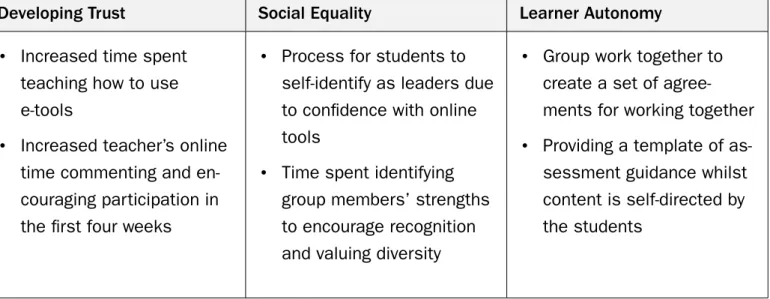
Developing Trust Social Equality Learner Autonomy
• Increased time spent teaching how to use e-tools
• Increased teacher’s online time commenting and en-couraging participation in the first four weeks
• Process for students to self-identify as leaders due to confidence with online tools
• Time spent identifying group members’ strengths to encourage recognition and valuing diversity
• Group work together to create a set of agree-ments for working together
• Providing a template of as-sessment guidance whilst content is self-directed by the students
the students need authority and the teacher is directive. In stage two (Interested) the students begin to set their own goals and the teacher models enthusiasm. In stage three (Involved) students become more aware of their learning and accepting of learning from other students, while the teacher shares decision making and offers guidance. In stage four (Self-directed) the students set their own goals and use strategies to achieve them, while the teacher offers guidance if requested. The authority to direct teaching and learning increases within students as they progress toward autonomous learning. This, in turn, may close the perceived gap between peers and teachers as a source of learning. Therefore, in this study, there could have been a mismatch between the openness of the online space for self-directed learning and the actual level of autonomy of the students. Many certificate-level students may be at the first stage, especially as some come from educational backgrounds where the teaching was mostly directive. Wiki participation may require students to be at stages three or four of this framework. Roussinos and Jimoyiannis (2013) suggested that the non-participating students may have persisted with individualistic learning habits carried over from high school. If students are still very dependent on the teacher’s direction, or they consider they can complete their assessments individually, they will be reluctant to listen to or teach other students.
Improvements in teaching practice
This first attempt to incorporate blended learning using a wiki into the teaching environment provided us with plenty of insight for students on what did not work and what might have worked better. These insights supported the reflective practice, and subsequent use of blended teaching and learning was adopted. Although no formal continuation of the study occurred due to the first author (Kay Hammond) moving to a different institution, the course teacher (Catherine Powell) incorporated the findings of the importance of developing trust, social equality and learner autonomy successfully into the subsequent cohort of students (hereafter called the new cohort, of which Catherine Powell was the sole instructor). These are summarised in Table 1 below.
In recognition of the need for teacher support and development, the new delivery design replaced Wikispaces with MyPortfolio, as there was more institutional support available for the latter online platform. Activities were also introduced to help a diverse range of students get to know each other, be more confident with their wiki-using abilities, and to create more certainty when starting with the wiki. The new activities included assigning tasks to create social cohesion, that both teach how to use the tools and build relationships to support effective peer feedback conditions. For example, students were put into small groups (4-6) with a mix of computer confidence levels and shown how to use an e-portfolio platform (MyPortfolio) in class to create a group page that covered each member’s strengths, values and a shared group agreement. This activity created the opportunity for those with lower confidence levels on electronic platforms to contribute verbally, and still identify skills that they bring to the group that extend beyond the online activities. Another implementation to help students strengthen relationships with teaching staff was to have high-level visibility of staff online in the first few weeks, to role model and build students’ confidence. This involved allocating large chunks of class time to teaching specific online skills a step at a time, with plenty of repetition, and the class tutor moving around the class encouraging
those with higher levels of confidence to support others. Also, the course teacher ensured that in the first three to four weeks of the course she was online, commenting on posts and encouraging participation. Learning advisors needed to demonstrate their connection with the course teacher and develop a supportive relationship with students so they were not seen as a ‘random person’, but rather a valuable resource for students. In-class visits were an effective way for the learning adviser to form connections with students. After a connection is made, contact could gradually reduce in the class and increase on the wiki. As a result of these implementations, it was noted anecdotally by the course teacher that the online engagement increased to 100%; for example, all students logged on and completed formative online activities. In addition, the course teacher’s confidence and skill in online teaching improved in terms of ease of navigating the online space and interacting with students online, thereby creating a welcoming and supportive environment.
Equality and autonomy on the wiki for entry-level students
Teachers and learning advisors need to consider the level of autonomy the wiki requires and the level of autonomy of their students. Weimer (2013) commented that more work is needed on how teachers can facilitate the progression from dependent to independent learning. The lower autonomy of entry-level cohorts, with their uncertainty around the potential hierarchy of peer teaching and sharing ideas, could be mitigated by placing the students in smaller groups, with mixed levels of ability with online tools. These smaller groups support the students to build relationships more easily before transitioning to whole-class work (Twu, 2009). Placing students in small groups may also facilitate the development of learner autonomy. The less-autonomous students’ need for a directive teacher can be met by identifying a potential peer teacher within a smaller group. Likewise, this identification provides the more autonomous students with permission to speak as authorities without appearing ‘bossy’. This was done, and continues to be done, by the course teacher in subsequent
cohorts. First, students placed themselves on a continuum of personal confidence with online tasks in general ranging from ‘very confident’ to ‘terrified of online work’. The confident end of the line is folded over so the least confident people are paired up with the most confident people and then those in the middle are added in to create a mix of levels in a selection of small groups. Although the use of the wiki could have assisted students with assessments, students felt they could still complete their assessments without it. The authors feel that students will perceive the wiki as more relevant and be more motivated to gain competence on it if it is associated with assessment. Cole (2009) recommended participation on the wiki be linked with assessment. Therefore, assessment tasks now require competence of tools and skills. For example, one of the assessment tasks is a group assignment where students create an ePortfolio exploring the role of community workers and how they have worked together as a group.
As a result of these implementations it was noted anecdotally by the course teacher that even the most initially nervous students developed skills that enabled them to utilise the online tools effectively by the end of the course. Those who were confident at the start learnt important social skills for supporting others, that are relevant to their career goals as community workers.
Limitations
One limitation of this study was that the we (the authors) were ourselves not very familiar with wikis; we were learning along with our students. Had we known more, we could have presented the wiki as less like Facebook, and of equal value to other appropriate sources of information. Although we introduced the potential for collaborative learning via sharing work and resources, we did not emphasise how this form of learning added value beyond existing resources such as in-class interactions, teacher, classmates, textbook or handouts.
Another limitation of this study was it did not investigate how cultural factors may influence the preference for face-to-face interaction above online interaction. Some cultures may value
face-to-face connection more highly in a teaching and learning relationship. There may also be some preference for this by individuals within cultural groups. As classes will have students from a mix of cultures, it cannot be assumed that each culture will interact with an online environment in the same way. Twu (2009) pointed out several challenges for high-context-culture students regarding building relationships with fewer non-verbal cues, and the understanding of editing as developing ideas rather than disrespecting others. In New Zealand, Pacific Island, Ma¯ori and Chinese were found to be higher-context cultures than New Zealand Europeans (Podsiadlowski & Fox, 2011). In our cohort we had approximately 30 percent of students from Pacific Island, Ma¯ori and Chinese cultures.
CONCLUSION
Increasing massification of tertiary education, combined with a decrease in public spending, drives the trend towards blended learning and increases numbers of entry-level students needing to engage with online learning tools. Therefore, educators working with these students need to be aware of the challenges faced by entry-level students in blended learning environments. Much can be learned from studies reporting unsuccessful attempts at online learning implementations (Cole, 2009; Weimer, 2013). Such studies can provide valuable considerations for teachers to develop more successful methods. In our cohort of entry-level tertiary students, the main barriers to accessing academic support using a wiki were trust, and the perception of social equality between student peers. Varying levels of learner autonomy may have been a contributor to these issues. This study demonstrated the importance of building student-to-student and student-to-staff trust in the wiki community and to encourage entry-level students towards greater autonomy and understanding of how to value peer contributions. This provided some clear directions, leading to better support of our entry-level students in community online spaces. This paper encourages educators to develop best practice academic support for their students through the design, implementation and evaluation of online tools
in their local contexts. This study contributes to the sharing of findings to inform the ongoing development of blended-learning spaces for entry-level students in tertiary education.
ACKNOWLEDGEMENTS
The writing up of this research was supported with funding from the School of Interprofessional Health Studies, Auckland University of Technology.
LIST OF FIGURES
Figure 1. The action research cycle Figure 2. Example of a content page Figure 3. Example of a sharing page
LIST OF TABLES
Table 1. Summary of teaching practice improvements in subsequent cohort
REFERENCES
Anders Norberg, C. D., & Dziuban, P. D. M. (2011). A time‐based blended learning model. On the Horizon, 19(3), 207-216. doi:10.1108/10748121111163913
Angelaina, S., & Jimoyiannis, A. (2012). Analysing students’ engagement and learning presence in an educational blog community. Educational Media International, 49(3), 183-200. doi:10.1080/ 09523987.2012.738012
Blessinger, P., & Wankel, C. (2012). New directions in higher education: An introduction to using wikis, blogs, and webquests. In C. Wankel & P. Blessinger, (Eds.), Increasing student engagement and retention using online learning (pp. 3-16). Bradford, UK: Emerald Group Publishing.
Bovill, C., Cook-Sather, A., & Felten, P. (2011). Students as co-creators of teaching approaches, course design, and curricula: Implications for academic developers. International Journal for Academic Development, 16(2), 133-145. doi:10.1080/1360144X.2011.568690
Cardno, C. (2003). Action research: A developmental approach. Wellington, NZ: New Zealand Council for Educational Research.
Cassidy, S. (2006). Developing employability skills: Peer assessment in higher education. Education and Training, 48(7), 508-517. doi:10.1108/00400910610705890
Cole, M. (2009). Using wiki technology to support student engagement: Lessons from the trenches.
Computers and Education, 52, 141-146. doi:10.1016/j.compedu.2008.07.003
Cowan, B. R., & Jack, M. A. (2014). The impact of identity on anxiety during wiki editing in higher education. Journal of Enterprise Information Management, 27(1), 56-65. doi:10.1108/JEIM-09-2012-0057
Demirbilek, M. (2015). Social media and peer feedback: What do students really think about using wiki and Facebook as platforms for peer feedback? Active Learning in Higher Education, 16(3), 211-224.
Elgort, I., Smith, A. G., & Toland, J. (2008). Is wiki an effective platform for group course work?
Australasian Journal of Educational Technology, 24, 195-210. doi:10.14742/ajet.1222
Engel, S., & Halvorson, D. (2016). Neoliberalism, massification and teaching transformative politics and international relations. Australian Journal of Political Science,51(3), 546‐-554. doi:10.1080 /10361146.2016.1200706
Hase, S., & Kenyon, C. (2001). From andragogy to heutagogy in vocational education. Proceedings of Research to Reality: Putting VET research to work: Australian Vocational Education and Training Research Association. Retrieved from http://www.avetra.org.au/abstracts_and_papers_2001/ Hase-Kenyon_full.pdf
Huijser, H., Kimmins, L., & Galligan, L. (2008). Evaluating individual teaching on the road to embedding academic skills. Journal of Academic Language and Learning, 2(1), A23-A38.
Joffe, H. (2011). Thematic analysis. In D. Harper & A. R. Thompson (Eds.), Qualitative research methods in mental health and psychotherapy (pp. 209-223). Hoboken, NJ: Wiley.
Kanuka, H., & Rourke, L. (2013). Using blended learning strategies to address teaching development needs: How does Canada compare? Canadian Journal of Higher Education, 43(3), 19-35. Retrieved from http://journals.sfu.ca/cjhe/index.php/cjhe/index
Kear, K., Woodthorpe, J., Robertson, S., & Hutchison, M. (2010). From forums to wikis: Perspectives on tools for collaboration. Internet and Higher Education, 13, 218-225. doi:10.1016/j. ihedu.2010.05.004
Kemmis, S. (2009). Action research as a practice-based practice. Educational Action Research, 17(3), 463-474. doi:10.1080/09650790903093284
Kift, S. M., Nelson, K. J., & Clarke, J. A. (2010). Transition pedagogy: A third generation approach to FYE: a case study of policy and practice for the higher education sector. The International Journal of the First Year in Higher Education, 1(1), 1-20.
Kitzinger, J. (1994). The methodology of focus groups: The importance of interaction between research participants. Sociology of Health & Illness, 16(1), 103-121. doi:10.1111/1467-9566. ep11347023
Krueger, R. A., & Casey, M. A. (2000). Focus groups: A practical guide for applied research (3rd ed.). Thousand Oaks, CA: Sage.
Larkin, K., Rowan, L., Garrick, B., & Beavis, C. (2016). Student perspectives on first year experience initiatives designed for pre-service teachers in their first weeks of university study. Journal of University Teaching & Learning Practice, 13(1). Retrieved from http://ro.uow.edu.au/jutlp/vol13/ iss1/7
Lin W-C., & Yang, S. C. (2011). Exploring students’ perceptions of integrating wiki technology and peer feedback into English writing courses. English Teaching: Practice and Critique, 10(2), 88-103. Retrieved from https://edlinked.soe.waikato.ac.nz/research/journal/index.php?id=1
Maisie, E. (2006). The blended learning imperative. In C. J. Bonk and C. R. Graham (Eds.), The handbook of blended learning: Global perspectives, local designs (pp. 22-26). San Francisco, CA: Pfeiffer.
McNiff, J., & Whitehead, J. (2011). All you need to know about action research. London, UK: Sage. Minocha, S. (2009). Role of social software tools in education: A literature review. Education &Training,
51, 353-369. doi:10.1108/00400910910987174
Naismith, L., Leet, B-H., & Pilkington, R. M. (2010). Collaborative learning with a wiki: Differences in perceived usefulness in two contexts of use. Journal of Computer Assisted Learning, 27, 228-242. doi:10.1111/j.1365- 2729.2010.00393.x
Percival, J., & Muirhead, B. (2009). Prioritzing the implementation of e-learning tools to enhance the post-secondary learning environment. Journal of Distance Education, 23(1), 89-106. Retrieved
from http://www.ijede.ca/index.php/jde/article/view/47
Podsiadlowski, A., & Fox, S. (2011). Collectivist value orientations among four ethnic groups: Collectivism in the New Zealand context. New Zealand Journal of Psychology, 40(1), E5-E18. Retrieved from http://www.psychology.org.nz/publications-media/new-zealand-journal-of-psychology/#.VBuu_8kSDGg
Roussinos, D., & Jimoyiannis, A. (2013). Analysis of students’ participation patterns and learning presence in a wiki-based project. Educational Media International, 50(4), 306-324. doi:10.1080 /09523987.2013.863471
Sandbach, K. (2015). Magnetic learning space through design. International Journal of Design Education, 8(3-4), 17-28. Retrieved from https://www.academia.edu/16680081/Magnetic_ Learning_Space_through_design
Shinebourne, P. (2011). The theoretical underpinnings of interpretative phenomenological analysis.
Existential Analysis, 22(1), 16-31. Retrieved from http://web.a.ebscohost.com/ehost/pdfviewer/ pdfviewer?vid=1&sid=db90af72-4451-4c42-a14d-d75d5b564992%40sessionmgr4006
Smith, J. A., Flowers, P., & Larkin, M. (2009). Interpretative phenomenological analysis: Theory, method and research. Thousand Oaks, CA: Sage.
Smith, J. A., & Osborn, M. (2008). Interpretative phenomenological analysis. In G. M. Breakwell (Ed.),
Doing social psychology research (pp. 229-254). Hoboken, NJ: Wiley-Blackwell.
Smith, R. O. (2011). Trust in online collaborative groups: A constructivist psychodynamic view. Adult Learning, 22(2), 19-23. doi:10.1080/01587910802395839
Thanh Pham, T. H. (2013). Using group projects as a strategy to increase cooperation among low- and high-achieving students. Higher Education Research & Development, 32, 993-1006.
Tinto, V. (2011). Taking student success seriously in the college classroom. Retrieved from https:// www.sdbor.edu/administrative-offices/student-affairs/sac/Documents/Tinto-TakingStudentS uccessSeriouslyintheCollegeClassroom.pdf Tseng, H. W., & Yeh, H-T. (2013). Team members’ perceptions of online teamwork learning experiences and building teamwork trust: A qualitative study. Computers and Education, 63, 1-9. doi:10.1016/j.compedu.2012.11.013
Twu, H-L. (2009). Effective wiki strategies to support high-context culture learners. TechTrends, 53(5), 16-21. doi:10.1007/s11528-009-0318-2
Upcraft, M. L., & Stephens, P. S. (2000). Academic advising and today’s changing students. In V. N. Gordon & W. R. Habley (Eds.), Academic advising: A comprehensive handbook (pp. 73-83). San Francisco: Jossey-Bass.
Vigentini, L., & Cowan, B. R. (2012). The psychological dimension of using wikis: Pedagogy, anxiety and usability. In S. Bocconi & G. Trentin (Eds.), Wiki supporting formal and informal learning (pp. 57-86). New York: Nova Science Publishers.
Wass, R., Harland, T., & Mercer, A. (2011). Scaffolding critical thinking in the zone of proximal development. Higher Education Research & Development, 30(3), 317-328. doi:10.1080/07294 360.2010.489237
AUTHORS
Catherine Powell has worked as a lecturer in Community Development at Unitec Institute of Technology since 2008. Prior to this, Catherine contracted to a range of not-for-profit organisations as a facilitator, mediator and project manager in New Zealand and Jordan. She is committed to supporting all students to be able to access tertiary education and succeed in whatever pathway they choose.
Kay Hammond has taught academic skills in New Zealand and Japan. She worked as a learning support advisor for six years at Unitec Institute of Technology. She is now Senior Lecturer in Auckland University of Technology’s Faculty of Heath and Environmental Sciences. She is passionate about creating materials and experiences to scaffold student academic skill development and learning confidence.