A Novel Controlled Method Of Transformer Less Cascaded H-Bridge
STATCOM
Jyothirmai Anguluri*1K Anil Kumar2
M.Tech Student, Department of EEE, KIET, Kakinada, India.1 Asst. Professor, Department of EEE, KIET, Kakinada, India.2
Abstract
This work is a mix of transformer less static synchronous compensator (STATCOM) and Cascade multilevel H-connect converter topology. This proposed controller current circle as well as have dc capacitor voltage control. As to the present circle control, a nonlinear controller in light of the resignation based control (PBC) hypothesis is utilized as a part of this Cascade structure STATCOM surprisingly. With regards to the dc capacitor voltage control, general voltage control is acknowledged by embracing a corresponding full controller. Bunched adjusting control is acquired by utilizing a dynamic unsettling influences dismissal controller. The recreation comes about demonstrate that H-connect Cascade STATCOM with the proposed control techniques has amazing dynamic execution and solid power. The dc capacitor voltage can be kept up at the given esteem adequately. Fuzzy controller is utilized to decrease the swells and better smoothening of the wave shapes. The outcomes dissected through MATLAB/SIMULINK condition.
I.INTRODUCTION
Adaptable air conditioning transmission frameworks (FACTS) are by and large progressively utilized as a part of energy framework to improve the framework usage, control exchange limit and also the power nature of air conditioning framework interconnections [1], [2]. As a normal shunt FACTS gadget, static synchronous compensator (STATCOM) is used at the purpose of regular association (PCC) to ingest or infuse the required receptive power, through which the voltage nature of PCC is enhanced [3]. Lately, numerous topologies have been connected to the STATCOM. Among these diverse sorts of topology, H-connect Cascade STATCOM has been broadly acknowledged in high-control applications for the accompanying focal points: brisk reaction speed, little volume, high effectiveness, negligible collaboration with the supply matrix and its individual stage controllability [4]–[7]. Contrasted and a diode-clasped
the high transfer speed and the quick reference current following pace. The consistent state execution of H-extension Cascade STATCOM is enhanced, however the dynamic execution is not made strides. In , a dc infusion disposal strategy called IDCF is proposed to assemble an additional criticism circle for the dc segment of the yield current. It can enhance the yield current nature of STATCOM. In any case, the circuit setup of the Cascade STATCOM is the delta arrangement, yet not the star design. Also, a versatile hypothesis based enhanced straight sinusoidal tracer control strategy is proposed in [19] and a flawed slightest mean square-based control technique is proposed in . Yet, these strategies are not for STATCOM with the Cascade structure. By utilizing the conventional straight control technique, the controller is described bits basic control structure and parameter plan accommodation, yet poor dynamic control security. Other control approaches apply nonlinear control which specifically makes up for the framework nonlinearities without requiring a straight guess. In, an input–output criticism linearization controller is outlined. By including a damping term, the swaying sufficiency of the inside elements can be adequately diminished. Be that as it may, the security can't be ensured At that point, numerous new altered damping controllers are intended to improve the steadiness and execution of the interior flow . In any case, the usage of these controllers is exceptionally perplexing. To upgrade power and streamline the controller plan, a lack of involvement based controller (PBC) in view of blunder flow is proposed for STATCOM . Besides, the exponential dependability of framework balance focuses ensured. In any case, these techniques are not outlined on the premise of STATCOM with the H-connect Cascade structure and there are no test confirmations in these literary works. As far as dc capacitor voltage adjusting control, there are three critical issues: general voltage control, bunched adjusting control, and individual adjusting control. In writing, under the presumption of all dc capacitors being similarly charged and adjusted, they can just wipe out the irregular characteristics caused byte conflicting drive beats without identifying all dc capacitor voltages. In extra equipment circuits are required in the strategies in light of air conditioning transport vitality trade and dc transport vitality trade, which will build the cost and the many-sided quality of the framework. In a strategy in view of zero-succession voltage infusion is proposed and it will build the dc capacitor voltage continuance limit. Despite what might be expected, the technique utilizing negative-succession current in does not require the wide edge of dc capacitor voltage, however the capacity of STATCOM is constrained. In [8], the dynamic energy of the individual stage group is controlled autonomously, while the circuit
condition is thought to be constrained in useful utilize. In and , cosine part of the framework voltage is superposed to the bunched yield voltage, yet it is anything but difficult to be influenced by aninacurate stage bolted circle (PLL). In , the dynamic voltage vector superposition technique is proposed. In any case, the reproduced and exploratory outcomes don't demonstrate the distinctions in control region and voltage swell. The particular symphonious disposal tweak strategy is utilized as a part of , in which voltage adjusting control and low-recurrence regulation are accomplished. Contrasted and the technique, a strategy changing the stage move plot for dc voltage adjusting controls proposed in, through which the alluring impact can be effortlessly accomplished, though it is constrained by the limit of STATCOM. In , the dc voltage and receptive power are controlled. Be that as it may, it can't be broadly utilized because of certainty that numerous no perfect variables are disregarded. In and , the proposed strategy accept that all cells are appropriated with equivalent responsive power and it utilizes the cosine estimation of the present stage point. It could prompt framework shakiness, when utilizing the zero-intersection purpose of the cosine esteem. In , the aftereffects of trials are acquired in the downscaled lab framework. Along these lines, they are not extremely enticing in this condition. In this paper, another nonlinear control technique in view of PBC hypothesis which can ensure Lyapunov work dynamic security is proposed to control the present circle. It performs attractively to enhance the unfaltering and dynamic reaction. For capacitor voltage adjusting control, by outlining a relative full (PR) controller for general voltage control, the control impact is enhanced, contrasted and the customary PI controller. Dynamic unsettling influences dismissal controller (ADRC) is first proposed by Han in his pioneer work , and broadly utilized in many designing practices ; besides, it discovers its new application in H-connect Cascade STATCOM for grouped adjusting control. It understands the fantastic dynamic pay for the outside unsettling influence. By moving the adjustment wave vertically for individual adjusting control, it is substantially simpler tube acknowledged in field-programmable door exhibit (FPGA) contrasted and existing strategies. Two real H-connect Cascade STATCOMs evaluated at 10 kV 2 MVA are built and a progression of check tests are executed. The test comes about have checked the practicality and viability of the proposed control strategies.
transporter beat width adjustment (ISPWM). To dispense with the basic - mode spillage current in the transformer less photovoltaic framework - associated framework, an enhanced single - stage inverter topology is exhibited. The enhanced transformer less
inv
Fig. 1. Actual 10 kV 2 MVA H-bridge cascaded STATCOM
Voltage of the lattice and the air conditioner PWM voltage of STATCOM. The air conditioner inductor additionally assume an essential part in sifting through switch swells caused by PWM. For choosing protected entryway bipolar transistor (IGBT), considering the complexities of down to earth mechanical fields, there may be the issues of the spike present and over load. Thusly, keeping in mind the end goal to guarantee the dependability and unwavering quality of H-extension Cascade STATCOM, and furthermore enhance the over load capacity, the present rating of the chose IGBT ought to be sufficiently saved wellbeing edge. In the proposed framework, 1.4 times evaluated current operation is ensured, the pinnacle current under the 1.4 times over-burden condition is224 A, the extra 76 A(30−224 A = 76
A)is the wellbeing edge of IGBT modules. Because of the past contemplations, the voltage and current appraisals of IGBT which is chosen as the exchanging component in principle circuit are 1.7 kV and 300 An (Infineon EF300R17KE3). The regulation innovation receives the bearer stage moved sinusoidal PWM (curtailed as CPS-SPWM) with the transporter
TABLE I
CIRCUIT PARAMETERS SYSTEM
Fig. 2. Digital control system for 10 kV 2 MVA H-bridge cascaded STATCOM.
Recurrence of 1 kHz. At that point, with a course number of=12, the air conditioner voltage Cascade outcomes in a 25-level waveform in line to impartial and a 49-level waveform in line to line. In each bunch, 12 transporter signals with an indistinguishable recurrence from 1 kHz are stage moved by 2π/12 from
each other. At the point when a transporter recurrence is as low as 1 kHz, utilizing the strategy for stage moved uni polar sinusoidal PWM, it can make a comparable bearer recurrence as high as 24 kHz. The lower bearer recurrence can likewise decrease the changing misfortunes to every cell.
point, DSP sends the reference voltages to the FPGA. The FPGA actualizes the balance procedure and creates 36 PWM exchanging signals for every phone. Caldor every phone gets PWM changing sign from the FPGA and drives IGBTs.
II.PCC(POINT OF COMMON COUPLING ) :
In future low voltage frameworks, with numerous inverter interfaced sources associated, voltage control may turn into an essential undertaking. The potential exists for inverter interfaced sources to be sent to manage the voltage at the purpose of basic coupling (PCC) of every inverter interfaced sources. The PCC voltage direction is achievable with inverter interfaced sources by powerfully controlling the measure of receptive power infused to the power conveyance framework by individual frameworks. In the ebb and flow inquire about, a shut circle controller is proposed to direct the PCC voltage of a sun based photovoltaic (PV) framework that is associated with a solitary stage control dispersion feeder (with R to X proportion more noteworthy than 1). The plant model of the PCC voltage controller of the PV framework is determined considering both reactance and resistance of the system to which the PV framework is associated. Three distinctive compensators are assessed to recognize a reasonable compensator for the shut circle PCC voltage controller to manage the PCC voltage at a given reference voltage. Recreation thinks about and trial check affirm that the hypothetical approach taken to determine the control plant model of the PCC voltage controller is precise and the strategy that is taken after to outline the controller is vigorous. The control outline methodology shown in the momentum look into prompts a PCC voltage control framework with worthy dynamic and relentless state execution.
III.BASICS OF MULTI-STAGE CONVERTERS
Fundamental Principle
The circuit of fig.2 demonstrates the fundamental topology of one converter utilized for the execution of multi-stage converters. It depends on the basic, four switches converter, utilized for single stage inverters or for double converters. These converters can create three levels of voltage in the heap: +Vdc, - Vdc, and Zero. The figure 2 shows the principle segments of a four-organize converter which is being investigated in this work.
Figure2. Three-level module for building multi converters
The figure just shows one of the three periods of the entire framework. As can be seen, the dc control supplies of the four converters are disconnected, and the dc supplies are scaled with levels of voltage in energy of three. The scaling of voltages in energy of three permits having, with just four converters, 81 (34) unique levels of voltage: 40 levels of positive esteems, 40 levels of negative esteems, and zero. The converter situated at the base of the figure has the greater voltage, and will be called Master. Whatever remains of the modules will be the Slaves. The Master works at the lower exchanging recurrence, which is an extra preferred standpoint of this topology. With 81 levels of voltage, a four-arrange converter can take after a sinusoidal waveform in an exceptionally exact manner, as appeared in figure 3. It can control the heap voltage as an AM gadget (Amplitude Modulation).The figure 3 indicates distinctive levels of adequacy, which are acquired through the control of the doors of the power transistors in every one of the four converters.
MULTICONVERTER APPLICATIONS
Once the issue of detached power supplies has been understood, the multi converters can be connected to practically every pragmatic circumstance. Dynamic power channels, sinusoidal current rectifiers, machine drives, control consider compensators, and consecutive recurrence interface frameworks, are a portion of the applications accessible with this procedure. For instance, the figure 8 demonstrates a normal setup for a shunt dynamic power channel, utilizing PWM procedure. The source is nourishing a polluting burden, for example, a power rectifier, and the dynamic channel, associated in parallel, infuses the sounds the heap needs, and the power framework sees a cleaner sinusoidal current waveform
supplanted by a capacitor C, whose voltage is kept at a VREF voltage, by a criticism control circle. The power transformers stay detached at the converter side, and are associated in star at the mains side. The PWM control is supplanted by a quick voltage flag, which experiences the DSP, to give the relating ON-OFF signs to every one of the four converters.
Mixture MULTILEVEL
STATCOM Multilevel statcom is broadly utilized for power quality changes. The yield waveforms of the statcom is of good quality if the level is expanded. with increment in level the quantity of switches expands which builds the exchanging misfortune.
The other strategy to acquire great quality yield is to build the exchanging frequency,this presents the issue of exchanging misfortunes in the statcom. Luckily, half breed multilevel innovation gives a decent exchange off between waveform quality and exchanging misfortune
IV.CONTROLALGORITHM
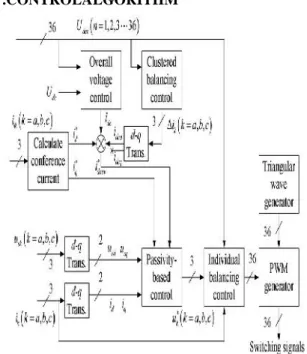
Fig. 3. Control block diagram for the 10 kV 2 MVA H-bridge cascaded STATCOM
Fig. 3 shows a block diagram of the control algorithm for-bridge cascaded STATCOM. The whole control algorithm mainly consists of four parts, namely, PBC, overall voltage control, clustered balancing control, and individual balancing control. The first three parts are achieved in DSP, while the last part is achieved in the FPGA.
A. PBC
Referring to Fig. 1, the following set of voltage and current equations can be derived:
Where is the equivalent series resistance of the inductor? Applying the d–q transformations (1), the equations in d–
q axis are obtained
Where’d and is the-axis and-axis components corresponding to the three-phase STATCOM cluster voltages ua, ub, and uc. Usd and usq are those corresponding to the three-phase grid voltages usa, usb, and us. When the grid voltages are sinusoidal and balanced, usqis always 0 because fusains aligned with thed-axis.idandiq are the-axis and-axis components corresponding to the three-phase STATCOM currents ia, ib, anodic.
Equation (2) is written as the following form:
To apply the PBC technique, (3) is changed into the type of the EL framework show in this paper. EL framework model is a critical piece of the nonlinear PBC hypothesis and a compelling displaying innovation. It characterizes the vitality condition by setting the general variable and outfits the known hypothesis that can muddle to examine the dynamic execution to derive the dynamic conditions. This can make the framework move along the limit direction of Lagrangian fundamental. EL framework model could depict the qualities of the framework which is troublesome tube arranged by linearization control strategy. This is the most imperative motivation to utilize the EL framework demonstrate for characterizing control arrangement of H-scaffold Cascade STATCOM.
This paper manages a control technique for reconciliation of Distributed Generation (DG) sources to the power lattice. The proposed control system has been composed in light of detachment strategy and gives pay to the dynamic, receptive, and symphonious current parts of burdens amid the association of DG connect to the lattice. The best possible exchanging elements of interfaced converter have been characterized in view of the lack of involvement technique through the accomplishing space conditions and appropriate arrangement damping infusion. The proposed control plan is finished by setting appropriate reference current segments for the d and q pivot in the control circle of DG, which are characterized in view of the targets of proposed technique. The adequacy of the proposed control plan is approved with infusion of most extreme accessible power from the DG assets to the power framework, amendment of energy component between the network current and load voltage, produces a fix voltage at the purpose of normal coupling (PCC), and diminishes add up to consonant contortion (THD) of lattice present, through the recreation comes about under unfaltering state and dynamic working conditions .Passivity-based control is generally utilized as a part of electronic circuit frameworks since it can use their inside structures to encourage the controller outline. In this paper, we initially propose a dissipative Hamiltonian acknowledgment of energy frameworks and talk about the disservices of the conventional lack of involvement based excitation controller. At that point, a novel excitation controller is advanced to reassign the interconnection and dissipative network, and the relating Hamiltonian work. Recreation comes about check that the proposed controller can viably enhance the transient solidness of the power framework. The port-controlled Hamiltonian (PCH) framework has increased expanding enthusiasm for the control and vitality group. The primary normal for the PCH framework is that the auxiliary data is accessible in the model portrayal: the aggregate vitality of the framework is spoken to by the Hamiltonian work, which can be generally utilized as a Lyapunov work in steadiness examination, while the interconnection property is expressly depicted by the interconnection and damping grid. By using the vitality idea and the interior basic property, a few techniques have been produced for the controller plan of PCH frameworks . Interconnection and damping task aloofness based control (IDA-PBC) is a broadly utilized state-criticism procedure which can balance out the considered nonlinear frameworks by forming the vitality and re-developing the structure networks. Up until this point, IDA-PBC has been effectively connected to electromechanical frameworks , control gadgets, and power frameworks. For power frameworks, the vitality
forming is for the most part accomplished by changing the vitality exchange design between the mechanical and the electrical segments, which is gotten by infusing damping into the electrical dynamic. The customary IDA-PBC excitation controller can't straightforwardly reassign the mechanical damping in the swing condition, however the damping in the swing condition is essential for transient dependability change. In this paper, we propose a novel IDA-PBC excitation controller to improve the transient soundness of energy frameworks by picking an advantageous interconnection lattice and discover an answer for the coordinated fractional subsidiary condition. The proposed excitation controller not just gives a pay damping into electrical dynamic condition, additionally into the mechanical swing condition. Recreation comes about check that, contrasted with the ordinary vitality molding strategy and PSS+AVR controller , the proposed control plan can adequately enhance the transient strength of the power framework. Whatever is left of the paper is composed as takes after. we give some preparatory outcomes on the IDA-PBC technique. we propose the dynamic model of the single machine boundless transport control frameworks and advanced a novel IDA-PBC excitation controller. we reproduce the power framework, to represent the viability of the proposed control conspire. Area 5 outlines the outcomes and finishes up.
V.PR CONTROLLER
control and sifting. The exchange elements of single-and three-stage PR controllers and channels can be determined utilizing inner model control, altered state change or recurrence area approach displayed in [4, 8], individually. In this work, the last approach is decided for introduction as it obviously exhibits likenesses between PR controllers and channels in the stationary reference outline and their identicalness in the synchronous casing, as appeared in the accompanying Sections through necessary squares would in any case compel the principal mistake amplitudeE1 to zero, caused by the unending addition of the indispensable pieces. Rather than changing the criticism blunder to the identical synchronous casing for handling, an option approach of changing the controller GDC(s)from the synchronous to the stationary casing is additionally conceivable .speak to controller pick up and cutoff recurrence individually), the inferred summed up AC integrators GAC(s) are communicated as: when gathered with a relative term Kp gives the perfect PR controller with an unending increase at the AC recurrence ofo(see Fig. 2a), and no stage move and pick up at different frequencies. For Kp, it is tuned in an indistinguishable route from for a PI controller, and it fundamentally decides the progression of the framework regarding data transmission, stage and pick up edge. To keep away from dependability issues related with an unending increase, can be utilized rather than (4) to give a non-perfect PR controller and, as delineated in Fig. 2b, its pick up is currently limited, yet at the same time moderately high to enforce little consistent state mistake. Another component of (5) is that, not at all like (4), its transmission capacity can be augmented by setting oc properly, which can be useful for decreasing affectability towards ( for instance) slight recurrence variety in a commonplace utility framework. Itemized clarification is given by paper[1].
FUZZY CONTROLLER
The word Fuzzy means dubiousness. Fluffiness happens when the limit of snippet of data is not obvious. In 1965 Lotfi A. Zahed propounded the fuzzy set hypothesis. Fuzzy set hypothesis shows monstrous potential for successful fathoming of the vulnerability in the issue. Fuzzy set hypothesis is an astounding numerical apparatus to deal with the vulnerability emerging because of dubiousness. Understanding human discourse and perceiving transcribed characters are some regular examples where fluffiness shows.
Fuzzy set hypothesis is an augmentation of traditional set hypothesis where components have changing degrees of enrollment. Fuzzy rationale utilizes the entire interim in
the vicinity of 0 and 1 to depict human thinking. In FLC the info factors are mapped by sets of enrollment capacities and these are called as "Fuzzy SETS".
Fuzzy set contains from an enrollment capacity which could be characterizes by parameters. The incentive in the vicinity of 0 and 1 uncovers a level of participation to the fuzzy set. The way toward changing over the fresh contribution to a fuzzy esteem is called as "fuzzificaton." The yield of the Fuzzier module is interfaced with the tenets. The fundamental operation of FLC is built from fuzzy control rules using the estimations of fuzzy sets when all is said in done for the mistake and the change of blunder and control activity. Essential fuzzy module is appeared in fig.6.
The outcomes are joined to give a fresh yield controlling the yield variable and this procedure is called as "DEFUZZIFICATION."
Fig3a : block diagram fuzzy logic
VII.MATLAB DESIGN AND SIMULINK RESULTS
adjusting control simulink, the estimation of dc capacitor voltages are transfered into DSP by a flag procurement framework and they can be recorded and seen by CCS programming in PC. At last, with the sent out simulink information from CCS, simulink waveform is plotted by utilizing MATLAB.
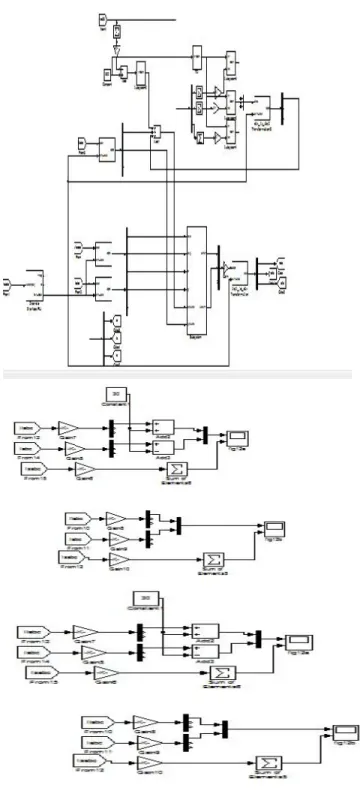
6.1Current Loop Control Simulink
The present circle control simulink is partitioned into four procedures: enduring state prepare, dynamic process, start-up process ,and ceasing process.
Fig:6.1Simulink results verify the effect of PBC in steady-state process(a) Ch1: reactive current; Ch2: compensating current; Ch3: residual current ofgrid. (b) Ch1: reactive current; Ch2: compensating current; Ch3: residual currentof grid.
( a)
(b)
Fig:6.2Fuzzy results verify the effect of PBC in steady-state process(a) Ch1: reactive current; Ch2: compensating current; Ch3: residual current of grid. (b) Ch1: reactive current; Ch2: compensating current; Ch3: residual current of grid.
CONCLUSION
This work has broke down the essentials of STATCOM in view of multilevel H-connect converter with star design. And after that, the real H-connect Cascade STATCOM appraised at 10 kV 2 MVA is developed and the novel control strategies are additionally proposed in detail. The proposed techniques has the accompanying qualities.
1) A PBC hypothesis based nonlinear controller is first utilized as a part of STATCOM with this Cascade structure for the present circle control, and the reasonability is checked by the reproduction comes about.
2) The PR controller is intended for general voltage control and the reproduction result demonstrates that it has better execution as far as reaction time and damping profile contrasted and the PI controller.
3) The ADRC is first utilized as a part of H-extension Cascade STATCOM for bunched adjusting control and the reproduction comes about check that it can understand phenomenal dynamic remuneration for the outside unsettling influence.
4) The individual adjusting control strategy which is acknowledged by moving the regulation wave vertically can be effortlessly actualized in the FPGA.
REFERENCES
[1] Rong Xu, Yong Yu, Rongfeng Yang, Gaolin Wang,
Member, IEEE, Dianguo Xu, Senior Member, IEEE,
Binbin Li, and Shunke Sui”A Novel Control Method for Transformerless H-Bridge Cascaded STATCO”
[2] B. Gultekin and M. Ermis, “Cascaded multilevel
converter-based transmission STATCOM: System design methodology and development of a 12 kV ±12 MVAr
power stage,”IEEE Trans. Power Electron., vol. 28, no.
11, pp. 4930–4950, Nov. 2013.
[3] S. Kouro, M. Malinowski, K. Gopakumar, L. G. Franquelo, J. Pou, J. Rodriguez, B.Wu,M. A. Perez, and
J. I. Leon, “Recent advances and industrialapplications
of multilevel converters,” IEEE Trans. Ind. Electron.,
vol. 57, no. 8, pp. 2553–2580, Aug. 2010.
[4] F. Z. Peng, J.-S. Lai, J. W. McKeever, and J.
VanCoevering, “A multilevel voltage-source inverter
with separateDCsources for static var generation,”IEEE Trans. Ind. Appl., vol. 32, no. 5, pp. 1130–1138, Sep./Oct. 1996.
[5] Y. S. Lai and F. S. Shyu, “Topology for hybrid multilevel inverter,” Proc. Inst. Elect. Eng.—Elect. Power Appl., vol. 149, no. 6, pp. 449–458, Nov. 2002.
[6] D. Soto and T. C. Green, “A comparison of high -power converter topologies for the implementation of
FACTS controllers,”IEEE Trans. Ind. Electron., vol. 49,
no. 5, pp. 1072–1080, Oct. 2002.
[7] C. K. Lee, J. S. K. Leung, S. Y. R. Hui, and H. S.-H.
Chung, “Circuit-level comparison of STATCOM
technologies,”IEEE Trans. Power Electron., vol. 18, no.
4, pp. 1084–1092, Jul. 2003.
[8] H. Akagi, S. Inoue, and T. Yoshii, “Control and
performance of a Transformerless cascade PWM