An Enhanced QoS-Oriented Distributed Routing
Protocol for Hybrid Wireless Networks
Ms.Nanthini.S M.E.,(CSE),
Jay Shriram Group of Institutions, Tiruppur.
Dr.S.Rajalakshmi Associate Professor/CSE,
Jay Shriram Group of Institutions, Tiruppur.
Abstract— Wireless communication is one of the most vivacious areas in the communication field today. This technology is biggest contributions to mankind. Wireless communication involves the transmission of information over a distance without help of wires, cables or any other forms of electrical conductors. The wireless communication supports dedicated quality of service required for wireless applications. A hybrid wireless network is an extension to an infrastructure network, where a mobile host may connect to an access point (AP) using multi hop wireless routes via other mobile hosts. Hybrid wireless networks facilitate the effective and efficient integration of a mobile Wireless Ad Hoc Network (MANET). The wireless infrastructure has proved a better alternative next generation wireless networks. By directly adopting resource reservation based QOS routing for MANET in a hybrid network Inherit invalid reservation and race condition problems in MANET.QOS transforms the packet routing problem to a resource scheduling problem QOS incorporates five routing algorithm, 1) QOS guaranteed neighbor selection algorithm to meet transmission delay requirement,2) A distributed packet scheduling algorithm reduce the further transmission delay, 3) A mobility based segment resizing algorithm that adaptively adjusts segment size,4) A traffic redundant elimination algorithm to increase transmission throughput and 5) A data redundancy based elimination algorithm top eliminate the redundant data to further improve the transmission QOS. QOS provide high performance in terms of overhead, transmission delay Mobile resilience and scalability.
Index Terms—Hybrid Wireless Networks, MANET, Routing Protocols, QOS.
I. INTRODUCTION
A.
Wireless Network
Wireless is a more modern alternative to traditional wired networking that relies on cables to connect networkable devices together. Wireless technologies are widely used in both home and business computer networks. Wireless networks have been developed with various wireless applications, which have been used in areas of commerce, emergency, services, military, education and entertainment. The rapid improvement of Wi-Fi capable mobile devices including laptops and handheld devices, for example the purpose of wireless internet users of smart phone in last three years. The usage of people watching video, playing games and making long distance video or audio conferencing through wireless mobile devices and video streaming applications on infrastructure wireless networks which connects directly to mobile users for video playing and interaction in real time are increased . The evolution and the anticipate future of real time mobile multimedia streaming services are extensively expanded, so the networks are in need of high Quality of Service(QoS) to support wireless and mobile networking environment.
B. Hybrid Wireless Network
A hybrid wireless network is an extension to an infrastructure network, where a mobile host may connect to an access point (AP) using multi hop wireless routes via other mobile hosts. The APs are configured to operate on one of multiple available channels. Mobile hosts and wireless routers can select their operating channels dynamically through channel switching. Hybrid wireless networks (i.e., multihop cellular networks) have been proven to be a better network structure for the next generation wireless networks. It can help to tackle
the stringent end-to end QoS requirements of different applications. Hybrid networks synergistically combine infrastructure networks and MANETs to leverage each other. For example it integrates a mobile Wireless Ad Hoc Network (MANET) and wireless infrastructure has proved a better alternative next generation wireless networks.
C. Quality of service (QoS)
It is the overall performance of a computer network, particularly the performance seen by the users of the network. To quantitatively measure quality of service, several related aspects of the network service are often considered, such as error rates, bandwidth, throughput, transmission delay, availability, jitter, etc. Quality of service is particularly important for the transport of traffic with special requirements. In particular, much technology has been developed to allow computer networks to become as useful as telephone networks for audio conversations, as well as supporting new applications with even stricter service demands. QOS provide high performance in terms of overhead, transmission delay Mobile resilience and scalability. Hybrid wireless network has proved a better network structure for next generation of wireless networks and help to tackle the stringent end to end QOS requirement for different applications.
II. OBJECTIVEOFTHEPROJECT
on the random way-point model and the real human mobility model show that QOD can provide high QoS performance in terms of overhead, transmission delay, mobility-resilience, and scalability.
III. RELATEDWORKS A.Routing protocols
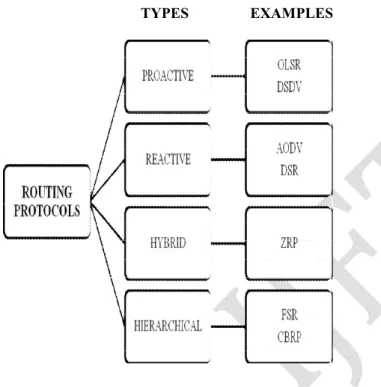
The routing protocol is a convention, or standard, that controls how nodes decide which way to route packets between computing devices in a network. In networks, nodes are not familiar with the topology of their networks. Instead, they have to discover it: typically, a new node announces its presence and listens for announcements broadcast by its neighbors. Each node learns about others nearby and how to reach them, and may announce that it too can reach them. The following is a list of routing protocols.
TYPES EXAMPLES
Fig 1. Classification of Routing Protocols Proactive routing
It is called as Table-driven Routing. This type of protocols maintains fresh lists of destinations and their routes by periodically distributing routing tables throughout the network.
The main disadvantages of such algorithms are: 1. Respective amount of data for maintenance. 2. Slow reaction on restructuring and failures. Examples of proactive algorithms are:
Optimized Link State Routing Protocol (OLSR) Optimized Link State Routing Protocol RFC 3626. Babel RFC 6126
Destination Sequence Distance Vector (DSDV) Reactive routing
It is called as On-demand Routing. This type of protocols finds a route on demand by flooding the network with Route Request packets. The main disadvantages of such algorithms are:
1. High latency time in route finding.
2. Excessive flooding can lead to network clogging. Examples of on-demand algorithms are:
Ad hoc On-demand Distance Vector(AODV) (RFC 3561)
Dynamic Source Routing (RFC 4728) Flow State in the Dynamic Source Routing Power-Aware DSR-based
Hybrid routing
This type of protocol combines the advantages of proactive and reactive routing. The routing is initially established with some proactively prospected routes and then serves the demand from additionally activated nodes through reactive flooding. The choice of one or the other method requires predetermination for typical cases.
The main disadvantages of such algorithms are:
1. Advantage depends on number of other nodes activated.
2. Reaction to traffic demand depends on gradient of traffic volume.
Examples of hybrid algorithms are:
ZRP (Zone Routing Protocol) ZRP uses IARP as pro-active and IERP as reactive component. Hierarchical routing protocols
With this type of protocol the choice of proactive and of reactive routing depends on the hierarchic level in which a node resides. The routing is initially established with some proactively prospected routes and then serves the demand from additionally activated nodes through reactive flooding on the lower levels. The choice for one or the other method requires proper attributation for respective levels. The main disadvantages of such algorithms are:
1. Advantage depends on depth of nesting and addressing scheme.
2. Reaction to traffic demand depends on meshing parameters.
Examples of hierarchical routing algorithms are: CBRP (Cluster Based Routing Protocol) FSR (Fisheye State Routing protocol) Need for QoS Routing
The Quality of Service (QoS) based routing is defined as a "Routing mechanism under which paths for flows are determined based on some knowledge of resource availability in the network as well as the QoS requirement of flows." The main objectives of QoS based routing are:
IV. EXISTINGSYSTEM A, INTRODUCTION
Hybrid wireless networks (i.e., multi hop cellular networks) have been proven to be a better network structure for the next generation wireless networks and can help to tackle the stringent end-to end QoS requirements of different applications. Hybrid networks synergistically combine infrastructure networks and MANETs to leverage each other. Specifically, infrastructure networks improve the scalability of MANETs, while MANETs automatically establish self-organizing networks, extending the coverage of the infrastructure networks. In a vehicle opportunistic access network (an instance of hybrid networks), people in vehicles need to upload or download videos from remote Internet servers through access points (APs) (i.e., base stations) spreading out in a city. Since it is unlikely that the base stations cover the entire city to maintain sufficiently strong signal everywhere to support an application requiring high link rates, the vehicles themselves can form a MANET to extend the coverage of the base stations, providing continuous network connections.
Disadvantages
How to guarantee the QoS in hybrid wireless networks with high mobility and fluctuating bandwidth still remains an open question. In the infrastructure wireless networks, QoS provision has been proposed for QoS routing, which often requires node negotiation, admission control, resource reservation, and priority scheduling of packets. However, it is more difficult to guarantee QoS in MANETs due to their unique features including user mobility, channel variance errors, and limited bandwidth. Thus, attempts to directly adapt the QoS solutions for infrastructure networks to MANETs generally do not have great success. By directly adopting resource reservation-based QoS routing for MANETs, hybrids networks inherit invalid reservation and race condition problems in MANETs. Invalid reservation problem means that the reserved resources become useless if the data transmission path between a source node and a destination node breaks. Race condition problem means a double allocation of the same resource to two different QoS paths.
B. SYSTEM ARCHITECTURE
Fig .2 Model architecture for Hybrid Wireless Network
Fig.2 exemplifies the network model of a hybrid network. For example, when a source node n1 wants to upload files to an Internet server through APs, it can choose to send packets to the APs directly by itself or require its neighbor nodes n2, n3, or n4 to assist the packet transmission. We assume that queuing occurs only at the output ports of the mobile nodes. After a mobile node generates the packets, it first tries to transmit the packets to its nearby APs that can guarantee the QoS requirements. If it fails (e.g., out of the transmission range of APs or in a hot/dead spot), it relies on its neighbors that can guarantee the QoS requirements for relaying packets to APs. Relaying for a packet stream can be modeled as a process, in which packets from a source node traverse a number of queuing servers to some APs.In order to enhance the QoS support capability of hybrid networks, in this paper, we propose a QoS-Oriented Distributed routing protocol (QOD). Usually, a hybrid network has widespread base stations. The data transmission in hybrid networks has two features. First, an AP can be a source or a destination to any mobile node. Second, the number of transmission hops between a mobile node and an AP is small. The first feature allows a stream to have any cast transmission along multiple transmission paths to its destination through base stations, and the second feature enables a source node to connect to an AP through an intermediate node
C. ALGORITHMS
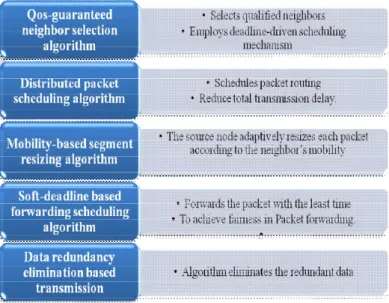
QOD constitutes following five algorithms.
Fig.3 QOD Algorithms QoS guaranteed neighbor selection algorithm.
Theorem 1. The QoS of the packets going through node ni can be satisfied if
+ +…….+ Wi
Proof. Liu et. al proposed a job scheduling model, where a task consists of a number of jobs. The authors proved that for a given set of jobs for an operating system, the deadline-driven scheduling algorithm is feasible for the job scheduling iff
+
+
…….+
---1
where Tg(j) denotes the job arrival interval time period and Tcp(j) denotes the job computing time of task j and 1 is the CPU utility when the CPU is busy all the time.
space utility Us(i) is the fraction of time a node ni is busy with packet forwarding over a unit time. In a communication network, the transmission time of a packet in packet stream from node nj can be regarded as the computing time Tcp(j) of a job from task j, the packet arrival interval Ta can be regarded as Tg, and the CPU utility can be regarded as node space utility in the job scheduling model. Then, (2) is reduced to
U
s(i)=
+
+
+
….. +
---2
=
+
+…….+
W
iwhere Wi =(1 - Uc(i) . Ci), Sp(j) is the size of the packet steam from node nj.
Equation (2) indicates that the scheduling feasibility of a node is affected by packet size Sp, the number of packet streams from m neighbors, and its bandwidth Wi
Similar to the random early detection (RED) algorithm, in which a queue length threshold is set to avoid queuing congestion, we set up a space utility threshold Us for each
node as a safety line to make the queue scheduling feasible. We use Uas(i) to denote the available space utility and Uas(i)= ( Us - Us(i)). In QOD, after receiving a forward
request from a source node, an intermediate node ni with space utility less than threshold Us replies the source node.
The replied node ni informs the source node about its available workload rate Uas(i) - Wi, and the necessary information to calculate the queuing delay of the packets from the source node.
The source node selects the replied neighbor nodes that can meet its QoS deadline for packet forwarding based on the calculated queuing delay. After the source node determines the Nq nodes that can satisfy the deadline requirement of the source node, the source node needs to distribute its packets to
the Nq nodes based on their available workload rate Uas(i) - Wi to make the scheduling feasible in each of the neighbor nodes. Then, the problem can be modeled as a linear programming process. Suppose the packet generating rate of the source node is Wg kb/s, the available workload rate of the intermediate node i is Uas(i) * Wi, and the workload rate allocation from source node to immediate node i is
Ai = , where 0 < i < n. Then, we need to solve the following equations to get an allocation set A:
---3
Any results that satisfy (3) can be used by the source node. If the equation cannot be solved, which means the QoS of the source node cannot be satisfied, then the source node stops generating packets based on the admission control policy. Based on Sp(i), the source node can calculate the packet arrival interval for node ni:
Ta(i)= Sp(i)/Ai
Distributed packet scheduling algorithm.
After qualified neighbors are known, this algorithmic program schedules packet routing. It assigns earlier generated packets to forwarders with higher queuing delays, while assigns a lot of recently generated packets to forwarders with lower queuing delays to decrease total transmission delay. In order to further reduce the stream transmission time, a distributed packet scheduling algorithm is proposed for packet routing.
This algorithm assigns earlier generated packets to forwarders with higher queuing delays and scheduling feasibility, while assigns more recently generated packets to forwarders with lower queuing delays and scheduling Feasibility, so that the transmission delay of an entire packet stream can be reduced.We use t to denote the time when a packet is generated, and use TQoS to denote the delay QoS requirement.
Let WS and WI denote the bandwidth of a source node and an
intermediate node respectively, we use T SI = Sp / WS to
denote the transmission delay between a source node and an intermediate node, and T I D =Sp / WI to denote the
transmission delay between an intermediate node and an AP. Let Tw denote the packet queuing time and Tw(i) denote the packet queuing time of ni. Then, as Fig. 3 shows, the queuing delay requirement is calculated as Tw < TQoS – T S I - T ID.
As TQoS, T SI , and TID are already known, the source node
needs to calculate Tw of each intermediate node to select intermediate nodes that can send its packets by the deadline, i.e., that can satisfy Tw < TQoS – T S I - T ID Below we
Before introducing the details of the distributed packet scheduling algorithm, we explain how to estimate the queuing time of a packet with priority x. It is estimated
-(4) Mobility based segment resizing algorithm.
The source node adaptively resizes every packet in its packet stream for every neighbor node in line with the neighbor’s quality so as to extend the programming feasibility of the packets from the source node.
In a highly dynamic mobile wireless network, the transmission link between two nodes is frequently broken down. The delay generated in the packet retransmission degrades the QoS of the transmission of a packet flow. On the other hand, a node in a highly dynamic network has higher probability to meet different mobile nodes and APs, which is beneficial to resource scheduling. As (2) shows, the space utility of an intermediate node that is used for forwarding a packet p is Sp / Wi .Ta . That is, reducing packet size can increase the scheduling feasibility of an intermediate node and reduces packet dropping probability. However, we cannot make the size of the packet too small because it generates more packets to be transmitted, producing higher packet overhead.
Based on this rationale and taking advantage of the benefits of node mobility, we propose a mobility-based packet resizing algorithm for QOD in this section. The basic idea is that the larger size packets are assigned to lower mobility intermediate nodes and smaller size packets are assigned to higher mobility intermediate nodes, which increases the QoS-guaranteed packet transmissions. Specifically, in QOD, as the mobility of a node increases, the size of a packet Sp sent from a node to its neighbor nodes i decreases as following
---5
where is a scaling parameter and vi is the relative mobility speed of the source node and intermediate node and Sp(unit) = 1 kb.
Traffic redundant elimination algorithm.
An intermediate node forwards the packet with the first smallest amount time allowed to attend before being forwarded to resolute succeed fairness in packet forwarding. Recall that in the EDF algorithm, an intermediate node forwards the packets in the order from the packets with the closest deadlines to the packets with the farthest deadlines. If an intermediate node has no problem to meet all packets’ deadlines in forwarding, that is, the packets are scheduling feasible, the EDF algorithm works satisfactorily.
However, when an intermediate node has too many packets to forward out and the deadlines of some packets must be missed, EDF forwards out the packets with the closest deadlines but may delay the packets with the farthest deadlines. Therefore, EDF is suitable for hard-deadline
driven applications (e.g., online conferences) where packets must be forwarded before their deadlines but may not be fair to all arriving packets in soft-deadline driven applications (e.g., online TV), where the deadline missing is sometimes acceptable.
In order to achieve fairness in the packet forwarding scheduling for soft-deadline driven applications, a forwarding node can use the least slack first (LSF) scheduling algorithm. The slack time of a packet p is defined as Dp _ t _ c0, where t is the current time and c0 is the remaining packet transmission time of the packet. LSF can achieve more fairness than EDF. QOD can choose either LSF or EDF based on the applications and we can apply (4) for LSF the same as EDF. The priorities of the packets are determined by the chosen policy.
Data redundancy elimination based transmission algorithm.
Due to the broadcasting feature of the wireless networks, the access point and mobile nodes will cache packets. This algorithmic rule eliminates the redundant data to boost the QoS of the packet transmission. The mobile nodes set their NAV values based on the overhearing message’s transmission duration time. A large NAV leads to a small available bandwidth and a small scheduling feasibility of the mobile nodes based on (2).
Therefore, by reducing the NAV value, we can increase the scheduling feasibility of the intermediate nodes and sequentially increase the QoS of the packet transmission. Due to the broadcasting feature of the wireless networks, in a hybrid network, the APs and mobile nodes can overhead and cache packets, we use an end-to-end traffic redundancy elimination (TRE) algorithm to eliminate the redundancy data to improve the QoS of the packet transmission in QOD. TRE uses a chunking scheme to determine the boundary of the chunks in a data stream. The source node caches the data it has sent out and the receiver also caches its received data. In QOD with TRE, the AP and mobile nodes overhear and cache packets.
From the overhearing, the nodes know who have received the packets. When a source node begins to send out packets, it scans the content for duplicated chunks in its cache. If the sender finds a duplicated chunk and it knows that the AP receiver has received this chunk before, it replaces this chunk with its signature (i.e., SHA-1 hash value). When the AP receives the signature, it searches the signature in its local cache. If the AP caches the chunk associated with the signature, it sends a confirmation message to the sender and replaces the signature with the matched data chunk. Otherwise, the AP requests the chunk of the signature from the sender.
drawbacks. In this paper, we propose a QoS oriented distributed routing protocol (QOD) for hybrid networks to provide QoS services in a highly dynamic scenario. Taking advantage of the unique features of hybrid networks, i.e., anycast transmission and short transmission hops, QOD transforms the packet routing problem to a packet scheduling problem. In QOD, a source node directly transmits packets to an AP if the direct transmission can guarantee the QoS of the traffic. Otherwise, the source node schedules the packets to a number of qualified neighbor nodes. Specifically, QOD incorporates five algorithms. The QoS-guaranteed neighbor selection algorithm chooses qualified neighbors for packet forwarding. The distributed packet scheduling algorithm schedules the packet transmission to further reduce the packet transmission time. The mobility-based packet resizing algorithm resizes packets and assigns smaller packets to nodes with faster mobility to guarantee the routing QoS in a highly mobile environment. The traffic redundant elimination-based transmission algorithm can further increase the transmission throughput. The Soft-deadline-based forwarding scheduling achieves fairness in packet forwarding scheduling when some packets are not scheduling feasible. Experimental results show that QOD can achieve high mobility-resilience, scalability, and contention reduction. Future Work
Quality of service Oriented Distributed routing protocol enhance the Quality of Service capability of hybrid networks. In Mobile ad hoc networks (MANET), the quality of service (QoS) depends on the available resources in the network and node mobility as mobility may result in frequent route failures. Some existing hybrid approach of multi-path routing technique rarely considers QoS metrics for path selection. In future, a QoS enhanced hybrid multi-path routing protocol is suitable for MANET. In this protocol, topology discovery is performed proactively and route discovery is performed in the reactive manner. In proactive topology discovery phase, each node collects the battery power, queue length and residual bandwidth of every other nodes and stores in the topology information table (TIT). By exchanging the TIT among the nodes, the topology is discovered. When the source node wants to forward the data packet to the destination, it utilizes the reactive route discovery technique where the multiple paths are established using multi-path Dijkstra algorithm. When any intermediate node does not recognize the next 2-hop information from TIT towards destination, the new multi-path route discovery is performed. By simulation results, it is shown that the proposed approach reduces the overhead.
VI REFERENCES
[1] Dr. Shuchita Upadhayaya and Charu Gandhi “Quality of service routing in Mobile ad hoc networks using Location and energy parameters”, International Journal of Wireless & Mobile Networks (IJWMN), Vol 1, No 2, November 2009
[2] Sunil Taneja and Ashwani Kush “A Survey of Routing Protocols in Mobile Ad Hoc Networks” International Journal of Innovation, Management and Technology, Vol. 1, No. 3, August 2010 ISSN: 2010-0248.
[3] V.G.Muralishankar et al, “Routing Protocols for MANET:A Literature Survey”, International Journal of Computer Science and Mobile Applications, Vol.2 Issue. 3, March- 2014, pg. 18-24
[4] H. Luo, R. Ramjeey, P. Sinhaz, L. Liy, and S. Lu, “UCAN: A Unified Cell and Ad-Hoc Network Architecture,” Proc. ACM MobiCom, 2003.
[5] P.K. Mckinley, H. Xu, A. Esfahanian, and L.M. Ni, “Unicast-Based Multicast Communication in Wormhole-Routed Direct Networks,” IEEE Trans.
Parallel Data and DistributedSystems, vol. 5, no. 12, pp. 1252-1265, Dec. 1992.
[6] H. Wu, C. Qiao, S. De, and O. Tonguz, Integrated Cell and Ad Hoc Relaying Systems: iCAR,” IEEE J. Selected Areas in Comm., vol. 19, no. 10, pp. 2105-2115, Oct. 2001.
[7] J. Zhou and Y.R. Yang, “PAR CelS: Pervasive Ad-Hoc Relaying for Cell Systems,” Proc. IFIP Mediterranean Ad Hoc Networking Workshop (Med-Hoc-Net), 2002. [8] R. Braden, D. Clark, and S. Shenker, Integrated Services
in the Internet Architecture: An Overview, IETF RFC 1633, 1994.
[9] Z. Li and H. Shen, “A QoS-Oriented Distributed Routing Protocol for Hybrid Networks,” Proc. IEEE Seventh Int’l Conf. Mobile Adhoc and Sensor Systems, 2010. [10] J. Li, C. Blake, S. Douglas, H. Lee, and R. Morris,
“Capacity of Ad Hoc Wireless Networks,” Proc. ACM MobiCom, 2001.
AUTHORS BIOGRAPHY
Nanthini.S received the B.Tech degree in Information Technology from Park College of Engineering and Technology, Coimbatore and currently pursuing M.E degree in Jay Shriram Group of Institutions, Tirupur, India. Her research interests include Networks and data mining.