18
Knowledge construction through active
learning in e-learning: An empirical study
Alex Koohang, Middle Georgia State College, [email protected]
Frederick G. Kohun, Robert Morris University, [email protected]
Gary DeLorenzo, California University of Pennsylvania, [email protected]
Abstract
The purpose of this study was to measure students' perception toward active learning in e-learning environment with regards to their age, gender, increased proficiency with course management system, and status. Collected data were analyzed by conducting four separate ANOVA. Where applicable, post hoc tests were conducted to find out where specific differences among groups are placed. Results indicated no significant differences for the variables of age, gender, and increased proficiency with course management system. Status was found to be a significant factor. The findings are discussed and recommendations for future studies are made.
Keywords: Knowledge construction, active learning, e-learning, constructivism
Introduction
The continued increased in adoption of e-learning, also known as "distance education", by higher education institutions is quite evident. A recent survey reported that acceptance of e-learning by higher education institutions are now close to seventy percent (Allen & Seaman, 2012). The survey specifically reported the following:
• "The proportion of chief academic leaders that say online learning is critical to their long-term strategy is now at 69.1 percent – the highest it has been for this ten-year period. • Likewise, the proportion of institutions reporting online education is not critical to their
long-term strategy has dropped to a new low of 11.2 percent." (Allen & Seaman, 2012) Furthermore the report stated that the number of additional students taking at least one online course increased in 2012 as it did in 2011. Specifically the following were reported:
• "The number of students taking at least one online course increased by over 570,000 to a new total of 6.7 million.
• The online enrollment growth rate of 9.3 percent is the lowest recorded in this report series.
19
With this increase in e-learning acceptance, "learning" in e-learning must be secured. Literature has documented that learning in e-learning is achieved through "active learning". In active learning, learning focuses on construction of new knowledge (Koohang, 2009; Koohang, & Harman, 2005; Bonwell & Eison, 1991).
Active learning is about continuous construction of new knowledge. "Active learning creates a learning environment that insists on reinforcing higher-order thinking skills, exploration, and scaffolding based on raw data and real-world problems. It requires learners to actively and continuously participate in ownership of their learning. Active learning gives learners the opportunity to create knowledge in the course of social negotiation." (Koohang, 2012, p. 75) The purpose of this study was to measure students' perception toward active learning in an e-learning environment where active e-learning was carried out through routine and regular activities, assignments, and/or projects. Four research questions were outlined:
• RQ1: Is there a difference among the levels of students’ age (18 – 23, 24 – 29, 30 – 35, 36 – 41, and over 41) and their perception toward active learning in e-learning environment?
• RQ2: Is there a difference between students’ gender (males and females) and their perception toward active learning in e-learning environment?
• RQ3: Is there a difference among the levels of students’ increased proficiency (excellent, good, average, and weak) with the course management system (CMS) and their perception toward active learning in e-learning environment?
• RQ4: Is there a difference among the levels of students’ status (freshmen, sophomores, juniors, and seniors) and their perception toward active learning in e-learning environment?
Age differences in online courses have been reported in the literature (Allen & Seaman, 2007; Allen & Seaman, 2010). In addition, the literature has reported no significant differences between ages in online learning environments (Shultz, Shultz, & Round, 2010; Yukselturk & Bulut, 2007; Koohang, Smith, Yerby, & Floyd, 2012). In the present study, we select age variable to find out whether it has an effect on students' perception toward active learning in an e-learning environment.
Gender was selected because gender differences with technology, in general, have been reported with inconsistent results. Studies reporting no significant gender differences (Shultz, Shultz, & Round, 2010; Yukselturk & Bulut, 2007), while one recent study by Koohang, Smith, Yerby, & Floyd ( 2012) has documented gender differences in regards to students' perception with their learning experience in online courses. Male students significantly scored higher in regards to their perception with learning experience in online courses than female students did. In the present study, we select gender as a variable to find out whether it has an effect on students' perception toward active learning in an e-learning environment.
20
to find out whether it has an effect on students' perception toward active learning in an e-learning environment.
Finally, we chose students' status (freshman, sophomore, junior, and senior) as a variable of interest to see whether it has an effect on students' perception toward active learning in an e-learning environment. This variable was selected because we could not specifically find any literature that has studies the effect of college status on toward active learning in an e-learning environment.
Research Methodology Instrumentation
The instrument in this study is based on an active learning model in e-learning advanced by Koohang (2012). The model contends that construction of new knowledge is achieved through active learning in three stages internal/direct to learning: the underpinning stage, the ownership stage, and the engaging stage. The elements of these stages are shown below:
Active Learning Elements
Underpinning Stage
• Real world and relevant examples • Exploration
• Higher-order thinking skills (analysis, evaluation, & synthesis)
• Scaffolding (used to make learners think above and beyond what they normally know)
Ownership Stage
• Learner’s driven goals and objectives
• Learner’s self-mediating and control of learning • Learner’s self-analysis, self-reflection, self-awareness • Learner's own experience
• Learner's self-assessment
• Learner's own representation of ideas and/or concepts
Engaging Stage
• Learners' active engagement in analysis, evaluation, & synthesis of multiple perspectives • Learners' collaborative assessment
The instrument was empirically validated in a study conducted by Koohang & Paliszkiewicz (in press) to be reliable and interpretable among all its associated items.
The instrument is comprised of twelve statements. These statements are as follows:
21
2. Through exploration in online course activities, assignments, and/or projects, I can seek knowledge independently and manage my learning goals.
3. Learning becomes more meaningful if real world and relevant examples are used in the online activities, assignments, and/or projects.
4. The online activities, assignments, and/or projects should encourage me to think above and beyond what I normally learn.
5. I learn better if I am asked, through online activities, assignments, and/or projects, to set my own learning goals and objectives.
6. I learn better if I am involved, through online activities, assignments, and/or projects, in self-mediating and control of my learning.
7. Encouraging self-awareness, self-analysis, and self-reflection in online activities, assignments, and/or projects are very important to my learning.
8. Online activities, assignments, and/or projects should encourage me to include my own previous experience in solving a problem.
9. Online activities, assignments, and/or projects should encourage me to do self-assessment about my learning.
10.Online activities, assignments, and/or projects should encourage me to present my own ideas/concepts.
11.Online activities, assignments, and/or projects should encourage active analysis, evaluation, & synthesis of multiple perspectives expressed by everyone.
12.Online activities, assignments, and/or projects should encourage everyone to assess each other's learning progress." (Koohang & Paliszkiewicz, in press).
The Likert-type instrument contained the following scoring strategy: strongly agree = 5, agree = 4, neither agree nor disagree = 3, disagree = 2, and strongly disagree = 1.
Subjects & Procedure
The instrument was approved by IRB and classified as "exempt". It was then administered to 141 students who were enrolled in a bachelor of information technology program in a medium-sized higher education institution in the southeast United States. Participants were taking online courses in various information technology courses through a popular Course Management System (CMS). These online courses were entirely asynchronous. The subjects were guaranteed protection of their anonymity. Of the 141 completed surveys, 2 were incomplete. This yielded a final sample of 139 subjects that were included in the study.
Data Analysis
22
variable with two categories. The predetermined level of significance (α = 0.05) was chosen for the present study.
Results
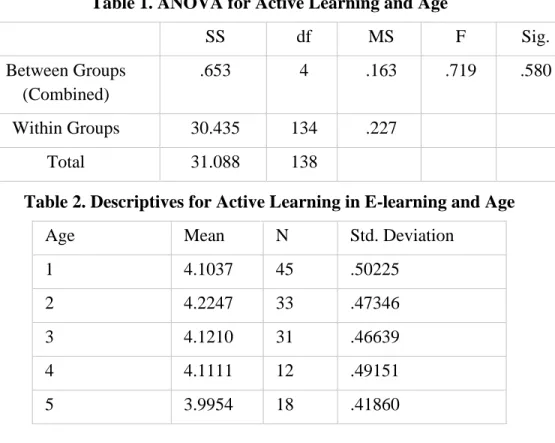
RQ1: Is there a difference among the levels of students’ age and their perception toward active learning in e-learning environment? ANOVA results for RQ1 showed no significant differences among the levels of students' age and their perception toward active learning in e-learning environment (See Table 1). Descriptives for age and active learning in e-learning are presented in Table 2, indicating high perception toward active learning in e-learning at all age levels.
Table 1. ANOVA for Active Learning and Age
SS df MS F Sig. Between Groups
(Combined)
.653 4 .163 .719 .580
Within Groups 30.435 134 .227 Total 31.088 138
Table 2. Descriptives for Active Learning in E-learning and Age
Age Mean N Std. Deviation 1 4.1037 45 .50225
2 4.2247 33 .47346 3 4.1210 31 .46639 4 4.1111 12 .49151 5 3.9954 18 .41860
1 = 18 – 23, l 2 = 24 – 29 , 3 = 30 – 35, 4 = 36 – 41, 5 = Over 41
23
Table 3. ANOVA for Active Learning and Gender
SS df MS F Sig. Between Groups (Combined) .001 1 .001 .002 .960 Within Groups 31.087 137 .227
Total 31.088 138
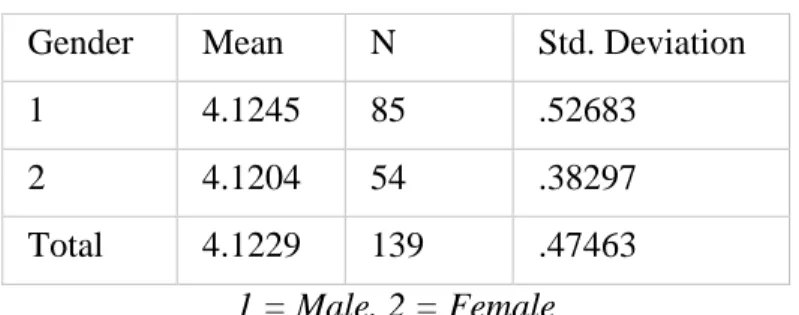
Table 4. Descriptives for Active Learning and Gender
Gender Mean N Std. Deviation 1 4.1245 85 .52683
2 4.1204 54 .38297 Total 4.1229 139 .47463
1 = Male, 2 = Female
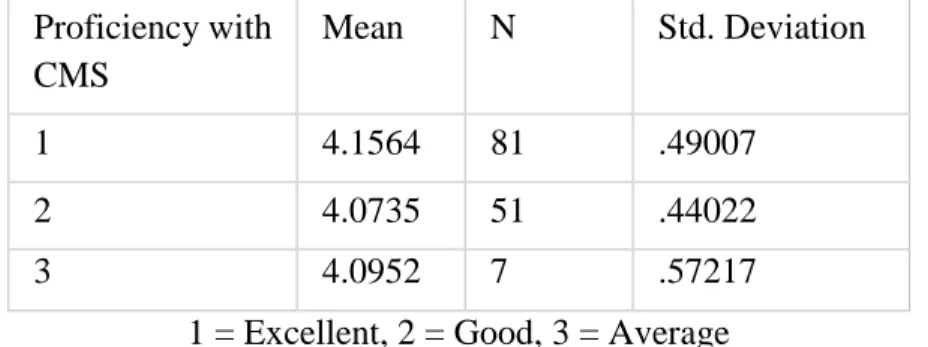
RQ3: Is there a difference among the levels of students’ increased proficiency with the course management system (CMS) and their perception toward active learning in e-learning environment? ANOVA results for RQ3 showed no significant differences among the levels of students’ increased proficiency with the course management system (CMS) and their perception toward active learning in an e-learning environment (See Table 5). Descriptives for students’ increased proficiency with the course management system (CMS) and active learning in e-learning are presented in Table 6, indicating high perception toward active e-learning in e-e-learning at all levels. The levels for this variable were 1 = excellent, 2 = good, 3 = average, and 4 = weak. No subject reported weak proficiency with the CMS.
Table 5. ANOVA for Active Learning and Proficiency with CMS
SS df MS F Sig. Between Groups (Combined) .220 2 .110 .486 .616 Within Groups 30.867 136 .227
24
Table 6. Descriptives for Active Learning and Proficiency with CMS
Proficiency with CMS
Mean N Std. Deviation
1 4.1564 81 .49007 2 4.0735 51 .44022 3 4.0952 7 .57217
1 = Excellent, 2 = Good, 3 = Average
RQ4: Is there a difference among the levels of students’ status and their perception toward active learning in e-learning environment? ANOVA results for RQ4 showed a significant difference among the levels of student's status (freshmen, sophomores, juniors, and seniors) and their perception toward active learning in e-learning environment (See Table 7). Post hoc tests were then conducted to find out where the significant differences lie among the levels of status. The result indicated Results indicated that freshmen significantly differ from all other categories. Next sophomores significantly differ from juniors and seniors. Descriptives for students’ status and active learning in e-learning are presented in Table 8.
Table 7. ANOVA for Active Learning and Status
SS df MS F Sig. Between Groups (Combined) 3.493 3 1.164 5.697 .001 Within Groups 27.595 135 .204
Total 31.088 138
Table 8. Descriptives for Active Learning and Status
Status Mean N Std. Deviation 1 3.7111 15 .57724
2 4.0797 23 .48297 3 4.1293 49 .43868 4 4.2548 52 .40972
25 Discussion
This study was undertaken to measure students' perception toward active learning in e-learning environment. Age, gender, increased proficiency with course management system, and status was selected for examination against students' perceptions toward active learning in e-learning environment. The e-learning environment where this study took place required active learning through routine and regular activities, assignments, and/or projects. Active learning was described as continuous construction of new knowledge where higher-order thinking skills, exploration, and scaffolding based on raw data and real-world problems are reinforced via students' collaborative engagement in activities, assignments, and/or projects.
Age: There were no significant differences among the levels of students' age and their perception toward active learning in e-learning environment. This result is consistent with previous research conducted by Shultz, Shultz, & Round (2010), Yukselturk & Bulut (2007), and Koohang, Smith, Yerby, & Floyd (2012). Descriptive analysis for the present study indicated high perception toward active learning in e-learning at all age levels. Therefore, the present study concludes that age, as a variable does not play a significant role in students' perception toward active learning in e-learning.
Gender: There was no significant difference between students’ gender and their perception
toward active learning in an e-learning environment. Descriptive analysis for the present study for gender indicated high perception toward active learning in e-learning for both males and females. This result is not in line with the study that was recently conducted by Koohang, Smith, Yerby, & Floyd (2012) where authors reported a significant difference between males and females. It is obvious that there is no clear trend for the variable of gender, therefore; the present study recommends that gender be included in future studies as a variable of interest.
Proficiency with Course Management System (CMS): There were no significant differences among the levels of students' increased proficiency with course the management system and their perception toward active learning in e-learning environment. Descriptive analysis for the present study indicated high perception toward active learning in e-learning at all levels of course management system proficiency. This result is consistent with previous research conducted by Koohang, Smith, Yerby, & Floyd (2012), but inconsistent with research conducted by Koohang (2004a) and Koohang (2004b) where increased prior experience with CMS significantly contributed to students' increased positive views about e-learning. This may be due to the timing of these studies. As e-learning matures, the proficiency with CMS may become a norm among students. Therefore, the proficiency with CMS may play an insignificant role in students' perception toward active learning in e-learning. However, it may be worthwhile to continue including this variable in future studies.
26
courses. Many of these students may be new to learning through e-learning. This attention should be constant and be communicated to students via on-line course policies. Koohang (2012) stated that setting policies for on-line courses and communicating them to students are critical to student success in e-learning. The author asserted that course policies should include the following:
• "A clear definition of how the course will be delivered (asynchronous, synchronous) and whether the curse requires additional software and/or hardware
• An explanation of the courseware platform(s) - where learning takes place
• A statement of student responsibility that includes exhibition of motivation, discipline, and commitment to learning
• A clear explanation for due dates for completing individual/group activities/assignments/projects
• A clear definition of active learning and learners' expectations in course engagement - individually and in team
• A clear guidelines for online discussions and online team collaboration • A clear explanation of how learners can access the professor
• A clear explanation of how the learner can access the support services • A clear explanation of the purpose and structure of the course
• A clear explanation of the measurable learning outcomes • A clear explanation of the learner's assessments
• A clear explanation of the methods of routine and regular communication between the professor and students and among students" (Koohang, 2012, p. 73)
Therefore, the present study recommends that these policies be included in all on-line course syllabi and constantly communicated with students.
This study has limitations that may influence the generalizability of the results. The data collected were limited to a population sample enrolled in various information technology online courses that required regular and routine active learning through activities, assignments, and/or projects. Furthermore, the sample of convenience used in this study may be perceived as a limitation that influences the generalizability of the results. Therefore, it is recommended that future expansion of this study include different population sample, preferably from various geographic regions.
References
Allen, E. & Seaman, J. (2007). Online nation: Five Years of Growth in Online Learning. The Sloan Consortium. Retrieved December 17, 2012 from
http://www.sloan-c.org/publications/survey/pdf/onlinenation.pdf
27
http://www.sloanc.org/publications/survey/pdf/class_differences.pdf
Allen, E., & Seaman, J. (2012). Changing Course: Ten Years of Tracking Online Education in the United States. The Sloan Consortium. Retrieved February 03, 2013 from
http://sloanconsortium.org/publications/survey/changing_course_2012
Bonwell, C., & Eison, J. (1991).Active learning: creating excitement in the classroom . (1 ed.). Washington, D.C: Jossey-Bass.
Koohang, A. & Paliszkiewicz, J. (in press). Knowledge construction in e-learning: an empirical validation of an active learning model. Journal of Computer Information Systems.
Koohang, A. (2004a). Expanding the concept of usability. Informing Science Journal, 7, 129-141.
Koohang, A. (2004b). A study of users' perceptions toward e-learning courseware usability.
International Journal on E-Learning, 3(2), 10-17.
Koohang, A. (2009). A learner-centered model for blended learning design. International Journal of Innovation and Learning, 6(1), 76–91.
Koohang, A. (2012). Active learning in e-learning: advancing a systemic model. Issues in Information Systems, 13(1), 68-76.
Koohang, A., & Harman, K. (2005). Open source: A metaphor for e-learning. Informing Science Journal, 8, 75-86.
Koohang, A., Smith, T., Yerby, J., & Floyd, K. (2012). Active learning in online courses: an examination of students' learning experience. International Journal of Management, Knowledge and Learning, 1(2), pp. 205-216.
Mertler, C. & Vannatta, R. (2010). Advanced and Multivariate Statistical Methods: Practical Application and Interpretation, (4th Edition). Glendale, CA: Pyrczak Publishing Schultz, M. C., Schultz, J. T., & Round, E. (2010). The effects of chronological age on management and business administration student performance in online/distance education courses. The Business Review, 16(1), 245-251.
Yukselturk, E., & Bulut, S. (2007). Predictors for student success in an online course.
Educational Technology & Society, 10(2), 71-83.
Biographies
28
Scholar and Endowed Chair in Information Technology. He was named the 2009 Computer Educator of the Year by IACIS.
Frederick G. Kohun is the University Professor of Computer and Information Systems
Robert Morris University in Pittsburgh, Pennsylvania has more than 36 years of experience as a professor, department head, associate dean, dean, associate provost, and founding director of the doctoral program in Information Systems and Communication. He holds a bachelor degree in economics from Georgetown University, graduate degrees in economics and information science, from the University of Pittsburgh, and a Ph.D. in applied history in technology from Carnegie Mellon University. At Robert Morris University he led the design and implementation of eight technology based academic programs at the undergraduate and graduate level (including a doctoral program) as well as the attainment of ABET-CAC accreditation He is known both nationally and internationally from his numerous publications and presentations in economics, health informatics, decision support, technological impact, and culture as well as his active involvement as an accreditation evaluator and team leader. In 2007 he was named the International Computer Educator of the Year by the International Association of Computer Information Systems