Research Article – Computer Engineering
Prediction of Employees’ Performance of an Organization Using Bayesian
Network
Faranak Salman Mohajer
٭
Department of Computer Engineering, Islamic Azad University, Zanjan Branch, Zanjan, Iran
Abstract
The assessment of employees’ performance in an organization not only identifies the staff abilities, but also has a significant role in improvement of that organization’s performance; the reason is that by encouraging staff in optimal performing their tasks, the productivity of the organization would be improved. There are several ways to assess the performance of employees; each can be used in its own place. The managers must select the best way of assessment for their organizations and perform the assessment according to that way in order to reduce the probability of error and increase the accuracy of the assessment. In this article, it was attempted to present a model for assessment, using Bayesian network tools that has a lower level of error and a high level of accuracy and needs less time for assessment. To do this, at first the effective components in assessment are specified, then the dataset are provided for this components and by separating the values of this dataset, its Bayesian network is created and finally we use the created model for the assessment.
Key words: Bayesian network, predicting employees’ performance, factors affecting the assessment,
dataset
Introduction
Due to the enhancement of the organization’s productivity and encouraging the staff, the staff performance assessment in the organization had always a special importance; therefore, the identification of the staff abilities in the organization is usually one of the concerns for the managers of that organization. Although unofficial ways, such as colleagues’ comments or occasional encouragement of supervisors and managers can make employees aware of their performance, the performance assessment has a formal structure. This structure is a system for measurement, assessment, and influencing the characteristics, behaviors, and the occupational achievements, as well as the number of his absence and ultimately determination of his current performance level [1].
On the one hand, the staff performance assessment in an organization can specify the individual’s performance so that he and other staff members could be compared and a number of decisions could be made in relation to the more or fewer salary, encouragement or reprimand, promotion or demotion, and on the other hand, this assessment could improve the individual’s performance, create an effective workforce, and contribute to the organization. In fact, the main objective of the staff performance assessment is to stimulate and encourage them to do their tasks better; to do this, some tools such as increasing salary, occupational promotion, selection for training etc. are used. In this situation the task of the manager to assess the staff performance would be very difficult in order for the assessment to perform correctly.
In this article, using Bayesian network, we create a graphical structure from the effective components in an employee’s performance and predict and assess the individual’s performance. ISSN 2519-9412 / © 2017 Phoenix Research Publishers
Received: 06-05-2017; Accepted 07-06-2017; Published Online 08-06-2017
٭Corresponding Author
Faranak Salman Mohajer, Department of Computer Engineering,
The Bayesian network is a graphical structure that shows the results of reasoning under uncertainty. The nodes are a set of random variables and the edges that connect a pair of nodes represent a direct dependency between random variables. The Bayesian network is an acyclic directed graph. If we consider two nodes X and Y and there would be an edge from X to Y, it means that the random variable Y depends on random variable X; in this case, X is called the parent of Y and Y is the offspring. However, if there is no edge between these two nodes, then the random variables X and Y would be independent from each other. Each node has conditional probability in these networks; because the parent node of each node would have an impact on it and conditional probability is stored in the Conditional Probability Table (CPT).
The methods of the staff performance assessment
De kenzo & Robbins divided the staff performance assessment methods into three groups: (1) absolute standards, (2) relative standards, and (3) objectives.
Absolute standards
This group of assessment methods uses the absolute standards. It means that the staff are compared through a standard and their assessment is performed independently from the other staff during a week. The methods of this group include the following:
A. Compositional assessment: This method is the
easiest assessment method in which the assessor presents explanation for strength and weaknesses of the staff, the previous performance and suggestions for the improvement of their performance. This method is often combined with other standards. The focus in this method is on the behavior.
B. The major incident assessment: In this method,
the focus is on the key factors that create differences in the effective performance of a job. This method is of high validity; because it depends on type of the job is on the basis of the individual performance, not a specific characteristic. It is necessary to try to use the specific events and times that have important place in the occupational performance to measure the individual performance. These events are knows as major
incidents. In this method, the manager assesses the positive and negative behavioral and personal performance.
C. Checklist: In this method the assessor provides
a list of conditions and compares this list with the staff. The checklist shows the staff characteristics and performance. The results of the assessment can be in quantitative form and individuals would be assigned a score. The answers of the checklist are often yes or no that is given to the individuals’ characteristics.
Relative standards
In the second group of assessment methods, the staff performance is compared with the other staff. In this method, the relative standards are used rather than the absolute measurement tools. The most popular methods of this group include the following:
A. Sequential ranking of the group: In this method, the staff are classified to special groups. For example, if the assessor has 20 staff, he could classify them to 5 groups; in this case only 4 individuals are in each group.
B. Individualistic ranking: In this method, the staff are ranked from top to bottom, meaning that the difference between the first and second individual is equal to the difference between the 21st and 22nd individuals. In this method, the manager compares each employee with the other staff in accordance with the occupational standards.
Two by two comparisons: In this method each employee is compared to all the staff in pairs. At the end, the best employee is selected for each feature.
Objectives
360-degree feedback assessment
The 360-degree feedback is the last performance assessment method. This method is the most popular method of performance assessment in which the assessment is performed by several sources. Feedback from multiple sources or the 360-degree feedback is one of the staff performance assessment methods in which the employee’s performance is performed through the perspective of managers, colleagues, subordinates, sometimes customers, and suppliers. In this method, the assessment of the considered individual is performed by others with the standard tools. In this method the self-assessment is also performed.
The staff performance assessment using Bayesian network
The reasons for using Bayesian network In this paper, a Bayesian network is used for the following reasons:
A. Since the staff performance assessment in each month for reward, promotion, etc. is time-consuming, the monthly staff performance assessment can be provided quickly by modeling this assessment.
B. Due to the large number of staff and their tasks, there is the possibility of error in the assessment by directors; but the Bayesian network starts the analysis with high precision.
C. In the cases where the certain information is not available, i.e., under uncertainty, taking decisions would be easier for the managers.
D. Maintains the knowledge of managers in relation to the way of staff performance assessment.
E. This network is a legible model for the managers and the staff.
The manner of implementing the assessment with Bayesian network
In this method, several methods are used for creating a dataset. It means that the data based on the most important organizational objectives are ranked and then are grouped; at last, a model is created which can be used for the future assessments. Since the effective components in the
staff performance assessment are different in each organization, at first all the effective components in the individuals’ performance assessment should be specified. The proper selection of these components is the most important step towards the proper assessment. These components form the Bayesian network’s nodes and the existence of an edge between two nodes shows the direct impact of a component on another component or the direct impact of a component on the individual’s performance assessment.
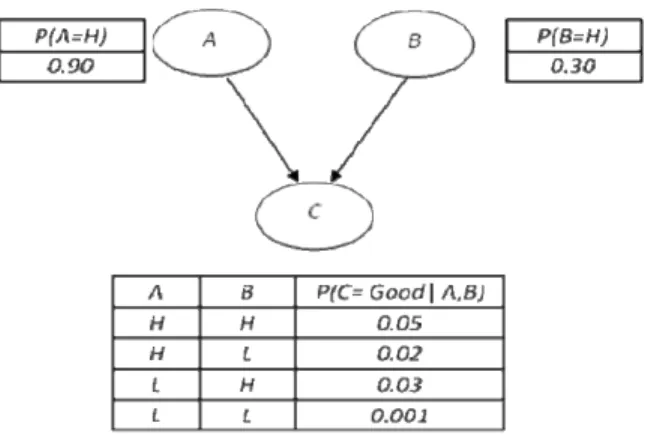
For example, if A & B are the effective components in the employee’s performance assessment and C is the individual’s performance assessment, the Bayesian network for it would be in the in the form the following figure (1).
Figure 1. The Bayesian network for individuals’ performance assessment in an organization with the components A & B
Case study: Performance assessment of the Tax Experts of the Tax Affairs General Office
In order to examine the staff performance assessment, a real case study is considered; this case study is the performance assessment of the Tax Experts of the Tax Affairs General Office.
The effective components in the staff performance assessment of the tax unit of this general office include the following:
The number of setting and issuing job identification paper
The number of setting and issuing real estate paper
Diagram1. The data of the Tax Affairs General Office staff
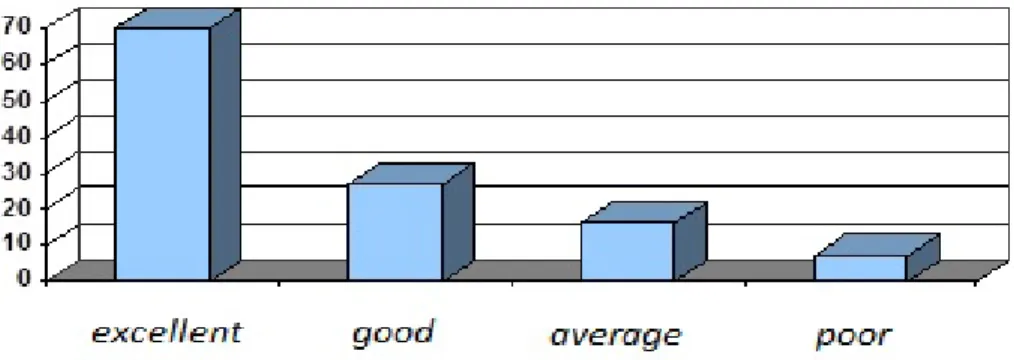
Diagram 2. The assessment results of the staff performance of Tax Affairs General Office
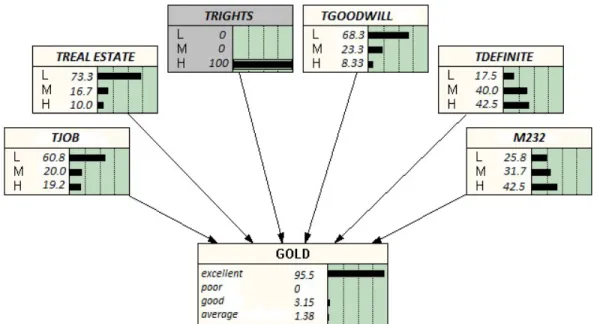
Figure 3. Inference in the obtained Bayesian network
Figure (4): an example of the inference in the network if TDEFINITE=L
The number of setting and issuing definite
paper
The number of agreement with Article 238 These 6 components were extracted for 120 staff along with the individuals’ performance assessment that was specified by the directors; these components form the dataset. The diagram (1) shows the dataset separately.
including excellent, good, average, and poor; these groups can be seen in diagram (2). However, since all these factors have a direct impact on individual assessment, it is expected that in the relevant Bayesian network, each node is connected directly to the assessment node and since each component has no relationship with the other components, so the nodes are independent from each other and there is no link between them. Netica software used as a tool for representing and reasoning the Bayesian networks, the dataset was modeled in the form of Bayesian network as shown in figure (2).
Inference in the obtained Bayesian network
By changing the value of the components, the impact can be seen in the results. In figure (3) if TRIGHTS=H, the probability of the excellent performance would reach from 73.7 to 95.5 and the probability of the poor performance would reach from 4.39 to 0 percentage. In figure (4) if TDEFINITE=L, the probability of the excellent performance would reach from 73.3 to 65.1 and the probability of the poor performance would reach from 4.39 to 12.3 percentage.
Conclusions
In this paper, it was attempted to state the importance of the staff performance assessment in an organization by the mentioned performance assessment methods, while presenting a model for the staff performance assessment using Bayesian
network tools. Here we were able to increase the assessment accuracy and speed by creating a Bayesian network, reduce the level of error, and register the directors’ information on the way of staff performance assessment in a model. Since the Bayesian network provides the possibility of reasoning under uncertainty, the directors can carry out the performance assessment using this model, in the cases where the dataset is incomplete or is accompanied noise.
References
[1] Personnel Management and Human Resources. Publisher: the High Institute of Education and Research for Management and Planning. Author: Shimon L. Dolan, Rand L. S. Shold. Translated by Dr. Toosi, M.A., Dr. Saebi, M., 2009.
[2] Evaluation of the performance assessment system of the staff of Disciplinary Forces of Islamic Republic of Iran from the perspective of the managers, Samavati, H., Nejat, S. A., bimonthly Police Human Development, N. 22, April & May, 2009.
[3] Kevin B. Korb, Ann E. Nicholson, “Bayesian Artificial Intelligence” A CRC Press Company Boca Raton London New York Washington, D.C., 2004