YM
YM
YM
YM
YM
YM
YM
YM
YM
YM
YM
YM
YM
YM
YM
YM
YM
YM
YM
YM
YM
YM
YM
YM
YM
YM
YMYM
YM
YM
YM
YM
YMYM
YM
YM
YM
YMYM
YM
YM
YM
YM
YM
YM
YM
YM
YM
YM
YM
YM
YM
YM
YM
YM
YM
YM
YM
YM
YM
YM
YM
YM
YM
YM
YM
YM
YM
YM
YM
YM
YM
YM
YM
YM
YM
YM
YM
YM
YM
YM
YM
YM
YM
YM
YM
YM
YM
YM
YM
YM
YM
YM
YM
YM
YM
YM
YM
YM
YM
YM
YM
YM
YM
YM
YM
YM
YM
YM
YM
YM
YM
YM
YM
YM
YM
YM
YM
YM
YM
YM
YM
YM
YM
YM
YM
YM
YM
YM
YM
YM
YM
YM
YM
YM
YM
YM
YM
YMYM
YM
YM
YM
YM
YM
YM
YM
YM
YM
YM
YM
YM
YM
YM
YM
YM
YM
YM
YM
YM YM
YM
YM
YM
YM
YM
YM
YM
YM
YM
YM
YM
YM
YM
YM
YM
YM
YM
YM
YM
YM
YM
YM
YM
YM
YM
YM
YM
YM
YM
YM
YM
YM
YM
YM
YM
YM
YM
YM
YM
YM
YM
YM
YM
YM
YM
YM
YM
YM
YM
YM
YM
YM
YM
YM
YM
YM
YM
YM
YM
YM
YM
YM
YM
YM
YM
YM
YM
YM
YM
YM
YM
YM
YM
YM
YM
YM
YM
YM
YM
YM
YM
YM
YM
YM
YM
YM
YM
YM
YM
YM
YM
YM
YM
YM
YM
YM
YM
YM
YM
YM
YM
YM
YM
YM
YM
YMYM
YM
YM
YM
YM
YM
YM
YM
YM
YM
YM
YM
YM
YM
YM
YM
YM
YM
YM
YM
YM
YM
YM
YM
YM
YM
YM
YM
YM
YM
YM
YM
YM
YM
YM
YM
YM
YM
YM
YM
YM
YM
YM
YM
YM
YM
YM
YM
YM
YM
YM
YM
YM
YM
YM
YM
YM
YM
YM
YM
YM
YM
YM
YM
YM
YM
YM
YM
YM
YM
YM
YM
YM
YM
YM
YM
YM
YM
YM
YM
YM
YM
YM
YM
YM
YM
YM
YM
YM
YM
YM
YM
YM
YM
YM
YM
YM
YM
YM
YM
YM
YM
YM
YM
YM
YM
YM
YM
YM
YM
YM
YM
YM
YM YM
YM
YM
YM
YM
YM
YM
YM
YM
YM
YM
YM
YM
YM
YM
YM
YM
YM
YM
YM
YM
YM
YM
YM
YM
YM
YM
YM
YM
YM
YM
YM
YM
YM
YM
YM
YM
YM
YM
YM
YM
YM
YM
YM
YM
YM
YM
YM
YM
YM
YM
YM
YM
YM
YM
YM
YM
YM
YM
YM
YM
YM
YM
YM
YM
YM
YM
YM
YM
YM
YM
YM
YM
YM
YM
YM
YM
YM
YM
YM
YM
YM
YM
YM
YM
YM
YM
YM
YM
YM
YM
YM
YM
YM
YM
YM
YM
YM
YM
YM
YM
YM
YM
YM
YM
YM
YM
YM
YM
YM
YM
YM
YM
YM
YM
YM
YM
YM
YM
YM
YM
YM
YM
YM
YM
YM
J U N I O R G u i d e b o o k
w w w . y o u n g m a r i n e s . c o m
YM
YM
YM
YM
YM
PREFACE
This guidebook is designed for the Young Marine Corporal and Young Marine Sergeant. There are two more guidebooks that you will receive as you progress through your career in the Young Marines. The Senior Young Marine Guidebook, and The Advanced Young Marine Guidebook. Each guidebook contains addition al knowledge as well as other degrees of performing, leading and instructing that will aid you in becoming a leader in your unit as well as in your community. Upon your completion of this guidebook, you should maintain it in your personal Young Marine Library as reference material in the future.
The proponent of this publication is the Young Marines National Headquarters. Send comments and recommendations to:
National Executive Director
Young Marines National Headquarters
TABLE OF CONTENTS
JUNIOR YOUNG MARINE GUIDEBOOK
YOUNG MARINES VISION, MISSION, OBJECTIVES,
GUIDING PRINCIPLES, & MOTTO………PAGE 1
PERFORMANCE OBJECTIVE 1 – CLOSE ORDER DRILL ...JYM-1-1
EO1 - FORM THE SQUAD……….JYM-1-2 EO2 - DISMISS THE SQUAD ...JYM-1-5 EO3 - ALIGN THE SQUAD………JYM-1-6 EO4 - OBTAIN CLOSE INTERVAL FROM NORMAL INTERVAL ON LINE...JYM-1-8 EO5 - OBTAIN NORMAL INTERVAL FROM CLOSE INTERVAL ON LINE...JYM-1-8 EO6 - OBTAIN DOUBLE ARM INTERVAL ON LINE...JYM-1-9 EO7 - OBTAIN NORMAL INTERVAL FROM DOUBLE ARM
INTERVAL ON LINE...JYM-1-9 EO8 - FORM A COLUMN FROM A LINE & REFORM TO A LINE.………JYM-1-10 EO9 - MARCH IN THE OBLIQUE..………JYM-1-10 EO10 - MARCH TO THE REAR...JYM-1-11 EO11 - MARCH TO THE FLANK………...JYM-1-12 EO12 - CHANGE DIRECTION OF A COLUMN……….JYM-1-13 EO13 - COLUMN OF TWOS FROM A SINGLE FILE………...JYM-1-14 EO14 - FORM A SINGLE FILE FROM A COLUMN OF TWOS………..JYM-1-15
PERFORMANCE OBJECTIVE 2 – ESSENTIAL SUBJECTS ... JYM-2-1
EO1 - UNDERSTAND YOUR UNITS ORGANIZATION ...JYM-2-3 EO2 - DRAW YOUR UNITS ORGANIZATIONAL CHART ...JYM-2-6 EO3 - IDENTIFY KEY EVENTS IN YM HISTORY ... JYM-2-7 EO4 - IDENTIFY KEY EVENTS IN MARINE CORPS HISTORY...JYM-2-8
PERFORMANCE OBJECTIVE 3 – FIELD SKILLS ... JYM-3-1
EO1 - EMPLOY METHODS OF ENVIRONMENTALLY SAFE
PERFORMANCE OBJECTIVE 4 – MAP & COMPASS ...JYM-4-1
EO1 - ORIENT A MAP BY INSPECTION ... JYM-4-6 EO2 - MEASURING DISTANCE BETWEEN 2 POINTS
ON A TOPOGRAPHICAL MAP...JYM-4-6 EO3 - CONTOUR LINES………..JYM-4-7 EO4 - IDENTIFY PARTS OF THE COMPASS AND THEIR FUNCTIONS...JYM-4-8 EO5 - IDENTIFY THE POINTS ON A COMPASS………...JYM-4-9 EO6 - ORIENT A MAP USING A COMPASS……...JYM-4-10 EO7 - MEASURE A MAGNETIC BEARING ...JYM-4-11
PERFORMANCE OBJECTIVE 5 – DRUG RESISTANCE ... JYM-5-1
EO1 - CONDUCT INDEPENDENT RESEARCH ON TOBACCO, ALCOHOL, AND
DRUGS ... JYM-5-1 EO2 - HELP INFORM AND ENCOURAGE FRIENDS TO STAY
AWAY FROM ALL FORMS OF TOBACCO, ALCOHOL,
AND DRUGS ...JYM-5-1 EO3 - SERVE AS A POSITIVE ROLE-MODEL FOR LEADERS,
PEERS, AND SUBORDINATES AGAINST THE USE OF
TOBACCO, ALCOHOL, AND DRUGS ...JYM-5-2
PERFORMANCE OBJECTIVE 6 – PUBLIC SPEAKING ... JYM-6-1
EO1 - LIST THE WAYS IN WHICH TO AVOID STAGE FRIGHT ... JYM-6-2 EO2 - TALK FOR 5 MINUTES ON DRUG YOU RESEARCHED
IN PERFORMANCE OBJECTIVE 5 ...JYM-6-2
PERFORMANCE OBJECTIVE 7 – LEADERSHIP ... ...JYM-7-1
EO1 - DEFINE LEADERSHIP ...JYM-7-2 EO2 - DISCUSS THE QUALITIES OF A LEADER ... JYM-7-2 EO3 - DISCUSS MORALE & ESPIRIT DE CORPS ... JYM-7-4 EO4 - THE ELEVEN PRINCIPLES OF LEADERSHIP ...JYM-7-5 EO5 - CARRY OUT THE DUTIES OF A YM ASSISTANT
SQUAD LEADER ...JYM-7-7 EO6 - CARRY OUT THE DUTIES OF A YM SQUAD LEADER ...JYM-7-7 EO7 - UNDERSTAND THE DUTIES OF A
YOUNG MARINE PLATOON GUIDE ... JYM-7-8 EO8 - UNDERSTAND THE DUTIES OF A
YOUNG MARINE COLOR SERGEANT ...JYM-7-8 EO9 - UNDERSTAND THE DUTIES OF A
YOUNG MARINE COLOR GUARD RIFLEMAN ...JYM-7-8
PERFORMANCE OBJECTIVE 8 – CITIZENSHIP ... ... JYM-8-1
PERFORMANCE OBJECTIVE 9 – PHYSICAL FITNESS, HEALTH, AND FIRST AID………..JYM-9-1
EO1 - DISCUSS THE COMPONENTS OF
PHYSICAL FITNESS ...JYM-9-1 EO2 - DEVELOP AND USE A PERSONAL
WORKOUT PLAN ... JYM-9-3 EO3 - MEASURE YOUR RESTING AND TARGET
HEART RATES ...JYM-9-5 EO4 - DETERMINE WHAT FACTOR CAUSES
WEIGHT LOSS AND GAIN ...JYM-9-6 EO5 - EARN THE YM CPR & ADVANCED FIRST AID RIBBON ...JYM-9-7
Full color reference Photos for some examples are at the back of the book
The Young Marines organization is supported by the following vision, mission,
guiding principles, objectives, and motto. It is not required that you learn them
however, they will come in handy as a reference when speaking about our
program.
Vision.
To earn and preserve a reputation as a leader in youth development and
drug demand reduction.
Mission.
The mission of the Young Marines is to positively impact America’s future
by providing quality youth development programs for boys and girls that nurtures
and develops its members into responsible citizens who enjoy and promote a
healthy, drug-free lifestyle.
Guiding Principles.
1. The health, welfare and safety of the Young Marines are paramount.
2. We value our volunteers and will provide them with the tools they need to
succeed.
3. We will never forget that this program is for our youth. We will uphold the core
values of Honor, Courage and Commitment.
4. We pledge to the parents to serve as positive role models to their children.
5. We get by giving.
Objectives. The objectives of the Young Marines is to:
•
Promote the physical, moral, and mental development of its members
•
Advocate a healthy, drug-free lifestyle through continual drug prevention
education
•
Instill in its members the ideals of honesty, fairness, courage, respect, loyalty,
dependability, attention to duty, love of God, and fidelity to
our country and its institutions
•
Stimulate an interest in and respect for academic achievement and the his tory
and traditions of the United States of America
•
Promote physical fitness through the conduct of physical activities, including
participation in athletic events and close order drill
Performance Objective 1: Close Order Drill Enabling Objectives:
Form the Squad. 1.
Dismiss the Squad. 2.
Align the Squad. 3.
Obtain Close Interval from Normal Interval on Line. 4.
Obtain Normal Interval from Close Interval on Line. 5.
Obtain Double Arm Interval on Line. 6.
Obtain Normal Interval from Double Arm Interval on Line. 7.
Form a Column from on Line and Reform to a line. 8.
March in the Oblique. 9.
March to the Rear. 10.
March to the Flank. 11.
Change Direction of a Column. 12.
Column of Twos from Single File. 13.
Form a Single File from a Column of Twos. 14.
1. General. A squad is a group of individuals formed for the purpose of instruction, discipline, control, and order.
Members of the squad take positions and move as stated in this Manual. All a.
individuals execute the movements at the same time. Squads may drill as squads or as part of a platoon or larger formation.
Squads are kept intact when practical. The normal formation for a squad is a single b.
rank (squad on line) or single file (squad in column). (See figure 1-1.) This permits variation in the number of individuals composing the squad. The first formation is
always on line. Column formation may be taken from line formation. A squad, not at drill, may be marched in column of twos by forming in two ranks.
The squad marches in line for minor changes of position only. c.
d. In this Chapter the term “unit leader,” (e.g., “The unit leader then checks the alignment) means the individual drilling the squad. He/she may be the squad leader, or squad member drilling the squad for an inspection or evaluation. If the unit leader is the squad
leader, then the number-two Marine (see figure 1-1) executes the movements of the
squad leader. The unit leader must maintain proper distance (3 paces) from the squad and remain centered on the squad during all drill movements.
If the squad executes a right step, the unit leader, who is facing the squad, would 1)
execute a left step in cadence with the squad to maintain proper position. For a left step the unit leader would execute a right step.
If the squad executes a back step, the unit leader would execute a half step, in 2)
cadence with the squad to maintain proper position.
Movements of the unit leader during other squad movements are explained in the 3)
paragraph describing the movement.
E.O. 1 Form the Squad
1. To Form the Squad.
a. Members of the squad normally form as indicated in figure 1-1. (e.g., maintain fire team/ section integrity). However, for parades and ceremonies where appearance is more important, the squads should be sized. To size the squad the tallest member takes
position 2 in figure 1-1 with the shortest squad member in position 13. The squad leader, regardless of height, always forms as the squad leader, in position one of
figure 1-2.
JYM-1-2
To form at normal interval, the command is
b. “FALL IN.”
The squad forms on line on the left of the squad leader. Each member of the squad, c.
except the individual on the left flank, raises their left arm shoulder high in line with their
body. Fingers are extended and joined, palm down thumb extended along the fore
finger. Each individual except the squad leader turns their head and looks to the right.
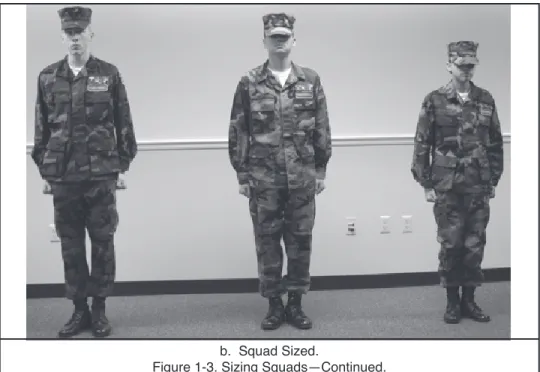
To obtain a normal interval, everyone places himself in line so their right shoulder
touches the fingertips of the person on their right. (see figure 1-3) As soon as each
individual is in line with the person on their right, and the person on their left has obtained normal interval, they assume the position of attention smartly but quietly.
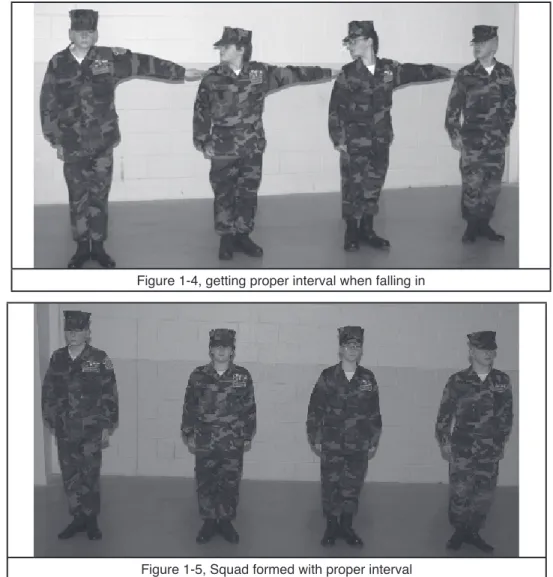
(See figure 1-4)
b. Squad Sized.
Figure 1-3. Sizing Squads—Continued.
d. To form at close interval, the command is “At Close Interval, FALL IN.”
The squad forms on line on the left of the squad leader. Each member of the squad, e.
except the individual on the left flank, places their left hand on their hip, elbow in
line with the body. They rest the heel of the palm on the hip with fingers extended
and joined and pointing down. Everyone except the squad leader turns their head and looks to the right. To obtain close interval, they place themselves in line so their right arm touches the elbow of the person on their right. (See figure 1-5) As soon
as each individual is in line with the person on their right, and the person on their left has obtained close interval, they assume the position of attention smartly but quietly. (See figure 1-6)
b. Squad Sized.
Figure 1-3. Sizing Squads—Continued.
JYM-1-4
d. To form at close interval, the command is “At Close Interval, FALL IN.”
The squad forms on line on the left of the squad leader. Each member of the squad, e.
except the individual on the left flank, places their left hand on their hip, elbow in
line with the body. They rest the heel of the palm on the hip with fingers extended
and joined and pointing down. Everyone except the squad leader turns their head and looks to the right. To obtain close interval, they place themselves in line so their right arm touches the elbow of the person on their right. (See figure 1-5) As soon
as each individual is in line with the person on their right, and the person on their left has obtained close interval, they assume the position of attention smartly but quietly. (See figure 1-6)
Figure 1-4, getting proper interval when falling in
E.O. 2 Dismiss the Squad.
1. To Dismiss the Squad.
The squad is dismissed only from a line with individuals at attention. a.
Color Guard Riflemen are dismissed with the commands
b. “ORDER ARMS;” and
“DISMISSED.”
Unarmed Young Marines are dismissed with the command
c. “DISMISSED.”
Figure 1-7, Squad formed at close interval
Figure 1-7, Squad formed at close interval
Figure 1-6, getting proper close interval when falling in
E.O. 3 Align the Squad.
1. To Align the Squad.
The purpose of these movements is to dress the alignment of the squad. They may a.
be executed when the squad is halted at attention on line. The command is “Dress Right, DRESS” or “At Close Interval, Dress Right, DRESS.” These commands are given only when the squad is at approximately the same interval as the interval at which the dress is commanded.
Dress Right Dress. b.
On the command
1) “Dress Right, DRESS,” everyone except the squad leader, smartly turn their heads to the right, 90 degrees over the shoulder look, and align
themselves. At the same time, everyone except the individual on the left flank,
provide interval by smartly raising their left arm to shoulder height and in line with
their body. Fingers are extended and joined, thumb along the forefinger, palm down. (See figure 1-8.)
As the base of the movement, the squad leader keeps his/her head and eyes 2)
to the front. All other members of the squad position themselves by short steps
until their right shoulders lightly touch the fingertips of the person on their
right.
The unit leader, on his/her own command of execution
3) “DRESS,” faces half left,
as in marching, and proceeds by the most direct route to a position on line with
and one pace to the right of the individual on the right flank. At this position,
the unit leader executes a halt in the oblique facing the rear of the formation, and then executes a right face, facing down the line of the squad. The unit leader aligns the squad by commanding those individuals in advance or rear of the line to move forward or backward until in line. Name or number designates these individuals. For example: “Jones, FORWARD;” or “Number Three, BACKWARD.” Those individuals will move until receiving the command
“STEADY.” The unit leader may execute a series of short side steps to the right or left in order to identify an individual. However, prior to commanding the
identified individual to move, the unit leader will be on line with the rank. After
verifying the alignment of the squad, the unit leader faces to the right in marching, marches straight to a point 3 paces beyond the squad, halts, faces to the left, and commands “Ready, FRONT.” Immediately after commanding
“FRONT,” the unit leader marches by the most direct route back to post 3 paces, front and centered, on the squad.
On the command
4) “Ready, FRONT,” all members of the squad who raised their left arm and turned their head to the right, will smartly but quietly lower their arm to their side and at the same time turn their head back to the front, assuming the position of attention.
When aligning a squad of welldrilled Young Marines or when there is
5)
insufficient time to verify alignment, the unit leader may command, “Ready, FRONT” from his/her normal position (3 paces front and centered), without
having verified alignment.
6) At Close Interval Dress Right Dress. This movement is executed in the same
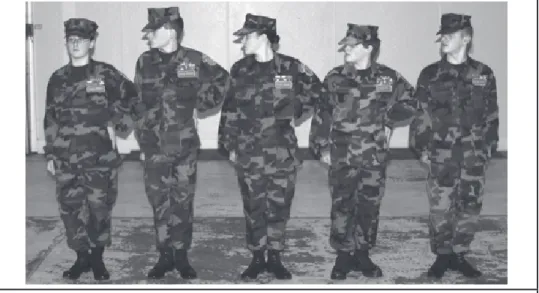
manner as dress right dress except, on the command, “At Close Interval, Dress Right, DRESS,” those individuals providing interval will do so by placing the heel of their left hand on their hip with the elbow in line with their body. Fingers are extended and joined and pointing down. Members gaining interval will move by short steps until their right arm is touching the left elbow of the individual to
their left. (See figure 1-9.)
Figure 1-8. Dress Right Dress.
Figure 1-8. Dress Right Dress.
Figure 1-9. At Close Interval Dress Right Dress.
E.O. 4 Obtain Close Interval from Normal Interval on Line.
1. To Obtain Close Interval from Normal Interval on Line.
The purpose of this movement is to close the interval between individuals of a squad a.
on line to 4 inches. It may be executed when the squad is halted at attention and on
line at normal interval. The command is “Close, MARCH.”
The squad leader is the base of this movement. On the command of execution b.
“MARCH,” the squad leader stands fast and places his/her left hand on his/her hip, as if dressing at close interval, to provide interval for the individuals to the left. At the same time, all other members of the squad face to the right as in marching, march toward the right flank until approximately 4 inches from the person in front of
them, halt, and face to the left. They then execute at close interval dress right dress. After aligning and without command, they will smartly lower their left hands and turn their heads to the front as soon as the individual to their left has touched their elbow with his/her right arm and stopped moving.
On his/her command of execution, the unit leader steps to the left in marching. c.
He/she marches parallel to the squad maintaining a distance of 3 paces from the squad. When approximately on the center of the squad at close interval the unit leader halts and faces the squad. He/she then adjusts to the center of the squad by taking small steps left, right, forward or back.
E.O. 5 Obtain Normal Interval from Close Interval on Line.
1. To Obtain Normal Interval from Close Interval on Line.
The purpose of this movement is to extend the interval between individuals of a squad a.
on line to one arm length. It may be executed when the squad is halted at attention and on line at close interval. The command is “Extend, MARCH.”
The squad leader is the base of this movement. On the command of execution b.
“MARCH,” the squad leader stands fast and raises his/her left arm to shoulder height to provide interval for the person on the left. At the same time, all other members
of the squad face to the left as in marching, march toward the left flank until they have
opened approximately a 30inch distance from the person behind them, halt, and face to the right. They then execute dress right dress. After aligning and without command, they will smartly, and quietly, lower their left arms and turn their heads to the front as
soon as the individual to their left has touched their finger tips with his/her right
shoulder and has stopped moving.
On his/her command of execution, the unit leader steps to the right in marching. c.
He/she marches parallel to the squad maintaining a distance of 3 paces from the squad. When approximately on the center of the squad at normal interval the unit leader halts and faces the squad. He/she then adjusts to the center of the squad by taking small steps left, right, forward or back.
E.O. 6 Obtain Double Arm Interval on Line.
1. To Obtain Double Arm Interval on Line.
The purpose of this movement is to extend the interval between the individuals of a a.
squad to a double arm distance. It may be executed when the squad is halted at attention and on line at normal or close interval. The command is “Take Interval to the Left, MARCH.”
The squad leader is the base of this movement. On the command of execution b.
“MARCH,” the squad leader stands fast and raises his/her left arm to shoulder height, to provide interval for the persons on the left. At the same time, all other
members of the squad face to the left as in marching, march toward the left flank until
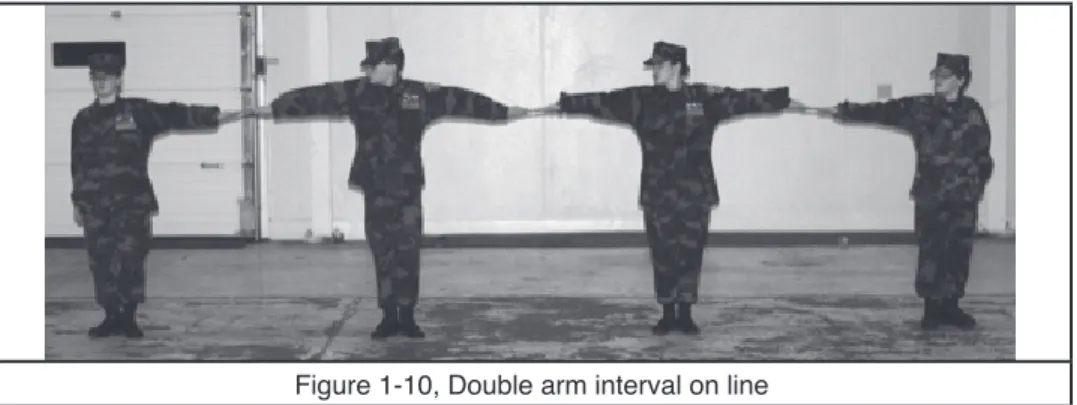
they have opened approximately a 70inch distance from the person behind them, halt, and face to the right. They then smartly turn their heads to the right and raise
both arms to shoulder height. Individuals on the left flank will only raise their right arm. (See figure 1-10) After aligning and without command, they will smartly, and quietly,
lower their right arms and turn their heads to the front as soon as they have proper interval. They will lower their left arms when they feel the individual to their left lower his/her right arm.
On his/her command of execution, the unit leader steps to the right in marching.
c. He/
she marches parallel to the squad maintaining a distance of 3 paces from the squad. When approximately on the center of the squad at double arms interval the unit leader halts and faces the squad. He/she then adjusts to the center of the squad by taking small steps left, right, forward or back.
E.O. 7 Obtain Normal Interval from Double Arm Interval on Line.
1. To Obtain Normal Interval from Double Arm Interval on Line.
a. The purpose of this movement is to decrease the interval between individuals of a squad on line from double arm to normal interval. It can only be executed when the squad is halted at attention and on line at a doublearm interval. The command is “Assemble to the Right, MARCH.” On the command of execution, the interval is reduced in a manner similar to close march; except that individuals halt
Figure 1-10, Double arm interval on line
approximately 30 inches from each other, face and execute the appropriate dress movement to obtain normal interval.
b. On his/her command of execution, the unit leader steps to the left in marching. He/she marches parallel to the squad maintaining a distance of 3 paces from the squad. When approximately on the center of the squad at normal interval the unit leader halts and faces the squad. He/she then adjusts to the center of the squad by taking small steps left, right, forward or back.
E.O. 8 Form a Column from a Line and Reform to a line.
1. To Form a Column from on Line and Reform to a line
When halted on line at normal interval, the command to form a column is
a. “Right,
FACE.” All members of the squad simultaneously face to the right, thereby forming column. The squad leader may then command, “Forward (Column {Half} Right/Left), MARCH” to cause the squad to march in column. NOTE: The squad becomes inverted if faced to the left, this should be done only for short movements.
When it is desired to form a column facing to the left, the squad should first form
column by facing to the right, then execute necessary successive column movements until the column is faced in the desired direction.
When on line at close interval, the squad is first extended to normal interval (See E.
b.
O. 5 - Obtain Normal Interval from Close Interval on Line), then forms column by facing to the right as described above.
When in column at a halt and at the order, to form a line, the command is
c. “Left,
FACE.”
E.O. 9 March in the Oblique.
1. To March in the Oblique.
The purpose of this movement is to shift the line of march to the right or left and then a.
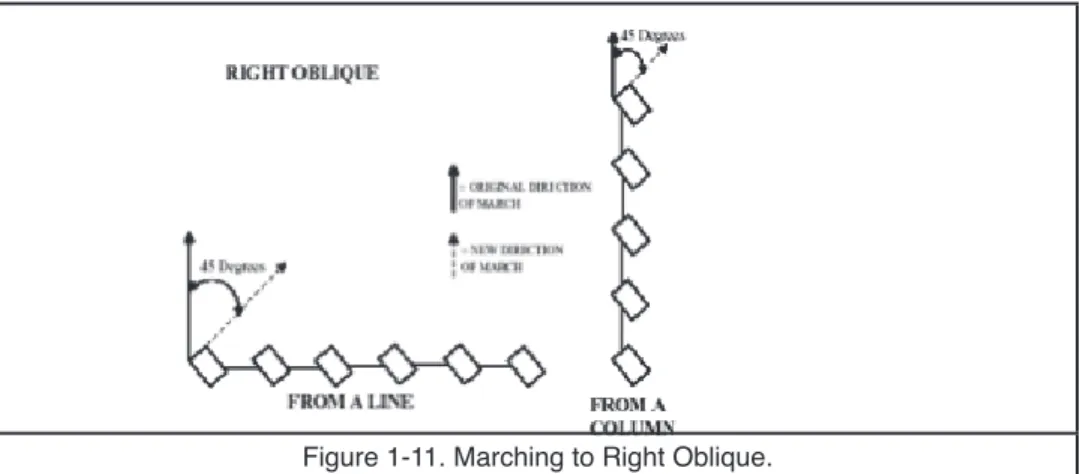
resume marching in the original direction. It may be executed from any formation that is marching at quick time cadence. The command is “Right (Left) Oblique, MARCH.” The word oblique is pronounced to rhyme with strike. The command of execution is given as the foot in the direction of the turn strikes the deck. The command to resume the original direction of march is “Forward, MARCH.” The command of execution is given as the foot toward the original front strikes the deck. To teach the squad to march to the oblique, the unit leader aligns the unit and has b.
members face half right (left). The unit leader then explains that these positions are maintained when marching to the oblique. Individuals keeping their shoulders parallel to the persons in front and/or adjacent to them achieve this. The squad leader is the base of the movement, and must maintain a steady line of march keeping his/her shoulders blocked perpendicular to the direction of march.
At the command
c. “Right Oblique, MARCH” the command of execution is given as the right foot strikes the deck. Everyone then takes one more 30inch step to the front
with the left foot and pivots 45 degrees to the right on the ball of the left foot.
Stepping out of the pivot with a 30inch step, the entire squad marches to the right
oblique until given another command. (See figure 1-11.) For the squad to resume
marching in the original direction, the command is “Forward, MARCH” in this case the command of execution will be given as the left foot strikes the deck. Everyone then takes one more step in the oblique direction; pivots back to the original front and continue to march. To march to the left oblique, substitute left for right and right for left in the above sequence.
To halt the squad facing in the original direction of march the command is
d. “Squad,
HALT.” The command of execution “HALT” is given on the left foot when marching to the right oblique and on the right foot when marching to the left oblique. At the command “HALT,” everyone takes one more step in the oblique direction, pivots to the original front on the toe of the right (left) foot, and places the left (right) foot beside the other at the position of attention.
To temporarily halt the squad in the oblique direction, in order to correct errors, the e.
command is “In Place, HALT.” The command of execution “HALT” may be given as either foot strikes the deck. At the command of execution “HALT,” the squad halts in two counts as in quick time and remains facing in the oblique direction. The only command that can be given after halting in place is “Resume, MARCH.” At that command, the movement continues marching in the oblique direction.
When given half step or mark time while marching in the oblique, the only commands f.
that may be given are “Resume, MARCH” to continue marching with a 30inch step in the oblique; or “In Place, HALT” to halt in the oblique in order to correct errors.
E.O. 10 March to the Rear.
1. To March to the Rear.
a. The purpose of this movement is to march the squad to the rear for a short distance. It may be executed when halted or marching forward at quick time or double time. The command is “To the Rear, MARCH.” The command of execution will be given as the right foot strikes the deck.
Figure 1-11. Marching to Right Oblique.
When halted, on the command of execution
b. “MARCH,” everyone takes one 15-inch
step to the front with the left foot and then pivots 180 degrees toward the right on the
balls of both feet. Stepping out of the pivot with a 30inch step, the entire squad marches to the rear. For the squad to resume marching in the original direction the command “To the Rear, MARCH” is given again. No other command may be given when marching to the rear until the unit has resumed marching to the original front. When marching at quick time, on the command of execution
c. “MARCH,” everyone
takes one more 15 inch step to the front with the left foot and then pivots 180 degrees
toward the right on the balls of both feet. Stepping out of the pivot with a 30inch step, the entire squad marches to the rear. For the squad to resume marching in the original direction, the command “To the Rear, MARCH” is given again. No other command may be given when marching to the rear until the unit has resumed marching to the original front.
When marching at double time, on the command of execution
d. “MARCH,” everyone
takes two more 36-inch steps to the front and then four, 6-inch vertical steps in place at double time cadence. On the first and third steps in place, everyone pivots 180 degrees to the right. After the fourth step in place, and for the fifth step, they step off with a 36-inch step in the new direction. For the squad to resume marching in the
original direction, the command “To the Rear, MARCH” is given again. No other command may be given when marching to the rear until the unit has resumed marching to the original front.
E.O. 11 March to the Flank.
1. To March to the Flank.
The purpose of this movement is to march the squad to the right or left flank for a
a.
short distance. It may be executed from any formation that is marching at quick time or double time cadence. The command is “By the Right (Left) Flank, MARCH.” The command of execution is given as the foot in the direction of the turn strikes the deck.
To march to the left flank, when marching at quick time, the command is
b. “By the Left
Flank, MARCH.” On the command of execution “MARCH,” everyone takes one more 30inch step to the front with the right foot and then pivots 90 degrees to the left on the ball of the right foot. Stepping out of the pivot with a 30inch step, the entire
squad marches in line to the left flank. The unit leader executes the flanking
movement with the squad maintaining his/her distance from the squad. For the squad to resume marching in the original direction, the command is “By the Right Flank, MARCH.” To march to the right flank, substitute right for left and left for right in the above sequence. No other command may be given when marching to the flank until
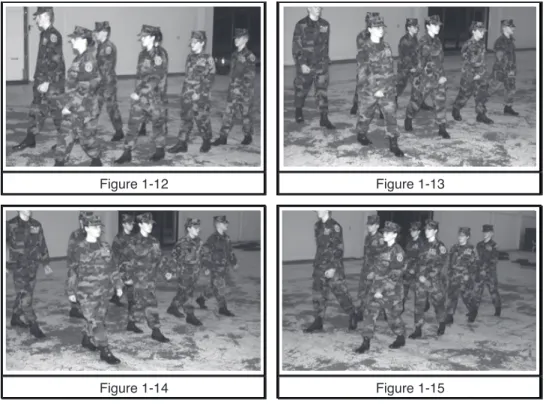
the unit has resumed marching to the original front. Figure 112 shows the original direction of march. Figure 113 shows the 90 degree turn performing “By the Left Flank”. Figure 1-14 shows the new direction of march, and figure 1-15 shows the
return to the original direction of march by means of the command “By the Right Flank”.
E.O. 12 Change Direction of a Column.
1. To Change Direction of a Column.
Figure 1-12 Figure 1-13
Figure 1-14 Figure 1-15
E.O. 12 Change Direction of a Column.
1. To Change Direction of a Column.
Figure 1-13
Figure 1-15
Figure 1-16
The purpose of this movement is to change the direction of march of a column. It may a.
be executed when the squad is halted or marching in column. The command is
“Column Right (Column Left, Column Half Right, or Column Half Left), MARCH.”
The squad leader establishes the pivot for the movement.
When marching, the commands of execution are given on the foot in the direction b.
of the turn. On the command of execution “MARCH,” the squad leader takes one more 30inch step to the front and then pivots 90 degrees to the right (left) on the ball of the left (right) foot. He/she then takes a 30inch step in the new direction. The remaining members of the squad continue to march to the point where the squad leader pivoted. They would then pivot 90 degrees in the new direction of march. When halted, at the command of execution
c. “MARCH,” the squad leader faces to the
right (left) as in marching and takes one 30inch step in the new direction with the right (left) foot. The remaining members of the squad step off to the front as in forward march. The remainder of the movement is executed the same as in marching.
Column half right (left) is executed as described above except that the pivot is 45
d.
degrees to the right (left).
During column movements, the unit leader executes the movement with the squad, e.
maintaining proper distance from the squad. For slight changes of direction, the command is
f. “INCLINE TO THE RIGHT (LEFT).”
At that command, the squad leader changes direction slightly as commanded. This is not a precision movement and is executed only while marching.
E.O. 13 Column of Twos from Single File.
1. To a Form Column of Twos from Single File.
When the squad is halted in column, the command a.
is “Column of Twos to the Left (Right), MARCH.”
If squad members do not already know whether b.
they are an odd or even number, the squad must be given count off before the above command is given. On
c. “MARCH,” the squad leader stands fast. Evennumbered squad members face half left (right) in marching, take two steps, face half right (left) in marching, and march forward to halt beside and at normal interval from the oddnumbered squad member who was originally in front of them. Odd numbered members, except the squad leader,
march forward and halt as they attain a 40-inch
distance from the oddnumbered member in front of them. All members required to move do so at the
same time. (See Figure 117.) Figure 1-17
E.O. 14 Form a Single File from a Column of Twos.
1. To Form a Single File from a Column of Twos. a. When the squad is halted in column of twos, the
command is “Column of Files from the Right (Left), MARCH.” It is important to note, in order to keep from inverting the squad, that:
If a column of twos was built TO the LEFT, then 1)
a column of files must be formed FROM the
RIGHT.
If a column of twos was built TO the RIGHT, 2) then
a column of files must be formed FROM the LEFT. b. At the command “MARCH,” number one and two
members step off at the same time. Number 1 moves forward as number 2 steps half right in marching, moves 2 steps, faces half left in marching, and follows
number 1 at a 40-inch distance. Remaining odd and
even numbered members step off in pairs, execute the same movements as numbers one and two, and
follow in file. (See figure 1-18.)
1) When teaching this movement the unit leader should, after the command of execution “MARCH,” begin calling a cadence of “and, STEP, and, STEP.” For example, on the command of execution “MARCH,” the number one and two
squad members step off. On the first “and, STEP” the number three and four squad members step off. On the second “and, STEP” the number five and six
squad members step off, etc. This cadence helps the squad members step off at the correct time and keeps the squad in step.
Figure 1-18
E.O. No.
Enabling Objective Description and
Performance Requirement Authorized Evaluators Signature
1 Form the Squad.
a. The Young Marine knows how to form the squad.
2 Dismiss the Squad.
a. The Young Marine knows how to dismiss the squad.
3 Align the Squad.
a. The Young Marine knows how to perform Dress Right Dress. 4 Obtain Close Interval from Normal Interval on Line.
a. The Young Marine knows how to obtain close interval from normal interval.
5 Obtain Normal Interval from Close Interval on Line. a. The Young Marine knows how to obtain normal interval from
close interval.
6 Obtain Double Arm Interval on Line.
a. The Young Marine knows how to obtain double arm interval on line. 7 Obtain Normal Interval from Double Arm Interval on Line.
a. The Young Marine knows how to obtain normal interval from double arm interval on line.
8 Form a Column from on Line and Reform to a line. a. The Young Marine knows how to form a column from on line. b. The Young Marine knows how to reform a line from a column. 9 March in the Oblique.
a. The Young Marine knows how to march the squad in the oblique. 10 March to the Rear.
a. The Young Marine knows how to march the squad to the rear. 11 March to the Flank.
a. The Young Marine knows how to march the squad to the flank. 12. Change Direction of a Column.
a. The Young Marine knows how to change the direction of a column. 13 Column of Twos from Single File.
a. The Young Marine knows how to form a column of twos from a
single file.
14 Form a Single File from a Column of Twos.
JYM-1-16
PERFORMANCE QUALIFICATION REVIEW Performance Objective 1: Close Order Drill
E.O. No.
Enabling Objective Description and
Performance Requirement Authorized Evaluators Signature
1 Form the Squad.
a. The Young Marine knows how to form the squad.
2 Dismiss the Squad.
a. The Young Marine knows how to dismiss the squad.
3 Align the Squad.
a. The Young Marine knows how to perform Dress Right Dress. 4 Obtain Close Interval from Normal Interval on Line.
a. The Young Marine knows how to obtain close interval from normal interval.
5 Obtain Normal Interval from Close Interval on Line. a. The Young Marine knows how to obtain normal interval from
close interval.
6 Obtain Double Arm Interval on Line.
a. The Young Marine knows how to obtain double arm interval on line. 7 Obtain Normal Interval from Double Arm Interval on Line.
a. The Young Marine knows how to obtain normal interval from double arm interval on line.
8 Form a Column from on Line and Reform to a line. a. The Young Marine knows how to form a column from on line. b. The Young Marine knows how to reform a line from a column. 9 March in the Oblique.
a. The Young Marine knows how to march the squad in the oblique. 10 March to the Rear.
a. The Young Marine knows how to march the squad to the rear. 11 March to the Flank.
a. The Young Marine knows how to march the squad to the flank. 12. Change Direction of a Column.
a. The Young Marine knows how to change the direction of a column. 13 Column of Twos from Single File.
a. The Young Marine knows how to form a column of twos from a
single file.
14 Form a Single File from a Column of Twos.
Full Camouflage
Figure 2-1
Modified Camouflage
Figure 2-2
PT Figure 2-3
Service A Figure 2-4
Service C Figure 2-5
Performance Objective 2: Essential Subjects
Enabling Objectives:
Understand your unit’s organization. 1.
Draw your unit’s organizational chart. 2.
Identify key events in the Young Marine history. 3.
Identify key events in Marine Corps history. 4.
Review
1. Dress Regulations and Personal Appearance. Young Marines are authorized to wear
appropriately modified versions of the Marine Corps uniform. The National Executive Director issues the modifications designed to clearly identify the wearer as a member
of the YM. The Young Marine uniform is worn during Young Marine Drills (Meetings) or other authorized Young Marine activities as determined by the unit commander.
Left Shoulder Patches
Figure 2-6
Front blouse patches and ribbons
Figure 2-7
Chevron Diagram
JYM-2-2
2. Grooming and Personal Appearance Standards. Young Marines shall adhere to the following standards:
a. Male Young Marines.
Hair will be neat and closely trimmed. Hair will be short enough so that it does 1)
not touch the ears or hang on the nape of the neck. The hair may be clipped at the edges of the side and back and will not be over 3 inches in length fully extended on the upper portion of the head. Head hair will be styled so as not to interfere with the proper wear of uniform headgear. Hair, which protrudes from beneath properly worn headgear in an unsightly manner, is considered excessive, regardless of length. Male Young Marines are not authorized to wear braids nor to have eccentric designs cut in their hair.
Beards are unauthorized. However, mustaches and sideburns may be worn, as 2)
long as they conform to current Young Marine grooming standards. When worn, the mustache will be neatly trimmed and must not extend beyond the length of the upper lip. The individual length of a mustache hair fully extended must not exceed 1/2 inch. Except for a mustache, sideburns, eyebrows, and eyelashes;
hair may be grown on the face only when a medical officer has determined that
shaving is temporarily harmful to the individual Young Marine’s health. Sideburns
will not extend below the top of the orifice of the ear. Sideburns will not be styled to taper or flare. The length of an individual hair of the sideburn will not exceed 1/8
inch when fully extended.
The only jewelry permitted is watches, medical items, religious medallions, class 3)
or Young Marines ring. All jewelry will be removed for physical training activities.
b. Female Young Marines.
1) Grooming. Hair may touch the collar, but will not fall below the collar’s lower edge. Hair that would fall naturally below the collar’s lower edge will be neatly and inconspicuously fastened or pinned. During physical training periods in which physical training clothing is worn, hair will be allowed to fall naturally, without being fastened or pinned. This does not apply when conducting physical training in the utility uniform.
Front Facial View Male Figure 2-9
Side Facial View Male Figure 2-10
Front Facial View Female Figure 2-11
2) Hair will be styled so as not to interfere with the proper wear of the uniform
headgear. All headgear will fit snugly and comfortably around the largest part of
the head without distortion or excessive gaps. Hairstyles, which do not allow the headgear to be worn in this manner, are prohibited.
Faddish and exaggerated styles to include shaved portions of the scalp other a)
than the neckline, designs in the hair, unsecured ponytails and styles that are distinctly unbalanced or lopsided are prohibited. Multiple braiding and buns are authorized. If hair extensions are used in the braiding of the hair, the extensions must have the same general appearance as the individual’s natural hair. Braided hairstyles will be conservative, and conform to other guidelines listed herein.
Barrettes, combs, rubber bands, etc. are authorized, if concealed by the hair. b)
Inconspicuous hairpins and bobby pins, if required, are authorized. Hairnets
will not be worn unless authorized for a specific type of duty.
3) Cosmetics. Cosmetics are authorized for wear in uniform if permitted by the parent or legal guardian. It shall be applied conservatively and must complement the individual’s complexion and skin tone. Exaggerated or faddish cosmetic styles are considered inappropriate and shall not be tolerated. Noneccentric lipstick and nail polish colors, to include colorless nail polish are authorized for wear with the uniform. Fingernails with multiple colors and decorative ornamentation are considered eccentric and MAY NOT be worn. Nail length will
be no longer than 1/4 inch from the tip of the finger.
4) Jewelry. The only jewelry permitted is watches, medical items, religious
medallions, class or Young Marines ring. All jewelry will be removed for physical training activities. Small, polished ball or round stud earrings, (post, screwon,
or clip), not to exceed six millimeters (about 1/4 inch) in diameter, may be worn with any uniform. When worn, earrings will fit tightly against, and will not extend
below, the earlobe. Only one earring will be worn on or in each earlobe in the lowest hole.
E.O. 1 Understand the Unit Organization.
1. Unit Organization. Most Young Marine units are made up of different components with different responsibilities. These include:
a. Unit Headquarters (UHQ). The UHQ consists of your unit commander, the executive
officer, and the unit staff, as defined by your unit commander. If your unit has a Unit
Young Marine First Sergeant, the Unit First Sergeant is also part of the UHQ. The Unit Headquarters plans, organizes, coordinates, and supervises all unit activities, functions, and events.
Unit Commander (UC). The UC is responsible for everything the unit does or 1)
fails to do. This includes the good order and discipline of the Young Marines and the UHQ staff. The name of my Unit Commander is ______________________.
Executive Officer (XO). The XO assist the UC in carrying out their duties and
JYM-2-4
responsibility. In the absence of the UC, the XO assumes the duties of the UC. The name of my Executive Officer is ___________________.
Adjutant (AD). The AD is responsible to the UC for all matters involving the 3)
administration of the unit. This includes registration and reregistration of Young Marines and adults, and the timely and proper maintenance of all Young Marine Record Books (YMRB) and the Young Marine Database System (YMDBS). The name of my Adjutant is _____________________.
Paymaster (PM). The PM is responsible to the UC for all matters involving the
4)
finances of the unit. The PM records all revenues (money the unit receives) and
all expenditures (money the unit uses to pay for something). Each month the
PM sends a financial report to the National Headquarters Accountant reporting
what money the unit received and what money the unit spent. The name of my Paymaster is ________________________________ .
Female Staff Advisors (FSA). The FSA advises the UC on all matters of special
5)
concern to girls in your unit.
Training Officer (TO). The TO is responsible to the UC for planning, coordinating, and 6)
executing all training activities, events, and functions under the direction of the UC. Young Marine First Sergeant (YM/1STSGT) or Unit 1STSGT. YM/1STSGT
7)
advises the UC on all matters of concern with the Young Marines under their charge.
b. Young Marines Headquarters Element (HQE). The HQE consists of the Unit First Sergeant, Unit Gunnery Sergeant, and Unit Guide. The HQE, under the supervision of the UHQ, is responsible for the good order and training of the Young Marines under their charge, for executing the Plan of the Day, for carrying out the orders of the UHQ, and advising the UHQ on matters of concern to Young Marines. The HQE is involved early in the planning and coordination of all activities, functions, and events. If you have ideas on how to make improvements, recommend new activities, functions, and events, you are encouraged to mention them to your HQE.
YM/1 STSGT or Unit 1 STSGT. The YM/1 STSGT is responsible to the UC for the 1)
discipline and training of the Young Marines under their charge. The YM/ 1 STSGT works closely with the TO in planning, coordinating, and executing the Training Plan. If your unit does not have a Unit First Sergeant, the senior Young Marine in the unit may assume that billet (position).
Unit Gunnery Sergeant (Unit Gunny). The senior YM/Gunnery Sergeant in the 2)
Unit. Assists the Unit 1STSGT in carrying out their duties. Responsible to the Unit 1 STSGT for all logistical planning, coordination, and support of unit training, activities, events, and functions. In the absence of the Unit 1STSGT temporarily assumes the duties of the Unit 1STSGT.
Unit Guide (UG). Appointed by the YM/1STSGT and Unit Gunny for their 3)
duties. In the absence of the Unit Gunny, the UG temporarily assumes the responsibility of the Unit Gunny.
c. Platoon (PLT). The Platoon has not more than twenty-five (25) Young Marines and one
adult leader. The platoon is divided into The Platoon Headquarters (PLT HQ) with a Platoon Commander (PLT CDR) and (PLT SGT) and three squads of eight Young Marines each.
PLT LDR. The PLT LDR is an adult leader who is appointed by the UC to serve in 1)
this billet. The PLT LDR is responsible for everything the platoon does or fails to do. The PLT LDR is a Young Marine who serves in this position when there is no adult available. This position may be held by an Advanced Young Marine who has served as the Unit 1 STSGT.
PLT SGT. The PLT SGT is the most senior Young Marine in the platoon under 2)
the rank of YM/GYSGT. The PLT SGT is responsible to the PLT CDR for the platoon muster, good order, and training the Young Marines in the platoon. The name of my PLT SGT is ______________________ .
Platoon Guide (PG). When needed, the PLT SGT designates the senior Squad 3)
Leader as the PG. The PG assists the PLT SGT in carrying out their duties.
d. Squad (SQD). The SQD has not more than eight (8) Young Marines. Each SQD is
made up of a SQD HQ and two teams. The SQD HQ consists of a Squad Leader (SQD LDR) and an Assistant SQD LDR (Asst SQD LDR).
SQD LDR. The SQD LDR is responsible to the PLT CDR for everything his SQD 1)
does or fails to do. They are responsible to the PLT SGT for the SQD muster, and good order and training of each member in their SQD. The SQD LDR is generally an YM/SGT. Young Marines of lesser rank may serve in this billet based on their maturity and proven leadership abilities. The name of my SQD LDR is__________________________________________________ . Asst SQD LDR. The Asst SQD LDR assists the SQD LDR in carrying their 2)
duties. The Asst SQD LDR is a senior YM/CPL who has served as a Team Leader and awaiting their opportunity to become SQD LDR. In the absence of the SQD LDR assumes the duties of the SQD LDR. The name of my Asst. SQD LDR is___________________________________________________ . e. Team (TM). The team has not more than three (3) Young Marines. Each team
consists of a Team Leader (TM LDR) and two Team Members (TM).
TM LDR. The TM LDR is responsible to the SQD LDR for TM muster, and good 1)
order and training of the members of their team. The TM LDR is generally an YM/ CPL. Young Marines of lesser rank may serve in this billet based on their maturity and proven leadership abilities. The names of the Team Leaders are
___________________ , and _________________ .
TM Members. TM members are responsible to the TM LDR for their conduct, 2)
JYM-2-5 JYM-2-6
YM/LCPL. The names of my team members are ________________________ , and _______________________.
E.O. 2 Draw Your Units Organizational Chart.
1. Organizational Chart. Organizational Charts are diagrams or pictures that show where organizations and people in an organization are relative to each other. There are organizations or people who are incharge or responsible for other organizations or people. In an organizational chart these organizations and people will appear above the organizations or people they are incharge of or responsible for.
In the information provided below, the organizational chart would show the UHQ a.
and UC at the top of the chart and the TM and TM members at the very bottom. For example:
Example of Organizational Chart
Figure 213
Your unit may be organized differently from what was previously discussed. This is b.
okay. It is very important for you to understand how your unit is organized. One way to do this is to draw your unit’s organizational chart. By doing this, you will see what organizations such as HQ, PLT, SQD, TM are incharge of or responsible for other organizations and what people are incharge of or responsible for all the different things that make your unit able to do the things it does each week. Once you know this you, will have a better understanding of how information, work, and fun is passed from one level of the organization to the next.
2.
c. Unit Organizational Chart. In the box provided above, draw your units Organizational Chart.
UHQ/UC l PLT/PLT CDR
l SQD/SQD LDR
E.O. 3 Identify Key Events in Young Marine history.
History of the Young Marines.
The Young Marines were formed in 1959 by Marine Corps League members of the Brass
City Detachment in Waterbury, Connecticut.
By 1960, this unit of Young Marines had grown to over 300 young people and 20 adults. In June of 1962, there were over 1500 boys in ten cities and towns, sponsored by various
Marine Corps League Detachments, throughout Connecticut.
Steve Zuraw, a member of the Marine Corps League Valley Detachment in Connecticut
raised more than $5000.00 to fly an entire Young Marine unit to the League’s National
Convention in Kansas City, Missouri, where the League adopted the Young Marines as a National Program.
The official charter of the Young Marines was issued on October 17, 1965.
Chartered as a subsidiary organization of the Marine Corps League, the Young Marines
began to function independently in 1974.
In 1975, membership was extended to females.
The Young Marines’ first by-laws were established in 1977 followed by an election of its first governing body. These by-laws were approved in 1978 at the Atlantic City Convention
of the Marine Corps League.
In 1980, the organization was granted status as a youth educational organization with a 501 (c) 3 IRS classification.
In 1993, the United States Marine Corps officially recognized the Young Marines as its
focal point for their Youth Drug Demand Reduction efforts. This became the Young Marines primary focus for strengthening our youth. Additional support given by the United
States Marine Corps is covered in Marine Corps Order 5000.20.
In 1995, the organization went international with the forming of Young Marine units in Okinawa, Japan.
The Secretary of Defense Fulcrum Shield Award is given annually by the Office of the
Deputy Assistant Secretary of Defense for Counternarcotics (ODASD(CN)) to recognize
the efforts of military-affiliated youth organizations that have successfully assisted in
spreading the antidrug message throughout their community. It focuses heavily on DoD Red Ribbon Activities in which the organization has participated, as well as other Drug
Demand Reduction activities the organization has participated during the previous fiscal year. The Young Marines were the first recipients of this prestigious award in 2001.
In 2004 and 2005 a group of Young Marines along with the National Executive Director and a group of veterans of the battle for Iwo Jima, made the journey to this historic location to commemorate the 59th and 60th anniversary of the Marines securing Mount Suribachi. The Young Marines shoulder patch depicts the famed flag raising atop this hill, and the most famous of all military monuments showing this flag
JYM-2-7
that described each Marine that fought, lived, and died on that island... “Uncommon Valor was a Common Virtue”.
In 2005, several ribbons and awards were added to include the Distinguished Order of Merit (DOM). The new guidebooks were implemented. In December of 2005, the first annual Young Marines Symposium was held in Baltimore, MD. The symposium was composed of the Young Marine of the Year, the 5 Division finalists, and the top
performers from Advanced Leadership School. The Young Marines gathered to discuss topics of im portance within the Young Marine program and to make recommendations to the National Executive Director.
In 2006, the online registration for the SPACES program was activated and two new
ad-ventures were added, the White Mountain Adventure and the Mountain River Adventure. New training material was unveiled at the Adult Leaders Conference to include the Com mander’s Manual, the Adjutant’s Manual, the Paymaster Manual and the Activity Guide.
E.O. 4. Identify Key Events in Marine Corps History
During its many years of experience in peace and war, the Marine Corps has developed
many traditions. Traditions of devotion to duty, self-sacrifice, versatility, dependability,
traditions of loyalty to country and to the Corps, traditions of uniform, insignia, and equipment. Since the American Revolution, generations of Marines have maintained and perpetuated these traditions.
The birthdate of the Marine Corps is November 10, 1775. This took place in
Philadelphia, Pennsylvania at a place called Tun Tavern. According to legend, Captain
Samuel Nicholas, the first Commandant of the Marine Corps, opened the first recruiting
station here.
The Marine Corps as it exists today, was formed by the Act of July 11, 1798. Since that
time, the Marine Corps has participated in every major war the United States was in volved.
The term “Leatherneck” as applied to Marines is widely used but few people associate it with the uniform. The fact that United States Marines wore a black leather stock, or
collar, from 1798 to 1880 may have given rise to the name. According to tradition, the
stock was originally worn to protect the jugular vein from a slash of a saber or cutlass.
However, official records fail to bear this out.
In 1805, the Marines raised the American flag for the first time in the Old World.
Additionally, traditions state that Marine Lieutenant Presley O’Bannon was presented the Mameluke Sword by a former Pasha of Tripoli. It symbolizes the exploits of the Marine Corps on the shores of this land.
During the years 1836 and 1837, Marines serving under Colonel Archibald Henderson assisted the Army in fighting the Creek and Seminole Indians in Georgia and Florida.
Colonel Henderson was to become known as the “Grand Old Man” of the Marine
Corps after serving as its 5th Commandant from 1820 to 1859. He held this post for
39 years under 10 different presidents.
Shortly after the Mexican War, the Marines carried the “Tripoli-Montezuma” flag, which had
the motto, “By Land, by Sea.” When the present Marine Corps emblem was adopted in
1868, the Navy Department authorized the use of the word on the flag of the United States
Marine Corps. The present motto, “Semper Fidelis”, replaced “By Sea and Land” on
streamers above the eagle soon after the Civil War and was officially adopted as the motto in 1880. The march, “Semper Fidelis” was composed by the late John Philip Sousa in the year 1888 during the time he was leader of the U.S. Marine Band. The U.S. Marine Band
is known as “The President’s Own.” The U.S. Marine Drum and Bugle Corps is known as “The Commandant’s Own.”
In 1868 the familiar emblem of the Marine Corps, the Eagle, Globe, and Anchor was
adopted. The streamer held in the beak of the eagle is inscribed with the motto of the United States Marine Corps, “Semper Fidelis”. This Latin phrase means “Always Faithful”. The eagle stands for air service, the globe for land service, and the anchor for sea service.
In 1915, Parris Island, South Carolina, was established as the Marine Corps Recruit
Depot. It is larger and older than MCRD San Diego. Parris Island is the only recruit depot for Women Marines.
Marines during World War I
During the battle of Belleau Wood, Marines fought with such ferocity that the Germans in
their official reports referred to them as “Teufel Hunde” (devil-dogs).
Marines in World War II
The Marine Corps in the Pacific during World War II was the “stopper”. At the outbreak of hostilities, they were the only trained amphibious force ready to fight an island-hoping war.
Iwo Jima – February 19, 1945
In order to provide fighter protection for the B-29 bombers based in the Marianas and
at the same time eliminate the enemy ‘s air base for attacks on the Superforts, it was
necessary to secure Iwo Jima in the Volcano Islands. The rugged, natural terrain of the bit of volcanic bleakness had been supplemented by extensive man-made fortifications. On the morning of February 19, 1945, hundreds of landing boats roared through the pounding surf to spill thousands of 4th and 5th Division Marines onto Iwo’s southeastern
beaches.
On February 23rd, units of the 28th Marines captured Mount Suribachi thus reducing the enemy’s fire on the landing beaches and gave the Marines an excellent observation point.
Organized resistance ended on Iwo Jima at 1800, March 16, 1945, when the 3rd and 5th
Marine Divisions smashed through the enemy’s lines to reach Kitano Point at the extreme
northern tip of the island. In all, 5000 Americans and 60,000 Japanese were killed in the battle of Iwo Jima.
Iwo Jima is the sight of the most famous Marine flag raising. The Marine Corps War Memorial in Arlington, Virginia is a physical representation of the Iwo Jima flag raising and it