National Survey of Practices to Prevent
Methicillin-Resistant
Staphylococcus aureus
and Multidrug-Resistant
Acinetobacter baumannii
in Thailand
Anucha Apisarnthanarak,1 David Ratz,2 Thana Khawcharoenporn,1 Payal K. Patel,2,3 David J. Weber,5 Sanjay Saint,2,4 and M. Todd Greene2,4
1Thammasat University, Pathumthani, Thailand; 2Center for Clinical Management Research, Veterans Affairs Ann Arbor Healthcare System, 3University of Michigan Division of Infectious Diseases, and 4University of Michigan Division of General Medicine, Ann Arbor; and 5University of North Carolina School of Public Health, Chapel Hill
Background. We evaluated the extent to which hospital characteristics, infection control practices, and compliance with preven-tion bundles impacted multidrug-resistant organism (MDRO) infecpreven-tions in Thai hospitals.
Methods. From 1 January 2014 to 30 November 2014, we surveyed all Thai hospitals with an intensive care unit and ≥250 beds. Infection control practices for methicillin-resistant Staphylococcus aureus (MRSA) and multidrug-resistant Acinetobacter baumannii
(MDR-AB) were assessed. Linear regression was used to examine associations between hospital characteristics and prevention bun-dle compliance and changes in MDRO infection rates.
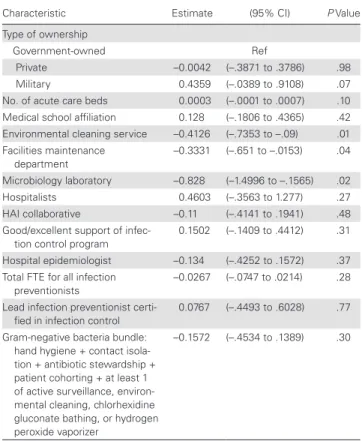
Results. A total of 212 of 245 (86.5%) eligible hospitals responded. Most hospitals regularly used several fundamental infec-tion control practices for MRSA and MDR-AB (ie, contact precauinfec-tions, private room/cohorting, hand hygiene, environmental cleaning, and antibiotic stewardship); advanced infection control practices (ie, active surveillance, chlorhexidine bathing, decol-onization for MRSA, and hydrogen peroxide vaporizer for MDR-AB) were used less commonly. Facilities with ≥75% compliance with the MRSA prevention bundle experienced a 17.4% reduction in MRSA rates (P = .03). Although the presence of environ-mental cleaning services (41.3% reduction, P = .01) and a microbiology laboratory (82.8% reduction, P = .02) were among char-acteristics associated with decreases in MDR-AB rates, greater compliance with the MDR-AB prevention bundle did not lead to reductions in MDR-AB rates.
Conclusions. Although fundamental MRSA and MDR-AB control practices are used regularly in most Thai hospitals, compli-ance with more comprehensive bundled prevention approaches is suboptimal. Improving complicompli-ance with bundled infection pre-vention approaches and promoting the integration of certain hospital factors into infection control efforts may help reduce MDRO infections in Thai hospitals.
Keywords. national survey; multidrug-resistant; MRSA; Acinetobacter baumannii; Thailand.
Multidrug-resistant gram-positive and gram-negative path-ogens are increasing worldwide and pose a major challenge for healthcare institutions [1–4]. In Southeast Asia, methi-cillin-resistant Staphylococcus aureus (MRSA) is the major resistant gram-positive pathogen, while multidrug-resistant
Acinetobacter baumannii (MDR-AB) has become the most common resistant gram-negative pathogen in several patient populations [5, 6]. In Thailand, the National Antimicrobial Resistance Surveillance Thailand program established a national commitment to multidrug-resistant organism (MDRO) sur-veillance and patient safety over the past decade [7–10]. The hospital prevalence of MRSA in Thailand has been estimated
to be 26% for colonization and infection, with higher estimates (65%) among intensive care unit (ICU) patients [7, 8].
Infection control interventions such as contact precautions, patient cohorting, hand hygiene, environmental cleaning, and the presence of an antimicrobial stewardship program are considered essential to prevent the spread of these resistant pathogens [11, 12]. Assessing the efficacy of individual and bundled infection control measures and determining predictors of increased com-pliance with these practices can add to our knowledge of infection prevention and inform policy to help prevent these resistant path-ogens. We therefore conducted a national survey in Thailand to evaluate the impact of infection prevention practices used to pre-vent MRSA and MDR-AB, and to investigate the extent to which compliance with prevention practices impacts these pathogens.
METHODS
Survey Instrument
From 1 January 2014 to 30 November 2014, we surveyed all hospitals in Thailand with an ICU and at least 250 hospitals
Correspondence: A. Apisarnthanarak, Division of Infectious Diseases, Thammasat University Hospital, Pratumthani, Thailand, 12120 ([email protected]).
beds (n = 245). The list of hospitals that met our inclusion criteria was obtained from the Ministry of Public Health of Thailand. The survey instrument was first developed by Krein et al and Saint et al [13–15]. The survey was translated into Thai by an experienced hospital epidemiologist (A. A.). The survey assessed facility-wide, personnel, and infection control program characteristics. Infection control practices specific to MDROs inclusive of MRSA and MDR-AB were assessed.
The lead infection preventionist for each hospital was inter-viewed to determine the frequency of various infection pre-vention practices being used as well as the level of compliance to MRSA and MDR-AB prevention practices. Infection pre-ventionists were asked about the frequency with which their hospital utilized the infection-specific prevention practices on a 5-point Likert scale for 5 fundamental (ie, contact precau-tions, private room/cohorting, hand hygiene, environmental cleaning, and antibiotic stewardship) and 4 advanced (ie, active surveillance for MRSA and MDR-AB, chlorhexidine bathing, decolonization for MRSA, and hydrogen peroxide vaporizer for MDR-AB) infection control measures. Responses of 4 (almost always) or 5 (always) were coded as “regular use” and the dichot-omized variables were used in all analyses. For the compliance questions, infection preventionists were asked how often their hospital complied with the given practices, alone and as a bun-dle (scaled as 1 = “100%” to 6 = “No monitoring compliance”). Responses of 1 or 2 (75%–99%) were coded as high bundle compliance for all analyses. For MRSA, the bundled practices consisted of hand hygiene, contact isolation, antibiotic steward-ship, patient cohorting, and at least 1 of the following: active surveillance, decolonization with mupirocin, chlorhexidine gluconate bathing, or environmental cleaning. For MDR-AB, the bundled practices consisted of hand hygiene, contact iso-lation, antibiotic stewardship, patient cohorting, and at least 1 of the following: active surveillance, environmental cleaning, chlorhexidine gluconate bathing, or hydrogen peroxide vapor-izer. Hospitals reported annual aggregate infection rates for MRSA and MDR-AB at 2 time points (12 months before and 12 months after the implementation of specific infection control practices) as the number of cases per 1000 patient-days.
Trained research nurses used the survey instrument to inter-view the lead infection preventionist at each hospital. Three training sessions were held to instruct the 5 research nurses on the survey and data collection procedures. The survey instru-ment was pilot tested in 10 hospitals to ensure the validity, reliability, and acceptability of the survey results by 5 research nurses; 100% interrater agreement in the responses captured was observed in the pilot test. The study was approved by the Institutional Review Board at Thammasat University.
Statistical Analysis
Descriptive statistics are given for all pertinent survey ques-tions. Multivariable logistic regression was used to determine
significant associations between hospital characteristics and regular use of MRSA and MDR-AB infection prevention prac-tices. Multivariable linear regression models were used to assess the associations between high compliance with the MRSA and MDR-AB prevention bundles and relative reductions in the respective infection rates. Hospital characteristics considered included type of ownership, number of acute care beds, affili-ation with a medical school, presence of hospitalists, involve-ment in a collaborative to reduce hospital infections, support of the infection control program from leadership, presence of a hospital epidemiologist, total full-time equivalent of all infec-tion preveninfec-tionists, and whether the lead infecinfec-tion preveninfec-tion- prevention-ist is certified in infection control. Additionally, whether or not the hospital has an infectious diseases physician, presence of environmental cleaning services, facilities maintenance depart-ment, or microbiology laboratory were also included as covar-iates if they were statistically significant in a bivariable model. Multivariable linear regression models were used to assess rela-tive reductions in MRSA and MDR-AB rates. In addition to the questions mentioned above, the relative reduction models were additionally adjusted for selected infection prevention prac-tices. All models were adjusted for whether or not the hospital has an established surveillance system for monitoring infection rates. All analyses were conducted using SAS software version 9.4 (SAS Institute, Cary, North Carolina).
RESULTS
Of the 245 eligible hospitals, 212 (86.5%) responded to our survey. General hospital and infection control characteristics are shown in Table 1. Nearly 97% of hospitals reported having hospitalists, 94.8% had a microbiology laboratory, and 92.5% had an infection preventionist who was certified in infection control. Approximately half of all hospitals were affiliated with a medical school (52.4%), had infection disease specialists (50.9%), and were involved in a healthcare-associated infection (HAI) collaborative (49.5%).
The odds ratios and 95% confidence intervals for select char-acteristics associated with MDRO prevention practices are also presented in Table 2. For MRSA, involvement in an HAI collab-orative, leadership support of infection control, and the presence of a facilities maintenance department were all significantly asso-ciated with increased active surveillance cultures for colonization. Leadership support of infection control was significantly associated with increased regular use of the following 5 MDR-AB infection prevention practices: contact precautions, private rooms or cohort-ing of patients, hand hygiene, environmental cleancohort-ing of infected patients’ room and surroundings, and chlorhexidine bathing.
Compliance rates for MRSA and MDR-AB prevention prac-tices were very similar. Nearly two-thirds of responding hos-pitals reported ≥75% compliance using hand hygiene (65.6% for MRSA, 64.2% for MDR-AB). More than 60% of hospitals reported compliance with hand hygiene and contact isolation in patients with MRSA (62.3%) or MDR-AB (61.3%). Compliance with antibiotic stewardship (45.8% for both MRSA and MDR-AB) and patient cohorting (40.1% for MRSA, 42% for MDR-AB) was lower. Nearly 40% of hospitals reported at least 75% compliance for the MRSA (37.0%) and MDR-AB (38.7%) prevention bundles.
Multivariable model results for changes in MRSA and MDR-AB infection rates are presented in Tables 3 and 4,
respectively. Facilities with ≥75% compliance with the preven-tion bundle for MRSA experienced on average a 17.4% reduc-tion in MRSA rates (P = .03). Involvement in a collaborative to reduce HAI was also associated with a reduction in MRSA rates (18.9%, P = .01). Although several individual factors were associated with changes in MDR-AB rates (presence of envi-ronmental cleaning services [41.3% reduction, P = .01], facil-ities maintenance department [33.3% reduction, P = .04], and microbiology laboratory [82.8% reduction, P = .02]), achieving high compliance with the prevention bundle for MDR-AB was not significantly associated with MDR-AB reductions.
DISCUSSION
Several important findings emerged from this national sur-vey in Thailand. First, although most hospitals reported reg-ular use of fundamental infection control measures to reduce MRSA and MDR-AB transmission, advanced infection control measures were less commonly performed. Second, we noticed that compliance with prevention bundles—consisting of fun-damental and advanced infection control measures—to con-tain both MRSA and MDR-AB was less than optimal. This is especially important as infection prevention interventions have been reported effective only when compliance is high [16, 17]. Third, hospitals reporting high compliance with the prevention bundle for MRSA were more successful at reducing MRSA. Additionally, hospitals with better infection control infrastruc-ture and support were more likely to reduce MDR-AB. Taken together, these findings suggest the need for continued educa-tion and process surveillance to ensure compliance with infec-tion control measures to prevent MDRO infecinfec-tions in Thailand. A previous study, using similar methodology, conducted by Apisarnthanarak and colleagues found that medical school affil-iation and participating in an HAI collaborative were associated with infection control policies to prevent MRSA, and having a physician as the head of infection control, strong leadership support of the infection control program, participating in a collaborative effort to reduce hospital infections, and a strong organizational safety culture were associated with infection con-trol policies to prevent MDR-AB [18]. In the current study, we identified a similar rate of implementing fundamental infection control measures with slight improvement in advanced infection control measure implementation. Our current findings confirm that leadership support of infection control programs and par-ticipation in a collaborative effort to reduce hospital infections remains crucial for MRSA and MDR-AB prevention. We also found that the lead infection preventionist being certified in infection control was associated with increased compliance to advanced infection control practices to prevent MDR-AB. This could be partly explained by the governmental Thai curric-ulum created in 2000 intended to provide formal training for postgraduate physicians who plan to head infection control. Whether this advanced training could impact competency of
Table 1. Respondent Hospital Characteristics (n = 212)
Characteristic No. (%) Region
Northern 14 (6.6) Southern 20 (9.4) Central 106 (50.0) Northeastern 36 (17.0) Eastern 22 (10.4) Western 14 (6.6) Facility ownership
Private 44 (20.8) Government-owned 148 (69.8) Military 20 (9.4) Total No. of acute care hospital beds (including ICU), mean
healthcare epidemiology programs in resource-limited settings should be further assessed [19–21].
Increasing compliance levels for utilizing infection control measures has been emphasized as a key component for success-ful outcomes in several guidelines for MDRO prevention efforts [22–24]. However, the optimal compliance level for success-ful MDRO control is unknown. In this survey, we found that
compliance rates for the various MRSA and MDR-AB prevention practices were very similar and ranged from approximately 40% to >75%. Not surprisingly, advanced infection control measures had a lower compliance rate than fundamental measures. Of interest, facilities with ≥75% compliance with fundamental infec-tion control measures plus either active surveillance, decoloniza-tion with mupirocin, chlorhexidine bathing, or environmental
Table 2. Characteristics Significantly Associated With Regular Use of Specific Methicillin-Resistant Staphylococcus aureus and Multidrug-Resistant
Acinetobacter baumannii Prevention Practices
Characteristic OR (95% CI) P Value
Infection Prevention Practice
Regular Use Practices specific to MRSA prevention
Medical school affiliation 0.35 (.17–.73) .005 Active surveillance cultures
37.30% Facilities maintenance department 8.40 (3.44–20.52) <.0001
HAI collaborative 2.35 (1.16–4.73) .02 Good/excellent support of infection
control program
2.09 (1.04–4.20) .04
Facilities maintenance department 2.82 (1.07–7.41) .04 Decolonization of the nose and skin in colonized patients prior to surgical procedure
22.60% HAI collaborative 2.46 (1.12–5.37) .02
Practices specific to MDR-AB prevention
Facilities maintenance department 2.39 (1.06–5.37) .04 Contact precautions while caring for infected patients
77.40% Good/excellent support of infection
control program
2.20 (1.09–4.46) .03 Lead infection preventionist certified
in infection control
4.19 (1.26–13.96) .02
Type of ownership Private rooms or cohorting of infected patients
72.20%
Private 4.22 (1.38–12.93) .01 Government-owned Ref
Military 2.11 (.61–7.33) .24 Good/excellent support of infection
control program 2.37 (1.22–4.61) .01 Lead infection preventionist certified in
infection control 3.41 (1.11–11.41) .05 Involved with a collaborative effort to
reduce HAI 2.86 (1.13–7.22) .03 Appropriate hand hygiene 84.00% Good/excellent support of infection
control program 3.33 (1.46–7.62) .004 Lead infection preventionist certified in
infection control
5.74 (1.43–23.05) .01 Antibiotic stewardship program
54.20% Good/excellent support of infection
control program
3.97 (1.70–9.27) .001 Environmental cleaning of infected patients’ room and surroundings
85.40%
Good/excellent support of infection control program
2.21 (1.10–4.46) .03 Chlorhexidine bathing for infected patients
31.10%
None Hydrogen peroxide
vaporization of infected patients’ room and surroundings
21.20%
Medical school affiliation 0.36 (.17–.74) .01 Active surveillance cultures
36.30% Facilities maintenance department 3.63 (1.57–8.43) .003
HAI collaborative 2.50 (1.24–5.03) .01
cleaning for MRSA prevention experienced on average a 17.4% reduction in MRSA rates over a year, while having sophisticated infrastructure facility factors (eg, environmental cleaning ser-vices, facilities maintenance department division, microbiol-ogy laboratory) were associated with MDR-AB rate reductions. These findings imply the need to have high-level compliance for both fundamental and advanced infection control measures for successful MRSA containment, while environmental cleaning is seemingly crucial for the control of MDR-AB. As prior studies have demonstrated the potential roles of airborne and water-borne transmission in MDR-AB infections [25–28], hospitals better equipped to limit these transmission routes due to better facility infrastructure and resources (eg, having a facilities main-tenance department division and microbiology laboratory) will likely achieve better infection control for MDR-AB than hospi-tals with limited resources.
Our study has several important limitations. First, because the response rate was <100%, our results are susceptible to nonresponse bias. Although we achieved a very high response rate, our findings may not be generalizable to all hospitals in Thailand. Second, as we relied on self-reported data from the lead infection preventionist to determine the frequency of various infection control practices being used, there is a potential for response bias. Third, MDRO infection rates at 2 time points were based on reported estimates from the lead infection preventionist at each hospital. Absent longitudinal infection rate data, reported rates in our study are prone to response bias. Finally, we did not have access to (and thus
could not adjust for) patient-level or hospital case-mix data. As such, our regression adjustments could be biased because of unmeasured confounding, and our results can only be interpreted as providing evidence for associations rather than causal mechanisms.
Despite these limitations, our study identified several areas of focus for quality improvement efforts for MDRO infection prevention in Thai hospitals. Key quality improvement tar-gets include education in implementing bundled prevention approaches that include advanced infection control measures. Continued government support for formal training on infec-tion preveninfec-tion for postgraduate physicians who become lead infection preventionists, enhancement of facility factors and safety structure, and infection control compliance level mon-itoring for both fundamental and advanced infection control measures are essential components to help reduce the burden of MRSA and MDR-AB in Thai hospitals.
Notes
Acknowledgments. We thank the Infectious Diseases Association of
Thailand for supporting this work.
Financial support. This study was supported by the National Research
University Project of the Thailand Office of Higher Education Commission (to A. A.).
Table 3. Rates of Methicillin-Resistant Staphylococcus aureus—
Multivariable Regression
Characteristic Estimate (95% CI) P Value Type of ownership
Government-owned Ref
Private –0.0158 (–.2122 to .1807) .87 Military –0.1358 (–.3902 to .1186) .30 No. of acute care beds 0.0001 (–.0002 to .0003) .62 Medical school affiliation –0.115 (–.2699 to .04) .15 Hospitalists 0.2999 (–.1151 to .715) .16 HAI collaborative –0.1889 (–.3397 to –.0381) .01 Good/excellent support of infection
control program
–0.1077 (–.2628 to .0474) .17 Hospital epidemiologist 0.257 (.103–.411) .001 Total FTE for all infection preventionists –0.0176 (–.0426 to. 0074) .17 Lead infection preventionist certified in
infection control
–0.0325 (–.3072 to .2421) .82 Gram-positive bacteria bundle: hand
hygiene + contact isolation + antibi-otic stewardship + patient cohorting + at least 1 of the following: active surveillance, decolonization with mupirocin, chlorhexidine gluconate bathing, or environmental cleaning
–0.1737 (–.3279 to –.0195) .03
Abbreviations: CI, confidence interval; FTE, full-time equivalent; HAI, healthcare-associated infection.
Table 4. Rates of Multidrug-Resistant Acinetobacter baumannii—
Multivariable Regression
Characteristic Estimate (95% CI) P Value Type of ownership
Government-owned Ref
Private –0.0042 (–.3871 to .3786) .98 Military 0.4359 (–.0389 to .9108) .07 No. of acute care beds 0.0003 (–.0001 to .0007) .10 Medical school affiliation 0.128 (–.1806 to .4365) .42 Environmental cleaning service –0.4126 (–.7353 to –.09) .01 Facilities maintenance
department
–0.3331 (–.651 to –.0153) .04 Microbiology laboratory –0.828 (–1.4996 to –.1565) .02 Hospitalists 0.4603 (–.3563 to 1.277) .27 HAI collaborative –0.11 (–.4141 to .1941) .48 Good/excellent support of
infec-tion control program
0.1502 (–.1409 to .4412) .31 Hospital epidemiologist –0.134 (–.4252 to .1572) .37 Total FTE for all infection
preventionists
–0.0267 (–.0747 to .0214) .28 Lead infection preventionist
certi-fied in infection control
0.0767 (–.4493 to .6028) .77 Gram-negative bacteria bundle:
hand hygiene + contact isola-tion + antibiotic stewardship + patient cohorting + at least 1 of active surveillance, environ-mental cleaning, chlorhexidine gluconate bathing, or hydrogen peroxide vaporizer
–0.1572 (–.4534 to .1389) .30
Supplement sponsorship. This article appears as part of the supplement “Infection Prevention in Asia Pacific,” sponsored by the Infectious Diseases Association of Thailand (IDAT).
Potential conflicts of interest. All authors: No potential conflicts.
All authors have submitted the ICMJE Form for Disclosure of Potential Conflicts of Interest. Conflicts that the editors consider relevant to the con-tent of the manuscript have been disclosed.
References
1. Rossolini GM, Mantengoli E, Montagnani F, Pollini S. Epidemiology and clinical relevance of microbial resistance determinants versus anti-gram-positive agents. Curr Opin Microbiol 2010; 13:582–8.
2. Ho J, Tambyah PA, Paterson DL. Multiresistant gram-negative infections: a global perspective. Curr Opin Infect Dis 2010; 23:546–53.
3. Durante-Mangoni E, Zarrilli R. Global spread of drug-resistant Acinetobacter baumannii: molecular epidemiology and management of antimicrobial resist-ance. Future Microbiol 2011; 6:407–22.
4. Peleg AY, Seifert H, Paterson DL. Acinetobacter baumannii: emergence of a suc-cessful pathogen. Clin Microbiol Rev 2008; 21:538–82.
5. Ling ML, Apisarnthanarak A, Madriaga G. The burden of healthcare-associated infections in Southeast Asia: a systematic literature review and meta-analysis. Clin Infect Dis 2015; 60:1690–9.
6. Suwantarat N, Carroll KC. Epidemiology and molecular characterization of mul-tidrug-resistant gram-negative bacteria in Southeast Asia. Antimicrob Resist Infect Control 2016; 5:15.
7. Tishyadhigama P, Dejsirilert S, Thongmali O, Sawanpanyalert P, Aswapokee N, Piboonbanakit D. Antimicrobial resistance among clinical isolates of Staphylococcus aureus in Thailand from 2000 to 2005. J Med Assoc Thai 2009; 92(suppl 4):S8–18.
8. Mootsikapun P, Trakulsomboon S, Sawanpanyalert P, Aswapokee N, Suankratay C. An overview of antimicrobial susceptibility patterns of gram-positive bacteria from National Antimicrobial Resistance Surveillance Thailand (NARST) pro-gram from 2000 to 2005. J Med Assoc Thai 2009; 92(suppl 4):S87–90. 9. Apisarnthanarak A, Buppunharun W, Tiengrim S, Sawanpanyalert P, Aswapokee
N. An overview of antimicrobial susceptibility patterns for gram-negative bacte-ria from the National Antimicrobial Resistance Surveillance Thailand (NARST) program from 2000 to 2005. J Med Assoc Thai 2009; 92(suppl 4):S91–4. 10. Dejsirilert S, Tiengrim S, Sawanpanyalert P, Aswapokee N, Malathum K.
Antimicrobial resistance of Acinetobacter baumannii: six years of National Antimicrobial Resistance Surveillance Thailand (NARST) surveillance. J Med Assoc Thai 2009; 92(suppl 4):S34–45.
11. Cohen AL, Calfee D, Fridkin SK, et al; Society for Healthcare Epidemiology of America and the Healthcare Infection Control Practices Advisory Committee. Recommendations for metrics for multidrug-resistant organisms in healthcare settings: SHEA/HICPAC position paper. Infect Control Hosp Epidemiol 2008; 29:901–13.
12. Cheon S, Kim MJ, Yun SJ, Moon JY, Kim YS. Controlling endemic multidrug-re-sistant Acinetobacter baumannii in intensive care units using antimicrobial stew-ardship and infection control. Korean J Intern Med 2016; 31:367–74.
13. Krein SL, Hofer TP, Kowalski CP, et al. Use of central venous catheter-related bloodstream infection prevention practices by US hospitals. Mayo Clin Proc 2007; 82:672–8.
14. Krein SL, Kowalski CP, Damschroder L, Forman J, Kaufman SR, Saint S. Preventing ventilator-associated pneumonia in the United States: a multicenter mixed-methods study. Infect Control Hosp Epidemiol 2008; 29:933–40. 15. Saint S, Kowalski CP, Kaufman SR, et al. Preventing hospital-acquired
uri-nary tract infection in the United States: a national study. Clin Infect Dis 2008; 46:243–50.
16. Furuya EY, Dick AW, Herzig CT, Pogorzelska-Maziarz M, Larson EL, Stone PW. Central line-associated bloodstream infection reduction and bundle compliance in intensive care units: a national study. Infect Control Hosp Epidemiol 2016; 37:805–10.
17. Furuya EY, Dick A, Perencevich EN, Pogorzelska M, Goldmann D, Stone PW. Central line bundle implementation in US intensive care units and impact on bloodstream infections. PLoS One 2011; 6:e15452.
18. Apisarnthanarak A, Khawcharoenporn T, Mundy LM. Practices to prevent multi-drug-resistant Acinetobacter baumannii and methicillin-resistant Staphylococcus aureus in Thailand: a national survey. Am J Infect Control 2013; 41:416–21. 19. Kaye KS, Anderson DJ, Cook E, et al. Guidance for infection prevention and
healthcare epidemiology programs: healthcare epidemiologist skills and compe-tencies. Infect Control Hosp Epidemiol 2015; 36:369–80.
20. Apisarnthanarak A, Buppajarntham A, Mundy LM. National survey of infectious diseases physicians on prevention practices for multidrug-resistant Acinetobacter baumannii in Thailand. Infect Control Hosp Epidemiol 2016; 37:489–91. 21. Buppajarntham A, Apisarnthanarak A, Khawcharoenporn T, Rutjanawech S,
Singh N. National survey of Thai infectious disease physicians on treatment of carbapenem-resistant Acinetobacter baumannii ventilator-associated pneumonia: the role of infection control awareness. Infect Control Hosp Epidemiol 2016; 37:61–9.
22. Calfee DP, Salgado CD, Milstone AM, et al. Strategies to prevent methicillin-re-sistant Staphylococcus aureus transmission and infection in acute care hospitals: 2014 update. Infect Control Hosp Epidemiol 2014; 35(suppl 2):S108–32. 23. World Health Organization Regional Office for South-East Asia. Prevention and
containment of antimicrobial resistance. Available at: http://www.searo.who.int/ entity/antimicrobial_resistance/en/. Accessed 7 July 2016.
24. Tacconelli E, Cataldo MA, Dancer SJ, et al. ESCMID guidelines for the manage-ment of the infection control measures to reduce transmission of multidrug-re-sistant gram-negative bacteria in hospitalized patients. Clin Microbiol Infect 2014; 20(suppl 1):S1–55.
25. Shimose LA, Doi Y, Bonomo RA, et al. Contamination of ambient air with Acinetobacter baumannii on consecutive inpatient days. J Clin Microbiol 2015; 53:2346–8.
26. Munoz-Price LS, Fajardo-Aquino Y, Arheart KL, et al. Aerosolization of Acinetobacter baumannii in a trauma ICU. Crit Care Med 2013; 41:1915–8. 27. Rock C, Harris AD, Johnson JK, Bischoff WE, Thom KA. Infrequent air
con-tamination with Acinetobacter baumannii of air surrounding known colonized or infected patients. Infect Control Hosp Epidemiol 2015; 36:830–2.