ARTS INTEGRATION CURRICULUM: BUILDING RELATIONAL CAPACITIES
Deborah Randolph
A dissertation submitted to the faculty of the University of North Carolina at Chapel Hill in partial fulfillment of the requirements for the degree of Doctor of Philosophy in the Culture,
Curriculum, and Change Program in the School of Education.
Chapel Hill 2016
Approved by:
Madeleine R. Grumet Sharon Derry
ABSTRACT
DEBORAH RANDOLPH: Arts Integration Curriculum: Building Relational Capacities (Under the direction of Madeleine R. Grumet)
In this qualitative study I examined the role of arts integration in interrupting
individualistic education through relational capacity building by studying 13 arts integration programs including arts-based school reform models, arts institution-based models, and teaching artists and single art form models across 11 States in the American South. I identified the ways in which providers of arts integration curriculum explicitly and
intentionally sought to help students have a better understanding of how they related to one another, their teachers, and the world. The relational capacities that were the framework for this study were relationship and social self-efficacy, social imagination and cultural
competence. I examined publicly accessed artifacts (lesson plans, videos, organization
TABLE OF CONTENTS
LIST OF TABLES ... viii
LIST OF FIGURES ... xi
CHAPTER 1: INTRODUCTION ...1
Introduction ...1
Research Questions ...4
Bias Disclosure ...4
Limitations ...6
Literature Review: Historical Perspective ...7
Literature Review: Arts Integration Research and Practices ...29
CHAPTER 2: METHODOLOGY ...37
Research Design Overview ...37
Sample: Arts Integration Models ...39
Selection Criteria ...49
Selected Programs ...55
A Pause from the Numbers ...61
Relational Capacities: A Framework ...64
CHAPTER 3: DATA CHARACTERISTICS ...69
Artifacts ...69
Data Analysis ...79
CHAPTER 4: OPPORTUNITIES FOR RELATIONAL CAPACITY BUILDING: RELATIONAL AND SOCIAL SELF-EFFICACY ...83
Introduction ...83
Relational and Social Self-Efficacy: Artifacts ...86
Relational and Social Self-Efficacy: Interviews ...110
Relational and Social Self-Efficacy: Expressivity ...119
CHAPTER 5: OPPORTUNITIES FOR RELATIONAL CAPACITY BUILDING: SOCIAL IMAGINATION ...136
Introduction ...136
Four Paths to Social Imagination ...139
CHAPTER 6: OPPORTUNITIES FOR RELATIONAL CAPACITY BUILDING: CULTURAL COMPETENCE...163
Introduction ...163
Four Paths to Cultural Competence ...169
CHAPTER 7: CONCLUSION ...193
Balance ...193
Shift ...195
Final Conclusion ...197
APPENDIX A: ARTIFACTS BY PROGRAM ...199
APPENDIX B: INTERVIEW PROTOCOL ...222
APPENDIX C: CITED LESSON PLANS AND VIDEOS ...223
LIST OF TABLES
Table 2.1 Schools, teachers and students served by programs ...61 Table 3.1 Artifact rubric ...69
LIST OF FIGURES
CHAPTER ONE: INTRODUCTION
Integration and wholeness have more to do with the way one knows, the way one is, the way one hopes children will become and how we and they will carry ourselves, and how light and careful our footfalls will be on this Earth.
- David Jardine (2003) - Introduction
promote the relational quality of knowledge. In this study, I will explore arts integration programs to examine their commitment to relational capacity building, which may bring students to an understanding of who they are becoming in relationship to others and the world.
Building capacities for relational understanding is particularly important in this age of individualistic education. Our present system emphasizes the needs and achievements of individual students. Michael Parsons, Research Professor in the School of Art and Design, University of Illinois, Champaign-Urbana (2004) suggests a need for a socially relevant education, as opposed to individualistic education. As our societal problems become more complex, solving them requires an infusion of information from a variety of sources. Parsons notes that an integrated socially relevant education focuses on these programs while helping students “have a greater awareness of self and more understanding and tolerance of others” (p. 775).
Parsons argues that this need has increased the interest in arts-integrated curriculum and has brought about a revival of ideas that germinated in early 20th century progressive education (Dewey, 1916, 1934; Bresler, 2002). Progressive education’s holistic approach to solving problems experientially provided a way for students to explore an issue across school subjects1. Dewey (1916) cautioned against valuing and reproducing subject matter for its own sake without noting “its organization into his [student’s] activities as a developing social member” (p. 202). In other words, Dewey argued that it was the act of working across
subjects within relational contexts that assisted in the development of the student, particularly as a social and contributing member of a democracy.
Although other curricula may potentially address the notion of relational education, I wanted to explore the proposition that arts integration is particularly well suited to relational understanding of self and other. The blending of the arts with non-art content creates
opportunities to develop capacities for relational understanding through the particularity of the art form explored with non-art content. In other words, even though we see the arts as providing imaginative and tactile dimensions of experience, arts integration mirrors the real world by de-compartmentalizing subjects, blurring the boundaries and creating more realistic environments. Because these environments create moments of relevance for students, they often connect with content, such as science and social studies, on a personal and physical level. I wanted to discern whether the providers of arts integrated curriculum expected that in these relevant, blended environments, students also recognize and respond to the connections their teachers and peers are making in personal and embodied ways.
Because of its experiential, expressive and embodied qualities, arts integration could be considered a “bodied curriculum” (Springgay and Freedman, 2007), which “attends to the relational, social, and ethical implications of being-with other bodies differently and to the different knowledges such bodily encounters produce” (p. xxiv). Emphasizingthe notion of students being with others differently, rather than only for one’s self, is a shift from
individualistic to relational education.As a way of exploring the possibilities of this shift, this
Research Questions
In what ways, if any, do designers and practitioners of arts integration curricula
interrupt historically individualistic education? By examining this phenomenon through
interviews and artifacts, I hoped to discover the ways in which arts integration helps build
capacities for increased relational understanding of self and other.
The study does not examine arts integration practice directly. There is no observation of students in the classroom or professional development workshops, except through viewing archived video artifacts and previous personal experience. Therefore, this study looks at the expressed intentions of arts integration. In what ways, if any, is arts integration curricula developed with the intention (explicitly or implicitly) to build capacities for increased
relational understanding of self and others?
Finally, through artifacts, such as lesson plans, professional development documents and demonstration videos, I examined the ways in which arts integration was presented to its publics. By sifting through websites, evaluation reports, research and promotional videos, I scrutinized the public face of arts integration. I was interested in whether the intention and rhetoric of arts integration is leading to a shift in educational values from individualist to relational, and if so, how the designers and practitioners of these programs navigate the individualistic education terrain. In what ways, if any, does arts integration intention and rhetoric around relational education catalyze, or not, the shift from current individualistic
educational practice to a more relational one?
Bias Disclosure
attending a conference in Atlanta, I shared a room with a friend who was an elementary school principal in California. Her school district had been mandated to select a school reform model from a list approved by the State. She chose the only arts-based school reform model on the list – an arts integration model which at the time was relatively new. She explained that through this model, the school would form more partnerships with arts
institutions and bring in more arts instruction. Most surprisingly, teachers would be expected to teach non-art content through the arts. This idea seemed magical to me. I began thinking of ways certain art forms could be helpful in teaching other subjects. The connections exploded in my mind. Because of my arts background and education, I was very drawn to this idea. My interest deepened after learning about schools through school principals and educational leadership folks while directing a school leadership center and incorporating the arts into school curriculum as an art museum educator.
I watched my friend struggle with the audit culture that was so pervasive, while standing by her belief that arts integration was critical to her students’ success academically and socially. Her students were poor, urban and most spoke Spanish as their primary
language. Many were children of migrant workers, and their time at the school was brief. However, working within the parameters of the arts integration model, the students thrived according to a variety of measures2, the school survived, and the community was
strengthened by the partnerships that were established. And the seeds of a dissertation were sown.
2 After just a few years in the program, Academic Performance Index scores
I am a strong advocate of arts integration and so are the individuals that I interviewed. They are naturally inclined to put a positive spin on arts integration. Most of the interview participants were leaders in their organizations and as such, were expected to “sell” their programs. Some projects are in competition with one another for federal dollars and private grants to ensure sustainability. Others compete for national and local recognition so that they can continue their work and extend their reach. The interview participants discussed arts integration through the lens of their programs. However, the emphasis was on the ways in which arts integration had an impact on learning for teachers and students. They did include positive descriptions of their programs, but in the context of what was happening in the schools, not in abstract ways. I did not want to emphasize the competition by pitting one model against another.
I am interested in relationships and how schooling informs and builds those
relationships. I believe that developing curriculum that can help our understanding of each other is important. I believe that the arts can be transformational. I know that I bring a particular set of experiences to this project, which aligns with those beliefs. When I imagine a future world, I imagine it in a certain way. When I discuss cultural competence, I am doing so from the perspective of a privileged white woman. These biases may limit the study because of the way that I approach the data.
Limitations
study takes a broader approach, it is limited because it tries to encompass a number of arts integration practices and, therefore, loses the advantages that result from close examination.
This project examined curriculum developed for students. I did not observe the implementation of lessons or teacher professional development. Therefore, this study is limited to an interpretation of the intent of the arts integration curriculum, not the actual implementation. Most interview participants did not directly work with students, although most had teaching experience at some point in their careers. However, the discussions
concerned student experiences. Through the interviews, they articulated their expectations for the students who participated in the programs and the teachers’ relationships with them.
Michelle Burrows, Director, A+ Schools of the North Carolina Arts Council, stated, Kids that leave a good A+ experience will then carry that with them for the rest of their lives. Carry the experience they had. Carry the connection to art, to
communication, to the interconnectedness, to creativity. They would carry it with them so they would see that they need that in their life and their children would need that in their life. They would be seeking that in their education, their work
environments, and in their family life (M. Burrows, personal communication, 2012).
Literature Review – Historical Perspective
One of the challenges one faces when studying arts integration is determining what it is. At this writing there are efforts to standardize arts integration and create definitions that uphold those standards. In this study of a broad range of arts integration models, the ways in which arts integration are described varies among projects, teachers and certainly students. Defining arts integration is often done with bias based on experience and understanding of the concept. A definition proposed by Julia Marshall (2005) resonates with my own thinking around this concept.
matters particular to disciplines), to a more abstract level (tapping into the concepts that underlie the disciplines addressed) to the most profound and conceptual level (revealing concepts that are common to art, the disciplines with which it is integrated, and the mind in general) (p. 228).
Marshall’s definition is particularly appealing because it shows that arts integration is a complex process that moves learning from concrete to abstract by breaking down the principles, structures and practices to reveal concepts common across disciplines. I believe that arts integration practiced in this way helps students make connections across non-art disciplines and the arts and blurs the boundaries separating knowledge and expression.
Working within the parameters of the research questions, I have attempted to build a theory of relational capacity building in arts integration by determining indicators within curriculum. I examined publicly accessed artifacts (lesson plans, videos, organization
websites, articles, published research and program evaluation) and interviewed key personnel from thirteen arts integration programs. Through a content analysis of the combined data, I came to describe a theory of relational capacity building in arts integration as specific ways in which individualistic education is interrupted through arts integration practice. In the following pages, I will support this theory through a) a literature review of the field of arts integration including overall history, foundational models and current research of the field, b) study methodology and c) findings and discussion.
I begin with a discussion of those moments and figures that influenced the
when possible, the movements that occurred in the American South where the programs I examined, and/or the schools they serve, are located.
Informal and Formal Education in America
Informal education. Cultures indigenous to North America and many peoples who
came to this country, forcefully or by choice, taught their children through storytelling, visual arts, music, dance and theater. Whether through Cherokee cyclical dances or the traditional ring dances performed by slaves at Congo Square in New Orleans, these art forms were valued as a way to pass down the knowledge of generations (Donaldson, 1984). John Best (1996), education history scholar, wrote, “Education in the South arose from non-formal sources, from southern culture, traditions and institutions more fundamental than mere
schools” (p. 47). Best defines non-formal education as the transmission of culture; however, I would argue that describing these ways of teaching as non-formal or non-traditional strips away the value of incorporating culture, and specifically, the arts in teaching. This language may lead to assumptions that teaching in more formal, traditional (i.e. factory model) ways is always preferable. Further separation of expression from knowledge distances students from the arts. While it is true that formal education has often excluded the arts, incorporating that exclusion in their description consigns the arts to a subordinate position.
emotional and organic experience, of vital impulse, balance, conflict, the ways of living and dying and feeling” (p. 116).
Formal education. Although not always in the embedded ways that Langer
describes, formal education in America has incorporated the arts into instruction in varying degrees. While some of the following examples highlight ways in which the arts were used to illustrate non-art content, common in early American formal education, other examples show how the arts were integrated with non-art content in substantive ways. Together these
examples provide an overview of the use of the arts in formal American education. I will begin with colonial examples because they illustrate the earliest so-called formal practices of arts incorporation. Learning through the arts during post-European contact in the Americas began with the Spanish religious settlers, who sprinkled the coasts and parts of the interior with missions teaching enslaved Native Americans to sculpt and paint images for spiritual instruction in mission schools and churches (Stankiewicz, Amburgy and Bolin, 2004). Initially, taught by artists of Spanish descent, the indigenous peoples transformed these objects by incorporating their own techniques and symbols. While they were being indoctrinated into Christianity, the Native Americans were transforming the art of the colonizers with their own distinctive hand.
Morality and religious teachings continued to drive education. Young girls in the English colonies in the 17th and 18th centuries were taught to sew and mark linens through the making of silk embroidered and needlepoint samplers. Samplers often included bits of
wisdom aimed at highlighting the virtue of the seamstress. Stitch by stitch, girls learned their letters and numbers by working with their hands and, as their skills in the needle arts
While girls were creating embroidery to illuminate learning, boys were encouraged to draw. Portable drawing slates were used in schools as early as the 18th century and were popularized by the English Lancaster method, which emphasized very structured mass education using slates as cheap tools for learning reading, writing and mathematics. Slates were also used in Indian mission schools. Proponents recognized that drawing lessons were, ‘‘valuable auxiliary to study in arithmetic, geometry, botany, natural history, and
penmanship” (Bolin, 1990, p. 64). This understanding led to the Massachusetts Drawing Act of 1870, the first to mandate drawing instruction in public schools. The slates became a tool integrating non-art content with the arts, specifically drawing, and connected the two in terms of instruction.
inquiry in the McGuffey readers can be seen as one of the moments in the history of American education that forecasts arts integration.
Early influences: Froebel, Peabody and Parker. Ignited by philosophies about child
development, 19th and early 20th century educational movements helped lay the foundation of arts integration in the late 20th century. Art education is often linked to Fredrick Froebel’s philosophy of education. Froebel urged that children explore their world creatively in a safe, efficient environment and in harmony with one another. He is most recognized for
promoting the kindergarten system in Germany, thus placing young children in a social organization that was an extension of the ideal caring family (Strauch-Nelson, 2012).
The concept of kindergarten quickly migrated to the United States. Elizabeth Peabody, who was a key figure in the transcendental movement, established the first kindergarten in America. She wrote about the connection of kindergarten and creative expression in an essay from The Identification of the Artisan and the Artist:
Froebel’s exercises on blocks, sticks, curved wires, colors, weaving of patterns, pricking, sewing with colored threads, and drawing, lead little children of three years’ old to create series of forms…By boxes of triangles, equilateral, isosceles, right-angled, or scalene, the foundations of mathematical thought may be laid to the senses (Peabody in Wiseman & Peabody, 1869, p. 44).
Froebel and Peabody saw the value in arts informing other disciplines, especially when children were given freedom to explore through creative expression. Froebel was also interested in how creative expression could enhance unity and social connections with others (Strauch-Nelson, 2012). The kindergarten model provided the environment in which children could experience social interaction with peers at a very young age boosted by creative
Later in the 19th century Francis Parker, a key figure in the progressive education movement, would emphasize expression as one of the key points of his philosophy of education. Francis Parker understood the interconnectedness of learning and believed that children learned through attention and expression. According to Parker, the act of attending meant observation, listening and stimulating the imagination. Diverse means of expressing (modeling, writing, music, drawing) coupled with attention provided an interrelated way of seeing the world. Parker believed that children would only retain knowledge if it were based in their own search for meaning. He wanted teachers to help students see the organic
relationship between art and other subjects by modeling reflection and expression across disciplines (Korzenik, 1984).
Direct influences – Dewey and Progressive Education. With the founding of the
Progressive Education Association in 1919, child-centered experiential learning was promoted throughout the United States. The most recognized figure of the movement was John Dewey, whose philosophy, among other things, encouraged problem solving through constructed learning and acknowledgement of the child’s experience. In The Child and the Curriculum he writes, “Abandon the notion of subject matter as something fixed and
ready-made in itself, outside the child’s experience; cease thinking of the child’s experience as also something hard and fast; see it as something fluent, embryonic, vital” (Dewey, 1902, p. 109).
child’s education, but also held the seeds of relational capacity building as he saw the school as a microcosm of society and an opportunity for children to be active contributors to
democracy in their classrooms. Parker may be known as the father of arts integration, but it is Dewey, who blended knowledge and expression with relational learning. As such, Dewey’s philosophies are an undercurrent of the history of arts integration and especially, arts
integration as a relational capacity building curriculum. Other progressives promoted the arts and expression in education including Harold Rugg, whose first ten years at Teacher’s College overlapped Dewey’s last years before his retirement.
Rugg believed that education and, specifically, instrumentalism relied too heavily on the sciences and did not encourage the artistic, creative and emotional side. He disliked the emphasis on conformity to a particular social group and lack of emphasis on the development of happy individuals. Rugg was interested in creativity and learning. His last volume
published posthumously was titled Imagination. The way Rugg imagined education – one that was creative, did not conform to a single social group and helped develop happy people – led, he believed, to social improvement (Evans, 2007). In Culture and Education in America Rugg wrote, “In the synthesis of pragmatic and artistic concepts we have a sound
basis for a description of our society… the marriage of intellect and imagination” (1931, p. 211). As Rugg suggests in this excerpt, and Dewey before him, it is the marriage of intellect and imagination, the blending of knowledge and expression that shapes the individual, his relationships with others and society. How is this synthesis achieved?
In the second chapter of Democracy and Education, Dewey promotes education as a social function. He writes,
one thing rather than another; it leads him to have certain plans in order that he may act successfully with others; it strengthens some beliefs and weakens others as a condition of winning the approval of others. Thus, it gradually produces in him a certain system of behavior, a certain disposition of action (1916, p.13).
Perhaps agreeing with Dewey that “needed attitudes cannot be plastered on,” Jane Addams, who with Ellen Gates Star, established Hull House for immigrant children, promoted engaging students through their own rituals (Stankiewicz, Amburgy and Bolin, 2004). With Addams and Starr, the pre-history of arts integration comes full circle from the Native American integration of the arts into life learning to the 20th century acknowledgment of the importance of ritual and tradition in teaching and learning. Addams believed that although the public school helped the immigrant district, separation from families and traditions was harmful to students. She saw the lack of ritual and tradition as a lost opportunity through which students could learn from each other. Addams wrote in 1908,
[Teachers should] bring out of them [students] their handicrafts and occupations, their traditions, their folk songs and folk lore the beautiful stories which every immigrant colony is ready to tell and translate; [teachers] could get the children to bring these things into school as the material from which culture is made and material from which culture is based” (Addams in Flinders & Thornton, 1997, p. 27).
Although Addams understood and advocated for inclusion of cultural artifacts in schools for immigrant children, these vestiges of “the other” were always overshadowed by the urgency to assimilate. Star was the first president of the Chicago Public School Arts Society, whose members were key advocates for the school decoration movement
art making in the non-art classroom, the Arts Society promoted the placement of black and white reproductions of Western masterpieces in the classroom through the picture study movement. “In an era of social reform,” Stankiewicz (1985) writes “picture study was expected to supplement moral and religious instruction, bringing elite virtues to poor
immigrant children” (p. 91). The picture study movement also incorporated some of the first arts integration strategies in the classroom. Students were asked questions about the works of art. The images were catalysts for storytelling about the artist and the representation.
Students acted out the scenes depicted in the images with tableau vivant (Stankiewicz, 1985). These strategies are still used in classrooms when images of art works are introduced through arts integration.
It should be noted that the intention of proponents of the picture study movement was to build character and taste through specific Western art historical references (Stankiewicz, Amburgy and Bolin, 2004), thus assimilating the immigrants in very particular ways that did not always honor their cultures. Although Addams advocated for cultural awareness in the immigrant classrooms, the disappearance and reappearance of “other” cultures haunted education throughout the 20th century. There seemed to be a tug-of-war between utilizing the arts to help indoctrinate mainstream American values and then returning to the arts to help expose students to “the other” by making masks, listening to African drumming or watching a video of an Indian dance. Either side showed education privileging the West and rarely going beyond spectacle. John Willinsky wrote in 1998 that current curriculum transmits imperial history, “which was largely determined to learn about the other – the one who is so markedly not the one engaged in the study – through subordination and surveillance,
and competence must have a depth of understanding that goes beyond learning about a one tiny aspect of a culture. We must undo the hundreds of years of “learning to divide” as Willinsky suggests. He writes,
We are not anything so much as what we have learned to call ourselves. Learning to read ourselves within and against how we have been written, too, seems part of the educational project ahead. But learning to read oneself is also about learning to read the other, as we consider how to rewrite the learned and learn-ed perceptions of difference (p. 264).
I would argue that part of the solution is learning to belong – creating opportunities for students to understand themselves and others and opportunities to communicate these understandings. Because the arts are often accessed as a means to cultural awareness and competence, arts integration is one of the ways these particular relational capacities are built.
revision of working relationships (2002). I would argue that these changes are in the realm of the relational – teacher and student, teacher and teacher, administration and teacher.
Relational capacity building is modeled by those who participate in arts integration in the “co-equal or cognitive style” of arts integration.
As has been noted, the “integration style” has its roots in progressive education. Key figures in art education, Leon Winslow and Charles Washburn, were systematic in their approach to integration. Winslow, who was the art education director for the City of Baltimore from the 1920s to the 1940s, prepared units combining teaching of the arts in relationship to other subject areas (White, 2004). Washburn, Superintendent of the Winetka Public Schools in Illinois, adopted a similar strategy in 1919. Students studied units through “creative group activities” and were allowed to study a unit as long as they needed to fully comprehend the concepts (Pinar, 1995). The idea of a correlation of subjects was not
relegated only to the arts. Ruth Ann Weeks developed a “correlated curriculum” in 1937 that integrated other subjects with English (National Council of Teachers of English, 1936). Correlation of subjects or integration across disciplines is important because it is one of the ways that arts integration mirrors “real life,” creating relevance and more explicit
connections across disciplines for students. As noted above, correlation also requires and models the formation of relationships, formed and maintained among students, teachers and administrators. One of the most notable curricula incorporating the notion of correlation of subjects was the project method, which certainly was a pre-curser to arts integration.
Shaping influences - The Project Method and MACOS. Dewey and other
activities should be considered when developing curriculum (Pinar, 1995). William Heard Kilpatrick framed Dewey’s ideas about children learning through expression into the project method. The “projects” were organized around themes and acknowledged relationships among content areas (Levine, 2001). The philosophy behind the project method is
experiential learning. Kilpatrick wrote in 1918, “If the purposeful act be in reality the typical unit of worthy life, then it follows that to base education on purposeful acts is exactly to identify the process of education with worthy living itself” (Pinar, 1995, p. 115). Although his work predates the project method, Henry David Thoreau (1854) regarded this concept in the first chapter of Walden. He wrote, “How could youths learn to live than by at once trying the experiment of living?” (Thoreau, 1854, reprinted 2011, p. 50). The experience of living is not an isolated phenomenon. Even during his solitary experiment at Walden Pond, Thoreau had two chairs for conversation and three chairs for group gatherings.
Jerome Bruner, a psychologist, was one of the framer’s of the curriculum reform. He wrote The Process of Education (1960), considered the curriculum manifesto of the 1960s. In this volume, Bruner made the claim that each discipline exhibited a particular structure, allowing students to learn the discipline through the structure. Bruner’s early work is
reflected in Discipline Based Art Education (DBAE), a method of arts education in which the arts permeated disciplined-based curriculum by demanding inclusion as their own
disciplines. DBAE has its origins in the work of Elliot Eisner (1968) with the Kettering Project at Stanford. Eisner recognizes Bruner as the source of the ideas manifested in DBAE (Eisner, 1998). Due to its influence on arts integration, DBAE will be discussed in more detail in a later section.
Bruner is also known for MACOS (Man, A Course of Study), which I would argue is one of the earliest attempts to employ arts to teach non-art subjects in a large-scale project. Utilizing the new media of television and film, which provided dynamic teaching tools, MACOS demonstrated ways in which these arts could be incorporated in the non-art classroom. More than passive illustration, MACOS allowed students to employ problem-solving skills to explore humanism by observing and discussing a culture outside their own experience.
1972, one scholar noted that the inclusion of this curriculum was in response to a perception that the primary schools were “over concerned with caring and relationships” and does not give students access to the “disciplines of knowledge that constitute the organization of knowledge for our culture” (Ruddick, 1972). Certainly, this organization was carefully scaffolded through the films, which highlight the instinctual survival of salmon, the social organization of baboons and finally, the dependence of Netsilik Eskimos on their stark environment. MACOS asserted basic structures of affiliation, such as family, and then examined these concepts across species and nationalities. Again, the arts were employed to teach students about the “other” in their absence. Rather than build skills to learn how to be with someone outside their experience, the Netsilik Eskimos were examined in the same way as the baboons were examined in terms of family organizations and behavior.
Beginning in 1966, MACOS was distributed throughout the United States. Over the next decade, 1,700 schools in 47 states adopted MACOS serving over 400,000 students. Conservative legislators and religious conservatives strongly objected to the project and by the mid-1970s, it was no longer in American schools (Lagemann, 2000).
Bruner noted that developing a course of study was not meant to merely to impart knowledge:
One must begin by setting forth the intellectual substance of what is to be taught, else there can be no sense of what challenges and shapes the curiosity of the student. Yet the moment one succumbs to the temptation to “get across” the subject, at that moment the ingredient of pedagogy is in jeopardy… Unless the learner also masters himself, disciplines his taste, deepens his view of the world, the “something” that is got across is hardly worth the effort of transmission (1971, p. 57).
students to gain “a new perspective on themselves and the culture that they share through an understanding of another way of life” (Ruddick, p. 121). This intent, this spirit of MACOS lives in arts integration today through elaborate units of study intended to challenge one’s own perceptions.
While MACOS is one of the few examples of arts integration in schools, integration across disciplines including the arts was flourishing in popular culture in the 1960s and 1970s. Most notably, Sesame Street, a children’s television show, used puppets to teach basic language and math skills and School House Rock taught grammar and civics lessons with animated videos featuring song and poetry. Integrating the arts into non-art content was not prevalent in schools until federal funding became available to funnel dollars to States for art education. The examples that did exist emerged from arts-institution based programs and support from advocacy groups. For example, The Center for Arts Education: A Decade of Progress (Center for Arts Education, 2007) describes the efforts of multiple organizations to
address the dire need for arts in New York City schools, which had declined severely in the 1970s.
During the 1970s a number of arts organizations and advocacy organizations emerged to address the absence of the arts in the city schools. The Lincoln Center Institute was established in 1975, Studio in a School in 1977, the Arts Connection in 1979, among others. Despite these programs and the offerings of museums, The Metropolitan Opera and other arts institutions that dedicated special performances for children or sent in arts for school residencies, arts experiences were not evenly distributed across the schools (Grumet, Randolph & Stanley, 2015, p. 270).
and by the 1980s and 1990s organizations were receiving significant funding for these efforts.
Through the 1977 publication Coming to Our Senses: The Significance of the Arts for American Education, the Arts, Education and Americans panel, chaired by David
Rockefeller, made ninety-six recommendations for the integration of the arts into school curriculum. These recommendations foreshadow the discussions about arts integration in the 21st century around interdisciplinary curriculum, relationships among general and specialized teachers, emphasis on new and global art forms and student inclusivity. The guidelines recommended that prospective classroom teachers have experience in a variety of arts and are able to relate them to each other and other disciplines. Classroom teachers were to be supported by an arts resource team. They encouraged arts educators to incorporate new art forms citing electronic music and art forms from other cultures. The guidelines also called for student inclusivity requiring that “schools make opportunities for creative work available to all students at every level, not just the very young, the talented or the aspiring
professional” (National Art Education Association, 1977, p. 66).
I had always thought of the provenance of arts integration in terms of a lineage – philosophies, publications and events – neatly ordered and chronologically descending from one movement to another. I now understand the influences and events that shaped arts integration as a swarm - grouping, gathering and pruning ideas almost in a call-and-response fashion as educators participate in and respond to the politics of their times.
result. Peaking with A Nation at Risk in 1983, the swarm turned toward an audit culture of reform. Much like the calls for reform after the Sputnik crisis, education was once more marked as a failed system. Although this shift marginalized the arts in education further, it also served as a catalyst for proponents of the arts in schools and gave birth to arts-based school reform, school-arts institution partnerships and studies in cognition and the arts.
Foundational influences - DBAE, Project Zero and LCI. In this section, I will
discuss early initiatives of arts integration, which are the foundation of arts-integrated practice today. They provide a framework for the ways in which arts integration is presented in schools – as school reform and through teaching artist and arts-based institutions. This section sets up the framework of this study, which examined arts-based school reform models, arts integration developed by arts-based institutions, and arts integration implemented by teaching artists and classroom teachers.
Disciplined-Based Art Education (DBAE). As noted above, DBAE has its origins in
the 1960s with Elliot Eisner and the work of the Kettering Project at Stanford. The Kettering project, which structured art education for very young students in a sequential way,
emphasized “the productive, the critical and the historical aspects of art” (Eisner, 1975, p. 26). The project was attentive to teachers’ needs and developed support and evaluation materials to assist them as they changed the unrelated, short-lived, unfocused art activities in schools to more purposeful, consistent and sequential modes of instruction. These emphases were expanded into Disciplined-Based Art Education and with funding from the Getty Center for Education in the Arts in 1983, became a nationally recognized model and,
criticism, and art making (Greer, 1984). Proponents claimed that these components allowed for deeper understanding of concepts, specifically visual art content, and moved art education out of the realm of “activities” to curriculum. DBAE honored the relationships among
history, critique, maker and philosophy within the discipline of visual art and advocated for teaching them in a structured, sequential way which led to a deeper understanding of the subject. When the Getty Trust moved its focus from DBAE to other initiatives in the late 1990s, disciplined-based art education became comprehensive art education (CAE) and Transforming Education through the Arts (TETAC) led the charge (Killeen, D, 2002). DBAE has not escaped reproach and has been accused of promoting sexist, Western and elitist academic values. Over time, these lenses of critique allowed for the opportunity to transform these ideas, as solidly grounded as they were, into something more relevant. I would argue that the echoes from DBAE are embedded in arts integration as it is practiced in the 21st century.
One example, rooted in DBAE, which is not included in the study to keep a
Project Zero (PZ). While DBAE was forming on the West Coast, Project Zero was
developing at Harvard. In 1967, Nelson Goodman founded this research center to form a starting point and grounding for projects which studied arts in schools. Goodman approached arts learning as a cognitive activity; but he also acknowledged that “zero” had been
established in this field, hence the name. In addition to position papers, Goodman introduced lecture-performances and multi-media performances to the Harvard community in an effort to highlight the cognitive processes encountered in artistic planning, production and
performance. As Project Zero evolved, the research emphases became broader and included applied research in museums and schools (Gardner et al, 2003). Project Zero’s researchers produced dozens of publications from their findings. From Project Zero research projects, Howard Gardner’s work in multiple intelligences (1983) and studio thinking developed by Hetland et al. (2007 and 2013) contributed broad implications for arts integration.
The theory of multiple intelligences, developed and published by Gardner in 1983 as Frames of Mind, was widely adopted by designers of arts-integrated curriculum. In an
attempt to broaden the idea of intelligence beyond a single, general capacity that could be measured by standardized tests, Gardner proposed that “an intelligence is the ability to solve problems, or to create products, that are valued within one or more cultural settings”
(Gardner, 1983, p. xiv). The original seven intelligences became nine over time and included linguistic, logical-mathematical, musical, visual-spatial, kinesthetic, interpersonal,
arts-integrated curriculum is that it recognizes multiple ways of knowing, providing students with additional points of entry (including the arts) to understanding. This theory also validates students’ ability to demonstrate their understanding of concepts to peers, teachers and parents through expression (Noblit et al, 2009).
With funding from the J. Paul Getty Foundation, Hetland, Winner, Veenema and Sheridan, researchers at Project Zero, studied visual arts classrooms to determine what teachers intended students to learn and the strategies used to teach in these art classrooms. The findings were published in Studio Thinking (2007) and Studio Thinking 2 (2013) and listed eight habits of mind that were engaged in the art classrooms. These studio-thinking habits provided a framework not only for art teachers, but also for teachers in non-art classrooms. I would argue that studio thinking has been practiced for decades by teaching artists in non-art classrooms, a practice that became formalized through the work of arts-based institutions in schools, most notably Lincoln Center Institute.
Lincoln Center Institute (LCI). Even though scholars from coast to coast were arguing
Arts-based organizations began filling the void by funding artists to work in schools. These experts in visual arts, music, dance and theater gave performances in schools and worked with teachers in classrooms in order to increase exposure and create environments that allowed for expression. The “lending” of artists to schools launched the teaching artist movement, which has evolved from a practice isolated from the curriculum to true
collaborations with classroom teachers. Teaching artists are a major component of current arts integration practice. The Lincoln Center Institute was among the first arts-based institutions to implement a teaching artist model of instruction in 1975 and LCI has since involved hundreds of teaching artists in New York City and schools across the world. Eric Booth, one of the early LCI teaching artists, has done extensive studies of teaching artists. He makes claims about teaching artists, a term coined by LCI staff, writing, “No, we are not exactly arts teachers. No, we are not ‘only’ artists. We are both; our skills live ‘in between…’ Both artist and educator, and often both at the same time” (Booth, 2005.)
and a handbook, Artist as Teacher: A Guide for Artists Working in Schools, to assist teaching artists (Herring-Harris et al., 2003).
The history that influenced arts integration is long and deep; however, arts integration as a national and international practice is entering a new phase. The current period may prove to be the most expansive in its history. Arts integration practitioners are constantly striving to re-unite knowledge and expression in sustainable ways even in these difficult times when testing is consuming all attention and funding. Currently, the scope of arts integration practice is broad, ranging from whole school reform to teaching artist residencies to isolated classroom teachers blending the arts and non-art curriculum. Increasing numbers of
classroom teachers, school administrators and teaching artists practice and advocate for the integration of arts into curriculum. Due to the many school-based initiatives, arts integration-specific professional development and university degree and certification programs and teaching artist development, there may be thousands of teachers, who have a working knowledge of arts. These educators are often passionate about the work because they see physical and emotional changes in their students when the arts are integrated into the curriculum. Teachers report that students stand taller, share their opinions with more confidence, and exhibit a deep understanding of the art and non-art content (Bellisario & Donovan, 2012).
Literature Review – Arts Integration Research and Practices
Practice (Burnaford et al., 2007) are the three most often cited compendia. Each reports
findings from studies about arts and learning. Many of the references cited in this proposal are included in these volumes. In the most comprehensive report of the three, Burnaford, et al. (2007) cited less than thirty studies.
Most of the studies noted in these reports are specific to particular arts integration programs such as A+ Schools Program of the North Carolina Arts Council (Noblit, Corbett, Wilson, and McKinney, 2009; Wilson, Corbett, and Noblit, 2001), Chicago Arts Partnership in Education (Catterall and Waldorf, 1999; Waldorf, 2002), Oklahoma A+ Schools® (Raiber, et al., 2010), and Mississippi Whole Schools Initiative (Corbett, Wilson, and Morse, 2002). The studies of A+ and Mississippi Whole Schools illustrate how arts integration has
contributed to school reform and sustainability. The Art Education Partnership has recently developed a research branch, which includes an online search for articles. At the beginning of this writing, a search for the phrase “arts integration” prompted a list of 59 articles. From 2012 to 2015 that list has grown to only 67 articles. This list is not exhaustive and has some glaring omissions. For example, no articles were cited about arts integration and museums. Research Focused on Transfer of Knowledge
individuals involved in the burgeoning educational consumer marketing claimed that there was significant evidence to suggest this direct transfer. Many studies focused on the effect of one art form on one discipline – music on math or drama on language arts skills. For
example, the researcher of one study found that structured reenactment was beneficial to students when learning story structure and improvisation and promoted oral language growth (Podlozny, 2000). Researchers also examined the effect of studying music on developing math skills. Rauscher et al (1997) found a positive correlation between piano instruction and the development of spatial-temporal reasoning in pre-school children.
The publication of Critical Links in 2002 continued the conversation about the question of transfer. In his essay in this volume, which provided a review of studies
examining learning through the arts, Catterall suggested future considerations in this debate. He argued that more studies on learning through the arts would be needed to understand the relationship between art and non-art domains.
Research Focused on Particular Groups
Recent research has expanded our understanding of arts integration by looking at its impact on particular groups, such as classroom teachers (Bellisario and Donovan, 2012), (Upitis, R., Smithrim, K. & Soren, B.J., 1999) and pre-service teachers (Manson, 2007) and the benefit for students with special needs (Mason, Steedly, & Thormann, 2008), English language learners (Spina, 2006) and students at risk of dropping out of school (Barry et. al., 1990). In examining arts integration’s benefit to specific student groups, researchers looked at standardized tests in some studies. For example, fifth-grade English language learners were found to have increased reading comprehension and English skill development without a loss of their native language skills when taught through an arts-based program when standardized test scores were compared to a similar group who did not participate in an arts-based program (Spina, 2006). Researchers also noted student benefit by the ways in which students were able to demonstrate their knowledge through the arts. For example, Mason et al (2007) found that students with disabilities had greater access to learning with arts
examined at-risk students in arts classes noting that inclusion of the arts attributed to staying in schools.
Research Focused on Arts Integration Programs
With the exception of studies involving particular groups and transfer of knowledge, as noted above, much of the research and publications remain specific to particular programs. Exploration of arts integration across programs has been published in two notable books. Deasy and Stevenson (2005) researched processes of arts education, including arts
integration, across programs in selected schools in Third Space. Their findings included ways in which schools created atmospheres for sustainability. Donahue and Stuart (2010) edited a volume, Artful Teaching, which looks at arts integration practice in a specific region – the San Francisco Bay Area.
Research concerning specific programs is especially rich in the area of school reform models. For example, Stephen Dobbs (1998) updated the 1992 guide to DBAE outlining the principles of disciplined based art education – art making, art history, aesthetics and art criticism – and the structures and methods through which these are integrated into the classroom. The authors of the final report of Transforming Education through the Arts (TETAC) funded in part by the Annenberg Foundation and the Getty Trust, concluded that this strategy worked compatibly with school reform efforts in various environments, provided flexibility to accommodate other school mandates, and promoted collaboration among teachers and students (Killeen, 2004).
capacity of teachers and teaching artists. Burnaford, G., Aprill, A. & Weiss, C. (2001) discussed arts integration through the lens of the Chicago Arts Partnerships in Education in the volume Renaissance in the Classroom, which is often cited and referenced by
practitioners of arts integration. Notable studies involving CAPE schools include the chapter by Catterall and Waldorf in Champions of Change (1999) that followed CAPE’s first six years and examined the resulting effects on student learning over time; Burnaford et al., (2007) investigated action research among teachers and teaching artists; and Waldorf (2002) looked at teaching artists in CAPE programs and their impact on students. More recently, CAPE participated in two federally funded studies. Developing Early Literacies through the Arts (DELTA) noted the promotion of multiple literacies formed through the arts (Scripp, 2007) and Partnership for Arts Integration Research (PAIR) study researchers looked at the impact of arts integration on student achievement and teacher capacity (Burnaford and
integrated schools through CAPE, these studies become a resource for other communities considering implementing arts integration in their schools.
Evaluations for several programs have been published. Wilson, Corbett and Noblit (2001), who evaluated the A+ Schools Program in North Carolina, published a summary of their work from 1995-1997. According to the summary, A+ schools increased their
organizational capacity in order to sustain this effort, as well as building community partnerships. Students were more engaged and able to demonstrate understanding of
curriculum in part because of the change in teacher instructional strategies (Wilson, Corbett & Noblit, 2001). Building upon this work and encompassing twelve years of research,
Noblit, Corbett, Wilson and McKinney published their exploration of the sustainability of A+ Schools (2009). The research conducted about Oklahoma A+ Schools® produced five
volumes (Raiber et al., 2010). The writers of these volumes outlined qualitative and
quantitative findings, history and foundational literature, and provided composite narratives of three schools. In the same way that studies about CAPE provide resources for schools implementing arts integration, the studies conducted about A+ Network schools help educators and advocates make claims about arts integration including improved student achievement as measured by test scores and other assessments, decreased disciplinary actions, increased collaboration among teachers and increased opportunities for artistic expression. In addition, since these are case studies, they provide an entry to the processes and structures of arts integration that can be similarly replicated in other school districts.
recent evaluation of Mississippi Whole Schools Initiative conducted by the Stennis Institute of Government researchers at Mississippi State University (2011). From findings largely based on standardized test results and surveys completed by administrators, teachers and arts specialists, they recommended that arts integration efforts be increased in early childhood and elementary school settings and that increased professional development for teachers and teaching artists was essential to the success of the model (Phillips et. al., 2011).
One of the weaknesses of program-specific studies is that claims of research-based successes are limited to a few programs. These claims can be very beneficial to the selected programs; however, they also set up a discourse supporting one strategy over another as “model arts integration.” In the United States, the authors of the President’s Committee on the Arts and the Humanities (PCHA) Report (2011) highlighted an elite group of twenty
programs that bring art into schools. Although the report mentions other programs and acknowledges the wide breadth of arts integration implementation, the authors recommended that arts integration be defined more narrowly based on these “chosen” models. The authors write,
PCAH sees a role for a national organization to facilitate one or more communities of practice among model arts integration programs to identify best practices in arts integration, organize curriculum units, bring together training approaches, and create a common frame for collecting evaluation results (p. 51).
CHAPTER TWO: METHODOLOGY Research Design Overview
This qualitative study is designed to determine the ways, if any, in which arts integration curricula helps build capacities for relational understanding of self and other. I wanted to study the possibility of relational capacity building by looking at the intention of several arts integration programs, rather than looking at one model of arts integration as it occurs in one school. In order to examine this phenomenon broadly, I selected programs of arts integration practice in each of three model categories: 1) arts-based school reform model, 2) arts institution-based model and 3) teaching artist and/or single art form model. Arts integration programs are commonly classified in the first two categories. The third category allowed me to examine programs that do not necessarily fall into the two major categories, but they are represented in the field. I proceeded in two rounds in order to initially screen artifacts in each model type. This method also provided a way to organize a large pool of artifacts into smaller parts making the study more manageable. Once programs for the first round had been selected (see Sample section below), I screened publically accessed
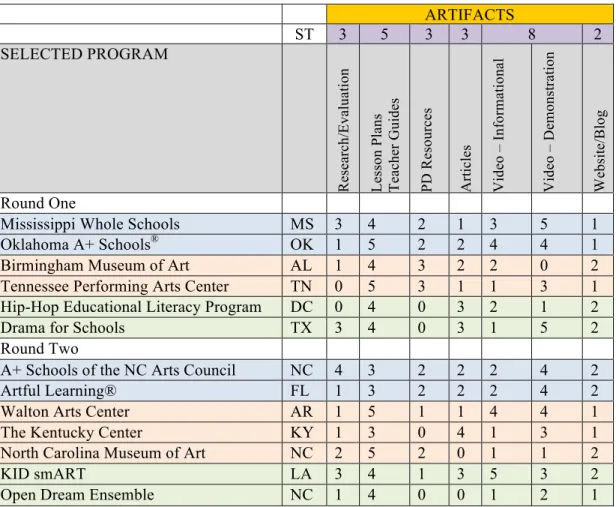
curricular artifacts from each program in this round and selected up to 24 artifacts from each of the selected programs for content analysis. The number of artifacts varied due to breadth of the artifact pool and public availability. These artifacts included lesson plans,
informational and demonstration videos, organizational and professional development
the artifacts, I determined indicators of relational capacity building within arts integration curricula. I repeated the process in a second round. Artifacts alone do not tell the whole story about relational capacity building within arts integration.
Curriculum is lived experience; it is not just made up of material artifacts. The people who work in this field provide the backstory to the artifacts – the intention of the model, the purposefulness in pairing of art object and non-art content, the articulation of the experience. Therefore, I purposefully selected individuals, who design and implement arts-integrated curricula for the selected programs, to be interviewed. Most often, arts integration curricula are the product and process of a collaborative effort among directors of programs,
practitioners, museum and arts center educators and professional development providers. The individuals who agreed to participate in this study included arts integration program
designers and administrators, professional development providers, university researchers, teachers and school administrators who had helped design or worked in schools and classrooms which implemented the selected programs. These interviews also served as a check of the findings from the curricular artifact analysis and provided an additional data set through which to explore the places in the intended curriculum where relational opportunities occur.
and declined, suggested a colleague. These recommendations from the field helped capture information considered vital by other participants.
The data from the selected programs (artifacts and interview transcripts) were examined in two rounds. Artifacts and interview transcripts from round one programs were examined and coded to encompass a broad range of relational capacity building. The themes that emerged from round one were identified, clarified, and built upon in round two. The data from the two rounds were further analyzed in order to build a case about arts integration and its facility (or not) for building relational capacities.
In the following sections of this chapter, I will discuss the sample including the
criteria by which the programs were selected and their geographic distribution, the selected
programs and the characteristics of the schools involved. I will also discuss in more depth,
the gathering of data including artifact selection and the interview process, and relational
capacities as a framework for the study.
Sample: Arts Integration Models
This research design employed stratified purposeful sampling as described by Patton (2002) who suggests that purposeful samples can be stratified or nested by selecting
distribution. I wanted to ensure that all model types were represented and that the programs were distributed across the South. The programs are representative of their model types.
When screening programs from this pool, I noted that implementation
generally takes one of three forms: 1) arts-based reform, 2) arts institution-based such as performing arts center-, museum- and artist(s)-led in-school programs and 3) teaching artist and single art form classroom initiatives. These forms encompass well-known programs that are deservedly touted for their success such as the A+ Schools National Consortium and Artful Learning®, as well as equally successful models that are not as familiar outside of their region or district.
schools. Several whole-school models now begin the process with a new school by conducting a needs assessment to determine the best path for implementation.
These norms represent the values of the programs. In this research, I have attempted to examine the intent of the keepers of the programs, who design these norms, to determine in what ways relational capacity building is part of that intent either implicitly or explicitly. In selecting the programs, I was deliberate in choosing ones from each of the three models of arts integration I have noted – 1) arts-based school reform model, 2) arts institution-based model and 3) teaching artist and/or single art form model. Figures 2.1, 2.2 and 2.3 depict the distribution of programs geographically and by the categories consistent with this research.
Arts-based School Reform Model
Programs within this model generally work with whole schools and
Southeastern Center for Art Education (1987), Mississippi Whole Schools Initiative (1991) and Artful Learning® (1992) among them, have also persisted through changes in local and national governments and their arts education policies. With some exceptions, arts integration practice thrives in schools in which these initiatives take place. This practice is sustained through rigorous professional development and ongoing support for teachers, artists and administrators, collaboration among teachers and across content areas, flexibility according to school-specific contexts, and strong adherence and belief in the norms and structures created by the models.
Hundreds of schools have adopted the arts-based school reform model of arts integration through various programs mandated by state legislatures and departments of instruction or promoted by local districts, schools and arts councils. It is important to distinguish between models and programs. Models hold the philosophy, research and history of the arts integration instruction. Programs are the implementation of the model.
I have identified six programs in the arts-based school reform model as they are implemented in the American South. Three are national programs - National A+ Schools Consortium, Artful Learning®, Disciplined Based Arts Education (DBAE), and three are State-based - Value + in Tennessee, Big Thought in Texas and Whole Schools Initiative in Mississippi. This is not an exhaustive list of the arts-based school reform efforts in the South. Some of these programs are based in arts organizations and are listed in the next section. Other Southern States have implemented arts
program is primarily focused on ensuring that arts instruction in dance, theater, visual arts and music is embedded in schools.
As discussed in earlier paragraphs, the distinguishing elements in the programs are the norms that each program follows. The norms are explained, justified, practiced and promoted through professional development for teachers, teaching artists and administrators. The arts integration program is implemented through curriculum development, demonstration, modeling and co-teaching in the schools, and lesson review, evaluation and revision. Schools are supported with online communities, ongoing professional development and site visits. These programs usually employ comprehensive outside evaluations, which occur
simultaneously with implementation. The programs in the arts-based school reform model are most often brought into the schools from the outside and until the “buy-in” occurs at the classroom level, these programs cannot be sustained at desired levels. Oreck (2006) concluded that teachers’ artistic approaches needed to be congruent with their educational values in order to for them to incorporate the arts into their curriculum. This statement is consistent with ideas of sustaining school reform. According to Noblit and his colleagues (2009) in an in-depth study of A+ Schools Program of the North Carolina Arts Council, school reform is sustained through “harnessing the power educators have to do what they value” (p. 104). The
Figure 2.1 below illustrates the extent of the arts-based reform model in the South. The colors on the illustration indicate the State in which the program is implemented in the South. The key for Figures 2.1, 2.2 and 2.3 is:
Red-Orange = AL, Sage = AR, Lime = DC, Yellow = FL, Gray = Georgia, Magenta = KY, Orchid = LA, Dark Purple = MD, Turquois = MS, Light Blue = NC, Red = OK, Green = TN, Brown = TX, Lavender = VA.
Arts Institution-based Model
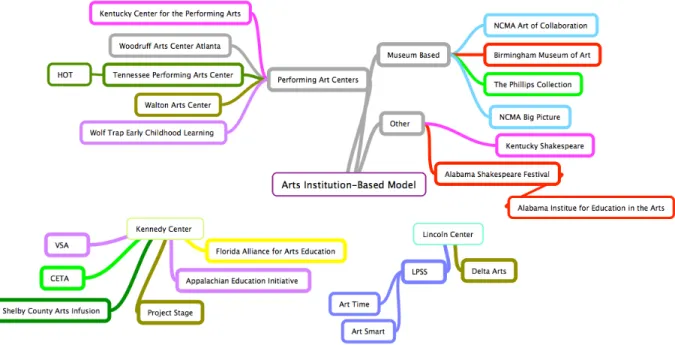
model were created or evolved to prepare schools to integrate the arts, programs in the arts institution-based model integrate the arts in schools as a component of a larger institutional mission. Arts integration is often tied back to performances or artwork of the sponsoring institution. For example, the Walton Arts Center, Tennessee Performing Arts Center and The Kentucky Center for the Performing Arts develop strong arts integration programs in schools around each season’s performances. Art museums include in-school object-based learning programs. The museum-school programs from the Isabel Stewart Gardner Museum and The Phillips Collection in Washington, DC are some of the most notable. North Carolina
Museum of Art’s Art of Collaboration works with teams of middle school teachers, who combine understanding of visual art and non-art content through in-museum discussion and classroom art making. One music initiatives brings the philosophy of Silk Road Ensemble into middle schools through teaching artist visits and professional development to “empower students and teachers to discover links across areas of study to highlight what connects rather than what separates them” (The Silk Road Project, 2013).
school and single classroom, reform and improvement, teaching artist and teacher – all are descriptors when discussing arts integration. Of course, what is of most importance is what happens in the classroom between teacher, teaching artist, student and student-artist.
Teaching Artist and/or Single Art Form Model
This category acts as a bridge between programs in the arts institute-based model and teaching artist programs. One of the oldest programs in this category is Young Audiences organized in 1952 to ensure that students had access to performances. Teaching artists are employed by schools across the country for artist residencies, single class visits, and as part of larger initiatives involving many artists. Programs in this category are often focused on a single art form. As might be suspected, the impact of these arts-integrated initiatives has not been examined. Some of these efforts are lived because of limited funding or short-term projects. As of this writing, one of the programs in the teaching artist and/or single art form model in the study is on hiatus for re-evaluation and may not be financially supported in the future.
State and local arts councils and sometimes school districts provide resources for arts integration efforts in schools. These resources appear most often in the form of professional development opportunities and access to teaching artists. These efforts are included in the chart as a reference; however, none of these programs were selected for the study because the teachers, who participate in these initiatives, are scattered in schools across the South and the artifacts are school-specific and difficult to access.
Due to Lincoln Center Institute, the Kennedy Center for Performing Arts, Young Audiences and other organizations, including State and local arts councils, that provide professional development and resources for arts integration, a growing number of teachers and teaching artists are comfortable integrating the arts into the curriculum whether or not they are part of a school or district initiative. Many classroom teachers, arts specialists and teaching artists are self-motivated and seek out arts integration professional development opportunities on their own. Once these strategies become embedded in the way they teach, teachers have claimed that “they are rejuvenated and reconnected to the passion for teaching and learning that brought them to the teaching field in the first place” (Bellisario and
Donovan, 2012, n.p.).