P
ROSTHETIC
F
OOT
S
HELL
,
QL+
F
INAL
D
ESIGN
R
EVIEW
JUNE 8, 2020
T
EAM:
C
OASTB
USTERSK
ATHRYNV
ERSTEEG–
KVERSTEE@
CALPOLY.
EDUJ
ACKSONT
UCKER–
JATUCKER@
CALPOLY.
EDUStatement of Disclaimer
T
ABLE OFC
ONTENTSAbstract ... 1
1. Introduction ... 1
2. Background ... 2
2.1. Meetings with Sponsor ... 2
2.2. Existing Designs and Patent Research ... 2
2.3. Technical Information and Research ... 4
3. Objectives ... 6
3.1. Problem Statement ... 6
3.2. Boundary Diagram ... 6
3.3. Quality Function Deployment (QFD) ... 7
4. Concept Design ... 8
4.1 Ideation Process ... 8
4.2 Concept Prototype ... 10
5. Final Design ... 12
5.1 Design Description ... 12
5.2 Design Justification ... 15
5.3 Design Changes Since CDR ... 16
6. Manufacturing ... 16
6.1 Procurement ... 16
6.2 Initial Manufacturing Plans ... 17
6.2.1 Manufacturing Plan 1 ... 17
6.2.2 Manufacturing Plan 2 ... 17
6.2.3 Manufacturing Plan 3 ... 17
6.3 Manufacturing the Mold Box ... 18
6.4 Creating Outer Foot Shell Mold ... 18
6.4.1 Initial Testing Procedures ... 21
6.5 Creating the Final Foot Shell ... 23
6.6 3D Printed Components... 24
6.7 Challenges.. ... 25
7. Design Verification ... 26
7.1 Specifications and Tests ... 26
7.1.1 Cycles to Failure ... 26
7.1.2 Weight ... 26
7.1.3 Fit ... 26
7.1.4 Appearance ... 26
7.1.5 Time to Use ... 26
7.1.6 Weather Resistant ... 27
7.1.7 Total Cost ... 27
7.1.8 ISO Testing ... 27
7.2 Completed Testing ... 27
7.3 Future Testing ... 29
7.3.1 Test Fixture ... 29
7.3.2 Testing Procedure ... 30
8. Project Management ... 30
9. Conclusion ... 31
9.1 Project Reflection ... 31
9.2 Next Steps ... 33
10. References ... 34
Appendix A ... 35
Appendix B ... 36
Appendix C ... 37
Appendix D ... 38
Appendix E ... 40
Appendix F... 41
Appendix G ... 42
Appendix H ... 44
Appendix I ... 45
Appendix J ... 46
Appendix K ... 47
-- 1 --
A
BSTRACTThis final design review includes an overview of our project and the steps we have taken to create our final product. We discuss the background research conducted, including various products like the foot shell we are trying to design and its related patents, along with similar past senior projects. As our product is considered a medical device, there are also certain standards that we must comply with. After determining our problem statement, we established what we believe to be the wants and needs of our user. These wants and needs were converted into specifications for our design, with durability as a main goal. These specifications were used to brainstorm initial design ideas through concept modeling. There are various images and diagrams of these models that we use to support our reasonings. A preliminary design solution was chosen after an analysis was performed on our concept models. We conclude the report with an overview of the steps we took to complete our project and design and manufacture a durable prosthetic foot shell as well as future plans for testing and manufacturing a full-size foot shell prototype. A summary of our conclusions and recommendations for next steps wrap up the project.
1.
I
NTRODUCTIONWe are a group of 4th year Mechanical Engineering students at California Polytechnic State University, San Luis Obispo. This project was proposed by the Quality of Life Plus (QL+) program, a not-for-profit organization focused on finding unique solutions for health problems faced by veterans. Our client, former Marine Dana Cummings, is an active individual, which results in his foot shell wearing out too quickly and needing to be replaced often. The goal of this project is to design and manufacture a foot shell for his prosthetic leg that will last longer than commercially available options.
This report includes our background research and the steps we took in trying to understand the root of the problem. After establishing our problem statement, we separated the user’s wants and needs to determine what the requirements of our project were. Extensive research on relevant patents and similar products was conducted to understand more about what we will be working on and what our competition is. Concept models were created during initial design brainstorming and we used a design matrix to choose our final design. We then mapped out how we will
- 2 -
2.
B
ACKGROUND2.1.
M
EETINGS WITHS
PONSORThis section has been updated in order to provide extra information gained in subsequent meetings with our sponsor and with Dana Cummings.
To better understand our problem and the overall scope of the final product, we conducted a meeting with our sponsor (QL+) and their representative, Vanessa Salas, as well as a separate meeting with our QL+ challenger and primary user of our finished product, Dana Cummings. Currently our challenger utilizes a variety of foot shell brands and a custom-made insert from a plastic cutting board sheet. This solution is a temporary fix but is not something that is
sustainable long term because he is looking for a more permanent solution. His main problem with current foot shell models is that they wear out and need to be replaced every two to three months. He needs a new foot shell that is more resistant to wear and weather, with a stretch goal of building an adaptive foot shell that could be used by multiple users with multiple types of prostheses.
In a later meeting, we presented some of our top concept designs to Dana. He confirmed that his foot shells tend to fail regularly in the toe area. We also discussed if the final product should be more specific to Dana, or if we should make a product that can easily be adapted to other foot shell users. His advice to us was to focus on concepts that are adaptable and can be easily modified to work with other users.
2.2.
E
XISTINGD
ESIGNS ANDP
ATENTR
ESEARCHThis section has been expanded to discuss other foot shells that we have looked at since the beginning of the project.
- 3 -
Fillauer MCV Foot Shell Fillauer ProCover Foot Shell
FIGURE 2.1 AESTHETIC DIFFERENCES IN LOW DURABILITY VS. HIGH DURABILITY FOOT SHELLS
While conducting background research, a patent search was performed to see and understand what kinds of foot shells had already been patented. A table containing some relevant patent searches, brief descriptions, and explanations of their relevancy to this project is included in Appendix A. Particularly, “Prosthetic foot shell enabling rapid conversion between shoe and barefoot walking” seems to be especially relevant to the research we are conducting. Included with this patent is a diagram, Figure 2.2, of varying thicknesses corresponding to different activities, such as walking barefoot around a room versus putting on running shoes and going for a hike. This patent, whose application status is currently abandoned, details a “removable cosmetic skin covering device” for the purpose of “either walking with shoes… or walking barefoot with minimal risk of knee hyperextension or prosthetic posterior lean.” While we are pursuing a different end goal, a removable cosmetic skin covering device in the heel presents itself as a possible solution to our problem.
- 4 -
Our team has gotten the opportunity to look at dozens of worn out foot shells and the way that they fail seems to be consistent. The failure is usually due to the prosthetic foot digging into the foot shell, which starts to shear and eventually breaks away. Failure typically happens at the toes, but significant signs of wear typically are also present at the heel. This means that our team needs to address both of these areas of high wear with our solution.
2.3.
T
ECHNICALI
NFORMATION ANDR
ESEARCHThis section has been updated to include information obtained during a meeting with a prosthetist, and to call out the ISO standards we will be following for this project.
In a technical document from the American Academy of Orthotists and Prosthetists entitled “Prosthetic Foot Prostheses/Orthoses,” author Melvin Stills describes various types of prosthetic foot solutions. For above the ankle amputations, many designs are “fabricated from
thermoplastic materials (polypropylene) [and] thermoset plastics (polyester or acrylic) which may be incorporated with graphite or other space age materials to reduce weight and increase strength”. Stills also talks about a flexible reinforced silicone prosthetic foot that is modified “to relieve sensitive areas and to load appropriate surfaces” [6]. Ultimately, the paper finds that there is no definitive prosthetic solution for all cases, and that improved flexibility seems to improve fit and comfort with users. This means that even though we are trying to improve the durability of a foot shell, we should also make sure that we keep the design flexible. Durability and flexibility will be competing requirements that will need to be well balanced in our final design.
In a paper for Prosthetics and Orthotics International, authors Jaarsveld, Grootenboer, De Vries, and Koopman discuss how hysteresis and stiffness are two factors often ignored when
considering prosthetic devices. These factors “could be adapted to improve the prosthetic walking performance” [3]. In this case, the authors define hysteresis as energy lost as a part of deformation. For bare feet, hysteresis varies significantly, but for users wearing sports shoes this issue is eliminated. Their article recommends sports shoes over alternatives like leather shoes due to the increased shock absorption of sports shoes. We could incorporate elements of a sports shoe design into our project to try to minimize shock absorbed by the actual shell.
- 5 -
In an article called “Optimization of mass-produced trans-tibial prosthesis made of pultruded fiber reinforced plastic,” authors Hahl, Taya, and Saito discuss a “transtibial prosthesis made of fiber reinforced plastic (FRP)” [5]. The initial study replaced load bearing screws in the foot section with an FRP stiffener which provided “high strength, great durability, and smooth walking” [5]. The FRP stiffener was found to be most effective placed slightly behind the toe region, at a slight angle from vertical. A visual of the optimized position is shown in Figure 2.3.
FIGURE 2.3 FRP STIFFENER AND PLACEMENT IN AN OPTIMIZED POSITION FOR STRENGTH AND DURABILITY [5].
In the Journal of Prosthetics and Orthotics, an article called “Energy Loss and Stiffness
Properties of Dynamic Elastic Response Prosthetic Feet,” by author Geil describes prosthetic feet “designed to store and return energy during the gait cycle” in order to make walking feel more natural for users [2]. The study found that the greatest amount of energy loss came in College Park feet, one of the currently available market options discussed earlier in the background section. The article suggest that material testing is not enough to determine the quality of a prosthesis, and that dynamic use is more important to consider, although it is harder to obtain objective data for these types of tests. This means that our design process should place equal emphasis on material and on dynamic use in order to ensure high quality of the final design. After conducting preliminary research, we met with Matt Robinson, a prosthetist at the Hangar Clinic in San Luis Obispo to discuss our project [11]. We found out during our discussion that prosthetics typically are covered with special socks or liners, some made from cotton and wool, others from synthetic fibers. These liners fill a vast number of roles, including protecting the shell from pressure and friction, trapping carbon dust from the prosthetic, and absorbs
- 6 -
belief that failure first occurs in the heel and keel areas of the foot shell. We also learned during our meeting that most modern prosthetic foot manufacturers tailor foot shells for one specific type of prosthesis and that said manufacturers also do not put a lot of research or money into improving their foot shells as they are not what the company makes the most money off of. Most foot shells last for around a year for most users, meaning that our user is a special case.
According to ISO Standards, a medical device is classified as “a product that is intended for the use in the diagnosis, prevention and treatment of diseases or other medical conditions.” This puts the foot shell we will be working on into this category; therefore, there are certain standards we must meet. The specific standard that relates to our project is ISO 13485:2016 Medical Devices – Quality management systems – Requirements for regulatory purposes. During our design
process, we will need to reference this standard to make sure we are satisfying the requirements. Furthermore, we must also consider ISO 22675:2016 when testing our final product, which “specifies a cyclic test procedure for ankle-foot devices and foot units of external lower limb prosthesis, distinguished by the potential to realistically simulate those loading conditions of the complete stance phase of walking ROM heel strike to toe-off that are relevant to the verification of performance requirements such as strength, durability and service life.” This ISO standard was obtained from a past senior project: Vida Nueva, in which a past senior project group designed and build a prosthetic foot for third world users [12].
3.
O
BJECTIVES3.1.
P
ROBLEMS
TATEMENTUsers of prosthetic legs have issues with current foot shells wearing out too quickly and needing to be replaced too often. They need a more durable foot shell that will last longer than
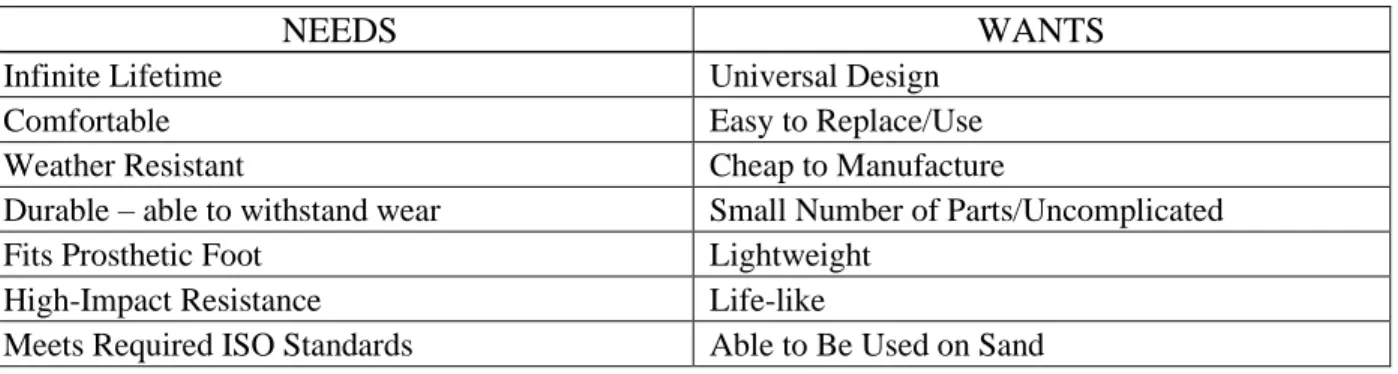
commercially available options. Table 3.1 includes a list of the needs and wants of our customer to assist with scoping the project.
TABLE 3.1 LIST OF USER NEEDS AND WANTS
NEEDS WANTS
Infinite Lifetime Universal Design
Comfortable Easy to Replace/Use
Weather Resistant Cheap to Manufacture
Durable – able to withstand wear Small Number of Parts/Uncomplicated
Fits Prosthetic Foot Lightweight
High-Impact Resistance Life-like
Meets Required ISO Standards Able to Be Used on Sand
3.2.
B
OUNDARYD
IAGRAM- 7 -
a factor we must consider. The ground is an important component because our challenger will be walking on it, and the surface could wear down the foot shell faster. We must also take the prosthetic leg into account because much of the wear comes from the leg’s weight and contact with the foot shell. The foot shell must also fit the prosthetic, so we need to ensure the sizing is correct and it is relatively easy to put on.
FIGURE 3.1 BOUNDARY DIAGRAM FOR PROSTHETIC FOOT SHELL
3.3.
Q
UALITYF
UNCTIOND
EPLOYMENT(QFD)
The House of Quality, as shown in Appendix B, is part of a process known as Quality Function Deployment (QFD). A QFD is used to define a customer’s specific needs and requirements, turning them into specific plans. The House of Quality itself is a planning matrix that creates relationships between all the working parts of a project and its specifications. There are seven steps to creating a house of quality: Who, What, Who vs What, Benchmarking, How, How vs What and How much. Each step can be found in the matrix in Appendix B.
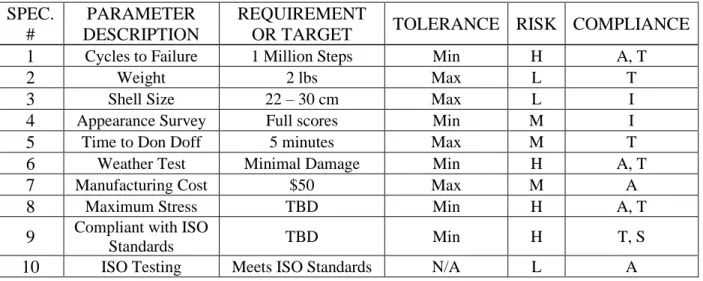
Table 3.2 summarizes the chosen specifications and their requirements for our foot shell. The specifications listed were chosen using our House of Quality. We then assigned a high (H), medium (M) or low (L) risk factor to each specification, determining how difficult we believe it will be to achieve it. Finally, a compliance qualification was chosen based on how we’d
- 8 -
TABLE 3.2 SPECIFICATIONS TABLE FOR PROSTHETIC FOOT SHELL
SPEC. #
PARAMETER DESCRIPTION
REQUIREMENT
OR TARGET TOLERANCE RISK COMPLIANCE
1 Cycles to Failure 1 Million Steps Min H A, T
2 Weight 2 lbs Max L T
3 Shell Size 22 – 30 cm Max L I
4 Appearance Survey Full scores Min M I
5 Time to Don Doff 5 minutes Max M T
6 Weather Test Minimal Damage Min H A, T
7 Manufacturing Cost $50 Max M A
8 Maximum Stress TBD Min H A, T
9 Compliant with ISO
Standards TBD Min H T, S
10 ISO Testing Meets ISO Standards N/A L A
TABLE 3.3 DESCRIPTION OF SPECIFICATION VERIFICATIONS
SPEC #
SPECIFICATION DESCRIPTION
1 Cycles to Failure Test the life cycle of the thermoplastic/composite used to manufacture the shell.
2 Weight Weigh the final product to determine if it meets our specified weight.
3 Shell Size Measure our final product with a tape measure or ruler.
4 Appearance Survey Compare the final product with other products on the market in a survey taken by outside sources.
5 Time to Use Observe how long it takes our challenger to put on the product. 6 Weather Test Simulate the effects of extreme weather, sand, and everyday
wear and measure how the material/shell responds.
7 Manufacturing Cost Determine the cost of manufacture using the cost of materials and approximating the cost of tooling.
8 Maximum Stress Determine maximum stress by impact testing the thermoplastic/composite used to manufacture the shell 9 Flexibility Determine an estimate for the modulus of elasticity for the
material used through fatigue testing
10 ISO Testing Research ISO Standards to determine if our project meets them.
4.
C
ONCEPTD
ESIGN4.1
I
DEATIONP
ROCESS- 9 -
models were then narrowed down to eight realistic designs that were evaluated based on three main functions for the foot shell: that it fits the prosthesis, protects the prosthesis, and is easy to manufacture. The foot shell will almost always be worn while our user has shoes on, so this narrows down our design focus. These main functions were broken down into several sub-functions which were analyzed for each of the eight designs in Pugh matrices, which are shown in Appendix C. Our top eight concept models are detailed and shown in Table 4.1 below.
TABLE 4.1 CHART OF TOP CONCEPT MODELS
1 2 3 4
Ridged Foot Shell Contoured Foot
Shell Removable Sole Running Feet
Foot shell with a ridged bottom to promote more concentrated wear
and easier replacement.
Foot shell with insert that molds to
the prosthetic foot for more support
and less wear.
Foot shell with removable sole for easier replacement and cheaper manufacturing.
Foot shell bottom modeled after the soles of running shoes to promote
support and less wear.
5 6 7 8
Slippered Foot Shell Reinforced Foot
Shell Layered Foot Shell
Expandable Foot Shell
Foot shell with entire covering for easy
replacement and prevention of wear.
Foot shell with reinforced toe and
heel to prevent wear.
Foot shell with multiple layers in the sole that are able to be replaced for less wear over time.
Foot shell with reinforced toe and heel that can expand
to fit various prosthesis sizes.
- 10 -
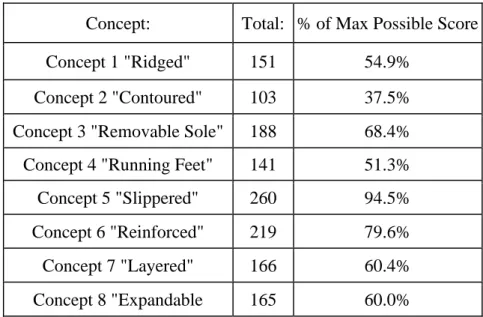
the functions in order of importance as follows: long life, durable, comfortable, ease of use, lightweight, meets ISO standards, affordable, high impact resistance, weather resistant, and lifelike being the least important. It is most important that our foot shell covers the foot
prosthesis and lasts longer than modern foot shell in order for our product to satisfy our problem statement. The foot shell being lifelike was determined to be the least important function of our eventual design as it is the constraint that can be worked around the most. Using these new weighted functions, we determined that the best design for our foot shell would be a mix of the slippered and reinforced concepts as they had the two highest scores.
TABLE 4.2 WEIGHTED DECISION MATRIX
Concept: Total: % of Max Possible Score Concept 1 "Ridged" 151 54.9%
Concept 2 "Contoured" 103 37.5% Concept 3 "Removable Sole" 188 68.4% Concept 4 "Running Feet" 141 51.3% Concept 5 "Slippered" 260 94.5% Concept 6 "Reinforced" 219 79.6% Concept 7 "Layered" 166 60.4% Concept 8 "Expandable 165 60.0%
4.2
C
ONCEPTP
ROTOTYPE- 11 -
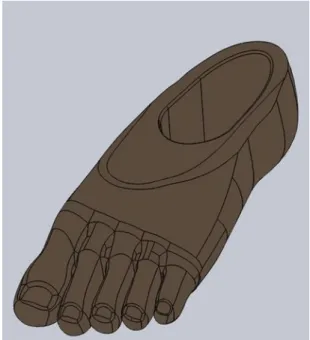
FIGURE 4.1 CONCEPT CAD MODEL
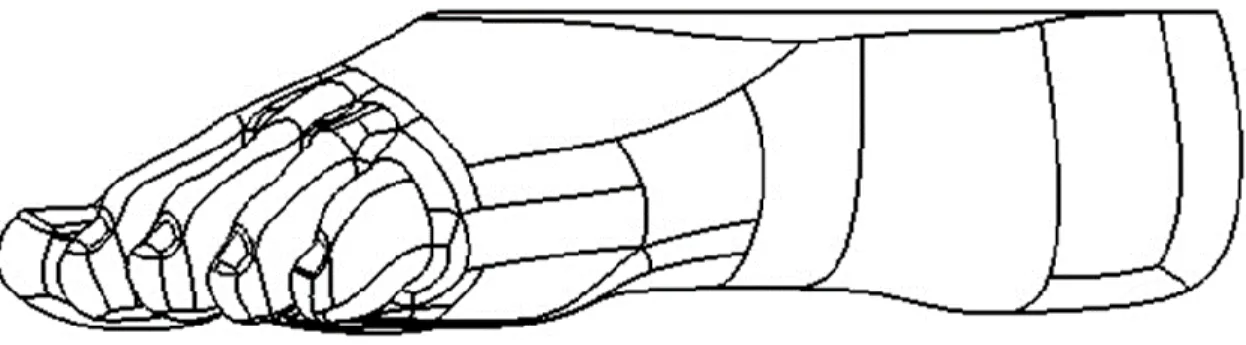
Our concept prototype was designed using our concept CAD model (Figure 4.1) and fabricated using 3D printing as shown in Figure 4.2.
FIGURE 4.2 3D PRINTED CONCEPT PROTOTYPE
- 12 -
5.
F
INALD
ESIGN5.1
D
ESIGND
ESCRIPTIONThe final design, seen in Figure 5.1, makes some modifications to the concept models seen in the previous section. Most notably, the larger mouth opening has been exchanged for a narrower one that will more rigidly connect to the prosthesis. The interior cavity has also been sized to fit with Dana’s prosthesis. The material used for the body of the foot shell will be a 40A durometer urethane, and a tougher 70A durometer urethane will be used as reinforcement in the sole. The interior of the sole is the main site for wear that causes the foot shell to fail, so using a stronger material will resist more wear. The rest of the foot shell can be made of a less tough rubber so that is more pliable, aiding the user in putting on and removing the shell. A shoe horn is
typically used for putting on and taking off foot shells, and this process will be made easier with the more flexible layer of material near the opening.
FIGURE 5.1 FINAL DESIGN CAD MODEL
- 13 -
FIGURE 5.2 FINAL DESIGN CAD MODEL, SIDE VIEW
Figure 5.3, shown below, includes the interior cavity of the foot shell. The shape of this cavity is designed to allow the prosthesis to rest on the keel (towards toes) and the heel of the shell while providing enough rigidity to prevent the prosthesis from moving around in the shell.
FIGURE 5.3 FINAL DESIGN CAD MODEL WITH INTERIOR VIEW
The decision to use a 40A durometer urethane as the main material was based on previous senior project groups that used similar durometers for foot shells, mainly the Vida Nueva low cost Prosthetic Foot. Before ordering material, we looked at several samples of urethane ranging from very soft to very hard. Based on the similarity to the hardness of Dana’s existing foot shell, we decided that a 60A urethane would be tougher than the existing shell while also not being over rigid, which could cause discomfort.
- 14 -
dimensions of the foot shell can be. The interior geometry is based on the size of the prosthesis that Dana uses and is designed to be a relatively close fit in order to keep things from sliding or moving inside of the shell. All drawings of the foot shell design can be found in Appendix O. Because foot shells are made from molded plastics, performing any repairs on a foot shell is difficult and buying a new foot shell is the likely solution for customers. This means that the product must be durable in all respects to ensure that the entire shell lasts until the sole is inevitably worn through. Users can increase the lifespan of their foot shells by always using a cover sock over the prosthesis, which helps eliminate some of the shearing forces that are seen when the prosthesis is directly in contact with the shell. The cover sock also helps eliminate some of the shearing forces that cause the foot shell to wear down, which will help increase the lifespan of the product. Once the foot shell has worn through the bottom, it is no longer a usable product, and could inhibit the users’ ability to walk while wearing the foot shell. It is
recommended that the user checks the condition of their foot shell before use, specifically feeling for any thinning of the sole occurring at the heel and keel.
The safety of the foot shell design is also impacted by how much wear is done to the shell while being used. Shells that are worn out and have holes in the sole will be more susceptible to damage from outside sources such as moisture and particulates. Due to the complex profile and surfaces associated with the foot shell design, we were unable to run any successful finite element analysis simulations by simulated forces acting on foot shell during use. The forces acting on the foot shell by the carbon fiber prosthesis and ground consist of many different components with many different magnitudes, which will be too complex to model using the tools available to us. We will also be unable to successfully estimate the magnitude of the forces acting on the foot shell as they will change depending upon several factors: the angle of contact between the shell and ground, the type of ground material, the type of activity being performed by the user, and the force applied by the carbon fiber prosthesis (which would require analyzing the prosthesis as well).
- 15 -
TABLE 5.1 SUMMARY COST ANALYSIS
SUB-ASSEMBLY COST SOURCE
Shell Assembly $55.56 Smooth-On
Urethane Mold $128.32 Smooth-On
Mold Box Assembly $68.54 Home Depot
3D Printed Negative N/A QL+
Total: $252.02 Budget = $1000
5.2
D
ESIGNJ
USTIFICATIONOur main justification for our final design is its similarity to existing foot shell models currently manufactured and sold by prosthetic foot companies. The majority of modern foot shells are designed to be life-like, with toes, a heel, and an opening at the top of the shell. Foot shells also have a cavity that extends to the toes in most cases, allowing for the carbon fiber prosthesis to fit inside of the shell successfully. The similarity in foot shell cross sections can be seen in Figure 5.4. Modern foot shells are also made from similar materials to what we are using and are
manufacturing using similar processes to ours, although they use different types of molds that are made for a mass manufacturing application.
Our Final Design Cross Section Ottobock Foot Shell Cross Section
FIGURE 5.4 COMPARISON OF FOOT SHELL CROSS SECTIONS
The main reason for our foot shell being so similar to foot shells currently on the market is that our main modification on existing foot shells is not related to the design of the foot shell, but rather the manufacture of the foot shell itself. Modern foot shells are typically manufactured using one type/durometer of rubber throughout the entire shell design. By using two different durometer foot shells we hope to utilize the best material properties from each different
- 16 -
5.3
D
ESIGNC
HANGESS
INCECDR
There are a couple of critical changes that were implemented into the design after the CDR stage. The primary change was to the material being used for the bottom/sole portion of foot shell, with the 60A urethane being upgraded to a 70A urethane instead. We determined this change by conducting durometer testing on a current foot shell provided to us by our sponsor; the results of the testing showed that the bottom of the current foot shell was already a higher durometer than 60A. These results meant that using a 60A urethane in the new design would not improve the hardness of that area. We then decided to replace this urethane with one with a 70A durometer rating instead; this way the sole area of the foot shell can have a higher hardness than current models.
Another key change to the design of the foot shell was in the design of the mold as the
surrounding mold material would need to be made from a urethane rubber instead of a silicone rubber. During the initial manufacturing phase, we discovered that using a silicone mold when casting a urethane part results in the urethane part curing with a highly tacky surface finish which is not ideal for a full-size foot shell. Due to the different chemical makeup of the two types of rubber, the two rubbers started to partially bond during the curing process and the finished casting did not come out cleanly. By using urethane instead of silicone, the urethane parts come out cleanly and the cost of the mold is reduced due to the urethane rubber being less expensive to acquire from Smooth-On than the silicone rubber we were previously planning on using.
6.
M
ANUFACTURINGThis section has been updated to discuss the materials and manufacturing processes that were necessary to create the final product.
6.1
P
ROCUREMENTOur procurement process began by contacting Reynold’s Advanced Materials, a third-party seller that acted as a middle-man between us and Smooth-On materials, the manufacturer of the
urethane rubbers that we will be using. We initially purchased three types of urethane rubbers of three different durometer ratings, Vytaflex 40A, 50A, and 60A, one silicone rubber, MoldMax 40A, and a can of mold release agent spray. Due to our issues casting with the MoldMax silicone, previously discussed in section 5.3, we decided to replace the MoldMax 40A with a larger quantity order of Vytaflex 40A urethane rubber. After initial testing was conducted using our acquired materials, we decided to order PMC 770 urethane to replace the Vytaflex 60A, which was originally planned for the bottom layer of the foot shell. The durometer test showed the 60A urethane would not have improved the hardness of the foot shell compared to current models used by our challenger. In the same order as the new 70A urethane, we also ordered a dye to be used to keep both layers of the foot shell a similar color.
- 17 -
acrylic sheets were purchased as they would be easy to machine to size and allow the molding process to be fully visible. The silicone adhesive was purchased in a size that could be used in a caulking gun to make the application process smooth and accurate.
The only part of our molding process that we did not purchase was the 3D printed negative, which we acquired by utilizing a 3D printer in the on-campus QL+ lab. This 3D printer printed the foot shell in PLA plastic and all the necessary support material in a cornstarch-based water-soluble material. This way there were no remnants of the support material left on the finished part.
Our team’s initial budget, set by QL+, was $1000. As shown in Appendix I, our project fell under budget at close to $396. The most expensive components of the project were the rubber materials purchased from Reynolds Advanced Materials.
6.2
I
NITIALM
ANUFACTURINGP
LANSWe began with three possible manufacturing plans for creating our prosthetic foot shell which depended upon how the two halves of out foot shell would bond together. Since both of our foot shell halves were made of urethane rubber, they bonded together easily. According to the Smooth-On website, newly mixed rubber bonds to cured rubber so long as the rubber has not been fully cured. The chances for a lasting bond between the two rubbers decreases significantly the longer the rubber cures for. Due to the long cure times for our selected urethane rubbers - sixteen to twenty hours - it was key to pour the new layer of rubber onto the curing rubber at the right moment for the bond to have the best chance of forming.
6.2.1 MANUFACTURING PLAN 1
Our first choice for our manufacturing plan was to use one mold that ultimately formed the foot shell with a horizontal parting line. We would pour the bottom layer of the foot shell with a high durometer urethane rubber, let this layer partially cure, and then fill the remainder of the mold with the lower durometer urethane. The two urethane layers would bond together chemically and naturally at the end of the top layer’s curing process.
6.2.2 MANUFACTURING PLAN 2
Our second choice was to use two separate 3D negatives, each representing one half of the foot shell. We would then create two molds, one for each of the negatives. The two printed halves would need to be cast individually using the mold box, resulting in four mold halves.
6.2.3 MANUFACTURING PLAN 3
- 18 -
straightforward approach. This method also allows us to control the placement of the parting line directly which would avoid having to make a blind cut into the mold. A simplified list of steps can be seen in the Operator’s Manual in Appendix N.
6.3
M
ANUFACTURING THEM
OLDB
OXWe began our chosen manufacturing process by building the mold box that we used to hold our urethane mold while it cured around our 3D printed negative. This mold box was built using acrylic sheets we purchased. The sheets were sawed into the correct dimensions, ultimately creating a box with a height of four inches, width of nine inches, and length of 18 inches. Using quick release clamps, we secured the edges of the acrylic sheets together. We then bonded the edges of our mold box together using a silicone-based gel plastic adhesive that also served as a sealant.
FIGURE 6.1 FINAL ASSEMBLY OF MOLD BOX
6.4
C
REATINGO
UTERF
OOTS
HELLM
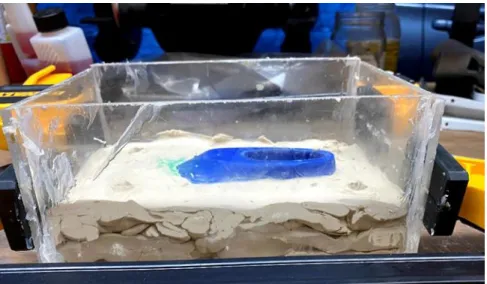
OLDUsing the scaled 3D printed mold negative that mimicked the final foot shell prototype, we casted our urethane mold by forming a layer of modeling clay at the bottom of the box,
embedding the 3D printed part in it, and creating a parting line using the modeling clay. We then created four small holes in the clay on each of the four corners of the box to create keys so the final pieces would fit together correctly. Mold Release Agent was sprayed over the clay and inside the cavity of the 3D model, and then VytaFlex 40A urethane rubber was poured over the mold. The parting line of the urethane mold could not be very complex, so we created a
- 19 -
FIGURE 6.2 MOLD BOX ASSEMBLY WITH 3D PRINTED FOOT SHELL EMBEDDED IN CLAY
FIGURE 6.3 MOLD BOX ASSEMBLY WITH BOTTOM LAYER OF URETHANE RUBBER
- 20 -
escape. Another layer of Mold Release Agent was sprayed on the surface of the mold before the second layer of VytaFlex 40A urethane rubber was poured.
FIGURE 6.4 MOLD BOX CONTAINING TWO URETHANE LAYERS AND SPRUES
Once the two urethane rubbers fully cured and bonded together, we separated the two layers and removed the 3D printed component to complete the process. The final outer mold is shown below in Figure 6.5.
- 21 -
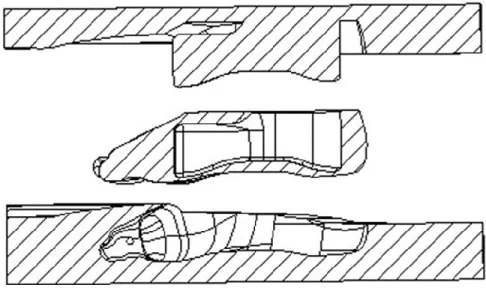
The mold assembly for this manufacturing plan is shown below in Figure 6.6.
FIGURE 6.6 PRIMARY MANUFACTURING PLAN MOLD ASSEMBLY
During each of these processes, we will have to spray Smooth-On Mold Release Agent before pouring the urethane in its respective molds. This release agent coats the mold box, 3D printed negative, and urethane mold which allows for the parts of the mold to be easily parted from one another. This step is especially important for making the urethane mold as we want to minimize the risk of it tearing. We will also need to include parting lines and sprues when casting our silicone mold to make the molding and urethane casting processes much easier, with the parting line separating the mold in two pieces to avoid cutting the mold blindly and the sprue allowing the mold to be filled without separating the two mold halves.
6.4.1 INITIAL TESTING PROCEDURES
- 22 -
FIGURE 6.7 TEST SILICONE MOLD ASSEMBLY
Using this silicone mold, we then casted a replica of the aluminum block using Vytaflex 60A urethane rubber. We chose this specific rubber to better understand the different material properties when increasing the durometer of the plastic. This casting process is depicted in Figure 6.8. Any other observations made during this test process are discussed in section 8.2 Planned Analysis, Testing, and Purchasing.
- 23 -
6.5
C
REATING THEF
INALF
OOTS
HELLTo create the final foot shell model, we began by putting the two layers of our outer mold
together, making sure the keys aligned with one another. Weights were then set on top to prevent leaking.
FIGURE 6.9 OUTER MOLD PUT TOGETHER WITH WEIGHTS ON TOP
- 24 -
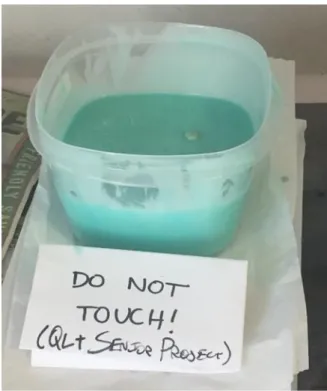
FIGURE 6.10 POURING THE PMC 770A INTO THE OUTER MOLD
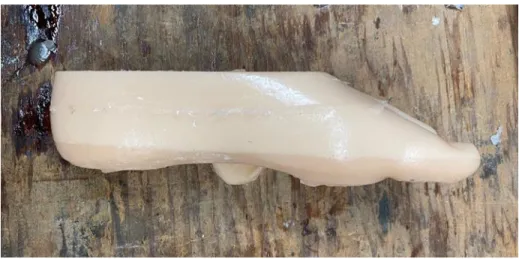
FIGURE 6.11 FINAL SCALE MODEL OF FOOT SHELL
6.6
3D
P
RINTEDC
OMPONENTS- 25 -
Another benefit of using the QL+ printer is the support material used during the printing of the part. Other printers that we could use have the same material used for support material as the part itself, meaning the support material must be broken and filed off the printed model. The 3D printer used by QL+ uses a type of support material that is water soluble, so we do not not have to mechanically remove the support material from the part. The less support material that needs to be mechanically removed from the part, the lower chance there is for the part to be damaged during the process.
Once we were sure our chosen manufacturing process worked correctly, we were going to outsource the print of a full-scale mold negative to use for creating the outer mold of the foot shell. However, due to the circumstances of the project, we were unable to complete this portion.
6.7
C
HALLENGESOur team faced many challenges during the manufacturing of our foot shell. One of the major challenges we faced was selected compatible materials. We began by using a silicone rubber for the outer mold and urethane rubber for the inner mold. After a few tests, we found that our urethane rubber was not curing fully and remained tacky, even after curing for over 24 hours. After proposing various explanations for this including temperature and uneven mixing, we ended up calling Reynolds Advanced Materials. A representative spoke to us and told us that silicone rubber and urethane rubber are not compatible materials and would never cure fully if put together. After the representative’s recommendation, we switched to using only urethane rubber for both the outer and final foot shell mold. This switch solved our issue and the molds were able to fully cure.
Another challenge we faced was the many air bubbles that formed in our final product. This was an issue because we believed it could lead to the earlier degradation of our foot shell. It also contributed to a poor surface finish for the final model. We mitigated this challenge by practicing various pouring techniques. Pouring slowly and from high above the surface of the mold in one spot reduces the amount of air bubbles formed. It is also helpful to mix the two parts of the urethane rubber slowly, avoiding whipping the mixture.
6.8
R
ECOMMENDATIONSFor future production, we highly recommend remaining consistent with the rubber material chosen, whether it be silicone, urethane, etc. We also suggest becoming familiar with the
- 26 -
7.
D
ESIGNV
ERIFICATIONThis section discusses how our team confirmed that our final foot shell met all our design
specifications. These specifications are listed along with the corresponding tests, test results, and recommendations for a final design. The full Design Verification Plan & Report can be found in Appendix H.
7.1
S
PECIFICATIONS ANDT
ESTS 7.1.1 CYCLES TO FAILUREWe expect our final product to have infinite life; therefore, we concluded it must reach at least 3.6 million steps to failure. This specification was determined by assuming our user takes 10,000 steps a day which equates to 3,650,000 steps/year. We will test this specification using a custom-built fixture on an Instron in the Cal Poly Composites Laboratory. This fixture will need to produce a shearing movement within the foot shell to mimic the steps a person would take when walking on it. We are in the process of designing this fixture and will need to manufacture it before our model is finalized.
7.1.2 WEIGHT
The foot shell must be lightweight as our user will be wearing it for extended periods of time. We estimate that the final product must be less than two pounds for it to be comfortable to wear. This can be tested by placing our final design on a scale and determining its total weight. We can also verify that this weight is satisfactory for our user by having him try on the foot shell.
7.1.3 FIT
The foot shell must also properly fit over the prosthesis for it to function correctly. This
requirement is met by increasing the opening of the foot shell and creating the upper material out of a lower durometer urethane rubber so it can stretch over the prosthesis. The foot shell must also fit inside of our user’s shoe. He wears a men’s size 8.5, so given the shell fits inside of a shoe that size, we will meet our specification.
7.1.4 APPEARANCE
The final appearance of our product must be satisfactory to our user. We expect it to look as life-like as we can make it. This requirement will be fulfilled by creating an appearance survey and giving it out to a multitude of people, including our user. Full marks on our survey from a majority of the group will result in us passing this specification test.
7.1.5 TIME TO USE
- 27 - 7.1.6 WEATHER RESISTANT
Most of the time, our user will be wearing the foot shell inside of his shoe. However, we want to ensure our design will not fail when exposed to the elements. This means that minimal damage must occur when left to variable weather conditions. We determine its resistance by leaving the foot shell outside over the course of several days to weeks to evaluate how it will be affected. 7.1.7 TOTAL COST
We want to make sure that our final product is able to be produced consistently and has reasonable manufacturing costs. This allows future users to readily purchase a new foot shell when their old one inevitably fails. After looking at our costs and comparing them to those of other manufacturers, we estimate a price of less than $50 per foot shell while still making a profit is sufficient.
7.1.8 ISO TESTING
According to ISO Standards, foot shells are considered a medical device. This means that there are strict requirements we must meet in order for it to be sold to users. We need to make sure that our final design meets all the associated ISO standards. This will be done by comparing our final product to the standards and ensuring there are no gaps between the two and using the testing standards as guidelines for how we perform our tests.
7.2
C
OMPLETEDT
ESTINGThe two main tests that we were able to complete before transitioning to online classes were durometer testing and testing cure times to maximize adhesion between layers. The durometer testing was performed to compare the hardness of our challengers’ foot shell to the hardness values of rubber samples we wanted to use for the sole layer of the foot shell. The hardness values of the rubber samples we ordered were advertised as Shore A hardness values, but we only had access to a Shore 00 durometer tester. Shore 00 is traditionally used to measure the hardness of softer materials. The values for hardness were converted from 00 to A to keep the results consistent. The results of the durometer testing are tabulated below.
TABLE 7.1 DUROMETER TESTING RESULTS IN SHORE 00 AND SHORE A EQUIVALENT
Material Shore 00 Hardness Shore A Equivalent
Vytaflex 40A 84.5 37.5
Vytaflex 50A 88 45
Vytaflex 60A 92 57.5
Foot Shell 86-94 40-65
Our original design called for the sole of the foot shell to be made from a durometer 60A
- 28 -
products. Shortly afterwards we purchased new material for the sole, PMC 770, which has an advertised Shore A hardness of 70. While we wanted to perform durometer testing on the PMC 770 samples, we were unable get a sample ready in time. The more pliable material on the foot shell had a hardness value of 40A, which is very close to the hardness of the Vytaflex 40A. The other main testing performed was finding the optimal waiting time between pouring layers of urethane to maximize the adhesion between them. Tests were performed at intervals of one hour up to six hours, and after being allowed to cure for 24 hours, samples were pulled and pried apart to see if the layers would stick together. At one hour, we found that the boundary layer between the two rubbers was less well-defined as the top layer was introduced before any curing could occur, creating a less consistent connection. At six hours, the bottom layer had cured too much before the second layer was poured on top, creating little adhesion between the two. We found that waiting for two hours after the first pour created the strongest connection between the layers and was unable to be pulled apart by hand. While tests for 3 and 4 hours created samples that did stick together, they were able to be pulled apart by hand and peeled off the bottom layer. This test helped us figure out the optimal time to wait between pouring the two layers of rubber for the prototype.
- 29 -
7.3
F
UTURET
ESTINGThe main testing initially planned for the project was fatigue testing to directly compare the cycles to failure for our prototype to preexisting designs. This testing was planned for the
beginning of Spring Quarter, which was moved online shortly after the situation with COVID-19 escalated. Because of these changes, plans were put in place to help a future group complete this testing if the project were to be picked up again in the future. These plans include an overview of the testing procedure our group wanted to perform, a possible design for a test fixture, and an overview of manufacturing for the selected test fixture. An overview of the test fixture and testing procedure will be included here, with more detailed information attached as appendices. 7.3.1 TEST FIXTURE
FIGURE 7.2 POSSIBLE FATIGUE TEST FIXTURE DESIGN, INCLUDING BASE PLATE
- 30 -
FIGURE 7.3 STRESS DISTRIBUTION SEEN ON BOTTOM OF TEST FIXTURE BLADES
The test fixture was run through FEA tests to determine the functionality of the design. The main finding of the FEA shows that the protruding blades see high levels of stress that will need to be monitored over the course of fatigue testing. The blades can be easily replaced if necessary but can cause inconsistency in the results if changed out during an uncompleted test. Included in Appendix L is a more detailed look at the results of the FEA.
7.3.2 TESTING PROCEDURE
If this project is continued at Cal Poly, the fatigue testing will likely take place in the composites lab, which has access to both Instron and Amtech fatigue testing equipment. The main fatigue tests will be performed on several prototypes, and additionally on a new foot shell identical to the one currently worn by our user. All foot shells will be tested for 1,000,000 cycles which is the number of cycles we estimate our users foot shells currently last in his experience, or until failure when the test blade pierces completely through the sole. Numerical data will be collected directly from the testing software, and qualitative results will be taken between test sessions and after test completion to describe the condition of the foot shell at various steps through the products life. The main goal of the fatigue testing is to create a prototype foot shell that has a longer life than the purchased foot shell. Appendix M includes instructions for the testing procedure our team was hoping to perform for this project. Also included in Appendix M are recommendations for giving a prototype to our challenger for a fit and direct use test.
8.
P
ROJECTM
ANAGEMENT- 31 -
process as described in section 6 of this report. Testing of our foot shell prototype began around the same time as we began finalizing the manufacturing process. Unfortunately, due to the onset of the COVID-19 pandemic, the team was unable to fully complete the manufacturing and testing stages of this process and was forced to modify our process. Our manufacturing process was able to be fully completed with a half-size model of our foot shell but not with a full-size negative due to our group not having access to the same 3D printer that we used to print the half-size model. We initially planned on outsourcing the 3D printing to a third party, but we were unable to due to many companies being closed during the pandemic and a lack of time needed for us to send them our CAD file and for them to ship the 3D printed part back to us.
Our testing phase was greatly impacted by the coronavirus shutdown as we were unable to manufacture our testing fixture or access the machines required to fully test our foot shell. The testing we were able to complete successfully included durometer testing of current foot shells and our purchased urethane rubbers, testing to determine a proper cure time between the two foot shell layers, and a simulated finite element analysis on our proposed test fixture, all of which were previously described in section 7.
Although we were unable to finish our design process as planned, we made significant progress in the manufacturing of our foot shell and are now able to set a strong starting point for a future team to continue this project in the future. We feel that the first stages of the design process went very well aside from the many phases of ideation and brainstorming that our design went
through. Due to the nature of the project being an improvement of an existing product and design we could have simply started our product design by modifying the existing design of foot shells instead of conceptualizing a new design from the ground up. If this phase of project design had been sped up, we would have been able to spend more time improving our manufacturing process and been able to develop a verification prototype faster. In the future, starting the
manufacturing and testing processes sooner would have allowed us to generate more test castings of our foot shell using our determined manufacturing plan.
9.
C
ONCLUSION9.1
P
ROJECTR
EFLECTIONOur project was as successful as it could be given the constraints put on the team during the final quarter of work. Our first two quarters of work went very smoothly, if a little slow due to the long period of time spent working on ideation for our foot shell design. The project
- 32 -
was designed and manufactured to the best of our ability, may not be meeting the design constraints that we initially designed the foot shell to meet. Without this testing, it is unclear if the foot shell achieved its primary goal of being more durable than shells currently available on the market. We were also unable to fully manufacture the foot shell and only manufactured a half-size model of the shell. We are still unsure if our manufacturing method will scale up to a full-size model without any molding deficiencies like air bubbles, cracks, or low surface finish quality.
Our project was able to achieve many goals we had not originally intended to design towards, as our foot shell was able to be manufactured in the garage of one of our team members without requiring factory machinery or molding processes. Additionally, our foot shell is more
customizable than other foot shells on the market due to its multiple layered design. These layers can be made using any two compatible urethane rubbers of any durometer, dependent upon user. Our team was also able to work very well together despite the coronavirus shutdown and was able to produce a verification prototype that will be useful for any teams that continue this project in future quarters. Our verification prototype also achieved its goals by having a realistic design as well as successful usage of dyes to make both layers a common skin tone. The foot shell prototype was also able to be manufactured without separation between layers of the foot shell, meaning that the two urethane rubbers were able to bond naturally during the
manufacturing process.
If we were to perform this project again, the main changes we would make revolve around the timing of our project. We would spend less time on the design iteration phase as our project was primarily an improvement on an existing foot shell design. Instead of trying to design a new foot shell from the ground up by trying to make it expandable or minimalistic, we could have saved time by simply taking a current foot shell design and modifying it slightly, which is ultimately what we ended up doing. By speeding up this process, we would have been able to spend more time perfecting our manufacturing process, especially the 3D printing of the foot shell negative and casting of the mold. We would also spend more time researching specific brands of urethane rubber and how they interact with each other, which might have prevented our unnecessary purchase of silicone rubber that interfaced incorrectly with our urethane test parts. We also ran into difficulty 3D printing our negatives due to improper communication with the representatives of the QL+ student association, whose 3D printer we ended up using to print our foot shell negatives. We would have also started talking to these representatives earlier so that way the negatives could have been printed earlier and without as much difficulty, enabling the team to begin our mold manufacturing earlier as well.
Overall, the project was very successful in developing a foot shell with the possibility of lasting longer than the foot shells currently used by our challenger. Our half-size model was able to be fully manufactured by one of our team members and displays many attributes that were
- 33 -
were not able to complete the project as planned, the progress we made on our project sets a strong starting point for a future group to pick up where our group left off.
9.2
N
EXTS
TEPSDue to the coronavirus shutdown, there is still a fair amount of work that needs to be done in order to deliver a full-size foot shell to our challenger. We would first recommend that a full-size 3D printed negative be printed using a 3D printer that is able to print support material out of a material that can dissolve in either water or some other liquid like a weak base or acid, this way the support material does not have to be ground off and potentially damage the part’s surface finish. After the negative has finished printing, the full-size mold box will need to be built using the same method discussed in the manufacturing section of this report. The acrylic sheets have already been cut to the correct size by our team and would simply need to be assembled and sealed using the silicone plastic adhesive. The foot shell mold and casted foot shell would be manufactured using the same process previously described in section 6 of this report. However, we recommend that the sponsor or next project team redesign the mold to include better
ventilation for the air bubbles that naturally form in the mold box. These improvements would improve the surface quality of the foot shell, reduce porosity in the shell itself, and eliminate any risk for large air bubbles in the foot shell.
- 34 -
10.
R
EFERENCES1. “The QL+ National Program Began.” QL+ CalPoly | Home, cpqlplus.com/.
2. “Energy Loss and Stiffness Properties of Dynamic Elastic Response Prosthetic Feet.: JPO: Journal of Prosthetics and Orthotics.” Lippincott Williams & Wilkins Inc., September 2001
journals.lww.com/jpojournal/Fulltext/2001/09000/Energy_Loss_and_Stiffness_Propertie s_of_Dynamic.11.aspx.
3. Jaarsveld, H. W. L. Van, et al. “Stiffness and Hysteresis Properties of Some Prosthetic Feet - H. W. L. Van Jaarsveld, H. J. Grootenboer, J. De Vries, H. F. J. M. Koopman, 1990.” SAGE Journals, journals.sagepub.com/doi/abs/10.3109/03093649009080337. 4. Sayman, and Ozen. “Modeling and Stress Analyses of a Normal Foot-Ankle and a
Prosthetic Foot-Ankle Complex.” Acta of Bioengineering and Biomechanics, 2013 yadda.icm.edu.pl/baztech/element/bwmeta1.element.baztech-bff8b696-0990-45b5-9a6d-e4bbd4b9b789;jsessionid=241116660A418F4420A33DE428153143.
5. Hahl, Taya, Saito. “Optimization of mass-produced trans-tibial prosthesis made of pultruded fiber reinforced plastic.” Mechanical Engineering Research Laboratory, Department of Mechanical Engineering, University of Washington, June 26, 2000.
6. Stills, Melvin L. “Partial Foot Prostheses/Orthoses.” American Academy of Orthotists and Prosthetists, 1987. http://www.oandplibrary.org/cpo/pdf/1988_01_014.pdf.
7. Fillauer. “MCV Foot Shell.” Fillauer, fillauer.com/Lower-Extremity-Prosthetics/cosmetic-solutions/MCV-foot-shell.php.
8. “Enviroshell - Breeze.” College Park, www.college-park.com/enviroshells-breeze. 9. “Foot Shells from Kingsley: Kingsley MFG Company: Orthotics & Prosthetics
Supplies.” Foot Shells from Kingsley | Kingsley MFG Company | Orthotics & Prosthetics Supplies, www.kingsleymfg.com/KMFGStore/Catalog_Product.asp?dept_id=7F805A57-C6A2-479E-8D92-513D5587D77D&product_id=KFSHELL.
10. “Praetor USA Rush Foot.” Patient Home |, Praetor USA, rushfoot.com/patient-home/. 11. Robinson, Matt. Personal interview. 24 October 2019.
- 35 -
A
PPENDIXA
T
ABLE OFR
ELEVANTP
ATENTSLIST OF RELEVANT PATENTS AND THEIR DESCRIPTIONS.
Patent Name (Patent Number)
Description
Artificial Foot RU2051648C1
Contains an artificial foot with an outer casing, insert of cushioned plates. Top and bottom plates are made from laminated composite materials. This patent would be helpful if we opted to redesign the prosthetic in order to reduce the pressure applied to the heel. Prosthetic foot shell enabling rapid
conversion between shoe and barefoot walking US20130218297A1
Foot shell cover placed on the heel in order to reduce changes of hyperextension in the ankle and to
compensate for prosthetic posterior lean. Height adjustable heel allows the user to switch to barefoot walking without experiencing discomfort. Heel reinforcement is a possible solution to our problem.
Prosthetic foot US20090030531A1
Low-cost foot includes 3 foam elements with varying stiffness values, in which the third foam element has a higher stiffness and protrudes through the other foam pieces to provide extra reinforcement. Foam inserts would be a simple way to approach reinforcing the foot shell and would be low cost.
Traction device and associated attachment device for prosthetic
running foot US8535390B1
Traction device made specifically for running with a prosthetic foot. Slips on to the prosthesis from underneath the sole and slides into the foot shell, providing extra traction between the prosthesis and the foot shell. This design attachment could be adapted to provide extra cushioning for the inside of the shell. Prosthetic foot
EP3052058A1
- 36 -
A
PPENDIXB
- 37 -
A
PPENDIXC
P
UGHM
ATRICESPROTECTS PROSTHESIS:
Concept/Criteria Footshell Datum 1 2 3 4 5 6 7 8
Weather Resistant S + + + S + + + +
Non-Porous S - - S - - S S S
Replaceable S S S + S + + + +
High Impact Resistance S + + S + + + + +
Long Lifetime S + + - + + - + -
Covers Prosthesis S - - S - + - - -
Σ+ NA 3 3 2 2 5 3 4 3
Σ- NA 2 2 1 2 1 2 1 2
ΣS NA 1 1 3 2 0 1 1 1
FITS PROSTHESIS:
Concept/Criteria Footshell Datum 1 2 3 4 5 6 7 8
Compliance S S - S S + + S +
Thickness of Shell S - S + - S + - S
Time to Don and Doff S S - + S + + S S
No Sharp Edges S - S S S S S S S
Ease of Mobility S - - + S + + - S
Light Weight S - - + - + + - -
Σ+ N/A 0 0 4 0 4 5 0 1
Σ- N/A 4 4 0 2 0 0 3 1
ΣS N/A 2 2 2 4 2 1 3 4
MANUFACTURABLE:
Concept/Criteria Footshell Datum 1 2 3 4 5 6 7 8
Simple S + S + S + + + S
Cost S + S + S + + + +
Number tools/processes S S - + - + S + -
Tolerances S + - + S + S S +
Time to manufacture S + S + S + S S -
Σ+ NA 4 0 5 0 5 2 3 2
Σ- NA 0 2 0 1 0 0 0 2
- 38 -
- 40 -
A
PPENDIXE
- 41 -
A
PPENDIXF
L
IST OFI
DEASRidged Design
Contour Foot
Replaceable Insert
Running Feet
Slip-on
Reinforced Foot Shell
Layered Sole
Expandable Reinforcement
Magnetic Attachment
- 42 -
A
PPENDIXG
D
ESIGNH
AZARDC
HECKLISTTeam: Coast Busters (Prosthetic Foot Shell) ________ Advisor: Self___________ Date: 2/7/19___
Y N
✓ 1. Will the system include hazardous revolving, running, rolling, or mixing actions?
✓ 2. Will the system include hazardous reciprocating, shearing, punching, pressing,
squeezing, drawing, or cutting actions?
✓ 3. Will any part of the design undergo high accelerations/decelerations?
✓ 4. Will the system have any large (>5 kg) moving masses or large (>250 N) forces? ✓ 5. Could the system produce a projectile?
✓ 6. Could the system fall (due to gravity), creating injury?
✓ 7. Will a user be exposed to overhanging weights as part of the design?
✓ 8. Will the system have any burrs, sharp edges, shear points, or pinch points? ✓ 9. Will any part of the electrical systems not be grounded?
✓ 10. Will there be any large batteries (over 30 V)?
✓ 11. Will there be any exposed electrical connections in the system (over 40 V)? ✓ 12. Will there be any stored energy in the system such as flywheels, hanging weights
or pressurized fluids/gases?
✓ 13. Will there be any explosive or flammable liquids, gases, or small particle fuel as part of the system?
✓ 14. Will the user be required to exert any abnormal effort or experience any abnormal
physical posture during the use of the design?
✓ 15. Will there be any materials known to be hazardous to humans involved in either
the design or its manufacturing?
- 43 -
✓ 17. Will the device/system be exposed to extreme environmental conditions such as
fog, humidity, or cold/high temperatures, during normal use?
✓ 18. Is it possible for the system to be used in an unsafe manner? ✓ 19. For powered systems, is there an emergency stop button?
✓ 20. Will there be any other potential hazards not listed above? If yes, please explain on reverse.
For any “Y” responses, add (1) a complete description, (2) a list of corrective actions to be taken, and (3) date to be completed on the reverse side.
Description of Hazard Planned Corrective Action Planned Date
Actual Date
15. The carbon from the prosthetic foot can
deteriorate creating carbon dust and possible splinters, and the manufacturing process will involve plastic casting
We will try to keep the prosthetic itself in the protective sock/cover when we are not directly working with it. When we are working on it, we will wear the necessary protective equipment. During plastic casting, we will wear the necessary protective equipment and utilize a fume hood to capture any toxic fumes released.
During all build phases
17. The system will be outside and exposed to all the elements including heat, rain, wind, dirt, etc.
The system will be designed to be able to deal with these elements while still fulfilling our goal to make a product that has a long lifetime
- 44 -
A
PPENDIXH
- 45 -
A
PPENDIXI
P
ROJECTB
UDGETCOMPONENT COST SOURCE DETAILS PART NUMBER
Vytaflex 40A $27.78 Smooth-On 2 Pound Trial Size 1111
Vytaflex 40A $112.81 Smooth-On Gallon Bucket 1211
Vytaflex 50A $27.78 Smooth-On 2 Pound Trial Size N/A Vytaflex 60A $27.78 Smooth-On 2 Pound Trial Size N/A PMC 770 (70A) $34.08 Smooth-On 2 Pound Trial Size 1121
MoldMax 40A $113.96 Smooth-On Gallon Bucket N/A
Mold Release Agent
$14.36 Smooth-On Spray Can 1212
Acrylic Sheets $29.78 Home Depot 2 18” by 24” 1221
Silicone Plastic Adhesive
$8.58 Home Depot 10.1 oz 1222
3D Printed Negative
N/A QL+ PLA Plastic 1300
- 46 -
A
PPENDIXJ
- 47 -
A
PPENDIXK
T
ESTF
IXTUREM
ANUFACTURINGMain Fixture Fabrication
1. Machine 0.30” slots to 2.00” depth on both sides of a 1.50” steel shaft.
Figure 1. Machined end of shaft created in step 1
2. Draw lines to help locate several hole positions on the rectangular face created by step 1. - The first lines will be perpendicular to the cross section of the pipe (in the axial direction) on the machined face. Both lines will be 0.30” from the outside of the rectangular face.
- The second set of lines will be placed perpendicularly to the first set of lines on the machined face. One line will be located 0.50” from the machined end, the second line will be 0.70” from the first line, continuing in the same direction.
- 48 -
Figure 2. Shaft with the necessary ¼” drilled holes made in steps 2 and 3.
4. Machine the opposite end of the shaft to mate properly with the testing apparatus (may depend on which apparatus is used, we recommend either the Instron or the new Amtech if it is
operating, both located in the composites lab)
5. Machine a ¼” steel plate into two separate rectangular sections. - The first section with dimensions 1.2” by 7.0”
- The second section with dimensions 1.2” by 4.5”
- 49 -
Figure 4. Lines marked from step 4 to reference where to bend the pieces.
7. On the shorter half of each piece created by the line in step 6, mark spaces for four holes to mate with the ones on the main shaft created in step 2.
8. Drill ¼” holes into all of the positions drawn in step 7 on both pieces. If they can be lined up on top of each other these holes can be drilled together to ensure that they will line up properly. This would also mean only one set of drawings would need to be made in step 7.
Figure 5. Pieces with the drilled ¼” holes completed from steps 7 and 8.
9. Use a brake to bend the two pieces of metal, using the line created in step 6 as a guide to line up on the fingers. Place the half with the holes into the flywheel to be fixed down.
- 50 - - Bend the longer piece 80 degrees
Figure 6. Pieces after they are bent to the proper angle from step 9.
10. Mate the two pieces created in steps 5-8 with the main shaft, keeping the bent faces pointing outwards. These pieces can be fixed in place with 1/4” bolts and the appropriate nuts.
Figure 7. Blades and main shaft connected with ¼” bolts to finish test fixture.
Alternative Plan For Manufacturing the Blades
- 51 -
Base Plate Recommended Fabrication (may vary depending on test apparatus used)
1. Make cuts in a wooden board about 1/2'” thick with outer dimensions large enough to cover slots in the table of the test apparatus.
2. Using the dimensions of the slots on the table as a guideline, mark places for holes on each corner of the base board.
3. Drill holes into the marked locations, this should allow appropriately sized bolts to be placed through the table slots and into the board so that it may be fixed down.
4. Cut through a board of wood the same width as the base board at a 30 degree angle on one side. This angled face will be placed flush on the surface of the base plate. Create another piece with the same procedure as the first.
5. Arrange the two boards from part 4 on top of the base board so they face away from each other and are 4.5” apart. Mark their positions on the base board for later assembly.
- 52 -
A
PPENDIXL
T
ESTF
IXTUREFEA
R
ESULTSStress Results
The main FEA performed on the foot shell was static load testing. The load was estimated to be about 150 pounds, split evenly between the front and back blades of the prosthesis.
Figure 1. Side view of FEA run on blades of fixture, including visualization of load and deformed shape.
The initial results from the FEA show that overall, the front blade experiences higher stresses up to 12 ksi while the back blade experiences peaks around 9 ksi. This was something we expected to see, due to the angle of the front blade having a sharper angle and being significantly longer. It resembles a cantilever beam structure, so high stresses particularly in this area was expected.
![FIGURE 2.3 FRP STIFFENER AND PLACEMENT IN AN OPTIMIZED POSITION FOR STRENGTH AND DURABILITY [5]](https://thumb-us.123doks.com/thumbv2/123dok_us/8219052.2179120/10.918.250.671.263.614/figure-frp-stiffener-placement-optimized-position-strength-durability.webp)