Journal of Physics: Condensed Matter
PAPER
Advanced capabilities for materials modelling with
Quantum ESPRESSO
To cite this article: P Giannozzi et al 2017 J. Phys.: Condens. Matter 29 465901
View the article online for updates and enhancements.
Related content
QUANTUM ESPRESSO: a modular and open-source software project for quantumsimulations of materials Paolo Giannozzi, Stefano Baroni, Nicola Bonini et al.
-Electronic structure calculations with GPAW: a real-space implementation of the projectoraugmented-wave method J Enkovaara, C Rostgaard, J J Mortensen et al.
-exciting: a full-potential all-electron package implementing density-functional theory and many-body perturbation theory Andris Gulans, Stefan Kontur, Christian Meisenbichler et al.
-Journal of Physics: Condensed Matter
Advanced capabilities for materials
modelling with Q
uantum
ESPRESSO
P Giannozzi1 , O Andreussi2,9, T Brumme3, O Bunau4, M Buongiorno
Nardelli5, M Calandra4, R Car6, C Cavazzoni7, D Ceresoli8, M Cococcioni9,
N Colonna9, I Carnimeo1, A Dal Corso10,32, S de Gironcoli10,32,
P Delugas10, R A DiStasio Jr 11, A Ferretti12, A Floris13, G Fratesi14 ,
G Fugallo15, R Gebauer16, U Gerstmann17, F Giustino18, T Gorni4,10, J Jia11,
M Kawamura19 , H-Y Ko6 , A Kokalj20, E Küçükbenli10, M Lazzeri4,
M Marsili21, N Marzari9, F Mauri22, N L Nguyen9, H-V Nguyen23,
A Otero-de-la-Roza24, L Paulatto4, S Poncé18, D Rocca25,26, R Sabatini27,
B Santra6 , M Schlipf18, A P Seitsonen28,29, A Smogunov30, I Timrov9 ,
T Thonhauser31, P Umari21,32, N Vast33, X Wu34 and S Baroni10
1 Department of Mathematics, Computer Science, and Physics, University of Udine, via delle Scienze
206, I-33100 Udine, Italy
2 Institute of Computational Sciences, Università della Svizzera Italiana, Lugano, Switzerland 3 Wilhelm-Ostwald-Institute of Physical and Theoretical Chemistry, Leipzig University, Linnéstr. 2,
D-04103 Leipzig, Germany
4 IMPMC, UMR CNRS 7590, Sorbonne Universités-UPMC University Paris 06, MNHN, IRD, 4 Place
Jussieu, F-75005 Paris, France
5 Department of Physics and Department of Chemistry, University of North Texas, Denton, TX,
United States of America
6 Department of Chemistry, Princeton University, Princeton, NJ 08544, United States of America 7 CINECA—Via Magnanelli 6/3, I-40033 Casalecchio di Reno, Bologna, Italy
8 Institute of Molecular Science and Technologies (ISTM), National Research Council (CNR), I-20133
Milano, Italy
9 Theory and Simulation of Materials (THEOS), and National Centre for Computational Design
and Discovery of Novel Materials (MARVEL), Ecole Polytechnique Fédérale de Lausanne, CH-1015 Lausanne, Switzerland
10 SISSA-Scuola Internazionale Superiore di Studi Avanzati, via Bonomea 265, I-34136 Trieste, Italy 11 Department of Chemistry and Chemical Biology, Cornell University, Ithaca, NY 14853,
United States of America
12 CNR Istituto Nanoscienze, I-42125 Modena, Italy
13 School of Mathematics and Physics, College of Science, University of Lincoln, United Kingdom 14 Dipartimento di Fisica, Università degli Studi di Milano, via Celoria 16, I-20133 Milano, Italy 15 ETSF, Laboratoire des Solides Irradiés, Ecole Polytechnique, F-91128 Palaiseau cedex, France 16 The Abdus Salam International Centre for Theoretical Physics (ICTP), Strada Costiera 11, I-34151
Trieste, Italy
17 Department Physik, Universität Paderborn, D-33098 Paderborn, Germany
18 Department of Materials, University of Oxford, Parks Road, Oxford OX1 3PH, United Kingdom 19 The Institute for Solid State Physics, Kashiwa, Japan
20 Department of Physical and Organic Chemistry, Jožef Stefan Institute, Jamova 39, 1000 Ljubljana,
Slovenia
21 Dipartimento di Fisica e Astronomia, Università di Padova, via Marzolo 8, I-35131 Padova, Italy 22 Dipartimento di Fisica, Università di Roma La Sapienza, Piazzale Aldo Moro 5, I-00185 Roma, Italy 23 Institute of Physics, Vietnam Academy of Science and Technology, 10 Dao Tan, Hanoi, Vietnam 24 Department of Chemistry, University of British Columbia, Okanagan, Kelowna BC V1V 1V7, Canada 25 Université de Lorraine, CRM2, UMR 7036, F-54506 Vandoeuvre-lès-Nancy, France
26 CNRS, CRM2, UMR 7036, F-54506 Vandoeuvre-lès-Nancy, France 27 Orionis Biosciences, Newton, MA 02466, United States of America 28 Institut für Chimie, Universität Zurich, CH-8057 Zürich, Switzerland 29 Département de Chimie, École Normale Supérieure, F-75005 Paris, France 30 SPEC, CEA, CNRS, Université Paris-Saclay, F-91191 Gif-Sur-Yvette, France
31 Department of Physics, Wake Forest University, Winston-Salem, NC 27109, United States of America
P Giannozzi et al
Advanced capabilities for materials modelling with Quantum ESPRESSO
Printed in the UK
465901 JCOMEL
© 2017 IOP Publishing Ltd 29
J. Phys.: Condens. Matter
CM
10.1088/1361-648X/aa8f79
Paper
46
Journal of Physics: Condensed Matter IOP
2017
1361-648X
https://doi.org/10.1088/1361-648X/aa8f79
32 CNR-IOM DEMOCRITOS, Istituto Officina dei Materiali, Consiglio Nazionale delle Ricerche, Italy 33 Laboratoire des Solides Irradiés, École Polytechnique, CEA-DRF-IRAMIS, CNRS UMR 7642,
Université Paris-Saclay, F-91120 Palaiseau, France
34 Department of Physics, Temple University, Philadelphia, PA 19122-1801, United States of America
E-mail: [email protected]
Received 5 July 2017, revised 23 September 2017 Accepted for publication 27 September 2017 Published 24 October 2017
Abstract
Quantum ESPRESSO is an integrated suite of open-source computer codes for quantum simulations of materials using state-of-the-art electronic-structure techniques, based on density-functional theory, density-functional perturbation theory, and many-body perturbation theory, within the plane-wave pseudopotential and projector-augmented-wave approaches. Quantum ESPRESSO owes its popularity to the wide variety of properties and processes it allows to simulate, to its performance on an increasingly broad array of hardware architectures, and to a community of researchers that rely on its capabilities as a core open-source development platform to implement their ideas. In this paper we describe recent extensions and improvements, covering new methodologies and property calculators, improved parallelization, code modularization, and extended interoperability both within the distribution and with external software.
Keywords: density-functional theory, density-functional perturbation theory, many-body perturbation theory, first-principles simulations
(Some figures may appear in colour only in the online journal)
1. Introduction
Numerical simulations based on density-functional theory (DFT) [1, 2] have become a powerful and widely used tool for the study of materials properties. Many such simulations are based upon the ‘plane-wave pseudopotential method’, often using ultrasoft pseudopotentials [3] or the projector augmented wave method (PAW) [4] (in the following, all of these modern developments will be referred to under the generic name of ‘pseudopotentials’). An important role in the diffusion of DFT-based techniques has been played by the availability of robust and efficient software implementa-tions [5], as is the case for Quantum ESPRESSO, which is an open-source software distribution—i.e. an integrated suite of codes—for electronic-structure calculations based on DFT or many-body perturbation theory, and using plane-wave basis sets and pseudo potentials [6].
The core philosophy of Quantum ESPRESSO can be summarized in four keywords: openness, modularity, efficiency, and innovation. The distribution is based on two core packages, PWscf and CP, performing self-consistent and molecular-dynamics calculations respectively, and on additional packages for more advanced calculations. Among these we quote in particular: PHonon, for linear-response calculations of vibrational properties; PostProc, for data analysis and postprocessing; atomic, for pseudopotential generation; XSpectra, for the calculation of x-ray absorp-tion spectra; GIPAW, for nuclear magnetic resonance and
elec-tron paramagn etic resonance calculations.
In this paper we describe and document the novel or improved capabilities of Quantum ESPRESSO up to and including version 6.2. We do not cover features already pre-sent in v.4.1 and described in [6], to which we refer for fur-ther details. The list of enhancements includes theoretical and methodological extensions but also performance enhance-ments for current parallel machines and modularization and extended interoperability with other software.
Among the theoretical and methodological extensions, we mention in particular:
• Fast implementations of exact (Fock) exchange for hybrid functionals [7, 42–44]; implementation of non-local van der Waals functionals [9] and of explicit corrections for van der Waals interactions [10–13]; improvement and extensions of Hubbard-corrected functionals [14, 15].
• Excited-state calculations within time-dependent density-functional and many-body perturbation theories.
• Relativistic extension of the PAW formalism, including spin–orbit interactions in density-functional theory [16, 17].
•turboTDDFT [21–24] and turboEELS [25, 26], for excited-state calculations within time-dependent DFT (TDDFT), without computing virtual orbitals, also inter-faced with the Environ module (see above).
•QE-GIPAW, replacing the old GIPAW package, for
nuclear magnetic resonance and electron paramagnetic resonance calculations.
•EPW, for electron–phonon calculations using Wannier-function interpolation [27].
•GWL and SternheimerGW for quasi-particle and excited-state calculations within many-body perturbation theory, without computing any virtual orbitals, using the Lanczos bi-orthogonalization [28, 29] and multi-shift conjugate-gradient methods [30], respectively.
•thermo_pw, for computing thermodynamical proper-ties in the quasi-harmonic approximation, also featuring an advanced master-slave distributed computing scheme, applicable to generic high-throughput calculations [31].
•d3q and thermal2, for the calculation of anharmonic
3-body interatomic force constants, phonon-phonon interaction and thermal transport [32, 33].
Improved parallelization is crucial to enhance performance and to fully exploit the power of modern parallel architec-tures. A careful removal of memory bottlenecks and of scalar sections of code is a pre-requisite for better and extending scaling. Significant improvements have been achieved, in par-ticular for hybrid functionals [34, 35].
Complementary to this, a complete pseudopotential library,
pslibrary, including fully-relativistic pseudopotentials, has
been generated [36, 37]. A curation effort [38] on all the pseudo-potential libraries available for Quantum ESPRESSO
has led to the identification of optimal pseudopotentials for efficiency or for accuracy in the calculations, the latter deliv-ering an agreement comparable to any of the best all-electron codes [5]. Finally, a significant effort has been dedicated to modularization and to enhanced interoperability with other software. The structure of the distribution has been revised, the code base has been re-organized, the format of data files re-designed in line with modern standards. As notable exam-ples of interoperability with other software, we mention in particular the interfaces with the LAMMPS molecular dynamics
(MD) code [39] used as molecular-mechanics ‘engine’ in the
Quantum ESPRESSO implementation of the QM–MM
methodology [40], and with the i−PI MD driver [41], also
featuring path-integral MD.
All advances and extensions that have not been docu-mented elsewhere are described in the next sections. For more details on new packages we refer to the respective references.
The paper is organized as follows. Section 2 contains a description of new theoretical and methodological devel-opments and of new packages distributed together with
Quantum ESPRESSO. Section 3 contains a
descrip-tion of improvements of parallelizadescrip-tion, updated infor-mation on the philosophy and general organization of
Quantum ESPRESSO, notably in the field of
modulari-zation and interoperability. Section 4 contains an outlook of future directions and our conclusions.
2. Theoretical, algorithmic, and methodological extensions
In the following, CGS units are used, unless noted otherwise.
2.1. Advanced functionals
2.1.1. Advanced implementation of exact (Fock) exchange and hybrid functionals. Hybrid functionals are already the de facto standard in quantum chemistry and are quickly gaining popularity in the condensed-matter physics and computational materials science communities. Hybrid functionals reduce the self-interaction error that plagues lower-rung exchange-corre-lation functionals, thus achieving more accurate and reliable predictive capabilities. This is of particular importance in the calculation of orbital energies, which are an essential ingredi-ent in the treatmingredi-ent of band alignmingredi-ent and charge transfer in heterogeneous systems, as well as the input for higher-level electronic-structure calculations based on many-body pertur-bation theory. However, the widespread use of hybrid func-tionals is hampered by the often prohibitive computational requirements of the exact-exchange (Fock) contribution, espe-cially when working with a plane-wave basis set. The basic ingredient here is the action (ˆVxφi)(r) of the Fock operator
ˆ
Vx onto a (single-particle) electronic state φi, requiring a sum
over all occupied Kohn–Sham (KS) states {ψj}. For spin-unpolarized systems, one has:
(ˆVxφi)(r) =−e2
j ψj(r)
drψ∗j(r)φi(r) |r−r| ,
(1)
where −e is the charge of the electron. In the original algo-rithm [6] implemented in PWscf, self-consistency is achieved via a double loop: in the inner one the ψ’s entering the defi-nition of the Fock operator in equation (1) are kept fixed, while the outer one cycles until the Fock operator converges to within a given threshold. In the inner loop, the integrals appearing in equation (1):
vij(r) =
dr ρij(r)
|r−r|, ρij(r) =ψi∗(r)φj(r),
(2)
are computed by solving the Poisson equation in reciprocal space using fast Fourier transforms (FFT). This algorithm is straightforward but slow, requiring O(NbNk)2 FFTs, where
Nb is the number of electronic states (‘bands’ in solid-state parlance) and Nk the number of k points in the Brillouin zone (BZ). While feasible in relatively small cells, this unfavorable scaling with the system size makes calculations with hybrid functionals challenging if the unit cell contains more than a few dozen atoms.
To enable exact-exchange calculations in the condensed phase, various ideas have been conceived and implemented in recent Quantum ESPRESSO versions. Code improve-ments aimed at either optimizing or better parallelizing the standard algorithm are described in section 3.1. In this sec-tion we describe two important algorithmic developments in
exchange (ACE) concept [7] and a linear-scaling (O(Nb)) framework for performing hybrid-functional ab initio molec-ular dynamics using maximally localized Wannier functions (MLWF) [42–44].
2.1.1.1. Adaptively compressed exchange. The simple formal derivation of ACE allows for a robust implementation, which applies straightforwardly both to isolated or aperiodic systems (Γ−only sampling of the BZ, that is, k=0) and to periodic ones (requiring sums over a grid of k points in the BZ); to norm conserving and ultrasoft pseudopotentials or PAW; to spin-unpolarized or polarized cases or to non-collinear mag-netization. Furthermore, ACE is compatible with, and takes advantage of, all available parallelization levels implemented
in Quantum ESPRESSO: over plane waves, over k
points, and over bands.
With ACE, the action of the exchange operator is rewritten as
|Vˆxφi jm
|ξj(M−1)jmξm|φi,
(3)
where |ξi= ˆVx|ψi and Mjm =ψj|ξm. At self-consistency,
ACE becomes exact for φi’s in the occupied manifold of KS states. It is straightforward to implement ACE in the double-loop structure of PWscf. The new algorithm is significantly faster while not introducing any loss of accuracy at conv-ergence. Benchmark tests on a single processor show a 3× to
4× speedup for typical calculations in molecules, up to 6× in extended systems [45].
An additional speedup may be achieved by using a reduced FFT cutoff in the solution of Poisson equations. In equa-tion (1), the exact FFT algorithm requires a FFT grid con-taining G-vectors up to a modulus Gmax=2Gc, where Gc is the largest modulus of G-vectors in the plane-wave basis used to expand ψi and φj, or, in terms of kinetic energy cutoff, up to a cutoff Ex=4Ec, where Ec is the plane-wave cutoff. The presence of a 1/G2 factor in the reciprocal space expression suggests, and experience confirms, that this condition can be relaxed to Ex∼2Ec with little loss of precision, down to
Ex=Ec at the price of increasing somewhat this loss [46].
The kinetic-energy cutoff for Fock-exchange computations can be tuned by specifying the keyword ecutfock in input.
Hybrid functionals have also been extended to the case of ultrasoft pseudopotentials and to PAW, following the method of [47]. A large number of integrals involving augmentation charges qlm are needed in this case, thus offsetting the
advan-tage of a smaller plane-wave basis set. Better performances are obtained by exploiting the localization of the qlm and
com-puting the related terms in real space, at the price of small aliasing errors.
These improvements allow to significantly speed up a calcul ation, or to execute it on a larger number of processors, thus extending the reach of calculations with hybrid func-tionals. The bottleneck represented by the sum over bands and by the FFT in equation (1) is however still present: ACE just reduces the number of such expensive calculations, but does not eliminate them. In order to achieve a real breakthrough, one has to get rid of delocalized bands and FFTs, moving to
a representation of the electronic structure in terms of local-ized orbitals. Work along this line using the selected column density matrix localization scheme [48, 49] is ongoing. In the next section we describe a different approach, implemented in the CP code, based on maximally localized Wannier functions (MLWF).
2.1.1.2. Ab initio molecular dynamics using maximally local-ized Wannier functions. The CP code can now perform highly efficient hybrid-functional ab initio MD using MLWFs [50]
{ϕi} to represent the occupied space, instead of the canoni-cal KS orbitals {ψi}, which are typically delocalized over the entire simulation cell. The MLWF localization procedure can be written as a unitary transformation, ϕi(r) =jUijψj(r),
where Uij is computed at each MD time step by minimizing
the total spread of the orbitals via a second-order damped dynamics scheme, starting with the converged Uij from the
previous time step as initial guesses [51].
The natural sparsity of the exchange interaction provided by a localized representation of the occupied orbitals (at least in systems with a finite band gap) is efficiently exploited during the evaluation of exact-exchange based applica-tions (e.g. hybrid DFT functionals). This is accomplished by computing each of the required pair-exchange potentials vij(r) (corresponding to a given localized pair-density ρij(r))
through the numerical solution of the Poisson equation:
∇2vij(r) =−4πρij(r), ρij(r) =ϕ∗i(r)ϕj(r)
(4)
using finite differences on the real-space grid. Discretizing the Laplacian operator (∇2) using a 19-point central-differ-ence stencil (with an associated O(h6) accuracy in the grid spacing h), the resulting sparse linear system of equations is solved using the conjugate-gradient technique subject to the boundary conditions imposed by a multipolar expansion of vij(r):
vij(r) =4π lm
Qlm
2l+1
Ylm(θ,φ)
rl+1 , Qlm=
drY∗
lm(θ,φ)rlρij(r) (5)
in which the Qlm are the multipoles describing ρij(r) [42–44].
Since vij(r) only needs to be evaluated for overlapping pairs of MLWFs, the number of Poisson equations that need to be solved is substantially decreased from O(N2
b) to O(Nb).
In addition, vij(r) only needs to be solved on a subset of the real-space grid (that is in general of fixed size) that encom-passes the overlap between a given pair of MLWFs. This further reduces the overall computational effort required to evaluate exact-exchange related quantities and results in a linear-scaling (O(Nb)) algorithm. As such, this framework for performing exact-exchange calculations is most efficient for non-metallic systems (i.e. systems with a finite band gap) in which the occupied KS orbitals can be efficiently localized.
The MLWF representation not only yields the exact-exchange energy Exx,
Exx =−e2
ij
drρij(r)vij(r),
at a significantly reduced computational cost, but it also provides an amenable way of computing the exact-exchange contributions to the (MLWF) wavefunction forces,
Dixx(r) =e2jvij(r)ϕj(r), which serve as the central
quanti-ties in Car–Parrinello MD simulations [53]. Moreover, the exact-exchange contributions to the stress tensor are readily available, thereby providing a general code base which enables hybrid DFT based simulations in the NVE, NVT, and NPT ensembles for simulation cells of any shape [44]. We note in passing that applications of the current implementation of this MLWF-based exact-exchange algorithm are limited to Γ-point calculations employing norm-conserving pseudo-potentials.
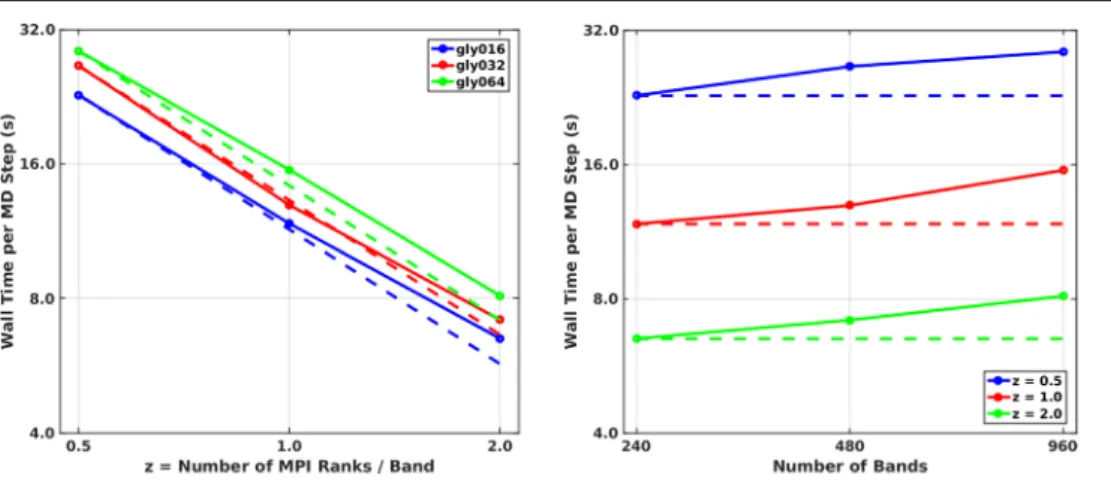
The MLWF-based exact-exchange algorithm in CP employs a hybrid MPI/OpenMP parallelization strategy that has been extensively optimized for use on large-scale mas-sively-parallel (super-) computer architectures. The required set of Poisson equations—each one treated as an independent task—are distributed across a large number of MPI ranks/ processes using a task distribution scheme designed to mini-mize the communication and to balance computational work-load. Performance profiling demonstrates excellent scaling up to 30 720 cores (for the α-glycine molecular crystal, see figure 1) and up to 65 536 cores (for (H2O)256, see [43]) on
Mira (BG/Q) with extremely promising efficiency. In fact, this algorithm has already been successfully applied to the study of long-time MD simulations of large-scale condensed-phase systems such as (H2O)128 [43, 52]. For more details on the performance and implementation of this exact-exchange algo-rithm, we refer the reader to [44].
2.1.2. Dispersion interactions. Dispersion, or van der Waals, interactions arise from dynamical correlations among charge fluctuations occurring in widely separated regions of space. The resulting attraction is a non-local correlation effect that cannot be reliably captured by any local (such as local den-sity approximation, LDA) or semi-local (generalized gradi-ent approximation, GGA) functional of the electron density [54]. Such interactions can be either accounted for by a truly non-local exchange-correlation (XC) functional, or modeled by effective interactions amongst atoms, whose parameters are either computed from first principles or estimated semi-empirically. In Quantum ESPRESSO both approaches are implemented. Non-local XC functionals are activated by selecting them in the input_dft variable, while explicit interactions are turned on with the vdw_corr option. From the latter group, DFT-D2 [10], Tkatchenko–Scheffler [11], and exchange-hole dipole moment models [12, 13] are cur-rently implemented (DFT-D3 [55] and the many-body disper-sion (MBD) [56–58] approaches are already available in a development version).
2.1.2.1. Non-local van der Waals density functionals. A fully non-local correlation functional able to account for van der Waals interactions for general geometries was first devel-oped in 2004 and named vdW-DF [59]. Its development is firmly rooted in many-body theory, where the so-called adia-batic connection fluctuation-dissipation theorem (ACFD)
[60] provides a formally exact expression for the XC energy through a coupling constant integration over the response function—see section 2.1.4. A detailed review of the vdW-DF formalism is provided in [9]. The overall XC energy given by the ACFD theorem—as a functional of the electron density
n—is then split in vdW-DF into a GGA-type XC part E0 xc[n] and a truly non-local correlation part Enl
c[n], i.e.
Exc[n] =E0xc[n] +Enlc[n],
(7) where the non-local part is responsible for the van der Waals forces. Through a second-order expansion in the plasmon-response expression used to approximate the plasmon-response func-tion, the non-local part turns into a computationally tractable form involving a universal kernel Φ(r,r),
Enl c[n] = 12
drdr n(r) Φ(r,r)n(r).
(8)
The kernel Φ(r,r) depends on r and r only through q0(r)|r−r| and q0(r)|r−r|, where q0(r) is a function of n(r) and ∇n(r). As such, the kernel can be pre-calculated, tab-ulated, and stored in some external file. To make the scheme self-consistent, the XC potential Vnl
c(r) =δEnlc[n]/δn(r) also needs to be computed [61]. The evaluation of Enl
c[n] in equation (8) is computationally expensive. In addition, the evaluation of the corresponding potential Vnl
c(r) requires one spatial integral for each point r. A significant speedup can be achieved by writing the kernel in terms of splines [62]
Φ(r,r) = Φq0(r),q0(r),|r−r|)
≈
αβ
Φ(qα,qβ,|r−r|)pαq
0(r)pβq0(r),
(9) where qα are fixed values and pα are cubic splines. Equation (8) then becomes a convolution that can be simplified to
Enl c[n] = 12
αβ
drdr θ
α(r) Φαβ(|r−r|)θβ(r)
= 1 2
αβ
dkθ∗α(k) Φαβ(k)θβ(k). (10)
Here θα(r) =n(r)pαq0(r) and θα(k) is its Fourier trans-form. Accordingly, Φαβ(k) is the Fourier transform of the original kernel Φαβ(r) = Φ(qα,qβ,|r−r|). Thus, two spa-tial integrals are replaced by one integral over Fourier trans-formed quantities, resulting in a considerable speedup. This approach also provides a convenient evaluation for Vnl
c(r). The vdW-DF functional was implemented in
Quantum ESPRESSO version 4.3, following
equa-tion (10). As a result, in large systems, compute times in vdW-DF calculations are only insignificantly longer than for standard GGA functionals. The implementation uses a tabulation of the Fourier transformed kernel Φαβ(k) from equation (10) that is computed by an auxiliary code,
generate_vdW_kernel_table.x, and stored in the external
file vdW_kernel_table. The file then has to be placed either
[63]. The proper spin extension of vdW-DF, termed svdW-DF [64], was implemented in Quantum ESPRESSO version 5.2.1.
Although the ACFD theorem provides guidelines for the total XC functional in equation (7), in practice E0
xc[n] is approximated by simple GGA-type functional forms. This has been used to improve vdW-DF—and correct the often too large binding separations found in its original form—by optimizing the exchange contribution to E0
xc[n]. The naming convention for the resulting variants is that the extension should describe the exchange functional used. In this context, the functionals vdW-DF-C09 [65], vdW-DF-obk8 [66], vdW-DF-ob86 [67], and vdW-DF-cx [68] have been developed and implemented in Quantum ESPRESSO. While all of these variants use the same kernel to evaluate Enl
c[n], advances have also been made in slightly adjusting the kernel form, which is referred to and implemented as vdW-DF2 [69]. A corresponding variant,
i.e. vdW-DF2-b86r [70], is also implemented. Note that vdW-DF2 uses the same kernel file as vdW-DF.
The functional VV10 [71] is related to vdW-DF, but adheres to fewer exact constraints and follows a very different design philosophy. It is implemented in Quantum ESPRESSO
in a form called rVV10 [72] and uses a different kernel and kernel file that can be generated by running the auxiliary code
generate_vdW_kernel_table.x.
2.1.2.2. Interatomic pairwise dispersion corrections. An alter-native approach to accounting for dispersion forces is to add to the XC energy E0
xc a dispersion energy, Edisp, written as a
damped asymptotic pairwise expression:
Exc=Exc0 +Edisp, Edisp=−12
n=6,8,10
I=J
C(n)IJ fn(RIJ)
Rn IJ
(11)
where I and J run over atoms, RIJ=|RI−RJ| is the
inter-atomic distance between atoms I and J, and fn(R) is a suitable damping function. The interatomic dispersion coef-ficients C(n)IJ can be derived from fits, as in DFT-D2 [10], or
calculated non-empirically, as in the Tkatchenko–Scheffler (TS-vdW) [11] and exchange-hole dipole moment (XDM) models [12, 13].
In XDM, the C(n)IJ coefficients are calculated assuming that
dispersion interactions arise from the electrostatic attraction between the electron-plus-exchange-hole distributions on different atoms [12, 13]. In this way, XDM retains the sim-plicity of a pairwise dispersion correction, like in DFT-D2, but derives the C(n)IJ coefficients from the electronic
proper-ties of the system under study. The damping functions fn in equation (11) suppress the dispersion interaction at short distances, and serve the purpose of making the link between the short-range correlation (provided by the XC functional) and the long-range dispersion energy, as well as mitigating erroneous behavior from the exchange functional in the rep-resentation of intermolecular repulsion [13]. The damping functions contain two adjustable parameters, available online [73] for a number of popular density functionals. Although any functional for which damping parameters are avail-able can be used, the functionals showing best performance when combined with XDM appear to be B86bPBE [74, 75] and PW86PBE [75, 76], thanks to their accurate modeling of Pauli repulsion [13]. Both functionals have been implemented
in Quantum ESPRESSO since version 5.0.
In the canonical XDM implementation, recently included
in Quantum ESPRESSO and described in detail
else-where [77], the dispersion coefficients are calculated from the electron density, its derivatives, and the kinetic energy density, and assigned to the different atoms in the system using a Hirshfeld atomic partition scheme [78]. This means that XDM is effectively a meta-GGA functional of the dis-persion energy whose evaluation cost is small relative to the rest of the self-consistent calculation. Despite the conceptual and computational simplicity of XDM, and because the dis-persion coefficients depend upon the atomic environment in a physically meaningful way, the XDM dispersion correction offers good performance in the calculation of diverse proper-ties, such as lattice energies, crystal geometries, and surface Figure 1. Strong (left) and weak (right) scaling plots on Mira (BG/Q) for hybrid-DFT simulations of the α-glycine molecular crystal polymorph using the linear-scaling exact-exchange algorithm in CP. In these plots, unit cells containing 16–64 glycine molecules (160–640 atoms, 240–960 bands) were considered as a function of z, the number of MPI ranks per band (z=0.5−2). On Mira, 30 720 cores (1920 MPI ranks × 16 OpenMP threads/rank × 1 core/OpenMP thread) were utilized for the largest system (gly064, z=2), retaining over 88%
adsorption energies. XDM is especially good for modeling organic crystals and organic/inorganic interfaces. For a recent review, see [13].
The XDM dispersion calculation is turned on by specifying vdw_corr=’xdm’ and optionally selecting appropriate damping function parameters (with the xdm_a1 and xdm_a2 keywords). Because the reconstructed all-electron densities are required during self-consistency, XDM can be used only in combination with a PAW approach. The XDM contribution to forces and stress is not entirely consistent with the energies because the current implementation neglects the change in the dispersion coefficients. Work is ongoing to remove this limi-tation, as well as to make XDM available for Car–Parrinello MD, in future Quantum ESPRESSO releases.
In the TS-vdW approach (vdw_corr=’ts-vdw’), all vdW parameters (which include the atomic dipole polariz-abilities, αI, vdW radii, R0
I, and interatomic C(IJ6) dispersion
coefficients) are functionals of the electron density and com-puted using the Hirshfeld partitioning scheme [78] to account for the unique chemical environment surrounding each atom. This approach is firmly based on a fluctuating quantum har-monic oscillator (QHO) model and results in highly accurate C(6)
IJ coefficients with an associated error of approximately
5.5% [11]. The TS-vdW approach requires a single empirical range-separation parameter based on the underlying XC func-tional and is recommended in conjunction with non-empirical DFT functionals such as PBE and PBE0. For a recent review of the TS-vdW approach and several other vdW/dispersion corrections, please see [79].
The implementation of the density-dependent TS-vdW cor-rection in Quantum ESPRESSO is fully self-consistent [80] and currently available for use with norm-conserving pseudo-potentials. An efficient linear-scaling implementa-tion of the TS-vdW contribuimplementa-tion to the ionic forces and stress tensor allows for Born–Oppenheimer and Car–Parrinello MD simulations at the DFT+TS-vdW level of theory; this approach has already been successfully employed in long-time MD simulations of large-scale condensed-phase sys-tems such as (H2O)128 [43, 52]. We note in passing that the
Quantum ESPRESSO implementation of the TS-vdW
correction also includes analytical derivatives of the Hirshfeld weights, thereby completely reflecting the change in all TS-vdW parameters during geometry/cell optimizations and MD simulations.
2.1.3. Hubbard-corrected functionals: DFT+U. Most approx-imate XC functionals used in modern DFT codes fail quite spectacularly on systems with atoms whose ground-state electronic structure features partially occupied, strongly localized orbitals (typically of the d or f kind), that suffer from strong self-interaction effects and a poor description of electronic correlations. In these circumstances, DFT+U is often, although not always, an efficient remedy. This method is based on the addition to the DFT energy functional EDFT
of a correction EU, shaped on a Hubbard model Hamilto-nian: EDFT+U=EDFT+EU. The original implementation in
Quantum ESPRESSO, extensively described in [81, 82], is based on the simplest rotationally invariant formulation of
EU, due to Dudarev and coworkers [83]:
EU= 1 2
I
UI m,σ
nIσ
mm−
m
nIσ
mmnImσm
,
(12)
where
nIσ
mm =
k,ν fσ
kνψkσν|φImφIm|ψkσν,
(13)
|ψσ
kν is the valence electronic wave function for state kν of spin σ, fσ
kν is the corresponding occupation number, |φIm is the chosen Hubbard manifold of atomic orbitals, centered on atomic site I, that may be orthogonalized or not. The pres-ence of the Hubbard functional results in extra terms in energy derivatives such as forces, stresses, elastic constants, or force-constant (dynamical) matrices. For instance, the additional term in forces is
FU Iα=−
1 2
I,m,m,σ UIδmm
−2nImmσ ∂nIσ
mm ∂RIα
(14)
where RIα is the α component of position for atom I in the unit cell,
∂nIσ
mm ∂RIα
=
k,ν fσ
kν
ψσkν
∂φ
I m ∂RIα
φIm|ψkσν
+ψσkν|φIm
∂φI
m ∂RIα
ψkσν
. (15)
2.1.3.1. Recent extensions of the formulation. As a correc-tion to the total energy, the Hubbard funccorrec-tional naturally contributes an extra term to the total potential that enters the KS equations. An alternative formulation [14] of the DFT + U method, recently introduced and implemented in
Quantum ESPRESSO for transport calculations,
elimi-nates the need of extra terms in the potential by incorporating the Hubbard correction directly into the (PAW) pseudopoten-tials through a renormalization of the coefficients of their non-local terms.
EU+J=
I,σ UI−JI
2 Tr
nIσ(1
−nIσ)+ I,σ
JI
2Tr
nIσnI−σ. (16) The on-site exchange coupling JI not only reduces the effec-tive Coulomb repulsion between like-spin electrons as in the simpler Dudarev functional (first term of the right-hand side), but also contributes a second term that acts as an extra pen-alty for the simultaneous presence of anti-aligned spins on the same atomic site and further stabilizes ferromagnetic ground states.
The fully rotationally invariant scheme of Liechtenstein
et al [84], generalized to non-collinear magnetism and two-component spinor wave-functions, is also implemented in the current version of Quantum ESPRESSO. The corrective energy term for each correlated atom can be quite generally written as:
Efull
U = 12
αβγδ
Uαβγδc†
αc†βcδcγDFT
= 1 2
αβγδ
Uαβγδ−Uαβδγnαγnβδ, (17)
where the average is taken over the DFT Slater determinant, Uαβγδ are Coulomb integrals, and some set of orthonormal spin-space atomic functions, {α}, is used to calculate the occu-pation matrix, nαβ, via equation (13). These basis functions could be spinor wave functions of total angular momentum j=l±1/2, originated from spherical harmonics of orbital momentum l, which is a natural choice in the presence of spin–orbit coupling. Another choice, adopted in our imple-mentation, is to use the standard basis of separable atomic functions, Rl(r)Ylm(θ,φ)χ(σ), where χ(σ) are spin up/down projectors and the radial function, Rl(r), is an eigenfunction of the pseudo-atom. In the presence of spin–orbit coupling, the radial function is constructed by averaging between the two radial functions Rl±1/2. These radial functions are read from the file containing the pseudopotential, in this case a fully-relativistic one. In this conventional basis, the corrective functional takes the form:
Efull
U = 12
ijkl,σσ
Uijklnσσik nσ σ jl −12
ijkl,σσ
Uijlknσσik nσ σ jl ,
(18)
where {ijkl} run over azimuthal quantum number m. The second term contains a spin-flip contribution if σ=σ. For collinear magnetism, when nσσ
ij =δσσnσij, the present
form-ulation reduces to the scheme of Liechtenstein et al [84]. All Coulomb integrals, Uijkl, can be parameterized by few input
parameters such as U (s-shell); U and J (p-shell); U,J and B
(d-shell); U,J,E2, and E3 (f-shell), and so on. We note that if
all parameters but U are set to zero, the Dudarev functional is recovered.
2.1.3.2. Calculation of Hubbard parameters. The Hub-bard corrective functional EU depends linearly upon the effective on-site interactions, UI. Therefore, using a proper value for these interaction parameters is crucial to obtain
quantitatively reliable results from DFT+U calculations. The
Quantum ESPRESSO implementation of DFT+U has
also been the basis to develop a method for the calcul ation of U [81], based on linear-response theory. This method is fully ab initio and provides values of the effective interactions that are consistent with the system and with the ground state that the Hubbard functional aims at correcting. A comparative analysis of this method with other approaches proposed in the literature to compute the Hubbard interactions has been initi-ated in [82] and will be further refined in forthcoming publica-tions by the same authors.
Within linear-response theory, the Hubbard interactions are the elements of an effective interaction matrix, computed as the difference between bare and screened inverse suscep-tibilities [81]:
UI =χ−1 0 −χ−1
II.
(19) In equation (19) the susceptibilities χ and χ0 measure the response of atomic occupations to shifts in the potential acting on the states of single atoms in the system. In particular, χ is defined as χIJ=mσdnIσ
mm/dαJ and is evaluated at self
consistency, while χ0 has a similar definition but is computed before the self-consistent re-adjustment of the Hartree and XC potentials. In the current implementation these susceptibili-ties are computed from a series of self-consistent total energy calculations (varying the strength α of the perturbing potential over a range of values) performed on supercells of sufficient size for the perturbations to be isolated from their periodic replicas. While easy to implement, this approach is quite cum-bersome to use, requiring multiple calculations, expensive convergence tests of the resulting parameters and complex post-processing tools.
These difficulties can be overcome by using density-func-tional perturbation theory (DFpT) to automatize the calcul-ation of the Hubbard parameters. The basic idea is to recast the entries of the susceptibility matrices into sums over the BZ:
dnIσ
mm dαJ =
1
Nq
Nq
q
eiq·(Rl−Rl)∆s
qnsmmσ,
(20)
where I≡(l,s) and J≡(l,s), l and l label unit cells, s and s label atoms in the unit cell, R
l and Rl are Bravais lattice
vectors, and ∆sqnsσ
mm represent the (lattice-periodic) response
of atomic occupations to monochromatic perturbations con-structed by modulating the shift to the potential of all the periodic replicas of a given atom by a wave-vector q. This quantity is evaluated within DFpT (see section 2.2), using linear-response routines contained in LR_Modules (see
problem for schemes based on perturbations to the potential. Full details about this implementation will be provided in a forthcoming publication [85] and the corresponding code will be made available in one of the next Quantum ESPRESSO
releases.
2.1.4. Adiabatic-connection fluctuation-dissipation theory. In the quest for better approximations for the unknown XC energy functional in KS-DFT, the approach based on the adiabatic connection fluctuation-dissipation (ACFD) theorem [60] has received considerable interest in recent years. This is largely due to some attractive features: (i) a formally exact expression for the XC energy in term of density linear response functions can be derived providing a promising way for a systematic improvement of the XC functional; (ii) the method treats the exchange energy exactly, thus canceling out the spurious self-interaction error present in the Hartree energy; (iii) the cor-relation energy is fully non local and automatically includes long-range van der Waals interactions (see section 2.1.2.1).
Within the ACFD framework a formally exact expression for the XC energy Exc of an electronic system can be derived:
Exc=−2π
1
0 dλ
drdr e2 |r−r|
×
∞
0 χλ(r,r
, iu)du+δ(r−r)n(r),
(21)
where =h/2π and h is the Planck constant, χλ(r,r; iu) is the density response function at imaginary frequency iu of a system whose electrons interact via a scaled Coulomb interac-tion, i.e.λe2/|r−r|, and are subject to a local potential such that the electronic density n(r) is independent of λ, and is thus equal to the ground-state density of the fully interacting system
(λ=1). The XC energy, equation (21), can be further sepa-rated into a KS exact-exchange energy Exx, equation (6), and
a correlation energy Ec. The former is routinely evaluated as in
any hybrid functional calculation (see section 2.1.1). Using a matrix notation, the latter can be expressed in a compact form in terms of the Coulomb interaction, vc=e2/|r−r|, and of
the density response functions:
Ec=−2π
1
0 dλ
∞
0 dutr
vc[χλ(iu)−χ0(iu)].
(22)
For λ >0, χλ can be related to the noninteracting density response function χ0 via a Dyson equation obtained from TDDFT:
χλ(iu) =χ0(iu) +χ0(iu)λvc+fxcλ(iu)χλ(iu). (23) The exact expression of the XC kernel fxc is unknown, and
in practical applications one needs to approximate it. In the
ACFDT package, the random phase approximation (RPA),
obtained by setting fλ
xc=0, and the RPA plus exact-exchange kernel (RPAx), obtained by setting fλ
xc=λfx, are imple-mented. The evaluation of the RPA and RPAx correlation energies is based on an eigenvalue decomposition of the non-interacting response functions and of its first-order correction in the limit of vanishing electron-electron interaction [86–88].
Since only a small number of these eigenvalues are relevant for the calculation of the correlation energy, an efficient itera-tive scheme can be used to compute the low-lying modes of the RPA/RPAx density response functions.
The basic operation required for the eigenvalue decompo-sition is a number of loosely coupled DFpT calculations for different imaginary frequencies and trial potentials. Although the global scaling of the iterative approach is the same as for implementations based on the evaluation of the full response matrices (N4), the number of operation involved is 100 to 1000
times smaller [87], thus largely reducing the global scaling pre-factor. Moreover, the calculation can be parallelized very efficiently by distributing different trial potentials on different processors or groups of processors.
In addition, the local EXX and RPA-correlation potentials can be computed through an optimized effective potential (OEP) scheme fully compatible with the eigenvalue decom-position strategy adopted for the evaluation of the EXX/RPA energy. Iterating the energy and the OEP calculations and using an effective mixing scheme to update the KS potential, a self-consistent minimization of the EXX/RPA functional can be achieved [89].
2.2. Linear response and excited states without virtual orbitals
One of the key features of modern DFT implementations is that they do not require the calculation of virtual (unoccupied) orbitals. This idea, first pioneered by Car and Parrinello in their landmark 1985 paper [53] and later adopted by many groups world-wide, found its way in the computation of excited-state properties with the advent of density-functional perturbation theory (DFpT) [90–93]. DFpT is designed to deal with static perturbations and its use is therefore restricted to those excita-tions that can be described in the Born–Oppenheimer approx-imation, such as lattice vibrations. The main idea underlying DFpT is to represent the linear response of KS orbitals to an external perturbation as generic orbitals satisfying an orthogo-nality constraint with respect to the occupied-state manifold and a self-consistent Sternheimer equation [94, 95], rather than as linear combinations of virtual orbitals (which would require the computation of all, or a large number, of them).
excited states is optimal in those cases where one is interested in a few excitations only, but can hardly be extended to con-tinuous spectra, such as those arising in extended systems or above the ionization threshold of even finite ones. In those cases where extended portions of a continuous spectrum is required, a new method has been developed, based on the Lanczos bi-orthogonalization algorithm, and dubbed the Liouville– Lanczos approach to time-dependent density-functional per-turbation theory (TDDFpT). This method allows one to reuse intermediate products of an iterative process, essentially iden-tical to that used for static perturbations, to build dynamical response functions from which spectral properties can be computed for a whole wide spectral range at once [21, 22]. A similar approach to linear optical spectroscopy was proposed later, based on the multi-shift conjugate gradient algorithm [102], instead of Lanczos. This powerful idea has been gen-eralized to the solution of the Bethe–Salpeter equation, which is formally very similar to the eigenvalue equations arising in TDDFpT [103–105], and to the computation of the polariza-tion propagator and self-energy operator appearing in the GW
equations [28, 29, 106]. It is presently exploited in several components of the Quantum ESPRESSO distribution, as well as in other advanced implementations of many-body per-turbation theory [106].
2.2.1. Static perturbations and vibrational spectroscopy. The computation of vibrational properties in extended sys-tems is one of the traditional fields of application of DFpT, as thoroughly described, e.g. in [93]. The latest releases of
Quantum ESPRESSO feature the linear-response
imple-mentation of several new functionals in the van der Waals and DFT+U families. Explicit expressions of the XC kernel, imple-mentation details, and a thorough benchmark are reported in [107] for the first case. As for the latter, DFpT+U has been implemented for both the Dudarev [83] and DFT+U+J0 functionals [15], allowing one to account for electronic local-ization effects acting selectively on specific phonon modes at arbitrary wave-vectors, thus substantially improving the description of the vibrational properties of strongly correlated systems with respect to ‘standard’ LDA/GGA functionals. The current implementation allows for both norm-conserving and ultrasoft pseudopotentials, insulators and metals alike, also including the spin-polarized case. The implementation of DFpT+U requires two main additional ingredients with respect to standard DFpT [108]. First, the dynamical matrix contains an additional term coming from the second derivative of the Hubbard term EU with respect to the atomic positions (denoted λ or μ), namely:
∆µ(∂λEU) =
Iσmm
UIδmm 2 −nImmσ
∆µ∂λnIσ
mm
−
Iσmm
UI∆µnIσ
mm∂λnImmσ, (24)
where the notations are the same as in equation (12). The symbols ∂ and Δ indicate, respectively, a bare derivative (leaving the KS wavefunctions unperturbed) and a total deriv-ative (including also linear-response contributions). Second,
in order to obtain a consistent electronic density response to the atomic displacements from the DFT+U ground state, the perturbed KS potential ∆VSCF in the Sternheimer equation is
augmented with the perturbed Hubbard potential ∆λV
U:
∆λV U=
Iσmm
UIδmm
2 −nImmσ
×|∆λφI
mφIm|+|φIm∆λφIm|
− Iσmm
UI∆λnIσ
mm|φImφIm|, (25)
where the notations are the same as in equation (13). The unperturbed Hamiltonian in the Sternheimer equation is the DFT+U Hamiltonian (including the Hubbard potential VU). More implementation details will be given in a forthcoming publication [109].
Applications of DFpT+U include the calculation of the vibrational spectra of transition-metal monoxides like MnO and NiO [108], investigations of properties of materials of geophysical interest like goethite [110, 111], iron-bearing [112, 113] and aluminum-bearing bridgmanite [114]. These results feature a significantly better agreement with experi-ment of the predictions of various lattice-dynamical prop-erties, including the LO-TO and magnetically-induced TO splittings, as compared with standard LDA/GGA calculations.
2.2.2. Dynamic perturbations: optical, electron energy loss, and magnetic spectroscopies. Electronic excitations can be described in terms of the dynamical charge- and spin-density susceptibilities, which are accessible to TDDFT [115, 116]. In the linear regime the TDDFT equations can be solved using first-order perturbation theory. The time Fourier transform of the charge-density response, ˜n(r,ω), is determined by the projection over the unoccupied-state manifold of the Fourier transforms of the first-order corrections to the one-electron orbitals, ψ˜
kν(r,ω), [21–24, 117]. For each band index kν, two response orbitals xkν and ykν can be defined as
xkν(r) =1
2Qˆ
˜
ψkν(r,ω) + ˜ψ−∗kν(r,−ω)
(26)
ykν(r) =1
2Qˆ
˜
ψkν(r,ω)−ψ˜−∗kν(r,−ω)
,
(27)
where Qˆ is the projector on the unoccupied-state manifold.
The response orbitals xkν and ykν can be collected in so-called batches X={xkν} and Y ={ykν}, which uniquely determine the response density matrix. In a similar way, the perturbing potential Vˆ can be represented by the batch Z={zkν}={QˆVˆψkν}. Using these definitions, the linear-response equations of TDDFpT take the simple form:
ω−Lˆ·
X
Y
=
0
Z
, Lˆ=
0 Dˆ
ˆ
D+ ˆK 0
,
(28)
where the super-operators Dˆ and Kˆ, which enter the
defini-tion of the Liouvillian super-operator, Lˆ, are defined in terms
time-independent DFpT. It is important to note that Dˆ and Kˆ,
and therefore Lˆ, do not depend on the frequency ω. For this
reason, when in equation (28) the vector on the right-hand side, (0,Z), is set to zero, a linear eigenvalue equation is obtained (Casida’s equation).
The quantum Liouville equation (28) can be seen as the equation for the response density matrix operator ρˆ(ω), namely (ω−Lˆ)·ρˆ(ω) = [ˆV,ρˆ◦], where [·,·] is the
commu-tator and ρˆ◦ is the ground-state density matrix operator. With this at hand, we can define a generalized susceptibility χAV(ω), which characterizes the response of an arbitrary one-electron Hermitian operator Aˆ to the external perturbation Vˆ as
χAV(ω) =TrAˆρˆ(ω)=Aˆ (ω−Lˆ)−1 ·[ˆV,ρˆ◦],
(29)
where ·|· denotes a scalar product in operator space. For instance, when both Aˆ and Vˆ are one of the three Cartesian components of the dipole (position) operator, equation (29) gives the dipole polarizability of the system, describing optical absorption spectroscopy [21, 22]; setting Aˆ and Vˆ to one of the space Fourier components of the electron charge-density oper-ator would correspond to the simulation of electron energy loss or inelastic x-ray scattering spectroscopies, giving access to plasmon and exciton excitations in extended systems [25, 26]; two different Cartesian components of the Fourier transform of the spin polarization would give access to spectroscopies probing magnetic excitations (e.g. inelastic neutron scattering or spin-polarized electron energy loss) [118], and so on. When dealing with macroscopic electric fields, the dipole operator in periodic boundary conditions is treated using the standard DFpT prescription, as explained in [119, 120].
The Quantum ESPRESSO distribution contains
sev-eral codes to solve the Casida’s equation or to directly com-pute generalized susceptibilities according to equation (29) and by solving equation (28) using different approaches for different pairs of Aˆ/Vˆ, corresponding to different spectros-copies. In particular, equation (28) can be solved iteratively using the Lanczos recursion algorithm, which allows one to avoid computationally expensive inversion of the Liouvillian. The basic principle of how matrix elements of the resolvent of an operator can be calculated using a Lanczos recursion chain has been worked out by Haydock et al [121, 122] for the case of Hermitian operators and diagonal matrix elements. The quantity of interest can be written as
gv(ω) =v(ω−ˆL)−1v.
(30)
A chain of vectors is defined by
|q0=0
(31)
| (32)q1=|v
αn =qn|ˆLqn
(33)
βn+1|qn+1= (ˆL−αn)|qn −βn|qn−1,
(34) where βn+1 is given by the condition qn+1|qn+1=1. The vectors |qn created by this recursive chain are orthonormal.
Furthermore, the operator Lˆ, written in the basis of these
vec-tors, is tridiagonal. If one limits the chain to the M first vectors
|q0,|q1,· · ·,|qM, then the resulting representation of ˆL is a
M×M square matrix TM which reads
TM=
α1 β2 0 · · · 0
β2 α2 β3 . .. ...
0 β3 . .. . .. 0
..
. . .. ... αM−1 βM
0 · · · 0 βM αM
.
(35)
Using such a truncated representation of ˆL, the resolvent in
equation (30) can be approximated as
gv(ω)≈v(ω−TM)−1 v.
(36)
Thanks to the tridiagonal form of TM, the approximate resol-vent can finally be written as a continued fraction
gv(ω)≈ 1
ω−α1+ β
2 2
ω−α2+...
.
(37)
Note that performing the recursion (31)–(34) is the compu-tational bottleneck of this algorithm, while evaluating the continued fraction in equation (37) is very fast. The recursion being independent of the frequency ω, a single recursion chain yields information about any desired number of frequencies, at negligible additional computational cost. It is also impor-tant to note that at any stage of the recursion chain, only three vectors need to be kept in memory, namely |qn−1, |qn, and |qn+1. This is a considerable advantage with respect to the direct calculation of N eigenvectors of ˆL where all N vectors
need to be kept in memory in order to enforce orthogonality. The Liouvillian Lˆ in equation (28) is not a Hermitian
oper-ator. For this reason, the Lanczos algorithm presented above cannot be directly applied to the calculation of the general-ized susceptibility (29). There are two distinct algorithms that can be applied in the non-Hermitian case. The non-Hermitian Lanczos bi-orthogonalization algorithm [22, 23] amounts to recursively applying the operator Lˆ and its Hermitian
conju-gate Lˆ† to two Lanczos vectors |v
n and |wn. In this way, a
pair of bi-orthogonal basis sets is created. The operator Lˆ can
then be represented in this basis as a tridiagonal matrix, simi-larly to the Hermitian case, equation (35). The Liouvillian Lˆ
of TDDFpT belongs to a special class of non-Hermitian oper-ators which are called pseudo-Hermitian [24, 123]. For such operators, there exists a second recursive algorithm to com-pute the resolvent—pseudo-Hermitian Lanczos algorithm—
which is numerically more stable and requires only half the number of operations per Lanczos step [24, 123]. Both algo-rithms have been implemented in Quantum ESPRESSO. Because of its speed and numerical stability, the use of the pseudo-Hermitian method is recommended.