REVISITING TRANSACTIONS: DEVELOPING A COMPREHENSIVE METHOD TO MEASURE PARENT-CHILD ENGAGEMENT
Thelma E. Uzonyi
A dissertation submitted to the faculty at the University of North Carolina at Chapel Hill in partial fulfillment of the requirements for the degree of Doctor of Philosophy in the Department
of Allied Health Sciences in the School of Medicine (Speech and Hearing Sciences).
Chapel Hill 2020
Approved by: Elizabeth R. Crais Linda R. Watson Karen A. Erickson
Eric A. Hodges
iii ABSTRACT
Thelma E. Uzonyi: Revisiting Transactions: Developing a Comprehensive Method to Measure Parent-Child Engagement
(Under the direction of Elizabeth R. Crais)
This dissertation comprises two studies relating to transactions in parent-child
engagement within a population of young children at-risk for autism spectrum disorder (ASD). The first study examined the establishment of transactional engagement (i.e., the phenomenon of how transactional engagement is established in reciprocal behaviors) between parents and their young children at-risk for ASD. In the study sample, established transactional engagement occurred at a higher rate than other levels of engagement. Additionally, transactional engagement had a higher likelihood of being established when parents initiated. The second study expanded the former study findings by measuring the length of transactions. In the study sample,
iv
v
ACKNOWLEDGEMENTS
I thankfully acknowledge the people who guided me through the doctoral process and made this dissertation possible: my advisors, Elizabeth Crais and Linda Watson; my dissertation committee: Karen Erickson, Eric Hodges, and Jessica Steinbrenner, the team at the Early
vi
TABLE OF CONTENTS
LIST OF TABLES...ix
LIST OF FIGURES ... x
LIST OF ABBREVIATIONS ... xi
CHAPTER 1: INTRODUCTION TO TWO STUDIES OF TRANSACTIONAL ENGAGEMENT BETWEEN PARENTS AND THEIR CHILDREN WITH OR AT-RISK FOR AUTISM SPECTRUM DISORDER...….……….. 1
Defining Transactions...1
Study 1: Measuring Established Transactional Engagement Among Young Children at-risk for Autism Spectrum Disorder ... 3
Study 2: Measuring Parent-Child Transactions for Early Identification of Young Children with Autism Spectrum Disorder... 4
Conclusion: Beyond the Coding — Implications for Early Identification of ASD and Clinical Intervention ... 4
CHAPTER 2: MEASURING TRANSACTIONAL ENGAGEMENT AMONG YOUNG CHILDREN AT-RISK FOR AUTISM SPECTRUM DISORDER... 6
Introduction ... 6
Transactions... 9
Significance of Transactions in ASD... 10
Purpose...11
Methods ...13
Research Design...13
vii
Current Study Participants and Procedures... 15
Coding Development... 16
Coding Procedures...16
Reliability and Validity... 20
Results ... 21
Aim 1 ... 21
Aim 2 ... 23
Aim 3 ... 24
Post hoc Analyses ... 25
Discussion ... 28
Limitations ... 32
Conclusion ...33
CHAPTER 3: MEASURING PARENT-CHILD TRANSACTIONS FOR EARLY IDENTIFICATION OF YOUNG CHILDREN WITH AUTISM SPECTRUM DISORDER .………...35
Introduction ... 35
Purpose... 38
Methods ... 39
Research Design... 39
EDP-2 Participants and Study Procedures... 40
Current Study Participants and Procedures………...41
Coding Development... 42
Coding Procedures ... 43
viii
Results ... 47
Aim 1 ... 49
Aim 2 ... 50
Aim 3 ... 51
Post hoc Analyses... 53
Discussion ... 55
Limitations ... 60
Conclusion ... 60
CHAPTER 4: BEYOND THE CODING: IMPLICATIONS FOR EARLY IDENTIFICATION OF ASD AND CLINICAL INTERVENTION ... 62
Differences Between Studies……... 62
General Transaction Characteristics... 67
Implications for Early Identification of ASD... 68
Implications for Clinical Intervention and Assessment ... 69
Future Directions ... 72
APPENDIX A: TEC CODING MANUAL... 73
APPENDIX B: TEC-E CODING MANUAL... 100
ix
LIST OF TABLES
Table 1 - Demographic characteristics of current study sample compared to full
EDP-2 sample... 15
Table 2 - Codes for initiation and response types in TEC... 18
Table 3 - Count and proportions of ETE, IR, and I………... 22
Table 4 - Regression analysis of ETE on initiator and initiator behavior... 24
Table 5 - Regression analysis of ADOS on ETE, IR and M proportions... 25
Table 6 - Count and proportions of miscues... 26
Table 7 - Regression analysis of ADOS on miscue proportion and miscue count... 27
Table 8 - Regression analysis of ADOS on parent miscue count and child miscue count... 28
Table 9 - Demographic characteristics of participants in EDP-2 and current study... 42
Table 10 - Codes for discourse function of turn and clarity of cue in TEC-E... 45
Table 11 - Transaction characteristics per 10-minute videos in the sample... 48
Table 12 - Transaction initiations by cue type per 10-minute videos in the sample... 48
Table 13 - Regression analysis of transaction length on actor and type of initiating cue... 50
Table 14 - Count and proportions of miscues………... 51
Table 15 - Regression analysis of ADOS CSS on median length of transaction and proportion of child miscues... 53
Table 16 - Effect of logged median length of transaction on ADOS CSS by child sex... 54
x
LIST OF FIGURES
Figure 1 - Transactional Model of Development... 2 Figure 2 - Conceptual Model of Transactions in parent-child engagement ... 12 Figure 3 - Examples of ETE, IR and I...19 Figure 4 - Proportion of coded behaviors in parent-child engagement. ETE,
established transactional engagement; IR, initiation response; I,
xi
LIST OF ABBREVIATIONS
ADOS Autism Diagnostic Observation Schedule
ADOS CSS Autism Diagnostic Observation Schedule Calibrated Severity Scores AIC Akaike information criterion
ART Adapted Responsive Teaching ASD Autism Spectrum Disorder EDP-2 Early Development Project-2
ETE Established Transactional Engagement FYI First Year Inventory
ICC Intra-class correlation IR Initiation-Response Only I Initiation Only
M Miscue
M Mean
RA Research assistant SD Standard deviation
TEC Transactional Engagement Coding
1
CHAPTER 1: INTRODUCTION TO TWO STUDIES OF TRANSACTIONAL ENGAGEMENT BETWEEN PARENTS AND THEIR CHILDREN WITH OR AT-RISK
FOR AUTISM SPECTRUM DISORDER
The two studies and conclusion presented in this dissertation expand on the concept of transactions from the transactional model of development (Sameroff, 1975, 1987, 2009) and explore methods of measuring transactions within a sample of young children at-risk for autism spectrum disorder (ASD). The first study explored how the beginning behaviors of transactional engagement can be measured with the development of a novel coding system. Using the same data set with a different random sample, the second study expanded the coding system to measure the length of transactions and examined if specific characteristics of transactions may indicate a later diagnosis of ASD. The conclusion highlights the implications of the study results with respect to early identification of ASD, clinical intervention aimed at improving
transactional engagement, and future directions in research. The purpose of this introduction is to provide a baseline understanding of transactions and describe how both studies deepen our collective understanding of the concept of transactions relative to young children at-risk for ASD.
Defining Transactions
The concept of transactions emerges from Sameroff’s transactional model of
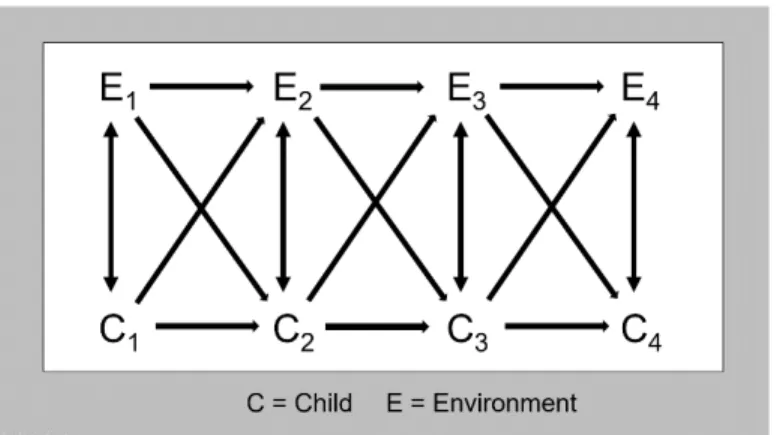
development (1975, 1987, 2009). The core assertion of the transactional model (Figure 1) is that child development occurs through continuous and dynamic exchanges between the child and his or her environment. These continuous and dynamic exchanges are often referred to as
2
1975, 1987, 2009). Sameroff emphasizes that the exchanges between a child and parent are bidirectional, interdependent and ever changing. This means that within transactions, the dyadic schema changes, adapts or develops, such that the behavior of one partner is impacted by the previous behavior of the other partner (Fogel, 2009; Sameroff, 2009). Similarly, Sameroff and Mackenzie (2003) argue that transactions are identified within a dyad when one activity changes another activity either qualitatively or quantitatively. Transactions can be viewed through a longitudinal lens or a moment-to-moment lens. In other words, transactions can be viewed as an ongoing process of bidirectional dyadic effects over months or years, or as they occur in real-time on a microsecond-by-microsecond basis (Sameroff, 2009), although the latter is
understudied. Intervention studies often aim to show longitudinal transactional effects, especially if the intervention is directed towards either a child or parent and shows later effects in the behavior of the other (Sameroff & Mackenzie, 2003).
Figure 1.Transactional Model of Development. Note. Modified from Sameroff (2009). The integration of the transactional model in language and social communication development is recognized in both the neuro-typical and ASD literatures (Kublin, Wetherby, Crais, & Prizant, 1989; Tamis-LeMonda, Bornstein, & Baumwell, 2001; Wan, Green,
3
interactions, responses of one partner are contingent on the response of the other partner. However, with transactions, the responses between the partners are contingent and the schema changes, adapts or develops, which is marked by something new in the experience (Sameroff, 2009). For example, imagine a child rolls a ball and the parent rolls the ball back. For this engagement to be considered a transaction, the child’s next action should be contingent on the parent’s response and the schema of engagement (i.e., rolling the ball) should change in some way (e.g., parent rolls the ball and the child laughs while trying to roll the ball back). The child’s response of rolling the ball back was contingent on the parent rolling the ball to the child, and the schema changed by the child showing enjoyment of the engagement by laughing.
Since transactions appear to play a critical role in child development, and the transactional model of development has been used as a framework for several intervention studies, the two studies in this dissertation expand on the concept of transactions to gain a deeper understanding of the transactional features between parents and children and the role that
transactions play in parent-child engagement, specifically for young children at-risk for ASD. Brief descriptions of the two studies and the conclusion are below.
Study 1: Measuring Established Transactional Engagement Among Young Children at-risk for Autism Spectrum Disorder
4
behaviors present in parent-child engagement. Specifically, the study examined the establishment of transactional engagement (i.e., the phenomenon of how transactional engagement is
established in reciprocal behaviors) between mothers and their young children at-risk for ASD. Study 2: Measuring Parent-Child Transactions for Early Identification of Young Children with Autism Spectrum Disorder
Several early behaviors associated with ASD can be identified when children are
engaging with their parents (Baranek, 1999), and Wan et al. (2013) suggest that using the context of parent-child engagement to assess ASD risk may be a more sensitive reflection of early
atypical behavior compared to structured measures given in unfamiliar contexts. The findings of the first study suggest that measuring parent-child transactions using a detailed micro-level coding tool may be a promising method of assessing for risk of ASD among young children. Specifically, transactions within parent-child engagement may capture atypical social behavior associated with ASD, and thus aid in earlier identification of the disorder. Therefore, the second study aimed to investigate if the length of transactions (i.e., number of reciprocal turns) and/or the presence of miscues (i.e., partner passively observes without providing a physical or
communicative indication to the other partner) was predictive of a later ASD diagnosis within a sample of young children at-risk for ASD. The coding tool used in the first study was expanded to capture additional details of transactions to address the research aims in study 2.
Conclusion: Beyond the Coding — Implications for Early Identification of ASD and Clinical Intervention
5
caregivers are incredibly important due to the critical influence of parent-child engagement on child development (Harrist & Waugh, 2002; Hwa-Froelich, 2014; National Institute of Child Health and Human Development, 2006), and the potential of diminishing cascading effects (Dawson, 2008; Wan et al., 2012) by improving engagement. The results of the two studies also set the stage for the development of a clinical tracking tool aimed at detecting changes in
6
CHAPTER 2: MEASURING TRANSACTIONAL ENGAGEMENT AMONG YOUNG CHILDREN AT-RISK FOR AUTISM SPECTRUM DISORDER
Introduction
Parent-child engagement has significant influence on the progression and trajectory of child development (Harrist & Waugh, 2002; Kublin et al., 1989; Spiker, Boyce, & Boyce, 2002; Wetherby et al.,1998) and has been the subject of several research studies in relation to both typically developing children (DiCarlo, Onwujuba, & Baumgartner, 2014; Hilbrink, Gattis, & Levinson, 2015; Hsu & Fogel, 2003; Lasky, 1982) and children with disabilities (Cielinski, Vaughn, Seifer, & Contreras, 1995; Hobson, Tarver, Beurkens, & Hobson, 2016; Howe, 2006; Lasky, 1982). Parent-child engagement and reciprocity over time are linked to several positive child developmental outcomes, such as socialization (Laakso, Poikkeus, Eklund, & Lyytinen, 1999), language learning (Conway et al., 2018), social skills, receptive language, school
readiness (Connell & Prinz, 2002), early literacy skills (Dodici, Draper, & Peterson, 2003), joint engagement (Adamson, Bakeman, Deckner, & Nelson, 2014), cognitive and language abilities (Rafferty, Griffin, & Lodise, 2011), and attachment security (Ainsworth & Bell, 1970; Cassidy, 2016).
7
constructs assess at the micro-level, macro-level, or both (Aspland & Gardner, 2003; Bell & Bell, 1989; Gardner, 2000; Lotzin et al., 2015), with each tool providing different levels of information about the qualities of the individuals in the dyad and the dyad as a whole (Mesman, 2010). Microanalytic tools assess the fine-grained discrete behaviors of either or both partners (Gardner, 2000; Lotzin et al., 2015), whereas macroanalytic tools assess behavioral concepts of the observation as a whole (Bell & Bell, 1989; Lotzin et al., 2015). For example, micro-level observational tools have been used to measure eye contact (Vernon, 2014), physical touch (Chorney, Garcia, Berlin, Bakeman, & Kain, 2010), and verbal responsiveness (Leezenbaum, Campbell et al., 2014). The discrete behaviors are coded as they occur, and there is only one code per behavior (Bakeman & Gottman, 1997). Micro-level tools use time as a basic unit (e.g., coding every five seconds or coding every second) or states as basic units (e.g., marking when a particular state of behaviors occurs; Aspland & Gardner, 2003; Bell & Bell, 1989). Macro-level observational tools have been used to measure the coordination of the behaviors between a parent and infant as whole constructs, such as synchrony (de Mendonça, Cossette, Strayer, & Gravel, 2011) and mutuality (Askan, Kochanska, & Ortmann, 2006). These behaviors are typically combined to derive a scale-based global score reflecting total observed engagement time (Bell & Bell, 1989). Some macro-level tools have separate scales that capture the behaviors of each partner, as well as a scale to capture behaviors of the dyad as a whole.
8
responsive the child was to the parent’s immediate responsiveness (e.g., child makes a bid to engage, the mother responds to the bid to engage, and the child responds to the mother’s bid response). Further, no tool measured the sequence of discrete, reciprocal, ongoing behaviors between a parent and child during a period of observation (e.g., child gestures, mother responds verbally, child responds with a smile, and so on). A handful of studies have addressed parts of the missing aspects described above. For example, Wimpory, Hobson, and Nash (2007)
9
studies to measure engagement is the Engagement State Coding used in Adamson et al. (2014). This coding offers a form of micro-analysis that documents the engagement states of the child with their parent. The coding scheme defines engagement states from the child’s focus of attention and engagement with objects, people, and/or symbols. However, it does not consider engagement states from the parent’s focus of attention.
Since both the parent and child can bring significant contributions to engagement, and both partners can assume reciprocal roles as initiator and responder in the dyad (Bell & Harper, 1980; Cohn & Tronick, 1988; Kelly & Barnard, 2000; Sameroff, 2009; Spiker et al., 2002; Tronick, Als, & Brazelton, 1977; Tronick & Cohn, 1989) it is imperative to develop a tool that measures the specific behaviors of each partner and fully characterizes what each partner brings to engagement and how these characterizations may impact the trajectory of engagement. Since the transactional framework examines both the child’s and parent’s influence on each other (Fogel, 2009; Sameroff, 1975, 1987, 2009; Sameroff & Fiese, 2000), developing an
observational tool with the framework of transactions can address the current lacuna in observational measurement tools. The product of such a tool would provide a detailed, micro-level, multi-dimensional record of the engagement between a parent and child that could not have been captured with traditional micro-level tools that only examine a handful of discrete behaviors or macro-level tools that provide a global view of an engagement construct. Transactions
Transactions are coordinated turn-taking behaviors where the behavior of one partner is influenced by the previous behavior of the other partner in a reciprocal manner such that the engagement schema changes or adapts (Fogel, 2009; Sameroff, 2009). The concept of
10
Sameroff & Fiese, 2000), which posits that child development occurs through continuous and dynamic exchanges between the child and his or her environment. Further, the model suggests that within parent-child engagement, each partner is influenced by their previous interpretations of behaviors in past exchanges. The model emphasizes that the exchanges between a parent and child are bidirectional, interdependent and ever changing (Sameroff, 2009), meaning that within transactions, the schema changes, adapts or develops such that one action is impacted by the previous action.
Although the transactional framework has been used to examine parent-child engagement in a variety of contexts (Leezenbaum, et al., 2014; Sameroff & Mackenzie, 2003;
Tamis-LeMonda et al., 2001; Vernon, 2014; Wan et.al, 2013), little research has described the specific characteristics of transactions at the micro-level of parent and child behaviors. Careful
descriptions of the features of transactions, such as the initiator and responder roles, may lead to improved understandings of successful exchanges between a child and parent, and foremost, how engagement is established within the context of transactions. Further, finding a way to measure transactions at the micro-level and apply that measurement clinically is important because it could provide an avenue to assess transactional engagement within populations of children who are neurotypical and non-neurotypical, as well as provide avenues for treatment models targeted at improving engagement. The first step in the exploration of transactions at the micro-level is to determine how transactional engagement is established (i.e., how it begins).
Significance of Transactions in ASD
11
Children with ASD may show signs of disengagement by the end of the first year of life (Campbell et al., 2015; Ozonoff et al., 2010), which may hinder the quality of parent-child engagement and thus future child development (Spiker et al., 2002). The cascading of possible effects makes transactions relating to ASD trajectories especially important. For example, Green et al. (2015) hypothesized that the early neurodevelopmental impairments of ASD, which relate to the deviations in dyadic engagement, may intensify pre-existing vulnerability and lead to progressively atypical trajectories on the path to later ASD diagnosis. This hypothesis is supported by Wan et al. (2013) whose data suggest that dyadic mutuality (a measurement of dyadic engagement) and infant attention to their parent at 12-months predicted ASD diagnosis at three years of age. Additionally, lower quality parent-child engagement has been found to correlate with the child’s severity of ASD (Hobson et al., 2016). If the long-term goal is to improve engagement skills for children with ASD, then a comprehensive understanding of successful exchanges between a child and parent, and foremost, how engagement is established and maintained, is needed. Using the framework of transactions to achieve this goal is a logical strategy.
Purpose
12
Sameroff’s claim that transactions are clear in the relationship between a child and parent. Second, Sameroff suggests that to assess reciprocal actions, a minimum of three turn-taking actions should occur where a response behavior is impacted by the previous behavior of the other partner, meaning, there must be response behaviors from both partners to determine if responses were reciprocal. Third, transactional behaviors are related, meaning a joint referent must be present (i.e., the object or focus of the dyad’s attention).
Figure 2. Conceptual Model of Transactions in Parent-Child Engagement. Note. Adapted by T.
Uzonyi from Sameroff (2009).
The study had the following aims:
Aim 1. Identify the proportion of ETE occurrences within parent-child dyads in
comparison to other levels of engagement (i.e., initiation-response only or initiation only). Given Sameroff’s (2009) theory that transactions are omnipresent and ever occurring, it was
hypothesized that ETE would have a higher proportion than initiation-response only or initiation only levels of engagement.
13
a touch behavior is clearer to the observer than a look behavior (Dunst, 1985; Rogers, 1988; Yoder, 1987), it was hypothesized that touch initiations would result in a higher rate of ETE.
Aim 3. Determine if the proportion of each level of engagement at one-year of age was associated with the presence of ASD at 2-years of age. This aim was exploratory and therefore there was no basis for a hypothesis prior to the study.
Methods Research Design
This study used extant data obtained from the Early Development Project-2 (EDP-2) at the University of North Carolina-Chapel Hill (PIs: Linda Watson and Elizabeth Crais,
R324A100305, Institute of Education Sciences, U.S. Department of Education, Efficacy of a Parent-Mediated Intervention for One-Year-Olds at-Risk for Autism, 7/1/2010 - 6/31/2014). The
EDP-2 data set was ideal for the current study for three primary reasons: (1) all infants in EPD-2 met criteria for being “at-risk” for ASD based on a sensitive and reliable screening tool used at 12-months of age, and accompanying outcome measures were completed for participants; (2) parent-child engagement was video recorded between 13 and 16-months of age in a lab setting with standardized toys; and (3) the EDP-2 study used a transactional perspective in its theoretical framework.
EDP-2 Participants and Study Procedures
Families were recruited through the North Carolina birth certificate registry by mailing out the First Year Inventory version 2.0 ([FYIv2.0] Baranek, Watson, Crais, & Reznick, 2003) to parents of one-year-old children. The FYIv2.0 is a parent report screening tool that assesses two domains of early symptoms associated with ASD risk: social-communication and
14
with scores of ≥ 94th percentile in the social-communication domain and ≥ 88th percentile in the sensory-regulatory domain. Of the 8,429 returned FYIs, 280 children met the dual cut-off criteria for being “at-risk”. Of the “at-risk” children, 87 participated in the EDP-2 study with a parent. Families with last names of Hispanic origin were not included in FYI mailings based on the large proportion in the catchment area who were predominantly Spanish-speaking, and families of identified children who spoke English less than 50% of the time at home were excluded from the original study due to the lack of validated instruments and translation of the intervention
materials into languages other than English. IRB approval of the study and consent for all participants were obtained as part of the EDP-2 study.
All 87 children were assessed, and participants were subsequently randomized into two groups: a group assigned to participate in an experimental intervention called Adapted
Responsive Teaching (ART), and a control group that was referred to community early
15
Ten-minute videotaped parent-child “free-play” sessions with standardized toys were video recorded at all three time points in a lab setting. Parents were asked to play with their child as they typically would at home. In an effort to promote naturalistic play, researchers were not present in the playroom at the time of the recording.
Current Study Participants and Procedures
Thirty of the 87 original parent-child free-play videos from Time 1 were randomly selected for use in the current study. The video selection included children in both the intervention and monitoring group, and only 30 videos were selected due to feasibility of
resources. Demographics for the participants are presented in Table 1, which shows the children in the current study are not statistically different from the overall EDP-2 sample.
Table 1
Demographic characteristics of current study sample compared to full EDP-2 sample
EDP-2 Current Study p
Chronological Age in Months Mean (SD) age at pretest Time 1
Range 13.75 (.77) 13-16 13.57 (.69) 13-15 t(85) = -1.48, p = 0.14 Mean (SD) age at Time 2
Range 22.53 (.86) 20-25 22.46 (.92) 21-25 t(81) = -0.49, p = 0.62 Sex
Boys 60/87 (68.97%) 23/30 (76.66%) X2(1, N = 87) = 1.78, = 0.18 p Race
White (68.97%) 60/87 (80.00%) 24/30
X2(2, N = 87) = 2.54,
p = .28 African-American (20.69%) 18/87 (10.00%) 3/30
16 Coding Development
The Transactional Engagement Coding (TEC) was developed by the researcher. The TEC was adapted from the Partial Interval Time Sampling of Adaptive Strategies for the Useful Speech Project (Yoder et al., 2010) because of its use in measuring child initiations and parent
responses in the EDP-2 study, as well as its utility for identifying parent-child responsiveness behaviors demonstrated in other studies (Carter et al., 2011; Flippin & Watson, 2015).
The TEC (see Appendix A) is a microanalytic coding system developed to measure the discrete initiation and response behaviors during parent-child engagement using a transactional perspective. Using theory, methods, and definitions similar to Yoder et al. (2010), the TEC classifies initiation behaviors by type (i.e., look or touch) and response behaviors by type (i.e., physical play, communication, both physical play and communication, or no response). Consistent with the transactional perspective, behaviors are coded when the dyad has a joint referent and their engagement schema changes as a result of the behaviors of each partner. Coding Procedures
The coding procedures occurred in two stages. Using interval coding methods, the first stage involved trained coders using the TEC to code the discrete initiation and response behaviors of the parent and child occurring in each interval. The second stage involved
17
In stage 1, trained coders coded free-play videos using Observer 6.1 XT software (Noldus, 2006) with time interval sampling. The intervals were set at 7.5 seconds (81 intervals total). Interval coding was used to capture the occurrence of three turn-taking behaviors happening close together. Following recommendations of Yoder, Lloyd, and Symons (2018), each 10-minute video was coded in its entirety to allow for as much observational data as possible. Videos were coded on a single pass to capture the parent and child engaging as a unit and ensure that behaviors were related to the same topic. In other words, all child and parent behaviors were coded at the same time, rather than watching the video on one pass for child behaviors and another pass for parent behaviors. However, coders were able to watch intervals several times before assigning a code. Counts, proportions and reliability were calculated using Observer 6.1 XT software (Noldus, 2006).
18 Table 2
Codes for initiation and response types in TEC
Initiation Types Response Types
Look: The action of looking at an object or person for at least 1 second. Looking is inferred by the direction the nose is pointing. Look is also coded if the child/parent
communicates via word, vocalization, gesture, or sign.
Physical Play:Ways parent and children physically play through demonstration, imitation, or aiding.
Communication: A word, vocalization, gesture, or sign used by the child/parent. Touch: The action of moving an object with
one’s hand or to move one’s hand or fingers on
an object for at least 1 second. Both Physical Play & Communication: Both properties of physical play and communication occur at the same time.
No Response: The parent or child does not respond to the previous behavior of their partner.
Within the initiation types, look and touch were mutually exclusive codes. A look was coded if a child/parent looked at an object without touching the object. A touch was coded if the child/parent touched an object. When touch was coded, it was implied that the child/parent was also looking at what they were touching. In some cases, a child/parent was looking at something different than what they were touching. If this was the case, credit was given to the initiation type that the partner responded to. For example, if the child looked at a bus, but touched a ball, and the parent’s response was, “That’s a bus”, then the child initiation was coded as a look with the bus considered as the joint referent.
At times, a child/parent produced some kind of communication as an initiation. Since there was not a separate communication type in initiations within the coding scheme,
communication initiations were coded as look. If a partner produced some kind of
19
Within response types, physical play, communication, both physical play and
communication, and no response were mutually exclusive codes. If a child/parent played with an
object while communicating about it, then both physical play and communication was coded. When physical play, communication and both physical play and communication were coded, it was implied that the child/parent was also looking at what they were playing with or
communicating about. In some cases, a child/parent looked at something different than what they were playing with or communicating about. If this was the case, credit was given to the response type that the partner responded to. Further details and specific coding examples are presented in Appendix A.
In stage 2, once coding was completed, the researcher categorized the coded discrete behaviors into levels of engagement for data analysis. The levels were: Initiation only (I),
Initiation-Response only (IR), and ETE. I was the base level (see Figure 3) because theoretically, there cannot be a response without an initiation. In other words, I is the base because it marks the beginning of all possible instances of engagement. The next level of engagement was IR, and the upper level of engagement was ETE, which required an initiation followed by a response from each partner. These levels of engagement were developed by the researcher through theoretical exploration of Sameroff’s (2009) writings.
20 Reliability and Validity
Reliability. Reliability was calculated at the interval level using Observer 6.1 XT software (Noldus, 2006) via its program selection of Cohen’s kappa, which adjusts for chance agreement between two coders (Aspland & Gardner, 2003; Cohen, 1960). Although there is no recommended threshold for reliability, Aspland and Gardner (2005) suggests k = 0.70 is acceptable. The main coder and research assistant first established interrater reliability on practice videos (average training reliability was k = 0.78). Reliability coding was conducted periodically through the coding process to check for coder drift. To accomplish this, the two coders were both assigned the same randomly selected videos. The coders were blind to the videos they were jointly coding to determine reliability. The average reliability for the 20% of all videos that were coded by both coders was k = 0.83.
Validity. Content and construct validity were addressed during the development of the coding system. As applied to a coding manual, Yoder, Lloyd, and Symons (2018) describe content validity as the relevance and representativeness of the examples and definitions to the stated object of measurement, and they describe construct validity as the degree to which a measurement system yields variables that perform as expected by theory and logic. In the current study, the code content was based on the work of Yoder and colleagues (2010) from the Partial Interval Time Sampling of Adaptive Strategies for the Useful Speech Project, which supports it
21 Results
The current study used a transactional approach to measure initiation and response behaviors within engagement between parents and their infants at-risk for an ASD diagnosis. Results are presented for each study aim first, with post hoc analyses presented last.
Aim 1
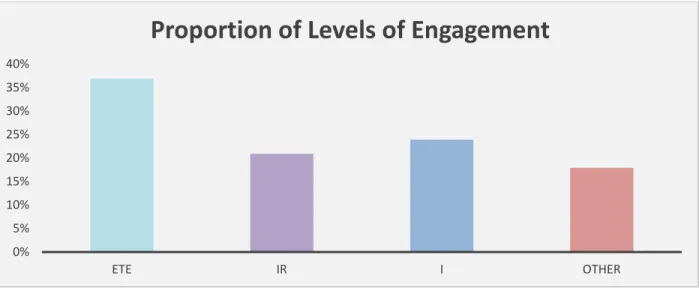
The first aim of the study was to compare the proportion of ETE occurrences within parent-child dyads to the proportion of other levels of engagement (i.e., IR and I). Proportions were calculated based on the total count of all levels of engagement across time intervals divided by the total count of each level of engagement. Figure 4 presents the proportions of each level of engagement, with 37% reflecting ETE, 21% IR and 24% I. Outside of the pre-defined levels of engagement, a series of undefined behaviors occurred which were labeled “other”. These undefined behaviors are discussed in the post hoc analyses. Table 3 displays the count and proportions of ETE, IR and I for each dyad.
Figure 4. Proportion of coded behaviors in parent-child engagement. ETE, established transactional engagement; IR, initiation response only; I, initiation only; Other.
0% 5% 10% 15% 20% 25% 30% 35% 40%
ETE IR I OTHER
22 Table 3
Count and proportions of ETE, IR, and I ID Codable intervals
(out of 81) count ETE proportion ETE count IR proportion IR count I proportion I
1 50 17 0.340 13 0.260 9 0.180
2 49 17 0.347 9 0.184 12 0.245
3 70 33 0.471 20 0.286 11 0.157
4 48 18 0.375 10 0.208 10 0.208
5 44 12 0.273 8 0.182 5 0.114
6 77 26 0.338 15 0.195 23 0.299
7 59 19 0.322 7 0.119 18 0.305
8 62 21 0.339 17 0.274 20 0.323
9 67 24 0.358 18 0.269 18 0.269
10 47 17 0.362 15 0.319 7 0.149
11 65 30 0.462 15 0.231 9 0.138
12 56 9 0.161 16 0.286 21 0.375
13 64 20 0.313 10 0.156 23 0.359
14 73 47 0.644 8 0.110 6 0.082
15 62 17 0.274 9 0.145 15 0.242
16 59 27 0.458 13 0.220 9 0.153
17 62 35 0.565 10 0.161 4 0.065
18 66 39 0.591 10 0.152 9 0.136
19 78 44 0.564 9 0.077 10 0.128
20 48 12 0.250 19 0.396 7 0.146
21 58 36 0.621 15 0.259 2 0.034
22 60 8 0.133 9 0.150 19 0.317
23 75 4 0.053 17 0.227 51 0.680
24 76 21 0.276 16 0.211 26 0.342
25 61 23 0.377 9 0.148 16 0.262
26 64 22 0.344 20 0.313 16 0.250
27 49 5 0.102 15 0.306 19 0.388
28 63 13 0.206 6 0.095 34 0.540
29 75 42 0.560 11 0.147 13 0.173
30 52 24 0.462 12 0.231 8 0.154
23 Aim 2
The second aim of the study was to determine if variation in the initiator (i.e., parent or child) and the type of initiation behavior (i.e., touch or look) was associated with ETE. An ordered probit regression was used in this analysis since the theoretical basis of the levels of engagement was on a scale (i.e., ETE being highest on the scale, then IR, then I). The
independent variables in the model were the initiator and initiation behavior, and the dependent variable was ETE on an ordered scale. Upon visual inspection of the data, ETE ordered data were skewed to the right. Thus, a log transformation of the ETE ordered data was used to fit the data more closely to a normal distribution. When the standard errors were plotted, the points indicated a pattern of heteroscedasticity, meaning there was variance in the error terms across the variables. To correct for this variance, the robust standard errors were used in the estimation of the model. Additionally, the model clustered the data by participant to account for the data points being correlated in repeated measures for individual participants.
24
insignificant relationship with the likelihood of ETE when random effects were included in the model (p = 0.656) and when fixed effects were included in the model (p = 0.717).
Table 4
Regression analysis of ETE on initiator and initiator behavior
Variables β Robust Std. Err. p
ETE; child initiations, parent initiations 0.204 0.103 0.048*
ETE; look initiations, touch initiations -0.109 0.157 0.489
Note. *p < .05., **p < .01., ***p < .001.
Aim 3
The third aim was to determine if the proportion of each level of engagement at one-year of age was associated with the presence of ASD at 2-years of age. Post-intervention/monitoring measures of the ADOS (Lord et al., 2012) classifications at Time 2 were analyzed with
transactional coding data. Time 2 ADOS classifications were selected over follow-up time point ADOS classifications because the age range of the children was more similar in age at Time 2 (20-24 months) in comparison to the follow-up time point (36-60 months). Additionally, more participants had ADOS scores at Time 2 (27 of 30) in comparison to the follow-up time point (18 of 30).
An ordered probit regression model was used to determine if the proportion of ETE, IR, or I at age one was associated with ASD at age 2. This approach to analysis was selected because the dependent variable, ADOS classification, falls on an ordered scale (0 being
25
codable intervals. The model accounted for group effects by including intervention/monitoring group assignments. Additionally, the log transformation was used for all levels of engagement because the data were skewed to the right. Heteroscedasticity was again found in the plotted standard errors; thus, the robust standard errors were used in the estimation of the model. Results showed that the proportions of ETE (p = 0.592), IR (p = 0.174), and I (p = 0.838), had no
discernable effect on the likelihood of an ASD diagnosis at age 2 (see Table 5). Table 5
Regression analysis of ADOS on ETE, IR and M proportions
Variables β Robust Std. Err. p
ADOS; ETE proportion 0.397 0.741 0.592
ADOS; IR proportion -0.774 0.569 0.174
ADOS; I proportion 0.108 0.526 0.838
Note. *p < .05., **p < .01., ***p < .001.
Post hoc Analyses
26
frequently enough that it was subsequently added to the coding procedures. Miscues accounted for 18% of coded intervals in relation to ETE, IR and I levels of engagement.
Given the novelty of the emergence of the miscue, further analyses were conducted to examine which partner in the dyad displayed a higher proportion of miscues. Proportions were calculated by the count of coded miscues by partner within intervals divided by the count of all codable intervals. Within the sample, children displayed a higher mean proportion of miscues (M = 0.104) than their parents (M = 0.080); however, the difference was not statistically significant in a paired t-test (t(29) = 1.168, p = 0.252). Additionally, children displayed less variance in their miscue behavior (SD = 0.066) compared to their parents (SD = 0.074. Descriptive data for
miscues are presented in Table 6.
Table 6
Count and proportions of miscues ID Codable
intervals (out of 81)
Miscue
count Miscue prop ID intervals (out Codable of 81)
Miscue
count Miscue prop
1 50 11 0.220 16 59 10 0.169
2 49 11 0.224 17 62 13 0.210
3 70 6 0.086 18 66 8 0.121
4 48 10 0.208 19 78 18 0.231
5 44 19 0.432 20 48 10 0.208
6 77 13 0.169 21 58 5 0.086
7 59 15 0.254 22 60 24 0.400
8 62 4 0.065 23 75 3 0.040
9 67 7 0.104 24 76 13 0.171
10 47 8 0.170 25 61 13 0.213
11 65 11 0.169 26 64 6 0.094
12 56 10 0.179 27 49 10 0.204
13 64 11 0.172 28 63 10 0.159
14 73 12 0.164 29 75 9 0.120
27
Based on the literature suggesting that atypical dyadic patterns at 12-months predict ASD diagnosis at age 3-years (Wan et al., 2013), further post-hoc analyses were conducted to
determine if miscues at 1-year of age were associated with ASD at 2-years of age. An ordered probit regression model was used to determine if miscues at age 1 were associated with ASD at age 2, where the independent variable in the model was the proportion of miscues, and the dependent variable was ADOS classifications from Time 2 on an ordered scale. Proportions were calculated by the count of coded miscue by partner within intervals divided by the count of all codable intervals. The model accounted for group effects by including group assignments (i.e., intervention/monitoring). Additionally, the log transformation was used for miscues because the data were skewed to the right. Heteroscedasticity was again found in the plotted standard errors; thus, the robust standard errors were used in the estimation of the model. Results (Table 7) showed that the proportion of miscues had no discernable effect on the likelihood of a later ASD diagnosis at age 2 (p = 0.285). To further investigate the presence of miscues without the relation of its proportion to other codable intervals, the counts of miscues were analyzed in the model (Table 7). The results indicated that a higher count of miscues increased the likelihood of having ASD at age 2 (p = 0.025). These results were driven by the count of child miscues (p = 0.005) rather than the count of parent miscues (p = 0.154) shown in Table 8.
Table 7
Regression analysis of ADOS on miscue proportion and miscue count
Variables β Robust Std. Err. p
ADOS; Miscue
proportion 0.801 0.749 0.285
ADOS; Miscue count 1.80 0.802 0.025*
28 Table 8
Regression analysis of ADOS on parent miscue count and child miscue count
Variables β Robust Std. Err. p
ADOS; Parent M
count 0.643 0.451 0.154
ADOS; Child M
count 1.13 0.405 0.005**
Note. *p < .05., **p < .01., ***p < .001.
Discussion
The results of this study contribute to the body of knowledge surrounding parent-child engagement by outlining a novel approach to measuring reciprocal engagement while illustrating different levels of engagement behavior present between parents and their young children who are at-risk for ASD. Further, the study takes the first steps in filling the gap in documenting the micro-level transactions between parents and their children at-risk for ASD. The study findings suggest that transactions are indeed occurring at the micro-level (at least at the basic level of ETE), and that these transactions can be reliably measured through an observational
measurement tool (i.e., the TEC). It further supports previous research by demonstrating that discrete behaviors can be measured (Bell & Bell, 1989; Chorney et al., 2010; Vernon, 2014), and extends the previous research by showing that the reciprocal discrete behaviors from each partner can be measured. The findings also begin to implicate the salient characteristics of transactions (i.e., initiations, responses), and how these discrete behaviors can be classified into three levels of engagement (i.e., ETE, IR, I) and miscues.
29
(Sameroff, 2009) in that there are response behaviors from both partners. Additionally, the study bolsters the argument that both parents and children can assume reciprocal roles as initiator and responder in the dyad (Spiker et al., 2002). Clinically, this study offers support for encouraging initiations from both members of the dyad. In many parent mediated interventions (Green et al., 2010; Siller, Hutman, & Sigman, 2013; Stadnick, Stahmer, & Brookman-Frazee, 2015), parents are encouraged to set up communication and learning opportunities by signaling/initiating with their child, or by setting up the environment to encourage their child to initiate. Further, this provides evidence in support of the fundamental importance of self-initiations in children with ASD (Buggey, Hoomes, Sherberger, & Williams, 2011; Koegel, Carter, & Koegal, 2003; Shabani et al., 2002).
30
Look and touch initiation behaviors did not appear to have a differential effect on ETE. This is surprising considering past research on infant clarity of cues, which suggests that touching an object is a clearer cue to a partner in comparison to looking at an object (Dunst, 1985; Rogers, 1988; Yoder, 1987; Yoder, Warren, Kim, Gazdag, & Center, 1994), and a clear cue is thought to be a bid for engagement. One reason to explain the lack of effect of type of behavior on ETE lies in the coding definition. In the coding definition, look behaviors could encompassed communication acts (i.e., vocalizations, verbalizations and/or gestures). It could be that combining look and communication initiating behaviors did not provide a clear picture of their impact on ETE in relation to touch initiating behaviors. It could be the case that touch behaviors may have had a stronger effect than look behaviors, but it may not have been detected since look behaviors could be combined with communication behaviors. Consideration was also given to external factors that could have impacted the results of look and touch initiation
31
moment may have been missed. Thus, the missed intentions may have also impacted the results of look and touch initiation behaviors not affecting ETE.
The presence of miscues added an intriguing dimension to parent-child engagement. In the study sample, children displayed a higher mean proportion of miscues in comparison to their parents. This finding supported past research in that children with disabilities have a difficult time providing clear cues to partners (Yoder, 1987). In considering the possible effects of miscues on later child outcomes, there was mixed evidence suggesting that miscues may be an early indicator of ASD. Although the proportion of miscues in a dyad did not predict ASD, children with a high count of miscues early had a higher likelihood of ASD diagnosis at 2-years-old. The difference in results between the proportion and counts may be due to how the
32
Given the possibility that the wide range of uncodable intervals impacted the
denominator for the proportions of miscues, the same notion extends to the proportions of ETE, IR and I, particularly in its analysis with ASD at age 2. Although the proportions of ETE, IR, and I had no discernable effect on the likelihood of an ASD diagnosis, it could be the case that using the counts of ETE, IR and I would provide a more accurate indicator of the levels of engagement given the high variability of uncodable intervals. Therefore, in future extensions of this research, efforts will be made to either ensure less variability in uncodable segments or the use of the counts of coded behaviors in analyses.
Limitations
Although this study contributes to the body of knowledge by outlining a novel approach in assessing parent-child engagement, there were several issues that arose during the course of the study that resulted in limitations of the project. First, it was originally thought that using interval coding was the best method to capture three turn-taking behaviors occurring close together, and that 7.5 second intervals was enough time to allow for three turn-taking behaviors to occur. However, the structure of the interval coding resulted in lost data, where either more than three turn-taking behaviors occurred in a 7.5 second interval, or where turn-taking behaviors spanned across intervals. In both situations, a portion of the data were not coded, resulting in lost data. Behaviors were only coded if they occurred within the defined 7.5 second interval, and only the first three related turn-taking actions in an interval were coded. Also, within interval coding, it may have been the case that the initiating behavior in an interval was a continuation of
33
appropriate method of measuring behaviors, where each behavior would have been coded and data would not have been lost.
Second, the coding definitions in the TEC may not have labeled each behavior
appropriately. For example, as described earlier, communication initiations were assigned a look code. Additionally, when physical play, communication and both physical play and
communication were coded, it was implied that the child/parent was also looking at what they
were playing with/ communicating about. However, there were cases when the child/parent was looking at something different than what they were touching or talking about, and in this case, what they were looking at may have been an intention of engagement that was not coded. Another issue that arose with coding was that miscues were not defined prior to coding. Rather, the researcher had to go back through the videos and review each miscue to try to gain an understanding of its occurrence. Ideally, all behavior types would be classified and defined prior to coding (Yoder, et al., 2018). In future studies, the TEC will be modified to address these coding issues to better reflect the behaviors that occurred.
Third, the data set for the additional analyses did not include ADOS scores for all 30 participants. Scores from 3 participants were missing in the sample, and it is unclear if the data were missing at random, completely missing at random or not random at all.
The limitations presented were all “lessons learned” that will be addressed in future extensions of this research.
Conclusion
34
well as salient characteristics of their behaviors. The findings indicate that parents are responding to their children and that children are responding to their parent’s initiating engagement
behavior. Further, the engagement types derived from the discrete behaviors show promising evidence in predicting later ASD diagnosis. Future directions include, expanding the TEC to measure the length of transactional engagement in the number of turns, improving on the
35
CHAPTER 3: MEASURING PARENT-CHILD TRANSACTIONS FOR EARLY IDENTIFICATION OF YOUNG CHILDREN WITH AUTISM SPECTRUM DISORDER
Introduction
Autism spectrum disorder (ASD) is a pervasive neurodevelopmental disorder
characterized by impairments in social communication and engagement, and restricted, repetitive patterns of behavior, interests, or activities (American Psychiatric Association, 2013).
Characteristics of the disorder can be seen in the first year of life (Baranek, 1999; Baron-Cohen et al., 1996; Lord, 1995; Werner et al., & 2000), specifically as early as 6-months old (Saint-Georges et al., 2011; Zwaigenbaum et al., 2005). It has been argued, and widely accepted, that identification of ASD, or risk for ASD, should be made early in the developmental period (age 18-months and younger) to allow children to access intervention as soon as possible and to take advantage of brain plasticity in early sensitive periods to potentially modify abnormalities in brain circuitry (Dawson, 2008; Zwaigenbaum, Bryson, & Garon, 2013). However, the average age of ASD diagnosis is not until age 3 to 4 years old (Baio, 2014; Christensen et al., 2016; Jo et al., 2015). This is in spite of the American Academy of Pediatrics recommendation that
surveillance should occur at all pediatric visits, with specific ASD screening at both 18 and 24 months (Dosreis, Weiner, Johnson, & Newschaffer, 2006). One of the reasons for this
36
2015). Such uncertainties may drive professionals to look for multiple sources of evidence to confirm the presence of ASD.
In an effort to provide corroborating evidence to support a suspected ASD profile, a brief direct observation of the child, specifically during parent-child engagement, may provide a clearer picture of the child’s skills and impairments. Examining early parent-child engagement may also provide a more comprehensive understanding of the development of ASD (Dawson, 2008; Wallace & Rogers, 2010; Wan et al., 2013) since several early behaviors of ASD can be identified when a child is engaging with their parent (Baranek, 1999). For example, 6-month-old infants who had a later diagnosis of ASD demonstrated lower infant-initiated social orientation to their parents (Saint-Georges et al., 2011). Additionally, Osterling and Dawson (1994) found that decreased looking at the face of another person, showing, pointing, and failing to orient to name classified 91% of infants at 12-months of age who were later diagnosed with ASD. Further, social markers that distinguish 12-month-old infants with ASD from those who are typically developing include decreased joint attention, social engagement, social anticipation, eye contact and response to name (Dawson, Webb, Carver, Panagiotides, & McPartland, 2004; Maestro et al., 2006; Werner et al., 2000). One study showed that the context of parent-child engagement to assess for ASD risk may be more sensitive to early atypical behavior in
comparison to structured measures used in unfamiliar contexts (Wan et al., 2013). Specifically, infant’s lower dyadic mutuality with parents at 12-months, predicted a later ASD diagnosis at age 3-years in at-risk siblings, whereas ASD-related behavioral atypicalities, as rated by the Autism Observation Scale for Infants (AOSI; Bryson & Zwaigenbaum, 2014) at 6 and 12
37
The aforementioned studies add to the growing evidence supporting the use of parent-child engagement to assess for ASD at an early age. Uzonyi, Crais, Baranek, and Watson (2019) support the use of transactions to measure the discrete reciprocal behaviors in parent-child engagement. Using transactions to examine parent-child engagement allows for the opportunity to see behavioral characteristics of each social partner, as well as their bidirectional influence. Further, Uzonyi et al. (2019) demonstrated that transactions consider the attentional focus of the dyad, the discourse function of each turn (i.e., initiation and response), the clarity of cues
provided by each partner (i.e., look, touch, communication) and the presence of miscues (i.e., partner passively observing without providing a physical or communicative indication to the other partner). Additionally, results indicated that transactions were more likely to occur when engagement was initiated by a parent, and that the count of child miscues within transactions was associated with later diagnostic symptoms of ASD in the child.
38
parent’s cues. This may be a result of the fact that the cues are not clear enough for them to read and understand or the children are not aware of the cue because of their social deficits. Either way, children with ASD may require more clarity in cues or multi-modal cues (i.e., touching an object while talking about the object [Tamis-LeMonda, Kuchirko, & Tafuro, 2013]), to be able to read and understand cues within transactions. Further, it is likely that the length of a transaction (i.e., the number of turns) is impacted by the presence of ASD, because children with ASD may already show signs of disengagement by the end of the first year of life (Campbell et al., 2015), which may hinder sustained parent-child engagement. These characteristics of transactions, along with others, show potential in offering a detailed view of atypical engagement associated with ASD; however, the core characteristics of transactions at the moment-to-moment level are still relatively unknown.
Purpose
The purpose of this study was to further explore the salient characteristics of transactions within parent-child engagement and to investigate relationships between these salient
characteristics and future diagnosis of ASD. The study had the following aims:
39
hypothesis that transactions initiated with combined communication and touch cues would be longer in length in comparison to transactions initiated with communication cues, touch cues, or look only cues for both parent and child-initiated transactions.
Aim 2. Determine if there are differences in the proportion of miscues among parents and children. Given that children in Uzonyi et al. (2019) had a higher proportion of miscues than their parents, albeit a non-significant difference, it was hypothesized that children in this sample would also have a greater proportion of miscues than parents.
Aim 3. Determine if the length of parent and child-initiated transactions and proportion of child miscues at 1-year of age are predictive of ASD diagnosis at preschool age. Given that children with ASD demonstrate impairments in engagement (American Psychiatric Association, 2013) and that children with ASD may already show signs of disengagement by the end of the first year of life (Campbell et al., 2015), it was hypothesized that shorter transaction length and higher proportions of child miscues at 1-year of age would be associated with an ASD diagnosis at preschool age.
Methods
Research Design
This study used extant data obtained from the Early Development Project-2 (EDP-2) at the University of North Carolina-Chapel Hill (PIs: Linda Watson and Elizabeth Crais,
R324A100305, Institute of Education Sciences, U.S. Department of Education, Efficacy of a Parent-Mediated Intervention for One-Year-Olds at-Risk for ASD, 7/1/2010 - 6/31/2014). The
40
participants; and (3) parent-infant engagement was video recorded between 13 and 16 months of age in a lab setting with standardized toys.
EDP-2 Participants and Study Procedures
Families were recruited to the original study through the North Carolina birth certificate registry by mailing out the First Year Inventory version 2.0 ([FYIv2.0], Baranek, Watson, Crais, & Reznick, 2003) to parents of 1-year-old children. The FYIv2.0 is a parent report screening tool that assesses social-communication and sensory-regulation, which are two domains of early symptoms associated with ASD risk (Reznick, Baranek, Reavis, Watson, & Crais, 2007; Turner-Brown, Baranek, Reznick, Watson, & Crais, 2013). Infants were determined to be “at-risk” if they met dual cut-off criteria with scores of ≥ 94th percentile in the social-communication
domain and ≥ 88th percentile in the sensory-regulatory domain. A total of 280 children met the dual cut-off criteria for being “at-risk” of the 8,429 returned FYIs. Of these “at-risk” children, 87 participated in the EDP-2 study with a parent. Families with last names of Hispanic origin were not included in FYI mailings based on the large proportion in the catchment area who were predominantly Spanish-speaking, and families of identified children who spoke English less than 50% of the time at home were excluded from the original study due to the lack of validated instruments and translation of the intervention materials into languages other than English. IRB approval of the study and consent for all participants were obtained in the EDP-2 study.
Per the procedures of the EDP-2 study, all participants were assessed and then randomized into two groups. One group was assigned to participate in an experimental
intervention called Adapted Responsive Teaching (ART). The other group was a control group that was referred to community early intervention services based on parent concerns or
41
ART group were also referred to community early intervention services when warranted, and families in each group pursued community early intervention services in equal proportions. The ART intervention group consisted of 45 parent-child dyads and the control group consisted of 42 parent-child dyads. Children in the study were 12-months old when the FYIv2.0 was completed. Assessments were given at three time points (pre- and post- the intervention and monitoring time period, and follow-up). Children were 13 to 16 months during Time 1 assessments and 20 to 24 months for Time 2 assessments. Follow-up assessments of a subset of the children occurred at preschool age which ranged from 35 to 70 months old. The Autism Diagnostic Observation Schedule ([ADOS] Lord et al., 2012), was given at Times 2 and 3, with several other measures
given at all three timepoints. The ADOS Calibrated Severity Scores ([ADOS CSS] Gotham, Pickles, & Lord, 2009; Shumway et al., 2012) were also calculated as part of the follow-up preschool measures as an indicator of ASD severity.
Ten-minute videos were recorded of parents and their children engaging in “free-play” sessions with standardized toys at all three time points. These sessions were recorded at all three time points in a lab setting. In an effort to promote naturalistic play, parents were asked to play with their child as they typically would at home, and researchers were not present in the
playroom at the time of the recording.
Current Study Participants and Procedures
Of the 87 parent-child free-play videos taken at time 1, there was a follow-up ADOS CSS score at preschool age for 45 children. Of these 45 videos, 30 were randomly selected for the current study. The video selection included children in both the ART intervention and monitoring group, and only 30 videos were selected due to feasibility of resources.
42
differences in age at Time 1 between the children in the larger EDP-2 study and those randomly selected for inclusion for use in the current study, and there were not significant differences in age when the ADOS was completed. There were also no significant differences in the proportion of boys across the two studies, but there were significant differences in racial composition with significantly more children identified as White and significantly fewer children identified as African-American in the current sample than the larger study.
Table 9
Demographic characteristics of participants in EDP-2 and current study
EDP-2 Current Study p
Chronological Age in Months Mean (SD) age at Time 1
Range 13.75 (.77) 13-16 13.77 (.77) 13-15 t(85) = -0.17, p = .86 Mean (SD) age at Time 3
Range 53.96 (11.05) 35-73 56.6 (11.67) 35-73 t(55) = -1.94, p = .06 Sex
Boys (68.97%) 60/87 19/30 (63.33%) X2(1, N = 87) = .68, p = .41 Race
White (68.97%) 60/87 26/30 (86.66%)
X2(2, N = 87) = 8.75, p = .01
African-American (20.69%) 18/87 (0.33%) 1/30
Mixed Race/Other (10.34%) 9/87 (10.00%) 3/30
Coding Development
The Transactional Engagement Coding- Extended (TEC-E) is an extension of the microanalytic coding system previously used to measure the initiation of transactional
43
from the Partial Interval Time Sampling of Adaptive Strategies for the Useful Speech Project (Yoder et al., 2010).
The TEC-E (see Appendix B) is a discrete coding system developed to measure the transactions between a parent and child while engaging with each other. The TEC-E goes beyond this by capturing the onset and offset of a transaction, the actor (i.e., parent or child), the
discourse function of each turn (i.e., initiation, response, miscue, redirection), and the clarity of the cue given within the turn along a four-point cue scale (i.e., look only, touch, communication , both communication and touch). It also captures the length of transaction in number of turns (i.e., 0, 1, 2, 3, 4, 5…+) and a bivariate judgment of the overall quality of transaction (i.e., rich,
lacking). Consistent with the transactional perspective, behaviors are coded when the dyad has a joint referent and their engagement schema changes as a result of the behaviors of each partner. Coding Procedures
Trained coders used a systematic coding scheme, developed by the lead researcher, to code for transactions in the videos. Each 10-minute video was coded in its entirety to allow for as much observational data as possible (Yoder et al., 2018). Videos were coded on a single pass to capture the dyad interacting as a unit and ensure that behaviors were related to the same topic; however, coders were able to watch each video multiple times to apply the coding scheme. Videos were coded on ProcoderDV™ (Tapp, 2003) software using continuous timed event coding. Continuous timed event coding was selected over interval coding to capture the length of transactions without separating behaviors by intervals. ProcoderDV™’s partner program
44
At the completion of the coding, the counts and proportions were used in statistical models to answer the study aims. The ADOS CSS were used in analyses to represent ASD diagnosis because evidence suggests that ADOS CSS is a more valid and stable indicator of ASD symptom severity than the ADOS raw total score (Gotham et al., 2009; Shumway et al., 2012).
As illustrated in Figure 5, the coders followed eight steps when watching the videos: (1) identified and marked the onset of the transaction; (2) coded the actor of each turn; (3) coded the discourse function of each turn; (4) coded the clarity of cue of each turn; (5) repeated steps 2-4 for subsequent turns in each transaction in relation to the joint referent (i.e., the focus of shared attention or interest of both the child and parent including toys, snack items, parent or child) and changed schema (i.e., perception of the schema of engagement changing by the behaviors of each partner); (6) identified and marked the offset of the transaction; (7) determined the length of transaction in number of turns; (8) determined and coded the overall quality of the transaction. Brief descriptions of codes are presented in Table 10.
45 Figure 5. Coding flowchart for the TEC-E.
Table 10
Codes for discourse function of turn and clarity of cue in TEC-E
Discourse Function of Turn Clarity of Cue in Initiations and Responses
Initiation: An act that begins a new topic or does not follow a partner’s act. A joint referent must be established with an initiation.
Look only: The action of looking at an object or person for at least 1 second. A look only should be coded if it is truly the only thing signaling active participation. Looking is inferred by the direction the nose is pointing.
Response: An act pertaining to an established joint referent that follows the other partner’s act within 3 seconds.
Touch: The action of physically touching or attempting to physically touch an object with one’s hand or fingers for at least 1 second. Passively holding an object without moving one’s hand over the object or without moving the object in a way that does not seem purposeful is not coded as a touch.
Miscue: A form of non-response where one partner is passively observing for 3 or more seconds (after the behavior of the pervious partner) but is not acting on the joint referent or communicating with the other partner.
Communication: A word, vocalization, gesture, or sign used by a partner that references the joint referent or is directed towards an object or partner as judged by the direction their nose is pointing. Redirection: An act where the partner responds
by changing the attention away from the established joint referent.
Both Communication and Touch: A cue that has both the properties of a communication and touch cue that are demonstrated at the same time.
= Actor = Discourse function of turn = Clarity of cue of turn = Length of transaction = Quality of transaction
Initiation
Look
Response Miscue Redirection
1, 2, 3, 4, 5, 6, 7, …+ Rich, Lacking Touch Communication Both Communication & Touch Look Touch Communication Both Communication & Touch