Sharif University of Technology
Scientia IranicaTransactions E: Industrial Engineering www.scientiairanica.com
A novel deterministic model for simultaneous weekly
assignment and scheduling decision-making in
operating theaters
M. Haghi
a, S.M.T. Fatemi Ghomi
b;and P. Hooshangi-Tabrizi
b a. Department of Industrial Engineering, Sharif University of Technology, Tehran, Iran.b. Department of Industrial Engineering, Amirkabir University of Technology, Tehran, Iran. Received 6 June 2015; received in revised form 21 May 2016; accepted 20 August 2016
KEYWORDS Operating room scheduling; Elective patients; Recovery beds; Mixed integer linear program;
Meta-heuristic methods.
Abstract.This paper studies a simultaneous weekly assignment and scheduling decision-making problem in operating theaters with elective patients. Because of limited recourses in hospitals, considering assignment and scheduling decisions simultaneously can help mangers exploit the available resources more eciently and make the work-load uniformly distributed during the planning horizon. This procedure can signicantly reduce hospital costs and increase satisfaction of patients and personnel. This paper formulates the mentioned problem as a Mixed Integer Linear Program (MILP) considering applicable assumptions like nite recovery beds and limitation of equipment. Since the problem is NP-hard, in order to solve large-scale instances and deal with the complexity, two eective and ecient algorithms are designed. Finally, as a practical case of study, a real data set of a surgery department of a big hospital in Iran (Aalinasab-e Tabriz) is used to solve the studied problem by the proposed algorithms.
© 2017 Sharif University of Technology. All rights reserved.
1. Introduction
Nowadays, health care costs have grown signicantly and hospital expenditures account for approximately a third of this total amount (Centers for Medicare and Medicaid Services, 2007). Surgery operations incur a large portion of a hospital's total expenses and revenues (Healthcare Financial Management Association 2003). Thus, operating theater as a critical part and the largest consumer of resources in the hospital requires ecient and eective planning to use resources and fa-cilities. Each surgery operation needs a lot of resources, including operating rooms, stas (surgeons, nurses, anesthesiologists, etc.), recovery beds, and surgery
*. Corresponding author. Tel.: +98 21 64545381
E-mail addresses: M [email protected] (M. Haghi); [email protected] (S.M.T. Fatemi Ghomi);
P [email protected] (P. Hooshangi-Tabrizi)
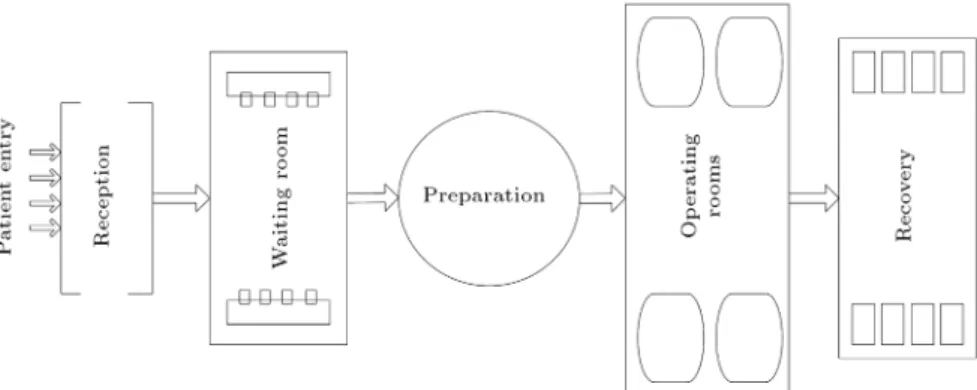
equipment. Therefore, due to the increasing demand for surgery operations, proper management of these limited resources is highly essential. Furthermore, attention to the correlations between operating rooms and other departments, such as recovery room or Intensive Care Unit (ICU), signicantly increases the importance and complexity of the problem. Figure 1 generally shows a simple ow of patients from entrance to the recovery room in a hospital.
The common procedure for the planning and scheduling of surgery department in almost all hos-pitals and medical centers has two main stages: the assignment of patients to operating rooms and the sequencing of the assigned patients in each room. In the rst stage, a day and a specic operating room are assigned to each patient. Then, in the second stage, the sequencing of patients in each room is determined. These two sequential main steps have been often considered independently in most papers.
Figure 1. The ow of patients in a hospital.
Jebali et al. [1] proposed a two-stage procedure for the operating room scheduling problem. At the rst stage, surgery operations were allocated to the rooms and, then, in the second stage, the surgery operations were scheduled and the start time of each surgery was determined. Cardeon et al. [2] only focused on the patient sequencing stage in their studied problem. They formulated the problem as a Mixed Integer Linear Program (MILP) with some assumptions such as oper-ating pediatric or priority patients in the beginning of each day.
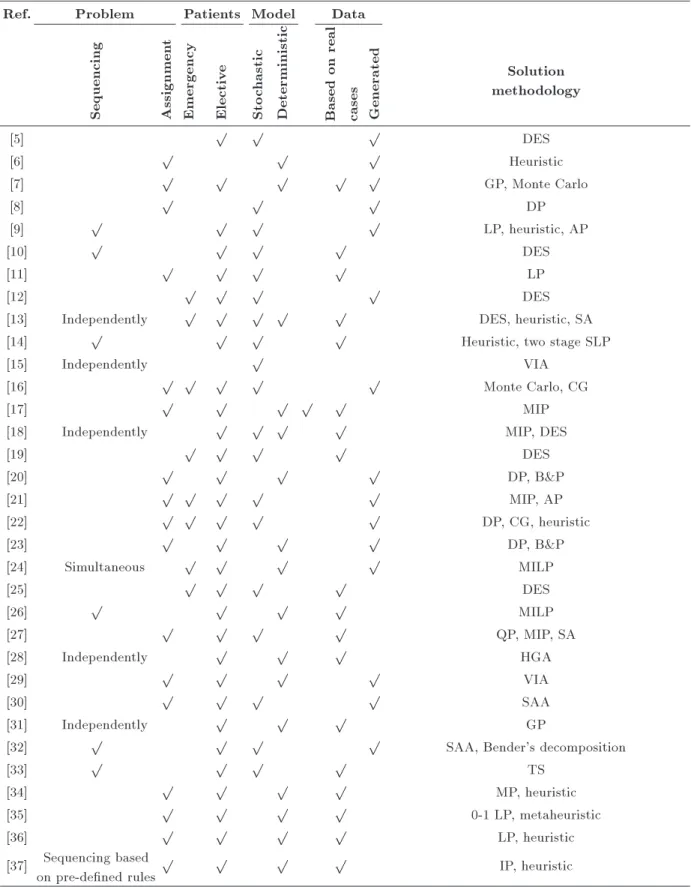
In other related works, Denton et al. [3] investi-gated the problem of determining the number of rooms to open on each day and daily allocation of surgery blocks to the rooms in a hospital with several identical rooms (in terms of equipment). In continuation of their work, Batun et al. [4] extended the problem to the case that the daily assignment and scheduling of elective patients were concerned. They assumed that the sequence of surgery operations of each surgeon was predetermined and they only had to schedule the surgeons. Table 1 classies most related papers to the problem in the literature review.
To the best of our knowledge, there are few studies in which the assignment and scheduling decisions are made simultaneously. Furthermore, weekly planning of the resources in surgery departments and using both generated and real data in evaluating solution methodologies have been neglected by most papers in the literature. On the other hand, the lack of a comprehensive study incorporating recovery bed and equipment limitation in weekly operating scheduling problems can be seen in the existing studies. Therefore, this paper proposes a mixed integer linear program to determine the weekly assignment of patients to the specic operating rooms and days in the plan-ning horizon and the sequencing of patients within each room on each day simultaneously. Moreover, the proposed MILP considers the availability of the equipment in operating rooms and the recovery beds after the patient's surgery. For large-scale instances of the problem, two algorithms based on genetic and
simulated annealing meta-heuristics are developed to solve the studied problem. A set of real test problems obtained by a hospital in Iran is used to evaluate the performance of the proposed algorithms.
The remainder of the paper is as follows. Section 2 formulates the studied problem as MILP. The proposed algorithms are explained in Section 3. Section 4 deals with the computational experiments and, nally, Section 5 concludes the paper.
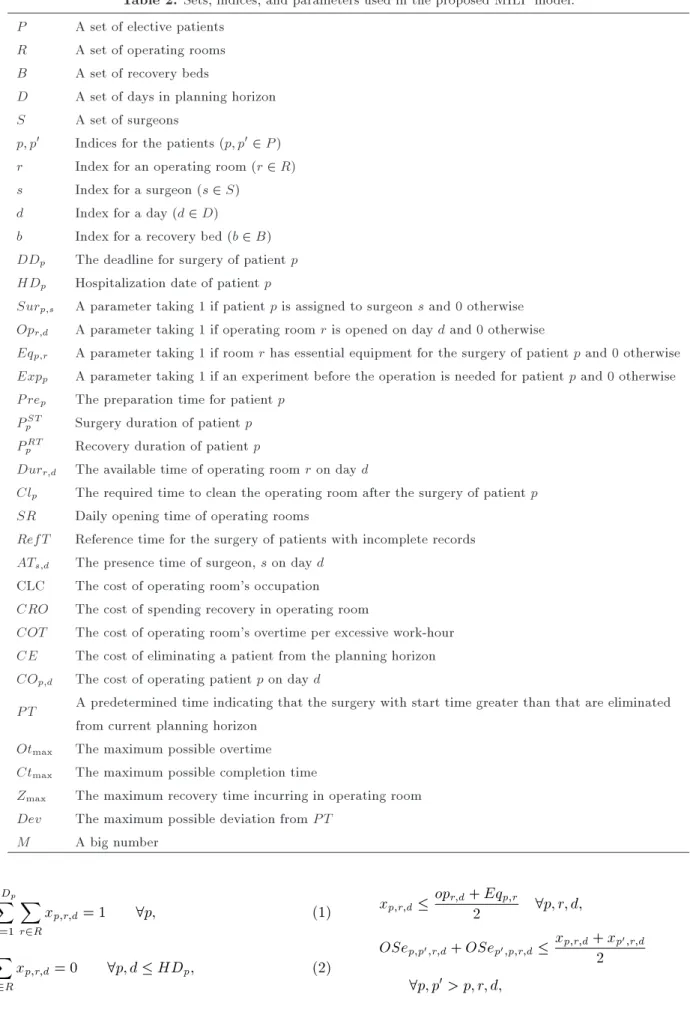
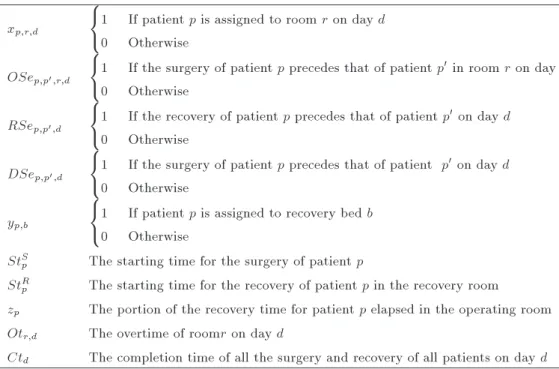
2. The MILP formulation of the problem This section formulates the problem as a mixed integer linear program. Tables 2 and 3 represent the sets, indices, parameters, and decision variables used in the proposed MILP. The proposed MILP of the problem is given in the following:
Min X5
i=1
wi Obji
Obj1=
X
d2D
X
r2R
X
p2P
COp;d xp;r;d;
Obj2=
X
d2D
X
r2R
COT OtOtr;d
max;
Obj3=
X
d2D
CLC CtCtd
max;
Obj4=
X
p2P
CRO zzp
max;
Obj5=
X
p2P
CE maxf0; StDevRp P T g
max ; 5
X
i=1
Table 1. Overview of the research on scheduling of operating rooms.
Ref. Problem Patients Model Data
Solution methodology Sequencing Assignmen
t
Emergency Electiv
e
Sto
chastic
Deterministic Based
on
real
cases Generated
[5] p p p DES
[6] p p p Heuristic
[7] p p p p p GP, Monte Carlo
[8] p p p DP
[9] p p p p LP, heuristic, AP
[10] p p p p DES
[11] p p p p LP
[12] p p p p DES
[13] Independently p p p p p DES, heuristic, SA
[14] p p p p Heuristic, two stage SLP
[15] Independently p VIA
[16] p p p p p Monte Carlo, CG
[17] p p p p p MIP
[18] Independently p p p p MIP, DES
[19] p p p p DES
[20] p p p p DP, B&P
[21] p p p p p MIP, AP
[22] p p p p p DP, CG, heuristic
[23] p p p p DP, B&P
[24] Simultaneous p p p p MILP
[25] p p p p DES
[26] p p p p MILP
[27] p p p p QP, MIP, SA
[28] Independently p p p HGA
[29] p p p p VIA
[30] p p p p SAA
[31] Independently p p p GP
[32] p p p p SAA, Bender's decomposition
[33] p p p p TS
[34] p p p p MP, heuristic
[35] p p p p 0-1 LP, metaheuristic
[36] p p p p LP, heuristic
[37] Sequencing based on pre-dened rules
p p p p IP, heuristic
Mixed Integer Programming (MIP), Discrete Event Simulation (DES), Goal Programming (GP), Tabu Search (TS), Dynamic Programming (DP), Linear Programming (LP), Analytical Procedure (AP), Simulated Annealing (SA),
Stochastic Linear Programming (SLP), Column Generation (CG), Quadratic Programming (QP), Branch and Price (B&P), Heuristic, Hybrid Genetic Algorithm (HGA), Sample Average Approximation (SAA), Value Iteration Algorithm (VIA), Mathematical Programming (MP), Integer Programming (IP).
Table 2. Sets, indices, and parameters used in the proposed MILP model. P A set of elective patients
R A set of operating rooms B A set of recovery beds
D A set of days in planning horizon S A set of surgeons
p; p0 Indices for the patients (p; p02 P )
r Index for an operating room (r 2 R) s Index for a surgeon (s 2 S)
d Index for a day (d 2 D)
b Index for a recovery bed (b 2 B) DDp The deadline for surgery of patient p
HDp Hospitalization date of patient p
Surp;s A parameter taking 1 if patient p is assigned to surgeon s and 0 otherwise
Opr;d A parameter taking 1 if operating room r is opened on day d and 0 otherwise
Eqp;r A parameter taking 1 if room r has essential equipment for the surgery of patient p and 0 otherwise
Expp A parameter taking 1 if an experiment before the operation is needed for patient p and 0 otherwise
P rep The preparation time for patient p
PST
p Surgery duration of patient p
PRT
p Recovery duration of patient p
Durr;d The available time of operating room r on day d
Clp The required time to clean the operating room after the surgery of patient p
SR Daily opening time of operating rooms
RefT Reference time for the surgery of patients with incomplete records ATs;d The presence time of surgeon, s on day d
CLC The cost of operating room's occupation CRO The cost of spending recovery in operating room
COT The cost of operating room's overtime per excessive work-hour CE The cost of eliminating a patient from the planning horizon COp;d The cost of operating patient p on day d
P T A predetermined time indicating that the surgery with start time greater than that are eliminated from current planning horizon
Otmax The maximum possible overtime
Ctmax The maximum possible completion time
Zmax The maximum recovery time incurring in operating room
Dev The maximum possible deviation from P T M A big number
DDXp
d=1
X
r2R
xp;r;d= 1 8p; (1)
X
r2R
xp;r;d= 0 8p; d HDp; (2)
xp;r;dopr;d+ Eq2 p;r 8p; r; d; (3)
OSep;p0;r;d+ OSep0;p;r;d xp;r;d+ xp0;r;d
2
Table 3. Decision variables used in the proposed MILP model. xp;r;d
8 < :
1 If patient p is assigned to room r on day d 0 Otherwise
OSep;p0;r;d
8 < :
1 If the surgery of patient p precedes that of patient p0 in room r on day d
0 Otherwise RSep;p0;d
8 < :
1 If the recovery of patient p precedes that of patient p0on day d
0 Otherwise DSep;p0;d
8 < :
1 If the surgery of patient p precedes that of patient p0on day d
0 Otherwise yp;b
8 < :
1 If patient p is assigned to recovery bed b 0 Otherwise
StS
p The starting time for the surgery of patient p
StR
p The starting time for the recovery of patient p in the recovery room
zp The portion of the recovery time for patient p elapsed in the operating room
Otr;d The overtime of roomr on day d
Ctd The completion time of all the surgery and recovery of all patients on day d
OSep;p0;r;d+ OSep0;p;r;d xp;r;d+ xp0;r;d 1
8p; p0> p; r; d; (5)
RSep;p0;d+ RSep0;p;d
P
r2Rxp;r;d+Pr2Rxp0;r;d
2 8p; p0 > p; d;(6)
RSep;p0;d+ RSep0;p;d
X
r2R
xp;r;d
+X
r2R
xp0;r;d 1 8p; p0> p; d; (7)
DSep;p0;d+ DSep0;p;d
P
r2Rxp;r;d+Pr2Rxp0;r;d
2 8p; p0 > p; d;(8)
DSep;p0;d+ DSep0;p;d
X
r2R
xp;r;d+
X
r2R
xp0;r;d 1 8p; p0 > p; d;
(9) Stt
p0 + P rep0 StSp + P rep+ PpST
M
3 DSep;p0;d Surp;s Surp0;s
8p; p06= p; r; d; (10)
StS
p+P rep Surp;sATs;d M(1
X
r2R
xp;r;d)
8p; s; d; (11)
StR
p0 StRp + PpRT zp
M
3 RSep;p0;d yp;b yp0;b
8p; p06= p; b; d; (12)
StR
p0 StRp M(1 RSep;p0;d) 8p; p06= p; d; (13)
StR
p = StSp + P rep+ PpST zp 8p; (14)
zp PpRT 8p; (15)
X
b2B
yp;b= 1 8p; (16)
StS
p + M 1
X
r2R
X
d2D
xp;r;d
!
SR 8p; (17)
Otr;d StRp + CLp M(1 xp;r;d)
StS
p + 2M 1
X
r2R
X
d2D
xp;r;d
!
RefT
M(1 Expp) 8p; (19)
StS
p0 StSp + P rep+ PpST + CLp+ zp
M(1 OSep;p0;r;d)
8p; p0 6= p; r; d; (20)
Ctd+ M(1
X
r2R
xp;r;d) StRp + PpRT zp
8p; d; (21)
StS
p; StRp; zp 0 8p; (22)
Otr;d 0 8r; d; (23)
xp;r;d; yp;bOSep;p0;r;d; RSep;p0;d; DSep;p0;d2 f0; 1g
8p; p0; b; r; d: (24)
The objective function consists of ve terms. The rst term is related to minimizing the surgery costs of patients, which is directly associated with the patients' priorities and the day of surgery. In this term, the value of COp;d for each patient is usually dierent
from one day to the next day. If the patient's health is in a dangerous situation, COp;d increases from the
rst day of the planning horizon to the last one, indicating that more delay in surgery imposes more costs. The second term minimizes the overall overtime in operating rooms. The third term tries to complete all patients' surgery as soon as possible. The fourth term minimizes the part of the patients' recovery times spent in the operating rooms as a result of the assigned recovery bed's occupation. Finally, the last term tries to minimize the overall cancelation cost of surgery. According to the latter term, the model tries to start surgery before a predened time. It should be noted that, as there are both monetary and time-based terms in the objective function, all terms are normalized. Furthermore, the same values of w for the objective terms are assumed.
Constraint (1) ensures that each patient is as-signed to only one operating room and one day. Constraint (2) guarantees that the surgery of each patient is operated after his/her hospitalization date. Constraint (3) says that each patient can be assigned to an operating room only if it is opened and has the required equipment. Constraints (4) and (5) determine the precedence relation between each pair of surgery operations assigned to the same operating room on
the same day. Constraints (6) and (7) determine the precedence relation between the recoveries of patients assigned to the same day. Constraints (8) and (9) state that a precedence relation exists between the start times of the surgery operations of the same surgeon on each day. Constraint (10) implies that a surgeon can only do surgery on one patient at a time. The presence of the surgeon at the hospital after preparing the patient for his/her surgery is ensured by Constraint (11). Constraint (12) says that each recovery bed cannot be occupied by more than one patient at a time. Constraint (13) relates the starting times of recovery of the consecutive patients assigned to the same day. The relation between the starting times of surgery and recovery for each patient is determined by Constraint (14). Constraint (15) implies that for each patient, the recovery time spent in the operating room has to be less than the total recovery time required for him/her. Assigning only one recovery bed to each patient is enforced by Constraint (16). Constraint (17) ensures that all the surgery operations begin after the opening time of the operating theater. The overtime for each operating room is calculated by Constraint (18). In Constraint (19), a reference time is used to provide a time for patients who need to do some specic tests and experiments before their surgery. Constraint (20) represents the relation between start-ing times of the surgery for the consecutive patients. In this constraint, the cleaning time of the operating room between successive surgery operations is also considered. Constraint (21) computes the completion time of all the surgery on each day. Constraints (22) to (24) dene the decision variables.
3. Algorithmic approach
The studied problem in this paper is placed in the category of the NP-hard problems and exact solution methods cannot be used to solve it, even in medium sized instances. Therefore, in order to solve the real-size instances of the problem, two meta-heuristic methods based on genetic and simulated annealing algorithms are developed. Since both the proposed algorithms utilize the similar solution representation and neighborhoods, these subjects are described at rst and, then, the algorithms will be explained.
3.1. Solution representation
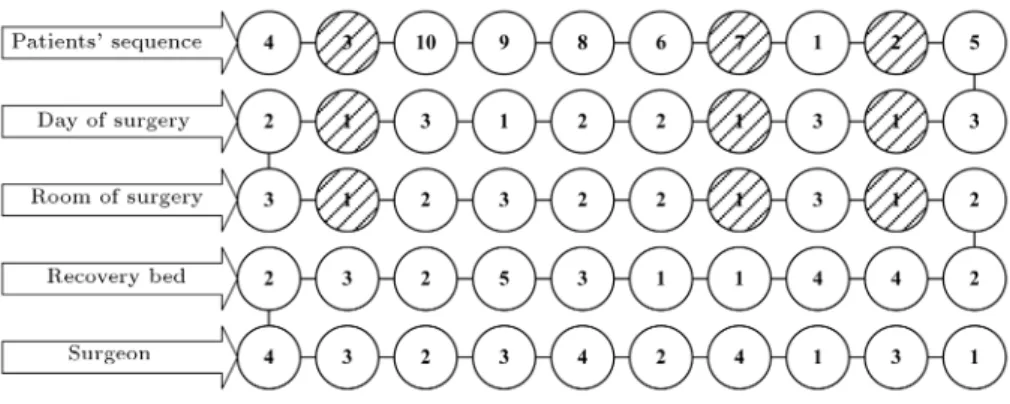
The solution to the studied problem is represented with a ve-row matrix in which the rst row denes the sequence of patients for surgery. The second to the fourth rows indicate the day, the room, and the recovery bed assigned to the patients, respectively.
To determine the sequence of the surgery from solution matrix, rst, we should nd the patients with the same assigned day and room, i.e. nd the patients
Figure 2. The solution matrix of the given example.
whose corresponding entries in the second and third rows are similar. The sequence of patients is in the similar order with the numbers in the rst row of the solution matrix.
For example, assume that we have 10 patients that should be scheduled in 3 days and 3 rooms. Furthermore, 5 recovery beds and 4 surgeons are supposed. Figure 2 gives the solution matrix for this example.
According to the solution matrix shown in Fig-ure 2, for example, the surgery of patients 3, 7, and 2 will be performed in the same room on the same day of planning horizon and the surgery sequence of them is 3 ! 7 ! 2.
3.2. Neighborhoods denition
This paper uses well-dened mutation and crossover operators exploiting the structure of the problem to nd the adjacent solutions described in the following. It should be noted that in the denition of the neigh-borhoods, a chromosome means a solution matrix. 3.2.1. Mutation operator
The mutation is a way to enlarge the search space and prevent the algorithm from falling into a local optimum. In this paper, three types of mutation operators are used as follows:
1. Depending on the size of the problem, select a number of patients randomly and regenerate their days, rooms, and recovery beds randomly;
2. Select a number of patients randomly and regener-ate their days, rooms, or recovery beds randomly;
3. Select two patients randomly and replace their days, rooms, and recovery beds with each other. 3.2.2. Crossover operator
A well-dened crossover operator is the one that maintains the ecient part of parent chromosomes and has enough freedom to provide searching within a larger portion of the solution space. This subsection introduces a hybrid crossover operator that keeps the Longest Common Subsequence (LCS) of parents
in children chromosomes. Using this operator, the algorithm can search in a larger solution space while retaining the good part of the parent chromosomes. The following explains how the LCS works on given solutions:
1. Find the LCS in either parents. Put the patients of the common subsequence in the rst child with the same place as Parent 1;
2. Find the rst patient of Parent 2 which is not a member of the LCS and copy it in the rst available location in the rst child;
3. Repeat the same process dened in step 2 with the other components of Parent 2 which are not members of the LCS until the rst row of the rst child is completed;
4. Repeat steps 1-3 in order to create the rst row of the second child.
To clarify how the proposed crossover works, the following example is given. Consider the rst row of two chromosomes of a problem with 4 patients as follows:
Parent 1 = 4 6 9 3 7 2 8 1 5 Parent 2 = 1 7 4 2 9 3 8 6 5
Longest common sub-sequence = 4 9 3 8 5 Child 1 = 4 9 3 8 5
Child 2 = 4 9 3 8 5 Child 1 = 4 1 9 3 7 2 8 6 5 Child 2 = 6 7 4 2 9 3 8 1 5
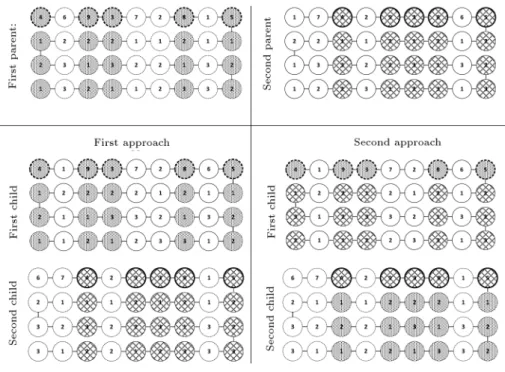
In this way, the rst row of each child chromosome is formed as it was explained before. To complete the next rows of the children's matrices, two approaches are considered. In the rst approach, for the rst child, the components of rows corresponding to the LCS take values from Parent 1 and other components are taken from the corresponding ones in Parent 2. In the second approach, for the rst child, the components
Figure 3. The approaches for crossover operator.
of all rows corresponding to the LCS are taken from Parent 2, and for the second child, they are taken from Parent 1. Figure 3 represents these two approaches for the mentioned example.
In the following subsections, two algorithms are developed in accordance with the problem under study. 3.3. Simulated annealing algorithm
Simulated annealing approach is a form of local search heuristic. For minimizing problems, traditional local search methods usually use reduction strategies that always move in reduction direction and often lead to convergence on the local optimum solution. To escape from the local optimum, the algorithm must also have some restricted and controlled uphill moves. In simulated annealing algorithm, if the objective function increases with an uphill movement, the new state is accepted with the probability obtained by equation p = exp F
T
> r. In this equation, r is a random number from uniform distribution in the interval [0,1]. The acceptance probability of uphill move is a function of both temperature and changes in the objective function. When the temperature of the system decreases or reaches zero, just the best movements will be accepted. Elements of simulated annealing algorithm are presented as follows:
Initial temperature (T0): The initial temperature
must be large enough so that in T0more unfavorable
transfers are accepted;
Temperature reduction function: The geometric functions can be used to reduce the temperature as
follows:
Tk+1= Tk; 0:8 0:99;
where represents the temperature reduction and remains constant throughout the algorithm;
Period length as a balance condition: Period length is the number of repetitions that take place at a constant temperature to reach equilibrium. This number is constant for all temperatures;
Stop condition: Stop condition can be expressed in dierent ways. Two of the known conditions are presented in the following:
1. To achieve a predetermined nal temperature (Tf), which is a very small fraction of the initial
temperature (Tf = T0 0:01);
2. To reach a maximum value of a predetermined number of iterations.
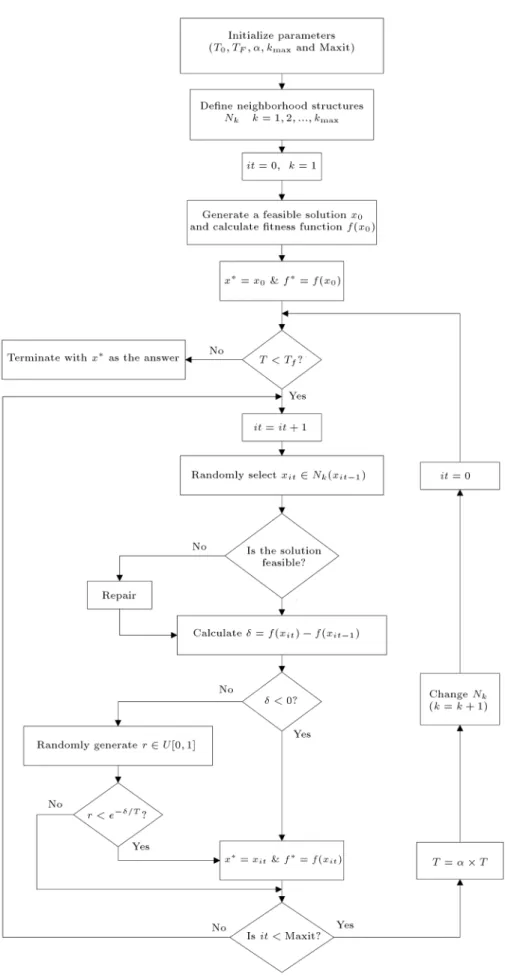
The procedure of the simulated annealing algo-rithm to solve the studied simultaneous scheduling and assignment problem is as follows.
At rst, the initial parameters are given as input of the algorithm. Then, an initial solution is randomly generated. The overall structure of generating initial solutions is to produce a randomized sequence of patients. After that, the available days, rooms, and beds are randomly assigned to each patient. It should be noticed that the procedure applied in this paper produces only feasible solutions in terms of assigned rooms and days to each patient. At the next stage, the objective function of the initial solution is calculated.
Afterwards, the algorithm enters into two loops, which control two parameters including the ature and the number of repetitions in each temper-ature, respectively. In each run of the rst loop, the second loop produces N solutions. In the second loop, according to the current temperature range, one of the designed neighborhood structures is applied to the current solution to produce a new solution and its corresponding objective function is computed. It should be noted that some of these adjacent solutions are infeasible. Therefore, a function is required to check the feasibility of the solutions and modify them if it is necessary.
In the next stage, the objective function is com-pared with the best objective function. In case of improvement, the current solution and its objective function are replaced by the best solution. Otherwise, if the current solution is worse than the best solution, a random uniform number between zero and one (r) is generated. If exp F
T
> r, in spite of the fact that the current solution is worse than the best, it is replaced by the best solution. At the end of this phase, the number of iterations increases by one and the inner loop is repeated with the corresponding designed neighborhood structures (the dened mutations and LCS crossover). This procedure will continue until the number of inner iterations reaches N. Then, the temperature decreases by the reduction rate and the process is repeated again until the nal temperature is reached.
Neighborhood structures in the high temperatures are generated in order to increase the diversication and to search a vast solution space. For low temper-atures, structures with less perturbation are used to make intensication. Figure 4 shows the owchart of the proposed simulated annealing algorithm schemati-cally.
3.4. Genetic algorithm
This subsection designs another solution method, Ge-netic Algorithm (GA), and compares it with the devel-oped simulated annealing algorithm. In general, GA is comprised of the following components:
Chromosomes: Chromosome represents a feasible solution to the problem in the search space. In Subsection 3.1, the solution to the studied problem was represented;
Population: A set of chromosomes make up a population. Through the eect of performing the dened mutation and crossover operators on a pop-ulation, a new population with the same number of chromosomes is formed;
Fitness function: For each chromosome, tness func-tion returns a non-negative integer that represents
the objective function of the individual chromo-somes;
Genetic operators: In genetic algorithms, operators are used during the reproduction stage. By imple-menting these operators on a population, the popu-lation of the next generation is produced. Selection, crossover, and mutation operators have the most usage in genetic algorithms. These operators are introduced in the following separately:
1. Selection: By performing the selection operator, a number of chromosomes in the current popula-tion are selected for reproducpopula-tion. More graceful chromosomes have more chances to be selected for reproduction. A roulette wheel selection is used as the selection operator in this paper;
2. Crossover: The crossover operator is applied to a pair of chromosomes in the current generation and produces a new pair of chromosomes for the next generation. This operator is implemented on each pair of chromosomes with a pre-dened probability (Pc). See Subsection 3.2.2 for more
details on the used crossover;
3. Mutation: After performing the crossover op-eration, mutation operator is implemented on the chromosomes with a probability (Pm). This
operator is used to avoid trapping into the local optimal solutions. See Subsection 3.2.1 for more details on the used mutations.
The following steps give a brief description of the GA's procedure:
- Step 0: Initialize parameters;
- Step 1: Generate an initial population randomly;
- Step 2: Evaluate the tness for each individual in the current population;
- Step 3: Dene selection rule and choose the best individuals to produce a new population;
- Step 4: Call the crossover operator for the selected individuals with probability Pc to generate new
individuals;
- Step 5: Call the mutation operator for each member with probability Pm;
- Step 6: Call a repair function for each member if the solution is infeasible;
- Step 7: Calculate anity function, i.e. the simi-larity degree to the best individual of the previous generation, for each individual and transfer the individuals whose anities are less than Panity. In
our proposed genetic algorithm, the anity function is dened as follows:
Aff = 1 1 + k=n;
Table 4. The information of the surgical ward of the hospital. Surgical
specialties
Surgery of each specialty
The range of operation time
The number of surgeons in each specialty
Urology
Removal of the bladder 360-480 minutes
5 Lithotripsy 30-120 minutes
Prostate surgery 60-180 minutes Varicocelectomy 30-90 minutes
Prostatectomy 90-120 minutes Hernia 60-90 minutes
Brain and nerves Disk 120-300 minutes 3
Brain tumor 180-360 minutes
General
Appendix 30-90 minutes
6 Gallbladder 45-90 minutes
Hernia 60-180 minutes Stomach tumor 180-300 minutes Esophagus tumor 180-360 minutes
Ear, Nose, and Throat (ENT)
Mastoidectomy 120-240 minutes
4 Tonsil 30-90 minutes
Rhinoplasty 180-300 minutes
Orthopedics
Total knee 180-240 minutes
4 Total hip 180-240 minutes
Plaque removal 60-180 minutes Knee ligament repair 180-240 minutes
Eye Eye 15-30 minutes 2
contents and n denotes dimension of the chromo-somes;
- Step 8: If the termination condition is met, stop; otherwise, repeat Steps 2-8.
4. Computational study
The proposed MILP was coded in Lingo 11.0 and was solved using CPLEX 12.1 solver. The proposed solution algorithms were implemented in MATLAB R2011b and run on a PC with 2.66 GHz Intel Core i5 and with 4 GB of RAM memory.
4.1. Description of the real data
The required data of the studied problem have been collected from a hospital in Iran (Aalinasab-e Tabriz). These data are used as a basis to create the problem instances in this paper.
The studied hospital has six operating rooms shared among all specialties in all days of the week. Most of the surgery operations can be performed in all rooms. Just some eye and orthopedic surgery can be
done only in specic rooms due to the requirement of special equipment. There are 9 recovery beds in the operating theater. The recovery may take, on average, between twenty to forty minutes, depending on each patient. The time required to prepare a patient for a surgery operation usually takes an average of ten minutes. Finally, the total cleaning and sterilizing time of the operating room is taken between 15 and 30 minutes depending on the duration of the surgery. Table 4 summarizes the information of the surgery performed in surgical ward of the hospital.
4.2. Taguchi design of experiments
Meta-heuristic algorithms have a random nature and, as a result, the diversity of the obtained solutions might be high. Thus, an eective and ecient algorithm is one that its solutions converge on the global optimal solution. In this case, the solutions of the algorithm can be trusted. One of the most important factors to achieve an ecient algorithm is the appropriate tuning of parameters. Therefore, in this paper, the Taguchi design of experiments has been applied to tune the
Table 5. Parameter tuning of the genetic algorithm.
Parameter Value
Number of generations 150 Population size 70 Mutation probability 0.35
Anity 0.9
Table 6. Parameter tuning of the simulated annealing algorithm.
Parameter Value
Maximum number of iterations 150
Initial temperature 150
Reduction rate of the temperature 0.95
Final temperature 20
parameters at their proper values and to achieve a good performance of GA and SA algorithms.
Taguchi design of experiments has some prede-termined patterns, each of which applies a dierent number of factors and dierent levels for each factor. Therefore, the investigator must select one of these predetermined patterns to dene his/her tests. In this paper, the pattern of L9(43) is used. This pattern
shows that the algorithm has four factors, each at three levels such that the combination of them forms 9 orthogonal scenarios. Tables 5 and 6 show the levels considered for each parameter of the proposed algorithms after applying the Taguchi method.
In order to evaluate the performance of designed algorithms, a Relative Deviation Percentage (RDP) is dened as follows:
RPD = ALGsol OPTsol OPTsol 100;
where ALGsol is the solution obtained from algorithm
and OPTsol is the optimal solution of the MILP.
The mathematical model and the proposed al-gorithms have been implemented on three instances of the problem: the rst sample consists of planning and scheduling 10 patients for one day, the second instance schedules 15 patients for two days, and the third instance considers 20 patients for two days.
It should be noted that for each problem instance, algorithms are run ve times and the average of RDPs is taken for comparisons. Table 7 presents the average RDPs obtained by the proposed algorithms.
As it is obvious from the above table, both algorithms perform very well in small-size instances and reach the optimum solution.
4.3. The comparative studies
This subsection applies the proposed algorithms to ve dierent sized instances of the problem created based on real data collected from the Alinasab-e Tabriz Hospital in Iran. Each of the algorithms has been run ve times for each sample and the results of the comparison are presented in Table 8. In this table, best-known solutions of the algorithms from dierent runs are used instead of optimal solution in calculating RDPs.
Figures 5 and 6 show the comparison of the av-erage RDPs and avav-erage CPU times obtained by both developed algorithms for dierent sizes of the problem. As it is obvious from these gures, both algorithms have good performance in small-size instances; but, as the size of the problem gradually increases, GA
Table 7. The CPU times and average RDPs of the two proposed meta-heuristic algorithms. Problem size
MILP SA GA
CPU time (s)
CPU time (s)
Average RDPs (%)
CPU time (s)
Average RDPs (%)
10 0.5 16 0.00 38 0.00
15 3 8 0.00 104 0.00
20 1095 10 0.00 71 0.00
Table 8. Comparison results of the proposed algorithms. Problem
instance
Number of patients
Number of days
Average RDPs (%) Average CPU times (s)
SA GA SA GA
1 15 2 0.00 0.00 7.808 104.16
2 30 2 0.10 0.19 13.356 189.114
3 50 3 0.29 1.01 25.138 381.38
4 100 4 1.58 26.93 53.48 959.772
Figure 5. The average RDPs obtained by the algorithms.
Figure 6. The average CPU times obtained by the algorithms.
loses its eciency, but simulated SA indicates better performance in terms of time and accuracy measures.
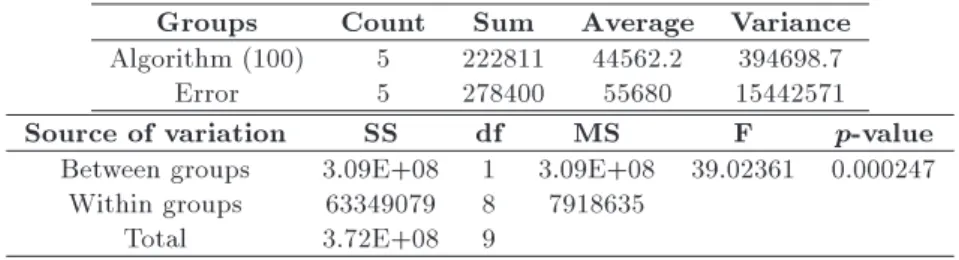
In order to have a better comparison, a single factor analysis of variance (ANOVA) is used to examine the eectiveness of the algorithms. For this analysis, the equality of the average solutions obtained from the two levels of treatments (GA and SA) is considered as hypothesis testing. For each level, ve observations have been collected and the condence level of 95% is considered. The analysis of variance has been applied for four dierent sized samples of the studied problem including 30, 50, 100, and 250 patients, respectively. The summary of the obtained results is shown in Ta-ble 9 and, as an example, the details of the ANOVA for the instance with 100 patients are shown in Table 10.
Table 9. The obtained results of ANOVA. Problem instance p-value
30 0.429917
50 0.391644
100 0.000247
250 0.004193
According to the p-values of Table 9, for a con-dence level of 95%, there is no signicant dierence be-tween the proposed algorithms for small-size instances, but for larger problems, there is signicant dierence between two algorithms and the proposed SA algorithm provides better performance than the GA does.
5. Conclusion and future research
This paper studied operating room scheduling problem for elective patient. The contributions of this paper were threefold. First, for the rst time in the litera-ture, a comprehensive Mixed Integer Linear Program (MILP) was provided to formulate the simultaneous weekly assignment and scheduling operating room problem. Second, in order to represent the problem more realistically, recovery bed limitations, equipment requirements, and priorities of patients based on their health conditions were incorporated in the modeling procedure. Finally, two well-dened and eective so-lution procedures with appropriate diversication and intensication mechanisms were proposed, which were able to solve real large-size instances of such a complex problem. The eciency of the proposed algorithms was evaluated by comparing their solutions with the exact solutions obtained by solving the MILP on a set of small-size test problems. Although both methods performed well in small sizes of the problem, the developed simulated annealing algorithm outperformed genetic algorithm in terms of CPU-time and accu-racy measures in real-case based instances. Sucient amount of analysis, including an analysis of variance (ANOVA), was carried out to show the superiority of the proposed SA method in solving large-size problems. For future studies on the studied problem, the following recommendations can be made:
Extension of the problem to the case that includes emergency patients as well as elective patients;
Consideration of the uncertainty in the arrival time of patients and the duration of surgery;
Developing a more realistic model that takes some other constraints into account related to the nursing sta, correlation between the operating theatre and other wards like intensive care unit, etc.
Table 10. The detailed results of ANOVA for an instance with 100 patients. Groups Count Sum Average Variance Algorithm (100) 5 222811 44562.2 394698.7
Error 5 278400 55680 15442571
Source of variation SS df MS F p-value
Between groups 3.09E+08 1 3.09E+08 39.02361 0.000247 Within groups 63349079 8 7918635
References
1. Jebali, A., Hadj Alouane, A.B. and Ladet, P.
\Oper-ating rooms scheduling", Int. J. of Prod. Econ., 99(1), pp. 52-62 (2006).
2. Cardoen, B., Demeulemeester, E. and Belien, J.
\Se-quencing surgical cases in a day-care environment: an exact branch-and-price approach", Comput. and Oper. Res., 36(9), pp. 2660-2669 (2009).
3. Denton, B.T., Miller, A.J., Balasubramanian, H.J. and
Huschka, T.R. \Optimal allocation of surgery blocks to operating rooms under uncertainty", Oper. Res., 58(4-Part-1), pp. 802-816 (2010).
4. Batun, S., Denton, B.T., Huschka, T.R. and Schaefer,
A.J. \Operating room pooling and parallel surgery pro-cessing under uncertainty", INFORMS J. on Comput., 23(2), pp. 220-237 (2011).
5. Harper, P.R. \A framework for operational modeling
of hospital resources", Health Care Manag. Sci., 5(3), pp. 165-173 (2002).
6. Guinet, A. and Chaabane, S. \Operating theatre
planning", Int. J. of Prod. Econ., 85(1), pp. 69-81 (2003).
7. Ogulata, S.N. and Erol, R. \A hierarchical
multi-ple criteria mathematical programming approach for scheduling general surgery operations in large hospi-tals", J. of Med. Syst., 27(3), pp. 259-270 (2003).
8. Marcon, E., Kharraja, S. and Simonnet, G. \The
operating theatre planning by the follow-up of the risk of no realization", Int. J. of Prod. Econ., 85(1), pp. 83-90 (2003).
9. Denton, B.T. and Gupta, D. \A sequential bounding
approach for optimal appointment scheduling", IIE Trans., 35(11), pp. 1003-1016 (2003).
10. Sciomachen, A., Tanfani, E. and Testi, A. \Simulation
models for optimal schedules of operating theatres", Int. J. of Simul., 6(12-13), pp. 26-34 (2005).
11. Perez Gladish, B., Arenas Parra, M., Bilbao Terol,
A. and Rodrguez Ura, M.V. \Management of surgi-cal waiting lists through a possibilistic linear multi-objective programming problem", Appl. Math. and Comput., 167(1), pp. 477-495 (2005).
12. Marcon, E. and Dexter, F. \Impact of surgical
sequenc-ing on post anesthesia care unit stang", Health Care Manag. Sci., 9(1), pp. 87-98 (2006).
13. Van der Lans, M., Hans, E., Hurink, J.L., Wullink, G.,
van Houdenhoven, M. and Kazemier, G. \Anticipating urgent surgery in operating room departments", Tech. Rep., WP-158 (2006).
14. Denton, B.T., Viapiano, J. and Vogl, A. \Optimization
of surgery sequencing and scheduling decisions under uncertainty", Health Care Manag. Sci., 10(1), pp. 13-24 (2007).
15. Gupta, D. \Surgical suites' operations management",
Prod. and Oper. Manag., 16(6), pp. 689-700 (2007).
16. Lamiri, M., Dreo, J. and Xie, X. \Operating room
planning with random surgery times", Automation Sci-ence and Engineering, IEEE International ConferSci-ence on, Scottsdale, AZ, pp. 521-526 (2007).
17. Santiba~nez, P., Begen, M. and Atkins, D. \Surgical
block scheduling in a system of hospitals: An applica-tion to resource and wait list management in a British Columbia health authority", Health Care Manag. Sci., 10(3), pp. 269-282 (2007).
18. Testi, A., Tanfani, E. and Torre, G. \A three-phase
approach for operating theatre schedules", Health Care Manag. Sci., 10(2), pp. 163-172 (2007).
19. VanBerkel, P.T. and Blake, J.T. \A comprehensive
simulation for wait time reduction and capacity plan-ning applied in general surgery", Health Care Manag. Sci., 10(4), pp. 373-385 (2007).
20. Belien, J. and Demeulemeester, E. \A
branch-and-price approach for integrating nurse and surgery scheduling", Eur. J. of Oper. Res., 189(3), pp. 652-668 (2008).
21. Lamiri, M., Xie, X., Dolgui, A. and Grimaud, F. \A
stochastic model for operating room planning with elective and emergency demand for surgery", Eur. J. of Oper. Res., 185(3), pp. 1026-1037 (2008).
22. Lamiri, M., Xie, X. and Zhang, S. \Column generation
approach to operating theater planning with elective and emergency patients", IIE Trans., 40(9), pp. 838-852 (2008).
23. Fei, H., Chu, C., Meskens, N. and Artiba, A. \Solving
surgical cases assignment problem by a branch-and-price approach", Int. J. of Prod. Econ., 112(1), pp. 96-108 (2008).
24. Pham, D.N. and Klinkert, A. \Surgical case scheduling
as a generalized job shop scheduling problem", Eur. J. of Oper. Res., 185(3), pp. 1011-1025 (2008).
25. Cardoen, B. and Demeulemeester, E. \Capacity of
clinical pathways - a strategic multi-level evaluation tool", J. of Med. Syst., 32(6), pp. 443-452 (2008).
26. Cardoen, B., Demeulemeester, E. and Belien, J.
\Op-timizing a multiple objective surgical case sequencing problem", Int. J. of Prod. Econ., 119(2), pp. 354-366 (2009).
27. Belien, J., Demeulemeester, E. and Cardoen, B. \A
decision support system for cyclic master surgery scheduling with multiple objectives", J. of Sched., 12(2), pp. 147-161 (2009).
28. Fei, H., Meskens, N. and Chu, C. \A planning and
scheduling problem for an operating theatre using an open scheduling strategy", Comput. and Ind. Eng., 58(2), pp. 221-230 (2010).
29. Min, D. and Yih, Y. \An elective surgery scheduling
problem considering patient priority", Comput. and Oper. Res., 37(6), pp. 1091-1099 (2010).
30. Min, D. and Yih, Y. \Scheduling elective surgery under uncertainty and downstream capacity constraints", Eur. J. of Oper. Res., 206(3), pp. 642-652 (2010).
31. Tan, Y., El Mekkawy, T.Y., Peng, Q. and
Op-penheimer, L. \Mathematical programming for the scheduling of elective patients in the operating room department", In Proc. of the 2007 CDEN and CCEE Conference (2007).
32. Mancilla, C. and Storer, R. \A sample average
ap-proximation approach to stochastic appointment", IIE Trans., 44(8), pp. 655-670 (2012).
33. Saremi, A., Jula, P., ElMekkawy, T. and Wang,
G. \Appointment scheduling of outpatient surgical services in a multistage operating room department", Int. J. of Prod. Econ., 141(2), pp. 646-658 (2013).
34. Agnetis, A., Coppi, A., Corsini, M., Dellino, G.,
Meloni, C. and Pranzo, M. \A decomposition approach for the combined master surgical schedule and surgical case assignment problems", Health Care Manag. Sci., 17(1), pp. 49-59 (2014).
35. Aringhieri, R., Landa, P., Soriano, P., Tanfani, E. and
Testi, A. \A two level metaheuristic for the operating room scheduling and assignment problem", Comput. and Oper. Res., 54, pp. 21-34 (2015).
36. Dios, M., Molina-Pariente, J.M., Fernandez-Viagas,
V., AndraPineda, J.L. and Framinan, J.M. \A de-cision support system for operating room scheduling", Comput. and Ind. Eng., 88, pp. 430-443 (2015).
37. Duran, G., Rey, P.A. and Wol, P. \Solving the
operating room scheduling problem with prioritized lists of patients", Ann. of Oper. Res., pp. 1-20 (2016).
Biographies
Maryam Haghi received her BSc degree in Industrial Engineering from Amirkabir University of Technology in 2012 and her MSc degree in Industrial Engineering from Sharif University of Technology in 2014. Her
present research interests include stochastic optimiza-tion and healthcare management.
Seyyed Mohammad Taghi Fatemi Ghomi was born in Ghom, Iran, on March 11, 1952. He received his BSc degree in Industrial Engineering from Sharif University of Technology, Tehran, in 1973, and the PhD degree in Industrial Engineering from University of Bradford, England, in 1980. He worked as planning and control expert in the group of construction and cement industries, a group of Organization of National Industries of Iran, during the years 1980-1983. Also, he founded the Department of Industrial Training in the aforementioned organization in 1981. He joined Amirkabir University of Technology in Tehran, Iran, as a faculty member in 1983. He is the author and co-author of more than 360 technical papers and the author of six books in the area of industrial engineering. He is currently Professor in the Department of Indus-trial Engineering at Amirkabir University of Technol-ogy, Tehran, Iran. Amirkabir University of Technology recognized him as one of the best researchers of the years 2004 and 2006. Also, Ministry of Science and Technology recognized him as one of the best professors of Iran in the year 2010.
His research and teaching interests include stochastic activity networks, production planning and control, scheduling, queuing systems, and statistical quality control.
Pedram Hooshangi-Tabrizi received his BSc and MSc degrees in Industrial Engineering from Amirkabir University of Technology in 2010 and 2013, respec-tively. His areas of research include Flexible Man-ufacturing Systems (FMSs), healthcare optimization, resource scheduling problems, mathematical modeling, and designing algorithms to solve large-scale prob-lems.