among business units and thus not even practiced in a cohesive, coher-ent manner. In the worst cases, busy business unit executives trade roving bands of developers like Pokémon cards in a fifth-grade classroom (in an attempt to get ahead). Suffice it to say, none of this is good.
The disconnect between secu-rity and development has ultimately produced software development ef-forts that lack any sort of contem-porary understanding of technical security risks. Today’s complex and highly connected computing envi-ronments trigger myriad security concerns, so by blowing off the idea of security entirely, software builders virtually guarantee that their creations will have way too many security weaknesses that could—and should—have been avoided. This article presents some recommendations for solving this problem. Our approach is born out of experience in two diverse fields: software security and information security. Central among our rec-ommendations is the notion of using the knowledge inherent in in-formation security organizations to enhance secure software develop-ment efforts.
Don’t stand
so close to me
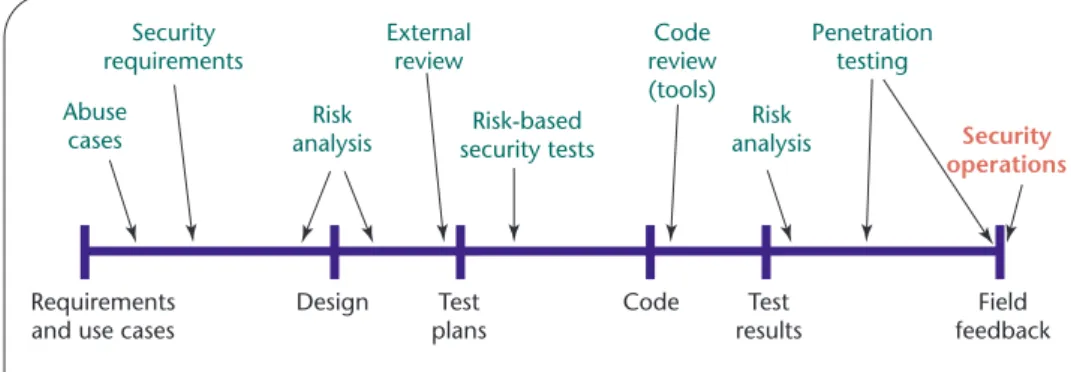
Best practices in software security in-clude a manageable number of sim-ple activities that should be applied throughout any software develop-ment process (see Figure 1). These lightweight activities should start at the earliest stages of software devel-opment and then continue through-out the development process and into deployment and operations.
Although an increasing number of software shops and individual de-velopers are adopting the software security touchpoints we describe here as their own, they often lack the requisite security domain knowl-edge required to do so. This critical knowledge arises from years of ob-serving system intrusions, dealing with malicious hackers, suffering the consequences of software vulnera-bilities, and so on. Put in this posi-tion, even the best-intended development efforts can fail to take into account real-world attacks pre-viously observed on similar applica-tion architectures. Although recent books1,2 are starting to turn this knowledge gap around, the science of attack is a novel one.
Information security staff—in
particular, incident handlers and vulnerability/patch specialists— have spent years responding to at-tacks against real systems and thinking about the vulnerabilities that spawned them. In many cases, they’ve studied software vulnerabili-ties and their resulting attack profiles in minute detail. However, few in-formation security professionals are software developers (at least, on a full-time basis), and their solution sets tend to be limited to reactive techniques such as installing software patches, shoring up firewalls, updat-ing intrusion detection signature databases, and the like. It’s very rare to find information security profes-sionals directly involved in major software development projects.
Sadly, these two communities of highly skilled technology experts exist in near complete isolation, yet their knowledge and experience bases are largely complementary. Finding avenues for interdisciplinary cooperation will likely bear fruit in the form of fielded software that’s bet-ter equipped to resist well-known and easily predicted attacks. A secondary benefit of any interdisciplinary coop-eration is gaining information secu-rity personnel with a much better understanding of the applications that they’re tasked with protecting.
Every silver lining’s
got a touch of gray
A complete description of every software security best practice is far beyond this article’s scope, but we can provide a high-level description
KENNETHR. VANWYK Cigital and KRVW Associates GARY MCGRAW Cigital
T
raditionally, software development efforts in large
corporations have been about as far removed from
information security as they were from human
re-sources or any other business function. Software
de-velopment has also had the tendency to be highly distributed
Bridging the Gap between
Software Development
and Information Security
of the most effective software secu-rity touchpoints available today. Requirements:
Abuse cases
The concept of abuse case develop-ment is derived from use case devel-opment. In an abuse case, the developer considers software’s delib-erate misuse and ponders its corre-sponding effect. When addressing user input, for example, the devel-oper can construct a series of abuse cases that describes in some detail how malicious users can and will at-tempt to overflow input buffers, in-sert malicious data, and so on. An abuse case depicts these scenarios as well as how the software should re-spond to them. As with their use case counterparts, each abuse case then drives a requirement and correspond-ing test scenario for the software. Design: Business risk analysis
Assessing the business impact likely to result from a successful software compromise is a critical undertak-ing. If no one explicitly tackles this issue, a security analysis will fall short in the “who cares?” department. A good risk analysis considers ques-tions of the project’s cost to the par-ent organization sponsoring the software in terms of both direct cost (liability, lost productivity, and re-work) and indirect cost (reputation and brand damage).
Design:
Architectural risk analysis Similar to a business risk analysis, an architectural risk analysis assesses the technical security exposures in an ap-plication’s proposed design and links them to business impact. Starting with a high-level depiction of the de-sign, the analysis team considers each module, interface, interaction, and so forth against known attack method-ologies and their likelihood of suc-cess. To provide a forest-level view of a software system’s security posture, the analysts typically apply such
analyses against a design’s individual subcomponents as well as to the de-sign as a whole. Attention to security’s holistic aspects is paramount: at least 50 percent of all security defects are architectural in nature.
Test planning: Security functionality testing
Just as testers typically use functional specifications and requirements to create test scenarios and test plans (especially those testers who under-stand the critical notion of require-ments traceability), security-specific functionality should be used to de-rive tests against the target software’s security functions. These kinds of investigations generally include tests that verify security features such as encryption, user identification, log-ging, confidentiality, authentication, and so on. These are “positive” se-curity features for white hats. Test planning:
Risk-driven testing
Thinking like a good guy isn’t enough: you have to don your black hat and think like a bad guy. Risk-based test scenarios are the natural result of the process of as-sessing and prioritizing software’s architectural risks. Each architec-tural risk and abuse case considered should be described and docu-mented down to a level that clearly explains how an attacker might go
about exploiting a weakness and compromising the software. Such descriptions can help generate a priority-based list of test scenarios for later “adversarial” testing. Implementation: Code review
The design-centric activities de-scribed thus far focus on architec-tural flaws built into software design, but they completely overlook im-plementation bugs that the coders might introduce during coding. Im-plementation bugs are both numer-ous and common (just like real bugs in the Virginia countryside) and can include nasty creatures such as the notorious buffer overflow, which owes its existence to the use (or mis-use) of vulnerable APIs. Code re-view processes—both manual and (even more important) automated with a static analysis tool—attempt to identify security bugs prior to the software’s release.
System testing: Penetration testing
System penetration testing, when used appropriately, focuses on human and procedural failures made during the software’s configuration and deployment. The best kinds of penetration testing are driven by previously identified risks and are engineered to probe risks directly to ascertain their exploitability.
Figure 1. Software security best practices or “touchpoints.” Although the software artifacts are laid out according to a traditional waterfall model, most organizations follow an iterative approach today: best practices are cycled through more than once as the software evolves.
Abuse cases Security requirements Risk analysis External review Risk-based security tests Code review (tools) Risk analysis Penetration testing Security operations Requirements and use cases
Design Test plans Code Test results Field feedback
Fielded system: Deployment and operations
Careful configuration and cus-tomization of any software applica-tion’s deployment environment can greatly enhance its security posture. Designing a smartly tailored deploy-ment environdeploy-ment for a program re-quires following a process that starts at the network-component level, pro-ceeds through the operating system, and ends with the application’s own security configuration and setup.
Kumbaya (for
software security)
With the software security touch-points we’ve just listed in mind, let’s turn to the issue at hand: how infor-mation security professionals can best participate in the software develop-ment process. If you’re a CISSP, an operational security professional, or a network administrator, this Bud’s for you. Let’s go back through the activ-ities we just covered and give some recommendations relevant to both software developers and information security practitioners.
Abuse cases
Folding information security into abuse case development is such low-hanging fruit that the fruit itself is dirt-splattered from the latest thun-derstorm. Simply put, information security professionals come to the table with the (rather unfortunate) benefit of having watched and dis-sected years of attack data, built forensics tools,3 created profiles of attackers, and so on. This might make them jaded and surly, but at least they intimately know what they’re up against.
Many abuse case analysis efforts begin with brainstorming or “white boarding” sessions during which the development team describes an ap-plication’s use cases and functional requirements while a room full of experts pontificate about how an at-tacker might attempt to abuse the system. Properly participating in
these exercises involves carefully and thoroughly considering similar sys-tems and the successful attacks against them. Getting past your own belly button is especially important to abuse case success, so consider other domains that could be relevant to the application under review while you’re at it. Once again, real battle experience is critical. Infor-mation security people are likely to find (much to their amusement) that the software developers in the room are blissfully unaware of many of the attack forms found daily beyond the network perimeter. Of course, many of the uninformed are also naturally skeptical unbelievers. While converting these skeptics, try to avoid succumbing to the ten-dency toward hyperbole and exag-geration that is unfortunately common among security types. There’s nothing worse than a blus-tery security weenie on his high horse about some minor skirmish. Don’t overstate the attacks you’ve seen and studied, just stick to the facts and be prepared to back up your statements with actual exam-ples. Knowledge of actual software technology a plus.
Business risk analysis The most important people to con-sult when assessing software-in-duced business risks are the business stakeholders behind the software. In organizations that already practice business-level technology analysis, this tends to be quite well under-stood. (Unfortunately, technological assessment of the business situation stops well before the software level in most of these organizations.) En-hancing a standard approach is easy with a few additional questions: What do the people asking for this software think about security? What do they expect? What are they try-ing to accomplish that a successful attack might thwart? What worries them about security?
The value information security professionals bring to answering
these questions comes from their wealth of experience in seeing secu-rity impacts first-hand when similar business applications were compro-mised. It gives them the opportu-nity to knowledgeably answer several other security-related ques-tions: What sorts of costs have simi-lar companies incurred from attacks? How much downtime was involved? What was the resulting publicity in each case? In what ways was the organization’s reputation tarnished? Information security people can provide input and flesh out a conversation with relevant sto-ries. Here again, take care to not overstate the facts. When citing in-cidents at other organizations, be prepared to back up your claims with news reports and other third-party documentation.
Architectural risk analysis Now we’re getting to the technical heart of the software development process. For architectural risk analy-sis to be effective, security analysts must possess a great deal of technol-ogy knowledge covering both the application and its underlying plat-form, frameworks, languages, func-tions, libraries, and so on. The most effective information security team member in this situation is clearly one who is a technology expert with solid experience around particular software tools. With this kind of knowledge under his or her belt, the information security professional can provide real-world feedback into the process. If the analysis team is discussing a particular network en-cryption protocol’s relative strengths and weaknesses, for example, infor-mation security can provide per-spective to the conversation. All software has potential weaknesses, but was component X involved in any actual attacks? Are there known vulnerabilities in the protocol the project is planning to use? Is a com-mercial off-the-shelf component or platform a popular attacker target? Or does it have a stellar reputation
and only a handful of properly han-dled published vulnerabilities and known attacks? Feedback of this sort is extremely useful for prioritizing risk and weaknesses as well as for de-ciding on what, if any, mitigation strategies to pursue.
Test planning
Although test planning and execu-tion are generally performed by qual-ity assurance (QA) and development groups, testing represents another op-portunity for information security to have a positive impact. Testing—es-pecially risk-based testing—must not only cover functionality, it should closely emulate the steps that an at-tacker will take when breaking a tar-get system. Highly realistic scenarios (the security analog to real user sce-narios) are much more useful than ar-bitrary pretend “attacks.” Standard-issue testing organizations, if they’re effective at all, are most ef-fective at designing and performing tests based on functional specifica-tions. Designing risk-based test sce-narios is a rather substantial departure from the status quo and should bene-fit from the experience base of secu-rity incident handlers. In this case, information security professionals who are good at “thinking like a bad guy” are the most valuable resources. Code review
By its very nature, code review re-quires knowledge of code. An infor-mation security practitioner with little experience writing and com-piling software is of little use during a code review. If you don’t know what it means for a variable to be declared in a header or an argument to a method to be static/final, staring at lines of code all day isn’t going to help. Because of this, the code re-view step is best left in the hands of the development organization, es-pecially if it’s armed with a modern source-code analysis tool. With the exception of information security people who are highly experienced in programming languages and
code-level vulnerability resolution, there is no natural fit for network se-curity expertise during the code re-view phase. This might come as a great surprise to those organizations currently attempting to impose soft-ware security on their enterprise through the information security di-vision. Although the idea of security enforcement is solid, making en-forcement at the code level success-ful when it comes to code review requires real hands-on experience with code. It’s definitely not suffi-cient to arm the information secu-rity team with a static code scanner and expect them to deliver substan-tive feedback to the coders. Penetration testing
Although testing software to a func-tional specification has tradifunc-tionally been QA’s domain, penetration test-ing is usually the domain of informa-tion security and incident-handling organizations. As such, the fit here for information security participa-tion is very natural and intuitive. Of course, several subtleties can’t be ig-nored. Most penetration testing today focuses its attention on net-work topology, firewall placement, communications protocols, and the like, thus it’s an outsidein ap-proach that barely begins to scratch an application’s surface. Penetration testing must encompass a more in-sideout approach that takes into account risk analyses and other soft-ware security results as it’s
per-formed. This distinction is sometimes described as the differ-ence between “network penetration testing” and “application
penetra-tion testing.” Software security is much more interested in the latter.
Also worth noting is the use of various black-box penetration tools. Network security scanners such as nessus, nmap, SATAN, and the like are extremely useful because of the countless ways in which to config-ure (and misconfigconfig-ure) complex networks and their various services. Application security scanners are nowhere near as useful, so if by an “application penetration test” you mean running an application secu-rity testing tool and gathering the re-sults, you have a long way to go to make your approach hold water. It goes almost without saying that soft-ware testing isn’t something that a set of canned tests can handle, no matter how large the can. The idea of test-ing any arbitrary program with, say, a few thousand tests determined in advance before the software was even conceived is ridiculous. The idea of testing any arbitrary program with a few hundred application se-curity tests is just as silly.
The good news about penetra-tion testing and informapenetra-tion security involvement is that it’s most likely al-ready underway. The bad news is that information security must up its level of software clue to most effec-tively perform penetration testing. Deployment
and operations
Many software developers would argue that deployment and
opera-tions aren’t even part of the soft-ware development process. Even if this view is correct, we can’t prop-erly address operations and
deploy-Software developers and information security
staff can benefit greatly from the respective
experiences of the other.
68 IEEE SECURITY & PRIVACY ■ SEPTEMBER/OCTOBER 2005 ment concerns if the software is so
poorly constructed that it falls apart no matter what kind of solid ground we place it on. Put bluntly, operations organizations have put up with some rather stinky soft-ware for a long time, which has made them wary. If we can set that argument aside for a moment and look at the broader picture—that is, safely setting up the application in a secure operational environ-ment and running it accordingly— then the work that needs doing can certainly be positively affected by information security. The best op-portunities exist in fine-tuning ac-cess controls at the network and operating system levels, as well as in configuring an event-logging and monitoring mechanism that’s most effective during incident response operations. Attacks will happen, so be prepared to clean up the mess af-terwards. This advice is pretty much a “no duh” for information security organizations, which is why their involvement in this step is so important.
Come together
(right now)
Even if you accept our recommen-dations wholesale as worthy, the act of aligning information security and software development is a serious undertaking (and not one for the faint of heart). Close cooperation with the development organization is essential to success. If developers perceive information security peo-ple to be the security police or “those people with sticks who show up every once in a while and beat us soundly for reasons we don’t under-stand,” you have a problem that must be addressed.
In many cases, developers are more than willing to accept guid-ance and advice from information security people who know what they’re talking about. One problem is that they don’t know who to talk to, who might help them, and who might just be a blowhard security
weenie. To fix this problem, the first step for any of you information se-curity professionals who want to help out with development efforts should be to reach out to the devel-opers, roll up your sleeves, and offer to assist.
Once you’ve made the develop-ers aware of your willingness to help, consider taking small steps toward the goals laid out in this article. Rather than trying to become in-volved in every phase all at once in a giant world-changing endeavor, try one at a time. Be careful not to over-whelm the overall system by at-tempting to make too many changes at once.
Another positive step is for the information security troops to take the time to learn as much as they can about software development in gen-eral and their organization’s software development environment in partic-ular. Study and learn about the types of applications your software people develop, why they’re doing it (that is, for what business purpose the soft-ware is being built), what languages, platforms, frameworks, and libraries are being used, and so on. Showing up with a clue is much better than showing up willing but clueless. Software people aren’t the most pa-tient people on the planet, and you often have only one shot at getting involved. If you help, that’s great, but if you hinder, it’ll be the last time they talk to you.
In the end, success or failure is as likely to be driven by the personali-ties of the people involved as any-thing else. Success will certainly not be guaranteed, even with the best of intentions and the most careful plan-ning. Beer helps.
T
he interesting thing about soft-ware security is that it appears to be in the earliest stages of develop-ment, much as the field of informa-tion security itself was 10 or so years ago. The security activities de-scribed here discuss only the tip ofthe best practice iceberg, but the good news is that these best prac-tices are emerging at all. Naturally, the software security discipline will evolve and change with time, and best practices and advice will ebb and flow like the tides at the beach, but the advice here is likely to bear fruit for some time.
The recommendations in this ar-ticle are based on years of experience with a large dose of intuition thrown in for good measure. We’ve pre-sented them in the hopes that others will take them, consider them, adjust them, and attempt to apply them in their organizations. We believe that software developers and information security staff can benefit greatly from the respective experiences of the other, but much work will need to be done before the practical recom-mendations made here prove them-selves to be as useful in practice as we believe they will be.
References
1. G. Hogland and G. McGraw,
Exploiting Software: How to Break Code, Addison-Wesley, 2004. 2. J. Koziol et al., The Shellcoder’s
Handbook: Discovering and Exploit-ing Security Holes, John Wiley & Sons, 2004.
3. D.Farmer and W. Venema, Forensic Discovery, Addison-Wesley, 2004.
Kenneth R. van Wykis a principal con-sultant at KRvW Associates and director of research at Cigital. His interests include software security and incident-handling. Van Wyk has a BS in mechanical engi-neering from Lehigh University. Contact him at [email protected].
Gary McGrawis chief technology officer of Cigital. His real-world experience is grounded in years of consulting with major corporations and software pro-ducers. McGraw is the coauthor of
Exploiting Software(Addison-Wesley, 2004), Building Secure Software (Addi-son- Wesley, 2001), Java Security(John Wiley & Sons, 1996), and four other books. He has a BA in philosophy from the University of Virginia and a dual PhD in computer science and cognitive science from Indiana University. Contact him at [email protected].