Mathematical and Software Engineering, Vol. 2, No. 2 (2016), 66-75 Varεpsilon Ltd, http://varepsilon.com
Development of Optimal Site Selection Method
for Large Scale Solar Photovoltaic Power Plant
Jacob Iniobong Joseph
1, Umoren Mfonobong Anthony
2*, and
Idorenyin Markson
31,3
Department of Electrical/Electronic Engineering, Akwa Ibom State University Mkpat Enin, Akwa Ibom State, Nigeria.
2
Department of Electrical/Electronic and Computer Engineering, University of Uyo, Akwa Ibom, Nigeria.
3
Department of Mechanical Engineering, University of Uyo, Akwa Ibom, Nigeria
*Corresponding Author: [email protected]
Abstract
In this paper, method selecting optimal location for large scale photovoltaic (PV) power plant in Imo State is carried out. Ten local government areas (LGAs) in Imo were selected out of the 27 LGAs in the state. Also, five parameters were used for ranking the selected LGAs for their suitability for large scale PV power plant. The five parameters are; (i) Global Irradiation On Horizontal Plane (kWh/m²) (ii) Available Energy (Kwh) (iii) Yearly Unit Cost of Energy (iv) Population (v) Land Mass (Km2). PVSyst software was used for the simulation of the PV energy generator output and unit cost at each of the selected LGA. The meteorological data used for the simulation was obtained from NASA website. Also, population density and land mass of each of the LGAs were obtained from Nigerian Population Commission publication. In all, Umuapu has the highest PV Site Suitability Factor (PVSSF) of 142 while Oguta has the least with 39. Consequently, the optimal site for large scaled PV power plant among the selected LGAs in Imo State is Umuapu. Accordingly, Umuapu has the PV Site Suitability Rank (PVSSR) of one (1) while Oguta has the poorest PVSSR value of 10.
Keywords: Optimal site, Photovoltaic, Electric Power, Renewable Energy, PVSyst,
Global Radiation On Horizontal Plane, Unit Cost of Energy, Site Suitability Factor , Suitability Ranking.
1 Introduction
one of the promising options available to meet the energy target. Of all the several renewable energy resources solar energy is the most promising option because of its inherent advantages [1]. Furthermore, as the cost of PV devices and systems drop, there is steady increase in the adoption of PV especially at Large Scale Photovoltaic Power (LSPVP) plant. One important aspect for achieving such highly ambitious plan is to identify the promising geographical areas for establishing such SPV plants since with the existing low conversion efficiencies, installation of solar PV power plant requires enormous amount of investment in terms of land, money and man power [2]. Moreover, site selection for large scale PV power plant has a heavy impact, among other factors, on attracting both public and private investments and the overall sustainability of the system [1]. In response to these factors, there is need for a careful and thorough evaluation of potential sites for implementation in order to deliver both social and economic benefits to potential power consumers, as well as boost investment from the public and private sectors [1].
Selection of a suitable site is based on a set of criteria mainly depending on the local conditions of its surrounding environment, availability of solar irradiation within years and even days, as well as some socio-economic criteria such as landmass, the proximity of the selected site to power transmission lines or converting stations and the proximity to main roads or populated areas. There are published works on optimal site selection for PV plants. Some of the notable works that suggested methodologies for selection of optimal site for different kinds of renewable energy systems includes [3, 4, 5]. The potential for wind farm in India was reported in [6] whereas; in [7] the economic potential of different renewable technologies in Karnataka was reported. Also, solar photovoltaic potential and capacity of plant in Patiala was reported in [8]. Detailed work on site selection methodology for large scale PV power plant was reported in [9]. Particularly, Khan and Rathiin [9] presented a decision and methodology to locate potential sites for large-scale Solar PV (SPV) plants focusing on various factors which they classified as “analysis criteria” and “exclusion criteria”. The criteria such as availability of empty land, availability of adequate solar radiation, distance from major roads and distance from existing transmission lines etc. are considered as analysis criteria [3]. Variations of local climate, module soiling, topography of site etc. are exclusion criteria [9]. Another study in Kenya presented a methodology for optimal site selection for PV plant [1]. The study in [1] adopted yet a different approach for classifying and using its criteria for the selection of optimal site for large scaled PV power plant.
2 Methodology
Normally, in site selection for large scale PV power plant, the first step is review of the site selection parameters and to determine if they are applicable to the sites under assessment [1]. Knowledge on applicability of parameters can be gained through interviews of key area informants, observation, and literature reviews. In this paper, the following three key site selection parameters are obtained from the NASA website [11] and the PVSyst simulation software [12];
1. The Monthly and daily average global solar irradiation on horizontal plane (kWh/m²)
2. The Available Energy (Kwh/year ) output from the PV modules per year 3. The Unit Cost of Energy computed from the annual energy output.
The two additional parameters considered for the site selection are:
1. Population 2. Land Mass (Km2)
Population density is computed from the data on population and landmass for each of the site considered. The data on the two additional parameters for large scale PV power plant site selection are obtained from the publication by the Nation Population Commission (NPC) of Nigeria [13, 14]. The data on the first three parameters are obtained as follows:
22-years average yearly, monthly, or daily solar radiation data, specifically, average hourly global irradiation on horizontal plane (KWh/m²) and air temperature are downloaded from NASA website for each of the 10 selected LGAs in Imo State studied. Particularly, the data are obtained from the NASA Langley Research Centre Atmospheric Science Data Centre Surface meteorological and Solar Energy (SSE) web portal supported by the NASA LaRC POWER Project [11].
With the NASA solar radiation data and a common or uniform available PV area (Apv) of 100m2, the PVSyst [12] is used to simulate and hence determine the solar energy potential of each of the 10 selected LGAs in Imo State along with the corresponding unit cost of the energy. The yearly solar electric power generation potential of any given area can be estimated as follows [4, 9]:
GP = SR ×CA × AF × η (1)
where, GP = Electric power generation potential per year (kWh/day)
SR = Annual solar radiation received per unit horizontal area (kWh/m2/day) CA = Calculated total area of suitable land (m2)
AF = the area factor, indicates what fraction of the calculated areas can be covered by solar panels
η = PV system efficiency
Alternatively, the effective available area for PV installation can be represented as Apv, where
Apv = CA x AF (2)
Hence
After identifying the site selection parameters, weighting factors are assigned to each parameter based on how much influence the parameter has on the suitability of a site for large scale PV power plant [1]. Let wi be the weight of parameter i where
i=1, 2, 3, 4, 5.
Table 1: The Weighting Factor for Each of The Five PV Site
Selection Parameters Unit Cost of Energy Available Energy (Kwh) Global Irradiation On Horizontal Plane (kWh/m²) Population
Density Population
Weighing
Factor 5 4 3 2 1
Also, each of the 10 locations is assigned rank for each of the 5 site selection parameters. Let Lj,ibe the ranking of location j for parameter i where i=1, 2, 3, 4, 5
and j=1, 2, 3,…, 10. Then, the PV Site Suitability Factor (PVSSF) for location j is given as;
( )
( )
(
)
∑
= = = 5 1 , i i i i jj L w
PVSSF (4)
The optimal location for the large scale PV power plant is therefore given as
OPTIMAL
L where
OPTIMAL
L =Maximum (PVSSFj) for j = 1, 2, 3,…, 10. (5)
3 Results and Discussion
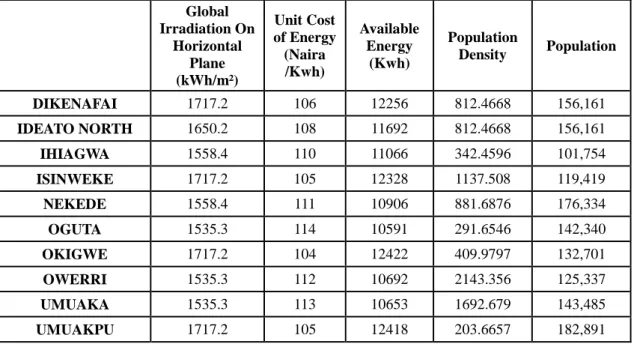
The values for each of the site selection parameter for the 10 selected local government areas (LGAs) in Imo State are shown in Table 2. Column 2 of Table 2 shows the Global Irradiation on Horizontal Plane (kWh/m²) obtained from NASA website [11]. Column 3 and column 4 of Table 2 contain the Unit Cost of Energy (Naira/KWh) and Available Energy (Kwh) respectively. The Unit Cost of Energy (Naira/KWh) and Available Energy (Kwh) are obtained from PVSyst simulation of the PV potential and economic analysis of PV system for each of the selected 10 LGAs in Imo state. Column 5 and column 6 contain data on population density and population respectively.
Table 2: The Values for Each of the Site Selection Parameters for the 10 LGAs in Imo State Global Irradiation On Horizontal Plane (kWh/m²) Unit Cost of Energy (Naira /Kwh) Available Energy (Kwh) Population
Density Population
DIKENAFAI 1717.2 106 12256 812.4668 156,161
IDEATO NORTH 1650.2 108 11692 812.4668 156,161
IHIAGWA 1558.4 110 11066 342.4596 101,754
ISINWEKE 1717.2 105 12328 1137.508 119,419
NEKEDE 1558.4 111 10906 881.6876 176,334
OGUTA 1535.3 114 10591 291.6546 142,340
OKIGWE 1717.2 104 12422 409.9797 132,701
OWERRI 1535.3 112 10692 2143.356 125,337
UMUAKA 1535.3 113 10653 1692.679 143,485
UMUAKPU 1717.2 105 12418 203.6657 182,891
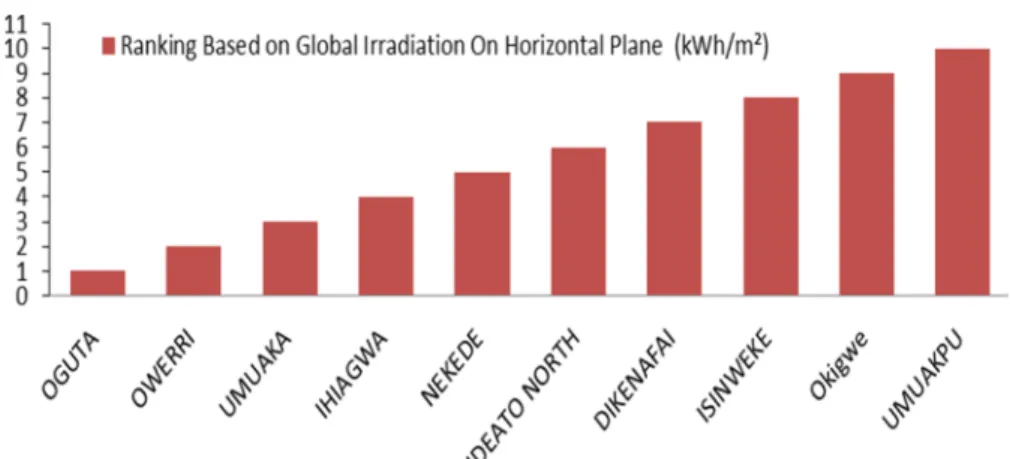
Site suitability is directly proportional to Global Irradiation on Horizontal Plane (kWh/m²). With respect to Global Irradiation on Horizontal Plane (kWh/m²), Fig. 1 shows that Umuakpu has the highest value and hence is the most preferred site if only Global Irradiation on Horizontal Plane (kWh/m²) is considered. On the other hand, Oguta is the worst location with respect to Global Irradiation on Horizontal Plane (kWh/m²).
Table 3: The Site Suitability Factor and Suitability Ranking Computation for the 10 LGAs in Imo State
Global Irradiation On Horizontal Plane (kWh/m²)
(wi= 3)
Unit Cost of energy
(wi=5)
Available Energy
(Kwh)
(wi = 4)
Populati on Density
(wi =
2)
Population
(wi=1)
PV Site Suitability Factor (PVSSF) PV Site Suitability Rank (PVSSR)
DIKENAFAI 7 7 7 6 8 105 3
IDEATO
NORTH 6 6 6 5 7 90 5
IHIAGWA 4 5 5 8 1 75 6
ISINWEKE 8 8 8 3 2 105 4
NEKEDE 5 4 4 4 9 69 7
OGUTA 1 1 1 9 5 36 10
OKIGWE 9 10 10 7 4 136 2
OWERRI 2 3 3 1 3 39 8
Figure 1: Site Ranking Based on global Irradiation On Horizontal Plane
(KWh/m2)
With respect to population density, Fig. 2 shows that Umuakpu has the lowest value and hence is the most preferred site if only population density is considered. On the other hand, Owerri with the highest population density is the worst location with respect to population density.
Figure 2: Site Ranking Based on Population Density
Actually, site suitability is inversely proportional to population density, consequently, in Table 2, Owerri has the highest population density, and so, Owerri is the most unsuitable because it will require evacuation of more people and payment of more compensation if the large scale PV power plant is to be sited in Owerri. Umuakpu, on the other hand, has the lowest population density.
Site suitability is directly proportional to population, the higher the population, the higher the number of potential customers for the PV power plant. With respect to population, Table 2 shows that Umuakpu has the highest value and hence in Fig. 3 Umuakpu is the most preferred site if only population density is considered. On the other hand, Ihiagwa is the worst location with respect to population. Actually, in Table 2, Umuakpu has the highest population density. As such it is the most suitable because it will have more customers who will pay for the investment if the large scale PV power plant is to be sited in Umuakpu.
With respect to potential available yearly energy output from the PV plant, Fig. 4 shows that Okigwe has the highest value and so it is the most preferred site if only available yearly energy output from the PV plant is considered. On the other hand, Oguta is the worst location with respect to available yearly energy output from the PV plant. Essentially, site suitability is directly proportional to potential available yearly energy output.
Figure 4: Site Ranking Based on Available Energy (KWh)
Figure 5: Site Ranking Based on Uint Cost Of Energy
from the PV plant.
When the five optimal site selection parameters are simultaneously considered using Eq. (4) and Eq. (5), a single value is obtained for ranking the different sites. Table 3 and Fig. 6 show the collective PV Site Suitability Factor (PVSSF) which is computed from the five site selection parameters. With respect to PVSSF, Table 3 and Fig. 6 show that Umuakpu has the highest value and so it is the most preferred site if all the five site selection parameters are simultaneously considered. On the other hand, Oguta is the worst location if all the five site selection parameters are simultaneously considered. Figure 7 shows the actual ranking of the 10 LGAs based on the PVSSF. Again, Umuakpu is ranked number 1 based on the PVSSF in Fig. 6 whereas Oguta is ranked number 10. In all, Umuakpu is the most suitable site for large scaled PV power plant in Imo state.
Figure 6: PV Site Suitability Factor (PVSSF)
Figure 7: PV Site Suitability Ranking (PVSSR)
4 Conclusion and Recommendations
4.1 Conclusion
scale PV power plant. The five parameters are:
1. Global Irradiation On Horizontal Plane (kWh/m²) 2. Available Energy (Kwh)
3. Yearly Unit Cost of Energy 4. Population
5. Land Mass (in )
In all, Umuapu has the highest PV Site Suitability Factor (PVSSF) of 142 while Oguta has the least with 39. Consequently, the optimal site for large scaled PV power plant among the selected LGAs in Imo State is Umuapu. Accordingly, Umuapu has the PV Site Suitability Rank (PVSSR) of one (1) while Oguta has the poorest PVSSR value of 10.
4.2 Recommendations
The study so far covered only 10 LGAs in Imo State. Further works are required to conduct the study for the whole LGAs in Imo State. Also, the data used for the study are obtained from NASA SSE website. It is always recommended that locally measured data should be used.
References
[1] Murunga J. (2014) Where shall we put it? Solar mini-grid site selection
handbook, Published by Deutsche Gesellschaft für Internationale
Zusammenarbeit (GIZ) GmbH, 2014.
[2] Khan, G., & Rathi, S. (2014) Optimal Site Selection for Solar PV Power Plant in an Indian State Using Geographical Information System (GIS). International
Journal of Emerging Engineering Research and Technology Volume 2, Issue 7,
October 2014, 260-266.
[3] Adel Gastli, Yassine Charabi (2011) PV site suitability analysis using GIS-based spatial fuzzy multi-criteria evaluation, Renewable Energy, Volume 36, Issue 9, September 2011, 2554–2561.
[4] Gastli, A., Charabi, Y. (2010) Solar electricity prospects in Oman using GIS based solar radiation maps, Renewable and Sustainable Energy Reviews, vol. 14, 790–797, 2010.
[5] M. A. Herrera-Seara, F. Aznar Dols, M. Zamorano, and E. Alameda-Hernández (2010) Optimal location of a biomass power plant in the province of Granada analyzed by multi-criteria evaluation using appropriate Geographic Information System according to the Analytic Hierarchy Process, 2010,
International Conference on Renewable Energies and Power Quality
(ICREPQ‟10).
[6] Hossain, Jami, Vinay Sinha, and V. V. N. Kishore (2011) A GIS based assessment of potential for windfarms in India. Renewable energy 36.12 (2011): 3257-3267.
[8] Souvik Ganguli, Jasvir Singh (2010) Estimating the Solar Photovoltaic generation potential and possible plant capacity in Patiala, 2010, International
Journal of Applied Engineering Research, Dindigul. Volume 1, No 2, 2010.
[9] Khan, G., & Rathi, S. (2014) Optimal Site Selection for Solar PV Power Plant in an Indian State Using Geographical Information System (GIS). International Journal of Emerging Engineering Research and Technology Volume 2, Issue 7, October 2014, PP 260-266.
[10] Miller, A., Lumby, B. (2012) Utility scale solar power plants: a guide for developers and investors. Guidilines book written for IFC. World Bank Group,
New Delhi, India.
[11] NASA surface meteorology and solar energy-location. Atmospheric Science Data center. Twenty two years average data of NASA SSE model (1983–2005). http://www.eosweb.laec.nasa.gov.
[12] Mermoud, A. (2012) Pvsyst: Software for the study and simulation of photovoltaic systems. ISE, University of Geneva, www. pvsyst. com.
[13] National Population Commission. (1991) Population census of the Federal Republic of Nigeria, Analytic report at the National level. 1991.
[14] National Population Commission. (2007) Results of the 2006 population census.
National Population Commission, Abuja, Nigeria. 2007.