INNOVATION IN
HEALTH INFORMATICS
Using the diffusion of innovations theory to
assess socio-technical factors in planning
the implementation of an electronic health
record alert across multiple primary care
clinics
Ching-Ping Lin
Institute of Translational Health Sciences, University of Washington, Seattle, USA
Janelle Guirguis-Blake
Tacoma Family Medicine Residency Program, Tacoma, USA
Gina A. Keppel
Institute of Translational Health Sciences, University of Washington, Seattle, USA, and Department of Family Medicine, University of Washington, Seattle, USA
Sharon Dobie
Department of Family Medicine, University of Washington, Seattle, USA
Justin Osborn
Department of Family Medicine, University of Washington, Seattle, USA
Allison M. Cole
Institute of Translational Health Sciences, University of Washington, Seattle, USA, and Department of Family Medicine, University of Washington, Seattle, USA
Laura-Mae Baldwin
Institute of Translational Health Sciences, University of Washington, Seattle, USA, and Department of Family Medicine, University of Washington, Seattle, USA
AbstrAct
background Adverse drug events (ADEs) are a leading cause of death in the United States. Patients with stage 3 and 4 chronic kidney disease (CKD) are at particular risk because many medications are cleared by the kidneys. Alerts in the electronic health record (EHR) about drug appropriateness and dosing at the time of prescription have been shown to reduce ADEs for patients with stage 3 and 4 CKD in inpatient settings, but more research is needed about the implementation and effectiveness of such alerts in outpatient settings.
Objective To explore factors that might inform the implementation of an electronic drug–disease alert for patients with CKD in primary care clinics, using Rogers’ diffu-sion of innovations theory as an analytic framework.
Methods Interviews were conducted with key informants in four diverse clinics using various EHR systems. Interviews were audio recorded and transcribed. results Although all clinics had a current method for calculating glomerular filtra-tion rate (GFR), clinics were heterogeneous with regard to current electronic deci-sion support practices, quality improvement resources, and organizational culture and structure.
conclusion Understanding variation in organizational culture and infrastructure across primary care clinics is important in planning implementation of an interven-tion to reduce ADEs among patients with CKD.
Research article
Cite this article: Lin C-P, Guirguis-Blake J, Keppel GA, Dobie S, Osborn J, Cole AM, Baldwin L-M. Using the diffusion of innovations theory to assess socio-technical factors in planning the implementation of an electronic health record alert across multiple primary care clinics. J Innov Health Inform. 2016;23(1):450–458.
http://dx.doi.org/10.14236/jhi.v23i1.157
Copyright © 2016 The Author(s). Published by BCS, The Chartered Institute for IT under Creative Commons license http://creativecommons.org/ licenses/by/4.0/
Author address for correspondence
Laura-Mae Baldwin, MD MPH University of Washington Department of Family Medicine Box 354696
Seattle, WA 98195, USA. Email: [email protected]
IntrOdUctIOn
Medical errors are the eighth leading cause of death in the United States1 and the most common form of medical error
in inpatient settings, estimatedat one medication error per patient per day.2 Patients in ambulatory care settings are also
subject to medication errors, with one study documenting an overall medication error rate of 7.6%. Adverse drug events (ADEs) result in increased morbidity and mortality, increased cost, and excessive healthcare utilization.2–4
Medication dosing errors and toxicity are especially impor-tant and common problems in patients with chronic kidney disease (CKD).5,6 The incidence of ADEs is much higher in
patients with CKD than those without CKD.7 Although
stan-dard dosing guidelines and methods of dose adjustment are available for patients with CKD,8 between 5.3% and 69.6%
of medications that require dose adjustment are dosed inap-propriately for patients with CKD.9–12
Two main strategies have been tested, almost exclusively in the inpatient setting, to assist practitioners in monitor-ing and adjustmonitor-ing drug therapy among CKD patients: com-puterised dosing programs and clinical pharmacist dosing services.13,14 Use of these strategies can decrease dosing
errors and the prescription of high-risk medications.15–18 We
found only one study evaluating a computerised tool in the outpatient setting. Its results suggest that alerting outpatient pharmacists to possible errors in drug selection and dosing at the time of dispensing can decrease medication errors.19
Computerised physician order entry (CPOE) is increas-ingly used in ambulatory clinics to improve medication safety and quality of care.20 With the advent of incentive programs
tied to meaningful use of an organization’s electronic health record (EHR), including effective decision support, a realistic strategy to improve medication management is to develop evidence-based alerts in ambulatory care that build on CPOE systems. An important next step is to evaluate whether this strategy can decrease dosing errors and other medication errors in the ambulatory care setting.
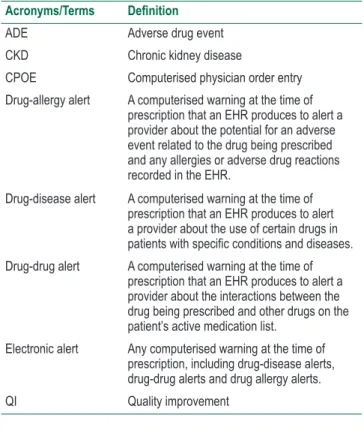
This study explored how best to implement electronic drug–disease alerts for patients with CKD in four primary care clinics in the Northwest United States. Electronic drug– disease alerts are computerised warnings at the time of pre-scription that an EHR produces to alert a provider about the use of certain drugs in patients with specific conditions and
diseases (Table 1). We recognized that working in a diverse set of community practices created heterogeneity of EHRs and numerous socio-technical factors. Research has docu-mented that the process for planning implementation in a par-ticular setting can be as important as the intervention itself.21
We wanted to explore these socio-technical factors because we knew a single implementation strategy might not succeed equally across clinics. This project asked what key elements might increase the likelihood of success in implementing electronic drug–disease alerts for patients with CKD across diverse clinics.
table 1 Glossary of acronyms and terms Acronyms/Terms Definition
ADE Adverse drug event CKD Chronic kidney disease
CPOE Computerised physician order entry Drug-allergy alert A computerised warning at the time of
prescription that an EHR produces to alert a provider about the potential for an adverse event related to the drug being prescribed and any allergies or adverse drug reactions recorded in the EHR.
Drug-disease alert A computerised warning at the time of prescription that an EHR produces to alert a provider about the use of certain drugs in
patients with specific conditions and diseases.
Drug-drug alert A computerised warning at the time of prescription that an EHR produces to alert a provider about the interactions between the drug being prescribed and other drugs on the patient’s active medication list.
Electronic alert Any computerised warning at the time of prescription, including drug-disease alerts, drug-drug alerts and drug allergy alerts. QI Quality improvement
MethOds
Practice sites and selection
This study was conducted in the Washington, Wyoming, Alaska, Montana, and Idaho (WWAMI) region Practice and Research Network (WPRN), a practice-based research Keywords: adverse drug event (ADE), chronic kidney diseases (CKDs),
electronic health records (EHRs), medication alert systems, outpatient clinic, primary care
What this paper adds
• This paper provides guidance in planning to implement electronic drug– disease alerts that warn providers about the use of certain drugs at the time of prescription for patients with specific diseases.
network in the five-state WWAMI region. We selected four WPRN clinics for this study based on the maturity of their EHR implementations and the ability to query the EHR. Two clinics are located in large cities (population >100,000) and two in smaller rural-serving cities. One clinic is hospital-affili-ated, one university-affilihospital-affili-ated, and the other two are commu-nity health centers. The number of annual patient visits in the clinics ranges from roughly 17,000–50,000.
Framework application
We used Rogers’ diffusion of innovations (DOI) theory frame-work for how new innovations are adopted by organizations and Greenhalgh’s subsequent work adapting the framework for healthcare settings.22,23 We used these frameworks to
deductively explore factors that might help the intervention better diffuse in each clinic setting. The DOI framework, developed originally from studies in rural sociology, has been used frequently in healthcare settings, such as to implement metabolic syndrome screening guidelines24 and screening of
mechanically ventilated patients for delirium.25
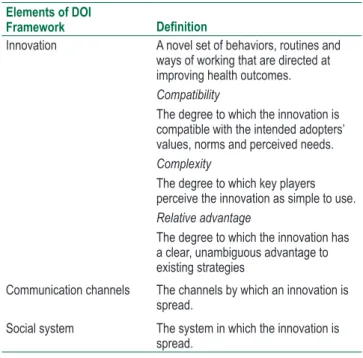
We focused on three of the four elements of the DOI framework most relevant to this study’s purpose: innovation, communication channels and social system (Table 2). Within innovation, we focused on three of the five characteristics of innovations that influence their adoption: compatibility, com-plexity and relative advantage.
table 2 conceptual framework based on rogers’ dOI theory Elements of DOI
Framework Definition
Innovation A novel set of behaviors, routines and ways of working that are directed at improving health outcomes.
Compatibility
The degree to which the innovation is compatible with the intended adopters’ values, norms and perceived needs.
Complexity
The degree to which key players perceive the innovation as simple to use.
Relative advantage
The degree to which the innovation has a clear, unambiguous advantage to existing strategies
Communication channels The channels by which an innovation is spread.
Social system The system in which the innovation is spread.
Interview guide and interview procedures
We developed an interview guide (Appendix 1) that focused on understanding each clinic’s EHR capabilities, current availability of CKD-related decision support, organizational culture, organizational structure, and research and quality improvement (QI) infrastructure. Two study team members (JGB and CPL) conducted seven interviews with key infor-mants at the four clinics, one team member leading while the other took notes. At each clinic, we interviewed a care
provider able to describe the current state of CKD decision support and the clinic’s culture. At three sites, we also inter-viewed an individual with specific knowledge of the clinic’s EHR system, as the care providers did not have the techno-logical expertise to answer all interview questions. Four key informants were physicians, one a clinical pharmacist, one a director of quality, and one both a physician and director of clinical quality and population management.
Six interviews were conducted in person, one by phone. All were recorded and transcribed. We gathered over 225 min of interviews resulting in 92 transcribed pages. Participants reviewed summaries of the interviews and corrected, clarified and/or supplemented the data as appropriate.
Analysis
The analysis mapped themes identified in the qualitative data to the DOI framework described above. Two coders (CPL and GK) developed a codebook based on the modified DOI framework. They used a deductive coding method starting with the DOI framework, then added open codes and recon-ciled them with the framework. Each coder separately coded interviews using ATLAS.ti.26 The coders used an iterative
process of reviewing and reconciling codes until agreement was reached. Other authors reviewed the primary coders’ themes and codes, verifying and augmenting them per their interpretation of the data. We received approval for this study from the University of Washington Human Subjects Division.
resUlts
Innovation
compatibility
We assessed compatibility (how well the innovation fits with the intended adopters’ values, norms and perceived needs) in three ways:
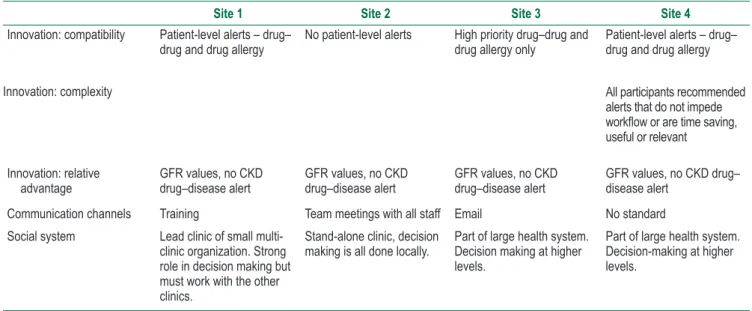
1. We compared the compatibility of the proposed intervention with the electronic alert capabilities at the clinics (Table 3). Of the four participating clinics, all had existing EHRs with the capability for drug– disease alerts, but none had implemented these alerts. Sites 1, 3 and 4 had electronic alerts active in their EHR systems. Site 3 had limited its alerts to high-priority drug–drug and drug allergy alerts. 2. We examined the clinics’ experience with and
infrastructure for supporting research or QI projects. All four clinics had QI boards or processes. Sites 2 and 3 had dedicated QI staff and commonly conducted QI projects using EHR data.
3. We investigated whether the clinics intended to meet one of the stage 1 meaningful use core objectives by implementing drug–drug and drug allergy alerts. Meaningful use is a program that sets specific objectives that eligible professionals and hospitals must achieve to qualify for Centers for Medicare and Medicaid Services Incentive Programs.27
tons more buttons and they were in different locations… And while it gives more usability, it’s like shopping at Costco when you just want a small spice or something’.
relative advantage
Relative Advantage is how well the innovation has a clear unambiguous advantage compared with existing strategies. Without electronic drug–disease alerts, providers are required either to know or to look up each medication at the time of prescribing to determine whether it requires dose adjustment or is contraindicated. This process generally involves several steps to access both the calculated glomerular filtration rate (GFR) from the chart and a database with information on medication renal dosing.
None of the clinics had CKD-related drug–disease alerts (Table 3). All of the clinics reported that they had a method to calculate GFR rates in the EHR or that laboratory reports return GFR calculations. Providers use this information at their discretion.
communication
We looked at communication channels to understand how change was effected in each organization. Each clinic had a dif-ferent culture of communication (Table 3). Site 2 regularly used team meetings with providers and nursing staff to communicate new information or initiatives. However, this method did not fully reach all of their staff: ‘One of the biggest problems that we have…is it’s just really hard to get everybody in the room and let them know what’s happening, not to mention your nurses. I mean even today, we’ve got one nurse sick and one nurse who’s off and we’re having our discussion about using [a new practice management tool]. So you can never capture everyone’.
For Site 1, clear communication was critical to its culture, with an emphasis on training for new initiatives: ‘the local hospital…recently implemented the CPOE process there without any training at all, and the providers were kind of up use. Sites 2 and 3 had already met meaningful use
criteria using methods that did not involve electronic alerts. Site 4 reported that alerts might be part of their meeting meaningful use criteria, but that their alerts would need to be reviewed in order to do so, saying: ‘we will probably reevaluate our alerts here relatively soon because we’re moving into meaningful use attestation… And my suspicion is that we will want to turn on a set of alerts for meaningful use. And it may be that in the process of doing that, we decide…we’d rather bother [providers] for pneumovax which is one of our requirements instead of this one’.
complexity
Complexity is the degree to which the innovation is perceived as difficult to use. Alert fatigue, the process of receiving too many alerts, causing the receiver to ignore alerts,28 emerged
as a common concern among all the key informants inter-viewed: ‘So the biggest barrier that I can think of is…alert fatigue… we all see an alert virtually every single time we enter the EMR, of one kind or another and you know, this would be just one more alert. But I do think that at least at this point in time, there are not many of our alerts that are really patient oriented…’
Key informants also discussed the importance of the alert fitting into their workflows, or being ‘useful’, ‘relevant’ or ‘time saving’. For example, one participant shared, ‘I think the ques-tion is when it flags you. I know early on they turned on some things that popped up as soon as you logged in and those really weren’t that helpful. It needs to happen around the time you’re ordering’. Another noted, ‘I think it’s going to be a welcome function as long as it doesn’t complicate current prescribing practices. If they can be seamlessly integrated into [the EHR system] without multiple additional clicks, I think it would be a very welcome piece’. One participant gave an example of a new EHR feature that did not have these traits, ‘[there were]
table 3 Key results by the dOI framework
Site 1 Site 2 Site 3 Site 4
Innovation: compatibility Patient-level alerts – drug–
drug and drug allergy No patient-level alerts High priority drug–drug and drug allergy only Patient-level alerts – drug–drug and drug allergy Innovation: complexity All participants recommended
alerts that do not impede
workflow or are time saving,
useful or relevant Innovation: relative
advantage GFR values, no CKD drug–disease alert GFR values, no CKD drug–disease alert GFR values, no CKD drug–disease alert GFR values, no CKD drug–disease alert Communication channels Training Team meetings with all staff Email No standard
Social system Lead clinic of small multi-clinic organization. Strong role in decision making but must work with the other clinics.
Stand-alone clinic, decision
making is all done locally. Part of large health system. Decision making at higher levels.
It is critical that we tailor an implementation plan for each organization to these factors to maximize acceptance. The DOI framework can be used to guide the design of an imple-mentation plan for a CKD electronic drug–disease alert.
Implications of the findings
Compatibility with Clinic Values, Norms and Needs
There was substantial variability in the availability of elec-tronic alerts in the four participating clinics. In a clinic without alerts, providers would not be accustomed to interruptions or stops to their prescribing workflow and the proposed inter-vention might represent a fundamental change, leading to potential disruption and rejection.29 For these clinics, the
implementation plan would need to be designed in a way that specifically addressed the introduction of electronic drug–dis-ease alerts and any resulting shift in provider workflow.
One clinic had a robust QI infrastructure that could sup-port long-term evaluation and follow-up. At the clinics that had limited QI resources, it would be critical to ensure that the necessary resources would be available for follow-up and monitoring CKD drug–disease alerts.
We thought that making the proposed intervention part of a larger QI effort such as meaningful use might be an incentive to potential partner clinics. However, we discovered that sev-eral had already met meaningful use criteria using methods that did not involve electronic alerts, and a third had other higher priority alerts to implement. Meaningful use standards may still serve as a possible incentive towards implementing an alert-based intervention, but clearly our approach must be tailored to each clinic.
Complexity of the intervention
This study found that the intervention must fit into a clinician’s existing workflow, saving time and being efficient. This rein-forces the importance of making sure that an intervention can meet these requirements before engaging with the clinics. Additionally, when working with the clinics, we must evaluate the intervention using these criteria to show the clinics that we understand their priorities and to ensure better long-term acceptance. Our key informants made clear that an alert that would require significant workflow redesign at the level of the provider alert interface would serve as a barrier to its use.
Relative advantage compared with existing
strategies
The proposed intervention would use the available GFR data in the EHR to identify patients with CKD and, for these patients, alert the provider with a pop up window at the time that a contraindicated drug or inappropriate drug dose was prescribed. The pop up window would support the provider by warning about drug contraindications for patients with CKD and by recommending drug doses or frequencies that fit the patient’s level of kidney function. This introduces new clinical functions (e.g. identification of patients previously not identified with CKD and recommended changes in drug dos-ing based on GFR) and a new delivery method for this infor-mation (pop up window). Thus, the proposed intervention in arms over that, you know, they were very clear about-do
not do that here’.
Sites 3 and 4 had a more ‘hands off’ approach to com-munication. Site 3 primarily used email to communicate and did not require approval from providers prior to implementing EHR changes.At this clinic, providers were accustomed to learning about new functions through their everyday use of the EHR.Key informants from site 4 also reported that their clinic has no standard method for communicating change.
social system
We examined the social system at each clinic, focusing on how decisions were made, which is integral to how quickly an innovation will be adapted. The clinics that are members of larger health systems had top-down management and decision making, whereas the other clinics had much more local decision-making authority (Table 3). For instance, site 2 is an independent clinic whose information technology was managed on-site by clinic-employed personnel. Therefore, all of its EHR customizations and implementations could be conducted locally, including provider-level customizations. Site 2’s key informant shared an example of provider-level customization, ‘you open up one of Dr … ’s patients that he is designated as the PCP (primary care provider) on? It will say basically, …call me. Don’t monkey with my patients too much’.
In contrast, sites 3 and 4 are members of large health sys-tems with centralized information technology syssys-tems, staff and committees. EHR-related decisions were made for the entire health care system rather than for individual clinics. Physicians from site 3 reported that they were accustomed to new features appearing in the EHR without their direct involvement in the decision-making process. Site 4’s orga-nization had recently implemented a new policy that any changes to the EHR must be system wide, rather than on a clinic-by-clinic basis. ‘So in the early days we could build all our own templates, we could do whatever, and now there’s… We’re becoming the battleship that’s slowly turning and no longer little speedboats’.
Site 1 is the largest clinic in a small network of clinics. This clinic hosted administrative committees and thus had a lead role in making decisions about EHR changes. This clinic was both similar to site 2 in its ability to drive change at a local level and subject to some of the same collective decision-making policies of the larger health systems.
Clinical pharmacists are one resource to promote and sup-port an alert-based intervention. All but one clinic employed a clinical pharmacist as an integral member of the clinical care team.
dIscUssIOn
Principal findings
the effectiveness of individual alert features. Practice-based research networks that include multiple clinics with EHR capabilities, sometimes within larger health systems, provide a robust environment in which to implement experiments of these features.34,35
lIMItAtIOns OF the stUdY
We interviewed at most two key informants at each clinic and thus did not receive multiple perspectives from the same organization. Because this preliminary research did not focus on the willingness of the clinics to engage in implementing this intervention, but rather on the socio-technical charac-teristics of each setting, we felt that these informants could accurately represent their clinics.
cOnclUsIOn
Rogers’ DOI theory provided a useful framework for explor-ing factors that might influence the implementation of a CKD drug–disease alert in four community-based primary care clinics. Rogers describes organizational culture as ‘how things are done’. This work shows that how things are done in community-based primary care settings can vary greatly, especially in terms of decision making and communication to providers. Given these findings, it is not surprising that clinics that are provided practice facilitators to assist with tailored clinical redesign and QI are significantly more likely to change their clinical practices than clinics without facilitators.36,37 Those who implement new interventions
in these settings, whether informatics based or not, must be conscious of clinic differences, understand how they might impact their implementation planning and tailor the interventions to different clinical settings in order to maximize the chances of acceptance.
Acknowledgements
This research was supported by the National Center for Advancing Translational Sciences of the National Institutes of Health under Award UL1TR000423. The content is solely the responsibility of the authors and does not necessar-ily represent the official views of the National Institutes of Health.
Conflicts of interest and source of funding
No conflicts of interest were declared. would add new capabilities and necessitate culture change at
each of the clinics, since there were no existing drug–disease alerts. It would be critical to emphasize the benefit of this new type of alert and the advantage over current methods to the clinics and their providers.
Communication channels and social system
Understanding clinics’ existing communication and social systems allows development of individualized communica-tion strategies for each setting. We discovered two general types of staff communication channels: face-to-face all-staff meetings and communication to staff via electronic means such as emails. Thus, an implementation plan for an alert-based intervention would best include support for multiple communication and information dissemination methods. This study suggests that different sites may be more accus-tomed to or expect use of certain communication channels. Supporting multiple approaches should provide the needed flexibility to respect clinic culture when choosing information dissemination methods while being sensitive to the informa-tion overload already facing clinicians.
comparison with Previous research
Like this study, Bates et al.30 found that an intervention must
fit into the existing workflow, saving time, being efficient and changing direction rather than forcing a hard stop in work. They also recommend continuous maintenance of alerts to reflect current evidence and to monitor the usage pattern of alerts. Though alerts can be an important tool for improving drug safety,31 Cho et al.32 have demonstrated that providers
do not heed (‘override’) the recommendations in alerts for renal dosing of medications most of the time, and only about 30% of these overrides are appropriate. A small number of providers were responsible for a large proportion of the over-rides. This suggests that alerts must be accompanied by other interventions to ensure success. Kawamoto et al.’s33
system-atic review of trials using clinical decision support systems to improve clinical practice identified features that predicted the success of these systems, including integration into clinician workflow at the time and location of decision making and provi-sion of recommendations rather than assessments only.
call for Further research
Electronic drug–disease alerts have the potential to include the features that Kawamoto et al.33 identified as predictive
of success, yet additional research is needed to directly test
reFerences
1. Kohn LT, Corrigan JM and Donaldson MS (Ed). To Err Is Human: Building a Safer Health System. Washington, DC: National Academies Press, 2000.
2. Aspden P, Wolcott JA, Bootman JL and Cronenwett LR. Preventing Medication Errors: Quality Chasm Series. Washington, DC: National Academies Press, 2007.
4. Shepherd G, Mohorn P, Yacoub K and May DW. Adverse drug reaction deaths reported in United States vital statistics, 1999– 2006. The Annals of Pharmacotherapy 2012;46(2):169–75. PubMed PMID: 22253191. Epub 2012/01/19. eng.
5. Hug BL, Witkowski DJ, Sox CM, Keohane CA, Seger DL and Yoon C et al. Occurrence of adverse, often preventable, events in community hospitals involving nephrotoxic drugs or those excreted by the kidney. Kidney International 2009;76(11):1192–8. PubMed PMID: 19759525. Epub 2009/09/18. eng.
6. Joosten H, Drion I, Boogerd KJ, van der Pijl EV, Slingerland RJ and Slaets JP et al. Optimising drug prescribing and dispens-ing in subjects at risk for drug errors due to renal impairment: improving drug safety in primary healthcare by low eGFR alerts. BMJ Open 2013;3(1):e002068. PubMed PMID: 23355668. Pubmed Central PMCID: PMC3563134. Epub 2013/01/29. eng. 7. Blix HS, Viktil KK, Moger TA and Reikvam A. Use of renal risk
drugs in hospitalized patients with impaired renal function – an underestimated problem? Nephrology, Dialysis, Transplantation : Official Publication of the European Dialysis and Transplant Association – European Renal Association 2006;21(11):3164– 71. PubMed PMID: 16880181. Epub 2006/08/02. eng.
8. Aronoff GR. Drug Prescribing in Renal Failure: Dosing Guidelines for Adults, 4th edition. Philadelphia, Pennsylvania: American College of Physicians, 1999.
9. Hu KT, Matayoshi A and Stevenson FT. Calculation of the estimated creatinine clearance in avoiding drug dosing errors in the older patient. The American Journal of the Medical Sciences 2001;322(3):133–6. PubMed PMID: 11570777. Epub 2001/09/26. eng.
10. Long CL, Raebel MA, Price DW and Magid DJ. Compliance with dosing guidelines in patients with chronic kidney disease. The Annals of Pharmacotherapy 2004;38(5):853–8. PubMed PMID: 15054147. Epub 2004/04/01. eng.
11. Sheen SS, Choi JE, Park RW, Kim EY, Lee YH and Kang UG. Overdose rate of drugs requiring renal dose adjustment: data analysis of 4 years prescriptions at a tertiary teaching hospi-tal. Journal of General Internal Medicine 2008;23(4):423– 8. PubMed PMID: 18373140. Pubmed Central PMCID: PMC2359525. Epub 2008/04/01. eng.
12. Yap C, Dunham D, Thompson J and Baker D. Medication dos-ing errors for patients with renal insufficiency in ambulatory care. Joint Commission Journal on Quality and Patient Safety/ Joint Commission Resources 2005;31(9):514–21. PubMed PMID: 16255329. Epub 2005/11/01. eng.
13. Chang J, Ronco C and Rosner MH. Computerized deci-sion support systems: improving patient safety in nephrology. Nature Reviews Nephrology 2011;7(6):348–55. PubMed PMID: 21502973. Epub 2011/04/20. eng.
14. Kaboli PJ, Hoth AB, McClimon BJ and Schnipper JL. Clinical pharmacists and inpatient medical care: a systematic review. Archives of Internal Medicine 2006;166(9):955–64. PubMed PMID: 16682568. Epub 2006/05/10. eng.
15. Field TS, Rochon P, Lee M, Gavendo L, Baril JL and Gurwitz JH. Computerized clinical decision support during medication ordering for long-term care residents with renal insufficiency. Journal of the American Medical Informatics Association
2009;16(4):480–5. PubMed PMID: 19390107. Pubmed Central PMCID: PMC2705250. Epub 2009/04/25. eng.
16. Galanter WL, Didomenico RJ and Polikaitis A. A trial of auto-mated decision support alerts for contraindicated medica-tions using computerized physician order entry. Journal of the American Medical Informatics Association 2005;12(3):269– 74. PubMed PMID: 15684124. Pubmed Central PMCID: PMC1090457. Epub 2005/02/03. eng.
17. Nash IS, Rojas M, Hebert P, Marrone SR, Colgan C and Fisher LA et al. Reducing excessive medication administration in hos-pitalized adults with renal dysfunction. American Journal of Medical Quality 2005;20(2):64–9. PubMed PMID: 15851383. Epub 2005/04/27. eng.
18. Roberts GW, Farmer CJ, Cheney PC, Govis SM, Belcher TW and Walsh SA et al. Clinical decision support implemented with academic detailing improves prescribing of key renally cleared drugs in the hospital setting. Journal of the American Medical Informatics Association 2010;17(3):308–12. PubMed PMID: 20442149. Pubmed Central PMCID: PMC2995705. Epub 2010/05/06. eng.
19. Steele AW, Eisert S, Witter J, Lyons P, Jones MA and Gabow P et al. The effect of automated alerts on provider ordering behav-ior in an outpatient setting. Public Library of Science Medicine 2005;2(9):e255. PubMed PMID: 16128621. Pubmed Central PMCID: PMC1198038. Pub 2005/09/06. eng.
20. Classen DC, Avery AJ and Bates DW. Evaluation and certification of computerized provider order entry systems. Journal of the American Medical Informatics Association. 2007;14(1):48–55. PubMed PMID: 17077453. Pubmed Central PMCID: PMC2215075. Epub 2006/11/02. eng.
21. Gross PA and Bates DW. A pragmatic approach to implement-ing best practices for clinical decision support systems in com-puterized provider order entry systems. Journal of the American Medical Informatics Association 2007;14(1):25–8. PubMed PMID: 17068354. Pubmed Central PMCID: PMC2215068. Epub 2006/10/28. eng.
22. Greenhalgh T, Robert G, Macfarlane F, Bate P and Kyriakidou O. Diffusion of innovations in service organizations: system-atic review and recommendations. The Milbank Quarterly 2004;82(4):581–629. PubMed PMID: 15595944. Pubmed Central PMCID: PMC2690184. Epub 2004/12/15. eng.
23. Rogers EM. Diffusion of Innovations, 5th edition. New York: Free Press, 2003. vol. xxi, 551 pp.
24. Parrinello MC. Prevention of metabolic syndrome from atypical antipsychotic medications: applying Rogers’ diffusion of innova-tions model in clinical practice. Journal of Psychosocial Nursing and Mental Health Services 2012;50(12):36–44. PubMed PMID: 23457716. Epub 2013/03/05. eng.
25. Bowen CM, Stanton M and Manno M. Using Diffusion of Innovations Theory to implement the confusion assessment method for the intensive care unit. Journal of Nursing Care Quality 2012;27(2):139–45. PubMed PMID: 22367153. Epub 2012/03/01. eng.
27. EHR Incentives & Certification. Meaningful Use Definition and Objectives. The Office of the National Coordinator for Health Information Technology, United States Department of Health and Human Services. Available from: https://www.healthit.gov/ providers-professionals/meaningful-use-definition-objectives. Accessed on 28 February 2016.
28. Phansalkar S, van der Sijs H, Tucker AD, Desai AA, Bell DS and Teich JM, et al. Drug–drug interactions that should be non-interruptive in order to reduce alert fatigue in electronic health records. Journal of the American Medical Informatics Association 2013;20(3):489–93. PubMed PMID: 23011124. Pubmed Central PMCID: PMC3628052. 264429. Epub 2012/09/25. eng.
29. Ash JS, Stavri PZ and Kuperman GJ. A consensus state-ment on considerations for a successful CPOE implestate-menta- implementa-tion. Journal of the American Medical Informatics Association 2003;10(3):229–34. PubMed PMID: 12626376. Pubmed Central PMCID: PMC342045. Epub 2003/01/28. eng.
30. Bates DW, Kuperman GJ, Wang S, Gandhi T, Kittler A and Volk L et al. Ten commandments for effective clinical decision sup-port: making the practice of evidence-based medicine a real-ity. Journal of the American Medical Informatics Association 2003;10(6):523–30. PubMed PMID: 12925543. Pubmed Central PMCID: PMC264429. Epub 2003/08/20. eng.
31. Schedlbauer A, Prasad V, Mulvaney C, Phansalkar S, Stanton W and Bates DW et al. What evidence supports the use of computerized alerts and prompts to improve clinicians’ pre-scribing behavior? Journal of the American Medical Informatics Association 2009;16(4):531–8. PubMed PMID: 19390110. Pubmed Central PMCID: PMC2705257. Epub 2009/04/25. eng.
32. Cho I, Slight SP, Nanji KC, Seger DL, Maniam N and Dykes PC et al. Understanding physicians’ behavior toward alerts about nephrotoxic medications in outpatients: a cross- sectional analysis. BMC Nephrology 2014;15:200. PubMed PMID: 25511564. Pubmed Central PMCID: PMC4279964. Epub 2014/12/17. eng.
33. Kawamoto K, Houlihan CA, Balas EA and Lobach DF. Improving clinical practice using clinical decision support systems: a sys-tematic review of trials to identify features critical to success. BMJ 2005;330(7494):765. PubMed PMID: 15767266. Pubmed Central PMCID: PMC555881. Epub 2005/03/16. eng.
34. Agency for Healthcare Research and Quality. Primary Care Practice-Based Research Networks: An AHRQ Initiative. Agency for Healthcare Research and Quality, Rockville, MD. Available from http://www.ahrq.gov/research/findings/factsheets/primary/ pbrn/index.html. Accessed on 7 April 2016.
35. Calmbach WL, Ryan JG, Baldwin LM and Knox L. Practice-based research networks (PBRNs): meeting the challenges of the future. Journal of the American Board of Family Medicine 2012;25(5):572–6. PubMed PMID: 22956692. Pubmed Central PMCID: PMC3880656. Epub 2012/09/08. eng.
36. Baskerville NB, Liddy C and Hogg W. Systematic review and meta-analysis of practice facilitation within primary care set-tings. Annals of Family Medicine 2012;10(1):63–74. PubMed PMID: 22230833. Pubmed Central PMCID: PMC3262473. 37. Nagykaldi Z, Mold JW and Aspy CB. Practice facilitators: a
review of the literature. Family Medicine 2005;37(8):581–8. PubMed PMID: 16145629.
APPendIX 1. IntervIeW GUIde
Thank you for agreeing to this telephone interview today as part of our pilot project on improving safe prescribing practices in patients with chronic kidney disease (CKD).
Specifically, we plan to create an EMR alert that will advise providers when they are prescribing drugs that require renal dose adjustment or that are contraindicated in patients with CKD – this alert will be in real time while the prescription is being signed electronically.
1. CKD alert
1.1. How would you feel about this alert? (Interview introduction explaining the CKD alert intervention omitted in this appendix)
1.2. What types of barriers might arise during implementation and might prevent full utilization? 1.3. What would your fellow physicians think about this intervention?
What barriers or challenges do you see to this future project, especially at your site?
2. General EMR experience
2.1. What electronic medical record is available at your practice?
2.2. What other health software packages do you use (e.g. billing, scheduling and specialty software)? 2.3. How many years has that electronic medical record been in the practice?
2.4. Are there any plans to change EMRs in the next 1–3 years?
2.5. Have there been major changes to your EMR in the past 1–3 years?
2.6. Who is the current EMR support staff at the practice? What EMR support is available outside of the practice? (e.g. who do you call when you need help with EMR problems?)
2.8. For what clinical scenarios does your EMR prompt you to do something (order test, laboratory, med) or not to do something (drug–drug interactions and allergies)? For what processes are EMR alerts available? (define EMR alerts: drug–drug interactions, allergies, disease–drug contraindications and drug dosing) What percentage of the time that you are using an EMR during a patient visit does one of these prompts appear?
2.9. Is there a particular type of alert that you find to be most useful/least useful?
2.10. Are there any EMR alerts, flags or decision support tools currently available that specifically relate to patients with CKD? If yes, please describe.
2.11. What clinical decision support tools (e.g. calculators for dosing and risk assessment [Gail, Framingham]) and links to external evidence-based websites [e.g. NIH, CDC and US Preventive Services Task Force] are available?
2.12. Does your EMR laboratory result calculate and report glomerular filtration rate?
3. Governance and operational questions
3.1. Describe how your clinic operates within a larger system (e.g. free standing clinic, part of university system of clinics, part of community clinics, network of private practices)?
3.2. When changes are implemented to your EMR, can that change be directed specifically to individual providers or individual clinics?
3.3. By what processes are EMR alerts developed and implemented in the practice? 3.4. What personnel are required for design, approval and implementation?
3.5. How are innovative clinical protocols vetted in your institution (e.g. quality committee)? Is there a queue, triage process? By what approval process are they implemented?
3.6. Are you aware of any evaluation process after the implementation of EMR alerts? Is there an updating process or quality check process after implementation? How have EMR-based initiatives been evaluated at your clinic? Who/what is responsible for this evaluation process?
4. EMR QI/research experience history
4.1. What CKD-related QI or research initiatives have been completed in the past 5 years at the clinic site? 4.2. How does the clinic expect to meet the meaningful use objective to implement drug–drug and drug allergy
interaction checks (or have they already)?
4.3. Does your clinic have specific guidelines or protocols or EMR decision support or curricula around CKD safe prescribing?