University of Pennsylvania
ScholarlyCommons
Publicly Accessible Penn Dissertations
2017
Learning And Decision Making In Groups
M. Amin Rahimian
University of Pennsylvania, [email protected]
Follow this and additional works at:https://repository.upenn.edu/edissertations
Part of theLibrary and Information Science Commons, and theStatistics and Probability Commons
This paper is posted at ScholarlyCommons.https://repository.upenn.edu/edissertations/2880 For more information, please [email protected].
Recommended Citation
Rahimian, M. Amin, "Learning And Decision Making In Groups" (2017).Publicly Accessible Penn Dissertations. 2880.
Learning And Decision Making In Groups
Abstract
Many important real-world decision-making problems involve group interactions among individuals with purely informational interactions. Such situations arise for example in jury deliberations, expert committees, medical diagnoses, etc. We model the purely informational interactions of group members, where they receive private information and act based on that information while also observing other people's beliefs or actions.
In the first part of the thesis, we address the computations that a rational (Bayesian) decision-maker should undertake to realize her optimal actions, maximizing her expected utility given all available information at every decision epoch. We use an approach called iterated eliminations of infeasible signals (IEIS) to model the thinking process as well as the calculations of a Bayesian agent in a group decision scenario. Accordingly, as the Bayesian agent attempts to infer the true state of the world from her sequence of observations, she recursively refines her belief about the signals that other players could have observed and beliefs that they would have hold given the assumption that other players are also rational. We show that IEIS algorithm runs in exponential time; however, when the group structure is a partially ordered set the Bayesian calculations simplify and polynomial-time computation of the Bayesian recommendations is possible. We also analyze the computational complexity of the Bayesian belief formation in groups and show that it is NP-hard. We
investigate the factors underlying this computational complexity and show how belief calculations simplify in special network structures or cases with strong inherent symmetries. We finally give insights about the statistical efficiency (optimality) of the beliefs and its relations to computational efficiency.
In the second part, we propose the "no-recall" model of inference for heuristic decision-making that is rooted in the Bayes rule but avoids the complexities of rational inference in group interactions. Accordingly to this model, the group members behave rationally at the initiation of their interactions with each other; however, in the ensuing decision epochs, they rely on heuristics that replicate their experiences from the first stage and can be justified as optimal responses to simplified versions of their complex environments. We study the
implications of the information structure, together with the properties of the probability distributions, which determine the structure of the so-called ``Bayesian heuristics'' that the agents follow in this model. We also analyze the group decision outcomes in two classes of linear action updates and log-linear belief updates and show that many inefficiencies arise in group decisions as a result of repeated interactions between individuals, leading to overconfident beliefs as well as choice-shifts toward extreme actions. Nevertheless, balanced regular structures demonstrate a measure of efficiency in terms of aggregating the initial information of individuals. Finally, we extend this model to a case where agents are exposed to a stream of private data in addition to observing each other's actions and analyze properties of learning and convergence under the no-recall framework.
Degree Type
Dissertation
Degree Name
Doctor of Philosophy (PhD)
Graduate Group
First Advisor
Ali Jadbabaie
Keywords
Bayesian Learning, Bounded Rationality, Computational Complexity, Decision Theory, Group Decision-Making, Social Learning
Subject Categories
LEARNING AND DECISION MAKING IN GROUPS
M. Amin Rahimian
A DISSERTATION
in
Electrical and Systems Engineering
Presented to the Faculties of the University of Pennsylvania
in Partial Fulfillment of the Requirements for the
Degree of Doctor of Philosophy
2017
Supervisor of Dissertation
Ali Jadbabaie, JR East Professor of Engineering, MIT
Graduate Group Chairperson
Alejandro Ribeiro, Associate Professor of Electrical and Systems Engineering
Dissertation Committee:
LEARNING AND DECISION MAKING IN GROUPS © COPYRIGHT
2017
M. Amin Rahimian
This work is licensed under the Creative Commons Attribution NonCommercial-ShareAlike 3.0 License
To view a copy of this license, visit
To my mother,
Acknowledgments
First and foremost, I would like to thank Ali Jadbabaie, for his support and guidance throughout my PhD studies. This past five years have been a very formative and constructive part of my life, both professionally and personally. This, to a large extent, is due to him. He was always ready to answer my questions, and extremely patient in explaining his reasons and helping me understand them.
I would also like to thank Victor Preciado. I interacted a lot with Victor during my PhD studies. Our discussions were often quite technical and I learned so much from him; not only his techniques, but also his organization skills and way of thinking.
I had the good pleasure of assisting Santosh Venkatesh in several probability courses that he was offering at Penn. We had many meetings during these years and we often ended up discussing many topics besides, but often somehow related to, probability, pedagogy, and problem-solving. Santosh was very generous in sharing his personal experiences and thoughts. I really miss our conversations.
In my fourth and fifth years, I was extremely fortunate to take two courses with Elchanan Mossel and to later collaborate with him on the results in Chapter two of my thesis (Bayesian learning). Elchanan, together with Dean Eckles, co-advises my postdoctoral research at MIT Institute for Data, Systems and Society, and I am really looking forward to our continued interactions.
I want to especially thank Rakesh Vohra and Alvaro Sandroni for being on my thesis commit-tee. They took their time to discuss my research results with me, to provide their feedback, and eventually to evaluate my work.
Penn has a very collegial and friendly environment that fosters research and collaboration. It has been made possible through the efforts of its leadership and administration. I would like to particularly thank George Pappas, Daniel Lee, Lilian Wu, Charity Payne and other members of the leadership and administration at ESE, GRASP, and Wharton Statistics for their effective efforts in creating such a wonderful environment. It is perhaps also a good place to thank my colleagues, classmates, and friends. I am very grateful for the pleasure of their company throughout these years.
Some other individual scientific contributions are acknowledged in the footnotes at the begin-ning of each chapter.
ABSTRACT
LEARNING AND DECISION MAKING IN GROUPS M. Amin Rahimian
Ali Jadbabaie
Many important real-world decision-making problems involve group interactions among indi-viduals with purely informational interactions. Such situations arise for example in jury delibera-tions, expert committees, medical diagnoses, etc. We model the purely informational interactions of group members, where they receive private information and act based on that information while also observing other people’s beliefs or actions.
In the first part of the thesis, we address the computations that a rational (Bayesian) decision-maker should undertake to realize her optimal actions, maximizing her expected utility given all available information at every decision epoch. We use an approach called iterated eliminations of infeasible signals (IEIS) to model the thinking process as well as the calculations of a Bayesian agent in a group decision scenario. Accordingly, as the Bayesian agent attempts to infer the true state of the world from her sequence of observations, she recursively refines her belief about the signals that other players could have observed and beliefs that they would have hold given the as-sumption that other players are also rational. We show that IEIS algorithm runs in exponential time; however, when the group structure is a partially ordered set the Bayesian calculations simplify and polynomial-time computation of the Bayesian recommendations is possible. We also analyze the computational complexity of the Bayesian belief formation in groups and show that it is NP-hard. We investigate the factors underlying this computational complexity and show how belief calcula-tions simplify in special network structures or cases with strong inherent symmetries. We finally give insights about the statistical efficiency (optimality) of the beliefs and its relations to computa-tional efficiency.
Contents
1 Introduction & Overview 1
1.1 Background & Motivation . . . 2
1.1.1 Rational Decision-Making . . . 4
1.1.2 Heuristic Decision-Making . . . 5
1.2 Contributions & Organization . . . 6
1.2.1 The Group Decision Setup . . . 7
1.2.2 Algorithms and Complexity of Rational Group Decisions . . . 8
1.2.3 Heuristics and Biases in Group Decision Making . . . 12
1.2.4 Learning from Streaming Data . . . 13
2 Rational Decision Making in Groups 16 2.1 The Bayesian Model . . . 17
2.1.1 Iterated Elimination of Infeasible Signals (IEIS) . . . 22
2.1.2 IEIS over POSETs . . . 26
2.2 The Case of Revealed Beliefs . . . 29
2.2.2 Belief Calculations in Nontransparent Structures . . . 38
2.2.3 Hardness of GROUP-DECISION . . . 40
3 Heuristic Decision Making in Groups 45 3.1 The No-Recall Model of Group Decision Making . . . 46
3.2 Affine Action Updates, Linear Updating, and DeGroot Learning . . . 49
3.2.1 Linear Updating and Convergence . . . 52
3.2.2 DeGroot Updates, Consensus, and Efficiency . . . 54
3.3 Log-Linear Belief Updates . . . 57
3.3.1 An Algebra of Beliefs . . . 59
3.3.2 Becoming Certain about the Group Aggregate . . . 62
3.3.3 Teaming for Efficient Belief Exchange subject . . . 63
4 Learning from Stream of Observations 68 4.1 The No-Recall Model Applied to Streaming Data . . . 69
4.2 Weighted Majority and Threshold Rules . . . 77
4.2.1 Analysis of Convergence and Learning in Ising Networks . . . 79
4.2.2 Equilibrium, Consensus, and (Mis-)Learning . . . 80
4.3 Log-Linear Learning . . . 80
4.3.1 Analysis of Convergence and Log-Linear Learning . . . 81
4.3.3 Learning by Random Walks on Directed Graphs . . . 87
4.3.4 Log-Linear Learning with Time-Varying Priors . . . 90
5 Conclusions & Future Directions 97 5.1 Summary & Discussion of Part one . . . 97
5.2 Summary & Discussion of Part Two . . . 99
5.3 Directions for Future Work . . . 102
A Proofs & Mathematical Derivations 104 A.1 Complexity of Bayesian Decisions Using (A1: BAYES-GROUP) . . . 104
A.2 Computational Complexity of (A2:BAYES-POSET) . . . 105
A.3 Proof of Theorem 2.7: A SUBSET-SUM Reduction . . . 106
A.4 Proof of Theorem 2.7: An EXACT-COVER Reduction . . . 108
A.5 Belief Calculations in Bounded Neighborhoods with i.i.d. Signals . . . 111
A.6 Proof of Theorem 3.3 . . . 113
A.7 Proof of Theorem 3.6 . . . 115
A.8 Proof of Theorem 3.7 . . . 115
A.9 Proof of Theorem 3.11 . . . 117
A.10 Proof of Lemma 4.1: Time-One Bayesian Actions . . . 119
A.11 A Markov Chain on the Boolean Cube . . . 121
A.13 Proof of Lemma 4.2: Time-One Bayesian Beliefs . . . 122 A.14 Proof of Theorem 4.4: No Learning whenρ > 1 . . . 123 A.15 Proof of Theorem 4.7: Learning by Random Walks on Directed Graphs . . 125 A.16 Analysis of Convergence when Agents Recall their Self Beliefs . . . 129
B Rational Equilibrium and Consensus in Symmetric Groups 132
C Bayesian Calculations for Forward Reasoning 134
D Efficient Rational Choice in Symmetric Binary Environments 139
E Minimum Variance Unbiased Estimation and Online Learning 143
F Generalization to Belief Updates with One-Step Recall 149
G Distributed Estimation and Learning from Intermittent Data 152
List of Tables
2.1 List of the variables that play a role in the Bayesian calculations for group decision-making (BAYES-GROUP). . . 24 2.2 List of the variables for Bayesian calculations in POSET groups
List of Figures
1.1 On the left, “The Jury”, by John Morgan(1861) - public domain; on the right, “Wikimedia advisory board meeting, Taipei, 2007” - photo credit: Chih Hao, Taiwan, CC BY-SA 2.0 Creative Commons license. Many pro-fessional societies in engineering, science, and medicine rely on technical committees to deliberate on different issues and make important policy de-cisions. . . 4 1.2 POSET structures: on the left, in a POSET structure any neighbors of a
neighbor of an agent are also among her immediate (directly observable) neighbors; in the middle, a round-table discussions; on the right, a vested agent (in blue) investigates the sources of her information in one-on-one meetings; imposing a POSET structure on her neighborhood. . . 10 1.3 On the left, bipartisanship is an example of a binary state space. On the
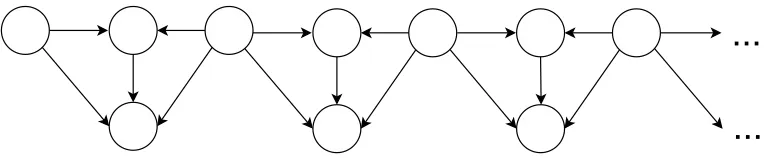
2.2 A structure with bounded growth: each agent is influenced by no more than three other agents even as the network (organization) size grows to infinity. 26 2.3 On the left, a directed path of length four. On the right, a directed graph is
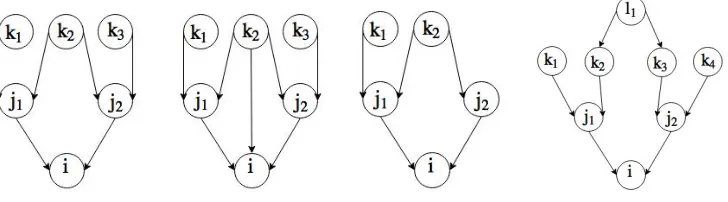
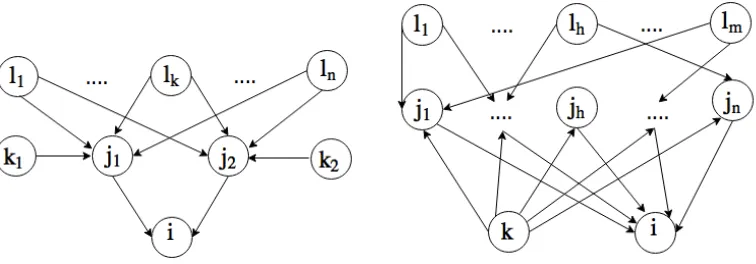
acyclic if and only if it has a topological ordering; a topological ordering of a DAG orders its vertices such that every edge goes from a lesser node (to the left) to a higher one (to the right). . . 29 2.4 The last three structures are transparent but the first one is not. . . 35 2.5 The graph structure on the left is used for the SUBSET-SUM reduction.
The graph structure on the right is used for the EXACT-COVER reduction. In the particular instance of EXACT-COVER that is depicted on the right, we have thatj1 ∈l1andj1 ∈ lm, as the links in the top two layers indicate
the inclusion relations among subsetsl1, . . . , lm and elementsj1, . . . , jn. . . 42
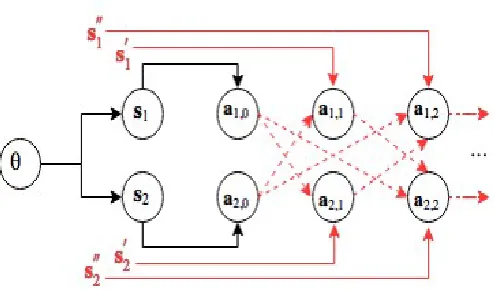
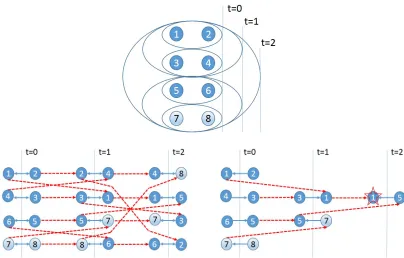
3.1 Heuristic agents ignore the history of interactions (dotted arrows) in their inferences and always attribute actions to (imaginary) private signals; com-pare with the decision flow diagram for the inferences of two rational agents who communicate their actions repeatedly (Fig. 2.1). . . 48 3.2 Implementation of (A5) for a group withD=2andn=6. Agents7and
4.1 Evolution of the first agent’s beliefs over time . . . 75
4.2 The difference in agents’ beliefs over time . . . 76
4.3 A hybrid structure . . . 86
4.4 Evolution of the third agent’s beliefs over time . . . 87
4.5 The difference between the first and eighth agents’ beliefs over time . . . . 88
4.6 Network Structure for Example 1 . . . 90
4.7 Evolution of the second agents beliefs over time . . . 91
4.8 The difference between the third and eighth agents beliefs over time . . . . 92
C.1 Learning about the private signals of neighbors, neighbors of neighbors, and so on. . . 135
Chapter 1
Introduction & Overview
In this chapter, we give an overview of our contributions to the group decision mak-ing and learnmak-ing literature, while highlightmak-ing the background of the study and our motivations for it. Individuals often exchange opinions with their peers in order to learn from their knowledge and experiences, and in making various decisions such as investing in stock markets, voting in elections, choosing their political affiliations, se-lecting a brand of a product or a medical treatment. These interactions occur in groups and through a variety of media which we collectively refer to as social networks. In this thesis, we examine the Bayesian and non-Bayesian models of decision making in groups or social networks by analyzing their computational properties and exploring their common behavioral foundations.1
1I would like to thank Mohsen Jafari Songhori for pointing me to the relevant literature in organization
In Section 1.1, we provide the background of our work and present our motivations; in particular, we explain the two major theoretical approaches: Bayesian (rational) and non-Bayesian (heuristics) for modeling group decision making. In Section 1.2, we present a summary of our contributions and explain how they are organized in the three chapters that follow.
1.1
Background & Motivation
Social learning or learning form actions of others is an important area of research in mi-croeconomics. Author James Surowiecki in his popular science book on wisdom of crowds [1], provides well-known cases for information aggregation in social networks, and argues how under the right circumstances (diversity of opinion, independence, decentralization and aggregation) groups outperform even their smartest or best informed members. One historical example provided in [1] is the essentially perfect performance of the middlemost estimate at the weight-judging competition of the 1906, West of England Fat Stock and Poultry Exhibition studied by Francis Galton in his 1907, Nature article [2], entitled “Vox Populi” (The Wisdom of Crowds). Another historical case mentioned by James Surowiecki is the market’s reaction to the 1986 challenger disaster in [3], where its is pointed out that the main responsible company’s (Morton Thiokol) stock was hit hardest of all, even months before the cause of the accident could be officially established.
On the other hand, several studies point out that the evolution of people’s opinions and decisions in groups are subject to various kind of biases and inefficiencies [4–8]. Daniel Kahneman in his highly acclaimed work, “Thinking, Fast and Slow”, points out that the proper way to elicit information from a group is not through a public discussion but rather confidentially collecting each person’s judgment [9, Chapter 23]. Indeed, decision making among groups of individuals exhibit many singularities and important inefficiencies that lead to Kahneman’s noted advice. As a team converges on a decision, expressing doubts about the wisdom of the consensus choice is suppressed; subsequently teams of decision makers are afflicted withgroupthinkas they appear to reach a consensus.1 The mechanisms of uncritical optimism, overconfidence, and the illusions of validity in group interactions also lead to group polarization, making the individuals more amenable toward extreme opinions [11]. An enhanced understanding of decision making and learning in groups sheds light on the role of individuals in shaping public opinion and how they influence efficiency of information transmissions. These in turn help to improve the predictions about group behavior and provide guidelines for designing effective social and organizational policies.
In decision theory, the seminal work of Aumann [12] studies the interactions of two
1Gar Klein proposes a famous method of project premortem to overcome the groupthink through an
rational agents with common prior beliefs and concludes that if the values of their poste-rior beliefs are common knowledge between the two agents, then the two values should be the same: rational agents cannot agree to disagree. The later work of Geanakoplos and Polemarchakis [13] investigates how rational agents reach an agreement by communicating back and forth and refining their information partitions. Following [12] and [13], a large body of literature studies the strategic interaction of agents in a social network, where they receive private information and act based on that information while also observing each other’s actions [14, 15]. These observations are in turn informative about other agents’ private signals; information that can be then used in making future decisions. In this line of work, it is important to understand the effectiveness of information sharing/exchange through observed actions and the effectiveness of decision-making using the available in-formation; indeed, the quality of decision-making depends on the quality of information exchange and vice versa.
In organization science, the economic theory of teams has a rich history devoted to choosing optimal information instruments subject to limited and dispersed resources in or-ganizations [16]. Some of the main issues that arise in the study of decision-making orga-nizations are information aggregation [17] and architecture [18].1 The author in [21] com-pares the performance of hierarchical and polyarchical organization structures in a project selection task, where each agent possesses a private signal about the quality of the projects and acts rationally (maximizing the expected pay-off from subject to her information). Limiting attention to two decision-makers, the author shows how each agent’s decision re-flects the organizational structure while accounting for the rationality of the other actor. Algorithmic and complexity aspects of organizational decision-making are relatively unex-plored. The author in [22] uses the formalism of constraint satisfaction problems to model the product development process in organizations. The author is thus able to identify some algorithmic and structural features that help reduce backtracking and rework costs of the design process in the organization. In this thesis, we provide new algorithmic and com-putational results about decision-making organizations. Addition of new results in this domain can further facilitate scalable and efficient cooperation among colleagues in large organizations (cf. Remark 2.2 and Subsection 3.3.3).
Throughout this thesis, we model the purely informational interactions of rational agents in a group, where they make private observations and act based upon that information while also observing other people’s recommendations repeatedly; such lack of strategic external-ities in group interactions arise since people are interested in each other’s action, only to learn what others know which they do not know, for example, in jury deliberations, expert committees, medical diagnosis, etc. (cf. Fig. 1.1).
1The organizational economics literature devotes considerable attention to incentive issues and agency
Figure 1.1: On the left, “The Jury”, by John Morgan(1861) - public domain; on the right, “Wikimedia advisory board meeting, Taipei, 2007” - photo credit: Chih Hao, Taiwan, CC BY-SA 2.0 Creative Commons license. Many professional societies in engineering, science, and medicine rely on technical committees to deliberate on different issues and make important policy decisions.
1.1.1
Rational Decision-Making
Some of the early results addressing the problem of social learning are due to Banerjee in [23], and Bikhchandani, Hirshleifer, and Welch in [24] where the authors consider a complete graph structure where the agent’s observations are public information and also ordered in time, such that each agent has access to the observations of all the past agents. These assumptions help analyze and explain the interplay between public and private in-formation leading to fashion, fads, herding, etc. Later results by [14] relax some of these assumptions by considering the agents that make simultaneous observations of only their neighbors rather than the whole network, but the computational complexities limit the anal-ysis to networks with only two or three agents. In more recent results, [25] provides a framework of rational learning that is analytically amenable and applies to general choice and information structures.
It is worth noting here that in this line of work and in ours as well, it is considered infeasible for the agents to share their private signals. Formally, sharing the signals may come at a prohibitive cost to the agents. Indeed, private signals might belong to different spaces and might not be interpretable by different agents. For example experts may observe signals that pertain to their domains of expertise and these signals may not be readable to people outside of their domains. In such a case, obtaining the required expertise for communicating signals come at a very high cost to non-experts. Moreover, signal spaces that represent personal experiences or individual perceptions might be far richer than action or belief spaces through which the agents communicate.
signals and third party interactions that are hidden from the agent. Moreover, the existence of loops in the network causes dependencies and correlations in the information received from different neighbors, which further complicates the inference task. Failure to account for such structural dependencies subjects the agents to mistakes and inefficiencies such as redundancy neglect [26] (by neglecting the fact that several of the neighboring agents may have been influenced by the same source of information), and data incest [27] (by neglect-ing the fact that neighborneglect-ing actions may have been affected by the past actions of the agent herself).
The agents form beliefs about unknown parameters of interest and their actions and de-cisions reflect their beliefs. The rational approach advocates formation of Bayesian poste-rior beliefs by application of Bayes rule to the entire sequence of observations successively at every step. However, such repeated applications of Bayes rule in networks become very complex, especially if the agents are unaware of the global network structure, and have to use their local data to make inferences about global contingencies that can lead to their observations. While rational learning continues to receive quite a significant amount of at-tention [28], it has also been criticized in the literature due to its unrealistic computational and cognitive demand on the agents [29]. Indeed, one of our goals in the first part of the thesis is to formalize this complexity notion and investigate the structural conditions around it. On the one hand, the properties of rational learning models are difficult to analyze be-yond some simple asymptotic facts such as convergence. On the other hand, these models make unrealistic assumptions about the cognitive ability and amount of computations that agents perform before committing to a decision. To avoid these shortcomings, an alterna-tive non-Bayesian approach relies on simple and intuialterna-tive “heuristics” that are descriptive of how agents aggregate the reports of their neighbors before coming up with a decision.
1.1.2
Heuristic Decision-Making
Heuristics are used widely in the literature to model social interactions and decision making [30–32]. They provide tractable tools to analyze boundedly rational behavior and offer in-sights about decision making under uncertainty. A dual process theory for the psychology of mind and its operation identifies two systems of thinking [33]: one that is fast, intuitive, non-deliberative, habitual and automatic (system one); and a second one that is slow, at-tentive, effortful, deliberative, and conscious (system two).1 Major advances in behavioral economics are due to incorporation of this dual process theory and the subsequent models
1While many decision science applications focus on developing dual process theories of cognition and
of bounded rationality [37]. Reliance on heuristics for decision making is a distinctive fea-ture of system one that avoids the computational burdens of a rational evaluation; but also subjects people to systematic and universal errors: the so-called “cognitive biases”. Hence, it is important to understand the nature and properties of heuristic decision making and its consequences to individual and organizational choice behavior. This premise underlies many of the recent advances in behavioral economics [38], and it also motivates our work in the second part of the thesis.
Hegselmann and Krause [39] investigate various ways of averaging to model opin-ion dynamics and compare their performance for computatopin-ions and analysis. Using such heuristics one can avoid the complexities of fully rational inference, and their suitability are also verified in experimental studies by Grimm and Mengel [40] and Chandrasekhar, Larreguy and Xandri [41]. The study of such heuristics took off with the seminal work of DeGroot [42] in 1974 on linear opinion pooling, where agents update their opinions to a convex combination of their neighbors’ beliefs and the coefficients correspond to the level of confidence that each agent puts in each of her neighbors. More recently, Jadbabaie, Molavi and Tahbaz-Salehi [43–45] consider a variation of this model for streaming obser-vations, where in addition to the neighboring beliefs the agents also receive private signals. Despite their widespread applications, theoretical and axiomatic foundations of social in-ferences using heuristics and non-Bayesian updates have received attention only recently [45, 46].
One of the main goals of this work is to analyze the connection between rational and heuristic approaches from a behavioral perspective. Some of the non-Bayesian update rules have the property that they resemble the replication of a first step of a Bayesian update from a common prior, and we aim to formalize such a setup. For instance [47] interpret the weights in the DeGroot model as those assigned initially by rational agents to the noisy opinions of their neighbors based on their perceived precision. However, by repeatedly applying the same weights over and over again, the agents ignore the need to update these weights with the increasing information.
1.2
Contributions & Organization
authors investigate the effects of mistakes and biases that arise from the group members’ emphasis on their common information and their negligence of their private data leading to a hidden profile problem in group decision making.
1.2.1
The Group Decision Setup
Throughout this work, we model the group decision process (GDP) by postulating an un-derlying state of the world (denoted byθ) that is common but unknown to all agents. The stateθbelonging to the finite setΘmodels the topic of the discussion/group decision pro-cess. For example, in the course of a political debate, Θ can be the set of all political parties and it takes a binary value in a bipartisan system (cf. Fig. 1.3, on the left). The value/identity of θis not known to the agents. To each agent, we assign an action space and a utility function that rewards their actions depending on the true state of the world and irrespective of the actions of others. Agents are interested in other people’s actions only to the extent that other actions are informative about other people’s private signals and allows them to make inferences about what other people know that they do not know. Such modeling of rewards to actions at successive time periods is common place in the study of learning in games and a central question of interest is that of regret which measures possi-ble gains by the players if they were to play other actions from what they have chosen in a realized path of play; in particular, existence of update/decision rules that would guarantee a vanishing time-average of regret ast → ∞, and possible equilibria that characterize the limiting behavior of agents under such rules have attracted much attention, cf. [50–52]. Under a similar framework Rosenberg et al. [15] consider consensus in a general setting with players who observe a private signal, choose an action and receive a pay-off at every stage, and pay-offs that depend only on an unknown parameter and players’ actions. They show that in this setting with no pay-off externalities and interactions which are purely in-formational players asymptoticly play their best-replies given their beliefs and will agree in their pay-offs; in particular, all motives for experimentation will eventually disappear.
In modeling the group decision process, we assume that the preferences of agents across time are myopic. At every timet, agentsi takes actionai,tto maximize her expected
util-ity, Ei,t{ui(ai,t, θ)}. This myopia is rooted in the underlying group decision scenario that
we are modeling: the agents’ goal for interacting with other group members is to come up with a decision that is more informed than if they were to act solely based on their own pri-vate data; hence, by observing the recommendations of their neighboring agents aj,t they
and end the group discussion); rather the purpose of the group discussion is to augment their information by learning from recommendations of others as much as possible before committing to a choice. The network externalities that arise in above settings are purely informational. People are therefore interacting with each other, only to learn from one an-other, and to improve the quality of their decisions; for example, in jury deliberations, after jurors are each individually exposed to the court proceedings, the jury enters deliberations to decide on a verdict. In another case, several doctors may examine a patient and then engage in group discussions to determine the source of an illness; or a panel of judges may repeatedly evaluate the performance of contenders in weightlifting, figure skating, or div-ing competitions. Lack of strategic externalities is an important characteristic of the kind of human interactions that we investigate in this thesis.1
Throughout this work, we analyze the repeated interactions of agents in a GDP follow-ing both the Bayesian and non-Bayesian frameworks. We first show how the computations of a Bayesian agent scale up with the increasing network size and give some structural conditions that can help curb this computational complexity. We then propose the no-recall model of belief formation and decision making in groups to offer a behavioral framework for heuristic decision making, by relying on the time-one Bayesian update and using it for all future decision epochs.
1.2.2
Algorithms and Complexity of Rational Group Decisions
In Chapter 2, we focus on the development of algorithms for Bayesian decision-making in groups and characterizing their complexity. We are interested in the computations that the Bayesian agent should undertake to achieve the goal of producing best recommendations at every decision epoch during a group discussion. We are further interested in determining how the complexity of these computations scale up with the increasing network size.2
1Rosenberg et al. in their study of the emergence of consensus under purely informational externalities
[15], show that even with forward-looking agents the incentives to experiment disappear, thus leading them to a consensus on their myopic best-responses subject to common utility and action structures. The authors in [53] also look at forward-looking agents with binary state and action space and propose an egalitarian condition on the topology of the network to guarantee learning in infinite networks. An egalitarian graph is one in which all degrees are bounded and every agent who is being observed by some agenti, observes her back, (possibly indirectly) through a path of bounded length.
2The authors in [54] analyze the problem of estimating a binary state of the world from a single initial
We begin by explaining the Bayesian model of decision-making in groups, the so-called group decision process (GDP), and the kind of calculations that it entails. In recent works, recursive techniques have been applied to analyze Bayesian decision problems with partial success [55–57]. The importance of a recursive implementation becomes apparent in light of the fact that a forward reasoning approach is bound to scale terribly with the increasing group size (cf. Appendix C). In a forward reasoning approach, to interpret observations of the actions of others, the agent considers the causes of those actions and is able to form a Bayesian posterior by weighing all contingencies that could have lead to those actions according to their probabilities. This requires the rational agent to simulate the inferences of her neighbors at all possible actions that they could have observed, and which she cannot observe directly but can only learn about partially (and indirectly) after knowing what her neighbors do. Although this forward reasoning about causes of the actions is natural to human nature [58], it is extremely difficult to adapt to the complexities of a partially observed setting where hidden causes lead to a multiplicity of contingencies.
In Chapter 2, we will use the framework of iterated eliminations to model the thinking process of a Bayesian agent in a group decision-making scenario: As the Bayesian agent attempts to infer the true state of the world from her private signal and sequence of obser-vations of actions of others, her decision problems at every epoch can be cast recursively, as a dynamic program [57]. By the same token, the private signals of all agents constitute the state space of the problem and with every new observation, the agent refines her knowl-edge about the private signals that other agents have observed, by eliminating all cases that are inconsistent with her observations under the assumption that other agents are acting rationally. The iterated elimination of infeasible signals (IEIS) approach curbs some of the complexities of the group decision process, but only to a limited extent.
In a group decision scenario, the initial private signals of the agents constitute a search space that is exponential in the size of the network. The ultimate goal of the agents is to get informed about the private signals of each other and use that information to produce the best actions. A Bayesian agent is initially informed of only her own signal; however, as the history of interactions with other group members becomes enriched, her knowledge of the possible private signals that others may have observed also gets refined; thus en-abling her to make better decisions. While the search over the feasible signal profiles in the IEIS algorithm runs in exponential time, these calculations may simplify in special highly connected structures: in Subsection 2.1.2, we give an efficient algorithm that enables a Bayesian agent to compute her posterior beliefs at every decision epoch, where the graph structure is a partially ordered set (POSET) as in [59]. In such structures, any agent whose actions indirectly influences the observations of agent i is also directly observed by her. Hence, any neighbor of a neighbor of agent iis a neighbor of agentias well; the same is
Figure 1.2: POSET structures: on the left, in a POSET structure any neighbors of a neighbor of an agent are also among her immediate (directly observable) neighbors; in the middle, a round-table discussions; on the right, a vested agent (in blue) investigates the sources of her information in one-on-one meetings; imposing a POSET structure on her neighborhood.
true for all neighbors of the neighbors of the neighbors of agenti, who would themselves be a neighbor of agent i, and so on and so forth. The complete graph, where everybody sees the actions of everybody else is an example of a POSET structure.1 Such rich com-munication structures are in fact characteristic of round-table discussions, and they arise quite often in settings with purely informational externalities: for example in applications such as jury deliberations where jurors enter a group discussion after they each is indepen-dently exposed to the court proceedings. Other examples include group decision-makings among professionals such as medical doctors who have each made their own examination of a critically ill person and have come together to decide on the best course of treatment. A POSET structure may also arise as a result of a vested agent investigating the sources of her information; thus deliberately imposing a POSET structure on her neighborhood. Such scenarios arise when stakes are high enough as in gathering legal evidence, or document-ing factual data for business decisions (cf. Fig. 1.2). Subsequently, in Subsection 2.1.2 we provide a partial answer to one of the open problems raised by [60], where the authors provide an efficient algorithm for computing the Bayesian binary actions in a complete graph: we show that efficient computation is possible for non-complete graphs (POSETs) with general finite action spaces.
IEIS approach curbs some of the complexities of the group decision process, but only to a limited extent. The Bayesian iterations during a group decision process can be cast into the framework of a partially observed Markov decision process (POMDP). Thereby, the pri-vate signals of all agents constitute the state space of the problem and the decision maker only has access to a deterministic function of the state, the so-called partial observations. In GDP the actions or beliefs of the neighbors constitute the partial observations. The par-tially observed problem and its relations to the decentralized and team decision problems
1See Definition 2.1 for a formal statement of the POSET property and the respective constraints that are
have been the subject of major contributions [61, 62]; in particular, the partially observed problem is known to be PSPACE-hard in the worst case [63, Theorem 6]. However, unlike the general POMDP, the state (private signals) in a GDP do not undergo Markovian jumps as they are fixed at the initiation of GDP. Hence, determining the complexity of GDP re-quires a different analysis. To address this requirement, in Section 2.2 we shift focus to a case where agents repeatedly exchange their beliefs (as opposed to announcing their best recommendations); subsequently in Section 2.2.3, we are able to show that computing the Bayesian posterior beliefs in a GDP is N P-hard with respect to the increasing network size.1 This result complements and informs the existing literature on Bayesian learning
over networks; in particular, those which offer efficient algorithms for special settings such as Gaussian signals in a continuous state space [55], or with binary actions in a complete graph [60].
The conflict and interplay between rationality and computational tractability in eco-nomic models of human behavior has been a focus of attention by both the earlier and the contemporary scholars of the field: for example in the early works of Herbert Simon on bounded rationality, artificial intelligence and cognitive psychology [64], and in the con-temporary research of Vela Velupillai on the computable foundations for economics [65]. Our work in Chapter 2 can be regarded as an effort in this direction; a particularly relevant recent study along these lines is due to [66] on complexity of agreement, who investigates the question of convergence of beliefs to a consensus and the number of messages (bits) that needs to be exchanged before one can guarantee that everybody’s beliefs are close to each other.
There is another relevant body of literature that is dedicated to computations of the Nash equilibria in games and characterizing their complexity [67]. Such equilibria of games are predictors for the behavior of rational players. The computational complexity results concerning Nash equilibria address the following problem (referred to as NASH): given a description of the game in terms of the strategy profiles and payoffs of its players (a normal-form game), compute a Nash equilibrium or an -approximation of it (a profile of mixed strategies where players cannot unilaterally improve their payoffs by more thanfor some positive rational ). NASH is closely related to the problem of computing fixed points for certain maps, a class of problems which Etessami and Yannakakis [68] have coined as FIXP (for fixed points). The complexity of computing Nash equilibria is also tied with the PPAD complexity class (Polynomial Parity Arguments on Directed graphs), and NASH is known to be PPAD-complete [67, 69–71].2 The authors in [73] study the related question
1We provide two reductions to known
N P-complete problems. One reduction relies on the increasing number of different types of signals that are observed by different agents in the the network. The other reduction relies on the increasing size of the agent’s neighborhood (with i.i.d signals).
2The PPAD formalism accounts for the fact that the existence of a solution is guaranteed for all instances
of communication complexity for reaching a Nash equilibrium. They consider a setup, where each player is initially informed of only her own utility function. They show that the number of bits that need to be transmitted before reaching a pure or mixed Nash equilibrium increases exponentially with the number of players; however, a correlated equilibrium can be reached after exchanging a polynomial number of bit.
Our results also enrich the evolving body of literature on various inference problems over graphs and networks. The interplay between statistical and computational complexity in such problems, as well as their complexity and algorithmic landscapes, are interesting issues that we highlight along with other concluding remarks and discussions of future directions in Chapter 5.
1.2.3
Heuristics and Biases in Group Decision Making
In Chapter 3, we propose the no-recall model of belief formation and decision making in groups that avoids the computational drawbacks of the Bayesian model, by relying on the time-one Bayesian update and using it for all future decision epochs.
The “no-recall” model offers a behavioral foundation for non-Bayesian updating that is compatible with the dual-process psychological theory of decision making and the princi-ples of judgment under uncertainty subject to heuristics and biases. Since our 2014 paper [74], various other authors have also developed results based on variations of this no-recall idea. In [75] the authors propose this model to analyze dynamic consensus and use it to study the effects of correlation neglect on voting behavior [75], as well as the persuasion power of media [76]. In [77], the authors use this model to analyze the structural and envi-ronmental conditions that are necessary for learning with binary actions. Where we depart from this body of work is in developing a behavioral rationale for no-recall updates. In par-ticular, we show when such updates lead to inefficient information aggregation and leverage these insights to propose better team and organizational decision making strategies.
On the one hand, our model of inference based onno-recallheuristics is motivated by the real-world behavior of people induced by their system one (the fast/automatic system) and reflected in their spur-of-the-moment decisions and impromptu behavior: Basing deci-sions only on the immediately observed actions and disregarding the history of the observed actions or the possibility of correlations among different observations; i.e. “what you see is all there is” [9]. On the other hand, the proposed Bayesian (no-recall) heuristics offer a boundedly rational approach to model decision making over social networks. 1 By ignor-ing the history of interactions, the heuristic (no-recall) agents are left with a substantially
problems, for which determining the existence of a solution (the feasibility problem) is just as hard.
1This is bounded-rationality in the sense of the word as coined by Herbert A. Simon, i.e. “to incorporate
simplified model of their environment that they can respond to optimally. This is in contrast with the Bayesian approach which is not only unrealistic in the amount of cognitive burden that it imposes on the agents, but also is often computationally intractable and complex to analyze [29].
In Chapter 3, we analyze the format of the no-recall update rules under various struc-tural conditions and investigate the evolution of beliefs and properties of the group decision outcome as the agents repeatedly interact with each other and deliberate their options un-der the no-recall model. Specific cases of Bayesian heuristics that we explore in Chapter 3 are the log-linear (multiplicative) updating of beliefs over the probability simplex, and the linear (weighted arithmetic average) updating of actions over the Euclidean space.
1.2.4
Learning from Streaming Data
In Chapter 4, we focus on a case of repeated interactions for social learning when agents receive new private signals in addition to observing their neighboring decisions (actions) at every point in time. Such a model is a good descriptor for online reputation and polling systems such as Yelp® and TripAdvisor®, where individuals’ recommendations are based on their private observations and recommendations of their friends [81, Chapter 5]. The analysis of such systems is important not only because they play a significant role in gen-erating revenues for the businesses that are being ranked [82], but also for the purposes of designing fair rankings and accurate recommendation systems.
Consider a Bayesian agent trying to estimate an unknown state of the world. She bases her estimation on a sequence of independent and identically distributed (i.i.d.) private sig-nals that she observes, whose common distribution is determined by the unknown state. Suppose further that her belief about the unknown state is represented by a discrete prob-ability distribution over the set of finitely many possibilities (denoted byΘ), and that she sequentially applies Bayes rule to her observations at each step, and updates her beliefs ac-cordingly. It is a well-known consequence of the classical results in merging and learning theory [83, 84] that the beliefs formed in the above manner constitute a bounded martingale and converge to a limiting distribution as the number of observations increases. However, the limiting distribution may differ from a point mass centered at the truth, in which case the agent fails to learn the true state asymptotically. This may be the case, for instance if the agent faces an identification problem, that is when there are states other than the true state which are observationally equivalent to the true state and induce the same distribution on her sequence of privately observed signals. However, by communicating in a social network the agents can resolve their identification problems by relying on each other’s observational abilities.
Figure 1.3: On the left, bipartisanship is an example of a binary state space. On the right, people reveal their beliefs through status updates and what they share and post on various social media platforms.
The fact that different people make independent observations about the underlying truth state, θ, gives them incentive to communicate in social networks, in order to benefit from each others’ observations and to augment their private information. Moreover, different people differ in their observational abilities. For instance, let the signals and their likeli-hoods for some agent i be denoted by si and`i(si|θ), respectively. Further suppose that
the signal structure of agent i allows her to distinguish the truth θ and the false state ˇθ, while the two statesθ^andθare indistinguishable to her: i.e. `i(si|θˇ) 6=`i(si|θ)for some
si ∈ Si, whereas`i(si|θˇ) = `i(si|θ)for allsi ∈ Si, whereSi is the signal space (the set of
all signals thatimay observe). In such circumstances, agentican never resolve her ambi-guity betweenθand ˇθon her own; hence, she has no choice but to rely on other people’s observations to be able to learn the truth state with certainty.
The chief question of interest in Chapter 4 is whether the agents, after being exposed to sequence of private observations and while communicating with each other, can learn the truth using the Bayesian without recall update rules. The learning framework of Chapter 4 in which agents have access to a stream of new observations is in contrast with the group decision models of Chapter 2 and 3; the difference being in the fact that in Chapters 2 and 3 the agents have a single initial observation and engage in group decision making to come up with the best decision that aggregates their individual private data with those of the other group members.
We begin by specializing the no-recall model to a case where agents try to decide be-tween one of the two possible states and are rewarded for every correct choice that they make; for example, when voting in a bipartisan political system (cf. Fig. 1.3, on the left).
the underlying beliefs that lead to actions; subsequently, an individual’s action is a fine reflection of her beliefs. The author in [85] characterizes the distinction between coarse and rich action spaces using the concept of “responsiveness”: the utility function is responsive, if a player with that utility chooses different actions at different beliefs (as is the case for the quadratic utility described above); the role of responsiveness in determining the observational learning outcome is also discussed in [85].
We show that the no-recall updates in the belief exchange case are log-linear in the reported beliefs of the neighbors and the likelihood of private signals. We investigate the properties of convergence and learning for such agents in a strongly connected social net-work, provided that the truth is identifiable through the aggregate observations of the agents across entire network. This is of particular interest, when the agents cannot distinguish the truth based solely on their private observations, and yet together they learn. Analysis of convergence and learning in this case reveals that almost-sure learning happens only if the agents are arranged in a directed circle. We characterize the rate of log-learning1 in such
cases as being asymptotically exponentially fast with an exponent that is linear in time and whose coefficient can be expressed as a weighted average of the relative entropies of the signal likelihoods of all agents.
1In the literature on theory of learning in games [50], log-linear learning refers to a class of randomized
Chapter 2
Rational Decision Making in Groups
In this chapter, we analyze the decision problem of a Bayesian agent in the course of group interactions, as she attempts to infer the true state of the world from her se-quence of observations of actions of others as well as her own private signal. Such an agent recursively refines her belief on the signals that other players could have ob-served and actions that they could have taken given the assumption that other players are also rational. The existing literature addresses asymptotic and equilibrium prop-erties of Bayesian group decisions and important questions such as convergence to consensus and learning. In this work, we address the computations that the Bayesian agents should undertake to realize the optimal actions at every decision epoch. We use a scheme called iterated eliminations of infeasible signals (IEIS) to model the thinking process as well as the calculations of a Bayesian agent in a group decision scenario. Following IEIS, with every new piece of information the agent refines her knowledge about the private signals that other agents have observed, by eliminating all cases that are inconsistent with her observations given that other agents are acting rationally. We show that IEIS algorithm runs in exponential time; however, when the group structure is a partially ordered set the Bayesian calculations simplify and polynomial-time com-putation of the Bayesian recommendations is possible. We next shift attention to the case where agents reveal their beliefs (instead of actions) at every decision epoch. We analyze the computational complexity of the Bayesian belief formation in groups and show that it isN P-hard. We also investigate the factors underlying this computational complexity and show how belief calculations simplify in special network structures or cases with strong inherent symmetries. We finally give insights about the statistical efficiency (optimality) of the beliefs and its relations to computational efficiency.1,2
1The following papers cover the results of this chapter: [29, 88]. Preliminary versions of the results were
also presented in the following non-archival venues: 2017 Statistics & Data Science Center Conference, 2017 New York Computer Science and Economics Day, 2017 ACM Conference on Economics and Computation (poster session), and 2017 Symposium on the Control of Network Systems.
2I would like to thank Mina Karzand for discussions about the decision flow diagram of two agents (Fig.
We begin Section 2.1 by presenting the model of decision making in groups that will be ap-plied throughout this work. In Subsection 2.1.1, we formalize the calculations of a Bayesian agent as an iterated elimination of infeasible signals (IEIS) algorithm. The IEIS approach curbs some of the complexities of the group decision process, but only to a limited extent. While the search over the feasible signal profiles in the IEIS algorithm runs in exponential time, these calculations may simplify in special highly connected structures. In Subsection 2.1.2, we give an efficient algorithm that enables a Bayesian agent to compute her pos-terior beliefs at every decision epoch, where the graph structure is a partially ordered set (POSET), cf. Definition 2.1 for the POSET property and the respective constraints that are imposed on the network topology. In Section 2.2 we shift focus to a case where agents repeated exchange their beliefs (as opposed to announcing their best recommendations); subsequently in Subsection 2.2.3, we are able to show that computing the Bayesian poste-rior beliefs in a GDP isN P-hard with respect to the increasing network size. We provide two reductions to known N P-complete problems. One reduction relies on the increasing number of different types of signals that are observed by different agents in the the net-work. The other reduction relies on the increasing size of the agent’s neighborhood (with i.i.d signals).
2.1
The Bayesian Model
We consider1 a group ofnagents, labeled by [n] = {1, . . . , n}, and interact according to
a fixed directed graph G. For each agent i ∈ [n], Ni denotes a neighborhood Ni ⊂ [n],
whose actions are observed by agent i. We use ∇(j, i) to denote the length (number of edges) of the shortest path inG that connectsjtoi.
There is a stateθ ∈ Θ that is unknown to the agents and it is chosen arbitrarily by nature from an underlying state spaceΘ, which is measurable by aσ-finite measureGθ(·).
For example if a space (Θor S) is a countable set, then we can take itsσ-finite measure (GθorGs) to be the counting measure, denoted byK(·); and if the space is a subset of Rk
with positive Lebesgue measure, then we can take itsσ-finite measure to be the Lebesgue measure onRk, denoted by Λ
k(·). Associated with each agenti, Si is a measurable space
called the signal space of i, and given θ, Li(· | θ) is a probability measure onSi, which
is referred to as the signal structure of agenti. Furthermore,(Ω,F,Pθ) is a probability 1Some notations:Ris the set of real numbers,Ndenotes the set of all natural numbers, andN
0:=N∪{0}.
triplet, whereΩ=S1×. . .×Snis a product space, andF is a properly defined sigma field
over Ω. The probability measure on Ω is Pθ(·) which assigns probabilities consistently
with the signal structuresLi(·|θ), i ∈[n]; and in such a way that withθfixed, the random
variablessi,i ∈[n]taking values inSi, are independent. These random variables represent
the private signals that agentsi ∈ [n]observe at time 0. Note that the private signals are independent across the agents. The expectation operatorEθ{·}represents integration with
respect toPθ(dω),ω∈Ω.
An agents’ belief about the unknown allows her to make decisions even as the outcome is dependent on the unknown valueθ. These beliefs about the unknown state are probability distributions over Θ. Even before any observations are made, every agent i ∈ [n]holds a prior beliefVi(·) ∈ ∇Θ; this represents her subjective biases about the possible values
of θ. For each time instant t, let Mi,t(·) be the (random) probability distribution over
Θ, representing the opinion or belief at time t of agent i about the realized value of θ. Moreover, let the associated expectation operator be Ei,t{·}, representing integration with
respect toMi,t(dθ).
Lett∈N0denote the time index; att =0the valuesθ∈Θfollowed bysi ∈ Siofsiare
realized and the latter is observed privately by each agentifor alli∈[n]. Associated with every agenti is an action spaceAi that represents all the choices available to her at every
point of timet∈N0, and a utilityui(·,·) :Ai×Θ→Rwhich in expectation represents her
von Neumann-Morgenstern preferences regarding lotteries with independent draws from
Aiand/orΘ.1 We assume that the preferences of agents across time are myopic. At every
time t ∈ N, agents i takes action ai,t to maximize her expected utility, Ei,t{ui(ai,t, θ)},
where the expectation is with respect toMi,t.
We now proceed to present the elements of the rational model for decision-making in a group. We assume that the signal, state, and action spaces are finite sets. Because some of our algorithms rely critically on the ability of the Bayesian agent to enumerate all possible private signals that the other network agents may have observed. We may relax this assumption in special cases where calculations are possible without resorting to exhaustive enumerations. The ultimate goal of a Bayesian agent can be described as learning enough about the private signals of all other agents in the network to be able to compute the Bayesian posterior belief about the true state, given her local observations; this, however, can be extremely complex, if not impossible.
In a rational group decision process (GDP), each agenti∈[n]receives a private signal
si at the beginning and then engages in repeated interactions with other group members 1The signal, action, and utility structures, as well as the priors, are all common knowledge among the
in the ensuing decision epochs: choosing actions and observing neighbors’ choices every time. The agents start with a prior belief about the value of θ, which is a probability distribution over the setΘwith probability mass functionν(·) =dVi/dK:Θ→[0, 1]for
alli. Throughout Chapter 2, we assume that this prior is common to all agents.1 At each timet, we denote the Bayesian posterior belief of agentigiven her history of observations by its probability mass functionµi,t(·) = dMi,t/dK : Θ → [0, 1]. Initially, every agent
receives a private signal about the unknownθ. Each signalsi belongs to a finite setSiand
its distribution conditioned onθ is given by`i(· | θ) := dLi(· | θ)/dKwhich is referred
to as thesignal structureof agenti. We useL(· |θ)to denote the joint distribution of the private signals of all agents, signals being independent across the agents.2
Accordingly, at every timet, agentiobserves the most recent actions of her neighbors,
{aj,t−1 for all j ∈ Ni}, and chooses an action ai,t ∈ Ai, maximizing her expected utility
given all her observations up to timet,{aj,τfor allj ∈ Ni, andτ ≤t−1}. For example in
the case of two communicating agents the action of agent one at time twoa1,2is influenced
by own private signals1as well as the neighboring action at times zero and one; part of the
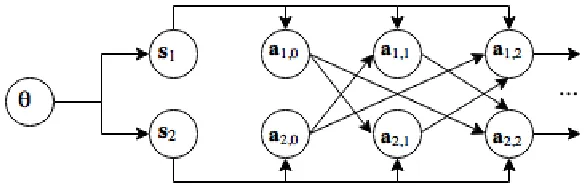
difficulty of the analysis is due to the fact that the action of agent two at time one is shaped not only by the private information of agent two but also by the action of agent one at time zero, cf. Fig. 2.1. A heuristic behavior may be justified as a mistake (cognitive bias) by interpreting actions of others as consequences of their private information, thus ignoring the history of observations when making inferences about the actions of others; in Fig. 2.1 this corresponds to ignoring all the arrows except those which are exiting the signal and state nodes: s1, s2, andθ(cf. Fig. 3.1). Such biased inferences are the focus of our results
in the next two chapters, where we study the heuristics for decision making and learning in groups.
In more general structures, there are also unobserved third party interactions that influ-ence the decisions of agent two but are not available to agent one (and therefore should be inferred indirectly).
1The assumption of common priors in our framework is without loss of generality, as long as each agents’
prior is known to all people who observe her directly or indirectly in the network. This is due to the fact that agents can account for their respective priors when making inferences about each other’s actions. In particular, all of the algorithms presented throughout the paper can be adapted to work with personalized priors. This is true because when simulating other agents’ actions in (2.1.4) or computing their beliefs in (2.2.5), the agents can use each individuals’ own prior beliefs in their calculations. The same principle applies to special structures where computations simplify and exhaustive simulations can be avoided; for example in step (1) of Algorithm (A2) or step (2) of Algorithm (A3). Finally, ourN P-hardness results naturally carry through since they are concerned with the worst-case structures.
2This independence of private signals allows us to exploit a decomposition property of feasible signal
Figure 2.1: The Decision Flow Diagram for Two Bayesian Agents
For each agenti, her history of observationshi,tis an element of the set:
Hi,t=Si×
Y
j∈Ni Aj
!t−1
.
At every timet, the expected reward to agenti given her choice of actionai and observed
historyhi,tis given by the expected reward functionri,t:Ai× Hi,t →R, as follows:
ri,t(ai,hi,t) =Ei,t{ui(ai, θ)|hi,t}=
X
^
θ∈Θ
ui(ai,θ^)µi,t(^θ),
for allhi,t∈ Hi,t, whereµi,t(^θ)is the Bayesian posterior of agentiabout the truthθgiven
the observed historyhi,t. The (myopic) optimal action of agentiat timet is then given by ai,t ←- arg maxai∈Airi,t(ai,hi,t). Here for a set A, we use the notationa ←- Ato denote
a deterministic choice from the elements of A that is assigned to a. The deterministic choice is dictated by a tie-breaking rule that is known to all agents; specifically, we assume that all of the action spaces are ordered (arbitrarily) and the ordering of each action space
Ai is known to all agents who observe agent i, directly or indirectly. According to the
tie-breaking rule←-, whenever an agent is indifferent between a multitude of options she will choose the one that ranks lowest in their ordering. The restriction to deterministic breaking rules is not without loss of generality. Because in the case of randomized tie-breaking rules, rational agents would have to make inferences about how past occurrences of ties have been resolved by other agents, whom they observe directly or indirectly. This is in addition to their inferences about private signals and other unknown random quantities whose values they are trying to learn. Thus the agent’s problem is to calculate her Bayesian posterior belief µi,t, given her history of past observations: hi,t := {si,aj,τ, j ∈ Ni, τ ∈
the GDP rather than its asymptotic properties.
Refinement of information partitions with the increasing observations is a key feature of rational learning problems and it is fundamental to major classical results that establish agreement [13] or learning [83, 84] among rational agents. Several follow-up works of [13] have extended different aspects of information exchange among rational agents. In this line of work, it is of particular interest to derive conditions that ensure the refinement of information partitions would lead to the consensus on and/or the common knowledge of an aggregate decision.1 In particular, the author in [25] points out that rational social learning requires all agents in every period to consider the set of possible information partitions of other agents and to further determine how each choice would impact the information partitions of others in the subsequent periods.
In the GDP setting, the list of feasible signals can be regarded as the information set representing the current understanding of the agent about her environment and the way additional observations are informative is by trimming the current information set and re-ducing the ambiguity in the set of initial signals that have caused the agent’s history of past observations. In Section 2.1.1, we describe a recursive implementation2 for the refinement of the information sets (partitions) that relies on iterated elimination of infeasible signals (IEIS) for all the agents. The IEIS calculations scale exponentially with the network size; this is true with the exception of some very well-connected agents who have, indeed, direct access to all the observations of their neighbors and can thus analyze the decisions of each of their neighbors based on their respective observations. We expand on this special case (called POSETs) in Subsection 2.1.2 and explain how the Bayesian calculations simplify as a result.
1Some notable examples include the works of [89–91], which consider information exchange by
repeat-edly reporting the values of a general set functionf(·)over the state space (rather than the conditional prob-abilities, which are the Bayesian beliefs). The authors in [89, 90] propose a condition of union consistency onf(·)and the authors in [91] replace this union consistency condition with a convexity property forf(·), all ensuring that the value off(·)become common knowledge among the agents after repeated exchanges.
2The recursive implementation is an important factor in reducing the complexity of Bayesian