Interdisciplinary Studio Pavilion [ISP] 2019
Albert Gutierrez
California Polytechnic State University San Luis Obispo, CA
Historically Cal Poly’s motto has been ‘Learn by Doing’ and the College of Architecture and Environmental Design (CAED) is one of the leading examples of this. Many students gain valuable hands-on and real-world experience through collaborative projects and assignments. Through this learn by doing philosophy and collaborative learning approach Cal Poly construction management, architecture and architectural engineering students worked together in 8 separate studio teams to design and construct a portable pavilion for the Wine History Project of San Luis Obispo County. Acting as a client they requested that we design a portable pavilion space that will be used to house historical artifacts relevant to the wine industry of San Luis Obispo county. This process involved the conceptual design and fabrication of the structure, including all details and relevant
construction documents and estimates. As the construction management student assigned to the team my responsibility was to ensure that the final product can be constructed and dissembled by hand without the use of any cranes or special equipment at multiple sites. Working together in a collaborative IPD studio is representative of projects that many of us will be working on after leaving school and staring work full-time.
Key Words: IPD, Project Delivery, Construction, Collaboration, Architecture
Background
The narrative of the WHP is a broad narrative of the viticulture environment: agriculture, land use, crop selection, the economic vitality of the county, and the relationships among the people who form the history of San Luis Obispo County. The purpose of the ISP 2019 project is to design a pavilion that will enable the public to experience a connection to that narrative. This studio will be an immersion in tectonic architecture. Tectonic architecture is defined as “the science or art of construction, both in relation to use and artistic design.”
Process
reassembly and transportability; and function.
Students were organized into eight interdisciplinary teams of architecture, architectural engineering and construction management students. Teams were tasked to produce conceptual designs, schematic designs, digital models, physical mock-ups, detailed drawings, structural calculations, detailed cost estimates and materials lists, description of fabrication techniques and methodologies, fabrication labor estimates, interconnection details, and assembly and disassembly manuals. At completion of the course, students presented their work, including scaled mockup models. WHP representatives selected the design (or designs) of one or more teams. This design (or designs) will survive to the build phase of the project. The build phase is outside of the scope of this senior project.
The ISP goals and objectives are listed in Table 1.
Table 1
ISP Goals and Objectives
Goal Description of Goal Description of Objectives 1 Incorporate WHP values
into the design,
demonstrated by achieving the listed objectives.
a) establish a set of 3 to 5 value propositions through interviews with the WHP;
b) gain WHP approval of these proposed value propositions; and
c) demonstrate how the design addresses each value proposition.
2 Achieve an integrated design through
interdisciplinary teaming, demonstrated by achieving the listed objectives.
a) establish team protocols for interdisciplinary participation;
b) measure the team’s adherence to those protocols; c) establish a list of design elements that required interdisciplinary participation in their design; and d) explain the interdisciplinary characteristics of each of those design elements.
3 Connect the user to the design and the design to the site, demonstrated by achieving the listed objectives.
a) establish a suitable scale that enables users to connect with the pavilion through the exhibits mounted therein; b) express the defining narrative that connects the pavilion to the site; and
c) explain the specific features of the pavilion that advance that narrative
4 Facilitate the user experience, demonstrated by achieving the listed objectives.
a) identify one or more elements of the user experience, and b) demonstrate how the pavilion facilitates those
experiences.
5 Incorporate tectonic portability into the design, demonstrated by achieving the listed objectives:
a) establish joinery of elements that enable easy knockdown and reassembly of the pavilion;
Deliverables
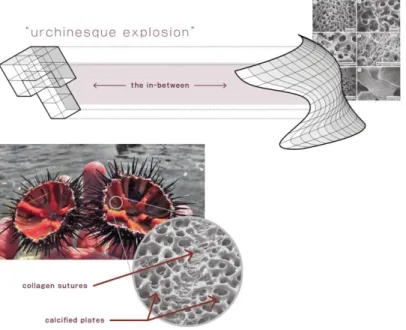
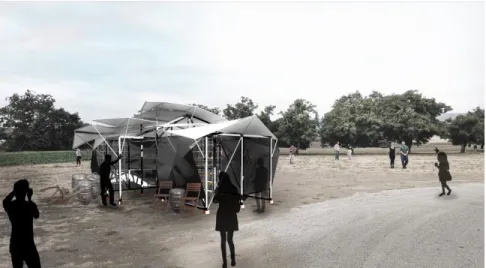
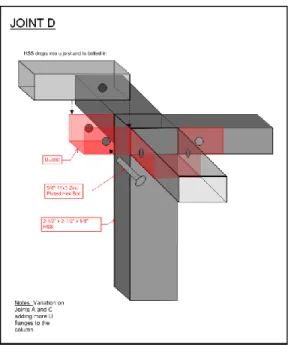
One of the preliminary requirements for this interdisciplinary studio was to draw inspiration from nature and choose a biomimetic feature to design and work around. After a few iterations we settled on the sea urchin, specifically its overlapping rigid exoskeleton. We took this natural precedent and modified it to our project’s needs, redefining the empty ‘in-between’ space, creating a purposeful loose-flowing tensile membrane around a rigid structural frame. Ultimately our final design took these ideas and inspirations to closely meet the needs of the Wine History Project. The final design of the project is a hollow structural steel frame surrounded by a free-flowing tensile fabric canopy and tessellated sheet metal wall panels. Throughout the quarter our studio collaborated with professional design firm LPA, located in Irvine, California, for design advice and digital ‘office hours.’ They also generously provided a grant that would cover the cost for fabricating the final mock-ups. A major concern of the Wine History project was that the artifacts inside the pavilion are to be protected from the natural elements and potential vandalism. We designed to these constraints creating an enclosed structure while still feeling open to the public and providing ample space for displaying the historic artifacts. Working as a team comprised of architecture, architectural engineering and construction management students we each used the disciplinary knowledge gained through our respective majors to collaborate and work towards this project, guiding the design and construction process. As the construction management student on the project my goal throughout the quarter was to ensure the constructability and transportation constraints were constantly met and adhered to. This included the fabrication of custom tectonic joinery details and assembly/disassembly diagrams. Detailed
fabrication documents for the entire structure are also required, including the identification of long-lead equipment and materials. In addition to this, a detailed cost estimate was produced that identified every single material needed to fabricate and construct the pavilion. A-full scale detailed mock-up was also required that shows how each detail and joint will come together in real life. For this mock-up additional cost estimates and fabrication plans were also produced and used for material orders sourced from local suppliers. Working as a team for an entire week we used these materials to fabricate the full-scale mock-up in the CAED support shop, utilizing the resources and equipment generously made available to us. These processes included: measuring and cutting material to size, welding necessary members together and figuring out how the final model will eventually be constructed. The final mock-up along with the other groups is to be presented to the clients and general public at the San Luis Obispo Botanical Gardens. At this final show the winning design will be selected and actually built the following spring quarter by other construction management students for the Wine History Project of San Luis Obispo County.
c) assure that all hardware is weather-resistant, (the use of non-corrosive metals and/or compatible metals is
encouraged); and
Project Pictures
Pictures detailing the final pavilion project and the processes taken to get there.
Figure 1: Biomimicry precedent that set the inspiration for all design going into the pavilion model.
Figure 3: Final design and render of pavilion at the Saucelito Canyon Tasting Room site.
Figure 5: Custom joint detail illustrating how the main HSS structure will be joined together.