The Burden of Hospital Readmissions among Pediatric Patients with
Inflammatory Bowel Disease
Edward L. Barnes, MD, MPH
1, Bharati Kochar, MD
1, Millie D. Long, MD, MPH
1,2, Christopher F. Martin, MSPH
1,2,
Seth D. Crockett, MD, MPH
1,2, Joshua R. Korzenik, MD
3, and Michael D. Kappelman, MD, MPH
2,4Objective
To evaluate the burden and predictors of hospital readmissions among pediatric patients with inflam-matory bowel disease using the Nationwide Readmissions Database.Study design
We performed a retrospective cohort study using 2013 Nationwide Readmissions Database. In-ternational Classification of Diseases, Ninth Revision, Clinical Modificationcodes were used to identify patients<18 years with diagnoses of ulcerative colitis (UC) or Crohn’s disease (CD). Demographic factors and details of hos-pitalizations were evaluated using survey procedures in SAS v 9.4 (SAS Institute, Cary, North Carolina). Multivari-able logistic regression was used to estimate ORs and 95% CIs of readmission.Results
Among 2733 hospitalizations (63% CD, 37% UC), 611 (22%) patients were readmitted within 90 days of the index hospitalization. Readmission resulted in weighted estimates of 11 440 excess days of hospitalization and total charges of over $107 million. For CD, male sex (aOR 1.36, 95% CI 1.03-1.81) and co-existing anxiety or de-pression (aOR 1.89, 95% CI 1.06-3.40) were associated with increased readmissions, while patients who under-went surgery had decreased readmissions (aOR 0.40, 95% CI 0.24-0.65). In patients with UC, an index admissionof >7 days was associated with increased readmissions (aOR 1.69, 95% CI 1.09-2.62).
Conclusions
Readmission occurs frequently in children with inflammatory bowel disease and is associated with significant cost and resource burdens. Among patients with CD, psychiatric comorbidities such as anxiety andde-pression are apparent drivers of readmission.(J Pediatr 2017;191:184-9).
H
ospital readmissions are a key metric associated with quality of healthcare in the US, with the potential to place a great burden on both the patient and the healthcare system.1Recent studies indicate that hospitalizations are increasing for children with inflammatory bowel diseases (IBD) in the US.2,3In addition, a Canadian study demonstrated that pe-diatric patients with IBD are at greater risk for hospital readmission compared with older patients.4These trends are cause for concern to both patients and payers, as hospitalization of pediatric patients with IBD has been associated with a significant cost burden5-7and hospitalization has been associated with decreased health-related quality of life in other populations of chil-dren with chronic diseases.8Despite these concerns, there remains a paucity of literature examining the factors associated with hospital readmissions in children with Crohn’s disease (CD) and ulcerative colitis (UC). Studies of postsurgical readmissions in children with IBD in-dicate that surgery performed by a pediatric surgeon9and having surgery at a high volume hospital10confer a lower risk of postoperative readmission. However, the exact role that healthcare disparities, racial differences in phenotypes, or other con-founding factors play in these risks for readmission is uncertain.11Single center experiences from American adults with IBD suggest that factors such as severe disease, poorly controlled pain and depression, and admission to a teaching service are as-sociated with a higher likelihood of readmission,9-11but it is unknown if these same factors are important in children with IBD. Our objectives were to use the Nationwide Readmissions Database (NRD) to describe the overall burden of readmission in patients with IBD, including the total charges associated with readmission, and analyze the specific factors associated with hos-pital readmission within 90 days.
Methods
We conducted a retrospective cohort study using 2013 data from the NRD, a re-source of the Healthcare Cost and Utilization Project (HCUP) State Inpatient
CD Crohn’s disease
HCUP Healthcare Cost and Utilization Project IBD Inflammatory bowel disease
ICD-9-CM International Classification of Diseases, Ninth Revision, Clinical Modification
LOS Length of stay
NRD Nationwide Readmissions Database UC Ulcerative colitis
From the1Division of Gastroenterology and Hepatology,
University of North Carolina at Chapel Hill;2Center for
Gastrointestinal Biology and Disease, Chapel Hill, NC;
3Division of Gastroenterology, Hepatology, and
Endoscopy, Brigham and Women’s Hospital, Boston, MA; and4Division of Pediatric Gastroenterology and
Hepatology, University of North Carolina at Chapel Hill, Chapel Hill, NC
Supported by the National Institutes of Health (T32DK07634 [to B.K.] and KL2-RR025746 [to S.C.]). The authors declare no conflicts of interest.
Databases. Designed to be nationally representative in the adult population, the NRD is a publicly available all-payer inpa-tient database from the US that contains discharge data from 22 geographically dispersed states accounting for 49.3% of all US hospitalizations. Weights were assigned to each admis-sion by HCUP to allow for national readmisadmis-sion analyses. The NRD contains over 100 clinical and nonclinical variables,12 in-cluding outcomes such as hospital length of stay (LOS), re-admission, and total charges. The NRD also contains up to 15 diagnostic and procedure codes per admission based on International Classification of Diseases, Ninth Revision, Clinical Modification(ICD-9-CM) coding. This study was determined exempt from review by the University of North Carolina Institutional Review Board, given the deidentified nature of the data.
We examined discharge data from patients age 17 years and younger. Patients were determined to have IBD if they had a primary or secondary ICD-9-CM diagnosis code indicating CD (555.xx) or UC (556.xx) on the index admission. Given that patients with UC undergoing colectomy could have a sched-uled readmission for repeat operation such as ileal pouch-anal anastomosis within the 90 day follow-up for readmission, we excluded any patient with an ICD-9-CM code for colec-tomy. Approximately 1% of patients were given discharge codes for both CD and UC(n=28),and to minimize misclassification of subgroups of IBD, we excluded those patients.
The primary outcome of interest, hospital readmission within 90 days of the index hospitalization, was determined using a unique identifier specific to the NRD to link discharge data of individual patients. We also evaluated the primary ICD-9-CM diagnosis code on readmission, LOS during all hospital-izations, and the total charges associated with readmission.
Patient demographics included age, sex, and primary insurance/payer for the index hospitalization. We used ICD-9-CM diagnosis codes to identify additional comorbidities or factors suggested to be independent predictors or confound-ers of the relationship between IBD and hospital readmis-sion. Given prior suggestions in adult populations that modifiable risk factors such as depression (ICD-9-CM 296.2, 296.3, 298.0, 300.4, 311), chronic pain (338.2, 338.4), and anxiety (300, 300.2) play a significant role in risk for read-mission we made the a priori decision to include these covariates in our analyses. We used ICD-9-CM definitions for anxiety and depression that have previously been validated in IBD using administrative data.13In addition, the diagnosis coding used to identify admissions withClostridium difficile infection (ICD-9-CM 008.45) has previously been used in HCUP databases.14IBD-related surgery was included in the models for CD only. For patients with CD, ICD-9-CM coding was used to identify potential complications of CD including small bowel obstruction and fistulizing disease (ICD-9-CM codes listed inTable I; available atwww.jpeds.com).
In the NRD, hospital teaching status is defined as “metro-politan teaching,” “metro“metro-politan nonteaching,” and “rural.” HCUP defines an institution as a teaching hospital if it has an American Medical Association-approved residency program, if the institution is a member of the Council of Teaching
Hospitals, or based on the ratio of full-time equivalent interns and residents to hospital beds (0.25 or higher).12In other HCUP databases such as the Nationwide Inpatient Sample and the Kids’ Inpatient Database, approximately 98% of patients with IBD admitted to rural hospitals are admitted to nonteaching hospitals,15and HCUP indicates that rural teaching hospitals are rare.12For our analyses, we collapsed rural and metropoli-tan nonteaching into 1 category and refer to metropolimetropoli-tan teach-ing hospitals as “teachteach-ing.” We also analyzed hospitals based on annual volume of patients with IBD, using thresholds pre-viously established in the Kids’ Inpatient Database,7where those hospitals with an annual volume of IBD discharges of>20 were defined as high volume IBD centers.
Statistical Analyses
All analyses were performed using survey procedures in SAS v 9.4 (SAS Institute, Cary, North Carolina). Data were weighted to reflect estimates of the national population, including the means and proportions presented. Thec2test and Studentt
test were used to compare proportions and continuous vari-ables, respectively. We used logistic regression modeling to es-timate the unadjusted odds of a readmission within 90 days of the index hospitalization for the covariates of interest. In all logistic regression models, we made the a priori decision to include only patients with Medicaid (33% of all admis-sions) or private insurance (60% of all admisadmis-sions) as their primary payer for the admission, given concerns that there may be significant overlap between the “other” insurance pro-vider group and the Medicaid group. In prespecified sensitiv-ity analyses, we included all patients, regardless of payer status, to assess for any differences in outcomes when patients with other payers were included.
Based on clinical knowledge and previously reported risk factors for readmission among adult populations of patients with IBD, we then evaluated the association between risk factors and readmission within 90 days using multivariable logistic regression. All factors included in the models were chosen due to their clinical relevance and were identified a priori, includ-ing payer and hospital specific factors. For all analyses, diag-noses of anxiety or depression were collapsed into one variable. Any covariate with<11 patients was excluded from the mul-tivariable models. ORs and 95% CIs are presented. A 2-tailed Pvalue of .05 was chosen as the threshold for statistical sig-nificance for all tests.
Results
(IQR1.95-6.58) compared with a median LOS of 4.53 days (IQR 2.41-8.84) for patients with UC (P=.057). Among patients with CD requiring readmission, 85% had a diagnosis of CD as a primary diagnosis. The other most common primary or sec-ondary diagnoses on readmission among patients with CD were anemia (3.3%), abnormal loss of weight (2%), dehydration (1.5%), andC difficileinfection (0.6%). Among patients with UC requiring readmission, 89% had UC as a primary diag-nosis. The other most common primary or secondary diagnoses
on readmission among patients with UC were anemia (13%), abnormal loss of weight (5.1%),C difficileinfection (2.5%), and dehydration (2.5%). All ICD-9-CM codes for comorbid diagnoses are listed inTable I.
The baseline demographics of the CD and UC popula-tions are depicted inTable II. There was no significant dif-ference in readmission if the diagnosis of CD was listed as the primary or secondary diagnosis (22% vs 17%,P=.105). Al-though the raw percentage of patients with a primary diag-nosis of UC requiring readmission was also greater than that of patients with a secondary diagnosis of UC, there was no sta-tistically significant difference in readmission within 90 days (25% vs 17%,P=.066).
Among patients with IBD who were readmitted within 90 days, the median total charges for the first readmission were $31 282 (IQR $16 491-$62 496). There was no signifi-cant difference when comparing the median total charges for the first readmission in patients with UC to patients with CD ($33 712 vs $30 387,P=.270). When aggregated among all pediatric patients with IBD in the NRD, the total charges attributed to the first readmission within 90 days were $35 698 897 with a weighted estimate of $107 820 643 in the national population of pediatric patients with IBD. Among readmissions of patients with CD, 78% were identified as nonelective readmissions. Sixty-seven percent of patients with UC requiring readmission were reported to have a nonelec-tive readmission.
Factors Associated with Readmission in CD
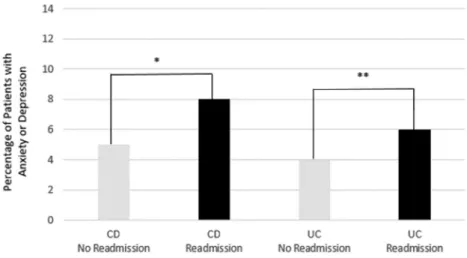
In univariate analysis of patients with CD, those patients re-quiring readmission were more likely to be male, have a pre-existing psychiatric diagnosis of anxiety or depression (Figure; available atwww.jpeds.com), and were less likely to have un-dergone an IBD related surgery during the index admission (Table III). There was no significant difference in readmission
Table II. Baseline clinical and demographic character-istics of pediatric patients with IBD in the 2013 NRD
CD
n=1733
UC
n=1000
n % n %
Age (y)
≤12 451 26 416 42
13-17 1282 74 684 68
Male sex 979 56 497 50
Anxiety or depression 101 6 43 4
Chronic pain <11 1 <11 1
Teaching hospital on index admission
1549 89 869 87
Hospital volume on index admission
≤20 IBD admissions per y 459 28 302 31 >20 IBD admissions per y 1274 72 698 69 Payer/insurance
Medicaid 549 32 375 38
Private insurance 1065 61 575 58
Other 119 7 78 8
C difficileinfection 87 5 67 7 Need for IBD-related surgery 225 13 N/A N/A LOS for index admission (d)
≤3 796 46 390 39
4-7 597 34 353 35
>7 340 20 257 26
Presence of a fistula 60 3 N/A N/A Small bowel obstruction 226 13 N/A N/A
Table III. Univariate comparison of characteristics of pediatric patients with CD in the 2013 NRD, including unad-justed odds of readmission
No readmission
n=1364
Readmission
n=369
Unadjusted OR
(95% CI) Pvalue
n % n %
Age (y) .183
≤12 371 27 80 22 Reference
13-17 993 73 289 78 1.22 (0.88-1.70)
Male sex 756 55 223 60 1.33 (1.01-1.75) .004
Anxiety or depression 73 5 28 8 1.99 (1.15-3.45) .028
Index admission to teaching hospital 1208 88 341 92 1.35 (0.85-2.14) .206 Index admission to high volume IBD center 980 72 294 74 1.12 (0.80-1.55) .509
Payer/insurance .087
Medicaid 414 30 135 37 1.28 (0.97-1.69)
Private insurance 857 63 208 56 Reference
C difficileinfection 61 5 26 7 1.50 (0.87– 2.57) .200
Need for IBD-related surgery 196 14 29 8 0.49 (0.31-0.78) .003
LOS for index hospitalization (d) .057
≤3 640 47 156 42 0.83 (0.60-1.13)
4-7 471 35 126 34 Reference
>7 253 19 87 24 1.22 (0.84-1.76)
Presence of a fistula 48 4 12 3 0.84 (0.38-1.88) .754
if the diagnosis of CD was listed as the primary or secondary diagnosis (22% vs 17%,P=.105). In multivariable analysis, male sex (aOR 1.36, 95% CI 1.03-1.81) and co-existing anxiety or depression (aOR 1.89, 95% CI 1.06-3.40) were associated with a significant increase in odds of readmission within 90 days of index hospitalization (Table IV). In addition, the need for IBD related surgery was associated with decreased odds of readmission within 90 days (aOR 0.40, 95% CI 0.24-0.65). In the prespecified sensitivity analysis including all payer sources, there was no change in the final results.
Factors Associated with Readmission in UC
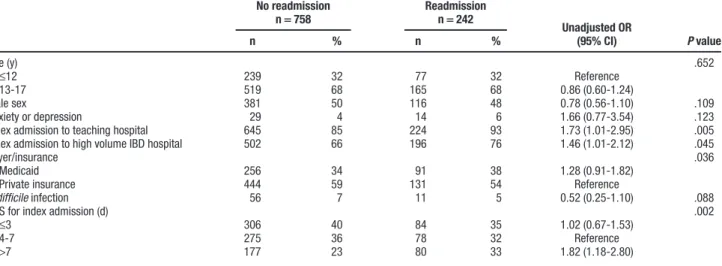
In univariate analysis, patients with UC requiring readmis-sion were more likely to be admitted to teaching hospitals, more likely to be admitted to high volume IBD centers, and demonstrated longer LOS on the index admission when
compared with patients who did not require readmission (Table V). When patients with UC were evaluated in multi-variable analysis, only a LOS of>7 days during the index ad-mission was associated with an increased odds of readad-mission within 90 days (aOR 1.69, 95% CI 1.09-2.62,Table IV). Al-though not significant, an increased odds of readmission within 90 days was suggested with a comorbid condition of anxiety or depression (aOR 1.57, 95% CI 0.69-3.54), index admis-sion to a teaching hospital (aOR 1.32, 95% CI 0.74-2.37), and index admission to a high volume IBD center (aOR 1.27, 95% CI 0.84-1.69). A sensitivity analysis was also performed in-cluding all payer sources, which demonstrated no change in the final results.
Discussion
Based on this US nationwide study of pediatric patients with UC and CD, the burden of readmissions is substantial. Over 20% of patients with IBD required a repeat hospitalization within 90 days of the index admission. These readmissions re-sulted in a national weighted estimate of over 11 000 excess hospital days and approximately $107 million total charges in the pediatric IBD population. Among patients with CD, male sex and a coexisting diagnosis of anxiety or depression were associated with significantly increased odds of readmission within 90 days. In patients with UC, an increased LOS during the index admission was associated with increased odds of readmission.
The majority of the literature evaluating risk factors for re-admission among patients with IBD has evaluated the adult population. Prior single center studies evaluating adults with IBD have associated an increased risk of hospital readmis-sion with factors such as chronic pain and depresreadmis-sion.16Both anxiety and depression are increased among patients with IBD compared with other disease states and the general population.17-19In addition, anxiety has been associated with worse outcomes among pediatric patients with IBD20and
Table IV. Multivariable analysis, odds of readmission among pediatric patients with CD or UC in the 2013
NRD*
CD aOR (95% CI)
UC aOR (95% CI)
Age (y)
≤12 Reference Reference
13-17 1.32 (0.94-1.85) 0.89 (0.62-1.28) Male Sex 1.36 (1.03-1.81) 0.81 (0.58-1.14) Anxiety or depression 1.89 (1.06-3.40) 1.57 (0.69-3.54) Index admission to teaching hospital 1.36 (0.80-2.32) 1.32 (0.74-2.37) Index admission to high volume
IBD center
1.02 (0.70-1.49) 1.27 (0.84-1.92)
Payer/insurance
Medicaid 1.23 (0.92-1.63) 1.19 (0.84-1.69) Private insurance Reference Reference Need for IBD-related surgery 0.40 (0.24-0.65) N/A LOS for index admission (d)
≤3 0.79 (0.57-1.08) 1.05 (0.70-1.57)
4-7 Reference Reference
>7 1.28 (0.87-1.89) 1.69 (1.09-2.62)
*All variables included in the final multivariable analysis are listed above.
Table V. Univariate comparison of characteristics of pediatric patients with UC in the 2013 NRD, including
unad-justed odds of readmission
No readmission
n=758
Readmission
n=242
Unadjusted OR
(95% CI) Pvalue
n % n %
Age (y) .652
≤12 239 32 77 32 Reference
13-17 519 68 165 68 0.86 (0.60-1.24)
Male sex 381 50 116 48 0.78 (0.56-1.10) .109
Anxiety or depression 29 4 14 6 1.66 (0.77-3.54) .123
Index admission to teaching hospital 645 85 224 93 1.73 (1.01-2.95) .005 Index admission to high volume IBD hospital 502 66 196 76 1.46 (1.01-2.12) .045
Payer/insurance .036
Medicaid 256 34 91 38 1.28 (0.91-1.82)
Private insurance 444 59 131 54 Reference
C difficileinfection 56 7 11 5 0.52 (0.25-1.10) .088
LOS for index admission (d) .002
≤3 306 40 84 35 1.02 (0.67-1.53)
4-7 275 36 78 32 Reference
increased resource utilization among adult patients with IBD.21,22 Although the impact of these psychological comorbidities has been evaluated in multiple studies, a majority of patients with UC or CD may not receive adequate psychosocial support in the scheme of their overall treatment for IBD.23Among patients with CD in our population, a co-existing diagnosis of anxiety or depression was associated with readmission within 90 days in both the unadjusted analysis and adjusted analy-ses. Although the association between a co-existing diagnosis of anxiety or depression and readmission was not significant in patients with UC, the magnitude of the effect estimate would seem to suggest that this relationship may also exist among pa-tients with UC. Although this study may have been under-powered to identify a significant relationship, further study of this potential association is indicated in patients with UC, as are efforts to better identify and treat psychological comorbidities among inpatients with IBD.
Among patients with IBD, chronic pain has also been as-sociated with significant effects on quality of life.24Less than 11 patients in both populations had a co-existing diagnosis of chronic pain, and, thus, chronic pain was not used in our analy-ses of patients with UC or CD. In a study of adult inpatients with IBD, a diagnosis of CD was associated with increased use of narcotics despite a lack of association with disease activity on objective evaluation such as radiographic imaging or endoscopy.25Taken together, continued examination of the role of pain among pediatric patients with IBD seems essential, as this population was underpowered to evaluate the relation-ship that chronic pain may play in readmission among pedi-atric patients with IBD.
In both univariate and multivariable analysis of pediatric patients with CD, the need for IBD-related surgery was a strong negative predictor for readmission within 90 days among pe-diatric patients. This may indicate that surgery offers either a temporary or definitive successful therapeutic option in pa-tients with CD, as only 8% of papa-tients requiring an IBD related surgery during the index admission were readmitted within 90 days. In a prior evaluation of children with CD and intra-abdominal abscesses, Dotson et al26found that 64% of pa-tients with intra-abdominal abscesses treated with medical management or percutaneous drainage ultimately required sur-gical intervention within one year. Although preservation of intestinal length remains a critical focus in pediatric patients with CD, definitive management with resection in cases of per-foration and abscess may be key in allowing a patient to resume school and age appropriate activities more quickly27while po-tentially decreasing the risk for readmission.
Among patients with UC, a longer LOS during the index admission was associated with an increased risk of readmis-sion within 90 days. Although not significant, we also ob-served that hospitalization at a teaching hospital seemed to be associated with increased odds of readmission. We specu-late that both of these may represent indirect markers of disease severity. However, the NRD does not contain suffi-cient clinical data (laboratory data, medication use, or phe-notypic information) to fully explore the relationships between disease severity, hospital characteristics, and readmission rates.
TheNRDisdesignedtobeanationallyrepresentativesample ofhospitalizationswithintheUS.However,asthemajorityof hospitalizationsareforadultpatients,itisunknownwhether theNRDistrulyrepresentativeoftheentirepopulationof chil-drenwithIBDintheUS.Nevertheless,theNRDremainsthe largest,mostgeographicallydiversesourceofhospitalization andreadmissiondataavailableintheUS.Thereareother limi-tationsinourstudyaswell.Asnoted,theNRDdoesnotcontain laboratorydataorclinicaldataregardingtheseverityofan in-dividualpatient’sdiseaseatthetimeofhospitalization,and, thus,asidefromsurrogateindicatorssuchasLOS,ourability toevaluatetherelationshipbetweentheseverity of disease andoddsof readmissionis limited.Althoughweevaluated variablessuchasthepresenceofafistulaorasmallbowel ob-struction,thepotentialremainsthatthesediagnosesmaynot becodedasaccuratelyasaprimarydiagnosisofCD.
Inaddition,theNRDdoesnotcontaininformationonrace. Thisisanimportantlimitationgivenpriorliterature demon-stratingashortertimetoreadmissionandahigher probabil-ity of readmission among black children with IBD when comparedwithwhitechildren.11Thereis also thepotential formisclassificationofthosefactorsassociatedwith readmis-sionwhenusinglargedatabasessuchastheNRD.Becauseof thehighlikelihood thatactiveIBDistheprimarydriverof many index admissions,thepotential exists thatcomorbid conditionssuchasanxiety,depression,andchronicpainmay belesslikelytobecoded.Thiscouldleadtoan underestima-tionof theinfluence thatthese comorbiddiseaseshave on readmission,evenwhenusingvalidatedalgorithmsfor case-finding. We were also unable to evaluate provider factors that mayhavecontributedtoreadmission,includingtheimpact thatfactorssuchasearlydischargefromtheindex hospital-izationplayin readmission.Althoughfutureinterestin de-creasingreadmission will likely focus onmultidisciplinary approachestodischargeplanning,acontinuedfocuson pro-viderdecisionmakingduringtheindexhospitalizationwill remaincriticalineffortstoimproveoutcomesamong hospi-talizedchildrenwithIBD.
Inconclusion,usinganationwidedatabase,weidentified asignificanteconomicburdenassociatedwithhospital read-missionamongpediatricpatientswithUCandCD.Among patientswithCD,psychiatriccomorbiditiesofanxietyor de-pressionandmalesexwereassociatedwithincreasedoddsof readmissionwithin90days.ThosepatientswithUCwho ex-periencedlongerLOSduringtheirindexadmissionwereat in-creasedoddsofreadmissionwithin90days.Thesefindings demonstratethe significanteconomic burden of readmis-sioninthispopulationandgiventhepaucityofliterature evalu-atingtheburdenofhospitalreadmissionamongchildrenwith IBD,mayleadtofuturestudiestobetteridentifyriskfactors associatedwithreadmission.
Submitted for publication May 24, 2017; last revision received Jul 6, 2017; accepted Aug 16, 2017
Reprint requests: Edward L. Barnes, MD, MPH, Division of Gastroenterology and Hepatology, University of North Carolina at Chapel Hill, 130 Mason Farm Rd, Bioinformatics Building, CB #7080, Chapel Hill, NC 27599-7080. E-mail:
References
1. Jencks SF, Williams MV, Coleman EA. Rehospitalizations among patients in the Medicare fee-for-service program. N Engl J Med 2009;360:1418-28.
2. Sandberg KC, Davis MM, Gebremariam A, Adler J. Increasing hospital-izations in inflammatory bowel disease among children in the United States, 1988-2011. Inflamm Bowel Dis 2014;20:1754-60.
3. deBruyn JCC, Soon IS, Hubbard J, Wrobel I, Panaccione R, Kaplan GG. Nationwide temporal trends in incidence of hospitalization and surgi-cal intestinal resection in pediatric inflammatory bowel diseases in the united states from 1997 to 2009. Inflamm Bowel Dis 2013;19:2423-32.
4. Nguyen GC, Bollegala N, Chong CA. Factors associated with readmis-sions and outcomes of patients hospitalized for inflammatory bowel disease. Clin Gastroenterol Hepatol 2014;12:1897-904, e1.
5. Heaton PC, Tundia NL, Schmidt N, Wigle PR, Kelton CML. National burden of pediatric hospitalizations for inflammatory bowel disease. J Pediatr Gastroenterol Nutr 2012;54:477-85.
6. Pant C, Anderson MP, Deshpande A, Altaf MA, Grunow JE, Atreja A, et al. Health care burden ofClostridium difficile infection in hospitalized chil-dren with inflammatory bowel disease. Inflamm Bowel Dis 2013;19:1080-5.
7. Pant C, Deshpande A, Sferra TJ, Almadhoun O, Batista D, Pervez A, et al. Pediatric hospitalizations for inflammatory bowel disease based on annual case volume: results from the Kids’ Inpatient Database 2012. J Investig Med 2017;65:94-6.
8. Naughton MJ, Ruggiero AM, Lawrence JM, Imperatore G, Klingensmith GJ, Waitzfelder B, et al. Health-related quality of life of children and ado-lescents with type 1 or type 2 diabetes mellitus: SEARCH for Diabetes in Youth Study. Arch Pediatr Adolesc Med 2008;162:649-57.
9. Jan AS, Slap G. Variation in surgical outcomes for adolescents and young adults with inflammatory bowel disease. Pediatrics 2013;131(Suppl 1):S81-9.
10. Kelley-Quon LI, Tseng C, Jen HC, Ziring DA, Shew SB. Postoperative complications and health care use in children undergoing surgery for ulcerative colitis. J Pediatr Surg 2012;47:2063-70.
11. Dotson JL, Kappelman MD, Chisolm DJ, Crandall WV. Racial dispari-ties in readmission, complications, and procedures in children with Crohn’s disease. Inflamm Bowel Dis 2015;21:801-8.
12. Introduction to the HCUP Nationwide Readmission Database (NRD) 2016 [Internet].https://www.hcup-us.ahrq.gov/db/nation/nrd/NRD _Introduction_2013.jsp#intro. Accessed January 1, 2016.
13. Marrie RA, Walker JR, Graff LA, Lix LM, Bolton JM, Nugent Z, et al. Per-formance of administrative case definitions for depression and anxiety in inflammatory bowel disease. J Psychosom Res 2016;89:107-13.
14. Kassam Z, Cribb Fabersunne C, Smith MB, Alm EJ, Kaplan GG, Nguyen GC, et al.Clostridium difficileassociated risk of death score (CARDS): a novel severity score to predict mortality among hospitalised patients with C. difficile infection. Aliment Pharmacol Ther 2016;43:725-33. 15. Barnes EL. Unpublished data, kids’ inpatient database nationwide
inpa-tient sample. 2017.
16. Allegretti JR, Borges L, Lucci M, Chang M, Cao B, Collins E, et al. Risk factors for rehospitalization within 90 days in patients with inflamma-tory bowel disease. Inflamm Bowel Dis 2015;21:2583-9.
17. Kappelman MD, Long MD, Martin C, Dewalt DA, Kinneer PM, Chen W, et al. Evaluation of the patient-reported outcomes measurement infor-mation system in a large cohort of patients with inflammatory bowel diseases. Clin Gastroenterol Hepatol 2014;12:1315-23, e2.
18. Loftus E V, Guérin A, Yu AP, Wu EQ, Yang M, Chao J, et al. Increased risks of developing anxiety and depression in young patients with Crohn’s disease. Am J Gastroenterol 2011;106:1670-7.
19. Mikocka-Walus A, Knowles SR, Keefer L, Graff L. Controversies revisited. Inflamm Bowel Dis 2016;22:752-62.
20. Reigada LC, Hoogendoorn CJ, Walsh LC, Lai J, Szigethy E, Cohen BH, et al. Anxiety symptoms and disease severity in children and adoles-cents with Crohn disease. J Pediatr Gastroenterol Nutr 2015;60:30-5. 21. Ramos-Rivers C, Regueiro M, Vargas EJ, Szigethy E, Schoen RE, Dunn
M, et al. Association between telephone activity and features of patients with inflammatory bowel disease. Clin Gastroenterol Hepatol 2014;12:986-94, e1.
22. Click B, Ramos Rivers C, Koutroubakis IE, Babichenko D, Anderson AM, Hashash JG, et al. Demographic and clinical predictors of high health-care use in patients with inflammatory bowel disease. Inflamm Bowel Dis 2016;22:1442-9.
23. Bennebroek Evertsz’ F, Thijssens NAM, Stokkers PCF, Grootenhuis MA, Bockting CLH, Nieuwkerk PT, et al. Do inflammatory bowel disease pa-tients with anxiety and depressive symptoms receive the care they need? J Crohns Colitis 2012;6:68-76.
24. Morrison G, Van Langenberg DR, Gibson SJ, Gibson PR. Chronic pain in inflammatory bowel disease. Inflamm Bowel Dis 2013;19:1210-7. 25. Long MD, Barnes EL, Herfarth HH, Drossman D. Narcotic use for
in-flammatory bowel disease and risk factors during hospitalization. Inflamm Bowel Dis 2012;18:869-76.
26. Dotson JL, Nwomeh B, Andridge R, Anderson SE, Crandall WV. Varia-tion in management of intra-abdominal abscesses in children with Croh’s disease. Inflamm Bowel Dis 2013;19:818-25.
Figure. Comparison of the percentage of patients with a coexisting diagnosis of anxiety or depression stratified by readmis-sion status and primary diagnosis of CD or UC, *P=.028, **P=.123.
Table I. ICD-9-CM diagnosis codes used in the analy-sis of 90-day readmissions among patients with CD and UC
Diagnoses ICD-9-CM Code
C difficileinfection 008.45 Small intestinal resection 45.6× Colectomy 45.7x, 45.8x Other abdominal operations 54.xx Dehydration 276.51
Anemia 280.0, 280.9, 281.9, 285.1, 285.29, 285.9 Depression 296.2, 296.3, 298,0 300.4, 311
Anxiety 300, 300.2
Chronic pain 338.2 or 338.4 Fistula 537.4, 569.81, 619.1
CD 555.xx
UC 556.xx