IC, 2014 – 10(3): 425-447 – Online ISSN: 1697-9818 – Print ISSN: 2014-3214 http://dx.doi.org/10.3926/ic.435
Role of OCB and Demographic Factors in the Relationship of Motivation
and Employee Performance
Tan Yew Huei1, Nur Naha Abu Mansor1, Huam Hon Tat2
1Faculty of Management, Universiti Teknologi Malaysia (Malaysia)
2Faculty of Business, Quest International University Perak (Malaysia)
[email protected],[email protected], [email protected]
Received June, 2013 Accepted April, 2014
Abstract
Purpose: This research seeks to broaden the study by investigating the interplay of organizational citizenship behaviour (OCB) and demographic factor (gender and organizational tenure) on the motivation and employee performance relationship.
Design/methodology/approach: Multiple linear regression was used to test the relationship between motivation (intrinsic and extrinsic) and employee performance among (n=368) lecturers in Malaysia. To test the mediating effect of OCB, path analysis was employed. Furthermore, the demographic factors (gender and organizational tenure) was tested using the moderated multiple regression analysis.
Research limitations/implications: Study limitations (e.g. cross-sectional research design and biasness) and future opportunities are outlined.
Practical implications: Argues that the suitable type of motivation in explaining the variances of employee performance. Also, identifies the important of OCB between the motivation and employee performance relationship, thus gender and organizational tenure were not significant to OCB and employee performance relationship.
Social implications: HR can help an organization to succeed, provided that the suitable motivations are adopted to monitor lecturer performance and helping behavior. In addition, HR should not emphasize too much of gender and organizational tenure to justify the lecturer performance as the findings show insignificant relationship.
Originality/value: This paper identifies and discusses the types of motivation that explain higher variance of employee performance and how OCB play role as mediator in the motivation and employee performance relationship. In addition, the moderating effect of gender and organizational tenure were also discussed. This is the first attempt to include all the variables in the same theoretical framework.
Keywords: Intrinsic motivation, extrinsic motivation, OCB, employee performance, gender and organizational tenure
Jel Codes: M10, M14, L15
1. Introduction
Motivation has been given the credit of bringing success to the employee performance. However, not many empirical discussions could be found within the higher education industry, especially among lecturers. Indeed, Malaysia believes that education is one of the critical elements in the development of the country (Arokiasamy, Ismail, Ahmad & Othman, 2009). Education among individuals is a means to career term and social mobility, whereas from the government’s perspective, it is a crucial step in the country’s economic development (Benjamin, Marathamuthu, Muthaiayh & Raman, 2011). The crucial workforce in the universities themselves, are lecturers (Arokiasamy et al., 2009).
intrinsic motivation was named as extrinsic motivation. Extrinsic motivation was defined as individual willingness to complete a task because of some separable outcomes or rewards (Ryan & Deci, 2000). Even though, most researchers agree that intrinsic motivation plays a prominent role among individuals, some of the job tasks and social demands that are not willing to be accomplished by individual have decreased the freedom to be intrinsically motivated (Ryan & Deci, 2000). According to Ryan and Deci (2000), many educational activities implemented in the education industry are not designed to be interesting. As a result, the challenge faced by the industry is about how to motivate lecturers to be self-regulated with such activities, in the absence of external pressure and able to carry out the activities on their own.
Furthermore, when OCB was first introduced in early 1930s by Barnard (1938), researchers started to develop a proper dimension to identify the OCB. The first two dimensions were introduced by Smith, Organ and Near (1983), which only consisted of altruism and generalized compliance. This two dimension were used to enhance the company effectiveness and efficiency in different ways (Smith et al., 1983). However, all dimensions introduced by the previous researchers were not accepted widely until the new dimension which introduced by Organ (1988) was found. According to Organ (1988), OCB dimension should consist of altruism, courtesy, sportsmanship, civic virtue and conscientiousness.
2. Literature Review
2.1. Theoretical Background
The present model was developed according to the theoretical and empirical studies from the psychology and human management literature, particularly on the work of the following researchers: Ryan and Deci (2000), Organ (1988), Ishak, Suhaida and Yuzainee (2009), Megginson and Whitaker (2003) and Meyer, Allen and Smith (1993).
knowledge self-efficacy (Kankanhalli, Tan & Kwok-Kee, 2005). Therefore, it involves both intrinsic and extrinsic benefits (Deci and Ryan, 1980; Vallerand, 1997). For example, lecturers who enjoy helping institutions or colleagues perform OCB because they are intrinsically motivated. However, lecturers who are willing to perform extra in exchange of rewards, they are extrinsically motivated.
To explain the existence of OCB-employee performance relationship, the norm of reciprocity theory (Gouldner, 1960) and SET were used as a basis. This theory establishes the obligation to return a favour and therefore, sustains relationships. It states that people should help those who have helped them and people should not injure those who have helped them (Gouldner, 1960). According to Rook (1987), the universal norm of reciprocity is the strongest of the social norms relevant to helping behaviour. By reciprocating good deeds, the individual will increase the chances of receiving benefits in the future (Gouldner, 1960). In the educational settings, employees of higher educational institutions sometimes may perform extra-role behaviors, which add value to the institutions.
Gender roles create expectations of the behaviors necessary to fulfill the role of ‘female’ and ‘male’. In other words, people are expected to behave in ways consistent with their socially prescribed gender roles. Past studies (e.g: Deluga, 1998; Morrison, 1994; Van Dyne & Ang, 1998) have generally reported differences between males and females in terms of their OCB enactment. The five dimensions of OCB encompass behavioral expectations that appear consistent with masculine and feminine stereotypes and role expectations. In this light, Kidder and Parks (2001) categorized OCB into two groups. Altruism, courtesy and conscientiousness are considered feminine OCBs, whereas sportsmanship and civic-virtue are perceived as masculine OCBs.
Meanwhile, human capital theory (Becker, 1964) suggested that long-tenured workers are better performers because they have accumulated more job-related knowledge over the course of their careers. Individuals can accumulate human capital through both formal education and work experience (Meyer, Griffith & Daugherty, 2004; Singer & Bruhns, 1991; Strober, 1990). Economists suggest that experience and education are signals to organizations about employees’ knowledge and skill levels (Sicherman & Galor, 1990). The labour market rewards individuals from acquiring more human capital with access to better jobs, higher earnings, and greater incentives to remain (Strober, 1990). In turn, employees with longer tenure have greater incentives to perform well into the future.
study was on the comparison of the two motivation dimensions, namely intrinsic motivation and extrinsic motivation. These dimensions were deemed to be significant with lecturer’s OCB. Besides, this study also looked at OCB and its relationship with employee performance. However, the OCB-employee performance relationships were expected to be contingent upon one factor. One of the particular interest in this study was the demographic factors variable.
2.2. Motivation and Employee Performance
In studies on motivation for teaching, it is common to distinguish between intrinsic and extrinsic reasons for choosing the profession (Roness, 2011; Eyal & Roth, 2011; Moran Kilpatrick, Abbott, Dallat & Mcclune, 2001). Intrinsically motivated lecturers are focused on the activity that is significantly related to their inherent satisfaction or joy (Ryan & Deci, 2009). Meanwhile, rewards and benefits are the driven forces for the lecturers who are extrinsically motivated (Ryan & Deci, 2009). Brookhart and Freeman (1992) reviewed American research that has sought to determine the characteristics of incoming academic candidates and they find that the reasons for choosing teaching were connected to intrinsic sources of motivation. Studies in Australia indicate that personal fulfilment, the desire to work with young children and to make a difference in their life and the opportunity to experience a meaningful engagement with the subject of their choice are intrinsic motivational factors (Manuel & Brindley, 2005; Manuel & Hughes, 2006).
Therefore, this research hypothesizes that:
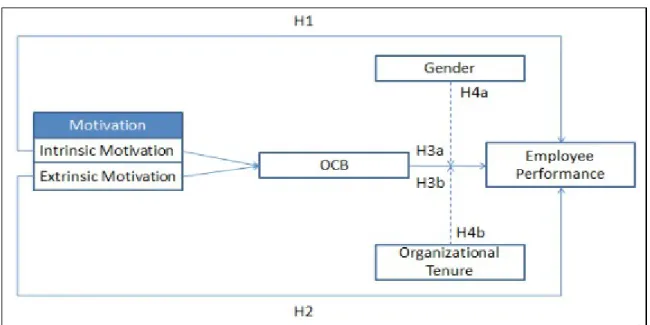
• H1: Intrinsic motivation is better in terms of explaining the variances of employee performance among lecturers in Malaysia.
• H2: Extrinsic motivation is better in terms of explaining the variances of employee performance among lecturers in Malaysia.
2.3. Intrinsic Motivation, Extrinsic Motivation and Employee Performance: OCB as Mediator
OCB comprises extra-role behaviours that are not within role but nevertheless of great importance for efficient processes in organizations (Organ, 1988; Podsakoff, Ahearne & Mackenzie, 1997). Building upon work (Ehrhart, Bliese & Thomas, 2006) that supports OCB as a means of positively influencing organizational performance; it is argued that the OCB of the implementation team should result in a successful outcome. Niehoff (2005) suggested that OCB exerts positive influence on organizational performance because it provides socio-emotional support to other employees, and facilitates the work of others. Therefore, employees may contribute to organizational effectiveness by building socio-emotional support in the organization and facilitating more efficient work behaviour.
Helping behaviour stimulates performance because new colleagues are easily integrated into the group. Therefore, the group can establish best practices, ease in coordination, and thus variations of performance become less probable (Boerner, Eisenbeiss & Griesser, 2007). Given high levels of sportsmanship, the group does not need to spend much energy and time on group maintenance functions. Hence, sportsmanship may raise the attractiveness of group membership for high performers (Boerner et al., 2007). With increasing of followers’ conscientiousness, leaders may tend to empower their followers and thus, raise their performance motivation. Accordingly, in a comprehensive literature review, Podsakoff, Mackenzie, Paine and Bachrach (2000) found OCB to predict followers’ performance.
As suggested, salient identification enhances the frequency of cooperation and cooperative behaviours (Islam, Anwar, Khan, Rasli, Ungku Ahmad & Ahmed, 2012). When individuals are identified by their organizations, they are more willing to engage in cooperative, altruistic and spontaneous unrewarded citizenship behaviour (Islam et al., 2012). Briefly, OCB may mediate the relationship between motivation and employee performance among lecturers in Malaysian higher education.
• H3a: The effect of OCB is perfectly mediating the relationship between intrinsic motivation and employee performance among lecturers in Malaysia higher education.
• H3b: The effect of OCB is perfectly mediating the relationship between extrinsic motivation and employee performance among lecturers in Malaysia higher education.
2.4. OCB and Employee Performance: Gender and Organization Tenure as Moderator
The notion of ‘role’ is of central importance in understanding the moderating effect of gender on the relationship between OCB and employee performance. Gender roles create expectations of the behaviours necessary to fulfil the role of ‘female’ and ‘male’. In other words, people are expected to behave in ways that are consistent with their socially prescribed gender roles. Several past studies (Deluga, 1998; Morrison, 1994; Van Dyne & Ang, 1998) have generally reported differences between males and females in terms of their OCB enactment. The five dimensions of OCB encompass behavioural expectations that appear consistent with masculine and feminine stereotypes and role expectations. In this light, Kidder and Parks (2001) categorized OCB into two groups. Altruism, courtesy and conscientiousness are considered feminine OCBs, whereas sportsmanship and civic-virtue are perceived as masculine OCBs.
Given the above, if people are expected to perform the OCBs related to their gender roles, this would suggest that females would get more credit, in terms of rewards or academic success than males for performing masculine OCBs, for instance, civic virtue and sportsmanship. Implicitly, the behaviours of the females go beyond expectations, and thus are likely to be rewarded. This would also be true for males performing feminine OCBs such as altruism, courtesy and conscientiousness. Therefore, this research hypothesizes that:
• H4a: The effects of gender moderate the relationship between OCB and employee performance among lecturers in Malaysia higher education.
In addition, according to Ng and Feldman (2010), much less theoretical and empirical work has been conducted on how long organizational tenure affects performance. This gap in the literature is due to the widespread assumption that workers with more years of service are generally better performers (McEnrue, 1988). The researchers have long argued that employees with more years of service know how to perform their jobs better (Wagner, Ferris, Fandt & Wayne, 1987), whereas poor-performing employees are likely to be weeded out before they accumulate many years of service (Schneider, Goldstein & Smith, 1995).
Cohen (1997) postulated that since employees accumulate relevant work experience as tenure increases, both their autonomy and their performance also grow. Sturman (2003) also argued that the explicit and tacit organizational knowledge gained through organizational tenure have unique positive effects on job performance. Moreover, given that increases in organizational tenure are also accompanied by increases in chronological age, the types of performance that long-tenured employees enjoy and excel at might be different from those of young new hires. For instance, research on aging and development suggests that older individuals adapt to aging by giving higher priority to socially oriented tasks that are emotionally satisfying to them (Carstensen, Issacowitz & Charles, 1999) and that they will invest their resources more in those goals that match their motivations and interests (Beier & Ackerman, 2001). As such, longer tenured employees may dedicate more resources to social-oriented tasks (helping others, making constructive suggestions) than other technically oriented job tasks. Therefore, this research hypothesizes that:
• H4b: The effects of organizational tenure moderate the relationship between OCB and employee performance among lecturers in Malaysia higher education.
Figure 1. Research Framework
3. Methodology
3.1. Participant
3.2. Measurement
This study adopts split-half reliability and inter-item because it examines the degree of how unified the items are in the instruments and the consistency of respondents’ answer for all items (Herzog, 1996). Alpha Cronbach’s coefficient alpha and spearman brown coefficient were used because they provide a measure of the degree to which the full scale, derived from a set of items, is free from error (Cozby, 2005). The questionnaire is considered highly reliable when the coefficient value (α) is above 0.70 as suggested by Hair, Anderson, Tatham and Black (1998). In conclusion, the items in this study were considered reliable when the alpha Cronbach and coefficient value was above 0.70.
Multiple regression analysis is used for predicting the unknown value of a variable from the known value of two or more variables-also called the predictors (Hair et al., 1998). The strength of the relationship stipulated by the regression equation can be determined by using the appropriate measures of association. In multiple regressions, the strength of association is measured by the square of the multiple correlation coefficients, R2, which is called the
coefficient of multiple determinations. It measures the strength of the relationship between the dependent variable and independent variables. In this study, the larger the R2 is, the more
significantly the brand equity is associated with customer loyalty.
The moderating effect of gender and organizational tenure was analyzed using moderated multiple regression (MMR) analysis. To determine the presence of moderating effect, the OLS model was then compared with the MMR model which was represented by Equation 2. Below are the definitions of the equation:
Equation (1) Y = i1 + b1X + c1Z + e1
Equation (2) Y = i2 + b2X + c2Z+ d2(X*Z) + e2
Where: Y = dependent variable;
X = independent variable;
Z = moderator
X*Z = the multiplier of independent variable and moderator
i = constant value for independent variable
b, c, d = coefficients for independent variable and moderator
R2 value is observed to determine the significant effect of moderator to the studied
relationship. If changes in R2 (∆R2) are statistical for the equations, then a significant
moderation effect is present (Hair et al., 1998). Dummy variable was created for gender and organizational tenure in this study, which was introduced into a regression equation (Hair, Anderson, Tatham & Black, 2009).
4. Findings
4.1. Hypotheses Testing
Table 1 demonstrates the mean, standard deviation, reliability and correlation between the variables. Based on the results, there was a significant relationship between all the variables. All variables reported significant at p< 0.01, and showed reliability at 0.7.
Variables M SD 1 2 3 4
Intrinsic motivation 83.60 10.08 (0.899)
Extrinsic motivation 70.26 10.00 0.356** (0.731)
OCB 72.69 10.47 0.571** 0.459** (0.896)
Employee
Performance 98.95 13.11 0.585** 0.307** 0.732** (0.850)
Note: ** p< 0.01, Reliability are reported in diagonal
Table 1. Mean standard deviation, reliability and correlation
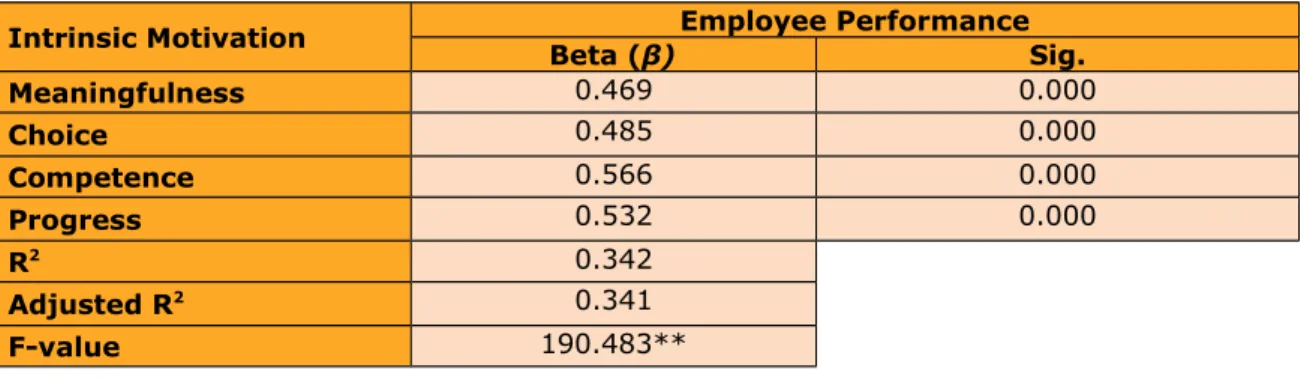
Table 2 and 3 represents the multiple regression analysis between intrinsic motivation and employee performance as well as extrinsic motivation and employee performance. Table 2 shows that the intrinsic motivation dimensions were positively and significantly associated with employee performance. As seen from the coefficient of determination, adjusted R2, intrinsic
motivation dimensions accounted for 34.1% of the variance in employee performance and, all four dimension dimensions (meaningfulness: β = .469, p < .01; choice: β = .485, p < .01; competence: β = 0.566, p <.01; progress: β = 0.532, p <.01).
The value of adjusted R2 in Table 3 implies that the extrinsic motivation dimensions explained
Besides, the adjusted R2 values from both regressions were used to test the predictive validity.
In terms of adjusted R2 intrinsic motivation model had a much higher value (34.1% versus
9.2%) compared to the extrinsic motivation dimensions in terms of its predictive validity. The intrinsic motivation, therefore, has higher predictive validity than extrinsic motivation dimensions. This suggests that intrinsic motivation dimensions have a higher ability to differentiate among lecturers in response to employee performance. All these results provided grounds for full support of hypothesis H1, which says that the intrinsic motivation is better in terms of explaining the variances of employee performance among lecturers in Malaysia. However, the hypothesis H2 was rejected.
Intrinsic Motivation Beta (β)Employee PerformanceSig.
Meaningfulness 0.469 0.000
Choice 0.485 0.000
Competence 0.566 0.000
Progress 0.532 0.000
R2 0.342
Adjusted R2 0.341
F-value 190.483**
Note: ** p < 0.01
Table 2. Results of multiple regression analysis between intrinsic motivation and employee performance
Extrinsic Motivation Beta (β)Employee PerformanceSig.
External Regulation 0.54 0.305
Introjected Regulation -0.051 0.329
Identified Regulation 0.485 0.000
Integrated Regulation 0.575 0.000
R2 0.094
Adjusted R2 0.092
F-value 38.184**
Note: ** p < 0.01
Table 3. Results of multiple regressions analysis between extrinsic motivation and employee performance
Table 4 demonstrates the summarized findings of the three equations. In the first equation, intrinsic motivation demonstrates the significant effect on employee performance (β = 0.585,
p< 0.05). In addition, intrinsic motivation also found to significantly affect the OCB (β = 0.571,
perfect mediation was found on the effect of OCB. Therefore, the null hypothesis was rejected.
Meantime, Table 5 demonstrates the summarized findings of the three equations. In the first equation, extrinsic motivation demonstrates the significant effect on employee performance (β
= 0.307, p< 0.05). In addition, extrinsic motivation also found to significantly affect the OCB (β = 0.459, p< 0.05). In the third equation, the finding showed that OCB significantly affects employee performance (β = 0.748, p< 0.05). However, extrinsic motivation showed no significant effect with employee performance (β = -0.036, p< 0.05). Therefore, it can be concluded that there was a perfect mediation relationship was found on the effect of OCB. Therefore, the null hypothesis was supported.
Variables Equation1 Equation 2 Equation 3
β t β t β t
Intrinsic Motivation 0.585** 13.802 0.571** 13.313 0.248** 5.982
OCB 0.590** 14.213
Note: **p< 0.05, β = Standardized Beta Coefficient
Table 4. The Mediating Effect of OCB on the Relationship of Intrinsic Motivation and Employee Performance
Variables Equation1 Equation 2 Equation 3
β t β t β t
Extrinsic Motivation 0.307** 6.179 0.459** 9.787 -0.036 -0.892
OCB 0.748** 18.641
Note: **p< 0.05, β = Standardized Beta Coefficient
Table 5. The Mediating Effect of OCB on the Relationship of Extrinsic Motivation and Employee Performance
Results of moderated multiple regressions analysis for Model 1 are shown as in Table 6, R=.732a, R² = .535 and F change = 421.273, p < 0.001. This R² means that 53.5% of the
variance in job performance is explained by OCB and gender groups. Model 2 shows the results after the product term (OCB*gender) was included in the equation. As indicated in Table 6, the addition of the product term resulted in an R2 change of .004 and F change = 3.357, p >
In addition, results of moderated multiple regression analysis for Model 1 are shown as in Table 7, R = .732a, R² = .535 and F change = 421.273, p < 0.001]. This R² means that 53.5% of
the variance in job performance is explained by OCB and organizational tenure group. Model 2 shows the results after the product term (OCB*organizational tenure) was included in the equation. As indicated in Table 7, there is no changes in R2 and F change = 0.012, p > 0.05.
The results do not support the presence of a moderating effect. Therefore, H4b was rejected.
Model R R2 Adjusted
R2 Std. Error
Change statistics
∆R2 F change Sig. F change
1 .732a .535 .534 8.95 .353 421.273 0.000
2 .734b .539 .537 8.92 .004 3.357 0.068
Note: a = Predictor: (constant), OCB; b = Predictor: (constant), OCB, Dummy variable gender
Table 6. The Moderating Effect of Gender on the Relationship of OCB and Employee Performance
Model R R2 Adjusted
R2 Std. Error
Change statistics
∆R2 F change Sig. F change
1 .732a .535 .534 8.95 .535 421.273 0.000
2 .732b .535 .533 8.96 .000 0.012 0.913
Note: a = Predictor: (constant), OCB; b = Predictor: (constant), OCB, Dummy variable organizational tenure
Table 7. The Moderating Effect of Organizational Tenure on the Relationship of OCB and Employee Performance
5. Discussion
in determining the employee performance, interplay of OCB, gender and organization tenure represented an important need in the human resource management literature, and thus, a key contribution of the present study.
In general, our findings only support two of our predictions: Intrinsic motivation explain higher variance in explaining the lecturer’s performance, OCB mediate the relationship between extrinsic motivation and employee performance. On the contrary to our predictions, extrinsic motivation explaining lower variances compare to employee performance, OCB does not mediate the relationship between intrinsic motivation and extrinsic motivation, gender and organizational tenure does not moderate the OCB-employee performance relationship.
6. Theoretical and practical implication
The findings on Pearson correlation analysis have confirmed that there is a significant relationship between intrinsic motivation and extrinsic motivation on employee performance. Then, further analysis is conducted using multiple regression analysis, which has also highlighted that intrinsic motivation and extrinsic motivation significantly improve the employee performance. Both findings, therefore, propose that intrinsic motivation and extrinsic motivation are imperative in developing and promoting higher performance among lecturers. Both motivations are also responsible for encouraging employee to positively respond to his/her performance. In other words, both motivations have become a predominant issue to influence employee performance.
The current findings thus enhance the understanding of significance of intrinsic motivation and extrinsic motivation on employee performance by suggesting the OCB as the mediating factor. As highlighted in aforementioned earlier, little is known about the mediating effect of OCB on the relationship between motivation and employee performance. This study has discovered that OCB does not perfectly mediate the relationship between intrinsic motivation and employee performance. However, it does decrease the relationship between intrinsic motivation and employee performance. Meanwhile, the findings showed that OCB is perfectly mediated the relationship between extrinsic motivation and employee performance. The evidence denotes that it is important to practice the value of OCB among lecturers who are extrinsically motivated to increase their performance.
is also believed that the masculine and feminine stereotype effect does not imply in higher learning, especially among lecturers. Studies from other industries have demonstrated that organizational tenure and gender are the most common moderators. However, it is interesting to find out that both moderators do not have any impact on lecturers. It can be concluded that the nature of job and industry holds strong significance in causing the result that varies among different industries.
Based on the findings and conclusion of this study, several important practical contributions pertaining to the effect of employee performance were identified.
• First, the Ministry of Higher Education should employ the potential lecturers who understand the value of being a lecturer. Special attention should be provided to those lecturers who have a positive behaviour towards their job and tend to enjoy the job as a lecturer. This is because the teachers must be interested in what they teach and in the children when they are teaching. If they are not interested in the work at all, they can never motivate the class to learn.
• Second, the organization should not employ too much of regulations to monitor the lecturers’ activities or promote the lecturers ego attainment whenever they accomplished something. Based on the findings, it can be stated that more regulations, punishments, and ego attainment tend to decrease the lecturers’ performance. Therefore, the organizations should give more freedom to the lecturers and help them to attain certain skill or knowledge that the lecturers can treat as their own.
• Third, the organization should focus more to promote the lecturer’s prosocial behaviour. Based on the finding, it is demonstrated that the lecturers who are extrinsically motivated are monitored by their sense of helping behaviour whenever they perform a task. Therefore, the organizations should encourage the lecturers to participate or carry out some activities in a group. This could increase the interaction with other lecturers which could promote their helping behaviour indirectly.
7. Limitations and recommendations for future study
As with most research, the results of this study should be interpreted with consideration of several limitations. First, the cross-sectional nature of the study does not guarantee accurate results. Individual who is born in difference period of time may share different experience and behaviour. Therefore, we are not able to claim an accurate causal relationship based on this results. Future research would be recommended by using a longitudinal design to test the present findings.
Second, the study relied on employee self-reports of employee performance. Due to the reason that lecturers was believe to be a professional group members, organizations do not monitor closely on each lecturer individually. Therefore, we could not obtain departmental or managerial reports on the lecturer’s performance and behaviour. As a result, we could not deny the fact that there would be biasness in answering the questionnaires. Based on this reason, we suggest that future research should impose controllable determinants over employee performance and OCB.
Finally, the findings of the study were not entirely representative to other industry. This study was only applicable to the higher learning industry because the employee performance measurement employed was set to investigate the lecturer’s performance rather than other job performance.
8. Conclusion
References
AROKIASAMY, L.; ISMAIL, M.; AHMAD, A.; OTHMAN, J. (2009). Background of Malaysia private institutions of higher learning and challenges faced by academics. The Journal of International Social Research, 2(8).
BARNARD, C.I. (1938). The Functions of the Executive. Cambridge, MA: Harvard University Press.
BECKER, G. (1964). Human capital: A theoretical and empirical analysis with special reference to education. New York: Columbia University Press.
BEIER, M.E.; ACKERMAN, P.L. (2001). Current-events knowledge in adults: An investigation of age, intelligence, and non-ability determinants. Psychology and Aging, 16: 615-628.
http://dx.doi.org/10.1037/0882-7974.16.4.615
BENJAMIN, S.J.; MARATHAMUTHU, M.S.; MUTHAIAYAH, S.; RAMAN, M. (2011). Affordability of private tertiary education: A Malaysian study. International Journal of Social Economics,
38(4): 382-406. http://dx.doi.org/10.1108/03068291111112068
BLAU, P. (1964). Exchange and power in social life. New York: Wiley.
BOERNER, S.; EISENBEISS, S.A.; GRIESSER, D. (2007). Follower behavior and organizational performance: The impact of transformational leaders. Journal of Leadership and Organizational Studies, 13(3): 15-26. http://dx.doi.org/10.1177/10717919070130030201
BOLINO, M.C.; TURNLEY, W.H.; BLOODGOOD, J.M. (2002). Citizenship Behavior and the Creation of Social Capital in Organizations. Academy of Management Review, 27(4): 505-522.
BROOKHART, S.M.; FREEMAN, D.J. (1992). Characteristics of entering teacher candidates.
American Educational Research Association, 62(1): 37-60.
CARSTENSEN, L.L.; ISSACOWITZ, D.M.; CHARLES, S.T. (1999).Taking time seriously: A theory of socioemotional selectivity. American Psychologist, 54: 165-181.
http://dx.doi.org/10.1037/0003-066X.54.3.165
CHENG, Y.-C.; YEH, H.-T. (2009). From concepts of motivation to its application in instructional design: Reconsidering motivation from an instructional design perspective. British Journal of Education Technology, 40(4): 597-605. http://dx.doi.org/10.1111/j.1467-8535.2008.00857.x
COHEN, J. (1997). Statistical power analysis for the behavioral sciences (2nd ed.). Hillsdale, NJ: Lawrence Erlbaum Associates Davis and Verma.
DECI, E.L.; RYAN, R.M. (1980). The empirical exploration of intrinsic motivational processes.
Advances in Experimental Social Psychology, 13: 39–80. http://dx.doi.org/10.1016/S0065-2601(08)60130-6
DECOENE, V.; BRUGGEMAN, W. (2006). Strategic alignment and middle-level managers’ motivation in a balance scorecard setting. International Journal of Operations and Production Management, 26(4): 429-448. http://dx.doi.org/10.1108/01443570610650576
DELUGA, R.J. (1998). Leader member exchange quality and effectiveness ratings: The role of subordinate supervisor conscientiousness similarity. Group and Organization Management, 23: 189-216. http://dx.doi.org/10.1177/1059601198232006
DELUGA, R.J. (1994). Supervisor trust building, leadermember exchange and organizational citizenship behavior. Journal of Occupational and Organizational Psychology, 67: 315-332.
http://dx.doi.org/10.1111/j.2044-8325.1994.tb00570.x
EAGLY, A.; CROWLEY, M. (1986). Gender and helping behavior: a meta-analytical review of the social psychological literature. Psychological Bulletin, 100: 282-308.
EHRHART, M.G.; BLIESE, P.D.; THOMAS, J.L. (2006). Unit level organizational citizenship behavior and unit effectiveness: Examining the incremental effects of helping behavior.
Human Performance, 19(2): 159–173. http://dx.doi.org/10.1207/s15327043hup1902_4
ERDLE, S.; SANSOM, M.; COLE, M.R.; HEAPY, N. (1992). Sex differences in personality correlates of helping behavior. Personality and Individual Differences, 13: 931-936.
http://dx.doi.org/10.1016/0191-8869(92)90010-M
EYAL, O.; ROTH, G. (2011). Principles’ leadership and teachers’ motivation: Self-Determination theory analysis. Journal of Educational Administration, 49(3): 256-275.
http://dx.doi.org/10.1108/09578231111129055
GEORGE, D.M.; CARROLL, P.; KERSNICK, R.; CALDERON, K. (1998). Gender-related patterns of helping among friends. Psychology of Women Quarterly, 22: 685-704.
http://dx.doi.org/10.1111/j.1471-6402.1998.tb00185.x
GOOD, G.E.; DELL, D.M.; MINTZ, L.B. (1989). Male role and gender role conflict: relations to help seeking in men. Journal of Counseling Psychology, 36: 295-300.
http://dx.doi.org/10.1037/0022-0167.36.3.295
GOULDNER, A.W. (1960). The norm of reciprocity: A preliminary statement. American Sociological Review, 25: 161-178. http://dx.doi.org/10.2307/2092623
HAIR, J.F. JR; ANDERSON, R.E.; TATHAM, R.L.; BLACK, W.C. (2009). Multivariate data analysis
HAIR, J.F. JR.; ANDERSON, R.E.; TATHAM, R.L.; BLACK, W.C. (1998). Multivariate Data Analysis (5th ed.). Upper Saddle River, NJ: Prentice Hall.
HERZOG, T. (1996). Research Methods in the Social Sciences. New York: Harper Collins.
ISHAK, M.I.M; SUHAIDA, M.S.; YUZAINEE, M.Y. (2009). Performance measurement indicators for academic staff in Malaysia private higher education institutions: A case study in UNITEN.
PMA Conference 2009, University of Otago, Dunedin, New Zealand.
ISLAM, T.; ANWAR, F.; KHAN, S.U.R.; RASLI, A.; UNGKU AHMAD, U.N.; AHMED, I. (2012). Investigating the mediating role of organizational citizenship behavior between organizational learning culture and knowledge sharing. World Applied Sciences Journal, 19(6): 795-799.
KANKANHALLI, A.; TAN, B.C.Y.; KWOK-KEE, W. (2005). Contributing knowledge to electronic knowledge repositories: an empirical investigation. MIS Quarterly, 29 (1): 113–143.
KELSEY, J. (2010). The negative impact of rewards and ineffective praise on student motivation. ESSAI: vol. 8, Article 24. Available at: http://dc.cod.edu/essai/vol8/iss1/24. (Last access date: December, 2012).
KIDDER, D.L.; PARKS, J.M. (2001). The good soldier: who is s(he)?. Journal of Organizational Behavior, 22: 939-959. http://dx.doi.org/10.1002/job.119
MANOLOPOULOS, D. (2008). An evaluation of employee motivation in the extent public sector in Greece. Employee Relationship, 30(1): 63-85. http://dx.doi.org/10.1108/01425450810835428
MANUEL, J.; BRINDLEY, S. (2005). The call to teach: identifying pre-service teachers’ motivations, expectations and key experiences during initial teacher education in Australia and the United Kingdom. English in Australia, 144: 38-49.
http://dx.doi.org/10.1080/13664530600587311
MANUEL, J.; HUGHES, J. (2006). ‘It has always been my dream’: exploring pre-service teachers’ motivations for choosing to teach. Teacher Development, 10(1): 5-24.
http://dx.doi.org/10.2307/256504
MCENRUE, M.P. (1988). Length of experience and the performance of managers in the establishment phase of their careers. Academy of Management Journal, 31: 175-185.
MEGGINSON, D.; WHITAKER, V. (2003). Continuing professional development. Charted Institutes of Personnel Development, CIPD House, Camp Road, London.
MEYER, J.P.; ALLEN, N.J.; SMITH, C. (1993). Commitment to Organizations and Occupations: Extension and Test of a Three-component Conceptualization. Journal of Applied Psychology,
MEYER, M.B.; GRIFFITH, D.A.; DAUGHERTY, P.J. (2004). Maximizing the human capital equation in logistics: Education, experience, and skills. Journal of Business and Logistics, 25: 211-232. http://dx.doi.org/10.1002/j.2158-1592.2004.tb00175.x
MOLM, L.D. (1997). Coercive Power in Social Exchange. New York: Cambridge University Press.
http://dx.doi.org/10.1017/CBO9780511570919
MORAN, A.; KILPATRICK, R.; ABBOTT, L.; DALLAT, J.; MCCLUNE, B. (2001). Training to teach: motivation factors and implications for recruitment. Evaluation and Research in Education, 15(1): 17-32. http://dx.doi.org/10.1080/09500790108666980
MORRISON, E.W. (1994). Role definitions and organizational citizenship behavior: The importance of the employee’s perspective. Academy of Management Journal, 37: 1543-1567. http://dx.doi.org/10.2307/256798
NG, T.W.H.; FELDMAN, D.C. (2010). Organizational tenure and job performance. Journal of Management, 36(5): 1220-1250. http://dx.doi.org/10.1177/0149206309359809
NIEHOFF, B.P. (2005). A theoretical model of the influence of organizational citizenshipbehaviors on organizational effectiveness. In: D. Turnipseed (Ed.), New Researching Organizational Citizenship Behaviors (pp. 385-397). New York: Nova.
ORGAN, D.W. (1988). Organizational citizenship behavior. The good soldier syndrome. MA: Lexington.
ORGAN, D.W. (1990). The motivational basis of organizational citizenship behavior (Vol. 12). Greenwich, CT: JAI Press.
OSTERLOH, M.; FROST, J.; FREY, B. (2002). The dynamics of motivation in new organizational forms. International Journal o f the Economics o f Business, 9 ( 1 ) : 6 1 – 7 8 .
http://dx.doi.org/10.1080/13571510110102976
PODSAKOFF, P.M.; AHEARNE, M.; MACKENZIE, S.B. (1997). Organizational citizenship behavior and the quantity and quality of work group performance. Journal of Applied Psychology, 82(2): 262–270. http://dx.doi.org/10.1037/0021-9010.82.2.262
PODSAKOFF, P.M.; MACKENZIE, S.B.; PAINE, J.B.; BACHRACH, D.G. (2000). Organizational citizenship behaviors: a critical review of the theoretical and empirical literature and suggestions for future research. Journal of Management, 26: 513-563.
http://dx.doi.org/10.1177/014920630002600307
RONESS, D. (2011). Still motivated? The motivation for teaching during the second year in the professional. Teaching and Teacher Education, 21: 628-638.
ROOK, K.S. (1987). Reciprocity of social exchange and social satisfaction among older women.
Journal of Personality and Social Psychology, 52: 145-154. http://dx.doi.org/10.1037/0022-3514.52.1.145
RYAN, R.M.; DECI, E.L. (2009). Promoting self-determined school engagement: Motivation, learning, and well-being. New York: Routledge.
RYAN, R.M.; DECI, E.L. (2000). Intrinsic and extrinsic motivation: Classic definitions and new directions. Contemporary Educational Psychology, 25: 54-67.
http://dx.doi.org/10.1006/ceps.1999.1020
SCHNEIDER, B.; GOLDSTEIN, H.W.; SMITH, D.B. (1995). The ASA framework: An update.
Personnel Psychology, 48: 747-773. http://dx.doi.org/10.1111/j.1744-6570.1995.tb01780.x
SHARMA, S.IL.; DURAND, R.M.; GUR-ARIE, O. (1981). Identification and analysis of moderator variables. Journal of Marketing Research, 18: 291-300. http://dx.doi.org/10.2307/3150970
SICHERMAN, N.; GALOR, O. (1990). A theory of career mobility. Journal of Political Economy, 98: 169-192. http://dx.doi.org/10.1086/261674
SINGER, M.S.; BRUHNS, C. (1991). Relative effect of applicant work experience and academic qualification on selection interview decisions: A study of between-sample generalizability.
Journal of Applied Psychology, 76: 550-559. http://dx.doi.org/10.1037/0021-9010.76.4.550
SMITH, C.A.; ORGAN, D.W.; NEAR, J.P. (1983). Organizational citizenship behavior: Its nature and antecedents. Journal of Applied Psychology, 68: 653–663. http://dx.doi.org/10.1037/0021-9010.68.4.653
STRINGER, C.; DIDHAM, J.; THEIVANANTHAMPILLAI, P. (2011). Motivation, pay satisfaction, and job satisfaction of front-line employees. Qualitative Research in Accounting and Management, 8(2): 161-179. http://dx.doi.org/10.1108/11766091111137564
STROBER, M.H. (1990). Human capital theory: Implications for HR managers. Industrial Relations, 29: 214-239. http://dx.doi.org/10.1111/j.1468-232X.1990.tb00752.x
STURMAN M.C. (2003). Searching for the inverted U-shaped relationship between time and performance: Meta-analyses of the experience performance, tenure performance, and age performance relationships. Journal of Management, 29: 609–640.
http://dx.doi.org/10.1016/S0149-2063(03)00028-X
VALLERAND, R.J. (1997). Toward a hierarchical model of intrinsic and extrinsic motivation.
Advances in Experimental Social Psychology, 29: 271–360. http://dx.doi.org/10.1016/S0065-2601(08)60019-2
WAGNER, J.A.; FERRIS, G.R.; FANDT, P.M.; WAYNE, S.J. (1987). The organizational tenure–job involvement relationship: A job-career experience explanation. Journal of Occupational Behavior, 8: 63-70. http://dx.doi.org/10.1002/job.4030080108
Intangible Capital, 2014 (www.intangiblecapital.org)
Article's contents are provided on a Attribution-Non Commercial 3.0 Creative commons license. Readers are allowed to copy, distribute and communicate article's contents, provided the author's and Intangible Capital's names are included. It must not be used for