Introduction
Decision analysis
The benefits of decision analysis to clinical practice have been advocated for several years.1,2It is a means of synthesising evidence quantitatively to model the risks and benefits of complex decisions. This can
clarify decision options, focus thinking and identify a recommended course of action.
The feasibility of conducting a decision analysis in general practice, however, has been questioned.3–5 Models are ideally tailored to individual patients and incorporate their unique characteristics and prefer-ences, but this is a time-consuming process. Primary care can rarely afford the time required to elicit all the factors necessary for such individualised analysis.
Refereed papers
The development and evaluation of a
computerised decision support system for
primary care based upon ‘patient profile
decision analysis’
Duncan Short BA MSc PhD
Research Fellow
Martin Frischer BA PhD
Senior Lecturer
James Bashford MRCGP
Lecturer and General Practitioner
Department of Medicines Management, University of Keele, Staffordshire, UK
ABSTRACT
Objective To develop and evaluate in primary care a computerised decision support system for the management of stroke patients based upon ‘patient profile decision analysis’.
Design The decision support system incorporated the findings of 960 Markov models examining the decision to prescribe aspirin in the secondary prevention of stroke. The models reflected each combination of nine risk factors that determined a patient’s profile. The evaluation comprised a qual-itative interview and a questionnaire administered before and after the general practitioners (GPs) were given access to the support system.
Setting Primary care.
Participants 15 GPs from the West Midlands. Main outcome measures Decision certainty scor-ing of hypothetical patient vignettes. Qualitative perceptions of the applicability and acceptability of the system for primary care.
Results After using the system, GPs were more cer-tain of their decision making and made decisions more in line with national guidelines. Quantitative results further suggested that the system made decision making easier, improved feelings of being supported, improved the quality of decision making and increased satisfaction. Qualitative themes included that GPs thought the system could clarify their own decision making and improve GP–patient dialogue.
Conclusions The feasibility of individualised decision analysis for general practice has been ques-tioned. Patient profile decision analysis, however, may be a valuable means of harnessing some of the advantages of the methodology to produce more patient-specific guidelines for primary care.
However, general practice does use decision support systems that provide guidance tailored towards groups of patients with particular characteristics or profiles, such as Sheffield tables for the primary prevention of coronary heart disease.6So can decision analysis based upon ‘patient profiles’ rather than individuals be useful to general practitioners (GPs)? Could this offer a practical middle ground between pure individual decision analysis and population-level risk assess-ment? Modelling decisions for patient profiles and using general utility values may not be individualised decision analysis, but it is nevertheless a movement towards more patient-focused decision making.
We sought to test whether patient profile decision analysis could provide valuable guidance to primary care. We modelled aspirin prescribing in the second-ary prevention of stroke for 960 patient profiles to calculate quality adjusted life years (QALY)-based prescribing recommendations and other risk informa-tion. We then developed a computerised support system as an interface to enable GPs to access the results quickly in a consultation. Prophylactic aspirin for stroke patients was selected as a study focus because prescribing in primary care has been consistently reported to be sub-optimal despite aspirin being the backbone of secondary prevention strategies around the world.7–13 Research has also indicated that guid-ance was required at a more patient-specific level.14
Methods
The underlying decision model
Markov models were developed for 960 different patient profiles. Each model examined the decision to ‘prescribe’/‘not prescribe’ aspirin and utilised evidence relating to that profile. All but one set of model values were identified following a compre-hensive search of the literature and where possible were taken from systematic reviews or meta-analyses. The unique risks of a stroke for patients of each defined profile were calculated from primary analysis of the General Practice Research Database (GPRD). The GPRD is the world’s largest computerised dataset of anonymised longitudinal patient records.15
The 960 profiles account for each combination of nine salient risk factors. These included age, time since onset of first stroke, gender, diabetes, hyper-tension and concurrent non-aspirin non-steroidal anti-inflammatory drug (NSAID) use. The profiles sought to reflect factors important to decision making as identified by the literature and by clinicians ad-vising the project. Other key factors were considered, but these could not be included due to the limitations
of the available data (for example, the incomplete recording of smoking status within GPRD and methodological issues of combining factors from different studies).
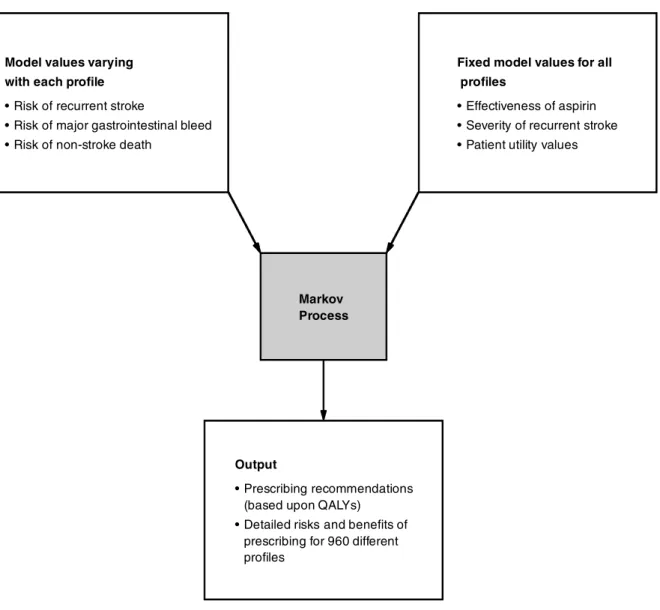
Figure 1 outlines the components of the decision model. Consistent with other studies, we modelled the prescribing decision for 12 months.16After this time period, users of the system could reassess the decision for patients in light of any changes to their profile, for example, age, risk factors.
The computerised decision support
system (CDSS)
Having generated a database of risk data for each patient profile, a practical CDSS was developed. This was designed to assist GP decision making and help facilitate GP–patient dialogue.
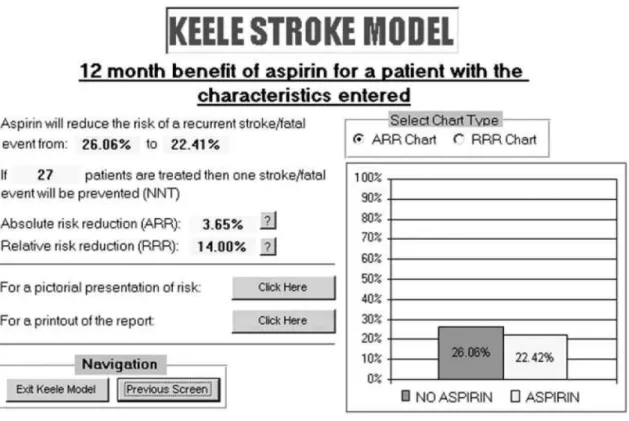
The system was developed as a self-executing file that could be distributed on a standard floppy disk or CD-ROM and installed as a desktop icon. The program offers GPs an initial screen from which they are required to select the desired patient profile from drop-down menus, such as diabetes (‘Yes’ or ‘No’). Having selected the profile, the user can then choose from multiple screen options for instant access to the information that they require. Options include a prescribing recommendation screen that gives a recommended course of action plus explicit risk and benefit information for the unique profile selected. Users can also choose screens with more detailed risk information, including the data presented in a variety of formats such as numerical, graphical or pictorial options (see Figure 2).
All stages of development were subject to an iterative consultation process. This included eliciting opinions on the model data generated, the CDSS design and its content. Those consulted included clin-icians from primary and secondary care, researchers with a specialist interest in stroke medicine and lay individuals.
Evaluation of the decision support
system
After approval from the local research ethics committee, a preliminary evaluation was conducted among 15 GPs from nine practices in North Staffordshire. The practices comprise a research network established by the Department of Medicines Management, Keele University. All 45 GPs from the network were invited to participate. Table 1 outlines the characteristics of the sample.
the CDSS and being allowed to familiarise themselves with the system. Participants were encouraged to take as long as they needed. One of the authors (DS) was present to answer any questions throughout the evaluation. On average, practitioners felt confident to use the system within five minutes. Each was then asked to complete a second questionnaire while having access to the system. Once completed, individuals were then interviewed by DS using a topic guide informed by a review of published studies and a pilot interview with a GP. The whole evaluation process lasted between 60 and 90 minutes.
The questionnaires explored GPs’ views about decision making. First, decision certainty in prescribing aspirin was examined by exploring GPs’ choice predis-position. Each questionnaire requested practitioners to consider the same ten prescribing scenarios. These described hypothetical stroke patients with com-plicating co-morbidity that could feasibly present in general practice. For each ‘vignette’, the GP was asked to indicate on a 15-point Likert scale how likely they
would be to prescribe aspirin. The scale was anchored by the options ‘yes aspirin’ and ‘no aspirin’, with ‘unsure’ at the midpoint. This was adapted from the Choice Predisposition scale developed by the Ottawa Health Research Institute.17
Nine vignettes were considered to be definite pro-aspirin cases according to the Royal College of Physicians’ National Guidelines for Stroke, while one included an absolute contraindication to prescribing. Decisions with clear optimum prescribing decisions according to national guidelines were used so that responses before and after having access to the model and its data could be compared against a definite outcome.
To further assess uncertainty, each questionnaire also explored GPs’ decision conflict and practitioners were asked to indicate their level of agreement with six statements. These were to be considered in the context of the decisions they had made about the ten vignettes. The statements were adapted from the Decision Conflict scale also developed by the Ottawa
Figure 1 Components of the decision model
Model values varying with each profile
Risk of recurrent stroke
Risk of major gastrointestinal bleed Risk of non-stroke death
Fixed model values for all profiles
Effectiveness of aspirin Severity of recurrent stroke Patient utility values
Output
Prescribing recommendations (based upon QALYs)
Detailed risks and benefits of prescribing for 960 different profiles
Health Research Institute. Responses were recorded on a five-point Likert scale from 1 (‘strongly disagree’) to 5 (‘strongly agree’). Both Ottawa scales were chosen as the basis of the data as they have high test–retest co-efficients, have been shown to be sensitive to change and have been tested in multiple clinical settings.17
Finally, to further examine any effect of the decision support system on decision making, practitioners were asked further purposive questions in the second questionnaire.
The final part of the evaluation was a qualitative interview. The topic guide developed by the authors served as a prompt for the interviewer to cover key
areas. These included perceived advantages and disadvantages of using the system in practice, barriers to use in a consultation, and the likelihood of use in a consultation for their own information and/or shared decision making with patients. All interviews were tape-recorded and transcribed verbatim with consent. Transcripts were analysed by all authors for major themes through an iterative process of comparison and evaluation. Each were revisited and revised as further data were gathered. Emergent themes were examined and their significance explored with practitioners.18,19
Results
Qualitative interview results
Detailed results of the qualitative interviews will be reported elsewhere. However, practitioners were very positive about the potential for the CDSS to address uncertainty among GPs. Comments ranged from the system’s ability to clarify risks to the provision of reassurance for GPs:
‘It is very reassuring to have the evidence in there . . . sometimes I wonder, is my opinion based upon evidence?’ GP11
‘I think [the CDSS] would be really helpful and I would feel on much firmer ground.’ GP09
Figure 2 One of the computerised decision support system’s risk information screens
Table 1 Characteristics of evaluation GPs
Gender:
male n=13
female n=2
Age (years) Mean 45
Range 34–59
GP principals n=15
Number of years practising Mean = 16 Range 6–34 Number of partners in Mean = 4
their practice Range 1–8
‘It is helpful in that it reminds me that the risk of stroke goes up substantially as you get older so your benefit increases.’ GP03
Practitioners also cited several other potential benefits of the system, including helping them to improve GP– patient dialogue and reinforcing their recommendation message to patients.
The applicability and acceptability of incorporating the system into a primary care consultation is para-mount to the value of such a tool. Again, this received positive feedback:
‘This is the kind of thing you would want to have in the consultation . . . you get immediate feedback on your [prescribing] concerns, you immediately get reassurance that this is the right course of action, and you can explain it to the patient . . . you can even print it off for them – a copy into the medical records, a copy to give to the patient so that they can study it further and show it to all their various relatives . . . I think it has a lot of potential.’ GP04
Almost all GPs also found the system very easy to use and to navigate through the data screens available:
‘You can pick it up in two minutes! Anyone who is computer literate.’ GP07
The time to access the system is another key issue when examining how well it can be incorporated into a consultation. As the system is almost instant to load and is immediately presented once the desktop icon is double-clicked, this was seen as a positive factor to its potential use:
‘You want them to come up in 20–30 seconds. That will . . . so you can do it mid-consultation.’ GP07
‘Compared to other ones it is quick. You don’t have a lot of time in consultations to plug in endless bits of data, but something like this you could do in a minute . . . I don’t think you can get any better than that and it is a lot better than any of the other ones that I have used. You are asking a specific question and you get the answer to your question in just a few mouse clicks.’ GP04
‘It’s quick enough definitely. The only people who would struggle are people who are unhappy at using a mouse.’ GP15
Furthermore, GPs liked the fact that the system could be stored as a desktop icon. This was regarded as a convenient source:
‘You haven’t got to load a floppy disk or a CD-ROM.’ GP01
Overall the interviewees regarded the system as something that they could use within consultations. However, several qualified their comments by expressing reservations about this being incorporated
into anyconsultation of anyGP. Issues such as prac-titioners needing basic information technology (IT) skills and both GPs and patients requiring an under-standing of simple risk concepts are necessary. Limita-tions to applicability of the system were therefore identified.
Practitioners further qualified the value of the sys-tem by stating that its potential lay with only certain stroke patients. Potential use in clarifying decision making for complex cases was one theme, while other GPs described value for consultations in which patients were unsure about taking aspirin:
‘If I had somebody who I was really unsure about, I would use it.’ GP10
‘I would use it for those patients who express some reservation about taking aspirin and where I am certain that they need it . . . It would be a tool to help the patient understand the risks and benefits. You often feel that you are giving patients advice to take aspirin and they say “yes”, but they go out of the door with no intention of taking the drug because of their preconceived ideas. So if you can help them overcome these misconceptions then future compliance will be easier hopefully.’ GP01
Quantitative results
Choice predisposition vignette scoring
Analysis of changes in the choice predisposition scores (that is, decision certainty) of the nine ‘pro-aspirin’ patient vignettes highlighted an improvement of decision certainty with the system in line with national guidelines. Across the nine vignettes there was an overall shift towards ‘yes aspirin’ of 116 points (1708 to 1824; maximum score = 2025) in the post-demonstration results. This suggests that decision making was made with greater certainty.
Decision conflict
Results suggest that access to the system reduced de-cision conflict for GPs (see Figure 3). Each statement was framed positively in terms of confidence in decision making and for all six there was a shift towards ‘strongly agree’ in the post-demonstration scores. Overall, in a five-point Likert scale, results shifted by 37 points over the six statements.
Due to the small sample size, statistical tests on the significance of the findings were not appropriate, but the suggestion is that access to the decision support system could have:
improved feelings that decisions were supported made decision making easier
improved the quality of decision making (feelings of making informed decisions)
increased satisfaction with decisions.
Purposive questioning
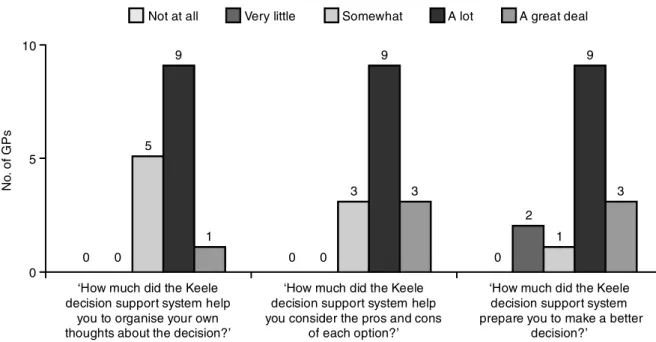
The additional questions included in the post-demonstration questionnaire only provided further indication that the CDSS had value in assisting GP decision making (see Figure 4).
Overall, for the GPs taking part in the evaluation, the majority were positive about its potential for general practice. Eighty percent (n=12) said that they would be ‘likely’ or ‘very likely’ to use it for their own information if it were available, while 80% (n=12) also said that they would be ‘likely’ or ‘very likely’ to use it to share information with patients. More than half of the GPs taking part in the evaluation (n=8) also thought that the system could improve con-cordance among patients ‘a lot’ or ‘a great deal’.
Figure 3 Decision conflict results (1 = Strongly disagree; 5 = Strongly agree)
0 1 3
2 4 5
‘I had enough information about
the options’
‘The decisions were easy for me to make’
‘I feel I knew the advantages and disadvantages of prescribing’
‘I am clear about how important the advantages of prescribing are compared to
the disadvantages’
‘I feel that I have made informed
decisions’
‘I am satisfied with my decisions’ 2
2.5 2.7 2.8 2.8
2.9
3.1 3.1 3.3 3.3 3.3 3.4
Pre-support system access (mean score) With support system access (mean score)
N
o.
o
f G
P
s
Figure 4 Post-demonstration purposive question results
0 0 5
9
1
0 0 3
9
3
0 2
1 9
3
0 5 10
‘How much did the Keele decision support system help
you to organise your own thoughts about the decision?’
‘How much did the Keele decision support system help you consider the pros and cons
of each option?’
‘How much did the Keele decision support system prepare you to make a better
decision?’ Not at all Very little
N
o.
o
f G
P
s
Discussion
This study has conducted a preliminary evaluation of a computerised decision support system developed for general practice. We used ‘patient profile decision analysis’ as a means of enhancing the evidence base available to clinicians and then designed the com-puterised interface to present a range of risk data in a variety of different styles to suit the user. The aim was to test the value of such an approach for general practice.
Our results were positive and suggest that synthesis-ing evidence in this way and framsynthesis-ing these results in a CDSS has value. This cannot offer the personalised information that a pure individualised decision analysis can, incorporating a patient’s own values, including utilities. However, this study indicates that in seeking a practical middle ground for time-pressured general practice, there may be a role for our approach of pre-calculating the findings of several profiles.
By predetermining the results of 960 profiles and developing a user-friendly support system interface, more patient-focused data than might otherwise be available can be drawn upon by the GP. Our evaluation suggests that this can clarify the risks and benefits of prescribing, assist GP–patient dialogue and promote shared decision making.
The positive results must nevertheless be context-ualised. First, the findings are based upon a study of 15 GPs. This number of evaluation subjects influences how the quantitative results can be interpreted and the results can only therefore be an indication of possible wider findings. The analysis that can be performed upon data with such small numbers is very limited, and this has been limited to descriptive tests. More detailed evaluations involving greater numbers of practitioners and also patients are necessary.
Secondly, potential bias arising from the individual characteristics of subjects is particularly important to recognise in evaluations with small numbers. A dif-ferent demographic sample could significantly change the scores and perspectives of the subjects, and this must be acknowledged. For example, the data were collected from GPs who were frequent users of IT in primary care. The results may therefore not reflect practitioners unfamiliar with computers and decision support systems. The evaluation would have benefited by the inclusion of some GPs with less exposure to IT. One further limitation of the evaluation method-ology is that decision making for hypothetical vignettes may not accurately reflect decision making for ‘real’ patients. Steps were taken to make the vignettes as real as possible. No attempts were made to restrict the vignette characteristics to the factors covered by the model, and specific complicating areas were included that were expected to highlight the
profile limitations of the system. This was thought the most appropriate way of mimicking ‘real practice’ and uncertainty that a GP with the system may encounter. Any interpretation of the findings of the evaluation is therefore limited, but the results to date are positive. The evaluation was only an initial phase to test the applicability and acceptability of such a system among a limited number of GPs. Greater numbers of clin-icians would be required to complete the evaluation and the patient perspective is an essential viewpoint that must also be incorporated.
The patient profile decision analysis approach may have potential for primary care, especially in provid-ing risk data. However, one concern of our approach is that we have relied upon the use of generic utility values rather than those of an individual patient when calculating a recommendation. Models in which utility values are sensitive would make it extremely difficult to make such a recommendation with any certainty. In our case this was less of a concern as sensitivity analysis on the QALYs revealed the values to be robust.
Conclusions
This study has demonstrated a means of incor-porating some of the advantages of decision analysis into a time-pressured general practice consultation that has the potential for wider application. By with-drawing the practical modelling phase from a con-sultation and replacing it with predetermined calculations in a user-friendly format, many of the advantages of the methodology can be retained. New information can then be made available to general practice to inform decision makers.
REFERENCES
1 Dowie J. The research–practice gap and the role of decision analysis in closing it.Health Care Analysis1996;4:5–18.
2 Thornton JG and Lilford RJ. Decision analysis for medical managers. British Medical Journal 1995;310: 791–4.
3 Elwyn G, Edwards A, Eccles M and Rovner D. Decision analysis in patient care.Lancet2001;358:571–4.
4 Haynes RB, Sackett DL, Muir A et al. Transferring evidence from research into practice. 1: the role of clinical care research evidence in clinical decisions. Evidence-based Medicine1996;1:196–8.
5 Littenberg B and Sox HC. Evaluating individualized medical decision analysis.American Journal of Medicine 1988;84:289–90.
health survey population.British Medical Journal2000; 320:671–6 (erratum British Medical Journal2000;320:1034). 7 Royal College of Physicians.National Clinical Guidelines for Stroke. www.rcplondon.ac.uk/pu bs/books/stroke / index.htm (accessed 06/03/03).
8 American Heart Association website:www.americanheart. org/presenter.jhtml?identifier=4456 (accessed 06/03/03). 9 Scottish Intercollegiate Guidelines Network (SIGN). Antithrombotic Therapy: a national clinical guideline. SIGN publications number 36. March 1999.
10 McCallum AK, Whincup PH, Morris RW et al. Aspirin use in middle-aged men with cardiovascular disease: are opportunities being missed? British Journal of General Practice1997;47:417–21.
11 Antiplatelet Triallists’ Collaboration. Collaborative overview of randomised trials of antiplatelet therapy. 1: prevention of death, myocardial infarction, and stroke by prolonged antiplatelet therapy in various categories of patients.British Medical Journal1994;308:81–106.
12 Department of Health.National Service Framework for Coronary Heart Disease. London: HMSO, 2000.www. doh.gov.uk/nsf/nsfhome.htm
13 Smithard DG. The NSF and GP management of stroke.
Geriatric Medicine2002;3:61–5.
14 Welton M, Croft P and Welton J. General practitioners’ use of aspirin in the secondary prevention of vascular events: knowledge, attitudes, and current practice.British Journal of General Practice 1999;49:607–10.
15 Garcia Rodriguez LA and Pérez Gutthann S. Use of the UK General Practice Research Database for pharmaco-epidemiology. British Journal of Clinical Pharmacology 1998;45:419–25.
16 Thomson R, Robinson A, Greenaway J et al. Development and description of a decision analysis-based decision support tool for stroke prevention in atrial fibrillation.
Quality and Safety in Health Care2002;11:25–31.
17 Ottawa Health Research Institute website ‘Evaluation Measures’:www.ohri.ca/programs/clinical_epidemiology/ OHDEC/measures.asp (accessed 06/03/03).
18 Gilbert N. Researching Social Life. London: Sage Publications, 1995.
19 Miles MB and Huberman AM.Qualitative Data Analysis: an expanded sourcebook. London: Sage Publications, 1994.
CONFLICTS OF INTERESTS
None.
FUNDING
This project was funded by the Department of Medicines Management, Keele University.
ADDRESS FOR CORRESPONDENCE
Dr Duncan Short
Department of Medicines Management University of Keele
Keele
Staffordshire ST5 5BG UK
Tel: +44 (0)1782 584136 Fax: +44 (0)1782 713586
Email: [email protected]