Predictors of Parent Responsiveness to 1-Year-Olds At-Risk for
Autism Spectrum Disorder
Jessica L. Kinard1,3, John Sideris2, Linda R. Watson3,4, Grace T. Baranek3,4, Elizabeth R. Crais3,4, Linn Wakeford3,4, and Lauren Turner-Brown3,5
1Carolina Institute for Developmental Disabilities, The University of North Carolina at Chapel Hill,
Chapel Hill, NC, USA
2Frank Porter Graham Child Development Institute, The University of North Carolina at Chapel
Hill, Chapel Hill, NC, USA
3Program for Early Autism Research, Leadership, and Service, The University of North Carolina
at Chapel Hill, Chapel Hill, NC, USA
4Department of Allied Health Sciences, The University of North Carolina at Chapel Hill, Chapel
Hill, NC, USA
5Department of Psychiatry, The University of North Carolina at Chapel Hill, Chapel Hill, NC, USA
Abstract
Parent responsiveness is critical for child development of cognition, social-communication, and self-regulation. Parents tend to respond more frequently when children at-risk for autism spectrum disorder (ASD) demonstrate stronger social-communication; however, it is unclear how
responsiveness is associated with sensory characteristics of children at-risk for ASD. To address this issue, we examined the extent to which child social-communication and sensory reactivity patterns (i.e., hyper- and hypo-reactivity) predicted parent responsiveness to 1-year-olds at-risk for ASD in a community sample of 97 parent-infant pairs. A combination of child
social-communication and sensory hypo-reactivity consistently predicted how parents played and talked
Correspondence concerning this article should be addressed to Jessica Kinard, Carolina Institute for Developmental Disabilities, the University of North Carolina at Chapel Hill, Campus Box #7255, Chapel Hill, NC 27599-7255, 919) 386-9602,
Conflict of Interest: The authors declare that they have no conflict of interest.
Ethical approval: All procedures performed involving human participants were in accordance with the ethical standards of the
Institutional Review Board of the University of North Carolina at Chapel Hill and with the 1964 Helsinki declaration and its later amendments.
Informed consent: Informed consent was obtained from all individual participants included in the study.
Authors’ Contributions
JLK coordinated data acquisition for parent interaction variables and contributed to data interpretation and drafting the manuscript. JS participated in the design of the study, performed statistical analyses, and contributed to drafting the manuscript. LRW served as principal investigator for the study, participating in study conceptualization, design and coordination; data acquisition, analysis, and interpretation; and drafting the manuscript. GTB participated in study conceptualization and design; assessor training and data interpretation; and drafting the manuscript. ERC served as co-principal investigator, with contributions to study conceptualization, design and coordination; assessor training, data acquisition and interpretation; and drafting the manuscript. LW participated in data acquisition and interpretation and drafting the manuscript. LTB participated in study conceptualization and design; assessor training,
HHS Public Access
Author manuscript
J Autism Dev Disord
. Author manuscript; available in PMC 2018 January 01. Published in final edited form as:J Autism Dev Disord. 2017 January ; 47(1): 172–186. doi:10.1007/s10803-016-2944-9.
A
uthor Man
uscr
ipt
A
uthor Man
uscr
ipt
A
uthor Man
uscr
ipt
A
uthor Man
uscr
with their 1-year-old at-risk for ASD. Parents tended to talk less and use more play actions when infants communicated less and demonstrated stronger hypo-reactivity.
Keywords
Infants at-risk for autism spectrum disorder (ASD); sensory reactivity patterns; social-communication; parent responsiveness
Parent responsiveness is critical to child development in areas of cognition, communication, and self-regulation, according to investigations of parent-child relationships (Bornstein & Tamis-LeMonda, 1989; Eshel, Daelmans, Mello, & Martines, 2006; Tamis-Lemonda, Bornstein, Kahana-Kalman, Baumwell, & Cyphers, 1998). Based on these studies, researchers have investigated the impact of interventions to increase parent responsiveness on improving outcomes of children with developmental delays (Carter et al., 2011; Green et al., 2015; Greenspan & Wieder, 1997; Karaaslan, Diken, & Mahoney, 2013; Landry, Smith, & Swank, 2006; Siller, Hutman, & Sigman, 2013). These intervention approaches are founded on three empirically-supported ideas: (a) parents influence what and how their children learn; (b) parents can be taught to use that influence in an intentional way (i.e., increasing their responsiveness) to help their child learn; and (c) as a result of the change in parental behavior, the child will develop key skills that will prevent or eliminate the effects of the developmental delay (Landry et al., 2006; Landry, Smith, Swank, & Guttentag, 2008; Mahoney, Perales, Wiggers, & Herman, 2006).
A population that may particularly benefit from parent-responsiveness interventions is children with autism spectrum disorder (ASD). Children with or at-risk for ASD
demonstrate inherent difficulties with two domains: social-communication and restricted, repetitive patterns of behavior, which currently include unusual sensory characteristics (APA, 2013). High levels of parent responsiveness have been linked with child social-communication outcomes in typically developing children (Landry, Smith, Swank, Assel, & Vellet, 2001; Tamis-LeMonda, Bornstein, & Baumwell, 2001), as well as children with ASD (Siller & Sigman, 2002, 2008). Some studies of early parent-mediated interventions have found promising results of targeting parent responsiveness as a way of improving the social-communication of children with or at-risk for ASD (e.g., Baranek et al., 2015; Carter et al., 2011; Green et al., 2015; Karaaslan et al., 2013; Kasari et al., 2014; Siller et al., 2013).
In considering the relationships between parent responsiveness and child social-communication, transactional perspectives may be useful. The Transactional Model of Development posits that there is a bidirectional relationship between parent responsiveness and children’s social-communication outcomes (Fiese & Sameroff, 1989; Sameroff, 2009; Sameroff & Mackenzie, 2003). Children who clearly communicate their interests elicit responses from those in their environment (Abraham, Crais, & Vernon-Feagans, 2013; Leezenbaum, Campbell, Butler, & Iverson, 2014; Wu & Gros-Louis, 2015), demonstrating a skill known as “joint attention,” or the ability to communicate interests with another person or respond to another person’s interests, simply because of a desire to share the experience (Mundy et al., 2007). A child with joint attention skills could point at an airplane, prompting the mother to say, “Airplane!”, a response that continues to strengthen the child’s
A
uthor Man
uscr
ipt
A
uthor Man
uscr
ipt
A
uthor Man
uscr
ipt
A
uthor Man
uscr
communication learning (Leezenbaum et al., 2014). In contrast, children with ASD demonstrate inherent difficulties with joint attention (Adamson, Bakeman, Deckner, & Romski, 2009; Paparella, 2011; Watson et al., 2013). If the child fails to initiate joint attention, caregivers might have difficulty recognizing the child’s focus, and so may not provide the same types of social and linguistic reinforcement as if the child had initiated communication. In addition, if the child fails to follow others’ bids for joint attention (also common for children with ASD), the child misses the opportunity to learn the word (e.g., “airplane”) that the parent is emphasizing. The idea behind parent-responsiveness
interventions for this population, then, is to teach parents to recognize their child’s focus of attention, even if the signs are subtle, and react in a highly responsive way, as well as help them teach their children to be more responsive to the parents’ bids.
Overview of Parent Responsiveness
Researchers have established varying definitions of “parent responsiveness” depending on the underlying assumptions of their investigations. Despite these differences, the following eight characteristics are commonly included: (1) sensitivity, or demonstrating awareness of the child’s current interest (e.g., Fish, 2001; Mahoney, 1999; Raval et al., 2001); (2) contingency, or responding in a meaningful way to the child’s focus of attention (Landry et al., 2006; Mahoney & Perales, 2003); (3) offering encouragement and support to the child; (4) demonstrating similar interests, difficulty levels, or pace as the child (Landry et al., 2001; Mahoney & Perales, 2003; Mahoney & Perales, 2005); (5) displaying physical affection (Bornstein et al., 1992; Landry et al., 2001; Richman, Miller, & LeVine, 1992); (6) quality of language input, including verbal scaffolding and verbal encouragement (Landry et al., 2008); (7) reciprocity, or encouraging back-and-forth interactions (Mahoney & Perales, 2003; Mahoney & Perales, 2005); and (8) shared control, or giving the child opportunities to control the interaction (Mahoney & Perales, 2003; Mahoney & Perales, 2005). This
construct of responsiveness may also be defined by what it does not include, such as power assertion, redirections, intrusion, restrictiveness, and/or harsh vocal tone (Fish, 2001; Landry et al., 2001; Masur, Flynn, & Eichorst, 2005). In essence, “parent responsiveness” is defined by quick, meaningful, and positive responses to a child, based on the child’s current focus of attention.
Following transactional tenets, a parent may respond differently to his/her child depending on the child’s characteristics. Child factors that may influence parent responsiveness include: (a) communication skills (Abraham et al., 2013; Tamis-LeMonda et al., 2001); (b) play skills (Flippin & Watson, 2011; Tamis-LeMonda et al., 2001); (c) temperament (Crockenberg, Leerkes, & Barrig Jo, 2008); and (d) the presence of or risk for a disability (Leezenbaum et al., 2014; Siller & Sigman, 2008).
Depending on the child’s developmental level, parents may provide different kinds of responses to their child’s communication. Parents tend to respond more frequently to (a) consonant-vowel utterances at 9 months of age, as opposed to vowel-only utterances, regardless of whether the child has high- or low-risk for ASD based on family history (Talbott, Nelson, & Tager-Flusberg, 2015); and (b) pointing and showing gestures at 13 months of age, as opposed to giving and requesting gestures, when the child is at low-risk
A
uthor Man
uscr
ipt
A
uthor Man
uscr
ipt
A
uthor Man
uscr
ipt
A
uthor Man
uscr
for developing ASD based on family history (Leezenbaum et al., 2014), and particularly when the child is moving while gesturing (i.e., walking or crawling) (Karasik, Tamis-Lemonda, & Adolph, 2014). When both gestures and vocalizations are considered in typically developing 12-month-olds, parents are more likely to respond to pointing than vocalizations (Wu & Gros-Louis, 2015).
Child sensory processing and regulatory disorders also have the potential to influence parent responsiveness (DeGangi, Sickel, Piserchia Kaplan, & Santman Wiener, 1997; Jaegermann & Klein, 2010), although this association has not been studied specifically in children with or at-risk for ASD. Atypical sensory features may include patterns of hypo-reactivity (child has attenuated or delayed response to sensory stimuli) and/or hyper-reactivity (child avoids or has aversive responses to sensory stimuli) (Ausderau et al., 2014). Compared to typically developing infants without sensory difficulties, infants with tactile hyper-reactivity are noted to display a variety of behaviors (e.g., less affect, less tactile exploration, less responsiveness to their mothers, and increased aggression and distress) that may make parent-child
interactions difficult (DeGangi et al., 1997). In turn, mothers of these infants tend to communicate from farther away, using words more often than gestures and touch, and demonstrate difficulties responding contingently to their infant’s cues (DeGangi et al., 1997). Mothers of 1-year-olds with sensory processing disorder (SPD) have also shown difficulties synchronizing their responses to their child’s leads when compared to mothers of children with SPD enrolled in a responsiveness intervention, a difficulty that may increase over time (Jaegermann & Klein, 2010). Sensory hyper-reactivity in children with ASD also may be related to anxiety (Green, Ben-Sasson, Soto, & Carter, 2012), repetitive behaviors (Boyd et al., 2010), and other problem behaviors that could similarly affect changes in parenting style.
As opposed to hyper-reactivity, the reciprocal effects of child sensory hypo-reactivity and parent responsiveness have not been studied directly. Sensory hypo-reactivity in children with ASD is related to a variety of characteristics that, theoretically, could make parent-child interactions difficult. For example, hypo-reactivity in young children with ASD has been associated with deficits in joint attention (Baranek et al., 2013), reduced
social-communication and language skills (Patten, Ausderau, Watson, & Baranek, 2013; Watson et al., 2011), and less adaptability (Brock et al., 2012). Hypo-reactivity is noted to be an early developing pattern in infants at-risk for a later diagnosis of ASD, and is maintained over time (Freuler, Baranek, Watson, Boyd, & Bulluck, 2012). In summary, child characteristics, such as communication styles and sensory reactivity patterns, have the potential to influence the ways in which parents respond to their children. Below, we examine literature about parent responsiveness and ASD, specifically, due to the association of responsiveness with later child outcomes.
Responsiveness and ASD
Research indicates that parents of children with or at-risk for ASD (i.e., siblings of a child with ASD) demonstrate similar levels of responsiveness (Leezenbaum et al., 2014; Siller & Sigman, 2002; Talbott et al., 2015; Watson, 1998) and types of responses as parents of typically developing children (Talbott et al., 2015). However, parents of children with or
at-A
uthor Man
uscr
ipt
A
uthor Man
uscr
ipt
A
uthor Man
uscr
ipt
A
uthor Man
uscr
risk for ASD tend to have fewer opportunities to respond (Leezenbaum et al., 2014). For example, when infants show or point to objects, parents often “translate” the child’s gesture into an object name (Leezenbaum et al., 2014; Wu & Gros-Louis, 2015). However, infant siblings at-risk for ASD tend to point to and show objects less frequently than low-risk infants, providing fewer opportunities for this verbal input (Leezenbaum et al., 2014). Thus, children with or at-risk for ASD may benefit from particularly intense or tailored levels of parent responsiveness when compared with typically developing children, due to inherent difficulties with social-communication and/or difficulties with self-regulatory behaviors (Siller & Sigman, 2002). The parent’s prompt, contingent response to the child’s focus of attention may be key to the successful completion of the parent-child communication loop and to the child’s ability to learn from the interaction (LeMonda et al., 2001; Tamis-Lemonda et al., 1998).
Recognizing the opportunities provided within the parent-child relationship, researchers have developed relationship-based early interventions for children with ASD that are either completely parent-mediated or include a parent-mediated component (Carter et al., 2011; Dawson et al., 2010; Green et al., 2015; Kasari, Gulsrud, Wong, Kwon, & Locke, 2010; Kasari et al., 2014; Mahoney & Perales, 2005; Siller et al., 2013; Venker, McDuffie, Ellis Weismer, & Abbeduto, 2012; Yoder & Stone, 2006a). In these relationship-based
approaches, interventionists coach parents to be highly responsive to their children, so that parent behaviors encourage child development in a variety of domains. Studies of these intervention approaches have reported complex findings, but a number of relationship-based intervention programs have resulted in positive effects on parent responsiveness and/or child pivotal behaviors in social-communication (e.g., Baranek et al., 2015; Carter et al., 2011; Green et al., 2015; Karaaslan et al., 2013; Mahoney & Perales, 2005; Siller et al., 2013; Venker et al., 2012; Wetherby et al., 2014). To our knowledge, two studies have also examined parent-responsiveness interventions specifically targeting sensory-regulation in 1-year-olds at-risk for ASD (Baranek et al., 2015) and 1-1-year-olds with SPD (Jaegermann & Klein, 2010). The findings from these studies suggest that parent-responsiveness
interventions targeting sensory-regulation can be beneficial for parent-child interactions, both for reducing parent directiveness and child sensory hypo-reactivity (Baranek et al., 2015), and for improving parent responsiveness (Jaegermann & Klein, 2010)
Not surprisingly, studies have found that both parent and child characteristics play a role in intervention success. As examples of moderated treatment effects, children with ASD who demonstrated low initial object interest (Carter et al., 2011) and low initial expressive language skills (Siller et al., 2013) demonstrated more positive communication outcomes after participating in parent-responsiveness interventions than did children with ASD who had higher object interest or expressive language skills. Additionally, parents who demonstrated high initial levels of insightfulness (i.e., the ability to interpret the child’s intentions and feelings) became more responsive after participating in parent-mediated programs than did parents with lower levels of insightfulness (Siller et al., 2013).
These findings reflect the importance of considering pre-treatment characteristics of both children and parents in order to optimize intervention success. Many early intervention programs exist for children with ASD, requiring interventionists and families to make
A
uthor Man
uscr
ipt
A
uthor Man
uscr
ipt
A
uthor Man
uscr
ipt
A
uthor Man
uscr
decisions about which program would be of greatest benefit to a particular family and child, and which behaviors and strategies to target. It is important to determine which factors could potentially play a role in intervention success.
The purpose of this study was to explore possible predictors of baseline levels of parent responsiveness in a sample of parents and their toddlers at-risk for ASD, prior to their taking part in a relationship-based, parent-mediated intervention. Expanding on the research reviewed above, we examined the extent to which initial child social-communication and sensory reactivity patterns (i.e., hyper-/hypo-reactivity) predicted initial parent
responsiveness before families began the intervention. Changes in child capacities and parental responsiveness as a result of intervention will be reported elsewhere; however, the current study lays a foundation for understanding how child and parent outcomes may be related to the child’s baseline or “pre-intervention” characteristics, and the extent to which pre-intervention factors may assist matching families to appropriate interventions.
In addition to examining pre-intervention characteristics, the current study makes a unique contribution to the early intervention literature by studying infants identified as at-risk for ASD based on a community screening. Thus, this study will provide insight on how child social-communication and sensory regulatory skills are associated with parent
responsiveness, when infants have only recently been identified as at-risk for ASD.
Methods
This study was approved by the Institutional Review Board at the University of North Carolina at Chapel Hill. Data were drawn from a randomized controlled trial (RCT) comparing an early parent-mediated intervention (i.e., Adapted Responsive Teaching; Baranek et al., 2015) to community-based early intervention services for infants identified as at-risk for ASD through a community screening. The current study examines data collected at study entry on participants who met eligibility criteria for the RCT.
Participants
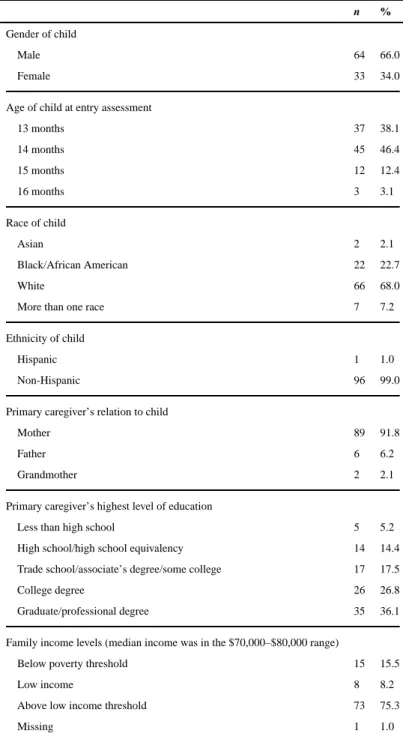
The sample included 97 infants who met criteria for being at high risk for an eventual diagnosis of ASD, based on their parents’ responses to the First Year Inventory 2.0 (FYI; Baranek, Watson, Crais, & Reznick, 2003) when the children were 12 months of age. The FYI is described in detail below. An additional inclusion requirement was that a primary caregiver of the infant would be willing to participate in the study. Infants with severe physical impairment, hearing or vision impairments, birth weight ≤ 2500 grams, or who lived in homes where English was spoken less than 50% of the time were excluded. Demographic information on the sample is summarized in Table 1.
Because these infants were identified in a community screening, most of them were not at known genetic risk for ASD; however, 8 infants (8.2% of the sample) disclosed that they had a first-degree relative with ASD. At the time of recruitment, 40 of the infants were the only children in their family; 2 infants had a younger sibling; and 55 had one or more older siblings.
A
uthor Man
uscr
ipt
A
uthor Man
uscr
ipt
A
uthor Man
uscr
ipt
A
uthor Man
uscr
Measures
Our measures included a screening tool to identify infants at-risk for ASD, and measures of general development, social-communication, sensory-regulatory functioning, and early ASD symptoms. Each is described below.
First Year Inventory 2.0 (FYI; Baranek et al., 2003). The FYI is a 63-item parent-report screening tool designed to identify infants-at-risk for autism at 12 months of age (Reznick, Baranek, Reavis, Watson, & Crais, 2007). The items are distributed across two primary domains: social-communication and sensory-regulatory functions. This screening tool was used to identify infants eligible for the study. Algorithm cut-offs on both function domains were used to determine the children at highest risk for autism. Based on previous research, risk score cut-offs were set at the 94th percentile for the social-communication domain and at the 88th percentile for the sensory-regulatory functions domain (Turner-Brown, Baranek, Reznick, Watson, & Crais, 2013). In this prior research, 31% of children who met these dual risk criteria on the FYI went on to be diagnosed with ASD at age three years, and 85% of children who met FYI risk criteria exhibited some type of developmental concerns at age three years (Turner-Brown et al., 2013). Thus, the likelihood a child enrolled would develop ASD was higher than if we worked with a familial at-risk sample (i.e., infant siblings of children with ASD), where risk of ASD would be around 20% (Ozonoff et al., 2011).
The Mullen Scales of Early Learning (MSEL; Mullen, 1995). As part of the larger study, we used 4 scales of the MSEL to assess the infants’ development (Receptive Language, Expressive Language, Fine Motor, and Visual Reception). Each of these scales yields a standardized T-score with a mean of 50 and a standard deviation of 10. We used the Visual Reception T-score in our current analysis as a measure of child nonverbal cognitive level.
The Communication and Symbolic Behavior Scales-Developmental Profile (CSBS; Wetherby & Prizant, 2002) is a standardized, norm-referenced instrument used to assess early social-communication and symbolic behaviors of children between 6 and 24 months of age. The CSBS-DP includes seven categories: emotion and eye gaze, communication, gestures, sounds, words, understanding, and object use. The total composite standard scores from both the CSBS Caregiver Questionnaire (CSBS-DP-CQ) and CSBS Behavior Sample (CSBS-DP-BS) were used in this study; each has a mean of 100 and a standard deviation of 15.
The Sensory Experiences Questionnaire (SEQ; Baranek, 1999a; Baranek, David, Poe, Stone, & Watson, 2006) is a 43-item questionnaire for children 6 months to 6 years that measures responses to various sensory stimuli in the context of daily activities. Scores for HYPO and HYPER are compatible with the conceptual model of the SPA (described below), and were used in this study. The internal consistency is acceptable (Cronbach’s α = .80). It
discriminates patterns unique to ASD and is sensitive to maturational changes. A score of 1 indicated that the child “almost never” demonstrated a behavior, and a score of 5 indicated that the child “almost always” demonstrated a behavior. The SEQ HYPO and HYPER raw scores were the sum of all item level scores in each scale. We used the HYPO and HYPER mean scores for each child as an index of hypo- and hyper-reactivity (i.e., raw score divided by the number of items in each scale). Note that both the SPA and SEQ use the terms
A
uthor Man
uscr
ipt
A
uthor Man
uscr
ipt
A
uthor Man
uscr
ipt
A
uthor Man
uscr
responsiveness” and “hypo-responsiveness” for these variables, but the terms “hyper-reactivity” and “hypo-“hyper-reactivity” are being used throughout this paper to avoid confusion with the parent responsiveness variables.
The Sensory Processing Assessment for Young Children (SPA; Baranek, 1999b; Baranek, Boyd, Poe, David, & Watson, 2007) is a play-based assessment that measures approach-avoidance to novel sensory toys, sensory seeking behaviors, and orienting responses across three sensory modalities (tactile, visual, auditory), and is sensitive to maturational changes. It has good inter-rater reliability (ICC = .91 to .99 for different scales), and discriminates different patterns of sensory reactivity between children with ASD and children with other developmental disabilities. Item scores ranged from 0 to 2, but were transformed to a 1 to 5 scale to be consistent with the SEQ. The SPA hypo-responsiveness (HYPO) and hyper-responsiveness (HYPER) raw scores were the sum of all item level scores in each scale. We used the HYPO and HYPER mean scores for each child as an index of sensory hypo- and hyper-reactivity (i.e., raw score divided by the number of items in each scale).
The Autism Observation Scale for Infants (AOSI; Zwaigenbaum et al., 2005) was used as a descriptive measure of observed ASD symptoms. Systematic presses are used during semi-structured play with infants to assess target behaviors. An index of ASD symptom severity was calculated from a total of 18 markers. As a point of reference, seven or more total markers is the recommended cut-off for identifying infants at-risk for ASD with the AOSI (Zwaigenbaum et al., 2005).
Staff completed Free Play Responsiveness Coding of 10-minute free-play sessions. This coding system was adapted from the “Partial Interval Time Sampling of Adaptive Strategies for the Useful Speech Project” (Yoder et al., 2010). For this assessment, we video-recorded the parent playing with his/her child for 10-minutes using a standard set of toys. Parents were told to play with their child as they typically would, and were left alone to play. Trained coders viewed the videos in 5-second intervals, coding for the following behaviors/ traits in each interval: (a) “codability” of the interval (i.e., the child and parent were clearly on screen); (b) “child lead” (i.e., the child demonstrated attention to a referent by looking at and/or touching the reference); and (c) “parent response” (i.e., the parent responded to the child’s lead).
Child leads could be either “child-initiated” (i.e., the child spontaneously demonstrated interest in a referent) or “child-adopted” (i.e., the child demonstrated sustained interest in a referent after the parent introduced it). Child-adopted leads could only be counted after the child focused on the parent’s referent for at least two consecutive intervals. To be considered responsive, parents could respond to a child lead in two ways: (a) by making a “follow-in utterance” (i.e., talking about the child’s focus of attention); and/or (b) by performing a “physical play act” (i.e., playing with the child’s focus of attention). Follow-in utterances could be either non-directive (i.e., the parent commented on the child’s focus of attention, but did not encourage him/her to do anything differently) or directive (i.e., the parent gave instructions related to the child’s focus of attention). Physical play acts included helping the child with an action, imitating the child’s action, or demonstrating a new action (either with the child’s referent or a related referent).
A
uthor Man
uscr
ipt
A
uthor Man
uscr
ipt
A
uthor Man
uscr
ipt
A
uthor Man
uscr
The total intervals that included one or more types of caregiver responsive strategies were used as the index of caregiver responsiveness derived from the Free Play Responsiveness Coding. The scores were calculated as follow: number of intervals with one or more responses, divided by number of codable intervals, and multiplied by 100 to create a percentage (i.e., [# intervals with response/# codable intervals] * 100). The following types of scores were calculated: total parent responsiveness (i.e., percentage of codable intervals with follow-in and/or physical play responses); total follow-in utterances (i.e., percentage of codable intervals with follow-in utterances or a combination of follow-in utterances and physical play acts); single follow-in utterances (i.e., percentage of codable intervals with follow-in utterances, but not physical play acts); total physical play acts (i.e., percentage of codable intervals with physical play acts or a combination of physical play acts and follow-in utterances); and sfollow-ingle physical play acts (i.e., percentage of codable follow-intervals with physical play acts, but not follow-in utterances). Parent responsiveness has been coded reliably using variations of this coding system in multiple studies (e.g., Carter et al., 2011; Warren, Fey, & Yoder, 2005; Yoder & Stone, 2006b; Yoder, Watson, & Lambert, 2015).
Procedures
We recruited participants by mailing the FYI to parents in a 6-county catchment area two weeks prior to their infants’ first birthdays, based on birth records. We did not mail to Hispanic families (self-identified on birth records) due to the large proportion of these families in our catchment area who are recent immigrants speaking primarily Spanish at home, coupled with limitations in our ability to obtain valid assessment data in Spanish. In addition, mailings were restricted to families of infants weighing >2500 grams at birth. A total of 61,437 FYIs were mailed to families, distributed across 37 months. A total of 8,717 FYIs were returned. Of the returned FYIs, 280 infants scored at or above the ASD risk threshold. Of these families, 109 declined participation, 74 were ineligible to participate, and 97 completed the entry assessment.
Assessments were provided in clinics located in each of three cities within our catchment area to minimize travel for families. Each clinic in which our staff conducted assessments specialized in services to young children; the environments were child- and family-friendly. The assessment team videotaped all child observational assessments. Families received an incentive payment of $35 for the entry assessment, and also were reimbursed for their travel costs to and from the assessment.
Data Analysis
Our aim was to determine predictors of parent responsiveness at the entry assessment, before families were randomized and began participating in the intervention phase of the study. We first computed descriptive statistics. To address our primary aim, we then ran hierarchical regression models with parent responsiveness at the entry assessment as the dependent variable, and child behaviors at the entry assessment as independent variables. In this context, “hierarchical” refers to the use of a planned series of models to assess changes in the explanatory power of the model as predictors are added. This method is similar to stepwise regression, with the exception that the changes at each step are theory-based and
A
uthor Man
uscr
ipt
A
uthor Man
uscr
ipt
A
uthor Man
uscr
ipt
A
uthor Man
uscr
determined a priori rather than being data driven and determined by atheoretical addition of variables simply to maximize power at each step. The hierarchical regression models examined the extent to which communication and sensory reactivity variables predicted parent responsiveness, and whether these relationships varied when measured by clinician observation or parent report. We examined the following regression models: (a) the extent to which child communication alone predicted parent responsiveness; (b) the extent to which child communication and nonverbal cognitive level predicted parent responsiveness; and (c) the extent to which child communication and sensory reactivity patterns predicted parent responsiveness.
The dependent variables included the following: (a) total parent responsiveness (i.e., all follow-in responses and play responses); (b) total follow-in responses (i.e., parents talked without playing or talked and played simultaneously); (c) total play responses (i.e., parents played without talking or played and talked simultaneously); (d) single follow-in responses (i.e., parents talked without playing); and (e) single play responses (i.e., parents played without talking). The independent variables included: (a) child communication, as measured by the CSBS-DP-BS or CSBS-DP-CQ total standard score; (b) nonverbal cognitive level, as measured by the Visual Reception T-score of the MSEL; (c) HYPO, as measured by the SPA or SEQ; and (d) HYPER, as measured by the SPA or SEQ. We ran two sets of models. In the first set, we used parent report measures of child communication (CSBS-DP-CQ) and sensory reactivity (SEQ) as independent variables. In the second set of models, we used clinician-administered measures of child communication (CSBS-DP-BS) and sensory reactivity (SPA) as independent variables. We chose to include the CSBS as our
communication measure, as opposed to the MSEL Expressive and Receptive Language T-scores, because the CSBS includes both clinician observation and parent report versions, whereas the MSEL is only collected via clinician observation and does not have a
corresponding parent report measure. We included the MSEL Visual Reception T-score (as measured by clinician observation) in both sets of models, because we did not have a parent report counterpart for nonverbal cognitive level. By running two sets of models, we could examine the extent to which our findings in the first set of models (i.e., clinician
observation) were replicated in the second set (i.e., parent report).
Results
Unless otherwise stated, statistical analyses were completed with SAS, version 9.3 (SAS Institute, 2011).
Reliability of Free Play Responsiveness Coding
R version 3.2.1 was used to complete reliability analyses for the Free Play Responsiveness Coding, using the “irr” package (The R Foundation for Statistical Computing, 2015). Intraclass correlation coefficients (ICCs) were calculated for 18% of the coded
pre-intervention videos, and were as follows: (a) codable intervals: ICC(20,21)=0.97, p <0.001; (b) child leads: ICC(20,21)=0.71, p <0.001; (c) total parent responses: ICC(20,21)=0.87, p<0.001; (d) total follow-in responses: ICC(20,21)=0.93, p<0.001; (e) total play responses:
A
uthor Man
uscr
ipt
A
uthor Man
uscr
ipt
A
uthor Man
uscr
ipt
A
uthor Man
uscr
ICC(20,21)=0.86, p<0.001; (f) single follow-in responses: ICC(20,21)=0.89, p <0.001; and (g) single play responses: ICC(20,21)=0.92, p<0.001.
Descriptive Statistics
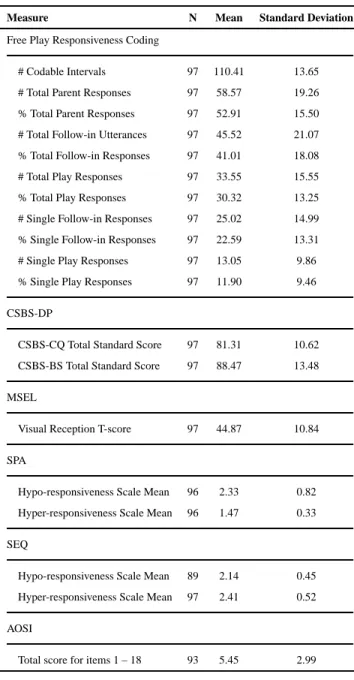
Descriptive statistics for the variables are provided in Table 2.
Hierarchical Regression Models
Hierarchical regression models were conducted to examine the dependent variables as possible predictors of parent responsiveness variables. The baseline regression model included only child communication as a predictor of parent responsiveness variables, due to replicated previous findings indicating associations between these two variables (Abraham et al., 2013; Leezenbaum et al., 2014; Talbott et al., 2015; Tamis-LeMonda et al., 2001; Wu & Gros-Louis, 2015). Subsequent variables were added to this baseline model, resulting in the following regression models: (a) child communication (as measured by either the CSBS-DP-CQ or the CSBS-DP-BS); (b) child communication and nonverbal cognitive level (as measured by the MSEL visual reception T score); (c) child communication and HYPO (as measured by either the SPA or SEQ); and (d) child communication and HYPER (as measured by either the SPA or SEQ). Table 3 presents the regression models that used the CSBS-DP-CQ for the baseline model, and Table 4 presents the regression models that used the CSBS-DP-BS for the baseline model.
Overall, HYPO consistently added power to predict variance in parent responsiveness across multiple models, whereas HYPER did not consistently do so. The addition of either HYPO measure increased the predictive power, regardless of which child communication measure was included in the baseline model. All models that included child communication (CSBS-DP-CQ or CSBS-DP-BS) and HYPO (SPA or SEQ) significantly predicted 7 – 10% of the variance in total follow-in responses, 9 – 16% of the variance in single follow-in responses, and 14 – 22% of the variance in single play responses. A combination of child
communication (CSBS-DP-CQ or CSBS-DP-BS) and SEQ HYPO also predicted 16 – 17% of the variance in total play responses.
Discussion
Parent responsiveness has been increasingly studied as a key ingredient in early
interventions for young children with or at-risk for ASD (Bradshaw, Steiner, Gengoux, & Koegel, 2015), based on its association with positive child outcomes later in life (Siller & Sigman, 2002, 2008). The results of these intervention studies are promising; however, pre-intervention characteristics appear to influence which families benefit from the pre-interventions (Carter et al., 2011; Siller et al., 2013). Findings such as these emphasize the importance of examining pre-intervention factors, and exploring how these initial parent and child characteristics might help “match” families to appropriate interventions. This is particularly important to determine for very young children, as interventions currently are being developed for infants at risk for a later diagnosis of ASD (Baranek et al., 2015; Bradshaw et al., 2015; Green et al., 2015).
A
uthor Man
uscr
ipt
A
uthor Man
uscr
ipt
A
uthor Man
uscr
ipt
A
uthor Man
uscr
Based on this need, we examined the extent to which initial child characteristics were associated with parent responsiveness to 1-year-olds risk for ASD (i.e., identified as at-risk for ASD through a community screening) before families began a parent-responsiveness intervention targeting social-communication and sensory-regulation. The child
characteristics we examined as possible predictors included child communication, nonverbal cognitive level, sensory hypo-reactivity, and sensory hyper-reactivity. All variables
contributed in small amounts to initial parent responsiveness; however, the most robust models predicting parent responsiveness included combinations of child communication and hypo-reactivity. These child characteristics predicted up to 16% of the variance in parent follow-in utterances (i.e., talking about the child’s interest) and up to 22% of the variance in parent play actions (i.e., playing with the child’s interest). Specifically, when children communicated less and demonstrated stronger hypo-reactivity, parents tended to talk less and use more play actions. For example, parents made fewer verbal comments (“wow, a block!”) and suggestions about their child’s activity (“stack the block”), and instead used more play actions, like physically helping their child complete an action, imitating their child’s action, or demonstrating a new action related to the child’s focus of attention. Conversely, parents tended to talk more and use fewer play actions when their children communicated more and demonstrated less hypo-reactivity. These results were found across both caregiver report and clinician measures of child communication and sensory reactivity patterns.
There are likely other characteristics associated with pre-intervention parent responsiveness that we failed to capture using these measures, such as: initial parent insightfulness (Siller et al., 2013); the parents’ level of concern about a possible diagnosis of ASD or other disorder; and the family’s cultural background, family dynamic, and parenting style (Bornstein et al., 1992; Richman et al., 1992; van Kleeck, 1994, 2013). Although the caregivers in our sample represented a variety of demographic backgrounds, the majority of the participants were from mainstream racial and ethnic backgrounds (i.e., White, Non-Hispanic), with high socioeconomic status and experience caring for older children. It is possible that parents with only one child and/or parents from more diverse cultural and socioeconomic
backgrounds would respond differently to their child’s sensory reactivity than the parents in our sample. For example, parents may have developed their interaction style based on the characteristics of their older children. This notion is supported by past research, which indicates that caregivers learn parenting techniques based on experiences with their firstborn children (Whiteman, 2003) and may continue to these parenting styles with their younger children (Meirsschaut, Warreyn, & Roeyers, 2011). Cultural beliefs about parenting could also influence how parents respond to their child. In some Hispanic cultures, for example, older siblings take on a caregiver role, possibly making parent-child play less of a priority for the parents (Langdon, 2009; Puig, 2012; van Kleeck, 1994). Since parent responsiveness may be shaped by interacting variables, future research could include child, parent, and family characteristics as possible predictors of parent responsiveness.
Another possible limitation is that the methods we used to identify our sample may restrict the generalizability of our findings. The FYI (Baranek et al., 2003) identifies infants as having high-risk for ASD based on the domains of social-communication and sensory-regulatory functions. Thus, the range of possible scores in each of these domains was more
A
uthor Man
uscr
ipt
A
uthor Man
uscr
ipt
A
uthor Man
uscr
ipt
A
uthor Man
uscr
restricted than might be found in other samples. Nevertheless, this is the first study to identify a combination of child communication and sensory hypo-reactivity as predictors of how parents are responding to their at-risk 1-year-olds.
Previous studies have also found associations between child communication and parent responsiveness. Parents tend to respond more frequently to their infants with or without risk for ASD when the infant uses more sophisticated communication (Abraham et al., 2013; Karasik et al., 2014; Leezenbaum et al., 2014; Talbott et al., 2015; Wu & Gros-Louis, 2015). The current study supports these past findings. It appears that parents are more verbally responsive when their infant has stronger communication, like sharing emotion and eye contact; communicating frequently for a variety of reasons; and using a variety of gestures, sounds, and words. Collectively, the findings from these studies make intuitive sense; it seems logical that a child who is more communicative would elicit more communication from his/her parent, and vice versa (Tamis-LeMonda et al., 2001).
Unlike child communication, no previous studies have examined the relationship between sensory characteristics in children with or at-risk for ASD and parent responsiveness. DeGangi and colleagues (1997) did examine tactile hyper-reactivity in infants, and found that mothers of these infants tended to respond verbally rather than through touch, and had difficulty providing contingent responses to their infants. In contrast with the results of DeGangi et al. (1997), sensory hyper-reactivity in the current study did not consistently predict parent play or verbal responsiveness. A combination of child communication and sensory hyper-reactivity did predict a small proportion of parent’s total follow-in responses (i.e., talking about the child’s focus of attention), single play (i.e., playing without talking), and single follow-in responses (i.e., talking without playing), but the significance and direction of these findings varied, depending on whether the child and parent variables were measured via caregiver report or clinician observation, and so the findings are less
conclusive. Future studies could analyze further whether specific modalities (i.e., tactile versus auditory or visual) may be responsible for differences across studies. Interestingly, whereas parents in the study by DeGangi and colleagues (1997) responded to their children’s hyper-reactivity behaviors with more verbal and fewer touch responses, the parents in our study responded to their children’s hypo-reactivity behaviors with fewer verbal and more physical play responses; thus, these two studies suggest that distinct sensory reactivity patterns (i.e., hyper- or hypo-reactivity) affect parent responses in different but theoretically predictable ways.
A possible explanation for these different findings relates to the sample used in each study. The infants in DeGangi et al. (1997) had diagnoses of tactile hyper-reactivity (sensory processing disorder), whereas the infants in our sample had been identified as at-risk for ASD. Thus, it is possible that the infants in DeGangi et al. (1997) exhibited more extreme hyper-reactivity (perhaps also limited to the tactile modality), allowing more conclusions to be drawn about this specific sensory pattern, whereas our sample demonstrated more prominent patterns of hypo-reactivity and these were manifest across three sensory modalities: auditory, visual, and tactile. This idea is supported by past studies, which have identified hypo-reactivity as the most salient sensory pattern in ASD (Baranek et al., 2006; Baranek et al., 2013; Ben-Sasson et al., 2009; Freuler et al., 2012). Collectively, these
A
uthor Man
uscr
ipt
A
uthor Man
uscr
ipt
A
uthor Man
uscr
ipt
A
uthor Man
uscr
findings suggest that sensory hypo-reactivity is an important marker for distinguishing children at-risk for ASD from other populations. It is possible that parents in the current study talked less frequently to their child, but used more play actions, because they anticipated that their child would fail to respond to talking and would be more likely to respond to physical play actions. Qualitative research could be useful to explore this question further, particularly: how parents view play interactions with their 1-year-old; how parents perceive their 1-year-old’s sensory reactivity patterns; and what drives the way parents play and talk with their 1-year-old during daily routines.
The findings from the current study raise several issues. First, what are the potential implications of responding to an infant’s sensory hypo-reactivity patterns using more physical play actions and fewer follow-in utterances? Let us consider each type of parent response in turn. Across several decades, parent verbal responsiveness to infants has been shown to strongly predict later language outcomes, such as the infants’ understanding of language, first word use, word combinations, and talking about past events (Tamis-LeMonda et al., 2001; Tamis-Lemonda et al., 1998). When mothers “translate” their child’s hand gestures (i.e., putting the gestures into words), the child tends to show greater word production (Leezenbaum et al., 2014), particularly using word-types that the mother has used (Olson & Masur, 2015). Even directive verbal responses have predicted children’s vocabulary outcomes, as long as these directives were in response to the child’s focus of attention, rather than redirecting the child (Masur et al., 2005). Clearly, parent verbal responsiveness is important for an infant’s later communication outcomes. Sensory hypo-reactivity patterns observed in infancy, therefore, may have cascading effects on a child’s language learning. Parents may find it difficult to engage their infant verbally, due to sensory hypo-reactivity, and so may rely more heavily on physical play responses to maintain the social interaction, or to make an interaction more perceptually salient or meaningful to the child. In turn, fewer parent verbal responses mean that the infant is missing potential language-learning opportunities.
Importantly, the parents in the current study were responding to their children exhibiting more extreme sensory hypo-reactivity patterns with increased physical play actions, rather than exhibiting a “lack” of responsiveness. Similar to verbal responses, physical play actions have also been associated with positive child outcomes. In one study of typically developing infants, the type of parent response (i.e., physical action or verbal response) predicted children’s later vocabulary, depending on the child’s age (Masur et al., 2005). At 10 – 13 months of age, physical responses predicted later vocabulary; at 13 – 17 months of age, verbal responses predicted later vocabulary; and at 17 – 21 months of age, a combination of verbal and physical responses predicted later vocabulary (Masur et al., 2005). Based on these results, physical play responses appear important throughout the first and second year of life, but may be particularly important around 10 – 13 months of age, whereas verbal responsiveness may become more influential from 13 months of age and onward. Interestingly, the children in the current study were in the age range where this transition appears to occur.
Thus, physical play responses may contribute to a child’s later communication and play skills, but the relative importance of these play actions may vary, depending on the child’s
A
uthor Man
uscr
ipt
A
uthor Man
uscr
ipt
A
uthor Man
uscr
ipt
A
uthor Man
uscr
age and whether the parent is concurrently using verbal responses. Overall, it is encouraging that parents in the current study used play actions to respond to their children who had low levels of communication and greater sensory hypo-reactivity; however, the tendency to use fewer verbal responses suggests that (a) parents were finding it challenging to communicate with their child; and (b) children were missing important language input. Sensory hypo-reactivity tends to remain stable as children with ASD grow older (Ausderau et al., 2014; Freuler et al., 2012). Also, higher hypo-reactivity is associated longitudinally with poorer verbal communication outcomes in children with ASD (Patten, Ausderau, Watson, & Baranek, 2013). Thus, the impact of hypo-reactivity on parental responsiveness and subsequent child learning opportunities over time may be especially worrisome.
These issues raise important questions for future research. First, do children with high versus low sensory hypo-reactivity benefit equally from high parent responsiveness? An alternative possibility is that children with high sensory hypo-reactivity may benefit from more directive parent interaction strategies. This question could be addressed in a longitudinal developmental study of infants or toddlers at-risk for ASD and their parents. A second key question for future research is: Could a parent-responsiveness intervention focused on social-communication and/or sensory hypo-reactivity behaviors help improve parent-child interactions? Both the Mediational Intervention for Sensitizing Caregivers (Jaegermann & Klein, 2010) and Adapted Responsive Teaching (Baranek et al., 2015) interventions have shown promise for improving parent-child interactions with children with sensory-regulation issues; however, it is still unknown how initial family characteristics influence which children would benefit from this type of intervention. Future research can address this important question by examining the extent to which initial communication and sensory reactivity patterns, particularly hypo-reactivity, predict which children respond to early parent-responsiveness intervention. This information could help practitioners and families determine which intervention approaches may be most beneficial for their particular situation, thus maximizing the outcomes for both parents and their children with and at-risk for ASD. This idea ties into the Transactional Model of Development (Fiese & Sameroff, 1989; Sameroff, 2009): if children with and at-risk for ASD are placed in an appropriate intervention where they can make gains in social-communication and sensory-regulatory functions, parents may find it easier to tailor their responses to their children, which, in turn, could continue to foster their child’s engagement and development across a variety of domains.
In conclusion, among a community sample of infants at-risk for ASD, we found that a combination of child communication and sensory hypo-reactivity patterns was the most robust predictor of parent responsiveness. Specifically, parents tended to use fewer verbal responses and more physical play responses when their child demonstrated less
communication and more sensory hypo-reactivity. These findings highlight the importance of focusing on a child’s communication and sensory reactivity patterns (particularly hypo-reactivity) in early parent-responsiveness interventions, as these characteristics may influence how a parent is responding to his/her child with or at-risk for ASD.
A
uthor Man
uscr
ipt
A
uthor Man
uscr
ipt
A
uthor Man
uscr
ipt
A
uthor Man
uscr
Acknowledgments
The research reported here was supported by a grant from the Institute of Education Sciences, U.S. Department of Education (Grant # R324A100305) to the University of North Carolina at Chapel Hill. Additional funding for this manuscript was provided by the National Institute of Health (Grant # T32 HD040127-11A1). The opinions expressed are those of the authors and do not represent views of the Institutes or the U.S. Department of Education. This study was presented at the 2015 American Speech-Language-Hearing Association Convention and the 2016 International Meeting for Autism Research. We gratefully acknowledge the contributions of our project staff and of the families who participated in this study.
References
Abraham LM, Crais E, Vernon-Feagans L. Early maternal language use during book sharing in families from low-income environments. Am J Speech Lang Pathol. 2013; 22(1):71–83. DOI: 10.1044/1058-0360(2012/11-0153) [PubMed: 23413267]
Adamson L, Bakeman R, Deckner D, Romski M. Joint Engagement and the Emergence of Language in Children with Autism and Down Syndrome. Journal of Autism and Developmental Disorders. 2009; 39(1):84–96. DOI: 10.1007/s10803-008-0601-7 [PubMed: 18581223]
APA. Diagnostic and Statistical Manual of Mental Disorders. 5th. 2013.
Ausderau K, Sideris J, Furlong M, Little LM, Bulluck J, Baranek GT. National survey of sensory features in children with ASD: factor structure of the sensory experience questionnaire (3.0). Journal of Autism and Developmental Disorders. 2014; 44(4):915–925. DOI: 10.1007/ s10803-013-1945-1 [PubMed: 24097141]
Baranek GT. Sensory Experiences Questionnaire (SEQ). 1999a Unpublished manuscript. Baranek GT. Sensory Processing Assessment for Young Children (SPA). 1999b Unpublished
manuscript.
Baranek GT, Boyd BA, Poe MD, David FJ, Watson LR. Hyperresponsive sensory patterns in young children with autism, developmental delay, and typical development. Am J Ment Retard. 2007; 112(4):233–245. DOI: 10.1352/0895-8017(2007)112[233:hspiyc]2.0.co;2 [PubMed: 17559291] Baranek GT, David FJ, Poe MD, Stone WL, Watson LR. Sensory Experiences Questionnaire:
discriminating sensory features in young children with autism, developmental delays, and typical development. J Child Psychol Psychiatry. 2006; 47(6):591–601. DOI: 10.1111/j.
1469-7610.2005.01546.x [PubMed: 16712636]
Baranek GT, Watson LR, Boyd BA, Poe MD, David FJ, McGuire L. Hyporesponsiveness to social and nonsocial sensory stimuli in children with autism, children with developmental delays, and typically developing children. Dev Psychopathol. 2013; 25(2):307–320. DOI: 10.1017/s0954579412001071 [PubMed: 23627946]
Baranek, GT.; Watson, LR.; Crais, E.; Reznick, J. The First Year Inventory. The University of North Carolina at Chapel Hill; Chapel Hill, NC: 2003. Unpublished instrument. Available from:
Baranek GT, Watson LR, Turner-Brown L, Field SH, Crais ER, Wakeford L, Reznick JS. Preliminary Efficacy of Adapted Responsive Teaching for Infants at Risk of Autism Spectrum Disorder in a Community Sample. Autism Research and Treatment. 2015; 2015:16.doi: 10.1155/2015/386951 Ben-Sasson A, Hen L, Fluss R, Cermak SA, Engel-Yeger B, Gal E. A meta-analysis of sensory
modulation symptoms in individuals with autism spectrum disorders. Journal of Autism and Developmental Disorders. 2009; 39(1):1–11. DOI: 10.1007/s10803-008-0593-3 [PubMed: 18512135]
Bornstein MH, Tamis-LeMonda CS. Maternal responsiveness and cognitive development in children. New Directions for Child and Adolescent Development. 1989; 1989(43):49–61. DOI: 10.1002/cd. 23219894306
Bornstein MH, Tamis-LeMonda CS, Tal J, Ludemann P, Toda S, Rahn CW, Vardi D. Maternal Responsiveness to Infants in Three Societies: The United States, France, and Japan. Child Development. 1992; 63(4):808–821. DOI: 10.1111/j.1467-8624.1992.tb01663.x [PubMed: 1505242]
A
uthor Man
uscr
ipt
A
uthor Man
uscr
ipt
A
uthor Man
uscr
ipt
A
uthor Man
uscr
Boyd BA, Baranek GT, Sideris J, Poe MD, Watson LR, Patten E, Miller H. Sensory features and repetitive behaviors in children with autism and developmental delays. Autism Res. 2010; 3(2):78– 87. DOI: 10.1002/aur.124 [PubMed: 20437603]
Bradshaw J, Steiner AM, Gengoux G, Koegel LK. Feasibility and Effectiveness of Very Early Intervention for Infants At-Risk for Autism Spectrum Disorder: A Systematic Review. Journal of Autism and Developmental Disorders. 2015; 45(3):778–794. DOI: 10.1007/s10803-014-2235-2 [PubMed: 25218848]
Brock ME, Freuler A, Baranek GT, Watson LR, Poe MD, Sabatino A. Temperament and sensory features of children with autism. Journal of Autism and Developmental Disorders. 2012; 42(11): 2271–2284. DOI: 10.1007/s10803-012-1472-5 [PubMed: 22366913]
Carter AS, Messinger DS, Stone WL, Celimli S, Nahmias AS, Yoder P. A randomized controlled trial of Hanen’s ‘More Than Words’ in toddlers with early autism symptoms. J Child Psychol Psychiatry. 2011; 52(7):741–752. DOI: 10.1111/j.1469-7610.2011.02395.x [PubMed: 21418212] Crockenberg S, Leerkes E, Barrig Jo PS. Predicting aggressive behavior in the third year from infant
reactivity and regulation as moderated by maternal behavior. Dev Psychopathol. 2008; 20(1):37. [PubMed: 18211727]
Dawson G, Rogers S, Munson J, Smith M, Winter J, Greenson J, Varley J. Randomized, Controlled Trial of an Intervention for Toddlers With Autism: The Early Start Denver Model. Pediatrics. 2010; 125(1):e17–e23. DOI: 10.1542/peds.2009-0958 [PubMed: 19948568]
DeGangi GA, Sickel RZ, Piserchia Kaplan E, Santman Wiener A. Mother-Infant Interactions in Infants with Disorders of Self-Regulation. Physical & occupational therapy in pediatrics. 1997; 17(1):17– 44. DOI: 10.1080/J006v17n01_02
Eshel N, Daelmans B, Mello MCD, Martines J. Responsive parenting: interventions and outcomes. Bulletin of the World Health Organization. 2006; 84:991–998. [PubMed: 17242836]
Fiese BH, Sameroff AJ. Family context in pediatric psychology: A transactional perspective. Journal of Pediatric Psychology. 1989; 14(2):293–314. [PubMed: 2666630]
Fish M. Attachment in low-SES rural Appalachian infants: Contextual, infant, and maternal interaction risk and protective factors. Infant mental health journal. 2001; 22(6):641–664. DOI: 10.1002/imhj. 1024
Flippin M, Watson LR. Relationships Between the Responsiveness of Fathers and Mothers and the Object Play Skills of Children With Autism Spectrum Disorders. Journal of Early Intervention. 2011; 33(3):220–234. DOI: 10.1177/1053815111427445
Freuler A, Baranek GT, Watson LR, Boyd BA, Bulluck JC. Precursors and trajectories of sensory features: qualitative analysis of infant home videos. Am J Occup Ther. 2012; 66(5):e81–84. DOI: 10.5014/ajot.2012.004465 [PubMed: 22917133]
Green, Ben-Sasson A.; Soto, TW.; Carter, AS. Anxiety and sensory over-responsivity in toddlers with autism spectrum disorders: bidirectional effects across time. Journal of Autism and Developmental Disorders. 2012; 42(6):1112–1119. DOI: 10.1007/s10803-011-1361-3 [PubMed: 21935727] Green, Charman T.; Pickles, A.; Wan, MW.; Elsabbagh, M.; Slonims, V.; team, B.. Parent-mediated
intervention versus no intervention for infants at high risk of autism: a parallel, single-blind,
randomised trial. Lancet Psychiatry. 2015. doi:http://dx.doi.org/10.1016/S2215-0366(14)00091-1
Greenspan SI, Wieder S. Developmental patterns and outcomes in infants and children with disorders in relating and communicating: A chart review of 200 cases of children with autistic spectrum diagnoses. Journal of Developmental and Learning disorders. 1997; 1:87–142.
Jaegermann N, Klein PS. Enhancing mothers’ interactions with toddlers who have sensory-processing disorders. Infant mental health journal. 2010; 31(3):291–311. DOI: 10.1002/imhj.20257
Karaaslan O, Diken I, Mahoney. A Randomized Control Study of Responsive Teaching With Young Turkish Children and Their Mothers. Topics in Early Childhood Special Education. 2013; 33(1): 18–27. DOI: 10.1177/0271121411429749
Karasik LB, Tamis-Lemonda CS, Adolph KE. Crawling and walking infants elicit different verbal responses from mothers. Dev Sci. 2014; 17(3):388–395. DOI: 10.1111/desc.12129 [PubMed: 24314018]
A
uthor Man
uscr
ipt
A
uthor Man
uscr
ipt
A
uthor Man
uscr
ipt
A
uthor Man
uscr
Kasari C, Gulsrud AC, Wong C, Kwon S, Locke J. Randomized controlled caregiver mediated joint engagement intervention for toddlers with autism. Journal of Autism and Developmental Disorders. 2010; 40(9):1045–1056. [PubMed: 20145986]
Kasari C, Siller M, Huynh LN, Shih W, Swanson M, Hellemann GS, Sugar CA. Randomized controlled trial of parental responsiveness intervention for toddlers at high risk for autism. Infant behavior & development. 2014; 37(4):711. [PubMed: 25260191]
Landry S, Smith KE, Swank PR. Responsive parenting: establishing early foundations for social, communication, and independent problem-solving skills. Developmental Psychology. 2006; 42(4): 627. [PubMed: 16802896]
Landry S, Smith KE, Swank PR, Assel MA, Vellet S. Does early responsive parenting have a special importance for children’s development or is consistency across early childhood necessary? Developmental Psychology. 2001; 37(3):387–403. DOI: 10.1037/0012-1649.37.3.387 [PubMed: 11370914]
Landry S, Smith KE, Swank PR, Guttentag C. A responsive parenting intervention: the optimal timing across early childhood for impacting maternal behaviors and child outcomes. Developmental Psychology. 2008; 44(5):1335. [PubMed: 18793067]
Langdon HW. Providing Optimal Special Education Services to Hispanic Children and Their Families. Communication Disorders Quarterly. 2009; 30(2):83–96. DOI: 10.1177/1525740108325430 Leezenbaum NB, Campbell SB, Butler D, Iverson JM. Maternal verbal responses to communication of
infants at low and heightened risk of autism. Autism. 2014; 18(6):694–703. DOI: 10.1177/1362361313491327 [PubMed: 24113343]
Mahoney. The Maternal Behavior Rating Scale-Revised. 1999 Unpublished manuscript. (Available from the author, Mandel School of Applied Social Sciences, 11235 Bellflower Rd., Cleveland, OH 44106-7164).
Mahoney, Perales F. Using Relationship-Focused Intervention to Enhance the Social—Emotional Functioning of Young Children with Autism Spectrum Disorders. Topics in Early Childhood Special Education. 2003; 23(2):74–86. DOI: 10.1177/02711214030230020301
Mahoney, Perales F. Relationship-focused early intervention with children with pervasive
developmental disorders and other disabilities: a comparative study. J Dev Behav Pediatr. 2005; 26(2):77–85. [PubMed: 15827458]
Mahoney, Perales F, Wiggers B, Herman B. Responsive teaching: early intervention for children with Down syndrome and other disabilities. Downs Syndr Res Pract. 2006; 11(1):18–28. [PubMed: 17048806]
Masur EF, Flynn V, Eichorst DL. Maternal responsive and directive behaviours and utterances as predictors of children’s lexical development. J Child Lang. 2005; 32(1):63–91. [PubMed: 15779877]
Meirsschaut M, Warreyn P, Roeyers H. What is the impact of autism on mother-child interactions within families with a child with autism spectrum disorder? Autism Res. 2011; 4(5):358–367. DOI: 10.1002/aur.217 [PubMed: 21882362]
Mullen, EM. Mullen Scales of Early Learning. Circle Pines, MN: American Guidance Service; 1995. Mundy P, Block J, Delgado C, Pomares Y, Van Hecke AV, Parlade MV. Individual differences and the
development of joint attention in infancy. Child Dev. 2007; 78(3):938–954. DOI: 10.1111/j. 1467-8624.2007.01042.x [PubMed: 17517014]
Olson J, Masur EF. Mothers’ labeling responses to infants’ gestures predict vocabulary outcomes. J Child Lang. 2015; :1–23. DOI: 10.1017/s0305000914000828
Ozonoff S, Young GS, Carter A, Messinger D, Yirmiya N, Zwaigenbaum L, Stone WL. Recurrence risk for autism spectrum disorders: a Baby Siblings Research Consortium study. Pediatrics. 2011; 128(3):e488–495. DOI: 10.1542/peds.2010-2825 [PubMed: 21844053]
Paparella TT. The emergence of nonverbal joint attention and requesting skills in young children with autism. Journal of communication disorders. 2011; 44(6):569–583. DOI: 10.1016/j.jcomdis. 2011.08.002 [PubMed: 21907346]
Patten E, Ausderau KK, Watson LR, Baranek GT. Sensory Response Patterns in Nonverbal Children with ASD. Autism Res Treat. 2013; 2013:436286.doi: 10.1155/2013/436286 [PubMed: 23956859]