The handle
http://hdl.handle.net/1887/30105
holds various files of this Leiden University
dissertation.
Author: Etemadi Idgahi (Etemaadi), Ramin
Title: Quality-driven multi-objective optimization of software architecture design :
method, tool, and application
Quality-driven Multi-objective
Optimization of Software Architecture Design:
Method, Tool, and Application
Ramin Etemaadi
Quality-driven Multi-objective
Optimization of Software Architecture Design:
Method, Tool, and Application
Proefschrift
ter verkrijging van
de graad van Doctor aan de Universiteit Leiden, op gezag van Rector Magnificus prof.mr. C.J.J.M. Stolker,
volgens besluit van het College voor Promoties te verdedigen op donderdag 11 december 2014
klokke 12.30 uur
door
Ramin Etemadi Idgahi
geboren te Teheran, Iran
Promotor: Prof. dr. Michel R. V. Chaudron (Chalmers and Gothenburg University, Sweden)
Co-promotor: Dr. Michael T. M. Emmerich (Leiden University, the Netherlands)
Other members: Prof. dr. Joost N. Kok (Leiden University, the Netherlands)
Prof. dr. Paris Avgeriou (University of Groningen, the Netherlands)
Dr. Emilio Insfran (University of Valencia, Spain)
Dr. Todor Stefanov (Leiden University, the Netherlands)
IPA Institute
The work in this thesis has been carried out under the auspices of the
research school IPA (Institute for Programming research and Algorithmics).
OMECA Project
Parts of this research were supported by the Dutch national project
OMECA (Optimization of Modular Embedded Computer-vision Architectures).
Typeset by LATEX.
ISBN: 978-94-6259-472-2
شﺎﺑ شﻮ ﯽ هدﺎﺑ ز ا مﺎﯿ
شﺎﺑ شﻮ ﯽ
ا ﯽ ﺎﻣ ﺎﺑ
ﺖ ا ﯽ نﺎﮫ رﺎﮐ ﺖ ﺎﻋ نﻮ
شﺎﺑ شﻮ ﯽ ﻮ ﯽ
رﺎﮕ ﻧا
Khayyam, if you are intoxicated with wine, enjoy!
If you are seated with a lover of thine, enjoy!
In the end, the void the whole world employ
Contents
1 Introduction 1
1.1 Problem Statement and Contribution. . . 1
1.2 Research Objectives . . . 4
1.3 Dissertation Outline . . . 4
2 Definitions 7 2.1 Evolutionary Multi-objective Optimization (EMO) . . . 7
2.1.1 Genotype and Phenotype . . . 8
2.1.2 Optimization Problem . . . 8
2.1.3 Multi-objective Optimization Problem. . . 8
2.1.4 Pareto Dominance . . . 9
2.1.5 Pareto Optimium . . . 9
2.1.6 Pareto Front . . . 9
2.1.7 Hypervolume . . . 10
2.2 Software Architecture and Software Components . . . 10
2.2.1 Software Architecture . . . 10
2.2.2 Software Component. . . 11
2.2.3 Component-Based Software Architecture . . . 13
2.3 Quality of Software Architecture . . . 14
2.4 Software Product Line (SPL) . . . 14
2.4.1 Software Product Line . . . 14
2.4.2 Feature . . . 15
2.4.3 Product . . . 15
3 State of the Art 17 3.1 Related Optimization Tools . . . 17
3.1.2 ArcheOpteryx . . . 18
3.1.3 Multicube Explorer . . . 18
3.1.4 Artemis . . . 19
3.1.5 KlaperSuite . . . 19
3.1.6 MOSES. . . 19
3.1.7 Other Related DSE Approaches. . . 19
3.2 Related Industrial Case Studies . . . 20
3.2.1 Reliability Optimization for Embedded Systems . . . 20
3.2.2 Symbolic Multi-objective Design Space Exploration . . . 20
3.2.3 Multiprocessor Systems-on-Chip Synthesis . . . 20
3.2.4 Exploring Embedded System Architectures . . . 21
3.3 Related Heuristic-based Approaches . . . 21
3.3.1 Architectural Tactics . . . 21
3.3.2 Anti-patterns in Palladio. . . 22
3.4 Software Design using Evolutionary Algorithms . . . 22
3.4.1 Evolutionary Search in Object-Oriented Class Design . . . 22
3.4.2 Class Responsibility with Genetic Algorithms . . . 22
3.5 Related Software Product Lines (SPL) . . . 23
3.5.1 Variability-driven Quality Evaluation in SPL . . . 23
3.5.2 Search-based Design of SPL . . . 23
3.5.3 SPL Configuration . . . 24
3.5.4 Software Evolution in SPL. . . 24
3.5.5 Quality Engineering for SPL . . . 25
4 AQOSA Framework 27 4.1 Framework Overall Process . . . 28
4.2 AQOSA Tooling Design . . . 29
4.3 Modelling Part. . . 30
4.4 Optimization Part . . . 31
4.4.1 Evolutionary Algorithms . . . 33
4.4.2 Degrees of Freedom . . . 34
4.4.3 Optimizer Module Implementation . . . 37
4.5 Solution Part . . . 37
4.5.1 Architecture Genotype Structure . . . 37
4.5.2 Genotype Validation . . . 39
4.5.3 Solution Module Implementation . . . 39
4.6 Evaluation Part . . . 39
4.6.1 Evaluation Model Transformation . . . 41
4.6.2 Quality Attributes . . . 43
4.6.3 Evaluator Module Implementation . . . 46
CONTENTS ix
4.8 Framework Algorithm Complexity . . . 48
4.9 Summary . . . 49
5 Case Studies 51 5.1 Case Study 1: Business Report System . . . 52
5.1.1 Business Report System Components . . . 52
5.1.2 Execution Scenarios . . . 53
5.1.3 Experiment Setup. . . 53
5.1.4 Experiment Results. . . 53
5.2 Case Study 2: Cruise Control System . . . 55
5.2.1 Cruise Control Components. . . 55
5.2.2 Execution Scenarios . . . 56
5.2.3 Experiment Setup. . . 57
5.2.4 Experiment Results. . . 58
5.3 Case Study 3: SAAB Instrument Cluster Sub-System. . . 59
5.3.1 Instrument Cluster Components . . . 60
5.3.2 Execution Scenarios . . . 62
5.3.3 Current Realization. . . 75
5.3.4 Experiment Setup. . . 75
5.3.5 Experiment Results. . . 76
5.3.6 Validation and Discussion of Results. . . 81
5.3.7 Interpretation of Results . . . 82
5.4 Summary . . . 83
6 New Degrees of Freedom for Software Architecture Optimization 85 6.1 New Degree of Freedom 1: Topology . . . 86
6.2 New Degree of Freedom 2: Replication of software components . . . 88
6.3 Experiment 1: Cruise Control System. . . 89
6.3.1 Optimization Setup. . . 89
6.3.2 Experiment Results. . . 91
6.4 Experiment 2: The SAAB Instrument Cluster System. . . 93
6.4.1 Optimization Setup. . . 94
6.4.2 Experiment Results. . . 96
6.5 Summary . . . 98
7 Heuristic-based Application of Search Operators 99 7.1 Problem-Specific Search Operators . . . 100
7.1.1 Caching for improving performance . . . 100
7.1.2 Voter pattern for improving safety . . . 101
7.1.3 Encryption/Decryption for improving security . . . 102
7.2.1 Search Operator: Component Movement . . . 103
7.2.2 Processor Change for Performance . . . 103
7.2.3 Processor Change for Cost. . . 104
7.2.4 Processor Change for Reliability . . . 105
7.3 Combining Search Operators in the Genetic Algorithm . . . 105
7.3.1 Random . . . 106
7.3.2 Sequential . . . 106
7.3.3 Random-Sequential . . . 107
7.3.4 Half-Random . . . 107
7.3.5 Half-Sequential . . . 107
7.3.6 Half-Random-Sequential . . . 108
7.4 Experiment. . . 108
7.4.1 Experiment Setup. . . 109
7.4.2 Experiment Results . . . 110
7.5 Summary . . . 111
8 Software Architecture Optimization for Software Product Lines 113 8.1 Optimization for SPL . . . 114
8.1.1 Process . . . 114
8.1.2 Modelling . . . 117
8.1.3 Optimization . . . 118
8.2 Commonality Analysis . . . 118
8.2.1 Solutions Distance Calculation . . . 119
8.3 Experiment for SPL-aware Optimization. . . 120
8.3.1 Products of SPL . . . 122
8.3.2 Experiment Setup. . . 128
8.3.3 Experiment Results . . . 130
8.3.4 Validation . . . 130
8.3.5 Interpretation of results . . . 132
8.4 Summary . . . 132
9 Parallel Execution of Software Architecture Optimization 135 9.1 The MapReduce Paradigm (with the Hadoop Framework) . . . 136
9.1.1 Case Study for the MapReduce Approach. . . 138
9.2 Actor-based Distribution (with the Akka Framework) . . . 138
9.3 Case Study for the Actor-based Approach . . . 139
9.3.1 Implementation of the Actor-based Approach . . . 139
9.3.2 Experiment Setup. . . 140
9.3.3 Experiment Results . . . 142
CONTENTS xi
10 Conclusion 145
10.1 Summary of Findings . . . 145
10.1.1 Research Question 1 . . . 146
10.1.2 Research Question 2 . . . 147
10.1.3 Research Question 3 . . . 147
10.1.4 Research Question 4 . . . 148
10.2 Future Work . . . 149
Appendix A AQOSA IR Sample Model 151
List of Figures 161
List of Tables 165
Bibliography 167
Summary 183
Samenvatting 185
List of Publications 187
Acknowledgements 191
Chapter
1
Introduction
In this chapter the motivations, the objectives and the contributions of this study are discussed.
This chapter is structured as follows. Section1.1gives a brief background on soft-ware architecture optimization and describes the contributions of this dissertation. Section1.2 introduces the research objectives of this study and the research ques-tions which we are going to address through this dissertation. After that, Section1.3 discusses the outline of the dissertation for the rest of chapters.
1.1 Problem Statement and Contribution
Software architecting is a people-intensive, non-trivial and demanding task for software engineers to perform. At the same time, its architecting is a fundamental activity of software development because it involves several questions such as balancing the dependencies among components, maximization modularity, and fulfilling of quality requirements.
The architecture is a key enabler for software systems. Besides being crucial for user functionality, the software architecture1has deep impact on non-functional properties such as performance, safety, energy consumption and cost. Moreover, software archi-tecture addresses fundamental design choices that are often difficult or very expensive to change in later stages of development. Hence, methods and techniques are needed
1It should be noted that we have approached the problem of architecture design coming from the area of
software architectures. However, for most practical cases (including all case studies in this dissertation) an architecture comprises a hardware architecture and a software architecture. A more precise terminology would be to talk about ’system architecture’ (as is common in system engineering).
for designing good software architectures which meet various quality constraints in the the early phases of development. The complexity of systems has increased sharply because of customers’ demand for more user functions. Fierce competition makes short time-to-market important. To construct a system that optimizes all its requirements simultaneously is difficult, if not impossible. Therefore, architects are faced with a complex optimization problem. During optimization, a large design space needs to be searched in an efficient manner.
In the recent years, researchers have proposed automated approaches for sup-porting architects in creating architectural designs: (1) Rule-based approaches and (2) Meta-heuristic-based approaches [MKBR10]. Rule-based approaches try to detect weak points (e.g. bottlenecks) in the architectural model based on predefined rules and apply predefined solutions (tactics, patterns) to alleviate these weak points. Meta-heuristic approaches [BR03] frame the challenge of designing architectures as an optimization problem and iteratively try to improve a candidate solution with regard to a given measure of quality. In this way these algorithms explore very large design spaces to find optimal architectural solutions. The component-based paradigm makes it possible to easily and automatically create variation of architectural designs. Hence, the component-based paradigm is key to meta-heuristic optimization approaches for architecture design.
Evolutionary Algorithms (EA), as a recent meta-heuristic approach, are a common optimization technique for solving software architectural problems. However, EA for generating new solutions uses generic search operators, such asCrossoverorMutate,
which are blind to the problem and do not take into account the domain knowledge. To overcome this issue, domain-specific search operators have been proposed by the researchers. The downside of using domain-specific search operators, is that the algorithm might find local optimal solutions. In addition, each domain-specific operator is usually useful only for one specific objective, and this is a threat to the optimality of results in multi-objective problems.
Problem Statement and Contribution 3
such as performance, safety, reliability, security, energy consumption and cost. In the context of software product lines, architects need to design an architecture that can work with different components that offer the same functionality, but differ in their behaviour, performance and other quality characteristics, and hence lead to different overall quality of the system.
In this dissertation, an automated approach for software architecture design is proposed that supports analysis and optimization of multiple quality attributes both for single products as well as for product lines.
The main contributions of this dissertation are:
• the demonstration of a meta-heuristic optimization approach for automated soft-ware architecture design in a real industrial system. More specifically, it reports the results of applying our architecture optimization framework to an automotive sub-system that was conducted based on a large-scale real world industrial case study. The framework supports multiple quality attributes including response time, processor utilization, bus utilization, safety and cost.
• the introduction of two novel degrees of freedom for the optimization of software architectures. It presents the usefulness of the topology degree of freedom as well as replication-degree of freedom. It demonstrates how the number of processing nodes and their interconnecting network can be codified to fit into a genetic algorithm genotype and thus be subject to automated synthesis. Our studies show that these extra degrees of freedom lead to better overall software architecture optimization. Moreover, it analyses the effectiveness of these two new degrees of freedom by running a very computationally-intensive experiment against our industrial case study. The results of this case study show us additional evidence for the usefulness of these two novel degrees of freedom.
• a comparison between various combinations of EA search operators (both domain-specific and generic) for multi-objective optimization of software architecture. The domain-specific operators we study are motivated by software architectural anti-patterns. However, each heuristic-based search operator improves only one quality attribute of the solution, which is challenging for multi-objective problems. To address this issue, we develop strategies for mixing generic and domain-specific search operators in evolutionary algorithms that speed up the finding of good solutions.
account the relationship between the software components in the architecture and features in the feature model. Our proposed optimizer addresses this by first searching for architectures that are optimal for individual product. After that, it analyses the commonality of the found optimal solutions and proposes a set of solutions which are suitable for the range of products defined by various feature combinations.
1.2 Research Objectives
We formalize the objectives of the current work via the following research questions:
• RQ1
Can meta-heuristic optimization improve the process of designing efficient architectures for a set of given quality attributes in an industrial domain?
• RQ2
Can enlargement of the optimization search space help the meta-heuristic approach to find better architectural solutions?
• RQ3
In which ways can meta-heuristic optimization be improved in order to make the process of reaching optimal architectural solutions faster?
• RQ4
In what aspects can search-based approaches improve the process of designing a software architecture for a family of products in a software product line?
1.3 Dissertation Outline
Dissertation Outline 5
Chapter 2 defines the foundations on which this dissertation is built and introduces the used terminology. This chapter discusses (i) optimization and more specifically multi-objective optimization problems, (ii) software architecture, software component and component-based software architecture, (iii) quality of software architectures, and (iv) software product lines.
Chapter 3 discusses the state of the art of tools, methods, and approaches related to our proposed framework. The related work in this chapter is categorized into four categories: (i) the related optimization tools which tackle the software architecture optimization problem, (ii) industrial case studies which use an optimization approach in embedded systems, (iii) related heuristic-based approaches for software architecture optimization, (iv) search-based approaches and techniques in the domain of software product lines.
Chapter 4 introduces a new meta-heuristic optimization framework for automated software architecture design. The framework has been developed as a new implementa-tion from scratch and is namedAQOSA forAutomatedQuality-drivenOptimization
ofSoftwareArchitectures. This chapter discusses the design of this framework.
Chapter 5 presents three software architecture design problems to which we apply our AQOSA framework. These cases show the effectiveness and usefulness of an automated quality-driven approach for the problem of software architecture design. These case studies will be the basis for the experiments in the following chapters, as well. To the best of our knowledge this is the largest case study on architecture optimization of real industrial embedded software system.
Chapter 6 introduces two novel degrees of freedom for the optimization of software architectures. We know that meta-heuristic approaches, such as genetic algorithms (GA), use degrees of freedom to automatically generate new alternative solutions. The two degrees of freedom are: (1) the topology of hardware platform, and (2) replication of software components. They can improve the results of the optimization algorithms by enlarging the design space. This chapter analyses the effectiveness of these two new degrees of freedom by running a very computationally-intensive experiment against an industrial case study.
of heuristic-based search operators for an embedded system architecture problem with multiple objectives based on a performance measurement called Averaged Hausdorff distance.
Chapter 8 proposes a new search-based approach for generating an optimal software architectural solution that supports a family of products that exist in the context of Soft-ware Product Line (SPL). This novel search-based method produces a set of solutions which are suitable for a range of products defined by various feature combinations. In this SPL-aware method, AQOSA will also consider feature models as input to the framework and take into account the relationship between the software components in the architecture and features in the feature model. Hence, the approach applies opti-mization techniques to each product of the SPL. After that, it analyses the commonality of the optimal solutions and proposes a set of solutions which are suitable for the entire range of products defined by various feature combinations.
Chapter 9 deals with making the optimization process faster by parallelising the exe-cution. We know that meta-heuristic approaches in multi-objective problems especially for high dimensions mostly take a very long time to be executed. One of the best solu-tions to speed up this process is by parallelising execution of evolutionary algorithm on multiple computing nodes. This chapter presents the results of parallel execution of evolutionary algorithm for multi-objective optimization of software architecture. This chapter studies two ways for parallelising the execution of evolutionary algorithm.
Chapter 10 closes with a conclusion and suggestions for future work.
Appendix Last, but not least, in AppendixAa sample of AQOSA IR is presented. It
Chapter
2
Definitions
This chapter defines the foundations on which this dissertation is built and introduces the basic concepts used terminology.
This chapter is structured as follows. Section2.1defines the optimization problem and more specifically multi-objective optimization problem. It also gives the definition of Pareto dominance for ordering of solutions in multi-objective optimization solutions and the Pareto front as the result of the optimization process. Section2.2 defines software architecture, software component and component-based software architecture. These are very critical aspects of our approach and in our framework. The notion of quality of software architecture is described in Section2.3which is a fundamental concept in our optimization approach. Finally, Section2.4defines software product line, feature and product which are used in Chapter8.
2.1 Evolutionary Multi-objective Optimization (EMO)
According to Bäck [Bäc96], Evolutionary Algorithms are based on a model of natural, biological evolution, which was formulated for the first time byCharles Darwin. The "Darwinian theory of evolution" explains the adaptive change of species by the princi-ple ofnatural selection, which favours those species for survival and further evolution
2.1.1 Genotype and Phenotype
According to [Bäc96] and [Mit98], the Evolutionary Algorithms are based ongenesas
transfer units of heredity. Genes are occasionally changed by mutations. The genotype of an individual using bit strings is simply the configuration of bits in that individual’s chromosome. Selection acts on the individual (the individual is the unit of selection), which express in its phenotype the complex interaction within itsgenotype; i.e., its total
genetic information, as well as the interaction of the genotype with the environment in determining thephenotype. The evolving unit is thepopulationwhich consists of a
common gene pool included in the genotypes of the individuals.
One of the distinctive features of the Genetic Algorithm (GA) approach is to allow the separation of the representation of the problem from the actual variables in which it was originally formulated. In line with biological usage of the terms, it has become customary to distinguish the ’genotype’ - the encoded representation of the variables, from the ’phenotype’ - the set of variables themselves.
2.1.2 Optimization Problem
According to Kruisselbrink [Kru12], an optimization problem is a triple(X, F, G), where:
• Xis the search space, which is the non-empty set of all possible solutions.
• F={f1, . . . , fk}, k∈N, is a set of one or more objective functions that are to be
minimized. Each objective function is a function of the formf:X→Rthat maps
elements of the search space to a score value.
• G =g1, . . . , gp, p ∈N, is a set of constraint functions that need to be satisfied.
Each constraint function is of the formg:X→Rmapping elements of the search
space to a constraint value. For a certain inputx∈Xa constraintgis said to be
satisfied if and only ifg(x)≥0. Otherwise, ifg(x)< 0, then solutionxviolates
the constraint and is therefore infeasible.
2.1.3 Multi-objective Optimization Problem
A multi-objective optimization problem is an optimization problem with more than one objective function. For instance, for the triple(X, F, G), the setFconsists of at least
two objective functions [Kru12].
For multi-objective optimization problems, the definition of optimality is often based on the notion of Pareto dominance on the objective space. Pareto dominance introduces a partial order on the space of objective function values, beingRkfor a
problem withkobjectives. In the context of minimization, this order is defined as the
Evolutionary Multi-objective Optimization (EMO) 9
2.1.4 Pareto Dominance
We follow the definition of Kruisselbrink [Kru12] who defines Pareto dominance as follows. For any two vectorsuandv:
udominatesv(notationu≺Pareto vor justu≺v) iff:
∀i∈{1, . . . , k}:ui≤vi (2.1)
and∃j∈{1, . . . , k}:uj< vj (2.2)
uweakly dominatesv(notationuv) iff:
u≺Pareto v∨u=v (2.3)
ustrictly dominatesviff:
∀i∈{1, . . . , k}:ui< vi (2.4)
uandvare incomparable (notationukv) iff:
uv∧vu (2.5)
The partial order introduced by using the notion of Pareto dominance on the solution space can be used to define the goal of multi-objective optimization as to find Pareto optimizers:
2.1.5 Pareto Optimium
For a multi-objective optimization problem(X, F, G), a pointxinXis called "efficient", if
it is feasible with respect toGand there is no other pointx0inXwithF(x0)≺ParetoF(x).
The pointF(x)in the objective space is then called a Pareto optimum.
2.1.6 Pareto Front
For a multi-objective optimization problem(X, F, G), the set of all Pareto optima is
called the "Pareto Front" and the set of all efficient points inXis called the "efficient
set".
2.1.7 Hypervolume
A variety of quality indicators is used in order to measure the quality of Pareto front approximations. Among them, the hypervolume indicator is of outstanding impor-tance. It is a quality indicator that rewards the convergence towards the Pareto front as well as the representative distribution of points along the front. The hypervolume measure was originally proposed by Zitzler and Thiele [ZT98], who called it the size of dominated space. LetΛdenote the Lebesgue measure, then the hypervolume measure
(φmetric) is defined as:
φ(B, yref) =Λ
[
y∈B
{y0 |y≺y0≺yref}
, B⊆Rm (2.6)
Here,yref∈Rmdenotes a reference point that should be dominated by all Pareto-optimal solutions.
2.2 Software Architecture and Software Components
2.2.1 Software Architecture
Numerous definitions for software architecture have been formulated, and the research community has not achieved final agreement on a common wording. In the following, we give two commonly accepted definitions for software architecture.
Software Architecture (Definition 1) A general definition, that is used in this
disser-tation, emphasizes design decisions:
"A software system’s architecture is the set of principal design decisions made about the system" [TMD10].
Interestingly, what is a principal design decision depends on the system goal. Exam-ples names by Taylor et al. [TMD10] are the structure of the system, important decisions on functional behaviour, the interaction of components, and non-functional properties. This definition only mentions the core concept of design decision. It is independent of the question how these design decisions are formulated, and thus includes intangible software architectures that are not documented. Thus, this definition separates the software architecture from its representation.
Software Architecture (Definition 2) A commonly accepted definition of software
Software Architecture and Software Components 11
logical view
development view
process view
physical view
use-case view
(scenarios)
Figure 2.1:The 4+1 view model of architecture
"[t]he fundamental organization of a system embodied in its components, their relationships to each other, and to the environment, and the principles guiding its design and evolution" [ISO11].
Because it concerns design at the software component level (as opposed to the design of those components themselves), software architecture is a pivotal vehicle to address and guarantee non-functional requirements. Since the interest in software architecture research has increased, several important concepts were introduced [Hei12].
For example, the influential 4 + 1-view model [Kru95] (as can be seen in Figure2.1) expounded that, for representational clarity and the purpose of completeness, a soft-ware architecture is to be described according to predefined views. These views are defined so that they each accommodate the different issues that stakeholders have. The feedback that these stakeholders are then able to give is thought to benefit the fitness and other general design aspects of the software architecture.
2.2.2 Software Component
There term ’software component’ is used with a somewhat different meaning in differ-ent fields of software engineering. In this section we first explain the view of compo-nents as result from decomposing the system. Next, we discuss software compocompo-nents as unit of composition.
Researchers have strived to define a notion of software component which has as main objective to enable the composition of systems from independently developed components. Szyperski et al. [Szy98] have identified the following characteristics of a software component that can be independently developed and reused, stressing the composability and reuse by third parties:
Software Component A software component is a unit of composition with
contractu-ally specified interfaces and explicit context dependencies only. A software component can be deployed independently and is subject to composition by third parties [Szy98].
According to Szyperski extended definition, a software component is:
• A subject for multiple use. A software component should be designed and implemented such that its functionality can be reused in many different systems.
• An externally stateless entity. A component should not expose its execution state to a system and can be bound, started and stopped at any moment of a system lifecycle.
• Composable with other components. A component provides well-specified interfaces, by which it can be bound to other components.
• An encapsulated entity, i.e. a component internal implementation cannot be explored through its interfaces.
• A unit of independent deployment. All component dependencies on external resources are clearly specified and it can be substituted by some other component.
Because component’s aim to encapsulate their internal implementations from the outside world, they expose their functionality and connectivity specification via inter-faces. A component interface is a set of named operations with specified signatures, through which it can interact with other components. As a special case, a component offers access to its functionality via its interfaces.
A component may have two types of interface: providedandrequiredinterfaces.
Software Architecture and Software Components 13
Component Model A component model determines what is and what is not a
com-ponent. Heineman and Councill [HC01] define a component model as follows:
"A component model defines a set of standards for component implemen-tation, naming, interoperability, customization, composition, evolution and deployment" [HC01].
This definition points out that a component model covers multiple facets of the de-velopment process, dealing with (i) rules for the construction of individual components, and (ii) rules for the assembly of these components into a system.
2.2.3 Component-Based Software Architecture
A software architecture that is structured based on software components and connec-tors is called a component-based software architecture in the following.
Component-Based Software Architecture A component-based software architecture
is a software architecture whose principal design decisions regarding the structure of the systems are made by structuring the system as a set of software components. The system is thus described as a composition of components [Koz11].
To express (component-based) software architectures, architects have to describe the architecture in some type of artefact. These artefacts can be ranging from natural language descriptions over UML models [OMGa] to formal architectural description languages such as the Palladio Component Model [BKR09].
Architecture Model An architecture model is an artefact that captures some or all of
the design decisions that compromise a system’s architecture [TMD10].
Component-Based Architecture Model A component-based architecture model is
2.3 Quality of Software Architecture
Developing high quality software products is a goal in many development projects. However, quality is a highly subjective term and depends on the goals and perceptions of stakeholders. The software architecture of a system is critical for a system to meet its quality-objectives. Thus, quality should be considered when designing software architecture.
To better reason about software product quality, software quality models have been suggested to describe and measure software quality, e.g. ISO/IEC 9126-1:2001 [ISO01]. (See [BKLW95] for more information)
Software quality attributes (also called quality characteristics or quality properties) are characteristics which provide the basis for evaluating quality of software systems. Examples of software quality attributes of software systems are performance, safety, reliability, maintainability, usability, and cost. Software quality attributes are one of the influencing factors to take into account when designing a software architecture [BCK03]. For some software quality attributes, quantitative quality metrics are available to assess the level of quality achieved by a software system.
Often, software quality objectives are found to be in conflict during the architectural design activity: For example, security and reliability often negatively influence each other: While a system is secure if it offers few places that keep sensitive data, such an organization may lead to single points of failure and decreased reliability. Furthermore, almost all software quality attributes conflict with performance [Koz11]. The art of architecting is to find suitable trade-off’s between multiple mutually conflicting quality objectives.
2.4 Software Product Line (SPL)
The Software Product Line (SPL) approach is aimed at the development of a set of prod-ucts within a well-defined domain by leveraging their commonalities and managing their variabilities in a systematic way in order to obtain large-scale reuse [vdLSR07].
2.4.1 Software Product Line
Software Product Line (SPL) 15
For example, a TV set, as a consumer electronic device, uses software. In the modern TV production processes, SPL has been heavily employed. Various types of TV sets have lots of commonality in core functionalities but they might be vary in terms of internet connectivity, or capability of installing applications, or quality of display panel (e.g. HD, Full HD or 4K).
2.4.2 Feature
According to FODA(Feature-Oriented Domain Analysis) [KCH+90], "A feature is a prominent or distinctive and user-visible aspect, quality, or characteristic of a software system or systems". Feature models allow visualization, reasoning, and configuration of large and complex software product lines.
2.4.3 Product
Chapter
3
State of the Art
In this chapter, the state of the art of tools, methods, and approaches are discussed which are related to our proposed framework and its related approaches in the follow-ing chapters. Besides the followfollow-ing related works from other research groups, the work presented in this dissertation is built on the previous works [BCdW06] and [LCL10]. In this chapter, related work is categorized into four categories which are structured as follows. Firstly, Section3.1details the related optimization tools which tackle the software architecture optimization problem. It should be noted that because each tool supports different objectives it is not practically feasible for us to directly compare the achieved results of our proposed framework with others. Then, in Section3.2some industrial case studies are listed which use an optimization approach in embedded systems. Although they use different optimization approaches at different levels, it is useful to compare our proposed approach with them. Section3.3discusses over related heuristic-based approaches for software architecture optimization. After that, a few approaches that use evolutionary algorithms to tackle software design problem are listed in Section3.4. And lastly, Section3.5discusses different search-based approaches and techniques in the domain of software product lines.
3.1 Related Optimization Tools
3.1.1 PerOpteryx
and quality prediction. More technically, Layered Queuing Networks (LQN) methods are used for performance property prediction and Markov models are adopted for analysis of reliability. The Palladio component model (PCM) specifies component-based software architectures in a parametric way. Its simulation tool is capable of making performance predictions. Hence, this approach is suitable for systems which are modelled by PCM and focused on performance quality attributes. Instead, our approach is independent from any specific component model or modelling language.
3.1.2 ArcheOpteryx
ArcheOpteryx [ABGM09] [MBAG10] is a generic framework which optimizes ar-chitecture models by means of evolutionary algorithms. It works on the basis of AADL [FGH06] (Architecture Analysis & Design Language) specifications. Two qual-ity criteria (data transmission reliabilqual-ity and communication overhead) are defined and the evaluation of architectures is based on analytical methods, rather than simula-tion. It supports only one degree of freedom for exploration, which is allocation (or deployment) of software components to hardware components. ArcheOpteryx spe-cializes in probabilistic analysis of quality attributes and software architecture under uncertainty. Therefore, their tool and their analysis techniques are very suitable for situations with uncertainty. Their approach has different focus than ours, since they focus on probabilistic analysis and uncertainty conditions.
3.1.3 Multicube Explorer
Related Optimization Tools 19
3.1.4 Artemis
Pimentel presented an overview of the Artemis workbench in [Pim08]. This workbench provides high-level modelling and simulation methods and tools for efficient perfor-mance evaluation and exploration of heterogeneous embedded multimedia systems. It consists of a set of methods and tools conceived and integrated in a framework to allow designers to model applications and System-on-Chip-based (multi-processor) architectures at a high level of abstraction, to map the former onto the latter, and to estimate performance through co-simulation of application and architecture models. It supports only one degree of freedom for exploration, which is allocation of software components.
3.1.5 KlaperSuite
The KlaperSuite [CFD+11] is a family of tools that offers designers a means to analyse performance and reliability at the architecture or design stage. The approach uses model transformations to automatically generate analysis models (queuing networks) out of an annotated UML design model. The approach focuses on validation of non-functional properties during early stages of design and does not offer optimization.
3.1.6 MOSES
MOSES [CPSV08] is a methodology proposed by Cortellessa et.al. which aims at the automated generation of feedback targeted at performance. It aims at systematically evaluating performance prediction results using step-wise refinement. It is built on top of UML-RT (UML for Real-Time) and presents a new implementation based on the UML2 meta-model. A unique feature of this approach is that it tries to diagnose the cause of performance problems in the system model level.
3.1.7 Other Related DSE Approaches
solution. But in GA, it is possible that a revolutionary solution is proposed as a result of some random mutation(s) in the genotype.
Räihä et al. in [RKM11] introduced a multi-objective genetic synthesis approach for software architecture. However, they cover two different quality attributes of software architectures; modifiability and efficiency. Therefore, although they use GA like our approach, we target different quality attributes.
3.2 Related Industrial Case Studies
3.2.1 Reliability Optimization for Embedded Systems
Glaß et al. [GLHT10] presented an automatic reliability-aware system-level design methodology to tolerate hardware defects. Real-life case studies from the automotive domain have been used to validate the effectiveness of the proposed techniques. For the reliability analysis and optimization at design time, a real-life specification for an adaptive light control has been explored. For the performance of the proposed online algorithm, a specification that combines six automotive applications including an adaptive cruise control and brake-by-wire system has been used. Similar to our case study, it studies real-life cases from the automotive domain. However, their optimization process tries to optimize two objectives: reliability and cost. Instead, our case study explores five objectives. Moreover, their approach does not use genetic algorithms.
3.2.2 Symbolic Multi-objective Design Space Exploration
Lukasiewycz et al. [LGHT08] formalized the problem of design space exploration as multi-objective 0−1 integer linear programming problem. They proposed a heuristic
approach based on Pseudo Boolean (PB) solvers and a complete multi-objective PB solver based on a backtracking algorithm that incorporates the non-dominance relation from multi-objective optimization, called Heuristic multi-objective PB Solver (HPB). To emphasize the efficiency of the proposed algorithms, they applied the algorithms to a real adaptive light control from the automotive area. So, similar to the previous work, it comes from the automotive domain. However, their focus is on the proposed HPB approach and comparison with other algorithms, instead of the industrial case study. In contrast, our case study does not compare design space exploration algorithms.
3.2.3 Multiprocessor Systems-on-Chip Synthesis
Related Heuristic-based Approaches 21
MP-SoCs). They considered three approaches: a multi-objective genetic algorithm, multi-objective Simulated Annealing, and multi-objective Tabu Search. In an exper-imental evaluation, they applied their method to a realistic JPEG compressor on the Xilinx FPGA toolchain. Again, similar to the previous work, although they worked on a real-life case study, their focus is on comparing three exploration algorithms.
3.2.4 Exploring Embedded System Architectures
Pimentel et al. [PEP06] presented the Sesame framework, which provides high-level modelling and simulation methods and tools for system-level performance evalua-tion and exploraevalua-tion of heterogeneous embedded systems. They demonstrated the framework by using a case study which traverses Sesame’s exploration trajectory for a Motion-JPEG encoder application. They focused on multiple abstraction levels in their method. So, their framework allows architectural exploration at different levels of abstraction. A Motion-JPEG (M-JPEG) encoder application has been used as industrial case study to illustrate Sesame’s modelling methodology and trajectory. Similar to our approach, they used a genetic algorithm for design space exploration. However, they focus on performance simulation. Instead, our approach aims to address other quality attributes in addition to performance as well.
3.3 Related Heuristic-based Approaches
3.3.1 Architectural Tactics
Koziolek et al. [KKR11] introduced a hybrid approach that incorporates architectural performance "tactics" into an evolutionary optimization process. They defined ar-chitectural tactics to improve two quality attributes: Performance and Cost. They implemented those tactics as part of the evolutionary optimization process. They showed that by using tactics, optimization algorithms can achieve better solutions. However, their experiment was conducted in an information systems context and considered 2-objective optimization.
3.3.2 Anti-patterns in Palladio
Turbiani et al. [TK11] discussed the advantages of using software performance anti-patterns in an iterative manner. They introduced a couple of performance anti-anti-patterns and defined an automatic approach to detect and solve the bottlenecks in software architectures. They demonstrated that, by applying this technique iteratively, the system performance can be improved significantly. However, they did not discuss quality attributes other than performance. They also did not integrate their approach within an evolutionary optimization process. Thus, the downside of their approach is that without having generic degrees of freedom and involving randomness in the optimization iterations, the optimality of the results is highly dependent on the initial architecture.
3.4 Software Design using Evolutionary Algorithms
3.4.1 Evolutionary Search in Object-Oriented Class Design
Simons et al. [SPG10] reported the findings of two experimental early life cycle design episodes wherein a human designer and software agents interact and collaborate to jointly steer an evolutionary, multi-objective search toward useful and interesting class designs. Their interactive search-based design approach takes place during upstream design before the design is realized in source code. It involves both a representation of the design problem and a representation of the design solution which are inherently traceable; and the representation of the solution space is a UML class model. Their approach changes the software design through an evolutionary process. Objective fitness functions available to the designer relate to the structural integrity of the solution class designs and include cohesion of classes, coupling between classes, and number of classes in a design. In their approach, they focus on interaction between human designer and software agents during evolutionary process which is different from our goals.
3.4.2 Class Responsibility with Genetic Algorithms
Related Software Product Lines (SPL) 23
heuristics such as hill climbing and a single objective GA. However, our approach does not aim to optimize at the class diagram level. So, we have different focus from this study.
3.5 Related Software Product Lines (SPL)
3.5.1 Variability-driven Quality Evaluation in SPL
Etxeberria et al. in [EM08] proposed a novel method for evaluation of a product line. It is clear that the quality evaluation in software product lines is much more complicated than in single-systems because different products within the same product line can require different quality levels and the product line can have variabilities in its design that affect the quality. However, we know that the evaluation of all the products of a product family is very expensive. They presented a method for facilitating cost-effective quality evaluation of a product line taking into consideration variability on quality attributes.
They mentioned that the assessment of all the instances of the product line may not be worthwhile due to the high cost. However, it is possible to shorten product architecture evaluations because"The product architecture evaluation is a variation of the product-line architecture evaluation as the product architecture is a variation of the product-line architecture and the extent to which product evaluation is a separate, dedicated evaluation depends on the extent to which the product architecture differs in quality-attribute-affecting
ways from the product line architecture". Therefore, their approach is to create a generic
evaluation model with variability that helps to evaluate the product family, thus reducing efforts, as several products can be evaluated together with that model.
3.5.2 Search-based Design of SPL
Colanzi in [Col12] proposed an approach for search-based design of the software prod-uct line architectures (PLA). She introduced a multi-objective optimization approach to the PLA design to ease the SPL development and to automate the PLA design. So, this approach focuses on search-based design of product lines; however in our approach, we assume that a product line is already designed and fixed. Then, we search to find optimal architectural solutions for the products of that fixed product line. Hence, our approach is not aimed at optimizing the features in a product line.
3.5.3 SPL Configuration
Sayyad et al. in [SIMA13] proposed an evolutionary algorithm, based on the Indicator-Based Evolutionary Algorithm (IBEA), for the problem of software product lines configuration. Specially, they targeted for large scale product lines. They mentioned that software product lines are hard to configure and techniques which work for medium sized product lines fail for much larger product lines such as the Linux kernel with 6000+ features. They found 30 sound solutions for this very large product line; however, we assume any arbitrary sound configuration as an input to our tool and our approach is not aimed at searching for sound configurations in a product line. In short, they showed an approach to automate the configuration of the very large variability models available from LVAT (Linux Variability Analysis Tools) feature model repository.
Moreover, Sayyad et al. in [SMA13] extended the aforementioned work to bring the user preferences in to the perspective. In this work, they presented a high-dimensional multi-objective search approach, which puts each user preference in focus without ag-gregation, and then incorporates the user preferences in the Pareto dominance criteria, using the Indicator-Based Evolutionary Algorithm (IBEA). They used 5 optimization objectives, namely: to maximize logical (syntactic) correctness, maximize richness of feature offering, minimize cost, maximize code reuse and minimize known defects. As can be seen, they are completely different from our approach objectives.
3.5.4 Software Evolution in SPL
Related Software Product Lines (SPL) 25
3.5.5 Quality Engineering for SPL
Chapter
4
AQOSA Framework
To be able to investigate the research questions of this dissertation, a new meta-heuristic optimization framework for automated software architecture design has been devel-oped based on the previous work and knowledge (e.g. [BCdW06], [LCL10]). The tool has been developed with new implementation from scratch. Our tool is named
AQOSA (AutomatedQuality-drivenOptimization ofSoftwareArchitectures). This
chapter discusses the details of this framework. The tool is open source and its source codes are accessible viahttp://bitbucket.org/retemaadi/aqosa.
The AQOSA framework has aimed the following goals to enable us to answer the research questions described in Section1.2:
1. Be able to support multiple quality attributes (amust have), and also gives the
possibility to extend quality attributes with external evaluators (acould have).
2. Increase the software architecture exploration space by enabling support for multiple degrees of freedom in varying architectural solutions (ashould have).
3. Be independent from architectural modelling languages. So, it would be able to in-teroperate with various architectural modelling languages (e.g. AADL [FGH06], UML/MARTE [OMGb], PCM [BKR09], ROBOCOP [Inf03]) (amust have).
Options for Additional Evaluators
AQOSA Architecture
Modeling Editor
AQOSA IR Model
Evaluation Sub-System Optimization Sub-System
Optimized Architectures
Evaluator Evaluator
Evaluator
Optimization Module
Optimization Algorithm Input Model
Evaluator for Quality Property X
Figure 4.1:AQOSA high level architecture
4.1 Framework Overall Process
AQOSA is a framework which uses a Genetic Algorithm (GA) optimization approach for automated software architecture design. The framework supports analysis and optimization of multiple quality attributes of the system including response time, processor utilization, bus utilization, safety and cost. Figure4.1shows the architecture of the AQOSA framework. It uses an architectural Intermediate Representation (IR) model for describing the architectural design. It takes the following as input:
• An initial functional part of the system (i.e. components that provide the needed functionality and their interactions with other components),
• A set of typical usage scenarios (includes triggers to create workloads),
• A list of objective functions (determines which architecture properties should be optimized),
• A repository of components which contains all specifications related to hardware and software components instances.
Then, AQOSA iterates through the following steps:
AQOSA Tooling Design 29
2. Evaluate the new set of candidate architecture solutions for multiple quality properties: This works by generating analysis models from the architecture model using model transformations and then invokes up the property-specific analysers to evaluate these models.
3. Select a set of (so far) Pareto-optimal solutions.
4. Iterate to step 1 until some stopping criterion holds. This can be a maximum number of generations or a criterion on the objective functions.
4.2 AQOSA Tooling Design
The AQOSA tool, developed in Leiden University as part of this dissertation, helps software architects to find optimal solutions for component-based software systems in the early stages of software architecture design. Figure4.2depicts the decomposition of the tool. It consists of the following major parts:
1. Modellingpart: It includes two modules (Scenario and Repository modules), which are regarded as input for the tool. They are described in Section4.3.
2. Optimizationpart: Using evolutionary algorithms, this part tries to explore the design space for finding optimal solutions. It employs the Solution module to vary architectural solutions and the Evaluator module to measure them. More details are given in Section4.4.
3. Solutionpart: Using a state-of-the-art genotype for software architecture it can generate architectural solutions in a broad range of degrees of freedom. More details are discussed in Section4.5.
4. Evaluationpart: The responsibility of this part is analysing different quality attributes for the candidate solutions. It uses external evaluators for this purpose. For example, it uses the queuing network analysis to evaluate performance attribute and the failure analysis to evaluate safety attribute. This part is described in Section4.6.
4.3 Modelling Part
Because AQOSA is designed to optimize architectures in a wide range of domains, it aims to be independent from specific modelling languages. Hence, it uses its own internal architecture representation, AQOSA intermediate representation (AQOSA IR). AQOSA architecture modelling is defined by means of the Eclipse EMF [Ecl]. The AQOSA IR model integrates multiple quality modelling perspectives (such as perfor-mance, safety, etc.).
Figure4.4represents a simplified view of the AQOSA IR meta-model. It consists of four major parts: Assembly, Scenarios, Repository and Objectives.
• Assembly: This part includes software components and their assembly for de-livering system functionalities. Every component provides some services, and interaction between different components are defined by flows and actions within flows.
• Scenarios: This part defines expected scenarios for the system. Thereby, the architect can define best-case, worse-case or normal-case for the system. It stores real-time constraints of the system such as expected completion time and deadline.
Optimization Part 31
Figure 4.3:AQOSA modelling tool screenshot
• Objectives: This part defines the objectives which the framework optimizes.
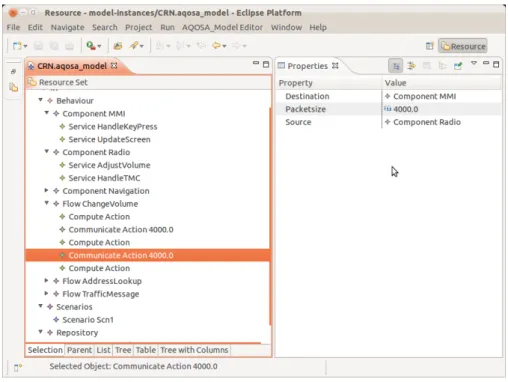
Figure4.3demonstrates a screenshot of the tool while modelling an architecture optimization problem. It shows the tree structure of the AQOSA model, while the architect is defining the scenarios and assigning the properties for various components as well. A sample of an AQOSA IR model (consists of its details objects and attributes) is presented in AppendixA. The sample is a model of the case study system that is described in Section5.3.
4.4 Optimization Part
In general, design of software architecture has to address multiple contradicting quality attributes. Various global optimization techniques have been used in handling complex engineering problems. Younis et al. [YD10] compared several optimization methods and revealed the pros and cons of these global optimization methods. They classified Global Optimization (GO) methods into two main categories: deterministic methods and stochastic methods.
Optimization Part 33
on the different quality attributes. So, the search space is combinatorial and discrete. Moreover, a large number of alternative designs exists in the the search space. In this context, deterministic approaches do not perform well. Instead, stochastic methods are a better fit for solving this kind of problems. Within stochastic methods, Younis describes the following strengths and weaknesses [YD10]: Simulated Annealing (SA) algorithms emulate the annealing process on how liquid freezes or metal re-crystallizes in cooling. Simulated annealing is easy to implement, although the method converges slowly and it is difficult to find an appropriate stopping rule. Therefore, because of the convergence speed the SA method is not an option for our method. Particle Swarm Optimization (PSO) has also been applied to solve practical optimization problems and proved to be one of the promising and successful methods. PSO shares many similarities with evolutionary computation techniques, such as Genetic Algorithms (GA). Genetic algorithms (GAs) are a class of search procedures based on the mechanics of natural genetics and natural selection. However, PSO design paradigm is mainly suited for continuous vector spaces and not for combinatorial optimization. Moreover, unlike GAs, PSO has no evolution operators such ascrossoverandmutation. Because of the need for using intelligent operators as one of the key features in AQOSA framework, PSO is not an option for our method, as well. Hence, Genetic Algorithm (GA) is chosen as optimization method for the AQOSA framework.
In the following, first evolutionary algorithms supported by the AQOSA framework are mentioned. After that, the implemented degrees of freedom for our architecture optimizer are discussed.
4.4.1 Evolutionary Algorithms
Due to the conflicts of quality attributes in the software architecture design, AQOSA uses Evolutionary Multi-Objective Algorithms (EMOA) to evolve the architecture. It has been implemented based on the Opt4J optimization framework [LGRT11][Depa]. The system designer can choose one of the following GA algorithms for his design problem:
• NSGA-II (non-dominated sorting based multi-objective evolutionary algorithm): It is one of the most widely used EMOA techniques and has been proposed by Deb [DAPM02]. It has a selection operator which uses non-dominated sorting, and crowding distance. The non-dominated sorting makes sure that the points converge to the Pareto front. And the crowding distance sorting makes the points spread out across the Pareto front.
• SMS-EMOA (S-Metric Selection Evolutionary Multi-Objective Algorithm): It has been proposed by Emmerich, Beume and Naujoks [EBN05] [BNE07]. It is a representative of the class of hypervolume-based EMOA, which recently gained popularity in the EMOA field.
A comparison of EMOA algorithms for our specific domain, software architecture domain, is discussed in Section5.1.
4.4.2 Degrees of Freedom
When an architectural design is created, usually, there are still variation to the solution without changing the functionality. We call themDegrees of Freedom (DoF). The component-based paradigm that underlies our approach, allows us to recompose components in different topologies and wrappers. However, the optimizer should consider only the variations of architectural designs which do not modify the interfaces used in the architecture in order to guarantee that the optimization process does not change the functionality of the system.
In the following, the degrees of freedom which are implemented by the AQOSA framework are listed:
Number of hardware nodes
If an architectural model containsnsoftware components, then these can be deployed
on a number of hardware nodes, ranging between a minimum of1and a maximum of K·nhardware nodes (for some natural numberK>0), because the number of nodes in
an architecture is finite. Adding more hardware nodes may provide more processing capacity and therefore may yield better performance. On the other hand, removing hardware nodes may reduce the total cost of the system.
Number of connections between hardware nodes
Ifnhardware nodes have been chosen for the deployment of components, then the
maximum number of possible connections between hardware nodes can be calculated
by:Maxc(n) =
n(n−1)
2 .
Optimization Part 35
Network topology
By definition, network topology is the layout of interconnections between hardware nodes. For example, Figure 4.5 shows some possible topologies for connecting a network with 4 nodes. In the other words, Even with the same number of nodes and the same number of connections, network topologies might be different. Even with the same number of nodes and connections, different topologies can still represent different architectures and the number of possibilities can be very large, which its number is inO(2n2). The impact and importance of this DoF is discussed in Chapter6. It is
important to consider that not all possible topologies are valid and therefore AQOSA performs a validation process before doing evaluation. This process is described in Section4.5.2.
Node 1 Node 2
Node 3 Node 4
Node 1 Node 2
Node 3 Node 4
Node 1 Node 2
Node 3 Node 4
Figure 4.5:Three possible topologies for a 4-node network
Software on hardware allocation
Given a hardware network topology, the allocation of software components on hard-ware nodes is another degree of freedom. This degree of freedom defines which software component executes on which hardware component. It also has large effect on the processors’ utilization and system’s performance.
Software components selection
Different components (e.g. developed by different vendors) that implement the same functionality are considered as different architectural alternatives. Our assumption is that one component can replace another, if and only if they implement the same functionality. This assumption prevents the solution from the violation of the system’s functionality.
Hardware components selection
Solution Part 37
Communication lines selection
This degree of freedom is similar to the hardware components selection, but is aimed at selection of communication lines. They might be different in bandwidth, communi-cation delay, failure probability, as well as cost.
4.4.3 Optimizer Module Implementation
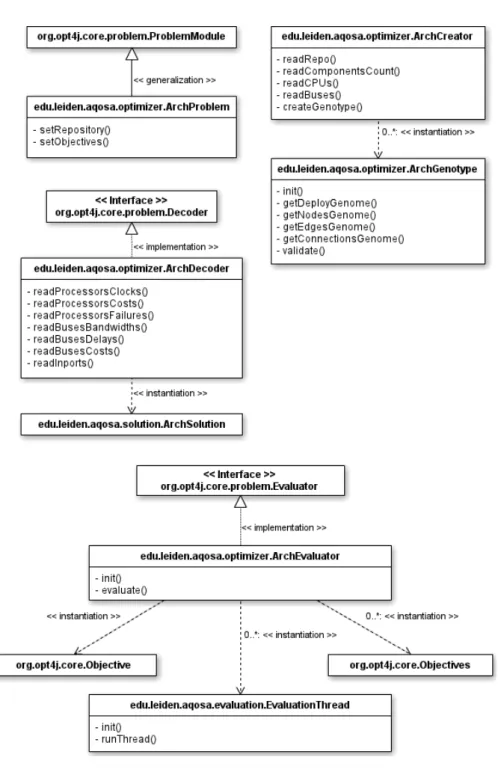
Figure4.6depicts the class diagram of theOptimizer module and its relation with the Solutionmodule.ArchProblemis the main class which reads an AQOSA IR model
and optimization parameters as well. Then, it generates an initial population by calling
theArchCreatorclass. TheArchCreatorclass creates theArchGenotypeclass
which consists of four genomes. TheArchDecoderclass decodes or translates an
ArchGenotypeinto anArchSolutionwhich is also described in Section4.5.3. The
ultimate aim is to evolve genes to find optimal solutions, therefore, theArchProblem
class repeatedly calls theArchEvaluatorto analyse quality attributes for each
solu-tion. With the help of evolutionary algorithms (described in Section4.4.1), the AQOSA framework keeps candidate optimal architectures and discards the others.
4.5 Solution Part
This section explains how the AQOSA framework encodes an architectural candidate solution for the optimization process. Because AQOSA uses a genetic algorithm for its optimization part, the architectural solutions need to be encoded in genetic form.
4.5.1 Architecture Genotype Structure
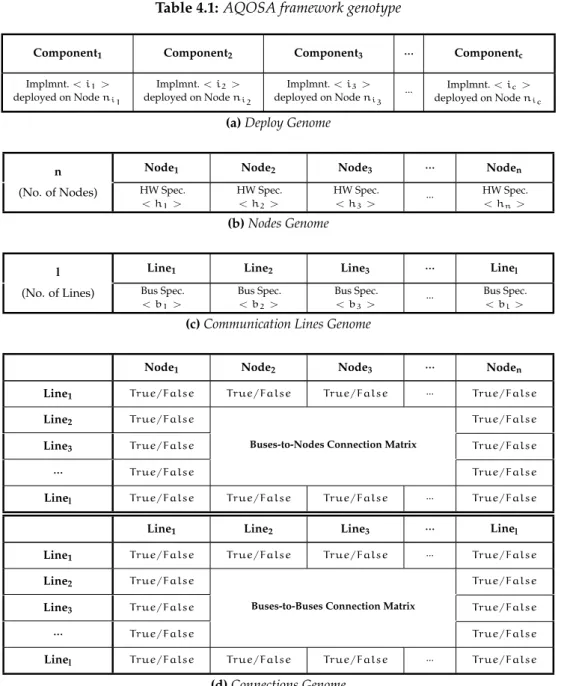
Table4.1shows the structure of the genotype which is used in the AQOSA framework. This genotype consists of a set of four genomes: (1) theDeployment genome, (2) the Nodes genome, (3) theCommunication genome, and (4) theConnection genome.
1. Thedeployment genome(Table4.1a) shows for each software component which implementation is deployed on which hardware node. It encodes the ‘software components selection’, ‘software on hardware allocation’, and the ‘number of hardware nodes’ DoFs.
3. The communication genome (Table4.1c), like the nodes genome, represents which hardware variant is selected for each communication line. It encodes the ‘number of connections’ and the ‘communication lines selection’ DoFs. Their
specification includes bandwidth, transmit delay, and cost.
Table 4.1:AQOSA framework genotype
Component1 Component2 Component3 ... Componentc
Implmnt.< i1>
deployed on Nodeni1
Implmnt.< i2>
deployed on Nodeni2
Implmnt.< i3>
deployed on Nodeni3 ...
Implmnt.< ic>
deployed on Nodenic
(a)Deploy Genome
n (No. of Nodes)
Node1 Node2 Node3 ... Noden
HW Spec.
< h1>
HW Spec.
< h2>
HW Spec.
< h3>
... HW Spec.
< hn>
(b)Nodes Genome
l (No. of Lines)
Line1 Line2 Line3 ... Linel
Bus Spec.
< b1>
Bus Spec.
< b2>
Bus Spec.
< b3>
... Bus Spec.
< bl>
(c)Communication Lines Genome
Node1 Node2 Node3 ... Noden
Line1 True/False True/False True/False ... True/False
Line2 True/False
Buses-to-Nodes Connection Matrix
True/False
Line3 True/False True/False
... True/False True/False
Linel True/False True/False True/False ... True/False
Line1 Line2 Line3 ... Linel
Line1 True/False True/False True/False ... True/False
Line2 True/False
Buses-to-Buses Connection Matrix
True/False
Line3 True/False True/False
... True/False True/False
Linel True/False True/False True/False ... True/False
Evaluation Part 39
4. Theconnection genome (Table4.1d) is the part of the genotype that represent architectural topology by the means of two Boolean matrices. These matrices list the connections between buses and nodes, and amongst buses themselves. Each cell in the matrix can beTrueorFalse, whereTruemeans this particular bus
and particular node (or that particular bus) are connected; andFalsemeans
those are not connected. They encode the ‘network topology’ DoF.
4.5.2 Genotype Validation
Evolutionary algorithms in AQOSA can apply various genetic operators such asCopy, Mutate orCrossover to the genotype for generating new architectural solutions as offspring. However, the validity of these solutions is not guaranteed. Therefore, the optimizer performs sanity checks for each genotype in order to validate it. In this process, those solutions which can not satisfy the functionality of the system will be omitted from being sent to the evaluation process. For example, if the model defines thatcomponent3should communicate withcomponent5and then the generated
offspring deployscomponent3onnode2andcomponent5onnode4, this process should
check whether there are any communication paths betweennode2andnode4.
4.5.3 Solution Module Implementation
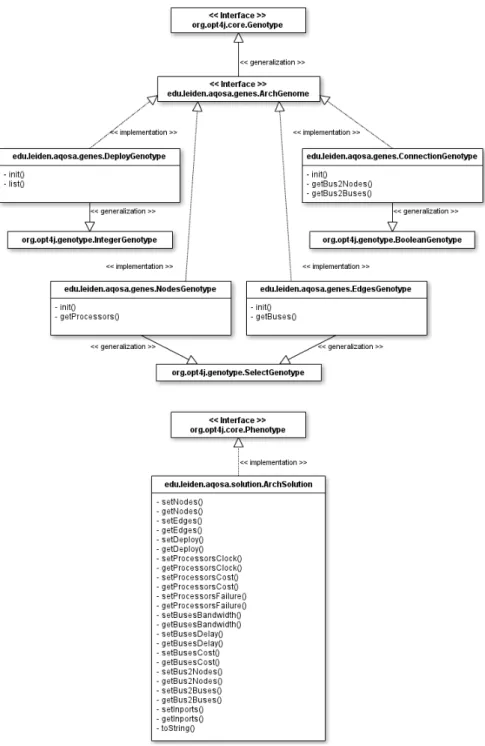
Figure4.7depicts how theSolution module implements the architecture genotype.
ArchGenomeis an interface which all the architectural genomes should implement.
As can be seen in the figure,DeployGenotype,NodesGenotype,EdgesGenotype,
andConnectionGenotype implement that interface. They represent the deploy
genome (4.1a), the nodes genome (4.1b), the communication genome (4.1c), and the connection genome (4.1d) respectively.
4.6 Evaluation Part
The AQOSA evaluation part takes as input an evaluation model (e.g. queuing network or fault tree). An evaluation model is a transformation of the AQOSA IR and a candidate genotype for a particular quality attribute (e.g. response time or safety). The AQOSA framework feeds evaluation models to each evaluator and returns the results to the optimization part.