
RNA helicase Belle/DDX3 regulates transgene expression in
Drosophila
Pang-Kuo Lo1,2, Yi-Chun Huang1, John S. Poulton3, Nicholas Leake4, William H. Palmer5, Daniel Vera6, Gengqiang Xie, Stephen Klusza3, and Wu-Min Deng*
Department of Biological Science, Florida State University, Tallahassee, Florida, USA
Abstract
Belle (Bel), the Drosophila homolog of the yeast DEAD-box RNA helicase DED1 and human DDX3, has been shown to be required for oogenesis and female fertility. Here we report a novel role of Bel in regulating the expression of transgenes. Abrogation of Bel by mutations or RNAi induces silencing of a variety of P-element-derived transgenes. This silencing effect depends on downregulation of their RNA levels. Our genetic studies have revealed that the RNA helicase Spindle-E (Spn-E), a nuage RNA helicase that plays a crucial role in regulating RNA processing and PIWI-interacting RNA (piRNA) biogenesis in germline cells, is required for loss-of-bel-induced transgene silencing. Conversely, Bel abrogation alleviates the nuage-protein
mislocalization phenotype in spn-E mutants, suggesting a competitive relationship between these two RNA helicases. Additionally, disruption of the chromatin remodeling factor Mod(mdg4) or the microRNA biogenesis enzyme Dcr-1 also rescued the transgene-silencing phenotypes in bel mutants, suggesting the involvement of chromatin remodeling and microRNA biogenesis in loss-of-bel-induced transgene silencing. Finally we showed that genetic inhibition of Bel function led to the de novo generation of piRNAs from the transgene region inserted in the genome, suggesting a potential piRNA-dependent mechanism that may mediate transgene silencing as Bel function is inhibited. Our findings have demonstrated a novel involvement of Bel in regulating transgene expression and its loss triggers a transgene silencing mechanism mediated by protein regulators implicated in RNA processing, piRNA biogenesis, chromatin remodeling and the microRNA pathway.
*Correspondence to: Department of Biological Science, Florida State University, Tallahassee, Florida, USA. TEL: (850) 645-1501;
FAX: (850) 645-8447. [email protected]. 1These authors contributed equally to this work.
2Current Address: Department of Biochemistry and Molecular Biology, University of Maryland School of Medicine, Baltimore, Maryland, USA
3Current Address: Lineberger Comprehensive Cancer Center, University of North Carolina, Chapel Hill, North Carolina, USA 4Current Address: Department of Biomedical Sciences, College of Medicine, Florida State University, Tallahassee, Florida, USA 5Current Address: School of Biological Sciences, Institute of Evolutionary Biology, The University of Edinburgh, Edinburgh, Scotland
6Current Address: The Center for Genomics and Personalized Medicine, Florida State University, Tallahassee, Florida, USA
Publisher's Disclaimer: This is a PDF file of an unedited manuscript that has been accepted for publication. As a service to our
customers we are providing this early version of the manuscript. The manuscript will undergo copyediting, typesetting, and review of
HHS Public Access
Author manuscript
Dev Biol
. Author manuscript; available in PMC 2017 April 01.Published in final edited form as:
Dev Biol. 2016 April 1; 412(1): 57–70. doi:10.1016/j.ydbio.2016.02.014.
A
uthor Man
uscr
ipt
A
uthor Man
uscr
ipt
A
uthor Man
uscr
ipt
A
uthor Man
uscr
Keywords
Belle; transgene silencing; Spindle-E; Mod(mdg4); Dcr-1; piRNAs; miRNA
Introduction
Transgene silencing refers to the activity of various host defense responses that ordinarily act on natural foreign or parasitic sequences such as transposable elements (TEs), viroids, RNA and DNA viruses, and bacterial DNA. Since transgenes or their transcripts can resemble these cellular invaders in a number of ways, they naturally become the targets of host protective reactions. There are at least two distinct host defense systems responsible for silencing transgenes (Fagard and Vaucheret, 2000). One performs its effect via de novo DNA methylation at the genome level. The second defense system operates post-transcriptionally to silence transgenes, which involves sequence-specific RNA degradation in the cytoplasm. Therefore, transgene silencing involves complex cell immune systems including epigenetic and RNA silencing mechanisms (Fagard and Vaucheret, 2000). Although many factors involved in transgene silencing have been identified, and several mechanisms have been proposed, there remains much to understand regarding this vital aspect of the cell immune system.
Drosophila oogenesis, which involves the generation of the female gamete (oocyte), nurse cells, and follicle cells, is an excellent system for the study of TE and transgene silencing. The egg chamber, the developmental unit of oogenesis, contains the germline cells (one oocyte and 15 nurse cells) and a layer of surrounding somatically derived epithelial follicle cells. Both the germline cells and follicle cells can produce small RNAs to silence TE expression (Siomi et al., 2011). The nuage, a perinuclear structure within Drosophila nurse cells, is an RNA-rich organelle unique to the germline. The nuage is required for the processing and localization of germline mRNAs and for the biogenesis of PIWI-interacting RNAs (piRNAs), a class of small non-coding RNAs that function as the cell immune system for silencing TEs (Lasko, 2013; Siomi et al., 2011). In D. melanogaster, most primary piRNAs are produced from discrete pericentromeric and telomeric heterochromatic loci (called piRNA clusters) containing damaged repeated TE sequences (Brennecke et al., 2007; Ishizu et al., 2012; Siomi et al., 2011). In fly germline cells, an additional step of piRNA biogenesis, the ‘ping-pong cycle’ mechanism, is employed to generate the secondary piRNAs (Brennecke et al., 2007; Ishizu et al., 2012; Siomi et al., 2011). Multiple factors localized in the nuage of germline cells have been discovered to be essential for secondary piRNA biogenesis, including Aub, AGO3, Spindle-E (Spn-E), and Vasa, (Handler et al., 2013; Malone et al., 2009). In follicle cells, piRNAs are only produced from piRNA clusters (e.g. flamenco) via PIWI and other related nuclear factors, and there is no secondary piRNA biogenesis involved (Halic and Moazed, 2009; Handler et al., 2013; Ishizu et al., 2012). Intriguingly, besides piRNA clusters, euchromatic transposon insertion sites have been identified as another origin to produce piRNAs and endo-siRNAs (Shpiz et al., 2014). This mechanism provides another layer of defense to suppress TE activity and can also serve as a way to affect expression of coding genes and microRNA (miRNA) genes adjacent to inserted TEs.
A
uthor Man
uscr
ipt
A
uthor Man
uscr
ipt
A
uthor Man
uscr
ipt
A
uthor Man
uscr
Vasa and Spn-E belong to a family of DEAD-box proteins defined by multiple distinct conserved motifs including the D-E-A-D (Asp-Glu-Ala-Asp) motif (Linder et al., 1989). Among the identified DEAD-box proteins, one subfamily is highly conserved from yeast to human, which includes orthologs in yeast (DED1), Drosophila (Belle (Bel)), Xenopus (An3), mice (PL10), and humans (DDX3) (Johnstone et al., 2005). These DEAD-box subfamily proteins possess the ATP-dependent RNA helicase activity to unwind double-stranded RNA and remodel RNA-protein interactions (Fairman et al., 2004; Iost et al., 1999). Yeast DED1 is a multifunctional protein that functions to regulate multiple stages of RNA processing and translation (Berthelot et al., 2004; Hayashi et al., 1996; Jamieson and Beggs, 1991; Schafer et al., 2003; Stevens et al., 2002). DED1 has also been shown to play a specific role in cell-cycle control (Forbes et al., 1998; Grallert et al., 2000; Liu et al., 2002). DDX3, the human homolog of DED1, is known to be involved in modulating multiple biological processes, including antiviral innate immunity (Mamiya and Worman, 1999; Owsianka and Patel, 1999; You et al., 1999), mitotic chromosome segregation in somatic cells (Pek and Kai, 2011), the suppression of spermatogenesis (Foresta et al., 2000; Lahn and Page, 1997), G1-S transition of the cell cycle (Chao et al., 2006),
epithelial-mesenchymal transition (EMT) (Botlagunta et al., 2008), a bona fide component of the RNAi pathway (Zhou et al., 2008), TNF-related apoptosis (Sun et al., 2008), and WNT signaling (Cruciat et al., 2013).
Vasa, a paralog of Bel, is required for the formation and function of nuage to suppress TE expression by being involved in the production of piRNAs (Lasko, 2013; Liang et al., 1994; Malone et al., 2009). Most recently, Xiol and colleagues reported that Vasa is a key
component in the piRNA amplifier complex in the nuage and serves as a protein platform to recruit Piwi proteins, the Tudor protein Qin/Kumo and antisense piRNA guides in an ATP-dependent manner for the ping-pong-loop amplification of secondary piRNAs (Xiol et al., 2014). Bel colocalizes with Vasa in the nuage and at the oocyte posterior during oogenesis, and is required for female fertility (Johnstone et al., 2005). Our recent findings have shown that loss of bel delays activation of Notch signaling in follicle cells, which in turn leads to delayed cell differentiation and defects in the switch from the mitotic cycle to the endocycle (Poulton et al., 2011). However, unlike Vasa, the specific roles of Bel in the nuage of germline cells, and whether it is involved in piRNA biogenesis, remain unknown.
From our previous studies, we unexpectedly found that the Gal4-driven expression of a UASp-Bel:GFP transgene was silenced in bel mutant germline cells. This silencing effect was not specific to bel-based transgenes because 13 out of 22 different transgenic lines we tested could be silenced in either germline or somatic bel mutant cells, or both. We
subsequently identified the RNA helicase Spn-E, the epigenetic regulator Modifier of mdg4 [Mod(mdg4)] and the miRNA biogenesis enzyme Dcr-1 as crucial factors for this bel-related transgene silencing. Their abrogation could either partially or completely rescue the
transgene-silencing phenotype induced by loss of bel. Importantly, our small RNA deep sequencing analysis suggests that a piRNA-mediated mechanism is potentially involved in Bel-inactivation-induced transgene silencing. Together, our studies genetically link the function of Bel to Spn-E, Mod(mdg4), and Dcr-1, and suggest that transgene silencing induced by Bel inactivation may involve RNA processing, piRNA, miRNA, and epigenetic mechanisms.
A
uthor Man
uscr
ipt
A
uthor Man
uscr
ipt
A
uthor Man
uscr
ipt
A
uthor Man
uscr
Materials and Methods
Fly stocks and genetics
The following fly stocks were used in this study: FRT82B bel74407 and FRT82B bel47110 [obtained from the Szeged stock center] (Poulton et al., 2011); belneo30 and belEKE [a gift from P. Lasko; belEKE was recombined with FRT82B in our laboratory]; FRT82B belL4740 [a gift from M. Frolov] (Ambrus and Frolov, 2010); bel6 [a gift from N. Perrimon; bel6 was recombined with FRT82B in our laboratory]; belpsg9 [a gift from A. Bashirullah] (Ihry et al., 2012); hsp83-IVS3-LacZ [a gift from D. Rio] (Roche et al., 1995); Following lines were obtained from the Bloomington Stock Center: FRT82B spn-EhlsΔ125, aubQC42, aubHN2, 2Mat-Gal4 [two maternally expressing Gal4 drivers were recombined together, BL#7062 and BL#7063], hsp83-MCP:GFP [BL#7280], ci-LacZ [BL#6303]; FRT82B
mod(mdg4)L3101 [Kyoto stock center, #111048]; FRT82B Dcr-1Q1147X (Poulton et al., 2011); ptc-Gal4, UAS-GFP; bel-RNAi [BL# 35302]. Homozygous mutant clones were generated by mitotic recombination with the FLP-FRT system (Xu and Rubin, 1993). The following stock lines were used to generate mutant clones: hsFLP,Stau:GFP;FRT82B ubiGFP/TM3,Sb; hsFLP,Stau:GFP;FRT82B arm-lacZ/TM6b; hsFLP;;FRT82B ubi-RFP/ TM6b. Flies were maintained and raised at 25°C. Adult female flies were heat-shocked for 30 minutes at 37°C. Two to four days after heat shock, the flies were dissected to harvest ovaries. The collected ovaries were subjected to immunofluorescence staining. To generate the UASp-Bel:GFP transgenic fly, we amplified the bel cDNA (clone: RE28061, DGRC, Indiana) using primers: GTGTGGTACCATGAGTAATGCTATTAACC-3, and
5-GTGTGCGGCCGCTTGAGCCCACCAGTCGG-3. The PCR products were cloned into the Kpn-NotI-digested pUASp-GFP vector DNA and the recombinant DNA was used to generate transgenic flies (Genetivision, Houston).
Antibodies, immunofluorescence staining and confocal microscopy
Immunocytochemistry was carried out as described previously (Deng et al., 2001). The following antibodies were used: rat anti-Vasa (1:300; from Development Studies Hybridoma Bank, DSHB), rabbit anti-Aub and rabbit anti-AGO3 (1:1000; a gift from J. Brennecke), rabbit anti-β-Galactosidase (1:2000; from MP Biomedicals), and mouse anti-β-Galactosidase (1:500; from Promega). Nuclear DNA was stained with DAPI (Invitrogen). Images were acquired with a Zeiss LSM-510 confocal microscope and assembled in Adobe Illustrator.
Quantitative RT-PCR analysis
Total RNA from two-day-old Drosophila ovaries was isolated using Trizol Reagent (Invitrogen) according to the manufacturer’s instructions and then treated with 2 U/µl of DNase I (Ambion) for 30 minutes at 37°C. One microgram of total RNA was reverse-transcribed in 20 µl of reaction mixture containing Superscript II reverse transcriptase (Invitrogen) and oligo (dT)12–18 primer according to the protocol for Superscript II first-strand cDNA synthesis system. One microliter cDNA (reverse transcribed from 50 ng of RNA) was subjected to quantitative real-time PCR (in 25 µl reaction volume) by using primers specific to a transposable element or RP49 (primer sequences can be found in supplemental Materials and Methods) and cDNA templates were amplified using the Platinum SYBR Green qPCR SuperMix UDG kit, according to the manufacturer’s
A
uthor Man
uscr
ipt
A
uthor Man
uscr
ipt
A
uthor Man
uscr
ipt
A
uthor Man
uscr
instructions (Invitrogen). PCR conditions are: 95°C for 10 minutes; 40 cycles of 95°C for 30 seconds, 58°C for 15 seconds, and 68°C for 45 seconds. Real-time PCR was performed using the ABI 7500 Thermocycler (Applied Biosystems), and results were analyzed using SDS version 2.1 software (Austin Biodiversity Web site gallery). Data analysis was done using the 2−ΔΔCT method for relative quantification. Calculated expression values of cDNA samples were normalized to RP49.
Small RNA library preparation and analysis
Small RNA libraries were prepared according to instructions for Illumina TrueSeq Small RNA sample prep kit with some modifications that pre-annealing of terminator
oligonucleotides to Drosophila 2S rRNA was performed prior to 5′ adapter ligation and reverse transcription for efficiently depleting 2S rRNA sequences (Wickersheim and Blumenstiel, 2013). Small RNA libraries were submitted for sequencing using the Illumina HiSeq-2500 sequencing system. Bioinformatic analysis of small RNA libraries was performed to analyze sequencing reads from small RNA libraries. Briefly, after clipping the Illumina 3’-adapter sequence (TGGAATTCTCGGGTGCCAAGGAA CTCCAGTCAC) using cutadapt (cutadapt.readthedocs.org/en/latest), the small RNA reads that passed quality control through removal of low-complexity or low-quality sequenced reads using sickle (github.com/najoshi/sickle), minimal length filter (>22nt) and the removal of rRNAs, snoRNAs and tRNAs reads by bowtie (-a --best --strata -v 1 --un)
(bowtie-bio.sourceforge.net/index.shtml) were mapped to the transgene P[LacW] nucleotide sequence (-a -v 0 -m 1) by bowtie. Small RNA sequencing data are deposited at Gene Expression Omnibus (GEO), accession number GSE65565.
Results
bel loss-of-function mutations induce transgene silencing in germline and somatic cells
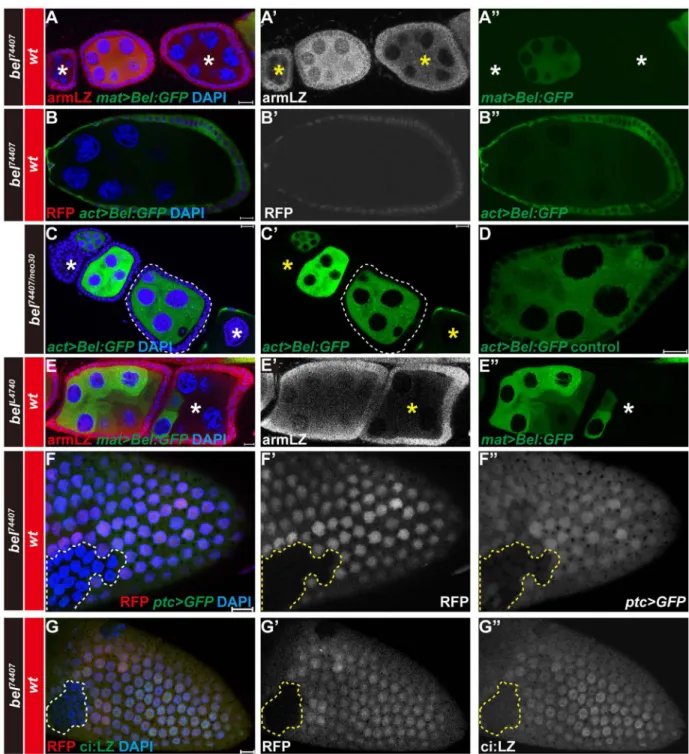
Our previous studies have shown that Bel acts together with the miRNA biogenesis pathway to regulate the timing of Notch signaling in follicle cells (Poulton et al., 2011). Intriguingly, when we attempted to use the germline-specific mat-Gal4 driver to express UASp-Bel:GFP in bel74407 germline clones, the expression of Bel:GFP was silenced (Fig 1A). To determine whether this silencing effect is specific to mat-Gal4, we then tested act-Gal4 driven UASp-Bel:GFP in bel74407 clones. Similar to the mat-Gal4 driver, act-Gal4-driven Bel:GFP expression was also silenced in bel74407 germline clones (Fig 1B,1D), suggesting this silencing is not restricted to a specific Gal4 driver.
To test whether the silencing of Bel:GFP can occur in a different tissue type we examined its expression in bel74407 clones in the wing disc. As shown in Fig S1, UASp-Bel:GFP
expression was also suppressed in bel74407 wing-disc cells, indicating the transgene silencing phenotype is not restricted to ovarian cells.
To rule out the possibility that transgene silencing is allele-specific to bel74407, we tested four other bel alleles (belneo30, belL4740, belEKE and bel47710) for their ability in silencing UASp-Bel:GFP. The hypomorphic belneo30 allele allowed us to create the bel74407/neo30 trans-heterozygote adults, which exhibited a similar but less penetrant silencing phenotype
A
uthor Man
uscr
ipt
A
uthor Man
uscr
ipt
A
uthor Man
uscr
ipt
A
uthor Man
uscr
of act-Gal4/UASp-Bel:GFP in both the nurse cells (22%, n = 45 germline cells) and the follicle cells (63%, n = 332 follicle cells) (Fig 1C), whereas the bel74407/+ heterozygote cells did not show the silencing phenotype (Fig 1D). The belL4740 germline clones also
manifested the silencing phenotype (40%, n = 40) (Fig 1E), but it was not as penetrant as the bel74407 homozygous cells. In addition, belEKE and bel47710 homozygous cells showed silencing for UASp-Bel:GFP expression in both the germline and follicle cell clones during oogenesis (data not shown). These findings, taken together, indicate that the transgene silencing phenotype is caused by loss of bel function and is not related to a specific allele, nor is it specific to germline or somatic cells.
To determine whether the silencing effect is applicable to other transgenes, we examined 22 different transgenic lines in bel mutant cells (Table S1). Expression of 13 out of 22 transgene lines was silenced in germline and/or somatic bel74407 mutant clones (Table S1). Examples of additional transgene silencing included ptc>GFP (ptc-Gal4, UAS-GFP) and ci:LacZ (an enhancer trap line) (Fig 1F, G). Therefore, abrogation of bel function likely has a general effect to silence expression of many, but not all, transgenes.
Loss-of-bel induced transgene silencing is attributable to downregulation of transgene RNA levels
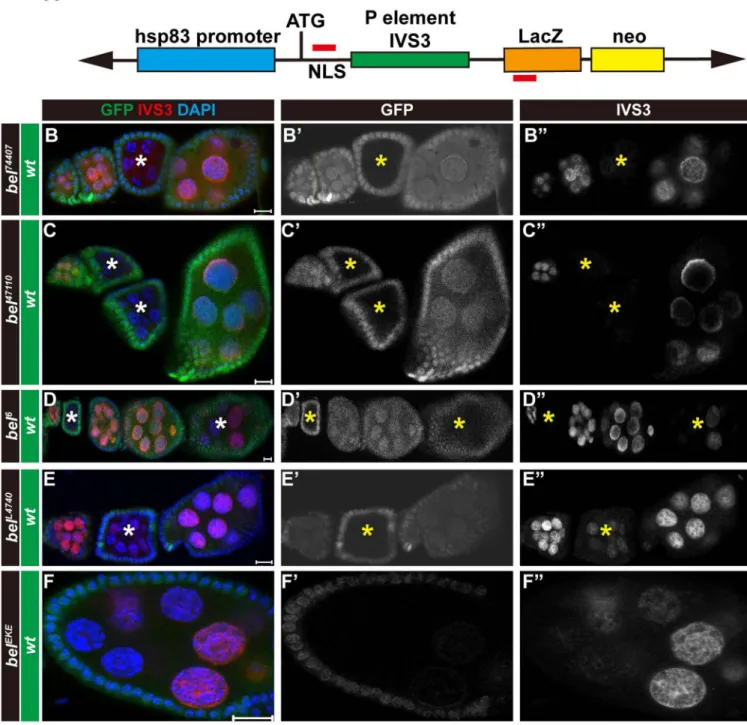
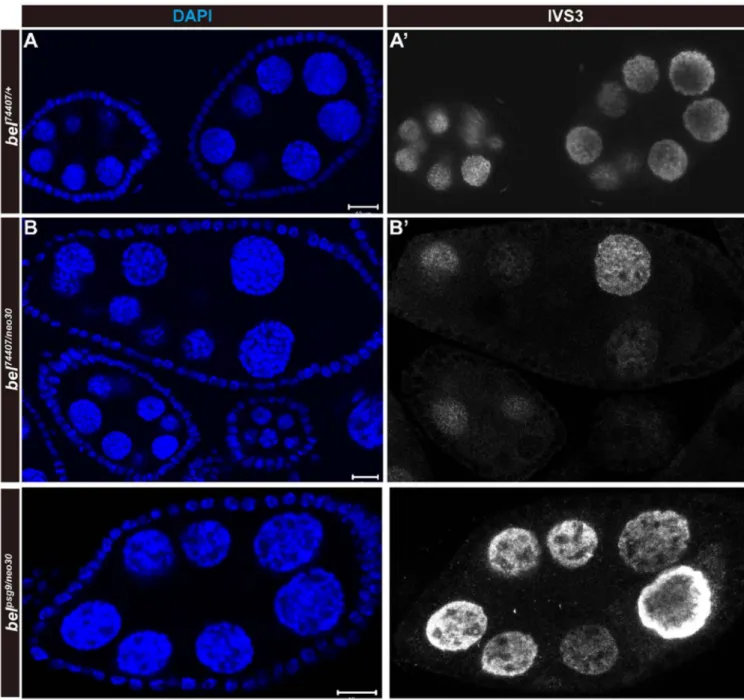
Among the silenced transgenes (Table S1), we were particularly interested in hsp83-IVS3-LacZ (IVS3-hsp83-IVS3-LacZ), a transgene with the intron 3 portion of the P element inserted between the hsp83 promoter and the LacZ reporter (Fig 2A), which exhibits germline specific expression of β-Galactosidase (Roche et al., 1995). Both bel74407 and bel47110 germline clones displayed 100% penetrance for silencing of IVS3-LacZ expression (Fig 2B, C). In germline clones of three other bel alleles, bel6, belL4740 and belEKE (Ambrus and Frolov, 2010; Ihry et al., 2012; Johnstone et al., 2005), IVS3-lacZ was silenced in 56%, 47% and 70% of the mutant clones, respectively (Fig 2D, E, F). The trans-heterozygote bel74407/neo30, on the other hand, showed a partial silencing phenotype, i.e. IVS3-lacZ was silenced in some nurse cells, while other nurse cells in the same egg chamber still had IVS3-lacZ expression (64%, n = 44 germline cells). In contrast, the heterozygous bel74407/+ showed no silencing of the reporter gene expression (Fig 3A, B). These results revealed that multiple bel mutant alleles silenced IVS3-LacZ expression. Interestingly, we found that belpsg9, an EMS-induced missense mutation (F469S) in the RNA helicase domain of the bel gene (Ihry et al., 2012), was unable to cause IVS3-LacZ silencing in germline cells when trans-heterozygous with belneo30 (Fig 3C). belpsg9 has been reported to affect the translational function of Bel (Ihry et al., 2012), indicating the silencing effect is unlikely related to the regulation of translation.
IVS3-lacZ expression is regulated at both the transcriptional and RNA splicing level. The intron 3 of the P element is only spliced out in germline cells, however, its transcription can be silenced in ovaries of the progeny from crosses of the M-cytotype males with the P-cytotype females (Roche et al., 1995). Previously, this transgene line has been exploited to study the TE silencing mechanism underlying silencing of P element expression in germline cells (Roche et al., 1995). Since DDX3, the human homolog of Bel, has been reported to be involved in splicing regulation (Tarn and Chang, 2009), we asked whether IVS-lacZ silencing is regulated at the transcriptional level or at the splicing level. To this end, we first
A
uthor Man
uscr
ipt
A
uthor Man
uscr
ipt
A
uthor Man
uscr
ipt
A
uthor Man
uscr
performed quantitative RT-PCR (qRT-PCR) analysis on RNA samples isolated from ovaries of IVS3-LacZ transgenic flies in the wild-type or trans-heterozygous bel74407/neo30
backgrounds. We employed a pair of primers complementary to the nuclear localization sequence (NLS) and N-terminal β-galactosidase coding sequence (Roche et al., 1995) to amplify cDNA generated from both spliced and un-spliced RNAs, respectively (Fig 2A). As shown in Fig 4A, overall expressed RNAs from the hsp83-IVS3-LacZ transgene were significantly decreased in the bel74407/neo30 sample compared with the wild-type control. Consistent with the data from bel mutant ovaries, germline knockdown of Bel, using mat-Gal4-driven Bel RNAi, also led to reduced RNA levels from hsp83-IVS3-LacZ (Fig 4C). These results indicate that silencing of the hsp83-IVS3-LacZ reporter activity in bel mutant cells is mainly caused by a significant reduction in its overall RNA levels.
To determine whether the splicing of the intron IVS3 is affected in bel mutant cells, we then performed traditional RT-PCR. If germline silencing of hsp83-IVS3-LacZ expression is caused by a defect in splicing of the IVS3 intron in bel mutants, we predicted no expression or very low levels of spliced IVS3-LacZ transcripts to be detected when compared with those of un-spliced transcripts. DNA gel electrophoresis showed that the ratio of spliced DNAs to un-spliced DNAs was not significantly affected in bel74407/neo30 ovaries compared with the wild-type control (Fig S1B), implying that silencing of hsp83-IVS3-LacZ
expression in bel74407/neo30 mutant germline cells is unlikely due to a defect in splicing of IVS3.
The IVS3-LacZ transgene expression is driven by the hsp83 promoter (Roche et al., 1995), we asked whether hsp83-IVS3-LacZ transgene silencing is related to the promoter activity of hsp83 in bel mutants. Thus we tested the expression of an unrelated hsp83 promoter-dependent transgene, hsp83MCP:GFP (GFP-tagged bacteriophage MS2 coat protein) (Jaramillo et al., 2008), in bel74407 clones. Interestingly, this transgene showed expression in both the germline and follicle cells in the ovary (Fig 4D). As shown in Fig 4D, expression of hsp83-MCP:GFP was silenced in both bel74407 germline and somatic follicle cell clones. This result implies that silencing of the hsp83-IVS3-LacZ transgene in bel mutants (Fig 2B) may be attributable to the suppression of the hsp83 promoter activity. These results, taken together, imply that silencing of transgene expression in bel mutant germline cells results from a decrease in transgene mRNA levels. Such changes might result from a decrease in promoter activity, an increase in the turnover rate of expressed transgene RNAs, or both mechanisms.
Spindle-E, Mod(mdg4) and Dcr-1 are involved in bel-mutation-induced transgene silencing
Bel has been shown previously to be involved in siRNA and miRNA function (Pek and Kai, 2011; Poulton et al., 2011) and TE and transgene silencing is known to be mediated by piRNAs and epigenetic regulation (Fagard and Vaucheret, 2000; Siomi et al., 2011). To understand the mechanisms underlying transgene silencing induced by bel mutations, we asked whether disrupting any of the small RNA silencing pathways would ameliorate the silencing effect on IVS3-LacZ or other transgene expression in bel mutants. Specifically, we tested several genes (spn-E, mod(mdg4), scm, su(Hw), Dcr-1, Dcr-2, R2D2, su(var)205, su(var)3–9) involved in epigenetic regulation or biogenesis of piRNAs, endo-siRNAs or
A
uthor Man
uscr
ipt
A
uthor Man
uscr
ipt
A
uthor Man
uscr
ipt
A
uthor Man
uscr
miRNAs, to determine whether any of them genetically interact with bel to regulate transgene expression.
Among the genes we examined, we found that disruption of spn-E, a gene required in germline cells for piRNA biogenesis (Handler et al., 2013; Malone et al., 2009), was capable of alleviating IVS3-LacZ silencing in bel mutants. To examine the role of Spn-E in bel mutant transgene silencing, we recombined the spn-EhlsΔ125 mutant allele (Gonzalez-Reyes et al., 1997) onto the FRT82B bel74407 chromosome, which enabled us to generate mutant clones double homozygous for bel and spn-E. The expression of hsp83-IVS3-LacZ and hsp83-MCP:GFP transgenes was clearly detected in these double homozygous germline clones (Fig 5A, B). These results suggest that the spn-E mutation alleviates the silencing of either transgene in homozygous bel74407 cells (Fig 2B, 4D), and that Spn-E is required for transgene silencing elicited by bel abrogation. Since bel mutant cells also showed transgene silencing in somatic follicle cells, we then examined the effect of Spn-E on the expression of the ptc-Gal4>UAS-GFP in bel mutant follicle cell clones. Similarly, abrogation of Spn-E function also alleviated the silencing effect and restored GFP expression in bel74407 follicle cell clones (Fig 5C). These findings together indicate that Spn-E function is necessary for transgene silencing in bel-mutant- germline and somatic cells.
In addition to spn-E, we found that the mod(mdg4)L3101 allele was able to alleviate the silencing of IVS3-LacZ in bel mutant germline clones (Fig 5D). The restoration of transgene expression was recapitulated when hsp83-MCP:GFP expression was examined in both the germline and follicle-cell clones carrying double mutation for mod(mdg4)L3101 and bel74407 (Fig 5E, F). The Mod(mdg4) proteins are involved in position effect variegation (PEV) and modifying the properties of insulators, the chromatin regulatory elements influencing gene expression (Buchner et al., 2000; Golovnin et al., 2014). Therefore, our results suggest that epigenetic events mediated by Mod(mdg4) are involved in transgene silencing induced by loss of bel function.
The miRNA biogenesis enzyme Dicer-1 (Dcr-1) was also found to be involved in bel-mutation-induced transgene silencing. In germline clones double mutant for bel74407 and Dcr-1Q1147X (Lee et al., 2004), the expression of IVS3-LacZ was restored (Fig 5G). Although Dcr-1Q1147X also restored the germline expression of hsp83-MCP:GFP silenced by bel74407, it had no effect on silencing of hsp83-MCP:GFP in bel mutant follicle cell clones (Fig 5H), suggesting a different mechanism may exist between the germline cells and the somatic cells in bel−/− induced transgene silencing. In conclusion, these findings genetically link Bel to the piRNA-related RNA helicase Spn-E, the chromatin modulator Mod(mdg4) and the Dcr-1 enzyme involved in miRNA biosynthesis.
bel, spn-E double mutants show normal localization of nuage protein components
Bel and Spn-E are known to colocalize at the nuage of germline nurse cells (Handler et al., 2013; Johnstone et al., 2005). Some of the nuage protein components have been reported to be required for maintaining the subcellular localization of other nuage protein components that are functionally associated with them (Findley et al., 2003; Handler et al., 2013; Lim and Kai, 2007; Malone et al., 2009). Mutations in spn-E have been shown to disrupt the nuage localization of piRNA-related proteins such as Aub and Maelstrom (Mael), but only
A
uthor Man
uscr
ipt
A
uthor Man
uscr
ipt
A
uthor Man
uscr
ipt
A
uthor Man
uscr
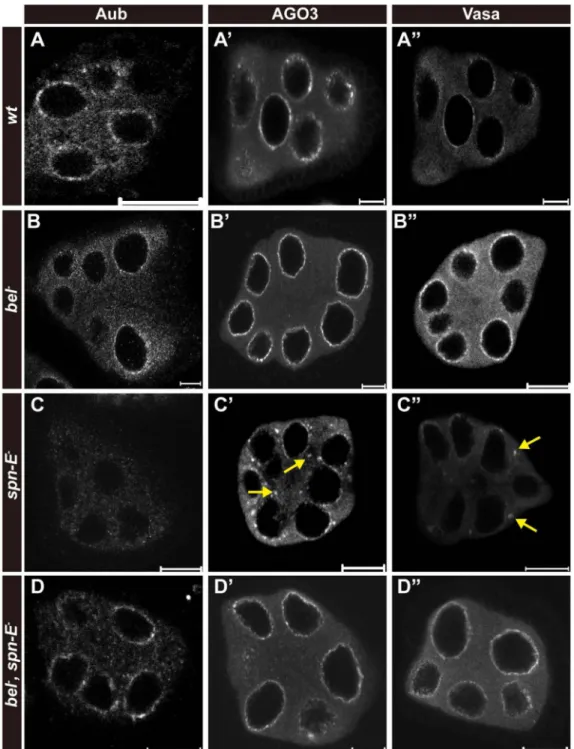
moderately affect the particulate appearance of Vasa in the nuage (Findley et al., 2003; Lim and Kai, 2007). This effect from Spn-E is consistent with the crucial role of Spn-E in germline piRNA biogenesis (Malone et al., 2009). To determine whether loss of bel affects nuage localization of piRNA-related protein components, we examined the localization of Aub and AGO3, two PIWI subfamily proteins that act as ping-pong factors crucial for secondary piRNA biogenesis (Brennecke et al., 2007; Handler et al., 2013; Malone et al., 2009), and Vasa in bel germline clones. Loss of bel, however, had no significant effect on the nuage localization of Vasa, Aub and AGO3 (Fig 6A,B). In contrast, spn- EhlsΔ125 germline clones showed loss and/or mislocalization of Aub and partial mislocalization of AGO3 and Vasa proteins from the nuage (Fig 6C). The spn-EhlsΔ125 germline clones manifested a stronger Vasa mislocalization phenotype compared with previous reports using transheterozygous spn-E mutants (spn-E616/hls3987 and spn-E616/hlsΔ125) (Findley et al., 2003; Lim and Kai, 2007). Surprisingly, we found that in germline clones double mutant for spn-E and bel, the nuage localization of all three proteins was restored (Fig 6D), suggesting that Bel is involved in the mislocalization of nuage protein components when Spn-E is absent.
Inhibition of Bel function leads to the de novo generation of piRNAs from the transgene inserted in the genome
The recent findings from Olovnikov and colleagues have shown that piRNAs can be generated directly from the transposon-derived transgene area located in the euchromatic genome (Olovnikov et al., 2013). Given that piRNAs are known to silence TEs and protein-coding genes at both the transcriptional and post-transcriptional level, their findings suggest that piRNA-mediated silencing mechanism is potentially involved in transgene silencing. To explore whether Bel-dependent transgene silencing is related to this mechanism, we isolated small RNAs from wild-type (w1118) and trans-heterozygous bel74407/neo30 ovaries and performed small RNA deep sequencing analysis. We examined piRNA reads mapped to the inserted transgene sequence, P[LacW], which was exploited to create the mutated allele bel74407. As shown in Fig 7, a significant number of piRNA reads (normalized mapped read count 215 ± 7, n = 3, p < 0.05) derived from bel74407/neo30 mutant ovaries were mapped to P[LacW], whereas only a very low number of background piRNAs (16 ± 3, n = 3) derived from control wild-type ovaries were mapped to P[LacW]. This finding indicates that Bel inhibition results in the de novo generation of piRNAs from the inserted transgene region in the genome.
Discussion
In this article, we report that loss-of-bel function triggers transgene silencing, which occurs through reduction in transgene RNA levels. Furthermore, our genetic studies indicate that this transgene silencing effect induced by bel abrogation requires the RNA helicase Spn-E, the insulator modulator Mod(mdg4) and/or the miRNA biosynthesis enzyme Dcr-1. Based on the functional roles of these three molecules, our data suggest that this transgene silencing effect may involve RNA processing, chromatin remodeling and/or miRNA biogenesis. This transgene silencing event occurring under various bel mutant backgrounds implies that Bel may regulate these three molecular mechanisms to sustain transgene
A
uthor Man
uscr
ipt
A
uthor Man
uscr
ipt
A
uthor Man
uscr
ipt
A
uthor Man
uscr
expression in the normal physiological condition. Intriguingly, our studies also identified additional complexity in the relationship between Bel and Spn-E because the mislocalization of nuage components in spn-E mutants requires Bel. Therefore, our findings, taken together, provide new insight into Bel function and expand the molecular interaction network radiating from Bel.
Our studies show that loss of bel gave rise to transgene silencing via decreased transgene RNA levels. This phenomenon could be attributable to either transcriptional suppression or increased RNA degradation. Some support for an RNA degradation/targeting mechanism comes from our finding that Spn-E is required for transgene silencing induced by loss of bel. In germline nurse cells, Spn-E, which is located in the cytoplasmic nuage, is crucial for properly maintaining the subcellular localization of piRNA-related protein factors in the nuage, the ping-pong reaction of piRNA biogenesis, and silencing of TEs (Handler et al., 2013; Malone et al., 2009). Spn-E is also required for the proper localization of RNA transcripts (e.g., Bicoid and Oskar) during oogenesis, which might be related to its role in organizing a cytoskeletal framework (Gillespie and Berg, 1995). Therefore, it is plausible that the Spn-E-dependent RNA processing activity and/or Spn-E-generated piRNAs mediate transgene RNA degradation. In addition, it is possible that piRNAs can also elicit
transcriptional silencing of transgenes based on their nuclear epigenetic role in TE silencing. Another striking finding from our studies shows that Bel is involved in disrupting the subcellular localization of nuage components when Spn-E is abrogated. In contrast, loss of Bel alone had no impact on the localization of piRNA-related nuage protein components. These findings suggest that there could be a competitive relationship between Bel and Spn-E, where these two molecules negatively regulate each other. This hypothesis is also supported by our observations that Spn-E is required for transgene silencing when Bel is abrogated. According to these findings, we envisage a model that Bel may function as a negative regulator for ping-pong-cycle-mediated piRNA biogenesis via disrupting the nuage localization of piRNA-related proteins as Spn-E function is abrogated, whereas Spn-E may be aberrantly activated by loss of Bel, in turn leading to transgene silencing. Whether piRNAs generated from the Spn-E-mediated ping-pong cycle are involved in transgene silencing is currently unknown. However, a recent study has shown that piRNAs can be generated directly from the transposon-derived transgene insertion area located in the euchromatic genome, which have been proposed to be involved in transgene silencing (Olovnikov et al., 2013). This finding links piRNAs to transgene silencing. Our preliminary small RNA deep sequencing analysis showed that the viable trans-heterozygous
bel74407/neo30 mutant ovaries, which manifest a partial transgene silencing phenotype, displayed no significant defect in overall piRNA biogenesis from piRNA clusters and the ping-pong cycle, indicating that unlike Vasa, Bel is not involved in regulating piRNA generation (data not shown). This finding is consistent with the result that homozygous bel mutants had no defect in nuage protein localization (Fig 6), which is different from other piRNA-related nuage proteins whose defects can significantly disturb the localization of other nuage protein components (Findley et al., 2003; Handler et al., 2013; Lasko, 2013; Lim and Kai, 2007; Malone et al., 2009). Nevertheless, our deep sequencing analysis also identified de novo piRNAs generated in bel74407/neo30 mutant ovaries (but not in wild-type ovaries) that could be mapped to the integrated P-element-derived transgene sequence area
A
uthor Man
uscr
ipt
A
uthor Man
uscr
ipt
A
uthor Man
uscr
ipt
A
uthor Man
uscr
(P[LacW]). This result is in line with Olovnikov’s findings (Olovnikov et al., 2013) and indicates that the de novo generation of piRNAs from the inserted transgene region in the genome occurs under the bel mutant background. Given that Bel is a paralog of Vasa and our genetic findings also suggest a competitive relationship between Bel and Spn-E, loss of Bel may disrupt its normal regulation of some small RNA-related helicases and co-factors, which in turn aberrantly activates the small RNA pathway(s). Therefore, it is possible that loss of Bel may promote de novo piRNA biogenesis from the transgene insertion sites by freeing these small RNA regulators and provoking the activation of their related small RNA pathway(s), which is one possible mechanism leading to transgene silencing. Since we were unable to create viable mutant progeny bearing mutations at both bel and spn-E gene loci, it is still uncertain whether Spn-E is involved in regulating de novo piRNA biogenesis from transgene insertion sites. Although we could not elucidate the detailed mechanism due to technical hurdles, exploring the regulatory roles of Bel and Spn-E in this new type of piRNA biogenesis will be key, interesting research for understanding molecular mechanisms underlying transgene silencing.
Another unexpected finding is that the spn-E mutant rescue of transgene silencing associated with loss of bel also occurs in somatic follicle cells. This indicates that in addition to its well-known function in germline cells, Spn-E may have a somatic function. As Spn-E is not implicated in somatic piRNA biogenesis (e.g., flamenco) (Handler et al., 2013; Malone et al., 2009), it is uncertain how Spn-E mediates somatic transgene silencing and whether piRNAs participate in this event. Therefore, it will be important in the future to unravel whether the mechanism by which Spn-E facilitates transgene silencing in bel mutant somatic cells is the same as that in germline cells.
The common feature for transgenes silenced by Bel abrogation is their P-element-based integration into genomic DNA. The observation that some P-element-based transgenes were not silenced in bel mutant cells raises an interesting question about what factors can
determine whether a transgene can be silenced or not. From genetic analysis of a series of transgenes (n = 22) (Table S1), we observed that six examined transgenes (ci-LacZ, dMyc-LacZ, dom-dMyc-LacZ, C306-Gal4, ptc-Gal4, Tj-Gal4), which were generated by the insertion of two different P-element-derived vector sequences (P[LacW] and P[GawB]), were silenced under the bel mutant background. In contrast, two transgenes (histone-GFP, histone-RFP) generated by the insertion of P[His2Av]-derived vector sequences were not silenced by Bel inactivation. Although these data are not a conclusive result, they imply that the inserted transgene sequence itself, not the insertion location in the genome, may be a critical determinant for Bel-dependent transgene silencing since this silencing phenotype seems to be transgene-specific and a change in the transgene insertion location in the genome has no influence on whether this transgene can be silenced or not when Bel function is inhibited. It is possible that the transgene sequence determines a local chromosomal conformation and whether the transgene can be silenced under the bel mutant background is determined by whether its chromosomal structure can be recognized by epigenetic regulators involved in transgene silencing. Although further investigations are still needed to verify this hypothesis due to limited cases in our study, it raises the possibility that epigenetic regulation at the chromatin level may be involved in Bel-dependent transgene silencing. Indeed, besides Spn-E, our genetic study identified Mod(mdg4) as another crucial factor required for transgene
A
uthor Man
uscr
ipt
A
uthor Man
uscr
ipt
A
uthor Man
uscr
ipt
A
uthor Man
uscr
silencing in both germline and somatic cells when Bel is abrogated. The mod(mdg4) gene encodes multiple nuclear factors through trans-splicing and this protein family is
functionally involved in the modification of the properties of insulators, which are genomic elements that regulate gene expression (Buchner et al., 2000; Golovnin et al., 2014). Mod(mdg4) proteins can function as chromatin modulators engaged in the organization of highly ordered chromatin domains (Buchner et al., 2000; Golovnin et al., 2014). The involvement of Mod(mdg4) in transgene silencing suggests that nuclear epigenetic events are also crucial for induction of transgene silencing when Bel is inactivated. However, the role of Mod(mdg4) in transgene silencing might also be indirect, such as through its regulation of other genes that could contribute to silencing. Nevertheless, our findings suggest that the coordination between nuclear and cytoplasmic events mediated by
Mod(mdg4) and Spn-E, respectively, is mandatory for induction of transgene silencing when Bel is functionally inhibited.
The miRNA biogenesis enzyme Dcr-1 (Lee et al., 2004) is the third factor identified from our studies that is crucial for transgene silencing in the absence of Bel. Interestingly, the block in transgene silencing in this case (double mutant for bel and dcr-1) only occurred in germline cells, but not in somatic cells. This discovery raises the possibility that there are additional miRNA-targeted proteins present in germline cells, but not in somatic cells, and they can interact with factors essential for germline transgene silencing. If this is a case, aberrantly elevated levels of these miRNA-targeted proteins in Dcr-1 mutant germline cells might interfere with transgene silencing. Besides this possible indirect role, another possibility is that the Dcr-1-dependent miRNA pathway may play a direct role in transgene silencing in germline cells as Bel is abrogated. The miRNA pathway has been shown to be implicated in transgene silencing in Drosophila S2 cells (Siomi et al., 2005). Although the silencing mechanism is unclear, this finding raises a possible direct role of the Dcr-1-dependent miRNA pathway in bel-mutant transgene silencing. A study from Zhou and colleagues has shown that Bel proteins were cofractionated with the miRNA-dependent RNA-induced silencing complexes (miRISCs) and co-immunoprecipitated with Ago1, the protein component of miRISCs (Zhou et al., 2008). This finding suggests a compelling possibility that Bel may be directly involved in the miRNA pathway to regulate miRISC-dependent RNA silencing and Bel inactivation may result in the aberrant functionality of miRISC and its related RNA silencing. Since miRNAs can target mRNAs via their short seed sequences, a possibility which cannot be ruled out is that some miRNAs may directly target transngene RNAs to regulate their levels. Future investigation is needed to reveal which possibility is more relevant.
In conclusion, our findings provide novel insights into the regulatory role of Bel in the expression of transgenes in Drosophila and its functional linkage to crucial factors implicated in RNA processing, chromatin remodeling and miRNA biogenesis. These findings further advance our understanding of the complex cellular functions of Bel. Our studies of the role for Bel in transgene expression may have important, future implications for understanding the regulation of expression of newly invaded or transposed TEs (Shpiz et al., 2014) and virus-retrotransposon DNA chimeras generated from viral infection (Goic et al., 2013) as they may share the similar scenario as transgene integration.
A
uthor Man
uscr
ipt
A
uthor Man
uscr
ipt
A
uthor Man
uscr
ipt
A
uthor Man
uscr
Supplementary Material
Refer to Web version on PubMed Central for supplementary material.
Acknowledgments
We thank members of the Deng laboratory for technical support and discussions. We thank P. Lasko , M. Frolov, N. Perrimon, A. Bashirullah, D. Rio, J. Brennecke, T. Kai, the Developmental Studies Hybridoma Bank, Szeged Drosophila Stock Center, Vienna Drosophila RNAi Center (VDRC), Kyoto Stock Center, Drosophila Genomics Resource Center (DGRC) and Bloomington Drosophila Stock Center (BDSC) for antibodies, vectors and fly stocks; and the Biology Imaging Laboratory and the Molecular Core Facility in Florida State University. W.-M. D. is supported by NIH grant R01GM072562 and National Science Foundation IOS-1052333.
References
Ambrus AM, Frolov MV. Mutation of the DEAD-box helicase belle downregulates the cyclin-dependent kinase inhibitor Dacapo. Cell Cycle. 2010; 9:1016–1020. [PubMed: 20160476] Berthelot K, Muldoon M, Rajkowitsch L, Hughes J, McCarthy JE. Dynamics and processivity of 40S
ribosome scanning on mRNA in yeast. Mol Microbiol. 2004; 51:987–1001. [PubMed: 14763975] Botlagunta M, Vesuna F, Mironchik Y, Raman A, Lisok A, Winnard P Jr, Mukadam S, Van Diest P,
Chen JH, Farabaugh P, Patel AH, Raman V. Oncogenic role of DDX3 in breast cancer biogenesis. Oncogene. 2008; 27:3912–3922. [PubMed: 18264132]
Brennecke J, Aravin AA, Stark A, Dus M, Kellis M, Sachidanandam R, Hannon GJ. Discrete small RNA-generating loci as master regulators of transposon activity in Drosophila. Cell. 2007; 128:1089–1103. [PubMed: 17346786]
Buchner K, Roth P, Schotta G, Krauss V, Saumweber H, Reuter G, Dorn R. Genetic and molecular complexity of the position effect variegation modifier mod(mdg4) in Drosophila. Genetics. 2000; 155:141–157. [PubMed: 10790390]
Chao CH, Chen CM, Cheng PL, Shih JW, Tsou AP, Lee YH. DDX3, a DEAD box RNA helicase with tumor growth-suppressive property and transcriptional regulation activity of the p21waf1/cip1 promoter, is a candidate tumor suppressor. Cancer Res. 2006; 66:6579–6588. [PubMed: 16818630] Cruciat CM, Dolde C, de Groot RE, Ohkawara B, Reinhard C, Korswagen HC, Niehrs C. RNA
helicase DDX3 is a regulatory subunit of casein kinase 1 in Wnt-beta-catenin signaling. Science. 2013; 339:1436–1441. [PubMed: 23413191]
Deng WM, Althauser C, Ruohola-Baker H. Notch-Delta signaling induces a transition from mitotic cell cycle to endocycle in Drosophila follicle cells. Development. 2001; 128:4737–4746. [PubMed: 11731454]
Fagard M, Vaucheret H. (TRANS)GENE SILENCING IN PLANTS: How Many Mechanisms? Annu Rev Plant Physiol Plant Mol Biol. 2000; 51:167–194. [PubMed: 15012190]
Fairman ME, Maroney PA, Wang W, Bowers HA, Gollnick P, Nilsen TW, Jankowsky E. Protein displacement by DExH/D “RNA helicases” without duplex unwinding. Science. 2004; 304:730– 734. [PubMed: 15118161]
Findley SD, Tamanaha M, Clegg NJ, Ruohola-Baker H. Maelstrom, a Drosophila spindle-class gene, encodes a protein that colocalizes with Vasa and RDE1/AGO1 homolog, Aubergine, in nuage. Development. 2003; 130:859–871. [PubMed: 12538514]
Forbes KC, Humphrey T, Enoch T. Suppressors of cdc25p overexpression identify two pathways that influence the G2/M checkpoint in fission yeast. Genetics. 1998; 150:1361–1375. [PubMed: 9832516]
Foresta C, Ferlin A, Moro E. Deletion and expression analysis of AZFa genes on the human Y chromosome revealed a major role for DBY in male infertility. Hum Mol Genet. 2000; 9:1161– 1169. [PubMed: 10767340]
Gillespie DE, Berg CA. Homeless is required for RNA localization in Drosophila oogenesis and encodes a new member of the DE-H family of RNA-dependent ATPases. Genes Dev. 1995; 9:2495–2508. [PubMed: 7590230]
A
uthor Man
uscr
ipt
A
uthor Man
uscr
ipt
A
uthor Man
uscr
ipt
A
uthor Man
uscr
Goic B, Vodovar N, Mondotte JA, Monot C, Frangeul L, Blanc H, Gausson V, Vera-Otarola J, Cristofari G, Saleh MC. RNA-mediated interference and reverse transcription control the persistence of RNA viruses in the insect model Drosophila. Nat Immunol. 2013; 14:396–403. [PubMed: 23435119]
Golovnin AK, Shapovalov IS, Kostyuchenko MV, Shamsutdinov MF, Georgiev PG, Melnikova LS. Chromator protein directly interacts with the common part of the Drosophila melanogaster Mod(mdg4) family proteins. Dokl Biochem Biophys. 2014; 454:21–24. [PubMed: 24633607] Gonzalez-Reyes A, Elliott H, St Johnston D. Oocyte determination and the origin of polarity in
Drosophila: the role of the spindle genes. Development. 1997; 124:4927–4937. [PubMed: 9362456]
Grallert B, Kearsey SE, Lenhard M, Carlson CR, Nurse P, Boye E, Labib K. A fission yeast general translation factor reveals links between protein synthesis and cell cycle controls. J Cell Sci. 2000; 113:1447–1458. [PubMed: 10725227]
Halic M, Moazed D. Transposon silencing by piRNAs. Cell. 2009; 138:1058–1060. [PubMed: 19766558]
Handler D, Meixner K, Pizka M, Lauss K, Schmied C, Gruber FS, Brennecke J. The genetic makeup of the Drosophila piRNA pathway. Mol Cell. 2013; 50:762–777. [PubMed: 23665231]
Hayashi N, Seino H, Irie K, Watanabe M, Clark KL, Matsumoto K, Nishimoto T. Genetic interaction of DED1 encoding a putative ATP-dependent RNA helicase with SRM1 encoding a mammalian RCC1 homolog in Saccharomyces cerevisiae. Mol Gen Genet. 1996; 253:149–156. [PubMed: 9003298]
Ihry RJ, Sapiro AL, Bashirullah A. Translational control by the DEAD Box RNA helicase belle regulates ecdysone-triggered transcriptional cascades. PLoS Genet. 2012; 8:e1003085. [PubMed: 23209440]
Iost I, Dreyfus M, Linder P. Ded1p, a DEAD-box protein required for translation initiation in Saccharomyces cerevisiae, is an RNA helicase. J Biol Chem. 1999; 274:17677–17683. [PubMed: 10364207]
Ishizu H, Siomi H, Siomi MC. Biology of PIWI-interacting RNAs: new insights into biogenesis and function inside and outside of germlines. Genes Dev. 2012; 26:2361–2373. [PubMed: 23124062] Jamieson DJ, Beggs JD. A suppressor of yeast spp81/ded1 mutations encodes a very similar putative
ATP-dependent RNA helicase. Mol Microbiol. 1991; 5:805–812. [PubMed: 1857205]
Jaramillo AM, Weil TT, Goodhouse J, Gavis ER, Schupbach T. The dynamics of fluorescently labeled endogenous gurken mRNA in Drosophila. J Cell Sci. 2008; 121:887–894. [PubMed: 18303053] Johnstone O, Deuring R, Bock R, Linder P, Fuller MT, Lasko P. Belle is a Drosophila DEAD-box
protein required for viability and in the germ line. Dev Biol. 2005; 277:92–101. [PubMed: 15572142]
Lahn BT, Page DC. Functional coherence of the human Y chromosome. Science. 1997; 278:675–680. [PubMed: 9381176]
Lasko P. The DEAD-box helicase Vasa: evidence for a multiplicity of functions in RNA processes and developmental biology. Biochim Biophys Acta. 2013; 1829:810–816. [PubMed: 23587717] Lee YS, Nakahara K, Pham JW, Kim K, He Z, Sontheimer EJ, Carthew RW. Distinct roles for
Drosophila Dicer-1 and Dicer-2 in the siRNA/miRNA silencing pathways. Cell. 2004; 117:69–81. [PubMed: 15066283]
Liang L, Diehl-Jones W, Lasko P. Localization of vasa protein to the Drosophila pole plasm is independent of its RNA-binding and helicase activities. Development. 1994; 120:1201–1211. [PubMed: 8026330]
Lim AK, Kai T. Unique germ-line organelle, nuage, functions to repress selfish genetic elements in Drosophila melanogaster. Proc Natl Acad Sci U S A. 2007; 104:6714–6719. [PubMed: 17428915] Linder P, Lasko PF, Ashburner M, Leroy P, Nielsen PJ, Nishi K, Schnier J, Slonimski PP. Birth of the
D-E-A-D box. Nature. 1989; 337:121–122. [PubMed: 2563148]
Liu HY, Nefsky BS, Walworth NC. The Ded1 DEAD box helicase interacts with Chk1 and Cdc2. J Biol Chem. 2002; 277:2637–2643. [PubMed: 11711540]
Malone CD, Brennecke J, Dus M, Stark A, McCombie WR, Sachidanandam R, Hannon GJ. Specialized piRNA pathways act in germline and somatic tissues of the Drosophila ovary. Cell. 2009; 137:522–535. [PubMed: 19395010]
Mamiya N, Worman HJ. Hepatitis C virus core protein binds to a DEAD box RNA helicase. J Biol Chem. 1999; 274:15751–15756. [PubMed: 10336476]
Olovnikov I, Ryazansky S, Shpiz S, Lavrov S, Abramov Y, Vaury C, Jensen S, Kalmykova A. De novo piRNA cluster formation in the Drosophila germ line triggered by transgenes containing a transcribed transposon fragment. Nucleic Acids Res. 2013; 41:5757–5768. [PubMed: 23620285] Owsianka AM, Patel AH. Hepatitis C virus core protein interacts with a human DEAD box protein
DDX3. Virology. 1999; 257:330–340. [PubMed: 10329544]
Pek JW, Kai T. DEAD-box RNA helicase Belle/DDX3 and the RNA interference pathway promote mitotic chromosome segregation. Proc Natl Acad Sci U S A. 2011; 108:12007–12012. [PubMed: 21730191]
Poulton JS, Huang YC, Smith L, Sun J, Leake N, Schleede J, Stevens LM, Deng WM. The microRNA pathway regulates the temporal pattern of Notch signaling in Drosophila follicle cells.
Development. 2011; 138:1737–1745. [PubMed: 21447549]
Roche SE, Schiff M, Rio DC. P-element repressor autoregulation involves germ-line transcriptional repression and reduction of third intron splicing. Genes Dev. 1995; 9:1278–1288. [PubMed: 7758951]
Schafer T, Strauss D, Petfalski E, Tollervey D, Hurt E. The path from nucleolar 90S to cytoplasmic 40S pre-ribosomes. Embo J. 2003; 22:1370–1380. [PubMed: 12628929]
Shpiz S, Ryazansky S, Olovnikov I, Abramov Y, Kalmykova A. Euchromatic transposon insertions trigger production of novel Pi- and endo-siRNAs at the target sites in the drosophila germline. PLoS Genet. 2014; 10:e1004138. [PubMed: 24516406]
Siomi MC, Sato K, Pezic D, Aravin AA. PIWI-interacting small RNAs: the vanguard of genome defence. Nat Rev Mol Cell Biol. 2011; 12:246–258. [PubMed: 21427766]
Siomi MC, Tsukumo H, Ishizuka A, Nagami T, Siomi H. A potential link between transgene silencing and poly(A) tails. RNA. 2005; 11:1004–1011. [PubMed: 15987811]
Stevens SW, Ryan DE, Ge HY, Moore RE, Young MK, Lee TD, Abelson J. Composition and functional characterization of the yeast spliceosomal penta-snRNP. Mol Cell. 2002; 9:31–44. [PubMed: 11804584]
Sun M, Song L, Li Y, Zhou T, Jope RS. Identification of an antiapoptotic protein complex at death receptors. Cell Death Differ. 2008; 15:1887–1900. [PubMed: 18846110]
Tarn WY, Chang TH. The current understanding of Ded1p/DDX3 homologs from yeast to human. RNA Biol. 2009; 6:17–20. [PubMed: 19106629]
Wickersheim ML, Blumenstiel JP. Terminator oligo blocking efficiently eliminates rRNA from Drosophila small RNA sequencing libraries. Biotechniques. 2013; 55:269–272. [PubMed: 24215643]
Xiol J, Spinelli P, Laussmann MA, Homolka D, Yang Z, Cora E, Coute Y, Conn S, Kadlec J, Sachidanandam R, Kaksonen M, Cusack S, Ephrussi A, Pillai RS. RNA clamping by Vasa assembles a piRNA amplifier complex on transposon transcripts. Cell. 2014; 157:1698–1711. [PubMed: 24910301]
Xu T, Rubin GM. Analysis of genetic mosaics in developing and adult Drosophila tissues. Development. 1993; 117:1223–1237. [PubMed: 8404527]
You LR, Chen CM, Yeh TS, Tsai TY, Mai RT, Lin CH, Lee YH. Hepatitis C virus core protein interacts with cellular putative RNA helicase. J Virol. 1999; 73:2841–2853. [PubMed: 10074132] Zhou R, Hotta I, Denli AM, Hong P, Perrimon N, Hannon GJ. Comparative analysis of
argonaute-dependent small RNA pathways in Drosophila. Mol Cell. 2008; 32:592–599. [PubMed: 19026789]
A
uthor Man
uscr
ipt
A
uthor Man
uscr
ipt
A
uthor Man
uscr
ipt
A
uthor Man
uscr
Highlights
• Loss of Belle (Bel), a DEAD-box RNA helicase, induces transgene silencing.
• Spindle-E, Mod(mdg4) and Dcr-1 mediate transgene silencing in bel mutants.
• The balance between Spindle-E and Bel is vital to sustain the nuage integrity.
• Inhibition of Bel leads to the de novo generation of piRNAs from the transgene.
A
uthor Man
uscr
ipt
A
uthor Man
uscr
ipt
A
uthor Man
uscr
ipt
A
uthor Man
uscr
Figure 1. Expression of transgenes in germline and somatic cells is silenced in bel mutants
(A, A', A") Expression of Bel:GFP driven by germline-specific mat-Gal4 is silenced in bel74407 homozygous mutant germline cell clones. Egg chamber were stained with anti-β
-galactosidase antibody (red in A, white in A'). Expression of Bel:GFP is indicated by the green fluorescence from GFP (green in A, A"). bel74407 mutant germline cell clones (β
-galactosidase-negative) are indicated by asterisks. (B, B', B") Expression of Bel: GFP driven by act-Gal4 is silenced in bel74407 mutant germline cell clones. bel74407 homozygous mutant
germline cell clones are identified by the absence of RFP (red in B, white in B'). Expression
A
uthor Man
uscr
ipt
A
uthor Man
uscr
ipt
A
uthor Man
uscr
ipt
A
uthor Man
uscr
of Bel: GFP is indicated by the green fluorescence from GFP (green in B"). (C, C') Random silencing of Bel: GFP expression driven by the act-Gal4 driver in trans-heterozygous bel74407/neo30 mutant germline (indicated by asterisks) and somatic follicle (outlined) cells of egg chambers. Bel:GFP expression is indicated by the GFP fluorescence (green in C, C'). (D) Normal act>Bel:GFP expression in wild-type germline and somatic follicle cells of egg chambers. (E, E', E") Silencing of Bel: GFP expression driven by mat-Gal4 in belL4740 mutant germline cell clones. belL4740 homozygous mutant germline cell clones (indicated by an asterisk) are identifiable by the absence of β-galactosidase staining (red in E, white in E'). Bel:GFP expression is indicated by the GFP green fluorescence (green in E, E"). (F, F, F") Expression of UAS-GFP driven by ptc-Gal4 is silenced in bel74407 mutant follicle cell clones. The GFP fluorescence indicating UAS-GFP expression is in green (F) or in white (F"). The follicle cell clones homozygous for bel74407 lack RFP (outlined) and wild-type cells are RFP-positive (red in F, white in F'). (G, G', G") Expression of ci:LacZ (ci:LZ) is silenced in bel74407 mutant follicle cell clones. β-galactosidase staining is in green (G) or in white (G"). bel74407 homozygous mutant follicle cell clones are identifiable by the absence (outlined) of RFP (red in G, white in G'). DAPI (in blue) was used to stain nuclear DNA. The orientation of egg chambers in confocal images is anterior (left) to posterior (right). The scar bar indicates 10 µm.
A
uthor Man
uscr
ipt
A
uthor Man
uscr
ipt
A
uthor Man
uscr
ipt
A
uthor Man
uscr
Figure 2. Different bel mutations trigger various degrees of transgene silencing
(A) A diagram showing the structure of the transgene hsp83-IVS3-LacZ. The left and right red lines shown in the diagram indicate the DNA sequence areas used to design forward and reverse primers, respectively, for quantitative RT-PCR analysis. Egg chambers of female progeny from the crosses of the IVS3-LacZ fly line with various bel mutant fly lines were stained with anti-β-galactosidase antibody and DAPI (blue inB, C, D, E, F) to label nuclear DNA. Germline cell clones homozygous for bel mutant alleles (marked by asterisks) are identifiable by the absence of GFP (green in B, C, D, E, F; white in B', C', D', E', F'). Expression of IVS3-LacZ is indicated in red (B, C, D, E, F) or in white (B", C", D", E", F").
A
uthor Man
uscr
ipt
A
uthor Man
uscr
ipt
A
uthor Man
uscr
ipt
A
uthor Man
uscr
(B- B") Expression of the transgene IVS3-LacZ is silenced in bel74407 mutant germline cells. (C- C") Expression of IVS3-LacZ is silenced in bel47110 mutant germline cells. (D- D") Expression of IVS3-LacZ is silenced to various degrees in different bel6 mutant germline cell clones. (E- E") Expression of IVS3-LacZ is partially silenced in belL4740 homozygous mutant germline cell clones. (F- F") Expression of IVS3-LacZ is partially silenced in homozygous belEKE mutant germline cell clones. The orientation of egg chambers in confocal images is anterior (left) to posterior (right). The scar bar indicates 10 µm.
A
uthor Man
uscr
ipt
A
uthor Man
uscr
ipt
A
uthor Man
uscr
ipt
A
uthor Man
uscr
Figure 3. The belpsg9 mutation fails to exhibit the transgene silencing phenotype in the trans-heterozygote with the hypomorphic belneo30 mutation
Egg chambers of ovaries carrying bel mutations and the IVS3-LacZ transgene were stained with anti-β-galactosidase antibody (white in A', B', C') and DAPI (blue in A, B, C) to label nuclear DNA. (A, A') Heterozygous bel74407/+ mutant egg chambers exhibit no silencing of IVS3-LacZ. (B, B') Trans-heterozygous bel74407/neo30 mutant egg chambers exhibit partial silencing of IVS3-LacZ. (C, C') Trans-heterozygous bepsg9/neo30 mutant egg chambers exhibit no silencing of IVS3-LacZ. The orientation of egg chambers in confocal images is anterior (left) to posterior (right). The scar bar indicates 10 µm.
A
uthor Man
uscr
ipt
A
uthor Man
uscr
ipt
A
uthor Man
uscr
ipt
A
uthor Man
uscr
Figure 4. Bel inactivation induces a reduction in transgene RNA levels
(A) Overall RNA expression from the transgene IVS3-LacZ is dramatically reduced in trans-heterozygous bel74407/neo30 mutant ovaries Quantitative RT-PCR was performed on total RNA isolated from ovaries of trans-heterozygous bel74407/neo30 mutant flies using primers indicated in (Fig 2A) as described in “Materials and Methods”. Triplicate experiments were performed for qRT-PCR analysis. Error bars indicate standard deviations and a decrease in hsp83-IVS3-LacZ expression in bel mutant ovaries is statistically significant (p < 0.05) compared with the control ovaries. (B) Expression of the transgene hsp83-MCP:GFP is silenced in bel74407 mutant germline (the top panel) and somatic follicle (the bottom panel) cell clones. Homozygous bel74407 mutant germline (indicated by an asterisk) and somatic
A
uthor Man
uscr
ipt
A
uthor Man
uscr
ipt
A
uthor Man
uscr
ipt
A
uthor Man
uscr
follicle (outlined) cell clones are identifiable by the absence of RFP (red in the left panel, white in the middle panel). The GFP fluorescence to indicate expression of hsp83-MCP:GFP is in green (the left panel) or in white (the right panel). DAPI staining to label nuclear DNA is in blue. The scar bar indicates 10 µm. (C) Germline-specific knockdown of Bel by RNAi leads to downregulation of RNA expression from hsp83-IVS3-LacZ. The Bel RNAi expression was driven by the germline-specific mat-Gal4 driver. The control is the fly line only carrying mat-Gal4 without UAS-bel-RNAi.
A
uthor Man
uscr
ipt
A
uthor Man
uscr
ipt
A
uthor Man
uscr
ipt
A
uthor Man
uscr
Figure 5. The RNA helicase Spn-E, insulator modifier Mod(mdg4) and endoribonuclease for miRNA biogenesis Dcr-1 are required for transgene silencing induced by Bel abrogation
(A, B, C) Inactivation of Spindle-E by a mutation rescues the transgene silencing phenotype exhibited in bel mutant germline and somatic cells. In (A, A', A"), the double mutant germline cell clones homozygous for bel74407 and spn-EhlsΔ125 (indicated by an asterisk) are identified by the absence of GFP (green in A, white in A'), and expression of hsp83-IVS3-LacZ was detected by staining with anti-β-galactosidase antibody (red in A, white in A"). In (B, B', B"), the double mutant germline cell clones homozygous for bel74407 and spn-EhlsΔ125 (indicated by an asterisk) are identifiable by the absence of RFP (red in B, white in
A
uthor Man
uscr
ipt
A
uthor Man
uscr
ipt
A
uthor Man
uscr
ipt
A
uthor Man
uscr
B') and the expression of hsp83-MCP:GFP is indicated by the GFP fluorescence shown in green (B) or in white (B"). In (C, C', C"), the double mutant follicle cell clones homozygous for bel74407 and spn-EhlsΔ125(outlined) are detected by the absence of RFP (red in C, white in C') and the expression of ptc>GFP is identified by the GFP fluorescence shown in green (C) or in white (C"). (D, E, F) The mod(mdg4) mutation suppresses the transgene silencing in germline and somatic cells triggered by Bel abrogation. In (D, D', D"), the double mutant germline cell clones homozygous for bel74407 and mod(mdg4)L3101 (indicated by an asterisk) are identified by the absence of GFP (green in D, white in D'), and immunostaining of β-galactosidase expressed from hsp83-IVS3-LacZ is shown in red (D) or in white (D"). In (E, E', E"), the double mutant germline cell clones homozygous for bel74407 and
mod(mdg4)L3101 are identifiable by the absence of RFP (red in E, white in E') and the expression of hsp83-MCP:GFP is indicated by the GFP fluorescence shown in green (E) or in white (E"). In (F, F', F"), the double mutant follicle cell clones homozygous for bel74407 and mod(mdg4)L3101 (outlined) are detected by the absence of RFP (red in F, white in F') and the expression of hsp83-MCP:GFP is identified by the GFP fluorescence shown in green (F) or in white (F"). (G, H) Transgene silencing induced by Bel inactivation is partially rescued by mutation-mediated inhibition of the Dcr-1 gene in germline cells, but not in somatic follicle cells. In (G, G', G"), the double mutant germline cell clones homozygous for bel74407 and Dcr-1Q1147X are identifiable by the absence of GFP (green in G, white in G'), and β-galactosidase staining to indicate hsp83-IVS3-LacZ expression is shown in red (G) or in white (G"). In (H, H', H"), the double mutant germline and somatic follicle (outlined) cell clones homozygous for bel74407 and Dcr-1Q1147X are identifiable by the absence of RFP (red in H, white in H'), and the GFP fluorescence indicating the expression of hsp83-MCP:GFP in germline and somatic follicle cells is shown in green (H) or in white (H""). DAPI (in blue) was used to stain nuclear DNA. The orientation of egg chambers in confocal images is anterior (left) to posterior (right). The scar bar indicates 10 µm.
A
uthor Man
uscr
ipt
A
uthor Man
uscr
ipt
A
uthor Man
uscr
ipt
A
uthor Man
uscr
Figure 6. Inactivation of Bel rescues the phenotype of mislocalization of nuage components in spn-E mutant germline nurse cells
Immunofluorescent staining was performed to detect the subcellular localization of Aub (A, B, C, D), AGO3 (A', B', C', D') and Vasa (A", B", C", D") in wild-type (wt) (A, A', A"), bel74407 mutant (bel−) (B, B', B"), spn-EhlsΔ125 mutant (spn-E−) (C, C', C") and bel−
+spn-E− double mutant (D, D', D") germline nurse cell clones of egg chambers. Aberrant
localization of protein staining is indicated by a yellow arrow. The scar bar indicates 10 µm.
A
uthor Man
uscr
ipt
A
uthor Man
uscr
ipt
A
uthor Man
uscr
ipt
A
uthor Man
uscr
Figure 7. Mapping of sequenced reads from piRNAs in wild-type and bel mutant ovaries to the transgene P[LacW] sequence
The top panel is the diagram for the sequence composition of the transgene P[LacW] that was inserted in the Drosophila genome to create the bel mutant. The two ends (the green regions) of P[LacW] are derived from P element. The piRNA sequencing reads (> 22 nt) from two ovary samples for each wild-type and bel74407/neo30 mutant were mapped to the sequence of P[LacW]. The y axis indicates normalized aligned read counts for sense (positive) and antisense (negative) piRNAs.


![Figure 7. Mapping of sequenced reads from piRNAs in wild-type and bel mutant ovaries to the transgene P[LacW] sequence](https://thumb-us.123doks.com/thumbv2/123dok_us/8312605.2201769/27.918.259.753.96.853/figure-mapping-sequenced-pirnas-mutant-ovaries-transgene-sequence.webp)
