The handle
http://hdl.handle.net/1887/68233
ho
lds various files of this Leiden University
dissertation.
Author: Panarelli, E.G.
Title:
T-CYCLE EPR Development at 275 GHz for the study of reaction kinetics &
intermediates
T-CYCLE EPR
Development at 275 GHz for the study
of reaction kinetics & intermediates.
Proefschrift
ter verkrijging van
de graad van Doctor aan de Universiteit Leiden,
op gezag van Rector Magnificus prof.mr. C.J.J.M. Stolker,
volgens besluit van het College voor Promoties
te verdedigen op maandag 10 december 2018
klokke 16.15 uur
door
Enzo Gabriele Panarelli
geboren te Cuneo (Itali¨e)
Co-promotor: Dr. P. Gast
Promotiecommissie: Prof. dr. W. J. Buma (Universiteit van Amsterdam)
Prof. dr. E. Giamello (Universit`a di Torino, Turijn, Itali¨e)
Prof. dr. H. J. Steinhoff (Universit¨at Osnabr¨uck, Osnabr¨uck, Duitsland)
Prof. dr. E. R. Eliel
Prof. dr. M. A. G. J. Orrit
Casimir PhD series, Delft-Leiden 2018-43
ISBN 978-90-85933731
An electronic version of this thesis can be found at https://openaccess.leidenuniv.nl
Contents
1 Introduction 1
1.1 Motivation and scope . . . 2
1.2 Chemical kinetics . . . 2
1.3 Rapid Freeze-Quench . . . 6
1.4 Laser-induced Temperature-jumps . . . 9
1.5 Electron Paramagnetic Resonance . . . 10
1.5.1 The electron Zeeman effect and theg-factor . . . 11
1.5.2 Electron spin – nuclear spin interaction: the hyperfine coupling . . . 13
1.5.3 High-spin systems . . . 16
1.5.4 Slow-to-fast motion and rigid limit in EPR spectra . . . 20
1.5.5 Home-built 275 GHz EPR spectrometer . . . 22
2 Effective coupling of RFQ to High-Frequency EPR 27 2.1 Introduction . . . 28
2.2 Experimental . . . 31
2.2.1 Materials . . . 31
2.2.2 Sample preparation . . . 31
2.2.3 EPR measurements . . . 37
2.2.4 Internal calibration . . . 37
2.2.5 Methodology . . . 38
2.3 Results . . . 39
2.4 Discussion and conclusions . . . 41
3 T-Cycle EPR for the investigation of chemical dynamics 49 3.1 Introduction . . . 50
3.3 Experimental . . . 54
3.3.1 Materials . . . 54
3.3.2 Setup . . . 56
3.3.3 Internal standard . . . 57
3.4 Temperature-Cycle EPR demonstrated on a model reaction . . . 58
3.4.1 The TEMPOL-ascorbic acid reaction as a model system . . . 58
3.4.2 First demonstration of Temperature-Cycle EPR . . . 61
3.4.3 Flexibility of Temperature-Cycle EPR . . . 62
3.5 Discussion and conclusions . . . 64
3.6 Appendix . . . 66
4 Exploring Temperature-Cycle EPR in the sub-second time domain 75 4.1 Introduction . . . 76
4.2 Experimental . . . 76
4.2.1 Materials and setup . . . 76
4.2.2 The TEMPOL-dithionite reaction . . . 79
4.2.3 Sub-zero mixing . . . 79
4.3 Results . . . 81
4.3.1 Temperature-Cycle EPR on a sub-second time scale . . . 81
4.3.2 Quantitative analysis of the sub-second kinetics . . . 82
4.4 Discussion . . . 90
4.4.1 Modeling of the temperature decay following a laser pulse . . . 91
4.5 Conclusions . . . 95
5 Venturing on the reoxidation of T1D SLAC with T-Cycle EPR 99 5.1 Introduction . . . 100
5.2 Experimental . . . 102
5.2.1 Materials and setup . . . 102
5.3 Results . . . 106
5.3.1 T1D SLAC sample mixed at room temperature . . . 106
5.3.2 Application of sub-second Temperature-Cycle EPR on the cryo-mixed T1D SLAC sample . . . 107
5.4 Discussion and conclusions . . . 109
Bibliography 115
CONTENTS
Samenvatting 127
Curriculum Vitae 131
1
1.1
Motivation and scope
Over the past century, scientific breakthroughs whose contributors were bestowed with a Nobel
prize have been achieved in a wide range of fields thanks to studies related to chemical kinetics.
In biochemistry, for instance, fundamental chemical kinetics investigations allowed to unravel the
biocatalytical role of RNA [1], and to shed light on the mechanisms of protein degradation [2],
of DNA repair [3], and of the synthesis of ATP [4] [5]. In inorganic chemistry, important studies
clarified, for instance, the adsorption of gases on solid surfaces [6] [7], the mechanism of certain
chain reactions [8], the mechanism of formation and decomposition of ozone [9], the dynamics of
chemical elementary processes [10], and molecular dynamics on the femtosecond time scale [11].
Given the wealth of information that can be derived from chemical kinetics, it is important to
develop methodologies for detection of reactive species with adequate time resolution. Coupling
kinetic information with structural information opens the doors to understanding the mechanisms
and functions of reactive (bio)chemical systems. This thesis is devoted to the development of
methods for kinetic investigations (Rapid Freeze-Quench and Temperature-Cycle), coupled with
the spectroscopic technique of choice for structural investigations of paramagnetic spin systems,
namely Electron Paramagnetic Resonance, particularly at high magnetic field [12].
In this introductory Chapter the necessary background is provided to understand the research
described in this thesis. First, the grounds of the theory of chemical kinetics are outlined, which
allow the qualitative and quantitative interpretation of chemical reactivity. Following, an overview
is given on Rapid Freeze-Quench, one of the most widespread methods to freeze reaction
inter-mediates for spectroscopic characterization. Next, an alternative method to investigate chemical
reactions is introduced. Finally, the theory and applications are presented of Electron
Paramag-netic Resonance, the spectroscopic technique used for the kiParamag-netic investigations throughout this
research.
1.2
Chemical kinetics
The study of the kinetics of reactive chemical species can give important insights in the
under-standing of the mechanism and function of a dynamical chemical system. In enzymatic reactions,
for example, knowing about the reaction mechanism may unravel the entire functioning of
pro-teins and their relations with the more complex biological contexts they operate in. As the main
subject of this thesis is, in broad sense, the development of a method to qualitatively and
1. INTRODUCTION
the theory of chemical kinetics, whose principles are briefly described hereinafter. Way more
complete descriptions can be found in textbooks, like [13].
A chemical reaction is characterized by its velocity, namely the rate at which reactants are depleted and products are generated, defined by the so-called rate law of a reaction. A simple and generic chemical reaction may be written as follows:
cAA+cBB−→cPP (1.1)
where A and B are two reactants, which react to yield a product P. cA,cB, andcP are the
stoichiometric coefficients of A, B, and P, respectively. The velocityv(t)at which A and B are
depleted, or P is formed, defines the rate law of the reaction, and can be written as Equation
1.2:
v(t) =− 1 cA
d[A] dt =−
1 cB
d[B] dt = +
1 cP
d[P]
dt (1.2)
where [A],[B], and[P]are the concentrations (in mol per volume unit) of species A, B, and
P, respectively. The negative sign indicates the depletion of the reagents, while the positive sign
indicates the generation of the product.
Experimentally, the rate law can be related to the concentration of the reagents through a
proportionality constantk, calledrate constant. Equation 1.2 can thus also be written as:
v(t) =k[A]a[B]b (1.3)
wherekis the rate constant of the reaction, andaandbare coefficients whose sum expresses
theorder of reaction, and commonly takes on the values of 0, 1, 2, or half-integer numbers. It
is important to notice that the value of k, as well as the order of reaction, are properties that
can only be determined experimentally.
Bimolecular reactions of the kind expressed by Equation 1.1 are often of second order,
mean-ing that the coefficientsaandbare equal to 1 and their sum is 2. Determining the rate constant
of a second-order reaction is possible by adjusting the experimental conditions such that one of
the two reactants (say B) is present in excess concentration as compared to the other. When
[B][A], the concentration of B does not change significantly in time, so that it can be
approx-imated to a constant, and be included in the rate constant. Equation 1.3 can thus be written
k[A][B]∼=k0[A] (1.4)
where k0 = k[B] is the apparent rate constant. From Equations 1.2, 1.3, and 1.4, the
dependence of the concentration of one reactant on time can be expressed analytically:
d[A] dt =−k
0[A] (1.5)
where the stoichiometric coefficientcAwas set, for simplicity, to 1. Since the form of Equation
1.5 resembles the rate law of a first-order reaction, such conditions are called ofpseudo-first order. By integrating Equation 1.5, the resulting dependence of[A]on time turns out to be exponential:
[A]t= [A]0e−k 0t
(1.6)
where[A]tand[A]0are, respectively, the concentration of reagent A at timet, and the initial
concentration of reagent A. It is clear from Equation 1.6 that operating under
pseudo-first-order conditions is an advantage when studying the kinetics of a chemical reaction, because the
concentration dependence of one single reactant as a function of time takes the form of a simple
exponential and can be easily linearized. Pseudo-first-order conditions were used in Chapters 2
and 4 of this thesis.
In spite of its name, a rate constant is not really constant, because it depends on several
physical conditions of the reacting system, most importantly the temperature. An empirical
relation betweenkandT was found by the Swedish scientist Svante Arrhenius [14], after whom
the following equation takes its name:
k(T) =Ae−RTEa (1.7)
whereAis a constant called pre-exponential factor,Eais theactivation energyof the reaction
(which is an inherent property of the reaction and does not depend on temperature), andR is
the universal gas constant. The Arrhenius equation is found to be valid for many reactions;
however, there exist variations on such an equation that plug in additional terms (for instance, a
temperature-dependent pre-exponential factor) to account for deviations of some reactions from
the simple Arrhenius behaviour. The activation energy featuring in Equation 1.7 represents the
1. INTRODUCTION
which evolves into the product [15]. Thermodynamic formulations of the Arrhenius equation,
such as the Eyring equation [16], correlate the activation energy to the Gibbs energy of activation,
which contains the activation enthalpy used to define whether a reaction is endo- or exothermic.
When the activation enthalpy is positive, the reaction is calledendothermic, as it requires energy to progress, and the rate constant increases as a function of temperature. On the contrary, when
the activation enthalpy is negative, the reaction isexothermic, meaning it releases energy as heat as it progresses, and the rate constant decreases as a function of temperature.
Equation 1.7 can be used to plot the logarithm ofk versus 1
T (known as Arrhenius plot) to find
the activation energy when the behaviour ofkas a function ofT is known. Use of the Arrhenius
plot is made in the analysis of Chapter 4 of this thesis.
Many chemical reactions, like virtually all enzymatic reactions, do not occur in one single
step that turns the reagent(s) directly to the product(s). Rather, several intermediate steps take
place, each one of them producing a transient species that serves as the reagent for the next
step. A chemical reaction can thus be conceived as a sequence of elementary reactions, each defined by a rate constantkj and an intermediate species Ij:
A+R1−k1
====−
k−1
I1+R2− k2
====−
k−2
I2+R3− k3
====−
k−3
· · ·−kn ====−
k−n
P (1.8)
where A is the initial reagent, Rj are the reactive species involved in each step, and P is
the final product. The Rj’s are not necessarily present, as the intermediates Ij might evolve
spontaneously to the next product. In principle each elementary reaction may or may not be in
chemical equilibrium (indicated by the double arrows), characterized by a forward rate constant
(kj) and a backward rate constant (k−j).
An important feature of the reaction intermediates is their transient nature. Reaction
in-termediates tend to be energetically unstable, so that their conversion towards the products is
highly favourable and fast [17]. For this reason, their concentration during the reaction peaks
well before the reaction is complete. Also, their concentration tends to be much lower than that
of the reagent(s) and the product(s), given the high rate of conversion to the product(s). The
typical concentration profile as a function of time of an intermediate of a first-order reaction can
be seen in Figure 1.1, where, as the concentration of reagent A (in red) decreases exponentially
and the product P (in blue) is generated, the intermediate I (in green) peaks at some point during
the reaction, and then fades away upon completion of the reaction. A great many (bio)chemical
reactions occur in short time scales (e.g., in milliseconds), like those under study in Chapter
to detect, as the time they exist during the reaction is extremely short, and their usually low
concentration does not help detecting them. For this reason, several techniques have emerged
to address the problem of intermediate detection.
Time
Co
nc
en
tra
tio
n
A
I
P
Figure 1.1: Concentration profiles of the species involved in a simple first-order reaction of the kind
A−−→k1 I−−→k2 P, with A being the reagent (plotted in red), I the intermediate (plotted in green), and P the product (plotted in blue). Notice that in this example no equilibrium is considerered in between the elementary reactions. Furthermore, the second elementary reaction, generating the product from the intermediate, is faster than the first elementary reaction, beingk2= 5k1.
1.3
Rapid Freeze-Quench
One of the most commonly used techniques to trap reaction intermediates on time scales of
milliseconds is the so-called Rapid Freeze-Quench (RFQ), first implemented by Bray in 1961 [18]
and in use ever since. Owing to the relatively high time resolution of this technique (down to
mil-liseconds), and to the possibility to couple it to several spectroscopic detection methods, RFQ has
1. INTRODUCTION
Resonance (EPR). Chapter 2 of this thesis is devoted to the coupling of RFQ to high-frequency
EPR, and many details are provided there. Here, a brief introduction to the principles of RFQ is
provided.
RFQ consists of the rapid reaction quench of a mixture of two or more chemically reactive
samples, caused by the mixture’s fast freezing in a cryogenic bath. Prior to the freezing, the
reagents have first rapidly and homogeneously mixed and then reacted for a well-defined amount
of time. In the setup used for the experiments of Chapter 2 of this thesis, the two reactants (here
labeled A and B) are contained in two separate syringes that are mounted on a stage coupled
to a ram. The ram is connected to a console-controlled servo motor that can move the ram
upwards, thereby pushing the pistons of the syringes symmetrically and injecting equal volumes
of the solutions of reactants to the mixer, to which the syringes are connected by suitable plastic
tubes. The mixer is specifically designed to rapidly and homogeneously mix the two reactant
solutions before injecting them to a so-calledaging tube, whose length is one of the parameters
that determine the reaction time (tr) of the mixture. At the end of the aging tube is a nozzle
that sprays the mixture into a cryogenic bath (most commonly isopentane at a temperature of
about 140 K). The cold medium immediately freezes the droplets of mixture, thereby quenching
the reaction at a specifictr. The frozen droplets take the shape of particles that can be collected
in a sample holder for later measurements. Specifically in this thesis (see Chapter 2), the RFQ
particles were collected in EPR tubes and later transferred into smaller capillaries suitable for
high-frequency EPR.
In the RFQ setup used in Chapter 2, three parameters can be directly set in the ram-controlling
console, which will determine the reaction time of the mixture for a given length of the aging tube. These parameters are:
• theram velocity UR (between 0.8 and 8 cm s−1), which is the actual velocity of the ram;
• thetotal displacement dT (between 0.01 and 10 cm per experiment), which is the length
by which the ram moves per experiment;
• the delay factor, which sets one or more incubation times between consecutive ram dis-placements.
For the RFQ experiment designed in Chapter 2, only the first two settings were taken into
account. In what follows is shown how the ram velocity and the total displacement directly affect
aging tube. The flow rate in turn affects the reaction time, which is the time the mixture spends
in the aging tube, and thus the time amount by which the reaction has progressed. Notice that
the following equations were derived from [19], whose notation is reproduced here.
The flow rate (in mL s−1) is described by the continuity equation relating the ram velocity
(directly set from the console) and the flow velocity in the aging tube:
Q=AsUR=ArUx (1.9)
where As is the cross-sectional area of the syringe (in cm2),UR is the ram velocity (in cm
s−1), A
r is the cross-sectional area of the aging tube (in cm2), and Ux is the flow velocity in
the aging tube (in cm s−1). Since the cross-sectional area of the syringe is related to the total
volume of the syringe, being Vs =AsdT, it results from Equation 1.9 that Q= dVs
TUR, which indicates that the flow rate is directly determined by the console-controlled ram velocity and
total displacement.
Since the flow velocity in the aging tube can be expressed asUx=lr/tr, the numerator being
the length of the aging tube and the denominator being the time the mixture spends in the
reaction tube (or reaction time), through Equation 1.9 it is possible to express the reaction time
as:
tr= lr Ux
=Ar As lr UR = D r Ds 2 l r UR (1.10)
where Dr and Ds are the diameters of the aging tube and of the syringe, respectively. In
the experiments described in Chapter 2 of this thesis, they have values of 0.05 cm and 0.7 cm,
respectively, while the ram velocity is set to 3.2 cm s−1. In this way, once the console parameters
are set, and the syringe volume and the aging tube diameter are known, Equation 1.10 allows
to calculate the reaction time per RFQ experiment only as a function of the length of the aging
tube.
A final important remark concerns the so-called dead time or – as is called in Chapter 2 – thefreezing timeof the RFQ setup. Owing to the connections between the tubes, the syringes,
and the mixer, any RFQ setup has an intrinsicdead volume that is filled by the mixture during the freezing time, which adds up to the actual reaction time. The temporal outcome of a RFQ
experiment is thus expressed in terms of an overall non-consistently definedaging time [20] or
1. INTRODUCTION
1.4
Laser-induced Temperature-jumps
The laser-induced Temperature-jump (T-jump) methodology was originally developed to study
the relaxation of (bio)chemical systems in equilibrium, following the perturbation of the
equi-librium induced by a heat source (such as an electrical discharge [22] or a near-infrared (NIR)
laser pulse [23]), which causes the system to quickly reach a higher temperature before going
back to the initial temperature after the heat source is turned off. Particularly in the case of a
laser-induced T-jump, the absorption of the NIR energy, typically by the solvent molecules (e.g.,
water), results in the heating of the sample volume, with a temperature difference (∆T) that
depends on:
• the heat conductivity and heat capacity of the solvent and sample holder; • the optical intensity of the laser pulse;
• the optical absorption of the solvent molecules at a specific excitation wavelength.
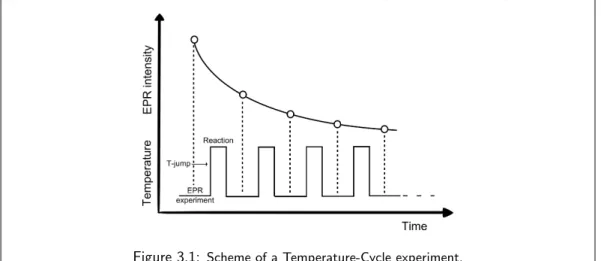
In this thesis, a laser-induced T-jump methodology was developed, in combination with
high-frequency Electron Paramagnetic Resonance (hence named T-Cycle EPR), for the investigation
of reaction kinetics between two chemically reactive species. The T-jump method developed here
has similarities with the one employed for relaxation studies. However, the important difference
with T-jump relaxation methodologies is that T-Cycle EPR involves the application of T-jumps
on a system that does not feature any chemical equilibrium, i.e., a frozen mixture of reactants
where no reaction is taking place. As such, the method is thus not developed with the aim of
observing the relaxation of the system back to its equilibrium state following a laser-induced
T-jump. Rather, the jumps applied here serve as ”heating shots” that warm up the system to
a temperature where a chemical reaction can take place for a certain amount of time, to which
follows the return of the system to a frozen state where no reaction occurs. This allows the
observation of the step-wise progress of a chemical reaction as a function of time, with no focus
whatsoever as regards the relaxation of the system.
An important aspect of the sample heating with a laser pulse for kinetic studies is that it
should take place homogeneously over the whole sample volume, so as to ensure a single,
well-defined reaction temperature of the sample – this being the equilibrium temperature between two
opposing driving forces, namely the heating by the laser pulse, and the cooling by the thermal
bath. To this end, a small sample volume is paramount, in order to maximize the rate of heat
to high-frequency EPR, which makes use of relatively small sample volumes. Evidence of the
homogenous heating produced by the laser pulses used in the setup of T-Cycle EPR described in
this thesis is given in Figure 1.2, where the 275 GHz cw EPR spectra of a solution of TEMPOL
in a mixture of water and glycerol are shown as a function of the nominal laser power. To
record these spectra, the laser was turned on continuously, and a spectrum was recorded for
different laser powers, in increasing order. These spectra can be easily interpreted and simulated
by taking into account one single spectral component (as described in the Appendix to Chapter
3), which implies they are not the summation of many different spectra that originate from zones
of the sample at different temperatures. The homogenous heating of the sample produced by
the laser-induced T-jumps applied here is facilitated by the small sample volume (about 20 nL),
and is in agreement with what has been reported by Azarkh and Groenen in [24].
A key point to achieve fast and homogenous T-jumps is the efficient absorption of the NIR
energy by the solvent molecules. Water has a broad absorption in its NIR spectrum peaking
around 1450 nm, originating from the first overtone of the O—H bond stretching [25]. The
absorption coefficients at 1600 nm (i.e., about the wavelength of the laser used in Chapters 3
to 5, at 1550 nm) of pure water [26], pure glycerol [27], and mixtures of water and glycerol
1:1 in volume [27] are, respectively, 7.7, 11.6, and 9.8 cm−1. In particular, the mixture of water
and glycerol has an absorption increased by roughly 25% as compared to that of pure water, an
observation in agreement with the work by Azarkh and Groenen [24].
1.5
Electron Paramagnetic Resonance
Electron Paramagnetic Resonance (EPR) is a powerful spectroscopic technique useful for
struc-tural investigations of paramagnetic species such as organic radicals, metal ions, or defect centres
in solids. Similarly to the more common Nuclear Magnetic Resonance (NMR), where
radio-frequency-induced nuclear spin transitions are measured, in EPR microwave-induced transitions
between electron spin energy levels are detected. Since the energy of the spin levels of an electron
are very sensitively influenced by its environment, valuable information can be extracted from
an EPR spectrum when the quantum mechanical energy description of the electron – its spin
Hamiltonian – is known. Nowadays, alongside the traditional continuous-wave (cw) approach in
EPR, more and more sophisticated microwave pulse sequences are being developed to provide
ever more detailed information on the spin systems of interest. Moreover, the technical
achieve-ments in microwave technology made EPR at higher microwave frequencies feasible, making it
very accessible and widespread, allowing improved spectral resolution (both in EPR and
1. INTRODUCTION
9.80 9.81 9.82 9.83 9.84 9.85
Magnetic field (T)
Figure 1.2: 275 GHz cw EPR spectra of TEMPOL, at a concentration of 1 mM, in solution with
a mixture of water and glycerol 95:5 in volume. The spectra are recorded with the laser turned on continuously at increasing optical power (top blue @ 0.0 W, bottom red @ 2.0 W), from a cryostat temperature of -50°C.
spin Hamiltonian (like the zero-field splitting), and a higher absolute sensitivity owing to a large
Boltzmann factor [12], not to mention that in certain systems the only possibility to induce EPR
transitions is with microwave quanta of high frequency. Hereinafter is a general introduction to
the basic theory of EPR meant to understand the spin systems studied in this thesis. Complete
treatments of the subject can be found, for instance, in [28] and [29].
1.5.1
The electron Zeeman effect and the
g
-factor
To illustrate the principles of EPR, the simplest paramagnetic system is considered first, namely
an isolated electron having a spinS=1/2. When a particle with non-zero spin is subject to an
externally applied magnetic field, the energy levels associated to its spin will split as a function of
the magnetic field (Equation 1.11), a phenomenon first observed by the Dutch physicist Pieter
Zeeman and thus called Zeeman effect. Quantum mechanically, energy levels resulting from such
H=geµBS·B (1.11)
where ge = 2.0023 is the g-factor of an isolated electron in the vacuum, µB is the Bohr
magneton,Bis the external magnetic field, andSis the electron spin. SinceBis oriented along
one direction (conventionally, z), only the magnetic field magnitude B0 is taken into account,
and therefore only theSzcomponent of the spin operatorS. In particular for the case ofS=1/2,
the eigenvalues ofSz aremS =±12, and the eigenvalues of the spin Hamiltonian of Equation
1.11 (namely, the energy levels of the electron spin) can be written asE±=±12geµBB0, which
evidences the dependence of the energy splitting on the external magnetic field.
The energy splitting of the spin levels is thus proportional to the magnitude of the external
magnetic field, but also depends on theg-factor, a quantity that acts as a proportionality constant
and is very sensitive to the magnetic environment of the electrons. In general, theg-factor is a
tensorial entity,g, and is calledanisotropicwhen the diagonal componentsgx,gy, andgzof the
matrix representation in the eigenbasis of gare not equal. When this is the case, the splitting
of the spin levels is different in different spatial directions, and the EPR transition arising from
the spin Hamiltonian of Equation 1.11 will be observed at different values of the magnetic field,
each one associated to a direction ofg.
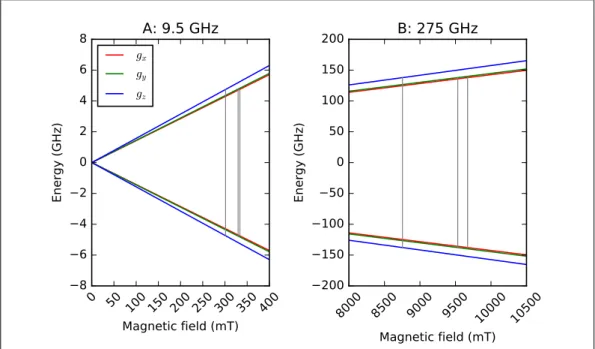
To better illustrate the Zeeman effect and the influence of an anisotropic g-factor, in Figure
1.3 are plotted the spin levels of an S = 1/2 system with a strongly anisotropic g (as is the
case for the system described in Chapter 5 of this thesis) as a function of the externally applied
magnetic field. At zero field, the spin states are degenerate, and by increasing the magnitude of
the external magnetic field, such states are split anisotropically and proportionally to gx (red),
gy (green), orgz (blue). When operating at 9.5 GHz (Figure 1.3 A), one of the most common
frequencies in EPR, the three transitions (depicted as grey lines) associated to the three different
values ofgare observed between roughly 300 and 350 mT. In particular, the two at higher field
(corresponding to gx and gy) are separated by about 5 mT. When going to higher magnetic
field, a correspondingly higher microwave frequency is required to match the energy difference
between the spin levels and induce an EPR transition. Figure 1.3 B shows such situation at the
EPR frequency of 275 GHz, with the three transitions associated to the anisotropicgspreading
between about 8700 and 9600 mT, and the two at higher field separated by about 140 mT. This
simple example highlights a fundamental advantage of high-frequency (HF) EPR versus
low-frequency (LF) EPR, namely a better resolution in magnetic field even for slightly anisotropic
1. INTRODUCTION
0 50 100 150 200 250 300 350 400
Magnetic field (mT)
−8
−6
−4
−2
0
2
4
6
8
En
e g
y (
GHz
)
A: 9.5 GHz
gx
gy
gz
800
0
850
0
900
0
950
0
100
00
105
00
Magnetic field (mT)
−200
−150
−100
−50
0
50
100
150
200
En
e g
y (
GHz
)
B: 275 GHz
Figure 1.3: Simulated electron spin energy levels for anS=1/2system with anisotropicg(whose
x, y, and z components are represented in red, green, and blue, respectively), subjected to the Zeeman effect in the presence of an external magnetic field. (A) EPR transitions at the microwave frequency of 9.5 GHz (gray lines). (B) EPR transitions at the microwave frequency of 275 GHz (gray lines). The g-valuesgx = 2.037, gy = 2.067, and gz = 2.25 are from [30]. Any other effect apart from the electron Zeeman is not included in the simulations, which are performed with EasySpin [31].
1.5.2
Electron spin – nuclear spin interaction: the hyperfine coupling
One of the most interesting properties of spins is their ability to interact with each other. The
interaction between electron spins and nuclear spins, called hyperfine coupling, provides a great
deal of information about the chemical environment of an electron. In the general case where one
electron with spinS =1/2interacts with one nucleus with spinI, the resulting spin Hamiltonian
can be expressed as:
H=geµBS·B−gNµNI·B+S·A·I (1.12)
where the first term represents the electron Zeeman effect, the second term represents the
electron spin and the nuclear spin. Like for the electron Zeeman term, also the nuclear Zeeman
term contains a nuclearg-factor,gN, and the nuclear magneton,µN. The hyperfine interaction
is represented by the tensor A, which can be viewed as composed of anisotropic contribution and ananisotropicone (similarly to thegtensor), namely A=aiso+T.
The effect of the Zeeman term on the nuclear spin is similar to that on the electron spin,
namely it splits the energy levels of the nuclear spin as a function of the external magnetic
field. To understand how this works, Figure 1.4 schematically illustrates the energy splitting of
a system composed of one electron spin S = 1/2 with isotropic g-factor, interacting with one
nuclear spinI = 1 (such as that of 14N). For simplicity, the terms of the spin Hamiltonian of
Equation 1.12 are applied separately and sequentially in the scheme. When no external magnetic
field is applied, all the energy levels of this S=1/2;I= 1 system are collapsed on one and
are thus degenerate (A). Upon applying a magnetic field, the electron spin levels are subject
to the Zeeman term (Figure 1.4 B) and are split according to the magnetic quantum numbers
mS = +1/2 andmS =−1/2, customarily labeled αandβ, respectively. Also the nuclear spin
is subject to the Zeeman term (Figure 1.4 C), so that each of the αand β states are further
split according to the magnetic quantum number of the nuclear spin, mI = +1, mI = 0, and
mI = −1. Lastly, the hyperfine coupling term applies on the aforesaid levels, shifting them
by an amount defined by the hyperfine tensor A (Figure 1.4 D). In the scheme of Figure 1.4,
only the isotropic component (aiso) of the hyperfine coupling is taken into account. It can be
appreciated how the single-line EPR signal arising from an isotropic g-factor and no hyperfine
coupling (Figure 1.4 B, bottom) is split into 2I+ 1 = 3 equally spaced lines (the spacing in
magnetic field being proportional toaiso) as a result of the hyperfine interaction with theI= 1
nucleus of14N (Figure 1.4 D, bottom).
In real systems, it is often the case that both the hyperfine coupling and the g-factor are anisotropic. When the spectral resolution is not high enough, as in low-frequency EPR, it can
be arduous to discern the various contributions of the A andg tensors on the EPR spectrum.
At LF-EPR, such contributions might be hidden within the spectral linewidth, which is often
broader than the magnitude of the hyperfine coupling itself, for instance. This can be visualized
in Figure 1.5, where a spectral simulation is provided of a system such as a nitroxide radical
(like TEMPOL, see Chapters 3 and 4), which features an unpaired electron with spinS =1/2
interacting with a 14N nucleus with spin I = 1. Both the g-factor and the hyperfine coupling
are anisotropic, so that each of the three components of g is split into 2I + 1 = 3 lines, for
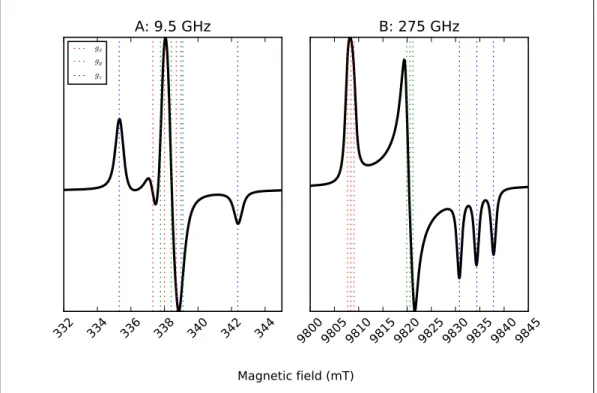
a total of in principle 9 lines. However, the 9.5 GHz spectrum of Figure 1.5 A shows a rather
1. INTRODUCTION
Figure 1.4: Energy diagram (not to scale) representing the effects of the spin Hamiltonian of Equation 1.12 for an electron spinS =1/2 interacting with a nuclear spinI = 1. (A) When no
external magnetic field is applied, the two spin statesms= +1/2andms=−1/2are degenerate. (B)
Upon application of a magnetic field, the electron Zeeman effect lifts the degeneracy of the electron
mS spin states. Here, the nuclear Zeeman effect is not taken into account yet, and the nuclearmI spin states are degenerate. When the g-factor is isotropic, a single transition arises (represented as a gray arrow), and a single-line EPR spectrum is observed (bottom). (C) A further splitting of the|mSmIispin states is caused by the nuclear Zeeman effect, which lifts the degeneracy of the nuclearmI spin states into 2I + 1 = 3 states. (D) As a result of the hyperfine coupling between the electron and the nuclear spin (here taken to be isotropic), the energy of the|mSmIispin states is shifted byaiso. Three transitions respecting the selection rules∆mS=±1and∆mI= 0arise (represented as red, green, and blue arrows), and the EPR spectrum will consist of 2I + 1 = 3 equally spaced lines (bottom).
splitting due to the Ax andAy components ofA are smaller than the spectral linewidth. The
red and green dotted lines indicate the field positions of, respectively, the transitions associated
to thegxcomponent and its Ax hyperfine component, and the transitions associated to thegy
to be discerned at 9.5 GHz, as shown by the peaks around 335 and 342 mT (the blue dotted line
represents the field positions of such transitions). All the other transitions are hidden within the
linewidth of the central peak around 339 mT, and cannot be resolved at the microwave frequency
of 9.5 GHz. However, going to HF-EPR offers a much clearer picture of the system under study.
In the spectrum of Figure 1.5 B, simulated for the microwave frequency of 275 GHz, the peaks
associated to the three transitions arising from the anisotropicg are clearly recognizable. The
hyperfine splitting of theAx andAy components is still too small as compared to the spectral
linewidth; however, theAzcomponent is large enough to give rise to three clearly separated lines
of thegz component around 9831, 9834, and 9837 mT. This example shows the advantages of
high-frequency EPR over low-frequency EPR also in determining the hyperfine components of a
paramagnetic system.
1.5.3
High-spin systems
So far, only the case of a single unpaired electron with spin S = 1/2 has been considered.
However, it is fairly common to come across paramagnetic systems with spin higher than 1/2,
such as transition metal ions (like in Chapter 2), or several electron spins ferromagnetically
coupled (like in Chapter 5).
In a high-spin system such as a transition metal ion, the unpaired electrons of the d(or f)
orbitals are subject to a second-order effect of the spin-orbit coupling known as zero-field splitting
(ZFS), which is a term that adds to the system’s spin Hamiltonian and takes the following form:
HZF S =S·D·S (1.13)
where Drepresents the zero-field splitting tensor. The name originates from the fact that
such contribution does not depend on the external magnetic field, and an energy separation
between the spin levels is present even in the absence of an externally applied magnetic field,
being an intrinsic property of the system.
In Chapter 2 of this thesis, the paramagnetic system under study is ad5Fe(III) center, which
turns from a high-spin (HS) S =5/2 state to a low-spin (LS)S =1/2state as a result of the
replacement of its axial ligand, which induces a change in the strength of the crystal field. Figure
1.6 shows the zero-field splitting of the spin levels for HS-Fe(III). It can be noticed how, even
in the absence of an external magnetic field (B0 = 0), the spin levels (arranged in degenerate
1. INTRODUCTION
332 334 336 338 340 342 344
A: 9.5 GHz
gxgy
gz
980
0
980
5
981
0
981
5
982
0
982
5
983
0
983
5
984
0
984
5
Magnetic field (mT)
B: 275 GHz
Figure 1.5: Simulated cw EPR spectra at 9.5 GHz (A) and 275 GHz (B) for an electron spin
S=1/2with anisotropicg-factor, with anisotropic hyperfine coupling with a14N nucleus with spin
I = 1. The colored dotted lines represent the field positions of the transitions associated to the
gx,gy, andgz components (in red, green, and blue respectively). Simulations are performed with EasySpin [31], with tensorsg= [2.0030,2.0058,2.0083]andA= [18,18,99]MHz set the same as for TEMPOL (see Chapters 3 and 4), and isotropic Voigtian linewidths (0.25 mT at 9.5 GHz and 0.5 mT at 275 GHz).
case, the zero-field splitting tensor is isotropic, and so large (D = 315 GHz [32]) that even at
room temperature only the lowest Kramers doublet (corresponding tomS±1/2) is populated,
and only transitions between themS = +1/2←→mS =−1/2levels can be observed.
Systems with spin higher than 1/2 can also be the result of separate electron spins at a
distance such that they can interact with each other. The electron–electron interaction consists
of a classically-viewed dipolar contribution, and a quantum-mechanicalexchange contribution:
0 5 10 15 20 25 30 35 40 Magnetic field (T)
−4 −3 −2 −1 0 1 2 3 En er gy ( THz )
m
S = ±52m
S = ±32m
S = ±1 2Figure 1.6: Simulated electron spin energy levels as a function of the external magnetic field for an
S=5/2system with isotropicgand isotropicD= 315 THz (from [32]). Simulations are performed
with EasySpin [31] showing thexdirection.
where, in analogy to Equation 1.11, the first term is the electron Zeeman effect, the second
term is the dipolar coupling between the two electrons (D12being the dipolar coupling tensor),
and the third term is the exchange interaction between the two electrons (J12being the isotropic
exchange coupling). The subscripts refer to electron 1 or 2.
In Chapter 5 of this thesis, the paramagnetic intermediate of the enzyme under study is
suggested to be a triplet system composed of a Cu2+ ion interacting with a tyrosyl radical (an
organic radical), both with spin S =1/2. Figure 1.7 shows the diagram of the magnetic field
dependence of the spin levels of a simplified system, namely one where theg-factor is isotropic
and there is no hyperfine interaction with the spin of the copper nucleus. As a result of the
interaction of two spinsS=1/2, anS = 0and anS= 1spin multiplicity are generated (named
singlet and triplet, respectively), whose energy separation is proportional to the exchange coupling
J12. The mS = 1 state of the S = 1 spin multiplicity is further split from the mS = 0 and
mS =−1states by the dipolar coupling tensor D12 at zero field. Transitions are possible only
1. INTRODUCTION
0
20
40
60
80
100
Magnetic field (mT)
−10
−8
−6
−4
−2
0
2
4
6
En
erg
y (
GHz
)
S
= 1S
= 0m
S=
+1m
S=
0m
S=
−1Figure 1.7: Simulated electron spin energy levels as a function of the external magnetic field for a triplet system made of two interactingS=1/2electron spins, with isotropicg, isotropic exchange
couplingJ12= 12 GHz, and anisotropicD12= [290,290,−580]MHz (from [30]). Simulations are
performed with EasySpin [31] showing thexdirection.
EPR transitions are called ”allowed” when they occur between spin levels with selection rule
∆mS = ±1. However, at LF-EPR, weaker transitions arise, called ”forbidden”, that deviate
from the aforementioned selection rule and, in the case of a triplet state, occur between spin
levels with ∆mS = ±2. These transitions, also called half-field transitions, occur when the
Zeeman terms of the spin Hamiltonians of Equations 1.13 and 1.14 (which are field-dependent)
are small in comparison to the ZFS or spin-spin interaction terms – in other words, when the
external magnetic field is low or, equivalently, when the EPR microwave frequency is low. Under
such circumstances, the spin levels are not well-defined by single magnetic quantum numbers,
but rather are a mix of them. The abundance of half-field transitions at LF-EPR makes the
resulting spectra extremely hard if not impossible to interpret, especially with systems with spin
S > 1. However, the spin levels of such systems are ”well-behaved” at high magnetic field,
namely when the Zeeman terms are bigger than the ZFS or spin-spin interaction terms, meaning
that the single spin levels can be correctly described by their magnetic quantum numbers, and
and interpretation of high-spin systems.
1.5.4
Slow-to-fast motion and rigid limit in EPR spectra
All the EPR spectra shown thus far originate from samples in the so-calledrigid limit, namely
samples whose paramagnetic species are not free to quickly rotate in any direction – a situation
proper of solids. When this is the case, the paramagnetic species in a solid matrix are bound
to a specific direction, and so are their electron spins. Such a rigid system is susceptible to
the orientation of the external magnetic field as compared to the orientations of its own
spin-Hamiltonian parameters, and the anisotropy (when present) is observable in the EPR spectra.
In particular, powders and frozen solutions (i.e., disordered glasses) can be seen as ensembles
of spins ranging all possible spatial directions – as opposed to single crystals, which have all
of their spins oriented in the same direction, thus giving rise to EPR spectra associated to one
specific spatial orientation. When the EPR spectrum of a powder is recorded (hence also called
powder spectrum), the spin transitions of all possible orientations are induced, and a continuous absorption is measured. In practice, however, the resulting powder spectrum does not look like
a continuous absorption as a result of the field modulation employed to record the spectrum,
which causes it to appear like a first-derivative spectrum. All the spectral simulations shown
before correspond to powder spectra.
The complete opposite case as that of a powder spectrum is when the paramagnetic species
are freely rotating in their medium, a situation that normally occurs with molecules in solutions,
and that is referred to asfast motion. Due to the fast rotational motion (or ”tumbling”) of the
paramagnetic species in the solution, all the anisotropic terms of the system’s spin Hamiltonian
average out. What is thus visible in the EPR spectrum of a paramagnetic species in a solution
is the mean value of thegtensor and the isotropic component (aiso) of the hyperfineAtensor.
The components of the D tensor average to zero in the fast-motion regime and the zero-field
splitting is thus not measurable.
An intermediate situation between the rigid-limit and the fast-motion regimes also exists,
namely when the medium containing the electron spins still allows rotational motion of the
paramagnetic species, but such motion is hindered by physical factors such as the high viscosity
of the solution (which is the case for the mixtures of water and glycerol described in Chapters 3
and 4) or steric effects (such as a spin label attached to a protein). As a result of these hindrance
effects, the rotational motion of the paramagnetic species is slowed down or, equivalently, their
rotational correlation time (τc) becomes longer, which affects the spin relaxation processes and
1. INTRODUCTION
rotates by one radian in a certain spatial direction, and it ranges from picoseconds for the
fast-motional regime, to nanoseconds up to microseconds for the slow-fast-motional regime. There are
several models to describe such slow-motion effects (like the Stokes-Einstein equation used in the
Appendix to Chapter 3 of this thesis), through which valuable information on the surroundings
of a spin system can be obtained, such as the temperature of a solution, or the conformation of
a spin-labeled protein.
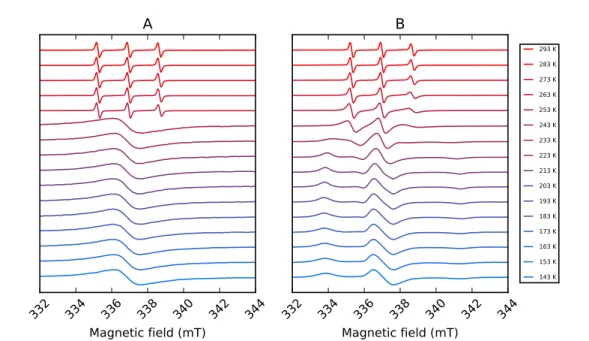
Nitroxide radicals such as TEMPOL exhibit important changes of the spectral line shape as a
function of their rotational correlation time. This is shown, as an example, in Figure 1.8, where
the spectral linewidth changes of solutions of TEMPOL are plotted as a function of the sample
temperature (in the range between 143 K and 293 K). A different dependence of the solution’s
viscosity on temperature affects the spectral shapes differently, so that a solution of TEMPOL
in pure water (A), and a solution of TEMPOL in a mixture of water and glycerol 1:1 in volume
(B) behave very differently as a function of temperature. Since the viscosity of liquid water does
not change much with temperature, the mobility of the molecules in the solution is fast and
roughly constant. This can be seen in the spectra of Figure 1.8 A in the temperature range
from 293 K down to 253 K, where the spectral line shape does not change much. The
three-line spectrum originates from the aiso component of the hyperfine interaction of the electron
with the 14N nucleus, as the anisotropic component is averaged to zero as a result of the fast
rotational motion of the molecules in the solution. From 243 K down, the solution freezes and
a powder spectrum arises, which has however an unusual shape. This is due to the fact the
TEMPOL molecules, at a relatively high concentration, form clusters in the absence of glycerol
in solution, becoming close enough to each other for their spins to interact intermolecularly,
which results in a broadening of the line shape. Figure 1.8 B shows a rather different situation,
because the viscosity of water and glycerol solutions varies greatly with temperature, affecting
the rotational motion of the molecules and thus the spectral shape. A progressive spectral
broadening is visible in the temperature range between 263 and 233 K, this being the range
where the sample transitions from a fast-motion regime through a slow-motion regime, down to
a rigid-limit regime. The plot of Figure 1.8 B highlights the importance of glycerol added to the
solution, which has a ”de-clustering” effect on the TEMPOL molecules. As a result, the changes
in the spectral line shape of TEMPOL are easy to interpret and simulate, yielding information
332 334 336 338 340 342 344
Magnetic field (mT)
A
332 334 336 338 340 342 344
Magnetic field (mT)
B
293 K 283 K 273 K 263 K 253 K 243 K 233 K 223 K 213 K 203 K 193 K 183 K 173 K 163 K 153 K 143 KFigure 1.8: 9.5 GHz cw EPR spectra of solutions of TEMPOL at a concentration of 2 mM, (A) in pure water and (B) in a mixture of water and glycerol 1:1 in volume. The spectra were recorded with a Bruker Biospin EMX 080 EPR spectrometer, in the temperature range between 143 K and 293 K, controlled by a nitrogen-flow cryostat ER4131VT temperature control system (Bruker).
1.5.5
Home-built 275 GHz EPR spectrometer
The EPR spectra at the microwave frequency of 275 GHz described in this thesis were performed
on a spectrometer built around 2000 by Blok and coworkers at Leiden University, and described
in great detail by the same authors in [34]. The construction of such spectrometer was driven
by ever-growing interest in HF-EPR, after spectrometers at frequencies such as 95 and 140 GHz
became commercially available.
Here, a brief description of the setup is provided. A simplified block diagram of the home-built
275 GHz EPR spectrometer is shown in Figure 1.9, and consists of four main parts:
(A) Two microwave sources, producing two microwave beams at the frequencies of 91.9 GHz
and of 89.7 GHz, which are sent to diode triplers that return the frequencies of 275.7 GHz
and 269.1 GHz. The former is the frequency used to excite the sample, while the latter
1. INTRODUCTION
(B) A microwave bridge operating in reflection mode, suitable for both cw and pulsed
experi-ments. It transmits the incoming microwave frequencies to and from the resonant cavity
with a quasi-optical transmission setup, which allows the confined beams of
electromag-netic waves to travel in free space, thus making the transmission losses negligible – as
opposed to conventional waveguide technologies at such high frequencies.
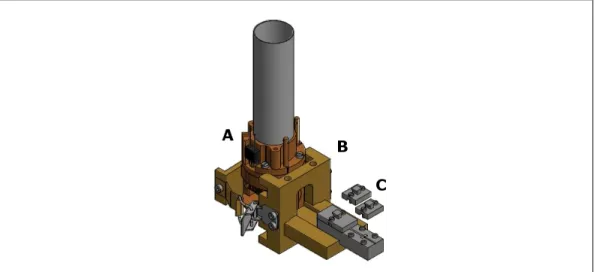
(C) A single-mode, tunable resonant cavity which is located at the bottom of a
variable-temperature helium-gas flow cryostat placed at the center of a superconducting magnet.
The cavity is coupled to the microwave bridge through a corrugated circular waveguide
whose geometry maximizes the microwave coupling and minimizes the transmission losses.
The cavity has an absolute sensitivity as high as 108spins per mT. The cylindrical cavity
has a diameter of 1.4 mm and a length between 0.8 and 1.4 mm that can be varied with
two plungers located at both sides, which move synchronously and symmetrically inward
and outward so as to allow the tuning of the cavity. Underneath the cavity is a coil that
generates the field modulation for cw experiments, and a grid that allows irradiation of
the sample from an external source.
(D) A superconducting solenoid magnet capable to reaching 14 T. The scan-to-scan field
stability is less than 0.1 mT, while the day-to-day field stability is less than 1 mT.
The microwave beam reflected from the resonant cavity, carrying the EPR signal, is
trans-mitted through the corrugated waveguide back to the bridge, where it reaches a Martin-Puplett
diplexer, which combines the EPR signal at 275.7 GHz with the local oscillator at 269.1 GHz,
giving both the same well-defined polarization. The coupled output signal is then directed to
a polarization-sensitive microwave mixer where a signal is produced at the so-called
intermedi-ate frequency (IF) of 275.7−269.1=6.6 GHz. The IF signal is finally amplified and fed to a
2
Effective coupling of Rapid
Freeze-Quench to High-Frequency
2.1
Introduction
Determination of reaction rates and detection of short-lived intermediates of fast chemical
reac-tions are an important goal in those fields that involve molecular chemistry, such as biochemistry,
pharmaceutics, medicine, environmental science, and material science, to name a few.
Kinet-ics and intermediates shed light on the mechanism of a reaction, which in turn yields broader
information about the chemical system under study.
One possible stratagem to investigate chemical kinetics is that of letting the reaction unfold
for controlled time steps and then ”freezing” it. In this way it is possible to follow the decay
and growth of reactants and products, or the evolution of reaction intermediates. One of the
most widely used techniques to attain this is called Rapid Freeze-Quench(RFQ), in use since 1961 [18], which is often coupled to Electron Paramagnetic Resonance (EPR) in view of the
paramagnetic nature of the intermediates of a great deal of chemical reactions.
The multi-frequency approach in EPR is of particular interest, namely when low-frequency
experiments (e.g. those at the standard frequency of 9.5 GHz, called X-band) are combined
with high-frequency ones (HF-EPR, e.g. those at microwave frequencies of 95 and 275 GHz).
Such approach offers a better and more complete characterization of the magnetic system under
study. However, collection of RFQ samples is – to say the least – problematic for applications in
HF-EPR, because the size of HF resonant cavities is hugely reduced as compared to the standard
9.5 GHz EPR, thus making the sample holders and the sample volume dramatically small. In
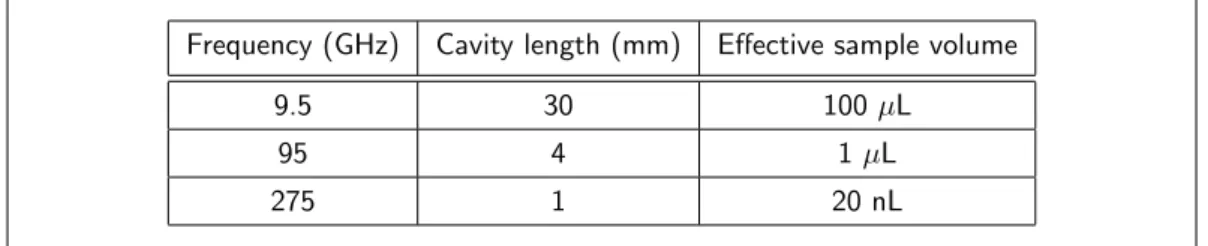
Table 2.1 is shown a comparison of the typical sample volumes used for three EPR frequencies,
namely 9.5, 95, and 275 GHz. The sample volume downsizes by about 104times going from low
to high frequency. It is therefore vital to develop a sample packing technique that guarantees
an efficient, homogeneous, and reproducible sample collection in the small capillaries used as
sample holders for HF-EPR.
Frequency (GHz) Cavity length (mm) Effective sample volume
9.5 30 100 µL
95 4 1µL
275 1 20 nL
2. EFFECTIVE COUPLING OF RFQ TO HIGH-FREQUENCY EPR
In the literature there have been endeavors to implement and standardize packing techniques
for RFQ-EPR applications [35] [36] [37] [38] [39] [40] [21].
Ballouet al.[35] and Oellerichet al.[36] are the earliest reported attempts to study a chemical reaction detected with X-band EPR on a timescale of less than 80 ms. Although of great interest
given the short timescale, both authors attribute the large inaccuracy on the reaction rates (errors
bigger than 10%) to the nonuniform and irreproducible packing of the RFQ particles. Indeed,
in both papers the authors report a rather low and nonhomogeneous packing efficiency, between
0.5 ÷ 0.7 the former, and between 0.4 ÷ 0.6 the latter. Oellerich even concludes that this
problem constitutes an ”intrinsic deficiency of freeze-quench EPR spectroscopy”, and indeed, as
described below, this is a serious issue not easily circumvented.
Namiet al.[37] propose an improved method to collect and pack RFQ particles from an
isopen-tane suspension, based on pumping said suspension through an EPR tube in which a filter has
been placed. The RFQ particles are trapped at the filter and the isopentane is easily removed.
The advantages of this method are its reproducibility and efficiency: the authors report a
pack-ing factor between 0.68÷0.76, which is indeed a considerable improvement, also compared to
previous studies (see below). A slightly modified version of this method is applied in this work.
Schuenemann et al.[38] are the first to report the application of RFQ to HF-EPR in a multi-frequency EPR study (at 9.6, 94, 190, and 285 GHz), on a timescale of up to 40 ms. Although
HF-EPR implies dealing with sample holders of reduced size, the method used by the authors
to pack the RFQ for HF-EPR is basically the same as for low frequency, i.e., compacting the
sample sprayed in a tube of the appropriate size by means of a metal rod. However, the authors’
focus is to detect the reaction intermediate of the reaction under study, rather than its reaction
rate, so that inhomogeneous sample packing is of no concern to them.
In the context of RFQ-HFEPR, Manzerova et al. [39] bring about an innovative method to
freeze-quench reactants, reduce them to fine particles, and collect them. They report a
technol-ogy based on rotating copper wheels kept at a temperature of 80 K, on which the mixture of the
reactants is sprayed through a home-built nozzle. The reactant mixture is thus freeze-quenched,
and the sample is then ”scraped” off the wheels and collected by tapping with a capillary suitable
for 130 GHz EPR. Although such approach introduces the advantage of not having to handle
static frozen particles floating in isopentane, the packing factor the authors report is 0.5, thus
being no improvement as compared to those from the aforementioned studies.
All of the aforesaid publications require a large amount of sample, which is often a disadvantage
when working with biological samples. Kaufmannet al. [40] and Pievo et al.[21] reported the development of, respectively, a micro-fluidic mixer (after its introduction by Cherepanov and de
for RFQ-HFEPR studies of biological samples. It is interesting that Kaufmann also implemented
a new way of collecting the RFQ samples, based on the idea of Manzerova [39]: they use a
rotating aluminum plate kept at a temperature of 80 K, on which the reagent mixture is sprayed
and freeze-quenched. The RFQ powder is then collected by tapping the capillary on it. However,
the packing efficiency is not mentioned, while in [21] a packing factor of 0.5÷0.6 is reported.
From the cited literature thus emerges a serious difficulty in RFQ-HFEPR when it comes to
collect RFQ particles and study them in a standardized, efficient, and reproducible way.
In the literature, a common and practical way of testing the performance of RFQ-HFEPR is
making use of the binding reaction of sodium azide to myoglobin. This reaction (Scheme 2.1)
is a well-understood model system that offers several advantages in EPR studies because of its
convenient spectral properties [35] [36] [21].
[Fe3+HS—OH2] +N−3 →[Fe 3+
LS—N
−
3] +H2O (2.1)
Myoglobin (abbreviated Mb) is an iron- and oxygen-binding hemoprotein, similar to hemoglobin,
whose function is that of reversibly storing and transporting oxygen in the muscle tissues of many
vertebrates [41]. At neutral pH, the heme iron (Fe(III), ad5ion) of ferric myoglobin (also known
as met-myoglobin) exhibits an octahedral coordination environment with one of the axial po-sitions being occupied by variable ligands. The nature of such variable ligands determines the
energy splitting between the upper and lower groups ofd orbitals. Water can be one of these
ligands, and weakly binding to the heme-Fe(III), thus generating a high-spin (HS)S=5/2state.
However, when an exogenous strong-binding ligand such as azide (N−3) replaces the axial water
molecule, the stronger ligand-field effect induced on Fe(III) converts its spin state to low-spin
(LS) withS=1/2. Scheme 2.1 illustrates the binding reaction of azide to myoglobin.
The spectral features of HS- and LS-Fe(III) are completely different, the former having an
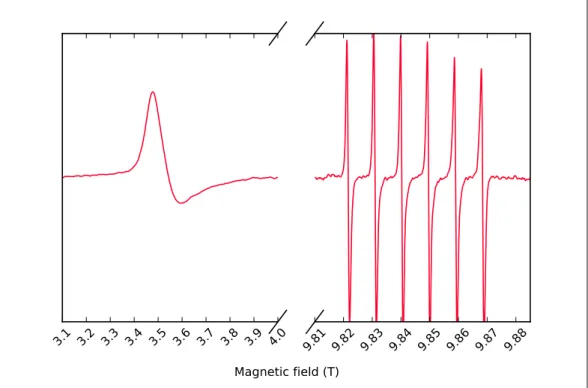
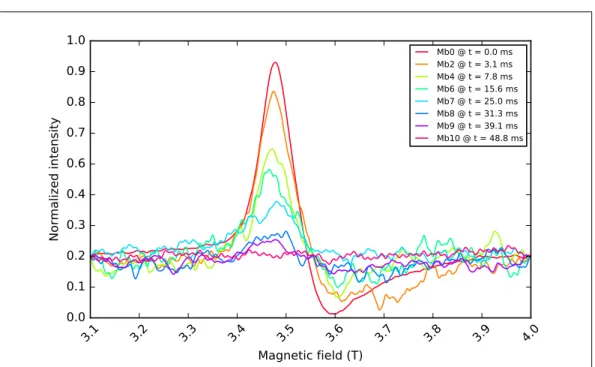
in-tense signal aroundg= 6, while the latter having a rhombic signal aroundg= 2. Such features
turn out to be so handy that the binding reaction of sodium azide to myoglobin has become a
standard when evaluating RFQ-EPR methods, both at low and high frequency [35] [36] [39] [21].
The present work originates from the premises cast by Nami in her PhD thesis [42], who
explored the feasibility of multi-frequency EPR coupled with RFQ making use of the binding
reaction of sodium azide to met-myoglobin, based on an improved method to pack and load
cap-illaries for HF-EPR [37]. However, her investigations at high-frequency EPR (95 and 275 GHz)
yielded unconvincing results, given the huge scatter of the data points. The two main limitations
2. EFFECTIVE COUPLING OF RFQ TO HIGH-FREQUENCY EPR
• The reaction time scale selected for the study was very short, namely less than 10 ms for a reaction with a characteristic time twice as long;
• The manganese(II) ions introduced in the RFQ samples, used for internal calibration, were originally mixed in the sodium azide solution, rather than in the myoglobin solution. In this
way, theMb/Mn2+ratio is affected by possible irreproducible mixing of the RFQ apparatus,
which results in an inconstant ratio for different RFQ samples.
For these two reasons, in this work it was chosen to select a longer time scale for the myoglobin
reaction of Scheme 2.1 (namely, up to∼50 ms), and to add MnCl2 to the myoglobin solution,
rather than to the sodium azide solution, prior to mixing in the RFQ apparatus.
Another critical aspect of this study is the packing of the RFQ samples in the sample holders
suitable for 275 GHz EPR, namely quartz capillaries with an inner diameter of 150µm, hosting
a sample volume of 20 nL in the resonant cavity. While the general procedure to prepare the
X-band RFQ samples is the same as described in [42], an improved method for sample preparation
for 275 GHz was devised.
2.2
Experimental
2.2.1
Materials
Equine-heart met-myoglobin, sodium azide (NaN3), and DMSO were purchased from
Sigma-Aldrich (cat. n. M1882-1G, 15,795-3, and 154938-1L respectively). MnCl2 was purchased from
Baker Chemicals (cat. n. 0173). Myoglobin was dissolved in phosphate buffer 100 mM at
pH 7.8, with the addition of 5% v/v DMSO and 50 µM of MnCl2, to form a solution with
concentration 2.4 mM. Sodium azide was dissolved in phosphate buffer 100 mM at pH 7.8 to
form a solution with concentration 24 mM. After RFQ mixing, the Mb:azide ratio is 1.2:12 mM.
The concentration of the myoglobin solution was determined spectrophotometrically using the
extinction coefficient505=9.7 mM−1 cm−1.
2.2.2
Sample preparation
Ten RFQ samples (named Mb1 to Mb10) were prepared with the same RFQ apparatus and
method described in [37] (2-mL syringes, ram velocity 3.2 cm s−1, displacement 3 mm), at a
ten samples were initially measured at 9.5 GHz, and later (about a year after), the same were
used for measurements at 275 GHz.
Table 2.2 summarizes, for each RFQ sample, the corresponding reaction time, that is calculated
from the parameters used in the RFQ setup, and not corrected by the so-calledfreezing time.
RFQ sample label Mb1 Mb2 Mb3 Mb4 Mb5 Mb6 Mb7 Mb8 Mb9 Mb10
Calculated reaction time (ms) 2.0 3.1 4.9 7.8 9.8 15.6 25.0 31.3 39.1 48.8
Table 2.2: Calculated reaction time of the RFQ samples.
In addition, two myoglobin solutions without any sodium azide were prepared (labeled Mb0),
meant to represent reaction 2.1 before it has started, namely at t = 0. For the spectra at
9.5 GHz, the Mb0 solution was prepared from the same batch used to prepare the RFQ samples.
However, for the spectra at 275 GHz, since about a year passed from the preparation of the RFQ
samples, the Mb0 solution was made from an independent batch, but with identical composition
as described in Subsection 2.2.1.
Sample packing for 9.5 GHz EPR
The preparation of RFQ samples for 9.5 GHz EPR is a procedure that was successfully
standard-ized by Nami [37]. With this procedure, the RFQ samples are straightforwardly packed in quartz
tubes, readily used as sample holders for 9.5 GHz EPR. The essential steps of this procedure,
conducted in a polystyrene box filled with dry ice pellets, are briefly reported below:
• The quartz tubes (10 cm long, 3 mm inner diameter) are open on both sides, and are cus-tomized by tapering them on one side. This allows the accommodation of a polypropylene
disk used as a filter.
• The tapered end is connected through a latex tubing to a hand-held 60-mL Norm-Jet disposable syringe used to create underpressure (instead of a water aspirator, as described
in the original procedure).
• While manually creating underpressure in the syringe, the other side of the quartz tube is dipped in cold isopentane contained in a vial in contact with dry ice. The isopentane is
2. EFFECTIVE COUPLING OF RFQ TO HIGH-FREQUENCY EPR
• By maintaining the underpressure in the syringe, the pre-cooled quartz tube is quickly transferred into the vial containing the RFQ sample in cold isopentane. This vial has
previously been lain on dry ice to ensure thermal contact. By pushing the quartz tube
to the end of the sample vial (and making sure that the filter-containing tapered part is
always in contact with dry ice so as to prevent the sample from warming), the RFQ sample
is sucked up the tube and accumulates through it thanks to the filter. With the settings
of the RFQ apparatus described above, a 3-mm quartz tube is typically filled with roughly
4 to 5 cm of sample.
• When all the isopentane contained in the sample vial has been aspirated, the latex tubing is cut and the quartz tube is stored in liquid nitrogen. As opposed to the procedure described
in [42], the sample in the tube is not further packed more tightly with a steel rod because
of the relatively big amount of sample present in the tube, and because a tighter packing
would result in a more difficult handling for applications at 275 GHz (see 2.2.2).
The quartz tubes prepared in this way are ready to be measured with a 9.5 GHz EPR
spectrometer, and do not need further treatments.
Sample packing for 275 GHz EPR
The preparation of RFQ samples for 275 GHz EPR is by far more complicated than for 9.5 GHz
EPR. The minuscule size of the capillaries used as sample holders (150µm inner diameter) poses
a twofold problem. Firstly, accidental warming of the samples is easy and fast, in view of the
tiny volumes involved. For this reason, since the warming of the samples has to be avoided at
all costs, they have to be handled at cryogenic temperatures. This leads to the second issue,
which is the difficulty of handling such small capillaries in a cryogenic atmosphere, while wearing
cryoprotective gloves that reduce the user’s hand sensibility.
A successful sample packing in capillaries for 275 GHz EPR is thus a troublesome procedure
that requires a trained operator. Following is a description of the basic steps of this procedure
(as reported in essence in [42]), which is carried out in a polystyrene box half-filled with liquid
nitrogen. Thanks to a flow of cold nitrogen gas blowing on the surface of the liquid nitrogen,
the average temperature in the box within the first 10 cm from the liquid nitrogen surface is
kept below -100°C.
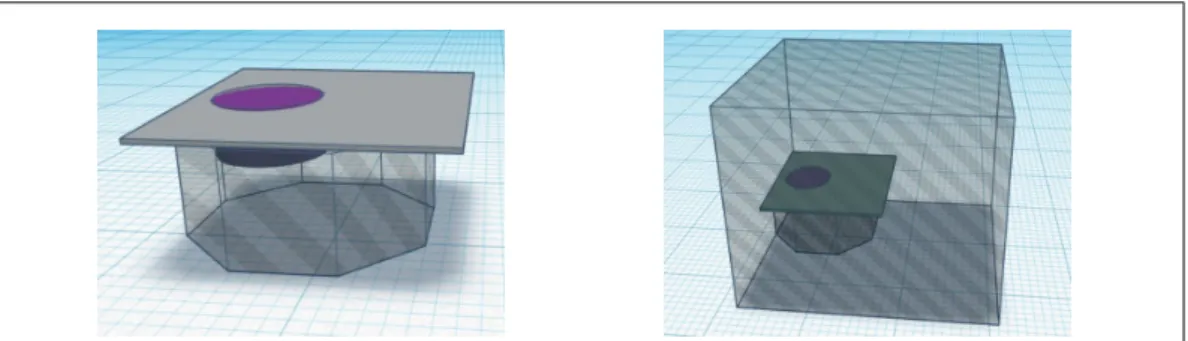
• A home-built stainless-steel plate (15×15 cm) is placed on top of an octagonal polystyrene box (14 ×14×6 cm). The plate has a central hole (6 cm diameter) that accommodates
an agate mortar (whose surface sits at the same height as the plate), tightened with