Advisor: Denise Anthony
Researchers aimed to establish current criteria, procedure and qualifications for rarity assessment in law libraries through a survey of law school library staff. Seventeen librarians from relevant departments responded to the survey. While only about half of respondent institutions conduct rarity assessment, there is a degree of commonality to the criteria used in these assessments. Responses indicate that age and item status at sister institutions are the most common criteria in determining rarity. Survey responses also indicate that while rarity assessment is a task conducted by multiple staff members, little time is actually spent conducting assessments. Moreover, while respondents hold
relevant, full-time staff positions and, in some cases, upper and middle management roles, very few have any formal education in rarity assessment.
Headings:
Rare books
RARITY ASSESSMENT IN LAW LIBRARIES: A SURVEY OF CRITERIA, PROCEDURE AND QUALIFICATIONS
by
Edward H Stocking
A Master’s paper submitted to the faculty of the School of Information and Library Science of the University of North Carolina at Chapel Hill
in partial fulfillment of the requirements for the degree of Master of Science in
Information Science.
Chapel Hill, North Carolina April 2019
Approved by
Table of Contents
I. Introduction ... 2
II. Literature review ... 3
III. Methods... 7
IV. Results ... 9
VI. Conclusion ... 17
VII. References ... 19
I. Introduction
Special Collections are a part of many libraries. They are the collections librarians
highlight in order to display the prominence of their library’s holdings. In the case of
special libraries---specifically in academic settings---special collections are an organic
result of an institutions’ age; a product of donations; and an effort to display an institution’s prominence often supplemental to the guidelines of the collection
development policy. This can pose an interesting challenge for special librarians, who are
responsible for these collections of rare and unique items but often are not trained in
bibliography or assessment of rare or historic materials.
Historically, the antiquarian book field is dominated by sellers, and value is
determined predominantly by booksellers before auctions or sales. Sellers do little to
explain the reasons for prices. Thus, it is difficult to understand what drives value.
Simply put, in the business of rare books, information is controlled and rarely distributed.
This may be acceptable for rare book dealers and buyers but makes assessment far more
difficult for library staff for whom rare manuscript education would be excessive, due to
the desperate nature of law librarianship and archival education.
This research focused on determining if there were common rare book assessment
practices in special libraries, specifically in the criteria and processes law school
librarians use to determine rarity. . The researcher used a survey to gather this
information. The survey also aimed to understand who is responsible for rarity
assessment by gathering job title information, as well as their formal education on the
topic. The analysis of the data the respondents supplied provides an indicator of common
II. Literature review
Guidelines and practices determine assessment standards. The focus of this area
of research is to determine basic trends in valuation, because the value of a book is
determined by a variety of factors. Reading broadly about polices for transferring books
from general to special collections and general collection development serves a similar
end and could be a different route to take for deliverables. Understanding how purpose
shapes collecting decisions can also impact what librarians factor into rarity assessment.
The literature for this subject falls into a few subcategories: guidelines on policies,
guidelines on assessment, and bibliography.
Guidelines on policy include information on transfer material and collection
development. These have been helpful for understanding the goal of rare collections. The
Association of College & Research Libraries (ACRL) provides a structure for writing “Guidelines on the Selection and Transfer of Materials from General Collections to
Special Collections”. It defines the transfer policy as the document of most importance.
The ACRL document also identifies six transfer criteria: market value; rarity and
scarcity; date and place of publication; physical and intrinsic characteristics;
bibliographic and research value; and condition (ALA 2007). For some, the special
collection policy also focuses on specific collection types or subjects (Arizona State
Library Archives and Public Records). Further review in this area is out of scope for this
current study, because this research seeks to establish a baseline for transfer, not for the
collection.
Library staff can determine the six criteria with varying degrees of ease.
other criteria, including date and place of publication; bibliographic and research value;
and rarity and scarcity as these are elements of catalog records and are accessible via
OCLC WorldCat.
Guidelines on assessment are paramount for crafting a proper understanding of
current views on rarity. The literature discusses rare books in a variety of ways that will
be useful for this research. Some attempt to get to brass tacks, some attempt to flush out
intangible qualities of value, and some focus setting. In all, each approach is telling when
seeking to define rarity. However, finding sources that try to explain rarity in simple
terms are hard to come by. Assessment is a profession and a huge industry, so the
information is tightly controlled. In some cases, rarity is not something that can be simply
decided (Sheehan). There are intangible qualities that change a book’s value, or (more
likely) the decision to mark a book rare has little to do with its content. Sometimes, a
signature or bookplate is enough. In cases such as these, the book has little inherent
value. There are two specific studies in the medical library field that are useful for
conducting rare book assessment in special libraries (Annan, Gnudi). Both discuss similar
criteria as the ACLR guidelines, but also note popularity as a cause for collection. So,
overall, what is the relationship between these articles and the research you did? Did they
not give you sufficient information so that you needed to ask your survey questions? Bibliography is the study of a book’s physical qualities. Understanding the book and
being able to discuss its defining features is useful in understanding rarity. Often the
bibliographic qualities are important in understanding the conservation needs of a book (Annan). Understanding a material’s condition also enables assessors to make
often work in tandem to determine rarity (Sheehan). Finally, bibliography is often a first
step in the assessment process, because most assessment begins serendipitously
(Korotkova).
Special collections differ from special libraries because of their inherent focus on
rare materials. As such, the workers employed in special collections have a familiarity
and education set that allows them to manage rare material appropriately (Bowden).
Given the focus on rare materials, special collections librarians use their materials
differently than special librarians (Bahde). Specifically, in special libraries rare books are
used in instruction and well as advocacy, while rare book rooms in special libraries often
are only used when requested by patrons. Moreover, Special collections and special
libraries do not always collect the same level of rare materials (Latham). Most
importantly, special collections spend more time dealing with their rare material, and
therefore have a better understanding of what they have accumulated through their
collecting. It is this reason that transfer policies are so important, because they are the
standard by which special librarians move items between their general and rare
collections, a dichotomy not present in a rare books library.
This is the other side of the coin when studying rare book collections in special
libraries: It is also important to understand the needs and limits of the general collection.
For example, decisions about transferring materials are complex because they could
affect access. Special librarians conceive of rarity assessment as a supplementary role
(Dystert). It is largely a form of upkeep, brought about by a need to preserve materials
(Westney). Ironically, although often viewed as an additional service, rare books often
Librarians in special libraries must also contend with the limits of their software, as
MARC cataloging and most ILS are insufficient for properly describing ephemera and
III. Methods
Recruitment
Because this study focused on rarity assessment in law libraries, the researcher
recruited librarians listed in the top 100 law school libraries in America based on a 2010
ranking by The National Jurist. While there are several law school rankings, this ranking
put significant weight on collection size and number of full-time professional librarians.
An underlying assumption of the researcher was that higher circulation loans would
imply a greater need to move an item to a rare collection. After compiling the list of
libraries, the researcher assembled their respective library directories. The researcher
attempted to find the most pertinent individual based on job title, highlighting archives,
rare books and manuscripts, special collections, collection services, and finally
circulation services. The researcher contacted the individuals via the emails listed on the
directory.
Data Collection
The researcher gathered research via Qualtrics survey, see appendix. The survey
consisted of 11 questions in three parts. (See appendix for survey questions) Part One
asked four questions related to the criteria for rarity assessment in the participants law
library and relevant forms. Part Two included five procedural questions relating to the
priority and systems in place at the participants’ law library. Part Three included two
professional questions regarding the participants title and education background. The
in a response rate of 22.5%. The researcher sent the email twice, on sequential Tuesday
IV. Results
Data Analysis
Part One:
Only half of survey respondents undertook rarity assessment in their law libraries.
Of these, only 3 attached formal documents or workflows. Assuming the likelihood of
rarity assessment decreases with collection size and prominence of library, it is difficult
to ascertain the sample size. Anonymity was kept out of respect for the privacy of
participants, but a further study focused on a more specific set of law libraries, such as the so called “Top 14” law schools could create a more authoritative set of standards, at
the expense of sample size.
Of the 17 completed surveys, seven participants indicated their institutions did not
conduct rarity assessments. Nine indicated yes, while another completed the survey
without selecting an answer for Question 1. Three participants attached forms as
requested in Questions 2 and 3. These were: a holdings limit based on year, a rare book
collection development policy, and a Qualtrics rarity assessment flowchart. Question 4
was a multipart question that asked respondents to enter values based on five possible
rarity metrics. These included age of material (9 answers), global holdings (6 answers),
rarity status at other libraries (7 answers), circulation statistics (3 answers), and an option
Chart 1: Factors in Rarity Assessment
Table 1: Specific Criteria for Rarity Assessment Q4.1
Age
Q4.2 Holdings Q4.3 Rarity Status Q4.4 Circulation
1830 5 Duke Sometimes
1850 (2) 10 Emory No specific Number
1876 30 Harvard (3) Avoid items with heavy use
1900 (2) 100 University of California 1923 Worldcat University of Texas
Yale (3) Regional (2) U.S.A.
While other samples could provide more answers of a specific context, results of
this survey indicate a degree of consistency in criteria for the broad range of law libraries.
Without a doubt, the criterion most used is age. This is unsurprising, as rarity of any item
importance among survey takers. Although over half of the respondents consider size of
holdings in rarity assessment, there is greater variance in holdings. There is more
commonality with inter-institutional status. While 75% looked to other institutions, half
specifically mentioned Harvard or Yale, who were also solicited in the study and are
believed to have answered. Whether due to question error or difference of opinion, there
is no conclusive evidence about its importance. While high circulation means degradation
of book quality, the answers suggest opposing viewpoints on the effect of circulation. To
quote one answer: “we try to avoid removing an item from general circulation if it is our only copy and is heavily used by patrons. We don’t want to restrict access.”
Q4.5 Other Metrics
Statehood and state history (3) Artistic qualities (2)
Relation to law school faculty Condition (4)
Older foreign and international materials Marginalia (2)
Existing collection areas (4)
Question 4.5 provided respondents with the opportunity to write in other criteria
which are considered in their institutions. Question 4.5 had 10 survey responses,
presumably submitted from the respondent who chose not to answer Question 1. While
the results expressed a number of other criteria, four responses indicated increased
importance to items in existing collecting areas. Four others mentioned items of good
condition given age, along with two mentioning artistic qualities and two mentioning
marginalia. While also falling under collecting areas. Three mentioned items that dated to
early statehood or held importance to a state’s legal history. Finally, one mentioned
Part Two:
Part Two asked questions regarding procedures surrounding rarity assessment.
Question 5 asked participants to name platforms, software, or applications used to
conduct rarity testing. Of seven answers, four use OCLC WorldCat. Six mention OCLC
or World Cat directly. One mentions Qualtrics, which the researcher connects to a
Qualtrics workflow attached in a Q3 answer, which uses World Cat to derive holdings.
Question 6 asked participants to explain how they select candidates for rarity assessment.
Four indicated age as a primary factor as seen in Q4.1. Furthermore, however two of the
four answers indicated desire to change current policy.
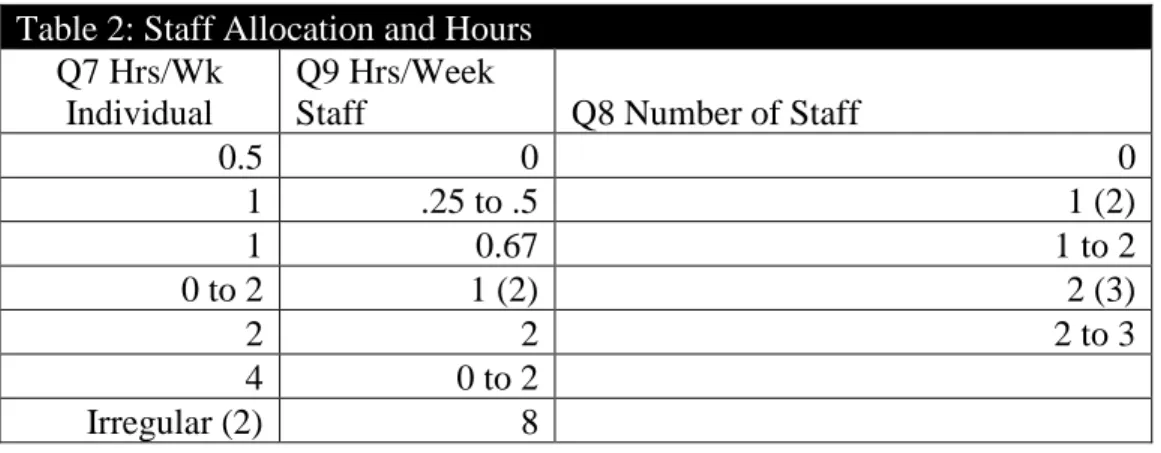
Table 2: Staff Allocation and Hours Q7 Hrs/Wk
Individual
Q9 Hrs/Week
Staff Q8 Number of Staff
0.5 0 0
1 .25 to .5 1 (2)
1 0.67 1 to 2
0 to 2 1 (2) 2 (3)
2 2 2 to 3
4 0 to 2
Irregular (2) 8
Question 7 asked participants how many hours a week they allocate to rarity
assessment. Two indicated no set time, three less than 1 hour, two were 2 hours or less,
and 4 hours was the largest answer. Question 8 asked how many staff members assist in
rarity assessment. As indicated by the Table Two, in the respondent libraries, no more
than three staff member work on assessment with two being the median number of staff
responsible for rarity assessment. Much like Question 7, Question 9 asked how many
hours a week all staff put into rarity assessment. Five respondents indicated less 1 hour,
Table 3: Job Title Q10 Title
Director of the Law Library
Reference and Faculty Research Services Librarian Associate Director for Collection Management Head of Collection Services
Head of Technical Services & Special Collections Head of Special Collections
Special Collections Librarian & College Archivist Special Collections Librarian (3)
Digital Content and Special Collections Librarian Rare Book Librarian
Intern Part Three:
Part Three questions were about professional level and education. Question 10
asked participants to list their current title. With the exception of one intern, all of the
respondents were in full time staff positions; five were department heads, including one
Director of the Law Library. While the majority of respondents work in collection
services, the researcher credits this to the sample population as well as their usual job
descriptions.
Question 11 asked participants about their level of coursework in rare
assessment. Of the 12 answers, 8 had no formal education involving rare books. One had
experience only through workshops and conferences. Three had formal rare book Table 4: Education
Q11 Level of Coursework High Level (2)
Two courses (1)
Workshops/Conferences (1)
coursework at library schools. While this does not directly indicate the education level of
all staff people conducting assessment, considering the survey requested individuals most
directly involved in assessment, assisting staff would be less influential in assistance.
However, this is inconclusive, considering some participants may have had formal
V. Discussion, Limitations, and Opportunities for Further Research
Question 4.4 “When conducting rarity assessment, [considering c]irculation
statistics. How many loans are deemed significant?” provided an interesting set of
answers. While only receiving three responses, the question sparked interesting answers,
and opportunity for further research. The underlying assumption of the researcher was
that higher circulation loans would imply a greater need to move an item to a rare
collection. This assumes higher circulation is indicated higher value, as well as greater
risk for damage. However, the only informative answer suggested high circulation would be grounds for rejecting transfer to rare collections, saying “[w]e try to avoid removing
an item from general circulation if it is our only copy and is heavily used by patrons. We don’t want to restrict access.” Question 4.4 was the lowest cited factor of the four
proposed, and even appeared lower than a few suggested by respondents. Two of the
three survey respondents provided ambiguous answers, saying “sometimes” and “no specific number, just extra information”.
Question 4.5 provided an opportunity for respondents to contribute other criteria.
Nine respondents included extra categories. Based on their answers, additional questions
about specific collection development would provide additional information. Question
4.5 points taps into an underlying issue with rarity assessment: the value of an object is
nebulous. The value of an item is determined by the combination of the aforementioned
criteria, so the values are contingent on each other. But the results indicated a few fields
that could be included in any follow up research: collection subjects, artistic qualities,
subjects of interest in their collection. While it may be too granular to ask a question on
collection areas and statehood, including a question on subject areas could yield
interesting results. This would also greatly expand the scope of this survey; due to the
VI. Conclusion
While not an exhaustive audit, this survey revealed several things about its
subject. Considering the survey as three parts, takeaways are presented regarding criteria,
procedure, and qualification for rarity assessment in the context of law libraries. First, it
is hard to define strictly, but rarity assessment is not conducted in half of the libraries
surveyed in this study. The job titles of survey responders, as well as precautions in the
cover letter, remove suspicion of a poor sample. The individuals who responded were
often mid or high-level management or explicitly librarians. Second, while there are
debates as to their related value, there are a few common criteria. The most prevalent
factor from respondents for defining rarity was age of the book, 75% of which were in
the 19th Century. The second highest occurring factor was rarity status at other
institutions. over half the participants identified Harvard and Yale as authorities. Overall
holdings, commonly determined by OCLC World Cat, left no conclusive number, but
were considered by most participants who undertake rarity.
Respondents also provided rich data around their work schedules and the priority
of rarity assessment in their library. While rarity assessment was conducted by a median
of 2 employees, the median total number of weekly hours allocated to rarity assessment is
1 hour. Although most of the 13 participants who listed their job titles of relevant
specificity (as in the case of Rare Book Librarian) or leadership (such as Head of Special
Collections), only three reported taking formal coursework related to rarity assessment,
Overall, this survey established a few patterns regarding rarity assessment in law
libraries. Yes. First, rarity assessment is not a ubiquitous responsibility in law libraries.
Second, age is the primary indicator of rarity, with a focus on books printed before 1900.
Third, a number of respondents expressed their processes were in need of improvement.
While additional questions could have better explained survey takers’ opinions and limits
of their current systems, comments indicated there was a desire to expand or revise their
procedure.
Finally, the individuals responsible for rarity assessment have little formal
training in the subject. While not a significant portion of workload, two employees are
responsible at over half of surveyed libraries who conduct rarity assessment. This affirms
an original suspicion, that there is no link between special collections management in law
VII. References
Admin. (2010, October 12). Best Law Libraries. Retrieved from
http://www.nationaljurist.com/content/best-law-libraries
Annan, G. L. (1952 January). What Makes A Book Rare? Bulletin of the Medical Library
Association 40(1): 72-73. Retrieved from
https://www-ncbi-nlm-nih-gov.libproxy.lib.unc.edu/pmc/articles/PMC195246/?tool=pmcentrez&report=abstract
Bahde, Anne. Smedberg, Heather; “Measuring the Magic: Assessment in the Special
Collections and Archives Classroom”, 13.2, 2012.
https://rbm-acrl-org.libproxy.lib.unc.edu/index.php/rbm/article/view/380
Bowden, Ann. "Training for Rare Book Librarianship." Journal of Education for Librarianship 12, no. 4 (1972): 223-31. doi:10.2307/40322190.
Gnudi, M. T. (1964). The rare book and history of medicine section in a university
medical library. Bulletin of the Medical Library Association, 52(3), 524. Retrieved from
https://www.ncbi.nlm.nih.gov/pmc/articles/PMC198170/pdf/mlab00184-0040.pdf
Greenberg, J. (1996). Subject control of ephemera: MARC format options. Popular
http://libproxy.lib.unc.edu/login?url=https://search-proquest-com.libproxy.lib.unc.edu/docview/57423786?accountid=14244
Korotkova, U. (2016). Rare books as historical objects: A case study of the Elmer E.
Rasmuson library rare books collection (Order No. 10104531). Available from ProQuest
Dissertations & Theses Global. (1789912597). Retrieved from
http://libproxy.lib.unc.edu/login?url=https://search-proquest-com.libproxy.lib.unc.edu/docview/1789912597?accountid=14244
Latham, K. F., “Medium rare: Exploring archives and their conversion from original to
digital part two- the holistic knowledge arsenal of paper-based archives” LIBRES:
Library and Information Science Research Electronic Journal, 21(1), 1-21, 2011.
http://libproxy.lib.unc.edu/login?url=https://search-proquest-com.libproxy.lib.unc.edu/docview/860228872?accountid=14244
Potter, S., & Holley, R. P. (2010). Rare material in academic libraries. Collection
Building, 29(4), 148-153. Retrieved from
http://libproxy.lib.unc.edu/login?url=https://search-proquest-com.libproxy.lib.unc.edu/docview/839636195?accountid=14244
Sheehan, J. K. (2006). Intangible qualities of rare books: Toward a decision -making
framework for preservation management in rare book collections, based upon the concept
Theses Global. (305295593). Retrieved from
http://libproxy.lib.unc.edu/login?url=https://search-proquest-com.libproxy.lib.unc.edu/docview/305295593?accountid=14244
Westney, L. C. “Intrinsic value and the permanent record: The preservation conundrum”,
OCLC Systems & Services, 23(1), 5-12, 2007.
doi:http://dx.doi.org.libproxy.lib.unc.edu/10.1108/10650750710720702
"Guidelines on the Selection and Transfer of Materials from General Collections to
Special Collections", American Library Association, April 19, 2007.
http://www.ala.org/acrl/standards/selctransfer
“Selections: Defining and Managing Special Collections”, Arizona State Library
Archives & Public Records,
Appendix A: Rare Book Assessment Survey:
Rare Book Assessment 2018 Edward Stocking
P1 The purpose of this research study is to see if there are common practices in law libraries regarding rarity assessment. You are being asked to take part in a research study because of your role in collections in a law library. Please answer all of the questions as thoroughly as possible. Out of respect for your anonymity, no personal information will be collected.
This study (IRB#19-0135) has been reviewed and exempted by the UNC Non-Biomedical Institutional Review Board on March 20, 2019.
Q1 Is rarity assessment conducted at your law library?
o
Yes (4)o
No (5)Q2 If possible, please attach forms, etc. your institution uses when conducting rarity assessment:
Q3 If above materials are web-based, please enter their URL's below
▢
Age of Material. What is the cut off date? (1) ________________________________________________▢
Overall holdings. what is the threshold for global holdings? (2) ________________________________________________▢
Rarity status at other institutions. Please name which institutions (3) ________________________________________________▢
Circulation statistics. How many loans are deemed significant? (4) ________________________________________________▢
Please name other factors for rarity analysis and associated cutoff metrics. (5) ________________________________________________P2 Please answer the following procedural questions
Q5 What platform, software, or application (if any) do you use to conduct rarity testing? ________________________________________________________________
Q6 How do you identify which items in the collection will undergo rarity assessment?
________________________________________________________________
Q7 How many hours a week do you allocate to rarity assessment?
________________________________________________________________
Q9 Combined, how many hours a week do staff at your institution put into rarity assessment?
________________________________________________________________
P3 Please answer the following professional questions
Q10 Please enter your current title:
________________________________________________________________
Q11 Have you taken coursework regarding rare books assessment? If so, discuss below:
________________________________________________________________