Abstract
Transition periods in athletics can be potentially detrimental to the psychiatric health and identity
of student-athletes in the college environment. Currently, minimal research is available that
investigates the changes in psychiatric symptomology and identity during sports transitions such
as following an injury, during the athletic off-season, and after retirement from collegiate sports.
This study uses a cross-sectional survey to investigate the relationship between these transition
periods and psychiatric symptomology in Division 1 NCAA athletes. The survey employed
questions regarding depression, anxiety, and disordered eating symptomology in addition to
athletic identity and was administered electronically to a sample of current and recently retired
student-athletes across a number of sports and disciplines. Significant differences appeared in a
number of psychiatric assessments between groups of athletes who differ in injury status
(depression score, anxiety score, disordered eating global score, weight concern score, shape
concern score), sport type (depression score), and sex (anxiety score, disordered eating global
score, weight concern score, shape concern score). Additionally, each possible combination of
the four variables of interest (depression score, anxiety score, athletic identity score, and
disordered eating global score) were significantly positively correlated. Based on these results,
we will be better prepared to understand and potentially mitigate the harmful psychiatric effects
Introduction
The shift to collegiate sports marks a prodigious transition in an adolescent athlete’s life.
For many athletes, this is the first time that they must balance an extremely high level of both
academics and athletics. Moreover, this transition occurs in a brand-new environment without
the parental supervision and guidance they likely had during high school. Due to these factors,
among others, student-athletes are considered an at-risk group for alcohol use and abuse, stress,
sleep deprivation, and injury while participating in collegiate sports.1 Additionally psychological disorders such as depression, anxiety, and eating disorders impact the athlete population.2-5While there are marked differences in prevalence depending on gender, race, ethnicity, and sport, all
collegiate athletes are potentially susceptible to these disorders due to the inherent stress of
collegiate sports culture.2,5,6
Even though collegiate sports may increase stress for athletes by virtue of time
commitment and pressure to excel, research indicates that NCAA athletes tend to score lower on
assessments of depression and anxiety, indicating decreased symptomology, than their
non-athlete classmates.4, 6-8 The evidence is conflicting in regards to the prevalence of disordered eating behavior in student-athletes, with some studies reporting increased prevalence in
collegiate athletes9 and others reporting lower prevalence.2,6,8,10 However, the prevalence of disordered eating behavior and threshold eating disorders among elite professional athletes is
significantly elevated over non-athlete controls, especially those in sports that emphasize
thinness or leanness.3,10,11 The trend of lower prevalence of psychological disorders (e.g., depression and anxiety) in collegiate athletes compared to their non-athlete peers has been
attributed to a number of factors. First, there is an inherent social support system that athletes
specifically to athletes at most universities.6 Furthermore, there are direct and indirect benefits associated with an athletic lifestyle including increased self-esteem and lower body
dissatisfaction.6-8 The NCAA has also recently begun increasing awareness and funding towards mental health resources as well. The NCAA Sports Science Institute and NCAA Student Athlete
Advisory Committees are working together to provide proper education and support to athletes
and athletic staff. These factors, among others, may help to ease student-athletes’ college
experience and likely support mental health while they are in school.
However, despite the mental health protections offered by college athletics and an
elevated self-esteem for most athletes, there are often unpredictable transition periods associated
with sport that can negatively impact athletes’ mental health. These harmful transition periods
could be initiated by season-ending injury, termination from the team, or the unanticipated end of
a season.12 Research documents that these periods of time can be highly stressful for student-athletes.11-15
Retirement from sport demonstrates another type of transition period for student-athletes.
Research establishes that retirement from collegiate sports can be either positive or negative in
terms of mental health depending on a number of factors. First, retirement can either be planned
(occurring after the season of an athlete’s final year of eligibility) or unplanned (a result of
injury, etc.). Retirement that is planned tends to be much less stressful to former collegiate
athletes than that which is unplanned.12,13 In fact, though sample sizes have been low,
preliminary research suggests that current collegiate-athletes have higher levels of depression
than recently retired collegiate-athletes.16 This demonstrates that a healthy transition out of sports can potentially be therapeutic for former athletes’ mental health. On the other hand, the loss of
cause the transition to be particularly trying for student-athletes’ mental and physical health.16 In fact, research shows that higher levels of athletic identity are associated with higher levels of
anxiety following collegiate sports retirement, indicating that a perceived loss of identity can be
highly traumatic.17 Additionally, athletes who have higher athletic identity have increased psychological, occupational, and psychosocial difficulties upon retirement.18,19 Furthermore, athletic identity ideals that are tied to body image could lead to changes in eating behaviors and
weight control practices upon retirement. Overall, reactions to transitions in sport are highly
individualized and are dependent on a number of factors including voluntariness, personal
athletic achievements, athletic identity, and educational status.11,13,19
Minimal research is available that investigates changes in psychiatric symptomology and
identity during sports transitions (e.g., as a result of an injury), during the transition into the
athletic off-season, and during the transition into retirement from collegiate sports. Furthermore,
little is known regarding the association between psychiatric disorders, eating behaviors, and
athletic identity in student-athletes. The goal of the current study is to document how injury, time
off from sports, and athletic retirement influence depression, anxiety, athletic identity, body
dissatisfaction, and disordered eating behaviors by comparing Division 1 NCAA athletes across
a number of sports and disciplines.
Methods
Participants
Participants invited to join the study were all Division 1 NCAA athletes at a large, public,
to participate in the study. All athletes were contacted via email during a period of time that was
one month after the completion of the fall-sport season and during the winter-sport season. This
timing ensured that responses provided occurred while fall-sport athletes were no longer
competing and winter-sport athletes were still actively competing. An individual electronic link
sent to each athlete’s email directed participants to an electronic consent page. Once the athlete
provided consent, the survey launched. The study received ethical approval from the University
of North Carolina at Chapel Hill (UNC) Biomedical Institutional Review Board.
Measures
Eating Disorder Examination Questionnaire-6.0 (EDE-Q)
The Eating Disorder Examination Questionnaire-6.0 (EDE-Q) is an assessment used to evaluate
disordered eating symptomology and to derive tentative eating disorder diagnoses.20 This 22-question assessment measures eating disorder pathology on four subscales—eating restraint,
shape concern, dietary concern, and weight concern. The questionnaire prompts participants to
report on their eating attitudes and behaviors over the prior 28 days. The EDE-Q global score
and all four subscales were separately considered and assessed in the present study, with higher
scores indicating increased severity of symptoms. Previous studies have indicated that the
EDE-Q has a high level of internal consistency in the athlete population.21
Patient Health Questionnaire-9 (PHQ-9)
The Patient Health Questionnaire-9 (PHQ-9) is a nine-item assessment that evaluates the
frequency with which participants experience the core symptoms of depression over the previous
Half of the Days’ (2), or ‘Nearly Every Day’ (3). The sum of the responses to the nine items
reflects an overall score that reflects total depressive symptomology. Higher scores reflect higher
symptomology on a scale from 0 to 27. Cumulative scores from 0 to 4 indicate ‘Minimal’
depression severity, scores from 5 to 9 indicate ‘Mild’ depression severity, scores from 10 to 14
indicate ‘Moderate’ depression severity, scores from 15 to 19 indicate ‘Moderately Severe’
depression severity, and scores from 20 to 27 indicate ‘Severe’ depression severity. However,
PHQ-9 scores in this study were used as a continuous variable and not interpreted by diagnostic
level.
General Anxiety Disorder-7 (GAD7)
The General Anxiety Disorder-7 (GAD-7) is a seven-item assessment used to quantify general
anxiety disorder and anxiety symptomology with questions addressing the frequency of
anxiety-related symptoms over the previous two weeks.23 Like the PHQ-9, the GAD-7 item responses range from ‘Not at All’ (0) to ‘Nearly Every Day’ (3). The summation of the seven responses
indicate the severity of anxiety symptomology with higher scores reflecting more severe anxiety
on a scale from 0 to 21. Cumulative scores from 5 to 9 indicate ‘Mild’ anxiety symptom severity,
scores from 10 to 14 indicate ‘Moderate’ symptom severity, and scores from 15 to 21 indicate
‘Severe’ anxiety symptom severity. GAD-7 scores in this study were assessed as a continuous
variable.
Athletic Identity Measurement Scale (AIMS)
The Athletic Identity Measurement Scale (AIMS) is a ten-item assessment used to investigate the
myself when I do poorly in sport.” Participants can respond to these statements using a
seven-point Likert scale ranging from Strongly Disagree (0) to Strongly Agree (6). The summation of
points equates to an overall level of athletic identity on a scale from 0 to 60, with higher scores
representing a higher athletic identity. Once again, AIMS cumulative scores were used as a
continuous variable in statistical analyses.
Statistical Analysis
In this study, two statistical approaches were applied. First independent samples t-tests were used
to evaluate differences between active and non-active athletes, between injured and non-injured
athletes, between individual sport and team sport athletes, and between male and female athletes.
Differences in PHQ-9, GAD-7, AIMS, and EDE-Q (both global and all four subscales) scores
were analyzed in these groups. Additionally, Pearson correlation coefficients were calculated to
determine relationships among the PHQ-9, GAD-7, AIMS, and EDE-Q scores. Since multiple
tests from the same groups were being performed, the Benjamini-Hochberg Procedure for false
discovery rates was utilized with an alpha level of 0.05 to decrease the likelihood of false
positive p-values.25 This correction is displayed in the results section and indicated that significance levels have been adjusted based on the numbers of tests being performed on each
group. All data were analyzed using SAS 9.4 software.
Results
Descriptive Statistics
Across the two sports seasons and sixteen teams contacted, there was a response rate of 24.5%
across variables was complete across sex (32 males, 58 females), academic year (14 first years,
21 second years, 28 third years, and 27 fourth years), and type of sport (59 from individual
sports, 31 from team sports). Participants were also asked about the season in which they
participated, plans to participate in a second collegiate sport, plans to play sport professionally,
sport type, as well as their injury status (See Table 1). From this information, participants were
further categorized into an active and inactive group (70 and 20 participants, respectively).
Retirement was not analyzed since the majority of the senior fall sport participants planned to
play their sport professionally and/or to participate in second collegiate sports season. This
rendered the retirement group too small (N= 4) for meaningful analysis. Means and standard
deviations were calculated for variables including PHQ-9 score, GAD-7 score, AIMS score, and
Table 1: Demographic distribution of participants
Sex n %
Male 32 35.55
Female 58 64.44
Total 90 100
Year
First Year 14 15.56
Second Year 21 23.33
Third Year 28 31.11
Fourth Year 27 30
Total 90 100
Season
Fall 27 70
Winter 63 30
Total 90 100
Athletic Status
Active 70 77.78
Inactive 20 22.22
Total 90 100
Type of Sport
Individual 59 65.56
Team 31 34.44
Total 90 100
Injury Status
Injured 9 10
Not Injured 81 90
Total 90 100
BMI Range (kg/m2) Underweight
(<18.5) 1 1.11
Normal (18.5-24.9) 74 82.22 Overweight
(25-29.9) 11 12.22
Obese (>30) 2 2.22
Athletic Status
Athletic status was determined by examining season, year, professional status, plans to play a
second sport, and injury status. Inactive players were those who were in the offseason, those who
were retired, and/or those who were injured such that they were unable to practice and compete.
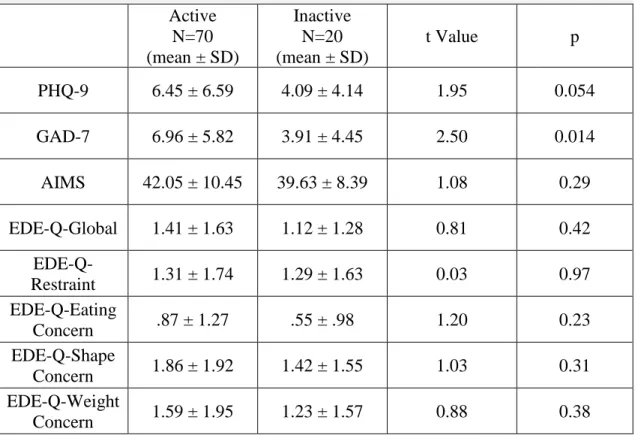
Independent t-tests revealed no significant differences between active and inactive athletes for
depression, anxiety, disordered eating, or athletic identity after accounting for false discovery
rate with the Benjamini-Hochberg procedure (Table 2).25
Table 2: Descriptive Comparison of Variable Means and Athletic Status
Current Athletic Status
Active N=70 (mean ± SD)
Inactive N=20 (mean ± SD)
t Value p
PHQ-9 6.45 ± 6.59 4.09 ± 4.14 1.95 0.054
GAD-7 6.96 ± 5.82 3.91 ± 4.45 2.50 0.014
AIMS 42.05 ± 10.45 39.63 ± 8.39 1.08 0.29
EDE-Q-Global 1.41 ± 1.63 1.12 ± 1.28 0.81 0.42
EDE-Q-Restraint 1.31 ± 1.74 1.29 ± 1.63 0.03 0.97
EDE-Q-Eating
Concern .87 ± 1.27 .55 ± .98 1.20 0.23
EDE-Q-Shape
Concern 1.86 ± 1.92 1.42 ± 1.55 1.03 0.31
EDE-Q-Weight
Concern 1.59 ± 1.95 1.23 ± 1.57 0.88 0.38
PHQ-9 refers to the cumulative score in the Patient Health Questionnaire, GAD-7 refers to the cumulative score in the General Anxiety Disorder assessment, AIMS refers to the cumulative score in the Athletic Identity Measurement Scale, EDE-Q-Global refers to the total Eating Disorder Examination Questionnaire score, and the EDE-Q-Restraint, EDEQ-Eating Concern, EDE-Q-Shape Concern, and EDE-Q-Weight Concern refer to the total scores for the four subscales on the Eating Disorder Examination Questionnaire
Injury Status
The injured and non-injured athlete groups differed significantly on PHQ-9 score, GAD-7 score,
EDE-Q-Global score, as well as on the EDE-Q Shape Concern and Weight Concern subscales
after accounting for the false discovery rate (Table 3).25 The injury group was small, but an F-test revealed no significant difference in variance between the injured and non-injured groups
(F=2.41). No significant differences were observed between the two groups across the AIMS,
EDE-Q Restraint subscale, or the EDE-Q Eating Concern subscale.
Table 3: Descriptive Comparison of Variable Means and Injury Status
Injury Status
Injured N=9 (mean ± SD)
Not Injured N= 81 (mean ± SD)
t Value p
PHQ9 10.89± 6.33 3.80 ± 3.94 5.46 <.001**
GAD7 10.44 ± 5.94 3.94 ± 4.37 4.08 <.001**
AIMS 46.11 ± 7.74 39.51 ± 8.80 2.16 0.034
EDEQ-Global 2.19 ± 1.67 1.07 ± 1.28 2.41 0.018**
EDEQ-Restraint 2.09 ± 2.04 1.21 ± 1.58 1.65 0.13
EDEQ-Eating
Concern 1.33 ± .46 .54 ± .98 2.21 0.030
EDEQ-Shape
Concern 2.82 ± 1.92 1.37 ± 1.54 2.61 0.011**
EDEQ-Weight Concern
2.51 ± 1.96 1.17 ± 1.48 2.49 0.015**
PHQ-9 refers to the cumulative score in the Patient Health Questionnaire, GAD-7 refers to the cumulative score in the General Anxiety Disorder assessment, AIMS refers to the cumulative score in the Athletic Identity Measurement Scale, EDEQ-Global refers to the total Eating Disorder Examination Questionnaire score, and the EDE-Q-Restraint, EDE-Q-Eating Concern, EDE-Q-Shape Concern, and EDE-Q-Weight Concern refer to the total scores for the four sub scales on the Eating Disorder Examination Questionnaire
Sport Type
Individual sport athletes differed significantly in PHQ-9 score only (2.71± 3.42, 5.61 ± 5.20)
with individual sport athletes showing higher levels of depressive symptoms. GAD-7 scores and
EDE-Q global and subscale scores were not significantly different, though they were numerically
lower for team sport athletes in all cases (Table 4).
Table 4: Descriptive Comparison of Variable Means and Sport Type
Sport Type
Team Sport N=31 (mean ± SD)
Individual Sport N=59 (mean ± SD)
t Value P
PHQ-9 2.71± 3.42 5.61 ± 5.20 -2.80 0.0063**
GAD-7 3.48 ± 4.14 5.17 ± 5.22 -1.56 0.12
AIMS 38.87 ± 9.77 40.85 ± 8.39 -1.00 0.32
EDE-Q-Global 1.06 ± 1.48 1.25 ± 1.30 -.62 0.54
EDE-Q-Restraint 1.07 ± 1.45 1.41 ± 1.73 -0.90 0.37
EDE-Q-Eating
Concern .52 ± 1.10 .67 ± 1.03 -0.63 0.53
EDE-Q-Shape
Concern 1.50 ± 1.87 1.52 ± 1.52 -0.07 0.94
EDE-Q-Weight
Concern 1.14 ± 1.79 1.39 ± 1.47 -0.70 0.48
PHQ-9 refers to the cumulative score in the Patient Health Questionnaire, GAD-7 refers to the cumulative score in the General Anxiety Disorder assessment, AIMS refers to the cumulative score in the Athletic Identity Measurement Scale, EDE-Q-Global refers to the total Eating Disorder Examination Questionnaire score, and the EDE-Q-Restraint, EDEQ-Eating Concern, EDE-Q-Shape Concern, and EDEQ-Weight Concern refer to the total scores for the four sub scales on the Eating Disorder Examination Questionnaire
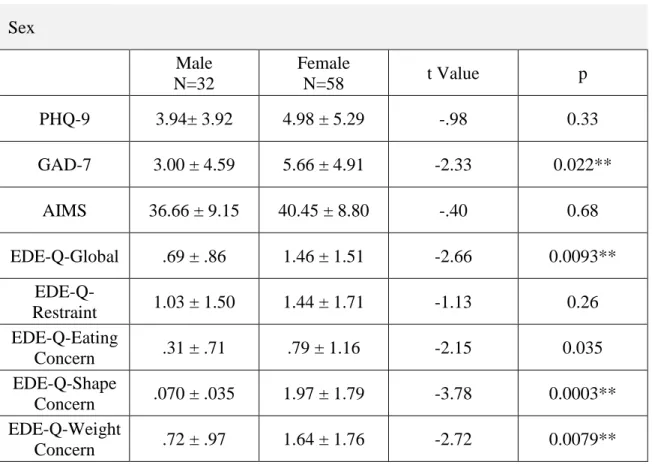
Sex
GAD-7 scores, EDEQ-Global scores, and the EDE-Q subscales of Shape Concern, and Weight
Concern scores differed significantly between male and female athletes with males having lower
scores across all assessments (Table 5). There was no significant difference between males and
females on the PHQ-9, AIMS, or on the EDE-Q-Restraint or Eating Concern subscales, although
males did have lower mean numeric scores in each of those as well.
Table 5: Descriptive Comparison of Variable Means and Sex
Sex
Male N=32
Female
N=58 t Value p
PHQ-9 3.94± 3.92 4.98 ± 5.29 -.98 0.33
GAD-7 3.00 ± 4.59 5.66 ± 4.91 -2.33 0.022**
AIMS 36.66 ± 9.15 40.45 ± 8.80 -.40 0.68
EDE-Q-Global .69 ± .86 1.46 ± 1.51 -2.66 0.0093**
EDE-Q-Restraint 1.03 ± 1.50 1.44 ± 1.71 -1.13 0.26
EDE-Q-Eating
Concern .31 ± .71 .79 ± 1.16 -2.15 0.035
EDE-Q-Shape
Concern .070 ± .035 1.97 ± 1.79 -3.78 0.0003**
EDE-Q-Weight
Concern .72 ± .97 1.64 ± 1.76 -2.72 0.0079**
PHQ-9 refers to the cumulative score in the Patient Health Questionnaire, GAD-7 refers to the cumulative score in the General Anxiety Disorder assessment, AIMS refers to the cumulative score in the Athletic Identity Measurement Scale, EDE-Q-Global refers to the total Eating Disorder Examination Questionnaire score, and the EDE-Q-Restraint, EDE-Q-Eating Concern, EDE-Q-Shape Concern, and EDE-Q-Weight Concern refer to the total scores for the four sub scales on the Eating Disorder Examination Questionnaire
Pearson Correlations
Pearson’s correlations were calculated to explore associations among continuous variables of
interest. Table 5 presents positive significant correlations between depression and anxiety
(r=0.80, p< 0.0001), depression and athletic identity (r= 0.33, p=0.0013), depression and
disordered eating (r=0.48, p<0.0001), anxiety and athletic identity (r=0.23, p= 0.026), anxiety
and disordered eating (r=0.44, p< 0.0001), and athletic identity and disordered eating
(r=.25,p=.019). The Benjamini-Hochberg Procedure was run to account for potential false
positives, but all findings remained statistically significant after correction for multiple
comparisons.
Figure 5: A Pearson Correlational Analysis of PHQ9, GAD7, AIMS, and EDEQ-Global
PHQ9 GAD7 AIMS
EDEQ Global PHQ9 Pearson Correlation Coefficient
p value N
1 - - -
GAD7 Pearson Correlation Coefficient p value N
0.80** <.0001 90
1 - -
AIMS Pearson Correlation Coefficient p value N 0.33** .0013 90 0.23** .026 90
1 -
EDEQ Global
Pearson Correlation Coefficient p value N 0.48** <.0001 89 0.44** <.0001 89 0.247** .019 89 1
PHQ-9 refers to the cumulative score in the Patient Health Questionnaire, GAD-7 refers to the cumulative score in the General Anxiety Disorder assessment, AIMS refers to the cumulative score in the Athletic Identity Measurement Scale, EDE-Q-Global refers to the total Eating Disorder Examination Questionnaire score
Discussion
The purpose of this study was to investigate the psychiatric dimensions of depression,
anxiety, athletic identity, and disordered eating among different cohorts of collegiate athletes and
to explore their interrelationship. While previous research did give some indication of trends in
group differences and comorbidities, other questions that were investigated were novel.
A key finding of this study was that the injured group (although small) had significantly
higher levels of depression, anxiety, and disordered eating behaviors compared to the
non-injured group. These results concur with prior research identifying an array of emotional effects
following sports injury.26,27 It is also well established that emotional changes stemming from sports injury can lead to potentially harmful reactions such as changes in appetite, irritability,
lack of motivation, pain behaviors, substance abuse, etc.27 Injured athletes have also been previously been found to have higher levels of depression compared to their non-injured
counterparts.27 Thus, it was not surprising that the present study showed similar findings. Alarmingly, athletics is associated with a number of barriers to seeking help for psychological
disorders, which can further exacerbate problems for athletes.27-29 Clearly, based on this research and prior research, injuries significantly impact emotional and psychiatric dimensions and should
be attended to in collegiate athletes.
Contrary to expectations, we did not detect any significant differences between inactive
and active student-athletes on the psychological dimensions of interest. The reasons for this are
not entirely clear; however, as noted, the inactive group included injured athletes, off-season
athletes, and those who had fully retired from collegiate sports. The heterogeneity of the group
could have obscured results and subgroups were too small for meaningful comparisons. One
benefits feelings towards athletic retirement.11,13,19 Thus, while injury, which causes unexpected time away from athletics, negatively impacts the psychological symptoms such as depression,
anxiety, and disordered eating, planned absence from athletics may not cause the same effects.
Intentional retirement from sports, with preparation and planning, may lead to a departure from
athletics that leads to less mental distress. Our small subsample size does not allow us to test this
hypothesis, though prior research supports this theory.16
Analysis of sports type (individual versus team sport) also revealed a significant
difference in depression symptomology with higher depression scores in those participating in
individual sports. Evidence supports that participation in team sports enhances the psychiatric
and physical benefits of physical activity in the general population, but similar studies have not
been completed in high levels of athletics.30 Our results suggest potential benefits for team sports, or risks for individual sport participation. Further investigation is needed to determine the
exact mechanism for this effect. Certainly, social support inherent in team sports may be one of
the means by which team sports lessen risk for psychiatric symptoms. It is well documented that
social support can aid in the deterrence of depression and anxiety in a number of groups such as
cancer patients, HIV patients, those going through cardiac rehabilitation, and patients with
schizophrenia.31-34 Perhaps the social support of competing together operates similarly in college athletes to reduce depressive symptomatology. Conversely, the personal stress of competing
individually and the lack of team social support may increase risk for depressive symptoms.
Clear gender differences emerged in the present study with female athletes scoring higher
on the GAD-7, EDE-Q Global Score, and EDE-Q Shape Concern and Weight Concern
subscales. The gender differences are not entirely surprising based on previous research looking
were 1.3 times more likely to be diagnosed with a psychiatric disorder than male elite athletes.11 This trend is also apparent in the general population where women are more likely to be
diagnosed with depression and/or anxiety disorders than are men.35 While the mechanism of effect remains unknown, the overall trend is well established. Our data suggest that the observed
gender differences in the population are mirrored in student-athletes. Additionally, in the general
population, women have been shown to have higher weight and shape concerns than males.36 This trend was observed in the student-athlete sample as well.
Of interest, significant positive correlations were observed across depression, anxiety,
athletic identity, and disordered eating behaviors (See Appendix A). This significant positive
correlation between athletic identity and depression, anxiety, and disordered eating may seem
surprising since athletics often acts as a protection against psychiatric disorders.4, 6-8 However, a high athletic identity in this sample was associated with greater psychological symptomology. It
is possible that athletes who associate themselves too closely with their sport may judge
themselves by their sports performance. This can be problematic as student-athletes’ identity
should be built on more than just their sport. The current study, along with others preceding it,
indicate that an high athletic identity can be associated with psychiatric problems, especially
during transition periods in sport.17,18,24 While a certain degree of athletic identity can boost an athlete’s self-esteem and self-worth, an overreliance on athletic identity can lead to anxiety,
depression, and disordered eating behaviors, especially if performance is less than desired, injury
Limitations
The findings from this study should be viewed as preliminary. Although significant differences
were observed for injured versus non-injured athletes, individual versus team sports, and males
versus females, our statistical power was limited by small sample size. Moreover, our design is
unable to make causal inferences. Several specific limitations should be mentioned. First, the
response rate was low, which not only led to a small sample size, but might also have introduced
bias. Future studies should include incentives to encourage participation. Second, all of the
participants came from a single athletic program at a large Division I Southeastern University
that may not be representative of other colleges, regions, or NCAA divisions. Third, sports were
unevenly represented. In order to generalize findings to a national audience, it will eventually be
necessary to sample a larger, more diverse group that includes student-athletes from across the
country and across sports. Finally, the timing of the study was a limitation since it would have
been preferred to complete a longitudinal design sampling all Division-1 sports offered at the
sampled university at two different times- in-season and during the off-season. Due to time
constraints, however, our design was cross sectional, and could only review two seasons of sport.
Conclusion
In this cross-sectional study, depression, anxiety, athletic identity, and disordered eating
behavior were investigated in a collegiate student-athlete population. Based on the current
findings, injured athletes, female athletes, and athletes competing in individual sports may be at
greater risk for psychological symptoms. Additionally, we saw positive associations among
Coaches and trainers should be more aware of these close relationships as to be able to look for
warning signs and situations (such as injury) that could spark the development of psychiatric
disorders. During their college experience, student-athletes should be encouraged to incorporate
more than just sports performance into their self-identity. Institutions should work to create
well-rounded athletes who base their self-worth on more than just their sports performance. This
development could come in the form of interventions by sports psychologists and athletic
departments ensuring that athletes are introduced to opportunities outside of sports.17 This expansion of identity will help athletes be more robust mentally and be better suited
psychologically to adapt to both foreseen and unforeseen athletic transitions during their careers.
Furthermore, it will better prepare student-athletes for a career and a life outside of sports.
Overall, this study gives researchers suggestions for future investigations. Of course,
these future studies will have to be larger and more powerful to support the types of culture shifts
necessary in collegiate sports to encourage a more positive and healthier competitive
environment. Any measures taken should consider means to support athletes in transitions, make
it easier for student-athletes to ask for mental health resources, and protect the emotional
References
1. Etzel EF, Watson JC, Visek AJ, Maniar SD. (2006) Understanding and promoting college student-athlete health: essential issues for student affairs professionals. J Natl Assoc Sport Phys Ed., 43, 518–546.
2. Greenleaf, C., PhD., Petrie, T. A., PhD., Carter, J., PhD., & Reel, J. J., PhD. (2009). Female collegiate athletes: Prevalence of eating disorders and disordered eating behaviors. Journal of American College Health, 57(5), 489-95.
3. Torstveit, M. K., Rosenvinge, J. H. and Sundgot‐Borgen, J. (2008), Prevalence of eating disorders and the predictive power of risk models in female elite athletes: a controlled study. Scandinavian Journal of Medicine & Science in Sports, 18. 108-118.
4. Eisenberg, D., Nicklett, E. J., Roeder, K., & Kirz, N. E. (2011). Eating Disorder Symptoms Among College Students: Prevalence, Persistence, Correlates, and Treatment-Seeking. Journal of American College Health, 59(8), 700–707.
5. Gulliver, A., Griffiths K., Mackinnon A., Batterham P., Stanimirovic R.. (2015), The mental health of Australian elite athletes. Journal of Science and Medicine in Sport, 18(3), 255-261.
6. Kirk, G., Singh, K., & Getz, H. (2001). Risk of Eating Disorders Among Female College Athletes and Nonathletes. Journal of College Counseling, 4(2), 122.
7. Armstrong, Shelley,PhD., M.A.T., & Oomen-Early, J. (2009). Social connectedness, self-esteem, and depression symptomatology among collegiate athletes versus nonathletes. Journal of American College Health, 57(5), 521-6.
8. Reinking, M. F., & Alexander, L. E. (2005). Prevalence of disordered-eating behaviors in undergraduate female collegiate athletes and nonathletes. Journal of Athletic Training, 40(1), 47-51.
9. Hoerr S., Bokram R., Lugo B., Bivins T. & Keast D. (2002) Risk for Disordered Eating Relates to both Gender and Ethnicity for College Students, Journal of the American College of Nutrition, 21:4, 307-314.
10.Smolak L, Murnen SK, Ruble AE. (2000). Female athletes and eating problems: a meta-analysis. Int J Eat Disord: 27: 371–380.
11.Schaal, K., Tafflet, M., Nassif, H., Thibault, V., Pichard, C., Alcotte, M..Toussaint, J. (2011). Psychological balance in high level athletes: Gender-based differences and sport-specific patterns. PLoS One, 6(5).
12.Knights S., Sherry E., & Ruddock-Hudson, M. (2016) Investigating Elite End-of-Athletic-Career Transition: A Systematic Review, Journal of Applied Sport Psychology, 28:3, 291-308
13.Cummins, P., & O’Boyle, I. (2015). Psychosocial Factors Involved in Transitions From College to Postcollege Careers for Male NCAA Division-1 Basketball Players.
Journal of Career Development, 42(1), 33–47.
14.Blinde, E. M., & Stratta, T. M. (1992). The "sport career death" of college athletes: Involuntary and unanticipated sport exits. Journal of Sport Behavior, 15(1), 3. 15.Cosh, S., Crabb, S., & Tully, P. J. (2015). A champion out of the pool? A discursive
16.Weigand, S., Cohen, J., & Merenstein, D. (2013). Susceptibility for Depression in Current and Retired Student Athletes. Sports Health, 5(3), 263–266.
17.Giannone, Z. A., Haney, C. J., Kealy, D., & Ogrodniczuk, J. S. (2017). Athletic identity and psychiatric symptoms following retirement from varsity sports.
International Journal of Social Psychiatry, 63(7), 598–601.
18.Patricia Lally. (2007) Identity and athletic retirement: A prospective study.
Psychology of Sport and Exercise, 8(1), 85-99.
19.S. Cecić Erpič, P. Wylleman, M. Zupančič. (2004) The effect of athletic and non-athletic factors on the sports career termination process. Psychology of Sport and Exercise, 5(1), 45-59.
20.Fairburn CG, Beglin SJ. (2008)Eating Disorders Examination Questionnaire (EDE‐Q 6.0). Fairburn CG. Cognitive behaviour therapy and eating disorders. Guilford Press, 309–313.
21.Shanmugam V, Jowett S, Meyer C. (2013) Eating psychopathology amongst athletes: the importance of relationships with parents, coaches and teammates. Int J Sport Exerc Psychol, 11 (1), 24–32.
22.Kroenke K, Spitzer R, Williams J. (2001) The PHQ‐9: validity of a brief depression severity measure. J Gen Intern Med, 16, 606‐613.
23.Spitzer R, Kroenke K, Williams J, Lowe B. (2006) A brief measure for assessing generalized anxiety disorder. Arch Intern Med, 166, 1092‐1097.
24.Brewer, B. W., Van Raalte, J. L., & Linder, D. E. (1993). Athletic identity: Hercules' muscles or Achilles heel? International Journal of Sport Psychology, 24(2), 237-254. 25.Benjamini, Y. and Hochberg, Y. ( 1995) Controlling the false discovery rate: a
practical and powerful approach to multiple testing. J. R. Statist. Soc. B, 57, 289– 300.
26.American College of Sports Medicine, American Academy of Family Physicians, American Academy of Orthopaedic Surgeons,et al. (2006) Psychological issues related to injury in athletes and the team physician: a consensus statement. Med Sci Sports Exerc, 38, 2030–4.
27.Putukian, M. (2016). The psychological response to injury in student athletes: A narrative review with a focus on mental health. British Journal of Sports Medicine, 50(3), 145.
28.Brewer BW, Petrie TA. (1995) A comparison between injured and uninjured football playerson selected psychological variables. Acad Athl J, 10, 11–18.
29.Gulliver A, Griffiths KM, Christensen H. (2012) Barriers and facilitators to mental health help-seeking for young elite athletes: a qualitative study. BMC Psychiatry, 12, 157.
30.Eime, R. M., Harvey, J. T., Brown, W. J. & Payne, W. R. (2010). Does Sports Club Participation Contribute to Health-Related Quality of Life?. Medicine & Science in Sports & Exercise, 42(5), 1022-1028.
31.Jin, J., McNeely, H., Schmidt, L., Khalesi, Z., & Khalesi, Z. (2019). An analysis of anxiety, depression, physical activity and social support in adults with schizophrenia.
Schizophrenia Bulletin, 42(2), S252–S253.
depression and anxiety symptoms among rural ugandan women living with HIV/AIDS. AIDS Care, 30(7), 888-895.
33.Turner, A., Phillips, L., Hambridge, J. A., Baker, A. L., Bowman, J., & Colyvas, K. (2010). Clinical outcomes associated with depression, anxiety and social support among cardiac rehabilitation attendees. Australian and New Zealand Journal of Psychiatry, 44(7), 658-666.
34.Hipkins, J., Whitworth, M., Tarrier, N., & Jayson, G. (2004). Social support, anxiety and depression after chemotherapy for ovarian cancer: A prospective study. British Journal of Health Psychology, 9(4), 569-581.
35.Altemus, M., Sarvaiya, N., & Neill Epperson, C. (2014). Sex differences in anxiety and depression clinical perspectives. Frontiers in Neuroendocrinology, 35(3), 320-330.
36.Anderson, C. B., & Bulik, C. M. (2004). Gender differences in compensatory
Appendix A
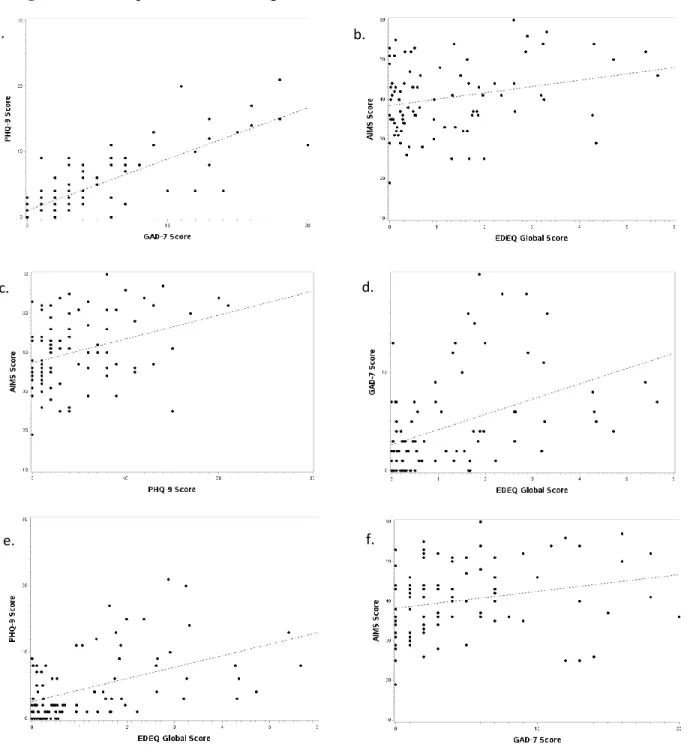
Figure 1: Scatterplots demonstrating the distribution and line-of-fit of variables of interest
Figure 1 a. shows the PHQ9 on the y-axis and the GAD7 on the x-axis (r=.80), figure 1 b. shows the AIMS on the y-axis and the EDEQ-Global on the x-axis (r=.25), figure 1 c. shows the AIMS on the y-axis and the PHQ9 on the x-axis (r=.33), figure 1 d. shows the GAD7 on the y-axis and the EDEQ-Global on the x-axis (r=.44), figure 1 e. shows the PHQ9 on the y-axis and the EDEQ-Global on the x-axis (r=.48), figure 1 f. shows the AIMS on the y-axis and the GAD7 on the x-axis (r=.23).
a.
c.
e.
b.
d.