PERSONAL UTILITY: EXAMINING THE EFFECTS OF GENOMIC RISK KNOWLEDGE ON MOTIVATION TOWARD DIET AND PHYSICAL ACTIVITY BEHAVIOR CHANGES
Harlyn Gynette Skinner
A dissertation submitted to the faculty at the University of North Carolina at Chapel Hill in partial fulfillment of the requirements for the degree of Doctor of Philosophy in the Department
of Nutrition in the Gillings School of Global Public Health.
Chapel Hill 2017
Approved by: Alice Ammerman Thomas Keyserling Jonathan C Schisler Dianne Ward
© 2017
ABSTRACT
Harlyn Gynette Skinner: Personal Utility: Examining The Effects Of Genomic Risk Knowledge On Motivation Toward Diet And Physical Activity Behavior Changes
(Under the direction of Alice Ammerman)
The National Institutes of Health and the Centers for Disease Control and Prevention have jointly indicated urgency in researching the use of personal genomics in the assessment of disease prevention. One research priority is the use of genomic information in behavior change research for reducing the risk for common chronic disease (e.g., cardiovascular disease—CVD). Research suggests improvements in motivation toward behavior change with counseling based on one gene (genetic counseling) and even better outcomes with counseling based on two or more genes (genomic or polygenetic counseling). Currently, little is known about the effect of genetic or genomic counseling in minority populations.
Common Sense Model. Messages were tested within the target population for comprehension and acceptance (n=32).
TABLE OF CONTENTS
LIST OF TABLES ... xiii
LIST OF FIGURES ... xv
LIST OF ABBREVIATIONS ... xvi
CHAPTER 1: INTRODUCTION ... 1
A. Overview ... 1
B. Formative Aims and Rationale ... 2
B.1. Formative Aim 1 ... 2
B.2. Formative Aim 2 ... 2
C. Experimental Aims and Hypotheses ... 3
C.1. Experimental Aim 1 ... 3
C.2. Experimental Aim 2 ... 3
C.3. Experimental Aim 3 ... 4
CHAPTER 2: LITERATURE REVIEW ... 5
A. Cardiovascular Disease Disparities — Region & Race ... 5
B. Lifestyle Change — Part Of The Solution But Does NOT Eliminate Disparity ... 6
B.1. Lifestyle ... 6
B.2. Genetics ... 7
C. Personalized Risk Communication ... 8
C.1. Personalized Risk Communications And Health Literacy ... 10
D. Personalized Genomic Risk Communication ... 11
D.1. Direct-To-Consumer ... 11
D.2. Diet And Physical Activity ... 12
D.3. Type 2 Diabetes Mellitus and CVD ... 14
E. Psychosocial Impact ... 18
F. Gaps in Knowledge ... 19
G. Heart Healthy Lenoir ... 20
H. Summary ... 20
CHAPTER 3: A CONCEPTUAL MODEL DEPICTING A HYPOTHESIS FOR THE COMMUNICATION OF GENOMIC RISK ... 21
A. Protection Motivation Theory ... 21
CHAPTER 4: USING COMMUNITY-BASED PARTICIPATORY RESEARCH PRINCIPLES TO DEVELOP MORE UNDERSTANDABLE RECRUITMENT AND INFORMED CONSENT DOCUMENTS IN GENOMIC RESEARCH ... 25
A. Overview ... 25
B. Introduction ... 26
C. Methods ... 28
C.1. Participants ... 28
C.2. Focus Group Guide Development ... 29
C.3. Focus Group Protocol ... 29
C.4. Analysis ... 30
D.1. Demographics ... 31
D.2. Defining Genomics ... 33
D.3. Focus Group Themes ... 33
D.3.1. Theme 1: Transparent Communication ... 34
D.3.2. Theme 2: Privacy ... 35
D.3.3. Theme 3: Participation Incentives and Barriers ... 36
D.3.4. Theme 4: Knowledge ... 38
D.3.5. Theme 5: The Impact of Knowing ... 39
E. Discussion ... 41
CHAPTER 5: COMMUNICATING GENOMICS RESULTS FOR A MINORITY AUDIENCE: DEVELOPMENT OF A PROTOCOL ... 45
A. Overview ... 45
B. Introduction ... 46
C. Methods ... 47
C.1. Background ... 47
C.2. Adaptation of Original Protocol ... 49
C.3. Participants ... 49
C.4. Message-Testing Protocol ... 50
C.5. Analysis ... 51
D. RESULTS ... 53
D.1. Demographics ... 53
D.2. Key Lessons Learned ... 54
D.2.1. Lesson 1: Genomics Education ... 54
D.2.3. Lesson 3: Language Usage ... 61
E. Discussion ... 61
E.1. Conclusions ... 63
CHAPTER 6: THE RETURN OF RESULTS STUDY: RESULTS FROM A RANDOMIZED CONTROLLED TRIAL TO EVALUATE THE CONCEPT OF USING PERSONALIZED GENOMIC RESULTS FOR MOTIVATION TO CHANGE DIET AND PHYSICAL ACTIVITY BEHAVIORS ... 64
A. Overview ... 64
B. Introduction ... 65
C. Methods ... 66
C.1. Parent Study ... 66
C.2. Risk Estimates ... 67
C.2.1. Phenotypic Risk Estimate ... 67
C.2.2. Genetic Risk Estimate ... 67
C.3. Intervention ... 71
C.3.1. Participant Screening and Recruitment ... 71
C.3.2. Randomization ... 71
C.3.3. Interventions ... 71
C.4. Outcome Measures ... 75
C.5. Analysis ... 76
D. Results ... 79
D.1. Participant Characteristics ... 79
D.2. Primary Outcome ... 81
D.3.1. Motivation Towards Stress Reduction ... 84
D.3.2. Protection Motivation Theory Constructs ... 84
D.3.3. Health Behaviors ... 86
E. Discussion ... 87
CHAPTER 7: SUMMARY OF FINDINGS AND RECOMMENDATIONS FOR FUTURE RESEARCH ... 94
A. Summary of Findings ... 94
B. Recommendations for Future Research ... 95
C. Recommendations for Theory ... 97
D. Conclusions ... 98
APPENDIX 4: SUPPLEMENTAL MATERIALS FOR ESTABLISHING COMMUNITY NEED ... 99
APPENDIX 4.1: ADDITIONAL QUOTATIONS ABOUT KNOWLEDGE ... 99
APPENDIX 4.2: FOCUS GROUP CONSENT FORM ... 102
APPENDIX 4.3: FOCUS GROUP GUIDE ... 105
APPENDIX 4.4: DEMOGRAPHICS SURVEY ... 108
APPENDIX 4.5: FOCUS GROUPS CODEBOOK ... 110
APPENDIX 5: RETURN OF RESULTS PROTOCOL DEVELOPMENT MATERIALS ... 111
APPENDIX 5.1 EXAMPLE ADAPTED RETURN OF RESULTS PROTOCOL ... 111
APPENDIX 5.2 KEYWORDS SHEET USED WITH RETURN OF RESULTS PROTOCOL ... 121
APPENDIX 5.3 TAKE HOME MATERIALS WITH RETURN OF RESULTS PROTOCOL ... 122
APPENDIX 5.5 PHASE 1 RECRUITMENT BROCHURE ... 129
APPENDIX 5.6 PHASE 1 STRUCTURED “COGNITIVE” INTERVIEW AND FOCUS GROUP PROTOCOL ... 131
APPENDIX 5.7 RAPID ESTIMATE OF ADULT LITERACY IN GENETICS ... 138
APPENDIX 6: RANDOMIZED CONTROLLED TRIAL SUPPLEMENTAL MATERIALS ... 140
APPENDIX 6.1: CONTROL GROUP MATERIALS ... 140
A. Script ... 140
APPENDIX 6.2 GENOTYPING METHODS ... 148
APPENDIX 6.2.1a: FINE-MAPPING AND ADMIXTURE PAPERS REVIEWED ... 150
A. BMI ... 150
B. Dyslipidemia ... 150
C. T2DM ... 150
D. Blood Pressure ... 151
E. CVD ... 152
F. Smoking ... 152
APPENDIX 6.2.1.b: LIST OF POTENTIAL SNPS ... 153
APPENDIX 6.3: OUTCOME MEASURES ... 156
A. Baseline Surveys ... 156
B. Post-Test Survey ... 175
C. 1-Month Follow-Up Survey ... 182
APPENDIX 6.4: BASELINE VARIABLES ... 197
APPENDIX 6.5: REGRESSION ANALYSES FOR
SECONDARY AND TERTIARY OUTCOMES ... 209
A. Motivation Towards Stress Reduction ... 209
B. Threat Appraisal ... 210
C. Coping Appraisal ... 214
D. Maladaptive Coping ... 219
E. Diet ... 223
F. Physical Activity ... 224
LIST OF TABLES
Table 2.1: Odds Ratios from Previous Research on Personalized Risk Information ... 9
Table 2.2: Type 2 Diabetes Mellitus and Cardiovascular Disease Return of Genomic Results Studies ... 16
Table 4.1. Characteristics Of Focus Group Sample (N=35) ... 32
Table 5.1. Focus Group Descriptions ... 52
Table 5.2. Focus Group Demographics ... 53
Table 6.1. Heart Healthy Lenoir CVD Genomic Risk Signature for African-Americans ... 70
Table 6.2. Measures Used In Randomized Controlled Trial ... 77
Table 6.3. Participant Characteristics ... 82
Table 6.4. Phenotypic Risk by Genomic Risk—Overall ... 83
Table 6.5. Phenotypic Risk by Genomic Risk—Intervention Group ... 83
Table 6.6. Regression Analysis For Motivation Towards Diet And Exercise ... 83
Table A6.1. GWAS Significant SNPs From Fine-Mapping And Admixture Studies ... 153
Table A6.2. Candidate SNPs From Fine-Mapping And Admixture Studies ... 154
Table A6.3. STOFHLA Frequency Table ... 197
Table A6.4. STOFHLA Means ... 197
Table A6.5. Demographics – Means ... 197
Table A6.6. Demographics – Frequency Table ... 198
Table A6.7. Phenotypic Risk – Frequency Table ... 204
Table A6.8. Phenotypic Risk – Means ... 206
Table A6.9. Genomic Risk – Frequency Table ... 207
Table A6.10. Regression Analysis For Motivation Towards Stress Reduction ... 209
Table A6.12. Regression Analysis For Perceived Vulnerability ... 211
Table A6.13. Regression Analysis For Perceived Severity ... 212
Table A6.14. Regression Analysis For Perceived Fear ... 213
Table A6.15. Regression Analysis For Coping Efficacy ... 214
Table A6.16. Regression Analysis For Diet Response Efficacy ... 215
Table A6.17. Regression Analysis For Diet Response Cost ... 216
Table A6.18. Regression Analysis For Physical Activity Response Efficacy ... 217
Table A6.19. Regression Analysis For Physical Activity Response Cost ... 218
Table A6.20. Regression Analysis For Fatalism ... 219
Table A6.21. Regression Analysis For Fatalism Subscale—Predetermination ... 220
Table A6.22. Regression Analysis For Fatalism Subscale—Luck ... 221
Table A6.23. Regression Analysis For Fatalism Subscale—Pessimism ... 222
Table A6.24. Regression Analysis For Fruit And Vegetable Servings ... 223
Table A6.25. Regression Analysis For Total Walking Time ... 224
LIST OF FIGURES
Figure 3.1. Conceptual Model ... 24
Figure 4.1. Transparent Communication Quotations ... 34
Figure 4.2. Privacy Quotations ... 35
Figure 4.3. Privacy Quotation—African-American Mistrust ... 36
Figure 4.4. Participation Incentives and Barriers Quotations ... 36
Figure 4.5. Participation Incentives and Barriers Quotation ... 37
Figure 4.6. Knowledge Quotations ... 38
Figure 4.7. Knowledge Quotation ... 38
Figure 4.8. The Impact of Knowing Quotation—Value of Knowing ... 40
Figure 4.9. The Impact of Knowing Quotation—Perceived Control ... 40
Figure 5.1. Genomics Education In ROR Script ... 55
Figure 5.2. "What Are SNPs?” Video ... 56
Figure 5.3. Take Home Genomic Education Resources ... 57
Figure 5.4. Phenotypic Risk Representation Using Framingham Risk Score ... 59
Figure 5.5. Genotypic Risk Presentation ... 60
Figure 6.1. SNP Decision Tree 3/4/16 ... 69
LIST OF ABBREVIATIONS
AA African-American
BRFSS Behavioral Risk Factors Surveillance System
C Control
CBPR Community-Based Participatory Research CDC Centers for Disease Control and Prevention CVD Cardiovascular Disease
DTC-GT Direct-to-Consumer Genetic Testing
FG Focus Group
FRS Framingham Risk Score GRS Genomic Risk Signatures
GWAS Genome-Wide Association Studies HDL High-Density Lipoprotein
HHL Heart Healthy Lenoir
I Intervention
IRB Institutional Review Board LDL Low-Density Lipoprotein
M Mean
MHI-5 Mental Health Inventory
NC North Carolina
NHGRI National Health Genomic Research Institute NIH National Institutes of Health
RCT Randomized Controlled Trial
REAL-G Rapid Estimate of Adult Literacy in Genetics RESIDE RESIDential Environment project
ROR Return of Results SD Standard Deviation SES Socioeconomic Status SF-12 Short Form Health Survey SNP Single Nucleotide Polymorphism SNS-3 Subjective Numeracy Scale
STOFHLA Short Test of Functional Health Literacy in Adults T2DM Type 2 Diabetes Mellitus
W White
CHAPTER 1: INTRODUCTION A.OVERVIEW
The National Institutes of Health (NIH) and the Centers for Disease Control and
Prevention (CDC) have jointly indicated urgency in researching the use of personal genomics in the assessment of disease risk and prevention. Chief among the research priorities is the
establishment of an evidence base for effective ways of communicating personal genomic information as an approach to behavior change particularly in chronic disease risk reduction (e.g., cardiovascular disease—CVD).1,2 High rates of CVD and its risk factors are found in (1) minorities,3 (2) those of low socioeconomic status, 3,4 and (3) by geographic boundary
(Southeastern states);3,4 all such vulnerable populations can be found in rural North Carolina (NC). CVD mortality and morbidity can be effectively decreased by improvements in diet and physical activity, but this does not ameliorate CVD disparity. Disparity can be partially
explained by genetic variation.
Research demonstrates positive improvements in motivation toward behavior change when individuals receive counseling based on one gene (genetic counseling) and even better outcomes when individuals receive counseling based on two or more genes (genomic
even fewer specifically in CVD.10 To our knowledge, none have been conducted exclusively in an African-American population. Comparing participants’ genomic profile to existing genomic risk markers for CVD identified from fine mapping and admixture studies, and then returning that genomic information to the participant, provides the basis for the current proposal. This study concentrates on the most vulnerable population—African-Americans living in a low socioeconomic area in the Southeastern United States. The primary goal of this study is to determine if genomic knowledge will increase motivation towards CVD risk reduction health behaviors as compared to the control group in a randomized proof-of-concept study with 62 African-American (AA) residents from the vulnerable population of Lenoir County, NC.
B.FORMATIVE AIMS AND RATIONALE
B.1.FORMATIVE AIM 1
Determine acceptance of genomic research in the African-American community in Lenoir County.
RATIONALE: There is a historical context of mistreatment by and lack of consent for
medical research in AA communities. This has led to a culture of mistrust. To determine if a genomics study would be acceptable to the community, focus groups were conducted with AAs and Whites in Lenoir County.
B.2.FORMATIVE AIM 2
RATIONALE: To our knowledge, previous genomic risk communication literature largely
focused on Whites. Given that ancestry is linked to genomic variation and that the most effective communication strategies can vary across cultural lines, adaptation of the current methods in the literature was necessary.
C.EXPERIMENTAL AIMS AND HYPOTHESES
C.1.EXPERIMENTAL AIM 1
Using a randomized controlled design, determine the effect of conveying CVD genomic risk via culturally and literacy appropriate materials on motivation toward changing diet and physical activity behaviors relative to no genomic risk communication (using an attention-control delayed intervention approach).
HYPOTHESIS: Motivation to change diet and physical activity will increase for AAs
receiving genomic knowledge relative to those receiving no genomic information. Effects will be moderated by genomic-risk category.
C.2.EXPERIMENTAL AIM 2
Determine the effect of receiving genomic risk information versus no risk communication on psychosocial factors—constructs of Protection Motivation Theory: threat appraisal, perceived vulnerability, perceived severity, perceived fear, perceived efficacy, response cost, response efficacy, and fatalism.
HYPOTHESIS: Threat appraisal, perceived vulnerability, perceived severity, perceived fear,
AAs receiving genomic knowledge relative to those receiving no genomic information. Fatalism will not change. Effects will be moderated by genomic-risk category.
C.3.EXPERIMENTAL AIM 3
Determine the effect of receiving genomic risk information versus no risk communication on self-reported change in diet and physical activity behaviors.
HYPOTHESIS: Reported diet quality will become more healthful but reported physical
CHAPTER 2: LITERATURE REVIEW
A.CARDIOVASCULAR DISEASE DISPARITIES —REGION &RACE
Cardiovascular disease (CVD) is the most common cause of morbidity and mortality in the United States.11 In 2014, 614,348 people died from CVD11 and at least 200,000 of those deaths could have been prevented.12
The risk of suffering from CVD is 49% higher than the U.S. average for those living in the Stroke Belt—an 11-state region of the southeastern United States, which includes North Carolina.4,13 Residents in the Stroke Belt have poorer health outcomes and a higher prevalence of obesity compared to the rest of the country.4 Situated in the heart of the Stroke Belt is Lenoir County, North Carolina. CVD is the leading cause of death in Lenoir County of adults aged 35 years and older (ranked 1st with 365.1 deaths per 100,000 compared to 192.7 deaths per 100,000 statewide).3,14,15 Lenoir County residents report their most pressing health concerns as obesity, Type 2 Diabetes Mellitus (T2DM), and heart disease.15 Additionally, the age-adjusted obesity rate (BMI > 30) in Lenoir County is 37.0% compared to 29.7% statewide.3,16 These facts illustrate disparity in CVD and its risk factors within Lenoir County and define residents as a vulnerable population.
Whites.3,13 The disparity in CVD and its risk factors widens in the Stroke Belt; in Lenoir County, AAs are at a 90% higher risk for CVD mortality than their White counterparts.4,13,14
B.LIFESTYLE CHANGE —PART OF THE SOLUTION BUT DOES NOTELIMINATE DISPARITY
B.1.LIFESTYLE
Environmental risk factors for CVD have been well established: smoking status, hypertension, hypercholesterolemia, type 2 diabetes, and obesity.17-19 These risk factors are strong predictors of CVD morbidity and mortality. A multitude of studies have demonstrated that lifestyle change targeting these risk factors lowers CVD risk.19-23 The Nurses’ Health Study suggests that a healthy lifestyle can lead to an 83% reduction in the risk of CVD; participants with a healthful lifestyle, noted the following healthy behaviors: not smoking, having a BMI < 25, consuming < ½ alcoholic beverage per day, engaging in moderate to vigorous physical activity for 30 minutes per day, and scoring in the highest 40% for ‘a good diet’.19 (A good diet was defined as high consumption of cereal fiber, fish fatty acids, folate, and a high ratio of polyunsaturated to saturated fat; and low consumption of foods high in trans-fats and low glycemic load.) In particular, studies of Mediterranean diets have demonstrated a beneficial effect of such diets on the prevention of CVD and further CVD events.23-26 The Mediterranean diet is characterized by olive oil as the main source of dietary oil, generous consumption of fruits and vegetables, lots of fish, little red meat (i.e., beef, lamb, pork), and modest consumption of alcohol. Meta-analysis confirms that focusing on diet and physical activity is critical in reducing CVD risk.21
behavior with regard to these lifestyle behaviors. According to the Behavioral Risk Factors Surveillance System (BRFSS) Survey, North Carolinians consumed 5 or more fruits or vegetables a day and engaged in the recommended levels of physical activity at lower rates compared to the average American.3 The disparity gap has also widened between AAs and Whites in the past 30 years.27 According to the BRFSS North Carolina Survey, fewer AAs than Whites consumed 5 or more fruits and vegetables or engaged in the recommended levels of physical activity.28 Overall, despite an effective prescription for lifestyle change to reduce CVD risk, AAs are less successful in making diet and physical activity changes that would reduce disparity in CVD risk factors and CVD mortality.
B.2.GENETICS
Studies have established a genetic component to the development of CVD.29-31 Genome-wide association studies (GWAS) have detected direct associations of genomic variations— called single nucleotide polymorphisms (SNPs)—with CVD.32 The effect size attributable to a single CVD-related SNP is modest at best.33 However, the large number of CVD-related SNPs identified in GWAS each explains a small amount of risk meaning that CVD is polygenic in nature. CVD genomic risk signatures (GRS)—aggregates of SNPs identified through GWAS that contribute to a genetic predisposition towards CVD—can be used to calculate an
individual’s CVD related genomic risk. These CVD genomic risk signatures are both independent predictors of CVD events and predictors of phenotypic risk.34-38
results on ancestral background. However, studies with AA participants have identified a multitude of CVD and CVD risk factor related SNPs in those of African-ancestry.39-49
Additionally, AAs are admixed descendants of European and African ancestors. Admixture and fine-mapping studies exist specifically to investigate SNP variations in those of non European-ancestry.42,44,46-48,50-75
B.3.LIFESTYLE &GENETICS
Researchers are looking for new ways to motivate health behavior change. Studies demonstrate that patients who have previously suffered myocardial infarctions are more motivated to make diet and physical activity changes because they perceive themselves more vulnerable to further CVD.76 However, public health practitioners want to encourage lifestyle change before a myocardial infarction. Protection Motivation Theory postulates that personal genomic knowledge may increase perceived vulnerability and motivate lifestyle change before a myocardial infarction in a similar manner to what is seen in myocardial infarction patients after their first CVD event.77
C.PERSONALIZED RISK COMMUNICATION
There is a paucity of research on the combined effect of personal genomic risk knowledge and lifestyle change on the reduction of CVD risk; none of this research has been conducted with AAs in the Stroke Belt. More broadly, there is research on personalized risk communication and some research on the effects of genomic risk knowledge.
Odds Ratio: 1.15 [1.02,1.29]).78 These health behavior changes are confirmed by meta-analyses which indicates that personalized risk communication messages are shown to be more effective over generic comparison messages in affecting health behavior change.79
In addition to health behavior changes, there are cognition changes in those who receive personalized risk communications (Table 2.1). Individuals who receive tailored messages are more than four-times as likely to make informed decisions about undergoing screening tests (Pooled Odds Ratio: 4.48 [3.62,5.53]).78 Personalized risk communication also affects an
individual’s understanding of risk perception making the participant’s understanding of their risk 46% more accurate (Pooled Odds Ratio: 1.46[1.13,1.88]).78,80 Knowledge has been shown to increase 2- to 7-fold as the result of tailoring.78 Across studies, anxiety was non-significantly decreased implying that personalized risk communications might lessen anxiety about health behavior change (Standard Mean Difference: -0.13 [-0.29,0.03]).78 In summary, personalized risk communication increases knowledge about risk and engenders more accurate risk perception leading to increased informed decision making about health behavior change.
Table 2.1: Odds Ratios from Previous Research on Personalized Risk Information Type of Risk Communication
Numerical Categorical List of Risk Factors Uptake of Screening 0.95 [0.78,1.15]81-86 1.29 [1.11,1.51]87-92 ----
Informed Decision 2.08 [1.14,3.81]81 --- 4.98 [3.97,6.24]93,94 Perceived Risk 1.22 [0.91,1.64]82,95 2.50 [1.48,4.20]96
C.1.PERSONALIZED RISK COMMUNICATIONS AND HEALTH LITERACY
As noted in Table 2.1, there are several different modalities through which risk can be presented—numerical, categorical, or a list of risk factors. The least effective modality is numerical. This may due to poor health literacy.
According to Berkman et. al. (2011), ‘health literacy’ is defined as the ability to: 1) “read and understand text to locate and interpret information in documents (print literacy)”; 2) “use quantitative information for tasks (numeracy)”; and 3) “speak and listen effectively (oral literacy).”97 The 2003 National Assessment of Adult Literacy found that 14% of adults (approximately 30 million people) have below basic health literacy.98 Low health literacy has long been associated with low health knowledge, poor disease self-management, and poor health outcomes.99-103 Specifically, those with low health literacy have poorer skills in taking
medications,104-106 interpreting medication and nutrition labels,107-109 and have higher all-cause mortality rates in the elderly.110-112 Similarly, low numeracy has been associated with poor self-management of chronic disease, including higher utilization of emergency department
services.113-116
Low numeracy is also a concern in personalized risk communications. According to the 2003 National Assessment of Adult Literacy, 22% of adults have below basic quantitative skills.98 Even highly educated adults have been shown to have inadequate understanding of probabilities and risks.117-121 These miscomprehensions of numerical information are suggested to result in poor risk estimation (regardless of format), improper calculation of disease
associated with the overestimation of risk leading to either increased cancer screening or fatalistic avoidance of cancer screening.120,127-131 All of these numeracy concerns could
contribute to the non-significant change in health behavior seen when providing numerical risk estimates.
Tailored communication efficacy is thought to be more relevant to the individual and therefore more comprehensible.132 Evidence shows that literacy and numeracy must be taken into consideration when conveying risk information. Additionally, research suggests that giving both verbal and written information increases comprehension.133 Making informed choices about health behaviors and increasing adherence to those behaviors is seen as the goal for personalized risk communication.78
D.PERSONALIZED GENOMIC RISK COMMUNICATION
Personalized risk communication has been applied to the field of genomics both in commercial industry and in public health.
D.1.DIRECT-TO-CONSUMER
deficits, questions have been raised as to whether DTC-GT marketing encourages inappropriate applications of genetic tests, as well as questions about the ramifications of communicating genomic results in the absence of a knowledgeable professional to help interpret results.2,143 Additionally, research suggests that DTC-GT may have limited public health impact. To this writer’s knowledge, very few studies have been performed that systematically test health behavior change in response to DTC-GT. The few studies that have been performed show little evidence that the provision of DTC-GT results alone result in sustained behavior change.144-146
D.2.DIET AND PHYSICAL ACTIVITY
In the field of public health, some studies have been performed on personalized genomic risk information’s effect on health behaviors. Past studies have mostly been in the fields of smoking cessation and cancer (not discussed here). However, there are limited numbers of studies on personalized genomic risk information’s impact on an individual’s diet and physical activity behaviors.
In a Cochrane review by Marteau et al (2010), genomic based risk communications were found to more than double uptake of a healthful diet (Pooled Odds Ratio: 2.24 [1.17,4.27]) and to have no effect on physical activity (Pooled Odds Ratio: 1.03 [0.59,1.80]).5 These results are based on findings from two studies: Marteau et al (2004) and Chao et al (2008).
diagnosis and behavioral advice. Dietary measurement was self-reported fat intake measured at baseline and the 6-month follow-up. Physical activity measurement was self-reported frequency of vigorous physical activity measured at baseline and the 6-month follow-up. Results showed a trend towards genomic risk recipients being more than twice as likely to have a lower fat diet (Odds Ratio: 2.10 [0.99, 4.43]) and no change in physical activity at the 6-month measurement (Odds Ratio: 0.99 [0.55,1.790]).5
Chao et al (2008) performed a RCT on the impact of genetic risk communication for Alzheimer’s disease on health behavior change—diet, physical activity, medication and vitamin use.148 Intervention participants received Alzheimer’s education, APOE genotype, and their lifetime risk based on their APOE genotype. Control participants received Alzheimer’s education and a numerical risk estimate based on family history and gender. Dietary measurement was self-reported diet changes aimed at reducing Alzheimer’s risk measured at baseline and 1-year follow-up. Physical activity measurement was self-reported physical activity changes aimed at reducing Alzheimer’s risk measured at baseline and 1-year follow-up. Results demonstrated a trend towards genetic risk recipients being more than twice as likely to alter their diet to reduce Alzheimer’s risk (Odds Ratio: 2.69 [0.75,9.70]) and no change in physical activity to reduce Alzheimer’s risk at 1-year (Odds Ratio: 1.40 [0.27,7.19]).5
Also of note is the Arkadianos et al study (2007).7 In a non-randomized design, this study investigated the impact of genomic risk communication for diet (nutrigenetics) on weight
and 300 days. However at > 300 days post return of results, weight management clinic patients who received nutrigenetic diet and exercise plans lost significantly more weight compared to weight management clinic patients with standard diet plans (Odds Ratio 5.74 [1.74,22.52]). Put another way, nutrigenetics subjects lost 5.6% of their original body weight compared to a 2.2% weight gain in comparison subjects.7
Results from these three studies, combined, imply that receiving personalized genomic risk communications may result in dietary change, however genomic risk assessment effects 1) may require a long-term intervention (~ 1 year), and 2) may be most beneficial in conjunction with lifestyle skill training. Results imply that physical activity behaviors are not affected by genomic risk assessment. It is important to note several key limitations of these studies: 1) It is unclear how risk was conveyed (i.e., verbally, written, using numerical estimates, using
categorical estimates, taking into account literacy, etc.); 2) Most of these studies were low intensity lifestyle programs that did not teach lifestyle change skills; 3) Participants tended to be White, highly educated women, thereby limiting generalizability.
D.3.TYPE 2DIABETES MELLITUS AND CVD
There is an emerging body of literature on personalized genomic risk assessments applied to Type 2 Diabetes Mellitus (T2DM) and cardiovascular disease (CVD) interventions. To our knowledge, there are only four of these types of studies, two of which have yet to report results (Table 2.2).
prevention lifestyle advice. Intervention group two received a phenotypic risk estimate and standard T2DM prevention lifestyle advice. The control group received no risk information, only standard T2DM prevention lifestyle advice. Participants were followed for eight weeks. There were no significant between-group findings.150
Grant et al investigated the effect of personalized genomic risk on motivation towards diabetes prevention (N=108).151 In their intervention, they included a 12-week lifestyle intervention program modeled after the Diabetes Prevention Program.152 At the end of the intervention, program attendance and motivation were measured as the main outcomes. There were no differences between intervention and control groups for either outcome at 12-weeks. A major strength of this research compared to the studies mentioned above is the use of a proven-effective lifestyle program. There were no differences between groups with this short-term study.
The Arkadianos study, described above, suggests that a longer-term study coupled with the intensive lifestyle program might be more effective. Additionally, Arkadianos et al found that when giving genomic results in conjunction with an intensive lifestyle program, intervention participants with fasting blood glucose levels >100mg/dl were almost twice as likely to have fasting blood glucose levels <100 mg/dl at >300 days when compared to the control group (Odds Ratio: 1.98 [1.01,3.87]).7
Other related studies, including Cho et al (2012), and Knowles et al (2012) have yet to publish study results.
literacy or numeracy issues in their genomic counseling; and 4) the study populations are largely highly educated White populations.
There are also research projects underway on how to use genomic risk information to improve health behaviors in common diseases at National Human Genome Research Institute (NHGRI) Centers for Excellence in the Ethical, Legal, and Social Implications Research Centers across the country. The application of personal genomic risk assessments to common diseases is an upcoming research field, which has been deemed an urgent priority by the NIH and the CDC.1,2 This proposal seeks to answer that call by contributing to the evidence base of effective ways of communicating personal genomic information as an approach to behavior change in CVD disease risk reduction.
TABLE 2.2:TYPE 2DIABETES MELLITUS AND CARDIOVASCULAR DISEASE RETURN OF GENOMIC RESULTS STUDIES
T2DM
Study (N)
Design
Follow-up
Intervention Control Primary
8-weeks Phenotypic risk estimate + standard lifestyle advice sheet Weight Intentions to be physically active Intentions to engage in a healthy diet Anxiety Diabetes-related worry Self-rated health Perceived risk intervention groups compared to control group Cho 2012154
N≅506
3-arm RCT In-person 3 months 1 year Genetic risk + one counseling session with healthcare staff at participant’s physician’s office One counseling session with healthcare staff at participant’s physician’s office One counseling session with healthcare staff at participant’s physician’s office Insulin resistance (HOMA-IR) BMI Diet pattern Physical activity Waist circumfere nce Perceived risk Not reported yet Not reported yet CVD
Study Design Follow
-up
Intervention Control Primary
Outcome Secondary Outcome Primary Results Secondary Results Knowles 201210
N≅100
Exercise patterns
Smoking
Stages of change
Risk perception
Medication compliance
Attitudes towards medications
Anxiety
E.PSYCHOSOCIAL IMPACT
The psychological impact of returning genomic results has been measured across many studies. The most frequently studied concept is perceived risk and intention to change health behavior. Findings for these measures are inconsistent.
A Cochrane review reports that perceived risk becomes more accurate as a result of genomic information (Pooled Odds Ratio: 1.46[1.13,1.88]).78 However meta-analysis suggests there is no change in perceived risk over time.146 Perceived risk has also been found to affect other psychosocial measures—anticipated worry and test-induced distress. However, this effect is not linearly related with genomic risk nor is it related to interest in undergoing genomic testing or perceived benefits from genomic testing.155 Perceived risk has yet to be fully elucidated in genomic studies. Therefore, further research is needed to better understand perceived risk’s relationship with genomic risk results.
in response to genomic risk information (Standardized mean difference: 0.18 [-0.02,0.38]).5 However, when analyzing intention to change health behaviors by genomic risk categories, some studies have found that participants who are told they are at low genomic risk then have lower intentions towards healthy behaviors.89,156 For this reason, experts have cautioned against the promotion of “genetic invulnerability” in participants with “lower” genetic risk. Some experts suggest that stressing gene-environment interaction and personal control in message framing will counteract the effect of lowered healthy behavior intentions.157
Other psychosocial constructs have been measured, but the research thus far is either inconsistent or suggests there is no effect. These measures include anxiety,5,78 outcome
expectations,5 perceived control,158 motivation.151 While genomic risk information may motivate health behavior change, the psychological underpinnings motivating such a change have yet to be fully elucidated.
F.GAPS IN KNOWLEDGE
G.HEART HEALTHY LENOIR
This investigation was conducted as ancillary study to the Heart Healthy Lenoir (HHL) study. HHL was a five-year three-project coordinated study spanning the CVD care continuum from prevention to treatment to genomics research aimed at reducing CVD risk disparities in a rural, low-income county in eastern North Carolina: the HHL Lifestyle Study was a community-based lifestyle intervention program designed to reduce CVD risk disparity by improving eating patterns, promoting physical activity, and supporting weight loss; the HHL Hypertension Study was a clinic-based lifestyle intervention program designed to improve blood pressure control of patients through their primary care practices by targeting medication and lifestyle management at the patient and practice level; and the HHL Genomics Study explored genomic factors associated with CVD risk and intervention success. All HHL Genomics participants were also enrolled in the Lifestyle or Hypertension studies.
H.SUMMARY
CHAPTER 3: A CONCEPTUAL MODEL DEPICTING A HYPOTHESIS FOR THE COMMUNICATION OF GENOMIC RISK A.PROTECTION MOTIVATION THEORY
Protection Motivation Theory (PMT) suggests that engaging in risk-reducing lifestyle changes is governed by an individuals’ perception of risk of the disease.124,159 PMT is based on expectancy-value theory which states that adoption of behavior is a function of expectancy regarding the consequences of the behavior and the value of those consequences.160 In PMT, these cognitive mediational processes take two forms—threat appraisal and coping appraisal. Threat appraisal is the process of evaluating a fear appeal—information developing a disease state—relevant to the individual’s perception of how threatened the person feels. Threat appraisal consists of the following constructs: perceived vulnerability, perceived severity, and fear arousal. Coping appraisal is the process of evaluating a fear appeal relevant to the
individual’s perception of the recommended behavior change to address the fear appeal. Coping appraisal consists of the following constructs: response efficacy (Will the behavior change be effective?) and self-efficacy (Do I believe I’m capable of performing the behavior?). Threat and coping appraisal is predictive of protection motivation which is predictive of concurrent
mediating mechanism of motivation. This type of maladaptive response has been theorized to inhibit protection motivation.
Research has shown that patients who have just suffered a cardiac event have higher motivation towards diet and physical activity changes.77,163 According to PMT, the fear appeal is the healthcare provider warning of another cardiac event, the threat appraisal is the patient’s perceived risk of another cardiac event, and the coping appraisal is the patient’s perception of diet and physical activity change. In cardiac patients, PMT has shown that increased feelings of vulnerability results in higher levels of motivation towards diet change.77 This relationship does not exist with physical activity.163 However, coping appraisal is strongly associated with both diet and physical activity motivation.77,163 Parallel mechanisms to threat and coping appraisals have been suggested in the study of personalized genomic risk communications.5,78 Additionally, deeper exploration of the mechanisms of motivation towards behavior change due to genomic knowledge has been named as a priority in the literature.164,165 For these reasons, PMT is the central theorem of this study.
In summary, genomic risk information may be internalized as more personally relevant than general non-personalized risk information. This could lead to a higher threat appraisal based on: 1) increased perceived vulnerability due to the use of genomics, 2) increased perceived severity of CVD because the genomic results are about CVD, and/or 3) increased fear due to increased perceived vulnerability and severity. This could also lead to higher coping appraisal: 1) increased perceived response efficacy of diet and/or physical activity changes, and/or 2)
24
FIGURE 3.1.CONCEPTUAL MODEL Genomic risk
communication
Risk Communication
Coping Appraisal - Perceived response-efficacy - Perceived response-cost
Threat Appraisal - Perceived vulnerability - Perceived severity - Fear
Maladaptive Coping
- Fatalism motivation Protection
Cognitive Mediation Processes
CHAPTER 4: USING COMMUNITY-BASED PARTICIPATORY RESEARCH PRINCIPLES TO DEVELOP MORE UNDERSTANDABLE
RECRUITMENT AND INFORMED CONSENT DOCUMENTS IN
GENOMIC RESEARCH1
A.OVERVIEW
Heart Healthy Lenoir is a transdisciplinary project aimed at creating long-term,
sustainable approaches to reduce cardiovascular disease risk disparities in Lenoir County, North
Carolina using a design spanning genomic analysis and clinical intervention. We hypothesized
that residents of Lenoir County would be unfamiliar and mistrustful of genomic research, and
therefore reluctant to participate; additionally, these feelings would be higher in
African-Americans. To test our hypothesis, we conducted qualitative research using community-based
participatory research principles to ensure our genomic research strategies addressed the needs,
priorities, and concerns of the community.
African-American (n=19) and White (n=16) adults in Lenoir County participated in four
focus groups exploring perceptions about genomics and cardiovascular disease. Demographic
surveys were administered and a semi-structured interview guide was used to facilitate
discussions. The discussions were digitally recorded, transcribed verbatim, and analyzed in
ATLAS.ti. From our analysis, key themes emerged: transparent communication, privacy,
participation incentives and barriers, knowledge, and the impact of knowing. African-Americans
were more concerned about privacy and community impact compared to Whites, however,
1 Skinner HG, Calancie L, Vu MB, et al. Using community-based participatory research
African-Americans were still eager to participate in our genomic research project. The results
from our formative study were used to improve the informed consent and recruitment processes
by: 1) reducing misconceptions of genomic studies; and 2) helping to foster participant
understanding and trust with the researchers. Our study demonstrates how community-based
participatory research principles can be used to gain deeper insight into the community and
increase participation in genomic research studies. Due in part to these efforts 80.3% of eligible
African-American participants and 86.9% of eligible White participants enrolled in the Heart
Healthy Lenoir Genomics study making our overall enrollment 57.8% African-American. Future
research will investigate return of genomic results in the Lenoir community.
B.INTRODUCTION
This paper discusses the Heart Healthy Lenoir (HHL) Genomics Study and the use of
community-based participatory research (CBPR) to engage a rural at-risk community in a
genomic research study. The HHL Genomics Study is one-third of a larger project designed to
create long-term, sustainable approaches to reduce cardiovascular disease (CVD) risk disparities
in Lenoir County, North Carolina. The primary aim of the study is to explore the genomic factors
associated with CVD risk, clinical outcomes, and responsiveness to CVD risk reduction
interventions. Participants were recruited from two clinical interventions, the HHL Lifestyle
Study (ClinicalTrials.gov number: NCT01433484) and the HHL Hypertension Control Study
(ClinicalTrials.gov number: NCT01425515).166,167
Lenoir County, North Carolina was chosen for the HHL study for a variety of factors
including its geographical location in eastern North Carolina, high poverty levels, and the
disease, stroke and obesity rates well above the national averages;168,169 Lenoir County rates are
elevated further still over North Carolina’s averages.170 According to 2014 U.S. Census Bureau
estimates, 24.9% of Lenoir County residents lived in poverty between 2008 to 2012 which is
8.1% higher than state averages for the same period.171 The county is also home to many clinical
and public health efforts, including a community hospital, a federally-funded community health
center, multiple primary care practices, a local public health department, a revitalized farmers’
market, and a community alliance dedicated to improving the county’s health.172
To our knowledge, prior to our study there have been no genomic studies performed in
Lenoir County. As such, we used CBPR to engage the community and to learn how best to
implement our study. Minkler (2010) defines CBPR as “a process that involves community
members or recipients of interventions in all phases of the research process”.173 The CBPR
method not only strengthens the relationship between research institutions and their
communities, but also increases community ownership of health-promoting programs.174 In
addition, the use of CBPR is an important component of medical research when trying to
overcome the mistrust of health researchers by vulnerable groups.175,176 According to 2013 U.S.
Census reports, 40.9% of Lenoir County residents are African-American, compared to 22.0%
statewide.171 African-Americans are considered a vulnerable group due to a history of
mistreatment by and lack of consent for medical research conducted on this population (e.g.,
Henrietta Lacks and the Tuskegee Syphilis Study). Therefore, researchers need to be sensitive to
issues of power and historical context when conducting studies on populations that include
African-Americans. Corbie-Smith et al. (1999) observed high levels of mistrust regarding
medical research amongst African-American focus group (FG) participants.176 Many in that
general feeling that they are exploited within the medical research field. The Tuskegee Syphilis
Study has a continuing legacy that can impact the relationship between African-Americans and
medical research.176-179 CBPR provides a way for university researchers to hear and address
community concerns including any historic misgivings in order to promote program feasibility,
acceptability, and success within the community. These methods can be used to develop study
materials for the whole community with particular salience for vulnerable groups within the
community.180-183 In particular, improvements to recruitment and informed consent documents
can be guided through the use of CBPR methods.184
In this paper, we present our findings from a CBPR study where we engaged members of
a rural community that includes a high proportion of African-Americans. Our objective was to
learn how to design study materials that would instill trust and encourage participation in
potential research participants, particularly those that are historically under-represented in
genomic research using feedback and knowledge derived directly from the community.
C.METHODS
C.1.PARTICIPANTS
We conducted four FG discussions attended by a total of 35 individuals from Lenoir
County that were organized into two African-American and two White FGs. We used purposeful
sampling to ensure that the predominant racial groups in the county, African-American and
White, were equally represented in our sample. Our recruitment goal was to have racially
homogenous groups with a balance of men and women. Eligibility criteria included being an
were recruited by key community members (e.g., the Health Director), or through flyers posted
in the community. Interested participants were screened by phone to determine eligibility.
C.2.FOCUS GROUP GUIDE DEVELOPMENT
Since we were unaware of any previous genomic studies conducted in Lenoir County, we
wanted to understand the thoughts, feelings, and concerns both about genomics and heart health
from Lenoir residents. Co-investigators with experience in the Lenoir community and
community member assistants worked together to develop a semi-structured discussion guide to
explore the acceptability of genomic research in Lenoir County based on input from discussions
with key community residents. The community member assistants were either referred by our
Community Advisory Council or recruited through a job advertisement in the community. The
two community member assistants reflected the racial makeup of each FG, either
African-American or White. The community residents who helped develop the guide included Lenoir
County Health and Human Services agency employees. Based on community input and existing
literature, we constructed our guide with the hypothesis that there would be unfamiliarity and
mistrust of genomic research in Lenoir County, and reluctance to participate in a genomics
study; furthermore, the mistrust and reluctance would be higher in African-Americans.
C.3.FOCUS GROUP PROTOCOL
The University of North Carolina Chapel Hill Institutional Review Board reviewed and
approved the study protocol (IRB # 10-0395). The FGs were conducted in winter 2011 with each
session lasting approximately 90 minutes. Groups were held in a private location at the
discussions, assisted by a community member of the research team. At the beginning of each
group, the moderator read the consent form aloud and gave participants the opportunity to ask
study-related questions before those interested signed the written informed consent form. Next,
demographic information was collected via survey (e.g., age, race, and education level). Word
association was then used to assess baseline familiarity with the term ‘genomics’. The FG leader
then provided an analogy that investigators and community research team members developed to
help participants define genomics. Next, participants were asked to verbally rate on a scale from
1 to 10, with 10 being “completely important,” how important genomics is to their health. The
discussion then commenced covering the following topics: (1) community concerns about
genomics; (2) thoughts and perceptions about genomics and heart health; and (3) community
concerns about participation in genomic research. Participants were each paid $25 upon
completion of the session.
C.4.ANALYSIS
FGs were digitally recorded and reviewed for quality and completeness. Files were
transcribed verbatim then verified by listening to the original recordings. To analyze our data, we
first created a coding scheme using both deductive and inductive methods.185,186 A codebook was
developed and applied to organize text and assist with interpretation. Using a deductive a priori
approach, we developed a codebook based on the discussion topics, the hypothesis, and a
preliminary reading of the transcripts before beginning an in-depth analysis of the data. We then
incorporated data-driven inductive coding techniques as described by Strauss and Corbin,187 and
Crabtree and Miller 188 to explore patterns. We applied the codes from the codebook to each line
and confirmed the findings through a process of clustering the themes.188 While codes were
mutually exclusive, lines of text could have been marked with multiple codes if more than one
theme was represented.
We used a qualitative data analysis software program, ATLAS.ti 6.2, to facilitate
analysis. After each transcript was imported into the software and coded, we retrieved text on
specific codes or combination of codes to enable thematic analysis of particular topics.189 From
this, we looked at the quotes in the context of the documents and assessed the levels of
agreement and saliency of themes. Finally, we summarized our findings and chose quotes
representative of each theme for presentation.
D.RESULTS
D.1.DEMOGRAPHICS
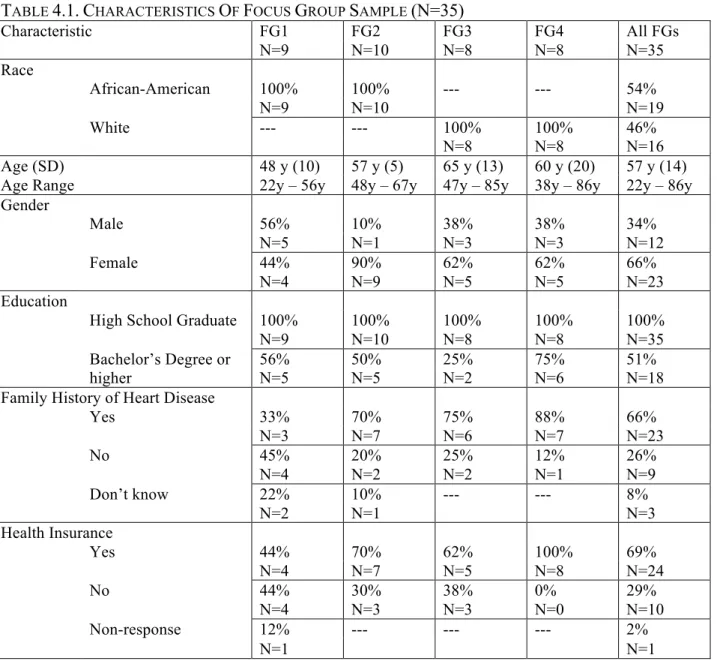
A total of 35 participants attended the FGs, with 8-10 attendees per group (Table 4.1).
Across all FGs, participant ages ranged from 22 to 86 years with the average age being 57 years.
Over half the participants were self-identified African-Americans (n=19). The majority of
participants were females (n=23). All participants finished high school with approximately half
having a college degree or higher. Compared to 2013 U.S. Census Bureau statistics for Lenoir
County,171 our FGs had more African-Americans (due to purposeful sampling), more females
(66% in the FGs versus 52.2% in Lenoir County), and a higher education level (100% finishing
high school and 51% having a Bachelor’s degree or higher in the FGs versus 77.8% and 14.1%,
respectively, in Lenoir County). The majority of FG participants also had a known family history
TABLE 4.1.CHARACTERISTICS OF FOCUS GROUP SAMPLE (N=35)
Characteristic FG1 FG2 FG3 FG4 All FGs
N=9 N=10 N=8 N=8 N=35
Race
African-American 100% 100% --- --- 54%
N=9 N=10 N=19
White --- --- 100% 100% 46%
N=8 N=8 N=16
Age (SD) 48 y (10) 57 y (5) 65 y (13) 60 y (20) 57 y (14)
Age Range 22y – 56y 48y – 67y 47y – 85y 38y – 86y 22y – 86y
Gender
Male 56% 10% 38% 38% 34%
N=5 N=1 N=3 N=3 N=12
Female 44% 90% 62% 62% 66%
N=4 N=9 N=5 N=5 N=23
Education
High School Graduate 100% 100% 100% 100% 100%
N=9 N=10 N=8 N=8 N=35
Bachelor’s Degree or higher
56% 50% 25% 75% 51%
N=5 N=5 N=2 N=6 N=18
Family History of Heart Disease
Yes 33% 70% 75% 88% 66%
N=3 N=7 N=6 N=7 N=23
No 45% 20% 25% 12% 26%
N=4 N=2 N=2 N=1 N=9
Don’t know 22% 10% --- --- 8%
N=2 N=1 N=3
Health Insurance
Yes 44% 70% 62% 100% 69%
N=4 N=7 N=5 N=8 N=24
No 44% 30% 38% 0% 29%
N=4 N=3 N=3 N=0 N=10
Non-response 12% --- --- --- 2%
N=1 N=1
Table 4.1 provides demographic characteristics of all focus groups. Data are presented as mean
D.2.DEFINING GENOMICS
Only one to two people per FG were familiar with the term “genomics.” Soliciting words
and ideas participants associated with “genomics” prior to providing the analogy yielded widely
varied responses such as “geometry,” “informative,” and “a continuing of possibilities.” The
genomics analogy was then given to provide a conceptual framework for participants to better
articulate their perspectives during the remainder of the focus group.
“Genomics is a term that describes the study of all of a person’s genes (their genome), including how genes interact with each other and with the person’s environment. This is different from genetics, which is the study of a single gene in isolation. Think of
genomics as a garden and genetics like a plant in your garden. If the plant is not flowering, you could study just the plant itself (genetics) or look at the surroundings to see if it is too crowded or there is not enough sun (genomics).”
Following the provision of the analogy, participants verbally reported finding the analogy
helpful in understanding what we meant by genomics for our discussion. Participants also made
connections between our genomics analogy and family history of common chronic diseases (e.g.,
CVD, type 2 diabetes, or cancer). Participants’ responses suggest that they understood the
distinction between single gene diseases and genomics, which was the purpose of our analogy.
Participants then verbally reported genomics as being highly important to their health ranking it
an 8.5 out of 10, with 10 being “completely important.” This importance did not vary across
racial groups.
D.3.FOCUS GROUP THEMES
Five themes emerged from the discussion about genomics: transparent communication,
privacy, participation incentives and barriers, knowledge, and the impact of knowing. There were
no major thematic differences between FGs or racial groups; therefore the results for each theme
additional information (e.g., Theme 2: Privacy and Theme 4: Knowledge) are noted within the
theme. Below we present a summary of each theme and how we used that information to tailor
our materials.
D.3.1.THEME 1:TRANSPARENT COMMUNICATION
D.3.1.A.RESULTS
Participants found genomics to be
a highly “technical word” and requested
that researchers use simple, non-technical
language instead. This theme arose when
discussing how to describe the project to
the community as well as how to describe the risks and benefits of participation. Many people
wanted plain-speak, and specificity regarding research aims and the possibility of receiving
negative health information. Specifically, they wanted research staff to be up-front about any
risks involved with the study. Participants felt that technical language could obfuscate the
presence of risk either through poor communication of what would happen to their genomic data
or poor communication of what could happen to their health as a result of their “genomics.”
Contrary to our hypothesis, there were no major thematic differences between racial groups.
D.3.1.B.IMPLICATIONS
Based on this finding, we incorporated transparent communication into HHL Genomics
materials. As such, we were purposeful in using non-technical language in study recruitment and
informed consent materials. Our goal was to have transparent communication that fostered trust “I would like to know what you’re really looking for. Talk to me” ~ AA
“Be honest and tell it like it really is, and don’t try to sugar coat it.” ~ W
between researchers and the community. Working with our community team members, we honed
language that was easily understood. For example, instead of describing the HHL Genomics
study aim as “determining whether genomic signatures can be used to predict responsiveness to
interventions that underlie CVD disparities,” the aim was described as “wanting to learn more
about genetic factors related to heart disease and needed treatments.”
D.3.2.THEME 2:PRIVACY
D.3.2.A.RESULTS
Many participants discussed
privacy concerns about the handling of
personal information and blood.
Participants wanted transparent
communication about who would have
access to their data and that “qualified”
professionals would handle blood draws (e.g., research staff, physicians, or nurses). Participants
also wanted explicit assurances that their personal information would be protected, particularly
regarding how their blood was handled after the study. If these privacy concerns were addressed,
the majority of participants stated that they would not have barriers against participation in a
genomics study.
African-Americans spoke of a mistrust of medical research that Whites did not. Many
African-Americans voiced mistrust of science in general and of medical professionals even
mentioning conspiracy theories. Their main privacy concern was of being identified from their
genetic information. Despite this and in contrast to expectations, most African-American “I would like to know about the privacy part [as an incentive to participate].” ~ W
“At the hospital though, after they test your blood or use your blood for whatever purpose, isn’t that blood destroyed? ... How do you know that’s what’s happening [here]? They show [information leaks] on TV on the Sci-Fi channel and everything.” ~ AA
participants voiced great trust in HHL researchers and even eagerness to participate in our
genomic study.
D.3.2.B.IMPLICATIONS
The finding about privacy led to the stressing of de-identification of samples and
participant rights under the Genetic Information Non-discrimination Act (GINA) in the informed
consent form. Also, recruitment and informed consent materials explicitly discuss the handling
of blood samples. While the study did decide to keep samples for future research, it was
emphasized that these samples are de-identified and that participants have the right to withdraw
their blood from the study at any point in time.
D.3.3.THEME 3:PARTICIPATION INCENTIVES AND BARRIERS
D.3.3.A.RESULTS
Receipt of money was
named as an incentive for the time
and financial costs of study
participation (e.g., travel to the
study site). Conversely, the
concern that participation would
require payment for genomic analyses and blood draws was stated as a barrier to participation. “Even though we’re not identifying ourselves and you say after this you know nobody would know anybody. How do we know down the road somebody won’t find out who we are? And that’s the only inhibitions that I have.” ~ AA
Figure 4.3. Privacy Quotation—African-American Mistrust
“[A participation incentive would be that] the services are gratis and medicine can be that way. And they cover travel.” ~ W
“Prevention. It’s like…be real positive about prevention, heart disease and prevention of heart disease.” ~ AA
Once the FG moderator explained that study participation would be free, participants stressed the
importance of explicitly stating that in study materials so that financial concerns would not be a
barrier to participation. Participants also repeatedly spoke of receiving CVD results from our
genomic study. Not only was this an important incentive unto itself, but participants also spoke
of using this information to change their lifestyle. Participants wanted incentives that would
support lifestyle changes, such as improving diet or increasing physical activity. For example,
health center memberships, gym shoes, and support in preparing healthy meals were mentioned.
There were no major differences between racial groups for this theme.
“[Researchers would benefit from] just recognizing that people are different before you go through with the study. I would figure out if people do want an incentive with money or people just want to do it just to figure out the information about their genes.” ~ AA
Figure 4.5. Participation Incentives and Barriers Quotation
D.3.3.B.IMPLICATIONS
From this finding, we learned the importance of stating all monetary gifts and expenses
(or lack thereof) upfront and explicitly in our recruitment materials. In addition to the monetary
incentive payment schedule, our materials also included explicit statements that participation in
our program, which included blood draws and genomic analysis, would not cost participants
anything, though transportation to the study site was at the participants’ expense. For example,
after explaining the study protocols, the informed consent document stated, “The program is free,
but travel costs to and from the measurement visits are not covered.” Additionally, we learned
that participants saw value in their genomic CVD results and wanted that information returned to
them. Lifestyle supports were strengthened in the two HHL clinical studies as a result of these
FGs. HHL Lifestyle participants were provided with healthy recipes and HHL Hypertension
D.3.4.THEME 4:KNOWLEDGE
D.3.4.A.RESULTS
Participants stated interest in
genomics for societal, health, and
individual benefits. Contributing to the
larger genomics knowledge pool was
named as important by both White and
African-American participants.
Additionally, African-Americans spoke specifically of adding to the knowledge pool about
African-Americans. All participants stated interest in the perceived health benefits of genomic
knowledge. Particularly, they believed that genomics could yield knowledge about disease states
like CVD and Type 2 Diabetes and could then be used to improve their own health and the health
of future generations of their family. Again, African-Americans shared this sentiment but were
also interested in the perceived health benefits of genomic research for the African-American
community at large. Lastly, participants were interested in genomics for the perceived individual
benefits. In general, participants viewed personal genomic information as an added catalyst to
make lifestyle changes, and the vast majority of participants wanted individualized genomic
feedback from the study. The desire for returning genomic results was evident irrespective of
race. (Additional quotes can be found in Appendix 4.1. Additional Quotations About
Knowledge.)
“If I was to do it [the study] I would want some feedback on my results and also the overall findings on what I could do to change if I had to do any changes.” ~ AA
Figure 4.7. Knowledge Quotation
“I would love to be part of the solution.” ~ W
“We need to know these things [results of
genomics research] and we need more support in these [African-American] communities, they’re not as tight knit as they used to be . . . we need a lot of this education.” ~ AA
D.3.4.B.IMPLICATIONS
This finding led us to explicitly state in our recruitment and informed consent materials
that the HHL Genomics study was being performed to help society. We did this to avoid
‘therapeutic misconception’ in our materials since our FG participants seemed equally if not
more motivated to participate in genomic research due to perceived health benefits or the
possibility of receiving genomic results. Appelbaum defines therapeutic misconception as the
conflation of research goals with therapeutic treatment.190 Furthermore, we also stated in our
recruitment and informed consent materials that participants would not receive their individual
results. Materials stated that since “the results of the blood tests for genomics is not a routine test
and would not be easy to understand by either you or your doctor, we will not send you the
results of these tests.”
D.3.5.THEME 5:THE IMPACT OF KNOWING
D.3.5.A.RESULTS
VALUE OF KNOWING
The consensus among the FGs was that the knowledge gained in genomic studies would
benefit both society and the individual; furthermore, this information would lead to better health
decisions. Some participants expressed negativity about receiving personal genomic information.
Concerns regarding genomic knowledge revolved around the fear of a “pre-determined” disease
state, confusion around what genomic results would mean, and possible depression and stress
“You have some that want to know the future, you have some that don’t want to know the future. And I guess [knowledge] can be harmful in some ways too, knowing too much.” ~ W
Figure 4.8. The Impact of Knowing Quotation—Value of Knowing
PERCEIVED CONTROL
The majority of participants reported feeling that they were ultimately in control of their
health no matter what their “genomics” said. Repeatedly, participants alluded to genomic
knowledge as something to empower them in making health decisions. Alternatively, others took
the perspective that they could not change what was in their genes, sometimes citing family
disease history as justification. However, the vast majority of participants, regardless of race, felt
that lifestyle choices were controllable (e.g., smoking, diet, and exercise), and that having
genomic information would empower them to make lifestyle choices.
“It’s not really a study but it’s a group that’s helping us to more [or] less take charge of our well-being as far as our health, eating right, and doing the right things as far as you know keeping our health intact. So I would try to participate in as many studies as I have to, to take care of me.” ~ AA
Figure 4.9. The Impact of Knowing Quotation—Perceived Control
D.3.5.B.IMPLICATIONS
Our findings suggest that knowing individualized genomic results is highly valuable and
empowering to our FG participants, therefore we explicitly addressed this in our recruitment and
informed consent materials. Materials explicitly stated that individualized results would not be
returned. HHL made this decision due to researchers not anticipating return of genomic results
being so coveted in this community and not having genetic counselors in our research plan.