STEREOCONVERGENT TRANSFORMATIONS OF CARBONYLS FOR EXPEDIENT SYNTHESIS OF STEREOCHEMICALLY COMPLEX SMALL
MOLECULES
C. Guy Goodman
A dissertation submitted to the faculty of the University of North Carolina at Chapel Hill in partial fulfillment of the requirements for the degree of Doctor of Philosophy in
the Department of Chemistry.
Chapel Hill 2016
© 2013
ABSTRACT
C. Guy Goodman: Stereoconvergent Transformations of Carbonyls for Expedient Synthesis of Stereochemically Complex Small Molecules
(Under the direction of Jeffrey S. Johnson)
I. A Primer on Dynamic Kinetic Resolutions and Extant Methods for Oxo-Ester Synthesis
A two part overview that details: 1) the principles of dynamic kinetic resolution
and its application in modern asymmetric catalysts and 2) current synthetic methods
for generation of enolizable β-substituted α-keto esters and α-substituted β-oxo
esters.
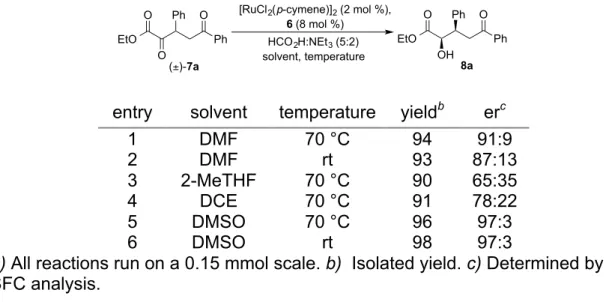
II. Asymmetric Transfer Hydrogenation-Dynamic Kinetic Resolution of β-Stereogenic α-Keto Esters
Two systems for dynamic kinetic resolution via asymmetric transfer
hydrogenation (DKR-ATH) of racemic β-stereogenic-α-keto esters yielding optically
active α-hydroxy esters are presented. In the first of these reports a previously
unreported Stetter addition of ethyl gloxylate provides β-stereogenic-α,δ-diketo
esters, which are reduced to α-hydroxy δ-keto esters. Stereo- and chemoselective
mono-reduction provides formal glycolate Michael products.
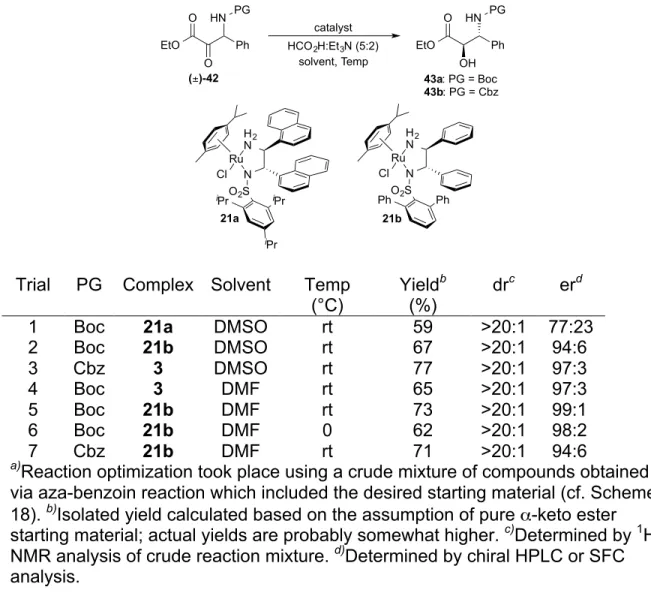
In the second disclosure, β-amino α-keto esters are reduced to the
the organic reductant , and use a Ru(II)-amido complex bearing a bulky
m-terphenylsulfonamide ligand which imparts remarkable levels of diastereo- and
enantiocontrol.
III. N-Heterocyclic Carbene-Catalyzed Dynamic Kinetic Resolutions of β -Stereogenic α-Keto Esters
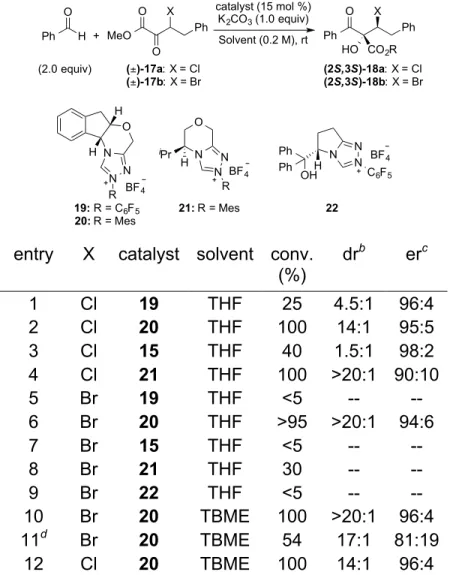
The development of two distinct N-Heterocyclic carbene catalyzed dynamic
kinetic resolutions of β-halo-α-keto esters are discussed. In the first of these, an
asymmetric cross-benzoin addition is described. The resulting fully substituted
β-halo glycolic ester products are obtained with high levels of enantio- and
diastereocontrol, and the reaction products undergo highly diastereoselective
substrate-controlled reduction to give functionalized stereotriads. Mechanistic
studies show that the high chemoselectivity observed is a result of greater
electrophilicity of the α-keto ester toward the Breslow intermediate.
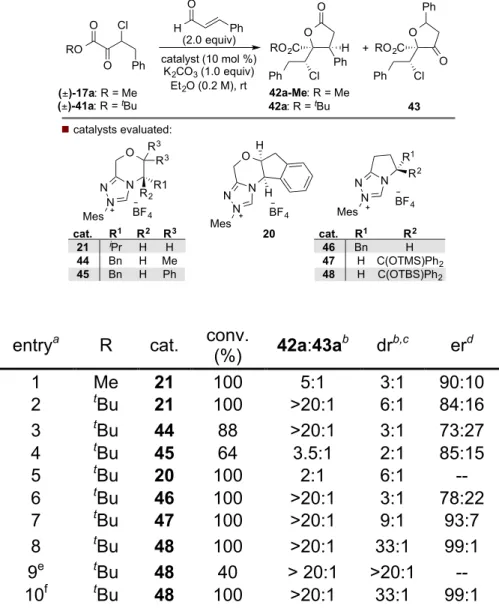
In the second report development of an asymmetric homoenolate (a3 − d3
-umpolung addition) of α,β-enals, forming γ-butyrolactones with three contiguous
stereocenters is described. The addition occurs with high regio-, diastereo-, and
enantiocontrol and constitutes the first stereoconvergent homoenolate process. PG
O
EtO HN
R O
DKR-ATH
PG O
EtO HN
R OH HCO2H
racemic β-amino-α-keto
ester
anti-β-amino-α-hydroxy
ester [Ru]* cat.
O
EtO O
DKR-ATH
O
EtO OH HCO2H
racemic α,δ-diketo
ester
chemoselective reduction α-hydroxy δ-keto ester [Ru]* cat.
R2 O R1
IV. Complexity Generating Dynamic Kinetic Resolutions of β-Oxo Acid Derivatives
Dynamic kinetic resolutions of α-stereogenic-β-formyl amides in asymmetric
2-aza-Cope rearrangements are described. Chiral phosphoric acids catalyze this
rare example of a non-hydrogenative DKR of a β-oxo acid derivative. The
[3,3]-rearrangement occurs with high diastereo- and enantiocontrol, forming β-imino
amides that can be deprotected to the primary β-amino amide or reduced to the
corresponding diamine. MeO O O R2 X dynamic kinetic cross-benzoin R1 O (−) R1 O HO CO2Me X R2 (±) tBuO O O R1 X dynamic kinetic homoenolate H O (−) (±) R2 O O tBuO2C H
R2 R1 X H O H X O (±)-β-formyl carboxylate H2N Ph Ph N H X OH Ph Ph N H X OH Ph Ph X(−) X H X(−) N H X O Ph Ph [3,3] X H
ACKNOWLEDGEMENTS
The most important decision I made in graduate school was to join Jeff’s lab.
Words don’t do justice the respect I have for Jeff, but I’ll pen a few anyway. Having
a graduate advisor who prioritizes student education, cares about the person as
much as the scientist, and has an extraordinary gift for instilling the ability to think
independently was invaluable. Perhaps more instructive to the point that I am trying
to make is to say that while I learned a lot about being a productive chemist from
Jeff, the two most important lessons that he taught me have nothing to do with
chemical synthesis. I am so grateful I was able to be a part of his group, and to have
gotten the chance to know a truly unique individual.
I would like to thank Professors Jillian Dempsey, Mike Gagné, Simon Meek,
and Alex Miller for serving on my final defense committee. I also acknowledge
Professors Maurice Brookhart, Erik Alexanian, and Valerie Ashby for their previous
committee work.
Talented co-workers have surrounded me during my time in the Johnson
Group, each has been integral to this experience, and each has my thanks. I’d like to
extend a specific note of thanks to Kim who helped get my feet underneath me,
Justin who was so willing to spend time teaching, and to Michael who continually
challenged my thinking and progressed my chemistry beyond what would have been
student as it enabled me to share in his life journey and watch him find who he
wanted to be−that really was one of the best parts of graduate school. Similarly, I
never thought that pushing MacKenzie to join my undergrad cohort would have such
a profound benefit to myself. Her friendship, and role in getting me through the bulk
of graduate school were so important.
My family and friends have been incredibly supportive throughout this
process. Mom in particular has been so encouraging of my educational process,
even though it kept me thousands of miles away. I’ve been blessed with an
incredible group of friends including those who I have lived, gone to lunch, watched
the Tar Heels, and spent countless Fridays at He’s Not with. Carolina sports helped
make this place home and Amber attended all of them with me. Since the first day of
grad school Thomas has been there, I’m beyond thankful we got to take this ride
together. Andrew and Javi, brought amazing levity to pretty much every situation;
and have my thanks for not burning the house down (yet). Lauren and Katie were
critical to making every outing better−always ensuring that food was a priority. From
Pantana’s on, Kelsey always provided a smile and was so integral to making the
latter part of this program enjoyable, I really can’t equate the value of those or so
many other things. Finally, I can’t express enough thanks to Ron and Sue who have
welcomed me into their home, solved pretty much all of my biggest grad school
TABLE OF CONTENTS
LIST OF SECTIONS ... ix
LIST OF TABLES ... xiii
LIST OF SCHEMES ... xiv
LIST OF ABBREVIATIONS AND SYMBOLS ... xviii
CHAPTER 1 A PRIMER ON DYNAMIC KINETIC RESOLUTIONS AND EXTANT METHODS FOR OXO-ESTER SYNTHESIS 1.1 Dynamic Kinetic Resolutions ... 1
1.1.1 Key Principles ... 1
1.1.2 Racemization by Tautomerization ... 4
1.1.3 Additional Pathways for Enantiomerization ... 5
1.1.4 Dynamic Kinetic Asymmetric Transformations ... 7
1.2 Oxo-Esters ... 8
1.2.1 Synthesis of Racemic β-Stereogenic α-Keto Acid Derivatives ... 10
1.2.2 Asymmetric Synthesis of β-Stereogenic α-Keto Acid Derivatives ... 13
1.2.3 Synthesis of Racemic α-Stereogenic β-Keto Acid Derivatives ... 15
1.2.4 Asymmetric Synthesis of α-Stereogenic β-Keto Acid Derivatives ... 16
1.3 Strategy for the Synthesis of New α- and β-Hydroxy or Amino Acids ... 18
1.4 References ... 20
2.2 Chemoselective Dynamic Asymmetric Reduction of α,δ-Diketo Esters ... 30
2.3 Asymmetric Synthesis of anti-β-Amino-α-Hydroxy Esters via Dynamic Kinetic Resolution of β-Amino-α-Keto Esters ... 41
2.4 Experimental Data and Conditions for the Chemoselective Dynamic Asymmetric Reduction of α,δ-Diketo Esters ... 53
2.4.1 General Information ... 53
2.4.2 General Procedure A for the Preparation of β-Substituted α,δ-Diketo Esters 7a-n ... 54
2.4.3 General Procedure B for the Preparation of Racemic δ-Keto α-Hydroxy Esters 8a-n ... 63
2.4.4 General Procedure C for the ATH-DKR of α,δ-Diketo Esters ... 63
2.4.5 Baeyer-Villiger Oxidation of 8c ... 75
2.4.6 Preparation of m-Terphenyl Sulfonyl Chloride ... 76
2.4.7 Preparation of 6 ... 77
2.5 Experimental Data and Conditions for the Asymmetric Synthesis of anti-β -Amino-α-Hydroxy Esters via Dynamic Kinetic Resolution of β-Amino-α-Keto Esters ... 79
2.5.1 General Information ... 79
2.5.2 General Procedure A for the Preparation of Amido Sulfones 41c-41o 81 2.5.3 General Procedure B for the Preparation of α-Diazo Esters 45a-o ... 89
2.5.4 Preparation of α-Diazo Ester 45o ... 96
2.5.5 Preparation of Complex 21b ... 98
2.5.6 General Procedure C for the ATH-DKR of β-Amino-α-Keto-Esters .... 98
2.5.7 Synthesis of (+)-47 from Epoxide 46 ... 113
2.5.8 Synthesis of (+)-43b from 47 ... 114
2.5.9 Boc deprotection of 43a ... 115
2.5.10 Cbz Deprotection of (-)-43b ... 115
CHAPTER 3 N-HETEROCYCLIC CARBENE-CATALYZED DYNAMIC KINETIC RESOLUTIONS OF β-STEREOGENIC α-KETO ESTERS
3.1 Introduction ... 123
3.2 Dynamic Kinetic Asymmetric Cross-Benzoin Additions of β-Stereogenic α -Keto Esters ... 125
3.3 Enantioconvergent Synthesis of Functionalized y-Butyrolactones via (3+2)-Annulation ... 136
3.4 Experimental Data and Conditions for the Dynamic Kinetic Asymmetric Cross-Benzoin Additions of β-Stereogenic α-Keto Esters ... 147
3.4.1 General Information ... 147
3.4.2 General Procedure A for the Preparation of α-Keto Esters ... 149
3.4.3 Preparation of Catalyst 21 ... 153
3.4.4 Optimization data for the Asymmetric Cross-Benzoin of 17a/17b with Benzaldehyde ... 155
3.4.5 General procedure C for the Asymmetric Cross-Benzoin Procedure 157 3.4.6 Attempting the Cross-Benzoin Reaction Using Homo-Benzoin Product 23 ... 167
3.4.7 Procedure for the Gram Scale Asymmetric Cross-Benzoin ... 167
3.4.8 General Procedure D for the Reduction of Cross-Benzoin Products 168 3.4.9 Synthesis of the Mosher ester of 24p ... 171
3.5 Experimental Data and Conditions for the Enantioconvergent Synthesis of Funcionalized γ-Butyrolactones via (3+2)-Annulation ... 173
3.5.1 General Information ... 173
3.5.2 Preparation of Catalyst 45 ... 175
3.5.3 Preparation of Catalyst 21 ... 176
3.5.4 Preparation of Catalyst 46 ... 178
3.5.5 Preparation of Catalyst 48 ... 179
3.5.6 General Procedure A: Preparation of α-Keto Esters ... 180
3.5.8 General Procedure B: Asymmetric (3+2)-Annulation ... 184
3.5.9 Procedure for the Gram Scale Asymmetric (3+2)-Annulation ... 198
3.5.10 Procedure for the Hydrogenation of 42k ... 199
3.6 References ... 200
CHAPTER 4 COMPLEXITY GENERATING DYNAMIC KINETIC RESOLUTIONS OF β-OXO ACID DERIVATIVES 4.1 Introduction ... 210
4.2 Asymmetric Synthesis of β-Amino Amides by Catalytic Enantioconvergent 3-Aza-Cope Rearrangement ... 215
4.3 Experimental Data and Conditions for the Asymmetric Synthesis of β-Amino Amides by Catalytic Enantioconvergent 2-Aza-Cope Rearrangement ... 225
4.3.1 General Information ... 225
4.3.2 Complete Reaction Data for the Asymmetric 2-Aza Cope Rearrangement of β-halo α-Keto Esters ... 227
4.3.3 Racemization Study of Enantioenriched α-Halo-β-Keto Esters Under Buffered Conditions ... 228
4.3.4 Tested Reaction Conditions to Promote the 2-Aza Cope Rearrangement of α-Substituted-β-Formyl Esters ... 229
4.3.5 Preparation of Allyl Amine 2b ... 230
4.3.6 General Procedure C: Preparation of β-Formyl Amide 16 ... 232
4.3.7 Full Optimization Data for the Asymmetric 2-aza Cope Rearrangement of β-Formyl Amides ... 241
4.3.8 General procedure E for the Asymmetric 2-Aza Cope Rearrangement of β-Formyl Amides ... 243
4.3.9 Procedure for the Generation of Amino Alcohol 21 ... 263
4.3.10 Procedure for the Generation of 1,3-Diamine 22 ... 264
4.3.11 Procedure for the Generation of Cyclohexene 23 ... 265
4.3.12 Testing for Reversibility of [3 , 3]-Aza Cope Rearrangement ... 266
LIST OF TABLES
Table 2-1 Chemoselective DKR-ATH: Reaction Optimization ... 33
Table 2-2 DKR-ATH of β-amino α-Keto Ester Optimization ... 48
Table 3-1 Catalyst and Substrate Optimization for the Asymmetric Cross
Benzoin ... 130
Table 3-2 Optimization of the Homoenolate Addition of Enals to α-Keto
Esters ... 141
Table 4-1 Attempts to Effect the 2-Aza-Cope Transformation Using β -Stereogenic α-Keto Esters ... 212
Table 4-2 Racemization Study of β-Bromo α-Keto Ester 7c Under the Proposed Reaction Conditions ... 213
Table 4-3 Attempts to Effect the 2-Aza-Cope Transformation Using α -Stereogenic β-Formyl Esters ... 216
LIST OF SCHEMES
Scheme 1-1 Principles of Kinetic Resolutions ... 2
Scheme 1-2 Dynamic Kinetic Enantioselective Reactions ... 3
Scheme 1-3 First Reported Chemical DKR with β-Keto Esters ... 4
Scheme 1-4 Stereoconvergent Hydrogenation of α-Branched Aldehydes ... 5
Scheme 1-5 Organocatalytic Reductive Amination DKR of α-Branched Aldehydes . 5 Scheme 1-6 Acylative DKR of Alcohols by Redox Cycling ... 6
Scheme 1-7 Reductive Amination DKR via Hydrogen Borrowing and Enamine Imine Tautomerization ... 7
Scheme 1-8 Synthetic Utility of α- and β-Oxo Acid Addition Products ... 9
Scheme 1-9 Complications of Nucleophile Additions to Stereochemically Defined α- and β-Oxo Esters ... 10
Scheme 1-10 Synthesis of β-Stereogenic α-Keto Esters Using Glyoxylate Equivalents ... 11
Scheme 1-11 Synthesis of β-Stereogenic α-Keto Esters via Structural Rearrangements ... 12
Scheme 1-12 Synthesis of β-Stereogenic α-Keto Esters from α-Diazo Esters ... 12
Scheme 1-13 Asymmetric Synthesis of β-Stereogenic α-Keto Acid Derivatives with 1,2-Dicarbonyl Pronucleophiles ... 14
Scheme 1-14 Asymmetric Synthesis of β-Stereogenic α-Keto Acid Derivatives from Glyoxylate Equivalents ... 15
Scheme 1-15 General Strategies for the Construction of Non-Quaternary Racemic α -Stereogenic β-Keto Acid Derivatives ... 16
Scheme 1-16 Approach to the Asymmetric Synthesis of α-Stereogenic β-Keto Acid Derivatives via Chiral Auxiliaries ... 17
Scheme 1-17 Catalytic Asymmetric Synthesis of α-Stereogenic β-oxo Acid Derivatives ... 18
Scheme 2-2 Proposed ATH-DKR of α,δ-Diketo Esters to Form α,δ-Dihydroxy
Esters ... 31
Scheme 2-3 Scope of the Glyoxylate Stetter Addition with Enones ... 32
Scheme 2-4 ATH-DKR of α,δ-Diketo Esters Delivers Formal Glycolate Michael Products ... 34
Scheme 2-5 Strategies to Access δ-Oxygenated Glycolic Acid Derivatives ... 34
Scheme 2-6 Variation of δ-Ketone in the Chemoselective ATH-DKR of α,δ-Diketo Esters ... 35
Scheme 2-7 Variation of the β-Substitutent in the Chemoselective ATH-DKR of α,δ -Diketo Esters ... 36
Scheme 2-8 Stereochemical Analysis of δ-Keto α-Hydroxy Esters ... 37
Scheme 2-9 Investigation into Observed Chemoselectivity of ATH-DKR ... 37
Scheme 2-10 1H NMR Showing Absence of in situ Lactol Formation ... 38
Scheme 2-11 Chemoselectivity of the [RuCl2(p-cymene)]2/Diamine 6 Catalyst System ... 39
Scheme 2-12 Atom Economy in the Synthesis of β-Substituted α-Hydroxy Esters ... 39
Scheme 2-13 Recent Developments in the ATH-DKR of a-Keto Esters and Congeners ... 41
Scheme 2-14 Proposed ATH-DKR of β-Amino α-Keto Esters ... 42
Scheme 2-15 Synthesis of β-Amino α-Hydroxy Esters from Alkenes ... 43
Scheme 2-16 Multistep Syntheses of β-Amino α-Hydroxy Esters ... 44
Scheme 2-17 Synthesis of Amido Sulfones ... 45
Scheme 2-18 Attempts at the Aza Benzoin Addition of Ethyl Glyoxylate into in situ Generated Aldimines ... 46
Scheme 2-19 Literature Precedented Mannich Addition ... 49
Scheme 2-20 Substrate Scope for the Mannich Addition of Ethyl Diazoacetate ... 50
Scheme 2-21 Substrate Scope for the ATH-DKR of β-Amino α-Keto Esters ... 51
Scheme 3-1 Attempted Carbon Based Nucleophile Additions to β-Halo α-Keto
Esters ... 123
Scheme 3-2 DyKAT Addition of Acetone and Nitromethane to β-Bromo α-Keto Esters ... 124
Scheme 3-3 NHC Catalyzed DKR for the Formation of β-Lactones ... 125
Scheme 3-4 Proposed NHC catalyzed DKR of β-halo α-keto esters ... 125
Scheme 3-5 NHC-Catalyzed Cross-Benzoin Couplings with α-Keto Esters ... 127
Scheme 3-6 Chemoselectivity Challenges for the Coupling of Aldehydes (blue) and Enolizable α-Keto Esters (red) in the Presence of Base and Carbene ... 128
Scheme 3-7 Cross-Benzoin Additions of Aldehydes to β-Bromo α-Keto Esters ... 131
Scheme 3-8 Gram Scale Reaction of 17b and Benzaldehyde ... 132
Scheme 3-9 Determining the Source of the Observed Cross-Benzoin Chemoselectivity ... 133
Scheme 3-10 Reduction of the Cross-Benzoin Products ... 133
Scheme 3-11 Absolute and Relative Stereochemistry and Proposed Transition State for the Dynamic Cross-Benzoin ... 134
Scheme 3-12 Levels of Stereocomplexity Present in DKR Reactions ... 137
Scheme 3-13 DKR Reactions that Establish Three Stereocenters ... 138
Scheme 3-14 Previous Homoenolate Additions to Linear α-Keto Esters ... 139
Scheme 3-15 Chemoselectivity Challenges for the Carbene-Catalyzed Coupling of α,β-Enals (blue) and Enolizable α-Keto Esters (red) ... 140
Scheme 3-16 Variation of α−β Unsaturated Aldehydes in the Homoenolate Addition to β-Chloro-α-Keto Esters ... 143
Scheme 3-17 Variation of β-Chloro α-Keto Esters in the Homoenolate Addition of Cinnamaldehyde ... 144
Scheme 3-18 Gram Scale Reaction of 41a ... 145
Scheme 3-19 Proposed Mechanism of the [3 + 2] Annulation ... 145
Scheme 4-1 Stereoconvergent Sigmatropic Processes ... 210
Scheme 4-2 Previous 2-Aza-Cope DKR ... 211
Scheme 4-4 Proposal for Achieving Facile Racemization ... 217
Scheme 4-5 Synthesis of α-Stereogenic β-Formyl Amides ... 219
Scheme 4-6 Variation of the α-Substituent in the [3,3]-Rearrangement of α−Stereogenic-β-Formyl Esters ... 221
Scheme 4-7 Variation of Amide and Allyl Amine Identity in the [3,3]-Rearrangement of α-Stereogenic-β-Formyl Esters ... 222
Scheme 4-8 Determination of Relative and Absolute Stereochemistry of the [3,3]-Aza Cope Rearrangement ... 223
LIST OF ABBREVIATIONS AND SYMBOLS
2D-NMR two-dimensional nuclear magnetic resonance
2Me-THF 2-methyl tetrahydrofuran
Å ångström
Ac acetate
ACN acetonitrile
Ac2O acetic anhydride
Ar aryl
aq aqueous
ATH asymmetric transfer hydrogenation
atm atmospheres
Aux auxiliary
BINAP 2,2´-bis(diphenylphosphino)-1,1´-binaphthyl
Bn benzyl
Boc benzyloxycarbonyl
br broad
br s broad singlet
nBu normal-butyl
tBu tert-butyl
13C NMR carbon nuclear magnetic resonance spectroscopy
cat catalytic amount or catalyst
CBz carboxybenzyl
CPME cyclopentyl methyl ether
C–C carbon-carbon bond
d doublet
D dextrorotation
DBU 1,8-diazabicyclo[5.4.0]undec-7-ene
DCC dicyclohexylcarbodiimide
DCE 1,2-dichloroethane
DCM dichloromethane
dd doublet of doublet
ddd doublet of doublet of doublets
dddd doublet of doublet of doublet of doublets
dt doublet of triplets
ddt doublet of doublet of triplets
(DHQ)2PHAL Hydroquinidine 1,4-phthalazinediyl diether
DiBAL-H diisobutyl aluminum hydride
DIPT (+)-diisopropyl L-tartrate
DKR dynamic kinetic resolution
DME 1,2-dimethoxyethane
DMAP N,N-dimethylaminopyridine
DMF N,N-dimethylformamide
DMP Dess–Martin Periodinane
DMSO dimethyl sulfoxide
dq doublet of quartet
dr diastereomeric ratio
dt doublet of triplet
DyKAT dynamic kinetic asymmetric transformation
E entgegen
E+ electrophile
EE ethoxyethyl
eq equation
equiv equivalents
er enantiomeric ratio
ESI electrospray ionization
Et ethyl
EtOH ethanol
Et2O diethyl ether
EtOAc ethyl acetate
EWG electron withdrawing group
19F NMR fluorine nuclear magnetic resonance spectroscopy
FID flame ionization detector
G Gibbs free energy
h hour
1H NMR proton nuclear magnetic resonance spectroscopy
HOAc acetic acid
HRMS high resolution mass spectroscopy
Hz hertz
I intermediate
IR infrared spectroscopy
iPr iso-propyl
J coupling constant
k reaction rate
KR kinetic resolution
L levorotation
L liter or ligand
L-Selectride® lithium tri-sec-butylborohydride
LA Lewis acid
LDA lithium diisopropylamide
LRMS low resolution mass spectroscopy
LTQ-FT linear trap quadrapole Fourier transform
M molarity
m multiplet
m meta
M left-handed helix (minus)
m-CPBA meta-chloroperoxybenzoic acid
Me methyl
MeOH methanol
MHz megahertz
min minutes
mL milliliter
mmol millimole
mp melting point
MS molecular sieves
MTBE methyl tert-butyl ether
n number of atoms or counterions
NCS N-chlorosuccinimide
Np naphthyl
NR no reaction
Nu nucleophile
o ortho
[O] oxidation
Oxone® potassium peroxomonosulfate
p para
P product
P right-handed helix (plus)
PG protecting group
pKa acid dissociation constant
Ph phenyl
PMP para-methoxyphenyl
ppm parts per million
PPTS pyridinium p-toluenesulfonate
psig pounds per square inch gage
iPr iso-propyl
q quartet
Q quaternary ammonium salt
R substituent
R Re
Rf retention factor
rac racemic or racemization
rt room temperature
Ru ruthenium
s singlet
S starting material
S Si
sept septuplet
oct octuplet
SFC supercritical fluid chromatography
T temperature
t triplet
tr retention time
TBHP tert-butyl hydroperoxide
TBS tert-butyl dimethylsilyl
TEA triethylamine
TFA trifluroacetic acid
TfOH trifluoromethanesulfonic acid
THF tetrahydrofuran
TLC thin-layer chromatography
TMG 1,1,3,3-tetramethylguanidine
TS transition state
TsOH para-toluenesulfonic acid
UV ultraviolet
X anionic ligand, halide, substituent, or number
Z zusammen
[α] optical rotation
δ chemical shift or partial charge
ΔG change in free energy
λ wavelength
µL microliter
CHAPTER 1
A PRIMER ON DYNAMIC KINETIC RESOLUTIONS AND EXTANT METHODS FOR OXO-ESTER SYNTHESIS
1.1 Dynamic Kinetic Resolutions 1.1.1 Key Principles
Synthetic methods that deliver enantioenriched small molecules on
industrial scale are of great importance for human health. Towards this end three primary approaches to access single enantiomer therapeutics are typically
employed: asymmetric catalysis, implementation of chiral feedstock provided by nature, and resolution of a pair of enantiomers. Of these, resolution strategies are particularly useful in kilogram scale synthesis due to A) cost effective access to functionalized racemic materials, B) numerous broadly applicable resolution platforms, and C) operational simplicity of those methods.
racemic allylic alcohol 1 under the control of a chiral titanium catalyst providing (1S,2S,3S)-2 in 97:3 er and 52% yield (Scheme 1B) with concomitant recovery of (R)-1 in 45% yield and 98:2 er.2
Scheme 1. Principles of Kinetic Resolutions
As there is no method for epimerization, typical kinetic resolutions, are inherently limited to a 50% theoretical yield of enantiomerically pure product.3 A potential solution to this low theoretical yield is presented when a pathway for interconversion of starting material enantiomers exists. Provided that the rate of racemization through an achiral intermediate I is at least as fast as conversion of the faster reacting enantiomer of starting material to product (i.e., krac≥kR>>kS) a dynamic kinetic resolution (DKR) can occur (Scheme 2A).1 This process is governed by Curtin−Hammett kinetics where the degree of stereoselectivity is determined by the magnitude of ΔΔG‡ (Scheme 2B).3
While in a KR [SS]/[SR] varies as a function of time, in an efficient DKR [SS]/[SR] = 1.0 at all times. The net outcome of these principles is that under a DKR manifold, a racemic starting material can be converted to a single
stereoisomeric product with 100% theoretical yield via the faster reacting
OH OH
(±)-1
O +
OH
(1S,2S,3S)-2 52% yield
97:3 er
(R)-1 45% yield
98:2 er
O O OH
O O OH
(+)-DIPT Ti(OiPr)
4 (1.0 equiv) (+)-DIPT (1.2 equiv) TBHP (0.6 equiv)
DCM, -20 °C B)
SS
SR
kS slow
kR fast
PS
enantiomer. As a result using facile modes of racemization is critical to producing an efficacious DKR.1,3-5
Scheme 2. Dynamic Kinetic Enantioselective Reactions
!G2‡ !G1‡
!!G‡
R2 R1 R3H
R2 H R3
R1 !G‡rac
100% 0%
reaction coordinate Energy
SS
SR
kS slow
kR fast
PS
PR I
A)
B)
krac
SS SR
PR = PS =
energy
1.1.2 Racemization by Tautomerization
Noyori reported the first chemical DKR, converting α-alkyl-β-keto ester 3
to β-hydroxy ester 4 via asymmetric hydrogenation (Scheme 3).6 Interconversion of (R)-3 and (S)-3 is through the tautomeric, achiral enol and is sufficiently facile due to the low pKa of the α-proton.
Scheme 3. First Reported Chemical DKR with β-Keto Esters
Since this seminal report, enolization as a racemization mode has been used for hydrogenative DKRs of a number of differentially substituted β-keto esters.1,3-5,7-11 Additionally, carbonyls with
α-protons having a higher pKa than those of β-keto esters have also been shown as competent DKR substrates. Aldehydes, ketones, and azlactones have all been deployed in a number of DKR reactions including asymmetric hydrogenation,12-16 aldol additions17-20 and
transesterifications.21-25 For example ruthenium diamino diphosphine 6, catalyzes the hydrogenative DKR of α-aryl aldehyde 5 forming primary alcohol 7 in 96% ee (Scheme 4).12
O
OMe O
RuBr2[(R)-BINAP] (3 mol %) DCM, H2 (100 atm)
OH OMe O
(±)-3 (1R,2R)-4
> 95% yield 99:1 er OH
OMe O
Scheme 4. Stereoconvergent Hydrogenation of α-Branched Aldehydes
Tautomerization of imines to enamines has been utilized as a similarly effective method of enantiomerization.26-29 List has demonstrated that under chiral phosphoric acid catalysis and using Hantzsch ester 9 as an organic reductant the reductive amination of racemic aldehyde 8 occurs to provide 10 in 92% yield and 99:1 er (Scheme 5).26
Scheme 5. Organocatalytic Reductive Amination DKR of α-Branched Aldehydes
These selected examples represent a much larger set of DKR reactions that use tautomerization as the mechanism for racemization. This
enantiomerization modality will be featured prominently in Chapters 2-4. 1.1.3 Additional Pathways for Enantiomerization
While the following will not be used in subsequent chapters, a number of additional modes of racemization have been applied in highly selective DKRs.
Me Me
H O
6(0.1 mol %) KOtBu (2 equiv) iPrOH, H2 (50 atm)
Me Me OH
(±)-5 (S)-7
96% ee P
Me OMe Me P Me OMe Me Ru H2 N N H2 Cl Cl 6 achiral intermediate Me Me H OK O O P O OH iPr iPr iPr iPr
iPr iPr Me Me
H
O 9(5 mol %)
C6H6, 6 °C
Me Me H N
(±)-8 99:1 er (R)-10
92% yield achiral enamine Me Me H H N N H Me Me
CO2Et EtO2C
When a heteroatom is present at the stereogenic center, redox cycling through intermediate carbonyls (X = O) or imines (X = N) has been shown to effectively interconvert enantiomers as part of DKR reactions.
The preponderance of these methods are chemoenzymatic, utilizing metal catalysts for redox cycling and enzymes for selective substrate
transformation. Enzymes are frequently employed for DKR acylations of secondary alcohols and numerous other reaction modalities. While they
frequently exhibit phenomenal spatial selectivity they are typically highly specific with little substrate generality.30 Therefore, while the significance of enzymatic DKRs is acknowledged, the focus of all subsequent discussion will be solely on the development of chemical DKRs. The first chemical acylative DKR of
secondary alcohols was disclosed by Fu,31 using (C5Ph5)Ru(CO)2Cl as a redox
cycling catalyst in conjunction with ferrocene-based chiral N,N-dimethyl amino pyridine (DMAP) catalyst 12 providing 13 in 95% yield and 87% ee (Scheme 6). Ruthenium-promoted equilibration between acetophenone and 1-phenylethanol resulted in a rate of racemization sufficient for dynamic conversion.
Scheme 6. Acylative DKR of Alcohols by Redox Cycling
Ph Me OH
(±)11 +
tAmOH/PhCH
3 (1:1), 10 °C
Ph Me O 13
Me O
achiral ketone Ph Me
O Me O
O
OiPr O
N NMe2 Fe
Ph Ph Ph
Ph Ph (1.5 equiv)
12 (C5Ph5)Ru(CO)2Cl (5 mol %)
KOtBu (4 mol %) 12 (1 mol %)
Zhao has reported a rare example where redox cycling and
tautomerization are used in tandem resulting in the stereoconvergence of four isomers to a single product.32 Subjecting alcohol 14 to a dual catalytic system consisting of iridium diamine 15 and spinol derived phosphoric acid 16 delivers reductive amination product 17 with high stereoselectivity (Scheme 7). This convergence of starting materials is the result of both redox cycling (alcohol into ketone via hydrogen borrowing) and imine/enamine racemization of the
α-stereocenter.
Scheme 7. Reductive Amination DKR via Hydrogen Borrowing and Enamine Imine Tautomerization
Although less frequently used, racemization by addition-elimination and Schiff base formation are both precedented; 1,3-5 however, they are not utilized in subsequent chapters.
1.1.4 Dynamic Kinetic Asymmetric Transformations
While often used synonymously with the term DKR, a dynamic kinetic asymmetric transformation (DyKAT) is a fundamentally different process. In a DKR, enantiomerization of the stereogenic center is independent of the chiral catalyst−driven solely by the spontaneity of racemization. Conversely in a DyKAT,
Me Ph
OH Me
NH2
Ir N HN
S O O
O O
P O
OH Ar
Ar Ar = 2,4,6-iPrC6H2 (±)-14
Ph
Me NH Me (2S,3S)-17
81% yield 97:3 dr 99:1 er
15 16
15 (5 mol %) 16 (10 mol %) PhCH3, 110 °C 1.2 equiv
+
achiral enamine Ph
Me NH Me
enantiomeric substrates are interconverted through diastereomeric complexes formed by association of a chiral catalyst with substrate, implying the potential for a different rate of equilibration for each enantiomer. The net effect of this is
twofold: 1) unlike in a DKR a DyKAT can result in an accumulation of one enantiomer (or with catalyst associated--diastereomer) over the other; 2)
interconversion of diastereomers can be more favorable than in a DKR due to the potential for an enthalpic driving force.1 There are four classifications of DyKATs, however all following chapters will focus on only traditional DKRs; consequently, understanding the above principles is an adequate conceptual framework for the work contained herein.
1.2 Oxo-Esters
This dissertation will focus on the reactivity of stereochemically labile oxo-acid derivatives; therefore, a short discussion on the utility of their reaction products is warranted. For both α- and β-oxo acids a number of functionally rich and biologically relevant products are accessible via addition of a nucleophile or through amine condensation and subsequent nucleophile addition. Direct
reaction platforms with β-keto esters deliver β-hydroxy acids, utilized in
pharmaceuticals40 and personal health products,33,41 and β-amino acids which are structural motifs present in the structures of taxol,42 cocaine,43 and
penicillin,44 among others45; representing some of the most influential modern pharmaceuticals.
Scheme 8. Synthetic Utility of α- and β-Oxo Acid Addition Products.
Of particular difficulty for these important scaffolds is the generation of single enantiomer products bearing non-quaternary stereocenters vicinal to the hydroxyl or amino group. Establishing this stereocenter prior to reaction with the carbonyl is complicated by the high acidity of the carbonyl α-proton (pKa = 11 and 13 for β-oxo esters and α-keto esters respectively)46 as it predisposes the
established stereocenter to racemization before nucleophile addition (Scheme 9). This same stereolability implicates use of these substrates in DKRs which can deliver products not prone to racemization while simultaneously establishing both both relative and absolute stereochemistry.
O O
R EtO
O EtO
O R
HO O
R Nu OH α-glycolic acids
Nu
NH3, Nu
HO O
R Nu NH2 α-amino acids
HO O
R Nu
Nu OH
NH3, Nu
HO O
R Nu NH2
Scheme 9. Complications of Nucleophile Additions to Stereochemically Defined α- and β-Oxo Esters
Since a DKR approach to stereochemically rich α- and β-amino or hydroxy acids requires only synthetic access to racemic, rather than enantiopure, starting oxo-acids, there is also a significant advantage in available product diversity. 1.2.1 Synthesis of Racemic β-Stereogenic α-Keto Acid Derivatives
There are numerous methods for the synthesis of non-quaternary racemic
β-substituted α-keto acid derivatives that provide access to a wide array of diverse β-functionality. Many rely on the generation and subsequent addition of glyoxylate acyl anion equivalents to assorted electrophiles. Of these umpolung (polarity inversion) strategies the Stetter addition of glyoxylate to a Michael acceptor is the most efficient. Our group has described N-heterocyclic carbene (NHC) catalyzed addition of ethyl glyoxylate 18 to alkylidene malonate 19 delivering racemic α-keto ester 20 (Scheme 10A).47 In a related report cyanide addition to silyl glyoxylate 21 is followed by cross-benzoin condensation with aldehyde 22 delivering β-siloxyl α-keto ester 22 (Scheme 10B).48 Takahashi has
O O EtO O EtO O R2 H R2 R1
H R1
O O EtO H R2 R1 O O EtO R1 R2 H OH O EtO R1 R2
Nu Nu O
EtO H R2 R1 HO Nu O EtO R1 R2 H Nu OH + Nu + Nu + Nu O EtO O R2 H R1
O EtO OH R2 R1 Nu O EtO O R2 R1H
O EtO R2
H R1 OH
Nu O
EtO R2 R1H
Nu HO + H O O
pKa (H2O) ~13
EtO EtO
O H
pKa (H2O) ~11 O
also reported the use of protected cyanohydrin 24 as a glyoxylate equivalent for the generation of β-acetoxy α-keto ester 26 (Scheme 10C).49
Scheme 10. Synthesis of β-Stereogenic α-Keto Esters Using
Glyoxylate Equivalents
Structural reorganization to unveil racemic α-keto acid scaffolds have also
been demonstrated. Our group has utilized aerobic deacylation of acetoacetate derivative 27 delivering α-keto ester 29.50 Mechanistically this process is
proposed to proceed via enolate peroxidation followed by formation and subsequent fragmentation of endoperoxide 28 (Scheme 11A). In a distinct
strategy, the Darzens reaction using dichloroacetate 30 and aldehyde 31 delivers epoxychloride 32 which upon nucleophilic ring opening eliminates chloride to form α-keto ester 33 (Scheme 11B).51
EtO O H O N N N
C6F5
BF4 +
R
CO2Me
CO2Me
EtO O
O R
CO2Me
CO2Me
19 (±)-20
(20 mol %) NEt3 (1 equiv), PhCH3, rt
R = aryl, heteroaryl, propargyl 11 examples 78-96% yield tBuO O TBS O R O H + DMF, rt Yb(OiPr)
3 (5 mol %)
Me2C(OH)CN (20 mol %)
tBuO O
O OTBS
R
R = aryl, heteroaryl, alkyl
21 22 (±)-23
12 examples 85-96% yield tBuO O OEE Me H
O 1) Ac2O, pyridine
tBuO O
O OAc
24 25 (±)-26
39% yield CN
A)
B)
C) + 2) PPTS, MeOH Me
Scheme 11. Synthesis of β-Stereogenic α-Keto Esters via Structural
Rearrangements
A number of β-substituents can be accessed using two-step protocols that
terminate in oxidation of α-diazo esters to keto esters. Addition of diazo acetate
34 into tosylaldimine 35 followed by oxidation with Oxone® delivers β-amino α
-keto ester 36.52The use of α-diazo ester 37 for condensation with aldehyde 38
provides β-hydroxy α-diazo ester 39.53
Scheme 12. Synthesis of β-Stereogenic α-Keto Esters from α-Diazo
Esters MeO O O Me R1 R2 O Cu(NO
3)2•3H2O (20 mol %)
air (50 psig), CH3CN MeO
O O R1 R2 O O O MeO2C
Me OCuII R1 R2 O ‡ 27 (±)25(±)2 28
R1O
O Cl
Cl H R2 O
R1O
O O R2 X ‡ 32
+ 1) KO
tBu 2) X−
R1O
O O R2 Cl X 30 31 (±)-29 6 examples 79-98% R1 = aryl, alkyl
R2 = aryl, alkyl, OR
R = Aryl, Heteroaryl, Alky
R1 = Me, iPr, tBu
R2 = aryl, alkyl
X = Cl, Br A) B) (±)-33 25 examples 56-97% MeO O H N2 1) DBU H R N Ts MeO O O NHTs R + EtO O H N2 H R O EtO O N2 OH R +
34 35 (±)-36
13 examples 51-82%
37 38 (±)-39
18 examples 10-95% A)
B) R = aryl
R = aryl
DBU 2) Oxone®, NaHCO3
Two-step protocols that generate the α-ketone via ozonolysis have been
reported including Morita-Baylis-Hillman (MBH) addition of vinyl acetates,54
Michael addition of enol acetates,55 and conjugate addition of methyl nitroacetate
to enones.56 Collectively, these and other transformations57-59 encompass the
synthesis of a wide variety of β-substituted α-keto acid surrogates including β
-oxo, -alkyl, -allyl, -vinyl, -aryl, -amino, -thiol, -cyano, -ester, -silyl, and -acetyl
groups.
1.2.2 Asymmetric Synthesis of β-Stereogenic α-Keto Acid Derivatives
Many of the above reaction platforms have been rendered asymmetric
yielding enantioenriched β-stereogenic α-keto acid derivatives. Prominent are the
use of 1,2 dicarbonyl pronucleophiles in conjugate additions.60 Multiple catalysts
have been used for the addition of pyruvates such as 40 to nitro olefins.60-64
While most of these reports are limited to β-alkyl substitution, the use of
Takemoto’s urea 42 as a catalyst allows formation of β-aryl and heteroaryl
substituted ketone 43 (Scheme 13A).62
Azodicarboxylate 44 was employed with guanidine catalyst 46 for the
generation of β-amino α-keto ester 47. This product was reduced directly to the
corresponding β-amino α-hydroxy ester 48 due to observed stereoablation during
attempted silica-gel chromatography (Scheme 13B).65 In a related report
N-fluorobenzenesulfonamide 50 was used as an electrophilic source of fluorine for
the synthesis of β-fluoro α-keto ester 52, which is directly reduced to β-fluoro α
-hydroxy ester 53 (Scheme 13C).66 In both of these methods the product
Mannich additions of pyruvate to aldimines have been used for the
asymmetric synthesis of γ-amino α-keto acid derivatives, albeit without a method
that can prevent epimerization with β-aryl substitution.67-69
Scheme 13. Asymmetric Synthesis of β-Stereogenic α-Keto Acid
Derivatives with 1,2-Dicarbonyl Pronucleophiles.
Diazoacetates can be used for asymmetric synthesis of β-oxo α-keto70 or
α-diazo esters71 under the control of chiral Lewis acids. Additionally both Lewis acid72-73 and guanidine
−74 catalyzed asymmetric Claisen rearrangements have been reported; however, none of these methods can tolerate β-aryl substitution.
Finally, a limited number asymmetric methods that use glyoxylate anion
equivalents have been reported. Addition of aminonitrile 54 to the iminium of α,β -PhHN
O O
R1 R2
NO2
40 41 43
42 (10 mol %)
EtOAc, rt PhHN O O R1 R2 NO2 + H N HN
S
NMe2
CF3 F3C
42 R1 =alkyl, aryl
R2 = alkyl, aryl, heteroaryl A) 13 examples 67-94% yield 10:1-20:1 dr 85-99% ee EtO O O R1
44 45 48
46 (5 mol %) THF, -20 °C +
46 R1 = alkyl
B)
5 examples 31-76% yield 94-96% ee N N
CO2tBu CO2tBu
L-Selectride 47 EtO O O R1 N tBuO 2C H N
CO2tBu
47
H N N H Ar Ar Ph
Ph
Ar = 3,4,5-(OMe)C6H2 THF, -78 °C EtO
O OH R1 N tBuO 2C H N
CO2tBu
tBuO O
O R1
49 50 53
51 (2.5 mol %) THF, -20 °C +
51 R1 = alkyl
C) 5 examples 66-89% yield 1.5-8:1 dr 83-94% ee DiBAL-H 52 EtO O O R1 F 52
THF, -78 °C tBuO O
OH R1 F PhO2S
N F
SO2Ph
unsaturated aldehyde 55 followed by aldehyde reduction, alcohol protection, and
ketone deprotection provides β-alkyl α-keto ester 57 in low yields (Scheme
14A).75 In the most atom economical route to date Rovis disclosed an asymmetric carbene catalyzed Stetter reaction using glyoxamide 58 and
alkylidene malonate 59 generating β-alkyl α-keto amide 61 (Scheme 14B).76 This
method was later extended to include alkylidene ketoamide electrophiles.77
Scheme 14. Asymmetric Synthesis of β-Stereogenic α-Keto Acid
Derivatives from Glyoxylate Equivalents.
One central problem with current methods for the asymmetric synthesis of
β-stereogenic α-keto esters is the limited number of β-substituents allowed. To
date, there remains only a single method that generates stereoenriched β-aryl α
-keto esters due to difficulty in maintaining the integrity of the established stereocenter; i.e. products are susceptible to base catalyzed racemization.
1.2.3 Synthesis of Racemic α-Stereogenic β-Keto Acid Derivatives
The low pKa, and associated nucleophilicity, of unsubstituted 1,3-dicarbonyls allows for easy access to a wide array of diversely substituted,
tBuO O CN N R1 H O 54 55
1) 56 (20 mol %), PhCH3, rt 2) NaBH4, THF/MeOH, 0 °C
57 tBuO O O R1 OTBS N H Ph OTMS Ph 56
3) TBS-Cl, THF, 0 °C 4) AgNO3, THF/H2O, rt +
O N
O H O R1
CO2tBu CO2tBu R1 = alkyl
+
60 (20 mol %) iPr2NEt (1.0 equiv)
O N
O O
R1 CO2tBu CO2tBu
10 examples 51-97% yield 80-91% ee N N N
C6F5 Bn
BF4
60
CCl4, MgSO4, -10 °C
R1 = alkyl
3 examples
30-38% yield 83-87% ee
58 59 61
A)
racemic, and non-quaternary α-substituted β-oxo acid derivatives. Aside from simple enolate alkylation, other commonly employed pathways include Claisen condensation,78-79 aldol condensation,80-81 conjugate additions,82-83 as well as enolate functionalization with other electrophilic reagents including sources of
nitrogen,84 oxygen,85 arenes,86 and halogens (Scheme 15A).87-88 Claisen condensation89 or aldol addition and subsequent oxidation90-91 starting from simple esters can also be used to generate mono-substituted β-oxo acid
derivatives (Scheme 15B).
Scheme 15. General Strategies for the Construction of Non-Quaternary Racemic α-Stereogenic β-Keto Acid Derivatives
1.2.4 Asymmetric Synthesis of α-Stereogenic β-Keto Acid Derivatives
The synthesis of enantioenriched non-quaternary α-stereogenic β-oxo acid derivatives is challenging due to the ease of racemization via enol or enolate
formation. The first method for asymmetric synthesis of these small molecules X
O
R1 O
X = OR, NR2 R = aryl, alkyl, H
R2 EWG
EtO R2 O H R2
O X O R1 O X O R1 O X O R1 O X O R1 O E R2 HO EWG R2 O R2 X O R1 X = OR, NR2 R1 = aryl, alkyl R2 = aryl, alkyl, H
X O R2 O X O R2 O
R1 R1
H R2 O
2) [O]
1) EtO R
2 O
A)
B)
was introduced by Evans in 1984, relying on the use of chiral oxazolidinone auxiliaries. Acylation of the lithium enolate of 62 resulted in highly
diastereoselective formation of 63, though this report was limited to alkyl substitution at the α-stereocenter (Figure 16A).92 In an expansion of this work
use of xylose derived oxazolidinone 64 allows for aromatic substitution at the α -stereocenter providing 65, albeit with generally poor diastereoselection (Figure 16B).93 The surprisingly slow rate of epimerization for these 1,3-dicarbonyls is proposed to stem from disfavored enolate formation due to developing allylic strain wherein both carbonyl π-systems must be co-planar with the methine hydrogen in order to form the enol.92
Scheme 16. Approach to the Asymmetric Synthesis of α-Stereogenic β-Keto Acid Derivatives via Chiral Auxiliaries
Despite the necessity of stoichiometric amounts of chiral auxiliaries, they remain heavily employed in the asymmetric formation of α-stereogenic β-oxo acid derivatives.94-95
O N O O Me iPr O N O O
iPr Me
O R1 1) LDA 2) Cl O R1 O N O O R1 1) LiHMDS 2) Cl O R2 O O O H H Ph O N O O O O O H H Ph R1 R2 O 63 2 examples 83-93% yield 94:6-95:5 dr R1 = Ph, Et
65 15 examples 47-75% yield 2.5:1-12:1 dr 62 64
R1 = aryl, alkyl
R2 = aryl alkyl A)
In contrast there are only two described methods for the catalytic asymmetric synthesis of these same substrates. Hydroformylation of dialkylacrylamide 66 provides α-methyl β-formyl amide 67 in moderate
enantioselectivity with product diversity limited to α-methyl substitution (Figure
17A).96 The catalytic Roskamp reaction has been employed for access to a range of α-alkyl β-keto esters. Feng has disclosed the use of a N,N-dioxide-scandium
(III) complex for addition of diazo-ester 69 to aldehyde 70 providing β-keto ester
71 with high yield and enantioselection (Figure 17B).97 The Roskamp reaction has also been catalyzed by oxazaborolidiniums,98 and under the control of a chiral camphorsultam auxillary.99
Scheme 17. Catalytic Asymmetric Synthesis of α-Stereogenic β-oxo
Acid Derivatives
O
N Me2N
O Me O H P P N N NN O O O O R R R R N H O Ph R =
Rh(acac)(CO)2 (0.2 mol %) 68 (0.25 mol %) CO/H2 (4.5 bar), PhCH3 Me OMe 68 66 67 N N O H N O N H O iPr iPr O iPr iPr R1O
O R2 N2
O H R3
Sc(OTf)3 (5 mol %) 72 (7.5 mol%)
CH2Cl2, -20 °C
69 70
R1O O R3 O R2 26 72 + A) B) 71 26 examples 90-99% 87-98% ee R1, R2 = alkyl
1.3 Proposed Strategy for the Synthesis of New α- and β-Hydroxy or Amino
Acids
The difficulty that underlies the synthesis of both non quaternary β
-stereogenic α-keto and α-stereogenic β-keto acids is linked to stereoablation by
1.4 REFERENCES
1) Steinreiber, J.; Faber, K.; Griengl, H. “De-racemization of enantiomers versus de-epimerization of diastereomers—classification of dynamic kinetic asymmetric transformations (DYKAT).” Chem. Eur. J. 2008, 14, 8060-8072.
2) Martin, V. S.; Woodard, S. S.; Katsuki, T.; Yamada, Y.; Ikeda, M.; Sharpless, K. B. “Kinetic resolution of racemic allylic alcohols by enantioselective epoxidation. A route to substances of absolute enantiomeric purity?” J. Am. Chem. Soc. 1981,
103, 6237-6240.
3) Huerta, F. F.; Minidis, A. B. E.; Backvall, J. “Racemisation in asymmetric
synthesis. Dynamic kinetic resolution and related processes in enzyme and metal catalysis.” Chem. Soc. Rev. 2001, 30, 321-331.
4) Pellissier, H. “Organocatalyzed dynamic kinetic resolution.” Adv. Synth. Catal.
2011, 353, 659-676.
5) Noyori, R.; Tokunaga, M.; Kitamura, M. “Stereoselective organic synthesis via dynamic kinetic resolution.” Bull. Chem. Soc. Jpn. 1995, 68, 36-55.
6) Noyori, R.; Ikeda, T.; Ohkuma, T.; Widhalm, M.; Kitamura, M.; Takaya, H.; Akutagawa, S.; Sayo, N.; Saito, T. “Stereoselective hydrogenation via dynamic kinetic resolution.” J. Am. Chem. Soc. 1989, 111, 9134-9135.
7) Ros, A.; Magriz, A.; Dietrich, H.; Lassaletta, J. M.; Fernández, R.
“Stereoselective synthesis of syn β-hydroxy cycloalkane carboxylates: transfer hydrogenation of cyclic β-keto esters via dynamic kinetic resolution.” Tetrahedron
2007, 63, 7532-7537.
8) Cartigny, D.; Püntener, K.; Ayad, T.; Scalone, M.; Ratovelomanana-Vidal, V. “Highly diastereo- and enantioselective synthesis of monodifferentiated syn-1,2-diol derivatives through asymmetric transfer hydrogenation via dynamic kinetic resolution.” Org. Lett. 2010, 12, 3788-3791.
9) Prévost, S.; Gauthier, S.; de Andrade, M. C. C.; Mordant, C.; Touati, A. R.; Lesot, P.; Savignac, P.; Ayad, T.; Phansavath, P.; Ratovelomanana-Vidal, V.; Genêt, J. “Dynamic kinetic resolution of α-chloro β-keto esters and
phosphonates: hemisynthesis of Taxotere® through Ru-DIFLUORPHOS asymmetric hydrogenation.” Tetrahedron: Asymmetry 2010, 21, 1436-1446. 10) Liu, Z.; Shultz, C. S.; Sherwood, C. A.; Krska, S.; Dormer, P. G.; Desmond, R.; Lee, C.; Sherer, E. C.; Shpungin, J.; Cuff, J.; Xu, F. “Highly enantioselective synthesis of anti aryl β-hydroxy α-amino esters via DKR transfer hydrogenation.”
11) Li, X.; Tao, X.; Ma, X.; Li, W.; Zhao, M.; Xie, X.; Ayad, T.; Ratovelomanana-Vidal, V.; Zhang, Z. “Dynamic kinetic resolution of β′-keto-β-amino esters using Ru–DTBM–Sunphos catalyzed asymmetric hydrogenation.” Tetrahedron 2013, 69, 7152-7156.
12) Xie, J.; Zhou, Z.; Kong, W.; Zhou, Q. “Ru-catalyzed asymmetric
hydrogenation of racemic aldehydes via dynamic kinetic resolution: efficient synthesis of optically active primary alcohols.” J. Am. Chem. Soc. 2007, 129, 1868-1869.
13) Wu, G.; Zhu, J.; Ding, Z.; Shen, Z.; Zhang, Y. “Dynamic kinetic resolution of racemic α-sulfonylaldehydes via asymmetric transfer hydrogenation.”
Tetrahedron Lett. 2009, 50, 427-429.
14) Zhou, Z.; Xie, J.; Zhou, Q. “Enantioselective synthesis of chiral α -aryloxy alcohols by asymmetric hydrogenation of α-aryloxy aldehydes via dynamic kinetic resolution.” Adv. Synth. Catal. 2009, 351, 363-366.
15) Xie, J.; Liu, S.; Huo, X.; Cheng, X.; Duan, H.; Fan, B.; Wang, L.; Zhou, Q. “RuII-SDP-complex-catalyzed asymmetric hydrogenation of ketones. Effect of the alkali metal cation in the reaction.” J. Org. Chem. 2005, 70, 2967-2973.
16) Liu, C.; Xie, J.; Li, Y.; Chen, J.; Zhou, Q. “Asymmetric hydrogenation of α,α′-disubstituted cycloketones through dynamic kinetic resolution: an efficient construction of chiral diols with three contiguous stereocenters.” Angew. Chem. Int. Ed. 2013, 52, 593-596.
17) Reyes, E.; Córdova, A. “Amino acid-catalyzed dynamic kinetic asymmetric transformations (DYKAT): one-step de novo synthesis of polyketide sugars from racemic β-hydroxy aldehydes.” Tetrahedron Lett. 2005, 46, 6605-6609.
18) Bergeron-Brlek, M.; Teoh, T.; Britton, R. A “Tandem organocatalytic α -chlorination−aldol reaction that proceeds with dynamic kinetic resolution: a powerful tool for carbohydrate synthesis.” Org. Lett. 2013, 15, 3554-3557.
19) Ward, D. E.; Jheengut, V.; Akinnusi, O. T. “Enantioselective direct
intermolecular aldol reactions with enantiotopic group selectivity and dynamic kinetic resolution.” Org. Lett. 2005, 7, 1181-1184.
20) Ward, D. E.; Jheengut, V.; Beye, G. E.; Gillis, M.; Karagiannis, A.; Bercerril-Jimenez, F. “Enantioselective direct aldol reactions of achiral ketones with
21) Berkessel, A.; Mukherjee, S.; Cleemann, F.; Muller, T. N.; Lex, J. “Second-generation organocatalysts for the highly enantioselective dynamic kinetic resolution of azlactones.” Chem. Commun. 2005, 1898-1900.
22) Berkessel, A.; Cleemann, F.; Mukherjee, S.; Müller, T. N.; Lex, J. “Highly efficient dynamic kinetic resolution of azlactones by urea-based bifunctional organocatalysts.” Angew. Chem. Int. Ed. 2005, 44, 807-811.
23) Berkessel, A.; Mukherjee, S.; Muller, T. N.; Cleemann, F.; Roland, K.; Brandenburg, M.; Neudorfl, J.; Lex, J. “Structural optimization of thiourea-based bifunctional organocatalysts for the highly enantioselective dynamic kinetic resolution of azlactones.” Org. Biomol. Chem. 2006, 4, 4319-4330.
24) Woong Lee, J.; Hi Ryu, T.; Suk Oh, J.; Yong Bae, H.; Bin Jang, H.; Eui Song, C. “Self-association-free dimeric cinchona alkaloid organocatalysts:
unprecedented catalytic activity, enantioselectivity and catalyst recyclability in dynamic kinetic resolution of racemic azlactones.” Chem. Commun. 2009, 7224-7226.
25) Yang, X.; Lu, G.; Birman, V. B. “Benzotetramisole-catalyzed dynamic kinetic resolution of azlactones.” Org. Lett. 2010, 12, 892-895.
26) Cheng, X.; Goddard, R.; Buth, G.; List, B. “Direct catalytic asymmetric three-component Kabachnik–Fields reaction.” Angew. Chem. Int. Ed. 2008, 47, 5079-5081.
27) Malkov, A.; Stončius, S.; Vranková, K.; Arndt, M.; Kočovský, P. “Dynamic kinetic resolution in the asymmetric synthesis of β-amino acids by organocatalytic reduction of enamines with trichlorosilane.” Chem. Eur. J. 2008, 14, 8082-8085. 28) Han, Z.; Xiao, H.; Gong, L. “Dynamic kinetic asymmetric transfer
hydrogenation of racemic 2,4-diaryl-2,3-dihydrobenzo[β][1,4]diazepines catalyzed
by chiral phosphoric acids.” Bioorg. Med. Chem. Lett. 2009, 19, 3729-3732.
29) Wakchaure, V.; Zhou, J.; Hoffmann, S.; List, B. “Catalytic asymmetric reductive amination of α-branched ketones.” Angew. Chem. Int. Ed. 2010, 49, 4612-4614.
30) Lee, J. H.; Han, K.; Kim, M.; Park, J. “Chemoenzymatic dynamic kinetic resolution of alcohols and amines.” Eur. J. Org. Chem. 2010, 999-1015.
32) Rong, Z.; Zhang, Y.; Chua, R. H. B.; Pan, H.; Zhao, Y. “Dynamic kinetic asymmetric amination of alcohols: from a mixture of four isomers to diastereo- and enantiopure α-branched amines.” J. Am. Chem. Soc. 2015, 137, 4944-4947.
33) Kornhauser, A.; Coelho, S. G.; Hearing, V. J. “Applications of hydroxy acids: classification, mechanisms, and photoactivity.” Clin. Cosmet. Investig. Dermatol.
2010, 3, 135-142.
34) Gu, X.; Wang, L.; Gao, Y.; Ma, W.; Li, Y.; Gong, P. “The synthesis of enantioenriched α-hydroxy esters.” Tetrahedron: Asymmetry 2014, 25, 1573-1580.
35) Coppola, G. M.; Schuster, H. F. “Chiral α-hydroxy acids in enantioselective syntheses” Wiley-VCH Verlag, Weinhem, 1997.
36) Spicer, C. D.; Davis, B. G. “Selective chemical protein modification.” Nat. Commun. 2014, 5. 4740.
37) Zhang, G.; Zheng, S.; Liu, H.; Chen, P. R. “Illuminating biological processes through site-specific protein labeling.” Chem. Soc. Rev. 2015, 44, 3405-3417.
38) Sochaj, A. M.; Świderska, K. W.; Otlewski, J. “Current methods for the
synthesis of homogeneous antibody–drug conjugates.” Biotechnol. Adv. 2015, 33, 775-784.
39) Werner, H. M.; Horne, W. S. “Folding and function in α/β-peptides: targets and therapeutic applications.” Curr. Opin. Chem. Biol. 2015, 28, 75-82.
40) Wong, D. T.; Bymaster, F. P.; Engleman, E. A. “Prozac (fluoxetine, Lilly 110140), the first selective serotonin uptake inhibitor and an antidepressant drug: twenty years since its first publication.” Life Sci. 1995, 57, 411-441.
41) Kornhauser, A.; Coelho, S. G.; Hearing, V. J. “Effects of cosmetic
formulations containing hydroxyacids on sun-exposed skin: current applications and future developments.” Dermatol. Res. Pract. 2012, 710893.
42) Guéritte-Voegelein, F.; Guénard, D.; Potier, P. “Taxol and derivatives: a biogenetic hypothesis.” J. Nat. Prod. 1987, 50, 9-18.
43) Findlay, S. P. “The three-dimensional structure of cocaine.” J. Am. Chem. Soc. 1953, 75, 4624-4625.
45) Kudo, F.; Miyanaga, A.; Eguchi, T. “Biosynthesis of natural products containing small β-amino acids.” Nat. Prod. Rep. 2014, 31, 1056-1073.
46) Guthrie, J. P. “The enol content of simple carbonyl compounds: an approach based upon pKa estimation.” Can. J. Chem. 1979, 57, 1177-1185.
47) Steward, K. M.; Gentry, E. C.; Johnson, J. S. “Dynamic kinetic resolution of α-keto esters via asymmetric transfer hydrogenation.” J. Am. Chem. Soc. 2012,
134, 7329-7332.
48) Steward, K. M.; Johnson, J. S. “Catalytic nucleophilic glyoxylation of aldehydes.” Org. Lett. 2010, 12, 2864-2867.
49) Takahashi, T.; Okano, T.; Harada, T.; Imamura, K.; Yamada, H. “Reactions of a new acyl anion equivalent; -COCO2R, and its use to preparation of α
-ketoesters.” Synlett, 1994, 121-122.
50) Steward, K. M.; Johnson, J. S. “Asymmetric synthesis of α-keto esters via Cu(II)-catalyzed aerobic deacylation of acetoacetate alkylation products: an unusually simple synthetic equivalent to the glyoxylate anion synthon.” Org. Lett. 2011, 13, 2426-2429.
51) Mamedov, V. A.; Berdnikov, E. A.; Tsuboi, S.; Hamamoto, H.; Komiyama, T.; Gorbunova, E. A.; Gubaidullin, A. T.; Litvinov, I. A. “Substituted benzaldehydes in the Darzens condensation with alkyl dihaloacetates.” Russ. Chem. Bull. 2006, 55, 1455-1463.
52) Zhao, Y.; Jiang, N.; Chen, S.; Peng, C.; Zhang, X.; Zou, Y.; Zhang, S.; Wang, J. “Concise and diastereoselective approach to syn- and anti-N-tosyl-α-hydroxy
β-amino acid derivatives.” Tetrahedron 2005, 61, 6546-6552.
53) Jiang, N.; Wang, J. “DBU-promoted condensation of acyldiazomethanes to aldehydes and imines under catalytic conditions.” Tetrahedron Lett. 2002, 43, 1285-1287.
54) Abella, C. A. M.; Rezende, P.; Lino de Souza, M. F.; Coelho, F. “Ozonolysis of Morita–Baylis–Hillman adducts originated from aromatic aldehydes: an
expeditious diastereoselective approach for the preparation of α,β -dihydroxy-esters.” Tetrahedron Lett. 2008, 49, 145-148.
55) Xian, M.; Alaux, S.; Sagot, E.; Gefflaut, T. “Chemoenzymatic synthesis of glutamic acid analogues: substrate specificity and synthetic applications of
56) Thompson, W. J.; Buhr, C. A. “Preparation of methyl 2,5-dioxohexanoate: a highly convenient reagent for the introduction of the
2-carbalkoxy-1,5-dialkylpyrrole nucleus.” J. Org. Chem. 1983, 48, 2769-2772.
57) Skinner, G. S. “The condensation of oxalic esters with benzyl cyanide.” J. Am. Chem. Soc. 1933, 55, 2036-2039.
58) Yamagiwa, S.; Sato, H.; Hoshi, N.; Kosugi, H.; Uda, H. “New rearrangement reactions of α-phenylsulphinylacrylate derivatives.” J. Chem. Soc., Perkin Trans. 1 1979, 570-583.
59) Shi, W.; Zhang, B.; Liu, B.; Xu, F.; Xiao, F.; Zhang, J.; Zhang, S.; Wang, J. “Unusual reaction of β-hydroxy α-diazo carbonyl compounds with TsNHN-CHCOCl/Et3N.” Tetrahedron Lett. 2004, 45, 4563-4566.
60) Raimondi, W.; Bonne, D.; Rodriguez, J. “Asymmetric transformations
involving 1,2-dicarbonyl compounds as pronucleophiles.” Chem. Commun. 2012, 6763-6775.
61) Baslé, O.; Raimondi, W.; Duque, M. d. M. S.; Bonne, D.; Constantieux, T.; Rodriguez, J. “Highly diastereo- and enantioselective organocatalytic Michael addition of α-ketoamides to nitroalkenes.” Org. Lett. 2010, 12, 5246-5249. 62) Shi, D.; Xie, Y.; Zhou, H.; Xia, C.; Huang, H. “A highly diastereo- and enantioselective reaction for constructing functionalized cyclohexanes: six contiguous stereocenters in one step.” Angew. Chem. Int. Ed. 2012, 51, 1248-1251.
63) Du, H.; Rodriguez, J.; Bugaut, X.; Constantieux, T. “Organocatalytic enantio- and diastereoselective conjugate addition to nitroolefins: when β-ketoamides surpass β-ketoesters.” Chem. Eur. J. 2014, 20, 8458-8466.
64) Nakamura, A.; Lectard, S.; Hashizume, D.; Hamashima, Y.; Sodeoka, M. “Diastereo- and enantioselective conjugate addition of α-ketoesters to
nitroalkenes catalyzed by a chiral Ni(OAc)2 complex under mild conditions.” J. Am. Chem. Soc. 2010, 132, 4036-4037.
65) Terada, M.; Amagai, K.; Ando, K.; Kwon, E.; Ube, H. “Direct enantioselective amination of α-ketoesters catalyzed by an axially chiral guanidine base.” Chem. Eur. J. 2011, 17, 9037-9041.
66) Suzuki, S.; Kitamura, Y.; Lectard, S.; Hamashima, Y.; Sodeoka, M. “Catalytic asymmetric mono-fluorination of α-keto esters: synthesis of optically active β-fluoro-α-hydroxy and β-fluoro-α-amino acid derivatives.” Angew. Chem. Int. Ed.
67) Juhl, K.; Gathergood, N.; Jørgensen, K. A. “Catalytic asymmetric direct
Mannich reactions of carbonyl compounds with α-imino esters.” Angew. Chem.
Int. Ed. 2001, 40, 2995-2997.
68) Lu, G.; Morimoto, H.; Matsunaga, S.; Shibasaki, M. “Chiral γ-amino amide
synthesis by heterobimetallic lanthanum/lithium/pybox-catalyzed direct
asymmetric Mannich-type reactions of α-keto anilides.” Angew. Chem. Int. Ed.
2008, 47, 6847-6850.
69) Xu, Y.; Lu, G.; Matsunaga, S.; Shibasaki, M. “Direct anti-selective catalytic
asymmetric Mannich-type reactions of α-ketoanilides for the synthesis of γ-amino
amides and azetidine-2-amides.” Angew. Chem. Int. Ed. 2009, 48, 3353-3356.
70) Yao, W.; Wang, J. “Direct catalytic asymmetric aldol-type reaction of
aldehydes with ethyl diazoacetate.” Org. Lett. 2003, 5, 1527-1530.
71) Trost, B. M.; Malhotra, S.; Fried, B. A. “Magnesium-catalyzed asymmetric
direct aldol addition of ethyl diazoacetate to aromatic, aliphatic, and α−β
-unsaturated aldehydes.” J. Am. Chem. Soc. 2009, 131, 1674-1675.
72) Abraham, L.; Czerwonka, R.; Hiersemann, M. “The catalytic enantioselective
Claisen rearrangement of an allyl vinyl ether.” Angew. Chem. Int. Ed. 2001, 40,
4700-4703.
73) Abraham, L.; Körner, M.; Schwab, P.; Hiersemann, M. “The catalytic diastereo- and enantioselective Claisen rearrangement of
2-alkoxycarbonyl-substituted allyl vinyl ether.” Adv. Synth. Catal. 2004, 346, 1281-1294.
74) Uyeda, C.; Jacobsen, E. N. “Enantioselective Claisen rearrangements with a
hydrogen-bond donor catalyst.” J. Am. Chem. Soc. 2008, 130, 9228-9229.
75) Enders, D.; Bonten, M. H.; Raabe, G. “Organocatalytic asymmetric conjugate
nucleophilic glyoxylation.” Synlett 2007, 6, 885-888.
76) Liu, Q.; Perreault, S.; Rovis, T. “Catalytic asymmetric intermolecular Stetter
reaction of glyoxamides with alkylidenemalonates.” J. Am. Chem. Soc. 2008, 130,
14066-14067.
77) Liu, Q.; Rovis, T. “Enantio- and diastereoselective intermolecular Stetter
reaction of glyoxamide and alkylidene ketoamides.” Org. Lett. 2009, 11,
2856-2859.
78) Anderson, K.; Calo, F.; Pfaffeneder, T.; White, A. J. P.; Barrett, A. G. M. “Biomimetic total synthesis of Angelicoin A and B via a palladium-catalyzed
decarboxylative prenylation-aromatization sequence.” Org. Lett. 2011, 13,