NEWTON-TYPE METHODS UNDER GENERALIZED SELF-CONCORDANCE AND INEXACT ORACLES
Tianxiao Sun
A dissertation submitted to the faculty of the University of North Carolina at Chapel Hill in partial fulfillment of the requirements for the degree of Doctor of Philosophy in
the Department of Statistics and Operations Research.
Chapel Hill 2018
Approved by: Quoc Tran-Dinh Shu Lu
c
ABSTRACT
TIANXIAO SUN: Newton-type methods under generalized self-concordance and inexact oracles (Under the direction of Quoc Tran-Dinh and Shu Lu)
Many modern applications in machine learning, image/signal processing, and statistics require
to solve large-scale convex optimization problems. These problems share some common challenges
such as high-dimensionality, nonsmoothness, and complex objectives and constraints. Due to these
challenges, the theoretical assumptions for existing numerical methods are not satisfied. In
numeri-cal methods, it is also impractinumeri-cal to do exact computations in many cases (e.g. noisy computation, storage or time limitation). Therefore, new approaches as well as inexact computations to design
new algorithms should be considered.
In this thesis, we develop fundamental theories and numerical methods, especially second-order
methods, to solve some classes of convex optimization problems, where first-order methods are
inefficient or do not have a theoretical guarantee. We aim at exploiting the underlying smoothness
structures of the problem to design novel Newton-type methods. More specifically, we generalize a
powerful concept called self-concordance introduced by Nesterov and Nemirovski to a broader class
of convex functions. We develop several basic properties of this concept and prove key estimates
for function values and its derivatives. Then, we apply our theory to design different Newton-type methods such as damped-step Newton methods, full-step Newton methods, and proximal Newton
methods. Our new theory allows us to establish both global and local convergence guarantees
of these methods without imposing unverifiable conditions as in classical Newton-type methods.
Numerical experiments show that our approach has several advantages compared to existing works.
In the second part of this thesis, we introduce new global and local inexact oracle settings, and
apply them to develop inexact proximal Newton-type schemes for optimizing general composite
convex problems equipped with such inexact oracles. These schemes allow us to measure errors
To my parents, Lidan Bai and Zhenwei Sun,
ACKNOWLEDGEMENTS
I would like to gratefully acknowledge the guidance, support, and encouragement of my doctoral
advisors, Dr. Quoc Tran-Dinh and Dr. Shu Lu. I have been extremely lucky to have two supervisors
who cared so much about my research and training, and responded to my questions and queries
so promptly. I would like to thank Dr. Ion Necoara. My collaboration with you has been a very
enjoyable and valuable part of my graduate study. I would like to thank my committee members
Dr. Kai Zhang, Dr. Nilay Argon and Dr. Gabor Pataki during my time at STOR Department
of UNC, for your valuable suggestions about my work. Without your expertise, I would not have been able to continue and complete my projects presented in this dissertation. I would also like to
thank for the partial support for my research of the NSF-grant No.DMS-1619884, USA.
Secondly, I would like to thank all my friends during my PhD period, especially Mr. Yuqin
Mu, Mr. Haipeng Gao, Ms. Yanni Lai, Mr. Hongsheng Liu and Dr. Yifan Cui. I treat you as my
examples and the source of inspiration in my heart all the time. Besides, you have brought me so
much joy, and taught me a lot about mathematics as well as how to be a good person.
Thirdly, I would like to thank all the scholars, professors, and my peers in the field of operations
research that I have recognized or haven’t recognized. No matter who you are, what languages you
speak, and how big the contributions you made, we are ultimately doing the same thing – optimizing the world. Because of our common goal, I am linked with all of you closely, honored and humbled.
Besides, I would like to thank myself. Research is simple, but not easy. Countless of midnight
you are struggling in front of the computer, reading and editing papers, and debugging codes
once and once again – making your own efforts to move forward, and finally you made this tiny
contribution, which pushes you to do faster, stabler and more accurate in future. Never forget why
you started, and your mission can be accomplished.
Last but not least, I would like to thank my parents, Lidan Bai and Zhenwei Sun, for your
endless love and support to me. It was your patience, experience, and continuous encouragement
TABLE OF CONTENTS
LIST OF TABLES . . . ix
LIST OF FIGURES . . . x
LIST OF ABBREVIATIONS AND SYMBOLS . . . xi
1 Introduction . . . 1
1.1 Introduction . . . 1
1.1.1 Motivation . . . 2
1.1.2 The goals of this research . . . 3
1.1.3 Literature review and the state of current research . . . 5
1.2 Contribution . . . 7
1.3 Outline of the thesis . . . 9
2 Mathematical Tools and Preliminary Results . . . 11
2.1 The Newton method . . . 11
2.2 Local norm and self-concordance . . . 12
2.3 Proximal operator . . . 14
2.4 Two variants of the Newton method . . . 15
2.5 Fenchel conjugates . . . 18
2.6 Nesterov’s smoothing techniques . . . 19
3 Theory ofgeneralized self-concordant functions . . . 21
3.1 Introduction . . . 21
3.2 Fundamental concepts and examples . . . 21
3.2.1 Univariategeneralized self-concordant functions . . . 21
3.3 Basic properties ofgeneralized self-concordant functions . . . 25
3.4 Generalized self-concordant functions with special structures . . . 28
3.5 Fenchel’s conjugate of generalized self-concordant functions . . . 30
3.6 Generalized self-concordant approximation of nonsmooth convex functions . . . 31
3.7 Key bounds on Hessian, gradient and function values . . . 32
3.8 Conclusion . . . 38
4 Generalized self-concordant minimization . . . 40
4.1 Introduction . . . 40
4.2 Generalized self-concordant minimization . . . 40
4.3 Composite generalized self-concordant minimization . . . 45
4.3.1 Existence, uniqueness, and regularity of optimal solutions . . . 46
4.3.2 Proximal Newton methods . . . 47
4.4 Numerical experiments . . . 50
4.4.1 Comparison with [109] on regularized logistic regression . . . 50
4.4.2 The caseν= 2: Matrix balancing . . . 53
4.4.3 The caseν∈(2,3): Distance-weighted discrimination regression. . . 54
4.4.4 The caseν= 3: Portfolio optimization with logarithmic utility functions. . . 57
4.5 Conclusion . . . 60
5 Composite convex optimization with global and local inexact oracles . . . 61
5.1 Introduction . . . 61
5.2 Inexact second-order oracles . . . 62
5.2.1 Inexact oracles for convex functions . . . 62
5.2.2 Properties of global inexact oracle . . . 64
5.2.3 Properties of local inexact oracle . . . 65
5.3 Examples of inexact oracles . . . 65
5.3.1 Example 1: The generality of new global inexact oracle . . . 66
5.3.3 Example 3: Fenchel conjugates . . . 69
5.4 Inexact proximal-Newton methods using inexact oracles . . . 71
5.4.1 iPNA with global inexact oracle: Global convergence . . . 71
5.4.2 iPNA with local inexact oracle: Local convergence . . . 75
5.4.3 Relationship to other inexact methods . . . 79
5.5 Application to primal-dual methods . . . 81
5.6 Preliminary numerical experiments . . . 84
5.6.1 Composite Log-barrier+`p-norm models . . . 84
5.6.1.1 The effect of inexactness to the convergence of iPNA . . . 85
5.6.1.2 Application to a network allocation problem . . . 88
5.6.1.3 Comparison to other methods . . . 90
5.6.2 iPNA for Graphical LASSO with inexact oracles . . . 92
5.7 Conclusion . . . 95
6 Conclusions and future works . . . 96
6.1 Conclusions . . . 96
6.2 Future works . . . 97
Appendix A Proofs of Technical Results . . . 99
A.1 Technical proofs of results in Chapter 3 . . . 99
A.1.1 The proof of Proposition 3.5.1: Fenchel’s conjugate . . . 99
A.1.2 The proof of Corollary 3.7.3: Bound on the mean of Hessian operator . . . 101
A.2 Technical proofs of results in Chapter 4 . . . 102
A.2.1 Techical lemmas . . . 102
A.2.2 The proof of Theorem 4.2.2: Convergence of damped Newton methods . . . 104
A.2.3 The proof of Theorem 4.2.3: Convergence of full Newton methods . . . 109
A.2.4 The proof of Theorem 4.3.1: Solution existence and uniqueness. . . 112
A.2.5 The proof of Theorem 4.3.2: Convergence of the damped PN method . . . 114
A.3 Technical proofs of results in Chapter 5 . . . 121
A.3.1 The proof of Lemma 5.2.1: Properties of global inexact oracle . . . 121
A.3.2 The proof of Lemma 5.2.2: Properties of local inexact oracle . . . 123
A.3.3 The proof of Lemma 5.3.1: Computational inexact oracle . . . 125
A.3.4 The proof of Lemma 5.3.2: Inexact oracle of dual problem . . . 127
A.3.5 The proof of Lemma 5.4.2: Key estimate for local convergence . . . 129
A.3.6 Implementation details: Approximate proximal-Newton directions . . . 131
LIST OF TABLES
3.1 Examples of univariate gsc functions (F1
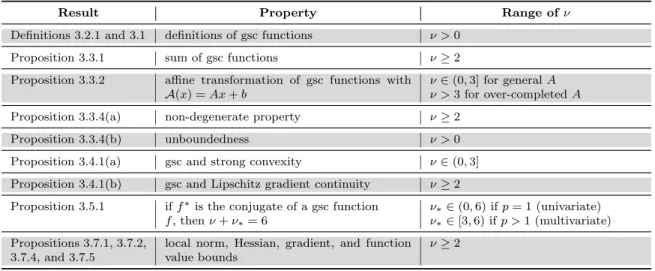
L means that∇ϕis Lipschitz continuous). 23 3.2 Summary of gsc properties and the corresponding range of ν . . . 39
4.1 The results of the three algorithms for solving the logistic regression
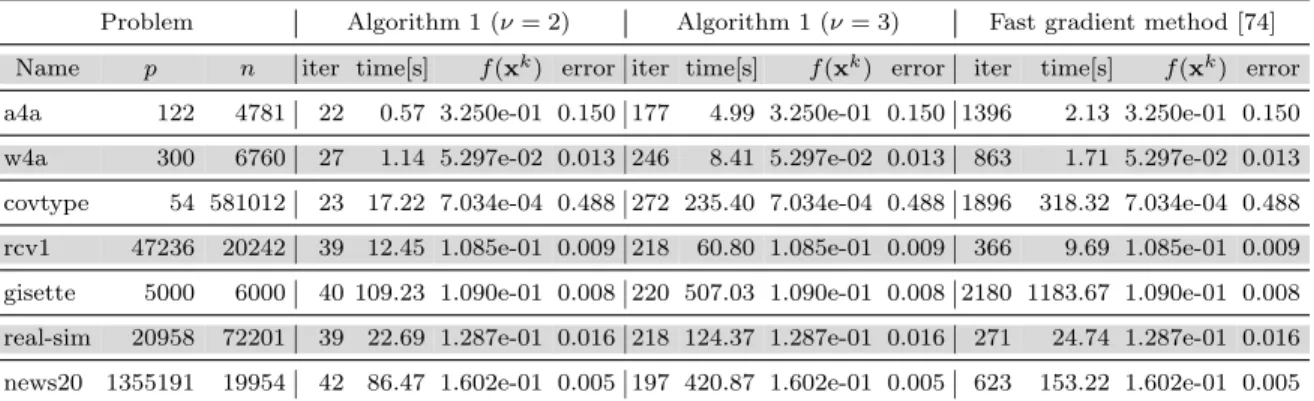
problem (4.14). . . 52
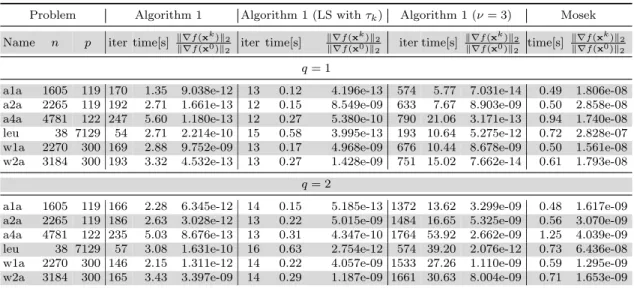
4.2 The performance and results of the two linesearch variants of
Algo-rithm 1 for solving (4.14). . . 53
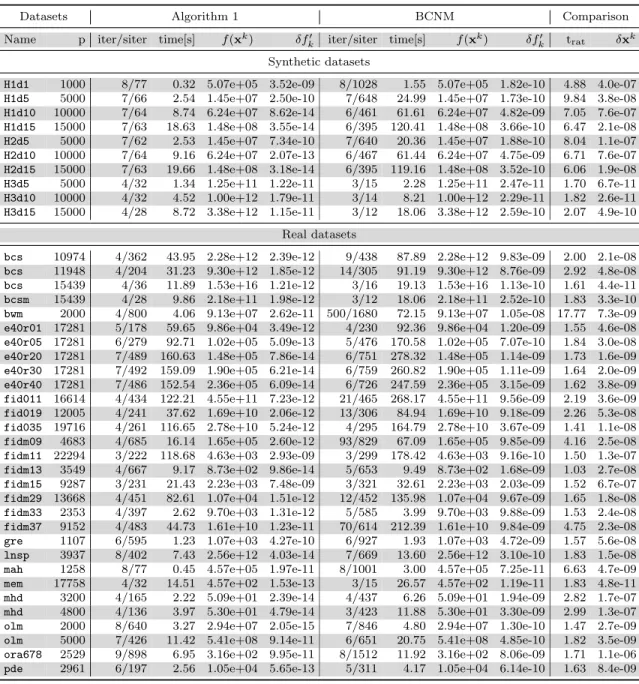
4.3 Summary of the results of Algorithm 1 and BCNM on 10 synthetic and
30 real problem instances . . . 55
4.4 The performance and results of the four methods for solving the DWD
problem (4.17). . . 57
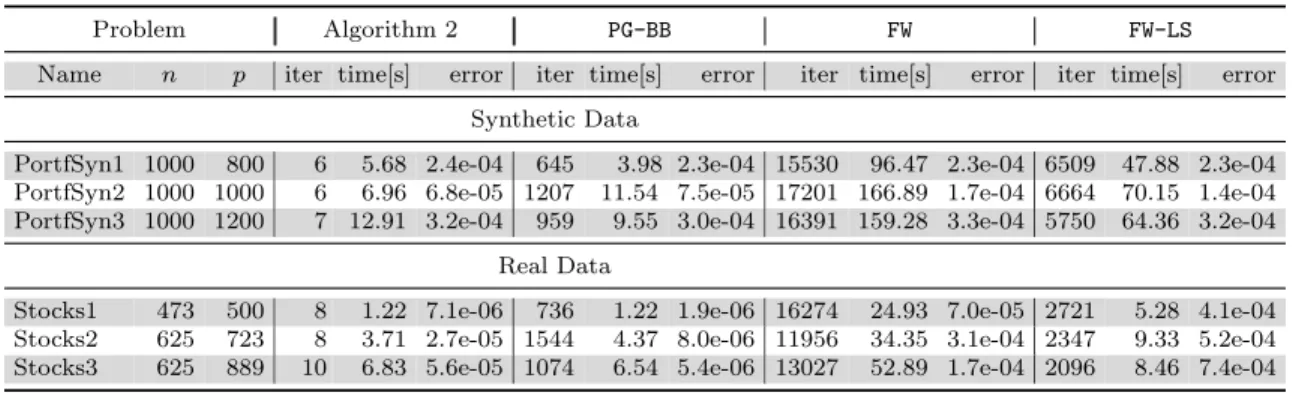
4.5 The performance and results of the four algorithms for solving the
port-folio optimization problem (4.18). . . 59
5.1 The performance of two solvers for l1,2-log barrier of 30 problems. . . 91
LIST OF FIGURES
4.1 The convergence of Algorithm 1 for news20.binary (Left: Relative objective residuals, Middle: Relative norms of gradient, and Right:
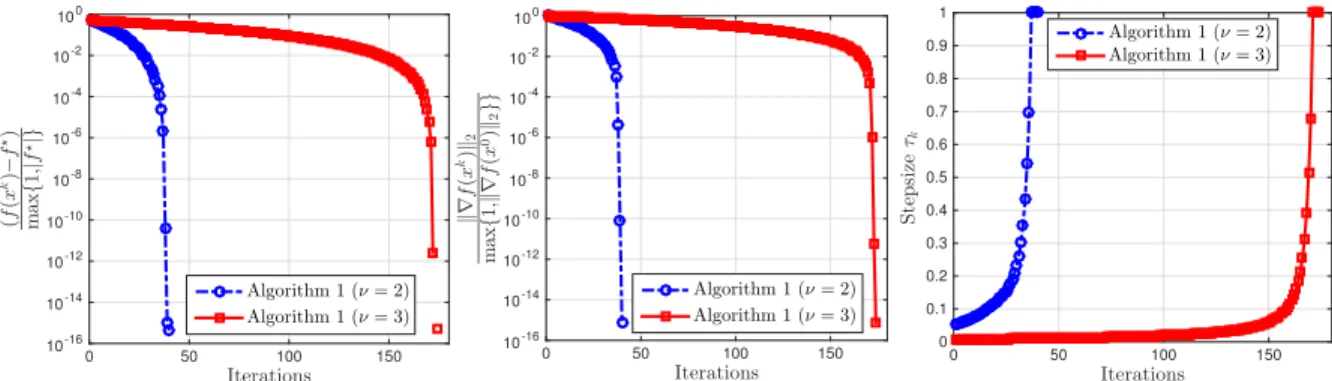
step-sizes). . . 51
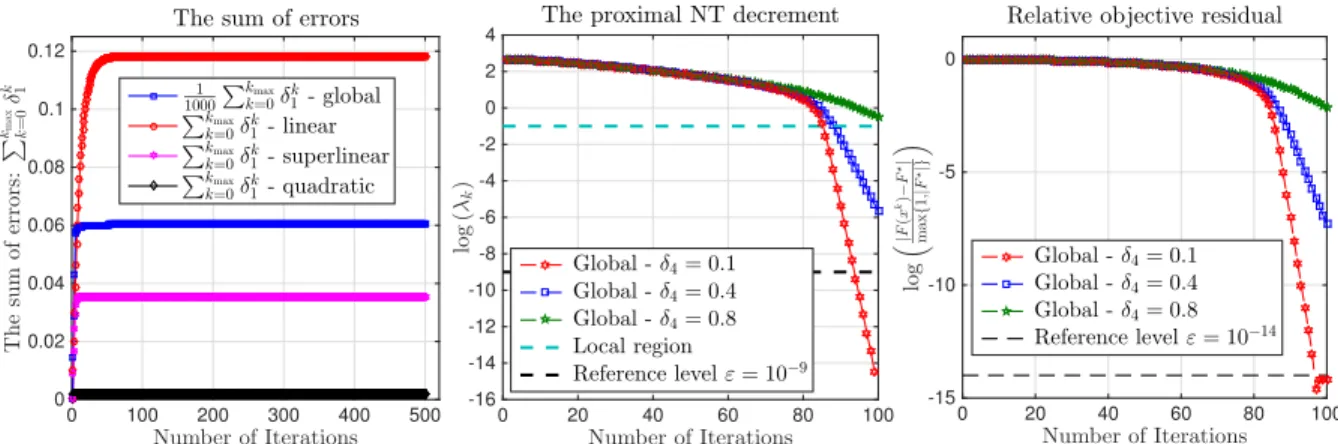
5.1 Global convergence behavior of iPNA in Theorem 5.4.1. . . 85
5.2 The local linear convergence of iPNA under the effect of inexact oracles. . . 86
5.3 The local superlinear convergence of iPNA under the effect of inexact oracles. . . . 87
5.4 The local quadratic convergence of iPNA under the effect of inexact oracles. . . 87
5.5 Optimal site allocation for routes UNC and STOR. . . 88
5.6 Optimal site allocation for US Network. . . 89
LIST OF ABBREVIATIONS AND SYMBOLS
dom(f)
Ip
F1
L
k · k
Cn(S)
x?f
e FM,νp
S++p
S+p
Rp
Rp+
Rp++
proxg(·)
LF(x) Dom(f) f∗(·)
ri(S)
λmin(H) k · kx |k · |kx
w.r.t
Domain of functionf, all x’s such that |f(x)|<∞
Identity matrix of size p
Lipschitz gradient function class with parameterL
Matrix or vector norm;`2-norm if the norm is unspecified
ntimes continuously differentiable function on set S
Optimal solution of the [constrained] optimization problem minxf(x)
p dimensionalgeneralized self-concordant class of parameters M and ν p dimensional positive definite cone
p dimensional positive semi-definite cone
Set of p dimensional real-valued vectors
Set of p dimensional real-valued nonnegative vectors
Set of p dimensional real-valued positive vectors
Standard proximal operator of g
Sublevel set of F at a pointx, all y∈dom(F) such thatF(y)≤F(x) The closure of the domain off, allx’s such that |f(x)| ≤ ∞
The Fenchel/convex conjugate of function f(·)
The relative interior of set S
The smallest eigenvalue of a positive [semi-]definite matrixH
Weighted norm based on Hessian matrix at pointx(∇2f(x))
CHAPTER 1
Introduction
1.1 Introduction
This thesis is about the theory and foundation of Newton-type methods, under the
gener-alized self-concordant structure and inexact global and local oracles. The Newton method is
an important computational tool for solving smooth minimization problems as well as smooth
equations. Its variant including proximal Newton methods, primal-dual methods, stochastic
Newton-type methods, and quasi-Newton methods, can be viewed as an advanced tool for non-smooth, constrained, large-scale, or distributed settings of these problems. In the first part
of this thesis, we study a smooth structure called generalized self-concordance. Like the self-concordance concept introduced by Nesterov and Nemirovski in the early 1990s, generalized
self-concordance serves as a powerful but more general analogous structure that allows ones to
develop Newton-type methods with rigorous theoretical convergence guarantees, while treating
a broader class of convex and smooth functions than the former one. In the second part of
this thesis, we introduce new global and local inexact oracle concepts for a wide class of convex
functions in composite convex minimizations, and use them to develop inexact Newton-type methods. This topic is motivated by the fact that many numerical methods, especially
second-order methods, naturally use inexact computations as well as oracles due to limited memory,
noisy data or limited computational time. Unfortunately, this inexact computational issue has
not been theoretically characterized in a full setting. We cover this topic in the second part of
this thesis.
Our work in this thesis provides an alternative view of using smoothness structures of
convex functions, as well as a control of bounds of function values, derivatives and subproblem
inexactness derived from our oracle settings, to develop Newton-type methods. Both theories in
that the theory and algorithms developed using generalized self-concordance and our inexact
oracles have many important and interesting applications. Moreover, our numerical experiments
show that the new theories provide competitive or better results compared to state-of-the-art
algorithms.
In the rest of this chapter, we first present our motivation and describe our research goals.
Next, we clarify our contribution and review current research state. Finally, we give a short outline of each chapter coved in this thesis.
1.1.1 Motivation
In recent years, there has been a huge interest in Newton-type methods for solving convex
optimization problems and monotone equations due to the development of new techniques
and mathematical tools in optimization, machine learning, and randomized algorithms [6, 14,
27, 29, 34, 60, 72, 76, 87, 89, 93, 94]. Several combinations of Newton-type methods and other
techniques such as proximal operators [10], cubic regularization [76], gradient regularization [89],
randomized algorithms such as sketching [87], subsampling [34], and fast eigen-decomposition
[46] create a new research direction and have attracted a great attention in solving nonsmooth
and large-scale optimization problems.
A wide range of problems especially in signal and image processing can be expressed in a
particular composite [primal] form, where the dual may be much easier to solve than the primal
one, due to the splitting structure of the dual settings. Correspondingly, one often study
methods which have ability to split the problem by activating each of the functions through
elementary processing steps which can be computed in parallel [56]. The primal-dual methods
make this possible, by exploiting the structure of the problem in a flexible manner, especially
when combined with the Lipschitz property of objective gradient or/and Hessian mappings.
While standard assumptions often required in both primal and dual methods, such as
non-singularity, Lipschitz gradient and Hessian conditions do not hold for many examples, Nesterov and Nemirovskii [75] introduced a powerful concept called self-concordance to overcome this
drawback and developed new Newton scheme to achieve global and local convergence without
was initially invented to study interior-point methods, but it is less well-known in other
com-munities. Recent works [1, 68, 102, 104, 109] have greatly popularized this concept to solve
other problems arising from machine learning, statistics, image processing, and variational
in-equalities.
Unfortunately, although the above self-concordant extension is improtant, it still cannot
cover some other basic or important convex functions, such as power function, entropy, arcsine distribution, just to name a few. Motivated by this fact, we extend it to a more general smooth
structure, develop the corresponding Newton-type schemes and customize it to the dual settings,
which covers the standard self-concordant optimization as a special case.
All the schemes above are mainly dealing with exact Newton methods. However, from
computational viewpoint, error measurement during evaluation, storage and transfer of data
happens frequently in sequential methods or distributed and parallel computation. Besides, due
to technical or complexity limitation, we often need inexact evaluations of function values and
derivatives. While existing inexact methods mostly focus on the inexactness of subproblem [63] or first-order oracles [28], there is no intensive work on inexact second-order oracles to the best
of our knowledge. Motivative by this, we introduce new global and local inexact second-order
oracle concepts, which allow one to develop novel inexact Newton-type variants that have the
desired convergence guarantees by direct control of function value and derivative tolerances,
and include the subproblem inexactness routines as special cases.
1.1.2 The goals of this research
Motivated by [1, 103, 109], our first goal is to generalize the self-concordance concept
in [75] to a broader class of smooth and convex functions. To develop the corresponding
methods, we require the generalization from univariate to multivariate case to preserve some
key properties. Unfortunately, the preliminary attempt shows that the natural generalization
has several drawbacks when developing the theory. Besides, similar extensions in [1, 103] for a class of logistic-type functions are still limited and creates certain difficulty for developing
further theories. Therefore, we first introduce a new definition of generalized self-concordance
Our second goal is to develop a unified mechanism to analyze the convergence (including
global and local convergence) of the following Newton-type scheme:
xk+1:=xk−skF0(xk)−1F(xk), (1.1)
where F0 is the Jacobian of F, sk ∈ (0,1] is a given step-size, and F can be presented as
the right-hand-side of a monotone equation F(x) = 0 or the optimality condition of a convex
optimization or a convex-concave saddle-point problem. Despite the Newton scheme (1.1) is
invariant to a change of variables [27], its convergence property relies on the growth of the Hessian along the Newton iterative process. In classical settings, the Lipschitz continuity of
the Hessian and the nondegeneracy of the Hessian in a neighborhood of the solution set are
key assumptions to achieve local quadratic convergence rate [27]. These assumptions have been
considered to be standard, but they are often very difficult to check in practice, especially the
second one. A natural idea is to classify the functionals of the underlying problem into a known
class of functions to choose a suitable method for solving it. While first-order methods for convex
optimization essentially rely on the Lipschitz gradient function assumption, Newton methods
usually use the Lipschitz continuity of the Hessian and its nondegeneracy property to obtain a
well-defined Newton direction as we have mentioned. For self-concordant functions, the second condition automatically holds, while the first does not. However, both full-step and
damped-step Newton methods still work in this case by appropriately choosing a suitable metric. This
situation has been observed and standard assumptions have been modified in different directions
to still guarantee the convergence of Newton methods, see [27] for an intensive study of generic
Newton methods, and [74, 75] for the self-concordant function class.
Thirdly, we want to combine our theory and methods with other broader settings in order
to make our scheme stabler and more efficient. For example, in the field of machine learning
, one has to deal with truly massive datasets and to train very large models, which naturally leads to high-dimensional optimization problems. Hence, computational accuracy and efficiency
constitute two major issues that need to be thoroughly addressed. We wish to develop inexact
oracle theory that can lower the computational accuracy of function value, derivative(s), solution
accuracy and convergence rates both globally and locally. As a special case, we customize our
theory to handle the primal-dual setting. As its name implied, this approach acts by solving the
primal problem as well as dual formulation simultaneously, or even merely in the dual space.
By doing so, we are able to exploit the structure of the underlying model more efficiently.
1.1.3 Literature review and the state of current research
The Newton-type method in convex optimization is often referred to as a second-order
method. It is widely used to solve both unconstrained and constrained optimization problems [45, 65]. It is popular among past several decades, mainly because of its fast local convergence
rate given the method is convergent. However, due to the unclearness of the global convergence
and the high per-iteration computational cost, it has been dominated by first-order methods
for solving modern large-scale optimization problems. For example, (a) the alternating
direc-tion method of multipliers (ADMM) which is closely related to [33], is a simple but powerful
algorithm that is well adapted to parallel and distributed optimization algorithms [18, 25], and
in particular to problems arising in image processing, applied statistics and machine learning,
where the objectives can be even nondifferentiable. (b) The Frank-Wolfe method, also known
as the conditional gradient method, was originally developed for smooth convex optimization on a polytope, dated back from Frank and Wolfe [37]. It is still popular among many
ap-plication such as sparse convex optimization [54], particle filtering [58], and support vector
machine [82], due to its low per-iteraion cost and good practical performance. (c) The methods
that use Nesterov’s acceleration and smoothness techniques [73] such as fast iterative shrinkage
thresholding algorithm (FISTA) [4] and Nesterov’s algorithm (NESTA) [5] are even used as a
criterion to test the performance of new methods. However, those kind of methods often require
strong smoothness structure assumptions such as the most commonly used Lipschitz gradient
and strongly convexity, which do not hold in many important applications. This brings the
Newton-type method back to its life. To overcome the difficulty of strong impractical assump-tions in first-order methods, the self-concordance concept was introduced in 1990s by Nestorov
and Nemirovski [75], as an innovative way of exploiting smoothness structures of convex
was proposed by [1] for a class of logistic regression. In [103], the authors extended [1] to study
proximal Newton method for logistic, multinomial logistic, and exponential loss functions. By
augmenting a strongly convex regularizer, Zhang and Lin [109] showed that the regularized
lo-gistic regression is indeed standard self-concordant. In [2] Bach continued exploiting his results
in [1] to show that the averaging stochastic gradient method can achieve the same best known
convergence rate as in strongly convex case without adding a regularizer. In our recent work [104], we developed a new generalized Newton-type framework to solve a large class of
self-concordant inclusion problem, and can achieve the same worst-case complexity as in standard
path-following method for smooth convex programming [75].
To overcome the difficulties of high per-iteration complexity of traditional Newton methods
and further accelerate the algorithm, both decentralized storage of big data as well as
accompa-nying distributed computation are necessary or at least highly desirable. In [102], the authors
exploited standard self-concordance theory in [75] to develop several classes of optimization
algorithms including proximal Newton, proximal-quasi Newton and proximal gradient methods to solve composite convex minimization problems. In a recent paper [40], Gao and Goldfarb
studied quasi-Newton methods for self-concordant minimization problems. In our recent work
[97], we made a broader generalization of the self-concordant concept, and developed the
corre-sponding Newton and quasi-Newton-type methods, which covers [1, 29, 109] as special cases. In
addition to deterministic approaches, randomized algorithms and stochastic methods have been
also well developed. Along with stochastic gradient descents and coordinate descent schemes,
subsampled and sketching Newton-type methods have recently gained a great attention. Lu
[66] extended [102] to study randomized block coordinate descent methods. In addition, we
refer to [55, 87, 93] for further related works.
To accommodate with data-related errors and reduce the computational complexity, inexact
methods have been widely studied recently. Among the first-order frameworks, [28] provides
a general inexact first-order oracle that covers a wide class of objective functions, including
nonsmooth functions, and covering many other existing inexact first-order oracles as special
cases. However, [28] only studied a global first-order inexact oracle to analyze the behavior for
first-order methods of smooth convex optimization. Such an oracle cannot be used to study the
quasi-Newton algorithms, secant equations are usually used to approximate the Hessian mapping
[77]. We show in Chapter 5 that this setup can also be cast into our Newton-type methods
with inexact oracles. Alternative to deterministic inexact oracles, stochastic gradient type
schemes can be viewed as optimization methods with inexact oracles [96]. Function values and
gradients are approximated by a stochastic sampling scheme to obtain inexact oracles. Finally,
derivative-free optimization can be considered as optimization methods with inexact oracles as well [23].
With the rapid development of computational power, the big advance in acceleration
tech-niques, and the considerable progress in algorithms, we believe that Newton-type methods will
eventually play a major role in the future.
1.2 Contribution
Our contribution of this thesis is twofolds: theoryandnumerical algorithms, which can be summarized as follows.
Theoretical contribution:
(a) We generalize the self-concordant notion in [74] to a more broader class of smooth convex
functions, which we call generalized self-concordance. We identify several link functions
that can be cast into our generalized self-concordant class. We also prove several
funda-mental properties and show that thegeneralized self-concordant class is closed with respect to the basic affine transformation, for a given range of parameters or under suitable
as-sumptions. In addition, we develop lower and upper bounds on the Hessian, gradient, and function values for generalized self-concordant functions. These estimates are key to develop and analyze several numerical optimization methods including Newton-type
methods.
(b) We introduce new global and local inexact second-order oracles for a large class of convex functions. Such a global inexact oracle covers a wide range of convex functions including
smooth convex functions with Lipschitz gradient continuity, nonsmooth Lipschitz
the local inexact oracle, we limit our consideration to the class of self-concordant
func-tions. Relying on these global and local inexact oracles, we develop several key properties
that are useful for algorithm development.
Algorithmic contribution:
(a) We propose a class of (proximal) Newton methods including damped-step and full-step schemes to minimize a (composite)generalized self-concordant function. We show explic-itly how to choose a suitable step-size to guarantee a descent direction in the
damped-step scheme, and prove a local quadratic convergence for both damped-damped-step and full-damped-step
schemes using a suitable metric.
(b) We develop a proximal-Newton algorithm based on inexact oracles and approximate
com-putations of the proximal-Newton directions to solve composite minimization (5.1). Our
global inexact oracle allows us to prove a general convergence result for the proposed
proximal-Newton method. When limited to self-concordant class forf, by using the new
local inexact oracle, we show how to adapt the inner accuracy parameters of the oracles
so that our algorithm still enjoys a global convergence guarantee, while having either
R-linear, R-superlinear, orR-quadratic local convergence rate.
(c) Finally, we customize our inexact method to handle a class of convex programs in the
primal-dual setting, where our method is applied to solve the dual problem. This
partic-ular application provides a new primal-dual method for handling some classes of convex
optimization problems including constrained formulations.
Let us emphasize the following of our contribution. First, we observe that the
self-concordance notion is a powerful concept and has been widely used in interior-point methods
as well as in other optimization schemes [49, 66, 102, 109]. Therefore, generalizing it to a broader
class of smooth convex functions can substantially cover a number of new applications, and is
helpful to develop new methods for solving classical problems including logistic and multimono-mial logistic regression, optimization involving exponential objectives, and distance-weighted
one to classify the underlying functions into different subclasses by using different parameters
ν and Mϕ and to choose suitable algorithms to solve the corresponding optimization problem.
Third, the theory developed in this chapter can potentially apply to other optimization
meth-ods such as gradient-type, sketching and sub-sampling Newton, and Frank-Wolfe algorithms as
done in the literature [80, 87, 93, 102]. Fourth, our generalization also shows that it is
pos-sible to impose additional structure such as self-concordant barrier to develop path-following scheme for solving a subclass of the composite convex minimization problems of the form (2.7).
Fifth, our global inexact second-order oracle is defined via a weighted local norm and via a
non-quadratic term and thus very different from the inexact first-order oracle from [28]. The
global convergence result is independent of the self-concordance off, and holds for a large class
of functions, including Lipschitz gradient convex functions analyzed in [28]. Our inexact
algo-rithm covers the inexact methods and quasi-Newton methods developed in [31, 40, 66, 104, 109]
as special cases. Finally, we believe that our generalized self-concordant theory is not limited to
convex optimization, but can be extended to solve convex-concave saddle-point problems, and monotone equations/inclusions involvinggeneralized self-concordant functions, and our inexact oracle theory can be used to further develop other methods such as sub-sampled Newton-type
methods rather than just the inexact proximal-Newton method in this thesis.
1.3 Outline of the thesis
The rest chapters are organized as follows.
• In Chapter 2, we provide some preliminary results and mathematical tools used in the
entire thesis, including a brief overview of Newton method and its variant, the concept of
standard self-concordance, [scaled] proximal operator, Fenchel conjugate, and Nesterov’s
smoothing technique.
• In Chapter 3, we introduce the class ofgeneralized self-concordant functions, which covers
standard self-concordant functions as special cases. Then, we establish several properties
and key estimates of this function class, which can be used to design new numerical
• In Chapter 4, we apply the theory introduced in Chapter 3 to develop several Newton-type
methods for solving a class of smooth convex optimization problems involving the
gen-eralized self-concordant functions. We provide an explicit step-size for damped-step
Newton-type scheme which can guarantee a global convergence without performing any
globalization strategy. We also prove a local quadratic convergence of this method and
its full-step variant without requiring the Lipschitz continuity of the objective Hessian. Then, we extend our result to develop proximal Newton-type methods for a class of
com-posite convex minimization problems involving generalized self-concordant functions. We
also achieve both local and global convergence without additional assumptions. Finally,
we verify our theoretical results via several numerical examples, and compare them with
existing methods.
• In Chapter 5, we introduce new global and local inexact second-order oracle concepts for
a wide class of convex functions in composite convex optimization. We also provide
exam-ples to show that the class of convex functions equipped with the newly introduced inexact
second-order oracles is larger than the standard self-concordant function class.
Further-more, we investigate several properties of convex and/or self-concordant functions under
the inexact second-order oracles which are useful for algorithm development. Next, we
apply our theory to develop inexact proximal Newton-type schemes for minimizing general composite convex problems equipped with such inexact oracles, with global convergence
guarantees. When the first objective term is self-concordant, we establish different
lo-cal convergence results for our method. We also apply our framework to derive a new
primal-dual method for composite convex minimization problems. Finally, we provide
some numerical examples to illustrate the benefit of our new algorithms based on this
concept of inexact second-order oracles.
• In Chapter 6, we summarize the main conclusions of this thesis, and list several related
CHAPTER 2
Mathematical Tools and Preliminary Results
In this chapter, we briefly present necessary mathematical concepts and preliminary results
which will be used in this thesis.
2.1 The Newton method
TheNewton method is a fundamental scheme in optimization, which can be found in many numerical analysis textbooks such as [75]. For the following unconstrained minimization
prob-lem
f? := min
x∈Rpf(x), (2.1)
wheref ∈ C2(Rp), the Newton scheme refers to the following iteration step:
xk+1 :=xk− ∇2f(xk)−1∇f(xk). (2.2)
Since the Hessian matrix may not always be positive definite, the global convergence behavior
for the Newton iteration step (2.2) is not clear. To guarantee the global convergence, there are two common strategies: linesearch and trust-region. One can see [77, Chapter 3 and 4]
for further references. In addition, the traditional Newton method has some drawbacks. For
example, Assumption (a) is hard to verify in practice, since we have limited information about
the optimal solution. Besides, Assumption (b) is strong in many applications. As mentioned
in Section 1.1.3, the Newton method has many variant versions and is extremely important for
modern applications in scientific computing. We briefly recall two variants in Section 2.4.
Let x? be the local minimum of the above optimization problem. Given the following assumptions
(a) ∇2f(x?)l
(b) k∇2f(x)− ∇2f(y)k
2 ≤Mkx−yk2 for all x andy∈Rp;
(c) The initial point x0 is close enough to the optimal solutionx?, i.e.:
kx0−x?k2≤¯r:=
2l 3M.
Then we conclude that
(a) The iterative scheme (2.2) is well-defined;
(b) kxk−x?k
2 ≤r¯for all k≥0;
(c) The sequence{xk} converges quadratically tox?, and the following relation holds:
kxk+1−x?k2 ≤
Mkxk−x?k2 2
2(l−Mkxk−x?k
2)
.
2.2 Local norm and self-concordance
Letf be a C3(
Rp) function. By the definition of third directional derivative, we have
∇3f(x)[u] := lim t→0
1 t[∇
2f(x+tu)− ∇2f(x)].
In this case, Assumption (b) of the Newton method in Subsection 2.1 becomes
|
∇3f(x)[u]v,v| ≤Mkuk2kvk22. (2.3)
We note that, the Newton scheme is affine invariant w.r.t affine transformation of variables,
while (2.3) is not. To maintain the affine invariant property, the following local norm and
self-concordant concept are naturally introduced.
Local norm: Given a matrix H ∈ S++, we define the weighted norm of u ∈ Rp w.r.t H as
kukH := hHu,ui1/2. Its dual norm is kvk∗H =
H−1v,v1/2
, which can be easily computed
through definition. Especially, whenH=I, the identity matrix, we havekukH=kuk∗H=kuk2,
function, i.e., f(x) ∈ C3(dom(f)). If ∇2f(x) 0 at a given x ∈ dom(f), then we define the local norm of u askuk∇2f(x), the weighted norm ofu w.r.t∇2f(x), shortly written askukx if the context is clear. The corresponding dual norm of v ∈ Rp, denoted bykvk∗
x, is defined as kvk∗x:= max{hv,ui | kukx≤1}=
∇2f(x)−1v,v1/2
.
Self-concordant function: Following the standard definition of self-concordance [74], we call a function f self-concordantif the inequality
|
∇3f(x)[u]u,u| ≤Mfkuk3x
holds for any x∈dom(f) and u∈Rp with some constant M
f ≥0. IfMf = 2, the function f is calledstandard self-concordant. One simple example of standard self-concordant function is f(x) =−ln(x), where x∈R+.
To apply the Newton-type method, sometimes we need to transfer the constrained problem
into unconstrained problem. Then we need to add a barrier function on the objective to prevent
the variable running close to the boundary in the iterative scheme. If the barrier shares some properties related to self-concordance, then we call it self-concordant barrier. The standard definition is given as follows.
Self-concordant barrier: Let B(x) be a standard self-concordant function. We call it a ν-self-concordant barrier for the set Dom(B) := cl (dom(B)), if
max
u∈Rp
{2h∇B(x),ui −
∇2B(x)u,u } ≤ν
for all x∈dom(B). The valueν is called the parameter of the barrier.
We will use the properties of self-concordant function when developing the inexact oracle theory in Chapter 5, and also generalize the self-concordance concepts together with
2.3 Proximal operator
Proximal operator: The proximal operator was first introduced in the early 1960s work by Moreau [69]. It is frequently used in optimization algorithms associated with nonsmooth
opti-mization problems. It shows its popularity along with many well-known optiopti-mization methods
such as proximal Newton methods (which will be discussed in Subsection 2.4) and proximal
gradient methods. The proximal operator proxf :Rp →Rp off is defined by
proxf(v) := arg min
x
f(x) +1
2kx−vk
2
2 . (2.4)
Two commonly used examples are as follows:
(a) Indicator function: If f is the indicator function of a closed convex setC, then proxf is the projection onto C:
proxf(v) = arg min
x∈Ckx−vk
2
2=PC(v).
(b) The`1-norm: If f(x) :=kxk1, then proxf is thesoft-thresholding operator:
proxf(v)i = sign(vi) max{|vi| −1,0}.
Because of (a), the proximal operator can be viewed as an extension of the projection onto
convex sets.
The proximity operator enjoys many properties of the projection, in particular it is firmly
nonexpansive:
kproxf(x)−proxf(y)k2 2 ≤
x−y,proxf(x)−proxf(y)
, for all x,y∈Rp, (2.5)
which will be used to prove the convergence results in Chapters 4 and 5.
Scaled proximal operator: Since we use local norms in the definition of self-concordance and generalized self-concordance in the next chapters, we also introduce the scaled proximal
g in (2.7) as
proxH−1g(x) := arg min
z
g(z) +12kz−xk2H . (2.6)
If H:= H(y) ∈ S++p , then we denote the above operator proxH−1g(x) as Py(x). We will use this notation in Chapter 5. Using the optimality condition of the minimization problem in
(2.6), we can show that
y= proxH−1g(x) ⇐⇒ 0∈H(y−x) +∂g(y) ⇐⇒ x∈y+H−1∂g(y)≡(I+H−1∂g)(y).
Sinceg is proper, closed, and convex, proxH−1g is well-defined and single-valued. In partic-ular, if we takeH=I, the identity matrix, then proxH−1g(·) = proxg(·), the standard proximal operator ofg. If we can efficiently compute proxH−1g(·) by a closed form or by polynomial time algorithms, then we say that g is proximally tractable. There exist several convex functions whose proximal operator is tractable. Examples such as `1-norm, coordinate-wise separable
convex functions, and the indicator of simple convex sets can be found in the literature
includ-ing [3, 38, 84].
2.4 Two variants of the Newton method
Proximal Newton method: The proximal Newton method was developed in early 1990s, see, e.g, [10, 91], which is known as the generalized Newton method. But this method is recently
popularized in [52, 60, 102]. Proximal algorithms can be viewed as an analogous tool for
nonsmooth, constrained, large-scale, or distributed versions of the unconstrained optimization
described in Section 2.1, and have plenty of interesting interpretations and are connected to many different topics in optimization and applied mathematics. Many surveys written on
various aspects of this topic over the years can be found easily, such as [22, 62, 84], and even for
nonconvex optimization [78]. However, in this section we just recall the basic algorithm scheme
and convergence results as follows.
We consider the composite minimization problem
min
x∈Rp
where f is a convex, continuously differentiable loss function, and g is a convex and proximal
tractable, but not necessarily differentiable penalty function or regularizer. Such problems
include the LASSO [98], the graphical LASSO [39], and trace-norm matrix completion [15].
The proximal Newton scheme refers to the following iterative scheme:
zk := arg min
x∈dom(g) n D
∇f(xk),x−xkE+1 2
D
∇2f(xk)(x−xk),x−xkE+g(x)o
= prox∇2f(xk)−1g
xk− ∇2f(xk)−1∇f(xk).
xk+1 :=xk+τk(zk−xk),
(2.8)
whereτk is the step-size determined by the backtracking linesearch in this section.
Given the following assumptions
(a) mI ∇2f LI;
(b) k∇2f(x)− ∇2f(y)k
2 ≤Mkx−yk2 for all x andy∈Rp.
Then we have the conclusion that
(a) The proximal Newton method (2.8) converges globally.
(b) Further more, it achieves local quadratic convergence rate:
kxk+1−x?k2≤
M 2mkx
k−x?k2 2.
Similar to the Newton method, the assumptions required here are too strong in practice.
Therefore, we will continue studying this formulation in detail in Chapters 4 and 5, by reducing
the above assumptions and giving an explicit step-size using [generalized] self-concordant theory.
Quasi-Newton method: The first quasi-Newton algorithm (DFP formula) was proposed by William C. Davidon, but it was soon superseded by its dual - the BFGS formula. Currently
the most common quasi-Newton algorithms are the SR1 formula (for symmetric rank-one),
the widespread BFGS method (suggested independently by Broyden, Fletcher, Goldfarb, and
Shanno, in 1970), and its low-memory extension L-BFGS. The Broyden’s class is a linear
In quasi-Newton methods, like steepest descent, only the gradient of the objective function
is required at each iteration. By measuring the Hessian mapping via secant equations in a
proper way, it can achieve a local superlinear convergence, while avoiding the computation of
the inverse Hessian matrix. In particular, we recall two important results as below.
Consider again the unconstrained convex minimization problem (2.1), the quasi-Newton
scheme refers to the following iterative scheme:
xk+1 :=xk−αkB−k1∇f(x
k), (2.9)
whereBk is a sequence of nonsingular matrices constructed in a certain way.
Theorem 2.4.1. [26, Dennis-Mor´e] Letx? be an optimal solution for (2.1), and∇2f(x?)0. LetEk:=Bk− ∇2f(x?). Assume that the sequence{xk} generated by (2.9) converges tox?. Then,{xk} converges tox? superlinearly if and only if
lim k→∞
kEk(xk+1−xk)k kxk+1−xkk = 0,
wherek · k represents an arbitrary vector norm inRp.
The above theorem characterizes the conditions for quasi-Newton method to achieve a
superlinear convergence rate. While the next theorem provides a more general rule for its
inexact updating version.
Given a starting pointx0 and a sequence of positive scalars{ηk}, we updatexk+1following the condition
k∇f(xk) +∇2f(xk)(xk+1−xk)k ≤ηkk∇f(xk)k, (2.10)
wherek · k represents an arbitrary vector norm inRp.
Theorem 2.4.2. [24, Theorem 3.4, Corollary 3.5] Let x? be an optimal solution of (2.1), and
∇2f(x?)0. Letη
k→0. If the sequence {xk} generated from (2.10) converges tox?, Then it converges tox? superlinearly.
40, 60] for further references. In this thesis, we will consider the inexact scheme (2.10) as a
subproblem by (1) specifying a certain [local] norm and different sequences of ηk; (2) replacing
the derivatives with approximations in the inexact oracle; and (3) in the composite setting
(2.7). Both convergence analysis and algorithm schemes can be found in Chapter 5.
2.5 Fenchel conjugates
Sometimes solving an optimization problem in its dual space is more convenient than its
primal setting. When forming the dual problem, the Fenchel conjugate is frequently used as an expression of a maximization problem related to the original objective or constraint (when
forming the Lagrangian function, see Chapter 5). The Fenchel conjugate, also known as convex
conjugate was first introduced by Fenchel [35]. The conjugate function f∗ of f inX, is defined in its dual spaceX∗, as follows
f∗(y) := sup{hy,xi −f(x)|x∈X}. (2.11)
By definition, the conjugate function f∗ is always convex, and shares an important inequality
that links the conjugate and original functions together:
hx,yi ≤f(x) +f∗(y), for allx∈X, and y∈X∗.
Here are some commonly used examples:
(a) Affine functions: The conjugate of an affine functionf(x) :=ha,xi −b is
f∗(y) :=
b ify=a
+∞ otherwise.
(b) Absolute value: The conjugate of the absolute value f(x) := |x| is the indicator of the closed interval [−1,1]:
f∗(y) :=
0 if|y| ≤1
(c) Exponential function: The conjugate of the exponential functionf(x) :=ex is
f∗(y) :=
yln(y)−y, x >0
0, x= 0
+∞ x <0.
2.6 Nesterov’s smoothing techniques
Nonsmooth convex functions or models appear frequently in practice. However, the
opti-mization methods for smooth functions are more efficient and well-developed than the methods
of nonsmooth ones. Therefore there is a need of good smoothing techniques that help us deal
with nonsmooth functions.
Nesterov’s smoothing techniques refer to an efficient approach for constructing efficient
schemes for nonsmooth convex optimization, introduced by Nesterov [71]. Historically, the first numerical schemes for nonsmooth convex minimization were subgradient methods [88], with
time complexity O(ε−2), whereε is the desired absolute accuracy of the approximate solution
measured by the function value. For the black-box model of the objective function, it was
shown that this efficiency of the simplest subgradient method cannot be improved uniformly
in dimension of variables [53]. However, we never meet a pure black box model in practice.
Motivated by this, Nesterov introduced this smoothing technique which makes a proper use of
the structure of the problem, with time complexity improved to O(ε−1).
In detail, given a proper, closed, possibly nonsmooth, and convex function f : Rp →
R∪ {+∞}, one can smooth f using the following Nesterov’s smoothing technique
fγ(x) := max
u∈dom(f∗){hAx,ui −f
∗(u)−γω(u)}, (2.12)
where f∗ is the Fenchel conjugate of f,ω : dom(ω) ⊆Rp → Ris a continuous and σ-strongly
Theorem 2.6.1. The function fγ is well-defined and continuously differentiable at any x ∈ dom(f). Moreover, this function is convex and its gradient ∇fγ(x) = A>u?γ is Lipschitz continuous with constantLγ = γσ1 kAk2
1,2, where uγ is the optimal solution of (2.12), and
kAk1,2 := max
x,u {hAx,ui:kxk1= 1,kuk2= 1}.
For examples and the optimal scheme for smooth optimization, we refer the reader to
[71, Section 3,4]. In this thesis, we combine this smoothing technique by choosing a proper
CHAPTER 3
Theory of generalized self-concordant functions
3.1 Introduction
In this chapter we develop our generalized self-concordance theory. On the one hand, it is a
generalization of the well-known self-concordance notion developed in [75]. On the other hand,
it also covers the work in [1, 29, 109] as specific examples. Several specific applications and
extensions of self-concordance notion can also be found in the literature including [49, 57, 80, 86].
The rest of this chapter is organized as follows. Section 3.2 develops fundamental concepts and examples ofgeneralized self-concordant functions. Section 3.3 gives the foundation theory including some basic properties. Section 3.4 shows the relationship between generalized self-concordant and special function structures. Section 3.5 highlights the property of generalized self-concordance in conjugate form. Section 3.6 introducesgeneralized self-concordant approxi-mation of nonsmooth functions. Section 3.7 provides the key bounds for Hessian, gradient and
function values ofgeneralized self-concordant functions, which will be used to develop our main theory in next chapter.
3.2 Fundamental concepts and examples
We introduce the fundamental concepts and motivating examples of generalized self-concordant functions in this section.
3.2.1 Univariate generalized self-concordant functions
Let ϕ : R → R be a three times continuously differentiable function on the open domain
dom(ϕ). Then, we writeϕ∈ C3(dom(ϕ)). In this case, ϕis convex if and only ifϕ00(t)≥0 for
Definition 3.2.1. Let ϕ:R→Rbe a C3(dom(ϕ))and univariate function with open domain
dom(ϕ), and ν > 0 and Mϕ ≥ 0 be two constants. We say that ϕ is (Mϕ, ν)-generalized self-concordant if
|ϕ000(t)| ≤Mϕϕ00(t)ν2, ∀t∈dom(ϕ). (3.1)
We denote this class of functions by FeMϕ,ν(dom(ϕ)) (shortly, FeMϕ,ν when dom(ϕ) is
ex-plicitly defined).
The inequality (3.1) also indicates that ϕ00(t) ≥0 for all t ∈dom(f). Hence, ϕis convex.
Clearly, ifϕ(t) = a2t2+btfor any constantsa≥0 andb∈R, we haveϕ00(t) =aandϕ000(t) = 0.
The inequality (3.1) is automatically satisfied for anyν > 0 and Mϕ ≥0. The smallest value
of Mϕ is zero. Hence, any convex quadratic function belongs to Fe0,ν for any ν > 0. While
(3.1) holds for any other constant ˆMϕ ≥Mϕ, we often require thatMϕis the smallest constant
satisfying (3.1).
Example 3.1. Let us now provide some common examples satisfying Definition 3.2.1.
(a) Standard self-concordant functions: If we choose ν = 3, then (3.1) becomes |ϕ000(t)| ≤
Mϕϕ00(t)3/2, which is the standard self-concordant functions inRintroduced in [75].
(b) Logistic functions: In [1], Bach modified the standard self-concordant inequality in [75] to obtain|ϕ000(t)| ≤Mϕϕ00(t), and showed that the well-known logistic lossϕ(t) := ln(1+e−t)
satisfies this definition. In [103] the authors also exploited this definition, and developed
a class of first-order and second-order methods to solve composite convex minimization
problems. Hence, ϕ(t) := ln(1 +e−t)∈Fe1,2.
(c) Exponential functions: The exponential function ϕ(t) := e−t ∈ Fe1,2. This function is
often used, e.g., in Ada-boost [59], or in matrix scaling [21].
(d) Distance-weighted discrimination (DWD): We consider a more general functionϕ(t) := t1q
on R++ and q ≥1 studied in [67] for DWD using in support vector machine. As shown
in Table 3.1,ϕ∈FeMϕ,ν with Mϕ= q+2
(q+2)√q(q+1) and ν=
2(q+3)
q+2 ∈(2,3).
(e) Entropy function: We consider the well-known entropy function ϕ(t) :=tln(t) fort >0. We can easily show that|ϕ000(t)|= 12 =ϕ
(f) Arcsine distribution: Consider the function ϕ(t) := √1
1−t2 for t∈(−1,1). This function is convex and smooth. Moreover, we verify that ϕ ∈ FeMϕ,ν with ν = 145 ∈ (2,3) and
Mϕ = 3
√
495−105√21
(7−√21)7/5 <3.25. We can generalize this function to ϕ(t) := [(t−a)(b−t)] −q
fort∈(a, b), where a < b and q >0. Then, we can show that ν= 2(qq+2+3) ∈(2,3).
(g) Robust Regression: Consider a monomial functionϕ(t) :=tqforq∈(1,2) studied in [107] for robust regression using in statistics. Then ϕ ∈ FeMϕ,ν with Mϕ = 2
−q
(2−q√) q(q−1) and ν = 2(32−−qq) ∈(4,+∞).
3
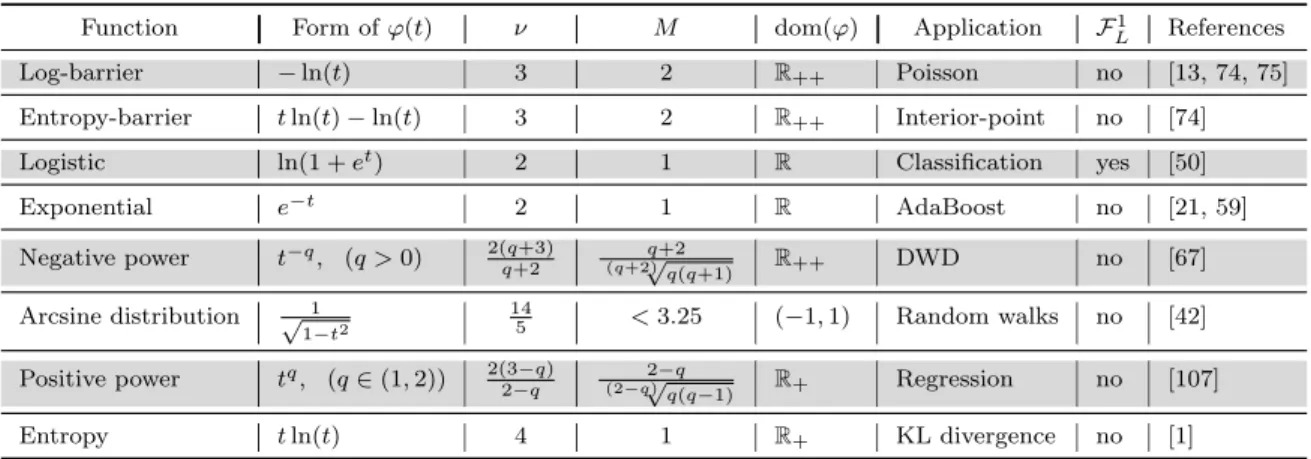
As concrete examples, the following table, Table 3.1, provides a non-exhaustive list of
generalized self-concordant (gsc) functions used in the literature.
Table 3.1: Examples of univariate gsc functions (F1
L means that∇ϕis Lipschitz continuous).
Function Form ofϕ(t) ν M dom(ϕ) Application F1
L References
Log-barrier −ln(t) 3 2 R++ Poisson no [13, 74, 75]
Entropy-barrier tln(t)−ln(t) 3 2 R++ Interior-point no [74]
Logistic ln(1 +et) 2 1 R Classification yes [50]
Exponential e−t 2 1
R AdaBoost no [21, 59]
Negative power t−q, (q >0) 2(q+3)
q+2
q+2
(q+2)√q(q+1) R++ DWD no [67]
Arcsine distribution √1 1−t2
14
5 <3.25 (−1,1) Random walks no [42]
Positive power tq, (q∈(1,2)) 2(3−q) 2−q
2−q
(2−q√)q(q−1) R+ Regression no [107]
Entropy tln(t) 4 1 R+ KL divergence no [1]
Remark 3.2.1. All examples given in Table 3.1 fall into the caseν ≥2. However, we note that Definition 3.2.1 also covers [109, Lemma 1] as a special case when ν ∈ (0,2). Unfortunately, as we will see in what follows, it is unclear how to generalize several properties of generalized
self-concordance from univariate to multivariable functions for ν ∈ (0,2), except for strongly
convex functions.
Table 3.1 only provides common generalized self-concordant functions using in practice. However, it is possible to combine these functions to obtain mixture functions that preserve
tln(t) and the negative logarithmic function−ln(t), which aregeneralized self-concordant with ν = 4 andν = 3, respectively.
3.2.2 Multivariate generalized self-concordant functions
Let f :Rp → Rbe a C3(dom(f)) smooth and convex function with open domain dom(f).
Given ∇2f the Hessian of f, x ∈ dom(f), and u,v ∈
Rp, we consider the function ψ(t) :=
∇2f(x+tv)u,u
. Then, it is obvious to show that
ψ0(t) :=
∇3f(x+tv)[v]u,u
.
fort ∈Rsuch that x+tv∈dom(f), where ∇3f is the third-order derivative of f. It is clear that ψ(0) =∇2f(x)u,u
=kuk2
x. By using the local norm, we generalize Definition 3.2.1 to
multivariate functionsf :Rp→R as follows.
Definition 3.1. A C3-convex function f :
Rp → R is said to be an (Mf, ν)-generalized self-concordant function of the order ν >0 and the constant Mf ≥ 0 if, for any x ∈dom(f) and
u,v∈Rp, it holds
|
∇3f(x)[v]u,u
| ≤Mfkuk2xkvkν
−2
x kvk3
−ν
2 . (3.2)
Here, we use a convention that 00 = 0 for the case ν <2 or ν >3. We also adopt the previous
univariate generalized self-concordant notation FeMf,ν(dom(f)) (shortly, Fe
p
Mf,ν orFeMf,ν when
dom(f) is explicitly defined) to denote this class of functions.
Let us consider the following two extreme cases:
1. Ifν= 2, (3.2) leads to|
∇3f(x)[v]u,u
| ≤Mfkuk2xkvk2, which collapses to the definition
introduced in [1] by lettingu=v.
2. Ifν = 3 andu=v, (3.2) reduces to|
∇3f(x)[u]u,u
| ≤Mfkuk3
x, Definition 3.1 becomes
the standard self-concordant definition introduced in [74, 75].
We emphasize that Definition 3.1 is not symmetric, but can avoid the use of multilinear
Defini-3.3 Basic properties of generalized self-concordant functions
We first show that iff1andf2are twogeneralized self-concordantfunctions, thenβ1f1+β2f2
is alsogeneralized self-concordant for any β1, β2>0 according to Definition 3.1.
Proposition 3.3.1 (Sum of generalized self-concordant functions). Letfi ∈FeM
fi,ν satisfying
(3.2), whereMfi ≥0 andν ≥2 fori= 1, . . . , m. Then, forβi >0,i= 1,2, . . . , m, the function
f(x) :=Pm
i=1βifi(x) is well-defined on dom(f) =Tim=1dom(fi), andf ∈FeMf,ν with the same
order ν≥2 and the constant
Mf := max{β1−
ν
2
i Mfi |1≤i≤m} ≥0.
Proof. It is sufficient to prove form= 2. Form >2, it follows fromm= 2 by induction. By [74, Theorem 3.1.5], f is a closed and convex function. In addition, dom(f) = dom(f1)∩dom(f2).
Let us fix somex∈dom(f) and u,v∈Rp. Then, by Definition 3.1, we have
| ∇3f
i(x)[v]u,u
| ≤Mfi
∇2f
i(x)u,u ∇2fi(x)v,v
ν−22
kvk32−ν, i= 1,2.
Denotewi:=∇2fi(x)u,u
≥0 and si :=∇2fi(x)v,v
≥0 for i= 1,2. We can derive
|
∇3f(x)[v]u,u |
h∇2f(x)u,ui h∇2f(x)v,viν−22
≤ β1|
∇3f
1(x)[v]u,u
|+β2|
∇3f
2(x)[v]u,u
|
h∇2f(x)u,ui h∇2f(x)v,viν−22
≤
Mf1β1w1s ν−2
2
1 +Mf2β2w2s ν−2
2
2
(β1w1+β2w2)(β1s1+β2s2) ν−2
2
[T]
kvk32−ν. (3.3)
Let ξ := β1w1β1w1+β2w2 ∈ [0,1] and η := β1s1β1s1+β2s2 ∈ [0,1]. Then, β1w1β2w2+β2w2 = 1−ξ ≥ 0 and β2s2
β1s1+β2s2 = 1−η ≥0. Hence, the term [T] in the square brackets of (3.3) becomes
h(ξ, η) :=β1−
ν
2
1 Mf1ξη
ν−2 2 +β1−
ν
2
2 Mf2(1−ξ)(1−η)
ν−2
2 , ξ, η∈[0,1].
Since ν≥2 andξ, η ∈[0,1], we can upper boundh(ξ, η) as
h(ξ, η)≤β1−
ν
2
1 Mf1ξ+β 1−ν
2
The right-hand side function is linear in ξ on [0,1]. It achieves the maximum at its boundary.
Hence, we have
max
ξ∈[0,1],η∈[0,1]h(ξ, η)
≤max{β1−
ν
2
1 Mf1, β
1−ν
2
2 Mf2}.
Using this estimate into (3.3), we can show thatf(·) :=β1f1(·) +β2f2(·) is (Mf, ν)-generalized
self-concordant with Mf := max{β
1−ν
2
1 Mf1, β
1−ν
2
2 Mf2}.
Using Proposition 3.3.1, we can also see that if f ∈ FeMf,ν and β > 0, then g(x) :=
βf(x) ∈ FeMg,ν with the constant Mg := β1− ν
2Mf. The convex quadratic function q(x) :=
1
2hQx,xi+c
>x with Q ∈ Sp
+ belongs to Fe0,ν for any ν > 0. Hence, by Proposition 3.3.1, if
f ∈FeMf,ν, thenf(x) +12hQx,xi+c>x∈FeMf,ν.
Next, we consider an affine transformation of a generalized self-concordant function.
Proposition 3.3.2 (Affine transformation). LetA(x) :=Ax+b be an affine transformation from Rp toRq, and f ∈FeMf,ν with ν >0. Then, the following statements hold:
(a) Ifν ∈(0,3], theng(x) :=f(A(x))∈FeMg,ν withMg :=MfkAk3−ν.
(b) If ν > 3 and λmin(A>A) > 0, then g(x) := f(A(x)) ∈ FeMg,ν with Mg :=
Mfλmin(A>A)
3−ν
2 , whereλmin(A>A) is the smallest eigenvalue ofA>A.
Proof. Since g(x) =f(A(x)) = f(Ax+b), it is easy to show that ∇2g(x) =A>∇2f(A(x))A
and∇3g(x)[v] =A>(∇3f(A(x)[Av])A. Let us denote by ˜x:=Ax+b, ˜u:=Au, and ˜v:=Av.
Then, using Definition 3.1, we have
|
∇3g(x)[v]u,u
| =|
A>(∇3f(˜x)[˜v])Au,u |=|
∇3f(˜x)[˜v]˜u,u˜ |
(3.2)
≤ Mf∇2f(˜x)˜u,u˜ ∇2f(˜x)˜v,v˜ν2−1
kvk˜ 32−ν
=Mf
A>∇2f(A(x))Au,u A>∇2f(A(x))Av,vν2−1
kAvk32−ν
=Mf
∇2g(x)u,u ∇2g(x)v,vν2−1
kAvk32−ν.
(3.4)
(a) If ν∈(0,3], then we havekAvk23−ν ≤ kAk3−νkvk3−ν
2 . Hence (3.4) implies
|
∇3g(x)[v]u,u
| ≤MfkAk3−ν
∇2g(x)u,u ∇2g(x)v,vν2−1
which shows thatg∈FeMg,ν withMg :=MfkAk3−ν.
(b) Note that kAvk2
2 = v>A>Av ≥ λmin(A>A)kvk22 ≥ 0, where λmin(A>A) is the
smallest eigenvalue of A>A. If λmin(A>A) > 0 and ν > 3, then we have kAvk32−ν ≤
λmin(A>A)
3−ν
2 kvk3−ν
2 . Combining this estimate and (3.4), we can show that g ∈FeMg,ν with
Mg :=Mfλmin(A>A)
3−ν
2 .
Remark 3.3.1. Proposition 3.3.2 shows that generalized self-concordance is preserved via an affine transformations if ν ∈ (0,3]. If ν > 3, then it requires A to be over-completed, i.e., λmin(A>A)>0. Hence, the theory developed in the sequel remains applicable for ν >3 if A
is over-completed.
Combining Proposition 3.3.1 and 3.3.2(a), we have a corollary of FeMf,ν class for the sum
of functions from different dimensional spaces.
Corollary 3.3.3. Let fi ∈FeMdi
i,ν for i= 1, . . . , m. If ν ∈[2,3], then f(x) := Pm
i=1fi(xi) also belongs to Fe
p
M,ν withp=
Pm
i=1di, and the same parameters as in Proposition 3.3.1.
Proof. Similar as the proof of Proposition 3.3.1, it is sufficient to prove for the case m = 2. Define ˜f1(x) := f1([Id1,0]x) = f1(x1) and ˜f2(x) := f2([0,Id2]x) = f2(x2). Since k[Id1,0]k=k[0,Id2]k= 1, by Proposition 3.3.2(a), ˜fi ∈FeMd1+d2
i,ν , i = 1,2. By Proposition 3.3.1,
f also belongs to Gd1+d2(M, ν) with the same parameters as in Proposition 3.3.1.
The following result is an extension of standard self-concordant functions (ν = 3), whose
proof is very similar to [74, Theorems 4.1.3, 4.1.4] by replacing the parameters Mf = 2 and ν = 3 with the general parameters Mf ≥0 and ν > 0 (or ν ≥2), respectively. We omit the
detailed proof.
Proposition 3.3.4. Letf ∈FeMf,ν withν >0. Then:
(a) Ifν ≥2 and dom(f) contains no straight line, then∇2f(x)0 for anyx∈dom(f).