ORIGINAL RESEARCH ARTICLE
CONSTRUCTION AND VALIDATION OF AN ASSESSMENT TOOL OF E-LEARNING COURSE FOR
THE KNOWLEDGE AND USE OF THE INTERNATIONAL CLASSIFICATION OF FUNCTIONALITY,
DISABILITY AND HEALTH (ICF)
1
Rafaella Stradiotto Bernardelli,
2Carolina Zanettini Alquati,
1Karoleen Oswald Scharan,
1
Katren Pedroso Correa and
3Auristela Duarte de Lima Moser
1PhD Student in The Post graduation Program of Health Technology of Pontifical Catholic University of Paraná,
Curitiba, Paraná Brazil
2Undergraduate Student of Physical Therapy of Pontifical Catholic University of Paraná, Curitiba, Paraná Brazil
3Professor in the Post-Graduation Program of Health Technology, Pontifical Catholic University of Paraná, Curitiba,
Paraná Brazil
ARTICLE INFO ABSTRACT
Purpose: to construct and validate a questionnaire that assess the knowledge acquired in ICF e-learning course and the use of the ICF in clinical practice. Method: methodological research of the construction and validation of questionnaires. Questions about the ICF content knowledge and use de ICF in clinical practices were elaborated and adapted. The consistency of this questions was reviewed by experienced researchers and the content and clarity was validated by 11 judges (5 with and 6 without ICF knowledge), who attributed note from 0 to 10 to each question. The percentage of concordance between judges was stipulated as ≥ 80% for content validity and clarity. Results: All questions validated already in the first round of assessment and formed 2 questionnaires: the Pre with1 question about previous contact with CIF, 10 about knowledge and 3 about use of the CIF, to be answered by the participants before the course of CIF; and the Post to be answered after, containing with 10 questions about knowledge and 2 about use. Conclusion: The 2 self-administered questionnaires contain the minimum number of questions necessary to assess the knowledge acquired in a basic CIF courses and the use of this ICF knowledge in clinical practice.
Copyright © 2019,Rafaella Stradiotto Bernardelli et al. This is an open access article distributed under the Creative Commons Attribution License, which permits unrestricted use, distribution, and reproduction in any medium, provided the original work is properly cited.
INTRODUCTION
In 2001, the World Health Organization (WHO) approved the International Classification of Functioning, Disability and Health (ICF) and indicated its use for member countries through the Resolution 54.21/2001 of the World Health Assembly (WHO, 2001). The ICF is a universally accepted framework that contemplates a biopsychosocial model and classifies the health status of individuals (WHO, 2015). Since its publication, ICF has been a growing subject of research in the world. Over time it becomes more disseminated and recognized as a facilitating tool for clinical practice and public policy. However, for ICF to be consistently and reliably applied, as recommended by WHO, it is essential for practitioners to learn how to use it (Brasileiro et al., 2013; Castaneda and Castro, 2013; Castanedaet al., 2014; Selb et al., 2017; Stucki and Bickenbach, 2017; Stucki et al., 2017).
*Corresponding author: Rafaella Stradiotto Bernardelli,
PhD student in the Postgraduation Program of Health Technology of Pontifical Catholic University of Paraná, Curitiba, Paraná Brazil
For this learning to be effective, it is essential that the ICF be included into the curricula at university-based schools and into the programs of the continuing health professional’s development (Allan et al., 2006; Edwards et al., 2004; Geertzen et al., 2011; Stephenson and Richardson, 2008). Although the CIF is being approached in graduation in health, it is not yet an integral part of the curricula at university-based schools of most universities in Brazil and in the world (Selb et al., 2017). Therefore, it is necessary to invest not only in its implementation in regular education, but also in the permanent education of professionals (WHO, 2013). In this context, institutions and research groups around the world have taught courses to training health professionals and graduation students to know and use ICF (Geertzen et al., 2011; al., 2017). These courses are mostly theoretical with the introductory content and in e-Learning (COFFITO, 2016, ICF Education, [2017], ICF Research Branch, 2017). According to WHO guidelines, educational programs for health professionals should be periodically assessed (WHO, 2013a).
ISSN: 2230-9926
International Journal of Development Research
Vol. 09, Issue, 03, pp.26640-26647, March, 2019
Article History:
Received 10th December, 2018
Received in revised form 07th January, 2019
Accepted 09th February, 2019
Published online 31st March, 2019
Key Words:
International Classification of Functioning, Disability and Health; ICF; Instrument Validation; e-Learning;Questionnaires.
Citation: Rafaella Stradiotto Bernardelli, Carolina Zanettini Alquati, Karoleen Oswald Scharan, Katren Pedroso Correa and Auristela Duarte de Lima Moser. 2019. “Construction and validation of an assessment tool of e-learning course for the knowledge and use of the international classification of functionality, disability and health (ICF)”, International Journal of Development Research, 09, (03), 26640-26647.
In addition, evidence on Distance Education (EAD) in health is not strong enough to guarantee its effectiveness, which indicates the need for the development of more research in the area (ISO, 1994; Padalino and Peres, 2007; REBRATS, 2013; Scorsolini-Comin et al., 2011; Silva et al., 2015; WHO, 2013b;). Among the methods of assessment of educational programs, the questionnaires have the advantage of being able to investigate any subject (BRENDER, 2006), are relatively inexpensive, easy to apply on a large scale at the stage where the technology is already implemented and can be elaborated specifically for a given program (Nykänen et al., 2011). In addition, they facilitate the coding of the closed answers, the speed in data collection and the use of large samples (Lima et al., 2018). Although there is a growing interest, need and number of CIF courses and training provided worldwide, especially in e-Learning. There is a shortage of published studies in the literature that have assessed the effectiveness of CIF e-Learning courses that presented the instruments of data collection used. Thus, this study aims to construct and validate a questionnaire that assess the knowledge acquired in ICF e-learning course and the application of this ICF knowledge in the clinical practice.
MATERIALS AND METHODS
Methodological research (Lobiondo-Wood e Haber, 2013) to the construction and validation of questionnaires (Brod et al., 2009; Souza et al., 2017) to assess the effectiveness of a basic ICF e-Learning course by the knowledge acquired by the course participant and the application of this ICF knowledge in the clinical practice. Using the curricular specifications for educational programs of the Reference Group of Functionality and Incapacity and the WHO Education and Implementation Committee as a reference to elaborate the questions (WHO-FIC Committees, 2010). This research was approved by the Ethics and Research Committee of Pontifical Catholic University of Paraná (approval number: 2080.45). The development process of the structure and content of the questionnaires began with a bibliographical review on: WHO standards and recommendations on teaching CIF to health professionals; e-Learning who tool for training health professional; and education methods assessment. We also analyzed the content of the ICFe-Learning Course of the Brazil Council of Physical Therapy and Occupational Therapy (COFFITO), which follows the curricular specifications for educational programs of the Functional and Disability Reference Group and the WHO Education and Implementation Committee. Actually, the COFFITO ICF e-Learning Course is the most comprehensive available for free in Brazil. For that reason, it was taken as a reference for construct establishment, target audience and context for the elaboration of the questionnaire. Subsequently, the process of developing issues of the instrument began, respecting the predetermined construct and the context to which it would be applied (Coluci
et al, 2015). Objective questions were elaborated and/or adapted to investigate the level of ICF knowledge and use to compose questionnaires to be answered by participants before and after to the ICF e-Learning courses. The questions to assess the ICF knowledge had a content, form and answers scale based on the ICF Knowledge Questionnaire, made available in the introductory module of the ICF e-Learning Tool by ICF Research Branch, a cooperation partner within the WHO Collaborating Centre for the Family of International Classifications in Germany. The content of this tool follows the specifications of the ICF core curriculum modules
compiled by members of the WHO Functioning and Disability Reference Group and the WHO Education and Implementation Committee too (ICF Research Branch, 2017). Two researchers with proficient English and a proven knowledge of CIF translated from English to Portuguese the 35 questions contained in the questionnaire mentioned above. A third researcher with the same knowledges, refereed in the questions that presented divergences in the translation. Among these, the questions that together contemplated the content of ICF basic courses of CIF in Brazil were selected and adapted. The authors elaborated five questions about the use of the CIF to identify: if the health professional is using the ICF or not; in affirmative case, what part of ICF is applying; in negative case, what the motivation to not use the ICF in clinical practices. In addition, was elaborate one question to investigating the self-perception of aptitude to the ICF use. Another question was also developed in order to investigate the background of the course participants through previous contacts with the CIF through courses and trainings. In order to avoid bias in the analysis of the CIF knowledge issues. As we did not find in the literature similar questions that could support this structure. The ICF use questions and their answers scales ware based on the analysis of the profile of the participant of the COFFITO ICF e-Learning Course. All questions were submitted a consistency review, involving adjustment, grouping and elimination of similar questions and adjustments in the response scales (Akins et al., 2005; Brod et al., 2009; Coluci et al., 2015; Martins 2006). This review was carried out by consensus of a group of five health professionals with master or doctor degree. The questions resulting from the review were submitted to the validation of content and clarity (Akins et al., 2005; Bordignon and Monteiro, 2015; Brod et al., 2009; Marques et al., 2015; Martins, 2006) by two groups: a group composed by Brazilian health professionals with knowledge and use experiences of the CIF (KG); and other composed by Brazilian health professionals without knowledge and use experiences of the CIF(No-KG). Ten health professionals with master or doctor degree, with scientific production or then clinical practices related to ICF were invited to compose the KG. In opposite to, ten health professionals with maximum degree master, who reported knowing only the existence of the CIF, without knowledge of the content or evidence of contact with the CIF in your curriculum to compose the No-KG. Of the twenty invited, eleven accepted to volunteer as judges in this validation process. Five composing the KG and six the No-KG. A validation form was sent to all of them, containing an introductory text presenting the objectives of the research and clarifying the proposed methodology for judging questions about CIF usage and knowledge and a brief definition of content validity and clarity followed by all questions elaborated and revised, separated into two sessions: 1) Questions on contact with and use of the CIF; and 2) Questions about CIF knowledge. In the validation form, below each question, there was a figure (FIGURE 1) for the judge to score from 0 to 10, the validity of the content and clarity and could add observations that were mandatory in the case of a score between 0 and 7. The grades from 0 to 10 were categorized into three for content validity and clarity (FIGURE 1). It was calculated the percentage of agreement of the judges with the validity of the content and with the clarity of each question according to Coluci et al. (2015), considering the categorical notes (Figure 2), 80% was considered the minimum agreement level among the judges of each group for the validation of each question. Therefore, if someone question
did not reach this agreement level should be corrected and submitted to new rounds of judgments until validation
et al., 2005).
RESULTS
The process of questions elaboration and validation that gave rise to the Pre and Post questionnaires to be applied immediately before and after the basic ICF e
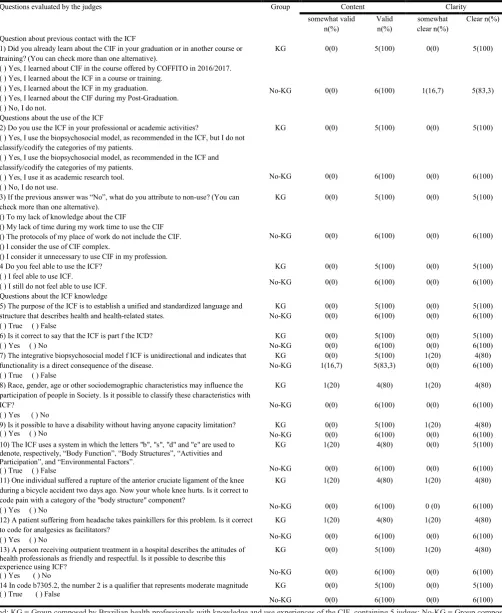
as well as the number of questions resulting from each stage of the process are represented in Figure 3. The results of the validation of content and clarity of the 14 questions into KG and No-KG are shown in Table 1.
CONTENT VALIDITY
CLARITY
[image:3.595.168.432.443.798.2]OBSERVATIONS: Source: The author
Figure 1. Judgment table for validation of content and clar
Adapted from Coluci et al. (2015).
Figure 2. Formulas for calculating the percentage of agreement of the judges with the validity of the content and the cla
Source: The author
Figure 3. Flow chart representative of the phases of the questionairres ela
did not reach this agreement level should be corrected and ts until validation (Akins
The process of questions elaboration and validation that gave rise to the Pre and Post questionnaires to be applied immediately before and after the basic ICF e-Learnig Course, estions resulting from each stage of The results of the validation of content and clarity of the 14 questions into KG
The categories: "invalid" to content and "unclear" to clarity were not presented in table 1 because none of the questions scored less than or equal to 4 for content and/or clarity by either groups of judges. All the questions evaluated had agreement percentage greater than or equal to 80%, into the both groups of judges (TABLE 1). Minor adjustments of cohesion, coherence and textual clarity and complements of expressions were suggested by the judges in 5 of the 14 evaluated questions. All of which were
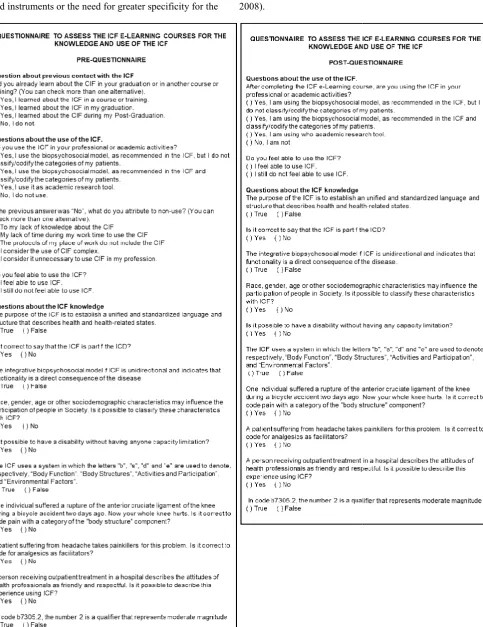
change in their content. Then, with 14 validated questions, the final versions of the Pre and Post questionnaires were established (Figure 4).
0 1 2 3 4 5 6 7 8
Invalid Somewhat Valid
0 1 2 3 4 5 6 7 8
Unclear Somewhat Clear
Judgment table for validation of content and clarity of each question elaborated
Adapted from Coluci et al. (2015).
Formulas for calculating the percentage of agreement of the judges with the validity of the content and the cla of each question evaluated
Source: The author
Flow chart representative of the phases of the questionairres elaboration and validation process
ories: "invalid" to content and "unclear" to clarity were not presented in table 1 because none of the questions scored less than or equal to 4 for content and/or clarity by All the questions evaluated had rcentage greater than or equal to 80%, into the (TABLE 1). Minor adjustments of cohesion, coherence and textual clarity and complements of expressions were suggested by the judges in 5 of the 14 All of which were adhered to without any Then, with 14 validated questions, the final versions of the Pre and Post questionnaires were
9 10 Valid
9 10 Clear
ity of each question elaborated
Formulas for calculating the percentage of agreement of the judges with the validity of the content and the clarity
DISCUSSION
The assessment of an educational program is a systematic process of information gathering, which aims to verify if the learning process allowed to achieve the desired results, that is, the effectiveness (Bremer, 2012, Clark, 2015, Silva et al. 2011).
[image:4.595.50.553.81.695.2]This is measured by the increase of knowledge resulting from the educational program with questions related to the content of the training applied before and after course(Abbad et al., 2000; Al-Shorbaji et al., 2015; Bremer, 2012; Kirkpatrick and Kirkpatrick, 2009; Souza et al., 2016). Research guidelines show the need to use data collection tools that provide accurate, valid and scientifically robust results (Alexandre et Table 1. Distribution of the number of judges according to the grade he attributes to each question evaluated and percentage of
concordance of content validity and clarity between them with separate values for the two groups
Questions evaluated by the judges Group Content Clarity
somewhat valid n(%)
Valid n(%)
somewhat clear n(%)
Clear n(%)
Question about previous contact with the ICF
1) Did you already learn about the CIF in your graduation or in another course or training? (You can check more than one alternative).
( ) Yes, I learned about CIF in the course offered by COFFITO in 2016/2017. ( ) Yes, I learned about the ICF in a course or training.
( ) Yes, I learned about the ICF in my graduation. ( ) Yes, I learned about the CIF during my Post-Graduation. ( ) No, I do not.
KG 0(0) 5(100) 0(0) 5(100)
No-KG 0(0) 6(100) 1(16,7) 5(83,3)
Questions about the use of the ICF
2) Do you use the ICF in your professional or academic activities?
( ) Yes, I use the biopsychosocial model, as recommended in the ICF, but I do not classify/codify the categories of my patients.
( ) Yes, I use the biopsychosocial model, as recommended in the ICF and classify/codify the categories of my patients.
( ) Yes, I use it as academic research tool. ( ) No, I do not use.
KG 0(0) 5(100) 0(0) 5(100)
No-KG 0(0) 6(100) 0(0) 6(100)
3) If the previous answer was “No”, what do you attribute to non-use? (You can check more than one alternative).
() To my lack of knowledge about the CIF
() My lack of time during my work time to use the CIF () The protocols of my place of work do not include the CIF. () I consider the use of CIF complex.
() I consider it unnecessary to use CIF in my profession.
KG 0(0) 5(100) 0(0) 5(100)
No-KG 0(0) 6(100) 0(0) 6(100)
4 Do you feel able to use the ICF? ( ) I feel able to use ICF.
( ) I still do not feel able to use ICF.
KG 0(0) 5(100) 0(0) 5(100)
No-KG 0(0) 6(100) 0(0) 6(100)
Questions about the ICF knowledge
5) The purpose of the ICF is to establish a unified and standardized language and structure that describes health and health-related states.
( ) True ( ) False
KG 0(0) 5(100) 0(0) 5(100)
No-KG 0(0) 6(100) 0(0) 6(100)
6) Is it correct to say that the ICF is part f the ICD? ( ) Yes ( ) No
KG 0(0) 5(100) 0(0) 5(100)
No-KG 0(0) 6(100) 0(0) 6(100)
7) The integrative biopsychosocial model f ICF is unidirectional and indicates that functionality is a direct consequence of the disease.
( ) True ( ) False
KG 0(0) 5(100) 1(20) 4(80)
No-KG 1(16,7) 5(83,3) 0(0) 6(100)
8) Race, gender, age or other sociodemographic characteristics may influence the participation of people in Society. Is it possible to classify these characteristics with ICF?
( ) Yes ( ) No
KG 1(20) 4(80) 1(20) 4(80)
No-KG 0(0) 6(100) 0(0) 6(100)
9) Is it possible to have a disability without having anyone capacity limitation? ( ) Yes ( ) No
KG 0(0) 5(100) 1(20) 4(80)
No-KG 0(0) 6(100) 0(0) 6(100)
10) The ICF uses a system in which the letters "b", "s", "d" and "e" are used to denote, respectively, “Body Function”, “Body Structures”, “Activities and Participation”, and “Environmental Factors”.
( ) True ( ) False
KG 1(20) 4(80) 0(0) 5(100)
No-KG 0(0) 6(100) 0(0) 6(100)
11) One individual suffered a rupture of the anterior cruciate ligament of the knee during a bicycle accident two days ago. Now your whole knee hurts. Is it correct to code pain with a category of the "body structure" component?
( ) Yes ( ) No
KG 1(20) 4(80) 1(20) 4(80)
No-KG 0(0) 6(100) 0 (0) 6(100)
12) A patient suffering from headache takes painkillers for this problem. Is it correct to code for analgesics as facilitators?
( ) Yes ( ) No
KG 1(20) 4(80) 1(20) 4(80)
No-KG 0(0) 6(100) 0(0) 6(100)
13) A person receiving outpatient treatment in a hospital describes the attitudes of health professionals as friendly and respectful. Is it possible to describe this experience using ICF?
( ) Yes ( ) No
KG 0(0) 5(100) 1(20) 4(80)
No-KG 0(0) 6(100) 0(0) 6(100)
14 In code b7305.2, the number 2 is a qualifier that represents moderate magnitude ( ) True ( ) False
KG 0(0) 5(100) 0(0) 5(100)
No-KG 0(0) 6(100) 0(0) 6(100)
Legend: KG = Group composed by Brazilian health professionals with knowledge and use experiences of the CIF, containing 5 judges; No-KG = Group composed by Brazilian health professionals without knowledge and use experiences of the CIF containing 6 judges; N = Absolute Frequency; % = Relative Frequency. Note: The relative frequency values of the "valid" and "clear" columns correspond to the value of the query's agreement percentage.
al., 2013; Cano and Hobart, 2011). In this way, it is recommended that the choice of the instrument to be used for data collection comes from a search in the scientific literature for instruments that have already been developed, validated and psychometric properties tested (Coluci et a
et al., 2002; Roach, 2006). The elaboration of a new instrument of data collection is relevant in the absence of validated instruments or the need for greater specificity for the
[image:5.595.67.551.134.762.2]Source: The author
Figure 4
1). In this way, it is recommended that the choice of the instrument to be used for data collection comes from a search in the scientific literature for instruments that have already been developed, validated
et al., 2015; Fitch The elaboration of a new instrument of data collection is relevant in the absence of validated instruments or the need for greater specificity for the
collection instrument in relation to the object, objective, population and context of the research in question (Coluci
al., 2015). Although much of then adequately validated (Chen
et al., 2010; Kosowski et al., 2009). The literature has alerted researchers to the need for an in
psychometric properties of questionnaires
Coluci, 2011; Brod et al., 2009; Martins, 2006; Salmond, 2008).
Figure 4. The final versions of Pre and Post questionnaires
collection instrument in relation to the object, objective, population and context of the research in question (Coluci et
It is observed in the description of the method and results of the present study that the motivation recommendations for the elaboration of the questionnaires were fulfilled based on a broad literature review and that the literature alert for the need for validation of the instrument was also strictly followed. The questionnaires were constructed respecting the construct predetermined by researchers, which is considered quite important in the literature, since the assurance that the instrument will be valid and useful increases proportionally to the specificity and completeness of the construct (Pasquali, 1998). The elaboration, writing and ordering of questions and response options should be also defined according to the operational definitions of the construct. Thus, to have as a basis for this process, already existing instruments, is shown a useful strategy, widely used in the construction of instruments of data collection in health (Kezei et al., 2010; Streiner and Norman, 2008). This strategy was used in the first phase of elaboration of the ICF knowledge questions in the present study. The experience and opinion of the target population and expertis another resource that literature points out as significant and source for item questionnaire construction and response options andis widely used (Bordignon and Monteiro, 2015; Kezei et al., 2010; Marques et al., 2015; Streiner and Norman, 2008). This resource was used in the present study, translated as validation of clarity performed by a group of experts and a target audience, and was the basis for the consistency review step.
The consistency review carried out in the present study based on prior consensus to the apparent validation process provides the need to balance the aspects of quality, relevance, clarity and objectivity (Nogueira, 2002). In relation to assessment process of the psychometric properties of the instruments, there is no consensus in the literature on whether it belongs to the development process of the instrument or not (Coluci et al, 2015). However, it is consensus in the literature that validity and reliability are the essential measures a new instrument (Martins, 2006; Pittman and Bakas, 2010) considering the validity of content the first of the properties to be assessment after the elaboration of a new instrument of data collection. In general, validity refers to the fact that an instrument measures exactly what it proposes to measure (Coluci et al., 2015; Martins, 2006) and content validity refers to the degree to which the content of an instrument adequately reflects the construct being measured, importance and specificity with the theoretical / technical content and the clarity with which it is expressed in the questions of the instrument (Polit, 2015). The present study presented in detail all phases of the content validation process, showing the moments and the different groups that participated in each moment, the corrections made in each phase, as well as the number of resulting issues. However, this detail is not always observed in validation studies of instruments published in the literature, a fact that sometimes hinders the reproducibility of the method (Chen et al., 2010; Kosowski et al., 2009; Salmond, 2008), which becomes a problem for the application of the instrument by other researchers to different target audiences and contexts, since the validity is not an immutable characteristic of the instrument and must be tested and determined considering the context and the population (Souza et al., 2017). The content validation process of the present study followed all literature recommendations (Coluci et al., 2015; Martins, 2006; Souza et al., 2017), so that experts participated in two phases of the process: in the first phase for the initial review of construct and consistency and in the second for validation of content issues
already ready. This judgment process is sometimes considered as the subjective phase of the validation process, since it represents the beginning of mechanisms to associate abstract concepts with observable and measurable indicators (Sireci, 1998). There is no specific number of judges who should participate in the validation process, but it is suggested that 5 to 10 judges, experts in the subject participating in this process (Coluci et al., 2015). This information that subsidized the invitation to 10 specialists to participate as judges, as well as 10 professionals considered as a target audience. Although, only 11 accepted to participate, which may have been motivated by the fact that the validation of content requires the evaluator, besides competence in the subject, availability of time for analysis. The low adherence of professionals to validation also occurred in the study by Marques (2015).
The 14 questions evaluated had a concordance percentage greater than or equal to 80%, calculated based on the Content Validity Index (Akins et al., 2005; Alexandre and Coluci, 2011; Wynd et al., 2003), both in KG and No-KG (TABLE 1). With this level of agreement among judges, for the validity of content and clarity, all questions could be considered adequate, with no need for a second round of evaluations, nor exclusion or significant changes (Akins et al., 2005; Coluci et al., 2015). When using an instrument for data collection, in addition to the concerns and care with the validity to avoid biases in the data collected, attention must also be paid to the way in which the questionnaire is answered. The possibility of bias was considered in the present study, when the instrument was constructed so that it could be easily structured and made available to be answered digitally by means of a platform that made it impossible for the survey respondent to submit the incomplete questionnaire, minimizing problems related to missing data, which would be difficult to analyze the results of the research, which has been a challenge, especially in researches with data from self-suspecting questionnaires (Schafer and Graham, 2002; Williams, 2010).
Limitations and future studies
The present study tested only the validity of content and the clarity of the instrument to make it feasible for application in a data collection. Therefore, there is a need for future studies that assess other psychometric properties of this new instrument, such as confiability, praticability, sensitivity, responsiveness, and other (Coluci et al., 2015; Martins, 2006; Roach, 2006; Souza, 2017).
Conclusion
Two questionnaires were developed to collect data about the knowledge and use of the CIF by health professionals, which, when answered before and after a basic ICF e-Learning course assess the fixation of the content covered in the course and the use knowledge in professional practice. The results obtained with their application of these questionnaires will provide a set of data that will reflect the level of knowledge and use of the CIF provided by the course and will subsidize the improvement of this educational strategy for future versions of it.
REFERENCES
Abbad G, Gama ALG, Borges-Andrade JE. 2000. Treinamento: análise do relacionamento da avaliação nos
níveis de reação, aprendizagem e impacto no trabalho. Revista de Administração Contemporânea. 4:3, pp 25-45. DOI: 10.1590/S1415-65552000000300003.
Akins RB, Tolson H, Cole BR. 2005. Stability of response characteristics of a Delphi panel: application of bootstrap data expansion. BMC Medical Research Methodology. 5:37, pp 37-37. DOI: 10.1186/1471-2288-5-37.
Alexandre NMC, Coluci MZO. 2011. Validade de conteúdo nos processos de construção e adaptação de instrumentos de medidas. Ciência & Saúde Coletiva. 16:7, pp 3061-68. DOI: 10.1590/S1413-81232011000800006.
Alexandre NMC, Gallasch CH, Lima MHM, Rodrigues RCM. 2013. A confiabilidade no desenvolvimento e avaliação de instrumentos de medida na área da saúde. RevistaEletrônica de Enfermagem. 15:3, pp 802-9. DOI: 10.5216/ree.v15i3.20776.
Allan CM, Campbell WN, Guptill CA, Stephenson FF, Campbell KE. 2006. A conceptual model for interprofessional education: the international classification of functioning, disability and health (ICF). Journal of Interprofessional Care. 20:3, pp 235-45. DOI: 10.1080/13561820600718139.
Al-Shorbaji N, Atun R, Car J, Majeed A, Wheeler E (eds) 2015. E-Learning for undergraduate health professional education: a systematic review informing a radical transformation of health workforce development. Geneva: World Health Organization.
Bordignon M, Monteiro MI. 2015. Validade aparente de um questionário para avaliação da violência no trabalho. Acta Paulista de Enfermagem. 28:6, pp 601-608. DOI: 10.1590/1982-0194201500098.
Brasileiro IC, Moreira TMM, Buchalla CM. 2013. Classificação Internacional de Funcionalidade, Incapacidade e Saúde e seu uso no Brasil.Acta Fisiátrica. 20:1, pp 37-41. DOI: 10.5935/0104-7795.20130007. Bremer C. 2012. Enhancing e-learning quality through the
application of the AKUE procedure model. Journal of Computer Assisted Learning. 28:1, pp 15-26. DOI: 10.1111/j.1365-2729.2011.00444.x.
Brender J. 2006. Handbook of evaluation methods for health informatics. Elsevier Academic Press: New York - USA. Brod M, Tesler LE, Christensen TL. 2009. Qualitative research
and content validity: developing best practices based on science and experience. Qual Life Res. 18:9, pp 1263-78. DOI: 10.1007/s11136-009-9540-9.
Cano SJ, Hobart JC. 2011. The problem with health measurement. Patient Prefer Adherence. 5, pp 279-90. DOI: 10.2147/PPA.S14399.
Castaneda L, Bergmann A, Bahia L. 2014. The International Classification of Functioning, Disability and Health: a systematic review of observational studies. Revista Brasileira de Epidemiologia. 17:2, pp 437-451. DOI: 10.1590/1809-4503201400020012ENG.
Castaneda L, Castro SS. 2013. Publicações brasileiras referentes à Classificação Internacional de Funcionalidade. Acta Fisiátrica. 20:1, pp 29-36. DOI: 10.5935/0104-7795.20130006.
Chen CM, Cano SJ, Klassen AF, King T, McCarthy C, Cordeiro PG. 2010. Measuring quality of life in oncologic breast surgery: A systematic review of patient-reported outcome measures. Breast J. 16:6, pp 587-97. DOI: 10.1111/j.1524-4741.2010.00983.x.
Clark D. 2015. Why Instructional System Design and ADDIE?. Available in: <http://www.nwlink.com/ ~donclark/hrd/sat1.html>. Access: 26 fev 2018.
Coluci MZO, Alexandre NMC, Milani D. 2015. Construção de instrumentos de medida na área da saúde. Ciências & Saúde Coletiva. 20:3, pp 925-936. DOI: 10.1590/1413-81232015203.04332013.
Conselho Federal de Fisioterapia e Terapia Ocupacional (COFFITO), 2016. COFFITO lança plataforma de Ensino a Distância e oferece curso sobre CIF aos profissionais. Available in: <https://www.coffito.gov.br/nsite/?p=5324 #more-5324>. Access: 26 fev 2018.
Edwards I, Jones M, Carr J, Braunack-Mayer A, Jensen GM. 2004. Clinical reasoning strategies in physical therapy. Physical Therapy. 84:4, pp 312-30. DOI: 10.1093/ ptj/84.4.312.
Fitch E, Brooks D, Stratford PW. 2002. Physical rehabilitation outcome measures: a guide to enhanced clinical decision making. 2 ed. Hamilton, Ontario: Lippincott Williams & Wilkins.
Geertzen JH, Rommers GM, Dekker R. 2011. An ICF-based education programme in amputation rehabilitation for medical residents in the Netherlands. Prosthetics and Orthotics International. 35:3, pp 318-22. DOI: 10.1177/0309364611412822.
ICF Education 2017. About Us. Available in:<http:// icfeducation.org/about>. Access: 26 fev 2018.
ICF Research Branch. 2017. A cooperation partner within the WHO Collaborating Centre for the Family of International Classifications (WHO-FIC) in Germany (at DIMDI). ICF e-Learning Tool. Available in: <https://www.icf-elearning.com>. Access: 26 fev 2018.
International Organization for Standardizatin (ISO) 1994. ISO 9241-10: Ergonomic requirements for office work with visual display terminals (VDTs) - dialogue principles. Zurique.
Keszei A, Novak M, Streiner DL. 2010. Introduction to health measurement scales. J Psychosom Res. 68:4, pp 319- 323. DOI: 10.5123/S1679-49742017000300022.
Kirkpatrick DL, Kirkpatrick JD. 2009. Implementing the Four Levels: a practical guide for effective evaluation of training programs: easyread large edition. San Francisco: Berrett-Koehler Publishers.
Kosowski T, McCarthy C, Reavey PL, Scott AM, Wilkins EG, Cano SJ. 2009. A systematic review of patient-reported outcome measures after facial cosmetic surgery and/or nonsurgical facial rejuvenation. PlastReconstrSurg. 123:6, pp 1819-27. DOI: 10.1097/PRS.0b013e3181a3f361. Lima GFA, Merino EAD, Triska R 2018. Métodos mais
usados para avaliações de Ambientes Virtuais de Aprendizagem (AVAs). HFD. 7:13, pp 132-147. DOI: 10.5965/2316796307132018132.
Lobiondo-Wood G, Haber J. 2013. Nursing research: methods and critical appraisal for evidence-based practice. 8 ed. St. Louis: Mosby.
Marques CAV, Figueiredo END, Gutiérrez MGRD. 2015. Validação de instrumento para identificar ações de rastreamento e detecção de neoplasia de mama. Acta Paulista de Enfermagem. 28:2, pp 183-189. DOI: 10.1590/1982- 0194201500031.
Martins GDA. 2006. Sobre Confiabillidade e Validade. Revista Brasileira de Gestão de Negócios. 8:20, pp. 1-12. Nogueira R. 2002. Elaboração e análise de questionários: uma
revisão da literatura básica e a aplicação dos conceitos a um caso real. Rio de Janeiro: UFRJ/COPPEAD.
InternationalJournalof Medical Informatics. 80:12, pp 815-827. DOI: 10.1016/j.ijmedinf.2011.08.004.
Organização Mundial da Saúde (OMS) 2013. Como usar a CIF: Um manual prático para o uso da Classificação Internacional de Funcionalidade, Incapacidade e Saúde (CIF). Versão preliminar para discussão. Versão em português. Genebra.
Organização Mundial da Saúde (OMS) 2015. Classificação Internacional de Funcionalidade, Incapacidade e Saúde, CIF. 2 ed. Brasil: Edusp – Editora da Universidade de São Paulo.
Padalino Y, Peres HHC. 2007. E-learning: a comparative study for knowledge apprehension among nurses. Revista Latino-Americana de Enfermagem. 15:3, pp 397-403. DOI: 10.1590/S0104-11692007000300006.
Pasquali L. 1998. Princípios de elaboração de escalas psicoló-gicas. Rev Psiq Clin. 25:5, pp 206-213.
Pittman J, Bakas T. 2010. Measurement and instrument design. J Wound Ostomy Continence Nurs.37:6, pp603-7. DOI:10.1097/WON.0b013e3181f90a60.
Polit DF. 2015. Assessing measurement in health: beyond reliability and validity. Int. J. Nurs. Stud. 52:11, pp 1746– 53. DOI: 10.1016/j.ijnurstu.2015.07.002.
Rede Brasileira de Avaliação de Tecnologias em Saúde (REBRATS) 2013. Diretrizes metodológicas: elaboração de estudos para avaliação de equipamentos médicos assistenciais. Brasília: Editora do Ministério da Saúde. Roach KE. 2006. Measurementofhealthoutcomes: reliability,
validityandresponsiveness. J ProsthetOrthot. 18:1S, pp 8-12.
Salmond SS. 2008. Evaluating the reliability and validity of measurement instruments. OrthopNurs. 27:1, pp 28-30. DOI: 10.1097/01.NOR.0000310608.00743.54.
Schafer JL, Graham JW. 2002. Missing data: our view of the state of the art. Psychol Methods. 7:2, pp 147-77. DOI: 10.1037//1082-989X.7.2.147.
Scharan KO, Bernardelli RS, Corrêa KP, da Silva TG, Martins FC, Moser ADL 2017. A training tool for International Classification of Functioning, Disability and Health application by Physical Therapy students. International Journal of Development Research. 7:11, pp 17230-17235. ISSN: 2230-9926.
Scorsolini-Comin F, Gameiro FJ, Inocente DF, Matias AB 2011.Avaliação de tecnologias educacionais em cursos a distância. RDBCI: Revista Digital de Biblioteconomia e Ciência da Informação. 8:2, pp 88-113. ISSN: 1678-765X. Selb M, Finger M, Maritz R 2017. ICF Workshop - presential
course. Nottwil (Switzerland): ICF Research Branch - a cooperation partner within the WHO Collaborating Centre for the Family of International Classifications (WHO-FIC) in Germany (at DIMDI).
Silva AN, Santos AMG, Cortez EA, Cordeiro BC 2015. Limites e possibilidades do ensino à distância (EaD) na educação permanente em saúde: revisão integrativa. Ciência & Saúde Coletiva. 20:4, pp 1099-1107. DOI: 10.1590/1413-81232015204.17832013.
Silva J, Rebelo N, Mendes P, Candeias A 2011. O portefólio na formação e avaliação profissional de professores. Educação e Pesquisa. 37:3, pp 529-548. DOI:10.1590/ S1517-97022011000300006.
Sireci SG. 1998. The constructofcontentvalidity. Soc. Indic. Res. 45:1-3, pp 83-117. DOI: 10.1023/A:1006985528729. Souza ACD, Alexandre NMC, Guirardello EDB. 2017.
Propriedades psicométricas na avaliação de instrumentos: avaliação da confiabilidade e da validade. Epidemiologia e Serviços de Saúde. 26:3, pp 649-659. DOI: 10.5123/S1679-49742017000300022.
Souza MAP, Dias JF, Ferreira FR,Mancini MC,Kirkwood RN, Sampaio RF. 2016. Características e demandas funcionais de usuários de uma rede local de reabilitação: análise a partir do acolhimento. Ciência & Saúde Coletiva. 21:10, pp 3277-3286. DOI: 10.1590/1413-812320152110.11192016. Stephenson R, Richardson B 2008. Building an
interprofessional curriculum framework for health: a paradigm for health function. Health Sciences Education. Theory and Practice. 13:4, pp 547-57. DOI: 10.1007/s10459-006-9042-2.
Streiner DL, Norman GR. 2008. Health measurement scales. A practical guide to their development and use. 4 ed. New York: Oxford University Press.
Stucki G, Bickenbach J. 2017. Functioning: the third health indicator in the health system and the key indicator for rehabilitation. European Journal of Physical and Rehabilitation Medicine. 53:1, pp 134-138. DOI: 10.23736/S1973-9087.17.04565-8.
Stucki G, Prodinger B, Bickenbach J. 2017. Four steps to follow when documenting functioning with the International Classification of Functioning, Disability and Health. European Journal of Physical and Rehabilitation Medicine. 53:1, pp 144-149. DOI: 10.23736/S1973-9087.17.04569-5.
Williams R. 2010. Fitting heterogeneous choice models with oglm. Stata Journal. 10:4, pp 540-67. DOI: 10.1177/ 1536867X1001000402.
World Health Organization (WHO) 2001. Resolution WHA 54.21: International classification of functioning, disability and health. Geneva. Available in: <http://apps.who.int/gb/ archive/pdf_files/WHA54/ea54r21.pdf?ua=1>. Access: 20 jun 2018.
World Health Organization (WHO) 2013a. Resolution WHA 66.23:Transforming health workforce education in support of universal health coverage. Geneva. Available in: <http://www.who.int/hrh/education/dev_who_toolkit_eval/ en/>. Access: 26 fev 2018.
World Health Organization (WHO) 2013b. Global action plan for the prevention and control of noncommunicable
diseases 2013-2020. Geneva. Available in:
<http://apps.who.int/iris/bitstream/10665/94384/1/9789241 506236_eng.pdf?ua=1>. Access: 26 fev 2018.
Wynd CA, Schmidt B, Schaefer MA. 2003. Two quantitative approaches for estimating content validity. West J. Nurs. Res. 25:5, pp 508-518. DOI: 10.1177/0193945903252998.