Copyright © 1999, American Society for Microbiology. All Rights Reserved.
Evaluation of Statens Serum Institut Enteric Medium for
Detection of Enteric Pathogens
MARIANNE BLOM,
1* AASE MEYER,
1PETER GERNER-SMIDT,
2KNUD GAARSLEV,
2AND
FRANK ESPERSEN
1Department of Research and Development
1and Department of Gastrointestinal Infection,
2Statens Serum Institut,
Copenhagen, Denmark
Received 26 October 1998/Returned for modification 6 February 1999/Accepted 26 March 1999
The efficacy of the Statens Serum Institut (SSI) enteric medium for isolation and direct identification of
enteric pathogens was evaluated. Six different biochemical reactions can be read by using the SSI enteric
medium, allowing direct identification of a range of enteric pathogens. All 248 gram-negative bacterial species
that were tested grew on the SSI enteric medium. Only 10 of 248 bacteria (4%) showed discrepant results in
the biochemical reactions, and none of these were enteric pathogens. Forty-three of 47 enteric pathogens (92%)
produced identical rates of semiquantitative growth on the SSI enteric medium and 5% blood agar, whereas
three
Vibrio
spp. and one
Aeromonas
spp. showed reduced growth. Gram-positive bacteria did not grow on the
SSI enteric medium. Most enteric pathogens had a detection limit of 50 bacteria per ml of feces, but higher
numbers of
Vibrio
spp. and some
Shigella
spp. were required for detection. The growth rates of 125 enteric
pathogens and 12
Yersinia
spp. on the SSI enteric medium, xylose lysine deoxycholate (XLD), Hektoen enteric
(HE),
Salmonella-Shigella
(SS), and cefsulodin-irgasan-novobiocin (CIN) agar were compared. Detection rates
after application of 200 CFU were 99% for SSI enteric medium, 92% for XLD, 88% for HE, and 82% for SS agar.
The 12
Yersinia
spp. grew excellently on both the SSI enteric medium and CIN agar. We conclude that the
performance of the SSI enteric medium compares favorably to those of other media tested. Its ability to detect
Yersinia
spp. may limit the number of media needed in the typical laboratory. The direct identification of enteric
pathogens on the medium may also provide a more rapid diagnosis.
Identification of organisms of the family
Enterobacteriaceae
constitutes a considerable proportion of the workload in many
clinical microbiology laboratories. The primary goal in a
diag-nostic microbiologiy laboratory is the rapid identification of a
pathogen. The traditional methodology for routine detection
of enteric pathogens nearly always employs a combination of at
least three different media in order to increase the sensitivity
and the specificity of the detection and identification method.
This is due to the fact that if one medium is highly inhibitory
to some members of the
Enterobacteriaceae, e.g.,
Escherichia
coli, there is a simultaneous loss of sensitivity for fastidious
pathogens such as the
Shigella
spp. (21). At the Statens Serum
Institut (SSI; Copenhagen, Denmark), a medium that
com-bines differentiating and selective properties without loss of the
ability to detect has been developed. For more than 20 years,
the SSI enteric medium alone has been used for detection of
enteric pathogens (with the exception of
Campylobacter
spp.
and anaerobic bacteria) in our reference laboratory, where
75,000 to 80,000 stool samples are investigated each year.
Al-though the SSI enteric medium has been used succesfully for
such a long time in typical clinical microbiology laboratories in
Denmark, it has never been evaluated in tests designed for that
purpose. The aims of this study were to evaluate the SSI
enteric medium and to compare its ability to detect and
iden-tify enteric pathogens to those of other standard enteric media.
Semiquantitative growth, the ability of the medium to produce
distinctive biochemical reactions, and the detection limits in
stools were evaluated. Also, quantitative growth on SSI
me-dium was compared with that on other enteric media.
(This work was presented at the 98th General Meeting of
the American Society for Microbiology, Atlanta, Ga., 17 to 21
May 1998 [12a].)
MATERIALS AND METHODS
Bacterial strains.A total of 275 different strains, representing 28 genera, were
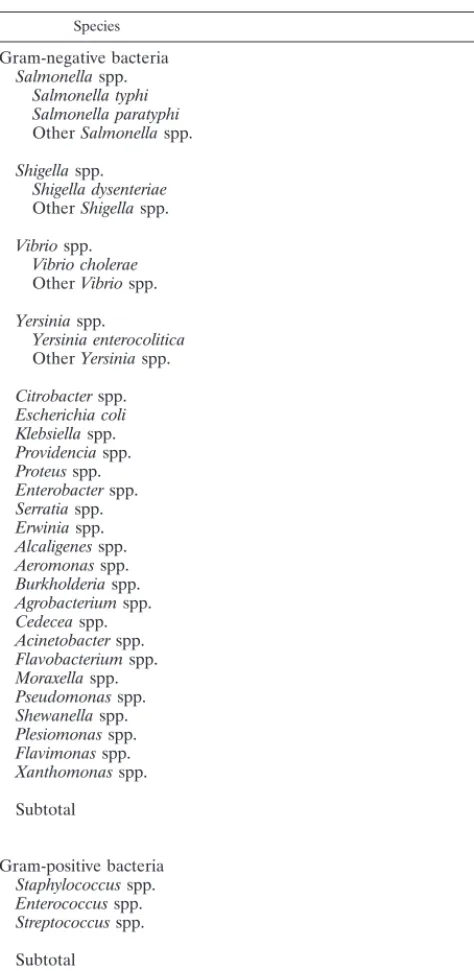
used for the evaluation of SSI enteric medium. The strains were isolated from clinical specimens at the SSI, and they were chosen to include the whole spec-trum of gram-negative rods (n5264) with the addition of a number of gram-positive bacteria (n511) as controls to examine the selectivity of the medium (Table 1). The bacteria were identified according to routine procedures. Only major pathogenic species were evaluated for their detection limits in stools and compared for their quantitative growth on the different enteric media. The 275 strains represented a pool from which the bacteria for each investigation were selected.
SSI enteric medium.The SSI enteric medium is available both as agar plates
and granulated powder. The selective action on SSI enteric medium is caused by the combination of a detergent (sodium dodecyl benzene sulfonate) and sodium deoxycholate, on which gram-positive bacteria, gram-negative cocci, and certain gram-negative rods (e.g., Pasteurella and Haemophilus) are excluded from growth. Also, the detergent is an efficient inhibitor of the swarming of nearly all
Proteusstrains. Upon inoculation, the medium produces four differentiating reactions.
(i) H2S reaction.Due to the presence of sodium thiosulfate and ferric citrate
in the agar, H2S-positive bacteria produce a distinct ferrosulfide precipitate
located centrally and deeply in the more anaerobic parts of the colony.
(ii) Lactose fermentation. Fermentation is manifested by acid production
made visible by using as an indicator the combination of deoxycholate and neutral red. The acid production is confined to the colony and its immediate surroundings due to the reaction with deoxycholate, which yields deoxycholic acid. Deoxycholic acid precipitates and becomes moderately colored by neutral red. The confinement of the reaction to the colony makes recognition of adjacent lactose-negative colonies possible.
(iii) Phenylalanine deaminase reaction.Phenylalanine deaminase-active
bac-teria are recognized. With ferric citrate in an acid environment, the conversion ofL-phenylalanine to phenylpyruvate is visible as a brown, diffusible pigment in
the SSI enteric medium.
(iv) Indole reaction.This reaction is included as a differentiating characteristic
in a pure subculture from a suspect colony on the primary medium. Deamination of tryptophan produces a volatile chemical, indole, which may be detected by placing a piece of filter paper inside the lid of the inverted petri dish that has
* Corresponding author. Mailing address: Department of Research
and Development, Statens Serum Institut, Artillerivej 5, Bygn. 45,
DK-2300 Copenhagen S, Denmark. Phone: 45 32683457. Fax: 45
32683887. E-mail: [email protected].
2312
on May 15, 2020 by guest
http://jcm.asm.org/
been wetted with the reagents of Ehrlich’s indole test, i.e.,p -dimethylaminoben-zaldehyde, ethyl alcohol, and hydrogen chloride.
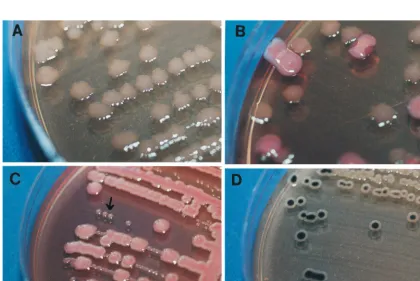
Table 2 provides more detailed information on how different species are identified on the SSI enteric medium (see also Fig. 1).
Two other reactions visible with the SSI enteric medium are useful for the identification ofSalmonellaspp. andShigella sonnei; however, both require a certain degree of practical experience before routine use.
(i) Metallic sheen reaction.This reaction is characterized by a metallic sheen
on top of the black center in H2S-producingSalmonella(except inSalmonella
typhi). The cause of this metallic sheen is largely unknown.
(ii) Rough transformation.Due to rather high concentrations of divalent ions
(Mg11and Ca11), a rough transformation is regularly induced in Shigella
sonnei, affecting the surfaces and the edges of the colonies. The resulting in-creased spreading of the colonies makes recognition possible also when they are located among colonies of other bacteria.
Other media. (i) XLD agar.Xylose-lysine-desoxycholate (XLD) agar (Oxoid,
Basingstoke, United Kingdom) was originally formulated by Taylor for the iso-lation and identification ofShigellaspp. from stool specimens (17). It has since been found also to be a satisfactory medium forSalmonellaspp. (8). XLD agar contains deoxycholate as the selective agent and identifies the bacteria according to lactose, sucrose, and xylose fermentation; H2S production; and lysine
decar-boxylation.
(ii) HE agar.Hektoen enteric (HE) agar (Oxoid) was developed by King and
Metzger (10) to grow shigellae as readily as other pathogens while inhibiting normal intestinal flora. HE agar contains bile salts and may contain novobiocin as selective agent; it identifies the bacteria according to lactose, sucrose, and salicin fermentation and H2S production.
(iii) SS agar.Salmonella-Shigella(SS) agar (Becton Dickinson, Basel,
Swit-zerland) is a differential selective medium for the isolation ofSalmonellaand someShigellaspecies from clinical speciments. It contains brilliant green and bile salts as selective agents and identifies bacteria according to lactose fermentation and H2S production.
(iv) CIN agar.Cefsulodin-irgasan-novobiocin (CIN) agar (Oxoid) was
devel-oped by Schiemann (15) for the isolation ofYersinia enterocolitica. It contains bile salts and antibiotics as selective agents and identifies the bacteria by mannitol fermentation.
All the media were prepared according to the manufacturers’ instructions at the Media Department at the SSI. XLD, HE, SS, and CIN agar have been described, evaluated, and compared by others (1, 3–11, 14–21).
Confirmatory reactions.H2S production was investigated by the addition of
several colonies into a ferrocloride-peptone-gelatin medium (SSI). After incu-bation at 22°C for a maximum of 4 days, H2S-positive bacteria were black or grey
along the stab line (12). We tested for phenylalanine deaminase by the addition of several colonies into a culture medium containing L-phenylalanine (SSI)
followed by incubation at 35°C for 2 to 4 h and the addition of a few drops of reagent (FeCl3z6H2O and 5 N HCl). Phenylalanine deaminase-active bacteria
give an immediate and strong dark green coloring of the culture medium (2). Lactose and indole fermentation was confirmed by using standard procedures. The indole reaction was performed after xylene extraction.
Growth and reactivity of gram-negative rods on the SSI enteric medium.
Bacteria were grown overnight on 5% blood agar (SSI). Several colonies were streaked on the SSI enteric medium and incubated overnight at 35°C. The plates were examined for the colony characteristics, size, and color of the test organ-isms, and the number of colonies on the medium was determined. Isolates showing unexpected reactions on the SSI enteric medium were retested further in confirmatory reactions by using the standard procedures described earlier.
Semiquantitative growth.A total of 59 bacterial strains were tested; 48
rep-resented the relevant gram-negative organisms, and 11 were gram-positive con-trols. Bacteria of each strain were suspended in saline and were adjusted to approximately 23108CFU/ml as measured by optical density (540 nm) using a
colorimeter (Ciba-Corning Colorimeter 254; Ciba Corning Diagnostics Ltd., Suffolk, United Kingdom). The bacterial suspensions were diluted in saline to produce 1021to 1027suspensions, and 200ml of each (including the undiluted
bacterial suspension) was plated onto 5% blood agar (SSI) and the SSI enteric medium. The bacteria were categorized as having the same growth on both media, less growth on SSI enteric medium than on 5% blood agar, or no growth. Same growth indicates that the number of colonies on the SSI enteric medium was between 10 and 120% of the number on the 5% blood agar, whereas less growth was between 0.1 and 10%.
Detection limit for enteric pathogens in simulated stool cultures.The most
common enteric pathogens (a total of 28 strains) were selected for this experi-ment. The bacteria in question were suspended in saline, adjusted to approxi-mately 23108CFU/ml and diluted in saline from 1021to 1027. The diluted
bacteria were mixed with normal feces (e.g., fecal samples with no growth of enteric pathogens) by suspending 10ml of feces into 2 ml of phosphate-buffered saline (pH 7.38) and adding 5ml of each dilution of bacteria. The suspension was mixed, and 10ml was plated on SSI enteric medium and incubated at 35°C overnight. The highest dilution resulting in growth on the medium was deter-mined.
Comparison with other enteric media.A total of 125 strains belonging to the
major pathogenic species were tested on XLD, CIN, HE, and SS agar, and the results were compared with those obtained with SSI enteric medium. The bac-teria in question were suspended and diluted so that an inoculum of;200 CFU was applied. Each of the five media were inoculated on the same day by the same technician. After incubation overnight at 35°C the number of colonies was counted.
RESULTS
[image:2.612.56.293.91.577.2]Growth and reactivity of gram-negative rods on the SSI
enteric medium.
All tested bacteria (n
5
248) grew on SSI
enteric medium and very few (10 of 248 [4%]) showed
dis-crepant biochemical reactions (H
2S production, lactose
fer-mentation, phenylalanine deaminase production, and indole
production) (Table 3). Five strains (Klebsiella pneumoniae,
TABLE 1. Genera and number of strains used to evaluate the SSI
enteric medium
Species n
Gram-negative bacteria
Salmonella
spp.
Salmonella typhi
2
Salmonella paratyphi
3
Other
Salmonella
spp.
65
Shigella
spp.
Shigella dysenteriae
2
Other
Shigella
spp.
29
Vibrio
spp.
Vibrio cholerae
7
Other
Vibrio
spp.
2
Yersinia
spp.
Yersinia enterocolitica
21
Other
Yersinia
spp.
7
Citrobacter
spp.
3
Escherichia coli
16
Klebsiella
spp.
12
Providencia
spp.
11
Proteus
spp.
20
Enterobacter
spp.
17
Serratia
spp.
16
Erwinia
spp.
1
Alcaligenes
spp.
4
Aeromonas
spp.
7
Burkholderia
spp.
1
Agrobacterium
spp.
2
Cedecea
spp.
1
Acinetobacter
spp.
4
Flavobacterium
spp.
1
Moraxella
spp.
1
Pseudomonas
spp.
5
Shewanella
spp.
1
Plesiomonas
spp.
1
Flavimonas
spp.
1
Xanthomonas
spp.
1
Subtotal
264
Gram-positive bacteria
Staphylococcus
spp.
4
Enterococcus
spp.
2
Streptococcus
spp.
5
Subtotal
11
Total
275
on May 15, 2020 by guest
http://jcm.asm.org/
Providencia rettgeri, and three
Enterobacter cloacae
strains)
gave a false-negative reaction for lactose fermentation. Three
other strains (Citrobacter freundii,
Proteus vulgaris, and
Proteus
mirabilis) did not produce H
2S, and one strain (Alcaligenes
piechaudii) did not produce phenylalanine deaminase.
How-ever, all of these strains expressed the expected reactions in
confirmatory tests.
Semiquantitative growth.
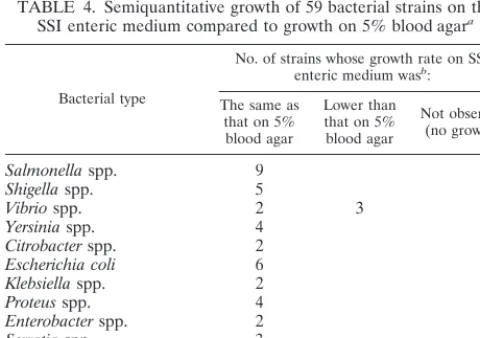
Most gram-negative rods (42 of 47
tested [92%]) grew with little or no inhibition on SSI enteric
medium compared to growth on 5% blood agar (Table 4).
Three
Vibrio
spp. (one each of
V. vulnificus,
V. cholera
O139,
and
V. parahaemolyticus) and an
Aeromonas sobria
strain
showed reduced growth (10- to 1,000-fold). The gram-positive
bacteria did not grow on SSI enteric medium.
[image:3.612.55.548.85.227.2]Detection limit for enteric pathogens in simulated stool
cultures.
Most enteropathogens (16 of 28 [57%]) had a
detec-tion limit of 50 bacteria/ml of feces except for
Vibrio
spp. and
some
Shigella
spp. (Table 5). Of the five
Vibrio
spp., one was
not detected (V. cholera
non-O1), two had a detection limit of
5,000 bacteria/ml of feces (V. vulnificus
and
V. cholera
O139),
and two had a detection limit of 50,000 CFU/ml of feces (V.
parahaemolyticus
and
V. cholera
O1). The strains with the high
TABLE 2. Differentiating reactions produced by the SSI enteric medium and possible identity of the pathogenic bacteria
Reaction
Possible identity H2S Lactose PDa Indole
1
2
2
2
Salmonella
spp. (including
Salmonella arizonae
), lactose-negative
Citrobacter freundii
,
Shewanella putrefaciens
1
2
2
1
E. coli
(of H
2S-positive variety),
Edwardsiella tarda
1
1
2
2
Citrobacter freundii
, lactose-positive
Salmonella
spp.
1
1
2
1
E. coli
(of H
2S-positive variety)
1
2
1
2
Proteus mirabilis
1
2
1
1
Proteus vulgaris
2
2
1
1
Morganella morganii
,
Providencia
spp.
2
2
2
2
Shigella
spp.,
Yersinia
spp.,
Salmonella paratyphi A
2
2
2
1
Shigella
spp.,
Vibrio
spp.,
Aeromonas
spp.,
E. coli
,
Plesiomonas
spp.
2
1
2
2
Klebsiella pneumoniae
,
Enterobacter
spp.
2
1
2
1
E. coli
,
Aeromonas
spp.,
Klebsiella oxytoca
aPhenylalanine deaminase.
FIG. 1. Colony appearance of four different genera of theEnterobacteriaceaeon SSI enteric medium. SSI enteric medium yields six differentiating biochemical reactions that allow direct identification of a range of enteric pathogens (see the text). In this figure, only the four major reactions are illustrated, with different bacteria. (A)Shigella sonnei, with the characteristic rough transformations, causes the surfaces and the edges of the colonies to become serrated. (B)E. coliandShigella sonnei.
E. coliorganisms appear as red colonies due to lactose production, and there is no rough transformation. (C)E. coliandY. enterocolitica.Yersiniaspp. appear as tiny round translucent colonies which resemble pearls on a string (indicated by the arrow). They are easily recognized compared to the much larger, red colonies ofE. coli. (D) H2S-positiveSalmonellaspp. H2-positive organisms appear with a black precipitate located centrally and deeply in the anaerobic parts of the colony.
on May 15, 2020 by guest
http://jcm.asm.org/
[image:3.612.93.514.395.676.2]detection limits were the same as the ones showing reduced
growth in the semiquantitative growth experiment. Of the four
Shigella
spp. tested, one had a detection limit of only 5 CFU/ml
of feces (S. sonnei) and three had a detection limit of 500
CFU/ml of feces (two
S. flexneri
and
S. boydii).
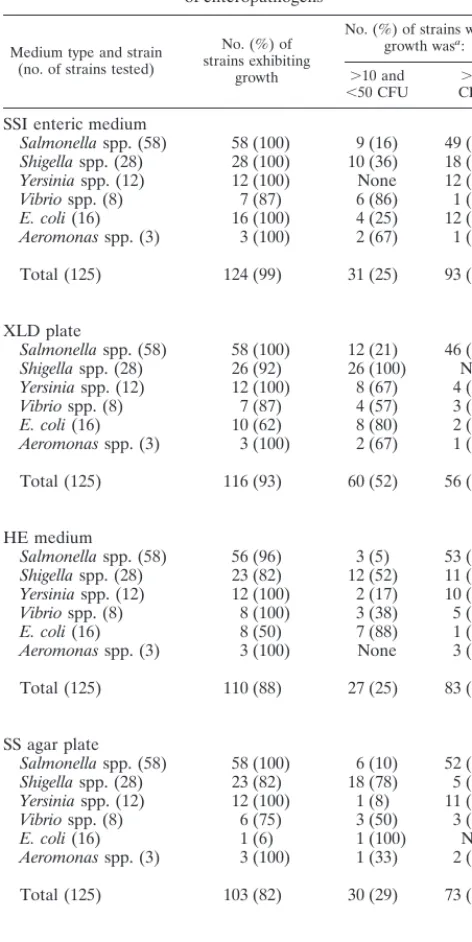
Growth on SSI enteric medium compared to that on
stan-dard enteric media.
Growth on SSI enteric medium was as
good as or better than that on other standard enteric media
(Table 6). This was particularly evident for
Shigella
spp. and
enteropathogenic
E. coli. Possible exceptions were
Vibrio
spp.,
which grew slightly better on HE agar than on all other media.
The SSI enteric medium also detected
Yersinia
spp. When an
inoculum of
;
200 CFU was applied to all five media and the
quantitative growth rates were compared, SSI enteric medium
showed
.
50 CFU in 75% of the tested bacteria compared to
48% for XLD medium, 75% for HE medium, and 71% for SS
agar (Table 6).
DISCUSSION
The SSI enteric medium evaluated in this study provided the
most effective universal medium for the recovery of enteric
pathogens. Since we could not evaluate all of the many
differ-ent types of media available for the isolation of differ-enteric
patho-gens, we decided to include in this study only those widely used
in typical clinical bacteriology laboratories.
XLD agar performed second best, although it had a lower
sensitivity towards
Shigella
spp. and
E. coli
than did the SSI
enteric medium. Like Taylor and Schelhart (21), Altwegg et al.
(1), and Desmond and Janda (3), we found XLD agar to be
superior to HE agar and SS agar, although HE agar supported
growth of
Vibrio
spp. best of all tested media. This may explain
why some investigators have reported HE agar to be equal to
or slightly superior to XLD agar (3, 4, 8). Even though this
study showed reduced growth and high detection limits of
some
Vibrio
spp. on the SSI enteric medium, the medium
detected
V. cholerae
O1-positive stools in a 1-year prospective
household-based diarrhea study in Guinea-Bissau (13). The
SSI enteric medium also proved its utility during a
V. cholerae
epidemic in September 1987 in Guinea-Bissau, although the
sensitivity of detecting
V. cholerae
was increased with the
ad-ditional use of thiosulfate-citrate-bile-sucrose (TCBS) agar
(12b). All cases of cholera diagnosed in the Department of
Gastrointestinal Infection at the SSI during the past 20 years
have been diagnosed as fast as or faster on the SSI enteric
medium than on the traditional TCBS medium after
preen-richment in peptone broth. This is probably due to the
ex-tremely high numbers of organisms present in stools of
pa-tients with cholera.
[image:4.612.311.551.91.223.2]Some investigators have questioned the efficiency of CIN
agar for its use in detection of
Yersinia enterocolitica
(6, 7, 9).
TABLE 3. Percentages of agreement with expected biochemical
reactions of 248 gram-negative rods on the SSI enteric medium
Bacterial type
No. of strains whose reaction was in agreement with the expected reaction/no. tested (% in agreement)
Result for strain whose reaction was not in agreement with the expected reaction
n Reaction
Salmonella
spp.
61/61 (100)
Shigella
spp.
28/28 (100)
Vibrio
spp.
5/5 (100)
Yersinia
spp.
24/24 (100)
Citrobacter
spp.
12/13 (92)
1
H
2S negative
Escherichia coli
12/12 (100)
Klebsiella
spp.
11/12 (92)
1
Lactose negative
Providencia
spp.
10/11 (90)
1
Lactose negative
Proteus
spp.
18/20 (90)
2
H
2S negative
Enterobacter
spp.
14/17 (82)
3
Lactose negative
Serratia
spp.
15/16 (94)
1
aIndole positive
Erwinia
spp.
1/1 (100)
Alcaligenes
spp.
3/4 (75)
1
PD
bOther gram-negative rods
c24/24 (100)
aJudged positive for a negative strain. bPhenylalanine deaminase production.
cOther gram-negative rods includeAeromonasspp. (n54),Burkholderiaspp.
[image:4.612.53.294.93.281.2](n51),Agrobacteriumspp. (n52),Cedeceaspp. (n51),Acinetobacterspp. (n54),Flavobacteriumspp. (n51),Moraxellaspp. (n51),Pseudomonasspp. (n57),Shewanellaspp. (n51),Plesiomonasspp. (n51), andFlavimonasspp. (n51).
TABLE 4. Semiquantitative growth of 59 bacterial strains on the
SSI enteric medium compared to growth on 5% blood agar
aBacterial type
No. of strains whose growth rate on SSI enteric medium wasb:
The same as that on 5% blood agar
Lower than that on 5% blood agar
Not observed (no growth)
Salmonella
spp.
9
Shigella
spp.
5
Vibrio
spp.
2
3
Yersinia
spp.
4
Citrobacter
spp.
2
Escherichia coli
6
Klebsiella
spp.
2
Proteus
spp.
4
Enterobacter
spp.
2
Serratia
spp.
3
Other gram-negative rods
c5
1
Gram-positive bacteria
d11
eaThe original (100) and 10-fold dilutions of 1021to 1027were plated.
bRelative growth rates were calculated as follows: (CFU per milliliter on SSI
enteric medium/CFU per milliliter on 5% blood agar)3100. Growth rates were deemed the same if growth on SSI enteric medium was 10 to 120% of that on blood agar and were deemed lower if growth on SSI enteric medium was#0.1 to
,10% of that on 5% blood agar.
cOther gram-negative rods includeAeromonasspp. (n53),Acinetobacterspp.
(n51),Pseudomonas(n51), andXanthomonasspp. (n51).
dGram-positive bacteria includeStaphylococcusspp. (n54),Enterococcus
spp. (n52), andStreptococcusspp. (n55).
[image:4.612.53.293.470.639.2]eFour strains grew undiluted (;108CFU/ml).
TABLE 5. Detection limits of 28 enteric pathogens with SSI
enteric medium
Bacterial strain n Detection limita
Salmonella
spp.
7
50
Salmonella typhimurium
1
500
Salmonella virchow
1
500
Shigella
spp.
3
500
Shigella sonnei
1
5
Vibrio
spp.
2
5,000
Vibrio parahaemolyticus
1
50,000
Vibrio cholerae
O1
1
50,000
Vibrio cholerae
non-O1
1
No detection
Yersinia
spp.
3
50
Yersinia
sp. strain O139
1
500
Escherichia coli
6
50
aDetection limit is defined as the lowest number of detectable CFU per gram
of feces. Tenfold dilutions of bacteria were mixed with fecal samples and plated, and CFU per gram of feces were determined.
on May 15, 2020 by guest
http://jcm.asm.org/
As the SSI enteric medium allows growth of all enteric
patho-gens, including
Yersinia
spp., CIN agar could be removed from
the list of standard plating agars in the typical laboratory and
thereby diminish workload and cost to the laboratory.
Yersinia
spp. grow as easily recognizable tiny round translucent colonies
which resemble pearls on a string on SSI enteric medium.
The performance of any medium is dependent upon the skill
and training of the technician and his or her familiarity with
the medium. To fully benefit from the capacity to directly
identify enteric pathogens on SSI enteric medium, the
recog-nition of the metallic-sheen reaction and the rough
transfor-mation reaction in particular requires practical experience.
In conclusion, SSI enteric medium is selective for
gram-negative bacteria and allows growth of all aerobic enteric
pathogens. The medium compares favorably to similar media,
and its ability to detect
Yersinia
spp. would limit the number of
media needed in a typical laboratory. Also, the direct
identi-fication of enteric pathogens on the SSI enteric medium may
provide a more rapid diagnosis.
REFERENCES
1.Altwegg, M., J. Buser, and A. von Graevenitz.1996. Stool cultures for
Shi-gellaspp.: improved specificity by using MacConkey agar with xylose. Diagn. Microbiol. Infect. Dis.24:121–124.
2.Bøvre, K., J. E. Fuglesang, S. D. Henriksen, S. P. Lapage, H. Lautrop, and
J. J. S. Snell.1974. Studies on a collection of gram-negative bacterial strains
showing resemblance toMoraxellae: examination by conventional bacterio-logical methods. Int. J. Syst. Bacteriol.24:438–446.
3.Desmond, E., and J. M. Janda.1986. Growth ofAeromonasspecies on
enteric agars. J. Clin. Microbiol.23:1065–1067.
4.Dunn, C., and W. J. Martin.1971. Comparison of media for isolation of
SalmonellaeandShigellaefrom fecal specimens. Appl. Microbiol.22:17–22.
5.Dusch, H., and M. Altwegg.1995. Evaluation of five new plating media for
isolation ofSalmonellaspecies. J. Clin. Microbiol.33:802–804.
6.Fukushima, H.1987. New selective agar medium for isolation of virulent
Yersina enterocolitica. J. Clin. Microbiol.25:1068–1073.
7.Fukushima, H., and M. Gomyoda.1986. Growth ofYersinia
pseudotubercu-losisandYersinia enterocoliticabiotype 3B serotype O3 inhibited on cefsu-lodin-irgasan-novobiocin agar. J. Clin. Microbiol.24:116–120.
8.Isenberg, H. D., S. Kominos, and M. Siegel.1969. Isolation ofSalmonellae
andShigellaefrom an artificial mixture of fecal bacteria. Appl. Microbiol.
18:656–659.
9.Kachoris, M., K. L. Rouff, K. Welch, W. Kallas, and M. J. Ferraro.1988.
Routine culture of stool specimens forYersinia enterocoliticais not a cost-effective procedure. J. Clin. Microbiol.26:582–583.
10. King, S., and W. I. Metzger.1968. A new plating medium for the isolation of
enteric pathogens. I. Hektoen enteric agar. Appl. Microbiol.16:577–578.
11. King, S., and W. I. Metzger.1968. A new plating medium for the isolation of
enteric pathogens. II. Comparison of Hektoen enteric agar with SS and EMB agar. Appl. Microbiol.16:579–581.
12. Kolmos, H. J., and J. Schmidt.1987. Failure to detect hydrogen-sulfide
production in lactose/sucrose-fermenting Enterobacteriaceae, using triple sugar iron agar. Acta Pathol. Microbiol. Immunol. Scand. Sect. B95:85–87.
12a.Meyer, A. A., M. Blom, N. Frimodt-Møller, and F. Espersen.1998.
Evalua-tion of SS1 enteric plate for rapid detecEvalua-tion of enteric pathogens, abstr. C-247, p. 172.InAbstracts of the 98th General Meeting of the American Society for Microbiology 1998. American Society for Microbiology, Wash-ington, D.C.
12b.Mølbak, K.Personal communication.
13. Mølbak, K., N. Wested, N. Hj`lyng, F. Scheutz, A. Gottschau, P. Aaby, and
A. P. Jose´ da Silva.1994. The etiology of early childhood diarrhea: a
com-munity study from Guinea-Bissau. J. Infect. Dis.169:581–587.
14. Morris, G. K., J. A. Koehler, E. J. Gangarosa, and R. G. Sharrar.1970.
Comparison of media for direct isolation and transport ofShigellaefrom fecal specimens. Appl. Microbiol.19:434–437.
15. Schiemann, D. A.1979. Synthesis of a selective agar medium forYersinia
enterocolitica. Can. J. Microbiol.25:1298–1304.
16. Silva, R. M., M. R. F. Toledo, and L. R. Trabulsi.1980. Biochemical and
cultural characteristics of invasiveEscherichia coli. J. Clin. Microbiol.11:
441–444.
17. Taylor, W. I.1965. Isolation ofShigellae. I. Xylose lysine agars: new media
for isolation of enteric pathogens. Am. J. Clin. Pathol.44:471–475.
18. Taylor, W. I., and B. Harris.1965. Isolation ofShigellae. II. Comparison of
plating media and enrichment broths. Am. J. Clin. Pathol.44:476–479.
19. Taylor, W. I., and D. Schelhart.1967. Isolation ofShigellae. IV. Comparison
of plating media with stools. Am. J. Clin. Pathol.48:356–362.
20. Taylor, W. I., and D. Schelhart.1968. Isolation ofShigellae. VI. Performance
of media with stool specimens. Appl. Microbiol.16:1387–1393.
21. Taylor, W. I., and D. Schelhart.1971. Isolation ofShigellae. VIII.
[image:5.612.54.290.99.570.2]Compar-ison of xylose lysine deoxycholate agar, Hektoen enteric agar, Salmonella-ShigellaAgar, and eosin methylene blue agar with stool specimens. Appl. Microbiol.21:32–37.
TABLE 6. Comparison of growth of 125 bacteria strains on the SSI
enteric medium to growth on other media used for detection
of enteropathogens
Medium type and strain (no. of strains tested)
No. (%) of strains exhibiting
growth
No. (%) of strains whose growth wasa:
.10 and
,50 CFU CFU.50
SSI enteric medium
Salmonella
spp. (58)
58 (100)
9 (16)
49 (84)
Shigella
spp. (28)
28 (100)
10 (36)
18 (64)
Yersinia
spp. (12)
12 (100)
None
12 (100)
Vibrio
spp. (8)
7 (87)
6 (86)
1 (14)
E. coli
(16)
16 (100)
4 (25)
12 (75)
Aeromonas
spp. (3)
3 (100)
2 (67)
1 (33)
Total (125)
124 (99)
31 (25)
93 (75)
XLD plate
Salmonella
spp. (58)
58 (100)
12 (21)
46 (79)
Shigella
spp. (28)
26 (92)
26 (100)
NA
bYersinia
spp. (12)
12 (100)
8 (67)
4 (33)
Vibrio
spp. (8)
7 (87)
4 (57)
3 (43)
E. coli
(16)
10 (62)
8 (80)
2 (20)
Aeromonas
spp. (3)
3 (100)
2 (67)
1 (33)
Total (125)
116 (93)
60 (52)
56 (48)
HE medium
Salmonella
spp. (58)
56 (96)
3 (5)
53 (95)
Shigella
spp. (28)
23 (82)
12 (52)
11 (48)
Yersinia
spp. (12)
12 (100)
2 (17)
10 (83)
Vibrio
spp. (8)
8 (100)
3 (38)
5 (62)
E. coli
(16)
8 (50)
7 (88)
1 (12)
Aeromonas
spp. (3)
3 (100)
None
3 (100)
Total (125)
110 (88)
27 (25)
83 (75)
SS agar plate
Salmonella
spp. (58)
58 (100)
6 (10)
52 (90)
Shigella
spp. (28)
23 (82)
18 (78)
5 (22)
Yersinia
spp. (12)
12 (100)
1 (8)
11 (92)
Vibrio
spp. (8)
6 (75)
3 (50)
3 (50)
E. coli
(16)
1 (6)
1 (100)
NA
Aeromonas
spp. (3)
3 (100)
1 (33)
2 (67)
Total (125)
103 (82)
30 (29)
73 (71)
CIN agar
Yersinia
spp. (12)
12 (100)
None
12 (100)
aAn inoculum of;200 CFU was applied for all 125 bacteria. bNA, not applicable.