0095-1137/05/$08.00⫹0 doi:10.1128/JCM.43.7.3438–3442.2005
Copyright © 2005, American Society for Microbiology. All Rights Reserved.
Sensitivity and Specificity of a Rapid rRNA Gene Probe Assay for
Simultaneous Identification of
Staphylococcus aureus
and
Detection of
mecA
Shannon Kaplan,
1Elizabeth M. Marlowe,
1* James J. Hogan,
1Mehmet Doymaz,
2†
David A. Bruckner,
2and Andrew E. Simor
3Gen-Probe Incorporated, San Diego, California1; UCLA Medical Center, Department of Pathology and
Laboratory Medicine, Los Angeles, California2; and Sunnybrook and Women’s College Health Sciences
Centre, Department of Microbiology, Toronto, Canada3
Received 29 November 2004/Returned for modification 24 January 2005/Accepted 21 March 2005
rRNA gene sequences were used for identification and target adequacy controls in a DNA probe assay to identify isolates asStaphylococcusand, more specifically, asS. aureuswithin 1 hour.mecAstatus was simul-taneously determined using a specific DNA probe. The target adequacy control guarded against false-negative
mecAresults.
Methicillin resistance in Staphylococcus aureusand
coagu-lase–negative Staphylococcus (CoNS) are leading causes of
nosocomial infections worldwide (13). These high levels of methicillin resistance have led to an overuse of vancomycin,
resulting in vancomycin-intermediate and -resistant
Staphylo-coccus(5, 19, 21, 22). Over the last several years,
methicillin-resistantStaphylococcus aureus(MRSA) has been emerging in
the community (community-acquired MRSA [CA-MRSA]). CA-MRSA is associated with strains that have some unique properties (such as virulence factors and susceptibility pat-terns) compared to the traditional hospital-acquired MRSA strains. Consequently, the need for rapid methods to identify
and detect resistantStaphylococcusremains (3).
Common methods for susceptibility testing include broth microdilution, disk diffusion, and screening agars, which re-quire timely incubations after isolate identification.
Alterna-tively, the Oxoid PBP2⬘latex agglutination (OLA) assay
(Ox-oid, United Kingdom) is a rapid test for differentiating MRSA
from methicillin-sensitive Staphylococcus aureus (MSSA) on
agar plates (2, 11, 14, 23, 24, 25, 26, 27). Unfortunately, reliable testing of CoNS with the OLA assay requires induction with oxacillin (Ox), and a heavier inoculum size and longer lysis are critical for accurate results (11, 14, 26).
Recently, molecular assays for methicillin resistance and
Staphylococcus identification usingmecAand
Staphylococcus-specific genes have yielded fast and reliable results (4, 6, 9, 12, 13, 16, 20). Molecular assays have an advantage because they do not rely on time-consuming incubations or phenotypic ex-pression (7). However, because of the technical expertise re-quired, many formats are not practical for routine use in most clinical laboratories.
The objective of this study was to evaluate the performance of a Gen-Probe (San Diego, Calif.) prototype DNA probe
hybridization protection assay (HPA). This assay, currently
under development, can simultaneously identify a
Staphylococ-cus isolate and themecA gene for rapid detection of MRSA
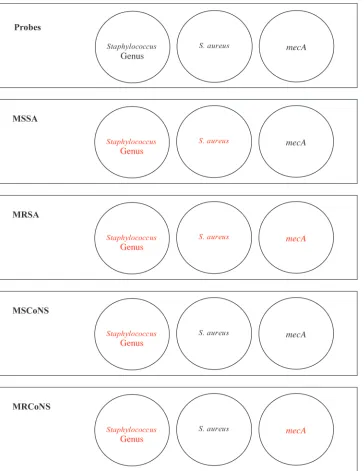
and methicillin-resistant CoNS (MRCoNS) (Fig. 1). This is the first report describing the use of DNA probe HPA for detect-ing sdetect-ingle-stranded DNA. A total of 589 clinical isolates and 24 American Type Culture Collection (ATCC) isolates were tested using the oxacillin MIC, the DNA probe HPA, and the OLA assay. Specificities for 368 clinical isolates representing
288S. aureusand 80 CoNS strains were tested on subculture
plates. To test assay sensitivity and specificity in a clinical
setting, 221 isolates representing 110S. aureusand 111 CoNS
strains were tested from primary culture plates. Each clinical isolate represented only one strain per patient. Ox MIC was the reference method, since it is used in the laboratory for
routine susceptibility testing. PCR of themecAgene was used
to resolve any discrepant results.
Clinical isolates were collected from the UCLA Medical Center and Sunnybrook and Women’s College Health Sci-ences Centre (SWCHSC). All frozen isolates were passed three times on blood agar plates prior to being tested. All clinical isolates collected from primary plates were collected from the UCLA Medical Center. Colonies from primary plates
presumed to be S. aureus or CoNS were used for OLA and
probe analysis. These colonies were subcultured for MIC test-ing, identification confirmation, and preparing glycerol stocks. Isolates were identified using conventional biochemical meth-ods. Oxacillin susceptibilities were determined for all isolates according to CLSI (formerly NCCLS) methods (17). Isolates from UCLA were tested using a broth microdilution reference method with in-house panels (17). SWCHSC tested isolates by disk diffusion and broth microdilution (17). The OLA test was performed with modifications as described previously (11, 14). PCR amplification was performed at UCLA, SWCHSC, and Gen-Probe (10, 15).
Probe analysis was performed using HPA (1, 18), which employs probes with chemiluminescent acridinium ester labels complementary to a highly conserved bacterial rRNA gene
* Corresponding author. Mailing address: Gen-Probe Incorporated, 10210 Genetic Center Drive, San Diego, CA 92121-4362. Phone: (858) 731-5974. Fax: (858) 731-5900. E-mail: [email protected].
† Present address: Beth Israel Medical Center, New York, N.Y.
3438
on May 15, 2020 by guest
http://jcm.asm.org/
region or antibiotic resistance gene. These highly conserved bacterial rRNA gene probes have been extensively character-ized for identification specificity (15). Gen-Probe Incorporated supplied all proprietary reagents. The assay was run in white 96-well microtiter plates (Whatman, Clifton, N.J.). Each mi-crotiter plate contained three probe mixtures in individual
wells to make up the reaction set (Fig. 1). A 1-l loop of cells
was lysed at 100°C in 150l of a succinate-buffered detergent
reagent. After the addition of 100 l of base solution and a
10-min 60°C incubation, the reaction mixture was cooled to
room temperature and 100 l of a hybridization buffer was
added. Of this mixture, 50l was aliquoted to each of the three
wells and a 50-l oil overlay was added to prevent evaporation
throughout the 60°C assay. HPA was automated using a BMG
luminometer (Lumistar 500; BMG Technologies, Offenburg, Germany), and the results were available in under 60 min.
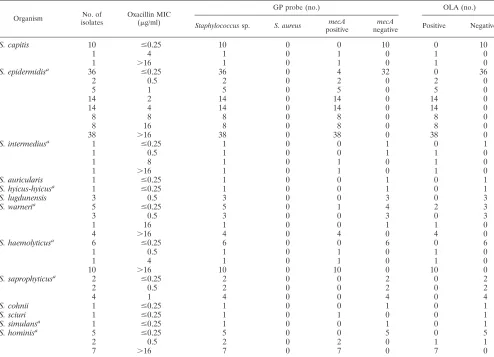
The probe results for detecting MRSA and MRCoNS from both primary and subculture plates are summarized in Tables
1 and 2. Of the 398 S. aureus clinical isolates, 196 were Ox
resistant (MICs ⱖ 4 g/ml) and 202 were Ox susceptible
(MICsⱕ2g/ml) (Table 1). ThemecAprobe results
demon-strated that 184 of the 196 Ox-resistant isolates produced pos-itive probe results and that 199 of the 202 Ox-susceptible
isolates produced negative probe results. ThemecAprobe
re-sults showed 184/196 MRSA and 199/202 MSSA. The mecA
probe, OLA, and PCR were negative for 12/196 MRSA
iso-lates formally defined as borderline resistant (MICsⱖ4 to 8
g/ml). Regarding the three OLA-, mecAprobe-, and
PCR-FIG. 1. Simultaneous identification ofStaphylococcusand determination ofmecAstatus. Positive probe results are indicated in red.
on May 15, 2020 by guest
http://jcm.asm.org/
[image:2.603.123.487.75.546.2]TABLE 1. Results for 411S. aureusisolates in Ox MIC, GP probe, and OLA assays
Organism No. of isolates
Oxacillin MIC (g/ml)
GP probe (no.) OLA (no.)
Staphylococcussp. S. aureus mecA positive
mecA
negative Positive Negative
Clinical MRSA 14 ⱖ4 14 14 6 8 6 8
13 8 13 13 9 4 9 4
14 16 14 14 14 0 14 0
155 ⬎16 155 155 155 0 154 1
Clinical MSSA 149 ⱕ0.25 149 149 1 148 1 148
32 0.5 32 32 0 32 0 32
13 1 13 13 0 13 0 13
8 2 8 8 2 6 2 6
ATCC MRSAa 1 8 1 1 1 0 1 0
1 16 1 1 1 0 1 0
ATCC MSSAa 6 ⱕ0.25 6 6 0 6 0 6
4 0.5 4 4 0 4 0 4
1 1 1 1 0 1 0 1
a
ATCC MRSA tested included no. 33591 and 43866. ATCC MSSA tested included no. 6538, 12598, 27661, 12600, 29213, 25923, 27660, 13301, 25904, 29247, and 33589.
TABLE 2. Results for 202 CoNS clinical and ATCC isolates in Ox MIC, GP Probe, and OLA assays
Organism No. of isolates
Oxacillin MIC (g/ml)
GP probe (no.) OLA (no.)
Staphylococcussp. S. aureus mecA positive
mecA
negative Positive Negative
S. capitis 10 ⱕ0.25 10 0 0 10 0 10
1 4 1 0 1 0 1 0
1 ⬎16 1 0 1 0 1 0
S. epidermidisa 36 ⱕ0.25 36 0 4 32 0 36
2 0.5 2 0 2 0 2 0
5 1 5 0 5 0 5 0
14 2 14 0 14 0 14 0
14 4 14 0 14 0 14 0
8 8 8 0 8 0 8 0
8 16 8 0 8 0 8 0
38 ⬎16 38 0 38 0 38 0
S. intermediusa 1 ⱕ0.25 1 0 0 1 0 1
1 0.5 1 0 0 1 1 0
1 8 1 0 1 0 1 0
1 ⬎16 1 0 1 0 1 0
S. auricularis 1 ⱕ0.25 1 0 0 1 0 1
S. hyicus-hyicusa 1 ⱕ0.25 1 0 0 1 0 1
S. lugdunensis 3 0.5 3 0 0 3 0 3
S. warneria 5 ⱕ0.25 5 0 1 4 2 3
3 0.5 3 0 0 3 0 3
1 16 1 0 0 1 1 0
4 ⬎16 4 0 4 0 4 0
S. haemolyticusa 6 ⱕ0.25 6 0 0 6 0 6
1 0.5 1 0 1 0 1 0
1 4 1 0 1 0 1 0
10 ⬎16 10 0 10 0 10 0
S. saprophyticusa 2 ⱕ0.25 2 0 0 2 0 2
2 0.5 2 0 0 2 0 2
4 1 4 0 0 4 0 4
S. cohnii 1 ⱕ0.25 1 0 0 1 0 1
S. sciuri 1 ⱕ0.25 1 0 1 0 0 1
S. simulansa 1 ⱕ0.25 1 0 0 1 0 1
S. hominisa 5 ⱕ0.25 5 0 0 5 0 5
2 0.5 2 0 2 0 1 1
7 ⬎16 7 0 7 0 7 0
a
ATCC isolates tested includedS. epidermidis(12228, 29887, 14990, and 35983),S. intermedius(29663),S. hyicus-hyicus(11249),S. warneri(27836),S. haemolyticus (29970),S. saprophyticus(15305),S. simulans(11631), andS. hominis(29885).
on May 15, 2020 by guest
http://jcm.asm.org/
[image:3.603.53.547.351.708.2]positive MSSA samples, the initial OLA results for two of the three were negative, but upon using the modified protocol, both samples converted to OLA positive. Converted
OLA-positive isolates may reflect low expression levels of themecA
protein due to regulatory mutations.
Of the 191 CoNS clinical isolates, 129 were Ox resistant
(MICsⱖ0.5g/ml) and 62 were Ox susceptible (MICsⱕ0.25
g/ml) (Table 2). Of the 129 MRCoNS isolates, 116 were
positive by mecA probe, PCR, and OLA. Eleven of the 13
discrepant MRCoNS isolates (MIC⫽0.5 to 1.0g/ml) wereS.
saprophyticus,S. lugdunensis, orS. warneri (Table 2).
Mecha-nisms of resistance other than those mediated bymecAmay be
responsible for these results. Other investigators using similar molecular methods with CoNS have observed this phenome-non (8, 11). Based on these MIC cutoffs, CLSI suggests further testing for clarification of resistance status using molecularly based techniques (17). The other two discrepant MRCoNS isolates were OLA positive and PCR negative and were
iden-tified asS. intermedius(MICⱕ0.5g/ml) andS. warneri(MIC
⫽16g/ml).
The two OLA-positive MRCoNS isolates that disagreed
with themecAprobe and PCR results might reflect mutations.
However, with three different DNA probes widely dispersed
along themecAgene, three different mutations yielding a
false-negative result are unlikely. A possible explanation is that the
material tested by themecAprobe and PCR was different from
the colonies used for MIC and OLA. This hypothesis is sup-ported by OLA-negative results when glycerol retention sam-ples of these colonies were grown on plates containing an oxacillin disk. These isolates were originally identified only as CoNS using a coagulase test, so a correlation at the species level could not be performed between the first and second rounds of test isolates.
Of 62 MSCoNS isolates, 56 were negative bymecAprobe,
PCR, and OLA. PCR confirmed the sixmecA probe-positive
MSCoNS isolates, with one displaying a positive OLA result
identified asS. warneri. Of the five that disagreed with OLA,
four wereS. epidermidisand one wasS. sciuri. The five
OLA-negative isolates may represent an unexpressedmecAgene due
to mutations in the regulatory regions. The single OLA-posi-tive isolate may be an example of down regulation as opposed
to nonexpression of themecAgene.
Testing of 24 ATCCStaphylococcusisolates showed 100%
agreement forS. aureuswith themecAprobe and PCR. Of the
11 ATCC CoNS isolates, 1 of 3 MRCoNS isolates wasmecA
probe and PCR negative and was identified asS. saprophyticus.
OLA results for the ATCC isolates agreed with MIC, mecA
probe, and PCR except for one false positive for a
methicillin-sensitiveS. warneriisolate and the false negative forS.
sapro-phyticus(Table 2). The OLA manufacturer’s insert states that
S. warnerimay give a false positive, and in such cases, the Ox
MIC should be used for determining resistance.
Rapid identification ofStaphylococcus, more specifically S.
aureus, along with the methicillin resistance status has been the focus of many recent studies (4, 6, 9, 12, 13, 20). Many direct and amplified formats have problems with false negatives due to lack of an internal control to verify that sufficient target was present and accessible. The DNA probe system described here addresses this problem by including an internal control
con-sisting of rRNA gene-targeted Staphylococcus identification
probes (Fig. 1). If there is sufficient DNA target to give a valid identification signal, there should be sufficient target for
de-termination of themecAstatus, thus eliminating false-negative
results.
This study demonstrates that the identification of an isolate
as a member of theStaphylococcusgenus, and more specifically
asS. aureus, coupled with the determination ofmecAstatus in
a 1-hour timeframe is feasible. The DNA probe identification
results forS. aureusdisplayed 100% sensitivity and specificity.
The mecA DNA probe results for S. aureus demonstrated
93.9% sensitivity and 98.6% specificity, and CoNS had 89.4% sensitivity and 91.4% specificity compared to MICs. When
PCR was used as the means to resolve the mecAdiscrepant
results, the mecA probe test demonstrated 100% sensitivity
and specificity with allS. aureusand CoNS isolates tested.
We have shown that this Staphylococcus-S. aureus-mecA
probe system is an accurate, easy, and rapid assay. The DNA probe sample-handling methodology requires less than 5 min of hands-on time, is amendable to batch processing, and is performed in under 15 min. The probe hybridization and de-tection steps are fully automated and can be completed in 45 min using the automated microtiter instrument. The data are automatically exported into a spreadsheet at the end of the run, which makes analysis simple. Coupled with effective com-munication to the physician, this 1-hour DNA probe assay could improve management and infection control practices for
methicillin-resistantStaphylococcusinfections.
We acknowledge the assistance of Lisa Louie from the Sunnybrook and Women’s College Health Sciences Centre and Linda Gibson from the UCLA Medical Center for all of their excellent work in supplying isolates and related test data.
REFERENCES
1. Arnold, L. J., P. W. Hammond, W. A. Wiese, and N. C. Nelson.1989. Assay formats involving acridinium-ester-labeled DNA probes. Clin. Chem.35:
1588–1594.
2. Cavassini, M., A. Wenger, K. Jaton, D. S. Blanc, and J. Bille.1999. Evalu-ation of MRSA-screen, a simple anti-PBP 2a slide agglutinEvalu-ation kit, for rapid detection of methicillin resistance inStaphylococcus aureus. J. Clin. Micro-biol.37:1591–1594.
3. Diekema, D. J., K. J. Doddgson, B. Sigurdardottir, and M. A. Pfaller.2004. Rapid detection of antimicrobial-resistant organism carriage: an unmet clin-ical need. J. Clin. Microbiol.42:2879–2883.
4. Francois, P., D. Pittet, M. Bento, B. Pepey, P. Vaudaux, D. Lew, and J. Schrenzel.2003. Rapid detection of methicillin-resistantStaphylococcus au-reusdirectly from sterile or nonsterile clinical samples by a new molecular assay. J. Clin. Microbiol.41:254–260.
5. Fridkin, S. K.2001. Vancomycin-intermediate and -resistantStaphylococcus aureus: what the infectious disease specialist needs to know. Clin. Infect. Dis.
32:108–115.
6. Grisold, A. J., E. Leitner, G. Mu¨hlbauer, E. Marth, and H. H. Kessler.2002. Detection of methicillin-resistantStaphylococcus aureusand simultaneous confirmation by automated nucleic acid extraction and real-time PCR. J. Clin. Microbiol.40:2392–2397.
7. Huletsky, A., R. Giroux, V. Rossbach, M. Gagnon, M. Vaillancourt, M. Bernier, F. Gagnon, K. Truchon, M. Bastien, F. J. Picard, A. van Belkum, M. Ouellette, P. H. Roy, and M. G. Bergeron.2004. New real-time PCR assay for rapid detection of methicillin-resistantStaphylococcus aureusdirectly from specimens containing a mixture of staphylococci. J. Clin. Microbiol.42:1875– 1884.
8. Hussain, Z., L. Stoakes, V. Massey, D. Diagre, V. Fitzgerald, S. El Sayed, and R. Lannigan.2000. Correlation of oxacillin MIC withmecAgene carriage in coagulase-negative staphylococci. J. Clin. Microbiol.38:752–754. 9. Jonas, D., M. Speck, F. D. Daschner, and H. Grundmann.2002. Rapid
PCR-based identification of methicillin-resistantStaphylococcus aureusfrom screening swabs. J. Clin. Microbiol.40:1821–1823.
10. Louie, L., S. O. Matsumura, E. Choi, M. Louie, and A. E. Simor.2000. Evaluation of three rapid methods for detection of methicillin resistance in Staphylococcus aureus. J. Clin. Microbiol.38:2170–2173.
11. Louie, L., A. Majury, J. Goodfellow, M. Louie, and A. E. Simor.2001.
on May 15, 2020 by guest
http://jcm.asm.org/
Evaluation of a latex agglutination test (MRSA-Screen) for detection of oxacillin resistance in coagulase-negative staphylococci. J. Clin. Microbiol.
39:4149–4151.
12. Louie, L., J. Goodfellow, P. Mathieu, A. Glatt, M. Louie, and A. E. Simor.
2002. Rapid detection of methicillin resistantStaphylococcifrom blood cul-ture bottles by using a multiplex PCR assay. J. Clin. Microbiol.40:2786–2790. 13. Maes, N., J. Magdalena, S. Rottieers, Y. De Gheldre, and M. J. Struelens.
2002. Evaluation of a triplex PCR assay to discriminateStaphylococcus au-reusfrom coagulase negative staphylococci and determine methicillin resis-tance from blood cultures. J. Clin. Microbiol.40:1514–1517.
14. Marlowe, E. M., A. J. Linscott, M. Kanatani, and D. A. Bruckner.2002. Practical therapeutic application of the Oxoid PBP2⬘latex agglutination test for the rapid identification of methicillin resistantStaphylococcus aureusin blood cultures. Am. J. Clin. Pathol.118:287–291.
15. Marlowe, E. M., I. Andruszkiewicz P. Gordon, J. Hindler, J. Hogan, and D. A. Bruckner.2003. Application of an rRNA probe matrix for the direct detection of bacteria and fungi from blood cultures. J. Clin. Microbiol.
41:5127–5133.
16. Murakami, K., and W. Minamide.1993. PCR identification of methicillin-resistantStaphylococcus aureus, p. 539–542.InD. Pershing, T. Smith, F. Tenover, and T. White (ed.), Diagnostic molecular microbiology: principles and application. ASM Press, Washington, D.C.
17. National Committee for Clinical Laboratory Standards.2000. Methods for dilution antimicrobial susceptibility tests for bacteria that grow aerobically; approved standard, 5th ed. NCCLS document M7-A5. NCCLS, Wayne, Pa. 18. Nelson, N. C., M. A. Reynolds, and L. J. Arnold, Jr.1995. Detection of acridinium esters by chemiluminescence, p. 392–429.InL. J. Kricka (ed.), Nonisotopic probing, blotting and sequencing. Academic Press, New York, N.Y.
19. Srinivasan, A., J. D. Dick, and T. M. Perl.2002. Vancomycin resistance in staphylococci. Clin. Microbiol. Rev.15:430–438.
20. Strommenger, B., C. Kettlitz, G. Werner, and W. Witte.2003. Multiplex PCR assay for simultaneous detection of nine clinically relevant antibiotic resis-tance genes inStaphylococcus aureus. J. Clin. Microbiol.41:4089–4094. 21. Tenover, F. C., L. M. Weigel, P. C. Appelbaum, L. K. Mcdougal, J. Chaitram,
S. McAllister, N. Clark, G. Killgore, C. M. O’Hara, L. Jevitt, J. B. Patel, and B. Bozdogan.2004. Vancomycin-resistantStaphylococcus aureusisolate from a patient in Pennsylvania. J. Clin. Microbiol.48:275–280.
22. Tenover, F. C.2000. VRSA, VISA, and GISA: the dilemma behind the name game. Clin. Microbiol. Newsl.22:49–53.
23. Udo, E. E., E. M. Mokadas, A. Al-Haddad, B. Mathew, L. E. Jacob, and S. C. Sanyal.2000. Rapid detection of methicillin resistance in staphylococci using a slide latex agglutination kit. Int. J. Antimicrob. Agents15:19–24. 24. Van Griethuyen, A., M. Pouw, N. Van Leuwen, M. Heck, P. Willemse, A.
Buiting, and J. Kluytmans.1999. Rapid slide latex agglutination test for detection of methicillin resistance inStaphylococcus aureus. J. Clin. Micro-biol.37:2789–2792.
25. Van Leeuwen, W. B., C. Van Pelt, A. Luijendijk, H. A. Verbrugh, and W. H. F. Goessens.1999. Rapid detection of methicillin resistance inStaphylococcus aureusisolates by the MRSA-screen latex agglutination test. J. Clin. Micro-biol.37:3029–3030.
26. Verma, P., G. Dewalt, and M. K. Hayden.2000. Evaluation of Oxoid latex agglutination test for the rapid detection of oxacillin resistance in coagulase-negative staphylococci, abstr C326. Abstr. 100th Gen. Meet. Am. Soc. Mi-crobiol. American Society for Microbiology, Washington, D.C.
27. Yamazumi, T., S. A. Marshall, W. W. Wilke, D. J. Diekema, M. A. Pfaller, and R. N. Jones.2001. Comparison of the Vitek gram-positive susceptibility 106 card and the MRSA-screeen latex agglutination test for determining oxacillin resistance in clinical blood stream isolates ofStaphylococcus aureus. J. Clin. Microbiol.39:53–56.