The Development of Teaching Material of Force
Oriented to Contextual Approach to Improve the Study
Result of Science in Elementary School
Pipit Hery Kurniawan Abdulloh1, Tjandra Kirana2, Wahono Widodo3
* Post graduate,State University of Surabaya ** Lecturer, State University of Surabaya *** Lecturer,State University of Surabaya
DOI: 10.29322/IJSRP.9.08.2019.p9220
http://dx.doi.org/10.29322/IJSRP.9.08.2019.p9220
Abstract- The study aims to produce material-oriented, practical, and effective contextual approach materials to enhance the learning outcomes of elementary school students. The research was carried out using four phases of the 4-D model. Which is the level of stage define (definition), design, develop and disseminate (dissemination) and in the test of class IV SDN Jajartunggal III Surabaya, SDN Pakis 1 Surabaya, and SDN Manukan Kulon in the even semester School year 2018/2019 with One-Group-Pretest-Posttest Design Data analysis techniques use quantitative and qualitative descriptive analytical techniques. The results showed: 1) Valid in accordance with the third assessment of the validator, 2) practical according to the assessment of both observers visible from the student activities increased at each meeting and implementation of RPP, 3) effectively visible from the existence of Difference between results pretest and posttest student learning results and student's positive response. Based on the results of data analysis, it can be concluded that the development of material style materials oriented on a contextual approach is valid, practical and effective to improve the learning outcomes of elementary school students.
Index Terms- development of teaching materials, contextual approaches, learning outcomes
I. INTRODUCTION
he efforts to improve education quality continue to be done by the government. The progress of a country is that one is determined by education (Kunandar, 2007, p. 8). Education in Indonesia not only prioritize skills in the realm of cognitive but there is another potential that will be developed in the Unit of education as stated in the National Education System Act number 20 year 2003 that explained that education is a conscious and well-planned effort to create a learning atmosphere and to possess the spiritual power of religion, self-control, personality, intelligence, noble morality, and skills required by him, society, nation, and country. Education is certainly a process to acquire and develop the knowledge, attitudes and skills and experience of learners. In law Number 20 year 2003 clause 1 paragraph 2 concerning the national education system, the education effort will involve educational components, including teachers, students, materials or curriculum, educational facilities, and infrastructure.
All these combinations are well-collaborated, which will form a useful alignment as an optimal achievement. In the education process, teachers have educational objectives to achieve the interests of students by planning a lesson according to Martinis Yamin and Bansu I. Ansari (2009:39)
At the elementary school Lot, students are very different in the development of physical, intellectual, moral, and ability. The development stage of student learning behavior is influenced by aspects of the inside and the surrounding environment. In elementary school students are in the concrete operational phase. In line with the theory of Piaget (in Slavin, 2009:66) that children aged 7 to 11 years of efficacy in the operational stage so that the learning process in removing the stage must also be meaningful. It is also by Ausubel's meaningful learning theory (Suyono & Haryanto, 2011, p. 82) stating that memorization learning does not help students in gaining knowledge, but is meaningful. Learning is said to be meaningful when the child experiences directly what it learns by activating more of the senses than just listening to the teacher's explanation.
In addition to the characteristics of students, learning also needs a learning resource that can be utilized by teachers, and students to enrich the content of education, methods, and tools of education, which may support educational purposes (Wisudawati and Sulistyomawatim, 2014). Independently to find solutions to the problems faced, will create a very meaningful skill (Dahar, 2006, p. 79) The process of learning the IPA at this time rests on the standards of basic and secondary education processes that govern About the criteria for learning implementation in the education unit. Based on the standard of learning process in the regulation of the Minister of Education and Culture of the Republic of Indonesia number 22 year 2016 learning process in the education unit is done interactively, inspiring fun, challenging, motivating Learners to participate actively and provide ample space for initiative, creativity and independence in accordance with the talents, interests and physical and psychological development of the learners.
Study of field and interviews conducted by researchers at SDN Jajartunggal III, SDN Pakis 1 and SDN Manukan Kulon in class IV in the learning process, students are less introduced scientific or experimental work and reality in the field remains Using the conventional way of memorizing and noting the teacher's explanation. It is also seen from the activity of students,
participation, and the role of students in the learning process especially in the use of teaching materials. Also, the development of teaching materials that exist in the field already exists but in a thematic form, so that the science material is less need to be developed to be given students. The learning application contained in the 2013 curriculum is different from the 2006 curriculum that students used to be given, now changed students who find out from learning resources not only from teachers can be from other sources for learning. The application of the teaching materials is still not maximally, because by conventionally providing learning is felt enough when students want to demand more so that their understanding lasts longer in their memory.
Duron Research, R (2006) said that school should be able to create an interactive learning environment that engages students actively in learning one of them by selecting a model or approach appropriate learning. A learning approach that provides opportunities for students and helps students gain an understanding of how science works to optimize learning outcomes by being attributed to real-life students.
Jhonson ( 2002:25) argues that learning that uses a CTL (Contextual Teaching and Learning) approach will be able to engage students in a variety of important activities that help students to relate lesson materials to the context of Real-life they face. By associating both students see meaning in learning. When students work on projects, they associate the material that is done with life situations. Making students learning meaningful. This is in line with the theory of constructivist learning which emphasizes on learning by the means of understanding the theory and gaining knowledge of students must actively build their knowledge and be associated with phenomena in life Everyday (contextual) so that the learning is more meaningful (Syaiful all, 2005:88). CTL is a learning concept that helps teachers relate between material taught to students ' real-world situations and encourages students to make connections between their knowledge and their application in their lives as members Families and communities.
The results of the research conducted by Napoleon (2016) on the development of contextual learning devices by utilizing the environment as a learning resource to improve the learning outcomes of students of IPS class IV SDN Koto Anau, Solok, West Sumatra shows that implementing contextual learning by utilizing the surrounding environment as a learning resource can increase teacher activity in learning and improve student learning outcomes.
SDN Jajartunggal III, SDN Pakis 1 and SDN Manukan Kulon in class IV in the learning process, students are less introduced as scientific or experimental works and the reality in the field continues to use the conventional means of memorizing and noting the teacher's explanation. It is also seen from the activity of students, participation, and the role of students in the learning process especially in the use of teaching materials. Also, the development of teaching materials that exist in the field already exists but in a thematic form, so that the science material is less need to be developed to be given students. The learning application contained in the 2013 curriculum is different from the 2006 curriculum that students used to be given, now changed students who find out from learning resources not only from teachers can be from other sources for learning. The application of the teaching materials is still not maximally, because by
conventionally providing learning is felt enough when students want to demand more so that their understanding lasts longer in their memory.
, Duron Research, R (2006) said that school should be able to create an interactive learning environment that engages students actively in learning one of them by selecting a model or approach Appropriate learning. A learning approach that provides opportunities for students and helps students gain an understanding of how science works to optimize learning outcomes by being attributed to real-life students.
The study of Eko Priyono (2008) demonstrated by applying the learning of the CTL positively influences the outcome of learning. The statement was also supported by the research of Tri Indrayani (2013) stating that the CTL approach can improve student life skills and learning outcomes. From the above studies can be concluded that contextual approaches can be used to improve learning outcomes. The differentiator factor from some of these studies is that researchers develop teaching materials with a contextual approach. The teaching materials contain the steps of contextual learning or CTL such as Constructivism, inquiry, questioning, learning community, modeling, reflection, authentic assessment and contain real examples in the environment Around the student. In carrying out some of these activities necessary help teachers as facilitators. These activities can be realized in the learning process through the use of teaching materials oriented contextual approaches.
Some of the material that can be taught in science learning is style material. The material style in class IV Elementary School According to the 2013 curriculum covers a variety of styles among other muscular styles, electric style, magnetic force, gravitational force, and friction style. Based on the sub material, the style material can be learned by applying a contextual approach. According to Djojodoediro (2010), The characteristic of science learning is involving many senses, using various techniques (Obsrvasi, Exploration, and experimentation), using tools and media and is an active learning process done by students. Based on these things, a contextual approach oriented teaching material is structured to facilitate the learning activities on the style material. With this teaching material contains material about style, students can conduct a scientific activity that is indirectly students have identified about the style so that students will understand the concept of style in hopes of improving students ' learning outcomes in science learning activities.
Based on the things outlined above, the idea arises to do a development study titled "The development of teaching material of force oriented to contextual approach to improve the study result of science in elementary school”
II. METHODS
competencies. Design is to determine learning objectives, exam preparation, tool selection, material selection and initial design of learning. . Development of the development phase is done by developing the teaching materials, conducting the validation of experts or practitioners to improve the feasibility of teaching materials. At the stage of dissemination is done by socialization to students and educators in a limited-scale exam. For the response, feedback about the teaching materials has been developed, Socialisai in the Seminar forum to introduce materials that have been developed, then done packaging with the printing of teaching materials.
Researchers then improved teaching materials and supporting devices from experts. The next stage is a validation test, the product design validation phase is done to assess the validity of the teaching materials design. The teaching materials of the validation are then revised according to the advice and criticism of the validator, so that the teaching materials can meet the needs of the students properly. Revised teaching materials were then condemned to a limited group of three small group tests for a total of 30 students, and a limited trial of 1 class of students. The product testing phase is conducted to test the feasibility level of teaching materials developed based on the criteria of content, presentation, language, and science process skills. This phase is implemented after the validation and revision phases. This test material is a final teaching material after passing a proven series of validation phases in grade IV students at SDN Jajar Tunggal III Surabaya, SDN Pakis 1 Surabaya and SDN Manukan Kulon which amounted to 30 heterogeneous students (based on learning
outcomes Gender and learning). To understand the effectiveness of teaching materials in improving the understanding of natural sciences of students in the material style, activities are continued by providing about the training questions that matter in accordance with the teaching materials developed. Experiments in development were conducted against restricted groups. Experimental design uses one group Pretest-posttest design. The trial in this study is grade IV students at SDN Jajar Tunggal III Surabaya, SDN Pakis 1 Surabaya and SDN Manukan Kulon. Experiments were conducted in small groups of 30 heterogeneous children (gender and learning outcomes).
III. RESULT
The results of material development of style materials oriented towards a contextual approach to improve the results of science study in elementary school can be said to be worthy of covering valid, practical and effective. The following are the validation results of the teaching materials, RPP and the test results obtained from the three validators, among others:
1. Validation result
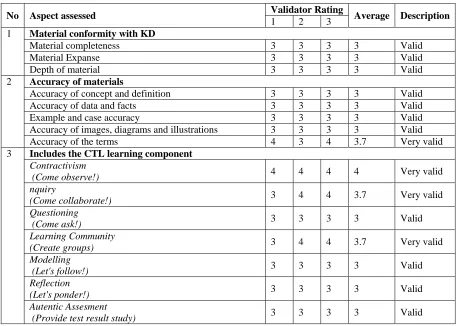
[image:3.612.76.533.411.737.2]a. The validation of the teaching materials developed is validated by three expert validators to obtain prior input from the teaching materials in the exam. The validation results can be seen in the following table 1
Table 1 Validation of teaching materials
No Aspect assessed Validator Rating Average Description
1 2 3 1 Material conformity with KD
Material completeness 3 3 3 3 Valid Material Expanse 3 3 3 3 Valid Depth of material 3 3 3 3 Valid 2 Accuracy of materials
Accuracy of concept and definition 3 3 3 3 Valid Accuracy of data and facts 3 3 3 3 Valid Example and case accuracy 3 3 3 3 Valid Accuracy of images, diagrams and illustrations 3 3 3 3 Valid Accuracy of the terms 4 3 4 3.7 Very valid 3 Includes the CTL learning component
Contractivism
(Come observe!) 4 4 4 4 Very valid
nquiry
(Come collaborate!) 3 4 4 3.7 Very valid
Questioning
(Come ask!) 3 3 3 3 Valid
Learning Community
(Create groups) 3 4 4 3.7 Very valid
Modelling
(Let's follow!) 3 3 3 3 Valid
Reflection
(Let's ponder!) 3 3 3 3 Valid
Autentic Assesment
No Aspect assessed Validator Rating Average Description
1 2 3 4 The establishment of material
Drawings, diagrams and illustrations in everyday life 4 3 4 3.7 Very valid Using examples and cases found in everyday life 4 4 4 4 Very valid 5 Encouraging curiosity
Encouraging curiosity 3 3 3 3 Valid Creating the ability to ask 3 3 3 3 Valid 6 Presentation techniques
The concept of material 3 3 3 3 Valid 7 Supporting presentation
The concept of material force 3 4 4 3.7 Very valid Examples of questions in each learning activity 3 3 3 3 Valid The book view makes students interested in learning 4 3 4 3.7 Very valid 8 Presentation of Learning
Student involvement 3 4 4 3.7 Very valid 9 Coherency and prosecution of the mindset
The link between learning activities/Sub learning
activities/paragraphs 3 3 3 3 Valid The integrity of meaning in learning activities/Sub
learning activities/paragraphs 3 3 3 3 Valid 10 Businesslike
The precision of sentence structure 3 4 4 3.7 Very valid Sentence effectiveness 3 3 3 3 Valid Term immortality 4 4 4 4 Very valid 11 Communicative
Understanding of messages or information 3 4 4 3.7 Very valid 12 Dialogical and Interactive
Ability to improve learners ' knowledge 3 3 3 3 Valid 13 Compliance with student developments
Compliance with the intellectual development of learners 3 3 3 3 Valid Compliance with learners ' emotional development level 3 3 3 3 Valid 14 Conformity with language conventions
Grammar accuracy 3 3 3 3 Valid Spelling accuracy 4 3 4 3.7 Very valid 15 CTL-oriented book size
Size compatibility with existing book standards 3 3 3 3 Valid Size compatibility with content material 3 3 3 3 Valid 16 Cover design
The appearance of layout elements on the front cover, back and back harmoniously has a rhythm and unity and consistency
4 3 4 3.7 Very valid Color layout elements harmoniously and clarify the
function 3 3 3 3 Valid Fonts used are attractive and easy to read 3 3 3 3 Valid 17 Cover illustration
Describing content/teaching materials and revealing
character objects 3 3 3 3 Valid The shape, color, size, proportion of objects according to
reality. 3 3 3 3 Valid 18 Content Design
No Aspect assessed Validator Rating Average Description
1 2 3
Creative and dynamic 3 3 3 3 Valid Based on table 1 above, the three validators have given a score range of 3-4
[image:5.612.79.538.58.97.2]b. The RPP validation is being developed validated by three expert validators to obtain the prior input of the teaching materials in the test. The validation results can be seen in table 2 below
Tabel 2 Validasi RPP
No Aspect assessed Validator Rating 1 2 3 Average Description
Identity
1. Contains RPP school identity (school name, subject, class, semester and Time allocation)
4 4 4 4 Very valid
Goal
2. Load Core Competencies (KI), basic competencies (KD), indicators, and learning objectives
3 4 3 3.3 Valid 3 Indicator conformity with basic competencies 3 3 3 3 Valid 4 Conformity of learning objectives with the time
provided
3 3 3 3 Valid 5 Clarity of learning objectives 3 4 4 3.7 Very valid
CTL approach
6 According to KD and the indicator 3 4 4 3.7 Very valid 7 Contains Contructivism, Inquiri, Question, Learning
community, Modeling, Reflection and Authentic assessment activities
3 4 4 3.7 Very valid
Learning Tools and Resources
8 Means of supporting goal achievement 4 4 4 4 Very valid 9 Learning resources are relevant to the material
presented
3 4 4 3.7 Very valid
Learning Step
10 Clarity of learning scenarios (according to KI and KD) 3 4 3 3.3 Valid 11 Detail a learning scenario (consisting of initial
activities, core activities, closing activities and including time allocation required)
4 4 4 4 Sangat valid
12 Delivering motivation and learning objectives 3 4 4 3.7 Very valid 13 Load the CTL learning step 3 4 4 3.7 Very valid 14 Contains discovery activities 3 4 4 3.7 Very valid 15 Provide follow-up assignments 3 4 4 3.7 Very valid 16 Contains aspects of knowledge 3 4 4 3.7 Very valid 17 Aspects of the invention 3 4 4 3.7 Very valid
The language
18 In accordance with Indonesian rules that are easy to understand
3 4 4 3.7
Very valid
Based on table 2 above, the three validators have given a score range of 3-4
Table 3 Results Validation test result study
N o
Validity of content Language and questions
Score Validato r 1
Score Validato r 2
Score Validato r 3
averag e
Descriptio n
Score Validato r 1
Score Validato r 2
Score Validato r 3
averag e
Descriptio n
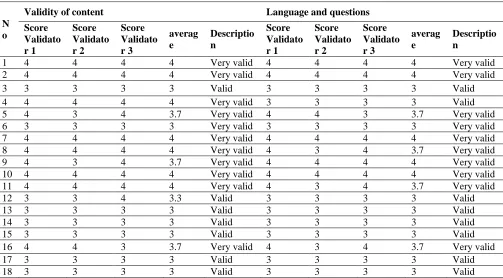
1 4 4 4 4 Very valid 4 4 4 4 Very valid 2 4 4 4 4 Very valid 4 4 4 4 Very valid 3 3 3 3 3 Valid 3 3 3 3 Valid 4 4 4 4 4 Very valid 3 3 3 3 Valid 5 4 3 4 3.7 Very valid 4 4 3 3.7 Very valid 6 3 3 3 3 Very valid 3 3 3 3 Very valid 7 4 4 4 4 Very valid 4 4 4 4 Very valid 8 4 4 4 4 Very valid 4 3 4 3.7 Very valid 9 4 3 4 3.7 Very valid 4 4 4 4 Very valid 10 4 4 4 4 Very valid 4 4 4 4 Very valid 11 4 4 4 4 Very valid 4 3 4 3.7 Very valid 12 3 3 4 3.3 Valid 3 3 3 3 Valid 13 3 3 3 3 Valid 3 3 3 3 Valid 14 3 3 3 3 Valid 3 3 3 3 Valid 15 3 3 3 3 Valid 3 3 3 3 Valid 16 4 4 3 3.7 Very valid 4 3 4 3.7 Very valid 17 3 3 3 3 Valid 3 3 3 3 Valid 18 3 3 3 3 Valid 3 3 3 3 Valid According to table 3 above, the three validators have given a score range of 3-4
1. The practicality of material teaching material style-oriented contextual approach
The practicality of material material-oriented contextual approach materials can be seen from the results of the implementation of learning activities and activities of students during learning activities with the observation by 2 observers.
a. Results of Learning Plan implementation The results of learning implementation are 75%-100%
b. Analysis results of student activity observations Results of the analysis of students activities received 75%-100%
0% 10% 20% 30% 40% 50% 60% 70% 80% 90% 100%
encounter 1 encounter 2 encounter 3
0% 20% 40% 60% 80% 100%
1. Material effectiveness of style materials teaching contextual approach a. Test student learning Results
Table 4 results of student to
No Name Value KKM Description
N-gain Description Pretest Posttest Pretest Posttest
SDN Jajartungal III Surabaya
1 AA 65 97 75 TT T 0,91 High 2 BB 56 82 75 TT T 0,59 Medium 3 CC 65 97 75 TT T 0,91 High 4 DD 74 94 75 TT T 0,76 High 5 EE 76 97 75 T T 0,87 High 6 FF 50 82 75 TT T 0,64 Medium 7 GG 65 88 75 TT T 0,66 Medium 8 HH 76 94 75 T T 0,75 High 9 II 82 97 75 T T 0,83 High 10 JJ 50 82 75 TT T 0.64 High
SDN Pakis I Surabaya
1 AA 70 97 75 TT T 0,90 High 2 BB 65 97 75 TT T 0,91 High 3 CC 56 82 75 TT T 0,59 Medium 4 DD 65 94 75 TT T 0,82 High 5 EE 82 97 75 TT T 0,83 High 6 FF 76 94 75 T T 0,75 High 7 GG 74 94 75 T T 0,83 High 8 HH 50 88 75 TT T 0.64 Medium 9 II 65 88 75 TT T 0.65 Medium 10 JJ 65 94 75 T T 0.82 High
SDN Manukan Kulon Surabaya
1 AA 59 82 75 TT T 0,56 Medium 2 BB 56 88 75 TT T 0,72 High 3 CC 65 88 75 TT T 0,65 Medium 4 DD 82 97 75 T T 0,83 High 5 EE 65 82 75 TT T 0,48 Medium 6 FF 74 94 75 TT T 0,83 High 7 GG 65 94 75 TT T 0,83 High 8 HH 50 88 75 TT T 0,76 High 9 II 56 88 75 TT T 0,72 High 10 JJ 65 94 75 TT T 0.82 High Rata-rata 66,2 91 75 77% TT 100%T
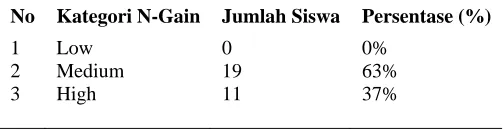
From the results of the pretests and posttest can also be known the submission of learning students using material-oriented style materials teaching contextual approach experienced increased learning outcomes of pretests and posttest values. The following is in the display recapitulation of results of students ' learning outcomes based on low, medium and high categories
Table 5 recapitulation of students learning outcomes
No Kategori N-Gain Jumlah Siswa Persentase (%)
1 Low 0 0% 2 Medium 19 63% 3 High 11 37%
The results you get when looking at Table 5 show that student learning results use stylish material teaching materials oriented towards a contextual categorized approach of 19 students with a percentage of 63% and a high category of 11 students with a percentage of 37%.
IV. DISCUSSION
[image:7.612.42.294.654.719.2]used with revisions. The RPP is developed validated by three people's validator experts to get the previous input of RPP applied in learning. The validation results that the RPP acquires a score from the validator with a very valid assessment category of 14 aspects of the 18 aspect assessment and the rest got valid categories. The three validators provide recommendations that a material-oriented stylistic approach to contextually developed approaches can be used with revisions.
Other devices after teaching materials and RPP which are the test of learning results measured in this study are test results learned about the style of double-choice material, short answer and description developed consisting of 18 items. The problem is adjusted with the indicator so that each indicator can be measured. From the validation results can be seen in table 4.8 that test results learn the validity of the content and the validity of the language and writing the test of study results in the form of multiple-choice, short answer and description that has been developed, obtained the results of the assessment of three The expert validator for every aspect gets value with a value range of 3-4 each aspect shows 10 questions of the 18 questions indicating a very valid category and 8 problem shows valid. In the aspect of the language and the writing of the results of the assessment of the three validators for each aspect with a score range of 3-4 shows 9 out of 18 very valid and 9 categorized questions with valid categories. The three validators provide recommendations that the developed study result test can be used with revisions.
The results of the implementation of RPP meeting 1 in RPP meeting I activities, the level that has been received an assessment from two observers with the category is done well. Both observers agreed to provide an assessment on 14 aspects of implementation in RPP with a percentage of 79% to 100% and overall all stages in the RPP at meeting 1 based on. Based on the observation basil, there are several things that need to be considered in the implementation of RPP namely guiding aspects and motivating students to ask questions (Questioning), in addition to giving examples by following students (Modelling). As well as carrying out the learning activities have not matched the allotted time allotted because the students when conducting experiments are slightly rowdy until the time that is seized exceeds the initial time. In this case, the teacher needs to dissipate the use of learning time so that the learning will be in accordance with the planning that has been compiled before.
The results of observations obtained at the meeting of 2 in RPP activities, the stage that received the assessment of two observers with a very good category there are 5 aspects of 14 aspects of assessment, while the rest got a pretty good category. Both observers agreed to give an assessment on the 14 aspects of the RPP and overall all the stages in the RPP at meeting 2 were carried out well. Based on the results of the observation of the less optimal learning at the meeting 1 on the guiding aspect and motivating the students to ask questions (Questioning), in addition to providing examples with the students follow (Modelling). As well as carrying out the learning activities has not been in accordance with the allocation of time specified because the students when conducting experiments slightly rowdy so that the specified time exceeds the initial time, from meeting 2 has been improved and more optimal than the meeting 1.
The results obtained at the meeting 3 on RPP activities, the level that was done received the assessment of two observers with
a very good category there are 9 aspects of 14 aspects of assessment, while the rest got a good category. Student activity is a percentage of students ' activities that arise during the learning process using a style material oriented to a contextual approach derived from the observation results of two observers use the observation sheet Students ' activities. The observation of students ' activities conducted during the learning activities took place on the material-oriented materials teaching test of the contextual approach that researchers developed. The observation of student activity consists of 10 aspects with discussion of observations by both observers as follows.
The results of students ' observations at the meeting of 1 observation of the students ' activity are carried out by scoring from two observers with active category of 8 aspects of 10 aspects and 2 aspects of receiving an assessment with a fairly active category. Both observers agreed to give assessments with a percentage of 75% to 100% in every aspect, the observation showed that students were enthusiastic about the learning but with the guidance of teachers because students were not accustomed to use Developed teaching materials.
The results of student observations at meeting 2 can be seen observing results of students who carried out the assessment of two observers with active category that is 9 aspects of 10 aspects and 1 aspect received an assessment with a fairly active category. Both observers mutually agreed to provide a percentage assessment of each aspect with a percentage range of 75% to 100%. The observation showed that students enthusiastically followed the study still with the guidance of teachers but not intense at the meeting I.
The results of student observations at meeting 3 can be seen observing results of students who carried out the assessment of two observers with active category that is 10 aspects of 10 aspects of the assessment. Both observers agreed to provide a percentage assessment of each aspect with a range of 83% to 100% with the active category.
Student observations and activities have been obtained that the application of a contextual approach-oriented material teaching can make students active in learning activities. According to Wilcox in (Slavin, 2009) that in beIajaran the student discovery is encouraged to learn through active involvement with concepts and principles, the teacher only encourages students to have experience and conduct experiments that allow They found the principles for themselves (Nur, 2008, p. 10). So it can be concluded that material oriented contextual approach developed researchers are practically used in the learning process.
Based on the submission of students ' learning outcomes before learning (pretest) on the device test is known to mean that the student's reach is 66.2 indicating that the students ' classification
is not complete with the specified KKM is ≥ 75 and 77% of
students The results of his studies. Low level of understanding of students when answering pretests because students have not obtained information about. In addition, students are not used to solve style material. Another factor that leads to low levels of student thinking when pretests is because students have not been trained to learn directly with them seeking answers from the experience performed by students. This is because the study has not been prepared through scientific process.
Based on the proof of student learning Test (post test), it is known that the average of the students ' submission is 91 indicating that all students after conducting their studies using material-oriented style materials teaching On a contextual approach can be completely individual and classical. From the acquisition of pretests results and post tests obtained information that there is an increase in learning outcomes before learning and after learning, these results show that students can already master the concept after conducting the learning.
Student responses resulted from the replenishment of the student response poll that was disseminated after conducting the study using material style materials oriented contextual approaches. This poll is filled by 30 students in grade IV Elementary School with an answer with answers in accordance with the circumstances that the students felt during the study. The student response results were obtained from the student's analysis that answered positively on each poll question.
The results of students ' responses to the questions of interest in developed materials can be seen from the student's response to the teaching material that the students respond to the category very well, with a percentage of 83% to 100%. This is due to the learning that has been implemented by students with material teaching materials oriented contextual approach is very enjoyable so that students ' motivation to activities performed high is characterized by a positive response that Given students. It is in line with the opinions expressed by Kurl Kelvin (in Sanjaya, 2014. P. 123) The factors that can encourage each individual to behave because there is motivation that arises due to a certain attraction.
V. CONCLUSION
The results of the research can be in conclusion that the development of material-oriented style materials on a contextual approach deserves the validity, practicality of which is seen from the implementation of RPP and student activity, and then the effectiveness of views from the test Students learning outcomes and responses and can improve student learning outcomes. a. Suggestions
1. Things to note in the application of teaching materials with contextual, effective management of time and efficiency so that the learning will be more optimal.
2. Style material teaching material oriented to the contextual approach developed can be used as a referral to apply to other materials.
3. This research may be used as the foundation for future researchers to be better developed to improve the quality of education in Indonesia.
REFERENCES
[1] Dahar, Ratna. 2006. Teori-Teori Belajar & Pembelajaran. Jakarta:airlangga [2] Duron, R., B Limbach, & W Waugh. 2006. Critical Thinking Framework For Any Discipline. Journal of Teaching and Learning in Higher Education Vol 17, No. 2, 160-166.
[3] Djojosoediro, Wasih. (2010). Hakikat IPA dan Pembelajaran IPA SD. Yogyakarta : Universitas Negeri Yogyakarta
[4] Eko Priyono. 2008. Pemanfaatan Kebun Binatang Surabaya (KBS) Sebagai Media Perkuliahan Berorientasi Contextual Teaching and Learning (CTL) Mata kukiah Taksonomi Hewan II. (Tesis master tidak di publikasikan), Universitas Negeri Surabaya, Indonesia.
[5] Johnson, E. B. 2002. Contextual Teaching and Learning. California: Corwin Press. Inc.
[6] Kunandar . 2007. Guru Profesional Implementasi kurikulum tingkat satuan Pendidikan (KTSP) dan persiapan menghadapi sertifikasi guru. Jakarta: Raja Grafindo: Persada.
[7] Martinis Yamin & Bansu I. Ansari. (2009). Taktik Pengembangan Kemampuan Individual Siswa. Jakarta : Gaung Persada Perss.
[8] Nur, M. 2001. Pengajaran dan Pembelajaran Kontekstual. Surabaya: Depdiknas (Direktorat Jendral Pendidikan Dasar dan Menengah.
[9] Nur, M. 2008. Pengajaran Berpusat pada Siswa dan Pendekatan Konstruktivis dalam Pengajaran. Surabaya: Unesa University Press
[10] Napoleon. 2014. Penerapan pembelajaran kontekstual dengan memanfaatkan lingkungan sebagai sumber belajar untuk meningkatkan hasil belajar siswa pada mata pelajaran IPS kelas IV SDN 10 Koto Anau Kabupaten Solok Sumatra Barat. Tesis master tidak dipublikasikan, Universitas Negeri Surabay, Indonesia.
[11] Sanjaya. 2008. Stategi Pembelajaran Berorientasi Standart Proses Pendidikan. Jakarta: Prenada Media Group.
[12] Suyono & Hariyanto. 2011. Belajar dan Pembelajaran: Teori dan Konsep Dasar. Bandung: PT. Remaja Rosdakarya.
[13] Slavin, R.E. 2009. Psikologi Pendidikan Teori dan Praktik.Jakarta: Indeks [14] Syaiful Segala. 2005. Konsep dan Makna Pembelajaran untuk Membantu
Memecahkan Problematika Belajar dan Mengajar. Bandung: Alfabeta. [15] Tri, Indrayani. 2013. Pengembangan Perangkat Pembelajaran Biologi dengan
Pendekatan CTL untuk Mengajarkan Life Skill siswa SMA. (Tesis Master tidak dipublikasikan). Surabaya: PPS Universitas Negeri Surabaya. [16] Wisudawati, A.W & Sulistyowati, E. 2014. Metodologi Pembelajaran IPA
disesuaikan dengan Pembelajaran Kurikulum 2013. Jakarta: Bumi Aksara
AUTHORS
First Author – Pipit Hery Kurniawan Abdullo,Post
graduate,State University of Surabaya, [email protected]
Second Author – Tjandra Kirana, Lecturer, State University of Surabaya, [email protected]