Applied Linguistics and English as a Second Language Dissertations
Department of Applied Linguistics and English as a Second Language
Fall 12-15-2016
Language Policy in Rwanda: Shifting Linguistic and
Educational Landscape
Pamela Pearson
Follow this and additional works at:https://scholarworks.gsu.edu/alesl_diss
This Dissertation is brought to you for free and open access by the Department of Applied Linguistics and English as a Second Language at
ScholarWorks @ Georgia State University. It has been accepted for inclusion in Applied Linguistics and English as a Second Language Dissertations by an authorized administrator of ScholarWorks @ Georgia State University. For more information, please [email protected].
Recommended Citation
Pearson, Pamela, "Language Policy in Rwanda: Shifting Linguistic and Educational Landscape." Dissertation, Georgia State University, 2016.
LANDSCAPE
by
PAMELA PEARSON
Under the Direction of Diane Belcher and Gayle Nelson
ABSTRACT
In the two decades since the 1994 Genocide, Rwanda has experienced pervasive societal
change, due in large part to ambitious policymaking in sectors ranging from business to public
health to education. Extensive language policies have also been enacted, including a 2008
Cabinet resolution shifting the medium of instruction (MOI) in all public schools from
Kinyarwanda and French to English (Republic of Rwanda, 2008). The promotion of English in a
formerly francophone nation inspired the present study seeking a closer look at the current state
of language planning and policy (LPP) in Rwanda. Toward that end, ethnography of language
policy (Hornberger & Johnson, 2007) fieldwork, consisting primarily of linguistic landscape
aspects of the 2008 Cabinet resolution are answered herein through three distinct but interrelated
research articles.
The first article investigates the current linguistic ecology of Rwanda, utilizing linguistic
landscape analysis methodology to explore language use in public spaces. Diachronic
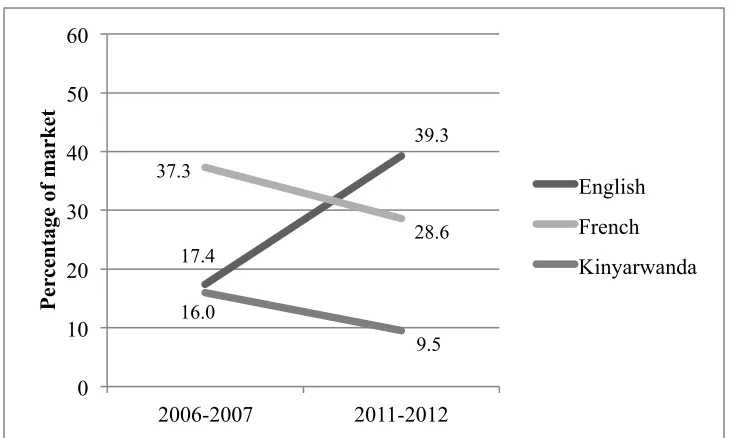
comparative analysis uncovers language shift trends (e.g., major English gain, major French loss,
negligible Kinyarwanda shift) that converge with national policy initiatives – the language
ecological implications of which (e.g. language loss, linguistic diversity) are discussed. The
second article reports mainly on the ethnographic interview data. The interviews, conducted with
teachers (n = 8) in two public primary schools and two public secondary schools, illuminate (a)
the layers and spaces in Rwandan MOI policy and practice, as well as (b) the local realities
associated with implementing national language-in-education policy without an articulated plan.
The third article, informed predominantly by classroom observation at the four research sites,
examines issues related to MOI policy implementation in Rwanda (e.g., classroom language use;
English medium instruction vs. mother tongue instruction) as well as its impacts on education
(e.g., disparate student access to content and language) through discourse analysis of classroom
language use by teachers and students. Taken together, these three “snapshots” form a panorama
of the LPP situation of contemporary Rwanda, exposing the shifts occurring across the past
five-year period in the Rwandan linguistic and educational landscape.
LANDSCAPE
by
PAMELA PEARSON
A Dissertation Submitted in Partial Fulfillment of the Requirements for the Degree of
Doctor of Philosophy
in the College of Arts and Sciences
Georgia State University
Copyright by Pamela Jo Pearson
LANDSCAPE
by
PAMELA PEARSON
Committee Chair: Diane Belcher
Gayle Nelson
Committee: Viviana Cortes
Eric Friginal
David Cassels Johnson
Electronic Version Approved:
Office of Graduate Studies
College of Arts and Sciences
Georgia State University
DEDICATION
I wish to dedicate this work to the indomitable public school teachers and students of
Rwanda, both past and present; to my intrepid grandmother Mary, who taught in a one-room
schoolhouse in rural Iowa when she was a young woman; to my first teacher, my unfailingly
supportive mother, Bonnie, who instilled in me the value of education, although she personally
didn’t have the opportunity to pursue it beyond high school; and in loving memory of Pearl, a
ACKNOWLEDGEMENTS
First and foremost, I would like to recognize the Department of Applied Linguistics and
ESL for admitting me to the doctoral program back in 2007 and for supporting me and my work
over the better part of a decade. The 12th floor of 34 Peachtree was the best academic home I
could have ever imagined, and I loved every minute of the long hours I spent at Workstation 14
in the GTA Room.
Among the many who shaped my academic career during my time at GSU, primary
appreciation goes to my co-chairs, Gayle Nelson and Diane Belcher. Gayle took a chance on me
when she took me on as her advisee, and she has been with me every step of the way ever since –
including some across Rwanda and over the Virungas and back. You’ve been “fabulous,” Gayle,
and the phrase ‘thank you for everything’ feels inadequate to express how grateful I am to and
for you, but I really do thank you for everything. Dr. Belcher, it has been an honor to study with
you and to have your input on this project. I hope you can see your influence in my work. I made
many research decisions based on issues we read about or discussed in QUAL Methods.
Huge gratitude also goes to my committee members, Viviana Cortes and Eric Friginal of
the Department of AL/ESL at GSU, and David Cassels Johnson of the College of Education at
the University of Iowa. Throughout this pursuit, your support, flexibility, patience, and feedback
have been greatly appreciated. Viviana, you have played a role in my academic career since
January 2004, when I began your Discourse Analysis course at ISU; I am so lucky to have you as
a constant in my life. Eric, your enthusiasm and encouragement have always been appreciated.
And Dave, it has been an honor to have you serve on my committee. Your work – particularly
your colloquium on Ethnography of Language Policy at AAAL 2010 – has inspired this project
In the Department of AL/ESL, I was fortunate to be perennially surrounded by truly
outstanding faculty, colleagues, and students. Beyond my committee, I recognize graduate
faculty present and past: YouJin Kim, for mentoring me in SLA research and for fun and
productive work sessions at White Windmill; Stephanie Lindemann, who recommended I look
into the State Department Fulbright in addition to the Department of Education Fulbright-Hays,
whose international apportionment ended up getting cut in 2011; John Murphy, Sara Cushing,
Lucy Pickering, and Nan Jiang. I enjoyed your classes, and I learned so much from each of you.
I am grateful for having had assistantships to teach in the Intensive English Program,
mostly because I got the opportunity to work closely with Meredith Bricker; John Bunting, a
class act; Alison Camacho, my “lunch buddy” and 一番おともだち; Sharon Cavusgil, a rock
solid friend and professional; Marcel Daniels, my Saudi culture and literacy co-investigator;
Rachel Da Silva, my Vietnamese pronunciation co-investigator; Jean Daugherty; Cheryl Delk,
whose humor was never lost on me (case in point: the perfect attendance list); Louise Gobron,
my favorite storyteller and movie date (Rwanda acknowledgement follows); Sarah Kegley, my
kindred pet friend and Stone Mountain hiking pal; Margareta Larsson, a wonderful friend and
endlessly calming influence; Daphne Orr; Janet Beth Randall; Debra Snell, my treasured
housemate and “taximoto” ride to campus (more acknowledgements to come); Amanda Starrick,
my fellow Sun Volt/futbol fan and “rock & roll retirement” co-producer; John Stowe, our
magical colleague whose sudden loss is still felt to this day; Dara Suchke; and Diana Wrenn. I
appreciate each of you for the camaraderie we shared.
I would also like to recognize all of the key folks in administration throughout my time at
34 Peachtree: Susan Coleman, Linh Dang, JanieHardman, Doreen Kincaid, Kerodna Smith, and
For making life in the PhD program so enriching and enjoyable, from the bottom of my
heart I thank my classmates/fellow GTAs: Amanda Baker, Paco Barron-Serrano, Luciana
Findlay, Eman Ghanem, Sarah Goodwin, Liang Guo, Jack Hardy, Eliana Hirano, Gloria Hu,
Magdi Kandil, Iryna Kozlova, Joe Lee, Cassie Leymarie, Man Li, Jason Litzenberg, Lauren
Lukkarila, Meg Montee, Kate Moran, Caroline Payant, Brittany Polat, Audrey Roberson,
Amanda Lanier Temples, Ashley Titak, Nancy Yanez-Pinto, WeiWei Yang, Lijuan Ye, and
Cheongmin Yook. Love you guys, and guess what: I finally get to sign my brochure!
From the many colleague friends/friend colleagues, a few stand out and deserve special
recognition: Caroline, Cheongmin, Jack, and Magdi. Caro Caro P, I hit the jackpot in you; you
were the best colleague, friend, and housemate anyone could wish for. Cheongmin, in you I
found not only an amazing friend but an awesome Emory library “study buddy;” thanks for all
the food, laughter, yoga, and Atlanta excursions. Jack, you brightened my days in the GTA
Room with your smile, personality, sketch comedy, and beachwear; you’ve got the mansion key.
And “Mogdi,” I thank you for (a) sharing your friendship, sense of humor, sociopolitical
perspective, and 5 o’clock teas – featuring El Arosa and the Delta spoon from the snack drawer,
and (b) supporting this project from its inception because you were the first person I ever told.
Teşekkürler to my two “beautiful” Boğaziçi arkadaşlarım, Emine Merdin and Pinar
Ersin: Once upon a time, you gave Pembe Pamuk Prenses’s life in Atlanta and Istanbul a
fairytale-like quality that she’ll never forget.
I would also like to recognize all of the students I had the privilege of working with
throughout my time as a GTA at GSU. Whether it was teaching English language learners in the
IEP, Applied Linguistics undergrads in the BA program, or exchange students in John/Alison’s
This dissertation couldn’t have come to fruition without two important sources of
funding. The first is a Fulbright Full Research Grant that allowed me to travel to Rwanda and
collect data there for nine months (a big shout out to Maria Gindhart, GSU Fulbright Coordinator
at the time), and the second is a GSU Dissertation Grant that allowed me to hire a research
assistant to type up field notes during the data preparation phase of this project (thank you, Jen
LeBoeuf, for your excellent work and attention to detail). The whole project wouldn’t have been
possible without two important professional connections: (1) Tove Rosendal of University of
Gothenburg, Sweden, and (2) Evariste Ntakirutimana of University of Rwanda. It was through
Tove that I gained contact with Professor Evariste, who sponsored my Fulbright affiliation at
NUR (National University of Rwanda, as it was called at the time) and thus “changed my life” –
although he will argue that he was “only doing his job.” Professor Evariste met with me on
several occasions throughout my time in Rwanda, offering me guidance on how to go about
conducting research in Rwanda; his insight was invaluable and can never be repaid.
For assistance I received in country, I am indebted to too many Rwandan friends and
colleagues to name individually – some of whom I’m indebted to so much that I’ve elected not to
name them individually (in order to ensure their anonymity). Instead, I’ll acknowledge the
role(s) they played in my life and experience there. I wholeheartedly thank (a) an employee at
the U.S. Embassy in Kigali for helping me acquire my visa and research permit; (b) three
undergraduate research assistants who worked for me at different phases of the project; (c) two
taximoto drivers for showing up every morning – and on time – to transport my research assistant
and me over the land of a thousand (often muddy) hills to get to our rural research sites; and (d)
four administrator and eight teacher participants, and the countless additional teachers, staff and
In Butare, I thank Shakila at NUR for securing my institutional affiliation for Fulbright;
Carl, for orienting me to town and introducing me to Inzozi Nziza; the women of Inzozi Nziza,
for their coffee and banana cake – special mention to the two workers who dragged me to
assistance the day I lost consciousness at the café. I thank Sister Augusta for helping me acquire
housing. I also thank Debra, Louise, and Gayle for making the trek to Rwanda to track mountain
gorillas – and for giving me extra motivation to learn Kinyarwanda and Rwandan history and
politics; your visit buoyed me through some rough waters and meant the world to me.
Beyond all others in Rwanda, I acknowledge my “family” in the big brown house in
Taba: Corrie, beautiful friend of the “maple people” for hearty meals and heartier laughter – I
was “pretty boring” without you; Kate, our friend of beauty and truth we lost along the way –
I’m sending love to where you are; Jane, our honorary housemate, for her incredible stories;
Roman, the Catan Man; Damascene, “C’est bon;” Eli, and Venant, “Namwe.” I also appreciate
Abubakar (the “biggest lion”); Straton; as well as Aussi and my Rwandan family (including my
dear sister Agnes), whom I love and miss to this day. I recognize Fabien, my Rwandan brother,
for his friendship: I also cherish meeting you that September afternoon at the FAMSS campus,
when “neither I was looking for you, nor you were looking for me.” In Kigali, I thank (a) Dave,
for his confidence, conversation, and Tangren talks, and (b) the staffs at Ninzi Hotel and
Beauséjour Pension, my Kigali homes away from home, for their warmth and hospitality. I thank
Carolyn Tucker for her Skype presence then and now; I couldn’t have survived without you.
To Debra and Baker Snell: I love you two, and I loved living at 421 “Callan Circus” with
you. You lived and witnessed this experience more than anyone, so you deserve to share in the
joy of its completion more than anyone. I can’t begin to describe how much I appreciated all of
without either of you. And to my Atlanta friends and our Candler Park neighbors: Edward, for
helping me move from Des Moines to Atlanta in a rented Chevy “Kampala” and insisting that I
take time out of my hectic new life to speak in Katakana and other languages/voices: merci and
“Uididi”; Ken; Laura & Carter; Mike, Fran & the crew; Sarah: “pedal to the metal;” Susan &
Ellen; June; and the guys at Aurora Coffee in Little Five. To Selam, my Ethiopian sister, who
will metaphorically cross the stage with me at graduation: “Every minute matter, baby girl.”
In Oregon, I want to extend my appreciation to my colleagues and friends in the
Education Department at Linfield College. Bob, Diane, Gennie, Kena, Mindy, Nancy, Rachel,
and Steve: It is a privilege to work with such caring and dedicated educators. Special mention
goes to my Crimson Court support: Neale, Javi, John, and Blaise. You guys provided a literal
refuge for me. To Angela, Matt, Hallie, and my fellow yogis at Four Elements in McMinnville,
for being a grounding force in my life, I say namaste.
And last because most/greatest, I wish to recognize my immediate family – Bonnie, Mel,
and Mark Pearson – and lifelong best friends – Melanie and Carmen – for their love and support
across my lifelong pursuit of education. Who knew that there would be more tears in a PhD
program than at Wright Elementary School? (Which reminds me: Mrs. Manahl, my dear first
grade teacher, I wish you were still with us so you could know that “the turtle” has finally
crossed the finish line.) Mark, thanks for always keeping my “nerdometer” in check. And Dad,
“tanks” for your optimism and support in so many ways. But Mom, I’ll thank you most of all:
The words are finally on the page.
Finally, in closing, I want to acknowledge that nothing has taught me more about life and
loss than this project. And no one has taught me more about imagining the future than Daniel.
TABLE OF CONTENTS
ACKNOWLEDGEMENTS ... v
LIST OF ACRONYMS ... xvii
LIST OF TABLES ... xviii
LIST OF FIGURES ... xix
1 GENERAL INTRODUCTION ... 1
1.1 The policy ... 2
1.2 The context ... 2
1.2.1 The Rwandan Genocide ... 4
1.2.2 Language and Rwandan society ... 7
1.2.3 Education and languages-in-education in Rwanda ... 16
1.3 The framework ... 19
1.3.1 Language planning and policy ... 19
1.3.2 Ethnography of language policy ... 24
1.4 The study ... 31
1.4.1 Purpose of the study ... 32
1.4.2 Context and funding ... 34
1.4.3 Methodological matters ... 35
1.4.4 Ethical considerations ... 48
1.6 Notes ... 52
2 FIRST ARTICLE ... 54
2.1 Background ... 55
2.1.1 Language policy in Rwanda ... 55
2.1.2 Linguistic ecology ... 55
2.1.3 Linguistic landscape analysis ... 57
2.1.4 Rationale for surveying the Rwandan linguistic landscape ... 59
2.2 Exploring linguistic ecology in Rwanda ... 60
2.2.1 Data collection ... 61
2.2.2 Data analysis ... 63
2.3 Linguistic landscape findings ... 64
2.3.1 Distribution of languages on storefronts ... 64
2.3.2 Shifting linguistic landscape ... 66
2.4 Language policy and linguistic ecology in Rwanda ... 67
2.4.1 Language policy and language shift in Rwandan society ... 68
2.4.2 The current linguistic ecology of Rwanda and implications for the future .... 77
2.5 Conclusion ... 86
2.6 Notes ... 88
2.7 References ... 91
2.8.1 Appendix A: Complete listing of storefronts along the main road ... 102
2.8.2 Appendix B: Complete listing of storefronts on back roads by main area .. 104
2.8.3 Appendix C: Diachronic evidence of Kinyarwanda glossed with English ... 105
2.8.4 Appendix D: Diachronic evidence of French replaced by English ... 106
2.8.5 Appendix E: Diachronic evidence of French and Kinyarwanda replaced by English ... 107
2.8.6 Appendix F: Example of public vs. private signage priorities ... 108
3 SECOND ARTICLE ... 109
3.1 Introduction ... 109
3.2 The Rwandan language-in-education policy landscape ... 111
3.2.1 Rwandan linguistic landscape ... 111
3.2.2 Rwandan educational landscape ... 112
3.2.3 Rwandan language-in-education policy landscape ... 112
3.3 Exploring medium of instruction policy shift in Rwanda ... 114
3.3.1 Research sites and participants ... 114
3.3.2 Data collection and analysis ... 116
3.4 Local teacher perceptions of national language policy ... 117
3.4.1 Sudden nature of the policy ... 117
3.4.2 Mandatory nature of the policy ... 118
3.5 Layers and spaces in Rwandan medium of instruction policy and practice
121
3.5.1 Implementational spaces ... 122
3.5.2 Ideological spaces ... 128
3.6 The realities of implementing language-in-education policy without a plan 133 3.6.1 Reality 1: Policy travels unpredictably ... 134
3.6.2 Reality 2: Policy impacts students ... 134
3.6.3 Reality 3: Policy carries high stakes ... 136
3.6.4 Reality 4: Policy without planning leads to policy revision ... 137
3.7 Conclusion ... 138
3.8 Notes ... 140
3.9 References ... 141
4 THIRD ARTICLE ... 146
4.1 The Rwandan language-in-education policy context ... 147
4.1.1 Language-in-education policy in Rwanda ... 149
4.1.2 Medium of instruction policy and practice in East Africa ... 150
4.1.3 Mother tongue instruction vs. English medium instruction ... 153
4.2 Exploring the impacts of national language policy on local educational
contexts 157
4.2.1 Conceptual framework and research design ... 157
4.2.2 Methods ... 159
4.3 Language-in-education practice in two Rwandan primary schools ... 163
4.3.1 Rural Primary School ... 163
4.3.2 Urban Primary School ... 170
4.4 Impacts of English medium instruction in Rwanda ... 177
4.4.1 Variation in teacher language use across classroom contexts ... 177
4.4.2 Non-acquisition of language and content ... 180
4.4.3 Detraction from quality education goals ... 182
4.5 Conclusion ... 184
4.6 Notes ... 185
4.7 References ... 186
4.8 Appendices ... 198
4.8.1 Appendix A: Lesson transcript – Angelique ... 198
4.8.2 Appendix B: Lesson transcript – Emmanuel ... 202
4.8.3 Appendix C: Lesson Transcript – Justine ... 205
4.8.4 Appendix D: Lesson Transcript – Peter ... 210
5.1 Shifting linguistic and educational landscape ... 215
5.1.1 Retrospective on the research process and outcomes ... 215
5.2 Taking stock of the 2009 language-in-education policy ... 218
5.2.1 Constraints, contributions, and future directions ... 218
5.2.2 Coda ... 226
GENERAL REFERENCES ... 228
GENERAL APPENDICES ... 241
General Appendix A: Ethnographic interview guides ... 241
General Appendix B: Nine-month research timeline (by month & week) ... 244
General Appendix C: Informed consent tool ... 246
General Appendix D: Republic of Rwanda research permit ... 248
LIST OF ACRONYMS
EAC East African Community
ELP Ethnography of language policy EMI English medium instruction
LPP Language planning and policy/language policy and planning MINEDUC Ministry of Education
MOI Medium of instruction
NCDC National Curriculum Development Centre NGO Non-governmental organization
NUR National University of Rwanda
REB Rwanda Education Board
RPS Rural Primary School
RSS Rural Secondary School
TSC Teacher Service Commission
UPS Urban Primary School
LIST OF TABLES
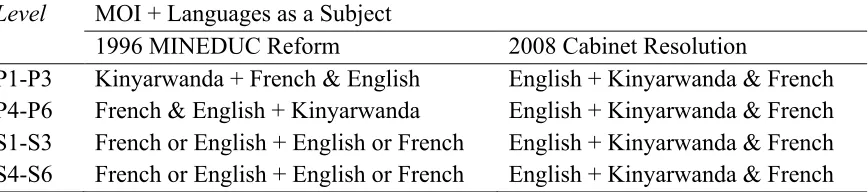
Table 1. MOI and languages as a subject: 1996 reform and 2008 resolution ... 18
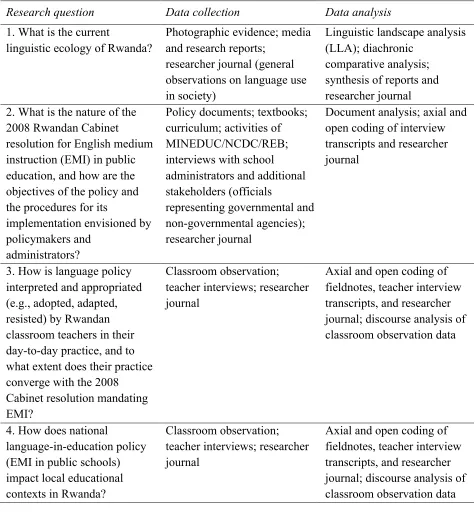
Table 2. Summary of research questions and data collection and analysis methods ... 37
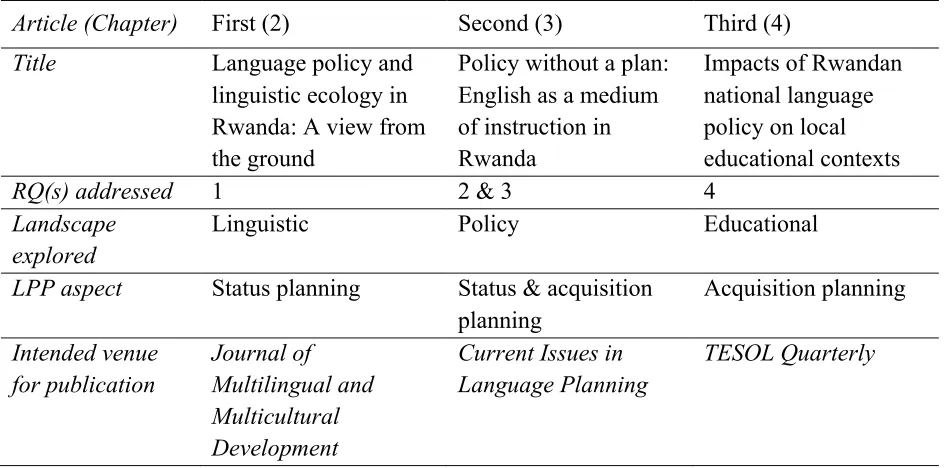
Table 3. Architectures of the articles ... 52
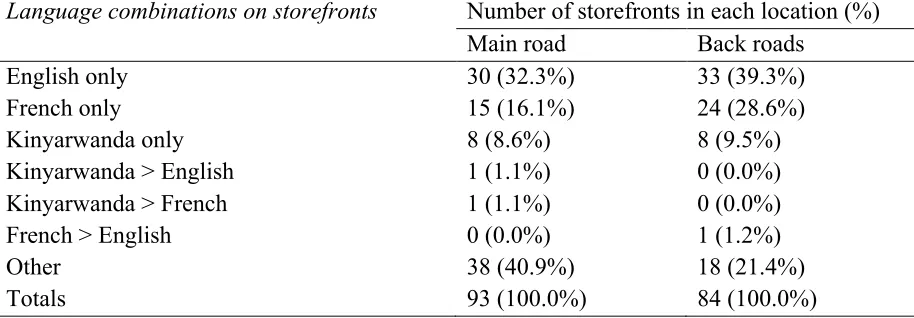
Table 4. Languages on storefronts of Butare main road and back roads, 2011-2012 ... 65
Table 5. Diachronic comparison of languages on storefronts along main road ... 66
Table 6. Diachronic comparison of languages on storefronts on back roads ... 68
Table 7. Overview of participants ... 116
Table 8. NCDC weekly time allocation (2010) ... 148
Table 9: Rural Primary School focal participants ... 165
Table 10. Urban Primary School focal participants ... 172
LIST OF FIGURES
Figure 1. Rwanda, on the African continent ... 3
Figure 2. Rwanda, in relation to neighboring countries ... 3
Figure 3. Rwanda, on the “Linguistic Maginot Line” ... 15
Figure 4. Inaugural ELT symposium in Rwanda ... 48
Figure 5. Map of main road and major areas of Butare ... 62
Figure 6. Distribution of languages on storefronts ... 65
Figure 7. Diachronic trends of monolingual signs on main road ... 67
Figure 8. Diachronic trends of monolingual signs on back roads ... 68
Figure 9. Distribution of languages on storefronts including ambiguous items ... 80
Figure 10. Final distribution of languages on storefronts, 2011-2012 ... 81
Figure 11. Huye District Office in 2009 (Photo credit: Vervimine Minéraux) ... 105
Figure 12. Huye District Office in 2011 ... 105
Figure 13. University Bookshop in 2009 (Photo credit: Vervimine Minéraux) ... 106
Figure 14. University Bookshop in 2011 ... 106
Figure 15. National Museum of Rwanda in 2009 (Photo credit: Vervimine Minéraux) 107
Figure 16. National Museum of Rwanda in 2011 ... 107
Figure 17. Sign on main road, Tumba Primary School ... 108
Figure 18. Sign on building, Tumba Primary School ... 108
Figure 19. Road to Rural Primary School ... 163
Figure 20. Angelique’s weekly timetable ... 166
Figure 21. Emmanuel’s weekly timetable ... 169
Figure 23. Justine’s weekly timetable ... 174
Figure 24. Peter’s weekly timetable ... 175
1 GENERAL INTRODUCTION
Although I had heard of Rwanda on the news and in French class when I was coming of
age, it wasn’t until I was in college that Rwanda truly reached my consciousness. Around the
time that I was studying abroad in Paris and sipping cafés au lait, something terrible was
brewing in Rwanda: the 1994 Genocide that left more than 800,000 Rwandans dead – and
countless chilling images in my mind. So, when on a December day in 2005 I found myself
crossing the Burundi-Rwanda border en route to Kampala, I did so with apprehension. I clutched
my passport and crossed the footbridge into “the heart of darkness.” But, as the bus continued on
toward Kigali, I observed the sun shining both in the sky and on Rwandan flags, and people
smiling and working in red clay fields. At one point, a group of young boys ran alongside the
bus, waving and making faces and laughing. I noticed trees tagged in an effort to conserve
national forests and signs posted in order to promote public health in Kigali, a vibrant and
bustling hillside capital. “So this is Rwanda,” I thought. It had been just over a decade since that
April-July of destruction and its somber aftermath.
From that point, fast forward three years to me sitting at my desk in Atlanta, reading an
article about Rwanda saying adieu to French as its medium of instruction in public schools. It
was at that moment – in November 2008 – that I formed this plan: For my doctoral project, I
would return to Rwanda to study the implementation of this new policy and its linguistic,
educational, and societal impacts. It has now been two decades since that April-July of
destruction: 2014 marked the 20th Commemoration of the Rwandan Genocide. It is within this
historical context that I am completing my dissertation on language policy and the shifting
1.1 The policy
This project was motivated by a single act of policy of a single sentence in length: On 8
October 2008, the Rwandan Cabinet, consisting of the President and Cabinet members, issued a
resolution requiring the Minister of Education to “put in place an intensive programme for using
English in all public and Government-sponsored primary and secondary schools and higher
learning institutions” (Republic of Rwanda, 2008, no. 11). Those 22 words made a big statement,
effectively (a) replacing Kinyarwanda, the indigenous language of Rwanda and medium of
instruction (MOI) for the first cycle of primary school (Primary 1-3 [Grades 1-3]), and French,
the MOI since colonial times for Primary 4 onward; and (b) instating English as the sole MOI
across all grades and levels, primary through tertiary. This new language-in-education policy was
effective almost immediately and stood – arguably still stands – to impact the majority of the
2.39 million students and 39,000 teachers at the primary level; 535,000 students and 14,000
teachers at the secondary level; and 77,000 students and 1,800 faculty at public universities
(2012 estimates; Republic of Rwanda, 2013) around the country. However, the 2008 Rwandan
Cabinet resolution set the stage for not only major educational change, but also for extensive
linguistic and societal change, as this dissertation will demonstrate.
1.2 The context
The Republic of Rwanda is a small, landlocked country in the Great Lakes region of East
Central Africa (Adekunle, 2007; see Figure 1). Located in mountainous highlands just south of
the equator, Rwanda is often called “the land of a thousand hills.” It borders Uganda to the north;
Tanzania to the east; Burundi to the south; and the Democratic Republic of the Congo (hereafter
(see Figure 2). At 26,338 square kilometers, or 10,169 square miles, Rwanda is approximately
the size of Belgium or the State of Maryland (Twagilimana, 2007). However, with a population
of 12.3 million (July 2014 estimate; CIA, 2014), it is the most densely populated nation in
sub-Saharan Africa and the second most in the world (after South Korea; Musoni, 2012). The
population is largely rural, with an estimated 19.1% living in urban areas (CIA, 2014).
[image:26.612.75.425.442.681.2]Figure 1. Rwanda, on the African continent
Life expectancy at birth is 64.5 years (Mugisha, 2014; WHO, 2014), having doubled over
the last 20 years (Boseley, 2014), and the median age of the overall population is 18.7 years
(CIA, 2014). The predominant religious affiliation of the Rwandan people is Christianity (93.4%
of the population – of which, 49.5% are Roman Catholic, 39.4% Protestant [includes 12.2%
Adventist], and 4.5% other Christian), with a smaller presence of Islam (1.8%), and indigenous
beliefs/no religion/unspecified (4.8%; CIA, 2014).
Unlike most sub-Saharan countries that are composed of many different ethnic groups,
there are just three major ethnicities found amongst the Rwandan people (Twagilimana, 2007):
Hutu, comprising approximately 84.0% of the total population, Tutsi 15.0%, and Twa (pygmy)
1.0% (Adekunle, 2007; CIA, 2014). It must be stated here that these terms describing ethnicity
(Hutu, Tutsi, and Twa) are highly charged in Rwanda, and since a 2002 law against divisionism
and a 2008 law against genocide ideology, their use in either written or spoken form is prohibited
(see e.g., Longman, 2011). However, these distinctions are necessary for scholarly discussion of
the sociohistorical, sociocultural, and sociolinguistic issues of contemporary Rwanda – including
the ones presented in this dissertation – so, it is with great awareness, sensitivity, and respect that
we go forward.
1.2.1 The Rwandan Genocide
The write-up of any social sciences research set in post-1994 Rwanda should begin, I
believe, with an acknowledgement of the Genocide because although it has been 20 years, it has
only been 20 years. To this day, aftereffects of the Genocide continue to permeate every aspect
of society – even linguistic and educational matters – so what follows is a brief synopsis of my
understanding of the Genocide based on numerous readings (e.g., Berkeley, 2001; Carr, 1999;
and countless conversations with Rwandans as well as longtime expatriate residents of Rwanda.
Nevertheless, it falls short of adequately describing one of the most complex events humanity
has ever known. (For a more nuanced account of the Rwandan Genocide, I recommend the
introductory chapter of historian and human rights activist Alison Des Forges’s (1999) Leave
none to tell the story: Genocide in Rwanda.)
Around 8:20 p.m. on 6 April 1994, two surface-to-air missiles struck and downed a plane
carrying the sitting presidents of Rwanda and Burundi as it prepared to land in Kigali, the
Rwandan capital, en route from a Peace Accords summit in Arusha, Tanzania. Within half an
hour, Hutu militia – composed of both local police and national military forces – began setting
up checkpoints and roadblocks across Kigali, essentially placing the city on lockdown. Soon
after, the systematic killing of Tutsis and moderate Hutus (i.e., those who refused to participate
in the Genocide) began, spread throughout the country, and lasted approximately 100 days –
until more than 800,000 Rwandans (by conservative estimates) had perished, including roughly
75.0% of the Tutsi population in Rwanda at the time.
The missile attack assassination of then-President Habyarimana – a Hutu – is often cited
as the catalyst for the Genocide. However, the Genocide had actually been meticulously planned
months or even years in advance as a culminating response to decades of interethnic conflict in
Rwanda, stoked in large part by the political impacts of colonization – first by Germany in the
late 1890s, and then by Belgium in the 1920s. Prior to the colonial era and for the first few
decades into colonialism, the three ethnic groups (i.e., Hutu, Tutsi, and Twa) generally coexisted
peacefully through a Tutsi monarchical system established in the 15th century, in which the Tutsi
king governed through a socioeconomic structure categorizing his subjects according to wealth:
aristocracy, while Tutsi who lost wealth would consequently lose social status, becoming part of
the Hutu agriculturalists. (The forest dwelling Twa only rarely intermingled with the other
groups and are known today in Rwanda as “historically marginalized people.”) Thus, in
pre-colonial times the categories were fluid, with social mobility and intermarriage possible.
All that changed with colonization, however, particularly in the 1930s, when the Belgian
administration began to take a more direct approach to “ruling” Rwanda. First, they replaced
Hutu chiefs at both the district and hill level with Tutsi, whom they judged – based on the
“Hamitic hypothesis” – to be more European in appearance and therefore more intelligent and
thus worthy of educational and political opportunities than the Hutu. Then, they issued identity
cards classifying citizens as Hutu, Tutsi or Twa, replacing the formerly fluid socioeconomic
categories with fixed racial categories based on patrilineage – and subsequently ignited the
ethnic tension.
Although the Tutsi were openly favored by the Belgian administration, by the late 1950s
they had grown resentful of the Belgians for usurping their political power (i.e., removing all but
the symbolic power of the monarchy), and the Hutu majority had grown resentful of their
second-class status and began to demand proportional representation in the administration.
Amidst these tensions, in 1959 the Government of Belgium announced it was planning to grant
independence to Rwanda (Ruanda-Urundi, as it was known at the time) and began taking steps
toward decolonization. This gave rise to a “Hutu Peasant Revolution” (also known as the “First
Genocide”) later that year, in which thousands of Tutsi were killed, displaced, or forced to flee to
neighboring countries. One of those forced into exile was Paul Kagame, the current President of
In 1961, in cooperation with Belgium, the Hutu ousted Mwami Kigeli V, the last Tutsi
king, and full independence from Belgium was granted the following year. From that point until
the onset of the Genocide, Rwanda was governed by two different Hutu presidents, Grégoire
Kayibanda and Juvenal Habyarimana, who maintained a strict “no return” policy for the nearly
half a million Tutsi in exile in Burundi, Uganda, Zaire (present-day Congo), and Tanzania. In the
late 1980s, Tutsi refugees in Uganda formed the Rwandan Patriotic Front (RPF), a political and
military movement led by current President Paul Kagame, for the purpose of repatriating the
Tutsi refugees to Rwanda. In 1990, RPF forces invaded Rwanda from their base in Uganda,
initiating a civil war that lasted almost two years until 1992, when then-President Habyarimana
signed the Arusha Accords granting a power-sharing arrangement. By the time President
Habyarimana signed an agreement in 1993 calling for a transition government to include the
RPF, it was assumed that the conflict was drawing to a close. However, Hutu extremists, angered
by the power-sharing arrangement, had begun planning the Genocide, and the rest is history –
but very much a part of the present in contemporary Rwandan society.
1.2.2 Language and Rwandan society
According to Title I Article 5 of its current Constitution, the Republic of Rwanda has
three official languages, Kinyarwanda, French, and English; and one national language,
Kinyarwanda (Republic of Rwanda, 2003). In this section, I (a) trace the historical development
and standing of each of Rwanda’s official languages, and (b) summarize the sociolinguistic
context of the country prior to September 2011, when I began conducting in-country fieldwork.
The current sociolinguistic context and implications will be presented through the findings of the
1.2.2.1 Kinyarwanda
Prior to all of the conflict and devastation of the 20th century, the Hutu, Tutsi, and Twa
coexisted rather harmoniously in Rwandan society. The Twa are said to have first arrived in
Rwanda sometime in the 8th century BC, followed by the Hutu a few centuries later, and finally
the Tutsi sometime prior to the 15th century A.D. (Briggs & Booth, 2009). For centuries, they
peacefully inhabited the region, not only sharing the land, but assimilating to the point that they
shared a common culture and a common language: Kinyarwanda (Rosendal, 2010).
Kinyarwanda is therefore an autochthonous (i.e., indigenous language) language, and of
the three official languages, it is the only one to have national language status. This is due in part
to the fact that it serves as the first language, or “mother tongue,” of the overwhelming majority
of Rwandans (99.4%; Republic of Rwanda, 2005) and as the sole language of communication for
an estimated 90.0% of the population (Munyankesha, 2004; LeClerc 2008; Businge & Kagolo,
2010), but also because it indexes the “heart and soul” of Rwandan culture (Gafaranga &
Niyomugabo, 2010). Kinyarwanda is a tonal Bantu language belonging to the central branch of
the Niger-Congo language family (Adekunle, 2007, pp. 3-4), and is alternately referred to as
Rwanda, Ikinyarwanda, Orunyarwanda, Ruanda, or Urunyaruanda (Lewis, Simons, & Fennig,
2014). There are mutually intelligible variants of Kinyarwanda spoken in Burundi and parts of
DRC, Uganda, and Tanzania (Samuelson, 2013).
Based on domain use analysis of data collected in Rwanda from 2006-2007, Rosendal
(2010) found Kinyarwanda to be the predominant language used for formal written and oral
communication as well as informal written and oral communication in official domains at both
the national and local levels (i.e., legislative, administrative, judicial institutions). The only
Rwandan Defense Forces (Army), and greater English use – than Kinyarwanda and French – for
formal written communication by Rwanda National Police.
As for literacy in Kinyarwanda, a comprehensive survey by the Rwandan Ministry of
Education (MINEDUC) in 2005 determined that 74.0% of all Rwandan adults [participant ages
not reported but likely follow UNESCO’s criterion of age 15 and over] were able to read and
96.0% were able to write1 – regardless of the level of education attained, including ‘never
attended’ (World Bank, 2011). The most recent UNESCO Global Monitoring Report (2010),
established the literacy rate among Rwandans between the ages of 15 and 24 to be 83.7% and for
all aged 15 and above to be 69.7% (Ministry of Education, 2013).
1.2.2.2 French
Following the First World War, the League of Nations awarded Belgium control of
Ruanda-Urundi (Ntakirutimana, 2010), a territory composed of two separate kingdoms, which
are known today as Rwanda and Burundi. As a result, French – sometimes distinguished as
Belgian French, although it is very similar to “French French” with the exception of a few
phonological and lexical variations (e.g. ‘septante’ for 70 instead of the “standard”
‘soixante-dix’) – has been an official language of Rwanda (and Burundi) since the early 1920s, when it
was given official status by the Belgian administration (Rosendal, 2010). In 1962, when Rwanda
gained independence, it elected to keep French as one of its official languages (Twagilimana,
2007). Moreover, it was a language of instruction in Rwanda from the time the Belgians
established Western schools (Adekunle, 2007, p. 8-9) until the recent policy change in 2009.
Although French has been an official language – and was a medium of instruction – for
nearly a century, figures estimating the number of French speakers in Rwanda are generally quite
second language (Rosendal, 2010), while Samuelson (2013) recently reported that approximately
5.0 to 15.0% of the population speaks French, qualifying that estimate with “although this
number has probably dropped in recent years” (p. 194). Media reports, such as McGreal (2009),
consistently mention small numbers of French speakers in Rwanda:
France has long claimed Rwanda as part of its francophone fold even though there is only
one language common to all citizens of the tiny central African nation — the indigenous
Kinyarwanda — and only a minority of the population speak passable French. (para. 1)
1.2.2.3 English
English does not have a long history in Rwanda. In fact, it was not widely spoken in the
country until after the 1994 Genocide, despite Rwanda’s proximity to anglophone East Africa
(i.e., Kenya, Tanzania, and to a slightly lesser extent, Uganda). Crystal (1997) estimated the
number of English speakers in Rwanda around the time of the Genocide to be approximately
24,000.
In the period following the Genocide, English was introduced as a third language in
society and in some schools, alongside Kinyarwanda and French, in order to accommodate large
numbers of refugees and expatriates returning to Rwanda from English-speaking countries in the
region (Mbori, 2008; Rosendal, 2010; Rurangirwa, 2010; Samuelson & Freedman, 2010;
Samuelson, 2013). Then, in 1996, English was promoted to official language status through an
amendment to the 1993 Constitution (LeClerc, 2012). By the 2002 census, the number of English
speakers in Rwanda had risen to roughly 190,000 (Republic of Rwanda, 2005, conversion to
Although preliminary results of the 2012 census are available, and while the form asked
for information about languages (Kinyarwanda, French, English, other) and skills proficiency
(e.g. speaking, reading and writing; Republic of Rwanda, 2012), those results have not yet been
published (as of early 2016). However, if as Samuelson (2013) reported, the “estimates of the
total number of English speakers range from 1.9% to 5.0%” (p. 213), that would render the
number of English speakers in Rwanda around the start of this fieldwork somewhere between
200,207 and 526,861 of “the total resident population of 10,537,222 people as of 15 August
2012, ‘census night’” (Republic of Rwanda, 2012).
1.2.2.4 Other languages
In addition to Kinyarwanda, French, and English, several other languages are spoken in
Rwanda, including two unofficial, or “migrant,” languages: (1) Swahili2, used widely throughout
East Africa (and linguistically related to Kinyarwanda), and (2) Kirundi, the principal language
of Burundi. Other languages present in Rwanda include Luganda, Lingala, and
Runyankole-Ruchiga [or Rukiga] (Munyaneza, 2010). Of these languages, Swahili is the only one with a
significant presence. According to Samuelson and Freedman (2010), an estimated 11.0% of the
Rwandan population speaks Swahili; Samuelson (2013) recently updated that statistic by
speculating “that number is likely higher now that the country has joined the East African
Community” (p. 213).
There are also speakers of Bufumbwa, Chiga [or Kiga], Goyi, Havu, Hutu, Lingala,
Mashi, Rasi, Rera, and Twa, which may be classified as Bantu languages belonging to the
Niger-Congo family, but are generally considered to be dialects of Kinyarwanda (Rosendal, 2010).
is an excerpt from my researcher journal about a conversation I had with Professor Evariste – my
in-country supervisor – about my dissertation proposal:
I met with Evariste today regarding my proposal. He had a few suggestions, but
thankfully I’m on the right track for the most part….One thing he requested that I delete
from my proposal was ‘Kirundi’:
Evariste: What do you think Kirundi is?
Me: The language of Burundi?
Evariste: No, it’s Kinyarwanda spoken in Burundi. Why do you think it’s a
different language? You must call it Kinyarwanda. (October 1, 2011)
Parenthetically, Rosendal (2010) states that Kirundi is “classed as a separate language because of
its status in the neighbouring country Burundi, even if the two languages belong to the same
linguistic unity” (p. 77). Not knowing either “language” well enough to know the extent of the
similarities, I did know from a previous stay in Burundi that folks there refer to the local
language as ‘Kirundi’, which would support Rosendal’s point about its status.
In my interviewing, only one participant reported speaking a language other than
Kinyarwanda, French, English, or Swahili – some of the probable reasons for which are detailed
below in the section on sociolinguistic context.
1.2.2.5 Sociolinguistic context
According to sources available at the time I was preparing my dissertation proposal,
and not only in the education sector. Baldauf (2007) claimed that although French was the
“language of business and power” in Rwanda for almost a century:
The Franco-Rwandaise Cultural Society – once the beating heart of all things French in
Kigali – ha[d] been closed, along with the French international school, the French
embassy, and many of the offices of French multinational companies. For language
study, Rwandans [were] turning to a growing industry of English-language academies.
(para. 10)
Africa correspondent Stephanie Nolen painted a similar picture of the (socio)linguistic shift in
Rwanda following a trip she made there in 2008:
Well, it was sort of interesting. I heard a lot of people who’d grown up speaking French –
at least outside of their home, it was the language of business previously – struggling to
speak in perfect English. It was a real shock for me because I’ve been going to Rwanda
every couple of years for about 10 years. And I got off the plane this time, and I said,
“Bonsoir,” and expected someone to say, “Bienvenue,” and instead I got, “Welcome to
Rwanda.” And the taxi driver said, “Welcome to Kigali.” And I thought, hang on a
second. (NPR, 2008)
In a multilingual context – especially in a context where the sociolinguistic situation is
“on the move” – more important perhaps than examining which languages are spoken by how
From the outside, Rwanda would appear to have a sociolinguistic profile typical of other
countries in East Central Africa: By most accounts, it boasts a (a) multilingual society, (b) plural
official language policy, and (c) medium of instruction policy that prioritizes an international
language over local languages in schools. Atypical of countries on the African continent,
however, is the fact Rwandans share a lingua franca, or a common language, Kinyarwanda, and
it is spoken by nearly the entire population (Republic of Rwanda, 2005; Rosendal, 2010). On the
inside, however, this superficially tidy sociolinguistic situation begins to muddy. The remainder
of this section provides a brief introduction to some of the complex issues and tensions related to
language in Rwandan society (e.g., ethnicity, identity, culture, history, ideology, politics);
however, a fuller discussion of sociolinguistic tensions in contemporary Rwanda will be offered
in Section 5.2.2 “Sociolinguistic implications of the policy” in the overall conclusion at the end –
once the issues have been presented in and explored through the articles.
One of the complicating factors contributing to the sociolinguistic complexity of
contemporary Rwanda is its fateful position on what Leclerc (2008) calls “the Linguistic
Maginot Line” – a line of “defense” delineating francophone Africa from anglophone Africa.
On the United Nations map in Figure 3, Rwanda is shaded dark gray, designating it a country
“usually considered as Francophone Africa” (United Nations, 2015). Yet, as we’ve seen, Rwanda
is presently moving away from French and toward English – a stance ensuring its position on the
frontlines of the battle (i.e., language politics) between anglophone and francophone Africa
(Kinzer, 2008; Mazrui, 2004).
A second complicating factor is the link between language and identity – and, by
extension, ethnicity. As mentioned earlier, the Rwandan Parliament passed laws in 2002 and
Figure 3. Rwanda, on the “Linguistic Maginot Line”
speaking or writing about ethnic differences – or even using the terms Hutu, Tutsi, and Twa.
An unforeseen result of the legislation, perhaps, is that “language preferences have become a
proxy for identity” (Samuelson & Freedman, 2010, p. 196). To illustrate, I share this story of a
conversation I had with a man seated next to me on a bus in Kigali shortly after I had arrived in
country. After chatting for a few minutes and fielding his questions, the man told me that he
taught at a local university, following it up with, “I’m Anglophone.” I thought to myself, “Yeah.
I mean, we’re speaking English…?” As a newcomer to Rwanda, it didn’t occur to me until later
that what he was saying was, “I’m Tutsi.”
What’s more, language proficiency in the language one identifies with is not a necessary
condition to claim that linguistic identity (ethnicity), as Ibuka (2011) claims in her thesis:
Language is used to identify the different ethnic groups, primarily the Hutu and the Tutsi
Uganda, as Anglophone. Note that when language is used within this context of ethnicity
distinction, one’s ability to speak a language does not factor in; it is irrelevant. For
example, a Hutu or a Tutsi returnee from Burundi who speaks English does not qualify to
be an Anglophone. In the same line, a Tutsi who speaks French does not qualify as a
Francophone. The words Francophone and Anglophone are ethnic specific. (p. 141)
In all, when it comes to sociolinguistic complexity in Rwanda, there is more than meets
the eye – or ear, so-to-speak. It is clear that the three main languages – Kinyarwanda, French,
and English – have each played a role in the country’s social and political history over the past
100 years. They have also each played a role in Rwanda’s educational history, and so we turn
now to education in Rwanda and its language-in-education situation.
1.2.3 Education and languages-in-education in Rwanda
Until European missionaries arrived at the turn of the 20th century and introduced the
concept of Western education, traditional education was practiced in Rwanda. Traditional
Rwandan education emphasized the principles of “dignity, diligence, discipline, mutual respect
and tolerance” (Adekunle, 2007, p. 8). Classes were formed based on age and gender and taught
by older relatives or villagers of the same gender so they could transmit knowledge of
gender-specific societal roles. In addition to traditional principles and roles, students were apprenticed in
the traditional skills of basketry, pottery, weaving, and storytelling (Adekunle, 2007).
European missionaries first introduced Western education, but it was the Belgian
administration that implemented it on a wide scale. In the 1930s, they began building schools
and subsidizing the costs of education. However, access to education was not universal: “During
bureaucratic elite” (Samuelson, 2013, p. 216). Since that time, education has expanded from a
privileged few in the 1930s to 73.0% in 2000-2001 and 94.0% in 2005-2006 (EDPRS, 2007), to
the nearly universal primary enrollment of today (Rosendal, 2010; J. Simpson, personal
communication, January 20, 2012).
Rwanda currently operates on a 6-3-3 exam-based system for public education: six years
of primary (P1-P6) are a universal right, with three years of junior secondary (S1-S3; also called
O Level [for Ordinary Level]) and three years of senior secondary (S4-S6; also called A Level
[for Advanced Level]) granted if students are successful on the leaving exams of the previous
cycle. In 2010, the Government of Rwanda introduced Nine Year Basic Education (9YBE),
which would provide an additional three years of education for students who are unsuccessful on
the primary leaving exam, and in 2011, they announced plans for Twelve Year Basic Education
(12YBE); implementation of both is currently underway.
The language-in-education situation in Rwanda has been punctuated by shifting MOI
policy over the years. French was the MOI across all grades and all levels under the Belgian
system, and it was retained as the MOI at independence in 1962 for all grades except P1-P3,
which were taught in Kinyarwanda. Due to growing pan-Africanist sentiment, Rwanda launched
a reform known as “Kinyarwandisation” (Rurangirwa, 2010); under this plan, the Ministry of
Education extended primary education to eight years (P1-P8), with Kinyarwanda as the MOI for
all eight years (Ntakirutimana, 2010; Rurangirwa, 2012).
Kinyarwandisation lasted until 1991, when MINEDUC announced a return to the
previous language-in-education structure (Kinyarwanda as MOI for P1-P3 and French from P4
onward) following poor overall performance on a nationwide French exam (Ntakirutimana,
part of the Government toward implementation (Rurangirwa, 2010). Three years into the return
to the previous reform, the Genocide devastated the country, destroying lives and infrastructure –
including schools. Once the Genocide ended in July 1994, large numbers of Rwandans began
returning from exile in neighboring anglophone countries, so when schools began reopening in
1995, they needed to accommodate this demographic of students that had little-to-no knowledge
of French – roughly 5.0% of the population at the time (Rosendal, 2010).
In response the influx of English-speaking returnees, MINEDUC announced in 1996 new
language-in-education reform that would allow (a) Kinyarwanda to continue as the sole MOI for
P1-P3; (b) French and English to become co-MOI for P4-P6; and (c) either French or English to
serve as the MOI for S1-S6, depending on which secondary school(s) one attended (Niyitanga,
2003). The two major MOI schemes – the 1996 reform instigated by MINEDUC and the 2008
resolution issued by Presidential Cabinet order – and their accompanying languages taught as
[image:41.612.75.509.487.583.2]subjects (as a foreign language) are recapitulated to facilitate comparison in Table 1.
Table 1. MOI and languages as a subject: 1996 reform and 2008 resolution
Level MOI + Languages as a Subject
1996 MINEDUC Reform 2008 Cabinet Resolution
P1-P3 Kinyarwanda + French & English English + Kinyarwanda & French P4-P6 French & English + Kinyarwanda English + Kinyarwanda & French S1-S3 French or English + English or French English + Kinyarwanda & French S4-S6 French or English + English or French English + Kinyarwanda & French
The reasons for Rwanda’s MOI shift are most frequently described as economic (to join the East
African Community), political (to join the British Commonwealth and reject la Francophonie as
Whatever the actual reason(s) for the shift, my intent was to conduct fieldwork exploring the
dynamic linguistic and educational landscape and language-in-education policy context of
Rwanda following it. In order to do so, I needed a robust but flexible framework.
1.3 The framework
The framework through which I conceptualized and conducted this research is called
ethnography of language policy (ELP3; Hornberger & Johnson, 2007), which allowed me to
follow a particular policy into a particular polity; explore it there both intensively and
extensively for a significant period of time; and make necessary adjustments to my research plan
in response to the contextual realities I encountered along the way. Johnson himself might call
ELP a ‘method’ or an ‘approach’ (2007; 2009a). However, I view it as a comprehensive
conceptual framework – and one that I relied on to guide my research in the field of language
planning and policy.
1.3.1 Language planning and policy
Throughout this document, the terms language policy, language planning, and language
planning and policy (also known as language policy and planning) are frequently utilized.
Because these constructs are complex, overlapping, and inconsistently defined in the literature, I
offer working definitions of each of them here before we move into a description of the study. In
his seminal work on language policy, Johnson (2013b) answers the question, “What is language
policy?” by synthesizing existing and often disparate definitions (e.g., Kaplan & Baldauf, 1997;
Spolsky, 2004; Tollefson, 1991) in order to come up with a new and more cohesive one of his
own:
acquisition of language and includes:
1. Official regulations – often enacted in the form of written documents, intended to
effect some change in the form, function, use, or acquisition of language – which
can influence economic, political, and educational opportunity;
2. Unofficial, covert, de facto, and implicit mechanisms, connected to language
beliefs and practices, that have regulating power over language use and
interaction within communities, workplaces, and schools;
3. Not just products but processes – “policy” as a verb, not a noun – that are driven
by a diversity of language policy agents across multiple layers of policy creation,
interpretation, appropriation, and instantiation;
4. Policy texts and discourses across multiple contexts and layers of policy activity,
which are influenced by the ideologies and discourses unique to that context.
(Johnson, 2013b, p. 9)
While closely related to language policy, the term language planning carries at least two
connotations in the literature: one refers to the field itself (e.g., Liddicoat & Baldauf, 2008;
LoBianco, 2010), while another points to the practical implementation of a language policy or
the deliberate efforts to influence linguistic behavior in a particular environment (Cooper, 1989;
Ferguson, 2006). I adopt the latter definition of language planning here and throughout, as I
follow Hornberger (2006), Ricento and Hornberger (1996), and Wiley (1996) in using the term
language planning and policy – or language policy and planning – (LPP) to denote the field.
Here, Hornberger (2006) demonstrates why there is a general lack of consensus around the
Does planning subsume policy (Fettes, 1997) or policy subsume planning (Ricento, 2000;
Schiffman, 1996; [Spolsky, 2004])? Is policy the output of planning? Not always – “a
great deal of language policy-making goes on in a haphazard or uncoordinated way, far
removed from the language planning ideal” (Fettes, 1997, p. 14). Does planning have
policy as its intended outcome? Not necessarily – language planning is first and foremost
about social change (Cooper, 1989; Tollefson, 1991)…. (p. 25)
Certain researchers (e.g., Fishman, 1979) have contended that planning follows policy,
while others have claimed that policies arise from planning interventions (Kaplan & Baldauf,
1997). The onetime contentious nature of the policy-planning relationship seems to have in
recent years coalesced around the fact that language policy and language planning are
“inextricably linked” (Hornberger, 2006): “LPP offers a unified conceptual rubric under which to
pursue fuller understanding of the complexity of the policy-planning relationship and in turn of
its insertion in the processes of social change” (p. 25). Referring to Hornberger’s (2006)
integrative framework which cross-indexes language planning activities with policy approaches,
McCarty (2011) indicates that she and the authors in her edited volume also view language
planning and policy “not as separate acts but at mutually constitutive, interdependent, and
co-occurring sociocultural processes” (p. 7-8).
Ricento and Hornberger (1996) introduced the metaphor of “unpeeling the onion” to
describe LPP as a “multilayered construct” and demonstrate how multiple agents and levels
“permeate and interact with each other in complex ways” (p. 419) – an idea that McCarty (2011)
reiterates, saying “LPP is an integrated and dynamic whole that operates within intersecting
planning-policy relationship is complex and inextricable: In my grant statement of purpose, I
suggested that language planning should “at least walk hand in hand with” language policy. To
me, the two concepts are dialectic (i.e., responsive to each other) – or rather should be.
When it comes to language planning, or the deliberate effort to influence the function,
structure, or acquisition of languages (Kaplan & Baldauf, 1997), there are three main types:
status, corpus, and acquisition. Status planning concerns the allocation of languages to certain
functional domains within society (e.g., officialization, nationalization); corpus planning deals
with deliberate intervention in the forms of a language (e.g., graphization, modernization); and
acquisition planning aims to promote language proficiency – including literacy – through
education (e.g., revitalization, shift). However, only two types are relevant to this study of the
2008 Cabinet resolution for English as a medium of instruction (EMI) in Rwanda: (1) status
planning, which addresses the uses of language in society, and (2) acquisition planning, which
focuses on the users of language in society who require proficiency in a particular language for
educational, literary, religious, or employment purposes, amongst others.
As for LPP, McKay and Hornberger (1996) classified it as a subfield of sociolinguistics.
A decade later, Ricento (2006) located LPP as a separate field of inquiry – one that “came into
its own as a branch of sociolinguistics” (p. 19). More recently, in a special issue of the
International Journal of the Sociology of Language entitled “Ethnography of Language Policy:
Theory, Method and Practice,” Johnson (2013a) noted that the field of LPP has “come a long
way since Haugen coined the term language planning (Haugen 1959) and the field’s founders set
about the task of developing language planning theories, concepts and models (e.g. Rubin and
Jernudd 1971)” (p. 1). Regardless of the standing of LPP, it is abundantly clear that there has
(2011) credits to “pragmatic concerns with solving language ‘problems’ in decolonizing,
multilingual polities” (p. 5), and Hornberger (2006) credits to the “resurgence of interest in the
field of language policy and planning, fueled in large part by the imperious spread of English and
other global languages and, reciprocally, the alarming loss and endangerment of indigenous and
small language communities world-wide” (p. 24).
Ricento and Hornberger (1996) claimed that LPP could provide a wealth of opportunities
for researchers in applied linguistics and social sciences – and beyond, suggesting that “scholars
from disciplines such as linguistics, education, political science history, policy studies, law,
demography, and sociology” (p. 401) have begun broadening the scope of the inquiry. For us in
applied linguistics, the interdisciplinary nature of LPP affords us opportunities to investigate
linguistic, sociocultural, and educational issues in our field. To that point, Wiley (1996) has
called us to examine the relationship between language planning and conflicts, whether social,
legal, economic, political and educational:
Language planning affects speakers of regional and social varieties within the language,
immigrants who do not speak the standard or majority language, and indigenous
conquered peoples and colonized peoples who speak languages other than the dominant
one. In struggles for power and dominance between groups, language is often the surface
focal point for deeper conflicts. Applied linguists and language teachers are not immune
from these conflicts but must consider how their skills and work relate to them. (p. 106)
It is through such a lens that we shall view language policy in post-conflict Rwanda (minus
complexity of issues involving language in society” (Ricento, 2006, p. 19), it is very possible to
examine complex LPP issues through a conceptual framework of ethnography of language
policy.
1.3.2 Ethnography of language policy
Ethnography in education is not new; in fact, it likely dates back to Mead’s (1928) Coming
of Age in Samoa (McCarty, 2011). Ethnography in applied linguistics isn’t new either: It is
generally traced to Hymes’ (1962/1964) ethnography of speaking/ethnography of
communication, which Hymes (1964) promoted as a means of ensuring scope and complexity in
sociolinguistic studies. Ethnography in LPP, on the other hand, is quite new – which is logical,
given that LPP as a field is itself quite new. We owe the innovation of ethnography in LPP
research to Nancy Hornberger and her protégées, such as David Cassels Johnson and Francis
Hult, in Educational Linguistics at Penn Graduate School of Education. Until Hornberger’s
(1988) portrait of Quechua language and bilingual education in Peru – which Johnson (2013a)
names as the first ethnography of language policy (ELP) – much of the work done in LPP
concerned concepts, frameworks, and technological aspects (Jernudd & Nekvapil, 2012). ELP
has expanded our understanding of LPP issues by permitting us to (a) examine “language policy
processes across national, institutional, and interpersonal layers [of the LPP onion],” and (b)
“slice through [them] to reveal agentive spaces in which local actors implement, interpret, and
perhaps resist policy initiatives in varying and unique ways” (Hornberger & Johnson, 2007, p.
509).
While Hornberger may be the first to have done an ELP study, and she introduced the
concept to the field alongside Johnson with their TESOL Quarterly article “Slicing the Onion