English Dissertations
Department of English
Summer 8-12-2016
Strategic Error as Style: Finessing the Grammar
Checker
Sarah Smith
Follow this and additional works at:
https://scholarworks.gsu.edu/english_diss
This Dissertation is brought to you for free and open access by the Department of English at ScholarWorks @ Georgia State University. It has been accepted for inclusion in English Dissertations by an authorized administrator of ScholarWorks @ Georgia State University. For more information, please [email protected].
Recommended Citation
by
SARAH MCARTHUR SMITH
Under the Direction of George Pullman, PhD
ABSTRACT
Composition studies lacks a comprehensive theory of error, one which successfully
defines error in writing and offers a pedagogical response to ostensible errors that neither
ignores nor pathologizes them. Electronic text-critiquing technologies offer some promise of
helping writers notice and correct errors, but they are under-researched in composition and
rarely well-integrated into pedagogical praxis. This research on the grammar and style checker
in Microsoft Word considers the program as an electronic checklist for making decisions about
what counts as an error in a given rhetorical situation. This study also offers a theory of error
grounded in the idea of attention, or cognitive load, some of which an electronic checker can
relieve in its areas of its greatest effectiveness, which this research quantifies. The proposed
theory of error forms the basis for a pedagogy of register, understood as typified style, and
establishes that error itself can be a strategic style move.
INDEX WORDS: Error, Style, Grammar checker, Microsoft Word, Composition, Editing,
by
SARAH MCARTHUR SMITH
A Dissertation Submitted in Partial Fulfillment of the Requirements for the Degree of
Doctor of Philosophy
in the College of Arts and Sciences
Georgia State University
Copyright by Sarah McArthur Smith
by
SARAH MCARTHUR SMITH
Committee Chair: George Pullman
Committee: Elizabeth Burmester
Michael Harker
Electronic Version Approved:
Office of Graduate Studies
College of Arts and Sciences
Georgia State University
DEDICATION
ACKNOWLEDGMENTS
My field of rhetoric and composition nurtures scholars of notable generosity as well as
rigor and scope, and one is fortunate to be mentored by fellow writing teachers when writing a
dissertation. Given the interdisciplinary nature of my research, I have also been happy to find
linguists and researchers in logophile industries such as dictionary building and grammar
checking software to be kind in sharing their knowledge. I have thus been the beneficiary of
more munificence than I can adequately note here, including a number of scholars who have
kindly met with me, phone- or video-chatted with me, and exchanged correspondence pointing
me towards sources and explaining aspects of their own research, including junior as well as
august senior researchers. Still, a few people warrant particular mention.
I am indebted to Caroline Haist and Canadore College for sharing her bank of data for
testing the checker, as well as to David Major for sharing his. Craig Hancock, Deborah
Rossen-Knill, Laura Aull, and the Language and Linguistics group at the annual Conference on College
Composition and Communication were more valuable to me than they know, by helping me to
find my tribe of likeminded researchers in the field.
The rhetoric and composition faculty of Georgia State University has welcomed and
challenged me from the start. My thanks to Elizabeth Lopez for giving me a rigorous
introduction to composition research as a social science endeavor and to Jennifer Bowie for her
early encouragement towards the inclusion of quantitative elements in our scholarship. Lynée
Gaillet guided me through the studies that laid the foundations for this work, and Malinda
Especial thanks to Elizabeth Burmester and Michael Harker for their mentorship on this
dissertation, from our earliest conversations about the topic to their thought-provoking
contributions and encouragement as the research took shape and in its final stages.
My profoundest professional gratitude to George Pullman. He has shown a gift for
offering the right words at the right time to prompt substantive thinking, discovery, and
rethinking – for knowing when to check in and when to let me muddle through. Mostly, in a
way that somehow causes neither annoyance nor despair, he has known how to direct me back
and back and back to the page, to the keyboard – to writing. Sir, you are a model for me in my
own work with writers, setting a standard that I can only hope to approach someday.
My thanks to those who those who have supported me personally – my mother, Ella,
and Dwight: you have helped me make room in my life and yours so that I could smith my
way through this massive endeavor. (Now we know why people get that look on their faces
when they talk about finishing a dissertation.) To Cap: you have stayed at the ready to share
from your encyclopedic memory. To Uncle Lewis: you have been steadfast in my corner
throughout. To Russ and Sheri: you have listened to me ramble about these topics for what
must have seemed an eternity. And to my Tiger team: you have been with me through this and
everything for lo these many years with your kindness, patience, and brilliance. Each of you,
my dearest family and friends, are invaluable to me, as I trust that you know. Many thanks.
My beloved father, who made every important thing possible in my life, was here for the
beginning of this journey but is not here for the end. Papa, you are ever remembered, missed,
In a better world, it is true, readers might be more generous with their energies, pausing to divine the meaning of a writer or mentally to edit the errors out of his text without expecting to be rewarded for
their efforts, but it would be foolhardy to bank on that kind of persistence except perhaps in English teachers or good friends. (That errors carry messages which writers can't afford to send is demonstrated
by the amount of energy and money individuals, business firms, publishing houses, etc., spend on error removal, whether by correcting fluids, erasers, scrapped paper, or proofreaders.)
TABLE OF CONTENTS
ACKNOWLEDGMENTS ... v
LIST OF FIGURES ... xii
INTRODUCTION. Error, attention, and the grammar checker ... 1
A. Research question ... 4
B. Summary of Chapters ... 6
CHAPTER 1. Theories, applications, and definitions of error ... 9
A. Error and style ... 10
B. Public angst about error ... 12
C. Problems of definition and application ... 14
D. Loaded language in the checker ... 17
E. Real-world use as the standard of correctness ... 20
F. Theories of error in rhetoric and composition ... 22
G. Defining error as an exchange of attention and meaning ... 25
CHAPTER 2. The Microsoft grammar checker ... 34
A. The name of the Microsoft grammar and style checker ... 38
B. Composition research on grammar checkers ... 39
C. The technological roots of grammar checkers ... 46
D. Testing the checker’s effectiveness... 58
F. Conclusions, pedagogical implications, and further research on effectiveness 75
CHAPTER 3. Grammar and style, misnomers for correctness ... 84
A. Grammar: a needless war ... 84
B. Interconnected definitions of grammar ... 87
C. Grammar as the vocabulary of error and style ... 92
D. Interconnected definitions of style ... 95
E. Disambiguating style ... 98
F. Conclusions about style ... 103
G. A note on grammar in the pedagogy of style and error ... 105
CHAPTER 4. Approaching style through genre, register, and stance... 106
A. Rhetorical genre ... 106
B. Genre as the mediator of conventions ... 110
C. Register as a bridge between genre and style ... 113
D. Style as functional ... 116
E. Individual agency and prescriptivism ... 118
F. Stance: the substance grounding any style ... 120
G. Official Microsoft style ... 124
H. Stance in the Microsoft register ... 128
I. Conclusions, application, and pedagogy ... 135
CHAPTER 5. The rhetoric of the interface: squiggles, error messages, and usage panels .... 137
B. The meanings of squiggles ... 142
C. Managing the squiggles during composing ... 147
D. Error messages popping up on a click ... 148
E. The genre of “error message” ... 152
F. Error messages and computers ... 154
G. The usage panel ... 156
H. The pedagogical genre of the mini-lesson ... 161
I. Notes on pedagogy... 165
CHAPTER 6. The rhetoric of the interface: the grammar checker menu and its focus on the sentence ... 166
A. Seeking the checker ... 167
B. The checker menu ... 172
C. Checklist as genre ... 176
D. The words that label word usage ... 178
E. The architecture of meaning in the checker menu ... 181
F. The checker’s priorities ... 185
G. The centrality of the sentence ... 188
H. Suitedness: error as decided by register ... 191
I. Implications for research and pedagogy ... 196
CHAPTER 7. The rhetoric of the interface: The Help page, grammar terms, and stance in the checker ... 198
B. The content of the explanations ... 201
C. Grammar terminology in the checker explanations: range of difficulty ... 211
D. The topics of grammar words on the Help page ... 215
E. Grammar words as our shop talk ... 219
F. The stance of the checker ... 223
G. Microsoft style when the checker was created: prescriptions on its stance ... 224
H. Stance as prescribed by the Microsoft style guide ... 226
I. Stylistic evidence of stance in the checker ... 230
J. Conclusions and pedagogical possibilities ... 247
CONCLUSIONS. A theory, its application, and a pedagogy of error ... 250
A. Error as defined by register ... 251
B. Applying the theory ... 257
C. A pedagogy grounded in register ... 258
D. Further research ... 270
AFTERWORD. Word 2016, and engaging with emerging technology ... 276
A. A gutted checker ... 277
B. Public frustration over the missing checker ... 278
C. Waiting ... 279
D. Behind the scenes at Microsoft ... 281
E. How the future checker decides what counts as an error ... 282
F. Compositionists’ engagement ... 285
LIST OF FIGURES
Figure 1. Evaluative words in the checker ... 18
Figure 2. Word's effectiveness ... 67
Figure 3. Word's improvement over time ... 72
Figure 4. Stance: Classic versus practical ... 130
Figure 5. The Proofing page ... 145
Figure 6. A pop-up error message ... 148
Figure 7. A pop-up error message for contextual spelling ... 150
Figure 8. A pop-up error message with no suggested correction (fragment) ... 151
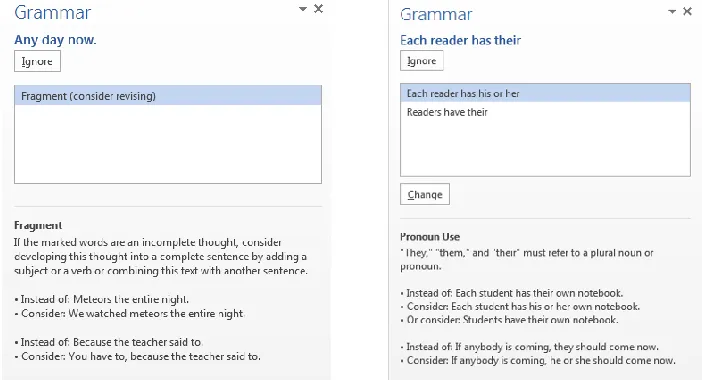
Figure 9. Three usage panels ... 157
Figure 10. Two usage panels, one without and one with suggested corrections ... 160
Figure 11. Word 2013 tabs, and Home ribbon ... 167
Figure 12. Word 2013 ribbon, showing Proofing tools under Review tab ... 168
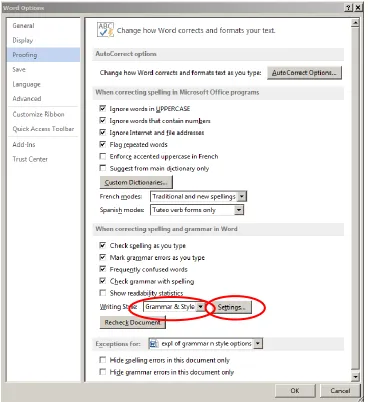
Figure 13. The Word 2013 page of Proofing options ... 170
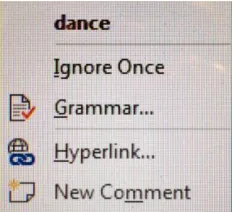
Figure 14. The grammar checker menu of item options ... 173
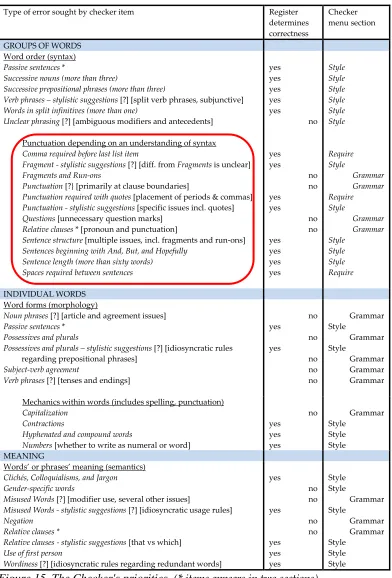
Figure 15. The Checker's priorities (* items appears in two sections) ... 187
Figure 16. Tiny question mark leading to Help ... 199
Figure 17. Screenshot of the beginning of the Grammar section on the Help page ... 204
Figure 18. Grammar terms on the Help page ... 212
Figure 19. A wrong rule, on pronoun case ... 242
Figure 20. A wrong rule, calling a tense problem ... 243
INTRODUCTION. Error, attention, and the grammar checker
Composition has long struggled with the question of error. In his 2008 monograph Dead
Letters: Error in Composition, 1873-2005, Tracy Santa offers a perspective of error grounded in the
history of rhetoric and composition’s sporadic engagement with the topic. Cueing from Joseph
Williams’s theory based on reader response (“Phenomenology”), Santa incorporates Foucault’s
“clinical gaze” into a theory of error while extending the notion of error as deeply social and
defined by its rhetorical context. Ultimately, however, Santa concludes that error has “largely
evaded successful theorizing” (131), and his study does not lead to a focus on pedagogy.
Making use of twenty-first century software technologies as well as the simple notion of the
checklist, this dissertation is an answer both to error’s elusiveness as well as to Chris Anson’s
call for composition to engage, as a field, with the challenge of error.
Any discussion of error in writing immediately lands in ambiguous terminology and
contested territories. The everyday moniker for a usage error is “bad grammar,” but some
refuse that label as nonsensical, understanding “grammar” in a structural or a generative sense,
as an innate human capability that cannot and need not be taught – only studied by
descriptivist linguists. At the same time, further confusing definitions, prescriptivist guides
often label those same mechanical and usage errors as “style” problems, notwithstanding how
such an impoverished application of the word “style” reduces that word to a dry crust of the
way to its theory of error, this dissertation will necessarily disambiguate the conflated meanings
of these three words: error, grammar, and style.
Anson sees composition as “unsettled as ever” about error and errors, but we prefer to
dismiss them as merely “surface issues” (5). Meanwhile the politics of language insistently
remind us that hot lava and tectonic clash are pushing from under that surface to create the
contours of these issues. Eager to allow and encourage students to put to good use the
linguistic skill they already possess in their home languages when they arrive in class, writing
instructors nevertheless remain unclear about how to teach language as part of composition
without imposing the cultural hegemony of prestige dialects. For decades, many writing
teachers have thus chosen to ignore or minimize questions of style, as well as of linguistic errors
in usage. This dissertation will offer a framework for instructors seeking to answer to
conscience – as individuals, or within departments, or more broadly in our field, as we seek
some consensus about how to teach amidst a chorus of dialects – by engaging with a pedagogy
of register.
A potential ally in facing the challenge of error, the computerized grammar checker, has
gone under-researched in rhetoric and composition. Aware of checkers’ failings and miscues
from our experience of their squiggles in our own writing, we tend to ignore them in our
pedagogies, even as we sense that the checkers are shaping our students’ writing in unknown
ways. Since such technologies appeared in the 1970s, researchers in business, technical, and
professional writing have shown more interest in them than compositionists, though even those
research articles have tended to evaluate the programs in the spirit of software reviews rather
increasing effectiveness, as they incorporate data gleaned from corpora of naturally occurring
language.
After the 1996 release of Microsoft Word 97, which included a new grammar and style
checker more effective than those in other widely used applications, a few substantive articles
on grammar checking appeared, among them Alec Vernon’s “Computerized Grammar
Checkers 2000: Capabilities, Limitations, and Pedagogical Possibilities”and Tim McGee and
Patricia Ericsson’s “The Politics of the Program: MS Word as the Invisible Grammarian.”
Caroline Haist’s “An Evaluation of Microsoft Word 97’s Grammar Checker” gave a detailed
assessment of the program’s effectiveness, an analysis whose quantitative data has proved
useful to subsequent composition theorists. Since then – so, for the past 15 years – composition
scholarship on this ubiquitous application has been sparse, with the notable exception of David
Major’s “How Computer Editing Responds to Types of Writing Errors,” on Word 2007. Finally,
in 2014, Ann Curzan dedicated a chapter to the Word checker, “Checking Grammar and
Grammar Checkers,” in her book Fixing English: Prescriptivism and Language History.
Given the changing landscape of error-detecting technology as well as the rapidly
transforming linguistic environment within which everyday writers – including our students –
write, both the practical and theoretical questions concerning grammar checkers deserve new
attention within any conversation about error and style. This dissertation will therefore
examine the most recent version of the Microsoft grammar and style checker, in Word 2013, for
A. Research question
The central question driving this research has been “What counts as an error?” or, more
particularly, “In any given writing situation, how does one decide what counts as an error?”
The Microsoft Word grammar and style checker evaluates what counts as an error more often
than any other single entity, so it makes sense to determine how the program makes those
determinations. But a writer need not follow its advice, as any of us know who have used
Word and ignored the squiggles, so the next question, leading back to the first, is how the user –
a writer – decides whether to accept the checker’s recommendations. The theory of error
offered here encapsulates the writer’s decision-making process that includes the checker’s
feedback.
After seeking to determine what the Word 2013 grammar and style checker considers an
error, this study assesses that information in light of pedagogical concerns about the hegemonic
power of its prescriptions. As a function of a machine – and one that sometimes gives wrong
corrections – a technological checker presents opportunities to keep questions of usage in
perspective, potentially making it easier to understand and teach the register that the Word
checker prescribes as one among many, even while it delivers the value-laden usage decisions
encoded into the program., Like most grammar checkers, Word also offers simple options for
customization that give writers increased agency and control over their own usage decisions,
allowing them to select what errors and style moves the application checks for. A pedagogy
that places the checker in its appropriate critical context acknowledges its strengths and
The element of attention has proven integral to this research. In The Economics of
Attention: Style and Substance in the Age of Information, rhetorician Richard Lanham establishes
attention, rather than information, as the scarce resource of a technologized “information
economy” that leaves us “drowning” in information, which requires attention to “make sense”
of it all (xii). This dissertation on error therefore considers how readers, writers, and the
computer each give attention to the challenge of error amidst that sea of information. For the
reader, perceived error distracts attention from meaning. The writer must decide how to
apportion attention between allowing, ignoring, or intentionally including apparent
transgressions of the usage expectations in a given register. And the computer’s attention, or
processing power, gives a grammar checking program the ability to relieve some of the
cognitive load of finding, understanding, and correcting errors. These exchanges, expectations,
and transfers of cognitive load speak to the heart of both the thornier issues in language and the
practicalities of the composing process, amidst competing demands for the writer’s, the
reader’s, and the computer’s attention.
From a broader view of these questions about error, attention, and the checker, a
comprehensive understanding of error has emerged. Rhetorical situation decides what counts
as an error, captured in a notion of register, or typified style. Register in turn defines an
essential reality for error: that in some registers, errors are less of a concern altogether. Writers
and writing teachers apply this knowledge intuitively, as we write, but this theory of error
articulates explicitly that an amount of allowable error is one of many defining features of any
register, one that writers can use to guide how they spend their attention during the composing
To better understand the program’s potential role in application and pedagogy, it is
important to know how effectively the Word grammar checker does its job of error detection,
and this study has conducted quantitative evaluation of the program. But its more significant
offering frames that information within the discovery that error itself – popular notions of error,
composition theories of error, critical definitions of error, and, most basically, the very factor of
attention to error – opens an unexpected door to that better use of technology and to better
writing style more generally, with or without software. That leap is possible only if we are
willing to reconceive the relationship between error and style, beyond the reductive notions of
both prescriptivists and descriptivists and their outmoded false binaries, based on what we can
learn from register: that what counts as error in one register is, precisely, style in another.
B. Summary of Chapters
The theory of error offered in this research relies on several interlocking domains of
scholarship in rhetoric and composition: research on error itself, on grammar and style, and on
genre and register. This approach to error also affects and is affected by the ubiquitous
technology of “grammar and style” checking, which is a product of a different research
tradition (computational linguistics), and I demonstrate how my understanding of error applies
in practice, for writers and in writing instruction, using the checker. It was therefore important
also to include empirical and practical research on the technology: its effectiveness, interface,
and implications. These several dimensions of the research fit together more like the spokes in
a wheel-shaped web than as a linear narrative. Constrained by the linear necessities of the
metadiscursive markers (e.g., “as discussed in Chapter 2”) – a patter of small connective threads
between the spokes. My chosen chapter sequence seeks to keep such recursions to a minimum
and to ensure that theoretical topics are presented thoroughly before they are then applied and
extended in the later chapters, about the technology.
After reviewing the literature on error in rhetoric and composition, Chapter 1 then
updates the definition of error to provide a conceptual baseline for the study. Chapter 2
introduces the Microsoft Word grammar and style checker: the small body of composition
research on the program as well as its function and technology. This chapter also presents and
discusses my empirical study of the checker, with quantitative and qualitative findings, as well
as my conclusions for application, pedagogy, and composition research based directly on those
findings.
The next two chapters examine the theoretical research in rhetoric and composition that
provide necessary underpinnings to this new theory of error. Chapter 3 looks at and
reconsiders key studies on “grammar” and “style,” two terms that are often conflated with
“error” and which, not coincidentally, are the name of “grammar and style checker.” Chapter 4
considers the scholarship on rhetorical genre and on register, the latter also making an
interdisciplinary venture to borrow relevant scholarship from linguistics. This chapter finishes
by examining stance (rather than mechanics) as the foundational determiner of style and then
evaluating the stance of Microsoft style as described in the company’s own style manual.
The following three chapters present a detailed study of the interface and functions of
the Microsoft grammar and style checker in Word 2013. All three of these chapters consider the
include screenshots of the interface as needed and charts that quantify essential aspects of my
analysis, which relies on the theoretical ground laid in the earlier chapters on error, grammar
and style, genre, and register. Chapter 5 begins this look at the application with the
omnipresent squiggles, error messages, and explanation panels. Chapter 6 looks at the primary
element of the application that allows for some control and customization of the checker – the
menu of options for selecting what it detects – and it considers both the practical and theoretical
knowledge we can glean from this checklist. Chapter 7 studies the only text that offers some
explicit glimpses of understanding into what the checker’s menu items mean: the Help page
that explains its grammar and style standards.
The second half of Chapter 7 then conducts a register analysis of the texts of the checker
– specifically, of the two elements that include complete sentences: the Help page and the usage
panels. Applying the theoretical framework laid down by the theories discussed in Chapters 1,
3, and 4 and the practical information presented in Chapters 5, 6, and 7, this register analysis
evaluates the language of this language-checking instrument against Microsoft’s own stated
style guidelines and considers what its stance reveals -- especially, what it assumes about the
users of the checker and what kind of writing it is pushing us toward.
The Conclusion presents the theory of error developed in the dissertation chapters and
offers ideas for its application, pedagogy, and further research, all incorporating the technology
of the grammar checker.
In an Afterword, I relate the curious tale of the unfinished next version of the Microsoft
grammar checker. A new checker is overdue but still in development for Word 2016, which has
implications for how compositionists can engage with new and developing writing
technologies.
CHAPTER 1. Theories, applications, and definitions of error
Hunting for mechanical errors and teaching young writers to hunt for them boasts a
long history. In Dead Letter: Error in Composition, 1873-2005, Tracy Santa recounts how error was,
in essence, the very foundation of the field of composition, beginning when American post-Civil
War college professors read their new students’ mistake-ridden essays and responded by
creating the freshman writing course, in an effort to deal with those errors. This course is still
with us in the twenty-first century, though it now tends to focus on any number of issues other
than error.
As writers and writing instructors, we take for granted that mistakes in usage and
mechanics are best avoided, but we tend to avoid the topic of error in research – and in
pedagogy as well, when we can. Errors, like the poor, are always with us; the title of one
landmark study carried a tinge of something between defensiveness and resignation: Andrea
Lunsford and Karen Lunsford’s 2008 “Mistakes are a Fact of Life.” Even instructors who are
concerned about error in their students’ writing tend to find it an intractable challenge (Anson
5). Research on error in composition has not yet focused on technological tools that might
reframe the conversation, as neither has scholarship on style. Error has held minimal place in
perennial resistance to research in style that arises from its association and conflation with error
avoidance, usually labeled “good grammar.”
A. Error and style
In the vernacular sense of the word “style,” to write with style is to write well, to express
oneself with panache. Nevertheless, the best-known “style guides” seem bent on eliminating
personal style, leaving it as a casualty in the crusade to eliminate errors. This dissertation
parses the meanings of “style” in Chapter 2, to establish how the ideas represented by this word
figure into a theory of error. Compositionists often avoid the confusing word “style”
altogether, but they at least agree that the best writing is that which is appropriate to its
rhetorical situation. What constitutes appropriateness and how best to negotiate the politics of
competing styles are all topics that have been hotly contested, however, within the histories of
rhetoric and of composition.
Today, the contested territory in any discussion of error includes disagreement over
what counts as an error, who has the authority – or cultural hegemony – to decide what counts
as an error, and whether errors do or should matter any longer. The complex role of language
in identity politics generated NCTE’s 1974 statement of “Students’ Right to Their Own
Language” (SRTOL), a document that is, ultimately, about style and error. A committee tasked
with creating a teacher’s guide to a pedagogy based on SRTOL was “abandoned” in 1978
without fulfilling its mission, its failure due in part to “’the lack of enough high quality
submissions’" (CCCC, quoted in Parks 210). For Rebecca Moore Howard, this little-known
sentence-level pedagogy; rather, it was to establish the basis for a new pedagogy” (47). There is
work left to be done.
The lack of pedagogical direction about how to navigate these questions of language
leaves a chasm at the center of the composition classroom, as those identity politics remain
relevant now as then – more so, in an even more linguistically diverse student population in
American universities – and composition has remained divided on questions of style and error.
Inasmuch as there has been some agreement on the pedagogy of usage conventions or on style,
the prevailing consensus has been to ignore both, in a “distaste for sentence-level pedagogy”
(Howard 48), except in incidental instruction to students popularly known as “mini-lessons” in
“grammar” (Weaver 1996, Weaver, McNally, and Moerman 2001). More rarely, a compositionist
may make the case for systematic instruction in grammar and style, to build a frame within
which learning writers can hang their developing knowledge from incidental discoveries and
mini-lessons (Zuidema 2012). The systematic approach falls within a path charted especially by
Martha Kolln, in her work with Loretta Gray (2010) and Craig Hancock (2010). Still, a few
instructors have maintained “dogged adherence to the pedagogies that SRTOL had discredited”
(Howard 48), but no widely accepted alternatives have arisen in their place, as error and usage
have remained at the margins of rhetoric and composition research. And even Kolln, one of the
best-known proponents of a teaching “Grammatical Choices, Rhetorical Effects” – the subtitle of
her textbook Rhetorical Grammar – shies away from any association with error management (see
both Preface and Introduction), despite the easy transferability of the some of the same concepts
B. Public angst about error
Meanwhile, outside academia, a loud focus on error has stayed ever-fresh. Type
“grammar mistakes” into an internet search engine, set the search dates for “this month,” and
invariably find a number of results, often including articles in major nonacademic publications.
The title of Newsweek’s 1974 “Why Johnny Can’t Write” still serves as a shorthand for this
phenomenon of public concern about perceived problems in writing and its pedagogy, and
such articles have tended to focus on details of word- and sentence-level error.
Harsher judgments about error eagerly associate or conflate writing missteps with much
more insidious failures of character such as selfishness, laziness, or a poor work ethic. A widely
shared Harvard Business Review article by entrepreneur Kyle Wiens was entitled “I Won’t Hire
People Who Use Poor Grammar. Here’s Why” and included a characteristic comment from this
school of thought: “sloppy is as sloppy does.” Readers bothered by usage errors experience
them as evidence that the writer does not care (not enough, at least) about her readers or about
the endeavor that occasions the writing. Setting aside the many possible reasons that an error
may appear in writing, or, rather, lumping all those reasons together, all error is read as lack of
consideration. To the arguments of this dissertation, this question of consideration shifts to one
of attention; indeed, Wiens specifically characterizes error as a writer’s failure to “pay
attention.” Sticklers insist that attention to correctness is necessary in any and all writing – an
assumption which turns out to be demonstrably inaccurate, as elucidated in this dissertation.
The dismay about writing errors continues a long tradition of desire to repair and freeze
written English, which Anne Curzan traces in Fixing English. For most of that history, the
classrooms. A writer facing a moment of doubt about a usage choice in post-student years
could use an old high school grammar book as a reference manual, pulled down from the shelf
where it sat next to a collegiate dictionary, also a source of usage direction. A “style guide,”
written by anyone willing to wade confidently into the fray of usage disputes, might give
nuanced, reflective recommendations about usages, in the tradition of the ancient grammatici,
or it might claim for itself the authority to declare one usage acceptable and all others wrong.
Now joining the carefulness of Fowler, Follett, and Garner is a long list of prescribers, as new
entries appear constantly. Some attempt to capture a sense of play, with titles such as The
Deluxe Transitive Vampire: The Ultimate Handbook of Grammar for the Innocent, the Eager, and the
Doomed (Gordon) and Woe is I: The Grammarphobe's Guide to Better English in Plain English
(O’Conner). Others are as imperious as Strunk and as mercurial as White.
Today, however, prescription is not limited to grammar handbooks, English teachers,
and the exploded market of style guides in the popular press, nor even to digital contributions
of blogs and podcasts (Fogarty, Yin) and the self-appointed grammar police in internet
comment sections. For almost two decades now, correctness enforcement has achieved an
unprecedented reach into writers’ moment-to-moment composing, in the automatic squiggles of
the “grammar and style checker” of Microsoft Word. As Curzan points out, “its rules are the
ones many writers of English encounter more regularly than any others” (92). The Word
checker is therefore the most powerful, because invasive, “style” guide in language history.
After exploring composition theories of error here in this chapter and establishing a
determine what it can teach us about error and style and how we can make better, more
enlightened use of the grammar and style checker.
C. Problems of definition and application
Curzan’s history of prescriptivism makes clear that the urge to define some language as
“good” and other language as “bad” has a long and hardy history in English. But no two users
of English will answer questions about what counts as an error or why in exactly the same way.
As Nicole Michel, a member of the Microsoft team currently working on the checker, notes,
“English is exceptional in that it doesn’t have a central authority which regulates the language
as is the case for most other languages” (all references to Michel drawn from personal
correspondence with me unless otherwise noted). An individual writer or teacher may
therefore disagree with the checker about what counts as an error, even when the checker
successfully detects an error by the standards programmed into it.
The word “error” turns out to be squirrelly, provoking more questions than it answers.
Concrete, specific examples quickly reveal the problems in any abstract, general definition. Is a
split infinitive an error? Even most prescriptive guides argue that such a convention is
unnecessary (Fogarty “Split Infinitives”), calling it a grammar myth – an “invented rule”
(Williams, Style 14). Strunk advises against split infinitives in most cases (58), but in the same
book White calls infinitive splitting “a matter of ear” (78). Still, some readers, including those
with evaluative power over a writer, may “disapprove” of the split infinitive, as was established
at my own university, in a survey of professors asking what mistakes they found bothersome in
end of a sentence a usage mistake? weak style? a question of formality? or simply not a
problem? Is capitalizing a noun for emphasis, even though it is not a “proper” noun, a mistake
or a bold style choice? Reasonable people can disagree.
Any mention of error inevitably points towards questions about what criteria the
speaker is using for the word. Those standards may not be grounded in principles credible to
the listener. One may consider an ostensible error not severe enough to have any significance.
And who actually notices or cares when a writer uses “which” instead of “that”? (In this
dissertation, this question is a real one, not a dismissive one presumed to have an obvious
answer.) If the misstep does not affect logos, does it still sully ethos? These problems of
definition make the word “error” both confusing and unpleasant enough to tempt the
avoidance of it altogether, the popular path in composition. And to a descriptivist with an
activist egalitarian bent, the very notion of error is inescapably political, as no usage is
inherently “wrong” or a mistake.
But “error” captures a concept that is valuable in discussing writing. Attempts to avoid
the word usually generate carefully chosen replacement words, nouns and adjectives such as
“nonstandard,” “variant,” “substandard,” or “deviation,” which nevertheless raise similar
problems of definition, as they usually imply some yardstick that the label itself does not
capture. The alternate terms quickly begin to sound like euphemisms, begging the question of
meaning and further muddying rather than clarifying the dilemmas at the heart of error. Even
a scholar such as Curzan, who has dedicated an entire monograph to explicating the idea and
history of prescribed correctness, has no simple name or phrase to capture concisely what is
grammar checker, she writes: “The use of the label ‘error’ categorically relegates nonstandard
forms to the realm of error.” She cites several examples of usages that the grammar checker
marks as errors but that occur in some dialects of spoken English, and she refers to them as
“systematic but nonstandard grammatical features.” Noting that the grammar checker “uses
the term ‘error’ with no further explanation,” she is concerned that “the most powerful
prescriptive force in the world,” as she sees the checker to be, “serves to reify attitudes about
nonstandard grammar being ‘error’” (79). But her “standard” that a given usage fails to meet
lacks any clear definition.
“Nonstandard” and “error” do not have identical meanings, neither in technical nor
vernacular contexts, and at this level of terminology analysis, subtle differences matter. But the
deeper one dives into the discussion around error, the more tortured seem the efforts to find
any clearer terms.
Some style guides and scholars make an effort to capture the “standard” behind words
such as “nonstandard” in a phrase naming a widely accepted dialect. Often such names add an
adjective or two to clarify: “Standard American English” and “Standard British English” are
two labels sometimes enlisted in attempts to capture this elusive idea. Microsoft has been
known to direct its employees to write in what the company called “General English” (Microsoft
Manual, 2nd ed. 286) Compositionist and linguist Geoffrey Huck refers to “Contemporary
Standard Publisher’s English” but then promptly notes the problem with both the concept and
the name: “There are too many versions of it,” each harking to a different style guide, and “their
multiplicity promotes confusion on the part of students” as “there appears to be no single
frustrating attempts to encapsulate a concept that the writer seems to believe, with reason, that
any literate reader already grasps, even if the label fails to fully capture that concept. “You
know I mean when I say ‘standard’ English,” the writer seems to say. And most readers are apt
to believe that they do, in fact, know, even if they cannot explain the standard clearly. The
general look and sound (to the mind’s ear) of written English that meets common usage
standards is clear to anyone already thoroughly familiar with written English – so, to the literate
– even if the devilish details remain slightly shifty.
The inescapable reality of error is that if a writer is seeking to fulfill the conventions of a
register called “standard English” (however inadequately defined) and fails to do so, she has
made a mistake – usually, a series of individual mistakes. Whatever “error” does mean, or can
mean, the fact that a usage is accepted in her familiar spoken dialect does not mitigate the fact
that it may be considered inappropriate for other rhetorical situations and thus, in those
situations, an error, to many or most readers. And word usage is not the only opportunity for
error in writing: “mechanics” encompasses all the textual elements that are unique to writing
and are not a part of spoken speech, including spelling, punctuation, spacing, and
capitalization. The grammar checker looks for errors in all these categories.
D. Loaded language in the checker
The checker participates fully in the confusion of meaning around the word “error.” As Curzan
notes, its documentation uses the word “error” without further explanation on its Help page. It
also employs her preferred term, “nonstandard,” again without explaining what standard is in
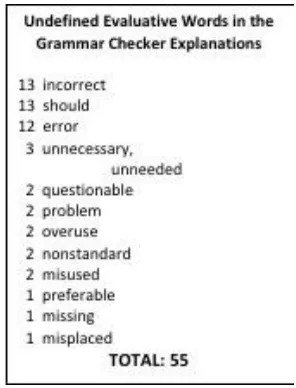
calls on the part of the programmers: as listed in Figure 1 below, 12 such words reoccur in a
total of 55 instances. Chapter 5 will explore how the checker attempts to distinguish between
significant errors and optional choices about usage by separating the items into the sections
Grammar and Style. But this question of evaluative vocabulary cuts across all sections of the
35-item checker. Each of these words naming ostensible problems or mistakes raises unanswered
questions of definition: How does one know what is “preferable”? By what criterion is a usage
determined “unnecessary”? What is the linguistic concept or usage convention that renders a
word “misused”? And who is asking the questions about “questionable” uses? One of the two
most frequent of these unexplained terms is simply “incorrect,” appearing 13 times in the menu.
[image:32.612.231.379.367.561.2]All of these words express undefined value judgments.
Figure 1. Evaluative words in the checker
For some items included in the checker’s explanations – such as Relative clauses - stylistic
suggestions, explained as “Questionable use of ‘that’ or ‘which’” – an English teacher or
correctness enthusiast might know which grammar convention this item describes, only
is likely to be as well. But a novice writer would need some explanation of this convention to
make sense of this checker rule about relative pronouns. Even a highly literate reader would
not be likely to have noticed the pattern of “which” with a comma and “that” with no comma,
much less the underlying difference in meaning between nonrestrictive or restrictive clauses, if
he were untutored in schoolbook grammar. A reader experiences the pauses in the sentence
“The lavender fields, which I passed on the last day, overwhelmed me with memories of my
grandmother’s linen chest”; he is unlikely to consciously note its difference from “The lavender
fields that I passed on the last day overwhelmed me,” except in a grammar class that attends to
formal usage prescriptions. What this item on the checker menu is designed to detect – the
error it seeks – is therefore apt to be unclear to the many users of the program who never
learned or have forgotten this quirk of correctness conventions. Only rhetorical situations
demanding especially careful attention to traditional usage rules will require its
implementation, but those are exactly the situations in which a writer is likely to want editing
assistance and turn to the grammar checker for error detection and explanations. Only the
writer who has antecedent understanding of dependent clauses and the “that/which”
convention will be able to make use of this item. The word “questionable” does nothing to
illuminate the understanding of a writer in the dark on this convention.
Perhaps the most telling of these evaluative words is the other most frequent: “should,”
which also appears 13 times. Pop psychology directs the beleaguered to cast off the burden of
“shoulds” and follow their own lights. The pragmatic perspective of discourse analysis asks us
to read a word closely, in its context. Carefully considering the grammar of “should” reminds
without an attached dependent clause indicates a missing condition. What is the implied
condition? That is to say, “should, if what?” The grammar checker program, as well as
prescriptivist grammar more generally, directs that the writer “should” make the suggested
correction and presumes that the writer knows why: to comply with the rules of good
grammar. But if the rules are unstable and the “goodness” standard is unreliable, what then is
the condition? When and why would one define a given usage as an error? The answer lies in
the rhetorical situation, and Chapter 4 will establish a path for a writer to use towards finding
an answer – for defining rhetorical situation in a way that is pragmatically applicable and not
simply an amorphous, conceptual dead end.
E. Real-world use as the standard of correctness
The prevailing answer to questions of correctness reaches back to the ancients, who
decided that the standard of usage should be use. The best-known rhetoricians confirmed the
necessity of correctness but already expressed impatience with sticklers (see Quintilian, Book 8
proemium). Following on Cicero, Quintilian declares that “Usage has now triumphed over
Authority” (1.5.63). Granted, both were referring to the consensum eruditorum (1.7.45), the usage
of the well-educated – a limited group of people comprised of men with money and citizenship,
and we are still sorting through the masculinist, classist, and nationalist politics of language.
But the yardstick of use as the standard of usage at least laid down – and largely holds to this
day – that to decide if a certain use of language is correct, we appeal not to its etymology or
history, to misleading notions of a pseudo-mathematical logic, or to the direction of an
persuasive to one’s audience: if a usage also happened to follow one of those other criteria –
sometimes due to prescriptivist pressures, as Curzan describes throughout Fixing English – then
so be it. But there was no point in trying to force language against its organic evolution, even
when it produced a preferred spelling as illogical as “judgment” or contradictory rules that
allowed “Regrettably” as an introductory sentence adverb but not “Hopefully,” unless and until
usage changed. In the wake of twentieth-century linguistics, we can also acknowledge that in
addition to the English of the educated or the published, there are also other styles and registers
of spoken language, some of them used effectively in writing as well, and not only in the
dialogues of fiction.
We now have means to measure use that were not available to the ancients, in corpus
linguistics. In this deep well, the swirl down a rabbit hole of questions stemming from “what
counts as an error?” has finally found a landing, or the promise of one. As Chapter 2 will
explore, whether a given usage is considered an error in a certain context of use is becoming
slightly less speculative than formerly, thanks to the ability to scan millions of words in
naturally occurring texts and to learn any number of things about those texts, including about
its usage standards. Still, however maddeningly to a stickler, a “standard” English will remain
undefinable by a few simple adjectives, nor even by tomes of explanation, because any one
concept or definition of a standard still holds multiple, conflicting conventions regarding any
number of usages. Appropriateness depends inescapably on particular rhetorical situations.
But corpus tools do allow us to analyze and quantify the frequency of certain uses in certain
for which one can collect and analyze a corpus or make use of one of the existing, large,
multi-genre corpora already available.
F. Theories of error in rhetoric and composition
In recent decades, composition research on error has come to emphasize the social
context of rhetorical situation. Most studies also focus on pedagogy, in whole or in part, so the
literal reader examined in those studies is often the writing teacher. In the late twentieth
century, Mina Shaughnessy’s Errors and Expectations marked a turn in theories of error,
prompting composition instructors to look for illuminating patterns in the errors of their least
fluent writers. She eloquently describes error as "unprofitable intrusions upon the
consciousness of the reader" that "demand energy without giving any return in meaning" (12).
Three years later, in 1980, David Bartholomae’s “The Study of Error” was an extension of and
response to her approach, based on close reading and interpretation of student error. Some of
the research that has focused on the perception of error as residing in the reader reaches beyond
the teacher-student dyad, such as Maxine Hairston’s “Not All Errors Are Created Equal,” which
collected data about nonacademic professionals’ reactions regarding the severity of various
errors, and Attitudes, Language, and Change by Anne Ruggles Gere and Eugene Smith, expressing
a hope for change not only in teachers’ responses to perceived error but in the general public’s
attitude, in a broad-based cultural shift to be led by teachers (a movement that has met with
only partial success). Joseph William’s “Phenomenology of Error” delves thoroughly (and
slyly) into the notion of error as located in the reader’s perception, in his landmark essay that
The twenty-first century opened with Chris Anson’s 2000 call for research into error,
“Response and the Social Construction of Error,” specifically focusing on teacher response to
error. As he describes it, “many teachers continue to feel torn between denying attention to
error in their response because of its incompatibility with newer theoretical perspectives and
experiencing the unavoidable effects of error as they read their students' writing” (4). Anson
defines error as “recognized deviations from specific language conventions imposed on texts by
readers with varying knowledge that they call into play depending on the context, purpose,
level of formality, and other elements of their reading” (17), and his probing into this
multifaceted nature of error illuminates why errors are hard to ignore, annoying even those
theoretically committed to finding them insignificant, an annoyance through which errors
undermine pathos as well as the aforementioned logos and ethos that error can tarnish.
Tracy Santa’s 2008 Dead Letters offers a thorough history of both the theory and
pedagogy of error, in which he confirms the social nature of error and locates its existence, like
Williams, in the reader, who performs Foucault’s “clinical gaze” (Santa 131). Santa notes
Bartholomae’s comment, nearly twenty years after writing “The Study of Error,” that he
[Bartholomae] had been “committed to … determin[ing] a grammar of error” which had turned
out to be a “vain hope”; instead, Bartholomae came to see error as “a social rather than a
linguistic phenomenon” (71). While the plane upon which writing errors occur is linguistic,
what defines a given usage as error is, finally, social.
Relevant to any study on error is Andrea Lunsford’s work with Robert Connors and,
later, Karen Lunsford, respectively: “Frequency of Formal Errors in Current College Writing”
of both studies is to establish the number and types of errors appearing in a wide sampling of
student papers, and they compare the findings of each study with earlier research. In the latter
paper, the authors make numerous, specific, but incidental comments on the observed effects of
spelling and grammar checkers, which are having measurable impacts on the nature of errors
appearing in student papers (796). While grammar checkers are not the focus of either study,
Lunsford and Lunsford’s 2008 findings bear directly on my argument and evidence regarding
the impact of the technology. They note that spelling and grammar checkers are changing the
nature of errors that are common in word-processed writing (799) – a change which inevitably
alters expectations about what kinds of error readers then deem acceptable or severe.
Another “major shift” that the 2008 study noted as a change from 1988 is also pertinent
to my research: a change in “type of paper” from “personal narrative” to “argument and
research” (793), a shift in what they aptly label as “genre” (801). This change has created new
challenges with error types, three of which appear on the new list of their top twenty errors, all
three regarding integration of quotations, attribution of sources, and the punctuation of both
according to a disciplinary style guide (796-97). Such a change in genres creates new social
exigencies.
Directly or indirectly, the effects of the grammar checker figure into almost every
notable finding in Lunsford and Lunsford’s research, as they reflect on the changing nature of
errors now in the student papers. One is the large drop in the number of spelling errors, which
had comprised the top number of errors by far in papers of the 1988 study but ranked only fifth
in 2008. The authors deduce that “the spell-check function took care of many spelling
mistakes that spell-checkers understandably do not flag” (796). (Word 2013 checks both these
item types, as Chapter 2 will discuss.) Another major change in error type is the new
front-runner, “wrong word,” now “by far the most frequent formal error” (796). Ironically, the shift
turns out to be a trade-off, as the researchers notice that “many of the wrong word errors
appear to be the result of spell-checker suggestions,” often combined with a “simple failure to
proofread” (796).
Invoking Williams’s focus on the reader in “The Phenomenology of Error,” Lunsford
and Lunsford note that what they quantify in their study as “error” is more aptly understood as
“attention to error” (801), the idea that forms the basis of the definition and theory of error in my
study.
G. Defining error as an exchange of attention and meaning
In its conclusions, this dissertation will offer a multifaceted theory of error grounded in
register and a pedagogy of error that incorporates the electronic grammar and style checker. To
develop that theory requires a working definition of the word.
The tradition of scholarship tracing to Shaughnessy provides the foundation for an
updated definition of error. Her understanding of errors as “unintentional and unprofitable
intrusions upon the consciousness of the reader” that “demand energy without giving any
return in meaning” (12) establishes error as an exchange between attention and meaning. When
writers “introduce in accidental ways alternative forms in spots where usage has stabilized a
particular form (as is now true in spelling, for example, or in the familiar albeit "illogical"
the groundwork for Williams’s location of error in the reader’s response as well as
twenty-first-century explorations of error in Anson and Lunsford, culminating in Santa’s recent monograph.
A definition cueing from this tradition requires revision of Shaughnessy’s on two points: the
idea of intention and the locating of error in the experience of the reader. And the
text-critiquing technologies of the twenty-first century expand our understanding of who or what
can attend to error.
Jettisoning assumptions of intention
Shaughnessy’s definition makes implicit assumptions about the writer’s process when
she characterizes errors as “unintentional” and “accidental,” both of which deserve
reconsideration. For a reader, the writer’s intention is ultimately unknowable. As Santa notes,
more broadly, a reader “imagines” the intended meaning of “any written text,” in what is
“always an act of interpretation” (5). Including this assumption about writerly intent (that is,
assuming a lack of it) in a definition of error is therefore to engage in an “intentional fallacy,” to
apply a term from literary criticism: “the design or intention of the author is neither available
nor desirable as a standard for judging the success of a work of literary art” (Wimsatt &
Beardsley 468). In the same way, in a non-literary work, we cannot know whether a writer’s
choice of a certain usage is conscious or unconscious; if the latter, it is arguably not a “choice” at
all. And the question of intention quickly becomes further complicated in light of the varied
possible causes for a writer’s transgressing a convention. To name a few, perhaps the writer
knows the usage standard but did not notice that he typed otherwise; he does not know the
but made a conscious style decision to express himself in a different way; or perhaps he noticed
but does not care to correct it, for one of any number of reasons, some of which are explored in
the conclusions of this dissertation.
In any of these cases, while some errors seem obviously to be only typographical
oversights and likely to have been unintended, Williams reminds us that we are inclined to give
a writer whom we consider an expert a benefit of the doubt, trusting that her quirks of usage
must be intentional, while we are likely to assume the same moves to be accidents in a student
writer (“Phenomenology”).
Among sticklers, the writers most likely to receive the benefit of the doubt are
themselves. Because they are aware of their own efforts at proofreading and do not question
that their own usage standards are the correct ones, they assume and expect others to assume
that any oversight in meeting conventions must have resulted from a rare momentary lapse, not
a failure of their knowledge nor any general sloppiness. Thus, a well-educated acquaintance of
mine, one of whose degrees is in English, was once complaining loudly on Facebook about
people who do not bother to use “good grammar” when they write. When a friend pointed out,
gently but wryly, that she had made a classic usage mistake in that selfsame post
(mispunctuating a possessive), she responded without irony that her mistake was different,
because of course it was “just a typo.” What bothered her, she said, was these people who don’t
even bother to try to write correctly. But as readers alone with a text, we cannot know the
difference between an error resulting from a lack of knowledge and one resulting from a lack of
proofreading attention, a lack of facility with the mechanics of a keyboard, a learning disability,
language myself, with an old-fashioned grammar and usage education in high school, more
than one English degree, and professional writing and editing experience, I certainly know the
difference between “their,” “they’re,” and “there,” but an errant form might still make its way
unnoticed into a text I type. For the reader bothered by such things, the cause of my error is
unknowable. (The grammar checker’s contextual spelling feature is a blessing at those
moments, if I am using a word processor that offers it.)
Paradoxically, according to what we learn from Williams, readers are less likely to notice
such errors in writing composed by someone presumed to know the conventions thoroughly.
Whether a writer known to be skilled is then more likely or less so to be forgiven for such
lapses, once noticed, depends on the attitude of the individual reader towards error. Applying
Williams’s principle that readers attribute more credibility to some writers than to others,
readers are also apparently more willing to do the work of supplying even unintended meaning
for a writer whose skill they trust. As Shaughnessy reminds us, “Great writers … have drawn
deeply upon the energies of readers, holding them through pages of exasperating density or
withholding from them conventional word order or vocabulary or punctuation” (12), but
readers sometimes trust from their experience or the writer’s reputation that such authors will
reward them with meaning. In the language of schools and grading, we might say that readers
grant to presumably skilled writers some extra credit, from the start, which creates a buffer zone
such that errors do not mar their perfect score.
Teachers reading student writing, on the other hand, may not be inclined to assume that
breaks with convention are flourishes of genius. Reading and providing feedback on student
meaning, but the meaning tends to emerge in spite of and around these transgressions of
convention, not because of them.
In student papers, too, the deviations may be flashes of brilliance. Usually, however, the
primary meaning that the errors themselves reveal is pedagogical – information about the
student’s learning process as a writer, such as Shaughnessy writes about in Errors and
Expectations – not about the topic of the student’s essay. And still, the meaning of the error is
not straightforward: most composition teachers have had the experience of explaining a usage
convention to a student whose writing reflects unfamiliarity with the convention. The student
may listen, smiling and nodding, while the teacher begins to suspect that she is wasting her
time – that the student knows the rule full well but simply does not want to admit failing to
proofread while rushing out the door to the deadline. The student may have enacted the Urban
Dictionary definition of “Red-line editing”: “When one could care less about proof-reading
something they have typed on the computer before submitting it and only scroll through to
make sure no words are underlined in red”; “Ex 2: My teacher thinks I'm pretty stupid because I
used ‘their’ instead of ‘there’, an unfortunate result from my habit of Red-Line editing.” [sic])
Such a source of errors further illuminates the folly of making assumptions about writerly
intention.
Locations of error perception
Having retained Shaughnessy’s understanding of error as an exchange between
attention and meaning but discarded assumptions about the writer’s intention, we must also
Shaughnessy, the major theorists in this tradition of error scholarship continue to focus
definitions of error on the experience of the reader. They do not include the writer’s experience
or process in the definition of error, even if some of them explore the writer’s participation in
the social construction of error elsewhere in their research – sometimes in depth, especially if
they are process-oriented composition theorists. In a reader-based theory of error, error exists
in the product after it has left the writer, in the relationship between the writing itself and the
reader’s attention.
I am interested in how error is located in all three components of the exchange: the
writer’s process, the writing itself, and the reader’s experience. And just as Shaughnessy
discusses the reader’s attention and energy in processing error, this research is also interested in
the writer’s attention and energy in processing error and the computer’s, through the grammar
checker. Where Bill Bolin, in summarizing composition theory on error, sees it as “an
inherently relative and localized phenomenon” but implies that definition to be contradictory
with both error’s existence as “an artifact on the page” and as “a product of the interaction
among reader, writer, and rulebook” (83), I understand these theories to be simultaneously true,
without contradiction. The technology of the grammar checker turns the “rulebook” itself into
an omnipresent, mediating reader of sorts, actively entering that interaction. Perceived error can
place its demands on any reader of the text, including the writer himself or the computer.
Error elimination, or reduction, or management, is a process requiring the writer’s
energy and attention – with or without the assistance of an editor, collaborators, volunteer
proofreaders, or anyone else who contributes to the effort of responding to potential errors.