CEPRIN Dissertations Center for Process Innovation
Fall 12-10-2018
Polycentric Information Commons: A Theory
Development and Empirical Investigation
Vitali Mindel
Follow this and additional works at:https://scholarworks.gsu.edu/ceprin_diss
This Dissertation is brought to you for free and open access by the Center for Process Innovation at ScholarWorks @ Georgia State University. It has been accepted for inclusion in CEPRIN Dissertations by an authorized administrator of ScholarWorks @ Georgia State University. For more information, please [email protected].
Recommended Citation
Mindel, Vitali, "Polycentric Information Commons: A Theory Development and Empirical Investigation." Dissertation, Georgia State University, 2018.
Empirical Investigation
By
VITALI MINDEL
ADISSERTATION SUBMITTED IN PARTIAL FULFILLMENT OF THE REQUIREMENTS FOR THE DEGREE
OF
D
OCTOR OFP
HILOSOPHYIN THE
R
OBINSONC
OLLEGE OFB
USINESSOF
G
EORGIAS
TATEU
NIVERSITYGEORGIA STATE UNIVERSITY
ROBINSON COLLEGE OF BUSINESS
2 Copyright by Vitali Mindel
3
ACCEPTANCE
This dissertation was prepared under the direction of the Vitali Mindel Dissertation Committee. It has been approved and accepted by all members of that committee, and it has been accepted in partial fulfillment of the requirements for the degree of Doctor of Philosophy in Business Administration in the J. Mack Robinson College of Business of Georgia State University.
Richard Phillips, Dean
DISSERTATION COMMITTEE
Chair: Dr. Lars Mathiassen (Center for Process Innovation & Computer Information Systems Department, Georgia State University)
Chair: Dr. Arun Rai (Center for Process Innovation & Computer Information Systems Department, Georgia State University)
Dr. Likoebe Maruping (Center for Process Innovation & Computer Information Systems Department, Georgia State University)
4
ABSTRACT
Polycentric Information Commons: A Theory Development and Empirical Investigation
BY
VITALI MINDEL
11/26/2018
Committee Chair: Lars Mathiassen & Arun Rai
Major Academic Unit: Center for Process Innovation & Computer Information Systems
5
Acknowledgments
As corny as it may seem, I would like first and foremost to acknowledge the American Dream. I came to this country in 2007 and had to start from the bottom. For almost two years, I worked as a housekeeping aid in a hospital in Springfield, Illinois, cleaning surgery rooms for minimum wage on the evening shift while taking classes at the local community college during the day. I then moved to Atlanta, where I worked as a daytime groundskeeper in an apartment complex for three years, cleaning the pool and hallways. After taking a year off of my education to avoid paying out-of-state tuition, I began taking evening classes and completed my bachelor’s degree at Georgia State University. To this day, when I see housekeepers in office buildings pushing carts equipped with spray bottles, paper towels, mop buckets, and other cleaning supplies, I get emotional. I pushed one of those carts for almost five years.
6
manager in the Atlanta apartment complex where I worked, for turning a blind eye when I was often doing homework instead of my job. All of these people noticed the drive in me and implicitly and explicitly supported my efforts. I thank you all for that.
I want to thank Dr. Jeannie Grussendorf, who was my favorite professor at Georgia State University and who’s teaching style inspires me now when designing my own classes. She was the one who told me about the internship opportunity with the World Affairs Council of Atlanta (WACA), and who connected me to the right people and wrote my recommendation letter. I would like to thank Dr. Wayne Lord, the president of WACA at the time, for hiring me as his assistant and introducing me to Dr. Lars Mathiassen, the academic director of Georgia State University’s Executive Doctorate Program, which shared office space with WACA. Without this introduction, I would not be writing these acknowledgments.
7
I know that Lars would not have admitted me to the program without the blessing of his close colleague, Dr. Arun Rai. Having worked mostly with Lars, I was at first intimidated by Arun. Not because of his status in the field (which I was unaware of) but because he seemed to be fiercely brilliant, intense, and unabashedly confident. I kept my distance for a while, but over time I was very happy to discover the true Arun Rai—brilliant, intense, and confident, yes, but also very much an outstanding human being who deeply cares about others. One should see the sparkle in his eyes when he talks about his students and other young aspiring academics! I learned a lot from working with Arun, including the importance of seeking constant inspiration and cultivating your passion for the academic pursuit. It is a little funny to me now to acknowledge how clueless I was when I started the program, with no idea who Arun Rai or Lars Mathiassen were; it was only after a while into the PhD program that I was pleasantly surprised to learn that I was being mentored by some of the most esteemed scholars in the IS field. It was a little like realizing that, after years jamming with Paul and John, I was actually making music with the Beatles.
8
person. Peiwei and Khaleed, although I did not get to know you as well as some other students, I enjoyed our interactions; take care of Lars. All of you, my fellow students, have worked hard and inspired me to do better. I wish you all success in your pursuits! Finally, I want to acknowledge Vanessa Browne. Over time, we developed a close friendship, and I will miss dearly our conversations and laughs. With all respect to the others, you are my favorite person in Robinson College of Business. I always knew you had my back.
9
Table of Content
Acknowledgments ... 5
Chapter 1: Dissertation Overview ... 12
1.1 Introduction ... 12
1.2 Essay 1 ... 17
1.3 Essay 2 ... 18
1.4 Essay 3 ... 20
1.5 References ... 23
Chapter 2: The Sustainability of Polycentric Information Commons ... 26
2.1 Sustainability of Decentralized Systems Online ... 27
2.2 Information Commons ... 32
2.3 Derived Stakeholder Value ... 38
2.3.1 Derived Producer Value ... 39
2.3.2 Derived Provider Value ... 40
2.3.3 Derived Appropriator Value ... 41
2.4 Sustainability... 41
2.4.1 Provision ... 42
2.4.2 Appropriation ... 43
2.4.3 Revitalization ... 43
2.4.4 Equitability ... 44
2.5 Collective-Action Threats ... 45
2.5.1 Free-riding ... 47
2.5.2 Congestion ... 48
2.5.3 Pollution ... 49
2.5.4 Violation ... 50
2.5.5 Rebellion ... 51
2.6 Polycentric Governance Practices ... 51
2.6.1 Boundary Regulation ... 55
2.6.2 Incremental Adaptation ... 56
2.6.3 Shared Accountability ... 57
2.6.4 Provider Recognition ... 57
10
2.8 Discussion ... 65
2.9 References ... 72
Appendix ... 82
Reviewed IS Research ... 82
Chapter 3: Harnessing Digital Activism for Institutional Change: A Collective-Action Perspective ... 99
3.1 Decentralized Systems Online and Societal Change ... 100
3.2 Digital Activism ... 100
3.2.1 Digital Online Activism ... 102
3.2.2 Digital Offline Activism ... 103
3.3 Theoretical Framing ... 105
3.3.1 Digital Activism as Polycentric Information Commons ... 108
3.3.2 Digital Activism for Institutional Change ... 113
3.4 Research Method ... 116
3.5 Case Study Analysis ... 117
3.5.1 Institutional Field ... 119
3.5.2 Instigating Institutional Change (September 2012–March 2013) ... 120
3.5.3 Emerging Collective Action (April 2013–July 2013) ... 120
3.5.4 Enacting Polycentric Governance (May 2013–September 2013) ... 127
3.5.5 Cascading Collective Action (May 2013–March 2014) ... 127
3.5.6 Avoiding Provider Rebellion (November 2014–December 2014) ... 131
3.5.7 Institutional Change ... 136
3.6 Discussion and Theory Development ... 136
3.7 Conclusion ... 147
3.8 References ... 147
Chapter 4: Polycentric Resolution of Information Pollution in Open Collaboration Systems ... 158
4.1 Information Pollution in Open Collaboration Systems Online ... 159
4.2 Addressing Information Pollution in Open Collaboration ... 162
4.3 Information Pollution in Polycentric Information Commons ... 167
4.3.1 Operational Level of Governance ... 169
4.3.2 Polycentric Principles ... 171
4.4 Study Design and Hypotheses... 174
4.4.1 Dependent Variable... 175
11
4.4.3 Control Variables ... 181
4.5 Dataset Construction ... 181
4.6 Analysis Results ... 183
4.6.1 Descriptive Statistics ... 183
4.6.2 Model Specification and Analysis Procedures ... 185
4.6.3 Results ... 186
4.6.4. Robustness and Additional Analyses ... 188
4.7 Discussion ... 192
4.7.1 Resolving Information Pollution in Open Collaboration Systems ... 193
4.7.2 Contribution to PIC Theory ... 195
4.7.3 Practical Implications ... 199
4.8 References ... 201
Appendix A: Dataset Construction ... 208
12
CHAPTER 1: DISSERTATION OVERVIEW
1.1 Introduction
Decentralized systems online—such as open source software (OSS) development, online communities, wikis, and social media—are highly accessible, dispersed and propelled by voluntary participation that varies in its intensity and stability (von Krogh and Spaeth 2007). The openness and decentralization of these systems has been shown to spur incredible outcomes (Benkler and Nissenbaum 2006; Tapscott and Williams 2008). Software created by volunteers and openly distributed online propels private and government organizations around the world and is used by private individuals daily. Online communities and social media platforms connect people and improve their well-being in countless ways, ranging from providing entertainment and professional functionality to offering emotional support and information. Wikis provide content on all sorts of topics, and are increasingly widely used as a source of information for lay people as well as a wide range of professionals, including academics, healthcare professionals, journalists, lawyers, and judges (Brokowski and Sheehan 2009; Brown 2011; Lim and Simon 2011; Miller and Murray 2010; Peoples 2009). The impact that decentralized systems online have on our everyday lives cannot be overstated; they impact how we spend our leisure time, connect, learn, absorb news and cultural trends, shop and find other transaction opportunities, and much more.
13
advertise all sorts of goods and services with little restrictions. At the same time, online dating was born and Match.com invited individuals to advertise themselves to others to promote a different type of transaction. In the early 2000s, the internet’s openness and connectivity gave rise to social media websites such as Myspace and Facebook, where people can freely share personal information, photos, and videos with anyone they choose to include in their virtual social circle. Social media’s value proposition is similar to that of transaction-oriented websites such as eBay and Craigslist and even Match; all are based on the notion of virtuous network effects (although the revenue model has shifted from charging brokerage and platform usage fees to selling eyeballs to advertisers). Half a decade later, the multisided platform business model progressed with the advent of smartphone technologies that incorporate global positioning systems (GPS) to allow people to coordinate transactions in real time. Multisided platform services driving the emerging sharing economy is exemplified by Uber and Lyft, which—with few restrictions—allow people with cars to offer rides for a fee to people needing a ride in real time. Similarly, Airbnb, also with little restrictions, allows individuals with extra living space to offer it for a fee to those looking for a place to stay. The idea of using decentralized online technologies to invite people to freely transact with each other or simply exchange information proved to be business gold; as of Summer 2018, the companies mentioned above are estimated to be worth collectively more than half a trillion dollars.1
The increase in the importance of decentralized systems online is well reflected in IS research, which shifted its focus in the past decade from “traditional” business systems such as enterprise resource planning (ERP) to the various “new” emerging systems online. In 2005, only three research papers on decentralized systems online were published in the top two IS journals—
14
Management Information Systems Quarterly (MISQ) and Information Systems Research (ISR); 10
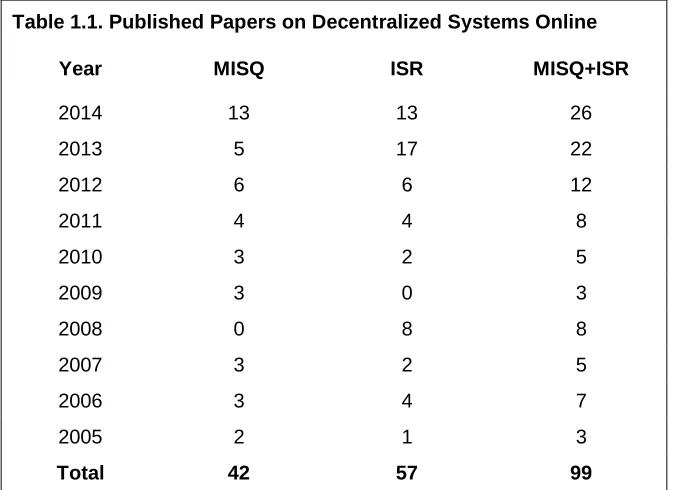
[image:15.612.139.477.155.400.2]years later, in 2014, the same two journals published 26 research papers on the subject, reflecting a steady trend (see Table 1.1).
Table 1.1. Published Papers on Decentralized Systems Online
Year MISQ ISR MISQ+ISR
2014 13 13 26
2013 5 17 22
2012 6 6 12
2011 4 4 8
2010 3 2 5
2009 3 0 3
2008 0 8 8
2007 3 2 5
2006 3 4 7
2005 2 1 3
Total 42 57 99
15
consolidate the many empirical insights generated shortly after the emergence of decentralized systems online and to serve as a stepping stone for future research in the field.
16
Table 1.2. Summary of Context, Theory, and Methods
Essay 1 Essay 2 Essay 3
Context Technological Context Online communities, social media, multisided platforms, online reviews, wikis, crowdsourcing
Smartphone-based crowdsourcing and social media
Open collaboration (OC) systems online
Area of research
Theory development on the governance of decentralized systems online
Digital activism for promoting institutional change OC systems governance against information pollution Target audience Researchers of decentralized systems online; firms using decentralized systems online as part of their business model
Researchers of technology and social activism; organizers of social activism
Researchers of OC systems; participants in OC systems
Theory
Informing theoretical perspectives
Tragedy of the commons; common pool resources (CPR) governance Polycentric information commons; legitimacy and institutional change Polycentric information commons Method
Data source Coding papers
published in MISQ and ISR between 2005 and 2014
Interviews with key informants; electronic communications, and official and media reports
Wikipedia data release processed with a Python script developed by coauthor Aleksi Aaltonen
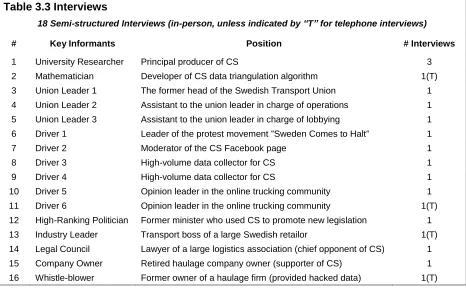
Sample 72 articles 18 interviews, 95
emails, 43 Facebook communication streams, 439
Facebook posts, 621 media stories, 7 official reports
4,325 pollution events and the editing activities in Wikipedia between the posting of a “cleanup” tag and its removal
Analysis approach
Manual coding Episodes and encounters analysis of qualitative data
17
1.2 Essay 1
To add to the body of theories on decentralized information systems online, Essay 1 focuses on the theoretical question of how these systems may be governed to achieve sustainability in the face of threats arising from within because of their openness to participation.2 At present, the literature examining the question of sustainability of decentralized systems online is limited and focused mostly on online communities. This stream of research finds that an increase in the community’s size reduces the efficiency of communication, and that participants are generally sensitive to barriers that raise the opportunity cost of engagement; it also identifies an inherent tension between the need to attract new members while also avoiding alienating old-timers that might be dissatisfied with the changes that new participants bring (Butler 2001; Butler and Wang 2012; Butler et al. 2014). The theory development essay seeks to further advance our understanding about the sustainability of decentralized information systems online by identifying the threats impacting them and the conditions under which these threats may be addressed.
Drawing on the well-established paradigms of tragedy of the commons (Hardin 1968) and
polycentric governance of common pool resource (CPR) systems (Ostrom 1990), in Essay 1, we3
analyze a sample of 72 research articles published in MISQ and ISR on decentralized systems online. We appropriate the Hardin and Ostrom terminologies to code the literature and create a “common language” repository of insights that we subsequently use, in conjunction with Ostrom’s
findings on CPR governance in the physical world, to develop a novel theoretical framework. Conceptualizing decentralized systems online as “information commons” because of their high
2Mindel, V., Mathiassen, L. and Rai, A., 2018. “The Sustainability of Polycentric Information Commons,” MIS
Quarterly (42:2), pp 607-631.
18
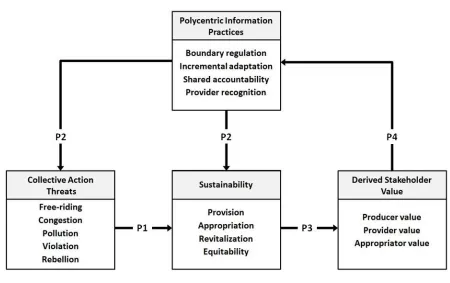
degree of openness to participation, the theory of polycentric information commons (PIC), theorizes on the categories of actors deriving value from participating in information commons; the factors associated with their sustainability; the collective-action threats that arise from within and threaten their sustainability; and the polycentric governance practices that may help them reduce the prevalence of threats and strengthen them in the long run.
Understanding the sustainability conditions for the various web-based decentralized information systems is important for theory for two reasons: (i) these systems represent a novel mode of information production and governance that is distinctly different from past hierarchical models (Benkler 2006; Benkler and Nissenbaum 2006), and (ii) they impact societal outcomes, ranging from affecting markets (Dellarocas 2005; Xu and Zhang 2013) and economic displacement (Chan and Ghose 2014) to outcomes in politics (Gibson and McAllister 2011; Wattal et al. 2010), health (Barak et al. 2008; Chan and Ghose 2014) and education (Agazio and Buckley 2009; Burke et al. 2009). Hence, it is important to understand theoretically what differentiates successful systems from the numerous systems that become unsustainable. Moreover, understanding practically how decentralized information systems may be governed to improve their sustainability odds becomes increasingly important for companies relying on these systems as part of their business model; those companies include YouTube, Airbnb, Uber, eBay, Waze, Facebook, Yelp, TripAdvisor, Twitter, and Craigslist, all of which rely on self-selecting volunteers to provide the bulk of their content.
1.3 Essay 2
19
decentralized systems online are being used to promote social change (Agarwal et al. 2014; Aouragh and Alexander 2011; Bennett and Segerberg 2011; Edwards et al. 2013). The literature demonstrates that the use of online communities, social media, crowdsourcing, and crowdfunding online can be useful for fundraising and promoting awareness for various causes, but they are not very impactful beyond these narrow objectives (Bimber et al. 2005; DeLuca et al. 2012). Digital activism online also suffers from the negative perception that it is simply an easy way for people to feel as if they are doing something without actually engaging with the issues beyond cyberspace (Butler 2011). Even when decentralized systems online enable mobilization offline in the real world, the resulting impact is typically disappointing (Friedersdorf 2015; White 2016). This is typically because the congregation of people sharing similar views feeds the echo-chamber effect of continuous reinforcement of agitation among activists (Garrett 2009), which alienates non-activists, while the lack of strong leadership makes it hard for social movements born online to articulate a clear and unified agenda (White 2016, 2017). Thus, despite their rising profile in promoting social change, we still do not fully understand how decentralized systems online can be effectively harnessed to achieve lasting institutional change.
20
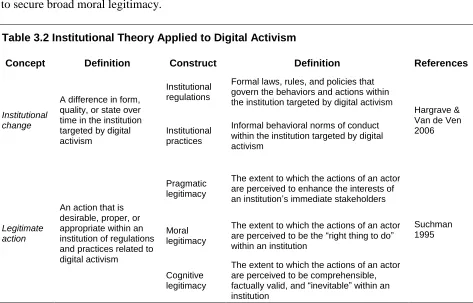
surprise of many, impacted large-scale institutional change, including noticeably shifting public opinion, shifting political alliances, passing new legislations, and changing industry practices. In Essay 2, we analyze CS through the prism of PIC and legitimacy theories. We find that for digital activism to achieve noticeable institutional change, it must establish its pragmatic, moral, and cognitive legitimacy, which is difficult when facing collective-action threats arising from within as well as attacks from opposing actors. By adopting more of a polycentric approach to managing the decentralized systems facilitating it, digital activism is more likely to overcome such treats and achieve the needed legitimacy to impact change.
Essay 2 contributes to the literature on digital activism by showing how it can be harnessed for institutional change. Drawing on the prisms of PIC and legitimacy theories, Essay 2 uses the empirical findings to formulate broad theoretical propositions on the relationship between digital activism and institutional change. In addition, Essay 2 contributes to PIC theory by illustrating its applicability for examining decentralized systems online and for qualitative research in general. Finally, Essay 2 contributes to practice by outlining the problems social movement organizers are likely to encounter in digital activism and how those problems can be lessened by incorporating polycentric practices in the governance and design of their initiatives.
1.4 Essay 3
21
and Nissenbaum 2006; von Hippel and von Krogh 2003). This fact stands in stark contrast to traditional economic theories. No theory of production could have predicted that unorganized and uncompensated self-selecting volunteers can sustain complex enterprises requiring constant updating and maintenance to keep generating value over time (Tapscott and Williams 2008). OC systems emerged in the past two decades, and our limited time perspective prevents us from knowing who is right: those who hype OC systems as a superior way of organizing production, or those who doubt the capacity of OC systems to continuously provide value over the long run. The conflicting findings from empirical research on the quality of OC system outputs—some finding it to be on par with professionally created products (Brown 2011; Chesney 2006; Giles 2005), while others finding it to be subpar (Holman Rector 2008; Kupferberg and Protus 2011; Lavsa et al. 2011)—continue to remind us that the questions of how OC systems resolve quality issues is important for their long-term viability.
22
unsubstantiated rumors and conspiracy theories, manipulated and biased content, and all sorts of incomplete and erroneous information.
In Essay 3, we zero-in on how polycentric practices of shared accountability, boundary regulation,
incremental adaptation, and provider recognition are associated with pollution event resolution in
23
1.5 References
Agarwal, S. D., Barthel, M. L., Rost, C., Borning, A., Bennett, W. L., and Johnson, C. N. 2014. Grassroots Organizing in the Digital Age: Considering values and Technology in Tea Party and Occupy Wall Street,” Information, Communication & Society (17:3), pp 326-341.
Agazio, J. and Buckley, K.M., 2009. “An untapped resource: Using YouTube in nursing education,” Nurse educator, (34:1), pp23-28.
Aouragh, M., and Alexander, A. 2011. “The Arab Spring| the Egyptian Experience: Sense and NNonsense of the Internet Revolution,” International Journal of communication (15:5), pp 1344-1358.
Barak, A., Boniel-Nissim, M. and Suler, J., 2008. “Fostering empowerment in online support groups,” Computers in Human Behavior, (24:5), pp 1867-1883.
Bateman, P. J., Gray, P. H., and Butler, B. S. 2011. “Research note-the impact of community commitment on participation in online communities,” Information Systems Research
(22:4), pp 841-854.
Benkler, Y. 2006. The Wealth of Networks: How Social Production Transforms Markets and
Freedom, Yale University Press.
Benkler, Y., and Nissenbaum, H. 2006. “Commons‐based peer production and virtue*,” Journal
of Political Philosophy (14:4), pp 394-419.
Bennett, W. L., and Segerberg, A. 2011. “Digital Media and the Personalization of Collective Action: Social Technology and the Organization of Protests Against the Global Economic Crisis,” Information, Communication & Society (14:6), pp 770-799. Bimber, B., Flanagin, A. J., and Stohl, C. 2005. “Reconceptualizing Collective Action in the
Contemporary Media Environment,” Communication Theory (15:4), pp 365-388. Brokowski, L., and Sheehan, A. H. 2009. “Evaluation of pharmacist use and perception of
Wikipedia as a drug information resource,” Annals of Pharmacotherapy (43:11), pp 1912-1913.
Brown, A.R., 2011. “Wikipedia as a data source for political scientists: Accuracy and completeness of coverage,” PS: Political Science & Politics (44:2), pp 339-343.
Brown, A.R., 2011. “Wikipedia as a data source for political scientists: Accuracy and completeness of coverage,” PS: Political Science & Politics (44:2), pp 339-343.
Butler, B. S. 2001. “Membership size, communication activity, and sustainability: A resource-based model of online social structures,” Information Systems Research (12:4), pp 346-362.
Butler, B. S., and Wang, X. 2012. “The cross-purposes of cross-posting: Boundary reshaping behavior in online discussion communities,” Information Systems Research (23:3-part-2), pp 993-1010.
Butler, B. S., Bateman, P. J., Gray, P. H., and Diamant, E. I. 2014. “An Attraction-Selection-Attrition Theory of Online Community Size and Resilience,” MIS Quarterly (38:3), pp 699-728.
Butler, M. 2011. Clicktivism, Slacktivism, or “Real” Activism Cultural Codes of American
Activism in the Internet Era. University of Colorado at Boulder.
Chan, J. and Ghose, A., 2014. Internet’s dirty secret: Assessing the impact of online intermediaries on HIV transmission. MIS Quarterly (38:4), pp 955-975.
24
Dellarocas, C. 2005. “Reputation mechanism design in online trading environments with pure moral hazard,” Information Systems Research (16:2), pp 209-230.
DeLuca, K. M., Lawson, S., and Sun, Y. 2012. “Occupy Wall Street on the Public Screens of Social Media: The Many Framings of the Birth of a Protest Movement,” Communication,
Culture & Critique (5:4), pp 483-509.
Edwards, F., Howard, P. P. N., and Joyce, M. 2013. “Digital Activism and Non‐Violent Conflict,” Available at SSRN: https://ssrn.com/abstract=2595115
Friedersdorf, C. 2015. “Will Black Lives Matter Be a Movement That Persuades? The Atlantic
Online.
Garrett, R. K. 2009. “Echo Chambers Online?: Politically Motivated Selective Exposure Among Internet News Users,” Journal of Computer‐Mediated Communication (14:2), pp 265-285.
Gibson, R.K. and McAllister, I., 2011. “Do online election campaigns win votes? The 2007 Australian “YouTube” election,” Political Communication (28:2), pp.227-244. Giles, J. 2005. “Internet Encyclopedias go head to head,” Nature (438:7070), pp 900-902. Hardin, G. 1968. “The tragedy of the commons,” Science (162:3859), pp 1243-1248. Hippel, E. V., and Krogh, G. V. 2003. “Open Source Software and the “Private-Collective”
Innovation Model: Issues for Organization Science,” Organization Science (14:2), pp 209-223.
Holman Rector, L. 2008. “Comparison of Wikipedia and other Encyclopedias for Accuracy, Breadth, and Depth in Historical Articles,” Reference Services Review (36:1), pp 7-22. Kupferberg, N., and Protus, B. M. 2011. “Accuracy and completeness of drug information in
Wikipedia: an assessment,” Journal of the Medical Library Association (99:4), pp 310-322.
Lavsa, S.M., Corman, S.L., Culley, C.M. and Pummer, T.L., 2011. “Reliability of Wikipedia as a medication information source for pharmacy students,” Currents in Pharmacy Teaching
and Learning (3:2), pp 154-158.
Lim, S. and Simon, C., 2011. “Credibility judgment and verification behavior of college students concerning Wikipedia,” First Monday (16:4).
Majchrzak, A. 2009. “Comment: Where is the Theory in Wikis?” MIS Quarterly (33:1), pp 18-20.
Miller, J. C., and Murray, H. B. 2010. “Wikipedia in court: When and how citing Wikipedia and other consensus websites is appropriate,” St. John’s Law Review (84), pp 633-656. Peoples, L.F., 2009. “The Citation of Wikipedia in Judicial Opinions,” Yale Journal of Law &
Technology (12), pp 1-51.
Suchman, M. C. 1995. “Managing Legitimacy: Strategic and Institutional Approaches,” Academy
of Management Review (20:3), pp. 571-610.
Tapscott, D., and Williams, A. D. 2008. Wikinomics: How mass collaboration changes everything. Penguin.
von Krogh G. and Spaeth, S., 2007. “The open source software phenomenon: Characteristics that promote research,” The Journal of Strategic Information Systems (16:3), pp 236-253. Wattal, S., Schuff, D., Mandviwalla, M., and Williams, C. B. 2010. “Web 2.0 and Politics: The
2008 US Presidential Election and an E-Politics Research Agenda,” MIS Quarterly
(34:4), pp 669-688.
25
White, M. 2017. “Occupy and Black Lives Matter Failed. We can either Win Wars or Win Elections,” The Guardian online
Xu, S. X., and Xiaoquan (Michael) Zhang. 2013. “Impact of Wikipedia on Market Information Environment: Evidence on Management Disclosure and Investor Reaction,” MIS
26
CHAPTER 2: THE SUSTAINABILITY OF POLYCENTRIC INFORMATION
COMMONS
ABSTRACT
Research on various distributed online information systems—including blogging, crowdsourcing, media sharing, online communities, online reviews, open source software development, social media, wikis, peer-to-peer file sharing, and two-sided electronic markets—shows that the level of user engagement and overall activity in most systems eventually decline substantially. Here, we draw on Hardin’s theory of the tragedy of the commons and Ostrom’s theory of polycentric governance to introduce a unifying theory of polycentric information commons (PIC) that explains these phenomena. Further, our theory illuminates how polycentric governance principles, as manifested in system rules and infrastructure features, counterbalance various sustainability threats arising from unrestricted participation. By integrating previous research findings and offering new insights into information and governance practices, the theory, practically applied, can enhance the likelihood of sustained participation across diverse, decentralized online information systems. We conclude by discussing how researchers can use the theory in empirical investigations and how they can engage in theoretical elaborations.
Key Words: Theory development, tragedy of the commons, polycentricity, governance,
27
2.1 Sustainability of Decentralized Systems Online
We increasingly depend on information systems (IS) with a high degree of volunteer user participation and consequential sustainability threats, including blogging, crowdsourcing, media sharing, online communities, online reviews, open source software (OSS) development, social media, wikis, peer-to-peer (P2P) file sharing, and two-sided electronic markets. Although many researchers have studied these decentralized online information systems and produced important insights over the past several years, the literature remains fragmented and light on theory (Majchrzak 2009; Singh et al. 2011). With the exception of the theory of social dynamics in online settings (Levina et al. 2014), which explains power relations across various user-generated content platforms, the few theories recently published are primarily phenomenon-specific (Bateman et al. 2011; Butler et al. 2014; Howison et al. 2014; Kane et al. 2012) and have limited applicability beyond their explicit context of origin. It is not surprising, then, that researchers are increasingly calling for “more highly socialized and multitheoretic explanations of community development” (Johnson et al. 2014) that “cover the interplay with institutions, goods, and the social practice” (Von Krogh et al. 2012). In response, our work integrates contemporary empirical evidence in IS research and theoretical insights from the literature on the sustainability of online communities (Butler 2001; Butler et al. 2014; Butler et al. 2012) with the literature on the governance of common pool resource (CPR) institutions (Ostrom 1990) to develop a theoretical framework aimed at explaining and predicting outcomes in decentralized online information systems.
28
information systems are (1) highly accessible4 to content consumers (typically at no cost) and (2) highly accessible to content producers who, in most cases, engage without payment. These features give rise to a third: (3) high-accessibility characteristics, which let individuals join for free and leave anytime, can lead to high volatility in consumer and producer participation. Although commercial (and sometimes nonprofit) organizations create and maintain the technical infrastructure of these systems, most of their content is not provided by system owners; rather, it is generated in an unordered, decentralized fashion by volunteer participants. This freedom of participation creates the conditions for sudden growth, but it also makes the systems vulnerable to sudden massive exits of content producers. This open access and high dependency on self-selecting individuals is the foundation on which we build our theory, guided by the following overarching research question: How can decentralized online information systems mitigate the threats to
sustainability that follow from their high degree of openness to participation?
For centuries, ecologists, demographers, economists, sociologists, and political scientists have studied and debated questions related to the sustainability of various types of openly accessible resource systems. The discourse on the topic can be coarsely categorized into two prominent—yet rival—schools of thought. One school is best represented by ecologist Garret Hardin, and the other by political scientist Elinor Ostrom.
In 1968, Hardin published his influential thought experiment in which he describes the dissipation of medieval-type grazing commons resulting from unchecked individual-level overgrazing and pollution. “The tragedy of the commons,” as it came to be known, grew to be the leading paradigm in political science and economics, taught in college classes and public administration circles as a
29
cautionary tale of what might happen to collective resources if strong, top-down institutions do not sufficiently curtail individual freedoms (Hardin 1968). According to the logic of the tragedy of the commons, decentralized online information systems will eventually decline and become unsustainable because of their high level of openness. Indeed, empirical evidence suggests that many online communities, after initial growth, have experienced a substantial decline in participation (as in Napster and MySpace) or ceased activity all together (Butler 2001; Butler et al. 2014; Butler et al. 2012; Hann et al. 2013; Ma et al. 2007; Moon et al. 2008; Ransbotham et al. 2011; Stewart et al. 2006; Zhang et al. 2013). Even high-profile systems such as Wikipedia, according to observers studying them, show signs of declining participation (Halfaker et al. 2011). The rise of cyber-archeology, which “digs” into failed digital communities and their digital artifacts, further illustrates the tendency of decentralized online information systems to decline or collapse (Harrison 2009; Jones 1997). Can the decline of these systems be viewed, at least partially, as a form of tragedy of the commons—that is, an inevitable outcome resulting from “too much” freedom in how people engage and interact with these technologies? If so, how can we then reconcile the supposed inevitability of decline with the fact that so many successful decentralized online information systems such as YouTube and Facebook manage to remain robust?
According to Ostrom, the tragedy of the commons oversimplifies reality, and its conclusion—that a central authority must significantly curtain individual freedoms—is highly problematic5 (Ostrom 1990). Ostrom and her colleagues analyzed thousands of cases of local resource governance arrangements (such as grazing grounds, fisheries, forests, and watersheds) and, while they did find instances of tragedies, they also found numerous examples of sustainable and well-functioning
5 Ostrom challenged Hardin’s notion of open access commons and instead maintained that Hardin in effect was
30
resource systems that operate without strong centralized authorities (Nagendra et al. 2012; Ostrom 1990; Schlager et al. 1999). More often than not, local communities, for hundreds of years in some cases, were found to be successful in governing CPRs with minimal oversight from central authorities (Ostrom 1990). That is, contrary to the tragedy of the commons, in most cases people communicate and work together to find sensible ways to share resources without endangering their long-term sustainability. Ostrom observed that the most resilient governance arrangements were those that dynamically managed boundary setting and mutual accountability through a high degree of inclusivity in decision-making. Increasing the number of independent decision-making centers generates system stability by reinforcing individual commitment to the CPR rather than delegating this responsibility to a narrow, elite group of decision makers. These boundary-setting and mutual-accountability mechanisms constitute local arrangements that keep wrongdoers at bay without compromising the freedoms of others. The mechanisms emerge from mutual adjustments among the involved autonomous actors, rather than relying primarily on central governance structures or private market forces; they thus represent a third mode of governance: polycentricity. Following this school of thought, could one major differentiating factor between successful and unsuccessful decentralized online information systems be rooted in the extent to which they embed polycentric governance principles in their design?
31
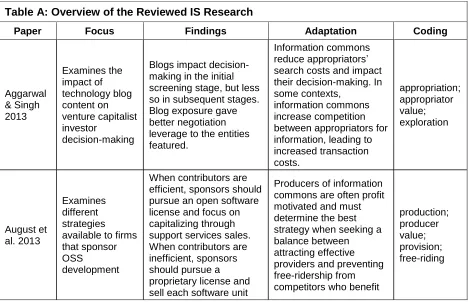
many collective-action threats resulting from their inherent openness. Although polycentricity cannot explain everything we need to know about the sustainability of decentralized online information systems, we use it as a starting point for developing a foundational theory. While we build on Ostrom’s insights, we acknowledge that decentralized online information systems are sociotechnical phenomena that do not entirely fit the definition of CPR systems. The difference in contexts necessitates a careful borrowing and adaptation of specific concepts to enhance the theory development beyond a simple overt reproduction that would fail to increase our understanding of the phenomena at hand (Whetten et al. 2009). Hence, in our theorizing, we rely on both our reasoning and our creative imagination (Bacharach 1989; Rivard 2014) supported by two literature streams: (i) the general literature on polycentric governance of shared resources, and (ii) the literature on decentralized online information systems (see the Appendix for details of our IS literature review).
We structure the paper in accordance with Zmud’s (1998) recommendations to develop “pure” IS theory papers by defining the principle phenomena, explicating core concepts, and relating them to each other while articulating their raisons d’être. Accordingly, we next specify the proposed theory’s content and boundaries by defining information commons and specifying the many different IS phenomena that fit the definition. We subsequently conceptualize and define the core concepts underlying our theoretical development: derived stakeholder value, sustainability,
collective-action threats, and polycentric governance practices. We then develop a conceptual
32
2.2 Information Commons
To facilitate analysis of their sustainability, we conceptualize decentralized online information systems as information commons—that is, a highly accessible, self-rising information system in
which stakeholders share an overarching goal. To conceptually unify several streams of research,
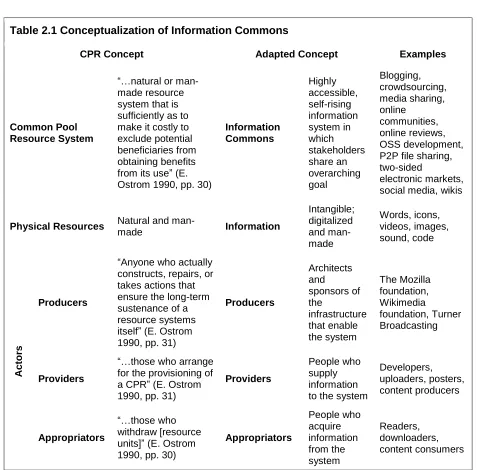
we addressinformation commons in their generic form, acknowledging that future research should explore differences across their specific forms, such as whether an information commons is stand-alone, nested within traditional systems, or entangled with other information commons. To set the boundary conditions for our theorizing, we draw on Ostrom’s work to conceptualize information commons (Table 2.1) and describe contemporary phenomena that represent information commons (Table 2.2).
33
Table 2.1 Conceptualization of Information Commons
CPR Concept Adapted Concept Examples
Common Pool Resource System
“…natural or man-made resource system that is sufficiently as to make it costly to exclude potential beneficiaries from obtaining benefits from its use” (E. Ostrom 1990, pp. 30)
Information Commons Highly accessible, self-rising information system in which stakeholders share an overarching goal Blogging, crowdsourcing, media sharing, online communities, online reviews, OSS development, P2P file sharing, two-sided
electronic markets, social media, wikis
Physical Resources Natural and
man-made Information
Intangible; digitalized and man-made Words, icons, videos, images, sound, code Act o rs Producers
“Anyone who actually constructs, repairs, or takes actions that ensure the long-term sustenance of a resource systems itself” (E. Ostrom 1990, pp. 31)
Producers Architects and sponsors of the infrastructure that enable the system The Mozilla foundation, Wikimedia foundation, Turner Broadcasting Providers
“…those who arrange for the provisioning of a CPR” (E. Ostrom 1990, pp. 31)
Providers
People who supply information to the system
Developers, uploaders, posters, content producers Appropriators “…those who withdraw [resource units]” (E. Ostrom 1990, pp. 30)
Appropriators People who acquire information from the system Readers, downloaders, content consumers
Hardin warned about the dire consequences of accessibility; however, Ostrom, basing her assertion on a substantial body of empirical observations, argued that, in the majority of cases, a high degree of accessibility prompts the emergence of a self-rising order. Taking Ostrom’s position, we identify self-rising order from within—as opposed to top-down design—as the second
34
the property as “self-emerging” (Hann et al. 2013), while online community research calls it “inherently evolving” (Butler et al. 2014). Moreover, blogs have different centers of influence that emerge spontaneously (Chau et al. 2012; Howison et al. 2014), and online communities involve autonomous centers that emerge and disappear without any predefined pattern (Johnson et al. 2014). Although the self-rising property of information commons is widely recognized in extant literature, it is rather unconventional. Throughout history, traditional information systems—from the hieroglyphs in the Great Pyramid to printed newspapers—were produced by specialists working within hierarchical structures of authority. Hence, based on the self-rising property alone, information commons are distinctly unique types of information systems.
In these systems, people play various roles; IS research describes these roles using many different terms, including users, consumers, participants, contributors, developers, uploaders, bloggers, and posters. To further clarify our definition of information commons, we adapt Ostrom’s (1990) concepts to classify these principal stakeholders into three distinct categories: (i) producers—the
architects and sponsors of the infrastructure that enable the system; (ii) providers—the people who
supply information to the system; and (iii) appropriators—the people who extract information
from the system. Of course, an individual may play more than one role; most people are both providers and appropriators of content on social media platforms, for example. Distinguishing among the principal actors involved in information commons also facilitates cross-case analyses (Darke et al. 1998). We expand further on these stakeholders in the next section.
35
motivated by different considerations and goals, they inevitably share some overarching goal that ties them to the information commons. For instance, sellers and buyers in two-sided electronic markets such as eBay, Craigslist, Airbnb, and Uber are typically interested in maximizing their individual utility but share the overarching goal of transacting. Similarly, providers of code, articles, and posts may have different motivations and goals than appropriators, yet they both share the overarching goal of exchanging the information; otherwise, they would not be participating in the information commons.
Despite common characteristics, an important difference exists between information commons on the one hand, and Hardin’s commons and Ostrom’s CPRs on the other. Hardin and Ostrom both addressed physical resource systems with tangible natural or man-made resource units. This materiality makes the resource units subtractable—implying that their consumption depletes the CPR (Ostrom 1990). In contrast, information commons pertain to resources in digitalized form, implying that the resources in information commons cannot be depleted through overconsumption. If anything, information commons become more sustainable through increased consumption because of network effects that bring about the comedy of the commons (Rose 1986) rather than
the tragedy of the commons (Hardin 1968). This difference in resources is a given and, in any case,
36
Information commons are information systems. Hence, to bound the phenomena of information commons, we emphasize the representation and token views of information (McKinney Jr et al. 2010). Information can be viewed as representative of something that exists independently in the world as an object, is reflected through symbols and signs,6 and becomes meaningful only after a brain (whether organic or computerized) processes it. An image or a video is simply mediums transferring static and dynamic visuals with or without auditory sounds—all of which are meaningless without a brain to process them. Similarly, words on the screen, numbers, and symbols (be they emojis or lines of code) are also just meaningless shapes outside a human context (language) that can attach significance to them. Subscribing to the representation view, we can see that, even though information commons differ vastly in the ways in which information is transferred within them, they are nonetheless information systems. We can also see that the process of encoding information into symbols and signs and the subsequent interpretation of them is inherently vulnerable. The “pure” form of information typically gets compromised to a certain degree because of the limitations of symbol systems and of the processing capabilities of humans and computers.
The token view is also worth considering here. This view asserts that information, while abstract
in general, acquires a certain tangible property when encoded into symbols and signs via an information system in which it can be further molded, moved, stored, repackaged, retrieved, and distributed (McKinney jr et al. 2010). The token view suggests that information, despite not being a physical resource, nonetheless is “governable.” When providers upload, delete, edit, transfer, and publish content, they engage in acts of information governance (as opposed to system governance,
6 Examples include language symbols, such as words, numbers, icons, and codes, as well as sensory signs, such as
37
which is the producers’ domain). Thus, when we posit that information commons are “self-rising,” we do not mean that they pop into existence out of nowhere, but rather that the content and information in them emerge in an unorganized fashion from the actions of individual providers.
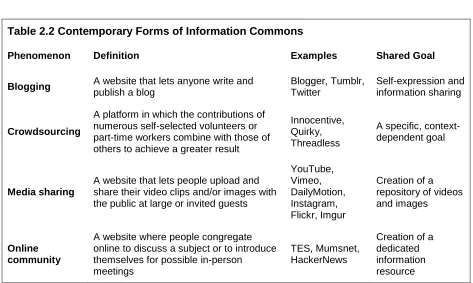
In Table 2.2, we list exemplary contemporary phenomena that we conceptualize as information
commons. Because these phenomena and the related literature are still emerging, each
[image:38.612.70.543.434.717.2]phenomenon has multiple definitions and names that at times overlap. For instance, we list Wikipedia as a wiki, but it may also be viewed as an online community or crowdsourcing platform. In this case, we categorize Wikipedia as a wiki because of its unique characteristic of live-time editing, which does not exist in most online communities or crowdsourcing platforms. The phenomena in Table 2.2 differ in many respects, but they all share the defining characteristics of information commons—that is, they are highly accessible, self-rising information systems in which stakeholders share an overarching goal, even if some of their individual goals differ and possibly conflict within the overarching goal’s framework.
Table 2.2 Contemporary Forms of Information Commons
Phenomenon Definition Examples Shared Goal
Blogging A website that lets anyone write and publish a blog
Blogger, Tumblr, Twitter
Self-expression and information sharing
Crowdsourcing
A platform in which the contributions of numerous self-selected volunteers or part-time workers combine with those of others to achieve a greater result
Innocentive, Quirky, Threadless
A specific, context-dependent goal
Media sharing
A website that lets people upload and share their video clips and/or images with the public at large or invited guests
YouTube, Vimeo, DailyMotion, Instagram, Flickr, Imgur
Creation of a repository of videos and images
Online community
A website where people congregate online to discuss a subject or to introduce themselves for possible in-person
meetings
TES, Mumsnet, HackerNews
38
Online reviews
A platform on which reviews can be posted about people, businesses, products, or services
Yelp, TripAdvisor, Amazon, IMDB
Self-expression and peer signaling on quality of products and services
Open source software development
A website that software developers can use to control and manage free and open-source software development
SourceForge, GitHub, BerliOS
Making software publically available to study, change, and distribute
Peer-to-peer file sharing
A platform that lets users access media files such as books, music, movies, and games
Pirate Bay, Torrentz, isoHunt
Sharing of digital content
Two-sided electronic markets
A platform that lets individuals post and access information for making online or offline transactions
eBay, Craigslist,
Airbnb, Uber Transacting
Social media
Online forms of communication that individuals and companies use to share information with interested parties (friends, colleagues, customers, etc.)
Facebook, MySpace, Friendster
Maintaining social ties
Wikis A website that lets users collaboratively edit its content and structure
LyricWiki, WikiAnswers, wikiHow, Wikipedia
Amassing a large body of information
2.3 Derived Stakeholder Value
Realizing the shared goal of an information commons requires that the involved stakeholders receive value7 from it. Accordingly, we define derived stakeholder value as the benefits
stakeholders gain from being involved with an information commons. Although a significant body
of IS research has examined IT’s value by focusing on tangible aspects of organizational performance, the value of information commons cannot be adequately gauged through such traditional measures. In information commons, derived value is context dependent, can be tangible or intangible, is realized at both the individual and collective levels, and is likely to be multifaceted. Prior research reveals that IT users can derive different types of value including satisfaction, self-expression, enjoyment, and economic value in different contexts (Agarwal et al. 2000; Kohli et al.
7 The word value can mean either “a person’s principles” or “worth.” Here, we refer to value as worth, which is how
39
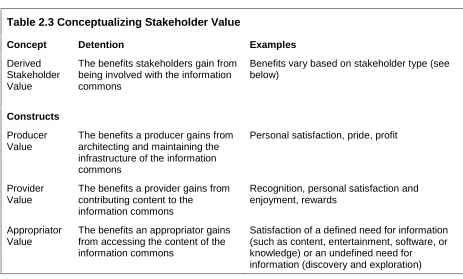
2008; Melone 1990); all of these facets of value can be relevant when examining derived stakeholder value in information commons. Drawing on these insights, we distinguish between three types of actors involved in information commons and propose the following constructs related to derived stakeholder value: (i) producer value, (ii) provider value, and (iii) appropriator value.
2.3.1 Derived Producer Value
We define producer value as the benefits a producer gains from architecting and maintaining the
infrastructure of an information commons. Information commons support may require an ongoing
40
Table 2.3 Conceptualizing Stakeholder Value
Concept Detention Examples
Derived Stakeholder Value
The benefits stakeholders gain from being involved with the information commons
Benefits vary based on stakeholder type (see below)
Constructs
Producer Value
The benefits a producer gains from architecting and maintaining the infrastructure of the information commons
Personal satisfaction, pride, profit
Provider Value
The benefits a provider gains from contributing content to the
information commons
Recognition, personal satisfaction and enjoyment, rewards
Appropriator Value
The benefits an appropriator gains from accessing the content of the information commons
Satisfaction of a defined need for information (such as content, entertainment, software, or knowledge) or an undefined need for
information (discovery and exploration)
2.3.2 Derived Provider Value
We define provider value as the benefits a provider gains from contributing content to an
information commons. In some information commons, providers can expect to receive tangible
41
2.3.3 Derived Appropriator Value
We define appropriator value as the benefits an appropriator gains from accessing the content of
an information commons. Appropriators turn to information commons to satisfy a specific need
for information or an indeterminate need to explore (Aggarwal et al. 2013; Browne et al. 2007; Heer et al. 2005). The need for information is personal for each appropriator and varies greatly across different information commons—ranging from a need to learn about transaction opportunities or the availability of free software to a need to know what members of one’s social circle are doing. Often, appropriators seek to satisfy the need to explore or simply to be entertained. Regardless of the context, the derived value from satisfying the need for information and discovery determines the likelihood of the appropriator returning to the information commons. Like providers, appropriators are also sensitive to barriers that raise their opportunity cost of information retrieval and exploration (Gu et al. 2007; Jones et al. 2004). Examples of opportunity cost-raising barriers include cumbersome registration mechanisms, interfaces that are difficult to navigate, cybersecurity issues, and other factors that reduce the seamlessness of appropriation.
2.4 Sustainability
42
sustainability can help explain why an information commons fails or succeeds in realizing its overarching goal, as well as help predict a commons’ trajectory. Accordingly, we define sustainability as the capacity of an information commons to continuously provide value to its
stakeholders. Ultimately, any information commons seeks to realize this overarching goal, whether
it is achieved through continuous activity, such as the ongoing cataloging of all human knowledge or ongoing maintenance of social relationships, or in a more temporary fashion that completes the overarching goal and countermands the need for sustainability, such as solving a technical problem in an online forum. Drawing on insights from CPR and IS research, we put forward four constructs of sustainability: (i) provision, (ii) appropriation, (iii) revitalization, and (iv) equitability.
Table 2.4 Conceptualizing Derived Stakeholder Value
Concept Definition Examples
Sustainability
The capacity of the information commons to continuously provide value to its stakeholders
The micro-blogging platform Pownce is an information commons that is no longer
sustainable due to low provision, appropriation, and revitalization
Constructs
Provision
The extent to which providers continuously input information into the information commons
Posting and uploading of digital content on YouTube, Facebook, eBay, Craigslist, and Digg
Appropriation
The extent to which appropriators continuously consume information from the information commons
Viewing, reading, listening to, and downloading digital content on YouTube, Facebook, eBay, Craigslist, and Digg
Revitalization
The rate of information provision between new and disengaged providers
The rate of digital content contributions between new and inactive providers on YouTube,
Facebook, eBay, Craigslist, and Digg
Equitability
The extent to which provision activities are distributed across a base of providers
The extent to which a broad rather than narrow base of individuals provide information on YouTube, Facebook, eBay, Craigslist, and Digg
2.4.1 Provision
43
Provision activities in information commons rely on self-selecting individuals who come from vastly different backgrounds (Hann et al. 2013; Shah 2006; Stewart et al. 2006) and who inevitably incur the opportunity cost of forfeiting their time and energy for no tangible return (Butler et al. 2014). As a result, provision of information is diverse and volatile (Daniel et al. 2013; Gu et al. 2007; Ransbotham et al. 2011). Understanding provision activities is thus important for predicting whether an information commons is growing, stabilizing, or declining.
2.4.2 Appropriation
Appropriation is a fundamental activity in information commons. In contrast to subtractable physical resource systems, which are strained as appropriation grows (for instance, ever-increasing hunting can cause extinction), information commons depend on continuous appropriation to reinforce network effects (Susarla et al. 2012). In addition, studies find that providers in information commons are often motivated by continuous appropriation (Goes et al. 2014; Huberman et al. 2009; Jabr et al. 2013; McKinney Jr et al. 2010; Moon et al. 2008; Singh et al. 2014; Zhang et al. 2013) and that information commons production is often supported by appropriation—through subscriptions, advertising, or brokerage fees. As such, understanding appropriation predicts the likelihood of an information commons to continue offering value.
2.4.3 Revitalization
Sustainability of natural resource systems is often gauged by the rate of resource unit replacement (Ostrom 1990). Although information does not decay8 and is not subject to physical depletion, the representation view implies that information is interdependent with the agency transferring it (McKinney Jr et al. 2010). Thus, attraction-selection-attrition theory (Butler et al. 2014) suggests
44
that the balance between newly engaged and withdrawing information providers (that is, the balance between those who enter and those who are no longer active) is an important predictor of an information commons’ capacity to continue generating value for its stakeholders. Accordingly, we focus on information revitalization—that is, the difference between contributions of content
from new providers and those who have become disengaged. A positive balance between provider entrance and exit (that is, a net gain in the number of providers) accompanied by an overall decrease in provision indicates that the new providers are not as productive as the providers that left the system. In contrast, a negative balance between the entrance and exit of providers (a net loss in the number of providers) accompanied by an overall increase in provision indicates that the burden of supplying the information commons with content is shared among fewer providers.
2.4.4 Equitability
45
Sustainability is as important for information commons as it is for organisms, ecosystems, and other artificial resource systems. On that account, the information commons are not unique. On the other hand, as highly accessible, self-rising information systems, information commons operate under conditions of uncertainty that make them more vulnerable to collective-action threats than traditional information systems.
2.5 Collective-Action Threats
Many factors can adversely or positively impact the sustainability of information commons. Ostrom identifies six institutional factors that include no less than 43 subfactors for analyzing socio-ecological system sustainability (Ostrom 2009). Factors known to reduce information commons’ capacity to provide value to their stakeholders include government censorship, insufficient internet infrastructure, competition from other information commons, poor design, information overload, and lack of capital (Christine Roy et al. 2001; Rochet et al. 2003; Rosen and Purinton 2004; Sullivan 2012). Factors that increase information commons’ capacity to provide value include uniqueness, virtuous network effects, and provision volume (Butler et al. 2014; Ellison et al. 2007; Prahalad et al. 2013). To advance research into these factors and maintain the thematic consistency of our theory development effort, we focus on collective-action threats to sustainability. Building on the notion of the tragedy of the commons, we conceptualize a collective-action threat as an adverse aggregate effect that is caused by individual-level actions.
46
rules are followed and processes carefully executed amplifies the potential for opportunistic behavior that can lead to negative consequences, including loss of trust, widespread desertion, and even crackdown by external authorities. Synthesizing observations from the literature on CPR management (Ostrom 1990) and the commons (Hardin 1968), with insights from the diverse body of research on decentralized online information systems, we identify five collective-action threats: (i) free-riding, (ii) congestion, (iii) pollution, (iv) violation, and (v) rebellion (see Table 2.5). Our theorizing of the five phenomena as collective-action threats is inspired by Hess and Ostrom’s (2003) conceptualization of information as a CPR; works on “open commons,” such as roads (Benkler et al. 2013); Hardin’s tragedy of the commons logic, which focuses on individual-level actions’ adverse effects on collective outcomes in an environment with few restrictions on such actions; and examples from the literature on decentralized online information system.
Table 2.5 Conceptualizing Collective-action Threats
Concept Definition Examples
Collective-action Threats
Adverse aggregate effects that are caused by individual-level actions
Individual-level consumption as a cause of global warming; individual-level tax evasion as a cause of budget shortages
Constructs
Free-riding The extent to which appropriators evade information provision
Consuming but not contributing to online reviews platforms, discussion boards, online support communities, P2P file sharing
Congestion
The extent to which appropriation or provision clogs the information commons
Slowdowns in video streaming, online gaming networks, edit wars on Wikipedia
Pollution
The extent to which information fails to be aligned with the information commons’ overarching goal
Electronic word-of-mouth manipulation, article vandalism, false rumors spread on social media
Violation
The extent to which providers break internal and external morals, rules, and laws
Copyright violation, cyber bullying, spread of hate speech, Illegal pornography
Rebellion
The extent to which providers exit because of dissatisfaction with producer actions
47
2.5.1 Free-riding
We define free-riding as the extent to which appropriators evade information provision. Extracting resource units from a resource system without contributing to it on a large, continuous scale might endanger that system’s sustainability (Ostrom 1990). The vast majority of appropriators never become active providers, and while information commons differ in their tolerance for free-riding, the extent to which appropriators avoid acting as providers will inevitably impact the information commons’ sustainability prospects. For instance, if two information commons occupy the same niche, yet free-riding is substantially higher in one than the other, then—all else being constant— we can reasonably predict that the latter is more likely to be sustainable in the long run. Information provision carries an opportunity cost that differs vastly across individuals (Butler et al. 2014). If people do not think that the benefit of information provision outweighs the cost of forfeiting their time and energy, they are more likely to free-ride. Smaller information commons, in which each additional provider has a relatively high marginal effect, are especially vulnerable to free-riding. Free-riding behavior is cited as a problem in OSS development (Baldwin et al. 2006), P2P file-sharing networks (Adar et al. 2000; Hosanagar et al. 2010; Johar et al. 2011; Karakaya et al. 2009; Rodrigues et al. 2010), discussion forums (Gu et al. 2007; Wasko et al. 2005), and reputation mechanisms (Liu et al. 2004).
48
appropriators might not contribute information, but may act as “ambassadors” and attract others to join (Susarla et al. 2012) or may engage in mundane but necessary tasks, such as editing and organizing content in wikis (Beck et al. 2015). When appropriators make contributions other than direct provisioning of information, they are playing a constructive role toward sustaining the commons and therefore should not be viewed as free-riders.
2.5.2 Congestion
We define congestion as the extent to which appropriation or provision clogs an information
commons. CPRs are vulnerable to spikes in appropriation that, in extreme cases, can render the