Munich Personal RePEc Archive
Ethnic diversity market structure and
risk sharing in developing countries
Jellal, Mohamed and Zenou, Yves
Al Makrîzî Institut d’Economie
2006
Online at
https://mpra.ub.uni-muenchen.de/38435/
Ethnic Diversity, Market Structure
and Risk Sharing in Developing Countries
∗
Mohamed Jellal
CES, Universit´e Mohamed V and Conseils-Eco, Toulouse
Yves Zenou
†IUI and GAINS, Universit´e du Maine
September 21, 2004 (Revised March 31, 2005)
Abstract
The paper addresses mainly three questions. One, do workers tend to be employed by employers of the same ethnic group; two, what is the structure of the equilibrium wage contract, and three, do more ethnically homogeneous labor markets tend to have different labor contracts than more ethnically diver-sified ones. The answer to thefirst question is in the affirmative - in equilibrium all employers offer the same wage contract and workers are hired by employers of the closest ethnic affiliation. In terms of the equilibrium wage contract, its nature depends on the attitude towards risk of both sides of the market. Finally, the answer to the third question is also in the affirmative since the more homogenous the labor market, the more deterministic is the wage.
Keywords: ethnicity, sharecropping, piece rates.
J.E.L. Classification: D43, J33, O12
∗We would like to thank Hillel Rapoport as well as two anonymous referees for their helpful comments. Yves Zenou thanks the Marianne and Marcus Wallenberg Foundation forfinancial support.
†Corresponding author. Address: IUI, The Research Institute of Industrial Economics,
“Those who study modern Africa commonly highlight three features: its poverty, its instability, and its ethnic diversity. ... scholars reason that Africa is poor because it is unstable and that its instability derives from its ethnic complexity. Ethnicity thus lies, it is held, at the root of Africa’s development crisis.”
Robert H. Bates (2000)
1
Introduction
In recent years, there has been an increasing interest in the economic conse-quences of ethnic diversity, especially in terms of economic development and growth (Barro, 1991; Mauro, 1995; Easterly and Levine, 1997; Montalvo and Reynal-Querol, 2005). These studies performed at the country level suggest that ethnically diverse societies have slower economic growth and are more prone to corruption and political instability than ethnically homogenous soci-eties as a result of political conflict across ethnic groups. As Barr and Oduro (2002) put it, “surely the time has come to place the economics of ethnicity on the agenda for policy debate”.
However, to the best of our knowledge, few researches have investigated the economic consequences of ethnicity at a more microeconomic level. Miguel and Gugerty (2005) examine the impact of ethnic diversity on local public provision (i.e. local funding of primary schools and community water wells) in sub-Saharian Africa (western Keyna). They show that ethnic diversity is negatively related to local public goods provision in this rural African setting because social sanctions are imposed more effectively within ethnic groups than between groups. In another paper (Barr and Oduro, 2002), the consequences of ethnic fractionalization (i.e. the segmentation of a population into several groups that are distinct in terms of language and/or culture) on Ghana’s labor market is analyzed. Their mainfinding is to show that workers who are related to their employers earn a wage premium.
The aim of the present paper is to follow this line of research by analyzing the impact of ethnic diversity on labor contracts in developing countries.
(uncertainty, risk and moral hazard problems), (ii) screening workers of differ-ent abilities (adverse selection problems), (iii) market imperfections for inputs besides land (see in particular Binswanger and Rosenzweig, 1982, McIntosh, 1984, Eswaran and Kotwal, 1985). All of these approaches have been well developed both theoretically and empirically (see in particular Stiglitz, 1974, Cheung, 1969, McIntosh, 1984, Newberry and Stiglitz, 1979, Shaban, 1987), even though the third approach has received less attention in the literature.
To the best of our knowledge, the link between ethnic diversity and wage contracts has been neglected and the aim of this paper is to provide a simple model that sheds some light on these aspects. It is indeed well documented that, in most countries, individuals tend to work with employers of the same ethnic origin. In developed countries, foreigners and recent migrants, like for example the Cubans in Florida or the Chinese and Mexican in California, form closed-knit societies and work together in cities (see e.g. Borjas, 1999). The same is true in the U.K. for Indians, Bangladeshi or Pakistanis (see e.g. Modood et al., 1997). In developing countries, the ethnic origin is even more crucial to understand the way labor markets work both in urban and rural areas (see e.g. Assaad, 1997, and Wahba and Zenou, 2005, for Egypt, Sadoulet et al., 1997, for Philippines, van de Walle and Gunewardena, 2001, for Viet Nam, Foster and Rosenzweig, 2001, for India and Pakistan, Barr and Oduro, 2002, and Udry and Conley, 2004, for Ghana, Krishnan and Sciubba, 2004, for Ethiopia).
To be more precise, we consider a population of workers (that could be for example laborers) and employers (that could be for example landlords) who belong to different ethnic groups, so that working together implies a cost (be-cause of language, religion and/or cultural differences). Part of the production is random (because for example of climate change) and not observable (ex ante) by both employers and employees. Our analysis encompasses both rural and urban labor markets.
documents the fact that working with in-kins prevents workers to shirk (moral hazard) because of reputation effects and peer group (or family) pressures.1
Contrary to the ‘standard’ approach with moral hazard where the focus is on the tension between the interests of the workers (laborers) and the firm (landlord) in an environment where (like here) output is not perfectly observ-able, in our model, the ‘tension’ is between employers of different ethnic origins. Indeed, because workers and employers belong to different ethnic groups, there is a cost for workers to work for an employer with a different ethnic back-ground. This implies that employers have market power over workers with similar ethnic origin, so that they play a Nash game with the other employers to determine the optimal wage contract. In particular, given the competition in the labor market and the volatility of output, profit-maximizing employers set a wage in order to attract enough workers and to reduce the risk associated with the output’s uncertainty. It is not surprising that most of our results will depend on the degree of competition in the labor market (as measured by the number of landlords, the ethnic cost ...) and on the degree of risk aversion of both workers and firms. In particular, if employers are very risk averse, they will be very sensitive to large variations in output and will transfer as much as risk as they can onto laborers. So our main question is how to share the risk of a random production that affects both employers’ profits and workers’ utility in a framework where all agents are ethnically differentiated and where employers imperfectly compete with each other to attract workers.
Our results are the following. First, we obtain that, in equilibrium, employ-ers tend to hire workemploy-ers of similar ethnic background and employemploy-ers’ co-ethnics earn more than other workers. Second, in terms of the equilibrium wage con-tract, its nature depends on the attitude towards risk of both sides of the market. If both employers and workers are risk averse, each side would like to shift as much risk as possible to the other side. The fact that workers bear disutility from working with ethnically different employers gives the lat-ter market power in proportion to the average workers disutility. The fewer employers there are, the greater the cost of a worker from switching to a more distant employer, hence the more risk employers is able to shift to workers. If workers are risk neutral and employers are risk averse, workers bear all the risk in every case, and the reverse if employers are risk neutral. Finally, the
1
more ethnically homogeneous is a labor market, the less the wage depends on random shocks.
2
The model
We develop a theoretical model in which the interaction in the labor market (i.e. wage setting) between employers and workers of different ethnic origins is explicitly taken into account.
In the literature, the measurement of ethnic diversity has been a very
dif-ficult task. There are six distinct characteristics of an individual that matter for ethnolinguistic classification: two of them (race and color) are inherited whereas two (culture and language) are learned. The fifth characteristic (the ethnic origin) is more difficult to define and refers to the main name by which people are known. Finally, the sixth component (nationality), in contrast to the other characteristics, can be changed. To summarize these different aspects, two types of synthetic indices have been proposed: indices of fraction-alization and indices of polarization. First, the most famous and widely used is the index of ethnolinguistic fractionalization (ELF), constructed by Taylor and Hudson (1972), which is defined as:
ELF = 1− N X
i=1
ψ2
i (1)
where if we consider religious (or ethnic) diversity, ψi is the proportion of people who professes religion i (or belongs to ethnic group i). Basically, this indicator can be interpreted as measuring the probability that two randomly selected individuals in a country will belong to different ethnolinguistic groups. As a result, the index ELF increases when the number of groups increases. Second, the polarizationindex has been proposed by Esteban and Ray (1994) and can be written as follows.
P O =k
N X
i=1
X
j6=i
ψ1+i γψj|xi −xj| (2)
where theψs are the sizes of each group in proportion to the total population, the term |xi−xj| measures the ‘distance’ between two ethnic (or religious) groups, iand j, and γ and k are parameters.
ethnically diverse. Montalvo and Reynal-Querol (2005) provide a table where they give the ethnic and religious fractionalization and polarization indices for most countries in the world. For example, a country like Algeria has very low indices of religious fractionalization and polarization (not surprisingly since most individuals are Muslims) but relatively high indices of ethnic polariza-tion (0.514) and fractionalization (0.299). On the contrary, a country like Bangladesh, has relatively high indices on religion (0.503 and 0.261 respec-tively) but relatively low indices on ethnicity (0.132 and 0.068 respectively).
In the present paper, in order to model ethnicity, we use an approach in terms of ‘distance’ between group. We assume that there is an ethnic ‘distance’ between workers and employers of different ethnic groups and, as a result, a cost t per unit of (ethnic) ‘distance’ is borne when they interact with each other. The most natural interpretation of t is ‘language, religion and culture’. There is indeed a cost to work with individuals of different cultures, religions and different languages since, as stated by Lazear (1999), ‘common culture and common language facilitate trade between individuals’. There are very strong evidences on this issue (see among others Chiswick, 1978, Chiswick and Miller, 1996, Dustman and Preston, 2001, for the U.S. and the U.K, and Assaad, 1997, or Barr and Ondoro, 2002, for less developed countries) showing that it is indeed costly to work with individuals of different ethnic groups because of language and cultural differences.2
It has to be clear that the way we model ethnicity is extremely simple and do not have all the rich aspects of the measures proposed above (fractional-ization or polar(fractional-ization indices). However, we are capturing one dimension of these measures, namely the ‘distance’, which could be in terms of religion, culture, race, etc., between two different groups in a given country.
We choose to represent the ethnicity space by the circumference C of a circle of length L (Salop, 1979). On this circle, n employers and a continuum of workers are uniformly distributed along its circumference. This captures the fact that ethnic diversity is pre-determined and that the ethnic distance between a worker and an employer of the same ethnic group is obviously lower than with an employer of a different ethnic group. For simplicity, we assume that employers are equally spaced along the circumferenceC so thatL/nis the ethnic distance between two adjacent employers. Workers reside in different ‘locations’ along the circumference, which implies that they support different ethnic costs to work with different firms. In other words, we segment the
2
population into several groups that are distinct in terms of language, religion and/or culture. Formally, the ethnic cost is given by a linear functiont|x−yi| of the difference between a worker of ethnicity x ∈ C and an employer of ethnicity yi ∈ C. To sum-up, in our framework, ethnic diversity is captured by L, the size of the ethnic space, n, the number of ethnic employers and t, the cost of interacting with other communities. Indeed, the higher (lower) L
and/or the lower (higher) n, the more ethnically diversified (homogenous) is the labor market. Also, the higher t, the more costly it is to interact with members of other ethnic groups and the more frictional is the labor market.
All workers are identically productive and produce q observable units of output. This means that agents are horizontally differentiated, which implies that employers do not come predominantly from one ethnic group (which is the case in most developing countries; see our discussion above and, in particular, Montalvo and Reynal-Querol, 2005).
It should be clear that, because of both employers’ and workers’ ethnic diversities, the competition in the labor market is imperfect since employers have local monopsony power over workers of similar ethnic background. This is because it is more costly for a worker of a certain ethnic group to work with an employer of a different ethnic background than with a similar one.
Firms produce an homogeneous good (which is taken to be the numeraire) sold on a competitive market whose production is random. Indeed, for exam-ple, even if all the inputs that a farmer can reasonably control are properly applied, the size of the harvest is still heavily dependent on Nature and will vary. To express this uncertainty, we suppose that the production level isq+θe, where q is the observable part of the production and where eθ is described by a random variable whose mean is chosen to be 0 (without loss of generality) while its variance is σ2
. As in Sandmo (1971), greater output uncertainty is measured by an increase in σ2
: a mean preserving spread in production. In the context of developing countries, the random part of the production is due for example to climate changes. In other words, all workers are assumed to produceqbut there is a common shock (uncertainty) captured byeθthat is out of control of both the employer and the worker and that affects production.
to focus onoptimal risk sharing and onemployers’ choice of method of pay in a framework where both employers and workers are ethnically differentiated.
For that, each employeri= 1, ...nproposes the following revenue (contract) to the worker:
e
Ri =αi(θe+q) +βi i= 1, ..., n (3)
with 0 ≤ αi ≤ 1 and βi ≷ 0. It is easy to see from (3) that this contract consists of two elements: afixed partβi that can be positive, negative or equal to zero, and a variable part, which is tied to the (random) output. In fact, the worker obtains a percentage αi of his/her production and the landlord gets a percentage 1−αi of the worker’s production. The following definition characterizes the different possible contracts.
Definition 1 For workers employed by firm i, we have:
• A fixed-wage (or rent) contract is when the workers’ compensation is independent of what they produce, i.e. αi = 0.
• A pure piece-rate contract is when workers are only paid according to what they produce, i.e. βi = 0.
• A full-residual claimant contract is when workers obtain the full benefit of their work but pay afixed amount to the employer, i.e. αi = 1 and βi <0.
• A share-tenancy contract (sharecropping) is a mix of fixed and piece-rate contracts, i.e. 0 < αi < 1 and βi > 0 or βi < 0. There are indeed two parts in the compensation: a fixed one, which is independent of production, and a variable one, which is a percentage of production.
The most natural application of these contracts in developing countries is in rural labor markets.3
In that case, a share-tenancy contract (sharecropping) typically entitles the supplier of land services to receive from the supplier of labor a prearranged proportion of crop output. Sharecropping thus differs significantly from contracts in which the rent for land or the wages for labor are fixed and do not vary with output (fixed-wage or fixed-rent contract); nor it should be confused with various forms of piecework (piece-rate contract),
3
where labor is engaged for a specific purpose, usually harvesting, an rewarded proportionally from the total crop. Finally, as pointed out by Lazear (1995), a typical example of afull-residual claimant contract is the case of taxi drivers. Indeed, the latter rent a car to a taxicab company i (βi < 0) and then keep everything that they make for themselves (αi = 1). In agriculture, the laborer can pay a fixed cost to the landlord to exploit the plot of hired land and then keep all the proceeds from the crops.
One of the main originality of our framework is to consider not one (as it is usually the case) but a finite number of heterogenous employers (in terms of ethnicity) and a continuum of heterogenous workers (in terms of ethnicity). Because of this double heterogeneity, the competition in the labor market will be imperfect since employers have some monopsony power over workers that are ethnically ‘close’. The other original part of this work is that the outside option of workers is endogenous and depends on the strategies of other employers. Indeed, each employer has to decide the optimal contract by taken into account the strategies of the other firms in the market. Even if some workers are ethnically different from an employer, they may work with him/her if this employer proposes a more advantageous contract.
Formally, firms choose simultaneously αi and βi (Nash equilibrium) and therefore workers’s revenues, Re1, ..,Rei, ..,Ren, before the realization of the risk e
θ but anticipating the impact of their compensation on workers’ labor supply. Thus, given (3), the realized wage of a worker of ethnicity x working for an employer of ethnicity yi is given by:
e
Zx,yi =Rei−t|x−yi|=αi(θe+ q) +βi−t|x−xi| (4)
In this section, we assume that workers are risk averse. In order to obtain closed forms solutions, we further assume that a worker of ethnicity xworking for an employer of ethnicity yi has a mean-variance utility function given by:4
Ux,yi =E(Zex,yi)−
a
2V ar(Zex,yi)
= Ehαi(θe+q) +βi−t|x−yi| i
−a 2V ar
h
αi(θe+q) +βi−t|x−yi| i
= Wi−t|x−xi| (5)
whereWi =αiq+βi−a2α 2
iσ
2
is the expected utility gross of ethnic costs when
4
working for firm i, E[·] is the expectation operator, V ar[·] is the variance operator and a≥0 is the degree of absolute risk aversion.5
Observe that Wi is not a random variablesince employers commit to wages and employment before output realizations. Once eachfirmiproposesWi, each worker chooses to be hired by the employer that gives the highest utility (net of ethnic costs). Since firms anticipate the choice of workers, they hire all work-ers who want to work at the prevailing expected utilities, (W1, .., Wi, .., Wn), because they know that these workers are ethnically quite similar. The reserva-tion wage is assumed to be the same across workers since they are all identical in terms of productivity. Thus, without loss of generality, the reservation wage is set equal to zero.
Given Wi−1 andWi+1, firmi’s labor pool is composed of two sub-segments
whose outside boundaries are given by marginal workersxandxfor whom the net wage is identical between firms i−1 and i, on the one hand, and firms i
and i+ 1, on the other. In other words, xis the solution of the equation:
Wi−t(yi−x) =Wi−1−t(x−yi−1)
so that
x= Wi−1−Wi+t(yi+yi−1)
2t (6)
In this case, firmi attracts workers whose locations belong to the interval [x, xi] because the expected utility net of ethnic costs they obtain from firm
i is higher than the one they would obtain from firm i−1. Clearly, workers belonging to the interval [xi−1, x] are hired by firmi−1. In a similar way, we
have:
x= Wi−Wi+1+t(yi+yi+1)
2t (7)
Consequently, firm i’s labor pool is defined by the interval [x, x]. In this context,firmi’s realized profits can thus be written as:
e Πi =
Z x
x
(θe+q−Ri)dx
= (θe+q−Ri)(x−x) =h(1−αi)(θe+ q)−βi i
(x−x)
5
To derive (5), one must use our initial hypotheses: E[θe] = 0 andV ar[θe] =σ2
In this section, we assume that landlords are risk averse. Here also, in order to obtain closed forms solutions, we further assume that firms have a mean-variance utility function given by:6
Vi =E(Πi)e −
ρ
2V ar(Πi)e (8)
where ρ≥0 is the degree of absolute risk aversion and whereΠie is defined by (8). Hence, we can rewrite (8) as follows:
Vi = [(1−αi)q−βi] (x−x)−
ρ
2(1−αi)
2
(x−x)2
σ2
(9)
Since employers and workers are all assumed to be risk averse, the problem here is how to share the risk in the context of imperfect competition and ethnic diversity. Firms play a Nash game to determine αi and βi. We will see that distinct types of compensations will emerge depending on the values of the different parameters.
3
Labor market equilibrium
We can now derive our first result. We assume that all workers take a job in equilibrium. In this context, the outer boundaries of firm i’s labor pool are given by (6) and (7). Firm i chooses αi and βi that maximize its utility (9). We have the following result.7
Proposition 1 (Existence and uniqueness) If
q >3 σ
2
ρ L a ρ L+a n +
4tL
n (10)
holds, there exists a unique symmetric Nash equilibrium given by:
α∗ = ρ L
ρ L+a n (11)
β∗ = (1−α∗)q− ρ L n (1−α
∗)2
q2
σ2
− tL
n
= a n
ρ L+a n
µ
q− σ
2
ρ L a ρ L+a n
¶ − tLn
6
Again, it is easy to see that the case of risk neutrality is a special case of our mean-variance utility function whenρ= 0. We will study this issue in the next section.
7
and, before ethnic costs, all workers obtain the same following positive util-ity:
W∗ =q− σ
2
ρ L a(ρ L/2 +a n) (ρ L+a n)2 −
tL
n (12)
whereas the equilibrium employers’ profit is equal to:
V∗ = µ
L n
¶2∙
t+ρ 2
µ
a n ρ L+a n
¶
σ2
¸
(13)
Proof. See the Appendix.
First, we obtain that, in equilibrium, employers tend to hire workers of similar ethnic background (in equilibrium, the maximum ‘distance’ to hire someone is L/2n) and employers’ co-ethnics earn more than other workers (indeed, even though the remuneration (12) is the same for all workers, because of ethnic costs, the net remuneration decreases with the ethnic ‘distance’ to the employer).
Second, this general case corresponds to an ‘impure’ piece rate (share-cropping) contract in which workers have a fixed pay equals to β ≷ 0 and a variable one which is a fraction 0< α <1 of what they produce (see Definition 1 above). In our model, the only choice faced by workers consists in decid-ing whom employer they want to work for (this depends on both their ethnic distance to that employer and the compensation offered). Given this choice, each employer i chooses αi and βi that maximize his/her profit by taking as given the choice of theαs andβs of the other employers in the economy. Each employer also takes into account the impact of his/her compensation policy on his/her ‘natural’ workers (i.e. those whose is enough close to the employer’s ethnic group). In this respect, we have:8
∂W
∂α =q−aασ
2
>0
and
∂W
∂β = 1>0
Indeed, when firms increase the variable part α or the fixed part β of the salary, their labor supply increases. It is interesting to observe from ∂W/∂α
that the reaction of workers negatively depends on both σ2
, the variance of the production, and a the workers’ degree of risk aversion.9
In particular, if
8
Observe that ∂W∗
∂α >0 by using (20) in the Appendix.
9
Indeed, it is easy to check that:
∂2
W∗
∂α∂σ2 <0 and
∂2
workers are very risk averse, their utility will not increase very much following a rise inα.
Third, one can verify from (11) that an increase in ρ, the degree of risk aversion of employers, and/or a decrease in a, the degree of risk aversion of workers, raises α∗. Concerning a, this is quite natural since more risk-averse workers prefer to see a reduction in α, the uncertain part of their salary. Concerning ρ, the decision to increase α∗ depends on the competition in the labor market. If it is very fierce, because for example employers are not very risk averse (low ρ), then employers reduce α∗ to attract more workers. The effects of ρ and a on β, thefixed part of the pay, are more complex, and will be analyzed in more details in the next section.
We can also analyze the effect of ethnic diversification on α and β. We have the following result.
Proposition 2 (Ethnic diversity)
(i) The more ethnically homogenous a labor market (i.e. higher L or lower
n), the lower the level of piece rate α∗ but the higher the fixed part of the remuneration β∗. In other words, the more ethnically homogeneous a labor market, the less the wage depends on random shocks.
(ii) The ethnic cost t has not impact on α∗ but has a negative effect on β∗. In other words, the more “frictions” or “conflicts” that exist between different ethnic groups, the lower the deterministic part of the wage.
Thus, in ethnically homogenous countries, where employers and employees are relatively homogenous (if L/n is quite small, then no worker will be eth-nically very ‘far away’ from an employer), most of the wage is independent of the random shock. In other words,the more homogenous the society, the more
similar ethnic background, which implies that employers have less monopsony power.
Another interesting result is about t. The latter measures in some sense the cost of interacting with people of different ethnic groups. This means that we can view t as a measure of the “tension” or the “conflict” that exists between different ethnic groups. Result (ii) indicates that, for a given level of ethnic diversity, the more intense the conflicts in a labor market, the lower the deterministic part of the wage. Indeed, when t increases (for example the cost of learning a language is high or cultural differences are large), employers have higher monopsony power on workers of similar ethnic background since it becomes too costly for these workers to work for other employers with more diverse ethnic origin. So, when t rises, employers can decrease the fixed part of the wage. They cannot however affect the piece rate since the latter is tied to output only.
Observefinally that the equilibrium wage (12), or more precisely the equi-librium utility before ethnic costs, is always belowq the marginal productivity of workers. Indeed, because firms have market power, they tend to exploit workers by setting wages below their marginal productivity. The following result confirms this intuition.
Proposition 3 (Perfect competition) When the number of firms becomes arbitrarily large, then
lim n→∞α
∗(n) = 0 and lim n→∞β
∗(n) =q
and the equilibrium wage tends to its competitive level (W∗ = q) while profits tend to zero.
4
Firms’ choice of method of pay
10We have obtained a general result. We would now like to see under which con-dition firms set different types of compensations. We start with the following result.
Proposition 4 (Salop (1979)) There exists a unique Nash equilibrium in which W∗ =q−tL/n and V∗ =tL2
/n2 if
(i) either employers are risk-neutral (ρ = 0) and workers are risk-averse (a > 0). In this case, employers set a fixed wage such that α∗ = 0 and
β∗ =q−tL/n.
(ii) or workers are risk-neutral (a = 0) and employers are risk-averse (ρ >
0). In this case, employers set a piece rate such that α∗ = 1 and β∗ = −tL/n.
The results of Proposition 4 are obviously a particular case of Proposition 1 when either firms or workers are risk neutral. This is the standard model of Salop (1979). Interestingly, the results strongly depend on the competition in the labor market and, therefore, on the degree of ethnic diversity of both employers and workers. Indeed, as stated above, ethnic diversity is measured here by t, L and n. So when the worker’ ethnic cost t or the degree of ethnic differentiationLincreases or when the number of employersndecreases, then, workers’ utility decreases whereas employers’ utility increases. Moreover, the wage contract set by employers also hinges on ethnic diversity. Indeed, even though the two cases (i) and (ii) leads to the same utility levelW∗ for workers and the same profit levelV∗ for employers, the wage contract is quite different. In case (i) where employers are risk-neutral and workers are not, it is optimal for employers to set a fixed wage that do not depend on the production q of workers so that α∗ = 0 and β∗ > 0. However, the fixed part β∗ decreases with ethnic diversity so that when workers and employers are more ethnically differentiated (tand Lhigh and nlow),β∗ decreases because workers are more isolated from employers of different ethnic background and closer to employers of similar ethnic origin. On the contrary, when employers are risk averse and workers risk neutral (case (ii)), employers set a piece-rate contract in which
10
α∗ = 1 and β∗ <0. In other words, workers are exactly paid according to what they produce (q+θe) minus afixed part β. In this case, employers care about random production (since it affects their profit) but workers do not. Therefore, they can set a pure piece-rate system and still attract workers. Here also, β∗ negatively varies with ethnic diversity.
Corollary 1 (No ethnic cost) When workers are risk-neutral (a= 0), em-ployers are risk-averse (ρ > 0) and the ethnic cost t is equal to zero, then employers set a pure piece rate such that α∗ = 1and β∗ = 0. The equilibrium
utility and profit levels are respectively given by W∗ =q and V∗ = 0.
This corollary reinforces our previous result on piece-rate contracts. It says that, if workers do not bear any ethnic cost to work with employer of different ethnic groups, then it is optimal for employers to set a pure piece-rate contract in which workers are paid according to what they produce. In this case, all risk-neutral workers obtain the same maximum level of utility q
whereas all risk-averse employers get the lowest profit level 0. This is becauset
is a measure of employers’ market power and thus of the degree of competition in the labor market since higher t implies more market power and thus less intense competition. So when the ethnic costtis equal to zero, the competition between employers to attract workers becomesfiercer and risk-averse employers do not obtain anymore the fixed compensation of their workers.
Observe that this case does not imply that labor is not differentiated since
L >0. In order to have no heterogeneity at all in this model, one must assume that L = 0. Then, without any other hypothesis, it is easy to verify that
α∗ = 0 and β∗ =q so thatW∗ =q and V∗ <0.
Let us now assume that employers and workers are both risk averse but have exactly the same degree of risk aversion, i.e., ρ = a > 0. In this case, employers will optimally set an impure piece-rate contract to workers. We have indeed:
Proposition 5 (Same degree of risk aversion) When both workers and em-ployers have the same degree of risk aversion, ρ=a >0, there exists a unique Nash equilibrium given by:
α∗ = L
L+n
β∗ = n
L+n
µ
q− ρLσ
2
L+n
¶ −t L
Before ethnic costs, workers obtain:
W∗ = q− σ
2
ρ L(L/2 +n)
L+n − t L
n
and employers’ profits are equal to:
V = µ
L n
¶2"
t+ ρ 2
µ
n L+n
¶2
σ2
#
In this case, employers find it optimal to set an impure piece rate contract where workers receive a fixed part β∗ and a variable part α∗. This is because employers and workers are both risk averse and thus must share the risk of uncertain production. It is thus obvious that α∗ or β∗ can never be equal to zero because both parties want to avoid the randomness of production.
It is interesting to observe that, in this case,α∗ only depends on the degree of ethnic diversity in the economy, i.e. Landn. Whennthe number of employers increases, thenα∗is reduced whereasβ∗ is augmented ifnis sufficiently large.11
Indeed,more employers or less ethnic diversity impliesfiercer competition since workers and employers become more and more ethnically similar, and thus employers tend to increase the fixed part and decrease the variable part of wages. On the contrary, when workers are more differentiated (L increases) and thus workers are more ethnically isolated from other ethnic groups, α∗
increases whereas β∗ decreases ifnis sufficiently large.12
Observe also that reducing t increases the fixed part of the wage β∗. As above, this is because competition between employers becomefiercer since each employer has less market power over their (local) workers.
An interesting question is what happens to the model whenρ=a= 0. It is then a model without uncertainty; the utility function of a worker working for employer i is now given by Wi =αiq+βi and the profit function of employer
i is equal to Vi = [(1−αi)q −βi](x−x) = (q−Wi)(x−x), where x and x are still given by (6) and (7). By solving the symmetric Nash equilibrium, it is easy to verify that we obtain the following relation:
(1−α)q−β =tL/n (14)
which implies that
W∗ =q−tL/n and V∗ =tL2
/n2
(15)
We have the following result.
11
It is indeed easy to check thatL < nis a sufficient condition to ensure that∂β∗/∂n >0.
12
Proposition 6 (Risk neutrality) When both workers and employers are risk neutral (a=ρ= 0), then any pay system can emerge. However, workers’ util-ities and employers’ profits are always given by (15) and they depend on the degree of isolation of workers from other communities.
Indeed, there are as many values ofα andβ that can satisfy equation (14), given that α and β are negatively correlated. Therefore, any wage system could be implemented and each of them will always lead to (15). For example, if α = 0, then β = q−tL/n and a pure fixed-wage emerges. If β = 0, then
α = 1−sL/(nq) < 1, employers set a pure piece-rate pay. If α = 1/2, then
β =q/2−tL/n, then an impure piece-rate contract prevails. Finally, ifα= 1,
β =−tL/n, we have a full-residual claimant contract in which workers receive all the benefits of their production but pay back some money to the employer.
5
Coexistence of
fi
xed-wage and piece-rate
con-tracts in a regional context
Our framework can easily be extended to account for the coexistence of fi xed-wage and piece-rate contracts within and between regions, a widely observed feature of labor markets in developing countries (see for example Bardhan and Rudra, 1981, Dr`eze and Mukherjee, 1989, Baland et al., 1999). Indeed, so far, we have assumed that all employers located in a region (i.e. equally spaced along the circumference of the circle) have exactly the same level of risk aversion ρ.
Assume now that there are two types of employers with risk averion, ρ1
and ρ2, and that all workers are still characterized by a. Assume also that
ρ1 < a < ρ2and that, along the circumference of the circle, the location offirms
alternate from afirm of typeρ1 to a firm of typeρ2 (such that there exactlyn1
firms of typeρ1 and n2 firms of typeρ2, withn1+n2 =n). It then easy to see
that, in equilibrium, if t is sufficiently large (closed-knit societies), both fi xed-wage and piece-rate contracts will coexist. Employers of typeρ1 setfixed-wage
contracts whereas employers of typeρ2 set piece-rate contracts. Interestingly,
i) obtain the same type of contract.
Another interesting result, already stressed above, is the importance of the degree of ethnicity of the region. If the region is very diverse (i.e. large L), then differences betweenfixed wages and piece rates will increase. Finally, this model also show that different areas offer different wage contracts. Indeed, if some regions are characterized by employers with a high degree of risk aversion (for example, regions with small firms) and others by employers with a low degree of risk aversion (for example, regions with largefirms), then this model enables us to explain the existence of different wage contracts across regions.
Our results can be compared to that of Baland et al. (1999). Using a very elegant model, in which individual effort is explicitly taken into account, they show that very-able laborers as well as low-ability laborers work on piece rates because they can chose their own effort level (the optimal number of tasks performed under a piece-rate contract increases with the worker’s ability). Laborers of middle ability will then be paid usingfixed-wage contracts. They also show that a monopsonistic employer alwaysfinds profitable to hire laborers under both types of contracts.
6
Empirical relevance of the results
Let us summarize our results and see if they are empirically relevant. Thefirst set of results(Proposition 1) indicates that, in equilibrium, all employers offer the same wage contract, workers are hired by employers of the closest ethnic affiliation and employers’ co-ethnics earn more than other workers.
Sadoulet et al. (1994) have studied two-rice growing farmer villages in
ruralThailand. In village N, located approximately 100 kilometers northwest of Bangkok, characterized by high risk and widespread poverty, they show that, of the share of tenancy contracts, 41% are among relatives. In village
Bo, located 20 kilometers east of Chian Mai City, characterized by low risk because of non-farm activities, they show that, of the share tenancy contracts, 83% are between relatives, and these contracts are generally repeated over a long period of time. Sadoulet et al. (1994) also observe that there are gift exchanges in this village since landlords make after-harvest gifts of grains to their tenants in exchange for hard work.
kin-ship ties with the landlord are a key determinant of cooperative behavior by sharecroppers and hence a key determinant of efficiency. They show that the terms of the contract affect negatively the input decisions of non-kin share-croppers but not those of kin shareshare-croppers and the latter use inputs at levels similar to those of owner-operators andfixed-rent contracts. Inspection of Ta-ble 4 in Sadoulet et al. (1997) indicates that non-kin sharecropper households are somewhat less well off than the other categories. On average, they have less land assets, they own less machinery, a smaller percentage of them have off-farm income, and their off farm income is substantially lower.
Barr and Oduro (2002) focus on a labor market in the Ghanaian manufac-turing sector. They use data from the fifth wave of the Ghanaian Manufac-turing Enterprise Survey, where the sample of enterprises is drawn from four cities in southern Ghana. Ghana’s index of ethnolinguistic fractionalization (which formula is given by (1)) is 0.71, placing it close to the average for sub-Saharan Africa of 0.65, thus indicating that the population is quite segmented into several groups that are distinct in terms of language and/or culture. In a labor market where both employers and employees come from different ethnic groups (see tables 2 and 3 in Barr and Oduro, 2002), they show that the eth-nic distributions of employers and employees are very similar. They run the following equation
lnwi =φ0+φ1ri+φ2ci+φ3ei+φ4pi+φ2fi+ζi
where lnwi is the log of earnings for worker i, φ0 is a constant term, ri is a dummy variable that takes value of 1 is the worker is related to the employer,
ci is a dummy variable that takes value of 1 is the worker is from the same ethnic group as the employer, ei is a vector of dummies, one corresponding to each ethnic group represented in the sample, pi is the vector of personal characteristics of worker i,fi are employers’ fixed effects (fixed across workers not time) andζi is the error term. The joint significance ofφ1 tells us whether
there is variation across the ethnic groups, the signs and significance of spe-cific elements of φ1 tell us whether particular groups earn significantly more
or less than the group chosen as a basis for comparison, and the signs and significance of differences between the elements of φ1 provide us with similar
information about other pairwise comparisons. Significant and positive coeffi-cients on ri and ci indicate that relatives and co-ethnics, respectively, receive positive earning premium relative to other workers.
More generally, worker from every ethnic group are more likely to work for a member of their own ethnic group than for a member of another Ghanaian ethnic group. Furthermore, they show that being related to the employer is associated with a 23% earnings premium.
The second set of our resultsis also related to ethnicity. We have shown in Proposition 2 that, given that sharecropping exists, the more ethnically homogenous the labor market, the lowerα∗ (the part of the remuneration that depends of random production) and the higher β∗ (the independent part of the remuneration) Also, the higher the ethnic cost t (more costly to interact between different ethnic groups), the lowerβ∗.
These results are consistent with the empirical results of Sadoulet et al. (1997). Indeed, in Philippines, they show that sharetenants who have family ties with their employer are not influenced by the terms of the contract (that is α and β), while the other sharecroppers (who are further away from their employer) respond negatively to a lower output share (i.e. lower α).
Wilson (1998) offers even stronger evidence of our results by providing an empirical analysis of labor transaction in the Lake Victoria13
fishing industry. In this labor market, remuneration of both crew and owners (i.e. entrepreneurs who has rights to the boat) usually take the form of distributing shares of the catch. In our model, this would correspond to sharecropping with α∗ >0 and
β∗ < 0. Share systems on the western part of the lake are mainly based on dividing each day’s catch among the nongear-owning crew and the owners of boats and gears. A typical example would be the boat and gear owner getting 60% of the proceeds from the catch after it is sold, and the crew getting 40% after deducing for the crew’s food, the nets, for the boat maintenance and fuel. In our model, this last part is β∗ <0, while the first two parts are 1−α∗ and
α∗ (or at least a function of them), respectively.
Three observations are in order. First, the fishing business is very volatile and thus risky since the output (i.e. the catch) strongly depends on weather conditions. Risk bearing can thus explains the persistence of systems of catch sharing in fisheries rather than wages and salaries. Second, social identities (mainly kin groups, ethnic groups, and local religious congregations) play a prominent role in the Lake Victoria fishing industry. Finally, even though this study is aboutfishing industry and not about agriculture, it is very related to our model since most workers live in rural areas and thus the findings apply
13
to rural labor markets.
The analysis is of data gathered between March 1993 and November 1994 on nine randomly selected fish-landing sites, called throughout beaches, on the Tanzanian shore of Lake Victoria. The sample unit is the fishing boat. There results are from 102fishing units that were currently or recentlyfishing. Wilson (1998) takes as the dependent variable the percentage of the catch that a nongear-owningfisher received as payment for his labor; this corresponds to ourα∗. Controlling for different personal characteristics, Wilson (1998) obtains the two following results (see his Table II). When a homogenous crew shares an ethnic identity with the boat owner, this has a significant negative effect on α∗. When a homogenous crew confronts a boat owner from a different ethnic group, this has a significant positive effect on α∗. These two results are exactly testing Proposition 2 since they say that the more (less) ethnically homogenous is the labor market, the lower (higher) is α∗ the random part of the remuneration. Even if there is no evidence on β∗, it seems quite natural to assume that crew members sharing a common ethnic identity with the boat owner will pay lower fees (such as nets, boat maintenance and fuel) than other crew members.
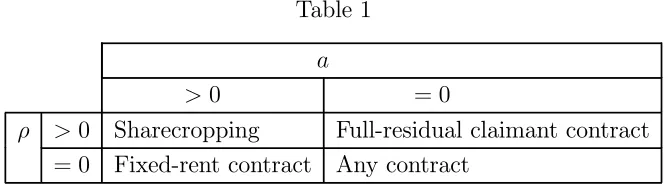
[image:23.595.143.479.470.565.2]Finally, the last set of our results (Propositions 4, 5 and 6) can be summarized in Table 1, which indicates which type of labor contract emerges depending on the values ofa and ρ.
Table 1
a
>0 = 0
ρ >0 Sharecropping Full-residual claimant contract = 0 Fixed-rent contract Any contract
a: Degree of absolute risk aversion of workers ρ: Degree of absolute risk aversion offirms
properly, then the combination of unobserved heterogeneity and of endogenous matching of agents to contracts is bound to create selection biases.
To illustrate this point, let us focus on the recent contribution of Ackerberg and Botticini (2002). They consider the choice between sharecropping and
fixed rent contracts in a tenant-landlord relationship. They regress the type of contract (fixed-rent contract or sharecropping) on crop riskiness and tenant’s wealth. If wealth is taken to be a proxy for risk aversion, we would expect that richer (and presumably less risk-averse) tenants are more likely to be under a rental contract. However, wealth is only an imperfect proxy for risk-aversion, and thus the unobserved component of risk-aversion is likely to be correlated with crop riskiness. There is thus an endogeneity problem since we only observe the match between agents (endogeneous matching). There are many stories that suggest matching between heterogenous employers and workers. One of them is employers with the some ethnic origin might end up matching with workers of the same ethnic origin. To remedy this endogenous matching problem, Ackerberg and Botticini instrument the crop riskiness variable, using geographical variables as instruments.
Using a data set on agricultural contracts between landlords and tenants in early Renaissance Tuscany, Ackerberg and Botticini (2002) address the issue of heterogeneity across agents andfind some role for risk in the choice between share contract and fixed rent contract. After for correcting for endogenous matching between landlords and tenants, theyfind that wealthier tenants (thus those who have lower risk aversion) are more likely to be infixed rent contracts. Thisfinding suggests that risk sharing is an important determinant of contract choice and is consistent with the predictions of our model, as described in Table 1.
(implicit) labor contracts is to be found anywhere it is in African manufac-turing. Bigsten et al. (2003) find strong evidence for risk sharing and labor imperfections (when afirm experienced a negative shock, it is costly for work-ers to move to anotherfirm). It is only where such costs exist that risk sharing contracts can be enforced. Risk sharing is only observed for non-production workers (production workers cover people with few skills thus more mobile group).
7
Concluding remarks
Though the model used in this paper may seem quite stylized, we believe that it captures some basic features of optimal compensations in rural/urban labor markets in less developed countries in the context of ethnically differentiated workers and employers. It shows the role of market structure, ethnic diversity and market competition as well as of the degree of risk aversion of workers and employers in the determination of firms’ choice of methods of pay. In an uncertain production environment, our model shows that, in equilibrium,firms tend to hire workers of similar ethnic background and employers’ co-ethnics earn more than other workers. It also shows that large language and cultural differences lead to lower wages because only workers and employers of similar ethnic origin can work together.
More generally, we believe that the ethnic origin of both employers and em-ployees is of paramount importance to understand the working of labor markets in less developed countries and should therefore be investigated further.
References
[1] Ackerberg, D. and M. Botticini (2002), “Endogenous matching and the empirical determinants of contract form,” Journal of Political Economy, 110, 564-591.
[2] Assaad, R. (1997), “Kinship ties, social networks and segmented labor markets: Evidence from the construction sector in Egypt,” Journal of Development Economics, 52, 1-30.
[4] Bardhan, P.K. (1984), Land, Labor and Rural Poverty: Essays in Devel-opment Economics,New York: Columbia University Press.
[5] Bardhan, P.K. and A. Rudra (1981), “Terms and conditions of labour contracts in agriculture: Results of a survey of West Bengal 1979,”Oxford Bulletin of Economics and Statistics, 43, 89-111.
[6] Barr, A. and A. Oduro (2002), “Ethnic fractionalization in an African labour market,”Journal of Development Economics, 68, 355-379.
[7] Barro, R. (1991), “Economic growth in a growth section of countries,”
Quarterly Journal of Economics, 106, 407-443.
[8] Bates, R.H. (2000), “Ethnicity and development in Africa: A reappraisal,”
American Economic Review, Papers and Proceedings, 90, 131-134.
[9] Bigsten, A., Collier, P., Dercon, S., Fafchamps, M., Gauthier, B., Gun-ning, J.W., Oduro, A., Oostendorp, R., Pattillo, C., S¨oderbom, M., Teal, F. and A. Zeufack (2003), “Risk sharing in labour markets,” World Bank Economic Review, 17, 349-366.
[10] Binswanger, H.P. and M.R. Rosenzweig (1982), Rural Labor Markets in Asia: Contractual Arrangements, Employment and Wages, New Haven: Yale University Press.
[11] Borjas, G.J. (1999),Heaven’s Door. Immigration Policy and the American Economy, Princeton: Princeton University Press.
[12] Cheung, S.N. (1969), The Theory of Share Tenancy, Chicago: Chicago University Press.
[13] Chiappori, P-A. and B. Salani´e (2003), “Testing contract theory: A survey of some recent work”, in Advances in Economics and Econometrics. The-ory and Applications, Eighth World Congress, M. Dewatripont, L. Hansen and P. Turnovsky (Eds.), Econometric Society Monographs, Cambridge University Press, Cambridge, pp. 115-149.
[14] Chiswick, B.R. (1978), “The effect of Americanization on earnings of foreign-born men,” Journal of Political Economy, 86, 897-921.
[16] Collier, P. and J.W. Gunning (1999), “Explaining African economic per-formance,” Journal of Economic Literature, 37, 64-111.
[17] Dr`eze, J.P. and A. Mukherjee (1989), “Labour markets in rural India: Theories and evidence,” in The Balance Between Industry and Agricul-ture in Economic Development, S. Chakravarty (ed.), London: Macmillan Press.
[18] Dustman, C. and I. Preston (2001), “Attitudes to ethnic minorities, ethnic context and location decisions,” Economic Journal, 111, 353-373.
[19] Easterly, W. and R. Levine (1997), “Africa’s growth tragedy,” Quarterly Journal of Economics, 112, 1203-1250.
[20] Esteban, J. and D. Ray (1994), “On the measurement of polarization,”
Econometrica, 62, 819-851.
[21] Eswaran, M. and A. Kotwal (1985), “A theory of contractual structure in Agriculture,” American Economic Review, 75, 352-367.
[22] Fafchamps, M. (1996), “The enforcement of commercial contracts in Ghana,” World Development, 24, 427-448.
[23] Foster, A. and M. Rosenzweig (2001), “Imperfect commitment, altruism, and the family: Evidence from transfer behavior in low-income rural ar-eas,” Review of Economics and Statistics, 83, 389-407.
[24] Krishnan, P. and E. Sciubba (2004), “Endogenous network formation and informal institutions in village economies,” Unpublished manuscript, Uni-versity of Cambridge.
[25] Laffont, J-J. and M.S. Matoussi (1995), “Moral hazard, financial con-straints and sharecropping in El Oulja,”Review of Economic Studies, 62, 381-399.
[26] Lazear, E.P. (1995),Personnel Economics, Cambridge: The MIT Press.
[27] Lazear, E.P. (1999), “Culture and language,” Journal of Political Econ-omy, 107, S95-S126.
[29] McIntosh, J. (1984), “An oligopsonistic model of wage determination in agrarian societies,” Economic Journal, 94, 569-579.
[30] Miguel, E. and M.K. Gugerty (2005), “Ethnic diversity, social sanctions, and public goods in Keyna,” Journal of Public Economics, forthcoming.
[31] Modood, T., Berthoud, R., Lakey. J., Nazroo, J., Smith, P. Virdee, S. and S. Beishon (1997), Ethnic Minorities in Britain: Diversity and Dis-advantage, London: Policy Studies Institute.
[32] Montalvo, J.G. and M. Reynal-Querol (2005), “Ethnic diversity and eco-nomic development,” Journal of Development Economics, 76, 293-323.
[33] Newberry, D.M. and J.E. Stiglitz (1979), “Sharecropping, risk sharing and the importance of imperfect information,” in Risk, Uncertainty and Agricultural Development, J.A. Roumasset, J.M. Boussard and I. Singh (eds.), New York: Agricultural Development Council.
[34] Pandey, P. (2002), “Effect of technology on incentive design of share con-tracts,” Unpublished manuscript, Pennsylvania State University.
[35] Sadoulet, E., Fukui, S. and A. de Janvry (1994), “Efficient share tenancy contracts under risk: The case of two rice-growing villages in Thailand,”
Journal of Development Economics, 45, 225-243.
[36] Sadoulet, E., de Janvry, A. and S. Fukui (1997), “The meaning of kinship in sharecropping contracts,”American Journal of Agricultural Economics, 79, 394-406.
[37] Salop, S.C. (1979). “Monopolistic competition with outside goods,” Bell Journal of Economics, 10, 141-156.
[38] Sandmo, A. (1971), “On the theory of the competitive firm under price uncertainty,” American Economic Review61, 65-73.
[39] Shaban, R. (1987), “Testing between competing models of sharecropping,”
Journal of Political Economy, 95, 893-920.
[40] Stiglitz, J.E. (1974), “Incentives and risk sharing in sharecropping,” Re-view of Economic Studies, 41, 219-255.
[42] Udry, C.R. and T.G. Conley (2004), “Social networks in Ghana,” Eco-nomic Growth Center Discussion Paper No. 888, Yale University.
[43] van de Walle, D. and D. Gunewardena (2001), “Sources of ethnic inequal-ity in Viet Nam,” Journal of Development Economics, 65, 177-207.
[44] Wahba, J. and Y. Zenou (2005), “Density, social networks and job search methods: Theory and application to Egypt,” Journal of Development Economics, forthcoming.
APPENDIX
Proof of Proposition 1
Our model uses the circle model of Salop (1979). So the spirit of our model is quite the same but the proof of existence and uniqueness is quite different since landlords strategically choose two variables α and β whereas in Salop they choose only one variable, the prices.
As it is well-known in the circle model of Salop (1979), the labor supply function14
for each landlord is not differentiable and not continuous. There are in fact three regions: the monopsony region where each landlord attracts only laborers betweenx andxand some laborers do not work; the competitive
region (our case) where all laborers take a job and landlords compete to attract them and finally the supercompetitive region where one landlord, by setting a wage sufficiently high, can attract all laborers of its neighbor landlord. This labor supply is not differentiable everywhere because there is a first kink when one switches from the monopsony region to the competitive region and another one when one switches from the competitive region to the supercompetitive region (see Figure 1, page 143, in Salop, 1979). This labor supply is also not continuous because when one switches from the competitive region to the su-percompetitive region, a landlord i that attracts the worker located at yi+1,
i.e. the location of the landlord i + 1, attracts at the same time all labor-ers located between yi+1 and the marginal worker who is indifferent between
landlords i+ 1 and i+ 2 (see Figure 1, page 143, in Salop, 1979). Therefore, in order to show the existence and uniqueness of our symmetric equilibrium, we proceed as follows. We first restrict ourselves to the competitive region (as we did in the text) where the labor supply is continuous and differentiable everywhere (within the competitive region) and show that the profit function
V(·) is strictly concave so that, within this region, there exists a unique maxi-mum. We then have to check that, at this equilibrium, all laborers take a job. Furthermore, we also have to check that all possible deviations of landlord i
from our symmetric equilibrium is not profitable. There are in fact only two possible deviations: one in the supercompetitive region, one in the monopsony region. We already know from Salop (1979) that a deviation to the supercom-petitive region is never profitable because landlord i has to set a wage higher
14
or equal than the marginal productivity of its laborers and thus make negative or null profits. However, we have to check that the second deviation, i.e. to the monopsony region, is not profitable for landlord i.
Let us start with the following result.
Lemma 1 In the competitive region, the profit functionV(·)is strictly concave in αi and βi.
Proof. Remember first that
Wi =αiq+βi−
a 2α 2 iσ 2 so that ∂Wi ∂αi
=q−aαiσ2 and
∂Wi
∂βi = 1
In this context, the first order conditions yield:15
∂V
∂α ≡Vα =
µ
q−αqσ2
t
¶ £
(1−α)q−β−ρ(1−α)2
σ2
(x−x)¤
(16)
−£q−ρ(1−α)σ2
(x−x)¤(x−x) = 0
∂V
∂β ≡Vβ =−(x−x) +
1
t
£
(1−α)q−β−ρ(1−α)2
σ2
(x−x)¤= 0 (17)
We have now to show that the Hessian matrix is negative definite, i.e.
Vαα <0 and VααVββ−VαβVαβ >0. We have:
∂2
V
∂α2 ≡Vαα =−
aσ2
t
£
(1−α)q−β−ρ(1−α)2
σ2
(x−x)¤−ρσ2
(x−x)2
−2 µ
q−aασ2
t
¶£
q−2ρ(1−α)σ2
(x−x)¤− µ
q−aασ2
t
¶2
£
ρ(1−α)2
σ2¤
We want to show that Vαα <0. For observe that at the symmetric equilib-rium y−x=L/n. Therefore, for Vαα <0, we will show that (i) : (1−α)q−
β−ρ(1−α)2
σ2
L/n >0, (ii) :q−aασ2
>0 and (iii) :q−2ρ(1−α)σ2
L/n >0.
(i) First, using (17), we have
(1−α)q−β−ρ(1−α)2
σ2L
n = tL
n >0 (18)
15
(ii) Second, using (17), we also have:
q−ρ(1−α)σ2L
n =
µ 1 1−α
¶ µ
β+tL
n
¶
Using (10), it is easy to check that in (12),q > σ2
ρLa/(ρL+an) so that
β+tL/n > 0 and thus
q−ρ(1−α)σ2L
n =
µ 1 1−α
¶ µ
β+tL
n
¶
>0 (19)
Then, by plugging (18) into (16), it is easy to verify by using (19) that:
q−aασ2
=q−ρ(1−α)σ2L
n >0 (20)
(iii) Finally, condition (10) guarantees that q−2ρ(1−α)σ2
L/n >0.
Now, using (i), (ii) and (iii), it is to see that Vαα <0.
Let us continue our demonstration of the concavity of V(·). We have:
∂2
V
∂β2 ≡Vββ =−
1
t
∙
2 + ρ(1−α)
2 σ2 t ¸ <0 ∂2 V
∂α∂β ≡Vαβ =Vβα≡ ∂2
V ∂β∂α
=−1
t
∙
q−2ρ(1−α)σ2
(x−x) + (q−aασ2
) µ
1 +ρ(1−α)
2
σ2
t
¶¸
After some manipulations and using the fact that, at the symmetric equi-librium,x−x=L/n and (18), we obtain:
VααVββ−VαβVαβ
=
∙
2 +ρ(1−α)
2
σ2
t
¸ µ
a+ρL n ¶ σ2 tL n + ∙
q−2ρ(1−α)σ2L
n
¸∙
3q−4aασ2
+ 2ρ(1−α)σ2L
n
¸
+(q−aασ2
) µ
2ρ(1−α)2
σ2
t
¶∙
q−2ρ(1−α)σ2L
n
¸
−(q−aασ2
)2
By (10), q−2ρ(1−α)σ2
L/n >0. Moreover, using (20), we have:
ρ(1−α)L
so that
3q−4aασ2
+ 2ρ(1−α)σ2
L/n
= 3q−2ρ(1−α)σ2
L/n
= q+ 2£q−ρ(1−α)σ2
L/n¤
= q+ 2(q−aασ2
)>0
We have therefore:
VααVββ−VαβVαβ
=
∙
2 +ρ(1−α)
2
σ2
t
¸ µ
a+ρL n
¶
σ2
tL n +q
∙
q−2ρ(1−α)σ2L
n
¸
+(q−aασ2
) µ
2ρ(1−α)2
σ2
t
¶∙
q−2ρ(1−α)σ2L
n
¸
+(q−aασ2
)
∙
q−3ρ(1−α)σ2L
n
¸
Since by using (10), q−2ρ(1−α)σ2
L/n >0 andq−3ρ(1−α)σ2
L/n >0, we haveVααVββ−VαβVαβ >0.
Because of Lemma 1 and because in the competitive region, the profit function V(·) is continuous in (αi−1, αi, αi+1) and in (βi−1, βi, βi+1), we can
guarantee that there exists a locally unique symmetric Nash equilibrium in wages. Then, by combining (16) and (17), and by equalizing the equilibrium
α and β, we obtain (at the symmetric Nash equilibrium) a unique (11) and (12). Then, we deduce the equilibrium compensation W∗ given by (12). Fur-thermore, using (9), it is easy to obtain (13).
We must now check that at the equilibrium candidate (12) all laborers take a job and that this wage is always positive. The equilibrium wage (12) is greater than 0 if:
W∗ >0 ⇔ q > σ
2
ρ L a(ρ L/2 +a n) (ρ L+a n)2 +
tL
n (21)
and the condition ensuring that there is full employment at the equilibrium candidate (12) (the worker with the worst match must have a positive utility) is given by:
W∗− tL
2n >0 ⇔ q > σ2
ρ L a(ρ L/2 +a n) (ρ L+a n)2 +
3tL
n (22)
Now, we have to show that it is not optimal for landlord i to deviate from our symmetric equilibrium by setting the monopsony wage. It is easy to verify that the monopsony wage is equal to q/2. So we have to set a condition that rules out this possible deviation. It suffices to show that, at the monopsony wageq/2, the worker located atxi (i.e. at the location of landlordi) who thus have no ethnic cost prefer to work in landlord i+ 1 than to landlord i. This condition is given by:
W∗− tL n >
q
2