http://dx.doi.org/10.4236/jamp.2014.25022
The Asymptotic Eigenvalues of First-Order
Spectral Differentiation Matrices
Jue Wang1, Fabian Waleffe2
1Department of Mathematics, Union College, Schenectady, USA
2Department of Mathematics, University of Wisconsin-Madison, Madison, USA
Email: [email protected]
Received January 2014
Abstract
We complete and extend the asymptotic analysis of the spectrum of Jacobi Tau approximations that were first considered by Dubiner. The asymptotic formulas for Jacobi polynomials PN
( , )
, , > −1
α β α β are derived and confirmed by numerical approxi-
mations. More accurate results for the slowest decaying mode are obtained. We explain where the large negative eigenvalues come from. Furthermore, we show that a large negative eigenvalue of order 𝑵𝑵𝟐𝟐 appears for− < <1 α 0; there are no large negative
eigenvalues for collocations at Gauss-Lobatto points. The asymptotic results indicate unstable eigenvalues for α >1. The eigenvalues for Legendre polynomials are directly related to the roots of the spherical Bessel and Hankel functions that are involved in solving Helmholtz equation inspherical coordinates.
Keywords
Asymptotic Analysis, Spectral Approximations, Jacobi Polynomials, Collocation, Eigenvalues
1. Introduction
Pseudospectral methods were developed to solve differential equations, where derivatives are computed numer- ically by multiplying a spectral differentiation matrix [1]. Compared to finite difference methods that use local information, pseudospectral methods are global, and have exponential rate of convergence and low dissipation and dispersion errors. However in boundary value problems, they are often subject to stability restrictions [2]. If the grid is not periodic, the spectral differentiation matrices are typically nonnormal [3], and the nonnormality may have a big effect on the numerical stability and behavior of the methods. On a grid of size N, pseudos- pec-tral methods require a time step restriction of O N( −2) [4] for hyperbolic and O N( −4) [5] for parabolic prob-lems.
Dubiner [6] carried an asymptotic analysis for theone-dimensional wave equation. He pointed out the O N
( )
Legendre Tau method. That would mean a time step size increase from O N( −2) to O N( −1). However, the eigen- values of Chebyshev and Legend respectral differentiation matrices are extremely sensitive to rounding errors and other perturbations [4]. On agrid of size N, machine rounding could lead to errors of size O N( 2). Thus the Le- gendre Tau method which has an O N( −1) time step restriction in theory, is subject to an O N
( )
−2restriction in practice.
The slowest decaying mode and largest wave numbers are often of interest. They affect stabilities and limit time step sizes of pseudospectral approximations. It is reported in [6] [8] that there exists a large negative eigenvalue of order N2 for Chebyshev spectral differentiation matrix. Where does that eigenvalue come from? When does it ap- pear? And how does it affect the time step size? In this paper, we will consider the first-order spectral differentiation matrix and examine the behavior of its eigenvalues asymptotically and numerically.
Let’s consider the first-order eigenvalue problem
( )
, 1 1, 1 0
du
u x u
dx =λ − < < = (1)
The spectrum of the differentiation operator is empty. However, the spectrum of the Tau approximations to the eigenvalue problem affects the stability of the associated wave equation ut=ux on ( 1,1)− with boundary condi-
tion u
( )
1,t =0, whose solution is a leftward translation at speed 1 [3]. Let uN( )x be a polynomial approxima- tion of degree N. uN( )x satisfies( )
,( )
1 0N N N N
u Du P x u
λ − = =
where D≡d dx/ ,P xN( ) is a polynomial of degreeN. We can write
( )
( )
x
x s
N N
a
u x = −eλ
∫
e−λ P s ds for some arbi- trary constant a. Integration by parts gives( )
0( )
( ) 0( )
1 N k N x a N k N
N k k k k
D P x e D P a
u x
λ
λ λ λ λ
−
= =
=
∑
−∑
. (2)The non-polynomial contribution (the second term) is eliminated by picking a= −∞ if Rλ <0, and a= +∞
if Rλ >0. We then obtain
( )
0( )
1 N k N
N k k
D P x u x
λ = λ
=
∑
(3)The boundary condition uN
( )
1 =0 implies( )
( )
1 1
0, 0
s N
eλ − P s ds λ
−∞
−
∫
= R < (4)( )1
( )
1
0, 0
s N
eλ P s ds λ
∞
− = >
∫
R (5)In the Tau method [1], the polynomial approximation uN( )x is determined from the boundary condition
( )
1 0N
u = and the requirement that P xN( ) is orthogonal to all polynomials of degree n−1 with respect to the weight function w x
( )
≥0 in the interval ( 1,1)− . For Jacobi weight function w( , )α β( ) (
x = −1 x)
α(1+x)β,( )
( , )( )
N N
P x =P α β x , the Jacobi polynomial of degree N with α β, > −1.
Assume λ ≠0, otherwise λ =0 corresponds to the trivial solution uN
( )
x =0. From (3), the boundary condition uN( )
1 =0 leads to the characteristic polynomial Φ( )
0 (1)N k k
N ν =
∑
k= D PN ν , with ν=1 /λ. It isproved [9] that the eigenvalues lie in the left half-plane for Jacobi polynomial ( , )
( )
N
P α β x if − < ≤1 α 1 and
1
β > − . The eigenvalues are computed numerically using the three term recurrence relation for corresponding
Jacobi polynomials [10] (see Figure 1). We will show that the theorem is sharp by obtaining asymptotic results indicating unstable eigenvalues for α >1.
Figure 1. The limit curve and eigenvalue approximations for Cheby-
shev polynomials ( 1
2
α β= =− ). Thick solid: F
(
µ σ, = − =1)
0, dash:(
)
3 ln 1, 1
2 N
F O
N N
µ σ= − = − −
, dash-dot:
(
)
3 ln
, 1
2 N F
N
µ σ= = −
1 O
N
− , where
(
)
2
2 1 1
, 1 ln
F µ σ µ σ µ σ µ
µ
− +
= + + +
R .
Thin solid: contours of B( )µ . Take dash-dot branch for B
( )
µ >0, dash for B( )
µ <0.The paper is organized as follows. In Section 2, we present the asymptotic analysis and numerical results for Chebyshev polynomials. We generalize the results to Jacobi polynomials in Section 3, and derive the approxi- mations of the slowest decaying mode and largest wave numbers. In Section 4, we show that the eigenvalues for Legendre polynomials are directly related to the roots of spherical Bessel and Hankel functions. The analysis and numerical results for collocation methods are explained in Section 5. Finally we conclude in Section 6.
2. Chebyshev Polynomials
We use Chebyshev polynomials PN
( )
s ≡TN( )
s to illustrate the approach and derive the asymptotic formulas.They correspond to the class of Jacobi polynomials with α β= = −1 / 2 and are especially relevant in practice. With a change of variable s=cosφ, TN(cos )φ =cosNφ, and (4) becomes
0 cos
cos ( sin ) 0
i e N d
λ φ
π φ φ φ
−
+ ∞ − =
∫
(6)It suggests that λ=Nµ. Define ρ φ
( )
= −µcosφ φ+i , and I twice the above integral,( )
1 2
0 2 sin
i i N
I =
∫
π+ ∞+∫
ππ− ∞e ρ φ φ φd = +I I (7) We will apply the method of steepest descent to deform the integration path without changing the value of the integral, so that it goes through the critical point (saddle point) φ* in such a way that Rρ φ( )* is maximum along the path, and Rρ φ( )* decreases along either direction away from φ* as rapidly as possible. As N→ ∞, the dominant contributions come from the saddle points and boundary points 0 and 2π.2.1. Saddle Contributions
The saddle points of ρ φ
( )
satisfy the equation ρ φ'( )=µsin sinφ+ =i 0, which implies sinφ*= −i/µ. The steepest-descent curves of eNρ φ( ) vary as μ varies. We consider two cases: Rµ≠0 and Rµ=0.2.1.1. Rµ≠0
There are two saddle points *( )
σ
φ , sign *( ) 0
σ
σ = Iφ ≠ , and "( *( )) 0
σ
( 1) (1)
* *
φ − = −π φ
, ρ φ( *( )1) ρ φ( *( )1)
− = −
R R , ρ φ( *( )1) π ρ φ( *( )1)
− = −
I I , and
( )
( )
( ) ( ) 2 2* * *
1 1
cos i 1 ln
σ σ σ σ µ
ρ φ µ φ φ σ µ
µ
− +
= − + = + + (8)
The integration paths follow the constant-phase contours ( ) ( *( ))
σ
ρ φ = ρ φ
I I , i.e. the steepest-descent curves, from 0 to π + ∞i for I1 and from 2π to π − ∞i for I2, passing through the saddle points
( ) *
σ
φ . The steepest curves corresponding to the opposite signs of Iµ are mirror images about Rφ π= axis. Define
( )
( )
( )1( )
( )1 2 2* *
2
1 1
2 1 ln
1 1
B µ ρ φ ρ φ µ µ
µ − − + ≡ − = + + + +
R R R (9)
and redefine σ to be σ =sign ( )B µ . Then ( * )
s
I φσ dominates when B( )µ ≠0.
Following the standard saddle point approximation ([11] §7.3), we evaluate the integrals near the saddle points and obtain the dominant contribution
( )
( ) ( ) ( ) * ( ) 1/ 2 * * ( ) * 2 ~ sin "( ) Ns s i
I I φσ N e ρ φσ eθσ φ σ πσ
ρ φ
−
= (10)
As N→ ∞ when B( )µ ≠0. If B
( )
µ =0,( ) (
(1) ( 1))
* *
s s s
I =I φ +I φ − .
2.1.2. Rµ=0
Let µ =ib. The two saddles points collide and form athird-order saddle point at µ= ±i. 1) 0< b <1. In this case B
( )
µ <0.( )1 1
* / 2 icosh ( 1 / )b
φ ± =π ± − −
when − < <1 b 0, 3 / 2π ±icosh (1 / )−1 b
when 0< <b 1.
(
( 1))
* s sI =I φ − .
2) b >1. We have B
( )
µ =0.( )1 1 * sin ( 1 / )b
φ = − −
, φ*( )1 π sin ( 1 / )1 b
− = − − −
when b< −1. φ*( )1 2π sin ( 1 / )1 b
−
= + − ,
( )1 1
* sin ( 1 / )b
φ − = −π − −
when b>1.
( )
(1) * s sI =I φ .
3) b= ±1. φ*= +π bπ/ 2 is a third-order saddle point. A similar saddle point approximation leads to
( )
*1 1
2 3
3 2 3
* ~ ( )6 / 3Γ(1/ 3)
b i
i iN s
I N e e e
π π π
φ
φ
− − −
− + .
2.2. Boundary Contributions
We approximate the contour at φ=0 by the straight line φ=iv with v∈[0, ]ε and obtain the dominant contribution at φ=0,
( )
( ) ( ) ( )( )
'0 0
0 2
2 ' 0
0 ~ ~
0 N N v
N
b e
I e e vdv N
ρ ε ρ
ρ
ρ
− −
−
∫
− (11)as N→ ∞. The approximation is the same near φ=2π. Therefore,
( )
( )( )
0 2 2 '0 (2 ) ~ 2
0 N
b b b e
I I I N
ρ
π
ρ
−
= + − (12)
2.3. Balance between Saddle and Boundary Contributions
There are four possible balances from Section 2.1:
1) Rµ≠0 and σ =sign ( )B µ ≠0, 2) Rµ=0 and B
( )
µ =0, 3) Rµ<0 and B( )
µ =0, 4) Rµ=0In case 1), using lnz=ln | |z +iargz+2k iπ , k∈, the balance between (10) and (12) leads to
(
2)
2 2
2 2
1
arg 1 arg 2
1 1 3 ln 1 2 2
1 ln ~ ln
2 2 2 1
i k N
i
N N N
π σ µ π
σ µ π µ
µ σ µ
µ µ µ
− − − + + + − + + + + − − − + (13) As N→ ∞, this implies the limit curve
2
2 1 1
1 ln µ 0
µ µ µ + + − + + =
R (14)
In case (2), from Section 2.1.2, the balance leads to the limit curve Rµ=0,|Iµ| 1≥ , i.e. the interval ±[ ,i i∞). The balances in cases (3) and (4) lead to inconsistent results. The limit curve (14) is in agreement with Dubin- er’s result ([9] Equation (8.5)). It can be divided into three parts: the interval [ ,±i i∞) and a curve connecting
i
± in the left half-plane. The number of eigenvalues distributed around each part is given by the number of in-tersections of Equation (14) and
2
2 1 1 2 π
1 ln k
N µ µ µ µ + + − + + =
I (15)
Around ±[ ,i i∞) are distributed about 1 1
2 2
N
π
−
eigenvalues respectively. There are left about
1 1
2 π N
+
eigenvalues distributed around the curve connecting ±i in the lefthalf-plane. Figure 1 shows the limit curve and eigenvalue approximations for Cheybshev polynomials. The numerical eigenvalues are com- puted using 128-bit or 34 decimal digits of precision. They distribute near the limit curve except a large negative real eigenvalue µ~O N( ), which is addressed in the next section. The asymptotic results are accurate even for small N’s.
From Equation (13) we derive that the slowest decaying eigenmode has wave number
3 ln 1 1 ln
~ ln ln 3
2 2 2 2
N N
bi
N N N
π
µ − − − ±
(16)
where
3 2
1 13 1 27 ln 3 ln 1
~1 / 1
2 4 2 8 2 2 6 ln
N N
b
N N N N
π σ π σ
+ − − − + + .
The eigenvalues are plotted in Figure 3. They demonstrate better approximations than Dubiner’s results ([6] Equation (8.6)).
If the boundary condition uN
( )
− =1 0 is imposed instead, then Rλ >0, and the limit curve is a reflection by the imaginary axis.2.4. The Large Negative Eigenvalue
The largest wave number limits the time step size of the numerical approximation. When λ >O N( ), the sad-
dle points ( )1 1
* sinh N i φ λ − = −
and
( )2 1
* 2 sinh
N i φ π λ − = + −
are too close to the boundaries φ0=0, 2π . Thus we have to take the integration path of I1 from 0 up to ( )
1 *
φ , then to π + ∞i , and that of I2 from 2π up to
( )2 *
φ , then to π + ∞i , going down passing through φ*( )1
−
to π − ∞i . Both φ*( )1 and
( )2 *
φ are dominant sad- dles and φ*( )1
−
| | cos | |
1 2
0 2 sin
N i
i i
I e d I I
λ φ φ
π π λ
π φ φ
+ + ∞ − ∞
=
∫
+∫
+ = + (17)The balance between saddle and boundary contributions implies a polynomial equation for x=N2/ |λ|,
1
0 0
!2 (2 1) !2
n n
n n
n
x x
n n n
+ ∞
= + − =
∑
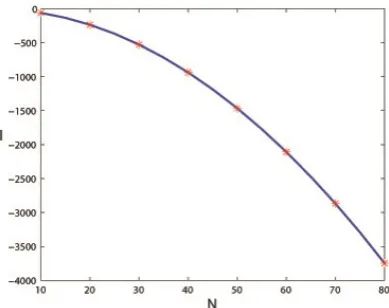
(18)The real root of (18) approaches a constant as the degree of the equation increases. Solving the equation of degree 5 gives |λ| /N2 ~0.5855. This large negative eigenvalue is plotted in Figure 2. The approximation agrees well with numerical results.
3. Jacobi Polynomials
We now generalize the asymptotic analysis in Section 2 to Jacobipolynomials PN( , )
(
cos)
α β φ
with weight func- tion w
(
cosφ) (
= −1 cosφ)
α(1 cos ) , ,+ φ β α β > −1.3.1. Approximation of Jacobi Polynomials
We approximate Jacobi polynomials in two regions, i.e. near 0 and away from 0.
Figure 2. The large negative eigenvalue for Chebyshev polynomial, λ~0.5855 2
N , confirmed by numerical approximations atN=[10:10:80], indicated by *.
Figure 3.○: the slowest decaying eigenmodes for Chebyshevpolynomial giv-
1) If |φ−nπ ε|≥ ,
( , )
(
)
1/ 2 1 1cos ~ (2 ) iN ( i ) iN ( i )
N
P α β φ π − e φD e−φ − +e− φD eφ − (19)
where
( )
1 1 1
2 2 2
2 (1 ) (1 )
D z z z
α β+ + α β
− + +
= − + , defined for z <1,1< z ≤ < ∞R , | | 1
lim ( )
z→± D z exists. We de-
rived it from Szego [12] Theorem 12.1.2. 2) If |φ −0 |1,
(
)
1 ( )(
)
1, 2 2
2
sin cos ~ (2 ) 2 iN i iN i
N
P e e e e
α β
α α β φ γ φ γ
φ + φ π − − + − −
(20)
where γ = − +(α 1 / 2) / 2π . We derived it from Szego [12] Theorem 12.1.4.
3.2. Limit Curve
Using approximation (19), the integral in (4) becomes
( ) 1
0 2 ( ) sin
i i N i
I=
∫
π+ ∞+∫
ππ− ∞e ρ φ D e−φ − φ φd , (21)with the same ρ φ
( )
= −µcosφ φ+i . A similar analysis gives the saddle contribution( ) ( ) ( ) ( )
( )
* * ( )1/ 2 *
( ) * sin 2 ~ "( ) N s i i
I N e e
D e σ σ
σ
σ ρ φ θ
σ φ
φ π
ρ φ
−
− (22)
This is in agreement with the results for Chebyshev polynomials in Section 2, where
( ) (
)
1/ 2sin
i i
D e−φ = i φe−φ α+ for α β= .
Using the asymptotic formula for Bessel function of the first kind [13],
( )
(
)
1 3
2 2
2
( ) cos ( )
J z z O z
z
α π γ
−
= + +
as | |z→ ∞ with arg
( )
z ≤ −π δ δ, >0, we obtain(
)
12(
)
10 0
0 2
( ) cos ( )
J N N O N
N
α φ = π φ φ γ+ + −
As N→ ∞ for |φ0 0 | N 1/3
−
− . From (20), we have
( , )
(
)
2 12( )
cos ~ 2 ( )
N
P N N J N
α β α
α β α
α
φ − + φ − φ
(23)
Plug (23) to the integral in (4) and we obtain the boundary contribution
3 1 1
2 2 2 2
(0) ~ 2 (2 )
Γ( )
b N
I N e
α β α
α µ π α − − − − (24)
(0) ~ 0
b
I when α =0.
3.2.1. α ≠0
The dominant balance is between saddle and boundary contributions. This gives the same limit curve as (14). The slowest decaying eigenmodes are plotted in Figure 3 for α = −0.3,β =0.5.
The theorem in [9] proves that the eigenvalues lie in the left half-plane for Jacobi polynomial PN(α β, ) if
1 α 1
− < ≤ . We have derived asymptotically that the eigenvalue becomes unstable for α >1.
3.2.2. α =0
The dominant balance is between two saddle contributions from φ*( )1
±
, and this leads to a new limit curve
2 2
2
1 1
2 1 ln 0
1 1 µ µ µ − + + + = + +
The intervals ±[ ,i i∞) are excluded because only one saddle point contributes.
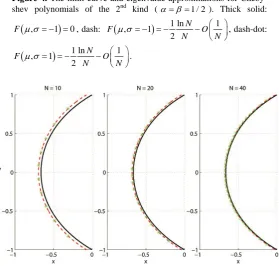
The limit curve and eigenvalue approximations for Chebyshevpolynomials of the 2nd kind (α β= =1 / 2) and Legendre polynomials (α β= =0) are plotted in Figures 4 and 5. The eigenvalues huddle around the limit curve. Note that even at a small N = 10, the eigenvalue approximations for Legendre polynomials lie exactly on the dashed curve, which is true for all the other figures.
Figure 4. The limit curve and eigenvalue approximations for Cheby- shev polynomials of the 2nd kind (α β= =1 / 2). Thick solid:
(
, 1)
0F µ σ = − = , dash:
(
, 1)
1 ln 12 N
F O
N N
µ σ= − = − −
, dash-dot:
(
)
1 ln 1, 1
2 N
F O
N N
µ σ= = − −
[image:8.595.191.443.160.356.2] .
Figure 5. The limit curve and eigenvalue approximations for Legendre poly-
nomials (α β= =0). Thick solid:
2 2
2
1 1
2 1 ln 0
1 1
µ µ
µ
− +
+ + =
+ +
R , dash:
2 2
2
2 2
1 1 1 1 1
2 1 ln ln
2
1 1 N 1 1
µ µ
µ
µ µ
− + + +
+ + =
+ + − +
[image:8.595.175.455.372.638.2]3.3. Olver Paths
When α =0 and |µ ±i|1, the two saddle points *( )1 sin1
i i φ µ − = −
and
( )1 1
* sin i i φ π µ − = − − −
nearly merge. They coincide at φ*=π/ 2 when µ= −i, and 3 / 2π when µ=i. The expansions given by the or- dinary method of steepest descents are not uniformly valid for |µ ±i|1. We need to construct uniform ex- pansions near ±i and deform the contours into Olver paths [14].
Apply the cubic transformation,
(
,)
1 3( )
( )3 A
ρ φ µ = ζ −η µ ζ + µ , to map the saddle points of ρ φ
( )
in theφ-plane to the saddle points ± η in the ζ -plane. It is shown [15] that the mapping is uniformly regular and one-to-one for all µ in a neighborhood of ±i. The integral (21) becomes
3
1
( )
1
3 ( ) sin s
N A
i d
I e D e d
d
ζ ηζ φ φ
φ ζ
ζ
±
− + − −
=
∫
(26)
where ± is a contour running from −∞ to ∞e±πi/3 when |µ±i|N−1, through the saddle point ζ = η. The first order approximation gives
5
1 4 2 1
2 6
3 3 3 3 6
~ 2 Ai 2 ( )
iN i i
s
I N e N e i
π π π
π
π µ
− ± ± (27)
for |µ±i|N−1, where Ai is the Airy function. The eigenvalues are related to the zeros of the Bessel and Hankel functions of half-integer order N+1 / 2 [16]. Further discussions are presented in Section 4.
The slowest decaying eigenmode’s wave number satisfies
(
)
2 1
1
3 3 6
Ai N 2 e i i O N( ) 0
π µ ± − ± + =
. (28)
Ai (z) has a maximal zero −c c0, 0>0 [17]. Then Equation (28) gives
1 1 2
3 3 6 3
0
~ 2 i ( ) [ (1)]
N N e c O N i N O
π
λ= µ − − + − + . (29)
This is also the largest wave number (see Section 3.4). Hence when α =0, the largest wave number is of or-der N instead of 2
N .
3.4. The Large Negative Eigenvalue
The formulas for saddle points contributions are not valid when the saddle points are too close to the boundaries at λ >O N( ). The approximation of Jacobi polynomials has to be replaced by Equation (20). If λ is not real, we can take the same integration paths as in Section 3.2 and obtain the saddle contribution. The boundary con- tribution remains the same with λ used first and then replaced by Nµ. The balance between saddle and boundary contributions when λ ≠0, or between two saddle contributions when λ =0 gives the same limit curve as before.
If λ is real negative, we take the integration paths as in Section 2.4. The balance leads to a polynomial equ- ation for x=N/ |λ|,
2 2 2
1
0 0 0
1
1
cos 1 sin 0
2
2 2 !2 !2 (2 1)
n n
n
n n n
n n n
n x x
c x
n n n
n
α α π α + απ
∞ − ∞ ∞ = = = − + + − − + = +
∑
∑
∑
(30)where cn = 2π / 2 2
(
k−1 !!)
when n is even n=2k; 2k n
c = k when n is odd n=2k+1. The lowest order approximation by solving Equation (30) of degree 2 gives
2
/ 2 cot ( / 2) cot 2(3 / 2 )(1 / 2 )
~
3 / 2
x π απ π απ α α
α
− + + + −
+ (31)
Figure 6. The large negative eigenvalue for 1− < <α 0 scaled by
2
N , compared with the numerical approximations for Jacobipoly- nomials at N=40 and α= [−0.001, −0.1: −0.1: −0.9], indicated as *. Solid: from solving Equation (30) of degree 4, dash: from Equa- tion (31).
genvalue for 0< ≤α 1 / 2. The integral diverges for α>1 / 2. Therefor there is a large negative eigenvalue of 2
( )
[image:10.595.188.444.82.283.2]O N for − < <1 α 0.
When |α −0 |1, the assumption λ >O N( ) is no longer valid. In this case, the negative eigenvalue is simply described by the zero of the limit curve given in (14). When α =0, the balance is between two saddle points. It gives same limit curve as (20). This is not consistent with the assumption λ >O N( ). So (29) also gives the largest magnitude eigenvalue which is O N( ).
4. Legendre Polynomials and Spherical Bessel Functions
Denote Legendre polynomials by PN PN( , ) α β
= , α β= =0. As indicated in Section 3.3, the eigenvalues are di- rectly related to the roots of spherical Bessel and Hankel functions.
The emission and scattering of electromagnetic radiation involves solving the vector wave equation [18]. The solutions are then expressed as an expansion in the orthogonal spherical waves, known as the multipole expan-
sion. Consider the scalar wave equation U 12 U 0
t c
∂
∆ − =
∂ , where U =U( , )xt is the velocity potential, ( , , )x y z
=
x and c is the speed of sound. For time-harmonic acoustic waves of the form
( )
,{
( ) i t}
U x t =R u x e−ω with frequency ω >0, each Fourier harmonic ( )u x satisfies the Helmholtz equation 2
0
u k u
∆ + = where k=ω/c is the wave number. It can be rewritten in terms of spherical coordinates ( , , )rθ ϕ . With the expansion u=
∑
fn( )
r Yn( , )θ ϕ , the radial function fn( )
r satisfies the equation2 2 2
" 2 ' [ ( 1)] 0
n n n
r f + rf + k r −n n+ f = (32)
known as the spherical Bessel differential equation [17] (10.1.1). With a change of variable gn
( )
r = r fn( )
r ,n
g satisfies the Bessel differential equation of half integer order n+1 / 2. Now let r=iz k/ and replace fn
by w, n by N, then Equation (32) becomes the modified spherical Bessel equation [17] (10.2.1)
2 2
" 2 ' [ ( 1)] 0
z w + zw− z +N N+ w=
It has a solution, the modified spherical Bessel function of the third kind [17] (10.2.4),
( )
1( )
2 2
N
N
k z K z
z
π
+
= , where 1
( )
2 N
K z
+ is the modified Bessel function of the third kind of order N+1 / 2.
( )
( )
(
)
1 0
1
zs z zt
N N N
k z e P s ds e e P t dt
∞ ∞
− − −
=
∫
=∫
+Similar to deriving Equation (3),
( )
0( )
1
k z
N N
N k k
D P e
k z
z z
− =
=
∑
Thus the eigenvalues λ in (3) are the roots of kN
( )
z , which are also the roots of Hankel function of order1 / 2
N+ , spherical and modified spherical Hankel functions using the relations [17] (10.1.1),(10.2.15).
5. Collocation
The Chebyshev collation method and stability analysis was discussed in [2], and then extended to general Gauss-Radau collocation methods [8] for the one-dimensional wave equation. The Gauss-Radau and Gauss- Lobatto Jacobi methods were compared and it is shown that the latter is asymptotically stable for α ≤ ≤1 β [8]. In particular the only Gauss-Lobattoultraspherical method which is marginally stable corresponds to α β= =1.
We take the discretization − =1 x0<x1<<xN =1 of the interval [−1,1], and approximate ( )u x by a po-
lynomial uN( )x of degree N that satisfies
( )
1 1
, for , , 1 0
N N N N
Du =λu x=x x − u = (33)
( )
N
u x interpolates the values a a0, 1,aN−1, 0 at − =1 x0<x1<<xN =1 and can be written as
( )
10 ( )
N
N J j j
u x =
∑
=− a l x , where{ }
l xj( ) are the cardinal functions. Substituting uN into (33) gives the matrix system with eigenvalue λ. Collocation at zeros of orthogonal polynomials (Gauss points) is identical to the Tau method with Gauss quadrature. We consider three sets of Gauss-Lobattopoints [ ,1 1]T N x x −
=
x :
1) Chebyshev extreme points: j cos
j x
N
π
= − ; 2) Chebyshev extreme points of the 2nd kind: xj = j th zero of
'
N
U ; 3) Legendre extreme points: xj = j th zero of PN'.
They can all be described as zeros of QN'( )x , where QN is Chebyshev, Chebyshev of the 2
nd
kind and Le- gendre polynomial of degree N, respectively. Defineresidual RN
( )
x =(λ−D u) N( )x . It is a polynomial of degree N that vanishes at x= −1 and zeros of QN'( )x . Thus RN takes the form RN( )
x =(x+1)QN'( )x . Ingeneral, for Jacobi polynomial PN( , ) α β
, from [19],
( ) (
)
( , )(
)(
)
( 1, 1)1 1
1 1 1
2
N N N
d
R x x P N x P
dx
α β α β α+ β+
−
= + = + + + +
Using (19) and (20), we obtain approximations of RN
(
cosφ)
for φ away from 0 and near 0. The balance remains valid with( )
(
)
( )
col 2 col col
2
, 1, 1
1
i i
i
D e D e
e
φ φ
φ α α β β
= = + = +
+
However, for Legendre extreme points, the balance is now between saddle and boundary contributions since
col 1
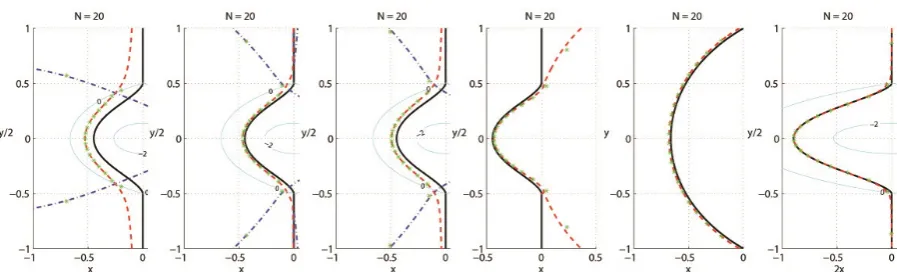
α = , and the limit curve is the same as the other two. Figure 7 shows the eigenvalues obtained using the Tau and collocation methods, together with their limit curves for Chebyshev (α β= = −1 / 2), Chebyshev of the 2nd kind (α β= =1 / 2) and Legendre (α β= =0) polynomials. Collocations at Chebyshev and Legendre ex-treme points are stable. Collocation at Chebyshev exex-treme points of the 2nd kind becomes unstable. In general, collocation at Gauss-Lobatto points is stable when α + ≤1 1, i.e. α ≤0, unstable when α >0. There is no large negative eigenvalue with Chebyshev extreme points used. This can be derived asymptotically using the same method as before, or simply follows from αcol= +α 1.
6. Conclusions
Figure 7. From left to right: Tau method at α β= = −1 / 2, collocation at Chebyshev extreme points, Tau method at 1 / 2
α β= = , collocation at Chebyshev extreme pointsof the 2nd kind, Tau method at α β= =0, collocation at Legendre extreme points.
boundary condition. We use the method of steepest descent to deform the integration path without changing the value of the integral, in order to obtain the dominant contributions from saddle and boundary points. This ap- proach leads to the asymptotic formulas for the eigenvalues of Jacobi Tau method. Numerical examples with Chebyshev of the 1st and 2nd kind and Legendre polynomials are presented. They agree well with the asymptotic analysis, even at small sizes.
The approximations for the slowest decaying modes give more accuracy than those obtained in [6]. The larg- est wave numbers have raised interest in stabilities in pseudospectral approximations. We show that a large neg- ative eigenvalue of order N2 appears for − < <1 α 0. The collocation methods are also examined. There are no large negative eigenvalues for collocations at Gauss-Lobatto points.
For Jacobi polynomials, the eigenvalues lie in the left half-plane if − < ≤1 α 1. We show that the theorem is sharp by obtaining asymptotic results that indicate unstable eigenvalues for α >1. The eigenvalues for Legen- dre polynomials are related to the roots of Bessel and Hankel functions of half-integer order, spherical and mod- ified spherical Bessel and Hankel functions. These results complete Dubiner’s earlier analysis [6].
References
[1] Canuto, C., Hussaini, M.Y., Quarteroni, A. and Zang, T.A. (1988) Spectral Methods in Fluid Dynamics. Springer, New York. http://dx.doi.org/10.1007/978-3-642-84108-8
[2] Gottlieb, D. (1981) The Stability of Pseudospectral Chebyshev Methods. Mathematics of Computation, 36, 107-118.
http://dx.doi.org/10.1090/S0025-5718-1981-0595045-1
[3] Trefethen, L.N. and Embree, M. (2005) Spectra and Pseudospectra: The Behavior of Nonnormal Matrices and Opera-tors. Princeton University Press.
[4] Trefethen, L.N. and Trummer, M.R. (1987) An Instability Phenomenon in Spectral Methods. SIAM Journal on Nu-merical Analysis, 24, 1008-1023. http://dx.doi.org/10.1137/0724066
[5] Weideman, J.A.C. and Trefethen, L.N. (1988) The Eigenvalues of Second-Order Spectral Differentiation Matrices. SIAM Journal on Numerical Analysis, 25, 1279-1298. http://dx.doi.org/10.1137/0725072
[6] Dubiner, M. (1987) Asymptotic Analysis of Spectral Methods. Journal of Scientific Computing, 2, 3-31.
http://dx.doi.org/10.1007/BF01061510
[7] Tal-Ezer, H. (1986) Spectral Methods in Time for Hyperbolic Equations. SIAM Journal on Numerical Analysis, 23, 11-26. http://dx.doi.org/10.1137/0723002
[8] Jackiewicz, Z. and Welfert, B.D. (2003) Stability of Gauss-RadauPseudospectral Approximations of the
One-Dimensional Wave Equation. Journal of Scientific Computing, 18, 287-313.
http://dx.doi.org/10.1023/A:1021121008091
[9] Csordas, G., Charalambides, M. and Waleffe, F. (2005) A New Property of a Class of Jacobi Polynomials. Proceedings of the AMS, 133, 3351-3560.
[10] Weideman, J.A.C. and Reddy, S.C. (2000) A Matlab Differentiation MatrixSuite. ACM Transactions on Mathematical Software, 26, 465-519. http://dx.doi.org/10.1145/365723.365727
[image:12.595.90.539.81.217.2][12] Szego, G. (1939) Orthogonal Polynomials. AMS Colloquium Publication, 23.
[13] Waston, G.N. (1995) A Treatise on the Theory of Bessel Functions. 2nd Edition, Cambridge University Press. [14] Olver, F.W.J. (1970) Why Steepest Descents? SIAM Review, 12, 228-247. http://dx.doi.org/10.1137/1012044
[15] Chester, C., Friedman, B. and Ursell, F. (1957) An Extension of The Method of Steepest Descents. Proc. Cambridge Philos. Soc., 53, 599-611. http://dx.doi.org/10.1017/S0305004100032655
[16] Driver, K.A. and Temme, N.M. (1999) Zero and Pole Distribution of Diagonal Padé Approximants to the Exponential Function. Questiones Mathematicae, 22, 7-17. http://dx.doi.org/10.1080/16073606.1999.9632055
[17] Abramowitz, M. and Stegun, I.A. (Eds.) (1965) Handbook of Mathematical Functions: With Formulas, Graphs, and Mathematical Tables. Dover Publications.
[18] Colton, D. and Kress, R. (1998) Inverse Acoustic and Electromagnetic Scattering Theory. 2nd Edition, Springer.
http://dx.doi.org/10.1007/978-3-662-03537-5
![Figure 6. The large negative eigenvalue for − <1α<0 scaled by N , compared with the numerical approximations for Jacobipoly- 2nomials at N =40 and α = [−0.001, −0.1: −0.1: −0.9], indicated as *](https://thumb-us.123doks.com/thumbv2/123dok_us/8037262.770501/10.595.188.444.82.283/figure-negative-eigenvalue-compared-numerical-approximations-jacobipoly-indicated.webp)