An Efficient Technique to Recognize License Plate using
Morphological Edge Detection and Character Matching
Algorithm
Suprokash Dey
Faculty of Engineering and Technology, Jadavpur University,
Kolkata, India
Amitava Choudhury
Indian Institute of Engineering Science and Technology,
Howrah, India
Joydeep Mukherjee
Faculty of Engineering and Technology, Jadavpur University,
Kolkata
,
IndiaABSTRACT
This paper describes an efficient technique of locating and extracting license plate and recognizing each segmented character. The proposed model can be subdivided into four parts- Digitization of image, Edge Detection, Separation of characters and Template Matching. In this work, we propose a method which is based on morphological operations where different Structuring Elements (SE) are used to maximally eliminate non-plate region and enhance plate region. Character segmentation is done using Connected Component Analysis. Correlation based template matching technique is used for recognition of characters. This system is implemented using MATLAB7.4.0. The proposed system is mainly applicable to Indian License Plates.
Keywords
License plate, Edge Detection, Character Segmentation, Connected Component Analysis, Template Matching
1.
INTRODUCTION
Automatic recognition of vehicle license plate number became a very important in our daily life because of the unlimited increase of cars and transportation systems which make it impossible to be fully managed and monitored by humans. Automatic Number Plate Recognition (ANPR) is a mass surveillance system that captures the image of vehicles and automatically extracts the number from the images of the vehicles’ license plates. Automatic Number Plate Recognition system is an important part of Intelligent Transportation System (ITS) and Intelligent Traffic Management System. License plate of vehicle is mainly consists of hardware and software. The hardware parts consist of control unit, Ethernet camera, source of uniform power supply and an interface control port. These total segments ensure that the car images intake and processing. The software part is divided into the Ethernet camera wh9ch embedded front-end software and the processing software in the industrial computer. The ANPR is widely used for detecting speeding cars, security control in restricted areas, unattended parking zones, traffic law enforcement, scrutinizing vehicle theft, electronic toll collection, automatic parking facilities etc. An ANPR is generally made up of three modules; License plate localization, character segmentation and optical character recognition module.
Fig 1: Sample of number plate
ANPR system can have two varieties: Online ANPR system and Offline ANPR system. In an online ALPR system, the localization and interpretation of license plates take place instantaneously from the incoming video frames, enabling real-time tracking of moving vehicles through the surveillance camera. Offline ALPR system captures the vehicle images and stores them in a centralized data server for further processing, i.e. for interpretation of vehicle license plates. The objective of the current work falls under the second category of ALPR system.
In developed countries the attributes of license plates are strictly maintained. For example, the size of the plate, color of the plate, fonts of characters, spacing between subsequent characters, etc are maintained very specifically. In India, license plates are not yet standardized across different states, making localization and recognition of license plates extremely difficult. The identification task became challenging in some conditions, like poor image resolution, blurry images, particularly motion blur, poor lighting and low contrast due to overexposure, reflection or shadows.
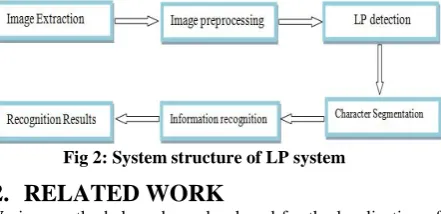
[image:1.595.320.541.621.728.2]In this paper, we proposed a method mainly based on morphological edge detection and correlation based template matching. The proposed method can be segmented as
Fig 2: System structure of LP system
2.
RELATED WORK
A new algorithm has been used to determine the edges of the image by A. M. Al-Ghaili, S. Mashohor, A. R. Ramli, and A. Ismail in “Vertical-Edge-Based Car-License-Plate Detection Method,” [1].
To locate the number plate, at first noise is removed using the operation of erosion and dilation. K. Deb, M. K. Hossen, M. I. Khan, and M. R. Alam proposed a method to recognize the location of the plate based on color intensity histogram [2]. P. Saiyadi proposed a novel approach using the combination of morphology, edge detection and the analysis of the histogram [3].
Halina Kwasnicka and Bartosz Wawrzyniakuse Hough Transform to identify the license plate by studying the variation between dark and bright pixels in a line [4]. J. R. Parker and Pavol Federl proposed an alogorithm where threshold was applied on the objects extracted from the image at first according to the width, height, area, and width to height ratio [5].
The two dimensions of the bounding boxes of the objects are used in [6] and [7] to detect whether an object is a character belonging to a license plate or not.
An efficient method of locating vehicle license plate based on HSI color model and position histogram is proposed by K. Deb, H. U. Chae, and K. H. Jo [8].
In [9], Z.C. Zhang and Y.Y. Tangfirst takes the input image into a grayscale, then erosion and dilation morphological operations. The plate is extracted with use of vertical and horizontal projection among various candidates.
In the work of P. Kananiet al. [10], a 2-Level 2-D Haar wavelet decomposition of the image is used in validating the license plate co-ordinates in the image of car.
Use of Hough transform is a very effective method of getting the directional analysis of the skew, however it involves large computational cost [11].
In [12] and [13] the two dimensions of the bounding boxes of the objects are used to detect whether an object is a character belonging to a license plate or not.
W. Jia et al. presents a region-based LP detection method in [14], which first applies a mean shift procedure in a spatial-range domain to segment a color vehicle image in order to get LP regions.
Fuzzy logic has been applied in detecting license plates in [15].
Sourav Roy et al. [16] present an approach based on simple and efficient morphological operation and Sobel edge detection method to locate the number plate.
Based on the above mentioned method, many numbers license plate localization and recognition algorithms have been developed. In this paper, an improved and efficient approach is identified with high detection rate based on morphological edge detection and template matching.
3.
PROPOSED METHOD
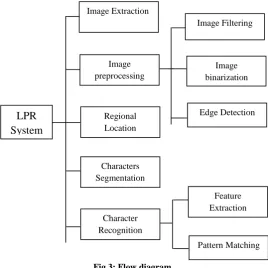
[image:2.595.294.563.74.343.2]Our proposed model consists of several steps- input image, gray-scale conversation, image binarization, noise reduction, plate localization, character segmentation, character recognition. The proposed method consists of the following steps:
Fig 3: Flow diagram
3.1 Image Preprosseing
A.
Input Image
Input raw image that is taken from the car. Then, resize the
image keeping the aspect ratio same.
Fig 4: Input image
B.
Gray-scale conversation
In any 24-bit color image, each pixel contains the Red (R), Green (G) and Blue (B) color components, each consuming 8 bits of information. From these R, G and B components, 8-bit gray value for each pixel position is calculated using the formula written in Equation (1)
The Gray-scale transformation can not only speed up the subsequent steps, but also transform the various kinds of images to gray image to simplify the process.
[image:2.595.331.544.649.731.2]g = 0.299*R + 0.587*G + 0.114*B …….. (1)
Fig 5: Gray-scale image
LPR
System
Image Extraction
Image preprocessing
Regional Location
Characters Segmentation
Character Recognition
Image Filtering
Image binarization
Edge Detection
Feature Extraction
Contrast adjustment was implemented to eliminate day and night light intensity variations.
Here,
Pmin= Minimum pixel value. P = Computed pixel value. α = Parameter.
X(p) = Cumulative probability distribution.
C.
Image Binarization
The key of image binarization is threshold selection. An appropriate threshold can not only greatly suppress the noise, but can clearly divide the image into the target and background, leading to reduce the computational time. Digitization of an image into a binary matrix of specified dimensions makes the input image invariant of its actual dimensions. The image of whatever size gets transformed into a binary matrix of fixed pre-determined dimensions. This establishes uniformity in the dimensions of the input. The input image is sampled into a binary window, which forms the input to the recognition system.
D.
Noise Reduction
Our first step for morphological edge detection is Median Filtering to remove noise. Median filter is a non-linear filter, which replaces the gray value of a pixel by the median of the gray values of its neighbors. In this work, a 3 × 3 convolution mask is used to get eight neighbors of a pixel and their corresponding gray values. This operation removes salt-and-pepper noise from the image.
3.2 Morphological operations based plate
localization
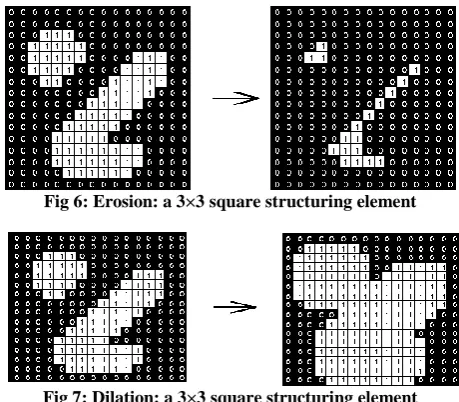
[image:3.595.313.543.69.270.2]The basic step in recognition of car number plate is to detect the edges of the rectangular plate. In our proposed method mathematical morphology is used to detect the region. Mathematical morphology is a part of digital image processing which is concerned with image filtering and geometric analysis by using structuring elements (SE). The image which will be processed by mathematical morphology theory must be changed into set and represented as matrix. Structuring Elements are used in morphological which represented as matrices. Structuring element is a characteristic of certain structure and features to measure the shape of an image and is used to carry out image processing operations. The shape and size of the structuring element (SE) plays important role in image processing. The basic mathematical morphological operations namely dilation, erosion, opening, closing are used for detecting, modifying, manipulating the features present in the image based on their shape. Morphological operations consist of a team of the morphology of the algebra operator, of which the basic two operations are imerode, imdilate. Dilation is a morphological transformation that combines two sets by using vector addition of set structural element. Erosion can be obtained by dilating the complement of the black pixels and the taking the complement of the resulting point set. Here we take a structure element (SE), dilate the gray image with the structure element and make erosion on the image by this structure element. Then we erode the binary image. Erosion reduces the number of pixels from the object boundary.
[image:3.595.55.216.106.204.2]Fig 6: Erosion: a 3×3 square structuring element
Fig 7: Dilation: a 3×3 square structuring element
Matlab toolbox function provides a function imfill (BE ‟holes”) that fills holes in the binarized image called BW. The set of background pixels are known as hole that cannot be reached by filling the background from the edge of the image. Using flood fill algorithm we fill the hole to locate the plate region. Now we omit the lower pixel components using Matlab toolbox function bwareaopen() that specifies the desired connectivity. All components lower than 100 pixels are removed to get the actual location of the number plate. Steps as fellows,
i. Structural element (disk of radius 1) for morphological processing.
ii. Dilating the gray image with the structural element. iii. Eroding the gray image with structural element. iv. Morphological Gradient for edges enhancement.
v. Converting the class to double.
vi. Convolution of the double image for brightening the edges.
vii. Intensity scaling between the ranges 0 to 1. viii. Conversion of the class from double to binary.
x. Filling all the regions of the image.
xi. Thinning the image to ensure character isolation. xii. Selecting all the regions that are of pixel area more
[image:4.595.294.545.72.208.2]than 100.
[image:4.595.53.284.514.652.2]Fig 8: Convolution of the image for brightening the edges
Fig 9: Selected region that are of more than 100 pixel
Fig 10: Localize the selected plate
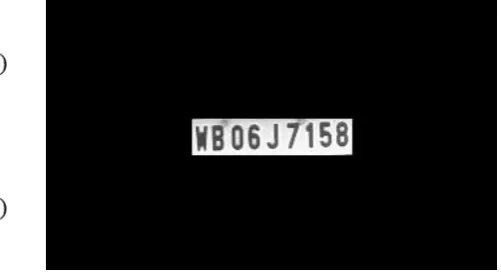
After location is obtained, its need to identify the exact location and deleted the unwanted region from the fig 8.1. In below figure (fig 8.2), shows the final location of license plate which contain only the valid license information.
Fig 11: License plate after successful processing
3.3 Character Segmentation
In case of character segmentation, the characters constitute the foreground components. So character segmentation is basically the isolation of the characters within the image component. Connected Component Labeling (CCL) is the process through which the characters are segmented from the background and also the individual characters are labeled distinctly to mark or identify them separately for future use. Connected Component Labeling (CCL) algorithm, or Connected Component Analysis (CCA) is an algorithmic application of graph theory, where subsets of connected components are uniquely labeled based on a given heuristic. The outcome of CCL algorithm is a set of foreground segments which are supposed to be the characters or digits within the license plate.
Fig 12: Character segmentation
Fig 13: License plate number segmentation
3.4 Character Recognition
Fig 14: Template database
Fig 15: Recognized number
4.
EXPERIMENTAL RESULTS
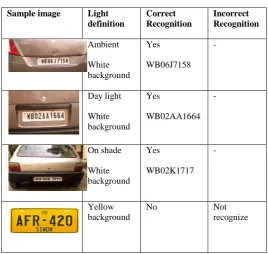
To evaluate the efficiency, our method has been tested using MATLAB 7.2 over 50 color images with a size of 640 × 480 × 24 pixel. Several vehicle images are captured from about 4 meters away by 1.3 mega pixel mobile camera as well as 12 mega pixel digital camera for real scenes. The tested images have been acquired from the front as well as from the rear of vehicles under various illumination conditions. The test results is more effective and efficient than [16] description with plate localization and recognition. Based on these results, it is shown that the proposed algorithms are very effective for the recognition of number plates. The performance of system can be further improved by compensating the brightness distortion and chromaticity distortion and improving ambient lighting conditions, as well as some other drawbacks. Some recognition case is given in page 5.
5.
CONCLUSION AND FUTURE STUDY
[image:5.595.305.574.85.339.2]In this paper, we present a convenient and practical method for license plate localization and recognition of Indian license plate based on morphological edge detection and template matching. Our proposed system is able to recognize number plates. The performance of the system is robust in its toleration of variation of illumination conditions. Since the recognition time is very small compared with the existing systems. The proposed method is mainly designed for real-time Indian license plate. The system can be further extended to recognize number plates of other countries. How to improve the recognition accuracy rate and how to speed up the computation to the real application are our future works.
Table 1: Recognition status
Sample image Light
definition
Correct Recognition
Incorrect Recognition
Ambient White background
Yes WB06J7158
-
Day light White background
Yes
WB02AA1664 -
On shade White background
Yes
WB02K1717 -
Yellow background
No Not
recognize
6.
REFERENCES
[1] A. M. Al-Ghaili, S. Mashohor, A. R. Ramli, and A. Ismail “Vertical-Edge-Based Car-License-Plate Detection Method,” IEEE transaction on vehicular technology, vol. 62, no. 1, 2013, pp.26-38
[2] K. Deb, M. K. Hossen, M. I. Khan, and M. R. Alam, “Bangladeshi vehicle license plate detection method based on HSI color model and geometrical properties IEEE,” 2013, pp. 1-5.
[3] P. Saiyadi, “Optimizing the Vehicle Plate Recognition Using the Mathematical Morphology,” Journal of Basic and Applied Scientific Research, 2012, pp. 9044-9048 [4] HalinaKwasnicka and BartoszWawrzyniak, "License Plate
Localization and Recognition in Camera Pictures", Faculty Division of Computer Science, Wroclaw University of Technology, Artificial Intelligence Methods, November 13-15, 2002, Gliwice, Poland [5] J. R. Parker, PavolFederl, “An Approach to License Plate
Recognition”, Computer Science Technical Report (1996-591-11), 1996
[6] Turchenko V.,Kochan V., Koval V., Sachenko A. and Markowsky G. Smart Vehicle Screening System Using Artificial Intelligence Methods, Proceedings of 2003 Spring IEEE Conference on Technologies for Homeland Security, May 7-8, 2003, Cambridge, MA, pp. 182-185. [7] H. Obeid and R. Zantout, “Line Processing: An Approach
to ALPR Character Recognition”, 2007 ACS/IEEE International Conference on Computer Systems and Applications, Amman, Jordan, May 13-16
[9] Z.C. Zhang, Y.Y. Tang, “License plate recognition algorithm based on derived kernel,” International Conference on Wavelet Analysis and Pattern Recognition IEEE, 2012, pp. 238-243
[10] P. Kanani, A. Gupta, D. Yadav, R. Bodade, and R.B. Pachori, “Vehicle license plate localization using wavelets”, Proceedings IEEE Conference on Informational Communication Technologies, Thuckalay, India, April 11-12, 2013.
[11] Z. Zhang and S. Yin, ‘‘Hough transform and its application in vehicle license plate tilt correction," Computer and Information Science, vol. 1, pp. 116-119, 2008.
[12] Turchenko V., Kochan V., Koval V., Sachenko A. and Markowsky G. Smart,“Vehicle Screening System Using Artificial Intelligence Methods”, Proceedings of 2003 Spring IEEE Conference on Technologies for Homeland Security, May 7-8, 2003, Cambridge, MA, pp. 182-185.
[13] H. Obeid and R. Zantout, “Line Processing: An Approach to ALPR Character Recognition”, 2007 ACS/IEEE International Conference on Computer Systems and Applications, Amman, Jordan, May 13-16 [14] W. Jia, H. Zhang, and X. He, “Region-based license plate
detection”, Journal of Network. and Computer Appl., vol. 30, issue 4, pp. 1324-1333, 2007.