A Histogram based Algorithm for Denoising Images
Corrupted with Impulse Noise
Jasmeen Kaur
Lecturer RBIENT, HoshiarpurAbstract
An algorithm is designed for the histogram representation of an image, subsequent detection of Salt and Pepper (SP) noise in the image and finally the restoration of the image from this noise. The image is first represented as histogram, then fuzzy rule are applied on this. The images taken up for experimental analyses are subjected to the fuzzy based filter for SP noise removal. The proposed algorithm exhibits superiority over traditional algorithms and recently proposed ones in terms of visual quality, Peak Signal to Noise Ratio (PSNR) and Mean Square Error (MSE). This superior performance of the fuzzy based Histogram Adaptive Filter is solely due to the histogram representation of the test images.
Keywords
:
HAF, PSNR, MSE, Median filter, Mamdani’s algorithm
1.
Introduction
Images are often corrupted by different types of noise. This can be any type of noise like Gaussian noise, Impulse noise, Speckle noise etc. In this paper salt and pepper noise is added to corrupt an image. The image distorted by Salt and pepper noise can corrupt pixel by either maximum or minimum gray level. Amongst these standard median filter has been established as reliable - method to remove the salt and pepper noise without harming the edge details. However, the major drawback of standard Median Filter (MF) is that the filter is effective only at low noise densities, as the noise densities start increasing, the edge details of the original image will not be preserved by standard median filter. Also images are often contaminated by factors such as channel transmission error, impulse noise from noisy sensors.[1] Since smoothening a region will destroy image details, while sharpening may lead to unwanted intensification of noise, attenuation of noise and preservation of details are usually two conflicting aspects of image processing. Thus image enhancement is a fundamental problem in image processing.[3]For image cleaning several filtering techniques are available, but sometimes one technique is not useful for all applications. To overcome these difficulties and to provide a more efficient tool for processing image, a new fuzzy based histogram adaptive filter was proposed. Firstly we apply histogram approach for noise added image. It will separate all the
pixels according to their values in the histogram form. Reading the pixels value from the histogram graph, we are able to compute those pixels that have the minimum values. Then we find out the noise and noise free pixels inside the window by applying our fuzzy algorithm which replaces the noise pixels.[7] The performance of the proposed algorithm is tested for various levels of noise corruption and compared with standard filters namely standard mean filter (SMF), fuzzy filter (FF). Our proposed method performs well in removing low to medium density impulse noise with detail preservation up to a noise density of 60% and it gives better Peak Signal-to-Noise Ratio (PSNR) and Mean square error (MSE) values.
2.
METHODOLOGY
In this paper the Fuzzy based Histogram Adaptive Filter is used to de-noise an image corrupted with salt and pepper noise. The following section describes the Histogram Adaptive Filter (HAF) and Proposed Algorithm used in the present work.
2.1
Fuzzy Algorithm
Fuzzy image processing is not a unique theory. It is the collection of all approaches that understands, represent and process the images, their segments and features as fuzzy sets. The representation and processing depend on the selected fuzzy technique and on the problem to be solved. Fuzzy based image processing algorithm provides promising results over classical filters. For recovering a heavily noise corrupted image, fuzzy set theory is very helpful. In this, the image is represented by a membership function and different types of fuzzy rules which by considering the neighborhood information removes the noise but preserve edges and retain smoothness. [14]Image and fuzzy set can be modeled in a similar way where the image pixels range is from 0, 1, 2 ….255. In this way the image is considered as a fuzzy set and thus fuzzy based algorithms are designed.
For mapping output from a given input fuzzy inference system with fuzzy logic is used. In this proposed algorithm Mamdani’s type fuzzy logic is used, which is an inbuilt function in MATLAB.
1. Read the original image
2. Convert it into gray scale image if it is a RGB image 3. Add salt and pepper noise to an image
4. Calculate the size of an image
5. Now an array is already made, automatically all the pixel value of an image will be put in that pre-defined array
6. Call the fuzzy array by using command load array 7. Scan the whole image and pass the parameter to the FIS 8. Compare the enhanced image
3.
Algorithm Description
In this proposed algorithm, two mamdani type fuzzy inference systems have been made, namely: fuzzy noise fis and layer 2 fis. These two fis in detail are discussed below:-
3.1 Fuzzy noise and layer 2 fis
In fuzzy noise fis editor two inputs are taken namely inp1 and inp2, which further gives single output named as out. For input five membership functions were choosen i.e. very low, low, med, high and very high, with range of -255 to 255. For defining these membership functions trapmf type was chosen. Similarly for the output 0 to100 range was selected with two membership functions i.e. low and high. For this fis rules are built in rule editor.
Now the output of fuzzy noise fis, is considered as input for layer 2 fis. This fis has again two inputs and has two membership function low and high. The reason behind choosing only two membership function is, as the pixel can have only two values i.e 0 or 1, so these two membership functions specify the value of these pixels.
4.
Histogram Adaptive Filter
When an image is interfered by salt and pepper noise, there will appear some dark spots and bright spots on the image, which seriously affect image’s quality. Thus filtering out these spots to get a clear image is very important task in image processing.[8] Although other filters are also proposed for removing such type of noise, but somehow they suffer from inability to remove those dark spots and bright spots on the image simultaneously. Hence there feasibility is poor. So here a fuzzy based histogram adaptive filter is introduced, which performs fuzzy processing to the histogram of a original image. The advantage of using this type of filter is that, it utilizes information of original image’s histogram and its start up time is shorter.[11] Histogram is a technique used to improve contrast in grayscale images. Figure 6.4 shows the intensity histogram for the image from figure 6.3. The histogram
Fig.1. Gray Scale Lena Image of Resolution 512x512
The proposed fuzzy based histogram adaptive filter (HAF) is particularly effective for removing salt and pepper noise while preserving edge sharpness. This is accomplished through a fuzzy smoothing filter constructed from a set of fuzzy IF-THEN rules, which alternate adaptively to minimize the output mean squared error as input histogram statistics change. An algorithm is developed to utilize input histogram to determine parameters for the near-optimal fuzzy membership functions. Construction of the HAF filter involves three steps:
1. Define fuzzy sets in the input space,
2. construct a set of IF-THEN rules by incorporating input
histogram statistics to form the fuzzy membership
functions, and
3. Construct the filter based on the set of rules.
5.
Experimental Results
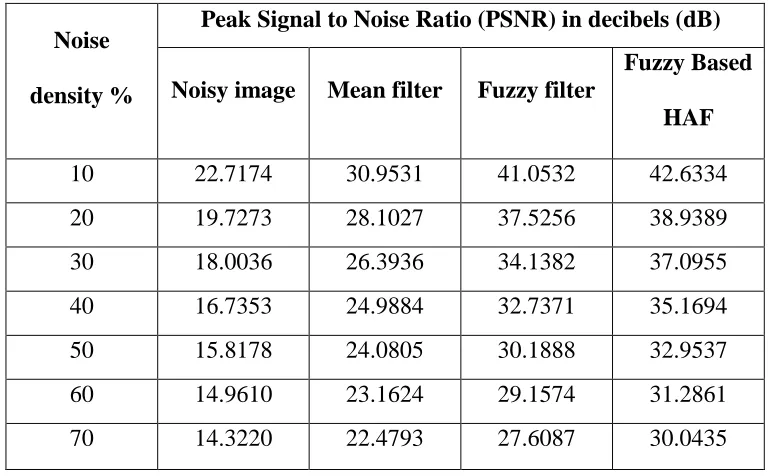
[image:3.612.118.503.280.518.2]The designed filter was tested using several noise percentages. The original image is corrupted by salt and pepper noise. The filter was trained using original Lena image and the noise corrupted image. The values of MSE (mean square error) and PSNR (peak signal to noise ratio) of the proposed filter is compared to the other filters. The MSE, PSNR have been computed as
Table 1. Results in PSNR for the pepper.jpg image at various noise levels for proposed algorithm
Noise
density %
Peak Signal to Noise Ratio (PSNR) in decibels (dB)
Noisy image
Mean filter
Fuzzy filter
Fuzzy Based
HAF
10
22.7174
30.9531
41.0532
42.6334
20
19.7273
28.1027
37.5256
38.9389
30
18.0036
26.3936
34.1382
37.0955
40
16.7353
24.9884
32.7371
35.1694
50
15.8178
24.0805
30.1888
32.9537
60
14.9610
23.1624
29.1574
31.2861
Graph1. PSNR Comparison results of proposed fuzzy histogram adaptive filter for pepper.jpg 512x512 image
Fig.3. a) Noise free pepper image b) image with 30% of salt and pepper noise c) denoised image with mean filter d) denoised image with fuzzy filter e) denoised image with fuzzy HAF filter
for Image Contrast Enhancement”, IEEE Transactions, Consumer Electronics, Vol. 53, No.2, pp 593-600, May 2007.
[4] Russo, F., "A new class of fuzzy operators for image processing: design and implementation", Proceedings of the Second IEEE International Conference on Fuzzy Systems, FUZZ-IEEE '93, San Francisco, March 28 - April I, pp. 815-820, 1993.
[5] T. Peli, J.S. Lim, "Adaptive Filtering for Image Enhancement", Optical Engineering, v01.21, pp. 108-1 12, Jan/Feb 1982.
[6] Z.Chi,H.Yan,T.Pham, “Fuzzy Algorithms: with Application to Image Processing and Pattern Recognition”, Advances in Fuzzy Systems- Application and Theory, Vol.10, 1996.
[7] Tinku Acharya, Ajoy.K.Ray, “Image Processing–Principles andApplications”, Hoboken, New Jersey, A JOHN WILEY & SONS, MC. , Publication, 2005.
[8] Detail information about the Peak signal to noise ratio, http://en.wikipedia.org/wiki/Peak_signal-to-noise_ratio
[9] Standard original images,
http://www.ece.rice.edu/~wakin/images/
[10]Lee C.S., Kuo Y.H. & Yu P.T., “Weighted fuzzy mean filters for image processing”, in Fuzzy Sets and Systems, Vol. 89, 1997, pp. 157-180.
[11]Arakawa K., “Fuzzy rule-based image processing with optimization”, in Fuzzy Techniques in Image Processing (Kerre E.E. & Nachtegael M.,editors), Springer-Verlag, pp.222-247, 2000.
[12]A.K.Jain, Fundamentals of, “Digital Image Processing”. Prentice-Hall, 1989.
[13]C.S.Lee,Y.H,Kuo and P.T.Yu, “Weighted Fuzzy Mean Filter for Image Processing”, Fuzzy Set Syst.,no.89, pp.157-180,1997.